DIELECTRIC HEATING


     Mr. Vijay Balu Raskar - Electrical Engineer
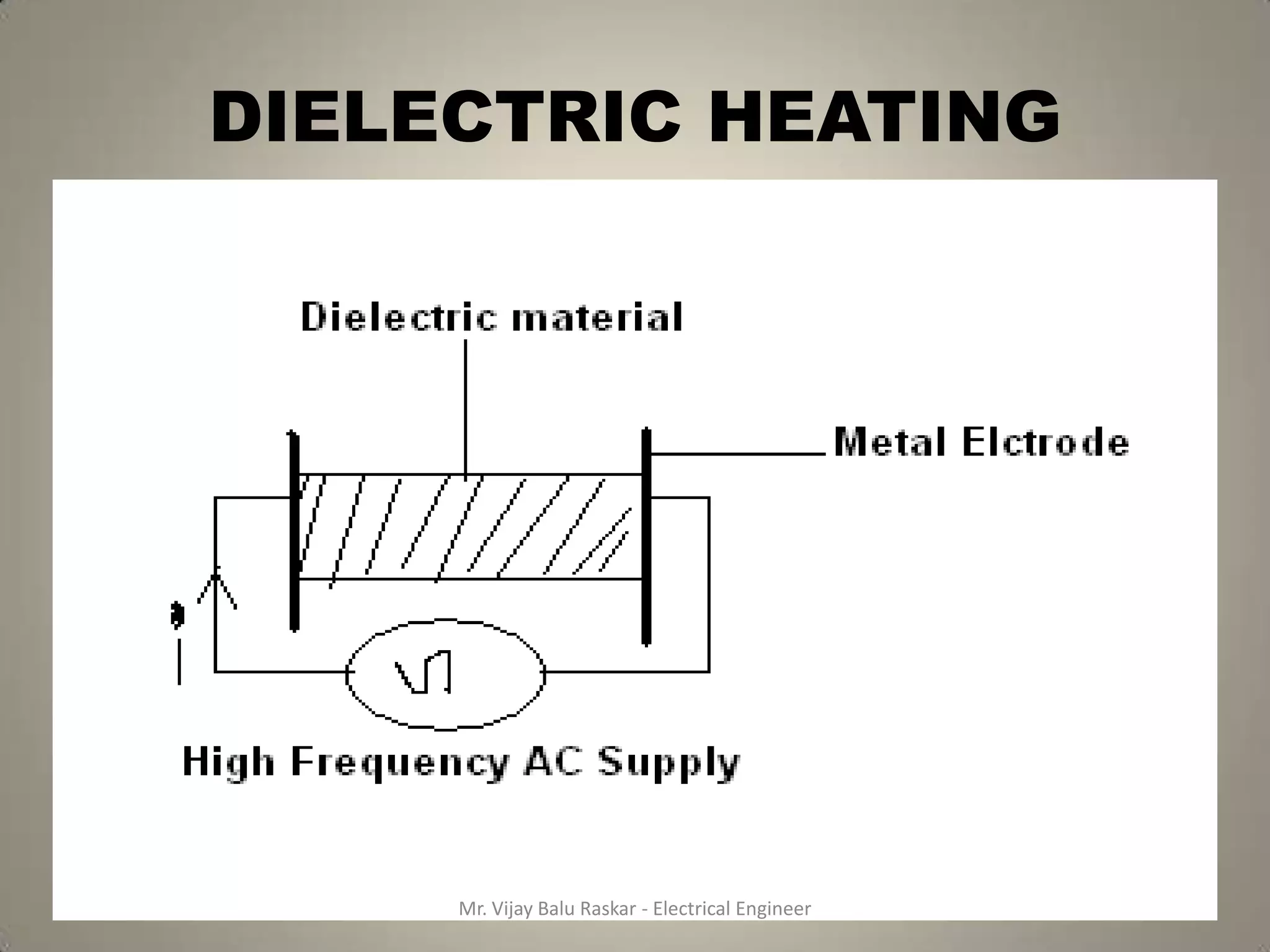
Wasted energy appears as heat called
dielectric loss.
The non metallic material with poor
thermal conductivity can be very
effectively heated by dielectric
heating.
Dielectric loss is proportional to
frequency and square of the supply
voltage.
Frequency can be selected between 10
to 30kHz and voltage about 20kV.
            Mr. Vijay Balu Raskar - Electrical Engineer
When a solid dielectric material
(Insulating) is subjected to an
alternating electric field , it is not
supposed to carry any current.
However, in practice some leakage
current passes through it and power
loss is takes place. This loss is called as
dielectric loss and result into heating
of dielectric material.
               Mr. Vijay Balu Raskar - Electrical Engineer
APPLICATION OF DIELECTRIC
            HEATING
 Plywood Industry
 Sand Core Baking
 Plastic Industry
 Tobacco Industry
 Bakeries
 Electronic Sawing
 Dehydration of food
 Electro medical application
 Book Binding
                  Mr. Vijay Balu Raskar - Electrical Engineer
Advantages of Dielectric heating
1) Heating is very quick
2) The efficiency is higher
3) Heating is uniform
4) Being free from smoke, dust,
process is very clean
5) There are no flue gases, no risk of
pollution
6) Heat is produced due to dielectric
loss occurs in the material itself
             Mr. Vijay Balu Raskar - Electrical Engineer
ARC HEATING
• One of the popular method of heating.
• Principle:- When voltage is applied between the
  two electrodes separated by small distance in air is
  increased, a stage is reached when the air gets
  ionized and air act like conducting. Hence, current
  flows between the electrodes in the form of
  continuous spark called ARC. This self sustained
  discharge of electricity between 2 electrodes
  through air is known as “Electric ARC”.

                   Mr. Vijay Balu Raskar - Electrical Engineer
An ARC drawn between 2 electrodes
has a temperature between 3000 C to
3500 C depending upon the electrode
             material.

       ARC Heating Types:-
       1) Direct ARC heating
      2) Indirect ARC heating


           Mr. Vijay Balu Raskar - Electrical Engineer
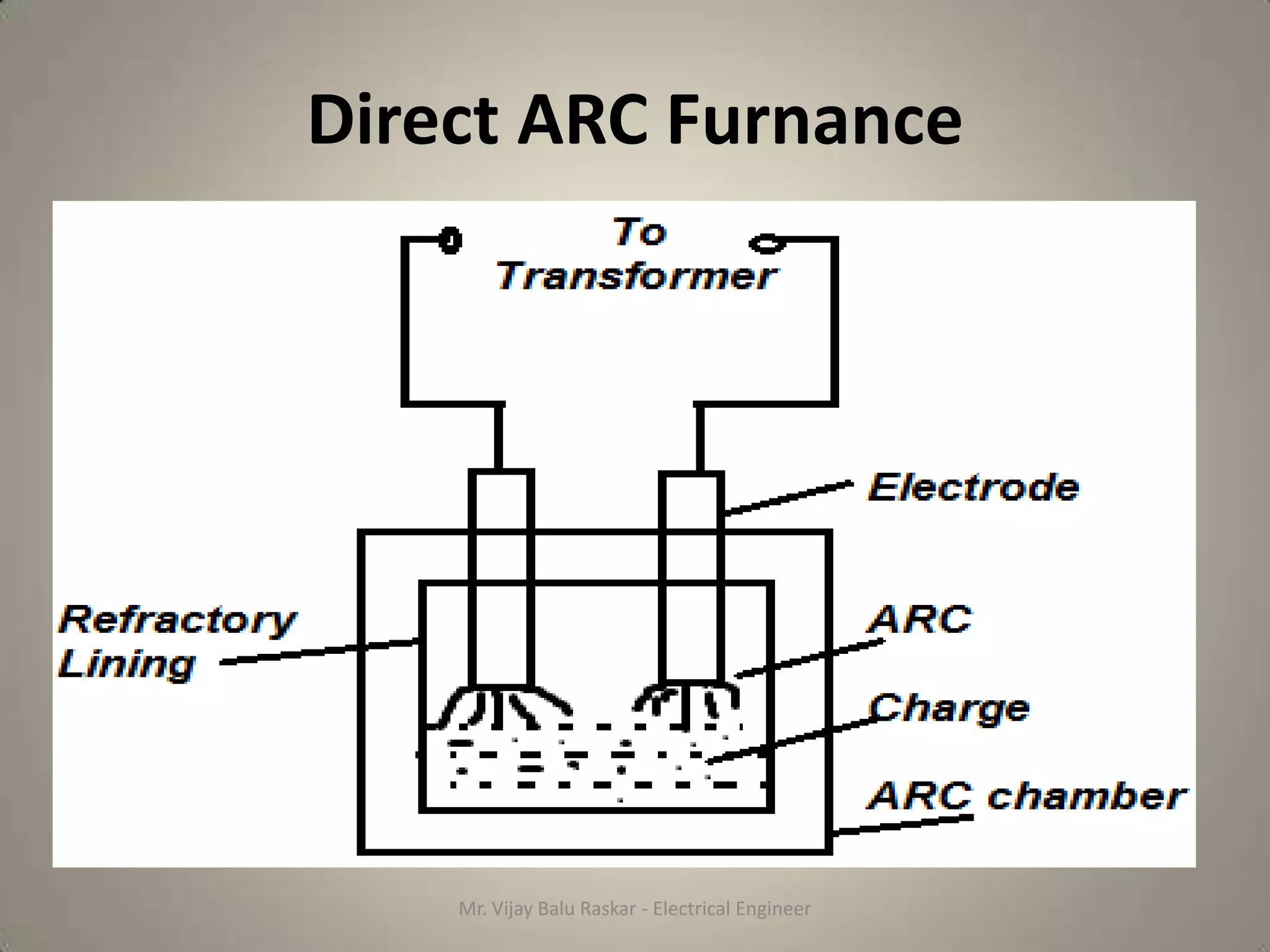
Direct ARC Furnance


    Mr. Vijay Balu Raskar - Electrical Engineer
Direct ARC :-
ARC is established between the charge and
the electrode.
The heat is directly conducted to the
charge which charge absorb.
Hence, this method is called Direct ARC
heating.
This consist of Carbon or Graphite
electrode.
The power is controlled by adjusting the
ARC length by moving the electrodes
manually or automatically.
              Mr. Vijay Balu Raskar - Electrical Engineer
USE (Direct ARC)
1) Making of Alloy steels like stainless
        and high speed steel
  2) Composition can be controlled
       during refining process.

Direct ARC operates at 0.8 p.f. Lagging


             Mr. Vijay Balu Raskar - Electrical Engineer
INDIRECT ARC:


 Mr. Vijay Balu Raskar - Electrical Engineer
INDIRECT ARC:
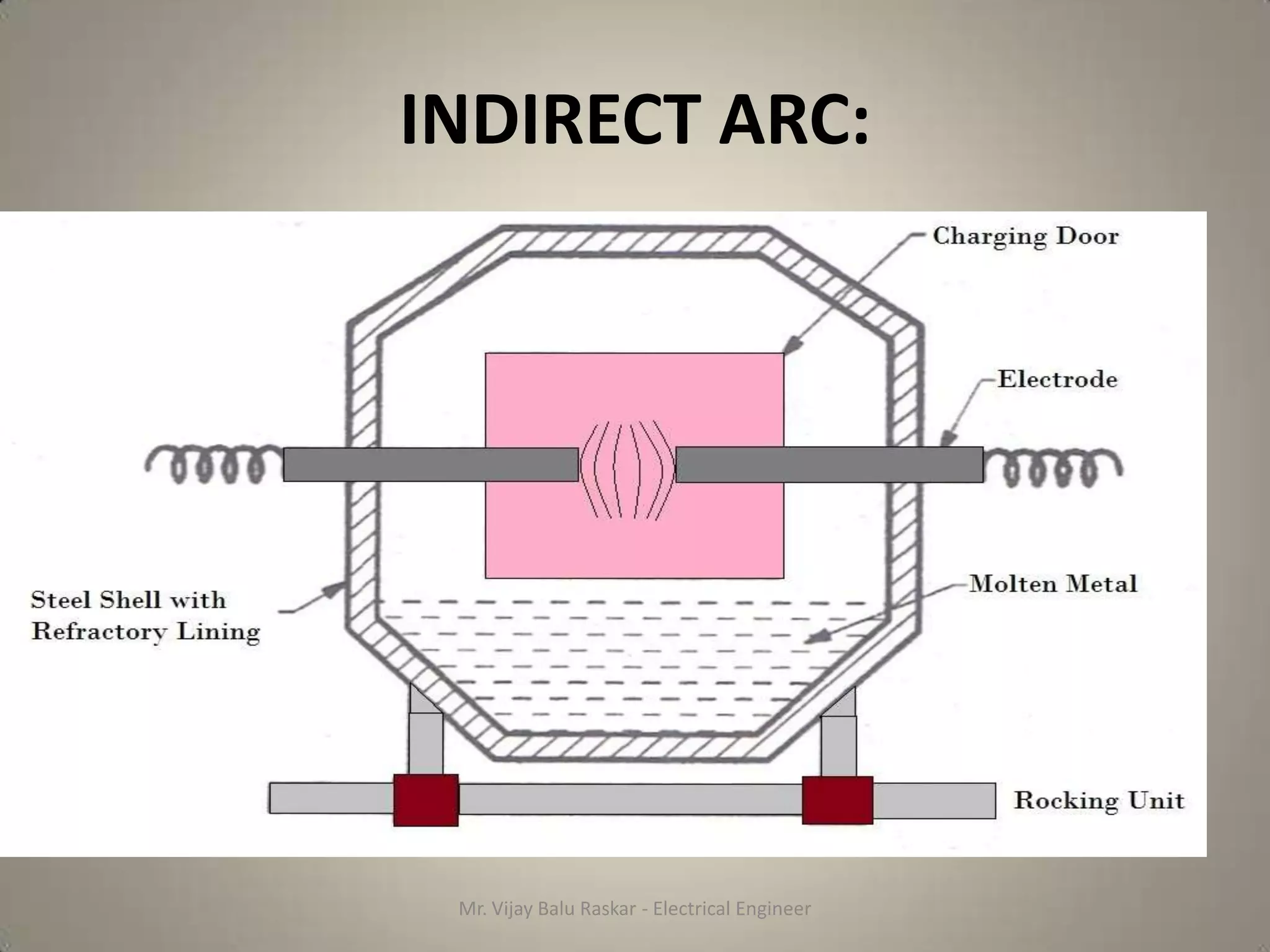
ARC is formed between two electrodes
and heat is transmitted to the charge
by radiation.
Lower temperature than direct ARC.
It Operates at 0.85 p.f. lagging
have to provide rocking motion
through a motor to distribute heat
uniformly.
USE:- melting non-ferrous metals.
            Mr. Vijay Balu Raskar - Electrical Engineer
Due to application of sufficiently high voltage across an
air gap causes the air in the gap to get ionized and form
ARC
ARC drawn between two electrodes develop high
temperature (3000-3500°C)depending upon material
ARC may be used in following ways:
by striking between charge and electrodes-
principle behind Direct ARC Furnace
by striking between two electrodes
principle behind Indirect ARC Furnace
by striking between an electrode and the
two metallic pieces to be joined -
principle behind ARC welding
                    Mr. Vijay Balu Raskar - Electrical Engineer
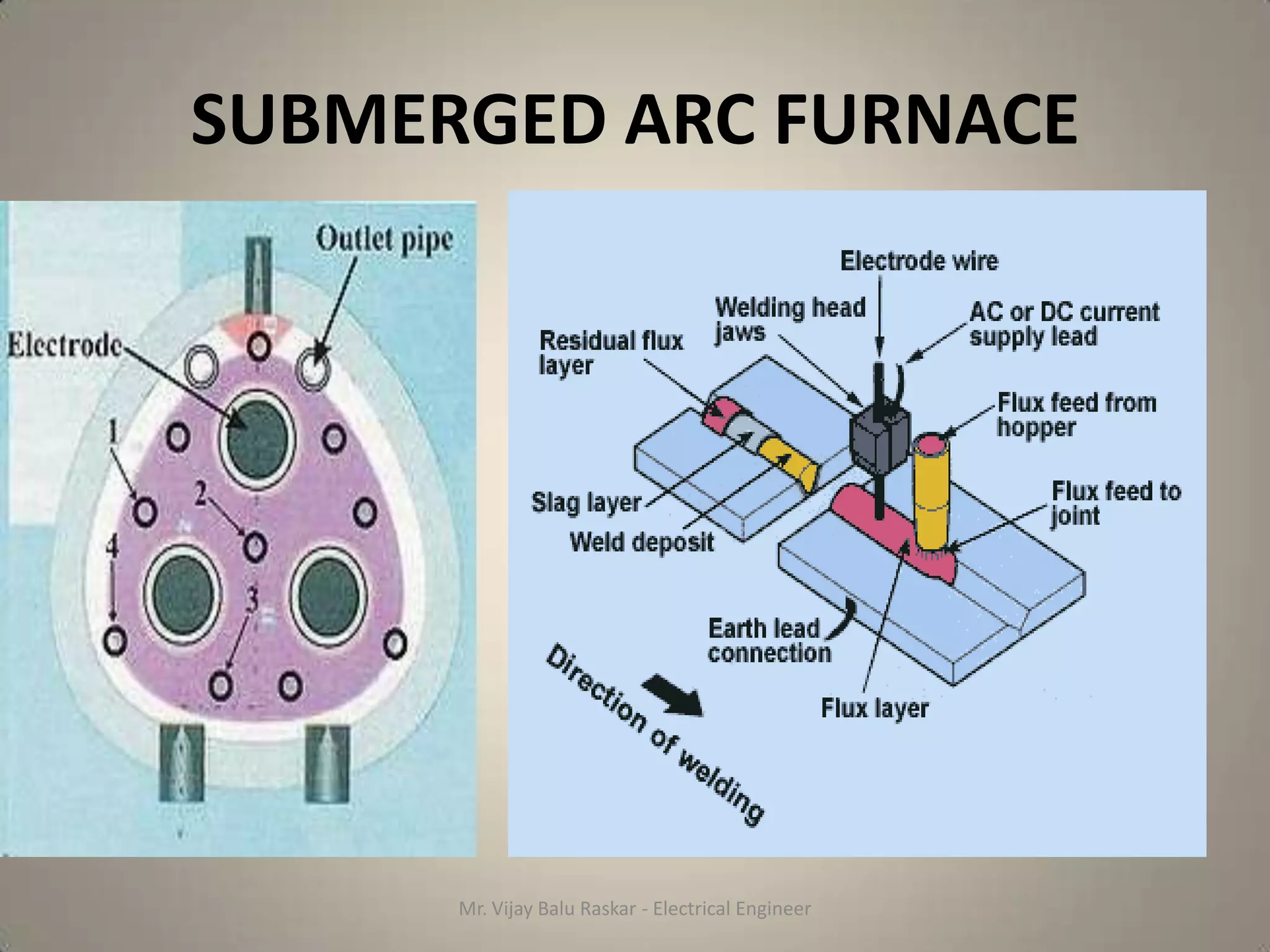
SUBMERGED ARC FURNACE


      Mr. Vijay Balu Raskar - Electrical Engineer
ARC is formed between carbon electrodes
placed at top and earth electrode or the
conducting earth itself.
Number of electrodes depends on type of
supply.
Power is controlled by varying supply or varying
distance between electrodes.
Better mixing of Charge.
P.f. is 0.8 Lagging

USE:-
Manufacturing of ferro-chrome and ferro-
manganese
                Mr. Vijay Balu Raskar - Electrical Engineer
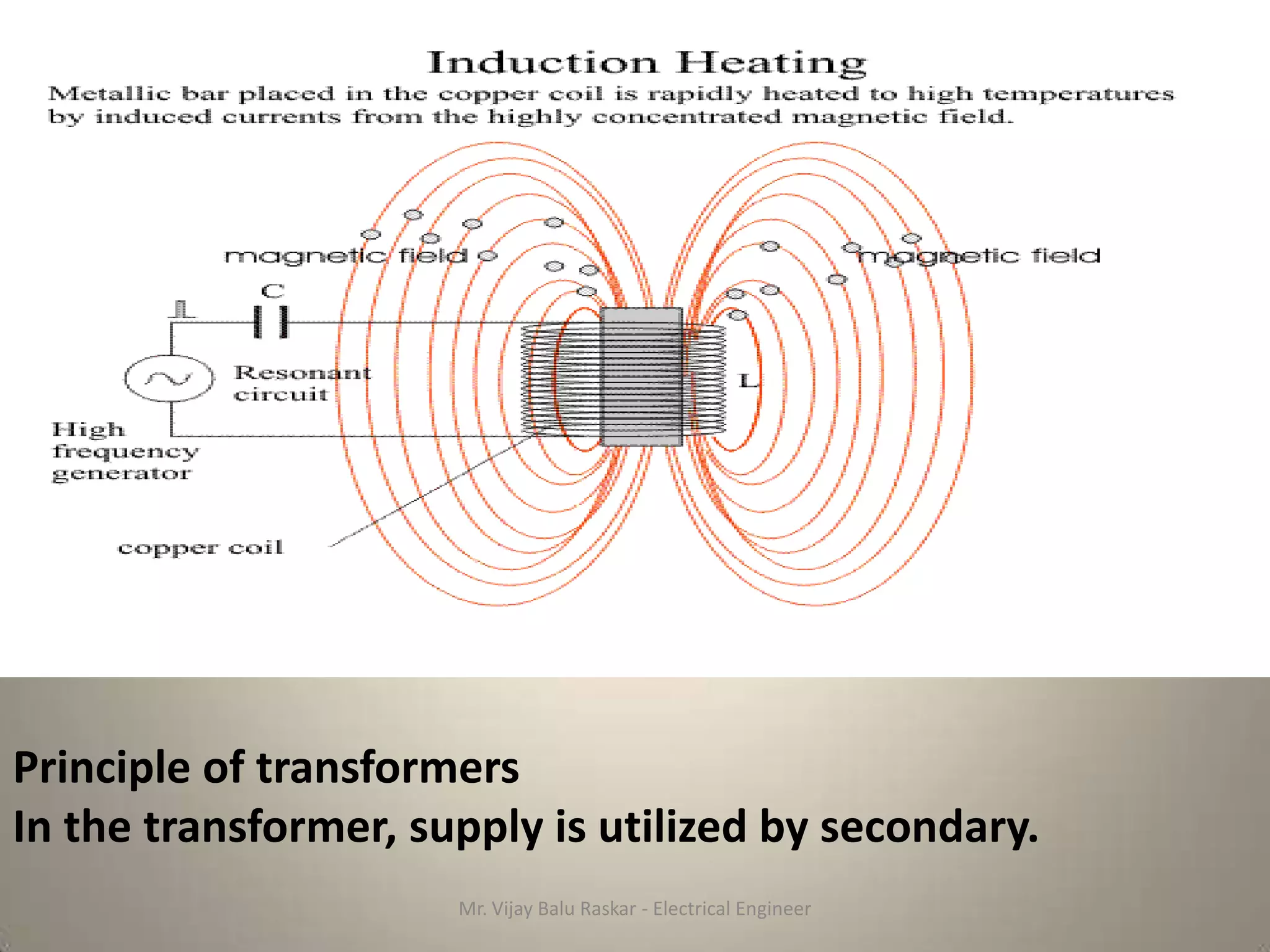
Principle of transformers
In the transformer, supply is utilized by secondary.
                      Mr. Vijay Balu Raskar - Electrical Engineer
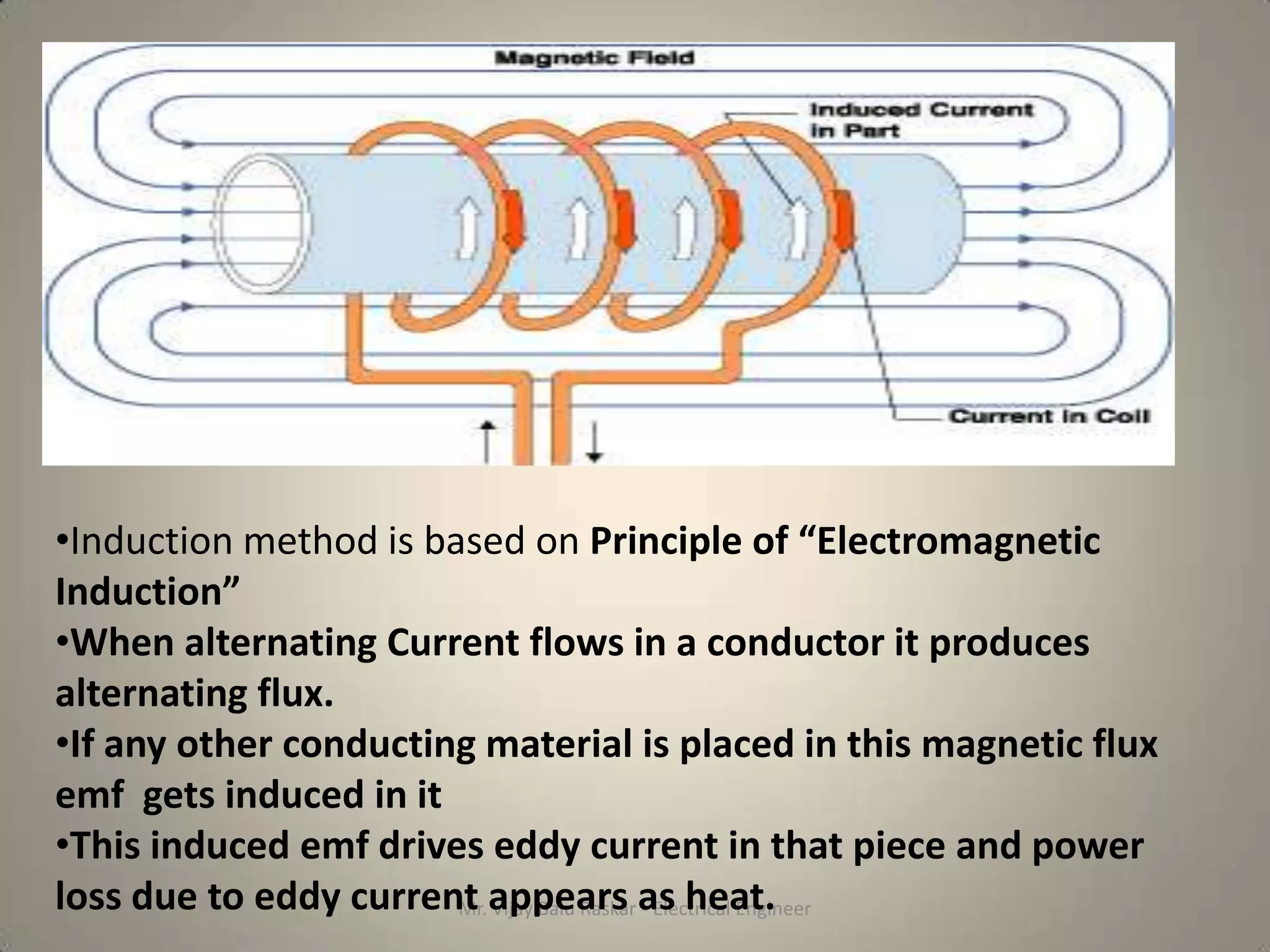
•Induction method is based on Principle of “Electromagnetic
Induction”
•When alternating Current flows in a conductor it produces
alternating flux.
•If any other conducting material is placed in this magnetic flux
emf gets induced in it
•This induced emf drives eddy current in that piece and power
loss due to eddy current appears as heat.
                       Mr. Vijay Balu Raskar - Electrical Engineer
Factors for Induction heating:-

1) it is proportional to relative
permeability. Heating produced in
magnetic material is more than non
magnetic material.
2) Heating is proportional to MMF.
Force can be vary by changing current
or number of turns.
3) Heating effect can be increased by
employing high frequency supply.
             Mr. Vijay Balu Raskar - Electrical Engineer
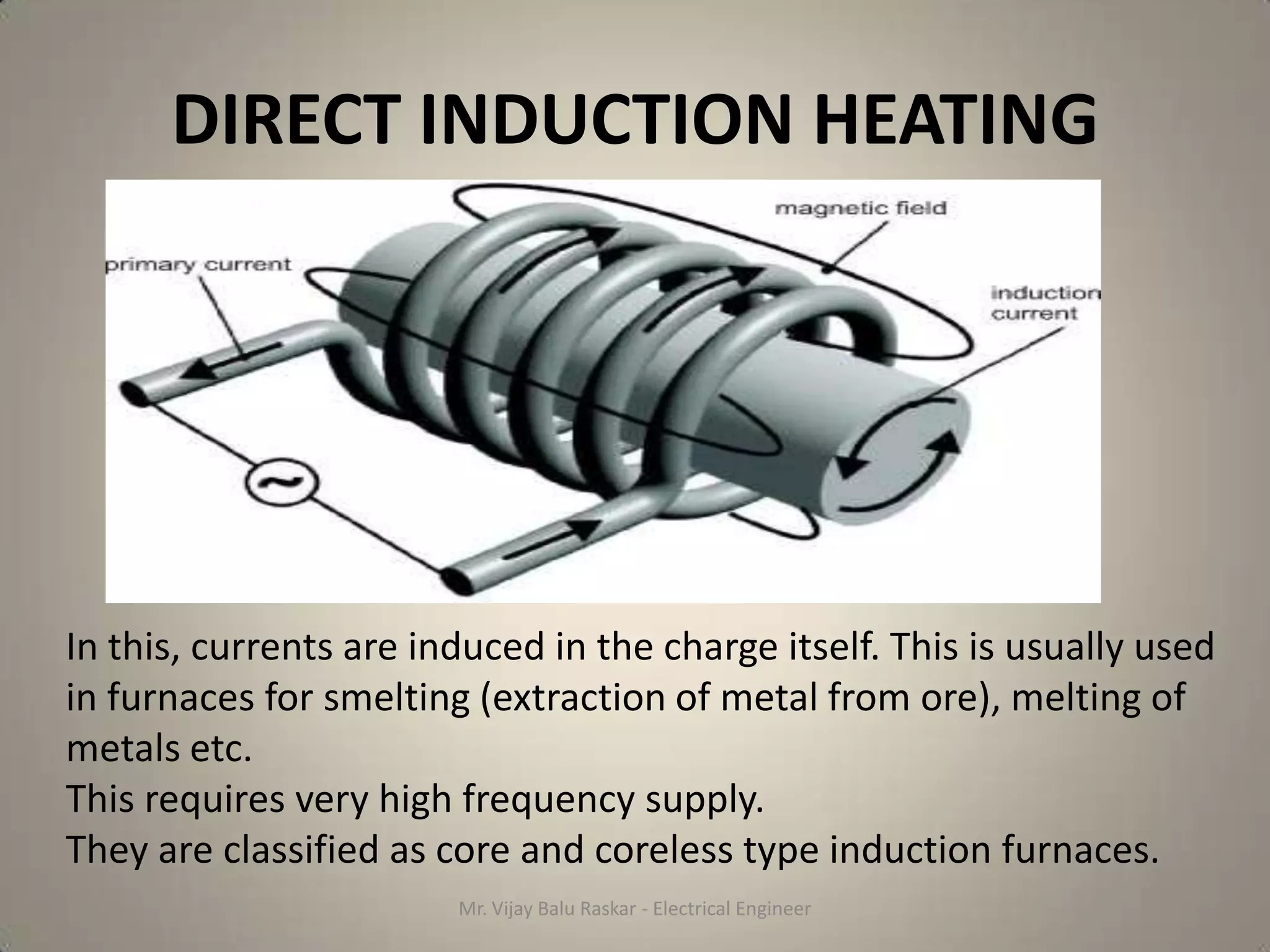
DIRECT INDUCTION HEATING


In this, currents are induced in the charge itself. This is usually used
in furnaces for smelting (extraction of metal from ore), melting of
metals etc.
This requires very high frequency supply.
They are classified as core and coreless type induction furnaces.
                        Mr. Vijay Balu Raskar - Electrical Engineer
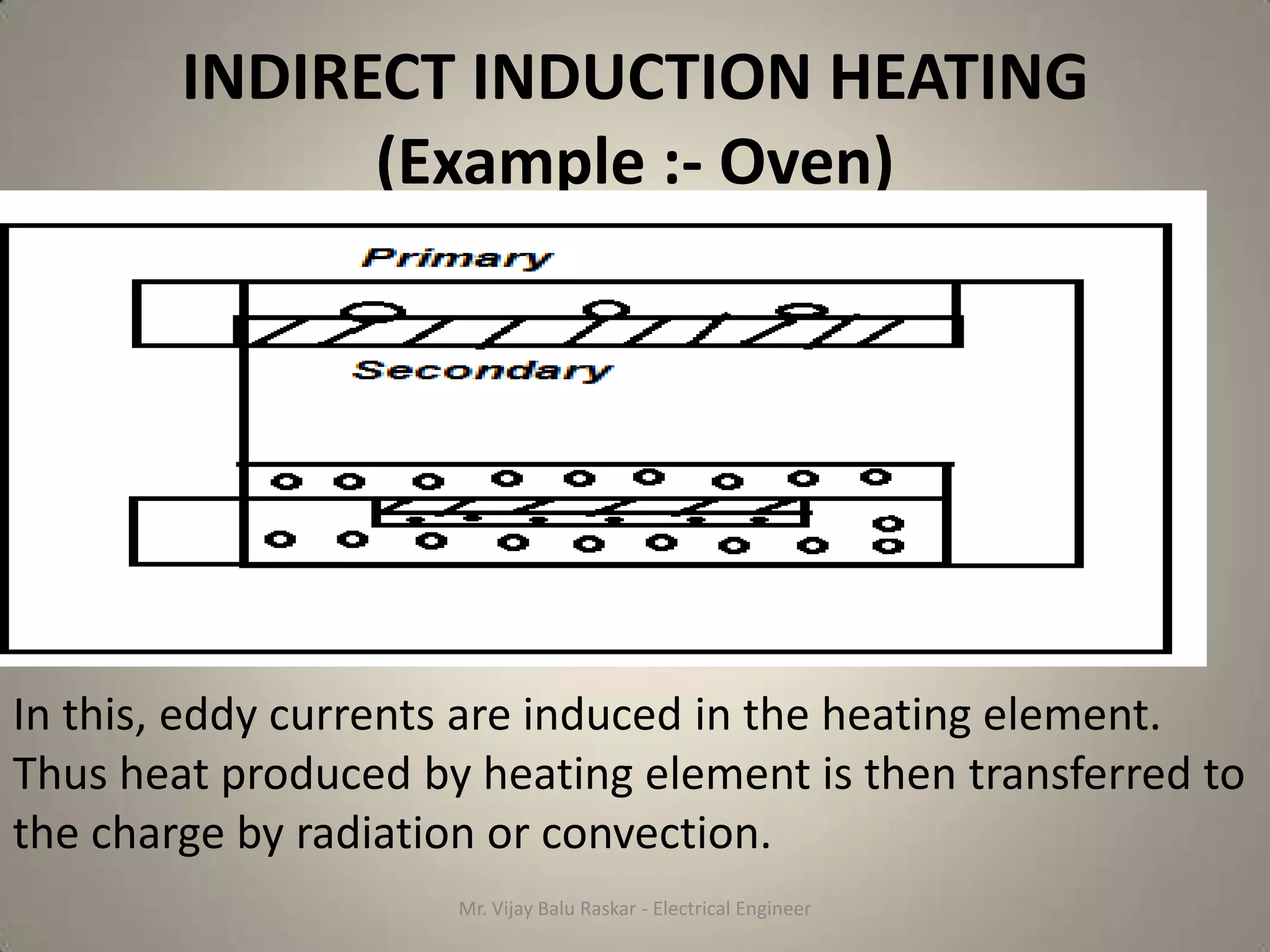
INDIRECT INDUCTION HEATING
              (Example :- Oven)


In this, eddy currents are induced in the heating element.
Thus heat produced by heating element is then transferred to
the charge by radiation or convection.
                     Mr. Vijay Balu Raskar - Electrical Engineer
In this, get heated due to eddy
currents and then heat transferred to
charge by radiation or convection.
Secondary winding is metal container.
Below part is situated in the oven
chamber which is made up of special
alloy which losses its magnetic
property and regain when they cooled.

            Mr. Vijay Balu Raskar - Electrical Engineer
Operation

When the primary winding is connected to the supply , the
eddy currents gets induced in the metal container forming th
walls of the oven.
Due to eddy currents, metal container gets heated and then i
transferred to the charge by radiation.

ACTION OF SPECIAL ALLOY:-
Oven reaches its critical temperature . Magnetic circuit looses its
magnetic property. Due to this reluctance of the magnetic circuit
becomes very high and inductive effect corrosponding decreases.


                        Mr. Vijay Balu Raskar - Electrical Engineer
Advantages:-
1) Simple and foolproof method of temperature control
2) No external temperature control equipments required


                               Limitations:-
 1) Poor Power factor
 2) Complicated Construction


                              Applications:-
 It is used for general heat treatment of metallic and other charges.


                                Mr. Vijay Balu Raskar - Electrical Engineer
Mr. Vijay Balu Raskar - Electrical Engineer

Electrical Heating 02-02

  • 1.
    DIELECTRIC HEATING Mr. Vijay Balu Raskar - Electrical Engineer
  • 2.
    Wasted energy appearsas heat called dielectric loss. The non metallic material with poor thermal conductivity can be very effectively heated by dielectric heating. Dielectric loss is proportional to frequency and square of the supply voltage. Frequency can be selected between 10 to 30kHz and voltage about 20kV. Mr. Vijay Balu Raskar - Electrical Engineer
  • 3.
    When a soliddielectric material (Insulating) is subjected to an alternating electric field , it is not supposed to carry any current. However, in practice some leakage current passes through it and power loss is takes place. This loss is called as dielectric loss and result into heating of dielectric material. Mr. Vijay Balu Raskar - Electrical Engineer
  • 4.
    APPLICATION OF DIELECTRIC HEATING  Plywood Industry  Sand Core Baking  Plastic Industry  Tobacco Industry  Bakeries  Electronic Sawing  Dehydration of food  Electro medical application  Book Binding Mr. Vijay Balu Raskar - Electrical Engineer
  • 5.
    Advantages of Dielectricheating 1) Heating is very quick 2) The efficiency is higher 3) Heating is uniform 4) Being free from smoke, dust, process is very clean 5) There are no flue gases, no risk of pollution 6) Heat is produced due to dielectric loss occurs in the material itself Mr. Vijay Balu Raskar - Electrical Engineer
  • 6.
    ARC HEATING • Oneof the popular method of heating. • Principle:- When voltage is applied between the two electrodes separated by small distance in air is increased, a stage is reached when the air gets ionized and air act like conducting. Hence, current flows between the electrodes in the form of continuous spark called ARC. This self sustained discharge of electricity between 2 electrodes through air is known as “Electric ARC”. Mr. Vijay Balu Raskar - Electrical Engineer
  • 7.
    An ARC drawnbetween 2 electrodes has a temperature between 3000 C to 3500 C depending upon the electrode material. ARC Heating Types:- 1) Direct ARC heating 2) Indirect ARC heating Mr. Vijay Balu Raskar - Electrical Engineer
  • 8.
    Direct ARC Furnance Mr. Vijay Balu Raskar - Electrical Engineer
  • 9.
    Direct ARC :- ARCis established between the charge and the electrode. The heat is directly conducted to the charge which charge absorb. Hence, this method is called Direct ARC heating. This consist of Carbon or Graphite electrode. The power is controlled by adjusting the ARC length by moving the electrodes manually or automatically. Mr. Vijay Balu Raskar - Electrical Engineer
  • 10.
    USE (Direct ARC) 1)Making of Alloy steels like stainless and high speed steel 2) Composition can be controlled during refining process. Direct ARC operates at 0.8 p.f. Lagging Mr. Vijay Balu Raskar - Electrical Engineer
  • 11.
    INDIRECT ARC: Mr.Vijay Balu Raskar - Electrical Engineer
  • 12.
    INDIRECT ARC: ARC isformed between two electrodes and heat is transmitted to the charge by radiation. Lower temperature than direct ARC. It Operates at 0.85 p.f. lagging have to provide rocking motion through a motor to distribute heat uniformly. USE:- melting non-ferrous metals. Mr. Vijay Balu Raskar - Electrical Engineer
  • 13.
    Due to applicationof sufficiently high voltage across an air gap causes the air in the gap to get ionized and form ARC ARC drawn between two electrodes develop high temperature (3000-3500°C)depending upon material ARC may be used in following ways: by striking between charge and electrodes- principle behind Direct ARC Furnace by striking between two electrodes principle behind Indirect ARC Furnace by striking between an electrode and the two metallic pieces to be joined - principle behind ARC welding Mr. Vijay Balu Raskar - Electrical Engineer
  • 14.
    SUBMERGED ARC FURNACE Mr. Vijay Balu Raskar - Electrical Engineer
  • 15.
    ARC is formedbetween carbon electrodes placed at top and earth electrode or the conducting earth itself. Number of electrodes depends on type of supply. Power is controlled by varying supply or varying distance between electrodes. Better mixing of Charge. P.f. is 0.8 Lagging USE:- Manufacturing of ferro-chrome and ferro- manganese Mr. Vijay Balu Raskar - Electrical Engineer
  • 16.
    Principle of transformers Inthe transformer, supply is utilized by secondary. Mr. Vijay Balu Raskar - Electrical Engineer
  • 17.
    •Induction method isbased on Principle of “Electromagnetic Induction” •When alternating Current flows in a conductor it produces alternating flux. •If any other conducting material is placed in this magnetic flux emf gets induced in it •This induced emf drives eddy current in that piece and power loss due to eddy current appears as heat. Mr. Vijay Balu Raskar - Electrical Engineer
  • 18.
    Factors for Inductionheating:- 1) it is proportional to relative permeability. Heating produced in magnetic material is more than non magnetic material. 2) Heating is proportional to MMF. Force can be vary by changing current or number of turns. 3) Heating effect can be increased by employing high frequency supply. Mr. Vijay Balu Raskar - Electrical Engineer
  • 19.
    DIRECT INDUCTION HEATING Inthis, currents are induced in the charge itself. This is usually used in furnaces for smelting (extraction of metal from ore), melting of metals etc. This requires very high frequency supply. They are classified as core and coreless type induction furnaces. Mr. Vijay Balu Raskar - Electrical Engineer
  • 20.
    INDIRECT INDUCTION HEATING (Example :- Oven) In this, eddy currents are induced in the heating element. Thus heat produced by heating element is then transferred to the charge by radiation or convection. Mr. Vijay Balu Raskar - Electrical Engineer
  • 21.
    In this, getheated due to eddy currents and then heat transferred to charge by radiation or convection. Secondary winding is metal container. Below part is situated in the oven chamber which is made up of special alloy which losses its magnetic property and regain when they cooled. Mr. Vijay Balu Raskar - Electrical Engineer
  • 22.
    Operation When the primarywinding is connected to the supply , the eddy currents gets induced in the metal container forming th walls of the oven. Due to eddy currents, metal container gets heated and then i transferred to the charge by radiation. ACTION OF SPECIAL ALLOY:- Oven reaches its critical temperature . Magnetic circuit looses its magnetic property. Due to this reluctance of the magnetic circuit becomes very high and inductive effect corrosponding decreases. Mr. Vijay Balu Raskar - Electrical Engineer
  • 23.
    Advantages:- 1) Simple andfoolproof method of temperature control 2) No external temperature control equipments required Limitations:- 1) Poor Power factor 2) Complicated Construction Applications:- It is used for general heat treatment of metallic and other charges. Mr. Vijay Balu Raskar - Electrical Engineer
  • 24.
    Mr. Vijay BaluRaskar - Electrical Engineer