Subject Title :
   Electronics
   Prepared by,
   Vijay Balu Raskar


 Mr. Vijay Balu Raskar
                           RASKAR
 (BE)Electrical Engineer
                           Electronics is the branch of engineering. Electonics derived
[Type the phone number]
                           from Greek word ‘Elektron and Electron Mechanics’
  [Type the fax number]

         [Pick the date]
Subject Title : Electronics

Prepared by , Mr. Vijay Balu Raskar vijayraskar2003@yahoo.co.in / vijay.raskar1986@gmail.com
_____________________________________________________________________________________


                          ELECTRONICS

S. NO                   NAME OF CHAPTER                                         MARKS
   1        Introduction to electronics                                          04
   2        Semiconductor Theory                                                 10
   3        Semiconductor Diode                                                  20
   4        Rectifiers Filters and Regulators                                    20
   5        Bipolar Junction Transistor                                          30
   6        Field Effect Transistors                                             10
   7        Integrated Circuits                                                  06


                                             2
Subject Title : Electronics

Prepared by , Mr. Vijay Balu Raskar vijayraskar2003@yahoo.co.in / vijay.raskar1986@gmail.com
_____________________________________________________________________________________


                     1. Introduction to electronics


Chapter number one is under construction.
Refer other chapters because of importance.


                                             3
Subject Title : Electronics

Prepared by , Mr. Vijay Balu Raskar vijayraskar2003@yahoo.co.in / vijay.raskar1986@gmail.com
_____________________________________________________________________________________


                      2. Semiconductor Theory
Q.1 Define semiconductor.
Ans:- The material whose electrical conductivity lies between those of
conductors and insulators and hence negative temperature coefficient
of resistance are known as semiconductors.

Q.2 Write a short note on semiconductor.
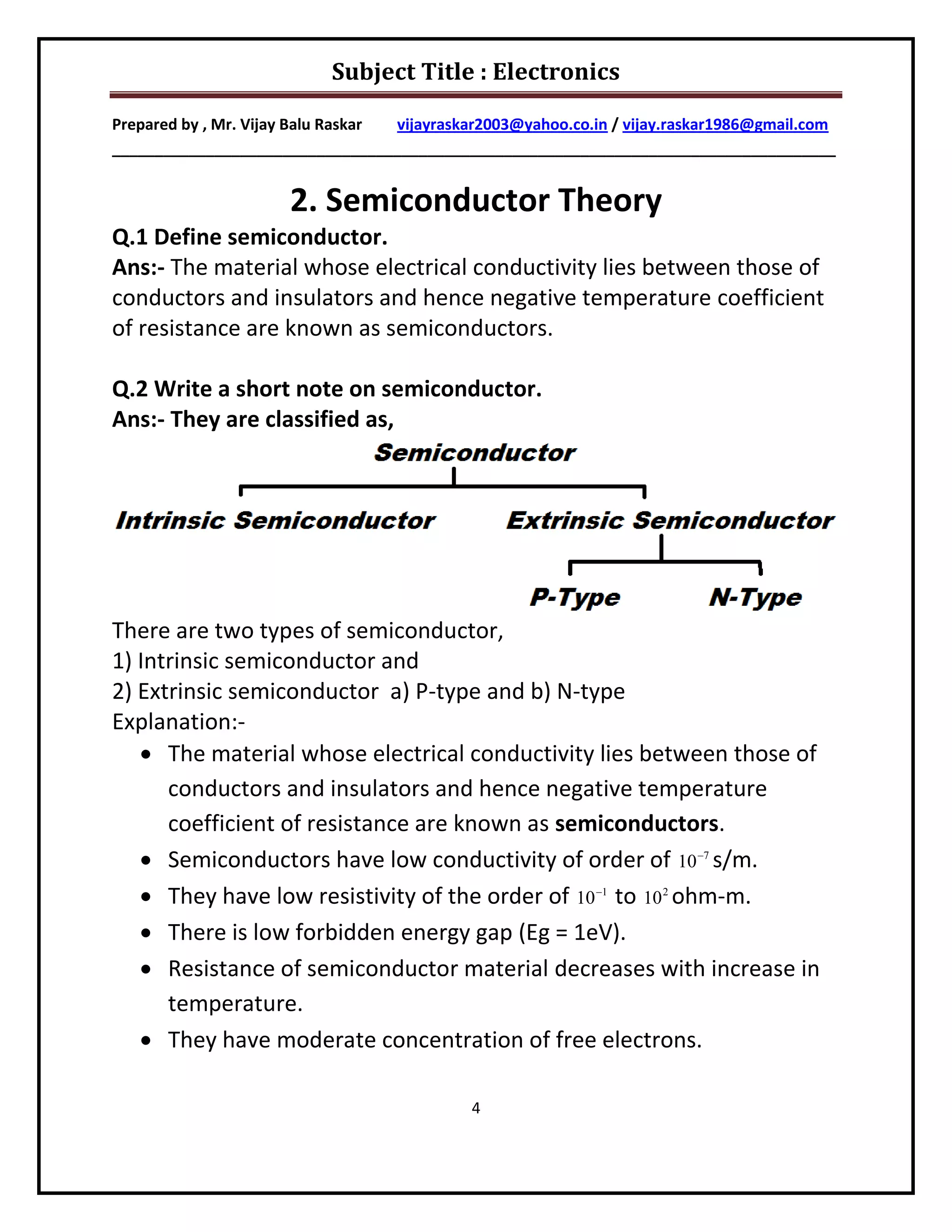
Ans:- They are classified as,


There are two types of semiconductor,
1) Intrinsic semiconductor and
2) Extrinsic semiconductor a) P-type and b) N-type
Explanation:-
    The material whose electrical conductivity lies between those of
      conductors and insulators and hence negative temperature
      coefficient of resistance are known as semiconductors.
    Semiconductors have low conductivity of order of 10 7 s/m.
    They have low resistivity of the order of 10 1 to 10 2 ohm-m.
    There is low forbidden energy gap (Eg = 1eV).
    Resistance of semiconductor material decreases with increase in
      temperature.
    They have moderate concentration of free electrons.

                                             4
Subject Title : Electronics

Prepared by , Mr. Vijay Balu Raskar vijayraskar2003@yahoo.co.in / vijay.raskar1986@gmail.com
_____________________________________________________________________________________

    At room temperature, they act as a moderate conductor of
      electricity.
1) Intrinsic Semiconductor:-
    A semiconductor in an extremely pure form is known as
      intrinsic semiconductor.
    An intrinsic semiconductor also called an undoped
      semiconductor or i-type semiconductor.
    Intrinsic Semiconductor has a negligible conductivity at room
      temperature.
    Semiconductor material with larger impurity concentrations
      (Example silicon and germanium)
    The current which will flow in an intrinsic semiconductor
      consists of both electron and hole current.
    In intrinsic semiconductors the number of
      excited electrons and the number of holes are equal: n = p.
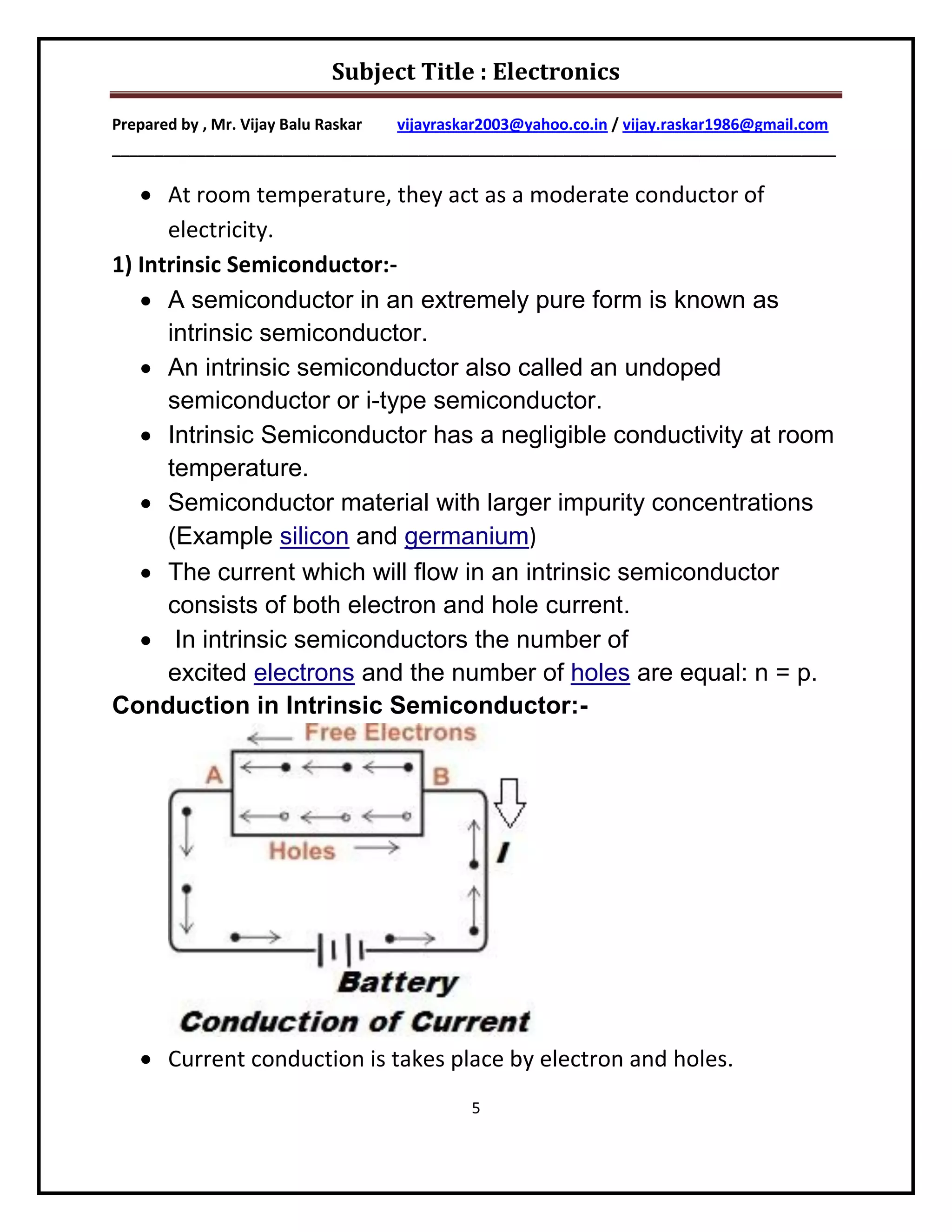
Conduction in Intrinsic Semiconductor:-


    Current conduction is takes place by electron and holes.
                                             5
Subject Title : Electronics

Prepared by , Mr. Vijay Balu Raskar vijayraskar2003@yahoo.co.in / vijay.raskar1986@gmail.com
_____________________________________________________________________________________

    The free electrons are generated due to the breaking up of some
      covalent bonds by thermal energy.
    The electron experiences the force towards the positive terminal
      of the battery.
    The holes experience the force towards the negative terminal of
      the battery.
    Random motion of electrons and holes occur a net movement
      called drift.
    This random motion is not contributing to any electric current.
    The free electron drifts towards the positive terminal of the
      battery and holes towards the negative.
    This moment of charge carriers constitute the electric current.
    Electron flows from negative to positive terminal of the battery.
    Current flows from positive terminal to negative terminal of the
      battery.
    The total current inside the semiconductor crystal is the sum of
      electric currents due to the free electrons and holes.
    When the flow of charge carriers is due to an applied voltage the
      resultant current is called a drift current.
    Diffusion current is also exit by the difference of carrier
      concentration from one region to another.
    The current which will flow in an intrinsic semiconductor
      consists of both electron and hole current.
   2) Extrinsic Semiconductor:-


                                             6
Subject Title : Electronics

Prepared by , Mr. Vijay Balu Raskar vijayraskar2003@yahoo.co.in / vijay.raskar1986@gmail.com
_____________________________________________________________________________________

    Electrical conductivity have to be increased by adding a certain
     amount of desired impurity atoms to intrinsic semiconductor is
     called as extrinsic semiconductor.
    The process of deliberately adding or diffusing impurity atoms to
     the intrinsic semiconductor crystal is called doping.
   


                                             7

Electonics VBR - Notes

  • 1.
    Subject Title : Electronics Prepared by, Vijay Balu Raskar Mr. Vijay Balu Raskar RASKAR (BE)Electrical Engineer Electronics is the branch of engineering. Electonics derived [Type the phone number] from Greek word ‘Elektron and Electron Mechanics’ [Type the fax number] [Pick the date]
  • 2.
    Subject Title :Electronics Prepared by , Mr. Vijay Balu Raskar vijayraskar2003@yahoo.co.in / vijay.raskar1986@gmail.com _____________________________________________________________________________________ ELECTRONICS S. NO NAME OF CHAPTER MARKS 1 Introduction to electronics 04 2 Semiconductor Theory 10 3 Semiconductor Diode 20 4 Rectifiers Filters and Regulators 20 5 Bipolar Junction Transistor 30 6 Field Effect Transistors 10 7 Integrated Circuits 06 2
  • 3.
    Subject Title :Electronics Prepared by , Mr. Vijay Balu Raskar vijayraskar2003@yahoo.co.in / vijay.raskar1986@gmail.com _____________________________________________________________________________________ 1. Introduction to electronics Chapter number one is under construction. Refer other chapters because of importance. 3
  • 4.
    Subject Title :Electronics Prepared by , Mr. Vijay Balu Raskar vijayraskar2003@yahoo.co.in / vijay.raskar1986@gmail.com _____________________________________________________________________________________ 2. Semiconductor Theory Q.1 Define semiconductor. Ans:- The material whose electrical conductivity lies between those of conductors and insulators and hence negative temperature coefficient of resistance are known as semiconductors. Q.2 Write a short note on semiconductor. Ans:- They are classified as, There are two types of semiconductor, 1) Intrinsic semiconductor and 2) Extrinsic semiconductor a) P-type and b) N-type Explanation:-  The material whose electrical conductivity lies between those of conductors and insulators and hence negative temperature coefficient of resistance are known as semiconductors.  Semiconductors have low conductivity of order of 10 7 s/m.  They have low resistivity of the order of 10 1 to 10 2 ohm-m.  There is low forbidden energy gap (Eg = 1eV).  Resistance of semiconductor material decreases with increase in temperature.  They have moderate concentration of free electrons. 4
  • 5.
    Subject Title :Electronics Prepared by , Mr. Vijay Balu Raskar vijayraskar2003@yahoo.co.in / vijay.raskar1986@gmail.com _____________________________________________________________________________________  At room temperature, they act as a moderate conductor of electricity. 1) Intrinsic Semiconductor:-  A semiconductor in an extremely pure form is known as intrinsic semiconductor.  An intrinsic semiconductor also called an undoped semiconductor or i-type semiconductor.  Intrinsic Semiconductor has a negligible conductivity at room temperature.  Semiconductor material with larger impurity concentrations (Example silicon and germanium)  The current which will flow in an intrinsic semiconductor consists of both electron and hole current.  In intrinsic semiconductors the number of excited electrons and the number of holes are equal: n = p. Conduction in Intrinsic Semiconductor:-  Current conduction is takes place by electron and holes. 5
  • 6.
    Subject Title :Electronics Prepared by , Mr. Vijay Balu Raskar vijayraskar2003@yahoo.co.in / vijay.raskar1986@gmail.com _____________________________________________________________________________________  The free electrons are generated due to the breaking up of some covalent bonds by thermal energy.  The electron experiences the force towards the positive terminal of the battery.  The holes experience the force towards the negative terminal of the battery.  Random motion of electrons and holes occur a net movement called drift.  This random motion is not contributing to any electric current.  The free electron drifts towards the positive terminal of the battery and holes towards the negative.  This moment of charge carriers constitute the electric current.  Electron flows from negative to positive terminal of the battery.  Current flows from positive terminal to negative terminal of the battery.  The total current inside the semiconductor crystal is the sum of electric currents due to the free electrons and holes.  When the flow of charge carriers is due to an applied voltage the resultant current is called a drift current.  Diffusion current is also exit by the difference of carrier concentration from one region to another.  The current which will flow in an intrinsic semiconductor consists of both electron and hole current. 2) Extrinsic Semiconductor:- 6
  • 7.
    Subject Title :Electronics Prepared by , Mr. Vijay Balu Raskar vijayraskar2003@yahoo.co.in / vijay.raskar1986@gmail.com _____________________________________________________________________________________  Electrical conductivity have to be increased by adding a certain amount of desired impurity atoms to intrinsic semiconductor is called as extrinsic semiconductor.  The process of deliberately adding or diffusing impurity atoms to the intrinsic semiconductor crystal is called doping.  7