EFFICIENT PURE PROJECT
ALLIANCE IN THE PUBLIC SECTOR
Saïd Boukendour
University of Quebec, Canada
1IPPC Dublin 2014
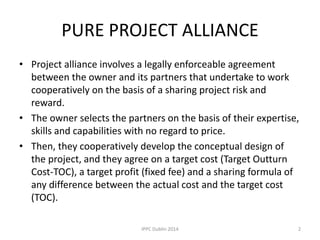
PURE PROJECT ALLIANCE
• Project alliance involves a legally enforceable agreement
between the owner and its partners that undertake to work
cooperatively on the basis of a sharing project risk and
reward.
• The owner selects the partners on the basis of their expertise,
skills and capabilities with no regard to price.
• Then, they cooperatively develop the conceptual design of
the project, and they agree on a target cost (Target Outturn
Cost-TOC), a target profit (fixed fee) and a sharing formula of
any difference between the actual cost and the target cost
(TOC).
2IPPC Dublin 2014
PURE PROJECT ALLIANCE
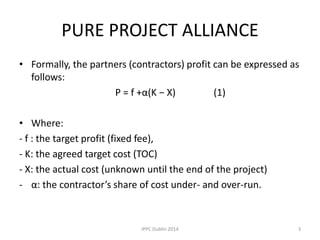
• Formally, the partners (contractors) profit can be expressed as
follows:
P = f +α(K − X) (1)
• Where:
- f : the target profit (fixed fee),
- K: the agreed target cost (TOC)
- X: the actual cost (unknown until the end of the project)
- α: the contractor’s share of cost under- and over-run.
3IPPC Dublin 2014
PURE PROJECT ALLIANCE
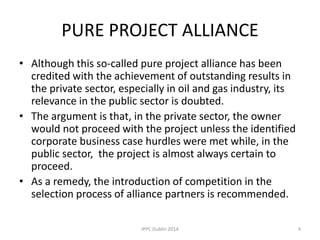
• Although this so-called pure project alliance has been
credited with the achievement of outstanding results in
the private sector, especially in oil and gas industry, its
relevance in the public sector is doubted.
• The argument is that, in the private sector, the owner
would not proceed with the project unless the identified
corporate business case hurdles were met while, in the
public sector, the project is almost always certain to
proceed.
• As a remedy, the introduction of competition in the
selection process of alliance partners is recommended.
4IPPC Dublin 2014
COMPETITIVE PROJECT ALLIANCE
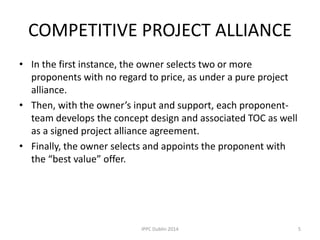
• In the first instance, the owner selects two or more
proponents with no regard to price, as under a pure project
alliance.
• Then, with the owner’s input and support, each proponent-
team develops the concept design and associated TOC as well
as a signed project alliance agreement.
• Finally, the owner selects and appoints the proponent with
the “best value” offer.
5IPPC Dublin 2014
THE REAL PROBLEM
• The problem stems in the linear sharing formula (1) which
gives the contractors (partners) the opportunity to increase
profit (P) either by reducing cost (X), which is intended by the
owner or, contrarily, by artificially inflating their target cost
(K).
• Actually, the alignment of interests after the signing of the
contract conceals a “win-lose” game in setting the target cost .
Each party may be tempted to use its bargaining power to
increase (decrease) the target cost as higher (lower) as
possible.
• Experience suggests that when the target cost is set too high
or too low, different strategic behaviors to recover potential
loss start to emerge.
6IPPC Dublin 2014
THE REAL PROBLEM
• The aim of this presentation is to suggest a new risk-reward
sharing formula that, in contrast to previous approaches,
incentivizes the partners (contractors) to submit their target
cost truthfully.
• Its primary and obvious advantage is that it makes needless
the use of competition or any other commercial pressure to
compel the partners (contractors) to lower their target cost.
7IPPC Dublin 2014
A NEW SHARING FORMULA
• The risk-reward sharing arrangement involved in a target cost
contract can be obtained (replicated) through an exchange of
options involving zero cash between the owner and the
partners.
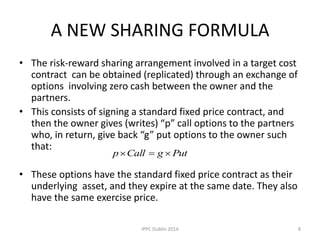
• This consists of signing a standard fixed price contract, and
then the owner gives (writes) “p” call options to the partners
who, in return, give back “g” put options to the owner such
that:
• These options have the standard fixed price contract as their
underlying asset, and they expire at the same date. They also
have the same exercise price.
PutgCallp 
8IPPC Dublin 2014
A NEW SHARING FORMULA
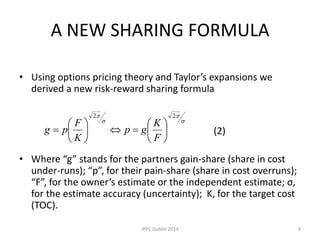
• Using options pricing theory and Taylor’s expansions we
derived a new risk-reward sharing formula
(2)
• Where “g” stands for the partners gain-share (share in cost
under-runs); “p”, for their pain-share (share in cost overruns);
“F”, for the owner’s estimate or the independent estimate; σ,
for the estimate accuracy (uncertainty); K, for the target cost
(TOC).



 22













F
K
gp
K
F
pg
9IPPC Dublin 2014
A NEW SHARING FORMULA
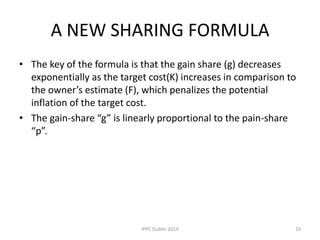
• The key of the formula is that the gain share (g) decreases
exponentially as the target cost(K) increases in comparison to
the owner’s estimate (F), which penalizes the potential
inflation of the target cost.
• The gain-share “g” is linearly proportional to the pain-share
“p”.
10IPPC Dublin 2014
OPTIMAL TARGET COST
• When submitting their target cost, the partners seek to
maximize their expected profit E(P):
(3)
• Where E(X) stands for the partners expected cost.
• The fixed fee (f) must be determined on the basis of the
owner’s estimate (F) but not on the basis of the submitted
target cost (K). Otherwise, this will motive the partners to
inflate their cost target in order to secure a high fixed profit.
)]([)( XEKgfPE 
11IPPC Dublin 2014
OPTIMAL TARGET COST
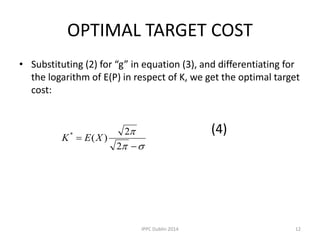
• Substituting (2) for “g” in equation (3), and differentiating for
the logarithm of E(P) in respect of K, we get the optimal target
cost:
(4)




2
2
)(*
XEK
12IPPC Dublin 2014
EXAMPLE
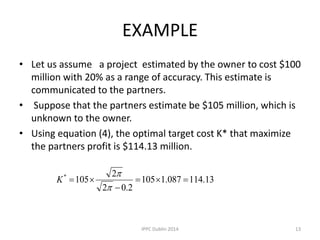
• Let us assume a project estimated by the owner to cost $100
million with 20% as a range of accuracy. This estimate is
communicated to the partners.
• Suppose that the partners estimate be $105 million, which is
unknown to the owner.
• Using equation (4), the optimal target cost K* that maximize
the partners profit is $114.13 million.
13.114087.1105
2.02
2
105*





K
13IPPC Dublin 2014
EXAMPLE
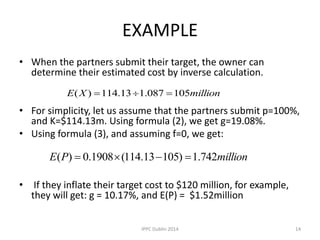
• When the partners submit their target, the owner can
determine their estimated cost by inverse calculation.
• For simplicity, let us assume that the partners submit p=100%,
and K=$114.13m. Using formula (2), we get g=19.08%.
• Using formula (3), and assuming f=0, we get:
• If they inflate their target cost to $120 million, for example,
they will get: g = 10.17%, and E(P) = $1.52million
millionXE 105087.113.114)( 
millionPE 742.1)10513.114(1908.0)( 
14IPPC Dublin 2014
CONCLUSIONS
• The use of competitive TOC alliance is expensive, time
consuming, and damageable for trust and collaborative
relationships.
• The new risk-reward sharing formula discourages the
partners from inflating their target cost.
• The most significant advantages are twofold:
– it makes unnecessary to hire a second proponent alliance
partners, which results in cost and time savings
– it fosters the development of trust and collaboration for
achieving better performance.
• The formula is not limited to project alliance but it can be
extended to any non-competitive negotiated contract.
15IPPC Dublin 2014

Efficient pure project alliances in the public sector

  • 1.
    EFFICIENT PURE PROJECT ALLIANCEIN THE PUBLIC SECTOR Saïd Boukendour University of Quebec, Canada 1IPPC Dublin 2014
  • 2.
    PURE PROJECT ALLIANCE •Project alliance involves a legally enforceable agreement between the owner and its partners that undertake to work cooperatively on the basis of a sharing project risk and reward. • The owner selects the partners on the basis of their expertise, skills and capabilities with no regard to price. • Then, they cooperatively develop the conceptual design of the project, and they agree on a target cost (Target Outturn Cost-TOC), a target profit (fixed fee) and a sharing formula of any difference between the actual cost and the target cost (TOC). 2IPPC Dublin 2014
  • 3.
    PURE PROJECT ALLIANCE •Formally, the partners (contractors) profit can be expressed as follows: P = f +α(K − X) (1) • Where: - f : the target profit (fixed fee), - K: the agreed target cost (TOC) - X: the actual cost (unknown until the end of the project) - α: the contractor’s share of cost under- and over-run. 3IPPC Dublin 2014
  • 4.
    PURE PROJECT ALLIANCE •Although this so-called pure project alliance has been credited with the achievement of outstanding results in the private sector, especially in oil and gas industry, its relevance in the public sector is doubted. • The argument is that, in the private sector, the owner would not proceed with the project unless the identified corporate business case hurdles were met while, in the public sector, the project is almost always certain to proceed. • As a remedy, the introduction of competition in the selection process of alliance partners is recommended. 4IPPC Dublin 2014
  • 5.
    COMPETITIVE PROJECT ALLIANCE •In the first instance, the owner selects two or more proponents with no regard to price, as under a pure project alliance. • Then, with the owner’s input and support, each proponent- team develops the concept design and associated TOC as well as a signed project alliance agreement. • Finally, the owner selects and appoints the proponent with the “best value” offer. 5IPPC Dublin 2014
  • 6.
    THE REAL PROBLEM •The problem stems in the linear sharing formula (1) which gives the contractors (partners) the opportunity to increase profit (P) either by reducing cost (X), which is intended by the owner or, contrarily, by artificially inflating their target cost (K). • Actually, the alignment of interests after the signing of the contract conceals a “win-lose” game in setting the target cost . Each party may be tempted to use its bargaining power to increase (decrease) the target cost as higher (lower) as possible. • Experience suggests that when the target cost is set too high or too low, different strategic behaviors to recover potential loss start to emerge. 6IPPC Dublin 2014
  • 7.
    THE REAL PROBLEM •The aim of this presentation is to suggest a new risk-reward sharing formula that, in contrast to previous approaches, incentivizes the partners (contractors) to submit their target cost truthfully. • Its primary and obvious advantage is that it makes needless the use of competition or any other commercial pressure to compel the partners (contractors) to lower their target cost. 7IPPC Dublin 2014
  • 8.
    A NEW SHARINGFORMULA • The risk-reward sharing arrangement involved in a target cost contract can be obtained (replicated) through an exchange of options involving zero cash between the owner and the partners. • This consists of signing a standard fixed price contract, and then the owner gives (writes) “p” call options to the partners who, in return, give back “g” put options to the owner such that: • These options have the standard fixed price contract as their underlying asset, and they expire at the same date. They also have the same exercise price. PutgCallp  8IPPC Dublin 2014
  • 9.
    A NEW SHARINGFORMULA • Using options pricing theory and Taylor’s expansions we derived a new risk-reward sharing formula (2) • Where “g” stands for the partners gain-share (share in cost under-runs); “p”, for their pain-share (share in cost overruns); “F”, for the owner’s estimate or the independent estimate; σ, for the estimate accuracy (uncertainty); K, for the target cost (TOC).     22              F K gp K F pg 9IPPC Dublin 2014
  • 10.
    A NEW SHARINGFORMULA • The key of the formula is that the gain share (g) decreases exponentially as the target cost(K) increases in comparison to the owner’s estimate (F), which penalizes the potential inflation of the target cost. • The gain-share “g” is linearly proportional to the pain-share “p”. 10IPPC Dublin 2014
  • 11.
    OPTIMAL TARGET COST •When submitting their target cost, the partners seek to maximize their expected profit E(P): (3) • Where E(X) stands for the partners expected cost. • The fixed fee (f) must be determined on the basis of the owner’s estimate (F) but not on the basis of the submitted target cost (K). Otherwise, this will motive the partners to inflate their cost target in order to secure a high fixed profit. )]([)( XEKgfPE  11IPPC Dublin 2014
  • 12.
    OPTIMAL TARGET COST •Substituting (2) for “g” in equation (3), and differentiating for the logarithm of E(P) in respect of K, we get the optimal target cost: (4)     2 2 )(* XEK 12IPPC Dublin 2014
  • 13.
    EXAMPLE • Let usassume a project estimated by the owner to cost $100 million with 20% as a range of accuracy. This estimate is communicated to the partners. • Suppose that the partners estimate be $105 million, which is unknown to the owner. • Using equation (4), the optimal target cost K* that maximize the partners profit is $114.13 million. 13.114087.1105 2.02 2 105*      K 13IPPC Dublin 2014
  • 14.
    EXAMPLE • When thepartners submit their target, the owner can determine their estimated cost by inverse calculation. • For simplicity, let us assume that the partners submit p=100%, and K=$114.13m. Using formula (2), we get g=19.08%. • Using formula (3), and assuming f=0, we get: • If they inflate their target cost to $120 million, for example, they will get: g = 10.17%, and E(P) = $1.52million millionXE 105087.113.114)(  millionPE 742.1)10513.114(1908.0)(  14IPPC Dublin 2014
  • 15.
    CONCLUSIONS • The useof competitive TOC alliance is expensive, time consuming, and damageable for trust and collaborative relationships. • The new risk-reward sharing formula discourages the partners from inflating their target cost. • The most significant advantages are twofold: – it makes unnecessary to hire a second proponent alliance partners, which results in cost and time savings – it fosters the development of trust and collaboration for achieving better performance. • The formula is not limited to project alliance but it can be extended to any non-competitive negotiated contract. 15IPPC Dublin 2014