International Journal of Teacher Educational Research (IJTER) Vol. 3 No.1 January,2014 ISSN: 2319-4642
www.ijter.com
Editorial
Dear Colleagues
Warm Greetings
While feeling happy in bring out the January,2014 of the INTERNATIONAL JOURNAL OF TEACHER
EDUCATIONAL RESEARCH (IJTER), a monthly online open access journal, indexed as international
journal in the Directory of Research Journal Indexing (www.drji.com), I would like to extend my best
wishes for a HAPPY AND PROSPEROUS NEW YEAR-2014. Hope this New Year will bring a lot of
healthy changes and developments in Teacher Education. You can find IJTER available in all online
repositories and data bases and also available in almost all the university libraries. Without your
support and constant co-operation this venture would have not been achieved. There are four research
papers chosen by the review committee in this issue. Hope these papers will be very useful for many
researches in the field of Education. Again I request you all to extend your fullest co-operation and
support for the further development of this Journal. Kindly do not hesitate to express your comments
and suggestions, if any, for fine tuning this journal further.
With every good wish and warm regards
Once again my hearty wishes for a Happy New Year -2014
Dr.S.RAJASEKAR
Date: 01-01-2014 Editor-in-Chief
IJTER
Emails: editor@ijter.com
editorijter@gmail.com
Website: www.ijter.com
International Journal of Teacher Educational Research (IJTER) Vol.3 No.1 January, 2014 ISSN: 2319-4642
www.ijter.com
Effectiveness of Bar Model in Enhancing the Learning of Mathematics at Primary level
15
EFFECTIVENESS OF BAR MODEL IN ENHANCING THE LEARNING OF MATHEMATICS AT PRIMARY
LEVEL
Mr.M.THIRUNAVUKKARASU
Ph.D. Research Scholar
Dept. of Educational Technology
Bharathidasan University
Tiruchirappalli – 620 023.
Email: edutechthiru@gmail.com
Dr. S. SENTHILNATHAN
Assistant Professor
Dept. of Educational Technology
Bharathidasan University
Tiruchirappalli – 620 023
Email: edutechsenthil@gmail.com
ABSTRACT
The present experimental study is on the effectiveness of Bar Model in enhancing the learning of
Mathematics at primary level. Pre-test post-test Equivalent Group Experimental Design was adopted and
the sample to form the group for treatment was drawn through Cluster Sampling. From this study, it was
found that Bar Model of teaching mathematics is more effective than the Conventional Method in enhancing
the learning of mathematics at the primary level.
Keywords: Teaching of Mathematics, Bar Model.
INTRODUCTION
Mathematics is an old, broad, and deep discipline. Mathematics as a formal area of teaching and
learning was developed about 5,000 years ago by the Sumerians. Mathematics is such a useful language
and tool that it is considered one of the "basics" in the formal educational systems. In the contemporary
world, it has become commonplace to speak of mathematics and science education as essential to a nation
to maintain or improve its economic position in a competitive world.
The aim of mathematics education is surely success for all pupils, yet it seems to be a fact of life
that while a few prosper in mathematics, a much greater number find mathematics difficult. There is a need
for educators to be constantly conscious of understanding not only how pupils process and construct
mathematical knowledge but also the difficulties that they face. Further, the teachers need to identify
innovative techniques for teaching mathematics that would enhance the learning of mathematics at
different levels. The „Singapore math‟ is one of the most innovative techniques with proven success in
enhancing the leaning of mathematics.
International Journal of Teacher Educational Research (IJTER) Vol.3 No.1 January, 2014 ISSN: 2319-4642
www.ijter.com
Effectiveness of Bar Model in Enhancing the Learning of Mathematics at Primary level
16
SINGAPORE MATH AND BAR MODEL
"Singapore Math" is a broad term used by educators and home-schoolers outside of Singapore. It
is not a reference to a specific math program and is not used within Singapore itself. It is ascribed to all the
math programs that follow the Math Guidelines as set out by Singapore‟s Ministry of Education (MOE).
Singapore Math is a balance between drill and creative problem solving. The Singapore approach
encourages greater problem solving skills and creative thinking. A key feature of Singapore Math is the use
of a problem-solving technique often called the „model approach‟. In this approach, students draw diagrams
in which they represent the problem situations and relevant concepts using bars. Drawing the model
permits students to visually relate various types of information given in the problem to an unknown amount
and helps them to determine which mathematical expressions are useful in solving the problem.
The purpose of drawing the models is not to have students follow specific rules, but rather to
understand the concepts and work out a strategy for finding the answer. For complex problems, several
strategies are possible, and drawing the model allows the student to visualize a good strategy. Drawing bar
model is a valuable tool for solving non-routine problems. These problems might also be solved using
algebra, but for children at the primary level, a model approach can be preferable since it is less abstract.
Model drawing is a problem-solving method that can be used across different levels, and as a link to
algebra in the secondary level. A commonly used strategy in using bar models is to draw units or divide the
bar into units, equate the number of units to a quantity, which is either given or calculated from other
quantities given in the problem, form a proportion statement, and finally to use a unitary or proportion
method to get the answer. The main feature of the method is a concrete to pictorial to abstract approach.
Model drawing, often called “bar modeling”, is a systematic method of representing word problems and
number relationships that is explicitly taught beginning in second grade and extending all the way to
secondary algebra. Students are taught to use rectangular “bars” to represent the relationship between
known and unknown numerical quantities and to solve problems related to these quantities. In Singapore
Math, students learn to represent these objects with rectangles that enable them to see the number
relationships, rather than focusing on the objects of the problems. Rectangles are used because they are
easy to draw, divide, represent larger numbers, and display proportional relationships.
International Journal of Teacher Educational Research (IJTER) Vol.3 No.1 January, 2014 ISSN: 2319-4642
www.ijter.com
Effectiveness of Bar Model in Enhancing the Learning of Mathematics at Primary level
17
REVIEW OF RELATED STUDIES
Yan Kow Cheong (2002) conducted a study into the common difficulties associated with the model
and suggested methods to help the pupils overcome the difficulties.
Researchers from the School of Education and Department of Mathematics and Computer Science
at North Georgia College and State University (NGCSU) conducted an empirical study that evaluated the
implementation of Singapore Math in all 21 elementary schools in Hall County during the 2008-2009 and
2009-2010 school years. The results indicate that students who have not previously worked with Singapore
Math have had a steeper learning curve as a group than is expected in subsequent years.
Ginsburg et al., (2005) compared the Singapore mathematics and U.S. mathematics in the primary
grades and found differences in textbooks, assessments, and teacher training programs, with a large
discrepancy identifying mastery of mathematics in Singapore students in contrast to U.S. students who
mechanically apply mathematical procedures to solve routine problems.
Ann Lyle Rethlefsen and Hyesung Park (2011) conducted a study entitled “A Mixed-Method Study:
Assessing the Bar Model's Impact on Preservice Teachers' Efficacy Beliefs”. The preservice teachers took
Enochs, Smith, and Huinker's Mathematics Teaching Efficacy Beliefs Instrument (MTEBI) on the first and
last day of class. A total of 297 responses were collected from the pre- and posttests, with 280 matching
responses, which were then used for data analysis. Mixed methods were used to analyze qualitative and
quantitative data. The researchers sought to determine if the specific teaching methods from the Bar model
led to positive changes in preservice teacher efficacy beliefs. They also explored if efficacy beliefs changed
as a result of field experiences. Preservice teachers' efficacy scores changed positively on every item on
the MTEBI. The researchers also determined that there was an increase in preservice teachers' output as a
result of their field experiences.
STATEMENT OF THE PROBLEM
Though the Bar Model of Teaching mathematics has been in practice Singapore and a few other
countries of the best for more than, the potential of this method seem to have escaped the notice of Indian
academics and educational researchers. As an attempt to fill the research gap in this vital area, the present
study has been undertaken to find out the effectiveness of the Bar Model of teaching in enhancing the
leaning of mathematics at the primary level. Hence the problem of the study is stared as
International Journal of Teacher Educational Research (IJTER) Vol.3 No.1 January, 2014 ISSN: 2319-4642
www.ijter.com
Effectiveness of Bar Model in Enhancing the Learning of Mathematics at Primary level
18
“EFFECTIVENESS OF BAR MODEL IN ENHANCING THE LEARNING OF MATHEMATICS AT PRIMARY
LEVEL”.
OBJECTIVES OF THE STUDY
The main objective of the study is to find out the effectiveness of Bar Model of Teaching
Mathematics at Elementary Level in terms of the students‟ performance in the achievements tests in
mathematics with specific reference to certain selected variables. The specific objectives of the study are:
 to measure the level of increase in the Elementary level students‟ performance in the
achievement test in mathematics, after teaching them Mathematics through Bar Model.
 to find out whether there exists any significant difference in the achievement of mathematics
with regard to the demographic variables.
METHODOLOGY OF THE STUDY
Experimental Method was employed for the present study. Pre-test, Post-test Equivalent Group
Design was adopted as the research design. The sample chosen for the study consists of 68 students of V
standard for the conventional method of teaching and 68 students of V standard for the Bar model of
teaching. The two groups of students were chosen to from the sample through Cluster Sampling technique.
The Conventional Method Group was taught the units Multiplication and Division in mathematics taught the
chalk Talk method and the Bar Model Group was thought the same units of mathematics through the Bar
Model. An achievement Test in Mathematics was employed for the purpose of data collection. The
collected data were analyzed using differential analysis.
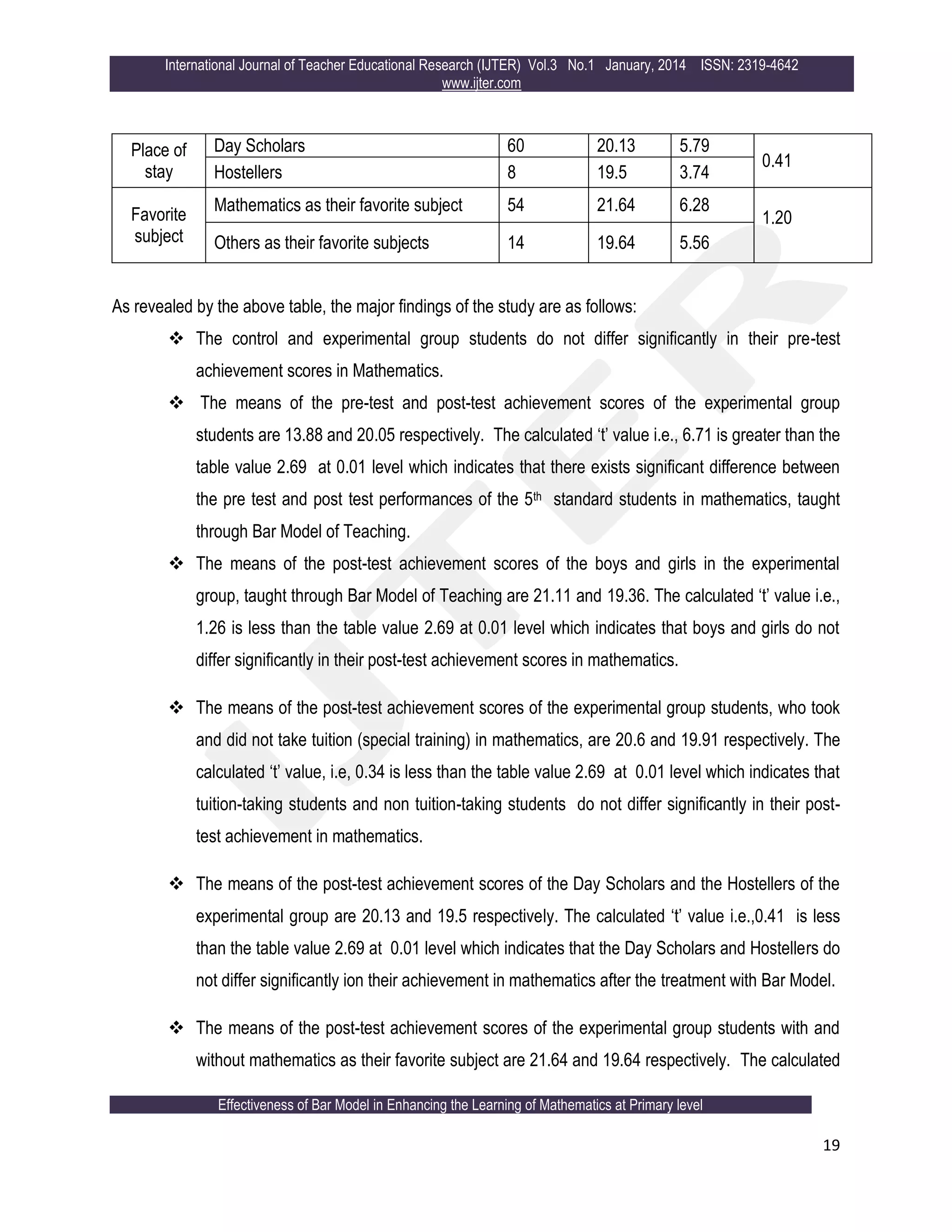
ANALYSIS OF DATA AND FINDINGS
Variables Groups N Mean SD ‘t’ value
Test
Pre-test 68 13.88 5.18 6.71
Post-test 68 20.05 5.57
Gender
Boys 27 21.11 5.84
1.26
Girls 41 19.36 5.33
Special
Training
Tuition Takers 15 20.6 7.36
0.34
Non-Tuition Takers 53 19.91 5.02
International Journal of Teacher Educational Research (IJTER) Vol.3 No.1 January, 2014 ISSN: 2319-4642
www.ijter.com
Effectiveness of Bar Model in Enhancing the Learning of Mathematics at Primary level
19
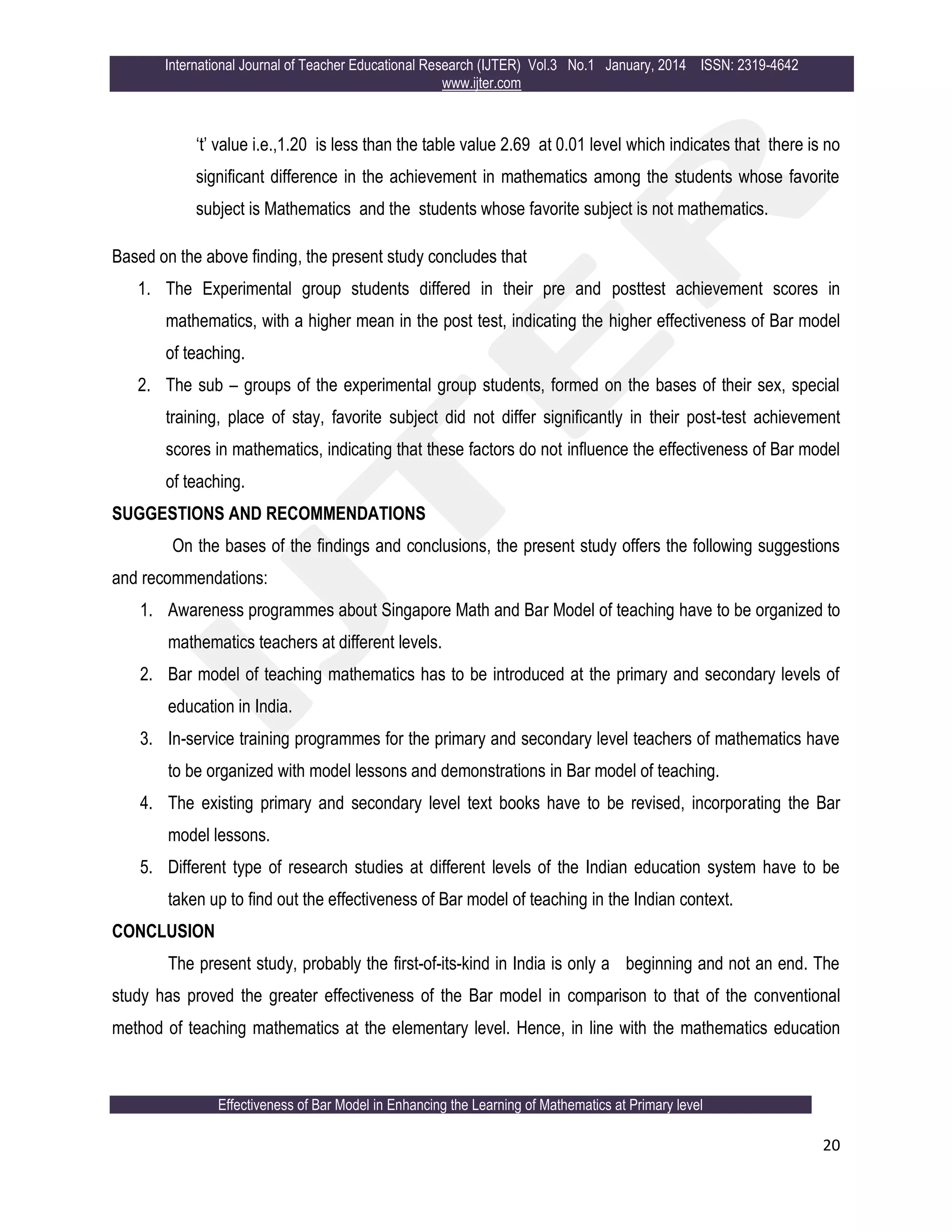
Place of
stay
Day Scholars 60 20.13 5.79
0.41
Hostellers 8 19.5 3.74
Favorite
subject
Mathematics as their favorite subject 54 21.64 6.28
1.20
Others as their favorite subjects 14 19.64 5.56
As revealed by the above table, the major findings of the study are as follows:
 The control and experimental group students do not differ significantly in their pre-test
achievement scores in Mathematics.
 The means of the pre-test and post-test achievement scores of the experimental group
students are 13.88 and 20.05 respectively. The calculated „t‟ value i.e., 6.71 is greater than the
table value 2.69 at 0.01 level which indicates that there exists significant difference between
the pre test and post test performances of the 5th standard students in mathematics, taught
through Bar Model of Teaching.
 The means of the post-test achievement scores of the boys and girls in the experimental
group, taught through Bar Model of Teaching are 21.11 and 19.36. The calculated „t‟ value i.e.,
1.26 is less than the table value 2.69 at 0.01 level which indicates that boys and girls do not
differ significantly in their post-test achievement scores in mathematics.
 The means of the post-test achievement scores of the experimental group students, who took
and did not take tuition (special training) in mathematics, are 20.6 and 19.91 respectively. The
calculated „t‟ value, i.e, 0.34 is less than the table value 2.69 at 0.01 level which indicates that
tuition-taking students and non tuition-taking students do not differ significantly in their post-
test achievement in mathematics.
 The means of the post-test achievement scores of the Day Scholars and the Hostellers of the
experimental group are 20.13 and 19.5 respectively. The calculated „t‟ value i.e.,0.41 is less
than the table value 2.69 at 0.01 level which indicates that the Day Scholars and Hostellers do
not differ significantly ion their achievement in mathematics after the treatment with Bar Model.
 The means of the post-test achievement scores of the experimental group students with and
without mathematics as their favorite subject are 21.64 and 19.64 respectively. The calculated
International Journal of Teacher Educational Research (IJTER) Vol.3 No.1 January, 2014 ISSN: 2319-4642
www.ijter.com
Effectiveness of Bar Model in Enhancing the Learning of Mathematics at Primary level
20
„t‟ value i.e.,1.20 is less than the table value 2.69 at 0.01 level which indicates that there is no
significant difference in the achievement in mathematics among the students whose favorite
subject is Mathematics and the students whose favorite subject is not mathematics.
Based on the above finding, the present study concludes that
1. The Experimental group students differed in their pre and posttest achievement scores in
mathematics, with a higher mean in the post test, indicating the higher effectiveness of Bar model
of teaching.
2. The sub – groups of the experimental group students, formed on the bases of their sex, special
training, place of stay, favorite subject did not differ significantly in their post-test achievement
scores in mathematics, indicating that these factors do not influence the effectiveness of Bar model
of teaching.
SUGGESTIONS AND RECOMMENDATIONS
On the bases of the findings and conclusions, the present study offers the following suggestions
and recommendations:
1. Awareness programmes about Singapore Math and Bar Model of teaching have to be organized to
mathematics teachers at different levels.
2. Bar model of teaching mathematics has to be introduced at the primary and secondary levels of
education in India.
3. In-service training programmes for the primary and secondary level teachers of mathematics have
to be organized with model lessons and demonstrations in Bar model of teaching.
4. The existing primary and secondary level text books have to be revised, incorporating the Bar
model lessons.
5. Different type of research studies at different levels of the Indian education system have to be
taken up to find out the effectiveness of Bar model of teaching in the Indian context.
CONCLUSION
The present study, probably the first-of-its-kind in India is only a beginning and not an end. The
study has proved the greater effectiveness of the Bar model in comparison to that of the conventional
method of teaching mathematics at the elementary level. Hence, in line with the mathematics education
International Journal of Teacher Educational Research (IJTER) Vol.3 No.1 January, 2014 ISSN: 2319-4642
www.ijter.com
Effectiveness of Bar Model in Enhancing the Learning of Mathematics at Primary level
21
scenario of Singapore, curricular changes are the need of the hour here in order to make the best use of
this innovative model with proven effectiveness in India too for the larger benefits of Indian students.
REFERENCES
Ann Lyle Rethlefsenand Hyesung Park (2011) A Mixed-Method Study: Assessing the Bar Model's Impact
on Preservice Teachers' Efficacy Beliefs, School Science and Mathematics, Volume 111, Issue 3, pages
102–117, March 2011.Retrieved from http://onlinelibrary.wiley.com/doi/ 10.1111 /j.1949-
8594.2010.00067.x/abstract on 27.2.2012
Ann Lyle Rethlefsen and Hyesung Park (2011) A Mixed-Method Study: Assessing the BAR Model‟s Impact
on Preservice Teachers‟ Efficacy Beliefs Volume 111 (3) pages 102 – 117 Retrieved from
http://onlinelibrary.wiley.com/doi/10.1111/j.1949-8594.2010.00067.x/pdf on 12.12.2011
Aliakbar Montazer Haghighi, Roozbeh Vakil & Roozbeh Vakil (2006) Reverse-Traditional/hands-on: An
Alternative Method of tTeaching Statistics, Applications and Applied Mathematics Vol. 1, No. 1 (2006) pp.
62 – 82 Retrieved from http://www.pvamu.edu/Include/Math/RTHO%20to%20AAM%2006%
20Issue%201_06_5.pdf on 12.10.2012
Berinderjeet Kaur (2004) Teaching of Mathematics in Singapore Schools. Retrieved from
http://home.sandiego.edu/~pmyers/singapore/ICME-10-RG-paper-patsy.pdf on 15.3.2012
Corporate Business Template: Why iSingaporeMath.com Training for Schools. Retrieved from
http://isingaporemath.com/why-isingaporemathcom-training-for-schools on 25.01.2012
Fong Ho Kheong (2009) Math in Focus: The Singapore Approach The Underpinning Concept. Retrieved
from http://www.hmheducation.com /singaporemath/pdf/MIF The UnderpinningConcept.pdf on 02.02.2012
Marye Audet (1981) History of Singapore Math. Retrieved from http://home-
school.lovetoknow.com/Singapore_Math_Curriculum on 02.02.2012
NCERT (2006) Position paper national focus group on teaching of mathematics Retrieved from
http://www.ncert.nic.in/new_ncert/ncert/rightside/links/pdf/focus_group/math.pdf on 01.09.2012
International Journal of Teacher Educational Research (IJTER) Vol.3 No.1 January, 2014 ISSN: 2319-4642
www.ijter.com
Effectiveness of Bar Model in Enhancing the Learning of Mathematics at Primary level
22
Yan Kow Cheong (2002) The Model Method in Singapore Vol. 6, No.2, 47-64 Retrieved from
http://math.nie.edu.sg/ame/matheduc/tme/tmeV6_2/05-Yan%20KC%20Final%20version.pdf on 07.12.2011
Yeap Ban Har (2009) Bar Modeling: A Problem-solving Tool. Marshall Cavendish Int (S) Pte Ltd,
Singapore.
Yeap Ban Har (2010) Improving Mathematical Thinking through Assessment, 187 Yeap Ban Har Journal of
Science and Mathematics Education in Southeast Asia 2010, Vol.33 No. 2, 187-197 Retrieved from
http://www.recsam.edu.my/R&D_Journals/ YEAR2010/dec2010vol2/yeap%28187-197%29.pdf

EFFECTIVENESS OF BAR MODEL IN ENHANCING THE LEARNING OF MATHEMATICS AT PRIMARY LEVEL

  • 2.
    International Journal ofTeacher Educational Research (IJTER) Vol. 3 No.1 January,2014 ISSN: 2319-4642 www.ijter.com Editorial Dear Colleagues Warm Greetings While feeling happy in bring out the January,2014 of the INTERNATIONAL JOURNAL OF TEACHER EDUCATIONAL RESEARCH (IJTER), a monthly online open access journal, indexed as international journal in the Directory of Research Journal Indexing (www.drji.com), I would like to extend my best wishes for a HAPPY AND PROSPEROUS NEW YEAR-2014. Hope this New Year will bring a lot of healthy changes and developments in Teacher Education. You can find IJTER available in all online repositories and data bases and also available in almost all the university libraries. Without your support and constant co-operation this venture would have not been achieved. There are four research papers chosen by the review committee in this issue. Hope these papers will be very useful for many researches in the field of Education. Again I request you all to extend your fullest co-operation and support for the further development of this Journal. Kindly do not hesitate to express your comments and suggestions, if any, for fine tuning this journal further. With every good wish and warm regards Once again my hearty wishes for a Happy New Year -2014 Dr.S.RAJASEKAR Date: 01-01-2014 Editor-in-Chief IJTER Emails: editor@ijter.com editorijter@gmail.com Website: www.ijter.com
  • 3.
    International Journal ofTeacher Educational Research (IJTER) Vol.3 No.1 January, 2014 ISSN: 2319-4642 www.ijter.com Effectiveness of Bar Model in Enhancing the Learning of Mathematics at Primary level 15 EFFECTIVENESS OF BAR MODEL IN ENHANCING THE LEARNING OF MATHEMATICS AT PRIMARY LEVEL Mr.M.THIRUNAVUKKARASU Ph.D. Research Scholar Dept. of Educational Technology Bharathidasan University Tiruchirappalli – 620 023. Email: edutechthiru@gmail.com Dr. S. SENTHILNATHAN Assistant Professor Dept. of Educational Technology Bharathidasan University Tiruchirappalli – 620 023 Email: edutechsenthil@gmail.com ABSTRACT The present experimental study is on the effectiveness of Bar Model in enhancing the learning of Mathematics at primary level. Pre-test post-test Equivalent Group Experimental Design was adopted and the sample to form the group for treatment was drawn through Cluster Sampling. From this study, it was found that Bar Model of teaching mathematics is more effective than the Conventional Method in enhancing the learning of mathematics at the primary level. Keywords: Teaching of Mathematics, Bar Model. INTRODUCTION Mathematics is an old, broad, and deep discipline. Mathematics as a formal area of teaching and learning was developed about 5,000 years ago by the Sumerians. Mathematics is such a useful language and tool that it is considered one of the "basics" in the formal educational systems. In the contemporary world, it has become commonplace to speak of mathematics and science education as essential to a nation to maintain or improve its economic position in a competitive world. The aim of mathematics education is surely success for all pupils, yet it seems to be a fact of life that while a few prosper in mathematics, a much greater number find mathematics difficult. There is a need for educators to be constantly conscious of understanding not only how pupils process and construct mathematical knowledge but also the difficulties that they face. Further, the teachers need to identify innovative techniques for teaching mathematics that would enhance the learning of mathematics at different levels. The „Singapore math‟ is one of the most innovative techniques with proven success in enhancing the leaning of mathematics.
  • 4.
    International Journal ofTeacher Educational Research (IJTER) Vol.3 No.1 January, 2014 ISSN: 2319-4642 www.ijter.com Effectiveness of Bar Model in Enhancing the Learning of Mathematics at Primary level 16 SINGAPORE MATH AND BAR MODEL "Singapore Math" is a broad term used by educators and home-schoolers outside of Singapore. It is not a reference to a specific math program and is not used within Singapore itself. It is ascribed to all the math programs that follow the Math Guidelines as set out by Singapore‟s Ministry of Education (MOE). Singapore Math is a balance between drill and creative problem solving. The Singapore approach encourages greater problem solving skills and creative thinking. A key feature of Singapore Math is the use of a problem-solving technique often called the „model approach‟. In this approach, students draw diagrams in which they represent the problem situations and relevant concepts using bars. Drawing the model permits students to visually relate various types of information given in the problem to an unknown amount and helps them to determine which mathematical expressions are useful in solving the problem. The purpose of drawing the models is not to have students follow specific rules, but rather to understand the concepts and work out a strategy for finding the answer. For complex problems, several strategies are possible, and drawing the model allows the student to visualize a good strategy. Drawing bar model is a valuable tool for solving non-routine problems. These problems might also be solved using algebra, but for children at the primary level, a model approach can be preferable since it is less abstract. Model drawing is a problem-solving method that can be used across different levels, and as a link to algebra in the secondary level. A commonly used strategy in using bar models is to draw units or divide the bar into units, equate the number of units to a quantity, which is either given or calculated from other quantities given in the problem, form a proportion statement, and finally to use a unitary or proportion method to get the answer. The main feature of the method is a concrete to pictorial to abstract approach. Model drawing, often called “bar modeling”, is a systematic method of representing word problems and number relationships that is explicitly taught beginning in second grade and extending all the way to secondary algebra. Students are taught to use rectangular “bars” to represent the relationship between known and unknown numerical quantities and to solve problems related to these quantities. In Singapore Math, students learn to represent these objects with rectangles that enable them to see the number relationships, rather than focusing on the objects of the problems. Rectangles are used because they are easy to draw, divide, represent larger numbers, and display proportional relationships.
  • 5.
    International Journal ofTeacher Educational Research (IJTER) Vol.3 No.1 January, 2014 ISSN: 2319-4642 www.ijter.com Effectiveness of Bar Model in Enhancing the Learning of Mathematics at Primary level 17 REVIEW OF RELATED STUDIES Yan Kow Cheong (2002) conducted a study into the common difficulties associated with the model and suggested methods to help the pupils overcome the difficulties. Researchers from the School of Education and Department of Mathematics and Computer Science at North Georgia College and State University (NGCSU) conducted an empirical study that evaluated the implementation of Singapore Math in all 21 elementary schools in Hall County during the 2008-2009 and 2009-2010 school years. The results indicate that students who have not previously worked with Singapore Math have had a steeper learning curve as a group than is expected in subsequent years. Ginsburg et al., (2005) compared the Singapore mathematics and U.S. mathematics in the primary grades and found differences in textbooks, assessments, and teacher training programs, with a large discrepancy identifying mastery of mathematics in Singapore students in contrast to U.S. students who mechanically apply mathematical procedures to solve routine problems. Ann Lyle Rethlefsen and Hyesung Park (2011) conducted a study entitled “A Mixed-Method Study: Assessing the Bar Model's Impact on Preservice Teachers' Efficacy Beliefs”. The preservice teachers took Enochs, Smith, and Huinker's Mathematics Teaching Efficacy Beliefs Instrument (MTEBI) on the first and last day of class. A total of 297 responses were collected from the pre- and posttests, with 280 matching responses, which were then used for data analysis. Mixed methods were used to analyze qualitative and quantitative data. The researchers sought to determine if the specific teaching methods from the Bar model led to positive changes in preservice teacher efficacy beliefs. They also explored if efficacy beliefs changed as a result of field experiences. Preservice teachers' efficacy scores changed positively on every item on the MTEBI. The researchers also determined that there was an increase in preservice teachers' output as a result of their field experiences. STATEMENT OF THE PROBLEM Though the Bar Model of Teaching mathematics has been in practice Singapore and a few other countries of the best for more than, the potential of this method seem to have escaped the notice of Indian academics and educational researchers. As an attempt to fill the research gap in this vital area, the present study has been undertaken to find out the effectiveness of the Bar Model of teaching in enhancing the leaning of mathematics at the primary level. Hence the problem of the study is stared as
  • 6.
    International Journal ofTeacher Educational Research (IJTER) Vol.3 No.1 January, 2014 ISSN: 2319-4642 www.ijter.com Effectiveness of Bar Model in Enhancing the Learning of Mathematics at Primary level 18 “EFFECTIVENESS OF BAR MODEL IN ENHANCING THE LEARNING OF MATHEMATICS AT PRIMARY LEVEL”. OBJECTIVES OF THE STUDY The main objective of the study is to find out the effectiveness of Bar Model of Teaching Mathematics at Elementary Level in terms of the students‟ performance in the achievements tests in mathematics with specific reference to certain selected variables. The specific objectives of the study are:  to measure the level of increase in the Elementary level students‟ performance in the achievement test in mathematics, after teaching them Mathematics through Bar Model.  to find out whether there exists any significant difference in the achievement of mathematics with regard to the demographic variables. METHODOLOGY OF THE STUDY Experimental Method was employed for the present study. Pre-test, Post-test Equivalent Group Design was adopted as the research design. The sample chosen for the study consists of 68 students of V standard for the conventional method of teaching and 68 students of V standard for the Bar model of teaching. The two groups of students were chosen to from the sample through Cluster Sampling technique. The Conventional Method Group was taught the units Multiplication and Division in mathematics taught the chalk Talk method and the Bar Model Group was thought the same units of mathematics through the Bar Model. An achievement Test in Mathematics was employed for the purpose of data collection. The collected data were analyzed using differential analysis. ANALYSIS OF DATA AND FINDINGS Variables Groups N Mean SD ‘t’ value Test Pre-test 68 13.88 5.18 6.71 Post-test 68 20.05 5.57 Gender Boys 27 21.11 5.84 1.26 Girls 41 19.36 5.33 Special Training Tuition Takers 15 20.6 7.36 0.34 Non-Tuition Takers 53 19.91 5.02
  • 7.
    International Journal ofTeacher Educational Research (IJTER) Vol.3 No.1 January, 2014 ISSN: 2319-4642 www.ijter.com Effectiveness of Bar Model in Enhancing the Learning of Mathematics at Primary level 19 Place of stay Day Scholars 60 20.13 5.79 0.41 Hostellers 8 19.5 3.74 Favorite subject Mathematics as their favorite subject 54 21.64 6.28 1.20 Others as their favorite subjects 14 19.64 5.56 As revealed by the above table, the major findings of the study are as follows:  The control and experimental group students do not differ significantly in their pre-test achievement scores in Mathematics.  The means of the pre-test and post-test achievement scores of the experimental group students are 13.88 and 20.05 respectively. The calculated „t‟ value i.e., 6.71 is greater than the table value 2.69 at 0.01 level which indicates that there exists significant difference between the pre test and post test performances of the 5th standard students in mathematics, taught through Bar Model of Teaching.  The means of the post-test achievement scores of the boys and girls in the experimental group, taught through Bar Model of Teaching are 21.11 and 19.36. The calculated „t‟ value i.e., 1.26 is less than the table value 2.69 at 0.01 level which indicates that boys and girls do not differ significantly in their post-test achievement scores in mathematics.  The means of the post-test achievement scores of the experimental group students, who took and did not take tuition (special training) in mathematics, are 20.6 and 19.91 respectively. The calculated „t‟ value, i.e, 0.34 is less than the table value 2.69 at 0.01 level which indicates that tuition-taking students and non tuition-taking students do not differ significantly in their post- test achievement in mathematics.  The means of the post-test achievement scores of the Day Scholars and the Hostellers of the experimental group are 20.13 and 19.5 respectively. The calculated „t‟ value i.e.,0.41 is less than the table value 2.69 at 0.01 level which indicates that the Day Scholars and Hostellers do not differ significantly ion their achievement in mathematics after the treatment with Bar Model.  The means of the post-test achievement scores of the experimental group students with and without mathematics as their favorite subject are 21.64 and 19.64 respectively. The calculated
  • 8.
    International Journal ofTeacher Educational Research (IJTER) Vol.3 No.1 January, 2014 ISSN: 2319-4642 www.ijter.com Effectiveness of Bar Model in Enhancing the Learning of Mathematics at Primary level 20 „t‟ value i.e.,1.20 is less than the table value 2.69 at 0.01 level which indicates that there is no significant difference in the achievement in mathematics among the students whose favorite subject is Mathematics and the students whose favorite subject is not mathematics. Based on the above finding, the present study concludes that 1. The Experimental group students differed in their pre and posttest achievement scores in mathematics, with a higher mean in the post test, indicating the higher effectiveness of Bar model of teaching. 2. The sub – groups of the experimental group students, formed on the bases of their sex, special training, place of stay, favorite subject did not differ significantly in their post-test achievement scores in mathematics, indicating that these factors do not influence the effectiveness of Bar model of teaching. SUGGESTIONS AND RECOMMENDATIONS On the bases of the findings and conclusions, the present study offers the following suggestions and recommendations: 1. Awareness programmes about Singapore Math and Bar Model of teaching have to be organized to mathematics teachers at different levels. 2. Bar model of teaching mathematics has to be introduced at the primary and secondary levels of education in India. 3. In-service training programmes for the primary and secondary level teachers of mathematics have to be organized with model lessons and demonstrations in Bar model of teaching. 4. The existing primary and secondary level text books have to be revised, incorporating the Bar model lessons. 5. Different type of research studies at different levels of the Indian education system have to be taken up to find out the effectiveness of Bar model of teaching in the Indian context. CONCLUSION The present study, probably the first-of-its-kind in India is only a beginning and not an end. The study has proved the greater effectiveness of the Bar model in comparison to that of the conventional method of teaching mathematics at the elementary level. Hence, in line with the mathematics education
  • 9.
    International Journal ofTeacher Educational Research (IJTER) Vol.3 No.1 January, 2014 ISSN: 2319-4642 www.ijter.com Effectiveness of Bar Model in Enhancing the Learning of Mathematics at Primary level 21 scenario of Singapore, curricular changes are the need of the hour here in order to make the best use of this innovative model with proven effectiveness in India too for the larger benefits of Indian students. REFERENCES Ann Lyle Rethlefsenand Hyesung Park (2011) A Mixed-Method Study: Assessing the Bar Model's Impact on Preservice Teachers' Efficacy Beliefs, School Science and Mathematics, Volume 111, Issue 3, pages 102–117, March 2011.Retrieved from http://onlinelibrary.wiley.com/doi/ 10.1111 /j.1949- 8594.2010.00067.x/abstract on 27.2.2012 Ann Lyle Rethlefsen and Hyesung Park (2011) A Mixed-Method Study: Assessing the BAR Model‟s Impact on Preservice Teachers‟ Efficacy Beliefs Volume 111 (3) pages 102 – 117 Retrieved from http://onlinelibrary.wiley.com/doi/10.1111/j.1949-8594.2010.00067.x/pdf on 12.12.2011 Aliakbar Montazer Haghighi, Roozbeh Vakil & Roozbeh Vakil (2006) Reverse-Traditional/hands-on: An Alternative Method of tTeaching Statistics, Applications and Applied Mathematics Vol. 1, No. 1 (2006) pp. 62 – 82 Retrieved from http://www.pvamu.edu/Include/Math/RTHO%20to%20AAM%2006% 20Issue%201_06_5.pdf on 12.10.2012 Berinderjeet Kaur (2004) Teaching of Mathematics in Singapore Schools. Retrieved from http://home.sandiego.edu/~pmyers/singapore/ICME-10-RG-paper-patsy.pdf on 15.3.2012 Corporate Business Template: Why iSingaporeMath.com Training for Schools. Retrieved from http://isingaporemath.com/why-isingaporemathcom-training-for-schools on 25.01.2012 Fong Ho Kheong (2009) Math in Focus: The Singapore Approach The Underpinning Concept. Retrieved from http://www.hmheducation.com /singaporemath/pdf/MIF The UnderpinningConcept.pdf on 02.02.2012 Marye Audet (1981) History of Singapore Math. Retrieved from http://home- school.lovetoknow.com/Singapore_Math_Curriculum on 02.02.2012 NCERT (2006) Position paper national focus group on teaching of mathematics Retrieved from http://www.ncert.nic.in/new_ncert/ncert/rightside/links/pdf/focus_group/math.pdf on 01.09.2012
  • 10.
    International Journal ofTeacher Educational Research (IJTER) Vol.3 No.1 January, 2014 ISSN: 2319-4642 www.ijter.com Effectiveness of Bar Model in Enhancing the Learning of Mathematics at Primary level 22 Yan Kow Cheong (2002) The Model Method in Singapore Vol. 6, No.2, 47-64 Retrieved from http://math.nie.edu.sg/ame/matheduc/tme/tmeV6_2/05-Yan%20KC%20Final%20version.pdf on 07.12.2011 Yeap Ban Har (2009) Bar Modeling: A Problem-solving Tool. Marshall Cavendish Int (S) Pte Ltd, Singapore. Yeap Ban Har (2010) Improving Mathematical Thinking through Assessment, 187 Yeap Ban Har Journal of Science and Mathematics Education in Southeast Asia 2010, Vol.33 No. 2, 187-197 Retrieved from http://www.recsam.edu.my/R&D_Journals/ YEAR2010/dec2010vol2/yeap%28187-197%29.pdf