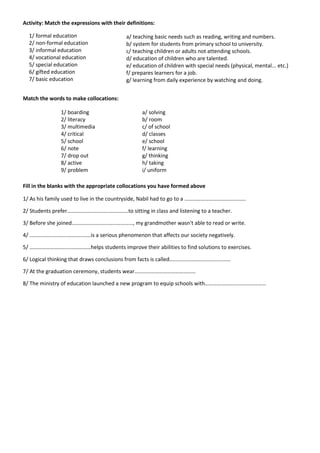
Activity: Match the expressions with their definitions:
Match the words to make collocations:
Fill in the blanks with the appropriate collocations you have formed above
1/ As his family used to live in the countryside, Nabil had to go to a ………………………………………
2/ Students prefer………………………………………to sitting in class and listening to a teacher.
3/ Before she joined………………………………………, my grandmother wasn't able to read or write.
4/ ………………………………………is a serious phenomenon that affects our society negatively.
5/ ………………………………………helps students improve their abilities to find solutions to exercises.
6/ Logical thinking that draws conclusions from facts is called………………………………………
7/ At the graduation ceremony, students wear………………………………………
8/ The ministry of education launched a new program to equip schools with………………………………………
a/ teaching basic needs such as reading, writing and numbers.
b/ system for students from primary school to university.
c/ teaching children or adults not attending schools.
d/ education of children who are talented.
e/ education of children with special needs (physical, mental... etc.)
f/ prepares learners for a job.
g/ learning from daily experience by watching and doing.
1/ formal education
2/ non-formal education
3/ informal education
4/ vocational education
5/ special education
6/ gifted education
7/ basic education
a/ solving
b/ room
c/ of school
d/ classes
e/ school
f/ learning
g/ thinking
h/ taking
i/ uniform
1/ boarding
2/ literacy
3/ multimedia
4/ critical
5/ school
6/ note
7/ drop out
8/ active
9/ problem

education_vocabulary.docx

  • 1.
    Activity: Match theexpressions with their definitions: Match the words to make collocations: Fill in the blanks with the appropriate collocations you have formed above 1/ As his family used to live in the countryside, Nabil had to go to a ……………………………………… 2/ Students prefer………………………………………to sitting in class and listening to a teacher. 3/ Before she joined………………………………………, my grandmother wasn't able to read or write. 4/ ………………………………………is a serious phenomenon that affects our society negatively. 5/ ………………………………………helps students improve their abilities to find solutions to exercises. 6/ Logical thinking that draws conclusions from facts is called……………………………………… 7/ At the graduation ceremony, students wear……………………………………… 8/ The ministry of education launched a new program to equip schools with……………………………………… a/ teaching basic needs such as reading, writing and numbers. b/ system for students from primary school to university. c/ teaching children or adults not attending schools. d/ education of children who are talented. e/ education of children with special needs (physical, mental... etc.) f/ prepares learners for a job. g/ learning from daily experience by watching and doing. 1/ formal education 2/ non-formal education 3/ informal education 4/ vocational education 5/ special education 6/ gifted education 7/ basic education a/ solving b/ room c/ of school d/ classes e/ school f/ learning g/ thinking h/ taking i/ uniform 1/ boarding 2/ literacy 3/ multimedia 4/ critical 5/ school 6/ note 7/ drop out 8/ active 9/ problem