By
Suad Alhalwachi
Education in New Zealand
Kia Ora
Welcome to New
Zealand
Welcome to New Zealand
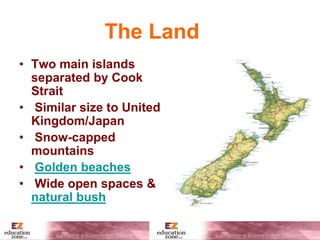
The Land
• Two main islands
separated by Cook
Strait
• Similar size to United
Kingdom/Japan
• Snow-capped
mountains
• Golden beaches
• Wide open spaces &
natural bush
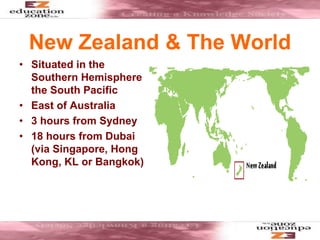
New Zealand & The World
• Situated in the
Southern Hemisphere
the South Pacific
• East of Australia
• 3 hours from Sydney
• 18 hours from Dubai
(via Singapore, Hong
Kong, KL or Bangkok)
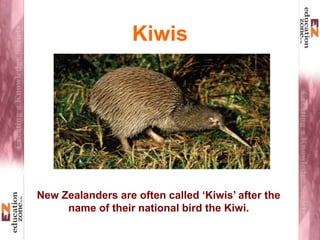
Kiwis
New Zealanders are often called ‘Kiwis’ after the
name of their national bird the Kiwi.
Kiwis - The people
•Multicultural society
•Enjoy a relaxed lifestyle
•Enjoy meeting other people
•Value independence and
equality
•English speaking
•Well known for their warm and
friendly welcome
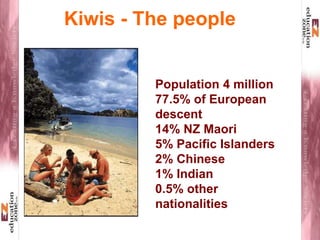
Kiwis - The people
Population 4 million
77.5% of European
descent
14% NZ Maori
5% Pacific Islanders
2% Chinese
1% Indian
0.5% other
nationalities
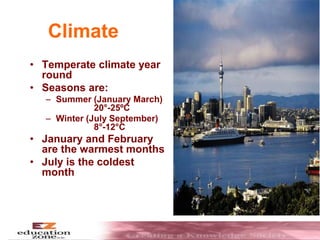
Climate
• Temperate climate year
round
• Seasons are:
– Summer (January March)
20°-25ºC
– Winter (July September)
8°-12°C
• January and February
are the warmest months
• July is the coldest
month
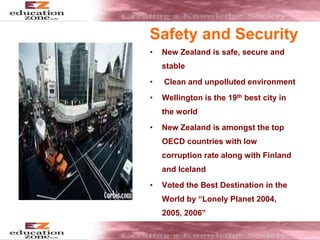
Safety and Security
• New Zealand is safe, secure and
stable
• Clean and unpolluted environment
• Wellington is the 19th best city in
the world
• New Zealand is amongst the top
OECD countries with low
corruption rate along with Finland
and Iceland
• Voted the Best Destination in the
World by “Lonely Planet 2004,
2005, 2006”
New Zealand Provides the Perfect Growing Conditions
Education System
Level Age
• Pre School 3 - 5 years
• Primary 5 - 10 years
• Intermediate 11 - 12 years
• Secondary 13 - 17 years
• Tertiary 18 + years
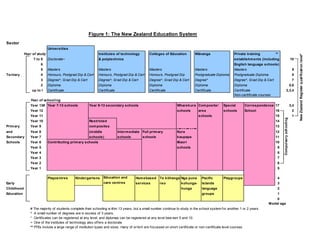
Figure 1: The New Zealand Education System
Sector
Universities
Year of study Institutes of technology Colleges of Education Wänanga Private training **
7 to 8 Doctorate~ & polytechnics establishments (including 10
6 English language schools)
5 Masters Masters Masters Masters Masters 9
Tertiary 4 Honours, Postgrad Dip & Cert Honours, Postgrad Dip & Cert Honours, Postgrad Dip Postgraduate Diploma Postgraduate Diploma 8
3 Degree^, Grad Dip & Cert Degree^, Grad Dip & Cert Degree^, Grad Dip & Cert Degree^ Degree^, Grad Dip & Cert 7
2 Diploma Diploma Diploma Diploma Diploma 5,6
up to I Certificate Certificate Certificate Certificate Certificate 2,3,4
Non-certificate courses
Year of schooling
Year 13# Year 7-13 schools Year 9-13 secondary schools Wharekura Composite/ Special Correspondence 17 3,4
Year 12 schools area schools School 16 2
Year 11 schools 15 1
Year 10 Restricted 14
Primary Year 9 composites 13
and Year 8 (middle Intermediate Full primary Kura 12
Secondary Year 7 schools) schools schools kaupapa 11
Schools Year 6 Contributing primary schools Maori 10
Year 5 schools 9
Year 4 8
Year 3 7
Year 2 6
Year 1 5
Playcentres Kindergartens Education and Homebased Te köhanga Nga puna Pacific Playgroups 4
Early care centres services reo kohunga- Islands 3
Childhood hunga language 2
Education groups 1
0
Modal age
# The majority of students complete their schooling w ithin 13 years, but a small number continue to study in the school system for another 1 or 2 years.
^ A small number of degrees are in excess of 3 years.
* Certificates can be registered at any level, and diplomas can be registered at any level bew een 5 and 10.
~ One of the institutes of technology also offers a doctorate
** PTEs include a large range of institution types and sizes, many of w hich are focussed on short certificate or non-certificate level courses
NewZealandRegisterqualificationlevel*
Compulsoryschooling
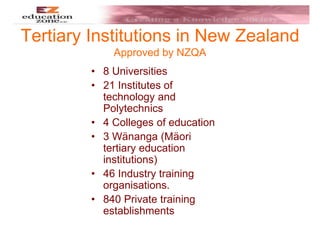
Tertiary Institutions in New Zealand
Approved by NZQA
• 8 Universities
• 21 Institutes of
technology and
Polytechnics
• 4 Colleges of education
• 3 Wänanga (Mäori
tertiary education
institutions)
• 46 Industry training
organisations.
• 840 Private training
establishments
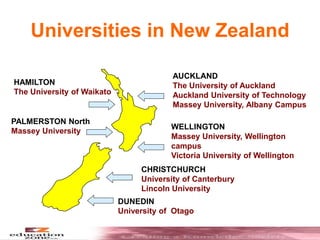
Universities in New Zealand
Welcome to New Zealand
AUCKLAND
The University of Auckland
Auckland University of Technology
Massey University, Albany Campus
WELLINGTON
Massey University, Wellington
campus
Victoria University of Wellington
CHRISTCHURCH
University of Canterbury
Lincoln University
DUNEDIN
University of Otago
PALMERSTON North
Massey University
HAMILTON
The University of Waikato
University Programmes
• Undergraduate
• Postgraduate
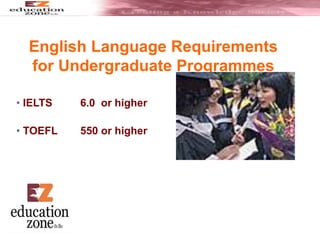
English Language Requirements
for Undergraduate Programmes
• IELTS 6.0 or higher
• TOEFL 550 or higher
University Tuition Fees
• Undergraduate
Arts DHs 38,000 – 44,000 p.a.
Commerce DHs 39,000 – 45,000 p.a.
Science DHs 40,000 – 48,000 p.a.
PHD Dhs 12000 only
NZ$1 = DHs 2.7 (October 2009)
Intakes February and July
Features of Universities
• Entry level is 13 years of schooling (American
high school 75% or above plus sat one and two may qualify
the student to skip the foundation year, CBSC 75% also
qualifies the student to enter directly into the programme)
• Research Based
• Lecturers involved in research and teaching
• Latest technology is used
• Many visiting lecturers and professors
Institutes of Technology
• 21 Institutes
• Government established
• Offer a range of programmes
• Situated throughout New Zealand
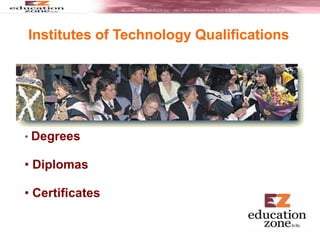
Institutes of Technology Qualifications
• Degrees
• Diplomas
• Certificates
Features of Institutes of
Technology
• Many entry levels
• Work ready graduates
• Small tutor to student ratio (15:1)
• Latest technology
• Strong industry links
Academic Entry Requirements for Institutes
of Technology
• Degree Courses ( Foundation programme
or a diploma programme)
• Diploma Courses (New Zealand Sixth Form
or Equivalent- American high school 62% or
above)
Institutes of Technology
• Intakes February and July
• Fees DHs 30,000 – 40,000 pa
English Language Providers
• Universities
• Institutes of Technology
• Private Tertiary Institutions
• Secondary Schools
• Private Language Schools
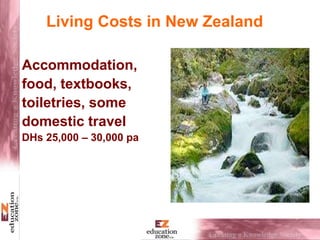
Living Costs in New Zealand
Accommodation,
food, textbooks,
toiletries, some
domestic travel
DHs 25,000 – 30,000 pa
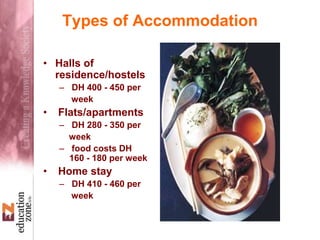
Types of Accommodation
• Halls of
residence/hostels
– DH 400 - 450 per
week
• Flats/apartments
– DH 280 - 350 per
week
– food costs DH
160 - 180 per week
• Home stay
– DH 410 - 460 per
week
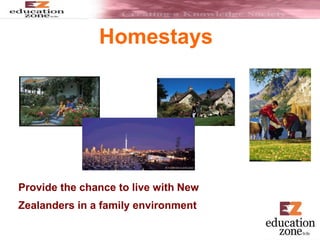
Homestays
Provide the chance to live with New
Zealanders in a family environment
• Provides the chance to live with New
Zealanders in a family environment
Support for International Students
• Additional academic support
• Counselling services:
 Courses, careers, financial, personal
• English language assistance
• Orientation and on-going support
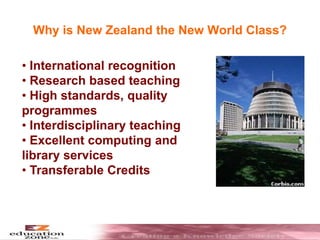
Why is New Zealand the New World Class?
• International recognition
• Research based teaching
• High standards, quality
programmes
• Interdisciplinary teaching
• Excellent computing and
library services
• Transferable Credits
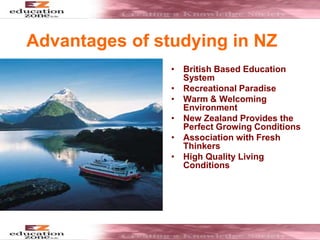
Advantages of studying in NZ
• British Based Education
System
• Recreational Paradise
• Warm & Welcoming
Environment
• New Zealand Provides the
Perfect Growing Conditions
• Association with Fresh
Thinkers
• High Quality Living
Conditions
You may apply for authorisation to work under the
following circumstances:
• to fulfil course requirements (two years and longer)
• up to 20 hrs a week for tertiary students undertaking
a long term course of study
• during the summer and New Year holiday period
• on completing your course of study
• as a postgraduate student
Studying and Working in New Zealand
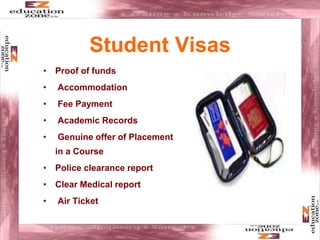
Student Visas
• Proof of funds
• Accommodation
• Fee Payment
• Academic Records
• Genuine offer of Placement
in a Course
• Police clearance report
• Clear Medical report
• Air Ticket
Help Us Create a Knowledge Society

Educationinnewzealand general-130718171203-phpapp02

  • 1.
  • 2.
    Kia Ora Welcome toNew Zealand Welcome to New Zealand
  • 3.
    The Land • Twomain islands separated by Cook Strait • Similar size to United Kingdom/Japan • Snow-capped mountains • Golden beaches • Wide open spaces & natural bush
  • 4.
    New Zealand &The World • Situated in the Southern Hemisphere the South Pacific • East of Australia • 3 hours from Sydney • 18 hours from Dubai (via Singapore, Hong Kong, KL or Bangkok)
  • 5.
    Kiwis New Zealanders areoften called ‘Kiwis’ after the name of their national bird the Kiwi.
  • 6.
    Kiwis - Thepeople •Multicultural society •Enjoy a relaxed lifestyle •Enjoy meeting other people •Value independence and equality •English speaking •Well known for their warm and friendly welcome
  • 7.
    Kiwis - Thepeople Population 4 million 77.5% of European descent 14% NZ Maori 5% Pacific Islanders 2% Chinese 1% Indian 0.5% other nationalities
  • 8.
    Climate • Temperate climateyear round • Seasons are: – Summer (January March) 20°-25ºC – Winter (July September) 8°-12°C • January and February are the warmest months • July is the coldest month
  • 9.
    Safety and Security •New Zealand is safe, secure and stable • Clean and unpolluted environment • Wellington is the 19th best city in the world • New Zealand is amongst the top OECD countries with low corruption rate along with Finland and Iceland • Voted the Best Destination in the World by “Lonely Planet 2004, 2005, 2006”
  • 10.
    New Zealand Providesthe Perfect Growing Conditions
  • 11.
    Education System Level Age •Pre School 3 - 5 years • Primary 5 - 10 years • Intermediate 11 - 12 years • Secondary 13 - 17 years • Tertiary 18 + years
  • 12.
    Figure 1: TheNew Zealand Education System Sector Universities Year of study Institutes of technology Colleges of Education Wänanga Private training ** 7 to 8 Doctorate~ & polytechnics establishments (including 10 6 English language schools) 5 Masters Masters Masters Masters Masters 9 Tertiary 4 Honours, Postgrad Dip & Cert Honours, Postgrad Dip & Cert Honours, Postgrad Dip Postgraduate Diploma Postgraduate Diploma 8 3 Degree^, Grad Dip & Cert Degree^, Grad Dip & Cert Degree^, Grad Dip & Cert Degree^ Degree^, Grad Dip & Cert 7 2 Diploma Diploma Diploma Diploma Diploma 5,6 up to I Certificate Certificate Certificate Certificate Certificate 2,3,4 Non-certificate courses Year of schooling Year 13# Year 7-13 schools Year 9-13 secondary schools Wharekura Composite/ Special Correspondence 17 3,4 Year 12 schools area schools School 16 2 Year 11 schools 15 1 Year 10 Restricted 14 Primary Year 9 composites 13 and Year 8 (middle Intermediate Full primary Kura 12 Secondary Year 7 schools) schools schools kaupapa 11 Schools Year 6 Contributing primary schools Maori 10 Year 5 schools 9 Year 4 8 Year 3 7 Year 2 6 Year 1 5 Playcentres Kindergartens Education and Homebased Te köhanga Nga puna Pacific Playgroups 4 Early care centres services reo kohunga- Islands 3 Childhood hunga language 2 Education groups 1 0 Modal age # The majority of students complete their schooling w ithin 13 years, but a small number continue to study in the school system for another 1 or 2 years. ^ A small number of degrees are in excess of 3 years. * Certificates can be registered at any level, and diplomas can be registered at any level bew een 5 and 10. ~ One of the institutes of technology also offers a doctorate ** PTEs include a large range of institution types and sizes, many of w hich are focussed on short certificate or non-certificate level courses NewZealandRegisterqualificationlevel* Compulsoryschooling
  • 13.
    Tertiary Institutions inNew Zealand Approved by NZQA • 8 Universities • 21 Institutes of technology and Polytechnics • 4 Colleges of education • 3 Wänanga (Mäori tertiary education institutions) • 46 Industry training organisations. • 840 Private training establishments
  • 14.
    Universities in NewZealand Welcome to New Zealand AUCKLAND The University of Auckland Auckland University of Technology Massey University, Albany Campus WELLINGTON Massey University, Wellington campus Victoria University of Wellington CHRISTCHURCH University of Canterbury Lincoln University DUNEDIN University of Otago PALMERSTON North Massey University HAMILTON The University of Waikato
  • 15.
  • 16.
    English Language Requirements forUndergraduate Programmes • IELTS 6.0 or higher • TOEFL 550 or higher
  • 17.
    University Tuition Fees •Undergraduate Arts DHs 38,000 – 44,000 p.a. Commerce DHs 39,000 – 45,000 p.a. Science DHs 40,000 – 48,000 p.a. PHD Dhs 12000 only NZ$1 = DHs 2.7 (October 2009) Intakes February and July
  • 18.
    Features of Universities •Entry level is 13 years of schooling (American high school 75% or above plus sat one and two may qualify the student to skip the foundation year, CBSC 75% also qualifies the student to enter directly into the programme) • Research Based • Lecturers involved in research and teaching • Latest technology is used • Many visiting lecturers and professors
  • 19.
    Institutes of Technology •21 Institutes • Government established • Offer a range of programmes • Situated throughout New Zealand
  • 20.
    Institutes of TechnologyQualifications • Degrees • Diplomas • Certificates
  • 21.
    Features of Institutesof Technology • Many entry levels • Work ready graduates • Small tutor to student ratio (15:1) • Latest technology • Strong industry links
  • 22.
    Academic Entry Requirementsfor Institutes of Technology • Degree Courses ( Foundation programme or a diploma programme) • Diploma Courses (New Zealand Sixth Form or Equivalent- American high school 62% or above)
  • 23.
    Institutes of Technology •Intakes February and July • Fees DHs 30,000 – 40,000 pa
  • 24.
    English Language Providers •Universities • Institutes of Technology • Private Tertiary Institutions • Secondary Schools • Private Language Schools
  • 25.
    Living Costs inNew Zealand Accommodation, food, textbooks, toiletries, some domestic travel DHs 25,000 – 30,000 pa
  • 26.
    Types of Accommodation •Halls of residence/hostels – DH 400 - 450 per week • Flats/apartments – DH 280 - 350 per week – food costs DH 160 - 180 per week • Home stay – DH 410 - 460 per week
  • 27.
    Homestays Provide the chanceto live with New Zealanders in a family environment • Provides the chance to live with New Zealanders in a family environment
  • 28.
    Support for InternationalStudents • Additional academic support • Counselling services:  Courses, careers, financial, personal • English language assistance • Orientation and on-going support
  • 29.
    Why is NewZealand the New World Class? • International recognition • Research based teaching • High standards, quality programmes • Interdisciplinary teaching • Excellent computing and library services • Transferable Credits
  • 30.
    Advantages of studyingin NZ • British Based Education System • Recreational Paradise • Warm & Welcoming Environment • New Zealand Provides the Perfect Growing Conditions • Association with Fresh Thinkers • High Quality Living Conditions
  • 31.
    You may applyfor authorisation to work under the following circumstances: • to fulfil course requirements (two years and longer) • up to 20 hrs a week for tertiary students undertaking a long term course of study • during the summer and New Year holiday period • on completing your course of study • as a postgraduate student Studying and Working in New Zealand
  • 32.
    Student Visas • Proofof funds • Accommodation • Fee Payment • Academic Records • Genuine offer of Placement in a Course • Police clearance report • Clear Medical report • Air Ticket
  • 33.
    Help Us Createa Knowledge Society