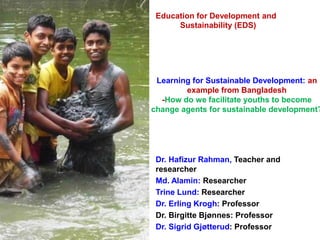
Learning for Sustainable Development: an
example from Bangladesh
-How do we facilitate youths to become
change agents for sustainable development?
Dr. Hafizur Rahman, Teacher and
researcher
Md. Alamin: Researcher
Trine Lund: Researcher
Dr. Erling Krogh: Professor
Dr. Birgitte Bjønnes: Professor
Dr. Sigrid Gjøtterud: Professor
Education for Development and
Sustainability (EDS)
Threats to sustainable development in Bangladesh
• Socially and culturally
-Poor quality of teaching
-Method: Chalk and talk; Moral, Critical
thinking??
-Content: theory, not related to the
children's everyday life
- Adults' view of children
- Children misuse time when playing
- 40% drop out of school by grade 5
- Child marriage, child labor
- Drugs, illegal labor, corruption
• Economic
31% live in poverty (UNDP, 2015)
• Free education program by/for children (grade 1-12), before/after school
• Children/youths are resources
• use learning by doing (Action learning/research: Dewey) and confluent
pedagogy (Grenstad)
Objectives are to:
- develop children/youth as change agents, sustainable development through
education
- Develop relation between Norwegian and EDS children
- fulfill the UN child rights (education, heard and seen) goals
What is Education for Development and Sustainability (EDS)?
Why have I started EDS?
Why have I included Alamin and Trine?
Feelings- sustainable development
Goal (Alamin) Lack of motivation
- social capital
Engaged
-role model (Bandura)
-meaning (Antonovsky)
Mastery
If I can do something once,
I can do it again (Bandura)
Collaborative learning
Develop empathy
School as an organization (Bronfenbrenner)
1000 children got education
64 at the university
RYLA, Norway
UN, New York
Leadership training, USA
Community of practice
in EDS:
- Scaffolding (Bruner)
- proximal zone of
development (Vygotsky)
Reflect
- on process, methods and result
- teacher’s role for a sustainable society
Develop self-understanding and
self-esteem (Klafki)
How have we developed change agents? (Modified relation model: Erling and Sigrid)
Recognition Developing relation
Giving responsibility
Inner motivation modell (Rahman et al. 2022)
Inner motivation
Stage 2
Stage 1
Stage 3
Stage 4
Developing relations/motivation
Grade 4-5 teach and guide grade 1-3 We observe when they teach
University students teach and guide grade 6-12 Grade 9-12 teach and guide grade 1-5
Give responsibility: Children teach and guide children
Giving responsibility: arranging picnic for 400
Giving responsibility: vegetable garden
Giving responsibility: shrimp and fish farming
Picnic
Distributing food
PPU students from NMBU: Recognition
EDS inspires students in Norway: Recognition
Re-flection and
critical thinking
Results of EDS
- Children develop feelings to other children
- Feel mastering –interest in learning/teaching
- Enhance self-esteem & wish to make a change in society
- New identity: change agent and motivator for change
- Self-confidence: I believe I can handle the problem!
- Reduced school dropout, child labor, child marriage
- 1000 poor children have education, 90 university students (ex-child laborers)
- Developed Alamin to EDS leader: UN New York and RYLA Norway
Outsourcing
Alamin
What is sustainable development?
How can you help us?
- How can we make EDS economically sustainable?
- How can we use EDS modell in other areas?
- Inspire EDS children to take positive initiatives.
Welcome to join our family and
community!

Education for Development and .pdf

  • 1.
    Learning for SustainableDevelopment: an example from Bangladesh -How do we facilitate youths to become change agents for sustainable development? Dr. Hafizur Rahman, Teacher and researcher Md. Alamin: Researcher Trine Lund: Researcher Dr. Erling Krogh: Professor Dr. Birgitte Bjønnes: Professor Dr. Sigrid Gjøtterud: Professor Education for Development and Sustainability (EDS)
  • 2.
    Threats to sustainabledevelopment in Bangladesh • Socially and culturally -Poor quality of teaching -Method: Chalk and talk; Moral, Critical thinking?? -Content: theory, not related to the children's everyday life - Adults' view of children - Children misuse time when playing - 40% drop out of school by grade 5 - Child marriage, child labor - Drugs, illegal labor, corruption • Economic 31% live in poverty (UNDP, 2015)
  • 3.
    • Free educationprogram by/for children (grade 1-12), before/after school • Children/youths are resources • use learning by doing (Action learning/research: Dewey) and confluent pedagogy (Grenstad) Objectives are to: - develop children/youth as change agents, sustainable development through education - Develop relation between Norwegian and EDS children - fulfill the UN child rights (education, heard and seen) goals What is Education for Development and Sustainability (EDS)?
  • 4.
    Why have Istarted EDS?
  • 5.
    Why have Iincluded Alamin and Trine?
  • 6.
    Feelings- sustainable development Goal(Alamin) Lack of motivation - social capital Engaged -role model (Bandura) -meaning (Antonovsky) Mastery If I can do something once, I can do it again (Bandura) Collaborative learning Develop empathy School as an organization (Bronfenbrenner) 1000 children got education 64 at the university RYLA, Norway UN, New York Leadership training, USA Community of practice in EDS: - Scaffolding (Bruner) - proximal zone of development (Vygotsky) Reflect - on process, methods and result - teacher’s role for a sustainable society Develop self-understanding and self-esteem (Klafki) How have we developed change agents? (Modified relation model: Erling and Sigrid) Recognition Developing relation Giving responsibility
  • 7.
    Inner motivation modell(Rahman et al. 2022) Inner motivation Stage 2 Stage 1 Stage 3 Stage 4
  • 8.
  • 9.
    Grade 4-5 teachand guide grade 1-3 We observe when they teach University students teach and guide grade 6-12 Grade 9-12 teach and guide grade 1-5 Give responsibility: Children teach and guide children
  • 10.
  • 11.
  • 12.
  • 13.
  • 14.
  • 15.
    PPU students fromNMBU: Recognition
  • 16.
    EDS inspires studentsin Norway: Recognition
  • 17.
  • 18.
    Results of EDS -Children develop feelings to other children - Feel mastering –interest in learning/teaching - Enhance self-esteem & wish to make a change in society - New identity: change agent and motivator for change - Self-confidence: I believe I can handle the problem! - Reduced school dropout, child labor, child marriage - 1000 poor children have education, 90 university students (ex-child laborers) - Developed Alamin to EDS leader: UN New York and RYLA Norway
  • 19.
  • 21.
  • 28.
    What is sustainabledevelopment?
  • 29.
    How can youhelp us? - How can we make EDS economically sustainable? - How can we use EDS modell in other areas? - Inspire EDS children to take positive initiatives.
  • 30.
    Welcome to joinour family and community!