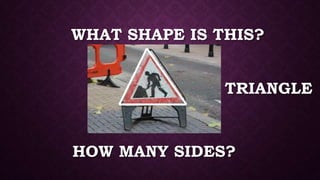
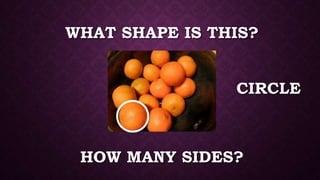
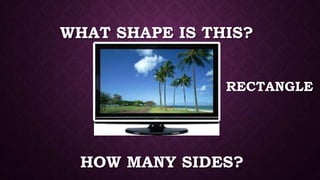
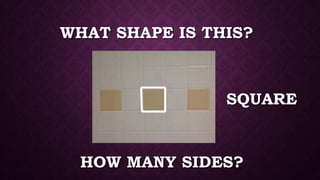
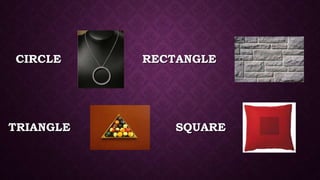
The document discusses different shapes including circle, rectangle, square and triangle. It asks questions about identifying shapes based on number of sides and shape type, and repeats shape names.
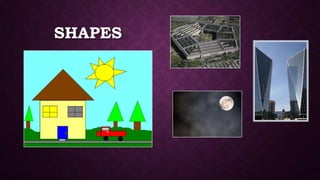
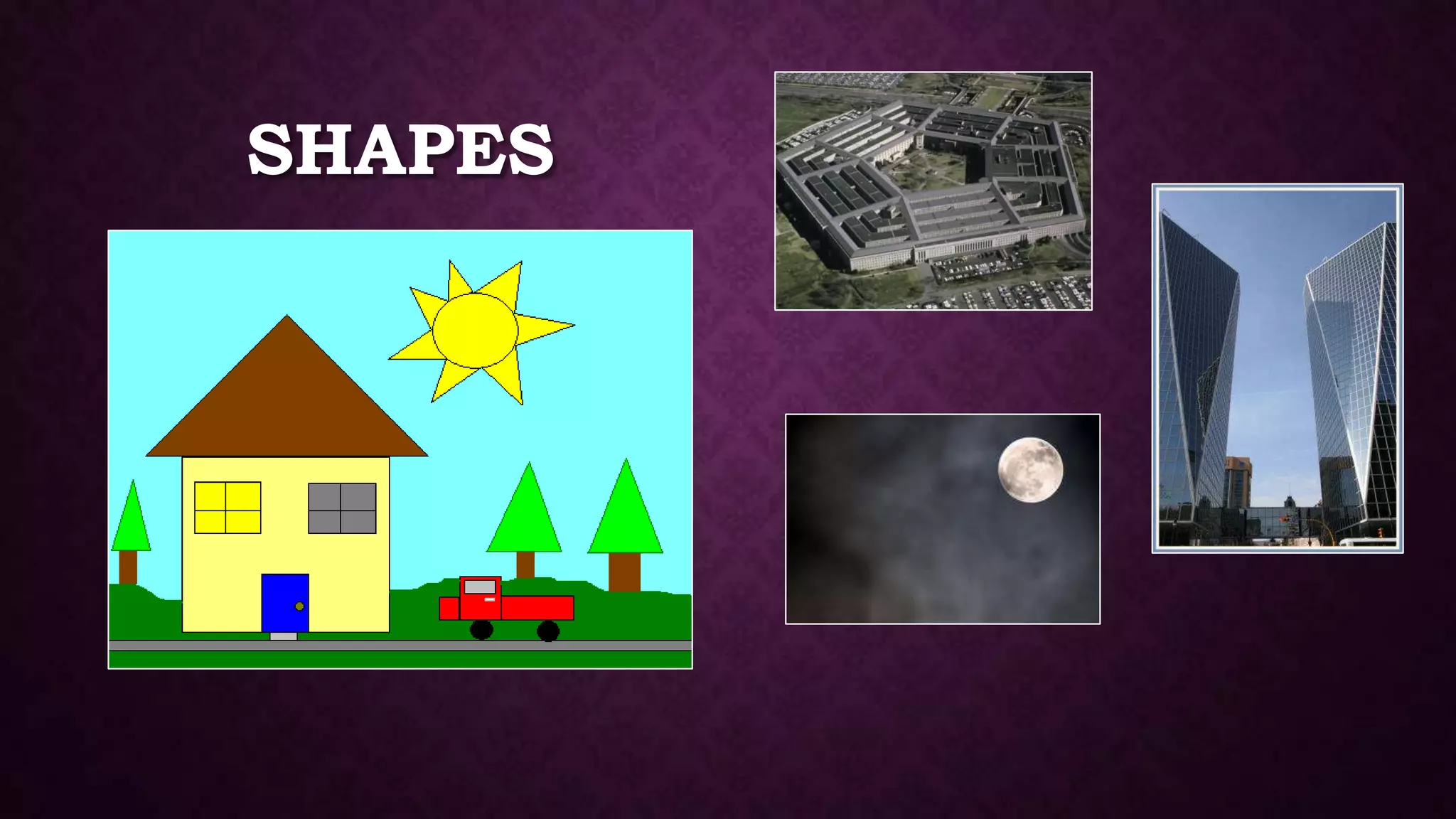
#2 Learning objective: The student will be introduced to the concept of shapes and how they occur in pictures and our every day world.SOL: The child will describe simple geometric shapes (circle, triangle, rectangle, and square).
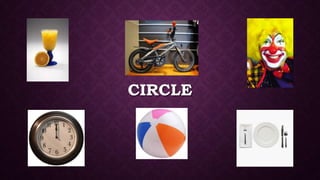
#3 Learning objective: The student will be able to view examples of circles. After discussing the characteristics of a circle, students will identify each circle on this slide with the teacher. SOL: The child will describe simple geometric shapes (circle, triangle, rectangle, and square).Design principle: I have tried to utilize arrangement of the pictures so the viewer’s eyes will revolve in a circle around the slide. I have formally balanced it to be symmetrical, because I wanted to include as several large images for examples for the students. I have used large font and do not need to have many words because my children I’m presenting to cannot read. The wording is more of a label, to help children start to associate the word “circle”, with the shape itself. I have tried to add appeal by including real life images versus clip art. The principles which apply to this slide are mostly: balance (symmetrical), legibility (large pictures), appeal (simple for my young audience), and universal design (several pictures, allows each students opportunity to connect with at least one of the pictures).
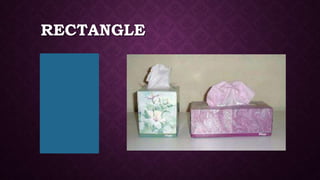
#4 Learning objective: The student will be able to view examples of a rectangle in simple, shape form and in real life objects, before discussing characteristics of the shape and hunting for more of the same shape in their own environment.SOL: The child will describe simple geometric shapes (circle, triangle, rectangle, and square).Design principle: I chose to keep the same background, font and font color, to keep the slides consistent. I used informal balance, keeping the page asymmetrical, but still visually interesting. I colored the rectangle blue in contrast with the purple background because the two colors are analogous colors and work well together, visually. Because I am working with such young children, I wanted to keep this slide very simple, giving only two real life shape pictures, in contrast with the previous slide. The principles that apply to this slide are: balance (asymmetrical – I changed from the previous slide to create visual interest), color (analogous color use), legibility (large pictures), appeal (simple for my young audience), and universal design (simple and used a photograph of something I know all of my children have seen before).
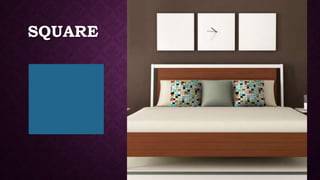
#5 Learning objective: The student will be able to listen to the teacher’s description of a square, then look for examples in the image on this slide. SOL: The child will describe simple geometric shapes (circle, triangle, rectangle, and square).Design principle: I wanted to try to stretch the image over the whole screen, but when doing that, I lost the bed, but did keep the pillows and square pictures. The reason, I chose to keep the whole picture is because I am working with young children who would benefit in seeing the whole bed with the square pillows in context. I kept the same background, font size and font color to be consistent with the previous slides. Again, I chose to be very simple in my design, with minimal wording – using a label instead of a sentence. I am trying to vary my slide images from including many, to few to one, to keep the visual interest of the whole presentation. In this slide, I have one picture with several examples of a square.The principles that apply to this slide are: balance (symmetrical), legibility (simple wording and clear large picture), appeal (simple for my young audience), and universal design (using a picture all children in my daycare can relate to).
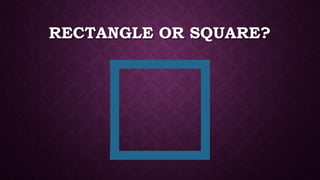
#6 Learning objective: The student will be able to view a square and see that it is made up of four equal sides.SOL: The child will describe simple geometric shapes (circle, triangle, rectangle, and square).Design principle: In this slide, I wanted to demonstrate to the students the characteristic of a square – that it has four equal sides. To do that, I used the animation feature. In designing it, I kept the color of the shape consistent with the rectangle on slide two, again, using colors that are analogous. The slide starts out with a square in the middle, and ends with equal sized lines spread across the slide. Both are laid out in a symmetrically balanced way. The principles that apply to this slide are: balance (simple and symmetrical), color (analogous), legibility (large shape and simple wording), appeal (simple for young children, yet interesting because of the movement), and universal design (designed to meet the objective for all my students).
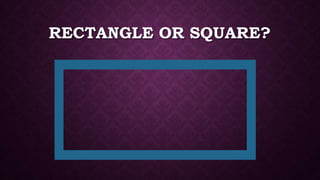
#7 Learning objective: The student will be able to view a rectangle and see that it is made up of two sets of equal sides.SOL: The child will describe simple geometric shapes (circle, triangle, rectangle, and square).Design principle: In this slide, I wanted to demonstrate to the students the characteristic of a rectangle– that it has two sets of equal sides. To do that, I used the animation feature. In designing it, I kept the color of the shape consistent with the rectangle on slide two, again, using colors that are analogous. The slide starts out with a rectangle in the middle, and ends with lines spaced down the middle of the slide. Both are laid out in a symmetrically balanced way. I also wanted it to be similar to slide four in that it help emphasize the differences between a square and a rectangle. One thing that really bothers me about the final position of the last side, is that it does not match up exactly with the ends of the side above it. No matter how hard I tried to maneuver it, the side kept “locking” into position, and it would not allow me to line them up exactly. I decided to leave it, because it still demonstrates the objective – that a rectangle is made up of two sets of equal sides. The principles that apply to this slide are: balance (simple and symmetrical), color (analogous), legibility (large picture and simple repeated labels), appeal (simple for young children, movement which creates interest), and universal design (designed to meet the objective for each of my students).
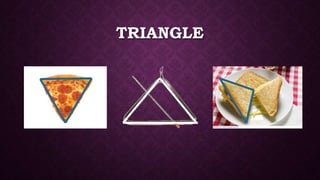
#8 Learning objective: The student will be able to view a triangle and see that it is made up of three straight sides.SOL: The child will describe simple geometric shapes (circle, triangle, rectangle, and square).Design principle: I have kept the same theme, font, font color – to keep the whole presentation consistent. Again, I have balanced the slides symmetrically, mainly because I want the focus to be on the pictures. I have added real life pictures, versus clip art, because I want the students to see that shapes occur everywhere in real life. After viewing the pictures, I added an animation aspect to emphasize the fact that each triangle has three straight sides. I kept the color of the triangle consistent with the whole presentation. I chose to make the center triangle white, because I felt that when using the blue, it was not as easy to see as using a highly contrasting color, like white. The principles that apply to this slide are: balance (symmetrical), color (analogous), legibility (used white in the center to increase legibility), appeal (simple and has added animations to add interest), and universal design (used photographs of things the students have seen in my daycare).
#9 Learning objective: The student will look at a shape, determine what it is, then check by counting the sides of the shape.SOL: The child will describe simple geometric shapes (circle, triangle, rectangle, and square).
#10 Learning objective: The student will look at a shape, determine what it is, then check by counting the sides of the shape.SOL: The child will describe simple geometric shapes (circle, triangle, rectangle, and square).
#11 Learning objective: The student will look at a shape, determine what it is, then check by counting the sides of the shape.SOL: The child will describe simple geometric shapes (circle, triangle, rectangle, and square).
#12 Learning objective: The student will look at a shape, determine what it is, then check by counting the sides of the shape.SOL: The child will describe simple geometric shapes (circle, triangle, rectangle, and square).
#13 Learning objective: The teacher will close with discussing the 4 shapes, their characteristics, and giving a real life example.SOL: The child will describe simple geometric shapes (circle, triangle, rectangle, and square).