WEEK 2- 1/14 1
EDT 4608
DATA COMMUNICATION & COMPUTER
NETWORKING
Introduction to Data
Communication
WEEK 1- 2/14 2
DATA REPRESENTATION
Refers to the methods used internally to represent information stored
in a computer.
Human speech is analog because it uses continuous (wave form)
signals that vary in strength and quality
WEEK 1- 2/14 3
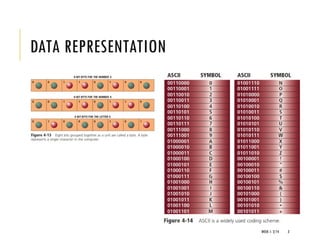
DATA REPRESENTATION
WEEK 1- 2/14 4
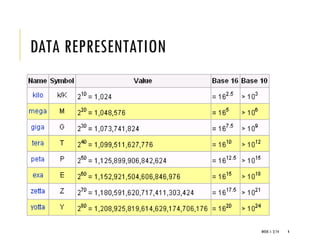
DATA REPRESENTATION
WEEK 1- 2/14 5
ENCODING
Encoding is the process of converting data from one form to another.
WEEK 1- 2/14 6
TYPE OF ENCODING
1. Analog to analog encoding
2. Analog to digital encoding
3. Digital to analog encoding
4. Digital to digital encoding
WEEK 1- 2/14 7
DATA ENCODING AND DECODING
 Data Encoding is the process of putting a sequence of characters
(letters, numbers, punctuation, and certain symbols) into a
specialized format for efficient transmission or storage.
 Decoding is the opposite process -- the conversion of an encoded
format back into the original sequence of characters.
WEEK 1- 2/14 8
DIGITAL TO ANALOG ENCODING
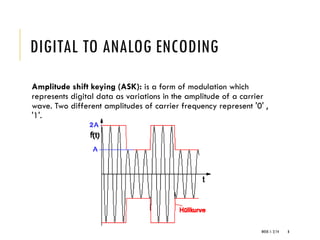
Amplitude shift keying (ASK): is a form of modulation which
represents digital data as variations in the amplitude of a carrier
wave. Two different amplitudes of carrier frequency represent '0' ,
'1'.
WEEK 1- 2/14 9
DIGITAL TO ANALOG ENCODING
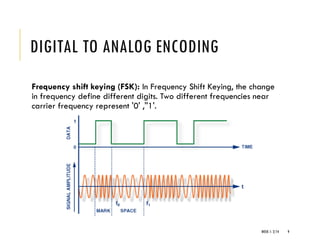
Frequency shift keying (FSK): In Frequency Shift Keying, the change
in frequency define different digits. Two different frequencies near
carrier frequency represent '0' ,''1'.
WEEK 1- 2/14 10
DIGITAL TO ANALOG ENCODING
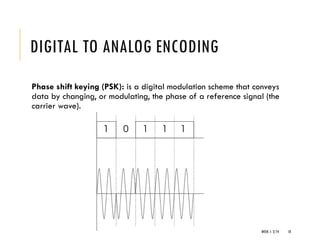
Phase shift keying (PSK): is a digital modulation scheme that conveys
data by changing, or modulating, the phase of a reference signal (the
carrier wave).
WEEK 1- 2/14 11
DATA MODULATION
Modulation is a process of mixing a signal with a sinusoid to produce
a new signal. This new signal, conceivably, will have certain benefits
over an un-modulated signal, especially during transmission.
Data modulation is a process of blending data into a carrier signal.
At the receiving side, a device demodulates the signals by separating
the constant carrier signals from the variable data signals
WEEK 1- 2/14 12
TYPE OF MODULATION
Amplitute Modulation (AM)
 a type of modulation where the amplitude of the carrier signal is modulated
(changed) in proportion to the message signal while the frequency and phase are
kept constant.
Frequency Modulation (FM)
 a type of modulation where the frequency of the carrier signal is modulated
(changed) in proportion to the message signal while the amplitude and phase are
kept constant.
Phase Modulation (PM)
 a type of modulation where the phase of the carrier signal is varied accordance to
the low frequency of the message signal is known as phase modulation.
WEEK 1- 2/14 13
MODEM – MODULATOR/DEMODULATOR
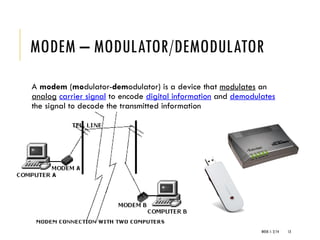
A modem (modulator-demodulator) is a device that modulates an
analog carrier signal to encode digital information and demodulates
the signal to decode the transmitted information
WEEK 1- 2/14 14
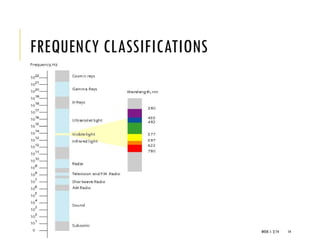
FREQUENCY CLASSIFICATIONS
WEEK 1- 2/14 15
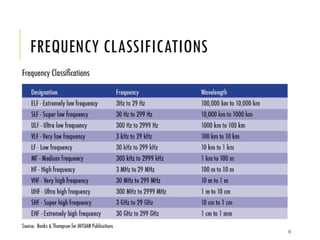
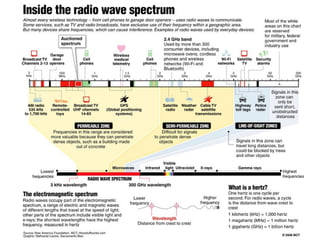
FREQUENCY CLASSIFICATIONS
WEEK 1- 2/14 16
WEEK 1- 2/14 17
MODE OF DATA TRANSMISSION
Serial & Parallel
Synchronous and asynchronous,
Simplex, Full duplex and half duplex;
WEEK 1- 2/14 18
DIFFERENCE BETWEEN SERIAL AND
PARALLEL TRANSMISSION
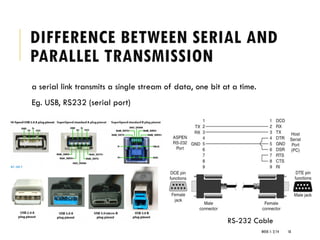
a serial link transmits a single stream of data, one bit at a time.
Eg. USB, RS232 (serial port)
RS-232 Cable
WEEK 1- 2/14 19
DIFFERENCE BETWEEN SERIAL AND
PARALLEL TRANSMISSION
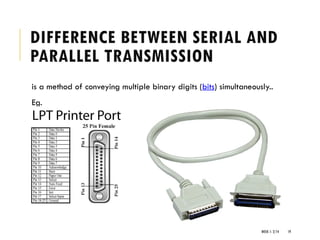
is a method of conveying multiple binary digits (bits) simultaneously..
Eg.
WEEK 1- 2/14 20
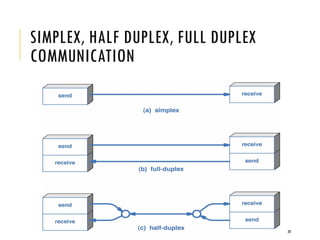
SIMPLEX, HALF DUPLEX, FULL DUPLEX
COMMUNICATION
WEEK 1- 2/14 21
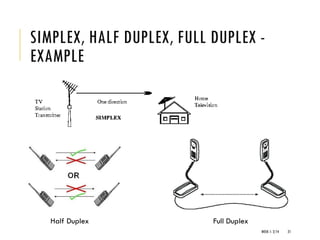
SIMPLEX, HALF DUPLEX, FULL DUPLEX -
EXAMPLE
Half Duplex Full Duplex
WEEK 1- 2/14 22
SYNCHRONOUS AND ASYNCHRONOUS
COMMUNICATION
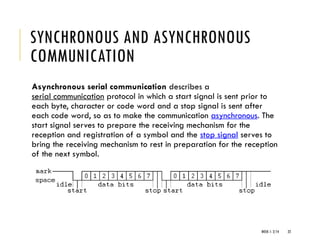
Asynchronous serial communication describes a
serial communication protocol in which a start signal is sent prior to
each byte, character or code word and a stop signal is sent after
each code word, so as to make the communication asynchronous. The
start signal serves to prepare the receiving mechanism for the
reception and registration of a symbol and the stop signal serves to
bring the receiving mechanism to rest in preparation for the reception
of the next symbol.
WEEK 1- 2/14 23
SYNCHRONOUS AND ASYNCHRONOUS
COMMUNICATION
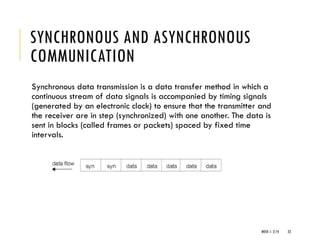
Synchronous data transmission is a data transfer method in which a
continuous stream of data signals is accompanied by timing signals
(generated by an electronic clock) to ensure that the transmitter and
the receiver are in step (synchronized) with one another. The data is
sent in blocks (called frames or packets) spaced by fixed time
intervals.

EDT 4608 -PART 3 DATA COMMUNICATION AND COMPUTER NETWORKING

  • 1.
    WEEK 2- 1/141 EDT 4608 DATA COMMUNICATION & COMPUTER NETWORKING Introduction to Data Communication
  • 2.
    WEEK 1- 2/142 DATA REPRESENTATION Refers to the methods used internally to represent information stored in a computer. Human speech is analog because it uses continuous (wave form) signals that vary in strength and quality
  • 3.
    WEEK 1- 2/143 DATA REPRESENTATION
  • 4.
    WEEK 1- 2/144 DATA REPRESENTATION
  • 5.
    WEEK 1- 2/145 ENCODING Encoding is the process of converting data from one form to another.
  • 6.
    WEEK 1- 2/146 TYPE OF ENCODING 1. Analog to analog encoding 2. Analog to digital encoding 3. Digital to analog encoding 4. Digital to digital encoding
  • 7.
    WEEK 1- 2/147 DATA ENCODING AND DECODING  Data Encoding is the process of putting a sequence of characters (letters, numbers, punctuation, and certain symbols) into a specialized format for efficient transmission or storage.  Decoding is the opposite process -- the conversion of an encoded format back into the original sequence of characters.
  • 8.
    WEEK 1- 2/148 DIGITAL TO ANALOG ENCODING Amplitude shift keying (ASK): is a form of modulation which represents digital data as variations in the amplitude of a carrier wave. Two different amplitudes of carrier frequency represent '0' , '1'.
  • 9.
    WEEK 1- 2/149 DIGITAL TO ANALOG ENCODING Frequency shift keying (FSK): In Frequency Shift Keying, the change in frequency define different digits. Two different frequencies near carrier frequency represent '0' ,''1'.
  • 10.
    WEEK 1- 2/1410 DIGITAL TO ANALOG ENCODING Phase shift keying (PSK): is a digital modulation scheme that conveys data by changing, or modulating, the phase of a reference signal (the carrier wave).
  • 11.
    WEEK 1- 2/1411 DATA MODULATION Modulation is a process of mixing a signal with a sinusoid to produce a new signal. This new signal, conceivably, will have certain benefits over an un-modulated signal, especially during transmission. Data modulation is a process of blending data into a carrier signal. At the receiving side, a device demodulates the signals by separating the constant carrier signals from the variable data signals
  • 12.
    WEEK 1- 2/1412 TYPE OF MODULATION Amplitute Modulation (AM)  a type of modulation where the amplitude of the carrier signal is modulated (changed) in proportion to the message signal while the frequency and phase are kept constant. Frequency Modulation (FM)  a type of modulation where the frequency of the carrier signal is modulated (changed) in proportion to the message signal while the amplitude and phase are kept constant. Phase Modulation (PM)  a type of modulation where the phase of the carrier signal is varied accordance to the low frequency of the message signal is known as phase modulation.
  • 13.
    WEEK 1- 2/1413 MODEM – MODULATOR/DEMODULATOR A modem (modulator-demodulator) is a device that modulates an analog carrier signal to encode digital information and demodulates the signal to decode the transmitted information
  • 14.
    WEEK 1- 2/1414 FREQUENCY CLASSIFICATIONS
  • 15.
    WEEK 1- 2/1415 FREQUENCY CLASSIFICATIONS
  • 16.
  • 17.
    WEEK 1- 2/1417 MODE OF DATA TRANSMISSION Serial & Parallel Synchronous and asynchronous, Simplex, Full duplex and half duplex;
  • 18.
    WEEK 1- 2/1418 DIFFERENCE BETWEEN SERIAL AND PARALLEL TRANSMISSION a serial link transmits a single stream of data, one bit at a time. Eg. USB, RS232 (serial port) RS-232 Cable
  • 19.
    WEEK 1- 2/1419 DIFFERENCE BETWEEN SERIAL AND PARALLEL TRANSMISSION is a method of conveying multiple binary digits (bits) simultaneously.. Eg.
  • 20.
    WEEK 1- 2/1420 SIMPLEX, HALF DUPLEX, FULL DUPLEX COMMUNICATION
  • 21.
    WEEK 1- 2/1421 SIMPLEX, HALF DUPLEX, FULL DUPLEX - EXAMPLE Half Duplex Full Duplex
  • 22.
    WEEK 1- 2/1422 SYNCHRONOUS AND ASYNCHRONOUS COMMUNICATION Asynchronous serial communication describes a serial communication protocol in which a start signal is sent prior to each byte, character or code word and a stop signal is sent after each code word, so as to make the communication asynchronous. The start signal serves to prepare the receiving mechanism for the reception and registration of a symbol and the stop signal serves to bring the receiving mechanism to rest in preparation for the reception of the next symbol.
  • 23.
    WEEK 1- 2/1423 SYNCHRONOUS AND ASYNCHRONOUS COMMUNICATION Synchronous data transmission is a data transfer method in which a continuous stream of data signals is accompanied by timing signals (generated by an electronic clock) to ensure that the transmitter and the receiver are in step (synchronized) with one another. The data is sent in blocks (called frames or packets) spaced by fixed time intervals.