The European Commission’s science
and knowledge service
Joint Research Centre
Entrepreneurial Discovery Process:
An introduction
Elisabetta Marinelli, PhD
Magdeburg, 8th March 2018
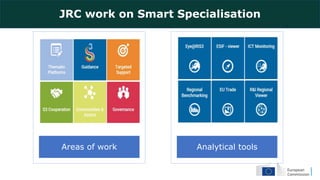
JRC work on Smart Specialisation
Areas of work Analytical tools
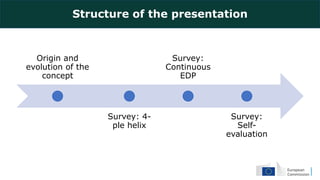
Structure of the presentation
Origin and
evolution of the
concept
Survey: 4-
ple helix
Survey:
Continuous
EDP
Survey:
Self-
evaluation
Legal basis
• S3s shall be developed through involving […]
managing authorities and stakeholders […] in
an entrepreneurial discovery process.
• ERDF Regulation
EDP: the legal basis
Entrepreneurial Discovery Process (EDP) – Evolution of the
concept
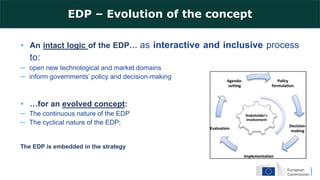
• An intact logic of the EDP… as interactive and inclusive process
to:
─ open new technological and market domains
─ inform governments’ policy and decision-making
• …for an evolved concept:
─ The continuous nature of the EDP
─ The cyclical nature of the EDP;
The EDP is embedded in the strategy
EDP – Evolution of the concept
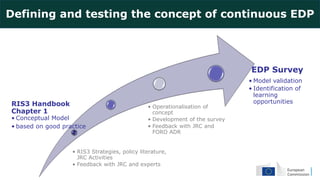
Defining and testing the concept of continuous EDP
• RIS3 Strategies, policy literature,
JRC Activities
• Feedback with JRC and experts
RIS3 Handbook
Chapter 1
• Conceptual Model
• based on good practice
• Operationalisation of
concept
• Development of the survey
• Feedback with JRC and
FORO ADR
EDP Survey
• Model validation
• Identification of
learning
opportunities
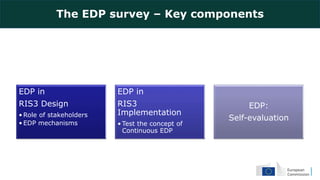
The EDP survey – Key components
EDP in
RIS3 Design
• Role of stakeholders
• EDP mechanisms
EDP in
RIS3
Implementation
• Test the concept of
Continuous EDP
EDP:
Self-evaluation
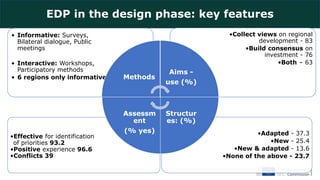
EDP in the design phase: key features
•Adapted - 37.3
•New - 25.4
•New & adapted - 13.6
•None of the above - 23.7
•Effective for identification
of priorities 93.2
•Positive experience 96.6
•Conflicts 39
•Collect views on regional
development - 83
•Build consensus on
investment - 76
•Both – 63
• Informative: Surveys,
Bilateral dialogue, Public
meetings
• Interactive: Workshops,
Participatory methods
• 6 regions only informative Methods
Aims -
use (%)
Structur
es: (%)
Assessm
ent
(% yes)
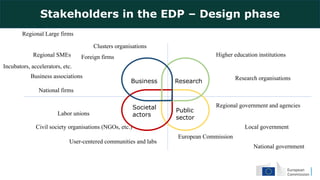
Stakeholders in the EDP – Design phase
Higher education institutions
Research organisations
Regional government and agencies
Local government
European Commission
National government
Regional SMEs
Regional Large firms
Business associations
Clusters organisations
Incubators, accelerators, etc.
Foreign firms
National firms
Civil society organisations (NGOs, etc.)
Labor unions
User-centered communities and labs
Business Research
Societal
actors
Public
sector
Invited?
No
Yes
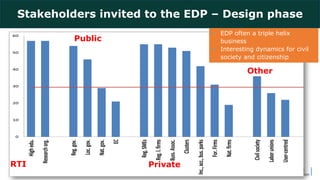
Stakeholders in the EDP – Design phase
0
10
20
30
40
50
60
High
edu.
Research
org.
Reg.
gov.
Loc.
gov.
Nat.
gov.
EC
Reg.
SMEs
Reg.
l.
firms
Buss.
Assoc.
Clusters
Inc.,
acc.,
bus.
parks
For.
Firms
Nat.
firms
Civil
society
Labor
unions
User-centred
Media
RTI
Public
Private
Other
Stakeholders invited to the EDP – Design phase
• EDP often a triple helix
business
• Interesting dynamics for civil
society and citizenship
Invited?
No
Yes Engagement
Desired
Actual
Expected
Stakeholders in the EDP – Design phase
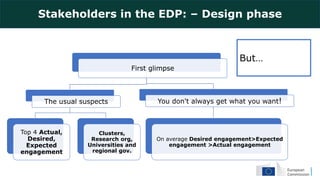
Stakeholders in the EDP: – Design phase
First glimpse
The usual suspects
Top 4 Actual,
Desired,
Expected
engagement
Clusters,
Research org,
Universities and
regional gov.
You don't always get what you want!
On average Desired engagement>Expected
engagement >Actual engagement
But…
Invited?
No
Yes Engagement
Desired
Actual
Expected
Stakeholders in the EDP – Design phase
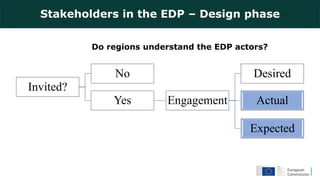
Do regions understand the EDP actors?
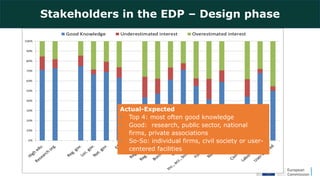
Stakeholders in the EDP – Design phase
Actual-Expected
• Top 4: most often good knowledge
• Good: research, public sector, national
firms, private associations
• So-So: individual firms, civil society or user-
centered facilities
Invited?
No
Yes Engagement
Desired
Actual
Expected
Stakeholders in the EDP – Design phase
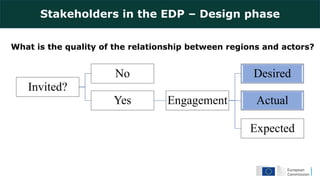
What is the quality of the relationship between regions and actors?
0%
10%
20%
30%
40%
50%
60%
70%
80%
90%
100%
Satisfactory Intrusive Unsatisfactory
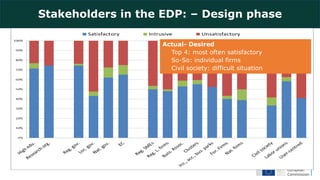
Stakeholders in the EDP: – Design phase
Actual- Desired
• Top 4: most often satisfactory
• So-So: individual firms
• Civil society: difficult situation
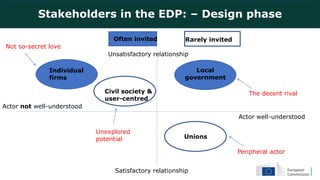
Stakeholders in the EDP: – Design phase
Unsatisfactory relationship
Actor not well-understood
Actor well-understood
Often invited Rarely invited
Individual
firms
Local
government
Civil society &
user-centred
Unions
Satisfactory relationship
The decent rival
Unexplored
potential
Not so-secret love
Peripheral actor
PART II
EDP survey – results
in the RIS3 implementation
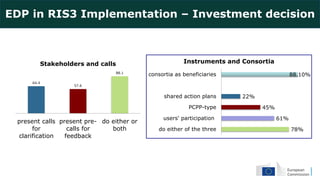
64.4
57.6
88.1
present calls
for
clarification
present pre-
calls for
feedback
do either or
both
Stakeholders and calls
78%
61%
45%
22%
88.10%
do either of the three
users' participation
PCPP-type
shared action plans
consortia as beneficiaries
Instruments and Consortia
EDP in RIS3 Implementation – Investment decision
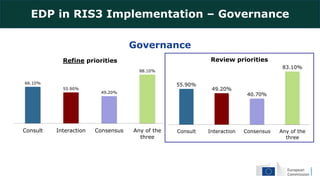
Governance
66.10%
55.90%
49.20%
88.10%
Consult Interaction Consensus Any of the
three
Refine priorities
55.90%
49.20%
40.70%
83.10%
Consult Interaction Consensus Any of the
three
Review priorities
EDP in RIS3 Implementation – Governance
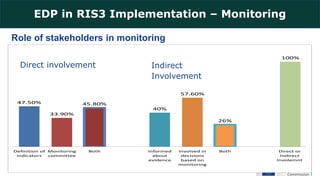
Role of stakeholders in monitoring
47.50%
33.90%
45.80%
40%
57.60%
26%
100%
Definition of
indicators
Monitoring
committee
Both Informed
about
evidence
Involved in
decisions
based on
monitoring
Both Direct or
Indirect
Involemnt
Direct involvement Indirect
Involvement
EDP in RIS3 Implementation – Monitoring
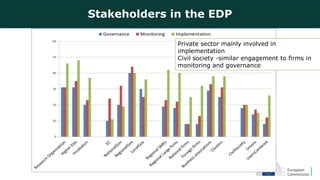
Stakeholders in the EDP
Private sector mainly involved in
implementation
Civil society -similar engagement to firms in
monitoring and governance
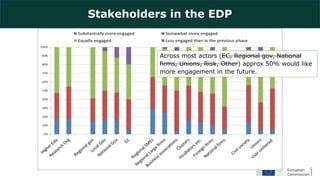
Stakeholders in the EDP
Across most actors (EC, Regional gov, National
firms, Unions, Risk, Other) approx 50% would like
more engagement in the future.
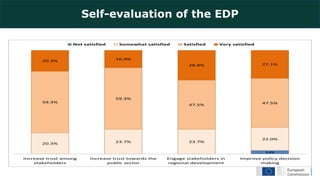
3.4%
20.3% 23.7% 23.7%
22.0%
59.3%
59.3%
47.5% 47.5%
20.3% 16.9%
28.8% 27.1%
Increase trust among
stakeholders
Increase trust towards the
public sector
Engage stakeholders in
regional development
Improve policy decision
making
Not satisfied Somewhat satisfied Satisfied Very satisfied
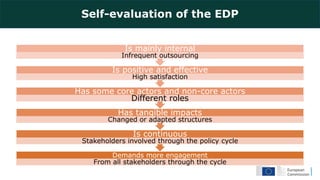
Self-evaluation of the EDP
Demands more engagement
From all stakeholders through the cycle
Is continuous
Stakeholders involved through the policy cycle
Has tangible impacts
Changed or adapted structures
Has some core actors and non-core actors
Different roles
Is positive and effective
High satisfaction
Is mainly internal
Infrequent outsourcing
Self-evaluation of the EDP
Many thanks!
Any question?

EDP PPT PXL.pptx

  • 1.
    The European Commission’sscience and knowledge service Joint Research Centre
  • 2.
    Entrepreneurial Discovery Process: Anintroduction Elisabetta Marinelli, PhD Magdeburg, 8th March 2018
  • 3.
    JRC work onSmart Specialisation Areas of work Analytical tools
  • 4.
    Structure of thepresentation Origin and evolution of the concept Survey: 4- ple helix Survey: Continuous EDP Survey: Self- evaluation
  • 5.
    Legal basis • S3sshall be developed through involving […] managing authorities and stakeholders […] in an entrepreneurial discovery process. • ERDF Regulation EDP: the legal basis
  • 6.
    Entrepreneurial Discovery Process(EDP) – Evolution of the concept • An intact logic of the EDP… as interactive and inclusive process to: ─ open new technological and market domains ─ inform governments’ policy and decision-making • …for an evolved concept: ─ The continuous nature of the EDP ─ The cyclical nature of the EDP; The EDP is embedded in the strategy EDP – Evolution of the concept
  • 7.
    Defining and testingthe concept of continuous EDP • RIS3 Strategies, policy literature, JRC Activities • Feedback with JRC and experts RIS3 Handbook Chapter 1 • Conceptual Model • based on good practice • Operationalisation of concept • Development of the survey • Feedback with JRC and FORO ADR EDP Survey • Model validation • Identification of learning opportunities
  • 8.
    The EDP survey– Key components EDP in RIS3 Design • Role of stakeholders • EDP mechanisms EDP in RIS3 Implementation • Test the concept of Continuous EDP EDP: Self-evaluation
  • 9.
    EDP in thedesign phase: key features •Adapted - 37.3 •New - 25.4 •New & adapted - 13.6 •None of the above - 23.7 •Effective for identification of priorities 93.2 •Positive experience 96.6 •Conflicts 39 •Collect views on regional development - 83 •Build consensus on investment - 76 •Both – 63 • Informative: Surveys, Bilateral dialogue, Public meetings • Interactive: Workshops, Participatory methods • 6 regions only informative Methods Aims - use (%) Structur es: (%) Assessm ent (% yes)
  • 10.
    Stakeholders in theEDP – Design phase Higher education institutions Research organisations Regional government and agencies Local government European Commission National government Regional SMEs Regional Large firms Business associations Clusters organisations Incubators, accelerators, etc. Foreign firms National firms Civil society organisations (NGOs, etc.) Labor unions User-centered communities and labs Business Research Societal actors Public sector
  • 11.
  • 12.
  • 13.
  • 14.
    Stakeholders in theEDP: – Design phase First glimpse The usual suspects Top 4 Actual, Desired, Expected engagement Clusters, Research org, Universities and regional gov. You don't always get what you want! On average Desired engagement>Expected engagement >Actual engagement But…
  • 15.
    Invited? No Yes Engagement Desired Actual Expected Stakeholders inthe EDP – Design phase Do regions understand the EDP actors?
  • 16.
    Stakeholders in theEDP – Design phase Actual-Expected • Top 4: most often good knowledge • Good: research, public sector, national firms, private associations • So-So: individual firms, civil society or user- centered facilities
  • 17.
    Invited? No Yes Engagement Desired Actual Expected Stakeholders inthe EDP – Design phase What is the quality of the relationship between regions and actors?
  • 18.
    0% 10% 20% 30% 40% 50% 60% 70% 80% 90% 100% Satisfactory Intrusive Unsatisfactory Stakeholdersin the EDP: – Design phase Actual- Desired • Top 4: most often satisfactory • So-So: individual firms • Civil society: difficult situation
  • 19.
    Stakeholders in theEDP: – Design phase Unsatisfactory relationship Actor not well-understood Actor well-understood Often invited Rarely invited Individual firms Local government Civil society & user-centred Unions Satisfactory relationship The decent rival Unexplored potential Not so-secret love Peripheral actor
  • 20.
    PART II EDP survey– results in the RIS3 implementation
  • 21.
    64.4 57.6 88.1 present calls for clarification present pre- callsfor feedback do either or both Stakeholders and calls 78% 61% 45% 22% 88.10% do either of the three users' participation PCPP-type shared action plans consortia as beneficiaries Instruments and Consortia EDP in RIS3 Implementation – Investment decision
  • 22.
    Governance 66.10% 55.90% 49.20% 88.10% Consult Interaction ConsensusAny of the three Refine priorities 55.90% 49.20% 40.70% 83.10% Consult Interaction Consensus Any of the three Review priorities EDP in RIS3 Implementation – Governance
  • 23.
    Role of stakeholdersin monitoring 47.50% 33.90% 45.80% 40% 57.60% 26% 100% Definition of indicators Monitoring committee Both Informed about evidence Involved in decisions based on monitoring Both Direct or Indirect Involemnt Direct involvement Indirect Involvement EDP in RIS3 Implementation – Monitoring
  • 24.
    Stakeholders in theEDP Private sector mainly involved in implementation Civil society -similar engagement to firms in monitoring and governance
  • 25.
    Stakeholders in theEDP Across most actors (EC, Regional gov, National firms, Unions, Risk, Other) approx 50% would like more engagement in the future.
  • 26.
    3.4% 20.3% 23.7% 23.7% 22.0% 59.3% 59.3% 47.5%47.5% 20.3% 16.9% 28.8% 27.1% Increase trust among stakeholders Increase trust towards the public sector Engage stakeholders in regional development Improve policy decision making Not satisfied Somewhat satisfied Satisfied Very satisfied Self-evaluation of the EDP
  • 27.
    Demands more engagement Fromall stakeholders through the cycle Is continuous Stakeholders involved through the policy cycle Has tangible impacts Changed or adapted structures Has some core actors and non-core actors Different roles Is positive and effective High satisfaction Is mainly internal Infrequent outsourcing Self-evaluation of the EDP
  • 28.

Editor's Notes

  • #7 The cyclical nature of the EDP: Discovering or learning what a country or a region is good at requires an investment in a concrete process of exploration. However, the experience accumulated over the past five years has shown that this is only the initial step of EDP. In other words, the EDP in practice goes beyond the prioritisation phase and the subsequent related investments. Hausmann & Rodrik (2003). It is critical to ensure continuity to the EDP. Breaking the EDP means disrupting a trust-building process that is crucial for the sustainability of the S3 itself. The new role of government: The inclusive governance and evidence-based policy, required for the EDP, demands that the public sector acts as a platform to enable targeted stakeholders’ interaction and policy coordination. This should sustain and guide stakeholders’ participation across the entire policy cycle. Here, the government operates as a service provider enabling its user community. As such, the EDP brings new opportunities to policy- makers, as well as important challenges. O’Reilly, (2010). The need to adapt EDP to contextual factors: The afore-mentioned challenges need to be addressed starting from the contextual factors. At the core of the S3 concept lays the conviction that development paths are place-based, which is why one EDP size does not fit all. A place-based approach is about extracting and building on local knowledge with the aim to mobilise it nationally and internationally, taking into account local specificities and constraints McCann and Ortega-Argilés (2015). The local, regional, national or transnational structures for EDP: The EDP approach has triggered new institutional arrangements beyond the regional scale. Such structures are based on the awareness that ‘bottom-up approaches’, which mobilise stakeholders in the pursuit of innovation and which requires multiple points of view to combine technology with market opportunities, have the potential to add value at different levels.
  • #10 Informative: Surveys, Bilateral dialogue, Public meetings Interactive: Workshops, Participatory methods (6 regions only informative)
  • #13 Frequency of stakeholders as expected.,. Virtually everyone invited HEIs and Research sectors… in fact I think there is a mistake about Emilia Romagna. Public and Business sector – clear preference for local/regional actors and institutionalised ones (business associations/clusters) "Other" unsurprisingly less represented! Civil Society and Users' centered most interesting to follow-up. They are closer to citizenship . Unions – institutionalised presence they are often invited. Other includes a mix of civil society and various socio-economic actors, peripheral to the innovation systems. Frequency is correlated with the role stakeholders are expected to have in the EDP process as indicated in the next slide
  • #19 TOP
  • #25 Local firms more than 50% would like them more engaged. Same with Civil society (i.e. fairly frequent invited stakeholders). Approx 25% want local firms substantially more involved. Opportunity – get those who are satisfied with the involvement to chat with those who are not It seems that there were some bad experiences in relation to Risk Capital (anyways not frequently invited). EC – more than 50% Equally engaged or less engaged!
  • #27 High levels of satisfaction across 5 dimensions. Though 3.4% unsatisfied with ability of EDP to improve decision making.