
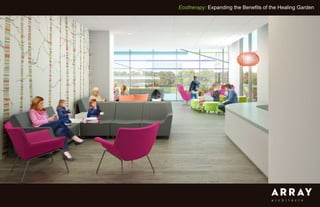

Ecotherapy:
Expanding the Benefits of
the Healing Garden
L. Kent Doss AIA, LEED AP BD+C, Lean/Six Sigma Black Belt
Ecotherapy: Expanding the Benefits of the Healing Garden
MID 1700s
Hotel-Dieu
Paris
100+ Beds
1871
St Thomas Hospital
London
24 Beds
1854
Lariboisere War Hospital
Paris
60+ Beds
1889
Johns Hopkins
Baltimore
24 Beds
1910
Mt Sinai Hospital
New York
26 Beds
1935
Beaujon Hospital
France
16 Beds
1946
Hill-Burton Act
USA
Semi-Private
1950
St. Thomas Hospital (rebuild)
London
4 Beds
1955
Montefiore
New York
2-4 Beds
2006
FGI Guidelines for
New Facilities
Private
Ecotherapy: Expanding the Benefits of the Healing Garden
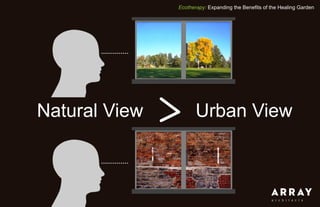
Natural View Urban View
Ecotherapy: Expanding the Benefits of the Healing Garden
Length of Hospitalization
(Surgery to Discharge)
8.70 7.96
Patient Mental State
(Negative Comments to Nurses)
3.96 1.13
Pain Management
(Frequency and Type of
Medications)
High &
Strong
Low &
Weak
Narcotics Aspirin
STUDY SUMMARY:
BRICK WALL COMPARED TO
NATURAL VIEW
notes notes
days days
Ecotherapy: Expanding the Benefits of the Healing Garden
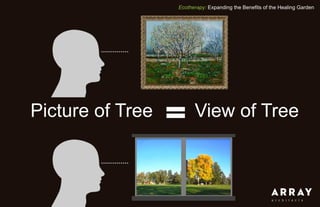
Picture of Tree View of Tree
Ecotherapy: Expanding the Benefits of the Healing Garden
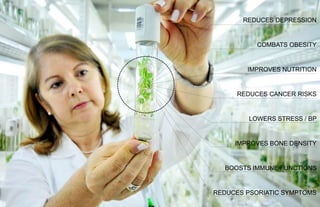
REDUCES PSORIATIC SYMPTOMS
IMPROVES BONE DENSITY
REDUCES CANCER RISKS
IMPROVES NUTRITION
COMBATS OBESITY
LOWERS STRESS / BP
BOOSTS IMMUNE FUNCTIONS
REDUCES DEPRESSION
Ecotherapy: Expanding the Benefits of the Healing Garden
Calming and
Active
Therapeutic
and
Educational
Accessible
and
Inclusive
Public and
Private
Productive
and
Nourishing
Connective
and
Economical
Ecotherapy: Expanding the Benefits of the Healing Garden
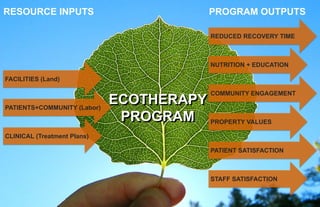
ECOTHERAPY
PROGRAM
RESOURCE INPUTS PROGRAM OUTPUTS
PATIENTS+COMMUNITY (Labor)
CLINICAL (Treatment Plans)
FACILITIES (Land)
REDUCED RECOVERY TIME
PROPERTY VALUES
NUTRITION + EDUCATION
COMMUNITY ENGAGEMENT
PATIENT SATISFACTION
STAFF SATISFACTION
Ecotherapy: Expanding the Benefits of the Healing Garden
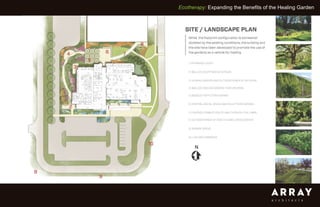
U10 SOCCER FIELD
(FOR REFERENCE)
`
UNINTERRUPTED VIEWS AND ACCESS TO
NATURAL/ LANDSCAPE AREAS FOR PLAY,
THERAPY, RESPITE AND EDUCATION
PLAYGROUND/
THERAPY ZONE
PUBLIC
PLAZA
COOPER’S HAWK
NESTING ZONE:
POTENTIAL FOR
OBSERVATION TRAILS
AND/OR BOARDWALKS
100’
200’300’
EAST LOT
WEST
LOT
SECONDARY/SERVICE
VEHICULAR ENTRANCE
MAIN VEHICULAR
ENTRANCE
PHASE I
UNINTERUPTED VIEWS OF
BUILDING FROM
WESTVILLE ALMONESSON ROAD
GENEROUS LINEAR LANDSCAPE
ISLANDS IN EAST & WEST LOTS FOR
PROTECTED PEDESTRIAN
CIRCULATION WITHIN PARKING
EXTENDED
WOODLAND
CANOPY
POTENTIAL FOR
WETLANDS / VERNAL
POOL EDUCATIONAL
ZONE
ALTERNATE PHASE II BUILDING
SITE (IF SEPARATE BUILDING)
PHASE II SECONDARY SERVICE
ROAD ( WILL ONLY BE PROVIDED
IN PHASE I IF REQUIRED BY
COUNTY)
UNINTERUPTED VIEWS OF
FOREST FROM BUILDING
Ecotherapy: Expanding the Benefits of the Healing Garden
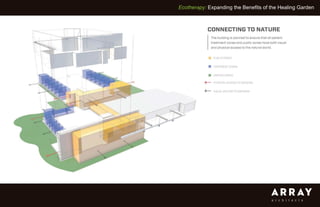
WOOD METAL
METAL
GLASS
STONE
Ecotherapy: Expanding the Benefits of the Healing Garden
Ecotherapy:
Expanding the Benefits of
the Healing Garden
L. Kent Doss AIA, LEED AP BD+C, Lean/Six Sigma Black Belt

EcoTherapy and its Effects on Design

  • 1.
    Ecotherapy: Expanding the Benefitsof the Healing Garden L. Kent Doss AIA, LEED AP BD+C, Lean/Six Sigma Black Belt
  • 2.
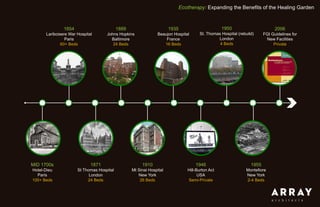
    Ecotherapy: Expanding theBenefits of the Healing Garden MID 1700s Hotel-Dieu Paris 100+ Beds 1871 St Thomas Hospital London 24 Beds 1854 Lariboisere War Hospital Paris 60+ Beds 1889 Johns Hopkins Baltimore 24 Beds 1910 Mt Sinai Hospital New York 26 Beds 1935 Beaujon Hospital France 16 Beds 1946 Hill-Burton Act USA Semi-Private 1950 St. Thomas Hospital (rebuild) London 4 Beds 1955 Montefiore New York 2-4 Beds 2006 FGI Guidelines for New Facilities Private
  • 3.
    Ecotherapy: Expanding theBenefits of the Healing Garden Natural View Urban View
  • 4.
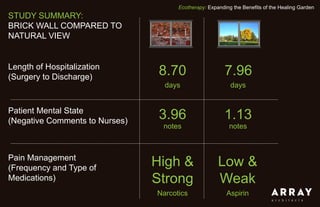
    Ecotherapy: Expanding theBenefits of the Healing Garden Length of Hospitalization (Surgery to Discharge) 8.70 7.96 Patient Mental State (Negative Comments to Nurses) 3.96 1.13 Pain Management (Frequency and Type of Medications) High & Strong Low & Weak Narcotics Aspirin STUDY SUMMARY: BRICK WALL COMPARED TO NATURAL VIEW notes notes days days
  • 6.
    Ecotherapy: Expanding theBenefits of the Healing Garden
  • 13.
    Ecotherapy: Expanding theBenefits of the Healing Garden
  • 14.
    Ecotherapy: Expanding theBenefits of the Healing Garden
  • 15.
    Ecotherapy: Expanding theBenefits of the Healing Garden Picture of Tree View of Tree
  • 16.
    Ecotherapy: Expanding theBenefits of the Healing Garden REDUCES PSORIATIC SYMPTOMS IMPROVES BONE DENSITY REDUCES CANCER RISKS IMPROVES NUTRITION COMBATS OBESITY LOWERS STRESS / BP BOOSTS IMMUNE FUNCTIONS REDUCES DEPRESSION
  • 17.
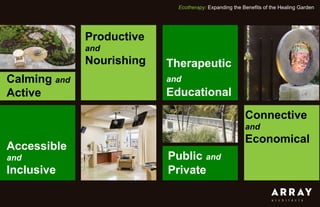
    Ecotherapy: Expanding theBenefits of the Healing Garden Calming and Active Therapeutic and Educational Accessible and Inclusive Public and Private Productive and Nourishing Connective and Economical
  • 18.
    Ecotherapy: Expanding theBenefits of the Healing Garden ECOTHERAPY PROGRAM RESOURCE INPUTS PROGRAM OUTPUTS PATIENTS+COMMUNITY (Labor) CLINICAL (Treatment Plans) FACILITIES (Land) REDUCED RECOVERY TIME PROPERTY VALUES NUTRITION + EDUCATION COMMUNITY ENGAGEMENT PATIENT SATISFACTION STAFF SATISFACTION
  • 19.
    Ecotherapy: Expanding theBenefits of the Healing Garden
  • 20.
    Ecotherapy: Expanding theBenefits of the Healing Garden
  • 21.
    Ecotherapy: Expanding theBenefits of the Healing Garden
  • 22.
    Ecotherapy: Expanding theBenefits of the Healing Garden
  • 23.
    Ecotherapy: Expanding theBenefits of the Healing Garden
  • 24.
    Ecotherapy: Expanding theBenefits of the Healing Garden
  • 25.
    Ecotherapy: Expanding theBenefits of the Healing Garden
  • 26.
    Ecotherapy: Expanding theBenefits of the Healing Garden
  • 27.
    Ecotherapy: Expanding theBenefits of the Healing Garden
  • 28.
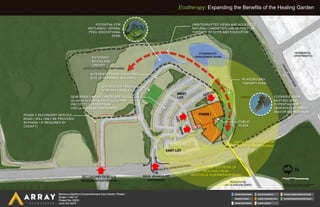
    Ecotherapy: Expanding theBenefits of the Healing Garden U10 SOCCER FIELD (FOR REFERENCE) ` UNINTERRUPTED VIEWS AND ACCESS TO NATURAL/ LANDSCAPE AREAS FOR PLAY, THERAPY, RESPITE AND EDUCATION PLAYGROUND/ THERAPY ZONE PUBLIC PLAZA COOPER’S HAWK NESTING ZONE: POTENTIAL FOR OBSERVATION TRAILS AND/OR BOARDWALKS 100’ 200’300’ EAST LOT WEST LOT SECONDARY/SERVICE VEHICULAR ENTRANCE MAIN VEHICULAR ENTRANCE PHASE I UNINTERUPTED VIEWS OF BUILDING FROM WESTVILLE ALMONESSON ROAD GENEROUS LINEAR LANDSCAPE ISLANDS IN EAST & WEST LOTS FOR PROTECTED PEDESTRIAN CIRCULATION WITHIN PARKING EXTENDED WOODLAND CANOPY POTENTIAL FOR WETLANDS / VERNAL POOL EDUCATIONAL ZONE ALTERNATE PHASE II BUILDING SITE (IF SEPARATE BUILDING) PHASE II SECONDARY SERVICE ROAD ( WILL ONLY BE PROVIDED IN PHASE I IF REQUIRED BY COUNTY) UNINTERUPTED VIEWS OF FOREST FROM BUILDING
  • 29.
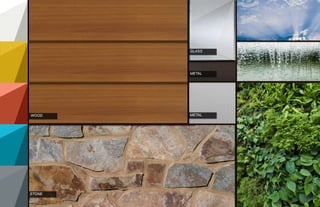
    Ecotherapy: Expanding theBenefits of the Healing Garden WOOD METAL METAL GLASS STONE
  • 30.
    Ecotherapy: Expanding theBenefits of the Healing Garden
  • 31.
    Ecotherapy: Expanding theBenefits of the Healing Garden
  • 32.
    Ecotherapy: Expanding theBenefits of the Healing Garden
  • 33.
    Ecotherapy: Expanding theBenefits of the Healing Garden
  • 34.
    Ecotherapy: Expanding theBenefits of the Healing Garden
  • 35.
    Ecotherapy: Expanding the Benefitsof the Healing Garden L. Kent Doss AIA, LEED AP BD+C, Lean/Six Sigma Black Belt

Editor's Notes

  • #2 The current turmoil and uncertainty resulting from healthcare reform legislation has led almost every healthcare provider to wrestle with the difficulty of achieving mandated clinical performance and patient satisfaction requirements without completely destroying their capital and operating budgets.   As healthcare designers we take very seriously our collaborative role with our clients in creating facilities that can help meet these challenges. Today I wanted to talk about an integrated facility design idea that we’re exploring that we believe can deliver excellent (and measurable) results for relatively modest investments – ecotherapy.   Before describing the “what’s” and “how’s” of our vision of ecotherapy, I wanted to start with a very personal story about the “why” behind our explorations.
  • #3 We’ve seen exponential advancements in healthcare in our lifetimes… Odds are that if you were hospitalized 150 years ago, you would have been admitted into a ward with 100-or-so other patients - and been exposed to all of their ailments in usually appalling conditions. The Pavilion Movement in the mid-1800s was one of the first steps in improving hospital facilities by increasing light and ventilation and reducing ward sizes…but 25+ ward sizes were the norm through the first half of the 20th century. The Hill-Burton Act in 1946 was another giant step that mandated semi-private rooms, and finally the crescendo was in 2006 when the FGI Guidelines began requiring all new facilities to have private rooms.
  • #4 In the design community, the catalyst for improved healthcare facilities was in 1984 after Robert Ulrich published his research in a Science magazine article titled View Through a Window May Influence Recovery from Surgery. Mr. Ulrich compared post-surgery recovery times for groups of patients who had an urban view of a brick wall with those who had a natural view of a tree and found that the tree-view group experienced significantly better recovery times and required less pain medications than the wall-view group.
  • #5 This study was one of the first to offer proof that the built environment could have a direct positive impact on clinical outcomes by addressing the psychological needs of the patient. It also offered a model that became one of the foundations of evidence-based design as well as becoming the major reference for the benefits of integrating nature into healthcare design.
  • #6 This has been a great thing healthcare architects…it’s helped transform hospital architecture from gloomy, impersonal places that are to be feared into humanized places of hope…and connecting patients and staff to the natural world through views, healing gardens, and respite gardens has been an integral part of the vast improvement in healthcare facility design quality. So everything’s great in the healthcare design world, right? Healthcare systems understand the evidence and are empowering their designers to create facilities that are tuned to our basic human needs for connecting to the natural world, outcomes are improving, patients are satisfied – it’s healthcare design’s golden age…then:
  • #8 This has been a great thing healthcare architects…it’s helped transform hospital architecture from gloomy, impersonal places that are to be feared into humanized places of hope…and connecting patients and staff to the natural world through views, healing gardens, and respite gardens has been an integral part of the vast improvement in healthcare facility design quality. So everything’s great in the healthcare design world, right? Healthcare systems understand the evidence and are empowering their designers to create facilities that are tuned to our basic human needs for connecting to the natural world, outcomes are improving, patients are satisfied – it’s healthcare design’s golden age…then:
  • #9 This has been a great thing healthcare architects…it’s helped transform hospital architecture from gloomy, impersonal places that are to be feared into humanized places of hope…and connecting patients and staff to the natural world through views, healing gardens, and respite gardens has been an integral part of the vast improvement in healthcare facility design quality. So everything’s great in the healthcare design world, right? Healthcare systems understand the evidence and are empowering their designers to create facilities that are tuned to our basic human needs for connecting to the natural world, outcomes are improving, patients are satisfied – it’s healthcare design’s golden age…then:
  • #10 This has been a great thing healthcare architects…it’s helped transform hospital architecture from gloomy, impersonal places that are to be feared into humanized places of hope…and connecting patients and staff to the natural world through views, healing gardens, and respite gardens has been an integral part of the vast improvement in healthcare facility design quality. So everything’s great in the healthcare design world, right? Healthcare systems understand the evidence and are empowering their designers to create facilities that are tuned to our basic human needs for connecting to the natural world, outcomes are improving, patients are satisfied – it’s healthcare design’s golden age…then:
  • #11 This has been a great thing healthcare architects…it’s helped transform hospital architecture from gloomy, impersonal places that are to be feared into humanized places of hope…and connecting patients and staff to the natural world through views, healing gardens, and respite gardens has been an integral part of the vast improvement in healthcare facility design quality. So everything’s great in the healthcare design world, right? Healthcare systems understand the evidence and are empowering their designers to create facilities that are tuned to our basic human needs for connecting to the natural world, outcomes are improving, patients are satisfied – it’s healthcare design’s golden age…then:
  • #12 This has been a great thing healthcare architects…it’s helped transform hospital architecture from gloomy, impersonal places that are to be feared into humanized places of hope…and connecting patients and staff to the natural world through views, healing gardens, and respite gardens has been an integral part of the vast improvement in healthcare facility design quality. So everything’s great in the healthcare design world, right? Healthcare systems understand the evidence and are empowering their designers to create facilities that are tuned to our basic human needs for connecting to the natural world, outcomes are improving, patients are satisfied – it’s healthcare design’s golden age…then:
  • #13 This has been a great thing healthcare architects…it’s helped transform hospital architecture from gloomy, impersonal places that are to be feared into humanized places of hope…and connecting patients and staff to the natural world through views, healing gardens, and respite gardens has been an integral part of the vast improvement in healthcare facility design quality. So everything’s great in the healthcare design world, right? Healthcare systems understand the evidence and are empowering their designers to create facilities that are tuned to our basic human needs for connecting to the natural world, outcomes are improving, patients are satisfied – it’s healthcare design’s golden age…then:
  • #15 a two-fisted punch in the gut: The Affordable Care Act (aka Obamacare) became law and created a massive amount of uncertainty for healthcare financial models… More and more research began to investigate (and sometimes validate) that artificial nature (in the form of nature themed artwork) could have the same positive effects as real views of nature…
  • #16 As a healthcare architect, I feared that this confluence of reduced capital and a (seemingly) less-expensive, artificial method for integrating nature could result in the marginalization (or complete elimination) of an important aspect of healthcare design…that the standard would become the expedient hanging of a clichéd photograph on the wall. So I started to dig deeper and try to gather an understanding of the more complete relationship of patient to nature (beyond the simple visual relationships that had been the focus of these studies)…and how a more holistic relationship could lead to improved outcomes and perceptions of healthcare environments.
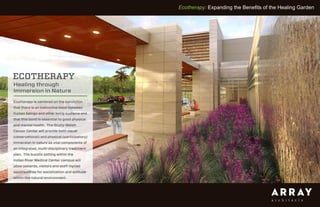
  • #17 What I found was a tremendous amount of research and data that re-affirmed my belief in the fundamental healing benefits that we receive from nature…however, what quickly became obvious was that the way we’ve been addressing this in healthcare design has been too limited – we’ve been aiming too low! Recently, we’ve been evolving our design approach with ecotherapy as a fundamental ingredient – this approach is centered on the conviction that there is an instinctive bond between human beings and other living systems and that this bond is essential to good physical and mental health. Our designs strive to provide both visual (contemplative) and physical (participatory) immersion in nature as vital components of an integrated, multi-disciplinary treatment plan.
  • #18 While the execution will be unique for every project based on geographic location, patient profiles, and facility resources, we’ve defined several paired characteristics of what an ecotherapy program should aspire to be: Calming and Active: In addition to providing places for meditative respite, ecotherapy spaces should encourage patients to engage and participate physically. Beyond the fitness benefits of walking paths, if at all possible patients should be encouraged to “get their hands dirty” and help create, maintain, and nurture the gardens – patients should be allowed to heal themselves by healing the earth. Accessible and Inclusive: Ecotherapy spaces should be appropriately green and lush (about 70% green to 30% hardscape seems to work well) but be easy to use…walkways should be wide and meandering and constructed of low-glare materials with minimal joints. Gardening beds should be at various heights to facilitate usage by all age and mobility groups. Productive and Nourishing: Consider expanding the gardening zones to include produce that can serve to both nourish and form the basis of a dietary educational program. Including food service departments in the planning and use of the gardens planting can introduce fresh, organic herbs, fruits and vegetables into meal plans. Public and Private: Natural spaces should be designed to provide opportunities for groups to socialize while also having personal spaces that allow for solitude and meditation. Care should also be taken to appropriately zone age and illness-related spaces. Therapeutic and Educational: In addition to the fundamental health benefits associated with being immersed in nature, gardens can also be tuned to provide directed healing qualities and educational opportunities…aromatic plants such as chamomile, lavender, marsh mallow or peppermint have been proven effective in improving mental and emotional imbalances while enhancing creativity and wellbeing…vitamin and antioxidant-rich fruits and vegetables such as oranges, strawberries, spinach or artichokes can contribute to dietary plans and healthy-lifestyle education…traditional medicinal plants and herbs such as aloe vera, sage, lemon balm, milk thistle, and comfrey can be part of a natural therapy plan. Connective and Economical: To realize maximum efficacy, ecotherapy spaces should have a broader reach than current patients. When properly planned and promoted, these spaces have the ability to connect providers with their community (thereby creating a larger demographic base) and become an integral part of a healthy lifestyle (instead of simply a physical repair shop). As the community that uses the space grows, the capital commitment for its upkeep reduces – the users become the caretakers – leading to a fiscally self-sustaining program.
  • #19 So, our vision for how a robust and sustainable ecotherapy program could be organized is summarized in this graphic:
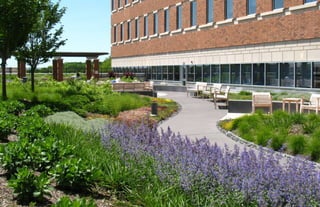
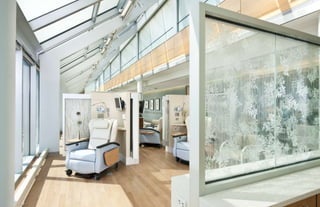
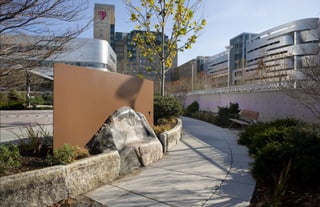
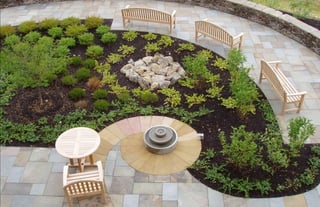
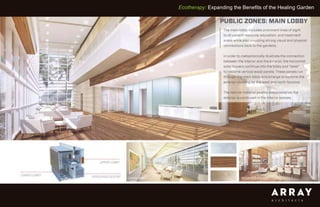
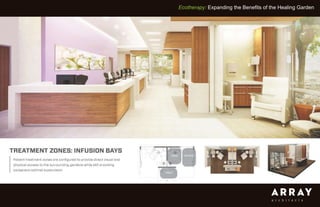
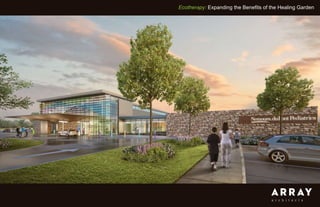
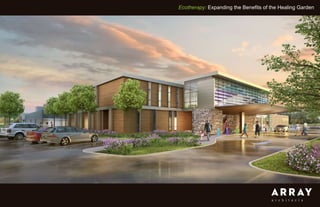
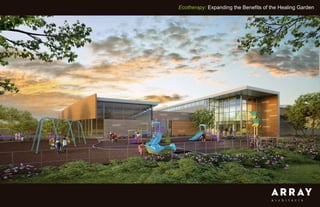
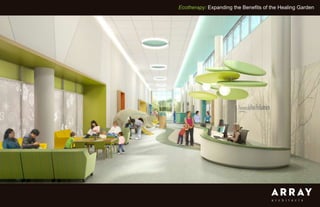
  • #20 Thanks for listening – I hope I haven’t bored you too much (and maybe inspired you to incorporate some of these ideas in your facility)…while I answer any questions you might have I thought I’d let some images of one of our current projects that has been designed with ecotherapy as a core principle scroll through…