September- O ctober 2012
ECONOMY W ATCH


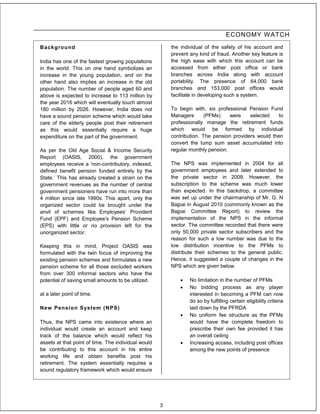
HIGHLIGHTS
      Government announces key reform measures: Update on unfinished agenda (page 2-6)

      Government’s action on some long pending policy reforms last month uplifts investors’ sentiment
       (page 5)

      Latest round of FICCI’s EOS reveals a modest improvement in economic outlook. The
       consensus GDP forecast for FY13 and FY14 are 5.7% and 6.5% respectively. Additionally, even
       though an overwhelming majority (69%) of the respondents believe that the economy is facing
       recession, there is also a growing feeling that the current phase of de-growth may be bottoming
                      rd
       out. Nearly 2/3 of the respondents believe that a recovery in global growth is possible in the
       medium term (pages 6-8)

      The consensus fiscal deficit forecast for FY13 is at 5.6% of GDP. However, more importantly, the
       consensus fiscal deficit estimate in the next fiscal is 5.3%, indicating that the process of fiscal
       consolidation will be long and arduous and it may be difficult to plough it back to the levels
       witnessed prior to the crisis (pages 6-8)

      Inflation forecast for FY13 veers towards a consensus of 7.4%, whereas for FY14, it is projected
       at 6.4%. The survey respondents affirm that the RBI’s “fixation” of prioritizing the domestic
       inflation correction over growth correction may not be justified in the current scenario. The other
       good news is that 63% of total respondents believe that domestic interest rates will eventually
       decline in the medium-term (pages 6-8)


Dr. Soumya Kanti Ghosh
soumya.ghosh@ficci.com
(with inputs from Nibedita & Sakshi)
FICCI Economics and Research Division


                                                   1
ECONOMY W ATCH

                       THE INDIAN ECONOMY - MACROVIEW
                             THEME WATCH – REFORMS 2.0 UNVEILED
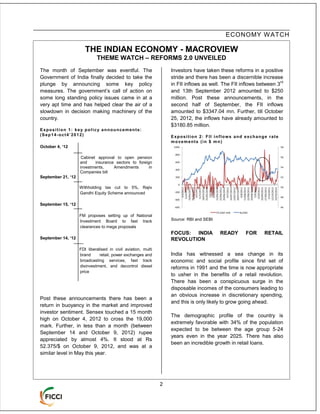
The month of September was eventful. The                           Investors have taken these reforms in a positive
Government of India finally decided to take the                    stride and there has been a discernible increase
                                                                                                                    rd
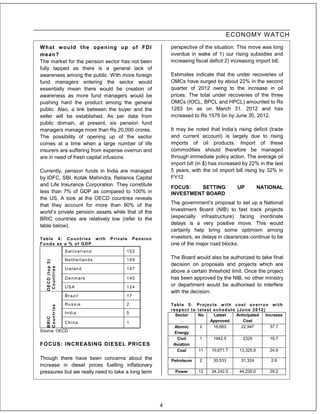
plunge by announcing some key policy                               in FII inflows as well. The FII inflows between 3
measures. The government’s call of action on                       and 13th September 2012 amounted to $250
some long standing policy issues came in at a                      million. Post these announcements, in the
very apt time and has helped clear the air of a                    second half of September, the FII inflows
slowdown in decision making machinery of the                       amounted to $3347.04 mn. Further, till October
country.                                                           25, 2012, the inflows have already amounted to
                                                                   $3180.85 million.
Exposition 1: key policy announcements:
(Sep14-oct4’2012)                                                  Exposition 2: FII inflows and exchange rate
                                                                   movements (in $ mn)
October 4, ‘12                                                      1000                                                  58

                                                                     800
                     Cabinet approval to open pension                                                                     56

                    and     insurance sectors to foreign             600

                    investments,     Amendments        in            400
                                                                                                                          54

                    Companies bill
September 21, ‘12                                                    200                                                  52

                                                                       0
                    Withholding tax cut to 5%, Rajiv                       19/04/2012
                                                                                                                          50

                                                                           26/04/2012


                                                                           25/05/2012


                                                                           29/06/2012

                                                                           16/07/2012


                                                                           13/08/2012
                                                                           22/08/2012


                                                                           20/09/2012
                                                                           27/09/2012


                                                                           19/10/2012
                                                                           18/05/2012


                                                                           15/06/2012
                                                                           22/06/2012


                                                                           23/07/2012
                                                                           30/07/2012


                                                                           29/08/2012


                                                                           12/10/2012
                                                                             4/5/2012


                                                                             1/6/2012
                                                                             8/6/2012


                                                                             9/7/2012


                                                                             6/8/2012
                                                                             3/4/2012


                                                                             5/9/2012
                                                                            12/9/2012
                                                                            12/4/2012


                                                                            11/5/2012


                                                                            5/10/2012
                    Gandhi Equity Scheme announced                  -200
                                                                                                                          48
                                                                    -400
September 15, ‘12
                                                                    -600                                                  46

                                                                                          FII (USD mill)   Rs/USD
                    FM proposes setting up of National
                    Investment Board to fast track                 Source: RBI and SEBI
                    clearances to mega proposals
                                                                   FOCUS: INDIA              READY             FOR   RETAIL
September 14, ‘12                                                  REVOLUTION
                    FDI liberalised in civil aviation, multi
                    brand      retail, power exchanges and         India has witnessed a sea change in its
                    broadcasting services, fast track              economic and social profile since first set of
                    disinvestment, and decontrol diesel            reforms in 1991 and the time is now appropriate
                    price
                                                                   to usher in the benefits of a retail revolution.
                                                                   There has been a conspicuous surge in the
                                                                   disposable incomes of the consumers leading to
                                                                   an obvious increase in discretionary spending,
Post these announcements there has been a
                                                                   and this is only likely to grow going ahead.
return in buoyancy in the market and improved
investor sentiment. Sensex touched a 15 month
                                                                   The demographic profile of the country is
high on October 4, 2012 to cross the 19,000
                                                                   extremely favorable with 34% of the population
mark. Further, in less than a month (between
                                                                   expected to be between the age group 5-24
September 14 and October 9, 2012) rupee
                                                                   years even in the year 2025. There has also
appreciated by almost 4%. It stood at Rs
                                                                   been an incredible growth in retail loans.
52.375/$ on October 9, 2012, and was at a
similar level in May this year.


                                                               2
ECONOMY W ATCH


Considering the above facts, it is not difficult to       different clientele and provide very different kind
estimate the sheer size of the retail space in            of services.
India and the kind of opportunities it can provide.
Various estimates put the size of the retail              For instance, the retailer belonging to the
industry to be between $400-450 billion.                  unorganized      sector   provides customized
Organized retail has been growing at an                   services such as understanding the likes and
impressive rate of 35% to 40% y-o-y in the last           dislikes of individual customers, recommending
few years compared to 9-10% growth in the                 new products, adjusting prices for different
overall retail industry. In fact, Indian market           customers and in turn gaining their long-term
remains a lucrative one for global retailers as it        patronage and goodwill. This is an integral part
ranks 5th in the A T Kearney’s Global Retail              of an Indian consumer’s routine life and is
Development Index (2012) which ranks the top              unlikely to change overnight. Alternatively, even
30 developing countries for retail expansion              though organized retail may have its own
worldwide.                                                advantages, it cannot provide such services
                                                          (Kohli & Bhagwati, 2011).
Further, the country’s urban population has
increased by nearly 90 mn between the years               Moreover, several studies have shown that the
2001 and 2011 and is expected to increase by              advent of these ‘big’ retailers will benefit the
250 mn (as per independent forecasts between              consumers and manufacturers. There will be a
2008 & 2030). Besides rapid urbanization, it is           multiplier effect in terms of employment
also vital to mention here that the expanding             generation. Consumers will have a wider choice
rural and semi rural markets also provide                 and get better deals besides assurance of an
potential opportunities for the retail industry           improved quality.
(independent estimates suggest rural and semi
rural areas to dominate the retail industry and           Another major contentious issue that has been
account for 50% of the market share by 2012)              in the limelight and needs to be discussed is the
The likely scenario therefore is that of a growing        impact on farmers. This is especially important
urban-based retailing supporting the rural                because a major chunk of retail industry is
economy by investing in rural food-processing             constituted by food and has a direct bearing on
facilities, warehouses, and transportation and            the farmers (in India food constitutes 70% of
shipment hubs (Kohli & Bhagwati, 2011).                   total retail). At present, even though India is the
                                                          world’s second largest producer of fruits and
However, one the key attributes of the Indian             vegetables, about a one third of it is lost due to
retail industry has been the dominance of the             inadequate storage facilities.
unorganized or the self organized sector. The
unorganized sector accounts for a whopping                Additionally, with greater investments coming in
95% of the retail industry and thus leaving the           (in China, for example, FDI was close to 4% of
organized retail with a share of only 5%.                 cumulative FDI inflow, since the sector was
                                                          opened up), we will see infusion of new
And for this reason lot of concerns have been             technology across the agriculture value chain as
expressed about the unorganized sector losing             well improvement in the back end infrastructure
its space and succumbing to the tough                     and a reduction in wastages. Not only the
competition. It is extremely crucial to dispel this       farmers will get much better prices for their
myth. The first and the foremost thing, as of now         produce but also access to better quality inputs
the organized and unorganized enjoy different             like seeds.
relative advantages. They cater to a very
                                                          India is already far behind a lot of countries as


                                                      1
ECONOMY W ATCH
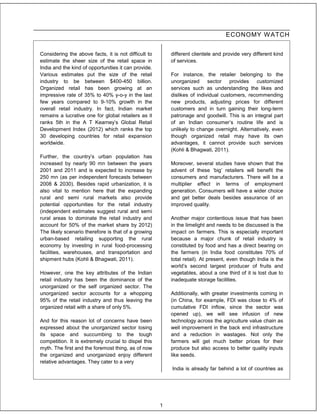
far as organized retailing is concerned. The                        in the country remains low. Though the life
share of organized retail in US is 80%, Thailand                    insurance segment penetration has increased
is 40%, Brazil is 36% and China is 20%. India                       from 1.72% in 2000 to 4.40% in 2010, the non-
cannot close the door to this opportunity. We                       life insurance market penetration has been
need to expand our horizons and be ready for                        between 0.55-0.70% in 2000 and 2010.
this retail revolution standing at our doorsteps!
                                                                    Table 2: Premiums as a     % of GDP 2011
Table1: FDI Caps raised                                                          Total         Life       Non-Life
Sector       E xi s t i n Revise   Benefits                                      Business      Business   Business
             g Cap        d Cap                                     North        7.9           3.5        4.4
Multi brand                51%     1.Stronger                       Am e r i c a
Retail                             Backend
                                                                    Latin        2.8           1.2               1.6
                                   Infrastructure
                                                                    Am e r i c a
                                                                    and
                                   2.Technology
                                   Infusion in Agri                 Caribbean
                                   value chain                      Europe       7.1           4.1                3.0
                                                                    As i a       5.8           4.3                1.6
                                   3. Employment                    India        4.1           3.4                0.7
                                   Generation                       PR China     3.0           1.8                1.2
                                                                    Af r i c a   3.6           2.5                1.2
P o we r           26%    49%      1. Capital                       World        6.6           3.8                2.8
E xc h a n g e s                   Investments                      Source: W orld Insurance   i n 2 0 1 1 , S wi s s R e

                                   2.Infusion of
                                   Technology                       Increasing the FDI cap in the insurance sector
Civil                     49%      1.New JVs                        will also result in channelization of funds from
Aviation
                                   2.Better
                                                                    the sector into infrastructure. It may be noted
                                   customer                         that FDI in Indian insurance sector stood at $1.4
                                   services                         bn of which life insurance comprised $1.1 bn
                                   3 . L o we r T a r i f f s       and general insurance comprised $0.2 bn of
Broadcasti         49%    74%      1.New                            FDI.
ng                                 Technology
Services
                                   2.Better                         Table 3: Investments of Life and Non Life
                                   Content                          Insurers in Infrastructure (Rs crore)
                                   Management                                          Life*         Non
Pension                   26%      1.Support                                                         Life
                                   Infrastructure                                      2010   2011   2010   2011
                                   Development                      Infrastructure     85675 8918    1037   12216
Insurance          26%    49%      1.Support                                           (9.8)* 1      3      (14.8)
                                   Infrastructure                                      *      (8.7)  (15.6)
                                   Development                      *includes housing
                                                                    ** share in total investments
                                   2.Better                         Source: Annual Report, IRDA
                                   insurance
                                   coverage                         FOCUS: RAISING THE CAP IN PENSION
Source: FICCI Research                                              SECTOR
                                                                    The government has also given a green signal
                                                                    to foreign investment in pension funds which
FOCUS: INSURANCE             SECTOR          REMAIN
                                                                    could increase up to 49% from the present 26%
UNTAPPED
                                                                    in line with that of the insurance sector. This
The insurance sector still remains largely                          step is likely to bring in more foreign players or
untapped in India. The insurance and banking                        pension fund managers for the New Pension
services contribution to the country’s GDP is                       System (NPS) as currently the foreign
about 7%.                                                           companies are not allowed to invest in India’s
                                                                    pension sector.
However, despite this, the insurance penetration


                                                                2
ECONOMY W ATCH
Background                                               the individual of the safety of his account and
                                                         prevent any kind of fraud. Another key feature is
India has one of the fastest growing populations         the high ease with which this account can be
in the world. This on one hand symbolizes an             accessed from either post office or bank
increase in the young population, and on the             branches across India along with account
other hand also implies an increase in the old           portability. The presence of 64,000 bank
population. The number of people aged 60 and             branches and 153,000 post offices would
above is expected to increase to 113 million by          facilitate in developing such a system.
the year 2016 which will eventually touch almost
180 million by 2026. However, India does not             To begin with, six professional Pension Fund
have a sound pension scheme which would take             Managers       (PFMs)    were    selected    to
care of the elderly people post their retirement         professionally manage the retirement funds
as this would essentially require a huge                 which would be formed by individual
expenditure on the part of the government.               contribution. The pension providers would then
                                                         convert the lump sum asset accumulated into
As per the Old Age Social & Income Security              regular monthly pension.
Report (OASIS, 2000), the government
employees receive a ‘non-contributory, indexed,          The NPS was implemented in 2004 for all
defined benefit pension funded entirely by the           government employees and later extended to
State.’ This has already created a strain on the         the private sector in 2009. However, the
government revenues as the number of central             subscription to the scheme was much lower
government pensioners have run into more than            than expected. In this backdrop, a committee
4 million since late 1990s. This apart, only the         was set up under the chairmanship of Mr. G. N
organized sector could be brought under the              Bajpai in August 2010 (commonly known as the
anvil of schemes like Employees’ Provident               Bajpai Committee Report) to review the
Fund (EPF) and Employee’s Pension Scheme                 implementation of the NPS in the informal
(EPS) with little or no provision left for the           sector. The committee recorded that there were
unorganized sector.                                      only 50,000 private sector subscribers and the
                                                         reason for such a low number was due to the
Keeping this in mind, Project OASIS was                  low distribution incentive to the PFMs to
formulated with the twin focus of improving the          distribute their schemes to the general public.
existing pension schemes and formulates a new            Hence, it suggested a couple of changes in the
pension scheme for all those excluded workers            NPS which are given below.
from over 300 informal sectors who have the
potential of saving small amounts to be utilized                No limitation in the number of PFMs
                                                                No bidding process as any player
at a later point of time.                                        interested in becoming a PFM can now
                                                                 do so by fulfilling certain eligibility criteria
New Pension Syst em ( NPS)                                       laid down by the PFRDA
                                                                No uniform fee structure as the PFMs
Thus, the NPS came into existence where an                       would have the complete freedom to
individual would create an account and keep                      prescribe their own fee provided it has
track of the balance which would reflect his                     an overall ceiling
assets at that point of time. The individual would              Increasing access, including post offices
be contributing to this account in his entire                    among the new points of presence
working life and obtain benefits post his
retirement. The system essentially requires a
sound regulatory framework which would ensure


                                                     3
ECONOMY W ATCH
W hat w ould t he opening up of FDI                               perspective of the situation. This move was long
mean?                                                             overdue in wake of 1) our rising subsidies and
The market for the pension sector has not been                    increasing fiscal deficit 2) increasing import bill.
fully tapped as there is a general lack of
awareness among the public. With more foreign                     Estimates indicate that the under recoveries of
fund managers entering the sector would                           OMCs have surged by about 22% in the second
essentially mean there would be creation of                       quarter of 2012 owing to the increase in oil
awareness as more fund managers would be                          prices. The total under recoveries of the three
pushing hard the product among the general                        OMCs (IOCL, BPCL and HPCL) amounted to Rs
public. Also, a link between the buyer and the                    1283 bn as on March 31, 2012 and has
seller will be established. As per data from                      increased to Rs 1576 bn by June 30, 2012.
public domain, at present, six pension fund
managers manage more than Rs 20,000 crores.                       It may be noted that India’s rising deficit (trade
The possibility of opening up of the sector                       and current account) is largely due to rising
comes at a time when a large number of life                       imports of oil products. Import of these
insurers are suffering from expense overrun and                   commodities should therefore be managed
are in need of fresh capital infusions                            through immediate policy action. The average oil
                                                                  import bill (in $) has increased by 22% in the last
Currently, pension funds in India are managed                     5 years, with the oil import bill rising by 32% in
by IDFC, SBI, Kotak Mahindra, Reliance Capital                    FY12.
and Life Insurance Corporation. They constitute
                                                                  FOCUS:   SETTING              UP          NATIONAL
less than 7% of GDP as compared to 100% in                        INVESTMENT BOARD
the US. A look at the OECD countries reveals
that they account for more than 90% of the                        The government’s proposal to set up a National
world’s private pension assets while that of the                  Investment Board (NIB) to fast track projects
BRIC countries are relatively low (refer to the                   (especially infrastructure) facing inordinate
table below).                                                     delays is a very positive move. This would
                                                                  certainly help bring some optimism among
Table 4: Countries with                  Private    Pension       investors, as delays in clearances continue to be
Funds as a % of GDP                                               one of the major road blocks.
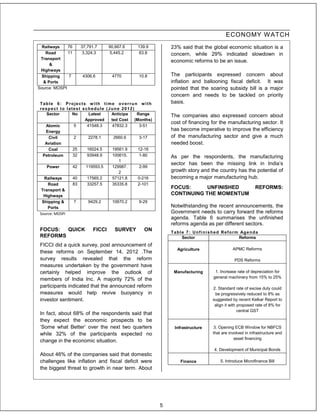
                  S wi t z e r l a n d         152

                  Netherlands                  149
                                                                  The Board would also be authorized to take final
   OECD (top 5)


                                                                  decision on proposals and projects which are
   Countries


                  Iceland                      147
                                                                  above a certain threshold limit. Once the project
                  Denmark                      140                has been approved by the NIB, no other ministry
                  USA                          124                or department would be authorised to interfere
                                                                  with the decision.
                  Brazil                       17

                  Russia                       2                  Table 5: Projects with cost overrun with
   Countries


                                                                  respect to latest schedule (June 2012)
                  India                        5
                                                                    Sector   No     Latest   Anticipated Increase
   BRIC


                  China                        1                                  Approved      Cost
                                                                    Atomic     2    16,663     22,947      37.7
Source: OECD                                                        Energy
                                                                     Civil     1    1942.5      2325       19.7
FO CUS: INCREASING DIESEL PRICES                                   Aviation
                                                                     Coal     11   10,671.7   13,325.8     24.9
Though there have been concerns about the                         Petroleum    2     30,533       31,324        2.6
increase in diesel prices fuelling inflationary
pressures but we really need to take a long term                    Power     12    34,242.5     44,235.0       29.2


                                                              4
ECONOMY W ATCH
  Railways    76   37,791.7      90,667.6    139.9       23% said that the global economic situation is a
    Road      11    3,324.3      5,445.2     63.8        concern, while 29% indicated slowdown in
 Transport
                                                         economic reforms to be an issue.
      &
 Highways
  Shipping     7   4306.6         4770       10.8        The participants expressed concern about
   & Ports                                               inflation and ballooning fiscal deficit. It was
Source: MOSPI                                            pointed that the soaring subsidy bill is a major
                                                         concern and needs to be tackled on priority
 Table 6: Projects with time overrun with                basis.
 respect to latest schedule (June 2012)
     Sector    No     Latest  Anticipa  Range            The companies also expressed concern about
                    Approved  ted Cost (Months)
                                                         cost of financing for the manufacturing sector. It
    Atomic      5    41548.3   47832.3    3-51
    Energy                                               has become imperative to improve the efficiency
      Civil     2    2278.1    2660.6     3-17           of the manufacturing sector and give a much
    Aviation                                             needed boost.
      Coal     25    16024.5   19561.9   12-16
   Petroleum   32    93948.9   100615.    1-80           As per the respondents, the manufacturing
                                  1
                                                         sector has been the missing link in India’s
     Power     42   119593.5   129987.    2-99
                                  2                      growth story and the country has the potential of
   Railways    40    17565.2   57121.8   0-216           becoming a major manufacturing hub.
     Road      83    33257.5   35335.8   2-101
  Transport &
                                                         FOCUS:      UNFINISHED                                REFORMS:
   Highways                                              CONTINUING THE MOMENTUM
  Shipping &    7    9429.2    10670.2    9-29
     Ports                                               Notwithstanding the recent announcements, the
 Source: MOSPI                                           Government needs to carry forward the reforms
                                                         agenda. Table 6 summarises the unfinished
                                                         reforms agenda as per different sectors.
 FOCUS:  QUICK           FICCI      SURVEY      ON       T a b l e 7 : U n f i n i s h e d R e f o r m Ag e n d a
 REFORMS                                                         Sector                               Reforms
 FICCI did a quick survey, post announcement of
                                                             Agriculture                        APMC Reforms
 these reforms on September 14, 2012 .The
 survey results revealed that the reform                                                         PDS Reforms
 measures undertaken by the government have
 certainly helped improve the outlook of                  Manufacturing              1. Increase rate of depreciation for
                                                                                    general machinery from 15% to 25%
 members of India Inc. A majority 72% of the
 participants indicated that the announced reform                                  2. Standard rate of excise duty could
 measures would help revive buoyancy in                                             be progressively reduced to 8% as
 investor sentiment.                                                               suggested by recent Kelkar Report to
                                                                                    align it with proposed rate of 8% for
                                                                                                  central GST
 In fact, about 68% of the respondents said that
 they expect the economic prospects to be
 ‘Some what Better’ over the next two quarters             Infrastructure           3. Opening ECB Window for NBFCS
 while 32% of the participants expected no                                          that are involved in infrastructure and
                                                                                                asset financing
 change in the economic situation.
                                                                                    4. Development of Municipal Bonds
 About 46% of the companies said that domestic
 challenges like inflation and fiscal deficit were             Finance                  5. Introduce Microfinance Bill
 the biggest threat to growth in near term. About


                                                     5
ECONOMY W ATCH
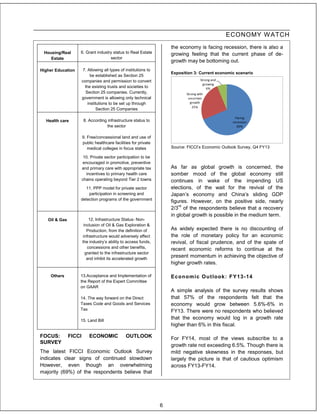
                                                                       the economy is facing recession, there is also a
 Housing/Real      6. Grant industry status to Real Estate             growing feeling that the current phase of de-
    Estate                         sector
                                                                       growth may be bottoming out.
Higher Education        7. Allowing all types of institutions to
                                                                       Exposition 3: Current economic scenario
                             be established as Section 25
                       companies and permission to convert                             Strong and
                                                                                        growing
                         the existing trusts and societies to                              6%
                          Section 25 companies. Currently,                    Strong with
                       government is allowing only technical                   uncertain
                           institutions to be set up through                    growth
                                                                                  25%
                                Section 25 Companies

                                                                                                       Facing
  Health care           8. According infrastructure status to                                        recession
                                    the sector                                                          69%


                       9. Free/concessional land and use of
                       public healthcare facilities for private
                          medical colleges in focus states             Source: FICCI’s Economic Outlook Survey, Q4 FY13

                        10. Private sector participation to be
                       encouraged in promotive, preventive
                       and primary care with appropriate tax           As far as global growth is concerned, the
                         incentives to primary health care             somber mood of the global economy still
                       chains operating beyond Tier 2 towns            continues in wake of the impending US
                     11. PPP model for private sector                  elections, of the wait for the revival of the
                       participation in screening and                  Japan’s economy and China’s sliding GDP
                   detection programs of the government
                                                                       figures. However, on the positive side, nearly
                                                                           rd
                                                                       2/3 of the respondents believe that a recovery
                                                                       in global growth is possible in the medium term.
   Oil & Gas                12. Infrastructure Status- Non-
                        inclusion of Oil & Gas Exploration &
                          Production, from the definition of           As widely expected there is no discounting of
                        infrastructure would adversely affect          the role of monetary policy for an economic
                       the industry’s ability to access funds,         revival, of fiscal prudence, and of the spate of
                           concessions and other benefits,             recent economic reforms to continue at the
                         granted to the infrastructure sector
                          and inhibit its accelerated growth
                                                                       present momentum in achieving the objective of
                                                                       higher growth rates.

    Others         13.Acceptance and Implementation of                 Economic O utlook : FY 13- 14
                   the Report of the Expert Committee
                   on GAAR
                                                                       A simple analysis of the survey results shows
                   14. The way forward on the Direct                   that 57% of the respondents felt that the
                   Taxes Code and Goods and Services                   economy would grow between 5.6%-6% in
                   Tax                                                 FY13. There were no respondents who believed
                   15. Land Bill
                                                                       that the economy would log in a growth rate
                                                                       higher than 6% in this fiscal.

FOCUS:         FICCI       ECONOMIC             OUTLOOK                For FY14, most of the views subscribe to a
SURVEY
                                                                       growth rate not exceeding 6.5%. Though there is
The latest FICCI Economic Outlook Survey                               mild negative skewness in the responses, but
indicates clear signs of continued slowdown                            largely the picture is that of cautious optimism
However, even though an overwhelming                                   across FY13-FY14.
majority (69%) of the respondents believe that


                                                                   6
ECONOMY W ATCH
Table 8: Consensus economic outlook: FY13-14                                                                              improvement in global output over medium term.
           GDP         GDP         Fiscal            Fiscal
           growth      growth      Deficit(%         Deficit(%    Growth       Growth       WPI          WPI
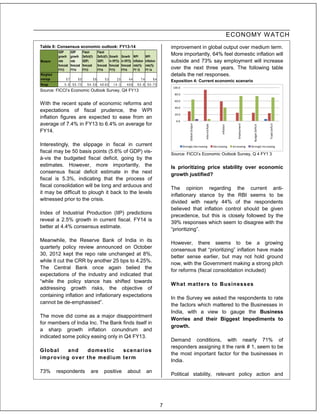
                                                                                                                          More importantly, 64% feel domestic inflation will
Measure    rate        rate        GDP)              GDP)         in IIP(%)    in IIP(%)    Inflation    Inflation        subside and 73% say employment will increase
           forecast    forecast    forecast          forecast     forecast     forecast     rate(%)      rate(%)
           FY13        FY14        FY13              FY14         FY13         FY14         FY 13        FY 14            over the next three years. The following table
Weighted                                                                                                                  details the net responses.
average          5.7         6.5               5.6         5.3           2.5          4.4          7.4          6.4
                                                                                                                          Exposition 4: Current economic scenario
Range           5 - 6 5.5 - 7.5        5.4 - 5.9       4.8 -6.5      1.4 - 3        4-5.6      6.5 - 8 5.5 - 7.5
                                                                                                                           100.0
Source: FICCI’s Economic Outlook Survey, Q4 FY13
                                                                                                                            80.0

                                                                                                                            60.0
With the recent spate of economic reforms and
                                                                                                                            40.0
expectations of fiscal prudence, the WPI
                                                                                                                            20.0
inflation figures are expected to ease from an
                                                                                                                             0.0
average of 7.4% in FY13 to 6.4% on average for


                                                                                                                                                                                               Employment
                                                                                                                                        Global Output


                                                                                                                                                                                                                               Trade Deficit
                                                                                                                                                        Interest Rate


                                                                                                                                                                                                              Budget Deficit
                                                                                                                                                                              Inflation
FY14.

Interestingly, the slippage in fiscal in current                                                                                   Strongly Decreasing                  Decreasing         Increasing       Strongly Increasing
fiscal may be 50 basis points (5.6% of GDP) vis-                                                                          Source: FICCI’s Economic Outlook Survey, Q 4 FY1 3
à-vis the budgeted fiscal deficit, going by the
estimates. However, more importantly, the                                                                                 Is prioritizing price stability over economic
consensus fiscal deficit estimate in the next                                                                             growth justified?
fiscal is 5.3%, indicating that the process of
fiscal consolidation will be long and arduous and
                                                                                                                          The opinion regarding the current anti-
it may be difficult to plough it back to the levels
                                                                                                                          inflationary stance by the RBI seems to be
witnessed prior to the crisis.
                                                                                                                          divided with nearly 44% of the respondents
                                                                                                                          believed that inflation control should be given
Index of Industrial Production (IIP) predictions
                                                                                                                          precedence, but this is closely followed by the
reveal a 2.5% growth in current fiscal. FY14 is
                                                                                                                          39% responses which seem to disagree with the
better at 4.4% consensus estimate.
                                                                                                                          “prioritizing”.

Meanwhile, the Reserve Bank of India in its
                                                                                                                          However, there seems to be a growing
quarterly policy review announced on October
                                                                                                                          consensus that “prioritizing” inflation have made
30, 2012 kept the repo rate unchanged at 8%,
                                                                                                                          better sense earlier, but may not hold ground
while it cut the CRR by another 25 bps to 4.25%.
                                                                                                                          now, with the Government making a strong pitch
The Central Bank once again belied the
                                                                                                                          for reforms (fiscal consolidation included)
expectations of the industry and indicated that
“while the policy stance has shifted towards
                                                                                                                          W hat matters to Business es
addressing growth risks, the objective of
containing inflation and inflationary expectations
                                                                                                                          In the Survey we asked the respondents to rate
cannot be de-emphasised”.                                                                                                 the factors which mattered to the Businesses in
                                                                                                                          India, with a view to gauge the Business
The move did come as a major disappointment
                                                                                                                          Worries and their Biggest Impediments to
for members of India Inc. The Bank finds itself in
                                                                                                                          growth.
a sharp growth inflation conundrum and
indicated some policy easing only in Q4 FY13.
                                                                                                                          Demand conditions, with nearly 71% of
                                                                                                                          responders assigning it the rank # 1, seem to be
G lobal   and     domest ic  scenarios
                                                                                                                          the most important factor for the businesses in
improv ing ov er t he medium t erm
                                                                                                                          India.

73%        respondents                    are             positive                  about                an
                                                                                                                          Political stability, relevant policy action and


                                                                                                                      7
ECONOMY W ATCH
competitive environment were closely following
as factors which if not worked on constructively
may deter the Indian business growth.

Rural spending cont inue t o outpace
urban consumpt ion

According to the recent NSSO data released, for
the first time since economic reforms in India
were launched in the early 1990s, rural
spending in the country has outpaced urban
consumption.

More than 80% of the responses were
affirmative of the above fact. In fact, a recent
study reveals a decline in rural poverty, owing to
an 6.8% annual real rural wage increase for the
last four years, the downside seem to be
hedged. Additionally, with the consumption
pattern in rural India shifting from necessities to
discretionary goods, there is a greater likelihood
of more being spent on education, health care,
entertainment, etc in the coming years!


                                                      8

Economy watch-sept-oct final-2012

  • 1.
  • 2.
    ECONOMY W ATCH HIGHLIGHTS  Government announces key reform measures: Update on unfinished agenda (page 2-6)  Government’s action on some long pending policy reforms last month uplifts investors’ sentiment (page 5)  Latest round of FICCI’s EOS reveals a modest improvement in economic outlook. The consensus GDP forecast for FY13 and FY14 are 5.7% and 6.5% respectively. Additionally, even though an overwhelming majority (69%) of the respondents believe that the economy is facing recession, there is also a growing feeling that the current phase of de-growth may be bottoming rd out. Nearly 2/3 of the respondents believe that a recovery in global growth is possible in the medium term (pages 6-8)  The consensus fiscal deficit forecast for FY13 is at 5.6% of GDP. However, more importantly, the consensus fiscal deficit estimate in the next fiscal is 5.3%, indicating that the process of fiscal consolidation will be long and arduous and it may be difficult to plough it back to the levels witnessed prior to the crisis (pages 6-8)  Inflation forecast for FY13 veers towards a consensus of 7.4%, whereas for FY14, it is projected at 6.4%. The survey respondents affirm that the RBI’s “fixation” of prioritizing the domestic inflation correction over growth correction may not be justified in the current scenario. The other good news is that 63% of total respondents believe that domestic interest rates will eventually decline in the medium-term (pages 6-8) Dr. Soumya Kanti Ghosh soumya.ghosh@ficci.com (with inputs from Nibedita & Sakshi) FICCI Economics and Research Division 1
  • 3.
    ECONOMY W ATCH THE INDIAN ECONOMY - MACROVIEW THEME WATCH – REFORMS 2.0 UNVEILED The month of September was eventful. The Investors have taken these reforms in a positive Government of India finally decided to take the stride and there has been a discernible increase rd plunge by announcing some key policy in FII inflows as well. The FII inflows between 3 measures. The government’s call of action on and 13th September 2012 amounted to $250 some long standing policy issues came in at a million. Post these announcements, in the very apt time and has helped clear the air of a second half of September, the FII inflows slowdown in decision making machinery of the amounted to $3347.04 mn. Further, till October country. 25, 2012, the inflows have already amounted to $3180.85 million. Exposition 1: key policy announcements: (Sep14-oct4’2012) Exposition 2: FII inflows and exchange rate movements (in $ mn) October 4, ‘12 1000 58 800 Cabinet approval to open pension 56 and insurance sectors to foreign 600 investments, Amendments in 400 54 Companies bill September 21, ‘12 200 52 0 Withholding tax cut to 5%, Rajiv 19/04/2012 50 26/04/2012 25/05/2012 29/06/2012 16/07/2012 13/08/2012 22/08/2012 20/09/2012 27/09/2012 19/10/2012 18/05/2012 15/06/2012 22/06/2012 23/07/2012 30/07/2012 29/08/2012 12/10/2012 4/5/2012 1/6/2012 8/6/2012 9/7/2012 6/8/2012 3/4/2012 5/9/2012 12/9/2012 12/4/2012 11/5/2012 5/10/2012 Gandhi Equity Scheme announced -200 48 -400 September 15, ‘12 -600 46 FII (USD mill) Rs/USD FM proposes setting up of National Investment Board to fast track Source: RBI and SEBI clearances to mega proposals FOCUS: INDIA READY FOR RETAIL September 14, ‘12 REVOLUTION FDI liberalised in civil aviation, multi brand retail, power exchanges and India has witnessed a sea change in its broadcasting services, fast track economic and social profile since first set of disinvestment, and decontrol diesel reforms in 1991 and the time is now appropriate price to usher in the benefits of a retail revolution. There has been a conspicuous surge in the disposable incomes of the consumers leading to an obvious increase in discretionary spending, Post these announcements there has been a and this is only likely to grow going ahead. return in buoyancy in the market and improved investor sentiment. Sensex touched a 15 month The demographic profile of the country is high on October 4, 2012 to cross the 19,000 extremely favorable with 34% of the population mark. Further, in less than a month (between expected to be between the age group 5-24 September 14 and October 9, 2012) rupee years even in the year 2025. There has also appreciated by almost 4%. It stood at Rs been an incredible growth in retail loans. 52.375/$ on October 9, 2012, and was at a similar level in May this year. 2
  • 4.
    ECONOMY W ATCH Consideringthe above facts, it is not difficult to different clientele and provide very different kind estimate the sheer size of the retail space in of services. India and the kind of opportunities it can provide. Various estimates put the size of the retail For instance, the retailer belonging to the industry to be between $400-450 billion. unorganized sector provides customized Organized retail has been growing at an services such as understanding the likes and impressive rate of 35% to 40% y-o-y in the last dislikes of individual customers, recommending few years compared to 9-10% growth in the new products, adjusting prices for different overall retail industry. In fact, Indian market customers and in turn gaining their long-term remains a lucrative one for global retailers as it patronage and goodwill. This is an integral part ranks 5th in the A T Kearney’s Global Retail of an Indian consumer’s routine life and is Development Index (2012) which ranks the top unlikely to change overnight. Alternatively, even 30 developing countries for retail expansion though organized retail may have its own worldwide. advantages, it cannot provide such services (Kohli & Bhagwati, 2011). Further, the country’s urban population has increased by nearly 90 mn between the years Moreover, several studies have shown that the 2001 and 2011 and is expected to increase by advent of these ‘big’ retailers will benefit the 250 mn (as per independent forecasts between consumers and manufacturers. There will be a 2008 & 2030). Besides rapid urbanization, it is multiplier effect in terms of employment also vital to mention here that the expanding generation. Consumers will have a wider choice rural and semi rural markets also provide and get better deals besides assurance of an potential opportunities for the retail industry improved quality. (independent estimates suggest rural and semi rural areas to dominate the retail industry and Another major contentious issue that has been account for 50% of the market share by 2012) in the limelight and needs to be discussed is the The likely scenario therefore is that of a growing impact on farmers. This is especially important urban-based retailing supporting the rural because a major chunk of retail industry is economy by investing in rural food-processing constituted by food and has a direct bearing on facilities, warehouses, and transportation and the farmers (in India food constitutes 70% of shipment hubs (Kohli & Bhagwati, 2011). total retail). At present, even though India is the world’s second largest producer of fruits and However, one the key attributes of the Indian vegetables, about a one third of it is lost due to retail industry has been the dominance of the inadequate storage facilities. unorganized or the self organized sector. The unorganized sector accounts for a whopping Additionally, with greater investments coming in 95% of the retail industry and thus leaving the (in China, for example, FDI was close to 4% of organized retail with a share of only 5%. cumulative FDI inflow, since the sector was opened up), we will see infusion of new And for this reason lot of concerns have been technology across the agriculture value chain as expressed about the unorganized sector losing well improvement in the back end infrastructure its space and succumbing to the tough and a reduction in wastages. Not only the competition. It is extremely crucial to dispel this farmers will get much better prices for their myth. The first and the foremost thing, as of now produce but also access to better quality inputs the organized and unorganized enjoy different like seeds. relative advantages. They cater to a very India is already far behind a lot of countries as 1
  • 5.
    ECONOMY W ATCH faras organized retailing is concerned. The in the country remains low. Though the life share of organized retail in US is 80%, Thailand insurance segment penetration has increased is 40%, Brazil is 36% and China is 20%. India from 1.72% in 2000 to 4.40% in 2010, the non- cannot close the door to this opportunity. We life insurance market penetration has been need to expand our horizons and be ready for between 0.55-0.70% in 2000 and 2010. this retail revolution standing at our doorsteps! Table 2: Premiums as a % of GDP 2011 Table1: FDI Caps raised Total Life Non-Life Sector E xi s t i n Revise Benefits Business Business Business g Cap d Cap North 7.9 3.5 4.4 Multi brand 51% 1.Stronger Am e r i c a Retail Backend Latin 2.8 1.2 1.6 Infrastructure Am e r i c a and 2.Technology Infusion in Agri Caribbean value chain Europe 7.1 4.1 3.0 As i a 5.8 4.3 1.6 3. Employment India 4.1 3.4 0.7 Generation PR China 3.0 1.8 1.2 Af r i c a 3.6 2.5 1.2 P o we r 26% 49% 1. Capital World 6.6 3.8 2.8 E xc h a n g e s Investments Source: W orld Insurance i n 2 0 1 1 , S wi s s R e 2.Infusion of Technology Increasing the FDI cap in the insurance sector Civil 49% 1.New JVs will also result in channelization of funds from Aviation 2.Better the sector into infrastructure. It may be noted customer that FDI in Indian insurance sector stood at $1.4 services bn of which life insurance comprised $1.1 bn 3 . L o we r T a r i f f s and general insurance comprised $0.2 bn of Broadcasti 49% 74% 1.New FDI. ng Technology Services 2.Better Table 3: Investments of Life and Non Life Content Insurers in Infrastructure (Rs crore) Management Life* Non Pension 26% 1.Support Life Infrastructure 2010 2011 2010 2011 Development Infrastructure 85675 8918 1037 12216 Insurance 26% 49% 1.Support (9.8)* 1 3 (14.8) Infrastructure * (8.7) (15.6) Development *includes housing ** share in total investments 2.Better Source: Annual Report, IRDA insurance coverage FOCUS: RAISING THE CAP IN PENSION Source: FICCI Research SECTOR The government has also given a green signal to foreign investment in pension funds which FOCUS: INSURANCE SECTOR REMAIN could increase up to 49% from the present 26% UNTAPPED in line with that of the insurance sector. This The insurance sector still remains largely step is likely to bring in more foreign players or untapped in India. The insurance and banking pension fund managers for the New Pension services contribution to the country’s GDP is System (NPS) as currently the foreign about 7%. companies are not allowed to invest in India’s pension sector. However, despite this, the insurance penetration 2
  • 6.
    ECONOMY W ATCH Background the individual of the safety of his account and prevent any kind of fraud. Another key feature is India has one of the fastest growing populations the high ease with which this account can be in the world. This on one hand symbolizes an accessed from either post office or bank increase in the young population, and on the branches across India along with account other hand also implies an increase in the old portability. The presence of 64,000 bank population. The number of people aged 60 and branches and 153,000 post offices would above is expected to increase to 113 million by facilitate in developing such a system. the year 2016 which will eventually touch almost 180 million by 2026. However, India does not To begin with, six professional Pension Fund have a sound pension scheme which would take Managers (PFMs) were selected to care of the elderly people post their retirement professionally manage the retirement funds as this would essentially require a huge which would be formed by individual expenditure on the part of the government. contribution. The pension providers would then convert the lump sum asset accumulated into As per the Old Age Social & Income Security regular monthly pension. Report (OASIS, 2000), the government employees receive a ‘non-contributory, indexed, The NPS was implemented in 2004 for all defined benefit pension funded entirely by the government employees and later extended to State.’ This has already created a strain on the the private sector in 2009. However, the government revenues as the number of central subscription to the scheme was much lower government pensioners have run into more than than expected. In this backdrop, a committee 4 million since late 1990s. This apart, only the was set up under the chairmanship of Mr. G. N organized sector could be brought under the Bajpai in August 2010 (commonly known as the anvil of schemes like Employees’ Provident Bajpai Committee Report) to review the Fund (EPF) and Employee’s Pension Scheme implementation of the NPS in the informal (EPS) with little or no provision left for the sector. The committee recorded that there were unorganized sector. only 50,000 private sector subscribers and the reason for such a low number was due to the Keeping this in mind, Project OASIS was low distribution incentive to the PFMs to formulated with the twin focus of improving the distribute their schemes to the general public. existing pension schemes and formulates a new Hence, it suggested a couple of changes in the pension scheme for all those excluded workers NPS which are given below. from over 300 informal sectors who have the potential of saving small amounts to be utilized  No limitation in the number of PFMs  No bidding process as any player at a later point of time. interested in becoming a PFM can now do so by fulfilling certain eligibility criteria New Pension Syst em ( NPS) laid down by the PFRDA  No uniform fee structure as the PFMs Thus, the NPS came into existence where an would have the complete freedom to individual would create an account and keep prescribe their own fee provided it has track of the balance which would reflect his an overall ceiling assets at that point of time. The individual would  Increasing access, including post offices be contributing to this account in his entire among the new points of presence working life and obtain benefits post his retirement. The system essentially requires a sound regulatory framework which would ensure 3
  • 7.
    ECONOMY W ATCH What w ould t he opening up of FDI perspective of the situation. This move was long mean? overdue in wake of 1) our rising subsidies and The market for the pension sector has not been increasing fiscal deficit 2) increasing import bill. fully tapped as there is a general lack of awareness among the public. With more foreign Estimates indicate that the under recoveries of fund managers entering the sector would OMCs have surged by about 22% in the second essentially mean there would be creation of quarter of 2012 owing to the increase in oil awareness as more fund managers would be prices. The total under recoveries of the three pushing hard the product among the general OMCs (IOCL, BPCL and HPCL) amounted to Rs public. Also, a link between the buyer and the 1283 bn as on March 31, 2012 and has seller will be established. As per data from increased to Rs 1576 bn by June 30, 2012. public domain, at present, six pension fund managers manage more than Rs 20,000 crores. It may be noted that India’s rising deficit (trade The possibility of opening up of the sector and current account) is largely due to rising comes at a time when a large number of life imports of oil products. Import of these insurers are suffering from expense overrun and commodities should therefore be managed are in need of fresh capital infusions through immediate policy action. The average oil import bill (in $) has increased by 22% in the last Currently, pension funds in India are managed 5 years, with the oil import bill rising by 32% in by IDFC, SBI, Kotak Mahindra, Reliance Capital FY12. and Life Insurance Corporation. They constitute FOCUS: SETTING UP NATIONAL less than 7% of GDP as compared to 100% in INVESTMENT BOARD the US. A look at the OECD countries reveals that they account for more than 90% of the The government’s proposal to set up a National world’s private pension assets while that of the Investment Board (NIB) to fast track projects BRIC countries are relatively low (refer to the (especially infrastructure) facing inordinate table below). delays is a very positive move. This would certainly help bring some optimism among Table 4: Countries with Private Pension investors, as delays in clearances continue to be Funds as a % of GDP one of the major road blocks. S wi t z e r l a n d 152 Netherlands 149 The Board would also be authorized to take final OECD (top 5) decision on proposals and projects which are Countries Iceland 147 above a certain threshold limit. Once the project Denmark 140 has been approved by the NIB, no other ministry USA 124 or department would be authorised to interfere with the decision. Brazil 17 Russia 2 Table 5: Projects with cost overrun with Countries respect to latest schedule (June 2012) India 5 Sector No Latest Anticipated Increase BRIC China 1 Approved Cost Atomic 2 16,663 22,947 37.7 Source: OECD Energy Civil 1 1942.5 2325 19.7 FO CUS: INCREASING DIESEL PRICES Aviation Coal 11 10,671.7 13,325.8 24.9 Though there have been concerns about the Petroleum 2 30,533 31,324 2.6 increase in diesel prices fuelling inflationary pressures but we really need to take a long term Power 12 34,242.5 44,235.0 29.2 4
  • 8.
    ECONOMY W ATCH Railways 76 37,791.7 90,667.6 139.9 23% said that the global economic situation is a Road 11 3,324.3 5,445.2 63.8 concern, while 29% indicated slowdown in Transport economic reforms to be an issue. & Highways Shipping 7 4306.6 4770 10.8 The participants expressed concern about & Ports inflation and ballooning fiscal deficit. It was Source: MOSPI pointed that the soaring subsidy bill is a major concern and needs to be tackled on priority Table 6: Projects with time overrun with basis. respect to latest schedule (June 2012) Sector No Latest Anticipa Range The companies also expressed concern about Approved ted Cost (Months) cost of financing for the manufacturing sector. It Atomic 5 41548.3 47832.3 3-51 Energy has become imperative to improve the efficiency Civil 2 2278.1 2660.6 3-17 of the manufacturing sector and give a much Aviation needed boost. Coal 25 16024.5 19561.9 12-16 Petroleum 32 93948.9 100615. 1-80 As per the respondents, the manufacturing 1 sector has been the missing link in India’s Power 42 119593.5 129987. 2-99 2 growth story and the country has the potential of Railways 40 17565.2 57121.8 0-216 becoming a major manufacturing hub. Road 83 33257.5 35335.8 2-101 Transport & FOCUS: UNFINISHED REFORMS: Highways CONTINUING THE MOMENTUM Shipping & 7 9429.2 10670.2 9-29 Ports Notwithstanding the recent announcements, the Source: MOSPI Government needs to carry forward the reforms agenda. Table 6 summarises the unfinished reforms agenda as per different sectors. FOCUS: QUICK FICCI SURVEY ON T a b l e 7 : U n f i n i s h e d R e f o r m Ag e n d a REFORMS Sector Reforms FICCI did a quick survey, post announcement of Agriculture APMC Reforms these reforms on September 14, 2012 .The survey results revealed that the reform PDS Reforms measures undertaken by the government have certainly helped improve the outlook of Manufacturing 1. Increase rate of depreciation for general machinery from 15% to 25% members of India Inc. A majority 72% of the participants indicated that the announced reform 2. Standard rate of excise duty could measures would help revive buoyancy in be progressively reduced to 8% as investor sentiment. suggested by recent Kelkar Report to align it with proposed rate of 8% for central GST In fact, about 68% of the respondents said that they expect the economic prospects to be ‘Some what Better’ over the next two quarters Infrastructure 3. Opening ECB Window for NBFCS while 32% of the participants expected no that are involved in infrastructure and asset financing change in the economic situation. 4. Development of Municipal Bonds About 46% of the companies said that domestic challenges like inflation and fiscal deficit were Finance 5. Introduce Microfinance Bill the biggest threat to growth in near term. About 5
  • 9.
    ECONOMY W ATCH the economy is facing recession, there is also a Housing/Real 6. Grant industry status to Real Estate growing feeling that the current phase of de- Estate sector growth may be bottoming out. Higher Education 7. Allowing all types of institutions to Exposition 3: Current economic scenario be established as Section 25 companies and permission to convert Strong and growing the existing trusts and societies to 6% Section 25 companies. Currently, Strong with government is allowing only technical uncertain institutions to be set up through growth 25% Section 25 Companies Facing Health care 8. According infrastructure status to recession the sector 69% 9. Free/concessional land and use of public healthcare facilities for private medical colleges in focus states Source: FICCI’s Economic Outlook Survey, Q4 FY13 10. Private sector participation to be encouraged in promotive, preventive and primary care with appropriate tax As far as global growth is concerned, the incentives to primary health care somber mood of the global economy still chains operating beyond Tier 2 towns continues in wake of the impending US 11. PPP model for private sector elections, of the wait for the revival of the participation in screening and Japan’s economy and China’s sliding GDP detection programs of the government figures. However, on the positive side, nearly rd 2/3 of the respondents believe that a recovery in global growth is possible in the medium term. Oil & Gas 12. Infrastructure Status- Non- inclusion of Oil & Gas Exploration & Production, from the definition of As widely expected there is no discounting of infrastructure would adversely affect the role of monetary policy for an economic the industry’s ability to access funds, revival, of fiscal prudence, and of the spate of concessions and other benefits, recent economic reforms to continue at the granted to the infrastructure sector and inhibit its accelerated growth present momentum in achieving the objective of higher growth rates. Others 13.Acceptance and Implementation of Economic O utlook : FY 13- 14 the Report of the Expert Committee on GAAR A simple analysis of the survey results shows 14. The way forward on the Direct that 57% of the respondents felt that the Taxes Code and Goods and Services economy would grow between 5.6%-6% in Tax FY13. There were no respondents who believed 15. Land Bill that the economy would log in a growth rate higher than 6% in this fiscal. FOCUS: FICCI ECONOMIC OUTLOOK For FY14, most of the views subscribe to a SURVEY growth rate not exceeding 6.5%. Though there is The latest FICCI Economic Outlook Survey mild negative skewness in the responses, but indicates clear signs of continued slowdown largely the picture is that of cautious optimism However, even though an overwhelming across FY13-FY14. majority (69%) of the respondents believe that 6
  • 10.
    ECONOMY W ATCH Table8: Consensus economic outlook: FY13-14 improvement in global output over medium term. GDP GDP Fiscal Fiscal growth growth Deficit(% Deficit(% Growth Growth WPI WPI More importantly, 64% feel domestic inflation will Measure rate rate GDP) GDP) in IIP(%) in IIP(%) Inflation Inflation subside and 73% say employment will increase forecast forecast forecast forecast forecast forecast rate(%) rate(%) FY13 FY14 FY13 FY14 FY13 FY14 FY 13 FY 14 over the next three years. The following table Weighted details the net responses. average 5.7 6.5 5.6 5.3 2.5 4.4 7.4 6.4 Exposition 4: Current economic scenario Range 5 - 6 5.5 - 7.5 5.4 - 5.9 4.8 -6.5 1.4 - 3 4-5.6 6.5 - 8 5.5 - 7.5 100.0 Source: FICCI’s Economic Outlook Survey, Q4 FY13 80.0 60.0 With the recent spate of economic reforms and 40.0 expectations of fiscal prudence, the WPI 20.0 inflation figures are expected to ease from an 0.0 average of 7.4% in FY13 to 6.4% on average for Employment Global Output Trade Deficit Interest Rate Budget Deficit Inflation FY14. Interestingly, the slippage in fiscal in current Strongly Decreasing Decreasing Increasing Strongly Increasing fiscal may be 50 basis points (5.6% of GDP) vis- Source: FICCI’s Economic Outlook Survey, Q 4 FY1 3 à-vis the budgeted fiscal deficit, going by the estimates. However, more importantly, the Is prioritizing price stability over economic consensus fiscal deficit estimate in the next growth justified? fiscal is 5.3%, indicating that the process of fiscal consolidation will be long and arduous and The opinion regarding the current anti- it may be difficult to plough it back to the levels inflationary stance by the RBI seems to be witnessed prior to the crisis. divided with nearly 44% of the respondents believed that inflation control should be given Index of Industrial Production (IIP) predictions precedence, but this is closely followed by the reveal a 2.5% growth in current fiscal. FY14 is 39% responses which seem to disagree with the better at 4.4% consensus estimate. “prioritizing”. Meanwhile, the Reserve Bank of India in its However, there seems to be a growing quarterly policy review announced on October consensus that “prioritizing” inflation have made 30, 2012 kept the repo rate unchanged at 8%, better sense earlier, but may not hold ground while it cut the CRR by another 25 bps to 4.25%. now, with the Government making a strong pitch The Central Bank once again belied the for reforms (fiscal consolidation included) expectations of the industry and indicated that “while the policy stance has shifted towards W hat matters to Business es addressing growth risks, the objective of containing inflation and inflationary expectations In the Survey we asked the respondents to rate cannot be de-emphasised”. the factors which mattered to the Businesses in India, with a view to gauge the Business The move did come as a major disappointment Worries and their Biggest Impediments to for members of India Inc. The Bank finds itself in growth. a sharp growth inflation conundrum and indicated some policy easing only in Q4 FY13. Demand conditions, with nearly 71% of responders assigning it the rank # 1, seem to be G lobal and domest ic scenarios the most important factor for the businesses in improv ing ov er t he medium t erm India. 73% respondents are positive about an Political stability, relevant policy action and 7
  • 11.
    ECONOMY W ATCH competitiveenvironment were closely following as factors which if not worked on constructively may deter the Indian business growth. Rural spending cont inue t o outpace urban consumpt ion According to the recent NSSO data released, for the first time since economic reforms in India were launched in the early 1990s, rural spending in the country has outpaced urban consumption. More than 80% of the responses were affirmative of the above fact. In fact, a recent study reveals a decline in rural poverty, owing to an 6.8% annual real rural wage increase for the last four years, the downside seem to be hedged. Additionally, with the consumption pattern in rural India shifting from necessities to discretionary goods, there is a greater likelihood of more being spent on education, health care, entertainment, etc in the coming years! 8