http://www.bized.co.uk
Copyright 2006 –Biz/ed
The Economic Problem
• Unlimited Wants
• Scarce Resources
– Land, Labour,
Capital
• Resource Use
• Choices
A wind farm. Copyright: Getty Images,
available from Education Image Gallery
3.
http://www.bized.co.uk
Copyright 2006 –Biz/ed
The Economic Problem
• What goods and services should an
economy produce? – should the emphasis
be on agriculture, manufacturing or services,
should it be on sport and leisure or housing?
• How should goods and services be
produced? – labour intensive, land intensive,
capital intensive? Efficiency?
• Who should get the goods and services
produced? – even distribution? more for the
rich? for those who work hard?
4.
http://www.bized.co.uk
Copyright 2006 –Biz/ed
Opportunity Cost
• Definition – the cost expressed in terms
of the next best alternative sacrificed
• Helps us view the true cost of decision
making
• Implies valuing different choices
5.
http://www.bized.co.uk
Copyright 2006 –Biz/ed
Production Possibility Frontiers
• Show the different combinations of goods and
services that can be produced with a given
amount of resources
• No ‘ideal’ point on the curve
• Any point inside the curve – suggests
resources are not being utilised efficiently
• Any point outside the curve – not attainable
with the current level of resources
• Useful to demonstrate economic growth and
opportunity cost
6.
http://www.bized.co.uk
Copyright 2006 –Biz/ed
Production Possibility
Frontiers
Capital Goods
Consumer Goods
Yo
Xo
A
B
Y1
X1
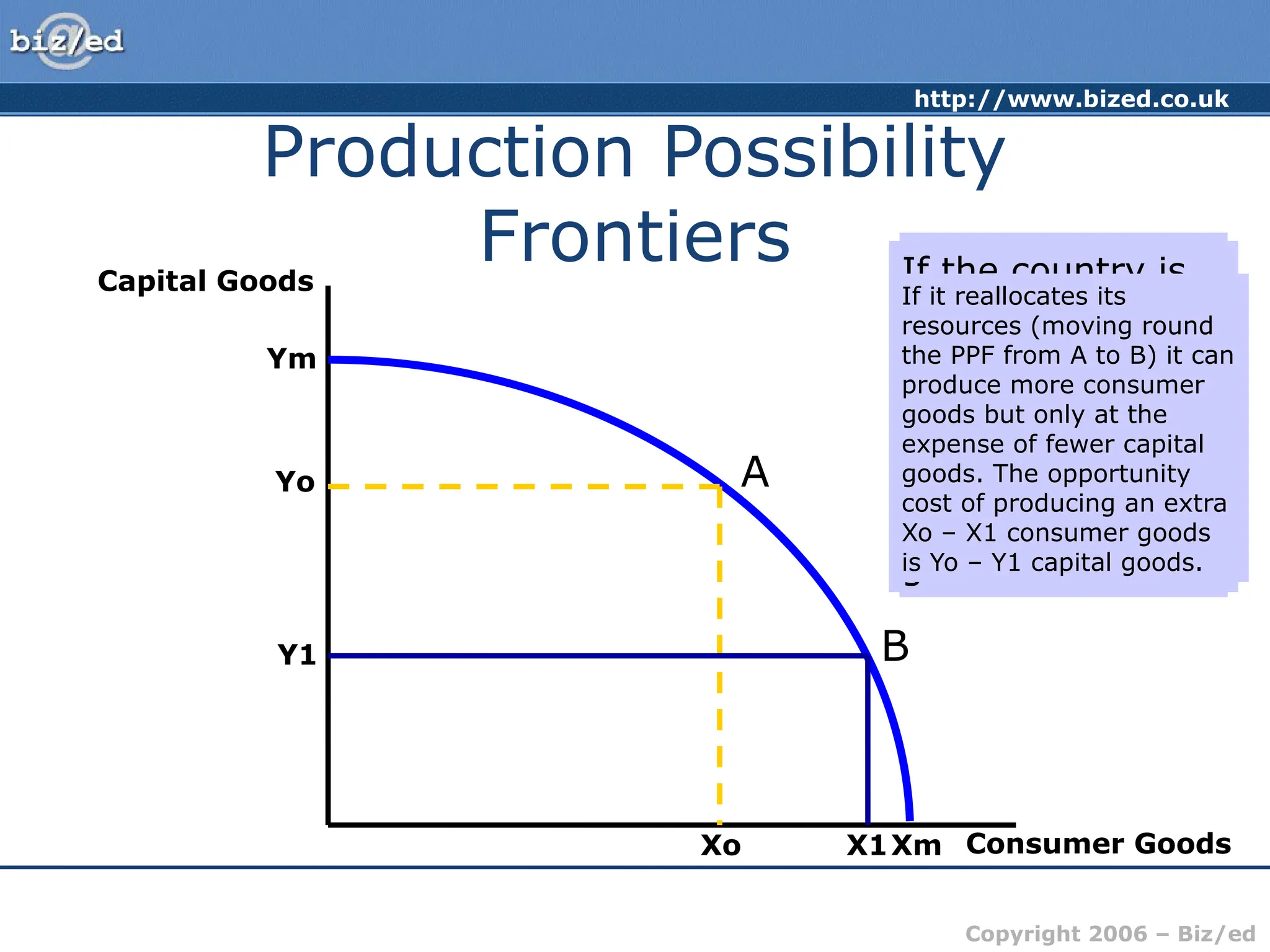
Assume a country
can produce two
types of goods
with its resources
– capital goods
and consumer
goods
If it devotes all
resources to capital
goods it could
produce a maximum
of Ym.
If it devotes all its
resources to
consumer goods it
could produce a
maximum of Xm
Ym
Xm
If the country is
at point A on the
PPF It can
produce the
combination of Yo
capital goods and
Xo consumer
goods
If it reallocates its
resources (moving round
the PPF from A to B) it can
produce more consumer
goods but only at the
expense of fewer capital
goods. The opportunity
cost of producing an extra
Xo – X1 consumer goods
is Yo – Y1 capital goods.
7.
http://www.bized.co.uk
Copyright 2006 –Biz/ed
Production Possibility
Frontiers
Capital Goods
Consumer Goods
Yo
Xo
A
.B
C
Y1
X1
Production
inside the PPF
– e.g. point B
means the
country is not
using all its
resources
It can only produce at
points outside the PPF
if it finds a way of
expanding its
resources or improves
the productivity of
those resources it
already has. This will
push the PPF further
outwards.
8.
http://www.bized.co.uk
Copyright 2006 –Biz/ed
Positive and Normative
Economics
• Health care can be
improved with more tax
funding
• Pollution control is
effective through a
system of fines
• Society ought to provide
homes for all
• Any strategy aimed at
reducing factory closures
in deprived areas would
be helpful
• Positive Statements:
– Capable of being
verified or refuted by
resorting to fact or
further investigation
• Normative
Statements:
– Contains a value
judgement which
cannot be verified by
resort to investigation
or research
Editor's Notes
#1 This series of slides will introduce some key concepts to students – the economic problem, opportunity cost and production possibility frontiers.
#2 Discussion can take place here about the key elements of the economic problem – the unlimited wants of humans against the scarce resources that exist to meet those wants. The notion of supply and demand can be introduced here and students can be involved by making a list of all the things they would like to buy if they had unlimited amounts of money! If then asked to trim that list down to meet a budget the more outrageous items disappear. This then introduces the notion of having to make choices – this issue can be discussed further using examples drawn from students own experiences about the choices they have had to make – possibly involving the choice of subjects they have had to make at college or school in relation to the time available, etc! How we use our scarce resources can also be linked into this discussion. The wind turbines highlight an issue raised in the In the News section (http://www.bized.ac.uk/cgi-bin/chron/chron.pl?id=1928) about the intention to build wind farms in areas of the UK and the controversies that it creates – useful to link theory and practice at an early stage.
#3 This is the traditional three key questions any economic system has to answer. Many students would have difficulty defining what an ‘economy’ actually is! It is useful at this stage to clear this up – a system for the production and exchange of goods and services to satisfy the wants and needs of the population. This is open ended enough to be able to incorporate all manner of economic systems from a barter system that still exists in remote parts of the world to sophisticated economic systems such as the UK and US! The questions and the examples raised can be used for discussion – get the students to express their views at this stage and be as controversial as possible to stimulate discussion and involvement!
#4 This is a key concept and one that often causes problems and misunderstanding but is central to students thinking like an economist. The crucial thing to knock out of students is their thinking that everything costs ‘money’. Because we have to make choices there are issues surrounding value judgements about what is important and what is not – it should not be difficult to stimulate discussion about what issues of government spending are important and what are not!
#5 This slide introduces the key features about PPFs. The activity that accompanies this presentation seeks to apply PPFs in a slightly different way – focussing on using health resources. Going through the theory at this stage and then following it up with the activity will be useful in developing early understanding of the issues.
#6 These slides introduce the diagrams and then have animation to show how points on the PPF relate to different resource use and allocation. Moving from point A to point B involves sacrificing some capital goods to gain more consumer goods and thus demonstrates the opportunity cost involved. Students doing history can be reminded about the resource allocation decisions taken by Stalin during the 1930s and the subsequent decisions by successive Soviet premiers since the war about what resources are important for a nation like the USSR! (you might of course have to explain a little bit about what the USSR was!)
#7 The next slide allows the lecturer to demonstrate what happens when resources are not used efficiently and production takes place within the PPF. It then allows the expansion of the PPF and can be used to illustrate the issue of economic growth and where opportunity cost does not exist if the economy moves from point A to point C (in a simple context of course – there is always some form of sacrifice of using resources!).
#8 The final slide introduces positive and normative statements. Definitions are given on the right hand side and then successive statements appear on the left – each of these can be used as a basis of discussion as to whether they are positive or normative statements and why!