ECONOMICS
RMM Technologies (p) Limited
Economics
Economics is the study of scarcity and
how it affects the use of resources, the
production of goods and services, the
growth of production and well-being
over time, and many other important
and complicated issues that affect
society.
DEFINITION
“Economics is the science of wealth” This definition
was given by Adam Smith. He is also known as the
'father of economics. According to this definition,
economics is a science of the study of wealth only. It
deals with production, distribution, and consumption.
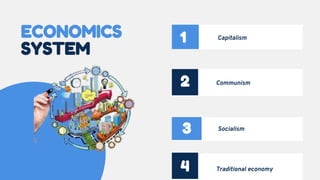
ECONOMICS
SYSTEM
1
2
3
Capitalism
Communism
Socialism
4 Traditional economy
ELEMENTS OF ECONOMICS
Goods
Services
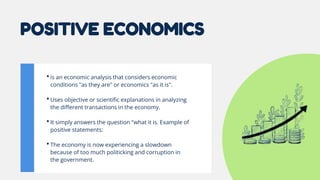
POSITIVE ECONOMICS
•is an economic analysis that considers economic
conditions "as they are" or economics "as it is".
•Uses objective or scientific explanations in analyzing
the different transactions in the economy.
•It simply answers the question "what it is. Example of
positive statements:
•The economy is now experiencing a slowdown
because of too much politicking and corruption in
the government.
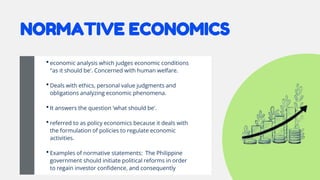
NORMATIVE ECONOMICS
•economic analysis which judges economic conditions
"as it should be'. Concerned with human welfare.
•Deals with ethics, personal value judgments and
obligations analyzing economic phenomena.
•It answers the question 'what should be'.
•referred to as policy economics because it deals with
the formulation of policies to regulate economic
activities.
•Examples of normative statements: The Philippine
government should initiate political reforms in order
to regain investor confidence, and consequently
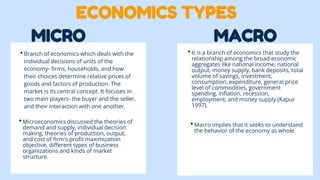
MICRO MACRO
•Branch of economics which deals with the
individual decisions of units of the
economy- firms, households, and how
their choices determine relative prices of
goods and factors of production. The
market is its central concept. It focuses in
two main players- the buyer and the seller,
and their interaction with one another.
•Microeconomics discussed the theories of
demand and supply, individual decision
making, theories of production, output,
and cost of firm's profit maximization
objective, different types of business
organizations and kinds of market
structure.
•It is a branch of economics that study the
relationship among the broad economic
aggregates like national income, national
output, money supply, bank deposits, total
volume of savings, investment,
consumption, expenditure, general price
level of commodities, government
spending, inflation, recession,
employment, and money supply (Kapur
1997).
•Macro implies that it seeks to understand
the behavior of the economy as whole.
ECONOMICS TYPES
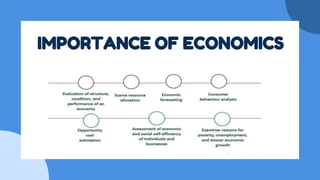
IMPORTANCE OF ECONOMICS
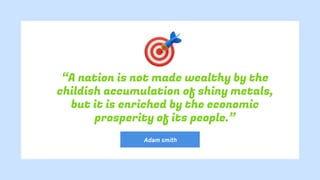
“A nation is not made wealthy by the
childish accumulation of shiny metals,
but it is enriched by the economic
prosperity of its people.”
Adam smith
Feel free to
get in touch.
info@rmmindia.com
www.rmmindia.com
Monday-Saturday, 9AM-6 PM

economics

  • 1.
  • 2.
    Economics Economics is thestudy of scarcity and how it affects the use of resources, the production of goods and services, the growth of production and well-being over time, and many other important and complicated issues that affect society.
  • 3.
    DEFINITION “Economics is thescience of wealth” This definition was given by Adam Smith. He is also known as the 'father of economics. According to this definition, economics is a science of the study of wealth only. It deals with production, distribution, and consumption.
  • 4.
  • 5.
  • 6.
    POSITIVE ECONOMICS •is aneconomic analysis that considers economic conditions "as they are" or economics "as it is". •Uses objective or scientific explanations in analyzing the different transactions in the economy. •It simply answers the question "what it is. Example of positive statements: •The economy is now experiencing a slowdown because of too much politicking and corruption in the government.
  • 7.
    NORMATIVE ECONOMICS •economic analysiswhich judges economic conditions "as it should be'. Concerned with human welfare. •Deals with ethics, personal value judgments and obligations analyzing economic phenomena. •It answers the question 'what should be'. •referred to as policy economics because it deals with the formulation of policies to regulate economic activities. •Examples of normative statements: The Philippine government should initiate political reforms in order to regain investor confidence, and consequently
  • 8.
    MICRO MACRO •Branch ofeconomics which deals with the individual decisions of units of the economy- firms, households, and how their choices determine relative prices of goods and factors of production. The market is its central concept. It focuses in two main players- the buyer and the seller, and their interaction with one another. •Microeconomics discussed the theories of demand and supply, individual decision making, theories of production, output, and cost of firm's profit maximization objective, different types of business organizations and kinds of market structure. •It is a branch of economics that study the relationship among the broad economic aggregates like national income, national output, money supply, bank deposits, total volume of savings, investment, consumption, expenditure, general price level of commodities, government spending, inflation, recession, employment, and money supply (Kapur 1997). •Macro implies that it seeks to understand the behavior of the economy as whole. ECONOMICS TYPES
  • 9.
  • 10.
    “A nation isnot made wealthy by the childish accumulation of shiny metals, but it is enriched by the economic prosperity of its people.” Adam smith
  • 11.
    Feel free to getin touch. info@rmmindia.com www.rmmindia.com Monday-Saturday, 9AM-6 PM