ECON Micro 2 2nd Edition McEachern Solutions
Manual download
https://testbankfan.com/product/econ-micro-2-2nd-edition-
mceachern-solutions-manual/
Find test banks or solution manuals at testbankfan.com today!
We believe these products will be a great fit for you. Click
the link to download now, or visit testbankfan.com
to discover even more!
ECON Micro 2 2nd Edition McEachern Test Bank
https://testbankfan.com/product/econ-micro-2-2nd-edition-mceachern-
test-bank/
ECON MICRO 6th Edition McEachern Solutions Manual
https://testbankfan.com/product/econ-micro-6th-edition-mceachern-
solutions-manual/
ECON Micro Canadian 1st Edition McEachern Solutions Manual
https://testbankfan.com/product/econ-micro-canadian-1st-edition-
mceachern-solutions-manual/
Public Finance 9th Edition Rosen Solutions Manual
https://testbankfan.com/product/public-finance-9th-edition-rosen-
solutions-manual/
Principles and Practice of American Politics Classic and
Contemporary Readings 6th Edition Kernell Test Bank
https://testbankfan.com/product/principles-and-practice-of-american-
politics-classic-and-contemporary-readings-6th-edition-kernell-test-
bank/
Managerial Accounting 9th Edition Crosson Test Bank
https://testbankfan.com/product/managerial-accounting-9th-edition-
crosson-test-bank/
Mathematics for Business 10th Edition Salzman Test Bank
https://testbankfan.com/product/mathematics-for-business-10th-edition-
salzman-test-bank/
Chemical Engineering Design 2nd Edition Towler Solutions
Manual
https://testbankfan.com/product/chemical-engineering-design-2nd-
edition-towler-solutions-manual/
Principles and Practice of Physics Global 1st Edition
Mazur Solutions Manual
https://testbankfan.com/product/principles-and-practice-of-physics-
global-1st-edition-mazur-solutions-manual/
Business and Professional Ethics 7th Edition Brooks
Solutions Manual
https://testbankfan.com/product/business-and-professional-ethics-7th-
edition-brooks-solutions-manual/
© 2012 Cengage Learning. All Rights Reserved. May not be copied, scanned, or duplicated, in whole or in part, except for use as permitted in a
license distributed with a certain product or service or otherwise on a password-protected website for classroom use.
CHAPTER 10
MONOPOLISTIC COMPETITION AND OLIGOPOLY
In this chapter, you will find:
Chapter Outline with PowerPoint Script
Chapter Summary
Teaching Points (as on Prep Card)
Answers to the End-of-Book Questions and Problems for Chapter 10
Supplemental Cases, Exercises, and Problems
INTRODUCTION
Students have now been introduced to the polar cases of perfect competition and monopoly, but most firms in
the economy are neither. This chapter examines two market structures—monopolistic competition and
oligopoly—that characterize most firms in business today. The model of monopolistic competition is
considered along with several models of oligopoly: collusion and cartels, price leadership, and game theory.
The interdependence of oligopolistic firms is noted to complicate analysis of firm behavior.
LEARNING OUTCOMES
1 Discuss factors that lead to monopolistic competition
Monopolistic competition describes a market in which many producers offer products that are substitutes but are not
viewed as identical by consumers. Product differentiation allows each supplier some power over the price it can
charge. Because barriers to entry are low, there are enough sellers that they behave competitively and act
independently.
Monopolistic competition contains elements of both monopoly and competition. Monopolistic competition
is like monopoly in the sense that firms in each industry face demand curves that slope downward. Monopolistic
competition is like perfect competition in the sense that easy entry and exit eliminate economic profit or economic
loss in the long run.
2 Explain the concept of oligopoly
An oligopoly is an industry dominated by just a few firms. Oligopolists are said to be interdependent since each one
must consider the effect of its own actions on competitors’ behavior. The formation of an oligopoly can often be
traced to some form of barrier to entry, such as economies of scale, legal restrictions, brand names built up by years
of advertising, or control over an essential resource.
3 Describe models of oligopoly
There is no general theory of oligopoly but rather a set of theories, each based on the diversity of observed behavior
in an interdependent market. The theories that are used to explain oligopoly behavior are collusion, price leadership,
and game theory. These models identify formal and informal efforts to collude and the strategic decision-making
process that firms employ when collusion does not occur.
4 Explain how game theory helps predict cartel behavior
Game theory examines oligopolistic behavior as a series of strategic moves and countermoves among rival firms.
This approach analyzes the behavior of decision makers, or players, whose choices affect one another. While
participation in a cartel would result in higher economic profits, game theory explains why the incentives to cheat
are so great that firms often act in ways that result in lower profits.
Chapter 10 Monopolistic Competition and Oligopoly 146
© 2012 Cengage Learning. All Rights Reserved. May not be copied, scanned, or duplicated, in whole or in part, except for use as permitted in a
license distributed with a certain product or service or otherwise on a password-protected website for classroom use.
5 Compare oligopoly and perfect competition
With monopolistic competition, there are so many firms in the market that each behaves independently. But with
oligopoly, there are so few firms in the market that each must consider the impact its pricing, output, and marketing
decisions will have on other firms. Each oligopolist behaves interdependently, and this makes oligopoly difficult to
analyze. In general, price and profits are usually higher under oligopoly.
CHAPTER OUTLINE WITH POWERPOINT SCRIPT
USE POWERPOINT SLIDES 2-3 FOR THE FOLLOWING SECTION
Monopolistic Competition: This section relies on Edward Chamberlin’s model.
Characteristics of Monopolistic Competition: A market structure characterized by a large number of firms
selling products that are close substitutes, yet different enough that each firm’s demand curve slopes
downward. Each supplier is a price maker. Barriers to entry are low and firms can enter or leave the industry
in the long run. Sellers also behave competitively.
• Product Differentiation
• Physical Differences: Physical appearance and qualities.
• Location: The number and variety of locations where product is available.
• Services: Accompanying services provided.
• Product Image: Image producer tries to convey to the buyer about the product’s quality.
USE POWERPOINT SLIDES 4-6 FOR THE FOLLOWING SECTION
Short-Run Profit Maximization or Loss Minimization: Elasticity of demand for a monopolistic
competitor depends on the number of rival firms and the firm’s ability to differentiate its product.
• Marginal Revenue Equals Marginal Cost: Monopolistic competition maximizes profit in the short
run just as a monopolist does. Profit maximizing quantity is where marginal revenue equals marginal
cost; profit maximizing price for that quantity is found on the demand curve.
• Maximizing Profit or Minimizing Loss in the Short Run: As long as the price is at or above
average variable cost, the firm should produce in the short run.
USE POWERPOINT SLIDES 7-9 FOR THE FOLLOWING SECTION
Zero Economic Profit in the Long Run: Because market entry is easy, monopolistically competitive firms
earn zero economic profit in the long run. Monopolistically competitive firms spend large amounts on
advertising, which contributes to an increase in average costs.
USE POWERPOINT SLIDES 10-12 FOR THE FOLLOWING SECTION
CaseStudy: Fast Forward to Creative Destruction
USE POWERPOINT SLIDES 13-17 FOR THE FOLLOWING SECTION
Monopolistic Competition and Perfect Competition Compared: If the two types of firms have the
same cost curves, the monopolistic competitor produces less and charges more than the perfect competitor,
exhibiting excess capacity in the long run.
USE POWERPOINT SLIDES 18-21 FOR THE FOLLOWING SECTION
An Introduction to Oligopoly: An industry characterized by just a few firms whose behavior is
interdependent.
Varieties of Oligopoly: In some industries the product is homogeneous; in others, it is differentiated across
producers.
• Undifferentiated Oligopolies: Sells a commodity.
Chapter 10 Monopolistic Competition and Oligopoly 147
© 2012 Cengage Learning. All Rights Reserved. May not be copied, scanned, or duplicated, in whole or in part, except for use as permitted in a
license distributed with a certain product or service or otherwise on a password-protected website for classroom use.
• Differentiated Oligopolies: Sells products that differ across producers.
Economies of Scale: If a firm’s minimum efficient scale is relatively large compared to industry output, only a
few firms are needed to satisfy industry demand.
High Cost of Entry: High start-up costs and established brand names deter new entrants.
Crowding Out the Competition: Multiple products from the same brand crowd out new entrants.
USE POWERPOINT SLIDE 22 FOR THE FOLLOWING SECTION
Models of Oligopoly: Because oligopolists are interdependent, no one general theory of oligopoly explains
their behavior, but several theories have been developed.
USE POWERPOINT SLIDES 23-25 FOR THE FOLLOWING SECTION
Collusion and Cartels:
• Collusion is an agreement among firms in the industry to divide the market and to fix the price.
• A cartel is a group of firms that agree to collude, thus they act as a monopoly.
• Effective functioning of a cartel is complicated by:
⎯ Differences in Cost: If average costs differ across firms, output allocation that maximizes cartel profit
yields unequal profits for cartel members.
⎯ Number of Firms in the Cartel: Consensus becomes harder to achieve as the number of firms in the
cartel grows.
⎯ New Entry into the Industry: New entrants increase market supply, thus driving prices down.
Therefore, a cartel’s success depends on barriers that block entry of new firms.
⎯ Cheating: Powerful temptation to cheat on agreement undermines cartels.
OPEC’s Spotty History
USE POWERPOINT SLIDES 26-27 FOR THE FOLLOWING SECTION
Price Leadership: A price leader is a firm whose price is adopted by the rest of the industry.
Obstacles:
 violates U.S. antitrust laws;
 the greater the product differentiation, the less effective price leadership is;
 no guarantee other firms will follow;
 profitable prices attract new entrants so barriers to entry are needed; and,
 temptation to cheat.
USE POWERPOINT SLIDES 28-37 FOR THE FOLLOWING SECTION
Game Theory: a model that analyzes oligopolistic behavior as a series of strategic moves and countermoves
by rival firms.
• Prisoner’s Dilemma: a game that shows why players have difficulty cooperating even when both players
would benefit from cooperation.
• Strategy: In game theory, the operational plan pursued by a player.
• Payoff matrix: In game theory, a table listing the payoffs that each player can expect based on the
combination of strategies that each player pursues.
• Dominant–strategy equilibrium: the outcome achieved when each player’s choice does not depend on
what he thinks the other player will do.
• Price-Setting Game: Applies the prisoner’s dilemma to pricing strategies.
One shot versus repeated games
One shot: Prisoner’s dilemma strategy.
Repeated game: Tit for Tat Strategy.
Coordination Game: Nash equilibrium
Summary of Oligopoly Models: Each model helps explain a phenomenon observed in oligopolistic markets.
Chapter 10 Monopolistic Competition and Oligopoly 148
© 2012 Cengage Learning. All Rights Reserved. May not be copied, scanned, or duplicated, in whole or in part, except for use as permitted in a
license distributed with a certain product or service or otherwise on a password-protected website for classroom use.
USE POWERPOINT SLIDE 38 FOR THE FOLLOWING SECTION
Comparison of Oligopoly and Perfect Competition: There is no single model of oligopoly.
• Price Is Usually Higher under Oligopoly: Price is usually higher and output lower under an
oligopoly.
• Higher Profits under Oligopoly: Profit in the long run should be higher under oligopolies than under
perfect competition.
USE POWERPOINT SLIDE 39 FOR THE FOLLOWING SECTION
Comparison of Market Structures
CHAPTER SUMMARY
Whereas the output of a monopolist has no close substitutes, a monopolistic competitor must contend with
many rivals. But because of differences among the products offered by different firms, each monopolistic
competitor faces a downward-sloping demand curve.
Sellers in monopolistic competition and in oligopoly differentiate their products through (a) physical qualities,
(b) sales locations, (c) services offered with the product, and (d) the product image.
In the short run, monopolistic competitors that can at least cover their average variable costs maximize profits
or minimize losses by producing that quantity where marginal revenue equals marginal cost. In the long run,
easy entry and exit of firms means that a monopolistic competitor earns only a normal profit, which occurs
where the average total cost curve is tangent to the downward-sloping demand curve for the firm’s product.
An oligopoly is an industry dominated by a few sellers. In undifferentiated oligopolies, such as steel or oil, the
product is a commodity—meaning that it does not differ across firms. In differentiated oligopolies, such as
automobiles or breakfast cereals, the product differs across firms.
Because an oligopoly consists of just a few firms, each may react to another firm’s changes in quality, price,
output, services, or advertising. Because of this interdependence, the behavior of oligopolists is difficult to
analyze. No single approach characterizes all oligopolistic markets.
In this chapter, we considered three approaches to oligopoly behavior: (a) collusion, in which firms form a
cartel to act collectively like a monopolist; (b) price leadership, in which one firm, usually the biggest one, sets
the price for the industry and other firms follow the leader; and (c) game theory, which analyzes oligopolistic
behavior as a series of strategic moves by rival firms.
The prisoner’s dilemma game shows why each player has difficulty cooperating even though all players would
be better off if they did. In a variety of decisions such as what price to charge ad how much to spend on
marketing, rival firms could increase profit by cooperating. Yet each faces incentives that encourage
noncooperation.
Chapter 10 Monopolistic Competition and Oligopoly 149
© 2012 Cengage Learning. All Rights Reserved. May not be copied, scanned, or duplicated, in whole or in part, except for use as permitted in a
license distributed with a certain product or service or otherwise on a password-protected website for classroom use.
TEACHING POINTS
1. A point that may be useful to stress in your lecture is that monopolistic competition is an intermediate
market structure that displays characteristics of both perfect competition and monopoly. Like perfect
competition, there are many buyers and sellers and there is free entry and exit of firms. Like monopoly
(because products are not perfectly substitutable), each firm faces a downward-sloping demand curve for
its product and thus has some influence over price. Therefore, like a monopoly, the monopolistically
competitive firm always prices its product above its marginal cost of production. In the long run, the
monopolistically competitive firm earns only a normal profit, as is the case for the perfect competitor.
2. Monopolistic competition is sometimes called the “brand name” model of market structure because firms
may choose to differentiate their products by means of brand names and then compete on the basis of
advertising as well as price. However, as the text points out, monopolistic competition need not require
brand names. Firms may produce a relatively homogeneous product, as in the case of non-specialty steel
or oil. Typically, when advertising is used to differentiate the products of different firms, costs are higher
than they would otherwise be. An interesting question for discussion is whether or not these extra costs
are incurred to offer consumers a choice of varieties. Students are also likely to be interested in
discussing whether it matters if the choice of products involves real differences in product characteristics
or merely the perception that such differences exist.
3. One interesting feature of monopolistic competition is that a firm is in long-run equilibrium when the
demand curve it faces is tangent to its average cost curve. The key concept is that entry of competing
firms shifts the demand curve to the left, reducing profits of each firm as a consequence. The extent to
which the tangency point deviates from minimum average cost is determined by the degree to which the
entering firms can closely duplicate the product of already successful firms. The closer competitors are to
each other, the flatter each firm’s demand curve is, and the closer the tangency is to minimum average
cost. The efficiency implication of this is that the same total output could be produced at a lower resource
cost if there were fewer firms, yet a less differentiated product would be the result.
4. You may wish to examine a number of industries with many products (e.g., cereals, soaps) to determine
whether they are monopolistically competitive or oligopolistic. The idea that individual firms
deliberately market sets of products that compete with each other may seem irrational to some students.
A discussion of why firms might do this gives a real-world flavor to the analysis of industry behavior and
leads directly into the theory of oligopoly.
5. The latter part of the chapter is devoted to a discussion of oligopoly—the kinked demand model is not
covered but the discussion of game theory is enhanced. The text considers cartels, price leadership, and
game theory models.
6. While a variety of models have been developed to explain firm behavior in oligopolistic industries, since
no one model characterizes the structure, this makes oligopoly analysis difficult yet fascinating for
economic researchers. This variation in firm behavior often occurs because of different operating
assumptions by the firms, a situation highlighted in the game theory approach.
7. A good example of an oligopoly is the toothpaste industry. The firms involved parry back and forth with
“new, improved formulas.” They segment the market by appealing to the young, the old, and smokers. If
any particular brand “catches fire” and sales are hot, very similar products are almost immediately
introduced. The same may be said for soaps and laundry detergents.
Chapter 10 Monopolistic Competition and Oligopoly 150
© 2012 Cengage Learning. All Rights Reserved. May not be copied, scanned, or duplicated, in whole or in part, except for use as permitted in a
license distributed with a certain product or service or otherwise on a password-protected website for classroom use.
ANSWERS TO END-OF-BOOK QUESTIONS AND PROBLEMS
1.1 (Short-Run Profit Maximization) A monopolistically competitive firm faces the following demand and
cost structure in the short run:
Output Price FC VC TC TR Profit/Loss
0 $100 $100 $ 0 ____ ____ ________
1 90 ____ 50 ____ ____ ________
2 80 ____ 90 ____ ____ ________
3 70 ____ 150 ____ ____ ________
4 60 ____ 230 ____ ____ ________
5 50 ____ 330 ____ ____ ________
6 40 ____ 450 ____ ____ ________
7 30 ____ 590 ____ ____ ________
a. Complete the table.
b. What is the highest profit or lowest loss available to this firm?
c. Should this firm operate or shut down in the short run? Why?
d. What is the relationship between marginal revenue and marginal cost as the firm increases output?
a. Output Price FC VC TC TR Profit/Loss
0 $100 $100 $ 0 $100 $ 0 -$100
1 90 100 50 150 90 –60
2 80 100 90 190 160 –30
3 70 100 150 250 210 –40
4 60 100 230 330 240 –90
5 50 100 330 430 250 –180
6 40 100 450 550 240 –310
7 30 100 590 690 210 –480
b. The lowest loss is $30.
c. The firm should continue to produce up to and including 2 units because marginal revenue still
exceeds marginal cost. [See answer to part (d).] In addition, at that quantity, price exceeds average
variable cost. Operating in that range allows the firm to cover at least a portion of the fixed costs
($100) that would not be covered at all if the firm shut down. Specifically, the firm should produce 2
units.
d. Through 2 units of output, marginal revenue exceeds marginal cost. Beyond 2 units, marginal cost
exceeds marginal revenue.
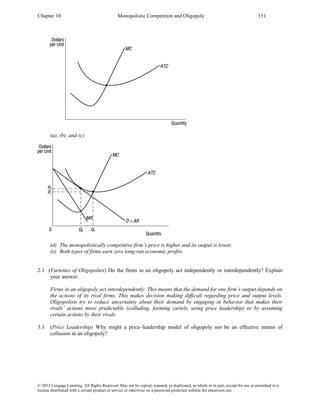
1.2 (Monopolistic Competition and Perfect Competition Compared) Illustrated below are the marginal cost
and average total cost curves for a small firm that is in long-run equilibrium.
a. Locate the long-run equilibrium price and quantity if the firm is perfectly competitive.
b. Label the price and quantity p1 and q1.
c. Draw in a demand and marginal revenue curve to illustrate long-run equilibrium if the firm is
monopolistically competitive. Label the price and quantity p2 and q2.
d. How do the monopolistically competitive firm’s price and output compare to those of the perfectly
competitive firm?
e. How do long-run profits compare for the two types of firms?
Chapter 10 Monopolistic Competition and Oligopoly 151
© 2012 Cengage Learning. All Rights Reserved. May not be copied, scanned, or duplicated, in whole or in part, except for use as permitted in a
license distributed with a certain product or service or otherwise on a password-protected website for classroom use.
(a), (b), and (c)
(d) The monopolistically competitive firm’s price is higher and its output is lower.
(e) Both types of firms earn zero long-run economic profits.
2.1 (Varieties of Oligopolies) Do the firms in an oligopoly act independently or interdependently? Explain
your answer.
Firms in an oligopoly act interdependently. This means that the demand for one firm’s output depends on
the actions of its rival firms. This makes decision making difficult regarding price and output levels.
Oligopolists try to reduce uncertainty about their demand by engaging in behavior that makes their
rivals’ actions more predictable (colluding, forming cartels, using price leadership) or by assuming
certain actions by their rivals.
3.1 (Price Leadership) Why might a price–leadership model of oligopoly not be an effective means of
collusion in an oligopoly?
Chapter 10 Monopolistic Competition and Oligopoly 152
© 2012 Cengage Learning. All Rights Reserved. May not be copied, scanned, or duplicated, in whole or in part, except for use as permitted in a
license distributed with a certain product or service or otherwise on a password-protected website for classroom use.
Price leadership is subject to a variety of obstacles. It violates antitrust law. The greater the product
differentiation among sellers, the less effective price leadership becomes. There is no guarantee others
will follow the price leader. Some firms may cheat on the price. A profitable price may attract new
entrants unless there are barriers to entry.
3.2 (Collusion and Cartels) Why would each of the following induce some members of OPEC to cheat on
their cartel agreement?
a. Newly joined cartel members are less–developed countries.
b. The number of cartel members doubles from 12 to 24.
c. International debts of some members grow.
d. Expectations grow that some members will cheat.
a. Many of the OPEC countries are less developed and need oil revenues to help diversify their
economies. If the underdevelopment or slow growth continues while the rest of the world continues
to grow, there will be an incentive for such countries to boost production and attempt to improve
their economies.
b. The larger the number of firms in the cartel, the more difficult it is to reach a consensus on the
allocation of output among members. As the size of the cartel increases, motivation to cheat
increases, and it becomes more difficult to track each member’s output.
c. To pay their loans expeditiously, such countries may resort to increased production and sales, thus
cheating on the quotas.
d. Each member expects that other members will cheat, and therefore cheats also.
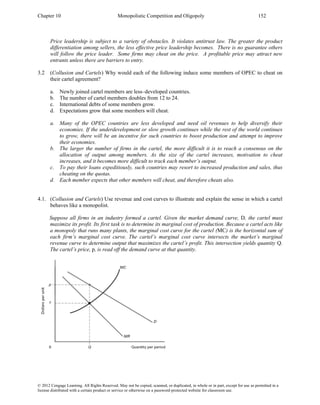
4.1. (Collusion and Cartels) Use revenue and cost curves to illustrate and explain the sense in which a cartel
behaves like a monopolist.
Suppose all firms in an industry formed a cartel. Given the market demand curve, D, the cartel must
maximize its profit. Its first task is to determine its marginal cost of production. Because a cartel acts like
a monopoly that runs many plants, the marginal cost curve for the cartel (MC) is the horizontal sum of
each firm’s marginal cost curve. The cartel’s marginal cost curve intersects the market’s marginal
revenue curve to determine output that maximizes the cartel’s profit. This intersection yields quantity Q.
The cartel’s price, p, is read off the demand curve at that quantity.
Chapter 10 Monopolistic Competition and Oligopoly 153
© 2012 Cengage Learning. All Rights Reserved. May not be copied, scanned, or duplicated, in whole or in part, except for use as permitted in a
license distributed with a certain product or service or otherwise on a password-protected website for classroom use.
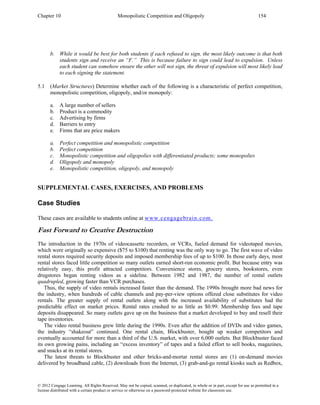
4.2 (Game Theory) Suppose there are only two automobile companies, Ford and Chevrolet. Ford believes
that Chevrolet will match any price it sets, but Chevrolet too is interested in maximizing profit. Use the
following price and profit data to answer the following questions.
Ford's Chevrolet's Ford’s Chevrolet’s
Selling Selling Profits Profits
Price Price (millions) (millions)
$ 4,000 $ 4,000 $ 8 $ 8
4,000 8,000 12 6
4,000 12,000 14 2
8,000 4,000 6 12
8,000 8,000 10 10
8,000 12,000 12 6
12,000 4,000 2 14
12,000 8,000 6 12
12,000 12,000 7 7
a. What price will Ford charge?
b. What price will Chevrolet charge once Ford has set its price?
c. What is Ford’s profit after Chevrolet’s response?
d. If the two firms collaborated to maximize joint profits, what prices would they set?
e. Given your answer to part (d), how could undetected cheating on price cause the cheating firm’s
profit to rise?
a. $8,000. Under the matching assumption (If Ford and Chevrolet both charge $4,000, the profits
would be $8; if they both charge $8,000, the profits are $10; and if they both charge $12,000, the
profits will be $7), Ford’s profits of $10 million are higher than those for any other price.
b. If Ford charges $8,000, Chevrolet maximizes its profits ($12 million) by charging $4,000.
c. If Chevrolet is charging $4,000 and Ford is charging $8,000, Ford’s profit is $6 million.
d. Both companies would set the price at $8,000, making total profits of $20 million that would be split
equally between them. Any other price combination lowers joint profit.
e. Chevrolet could increase its profits to $12 million by cutting its price to $4,000 (if undetected). Ford
could also increase profits to $12 million by cutting its price to $4,000 (if undetected).
4.3 (Game Theory) While grading a final exam, an economics professor discovers that two students have
virtually identical answers. She is convinced the two cheated but cannot prove it. The professor speaks
with each student separately and offers the following deal: Sign a statement admitting to cheating. If
both students sign the statement, each will receive an “F” for the course. If only one signs, he is allowed
to withdraw from the course while the other student is expelled. If neither signs, both receive a “C” since
the professor does not have sufficient evidence to prove cheating.
a. Draw the payoff matrix.
b. Which outcome do you expect? Why?
a. The payoff matrix is
Student A signs Student A does NOT sign
Student B signs A gets an F; B gets an F A is expelled; B withdraws
Student B does NOT sign A withdraws; B is expelled A gets a C; B gets a C
Chapter 10 Monopolistic Competition and Oligopoly 154
© 2012 Cengage Learning. All Rights Reserved. May not be copied, scanned, or duplicated, in whole or in part, except for use as permitted in a
license distributed with a certain product or service or otherwise on a password-protected website for classroom use.
b. While it would be best for both students if each refused to sign, the most likely outcome is that both
students sign and receive an “F.” This is because failure to sign could lead to expulsion. Unless
each student can somehow ensure the other will not sign, the threat of expulsion will most likely lead
to each signing the statement.
5.1 (Market Structures) Determine whether each of the following is a characteristic of perfect competition,
monopolistic competition, oligopoly, and/or monopoly:
a. A large number of sellers
b. Product is a commodity
c. Advertising by firms
d. Barriers to entry
e. Firms that are price makers
a. Perfect competition and monopolistic competition
b. Perfect competition
c. Monopolistic competition and oligopolies with differentiated products; some monopolies
d. Oligopoly and monopoly
e. Monopolistic competition, oligopoly, and monopoly
SUPPLEMENTAL CASES, EXERCISES, AND PROBLEMS
Case Studies
These cases are available to students online at www.cengagebrain.com.
Fast Forward to Creative Destruction
The introduction in the 1970s of videocassette recorders, or VCRs, fueled demand for videotaped movies,
which were originally so expensive ($75 to $100) that renting was the only way to go. The first wave of video
rental stores required security deposits and imposed membership fees of up to $100. In those early days, most
rental stores faced little competition so many outlets earned short-run economic profit. But because entry was
relatively easy, this profit attracted competitors. Convenience stores, grocery stores, bookstores, even
drugstores began renting videos as a sideline. Between 1982 and 1987, the number of rental outlets
quadrupled, growing faster than VCR purchases.
Thus, the supply of video rentals increased faster than the demand. The 1990s brought more bad news for
the industry, when hundreds of cable channels and pay-per-view options offered close substitutes for video
rentals. The greater supply of rental outlets along with the increased availability of substitutes had the
predictable effect on market prices. Rental rates crashed to as little as $0.99. Membership fees and tape
deposits disappeared. So many outlets gave up on the business that a market developed to buy and resell their
tape inventories.
The video rental business grew little during the 1990s. Even after the addition of DVDs and video games,
the industry “shakeout” continued. One rental chain, Blockbuster, bought up weaker competitors and
eventually accounted for more than a third of the U.S. market, with over 6,000 outlets. But Blockbuster faced
its own growing pains, including an “excess inventory” of tapes and a failed effort to sell books, magazines,
and snacks at its rental stores.
The latest threats to Blockbuster and other bricks-and-mortar rental stores are (1) on-demand movies
delivered by broadband cable, (2) downloads from the Internet, (3) grab-and-go rental kiosks such as Redbox,
Chapter 10 Monopolistic Competition and Oligopoly 155
© 2012 Cengage Learning. All Rights Reserved. May not be copied, scanned, or duplicated, in whole or in part, except for use as permitted in a
license distributed with a certain product or service or otherwise on a password-protected website for classroom use.
and (4) online rental services that mail DVDs, such as QwikFliks and Netflix (Netflix offers 100,000 movie
titles and mails out 2 million DVDs a day). In other developments, Wal-Mart bought Vudu in 2010 to stream
movies over the Internet in high definition using Vudu’s compression technology. And Best Buy teamed up
with Cinema Now to stream movies online. Other download competition came from Amazon.com’s Unbox,
Microsoft’s Xbox, Apple TV, and Netflix (half of Netflix’s 12 million subscribers stream movies).
Technological change has created powerful rivals to the bricks-and-mortar movie rental business.
Competition is fierce. Blockbuster announced in 2010 that it planned to close 1,560 of its remaining 3,750
outlets and warned that it may be forced into bankruptcy. As a measure of how far Blockbuster’s fortunes have
fallen, in 2002 the company stock sold for about $30 per share. By September 2010, the price was less than 10
cents a share. Such is the dynamic nature of a market economy—out with the old and in with the new, in a
competitive process that has been aptly called creative destruction. This destruction is no fun for producers on
the losing end, but consumers benefit from a wider choice and more competitive prices.
Sources: James Jarman, “Video Stores Crippled by Online, Kiosk, Mail Services,” Arizona Republic, 27
February 2010. Mary Ellen Lloyd, “Blockbuster Considers Bankruptcy Filing,” Wall Street Journal, 17 March
2010; and Stephen Grocer, “Wal-Mart Pays Up for Vudu. Should It Have Bought NetFlix?,” Wall Street
Journal, 22 February 2010..
Timely Fashions Boost Profit for Zara
One way a firm can increase market power is to offer a differentiated product. Zara, the largest fashion retailer
in Europe, has been described as “possibly the most innovative and devastating retailer in the world.” The
company makes much of its clothing in its own workshops and factories, including designing, fabric dyeing,
tailoring, and ironing. Zara also outsources some manufacturing to select suppliers that have developed the
ability to make high-quality garments with the required flexibility and speed.
Zara’s network of retail shops and clothing factories communicate through a sophisticated feedback
mechanism for gathering market intelligence and putting it to work. Sales associates carry personal digital
assistants to relay information on fashion trends and customer demand back to the company’s team of 200
designers in Spain. Real-time sales data allow the factory to increase production of items that are selling and to
bring out similar designs. Direct shipments from factory to shops also eliminate the need for costly
warehouses.
Zara takes as little as two weeks to develop a new item and deliver it to one of its more than 1,000 retail
stores. The industry average is six months. The company launches about 10,000 new designs a year, making
new items in small batches at first so if something doesn’t sell, there is not much left over. But if something
catches on, stores can restock in a few days, so Zara doesn’t miss out on a fashion wave. Thus, shops never
have to wait long for fresh stock or to get an order filled. Whereas traditional stores such as the Gap may get
new fashions twice a season, Zara distributes them twice a week. And in perhaps its most unusual of strategies,
the company advertises little, relying instead on prime store location and word of mouth.
In short, Zara believes that making most of its own apparel and selectively outsourcing the rest, reduces
delays, exploits customer feedback, maintains flexibility, and ensures quality. This steady supply of new
clothing lines and continuous supply of popular items help Zara differentiate its products. Amancio Ortega,
Zara’s founder, opened his first store in 1975. With a personal fortune of $25 billion in 2010, he became the
richest person in Spain and the ninth richest on the planet. The market rewards successful innovators.
Sources: Nebahat Tokatli, “Insights from the Global Clothing Industry—The Case of Zara, A Fast Fashion
Retailer,” Journal of Economic Geography, 8 (January 2008): 21–38; Vanessa O’Connell, “How Fashion
Makes Its Way from the Runway to the Rack,” Wall Street Journal, 8 February 2007; “Supply-Chain
Management,” The Economist, 6 April 2009; and “The World’s Billionaires,” Forbes, 11 March 2010.
Chapter 10 Monopolistic Competition and Oligopoly 156
© 2012 Cengage Learning. All Rights Reserved. May not be copied, scanned, or duplicated, in whole or in part, except for use as permitted in a
license distributed with a certain product or service or otherwise on a password-protected website for classroom use.
Experiential Exercises
1. OPEC is the economist’s favorite cartel to study, partly because it had such a spectacular short-run success
and partly because oligopoly theory could be used to predict how OPEC pricing actually evolved. Have
students search for some recent developments in petroleum pricing. How relevant are the factors listed in
this chapter in affecting the difficulty of maintaining a cartel?
2. To find evidence of price leadership, have students check The Wall Street Journal for stories about airfares.
Typically, one airline will raise its fares—on certain routes or across the board—and other airlines will
match those changes within a day or two. Such stories are typically reported on the front page—in the
“What’s News” column. When students find such a story, ask them to check back over the next few days.
Did they find that other airlines matched the leader, or was the leader forced to back off its price changes?
3. (Global Economic Watch) Go to the Global Economic Crisis Resource Center. Select Global Issues in
Context. In the Basic Search box at the top of the page, enter the phrase "product and service
differentiation." On the Results page, go to the News section. Click on the link for the April 1, 2010, article
"Study Results from University of Adelaide Broaden Understanding of Research Policy." According to the
article, are innovation-related activities enough to create product and service differentiation?
No. "The researchers concluded: 'The results contribute to the innovation literature in finding that
innovation-related activities can only drive a firm's competitive advantage when they occur concomitantly
with actual changes in the market position and offerings of firms." In other words, marketing and sales
matter in addition to research and development.
4. (Global Economic Watch) Go to the Global Economic Crisis Resource Center. Select Global Issues in
Context. In the Basic Search box at the top of the page, enter the term "game theory." Write a paragraph
about one example of game theory being used to analyze economic behavior.
Student answers will vary. Look for examples of strategic moves and countermoves.
Additional Questions and Problems
(From student Web site at www.cengagebrain.com)
1. (Characteristics of Monopolistic Competition) Why does the demand curve facing a monopolistically
competitive firm slope downward in the long run, even after the entry of new firms?
The negative slope of the monopolistically competitive firm’s demand curve is the result of product
differentiation. Firms will face perfectly elastic demand curves only if their products are perfect
substitutes for the products of other firms. If firms can successfully differentiate their products in the long
run, the demand curve each firm faces continues to slope downward. Some distinguishing features of a
firm’s product may not be readily duplicated, advertising could help a firm maintain a different image
for its product, or customers may continue to buy a certain firm’s product out of habit.
2. (Product Differentiation) What are four ways in which a firm can differentiate its product? What role can
advertising play in product differentiation? How can advertising become a barrier to entry?
A firm can differentiate its product by varying its physical appearance and qualities, by providing more
and different locations where the product can be purchased, by providing more accompanying services,
or by trying to foster a different image in the consumer’s mind.
Chapter 10 Monopolistic Competition and Oligopoly 157
© 2012 Cengage Learning. All Rights Reserved. May not be copied, scanned, or duplicated, in whole or in part, except for use as permitted in a
license distributed with a certain product or service or otherwise on a password-protected website for classroom use.
Advertising makes the consumer aware of how a firm’s product differs from that of its competitor.
Advertising often emphasizes physical qualities or services, or establishes a brand name. In industries
with high advertising expenses, the cost of entry increases for a new competitor who must compete
effectively with existing firms by matching their high advertising budget. This high cost of entry
represents a potential barrier to entry.
3. (Zero Economic Profits in the Long Run) In the long run, a monopolistically competitive firm earns zero
economic profit, which is exactly what would occur if the industry were perfectly competitive. Assuming
that the cost curves for each firm are the same whether the industry is perfectly or monopolistically
competitive, answer the following questions.
a. Why don’t perfectly and monopolistically competitive firms produce the same equilibrium quantity
in the long run?
b. Why is a monopolistically competitive industry said to be economically inefficient?
c. What benefits might cause us to prefer the monopolistically competitive result to the perfectly
competitive result?
a. In the monopolistic competition case, firms produce where demand is tangent to ATC. The price in
this case is higher than it would be in the competitive industry structure. Therefore, industry output
is lower than in a perfectly competitive market.
b. It is economically inefficient because the same total output could be produced at a lower resource
cost if it were produced by fewer (and therefore larger) firms taking full advantage of economies of
scale. This results in excess capacity.
c. The monopolistically competitive industry produces differentiated products, which apparently give
consumers a wider choice of options.
ANSWERS TO ONLINE CASE STUDIES
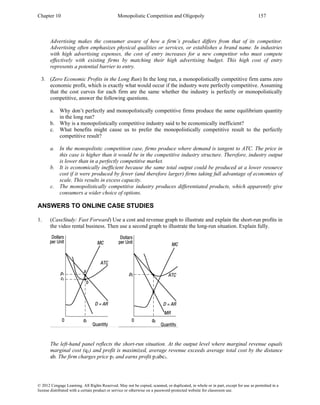
1. (CaseStudy: Fast Forward) Use a cost and revenue graph to illustrate and explain the short-run profits in
the video rental business. Then use a second graph to illustrate the long-run situation. Explain fully.
The left-hand panel reflects the short-run situation. At the output level where marginal revenue equals
marginal cost (q1) and profit is maximized, average revenue exceeds average total cost by the distance
ab. The firm charges price p1 and earns profit p1abc1.
Chapter 10 Monopolistic Competition and Oligopoly 158
© 2012 Cengage Learning. All Rights Reserved. May not be copied, scanned, or duplicated, in whole or in part, except for use as permitted in a
license distributed with a certain product or service or otherwise on a password-protected website for classroom use.
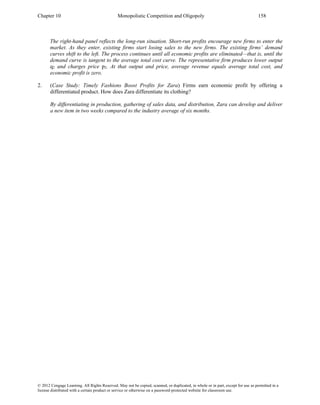
The right-hand panel reflects the long-run situation. Short-run profits encourage new firms to enter the
market. As they enter, existing firms start losing sales to the new firms. The existing firms’ demand
curves shift to the left. The process continues until all economic profits are eliminated—that is, until the
demand curve is tangent to the average total cost curve. The representative firm produces lower output
q2 and charges price p2. At that output and price, average revenue equals average total cost, and
economic profit is zero.
2. (Case Study: Timely Fashions Boost Profits for Zara) Firms earn economic profit by offering a
differentiated product. How does Zara differentiate its clothing?
By differentiating in production, gathering of sales data, and distribution, Zara can develop and deliver
a new item in two weeks compared to the industry average of six months.
Random documents with unrelated
content Scribd suggests to you:
“We have already discussed that. By the way, I would suggest that
you make it convenient to leave here early in the morning instead of
to-morrow night, and so spare, in some measure, the feelings of
your mother and sisters—”
“You are heartless! I will leave the house now!”
“Please no, unless you desire to start a scandal among the servants,
and another in the village.”
“Oh, you are worse than heartless; you are unjust. . . . But I will
wait till the morning. Good-bye.” Colin turned and moved towards
the door.
“Stay! You have forgotten your money.”
Without looking back Colin went out.
When Mr. Hayward went to bed, half-an-hour later, he left—
deliberately—the notes lying on his writing-table.
At 6.30 a.m. Colin entered a closed carriage, and with his modest
baggage was driven to the station. There had been no farewells,
and on the whole he did not regret their absence, for he knew they
would have been highly seasoned with reproaches and unwelcome
advice. He took a ticket for Glasgow.
Having heard the carriage drive away, Mr. Hayward in his dressing
gown came down to the library. Where the notes had been he
found a scrap of paper—
I.O.U.
One hundred pounds.
C. H. Hayward.
He smiled sardonically, muttering, “I thought he would climb down,”
and put the I.O.U. beside the anonymous note of last night, in his
safe.
CHAPTER III
The morning mail for Dunford was usually in the post-office by a
quarter to seven. It was conveyed from the train by Sam, the
postman, a little stout person with a grey military moustache, whose
age, according to his own statement, was “forty-nine and a bit.” It
had been that for a good many years. With Sam’s assistance Kitty
was wont to sort the letters, and the two had become staunch
friends, though no very serious confidences had been exchanged.
In the midst of the sorting this morning Sam suddenly remarked that
Mr. Colin Hayward had not made a long stay with his people.
“I seen him at the station,” he continued. “I couldna say where he
was bound for, but he had a pickle luggage, and he wasna looking
extra cheery. Been getting lectured for no passing his examination, I
suppose. Poor lad, I’m vexed for him. He never got on with his folk,
and he’s the only real gentleman in the family. They’re a cauld-
hearted stuck-up lot. Him an’ me used often to gang fishing—that
was afore your time, Miss—and a kinder, blither chap I never hope to
meet. Well, well, if he’s the black sheep, the others ha’ used a
queer lot o’ whitewash.”
Kitty felt that she was expected to say something, but just then Sam
came on an address that required deciphering, and the subject
dropped, not a little to her relief.
When the sorting was finished, Sam set out on his round, and she
made her way to the cottage for breakfast. Her uncle was already at
table looking more than usually morose; her aunt was muttering to
something on the stove—a habit of hers when annoyed. Kitty
perceived that she was still in disgrace, and her heart sank. After
all, those two people constituted her whole kin, and she would have
pleased them had it been possible, if only for the sake of peace and
cheerfulness. More, she would have loved them had they given her
the slightest encouragement.
Mr. Corrie took no notice of his niece as she approached her
accustomed seat. To his sister he growled over his shoulder—
“The paper’s late again! I’ve a good mind to start selling
newspapers myself. That woman seems to think she can play wi’
her customers just because she’s a widow.”
“I’ll speak to her,” said Miss Corrie, coming over with a dish of bacon.
“Tell her she had best bring the paper here—or send it—within five
minutes o’ the train’s arrival. D’ye hear?”
“Ay, I hear ye, John. Take yer breakfast now, and ha’ patience for
the paper.”
The meal was almost over when Mr. Corrie spoke again—this time to
his niece.
“Well, ha’ ye thought over what I said to ye last night?” he abruptly
demanded.
Kitty was not unprepared for the question, and she answered calmly
enough that she had not further considered the matter—which was
not, perhaps, quite accurate—because she had assumed that it was
closed.
“Then ye’d better think it over now, for Mr. Symington’s pretty sure
to come again to-night.”
“If he comes, I can only tell him what I told you—of course, I’ll do it
politely. . . . Uncle John, why are you so anxious for me to marry
that man? Tell me straight—do you and Aunt Rachel want to get rid
of me?”
Corrie hesitated. He dared not say, as he was tempted to say, that
he could not afford to give her a home any longer, because, for one
thing, the girl was as well aware as himself that he kept the
allowance made by the post-office for her services as assistant—an
assistant, by the way, who did practically all the work.
“Not so long ago you thought very little of Mr. Symington,” she
pursued, “and I’ve often heard Aunt Rachel call him anything but a
nice man. Besides, he must be nearly forty.”
“That’s enough,” said Corrie sharply. “Your aunt and me know him
better than we used to. We want you to marry him because we see
’twould be a good thing for you. Same time, he’s come into a heap
of money.”
“Ay,” said Miss Corrie, “he has that! He’s talking o’ giving up the
farm and setting up house in the city—Glasgow, maybe. That would
suit ye fine, Kitty.”
“I’m sorry I can’t do what you want,” the girl said slowly. “I’d rather
be dead than married to him. He—”
“Don’t talk trash!” exclaimed Corrie, lowering upon her. “Ye’ll give
him ‘ay’ to-night or it’ll be the worse for ye. Don’t you try to cross
me, ye daughter o’ a beggar!”
“John!” squealed his sister.
Kitty was on her feet, her beautiful eyes blazing from her white
face. “How dare you?” she cried, shaking with furious indignation,
“how dare you speak so of my father, a man with a great, noble
mind?—you, you miserable thing, with not an idea in your head, not
a thought in your heart, but money, money, money! My father owes
you nothing—nothing, do you hear? His daughter has earned every
penny she has cost you.”
John Corrie, unused to contradiction, much less to retaliation, rose,
grey of countenance, shaking with passion. Probably he was not
aware that he had the bread knife in his hand, but his sister grabbed
his wrist.
“Listen to me,” he began in a thick voice.
“I won’t! You are not sane,” said Kitty, “or you would never have
spoken such words about my father, your own sister’s husband—not
that I’ll ever forgive them or you. But you are mad—mad with
greed! I tell you, once and for all, I’m not for sale to Mr.
Symington!”
He sat down with a crash, his mouth gaping.
“Go, go!” whispered Miss Corrie, motioning frantically with her free
hand. “It’s eight o’clock—time the office was open.”
Kitty turned and went. She was glad to go, for her courage was
already burned out.
Miss Corrie shook her brother. “Ye fool, ye forsaken fool!” she
sputtered. “That temper o’ yours has ruined everything. Ye’ll never
get her to marry him now.”
He turned on her savagely. “What ha’ ye told her?”
“Me? Never a word.”
“Then what did she mean by saying she wasna for sale? . . . God!
she must ha’ heard—”
“Guessed maybe. Why did ye tell her the man had come into a heap
o’ money? I warned ye to go canny.”
He flung her from him and got up. “Let her guess what she likes,
think what she likes, do what she likes—but she’s no going to beat
me. I’ll find a way! I’ll manage her yet! Ten thousand—twenty—
maybe twenty-five thousand pound—no, by heavens, I’m not to be
done out o’ that by a stubborn lass.”
“Let be, John. Ye ha’ siller enough. Ye dinna spend a trifle o’ your
income. Ye’ll rue the day that ye cheated your sister’s daughter, for
that’s what it comes to.”
“Hold your silly tongue, woman. I’ve cheated nobody but myself.”
She shook her head, saying, “I would like to read Hugh Carstairs’
letter again.”
“Ye’re welcome—another time. There’s the paper at last.” He
almost ran to the front door.
He returned, opening the paper at the financial page. Seating
himself, he cleared a space on the table and laid it thereon. Then
his thick forefinger began to move down one of the columns as
though it was feeling for something. At last it stopped, and he
gazed awhile. . . . His breath went in with a hiss. “Zeniths!” he
muttered.
His sister was staring over his shoulder, but her sight was
indifferent. “What is it?” she gasped. “What about the Zeniths?”
In a hushed voice he replied, “They rose seven-and-sixpence
yesterday. They’re now worth ninety shillings a share. That means
£22,500 for the five thousand. . . . That would be £11,260 for me—
us. . . . I wonder if Symington shouldna sell now. Wait till I see if it
says anything about them here.” He turned to some paragraphs,
headed “Mining Notes.” . . . “Ay, here it is! Oh, listen, Rachel! It
says they’ll likely go to eight pound! Almighty! We munna let him
sell!”
She sighed and said, “It’s time the shop was open.”
“Ay, so it is—but wait a minute.”
With another headshake she began to clear the table.
He rose suddenly. “There’s the keys,” he said, throwing them on to
the table. “Ye can open the shop. I’m going up to White Farm.”
CHAPTER IV
At the risk of offending a stray customer Kitty delayed opening the
post-office until her outraged spirit had become a little calmer—only
a little, for the mingled passions so brutally aroused would subside
only through sheer exhaustion. She had no one to confide in, no
one to count on for sympathy and comfort. She had thought she
had grown used to being alone in the world, but she had never
experienced loneliness like this. Her bosom heaved, but her eyes
remained dry.
The sounds of her aunt opening the shop next door roused her from
a sort of stupor. Taking the big key, she proceeded to open the
office for the day’s business. There was some book-keeping to be
done, also a schedule or two to fill up, but her hand shook so that
she could scarcely write. And suddenly she realized that she was
afraid, desperately afraid. She was so wholly dependent on that
man next door; her very existence was in his hands; she was, to all
intents and purposes, his prisoner.
A few pounds would have made all the difference now. She
possessed less than two shillings. There was no escape.
She unlocked the safe, and transferred part of its contents, money,
stamps, and so forth, to their proper drawers. The money gave her
a sickish feeling; so much of it—the price of her salvation over and
over again—her freedom in a fraction of it. . . . Violently she shut
the drawer and turned to the desk.
A child came in with a letter and a penny, and, a little later, a woman
with a parcel. Then there was a longish blank till an elderly man
entered. He made a brief remark on the weather and proceeded to
fill up a money order request-form. Presently he pushed it across
the counter along with the money, £27, in three five-pound and
twelve one-pound notes, also an eightpence to pay the charge.
Laying the money on the desk, she collected her wits and carefully
wrote out the order. Her sleeve brushed the notes separate without
her noticing.
The man wanted to know when a letter would be delivered in a
certain outlying place in Ireland, and she took the “Post-office guide”
to the counter and found him the information contained therein. He
went out, leaving the door open. The brisk current of morning air
was welcome. Before she could turn from the counter a girl came in
with a few shillings for her savings account. . . .
When the girl had gone Kitty put her hands to her head, which was
now throbbing painfully. Some little time elapsed before she
returned to the desk. Observing the notes, she gathered them up
and placed them in the proper drawer for money order and postal
order transactions. She locked the drawer with a key on the bunch
hanging from her belt. Often this drawer contained fairly large
sums. Once more she attacked her clerical work.
Somehow the morning passed. At noon she was relieved for half an
hour, by her uncle. He peered about, but made no remark, and
without even glancing at him she passed through the short passage
leading to the shop and thence to the cottage. Her dinner was
waiting on the table. Miss Corrie, who had put it there, had gone
back to the shop; she dined with her brother later.
Kitty could not eat. After a while she went up to her room and lay
down for ten minutes. The pity was that she did not spend the
whole of her half-hour upstairs.
The first thing Corrie did on being left to himself, was to snatch from
the floor, under the shadow of the desk, a five-pound note. Holding
it stretched between his hands, he stood transfixed, while the clock
ticked nearly a hundred seconds. Then his hands began to shake
and sweat appeared on his face. . . . Two minutes later he left the
office to take care of itself, going out by the public way. Keeping
close to the wall he passed round behind the office and shop and
into the yard at the back of the house. The place was not
overlooked by neighbours, but he glanced keenly about him before
he turned his gaze upwards. Above the ivy an attic window was
wide open.
He tiptoed to an out-house; he tiptoed back with a ladder. He
placed the ladder in position and climbed a few bars, halted, and
made a show of doing something to the ivy. Ascending further, he
repeated the performance. At last he was at the window. For a few
seconds he remained with his body bent and stretched into the
room, then he withdrew, descended the ladder, replaced it in the
out-house, and returned to the office.
At 12.30 his niece appeared. He moved towards the shop, seemed
to change his mind, and came back. He cleared his throat, and said
—
“I’ll check the cash.”
Hitherto the formality had always taken place after business hours,
but the girl, too sick at heart to be surprised at anything, without
hesitation or remark handed him her keys.
Before long Miss Corrie called him to dinner.
“It’ll ha’ to wait,” he returned, apparently immersed in his task.
At the end of twenty minutes he spoke.
“Here!”
She came over. “Anything wrong?” she asked wearily.
He pointed to the open drawer. “Ye’re short!”
“Nonsense! Twenty-seven pounds—that’s been the only money
order business to-day.”
“Well, there’s only twenty-two.”
“You’ve made a mistake,” she said, with reviving alertness. “Three
fives and twelve singles.”
“Was that how Torrance gave ye the money? Be very sure now!—
Three fives and twelve singles? Eh?”
“I’m perfectly sure,” she returned impatiently. “The notes must have
stuck. How much do you make me short?”
“Count for yourself.”
She took them out and laid them on the counter. There was a short
silence broken only by the rustle of the paper and the ticking of the
clock.
Suddenly she raised her head and looked him straight in the eyes,
without a word.
He stood her gaze for a brief space, then turned it to the notes. His
fist banged the counter.
“Five pound short—a five-pound note—where is it?”
Still she stared at him silent.
“Can ye no answer?” he snarled at last.
She answered with an odd, slow smile. It maddened him. He
strode across to the passage and shouted for his sister.
Miss Corrie came at once. “What’s the matter, John? Mind, the lad’s
in the shop.”
“Send him to his dinner.”
Kitty spoke. “No. I want a witness.”
“A witness!” screeched the woman. “What for?”
Corrie pushed her aside, and bawled—
“Peter, ye can go for your dinner now.” He waited until he heard a
door open and close, then wheeled and said to his sister—“She’s five
pound short.”
Miss Corrie threw up her hands.
“Yes,” said Kitty quietly, “I’m five pounds short.”
The woman was about to speak, but her brother motioned her to
hold her tongue.
“I want to know where that five-pound note is. . . . Do ye hear me,
girl?”
She paid not the slightest attention.
“See here, Rachel,” he said, somewhat wildly, “she admits she got
twenty-seven pound from Torrance this morning. She had the key o’
the drawer all the time I was here my lone. As you and the boy can
swear I never passed to the house. When I checked the cash in her
presence, I found her five pound short. . . . And she won’t say
what’s become o’ it.”
“Tell him,” cried Miss Corrie. “Speak!”
“What’s the use?” said the girl, and there was a pause.
“Were ye up the stair at your dinner-time?” he demanded.
No answer.
“Ay; I heard her,” said her aunt.
“Then it’s my duty to—to make a search,” he said in a thick voice.
“Get the police,” said Kitty. “They’re honest.”
He all but lost control then. “Up to your room!” he roared. “Rachel,
you maun come likewise.”
Kitty turned and led the way. She felt that this was only the
beginning of the ghastly farce, nothing could possibly be found in
her room unless her uncle contrived to put it there while he was
pretending to search, and she would see to it that he was not
allowed to manage that!
“If it’s no in there,” said Corrie, as they reached the small landing,
“your aunt’ll ha’ to search your person. Go inside the two o’ ye. I’ll
bide here. Rachel, you make search.”
Kitty began to feel puzzled in a dull, dreary fashion. Her uncle could
play no tricks from where he stood. Why should he make such a
long business of the matter? He had failed to terrify her, and—
“Where’ll I search?” wailed Miss Corrie.
“Every place. It’s got to be found,” replied her brother. “It’s
Government money.”
“It’ll take a long, long time. Would ye no give her another chance to
—to speak?”
“She’s had her chance. Hurry up!”
It was no doubt natural that Miss Corrie should start with the chest
of drawers that served also for a dressing table, placed at an angle
with the window and near it. She drew out the right-hand top
drawer.
“Turn it out on the floor,” he ordered.
Kitty sat down on the bed and apathetically watched the scattering
of her poor little fineries, gloves, ribbons, fancy buttons, and so on.
“It’s no’ there, anyway,” remarked Rachel, rising at last.
She opened the neighbour drawer, and Kitty winced, for it held her
father’s manuscripts.
“Oh!” gasped Rachel, and stood petrified.
“Hurry up!” called her brother, and she started.
“It—it’s here,” she whispered, and held it up.
Corrie strode in, snatched it and held it close to his niece’s face.
Kitty was white as death now. What dumb innocence, what loud
defence, could stand against this?
Her aunt slunk from the room.
“Well,” said Corrie at last in a lowered voice, “I’ll let ye go free now;
I’ll let ye go free till this time to-morrow—no, till ten o’clock to-
morrow night. But if ye want to go free after that, ye know the way
—the only way. Now ye can think over it. I’ll mind the office
myself.”
With that he went out.
Had Kitty held a weapon of any sort then, she would certainly have
tried to kill him.
* * * * *
In the evening her aunt brought her some tea, set it down, and
retired without a word. But no restraint was put on her
movements. Restraint was unnecessary. Where could she go,
penniless? Later, when she heard Symington’s voice in the kitchen,
she stole downstairs and out of doors.
In the dusk, an hour afterwards, she stood at her old place, waiting
the roaring approach, the thundering dash past, of the London mail.
Colin Hayward would not be on board, she told herself, and
wondered vaguely why, after all, he had left early in the morning.
And now he would be in London, and things there would already be
making him forget her. She did not love him as she judged a maid
should love a man—but oh! how gladly she would have yielded now
to his tender arms and his kind voice. . . .
The train was coming—it was nearly on her. Something white
fluttered from a window. But the signal could not be for her!—and
yet with her heart in her eyes she gazed. And just for a tick of time
she had a glimpse of Colin’s face. It was all over.
She laid her arms on the fence, and bowed her face on them, and
wept as never she had wept in all her one-and-twenty years—such
tears of bitterness, such tears of loneliness.
Perhaps Sam, quitting his post on the railway, may have wondered
at the bowed figure, but he went off discreetly by his one way, a
hundred yards further down the field.
In the starry darkness Kitty came to herself, and slowly made her
way to the only home she had. Emotion had weakened her
physically, but her spirit yet struggled strongly in the toils. She had
still nearly twenty-four hours of freedom, such as it was. To-night it
was too late for any persecution from Alec Symington, who surely
must have left the cottage some time ago, and gone home, for it
was now nearing eleven o’clock.
But on the road, at the gate of the field, he was waiting.
CHAPTER V
“Aren’t you going to shake hands?” he asked. He was leaning on the
gate, smoking a cigarette.
It was not so dark that the girl, who had halted a couple of yards
away, could fail to see the smile accompanying the words.
Symington’s was by no means an ill-looking countenance, though
forty years, half of them strenuous after a fashion, had blurred the
fineness of the well-shaped features; it would have been attractive,
admirable even, but for something in the eyes, something about the
mouth, under the nicely trimmed tawny moustache, that is not to be
fully described by the word covetous. His was a face that no wise
man would regard without doubts, that no wise woman would trust.
Symington was tall and broad-shouldered, but in the light of day he
had a softish look, and one imagined him as a “fat man” in the years
soon to come. He was no hard-working farmer. White Farm had
come to him for lack of a worthier and fitter heir, his two brothers
having died not long before his father, and there were honest people
in the neighbourhood who would tell you that the good old property
was already on the road to ruin. Symington’s record was that of a
man who had seen a good deal of life in different parts of the world,
and learned little worth knowing, who had frequently touched the
skirts of Fortune but never captured her, and who had gambled away
more hours than he had toiled. And now, at forty, he was probably
nearer to Fortune than he had ever been, and certainly nearer to
love, as he understood it. For in Kitty Carstairs he had nothing to
gain but youthful sweetness and fresh beauty; indeed, in a material
sense, the possession of her was going to cost him dear—if he kept
his bond with the contemptible John Corrie.
“Aren’t you going to shake hands?” he asked again.
“Please open the gate,” said Kitty, “or I must go home another way.”
“It’s a lovely night, and your aunt knows I’m looking after you. I
want to have a talk with you, Kitty.”
She sighed. “I’m very tired—too tired to listen to any one. Please
let me go.”
“I won’t keep you long, and we can find a nice dry seat in the wood,
since you’re so tired. Come, you needn’t be shy with me, Kitty—”
“Are you going to open the gate?” she coldly asked.
“Immediately, if you’ll promise—”
He turned sharply. Some one had come out of the little wood, and
was crossing the road.
“Is that you, Miss?”
“Oh, Sam!” cried the girl in a gasp of relief.
“Can ye no’ get the gate open?” the postman inquired, as though no
Symington had been there. He came forward and laid a hand on the
bolt.
“What the blazes do you want?” blurted Symington, suddenly erect.
“I’m thinking Miss Carstairs is due home by now,” Sam said coolly.
“What do ye say, Miss?”
“Miss Carstairs is in my charge, you interfering fool!”
“No, no, Sam; I’m not!—and I want to get home at once.”
“Kindly stand aside, Mr. Symington,” said the postman.
“Stand aside—for you!” exclaimed Symington in a fury. With an ugly
laugh and a curse he drove his fist at the little man’s face, sending
him down in a heap. “That’s to go on with,” he said, and strolled off.
“Oh, you coward!” cried Kitty, wrenching open the gate. “Are you
badly hurt, Sam?”
Sam was already rising, holding his aching jaw. Inwardly he was
raging, but all he said then was, “All right, Miss. My turn’ll maybe
come. And now I’ll be seeing ye home.”
She caught his arm, for he seemed in need of support.
“Ye’re trembling, Miss,” he remarked, “and no wonder. Never mind;
it’s all over now. But I’d just like to hear ye say ye didna think me
too interfering-like.”
“Oh,” she said earnestly, “I don’t know what I’d have done if you
hadn’t come. I’ll be grateful to you as long as—”
“There, there! It’s a reward to hear that ye didna want his company,
for he’s a rotten bad one.”
They walked a little way in silence, and then a sob escaped the girl.
She was at the end of her wits and her courage. Few of us can
struggle alone all the time, and she knew that Sam had saved her
only for a matter of so many hours.
“Come, cheer up, Miss,” he said kindly. “Ye wasna in the office to-
night, and your aunt told me ye wasna so well, so it’s no wonder
ye’re upset. Still—”
“Sam,” she interrupted, “I’m going to tell you everything—nearly
everything. You’re the only soul I can trust.” And in whispered,
spasmodic sentences she poured forth her tale.
Sam was more than shocked; he was overwhelmed.
“To think of it, to think of it!” he repeated feebly a dozen times
before wrath and pity took command of his honest soul. Then he
was for taking John Corrie by the throat, and shaking all but the last
breath out of his body, for telling Miss Corrie exactly what he
thought of her, and for presenting Kitty with his savings, yea, and his
own little abode, to enable her to stand independent of her
unnatural relatives.
She was half-laughing, half-crying, by the time he paused for breath.
“Oh, Sam, you know I’d never allow you to do any of those things
for my sake, but I’ll never forget your goodness. You mustn’t do
anything, or I’ll wish I hadn’t told you. But I do want you to advise
me what to do.”
“I never liked John Corrie,” he cried, “nor did any soul in Dunford;
but I never doubted he was a straight man. But dinna ye be afraid
for the five-pun’ note business—dinna ye be afraid for that!”
“But that’s what I am afraid of! I might escape from Mr. Symington
by simply going away, but not from—”
“Your uncle would never dare to—”
“Dare? After what he’s done, what would he not dare? And he’s
clever in his way. How did he get that five-pound note into my
drawer?”
Sam’s hand went to his mouth. A sound not unlike a chuckle
became the beginning of a fit of coughing. When it had passed he
said—
“We’ll maybe find that out yet, so dinna let it bother ye too much,
Miss. But if he tries to frighten ye, let me know, and I’ll deal wi’ him
—by gravy, I’ll deal wi’ him!”
“Sam, you must be careful. What if he got you into trouble, and you
lost your—”
“I can take care o’ myself,” said Sam, “except, maybe at the boxing
—and I didna get fair play from that scoundrel.” He laughed ruefully.
“The beast!”
“Well, well, as I said, my turn’ll maybe come—and yours’ll come to a
certainty, Miss. Keep up your heart. Are ye feeling a bit better
now?”
“Oh, yes,” she answered warmly. “It’s not so awful when one isn’t
all alone.”
“Poor, pretty thing!” he said gently, “ye’ll win through yet. . . . And
now we’re nearly there, and I’d best no be seen wi’ ye. We’ll get a
talk at sorting-time in the morning.”
“Unless I’m forbidden the office.”
“If your uncle does that, we’ll just ha’ to find another way.”
With a hurried pat on her shoulder, he turned and went.
* * * * *
The cottage door was not locked. Having entered, Kitty stood still
for a moment, listening. Silence. She turned into the kitchen to find
it, as she had scarcely dared to hope, unoccupied. Her aunt and
uncle had evidently retired for the night. A candle burned on the
table. A jug of milk, bread and butter were there also. Somehow
the sight of food stirred her sense of humour. She had read of a
murderer being treated to an egg with his breakfast on the morning
of his execution, and it had struck her as pathetically absurd. Never
before had such an attention been paid her. She drank a little milk,
because she was thirsty, and went upstairs.
On the chest of drawers in her room she found a piece of yellow
wrapping paper bearing her aunt’s writing in pencil.
“Do your work in the office to-morrow morning as usual.”
So her uncle intended to keep his promise that she should “go free”
until the following night. But after that, what?
If Kitty had disliked Symington in the past, she hated him, nay,
detested him now. Yes, and despised him. His assault on Sam had
brought about the last. To give Symington his due, he had regretted
the blow almost at once. It had been a stupid blunder to make in
Kitty’s presence. Her indignant, contemptuous words had told him
that.
He had gone home angry with himself, cursing the postman, feeling
that it would be inadvisable, if not fatal, to approach the girl again
until the thing had cooled in her mind. Then he could apologize,
blaming the outburst on his overpowering desire for her. Yes, he
had better give her a week, during which Old Corrie would, of
course, continue to exert his influence. Meantime he would make a
trip to London. Whether he liked it or not, he must convert a few
Zeniths into cash.
Kitty endured a bad two hours before sleep came, but nature won at
last, and she passed the remainder of the night in blessed
unconsciousness.
* * * * *
With the morning mail-bags Sam arrived in a heated condition,
puffing and blowing.
“I was in such a hurry to see how ye was, Miss,” he explained.
“Keeping up your heart?”
She gave him a nod and a brave smile. Poor old Sam! he was good
and kind and willing, but how could he really help her from her
hideous plight?
They fell to work on the contents of the sacks, and the minutes
ticked past.
“Registered letter, Miss,” said Sam, throwing it to her end of the
counter, as he usually did with such a packet.
She was about to lay it aside for attention later when the address
caught her eye. A cry escaped her.
Sam turned to see her, white as a ghost, tearing at the envelope.
“Oh, what can it be?” she whispered. Then, as if courage failed her,
“Sam, come and take it. Tell me what it’s all about. I—I daren’t
look. It may be nothing much, after all.”
Sam’s fingers were none too steady as he received the envelope.
“Registered at Glasgow,” he muttered, and proceeded to extract the
contents.
These were a fairly plump number of banknotes, and a half-sheet of
paper bearing the words—
“From an old friend of your father.” . . . Sam read them aloud while
she stood rigid with her face in her hands.
“Am I to count them?” he asked.
“Yes,” she murmured.
“Five-pun’ notes,” he said, and there followed a rustling pause.
“Twenty o’ them—a hundred pound. . . . See!” he took one of her
hands from her face, and pressed the bundle into it. “Feel them—
they’re real, ye poor, pretty thing!”
CHAPTER VI
Sam was doomed to be late in starting on his round that morning.
The moment Kitty’s mind grasped the significance of the windfall her
tongue was loosed. She talked excitedly, even wildly. The sender of
the notes—she wished he had given his name—must be some one
whom her father had helped in the old days. Her father was always
lending money that never came back. That was why there was none
when he died. She hoped she might some day discover the sender,
otherwise he could never realize how much more than kind, how
truly wonderful, was the thing he had done. For he had given a
desperate, persecuted girl her freedom!
“But what are ye going to do, Miss?” Sam ventured at last.
“I’m going to trust you,” she said, with a broken laugh.
“Aye, surely ye can do that. But I hope ye’re no’ for being reckless.
Your eyes are shining something terrible.”
She laughed again, and said, “I’m going to London!”
“London!”
“To-night!”
It took Sam some moments to recover. “But what’s taking ye a’ the
road to London?”
“I’ve always wanted to go. I’ve always said I would go if I had the
money—and now I’ve got it!”
Welcome to our website – the perfect destination for book lovers and
knowledge seekers. We believe that every book holds a new world,
offering opportunities for learning, discovery, and personal growth.
That’s why we are dedicated to bringing you a diverse collection of
books, ranging from classic literature and specialized publications to
self-development guides and children's books.
More than just a book-buying platform, we strive to be a bridge
connecting you with timeless cultural and intellectual values. With an
elegant, user-friendly interface and a smart search system, you can
quickly find the books that best suit your interests. Additionally,
our special promotions and home delivery services help you save time
and fully enjoy the joy of reading.
Join us on a journey of knowledge exploration, passion nurturing, and
personal growth every day!
testbankfan.com

ECON Micro 2 2nd Edition McEachern Solutions Manual

  • 1.
    ECON Micro 22nd Edition McEachern Solutions Manual download https://testbankfan.com/product/econ-micro-2-2nd-edition- mceachern-solutions-manual/ Find test banks or solution manuals at testbankfan.com today!
  • 2.
    We believe theseproducts will be a great fit for you. Click the link to download now, or visit testbankfan.com to discover even more! ECON Micro 2 2nd Edition McEachern Test Bank https://testbankfan.com/product/econ-micro-2-2nd-edition-mceachern- test-bank/ ECON MICRO 6th Edition McEachern Solutions Manual https://testbankfan.com/product/econ-micro-6th-edition-mceachern- solutions-manual/ ECON Micro Canadian 1st Edition McEachern Solutions Manual https://testbankfan.com/product/econ-micro-canadian-1st-edition- mceachern-solutions-manual/ Public Finance 9th Edition Rosen Solutions Manual https://testbankfan.com/product/public-finance-9th-edition-rosen- solutions-manual/
  • 3.
    Principles and Practiceof American Politics Classic and Contemporary Readings 6th Edition Kernell Test Bank https://testbankfan.com/product/principles-and-practice-of-american- politics-classic-and-contemporary-readings-6th-edition-kernell-test- bank/ Managerial Accounting 9th Edition Crosson Test Bank https://testbankfan.com/product/managerial-accounting-9th-edition- crosson-test-bank/ Mathematics for Business 10th Edition Salzman Test Bank https://testbankfan.com/product/mathematics-for-business-10th-edition- salzman-test-bank/ Chemical Engineering Design 2nd Edition Towler Solutions Manual https://testbankfan.com/product/chemical-engineering-design-2nd- edition-towler-solutions-manual/ Principles and Practice of Physics Global 1st Edition Mazur Solutions Manual https://testbankfan.com/product/principles-and-practice-of-physics- global-1st-edition-mazur-solutions-manual/
  • 4.
    Business and ProfessionalEthics 7th Edition Brooks Solutions Manual https://testbankfan.com/product/business-and-professional-ethics-7th- edition-brooks-solutions-manual/
  • 5.
    © 2012 CengageLearning. All Rights Reserved. May not be copied, scanned, or duplicated, in whole or in part, except for use as permitted in a license distributed with a certain product or service or otherwise on a password-protected website for classroom use. CHAPTER 10 MONOPOLISTIC COMPETITION AND OLIGOPOLY In this chapter, you will find: Chapter Outline with PowerPoint Script Chapter Summary Teaching Points (as on Prep Card) Answers to the End-of-Book Questions and Problems for Chapter 10 Supplemental Cases, Exercises, and Problems INTRODUCTION Students have now been introduced to the polar cases of perfect competition and monopoly, but most firms in the economy are neither. This chapter examines two market structures—monopolistic competition and oligopoly—that characterize most firms in business today. The model of monopolistic competition is considered along with several models of oligopoly: collusion and cartels, price leadership, and game theory. The interdependence of oligopolistic firms is noted to complicate analysis of firm behavior. LEARNING OUTCOMES 1 Discuss factors that lead to monopolistic competition Monopolistic competition describes a market in which many producers offer products that are substitutes but are not viewed as identical by consumers. Product differentiation allows each supplier some power over the price it can charge. Because barriers to entry are low, there are enough sellers that they behave competitively and act independently. Monopolistic competition contains elements of both monopoly and competition. Monopolistic competition is like monopoly in the sense that firms in each industry face demand curves that slope downward. Monopolistic competition is like perfect competition in the sense that easy entry and exit eliminate economic profit or economic loss in the long run. 2 Explain the concept of oligopoly An oligopoly is an industry dominated by just a few firms. Oligopolists are said to be interdependent since each one must consider the effect of its own actions on competitors’ behavior. The formation of an oligopoly can often be traced to some form of barrier to entry, such as economies of scale, legal restrictions, brand names built up by years of advertising, or control over an essential resource. 3 Describe models of oligopoly There is no general theory of oligopoly but rather a set of theories, each based on the diversity of observed behavior in an interdependent market. The theories that are used to explain oligopoly behavior are collusion, price leadership, and game theory. These models identify formal and informal efforts to collude and the strategic decision-making process that firms employ when collusion does not occur. 4 Explain how game theory helps predict cartel behavior Game theory examines oligopolistic behavior as a series of strategic moves and countermoves among rival firms. This approach analyzes the behavior of decision makers, or players, whose choices affect one another. While participation in a cartel would result in higher economic profits, game theory explains why the incentives to cheat are so great that firms often act in ways that result in lower profits.
  • 6.
    Chapter 10 MonopolisticCompetition and Oligopoly 146 © 2012 Cengage Learning. All Rights Reserved. May not be copied, scanned, or duplicated, in whole or in part, except for use as permitted in a license distributed with a certain product or service or otherwise on a password-protected website for classroom use. 5 Compare oligopoly and perfect competition With monopolistic competition, there are so many firms in the market that each behaves independently. But with oligopoly, there are so few firms in the market that each must consider the impact its pricing, output, and marketing decisions will have on other firms. Each oligopolist behaves interdependently, and this makes oligopoly difficult to analyze. In general, price and profits are usually higher under oligopoly. CHAPTER OUTLINE WITH POWERPOINT SCRIPT USE POWERPOINT SLIDES 2-3 FOR THE FOLLOWING SECTION Monopolistic Competition: This section relies on Edward Chamberlin’s model. Characteristics of Monopolistic Competition: A market structure characterized by a large number of firms selling products that are close substitutes, yet different enough that each firm’s demand curve slopes downward. Each supplier is a price maker. Barriers to entry are low and firms can enter or leave the industry in the long run. Sellers also behave competitively. • Product Differentiation • Physical Differences: Physical appearance and qualities. • Location: The number and variety of locations where product is available. • Services: Accompanying services provided. • Product Image: Image producer tries to convey to the buyer about the product’s quality. USE POWERPOINT SLIDES 4-6 FOR THE FOLLOWING SECTION Short-Run Profit Maximization or Loss Minimization: Elasticity of demand for a monopolistic competitor depends on the number of rival firms and the firm’s ability to differentiate its product. • Marginal Revenue Equals Marginal Cost: Monopolistic competition maximizes profit in the short run just as a monopolist does. Profit maximizing quantity is where marginal revenue equals marginal cost; profit maximizing price for that quantity is found on the demand curve. • Maximizing Profit or Minimizing Loss in the Short Run: As long as the price is at or above average variable cost, the firm should produce in the short run. USE POWERPOINT SLIDES 7-9 FOR THE FOLLOWING SECTION Zero Economic Profit in the Long Run: Because market entry is easy, monopolistically competitive firms earn zero economic profit in the long run. Monopolistically competitive firms spend large amounts on advertising, which contributes to an increase in average costs. USE POWERPOINT SLIDES 10-12 FOR THE FOLLOWING SECTION CaseStudy: Fast Forward to Creative Destruction USE POWERPOINT SLIDES 13-17 FOR THE FOLLOWING SECTION Monopolistic Competition and Perfect Competition Compared: If the two types of firms have the same cost curves, the monopolistic competitor produces less and charges more than the perfect competitor, exhibiting excess capacity in the long run. USE POWERPOINT SLIDES 18-21 FOR THE FOLLOWING SECTION An Introduction to Oligopoly: An industry characterized by just a few firms whose behavior is interdependent. Varieties of Oligopoly: In some industries the product is homogeneous; in others, it is differentiated across producers. • Undifferentiated Oligopolies: Sells a commodity.
  • 7.
    Chapter 10 MonopolisticCompetition and Oligopoly 147 © 2012 Cengage Learning. All Rights Reserved. May not be copied, scanned, or duplicated, in whole or in part, except for use as permitted in a license distributed with a certain product or service or otherwise on a password-protected website for classroom use. • Differentiated Oligopolies: Sells products that differ across producers. Economies of Scale: If a firm’s minimum efficient scale is relatively large compared to industry output, only a few firms are needed to satisfy industry demand. High Cost of Entry: High start-up costs and established brand names deter new entrants. Crowding Out the Competition: Multiple products from the same brand crowd out new entrants. USE POWERPOINT SLIDE 22 FOR THE FOLLOWING SECTION Models of Oligopoly: Because oligopolists are interdependent, no one general theory of oligopoly explains their behavior, but several theories have been developed. USE POWERPOINT SLIDES 23-25 FOR THE FOLLOWING SECTION Collusion and Cartels: • Collusion is an agreement among firms in the industry to divide the market and to fix the price. • A cartel is a group of firms that agree to collude, thus they act as a monopoly. • Effective functioning of a cartel is complicated by: ⎯ Differences in Cost: If average costs differ across firms, output allocation that maximizes cartel profit yields unequal profits for cartel members. ⎯ Number of Firms in the Cartel: Consensus becomes harder to achieve as the number of firms in the cartel grows. ⎯ New Entry into the Industry: New entrants increase market supply, thus driving prices down. Therefore, a cartel’s success depends on barriers that block entry of new firms. ⎯ Cheating: Powerful temptation to cheat on agreement undermines cartels. OPEC’s Spotty History USE POWERPOINT SLIDES 26-27 FOR THE FOLLOWING SECTION Price Leadership: A price leader is a firm whose price is adopted by the rest of the industry. Obstacles:  violates U.S. antitrust laws;  the greater the product differentiation, the less effective price leadership is;  no guarantee other firms will follow;  profitable prices attract new entrants so barriers to entry are needed; and,  temptation to cheat. USE POWERPOINT SLIDES 28-37 FOR THE FOLLOWING SECTION Game Theory: a model that analyzes oligopolistic behavior as a series of strategic moves and countermoves by rival firms. • Prisoner’s Dilemma: a game that shows why players have difficulty cooperating even when both players would benefit from cooperation. • Strategy: In game theory, the operational plan pursued by a player. • Payoff matrix: In game theory, a table listing the payoffs that each player can expect based on the combination of strategies that each player pursues. • Dominant–strategy equilibrium: the outcome achieved when each player’s choice does not depend on what he thinks the other player will do. • Price-Setting Game: Applies the prisoner’s dilemma to pricing strategies. One shot versus repeated games One shot: Prisoner’s dilemma strategy. Repeated game: Tit for Tat Strategy. Coordination Game: Nash equilibrium Summary of Oligopoly Models: Each model helps explain a phenomenon observed in oligopolistic markets.
  • 8.
    Chapter 10 MonopolisticCompetition and Oligopoly 148 © 2012 Cengage Learning. All Rights Reserved. May not be copied, scanned, or duplicated, in whole or in part, except for use as permitted in a license distributed with a certain product or service or otherwise on a password-protected website for classroom use. USE POWERPOINT SLIDE 38 FOR THE FOLLOWING SECTION Comparison of Oligopoly and Perfect Competition: There is no single model of oligopoly. • Price Is Usually Higher under Oligopoly: Price is usually higher and output lower under an oligopoly. • Higher Profits under Oligopoly: Profit in the long run should be higher under oligopolies than under perfect competition. USE POWERPOINT SLIDE 39 FOR THE FOLLOWING SECTION Comparison of Market Structures CHAPTER SUMMARY Whereas the output of a monopolist has no close substitutes, a monopolistic competitor must contend with many rivals. But because of differences among the products offered by different firms, each monopolistic competitor faces a downward-sloping demand curve. Sellers in monopolistic competition and in oligopoly differentiate their products through (a) physical qualities, (b) sales locations, (c) services offered with the product, and (d) the product image. In the short run, monopolistic competitors that can at least cover their average variable costs maximize profits or minimize losses by producing that quantity where marginal revenue equals marginal cost. In the long run, easy entry and exit of firms means that a monopolistic competitor earns only a normal profit, which occurs where the average total cost curve is tangent to the downward-sloping demand curve for the firm’s product. An oligopoly is an industry dominated by a few sellers. In undifferentiated oligopolies, such as steel or oil, the product is a commodity—meaning that it does not differ across firms. In differentiated oligopolies, such as automobiles or breakfast cereals, the product differs across firms. Because an oligopoly consists of just a few firms, each may react to another firm’s changes in quality, price, output, services, or advertising. Because of this interdependence, the behavior of oligopolists is difficult to analyze. No single approach characterizes all oligopolistic markets. In this chapter, we considered three approaches to oligopoly behavior: (a) collusion, in which firms form a cartel to act collectively like a monopolist; (b) price leadership, in which one firm, usually the biggest one, sets the price for the industry and other firms follow the leader; and (c) game theory, which analyzes oligopolistic behavior as a series of strategic moves by rival firms. The prisoner’s dilemma game shows why each player has difficulty cooperating even though all players would be better off if they did. In a variety of decisions such as what price to charge ad how much to spend on marketing, rival firms could increase profit by cooperating. Yet each faces incentives that encourage noncooperation.
  • 9.
    Chapter 10 MonopolisticCompetition and Oligopoly 149 © 2012 Cengage Learning. All Rights Reserved. May not be copied, scanned, or duplicated, in whole or in part, except for use as permitted in a license distributed with a certain product or service or otherwise on a password-protected website for classroom use. TEACHING POINTS 1. A point that may be useful to stress in your lecture is that monopolistic competition is an intermediate market structure that displays characteristics of both perfect competition and monopoly. Like perfect competition, there are many buyers and sellers and there is free entry and exit of firms. Like monopoly (because products are not perfectly substitutable), each firm faces a downward-sloping demand curve for its product and thus has some influence over price. Therefore, like a monopoly, the monopolistically competitive firm always prices its product above its marginal cost of production. In the long run, the monopolistically competitive firm earns only a normal profit, as is the case for the perfect competitor. 2. Monopolistic competition is sometimes called the “brand name” model of market structure because firms may choose to differentiate their products by means of brand names and then compete on the basis of advertising as well as price. However, as the text points out, monopolistic competition need not require brand names. Firms may produce a relatively homogeneous product, as in the case of non-specialty steel or oil. Typically, when advertising is used to differentiate the products of different firms, costs are higher than they would otherwise be. An interesting question for discussion is whether or not these extra costs are incurred to offer consumers a choice of varieties. Students are also likely to be interested in discussing whether it matters if the choice of products involves real differences in product characteristics or merely the perception that such differences exist. 3. One interesting feature of monopolistic competition is that a firm is in long-run equilibrium when the demand curve it faces is tangent to its average cost curve. The key concept is that entry of competing firms shifts the demand curve to the left, reducing profits of each firm as a consequence. The extent to which the tangency point deviates from minimum average cost is determined by the degree to which the entering firms can closely duplicate the product of already successful firms. The closer competitors are to each other, the flatter each firm’s demand curve is, and the closer the tangency is to minimum average cost. The efficiency implication of this is that the same total output could be produced at a lower resource cost if there were fewer firms, yet a less differentiated product would be the result. 4. You may wish to examine a number of industries with many products (e.g., cereals, soaps) to determine whether they are monopolistically competitive or oligopolistic. The idea that individual firms deliberately market sets of products that compete with each other may seem irrational to some students. A discussion of why firms might do this gives a real-world flavor to the analysis of industry behavior and leads directly into the theory of oligopoly. 5. The latter part of the chapter is devoted to a discussion of oligopoly—the kinked demand model is not covered but the discussion of game theory is enhanced. The text considers cartels, price leadership, and game theory models. 6. While a variety of models have been developed to explain firm behavior in oligopolistic industries, since no one model characterizes the structure, this makes oligopoly analysis difficult yet fascinating for economic researchers. This variation in firm behavior often occurs because of different operating assumptions by the firms, a situation highlighted in the game theory approach. 7. A good example of an oligopoly is the toothpaste industry. The firms involved parry back and forth with “new, improved formulas.” They segment the market by appealing to the young, the old, and smokers. If any particular brand “catches fire” and sales are hot, very similar products are almost immediately introduced. The same may be said for soaps and laundry detergents.
  • 10.
    Chapter 10 MonopolisticCompetition and Oligopoly 150 © 2012 Cengage Learning. All Rights Reserved. May not be copied, scanned, or duplicated, in whole or in part, except for use as permitted in a license distributed with a certain product or service or otherwise on a password-protected website for classroom use. ANSWERS TO END-OF-BOOK QUESTIONS AND PROBLEMS 1.1 (Short-Run Profit Maximization) A monopolistically competitive firm faces the following demand and cost structure in the short run: Output Price FC VC TC TR Profit/Loss 0 $100 $100 $ 0 ____ ____ ________ 1 90 ____ 50 ____ ____ ________ 2 80 ____ 90 ____ ____ ________ 3 70 ____ 150 ____ ____ ________ 4 60 ____ 230 ____ ____ ________ 5 50 ____ 330 ____ ____ ________ 6 40 ____ 450 ____ ____ ________ 7 30 ____ 590 ____ ____ ________ a. Complete the table. b. What is the highest profit or lowest loss available to this firm? c. Should this firm operate or shut down in the short run? Why? d. What is the relationship between marginal revenue and marginal cost as the firm increases output? a. Output Price FC VC TC TR Profit/Loss 0 $100 $100 $ 0 $100 $ 0 -$100 1 90 100 50 150 90 –60 2 80 100 90 190 160 –30 3 70 100 150 250 210 –40 4 60 100 230 330 240 –90 5 50 100 330 430 250 –180 6 40 100 450 550 240 –310 7 30 100 590 690 210 –480 b. The lowest loss is $30. c. The firm should continue to produce up to and including 2 units because marginal revenue still exceeds marginal cost. [See answer to part (d).] In addition, at that quantity, price exceeds average variable cost. Operating in that range allows the firm to cover at least a portion of the fixed costs ($100) that would not be covered at all if the firm shut down. Specifically, the firm should produce 2 units. d. Through 2 units of output, marginal revenue exceeds marginal cost. Beyond 2 units, marginal cost exceeds marginal revenue. 1.2 (Monopolistic Competition and Perfect Competition Compared) Illustrated below are the marginal cost and average total cost curves for a small firm that is in long-run equilibrium. a. Locate the long-run equilibrium price and quantity if the firm is perfectly competitive. b. Label the price and quantity p1 and q1. c. Draw in a demand and marginal revenue curve to illustrate long-run equilibrium if the firm is monopolistically competitive. Label the price and quantity p2 and q2. d. How do the monopolistically competitive firm’s price and output compare to those of the perfectly competitive firm? e. How do long-run profits compare for the two types of firms?
  • 11.
    Chapter 10 MonopolisticCompetition and Oligopoly 151 © 2012 Cengage Learning. All Rights Reserved. May not be copied, scanned, or duplicated, in whole or in part, except for use as permitted in a license distributed with a certain product or service or otherwise on a password-protected website for classroom use. (a), (b), and (c) (d) The monopolistically competitive firm’s price is higher and its output is lower. (e) Both types of firms earn zero long-run economic profits. 2.1 (Varieties of Oligopolies) Do the firms in an oligopoly act independently or interdependently? Explain your answer. Firms in an oligopoly act interdependently. This means that the demand for one firm’s output depends on the actions of its rival firms. This makes decision making difficult regarding price and output levels. Oligopolists try to reduce uncertainty about their demand by engaging in behavior that makes their rivals’ actions more predictable (colluding, forming cartels, using price leadership) or by assuming certain actions by their rivals. 3.1 (Price Leadership) Why might a price–leadership model of oligopoly not be an effective means of collusion in an oligopoly?
  • 12.
    Chapter 10 MonopolisticCompetition and Oligopoly 152 © 2012 Cengage Learning. All Rights Reserved. May not be copied, scanned, or duplicated, in whole or in part, except for use as permitted in a license distributed with a certain product or service or otherwise on a password-protected website for classroom use. Price leadership is subject to a variety of obstacles. It violates antitrust law. The greater the product differentiation among sellers, the less effective price leadership becomes. There is no guarantee others will follow the price leader. Some firms may cheat on the price. A profitable price may attract new entrants unless there are barriers to entry. 3.2 (Collusion and Cartels) Why would each of the following induce some members of OPEC to cheat on their cartel agreement? a. Newly joined cartel members are less–developed countries. b. The number of cartel members doubles from 12 to 24. c. International debts of some members grow. d. Expectations grow that some members will cheat. a. Many of the OPEC countries are less developed and need oil revenues to help diversify their economies. If the underdevelopment or slow growth continues while the rest of the world continues to grow, there will be an incentive for such countries to boost production and attempt to improve their economies. b. The larger the number of firms in the cartel, the more difficult it is to reach a consensus on the allocation of output among members. As the size of the cartel increases, motivation to cheat increases, and it becomes more difficult to track each member’s output. c. To pay their loans expeditiously, such countries may resort to increased production and sales, thus cheating on the quotas. d. Each member expects that other members will cheat, and therefore cheats also. 4.1. (Collusion and Cartels) Use revenue and cost curves to illustrate and explain the sense in which a cartel behaves like a monopolist. Suppose all firms in an industry formed a cartel. Given the market demand curve, D, the cartel must maximize its profit. Its first task is to determine its marginal cost of production. Because a cartel acts like a monopoly that runs many plants, the marginal cost curve for the cartel (MC) is the horizontal sum of each firm’s marginal cost curve. The cartel’s marginal cost curve intersects the market’s marginal revenue curve to determine output that maximizes the cartel’s profit. This intersection yields quantity Q. The cartel’s price, p, is read off the demand curve at that quantity.
  • 13.
    Chapter 10 MonopolisticCompetition and Oligopoly 153 © 2012 Cengage Learning. All Rights Reserved. May not be copied, scanned, or duplicated, in whole or in part, except for use as permitted in a license distributed with a certain product or service or otherwise on a password-protected website for classroom use. 4.2 (Game Theory) Suppose there are only two automobile companies, Ford and Chevrolet. Ford believes that Chevrolet will match any price it sets, but Chevrolet too is interested in maximizing profit. Use the following price and profit data to answer the following questions. Ford's Chevrolet's Ford’s Chevrolet’s Selling Selling Profits Profits Price Price (millions) (millions) $ 4,000 $ 4,000 $ 8 $ 8 4,000 8,000 12 6 4,000 12,000 14 2 8,000 4,000 6 12 8,000 8,000 10 10 8,000 12,000 12 6 12,000 4,000 2 14 12,000 8,000 6 12 12,000 12,000 7 7 a. What price will Ford charge? b. What price will Chevrolet charge once Ford has set its price? c. What is Ford’s profit after Chevrolet’s response? d. If the two firms collaborated to maximize joint profits, what prices would they set? e. Given your answer to part (d), how could undetected cheating on price cause the cheating firm’s profit to rise? a. $8,000. Under the matching assumption (If Ford and Chevrolet both charge $4,000, the profits would be $8; if they both charge $8,000, the profits are $10; and if they both charge $12,000, the profits will be $7), Ford’s profits of $10 million are higher than those for any other price. b. If Ford charges $8,000, Chevrolet maximizes its profits ($12 million) by charging $4,000. c. If Chevrolet is charging $4,000 and Ford is charging $8,000, Ford’s profit is $6 million. d. Both companies would set the price at $8,000, making total profits of $20 million that would be split equally between them. Any other price combination lowers joint profit. e. Chevrolet could increase its profits to $12 million by cutting its price to $4,000 (if undetected). Ford could also increase profits to $12 million by cutting its price to $4,000 (if undetected). 4.3 (Game Theory) While grading a final exam, an economics professor discovers that two students have virtually identical answers. She is convinced the two cheated but cannot prove it. The professor speaks with each student separately and offers the following deal: Sign a statement admitting to cheating. If both students sign the statement, each will receive an “F” for the course. If only one signs, he is allowed to withdraw from the course while the other student is expelled. If neither signs, both receive a “C” since the professor does not have sufficient evidence to prove cheating. a. Draw the payoff matrix. b. Which outcome do you expect? Why? a. The payoff matrix is Student A signs Student A does NOT sign Student B signs A gets an F; B gets an F A is expelled; B withdraws Student B does NOT sign A withdraws; B is expelled A gets a C; B gets a C
  • 14.
    Chapter 10 MonopolisticCompetition and Oligopoly 154 © 2012 Cengage Learning. All Rights Reserved. May not be copied, scanned, or duplicated, in whole or in part, except for use as permitted in a license distributed with a certain product or service or otherwise on a password-protected website for classroom use. b. While it would be best for both students if each refused to sign, the most likely outcome is that both students sign and receive an “F.” This is because failure to sign could lead to expulsion. Unless each student can somehow ensure the other will not sign, the threat of expulsion will most likely lead to each signing the statement. 5.1 (Market Structures) Determine whether each of the following is a characteristic of perfect competition, monopolistic competition, oligopoly, and/or monopoly: a. A large number of sellers b. Product is a commodity c. Advertising by firms d. Barriers to entry e. Firms that are price makers a. Perfect competition and monopolistic competition b. Perfect competition c. Monopolistic competition and oligopolies with differentiated products; some monopolies d. Oligopoly and monopoly e. Monopolistic competition, oligopoly, and monopoly SUPPLEMENTAL CASES, EXERCISES, AND PROBLEMS Case Studies These cases are available to students online at www.cengagebrain.com. Fast Forward to Creative Destruction The introduction in the 1970s of videocassette recorders, or VCRs, fueled demand for videotaped movies, which were originally so expensive ($75 to $100) that renting was the only way to go. The first wave of video rental stores required security deposits and imposed membership fees of up to $100. In those early days, most rental stores faced little competition so many outlets earned short-run economic profit. But because entry was relatively easy, this profit attracted competitors. Convenience stores, grocery stores, bookstores, even drugstores began renting videos as a sideline. Between 1982 and 1987, the number of rental outlets quadrupled, growing faster than VCR purchases. Thus, the supply of video rentals increased faster than the demand. The 1990s brought more bad news for the industry, when hundreds of cable channels and pay-per-view options offered close substitutes for video rentals. The greater supply of rental outlets along with the increased availability of substitutes had the predictable effect on market prices. Rental rates crashed to as little as $0.99. Membership fees and tape deposits disappeared. So many outlets gave up on the business that a market developed to buy and resell their tape inventories. The video rental business grew little during the 1990s. Even after the addition of DVDs and video games, the industry “shakeout” continued. One rental chain, Blockbuster, bought up weaker competitors and eventually accounted for more than a third of the U.S. market, with over 6,000 outlets. But Blockbuster faced its own growing pains, including an “excess inventory” of tapes and a failed effort to sell books, magazines, and snacks at its rental stores. The latest threats to Blockbuster and other bricks-and-mortar rental stores are (1) on-demand movies delivered by broadband cable, (2) downloads from the Internet, (3) grab-and-go rental kiosks such as Redbox,
  • 15.
    Chapter 10 MonopolisticCompetition and Oligopoly 155 © 2012 Cengage Learning. All Rights Reserved. May not be copied, scanned, or duplicated, in whole or in part, except for use as permitted in a license distributed with a certain product or service or otherwise on a password-protected website for classroom use. and (4) online rental services that mail DVDs, such as QwikFliks and Netflix (Netflix offers 100,000 movie titles and mails out 2 million DVDs a day). In other developments, Wal-Mart bought Vudu in 2010 to stream movies over the Internet in high definition using Vudu’s compression technology. And Best Buy teamed up with Cinema Now to stream movies online. Other download competition came from Amazon.com’s Unbox, Microsoft’s Xbox, Apple TV, and Netflix (half of Netflix’s 12 million subscribers stream movies). Technological change has created powerful rivals to the bricks-and-mortar movie rental business. Competition is fierce. Blockbuster announced in 2010 that it planned to close 1,560 of its remaining 3,750 outlets and warned that it may be forced into bankruptcy. As a measure of how far Blockbuster’s fortunes have fallen, in 2002 the company stock sold for about $30 per share. By September 2010, the price was less than 10 cents a share. Such is the dynamic nature of a market economy—out with the old and in with the new, in a competitive process that has been aptly called creative destruction. This destruction is no fun for producers on the losing end, but consumers benefit from a wider choice and more competitive prices. Sources: James Jarman, “Video Stores Crippled by Online, Kiosk, Mail Services,” Arizona Republic, 27 February 2010. Mary Ellen Lloyd, “Blockbuster Considers Bankruptcy Filing,” Wall Street Journal, 17 March 2010; and Stephen Grocer, “Wal-Mart Pays Up for Vudu. Should It Have Bought NetFlix?,” Wall Street Journal, 22 February 2010.. Timely Fashions Boost Profit for Zara One way a firm can increase market power is to offer a differentiated product. Zara, the largest fashion retailer in Europe, has been described as “possibly the most innovative and devastating retailer in the world.” The company makes much of its clothing in its own workshops and factories, including designing, fabric dyeing, tailoring, and ironing. Zara also outsources some manufacturing to select suppliers that have developed the ability to make high-quality garments with the required flexibility and speed. Zara’s network of retail shops and clothing factories communicate through a sophisticated feedback mechanism for gathering market intelligence and putting it to work. Sales associates carry personal digital assistants to relay information on fashion trends and customer demand back to the company’s team of 200 designers in Spain. Real-time sales data allow the factory to increase production of items that are selling and to bring out similar designs. Direct shipments from factory to shops also eliminate the need for costly warehouses. Zara takes as little as two weeks to develop a new item and deliver it to one of its more than 1,000 retail stores. The industry average is six months. The company launches about 10,000 new designs a year, making new items in small batches at first so if something doesn’t sell, there is not much left over. But if something catches on, stores can restock in a few days, so Zara doesn’t miss out on a fashion wave. Thus, shops never have to wait long for fresh stock or to get an order filled. Whereas traditional stores such as the Gap may get new fashions twice a season, Zara distributes them twice a week. And in perhaps its most unusual of strategies, the company advertises little, relying instead on prime store location and word of mouth. In short, Zara believes that making most of its own apparel and selectively outsourcing the rest, reduces delays, exploits customer feedback, maintains flexibility, and ensures quality. This steady supply of new clothing lines and continuous supply of popular items help Zara differentiate its products. Amancio Ortega, Zara’s founder, opened his first store in 1975. With a personal fortune of $25 billion in 2010, he became the richest person in Spain and the ninth richest on the planet. The market rewards successful innovators. Sources: Nebahat Tokatli, “Insights from the Global Clothing Industry—The Case of Zara, A Fast Fashion Retailer,” Journal of Economic Geography, 8 (January 2008): 21–38; Vanessa O’Connell, “How Fashion Makes Its Way from the Runway to the Rack,” Wall Street Journal, 8 February 2007; “Supply-Chain Management,” The Economist, 6 April 2009; and “The World’s Billionaires,” Forbes, 11 March 2010.
  • 16.
    Chapter 10 MonopolisticCompetition and Oligopoly 156 © 2012 Cengage Learning. All Rights Reserved. May not be copied, scanned, or duplicated, in whole or in part, except for use as permitted in a license distributed with a certain product or service or otherwise on a password-protected website for classroom use. Experiential Exercises 1. OPEC is the economist’s favorite cartel to study, partly because it had such a spectacular short-run success and partly because oligopoly theory could be used to predict how OPEC pricing actually evolved. Have students search for some recent developments in petroleum pricing. How relevant are the factors listed in this chapter in affecting the difficulty of maintaining a cartel? 2. To find evidence of price leadership, have students check The Wall Street Journal for stories about airfares. Typically, one airline will raise its fares—on certain routes or across the board—and other airlines will match those changes within a day or two. Such stories are typically reported on the front page—in the “What’s News” column. When students find such a story, ask them to check back over the next few days. Did they find that other airlines matched the leader, or was the leader forced to back off its price changes? 3. (Global Economic Watch) Go to the Global Economic Crisis Resource Center. Select Global Issues in Context. In the Basic Search box at the top of the page, enter the phrase "product and service differentiation." On the Results page, go to the News section. Click on the link for the April 1, 2010, article "Study Results from University of Adelaide Broaden Understanding of Research Policy." According to the article, are innovation-related activities enough to create product and service differentiation? No. "The researchers concluded: 'The results contribute to the innovation literature in finding that innovation-related activities can only drive a firm's competitive advantage when they occur concomitantly with actual changes in the market position and offerings of firms." In other words, marketing and sales matter in addition to research and development. 4. (Global Economic Watch) Go to the Global Economic Crisis Resource Center. Select Global Issues in Context. In the Basic Search box at the top of the page, enter the term "game theory." Write a paragraph about one example of game theory being used to analyze economic behavior. Student answers will vary. Look for examples of strategic moves and countermoves. Additional Questions and Problems (From student Web site at www.cengagebrain.com) 1. (Characteristics of Monopolistic Competition) Why does the demand curve facing a monopolistically competitive firm slope downward in the long run, even after the entry of new firms? The negative slope of the monopolistically competitive firm’s demand curve is the result of product differentiation. Firms will face perfectly elastic demand curves only if their products are perfect substitutes for the products of other firms. If firms can successfully differentiate their products in the long run, the demand curve each firm faces continues to slope downward. Some distinguishing features of a firm’s product may not be readily duplicated, advertising could help a firm maintain a different image for its product, or customers may continue to buy a certain firm’s product out of habit. 2. (Product Differentiation) What are four ways in which a firm can differentiate its product? What role can advertising play in product differentiation? How can advertising become a barrier to entry? A firm can differentiate its product by varying its physical appearance and qualities, by providing more and different locations where the product can be purchased, by providing more accompanying services, or by trying to foster a different image in the consumer’s mind.
  • 17.
    Chapter 10 MonopolisticCompetition and Oligopoly 157 © 2012 Cengage Learning. All Rights Reserved. May not be copied, scanned, or duplicated, in whole or in part, except for use as permitted in a license distributed with a certain product or service or otherwise on a password-protected website for classroom use. Advertising makes the consumer aware of how a firm’s product differs from that of its competitor. Advertising often emphasizes physical qualities or services, or establishes a brand name. In industries with high advertising expenses, the cost of entry increases for a new competitor who must compete effectively with existing firms by matching their high advertising budget. This high cost of entry represents a potential barrier to entry. 3. (Zero Economic Profits in the Long Run) In the long run, a monopolistically competitive firm earns zero economic profit, which is exactly what would occur if the industry were perfectly competitive. Assuming that the cost curves for each firm are the same whether the industry is perfectly or monopolistically competitive, answer the following questions. a. Why don’t perfectly and monopolistically competitive firms produce the same equilibrium quantity in the long run? b. Why is a monopolistically competitive industry said to be economically inefficient? c. What benefits might cause us to prefer the monopolistically competitive result to the perfectly competitive result? a. In the monopolistic competition case, firms produce where demand is tangent to ATC. The price in this case is higher than it would be in the competitive industry structure. Therefore, industry output is lower than in a perfectly competitive market. b. It is economically inefficient because the same total output could be produced at a lower resource cost if it were produced by fewer (and therefore larger) firms taking full advantage of economies of scale. This results in excess capacity. c. The monopolistically competitive industry produces differentiated products, which apparently give consumers a wider choice of options. ANSWERS TO ONLINE CASE STUDIES 1. (CaseStudy: Fast Forward) Use a cost and revenue graph to illustrate and explain the short-run profits in the video rental business. Then use a second graph to illustrate the long-run situation. Explain fully. The left-hand panel reflects the short-run situation. At the output level where marginal revenue equals marginal cost (q1) and profit is maximized, average revenue exceeds average total cost by the distance ab. The firm charges price p1 and earns profit p1abc1.
  • 18.
    Chapter 10 MonopolisticCompetition and Oligopoly 158 © 2012 Cengage Learning. All Rights Reserved. May not be copied, scanned, or duplicated, in whole or in part, except for use as permitted in a license distributed with a certain product or service or otherwise on a password-protected website for classroom use. The right-hand panel reflects the long-run situation. Short-run profits encourage new firms to enter the market. As they enter, existing firms start losing sales to the new firms. The existing firms’ demand curves shift to the left. The process continues until all economic profits are eliminated—that is, until the demand curve is tangent to the average total cost curve. The representative firm produces lower output q2 and charges price p2. At that output and price, average revenue equals average total cost, and economic profit is zero. 2. (Case Study: Timely Fashions Boost Profits for Zara) Firms earn economic profit by offering a differentiated product. How does Zara differentiate its clothing? By differentiating in production, gathering of sales data, and distribution, Zara can develop and deliver a new item in two weeks compared to the industry average of six months.
  • 19.
    Random documents withunrelated content Scribd suggests to you:
  • 20.
    “We have alreadydiscussed that. By the way, I would suggest that you make it convenient to leave here early in the morning instead of to-morrow night, and so spare, in some measure, the feelings of your mother and sisters—” “You are heartless! I will leave the house now!” “Please no, unless you desire to start a scandal among the servants, and another in the village.” “Oh, you are worse than heartless; you are unjust. . . . But I will wait till the morning. Good-bye.” Colin turned and moved towards the door. “Stay! You have forgotten your money.” Without looking back Colin went out. When Mr. Hayward went to bed, half-an-hour later, he left— deliberately—the notes lying on his writing-table. At 6.30 a.m. Colin entered a closed carriage, and with his modest baggage was driven to the station. There had been no farewells, and on the whole he did not regret their absence, for he knew they would have been highly seasoned with reproaches and unwelcome advice. He took a ticket for Glasgow. Having heard the carriage drive away, Mr. Hayward in his dressing gown came down to the library. Where the notes had been he found a scrap of paper— I.O.U. One hundred pounds. C. H. Hayward. He smiled sardonically, muttering, “I thought he would climb down,” and put the I.O.U. beside the anonymous note of last night, in his safe.
  • 22.
    CHAPTER III The morningmail for Dunford was usually in the post-office by a quarter to seven. It was conveyed from the train by Sam, the postman, a little stout person with a grey military moustache, whose age, according to his own statement, was “forty-nine and a bit.” It had been that for a good many years. With Sam’s assistance Kitty was wont to sort the letters, and the two had become staunch friends, though no very serious confidences had been exchanged. In the midst of the sorting this morning Sam suddenly remarked that Mr. Colin Hayward had not made a long stay with his people. “I seen him at the station,” he continued. “I couldna say where he was bound for, but he had a pickle luggage, and he wasna looking extra cheery. Been getting lectured for no passing his examination, I suppose. Poor lad, I’m vexed for him. He never got on with his folk, and he’s the only real gentleman in the family. They’re a cauld- hearted stuck-up lot. Him an’ me used often to gang fishing—that was afore your time, Miss—and a kinder, blither chap I never hope to meet. Well, well, if he’s the black sheep, the others ha’ used a queer lot o’ whitewash.” Kitty felt that she was expected to say something, but just then Sam came on an address that required deciphering, and the subject dropped, not a little to her relief. When the sorting was finished, Sam set out on his round, and she made her way to the cottage for breakfast. Her uncle was already at table looking more than usually morose; her aunt was muttering to
  • 23.
    something on thestove—a habit of hers when annoyed. Kitty perceived that she was still in disgrace, and her heart sank. After all, those two people constituted her whole kin, and she would have pleased them had it been possible, if only for the sake of peace and cheerfulness. More, she would have loved them had they given her the slightest encouragement. Mr. Corrie took no notice of his niece as she approached her accustomed seat. To his sister he growled over his shoulder— “The paper’s late again! I’ve a good mind to start selling newspapers myself. That woman seems to think she can play wi’ her customers just because she’s a widow.” “I’ll speak to her,” said Miss Corrie, coming over with a dish of bacon. “Tell her she had best bring the paper here—or send it—within five minutes o’ the train’s arrival. D’ye hear?” “Ay, I hear ye, John. Take yer breakfast now, and ha’ patience for the paper.” The meal was almost over when Mr. Corrie spoke again—this time to his niece. “Well, ha’ ye thought over what I said to ye last night?” he abruptly demanded. Kitty was not unprepared for the question, and she answered calmly enough that she had not further considered the matter—which was not, perhaps, quite accurate—because she had assumed that it was closed. “Then ye’d better think it over now, for Mr. Symington’s pretty sure to come again to-night.” “If he comes, I can only tell him what I told you—of course, I’ll do it politely. . . . Uncle John, why are you so anxious for me to marry
  • 24.
    that man? Tellme straight—do you and Aunt Rachel want to get rid of me?” Corrie hesitated. He dared not say, as he was tempted to say, that he could not afford to give her a home any longer, because, for one thing, the girl was as well aware as himself that he kept the allowance made by the post-office for her services as assistant—an assistant, by the way, who did practically all the work. “Not so long ago you thought very little of Mr. Symington,” she pursued, “and I’ve often heard Aunt Rachel call him anything but a nice man. Besides, he must be nearly forty.” “That’s enough,” said Corrie sharply. “Your aunt and me know him better than we used to. We want you to marry him because we see ’twould be a good thing for you. Same time, he’s come into a heap of money.” “Ay,” said Miss Corrie, “he has that! He’s talking o’ giving up the farm and setting up house in the city—Glasgow, maybe. That would suit ye fine, Kitty.” “I’m sorry I can’t do what you want,” the girl said slowly. “I’d rather be dead than married to him. He—” “Don’t talk trash!” exclaimed Corrie, lowering upon her. “Ye’ll give him ‘ay’ to-night or it’ll be the worse for ye. Don’t you try to cross me, ye daughter o’ a beggar!” “John!” squealed his sister. Kitty was on her feet, her beautiful eyes blazing from her white face. “How dare you?” she cried, shaking with furious indignation, “how dare you speak so of my father, a man with a great, noble mind?—you, you miserable thing, with not an idea in your head, not a thought in your heart, but money, money, money! My father owes you nothing—nothing, do you hear? His daughter has earned every penny she has cost you.”
  • 25.
    John Corrie, unusedto contradiction, much less to retaliation, rose, grey of countenance, shaking with passion. Probably he was not aware that he had the bread knife in his hand, but his sister grabbed his wrist. “Listen to me,” he began in a thick voice. “I won’t! You are not sane,” said Kitty, “or you would never have spoken such words about my father, your own sister’s husband—not that I’ll ever forgive them or you. But you are mad—mad with greed! I tell you, once and for all, I’m not for sale to Mr. Symington!” He sat down with a crash, his mouth gaping. “Go, go!” whispered Miss Corrie, motioning frantically with her free hand. “It’s eight o’clock—time the office was open.” Kitty turned and went. She was glad to go, for her courage was already burned out. Miss Corrie shook her brother. “Ye fool, ye forsaken fool!” she sputtered. “That temper o’ yours has ruined everything. Ye’ll never get her to marry him now.” He turned on her savagely. “What ha’ ye told her?” “Me? Never a word.” “Then what did she mean by saying she wasna for sale? . . . God! she must ha’ heard—” “Guessed maybe. Why did ye tell her the man had come into a heap o’ money? I warned ye to go canny.” He flung her from him and got up. “Let her guess what she likes, think what she likes, do what she likes—but she’s no going to beat me. I’ll find a way! I’ll manage her yet! Ten thousand—twenty— maybe twenty-five thousand pound—no, by heavens, I’m not to be done out o’ that by a stubborn lass.”
  • 26.
    “Let be, John.Ye ha’ siller enough. Ye dinna spend a trifle o’ your income. Ye’ll rue the day that ye cheated your sister’s daughter, for that’s what it comes to.” “Hold your silly tongue, woman. I’ve cheated nobody but myself.” She shook her head, saying, “I would like to read Hugh Carstairs’ letter again.” “Ye’re welcome—another time. There’s the paper at last.” He almost ran to the front door. He returned, opening the paper at the financial page. Seating himself, he cleared a space on the table and laid it thereon. Then his thick forefinger began to move down one of the columns as though it was feeling for something. At last it stopped, and he gazed awhile. . . . His breath went in with a hiss. “Zeniths!” he muttered. His sister was staring over his shoulder, but her sight was indifferent. “What is it?” she gasped. “What about the Zeniths?” In a hushed voice he replied, “They rose seven-and-sixpence yesterday. They’re now worth ninety shillings a share. That means £22,500 for the five thousand. . . . That would be £11,260 for me— us. . . . I wonder if Symington shouldna sell now. Wait till I see if it says anything about them here.” He turned to some paragraphs, headed “Mining Notes.” . . . “Ay, here it is! Oh, listen, Rachel! It says they’ll likely go to eight pound! Almighty! We munna let him sell!” She sighed and said, “It’s time the shop was open.” “Ay, so it is—but wait a minute.” With another headshake she began to clear the table. He rose suddenly. “There’s the keys,” he said, throwing them on to the table. “Ye can open the shop. I’m going up to White Farm.”
  • 27.
    CHAPTER IV At therisk of offending a stray customer Kitty delayed opening the post-office until her outraged spirit had become a little calmer—only a little, for the mingled passions so brutally aroused would subside only through sheer exhaustion. She had no one to confide in, no one to count on for sympathy and comfort. She had thought she had grown used to being alone in the world, but she had never experienced loneliness like this. Her bosom heaved, but her eyes remained dry. The sounds of her aunt opening the shop next door roused her from a sort of stupor. Taking the big key, she proceeded to open the office for the day’s business. There was some book-keeping to be done, also a schedule or two to fill up, but her hand shook so that she could scarcely write. And suddenly she realized that she was afraid, desperately afraid. She was so wholly dependent on that man next door; her very existence was in his hands; she was, to all intents and purposes, his prisoner. A few pounds would have made all the difference now. She possessed less than two shillings. There was no escape. She unlocked the safe, and transferred part of its contents, money, stamps, and so forth, to their proper drawers. The money gave her a sickish feeling; so much of it—the price of her salvation over and over again—her freedom in a fraction of it. . . . Violently she shut the drawer and turned to the desk.
  • 28.
    A child camein with a letter and a penny, and, a little later, a woman with a parcel. Then there was a longish blank till an elderly man entered. He made a brief remark on the weather and proceeded to fill up a money order request-form. Presently he pushed it across the counter along with the money, £27, in three five-pound and twelve one-pound notes, also an eightpence to pay the charge. Laying the money on the desk, she collected her wits and carefully wrote out the order. Her sleeve brushed the notes separate without her noticing. The man wanted to know when a letter would be delivered in a certain outlying place in Ireland, and she took the “Post-office guide” to the counter and found him the information contained therein. He went out, leaving the door open. The brisk current of morning air was welcome. Before she could turn from the counter a girl came in with a few shillings for her savings account. . . . When the girl had gone Kitty put her hands to her head, which was now throbbing painfully. Some little time elapsed before she returned to the desk. Observing the notes, she gathered them up and placed them in the proper drawer for money order and postal order transactions. She locked the drawer with a key on the bunch hanging from her belt. Often this drawer contained fairly large sums. Once more she attacked her clerical work. Somehow the morning passed. At noon she was relieved for half an hour, by her uncle. He peered about, but made no remark, and without even glancing at him she passed through the short passage leading to the shop and thence to the cottage. Her dinner was waiting on the table. Miss Corrie, who had put it there, had gone back to the shop; she dined with her brother later. Kitty could not eat. After a while she went up to her room and lay down for ten minutes. The pity was that she did not spend the whole of her half-hour upstairs.
  • 29.
    The first thingCorrie did on being left to himself, was to snatch from the floor, under the shadow of the desk, a five-pound note. Holding it stretched between his hands, he stood transfixed, while the clock ticked nearly a hundred seconds. Then his hands began to shake and sweat appeared on his face. . . . Two minutes later he left the office to take care of itself, going out by the public way. Keeping close to the wall he passed round behind the office and shop and into the yard at the back of the house. The place was not overlooked by neighbours, but he glanced keenly about him before he turned his gaze upwards. Above the ivy an attic window was wide open. He tiptoed to an out-house; he tiptoed back with a ladder. He placed the ladder in position and climbed a few bars, halted, and made a show of doing something to the ivy. Ascending further, he repeated the performance. At last he was at the window. For a few seconds he remained with his body bent and stretched into the room, then he withdrew, descended the ladder, replaced it in the out-house, and returned to the office. At 12.30 his niece appeared. He moved towards the shop, seemed to change his mind, and came back. He cleared his throat, and said — “I’ll check the cash.” Hitherto the formality had always taken place after business hours, but the girl, too sick at heart to be surprised at anything, without hesitation or remark handed him her keys. Before long Miss Corrie called him to dinner. “It’ll ha’ to wait,” he returned, apparently immersed in his task. At the end of twenty minutes he spoke. “Here!” She came over. “Anything wrong?” she asked wearily.
  • 30.
    He pointed tothe open drawer. “Ye’re short!” “Nonsense! Twenty-seven pounds—that’s been the only money order business to-day.” “Well, there’s only twenty-two.” “You’ve made a mistake,” she said, with reviving alertness. “Three fives and twelve singles.” “Was that how Torrance gave ye the money? Be very sure now!— Three fives and twelve singles? Eh?” “I’m perfectly sure,” she returned impatiently. “The notes must have stuck. How much do you make me short?” “Count for yourself.” She took them out and laid them on the counter. There was a short silence broken only by the rustle of the paper and the ticking of the clock. Suddenly she raised her head and looked him straight in the eyes, without a word. He stood her gaze for a brief space, then turned it to the notes. His fist banged the counter. “Five pound short—a five-pound note—where is it?” Still she stared at him silent. “Can ye no answer?” he snarled at last. She answered with an odd, slow smile. It maddened him. He strode across to the passage and shouted for his sister. Miss Corrie came at once. “What’s the matter, John? Mind, the lad’s in the shop.” “Send him to his dinner.”
  • 31.
    Kitty spoke. “No.I want a witness.” “A witness!” screeched the woman. “What for?” Corrie pushed her aside, and bawled— “Peter, ye can go for your dinner now.” He waited until he heard a door open and close, then wheeled and said to his sister—“She’s five pound short.” Miss Corrie threw up her hands. “Yes,” said Kitty quietly, “I’m five pounds short.” The woman was about to speak, but her brother motioned her to hold her tongue. “I want to know where that five-pound note is. . . . Do ye hear me, girl?” She paid not the slightest attention. “See here, Rachel,” he said, somewhat wildly, “she admits she got twenty-seven pound from Torrance this morning. She had the key o’ the drawer all the time I was here my lone. As you and the boy can swear I never passed to the house. When I checked the cash in her presence, I found her five pound short. . . . And she won’t say what’s become o’ it.” “Tell him,” cried Miss Corrie. “Speak!” “What’s the use?” said the girl, and there was a pause. “Were ye up the stair at your dinner-time?” he demanded. No answer. “Ay; I heard her,” said her aunt. “Then it’s my duty to—to make a search,” he said in a thick voice. “Get the police,” said Kitty. “They’re honest.”
  • 32.
    He all butlost control then. “Up to your room!” he roared. “Rachel, you maun come likewise.” Kitty turned and led the way. She felt that this was only the beginning of the ghastly farce, nothing could possibly be found in her room unless her uncle contrived to put it there while he was pretending to search, and she would see to it that he was not allowed to manage that! “If it’s no in there,” said Corrie, as they reached the small landing, “your aunt’ll ha’ to search your person. Go inside the two o’ ye. I’ll bide here. Rachel, you make search.” Kitty began to feel puzzled in a dull, dreary fashion. Her uncle could play no tricks from where he stood. Why should he make such a long business of the matter? He had failed to terrify her, and— “Where’ll I search?” wailed Miss Corrie. “Every place. It’s got to be found,” replied her brother. “It’s Government money.” “It’ll take a long, long time. Would ye no give her another chance to —to speak?” “She’s had her chance. Hurry up!” It was no doubt natural that Miss Corrie should start with the chest of drawers that served also for a dressing table, placed at an angle with the window and near it. She drew out the right-hand top drawer. “Turn it out on the floor,” he ordered. Kitty sat down on the bed and apathetically watched the scattering of her poor little fineries, gloves, ribbons, fancy buttons, and so on. “It’s no’ there, anyway,” remarked Rachel, rising at last.
  • 33.
    She opened theneighbour drawer, and Kitty winced, for it held her father’s manuscripts. “Oh!” gasped Rachel, and stood petrified. “Hurry up!” called her brother, and she started. “It—it’s here,” she whispered, and held it up. Corrie strode in, snatched it and held it close to his niece’s face. Kitty was white as death now. What dumb innocence, what loud defence, could stand against this? Her aunt slunk from the room. “Well,” said Corrie at last in a lowered voice, “I’ll let ye go free now; I’ll let ye go free till this time to-morrow—no, till ten o’clock to- morrow night. But if ye want to go free after that, ye know the way —the only way. Now ye can think over it. I’ll mind the office myself.” With that he went out. Had Kitty held a weapon of any sort then, she would certainly have tried to kill him. * * * * * In the evening her aunt brought her some tea, set it down, and retired without a word. But no restraint was put on her movements. Restraint was unnecessary. Where could she go, penniless? Later, when she heard Symington’s voice in the kitchen, she stole downstairs and out of doors. In the dusk, an hour afterwards, she stood at her old place, waiting the roaring approach, the thundering dash past, of the London mail. Colin Hayward would not be on board, she told herself, and wondered vaguely why, after all, he had left early in the morning. And now he would be in London, and things there would already be
  • 34.
    making him forgether. She did not love him as she judged a maid should love a man—but oh! how gladly she would have yielded now to his tender arms and his kind voice. . . . The train was coming—it was nearly on her. Something white fluttered from a window. But the signal could not be for her!—and yet with her heart in her eyes she gazed. And just for a tick of time she had a glimpse of Colin’s face. It was all over. She laid her arms on the fence, and bowed her face on them, and wept as never she had wept in all her one-and-twenty years—such tears of bitterness, such tears of loneliness. Perhaps Sam, quitting his post on the railway, may have wondered at the bowed figure, but he went off discreetly by his one way, a hundred yards further down the field. In the starry darkness Kitty came to herself, and slowly made her way to the only home she had. Emotion had weakened her physically, but her spirit yet struggled strongly in the toils. She had still nearly twenty-four hours of freedom, such as it was. To-night it was too late for any persecution from Alec Symington, who surely must have left the cottage some time ago, and gone home, for it was now nearing eleven o’clock. But on the road, at the gate of the field, he was waiting.
  • 35.
    CHAPTER V “Aren’t yougoing to shake hands?” he asked. He was leaning on the gate, smoking a cigarette. It was not so dark that the girl, who had halted a couple of yards away, could fail to see the smile accompanying the words. Symington’s was by no means an ill-looking countenance, though forty years, half of them strenuous after a fashion, had blurred the fineness of the well-shaped features; it would have been attractive, admirable even, but for something in the eyes, something about the mouth, under the nicely trimmed tawny moustache, that is not to be fully described by the word covetous. His was a face that no wise man would regard without doubts, that no wise woman would trust. Symington was tall and broad-shouldered, but in the light of day he had a softish look, and one imagined him as a “fat man” in the years soon to come. He was no hard-working farmer. White Farm had come to him for lack of a worthier and fitter heir, his two brothers having died not long before his father, and there were honest people in the neighbourhood who would tell you that the good old property was already on the road to ruin. Symington’s record was that of a man who had seen a good deal of life in different parts of the world, and learned little worth knowing, who had frequently touched the skirts of Fortune but never captured her, and who had gambled away more hours than he had toiled. And now, at forty, he was probably nearer to Fortune than he had ever been, and certainly nearer to love, as he understood it. For in Kitty Carstairs he had nothing to gain but youthful sweetness and fresh beauty; indeed, in a material
  • 36.
    sense, the possessionof her was going to cost him dear—if he kept his bond with the contemptible John Corrie. “Aren’t you going to shake hands?” he asked again. “Please open the gate,” said Kitty, “or I must go home another way.” “It’s a lovely night, and your aunt knows I’m looking after you. I want to have a talk with you, Kitty.” She sighed. “I’m very tired—too tired to listen to any one. Please let me go.” “I won’t keep you long, and we can find a nice dry seat in the wood, since you’re so tired. Come, you needn’t be shy with me, Kitty—” “Are you going to open the gate?” she coldly asked. “Immediately, if you’ll promise—” He turned sharply. Some one had come out of the little wood, and was crossing the road. “Is that you, Miss?” “Oh, Sam!” cried the girl in a gasp of relief. “Can ye no’ get the gate open?” the postman inquired, as though no Symington had been there. He came forward and laid a hand on the bolt. “What the blazes do you want?” blurted Symington, suddenly erect. “I’m thinking Miss Carstairs is due home by now,” Sam said coolly. “What do ye say, Miss?” “Miss Carstairs is in my charge, you interfering fool!” “No, no, Sam; I’m not!—and I want to get home at once.” “Kindly stand aside, Mr. Symington,” said the postman.
  • 37.
    “Stand aside—for you!”exclaimed Symington in a fury. With an ugly laugh and a curse he drove his fist at the little man’s face, sending him down in a heap. “That’s to go on with,” he said, and strolled off. “Oh, you coward!” cried Kitty, wrenching open the gate. “Are you badly hurt, Sam?” Sam was already rising, holding his aching jaw. Inwardly he was raging, but all he said then was, “All right, Miss. My turn’ll maybe come. And now I’ll be seeing ye home.” She caught his arm, for he seemed in need of support. “Ye’re trembling, Miss,” he remarked, “and no wonder. Never mind; it’s all over now. But I’d just like to hear ye say ye didna think me too interfering-like.” “Oh,” she said earnestly, “I don’t know what I’d have done if you hadn’t come. I’ll be grateful to you as long as—” “There, there! It’s a reward to hear that ye didna want his company, for he’s a rotten bad one.” They walked a little way in silence, and then a sob escaped the girl. She was at the end of her wits and her courage. Few of us can struggle alone all the time, and she knew that Sam had saved her only for a matter of so many hours. “Come, cheer up, Miss,” he said kindly. “Ye wasna in the office to- night, and your aunt told me ye wasna so well, so it’s no wonder ye’re upset. Still—” “Sam,” she interrupted, “I’m going to tell you everything—nearly everything. You’re the only soul I can trust.” And in whispered, spasmodic sentences she poured forth her tale. Sam was more than shocked; he was overwhelmed. “To think of it, to think of it!” he repeated feebly a dozen times before wrath and pity took command of his honest soul. Then he
  • 38.
    was for takingJohn Corrie by the throat, and shaking all but the last breath out of his body, for telling Miss Corrie exactly what he thought of her, and for presenting Kitty with his savings, yea, and his own little abode, to enable her to stand independent of her unnatural relatives. She was half-laughing, half-crying, by the time he paused for breath. “Oh, Sam, you know I’d never allow you to do any of those things for my sake, but I’ll never forget your goodness. You mustn’t do anything, or I’ll wish I hadn’t told you. But I do want you to advise me what to do.” “I never liked John Corrie,” he cried, “nor did any soul in Dunford; but I never doubted he was a straight man. But dinna ye be afraid for the five-pun’ note business—dinna ye be afraid for that!” “But that’s what I am afraid of! I might escape from Mr. Symington by simply going away, but not from—” “Your uncle would never dare to—” “Dare? After what he’s done, what would he not dare? And he’s clever in his way. How did he get that five-pound note into my drawer?” Sam’s hand went to his mouth. A sound not unlike a chuckle became the beginning of a fit of coughing. When it had passed he said— “We’ll maybe find that out yet, so dinna let it bother ye too much, Miss. But if he tries to frighten ye, let me know, and I’ll deal wi’ him —by gravy, I’ll deal wi’ him!” “Sam, you must be careful. What if he got you into trouble, and you lost your—” “I can take care o’ myself,” said Sam, “except, maybe at the boxing —and I didna get fair play from that scoundrel.” He laughed ruefully.
  • 39.
    “The beast!” “Well, well,as I said, my turn’ll maybe come—and yours’ll come to a certainty, Miss. Keep up your heart. Are ye feeling a bit better now?” “Oh, yes,” she answered warmly. “It’s not so awful when one isn’t all alone.” “Poor, pretty thing!” he said gently, “ye’ll win through yet. . . . And now we’re nearly there, and I’d best no be seen wi’ ye. We’ll get a talk at sorting-time in the morning.” “Unless I’m forbidden the office.” “If your uncle does that, we’ll just ha’ to find another way.” With a hurried pat on her shoulder, he turned and went. * * * * * The cottage door was not locked. Having entered, Kitty stood still for a moment, listening. Silence. She turned into the kitchen to find it, as she had scarcely dared to hope, unoccupied. Her aunt and uncle had evidently retired for the night. A candle burned on the table. A jug of milk, bread and butter were there also. Somehow the sight of food stirred her sense of humour. She had read of a murderer being treated to an egg with his breakfast on the morning of his execution, and it had struck her as pathetically absurd. Never before had such an attention been paid her. She drank a little milk, because she was thirsty, and went upstairs. On the chest of drawers in her room she found a piece of yellow wrapping paper bearing her aunt’s writing in pencil. “Do your work in the office to-morrow morning as usual.” So her uncle intended to keep his promise that she should “go free” until the following night. But after that, what?
  • 40.
    If Kitty haddisliked Symington in the past, she hated him, nay, detested him now. Yes, and despised him. His assault on Sam had brought about the last. To give Symington his due, he had regretted the blow almost at once. It had been a stupid blunder to make in Kitty’s presence. Her indignant, contemptuous words had told him that. He had gone home angry with himself, cursing the postman, feeling that it would be inadvisable, if not fatal, to approach the girl again until the thing had cooled in her mind. Then he could apologize, blaming the outburst on his overpowering desire for her. Yes, he had better give her a week, during which Old Corrie would, of course, continue to exert his influence. Meantime he would make a trip to London. Whether he liked it or not, he must convert a few Zeniths into cash. Kitty endured a bad two hours before sleep came, but nature won at last, and she passed the remainder of the night in blessed unconsciousness. * * * * * With the morning mail-bags Sam arrived in a heated condition, puffing and blowing. “I was in such a hurry to see how ye was, Miss,” he explained. “Keeping up your heart?” She gave him a nod and a brave smile. Poor old Sam! he was good and kind and willing, but how could he really help her from her hideous plight? They fell to work on the contents of the sacks, and the minutes ticked past. “Registered letter, Miss,” said Sam, throwing it to her end of the counter, as he usually did with such a packet.
  • 41.
    She was aboutto lay it aside for attention later when the address caught her eye. A cry escaped her. Sam turned to see her, white as a ghost, tearing at the envelope. “Oh, what can it be?” she whispered. Then, as if courage failed her, “Sam, come and take it. Tell me what it’s all about. I—I daren’t look. It may be nothing much, after all.” Sam’s fingers were none too steady as he received the envelope. “Registered at Glasgow,” he muttered, and proceeded to extract the contents. These were a fairly plump number of banknotes, and a half-sheet of paper bearing the words— “From an old friend of your father.” . . . Sam read them aloud while she stood rigid with her face in her hands. “Am I to count them?” he asked. “Yes,” she murmured. “Five-pun’ notes,” he said, and there followed a rustling pause. “Twenty o’ them—a hundred pound. . . . See!” he took one of her hands from her face, and pressed the bundle into it. “Feel them— they’re real, ye poor, pretty thing!”
  • 42.
    CHAPTER VI Sam wasdoomed to be late in starting on his round that morning. The moment Kitty’s mind grasped the significance of the windfall her tongue was loosed. She talked excitedly, even wildly. The sender of the notes—she wished he had given his name—must be some one whom her father had helped in the old days. Her father was always lending money that never came back. That was why there was none when he died. She hoped she might some day discover the sender, otherwise he could never realize how much more than kind, how truly wonderful, was the thing he had done. For he had given a desperate, persecuted girl her freedom! “But what are ye going to do, Miss?” Sam ventured at last. “I’m going to trust you,” she said, with a broken laugh. “Aye, surely ye can do that. But I hope ye’re no’ for being reckless. Your eyes are shining something terrible.” She laughed again, and said, “I’m going to London!” “London!” “To-night!” It took Sam some moments to recover. “But what’s taking ye a’ the road to London?” “I’ve always wanted to go. I’ve always said I would go if I had the money—and now I’ve got it!”
  • 43.
    Welcome to ourwebsite – the perfect destination for book lovers and knowledge seekers. We believe that every book holds a new world, offering opportunities for learning, discovery, and personal growth. That’s why we are dedicated to bringing you a diverse collection of books, ranging from classic literature and specialized publications to self-development guides and children's books. More than just a book-buying platform, we strive to be a bridge connecting you with timeless cultural and intellectual values. With an elegant, user-friendly interface and a smart search system, you can quickly find the books that best suit your interests. Additionally, our special promotions and home delivery services help you save time and fully enjoy the joy of reading. Join us on a journey of knowledge exploration, passion nurturing, and personal growth every day! testbankfan.com