eclipse-logo
What Is Eclipse
Growth Path
How We Are Organized
The Eclipse Way
Szymon Brandys Pawel Pogorzelski Tomasz Zarna
Platform Workspace Team
IBM Poland
2009-06-27
The Eclipse Way Copyright c IBM Corp., 2009. All rights reserved. | 2009-06-18
eclipse-logo
What Is Eclipse
Growth Path
How We Are Organized
Agenda
1 What Is Eclipse
2 Growth Path
3 How We Are Organized
The Eclipse Way Copyright c IBM Corp., 2009. All rights reserved. | 2009-06-18
eclipse-logo
What Is Eclipse
Growth Path
How We Are Organized
How We Got Here
Eclipse Architecture
Eclipse Based Products
How We Got Here
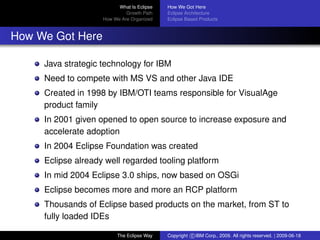
Java strategic technology for IBM
Need to compete with MS VS and other Java IDE
Created in 1998 by IBM/OTI teams responsible for VisualAge
product family
In 2001 given opened to open source to increase exposure and
accelerate adoption
In 2004 Eclipse Foundation was created
Eclipse already well regarded tooling platform
In mid 2004 Eclipse 3.0 ships, now based on OSGi
Eclipse becomes more and more an RCP platform
Thousands of Eclipse based products on the market, from ST to
fully loaded IDEs
The Eclipse Way Copyright c IBM Corp., 2009. All rights reserved. | 2009-06-18
eclipse-logo
What Is Eclipse
Growth Path
How We Are Organized
How We Got Here
Eclipse Architecture
Eclipse Based Products
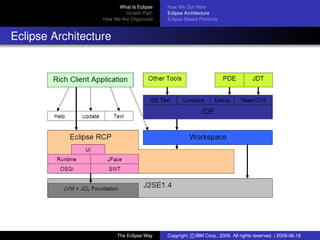
Eclipse Architecture
The Eclipse Way Copyright c IBM Corp., 2009. All rights reserved. | 2009-06-18
eclipse-logo
What Is Eclipse
Growth Path
How We Are Organized
How We Got Here
Eclipse Architecture
Eclipse Based Products
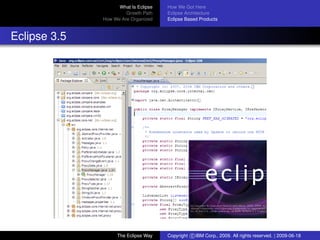
Eclipse 3.5
The Eclipse Way Copyright c IBM Corp., 2009. All rights reserved. | 2009-06-18
eclipse-logo
What Is Eclipse
Growth Path
How We Are Organized
How We Got Here
Eclipse Architecture
Eclipse Based Products
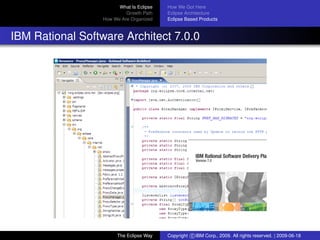
IBM Rational Software Architect 7.0.0
The Eclipse Way Copyright c IBM Corp., 2009. All rights reserved. | 2009-06-18
eclipse-logo
What Is Eclipse
Growth Path
How We Are Organized
How We Got Here
Eclipse Architecture
Eclipse Based Products
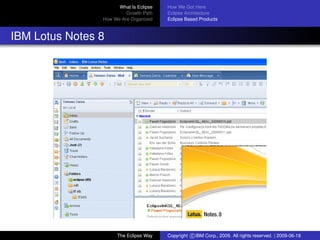
IBM Lotus Notes 8
The Eclipse Way Copyright c IBM Corp., 2009. All rights reserved. | 2009-06-18
eclipse-logo
What Is Eclipse
Growth Path
How We Are Organized
How We Got Here
Eclipse Architecture
Eclipse Based Products
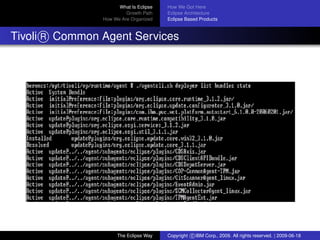
Tivoli R Common Agent Services
The Eclipse Way Copyright c IBM Corp., 2009. All rights reserved. | 2009-06-18
eclipse-logo
What Is Eclipse
Growth Path
How We Are Organized
Keeping It Big
Modularity
Declarative Extensions
Stable APIs
Keeping It Big
How can you build something that can last 10 years and be:
Industry leading
Extendable
Constantly evolving
Well, you need to have those:
Modularity
Scalability
Stable APIs
The Eclipse Way Copyright c IBM Corp., 2009. All rights reserved. | 2009-06-18
eclipse-logo
What Is Eclipse
Growth Path
How We Are Organized
Keeping It Big
Modularity
Declarative Extensions
Stable APIs
JVM Classloading
Application wide classpath
java -classpath
./a-1.5.0.jar:./b.jar:./c.jar:./a-2.1.0.jar./bin:
com.vendor.App
Not possible to use the same library in two versions
Classnames conflicts
All entries has to be searched which results in performance hit
No need to declare dependencies explicitly
The Eclipse Way Copyright c IBM Corp., 2009. All rights reserved. | 2009-06-18
eclipse-logo
What Is Eclipse
Growth Path
How We Are Organized
Keeping It Big
Modularity
Declarative Extensions
Stable APIs
OSGi
Classes and charts aren’t enough, you need components. OSGi
provide those in form of bundles:
Explicit dependencies managment
Import-Package: org.osgi.framework;
version=1.2
Export-Package: org.osgi.service.cm;
version="1.2.1"
No sea of classes, no exhibitionism
Application wide classpath
Modularity that OSGi gives enables evolution.
The Eclipse Way Copyright c IBM Corp., 2009. All rights reserved. | 2009-06-18
eclipse-logo
What Is Eclipse
Growth Path
How We Are Organized
Keeping It Big
Modularity
Declarative Extensions
Stable APIs
Declarative extensions
Extension points are the places where you expect functionality to be
extended. Extensions are features that plug-in into extension points.
Simple and powerful
Don’t load code until it is needed
Explicit points where you can plug-in
Lazy loading
Lazy loading given by Extension Registry gives scalability.
The Eclipse Way Copyright c IBM Corp., 2009. All rights reserved. | 2009-06-18
eclipse-logo
What Is Eclipse
Growth Path
How We Are Organized
Keeping It Big
Modularity
Declarative Extensions
Stable APIs
Stable APIs
Stable APIs are critical to sustain growth. Clients can add features
instead of updating to new API. So, it has to be:
Consistent and wise
Any decision made today will impact where you can go tommorow
API compatibility is a huge commitment so we take a defensive
approach:
Don’t add until there is at least one client
Exhibit less rather then more
Expose more if needed
The Eclipse Way Copyright c IBM Corp., 2009. All rights reserved. | 2009-06-18
eclipse-logo
What Is Eclipse
Growth Path
How We Are Organized
Keeping It Big
Modularity
Declarative Extensions
Stable APIs
API Tension
API needs iteration and clients to work. But we need to have stable
APIs for widespread adoption. So, we:
Develop API and client at the same time
Don’t commit API before it’s time
API changes within release to accomodate new requirements and
experience
It also gives us early feedback on API violation. Just because it works
doesn’t mean it’s API compliant.
The Eclipse Way Copyright c IBM Corp., 2009. All rights reserved. | 2009-06-18
eclipse-logo
What Is Eclipse
Growth Path
How We Are Organized
Keeping It Big
Modularity
Declarative Extensions
Stable APIs
API Layers
What if we want add new, more feature rich mechanizm?
1 Add a new functionality
2 An API layer that maps the old API to new implementation
3 Remove the old implementation
4 Deprecate the old API
5 After a few years we might drop it
Binary compatibility
We tend to have more than stable API. Binary compatibility is what matters
since users will not rebuild a plug-in.
The Eclipse Way Copyright c IBM Corp., 2009. All rights reserved. | 2009-06-18
eclipse-logo
What Is Eclipse
Growth Path
How We Are Organized
Keeping It Big
Modularity
Declarative Extensions
Stable APIs
API Tools
API Baseline defines the state you want to compare your development
against. Tools check:
Usage problems
Binary compatibility
Bundle version numbers
Maintanance tag @since
Other tags:
@noimplement
@noinstantiate
@noextend
Known problems can be marked appropriately and filtered.
Integration
Tools make API violations are perceived as natural as language constraints.
The Eclipse Way Copyright c IBM Corp., 2009. All rights reserved. | 2009-06-18
eclipse-logo
What Is Eclipse
Growth Path
How We Are Organized
Planning
Continous Integration
Cycles
The Community
Planning
Comminity input
Discuss propositions on bug reports
Committed, proposed items
We drop items to maintain schedule
The Eclipse Way Copyright c IBM Corp., 2009. All rights reserved. | 2009-06-18
eclipse-logo
What Is Eclipse
Growth Path
How We Are Organized
Planning
Continous Integration
Cycles
The Community
Continous Integration
Releases - e.g. R3.4; stable, tested, lack the lates features
Stable - e.g. 3.5RC4; latest features, valuable and timely
feedback
Integration Builds - e.g. I20090611-1540, run weekly
Nightly Builds - e.g. N20090426-1232; often major problems,
useful to Eclipse Project developers
Always beta
We work on nightly builds so we try to keep them running.
The Eclipse Way Copyright c IBM Corp., 2009. All rights reserved. | 2009-06-18
eclipse-logo
What Is Eclipse
Growth Path
How We Are Organized
Planning
Continous Integration
Cycles
The Community
Milestones
There is 7 milesontes, each takes 6 weeks
Shipping is hard, that’s why we do it 7 times a release
Customers can rebase more frequently
Plan, develop, test, release, retrospective
We play all the roles
New and Noteworthy
Feed the community
Make people move to milestone builds
Fewer completed than more in progress
The Eclipse Way Copyright c IBM Corp., 2009. All rights reserved. | 2009-06-18
eclipse-logo
What Is Eclipse
Growth Path
How We Are Organized
Planning
Continous Integration
Cycles
The Community
The Convergence Process
M6 - API freeze
M7 - feature freeze
RC1 - another commiter, PMC for API changes
RC2 - two commiters
RC3 - two commiters, compoment lead
RC4 - two compoment leads, any lead can veto
Commiting Into RCs
Release Candidates time is when you never want to have a buildbrake.
The Eclipse Way Copyright c IBM Corp., 2009. All rights reserved. | 2009-06-18
eclipse-logo
What Is Eclipse
Growth Path
How We Are Organized
Planning
Continous Integration
Cycles
The Community
Community
Inital investment
Community grows and becomes self supporting, we don’t have to
grow
Early feedback
Open technical discussions, even more important than open bugs
Transparency, good for distributed teams
The village effect
The Eclipse Way Copyright c IBM Corp., 2009. All rights reserved. | 2009-06-18

Eclipse Way

  • 1.
    eclipse-logo What Is Eclipse GrowthPath How We Are Organized The Eclipse Way Szymon Brandys Pawel Pogorzelski Tomasz Zarna Platform Workspace Team IBM Poland 2009-06-27 The Eclipse Way Copyright c IBM Corp., 2009. All rights reserved. | 2009-06-18
  • 2.
    eclipse-logo What Is Eclipse GrowthPath How We Are Organized Agenda 1 What Is Eclipse 2 Growth Path 3 How We Are Organized The Eclipse Way Copyright c IBM Corp., 2009. All rights reserved. | 2009-06-18
  • 3.
    eclipse-logo What Is Eclipse GrowthPath How We Are Organized How We Got Here Eclipse Architecture Eclipse Based Products How We Got Here Java strategic technology for IBM Need to compete with MS VS and other Java IDE Created in 1998 by IBM/OTI teams responsible for VisualAge product family In 2001 given opened to open source to increase exposure and accelerate adoption In 2004 Eclipse Foundation was created Eclipse already well regarded tooling platform In mid 2004 Eclipse 3.0 ships, now based on OSGi Eclipse becomes more and more an RCP platform Thousands of Eclipse based products on the market, from ST to fully loaded IDEs The Eclipse Way Copyright c IBM Corp., 2009. All rights reserved. | 2009-06-18
  • 4.
    eclipse-logo What Is Eclipse GrowthPath How We Are Organized How We Got Here Eclipse Architecture Eclipse Based Products Eclipse Architecture The Eclipse Way Copyright c IBM Corp., 2009. All rights reserved. | 2009-06-18
  • 5.
    eclipse-logo What Is Eclipse GrowthPath How We Are Organized How We Got Here Eclipse Architecture Eclipse Based Products Eclipse 3.5 The Eclipse Way Copyright c IBM Corp., 2009. All rights reserved. | 2009-06-18
  • 6.
    eclipse-logo What Is Eclipse GrowthPath How We Are Organized How We Got Here Eclipse Architecture Eclipse Based Products IBM Rational Software Architect 7.0.0 The Eclipse Way Copyright c IBM Corp., 2009. All rights reserved. | 2009-06-18
  • 7.
    eclipse-logo What Is Eclipse GrowthPath How We Are Organized How We Got Here Eclipse Architecture Eclipse Based Products IBM Lotus Notes 8 The Eclipse Way Copyright c IBM Corp., 2009. All rights reserved. | 2009-06-18
  • 8.
    eclipse-logo What Is Eclipse GrowthPath How We Are Organized How We Got Here Eclipse Architecture Eclipse Based Products Tivoli R Common Agent Services The Eclipse Way Copyright c IBM Corp., 2009. All rights reserved. | 2009-06-18
  • 9.
    eclipse-logo What Is Eclipse GrowthPath How We Are Organized Keeping It Big Modularity Declarative Extensions Stable APIs Keeping It Big How can you build something that can last 10 years and be: Industry leading Extendable Constantly evolving Well, you need to have those: Modularity Scalability Stable APIs The Eclipse Way Copyright c IBM Corp., 2009. All rights reserved. | 2009-06-18
  • 10.
    eclipse-logo What Is Eclipse GrowthPath How We Are Organized Keeping It Big Modularity Declarative Extensions Stable APIs JVM Classloading Application wide classpath java -classpath ./a-1.5.0.jar:./b.jar:./c.jar:./a-2.1.0.jar./bin: com.vendor.App Not possible to use the same library in two versions Classnames conflicts All entries has to be searched which results in performance hit No need to declare dependencies explicitly The Eclipse Way Copyright c IBM Corp., 2009. All rights reserved. | 2009-06-18
  • 11.
    eclipse-logo What Is Eclipse GrowthPath How We Are Organized Keeping It Big Modularity Declarative Extensions Stable APIs OSGi Classes and charts aren’t enough, you need components. OSGi provide those in form of bundles: Explicit dependencies managment Import-Package: org.osgi.framework; version=1.2 Export-Package: org.osgi.service.cm; version="1.2.1" No sea of classes, no exhibitionism Application wide classpath Modularity that OSGi gives enables evolution. The Eclipse Way Copyright c IBM Corp., 2009. All rights reserved. | 2009-06-18
  • 12.
    eclipse-logo What Is Eclipse GrowthPath How We Are Organized Keeping It Big Modularity Declarative Extensions Stable APIs Declarative extensions Extension points are the places where you expect functionality to be extended. Extensions are features that plug-in into extension points. Simple and powerful Don’t load code until it is needed Explicit points where you can plug-in Lazy loading Lazy loading given by Extension Registry gives scalability. The Eclipse Way Copyright c IBM Corp., 2009. All rights reserved. | 2009-06-18
  • 13.
    eclipse-logo What Is Eclipse GrowthPath How We Are Organized Keeping It Big Modularity Declarative Extensions Stable APIs Stable APIs Stable APIs are critical to sustain growth. Clients can add features instead of updating to new API. So, it has to be: Consistent and wise Any decision made today will impact where you can go tommorow API compatibility is a huge commitment so we take a defensive approach: Don’t add until there is at least one client Exhibit less rather then more Expose more if needed The Eclipse Way Copyright c IBM Corp., 2009. All rights reserved. | 2009-06-18
  • 14.
    eclipse-logo What Is Eclipse GrowthPath How We Are Organized Keeping It Big Modularity Declarative Extensions Stable APIs API Tension API needs iteration and clients to work. But we need to have stable APIs for widespread adoption. So, we: Develop API and client at the same time Don’t commit API before it’s time API changes within release to accomodate new requirements and experience It also gives us early feedback on API violation. Just because it works doesn’t mean it’s API compliant. The Eclipse Way Copyright c IBM Corp., 2009. All rights reserved. | 2009-06-18
  • 15.
    eclipse-logo What Is Eclipse GrowthPath How We Are Organized Keeping It Big Modularity Declarative Extensions Stable APIs API Layers What if we want add new, more feature rich mechanizm? 1 Add a new functionality 2 An API layer that maps the old API to new implementation 3 Remove the old implementation 4 Deprecate the old API 5 After a few years we might drop it Binary compatibility We tend to have more than stable API. Binary compatibility is what matters since users will not rebuild a plug-in. The Eclipse Way Copyright c IBM Corp., 2009. All rights reserved. | 2009-06-18
  • 16.
    eclipse-logo What Is Eclipse GrowthPath How We Are Organized Keeping It Big Modularity Declarative Extensions Stable APIs API Tools API Baseline defines the state you want to compare your development against. Tools check: Usage problems Binary compatibility Bundle version numbers Maintanance tag @since Other tags: @noimplement @noinstantiate @noextend Known problems can be marked appropriately and filtered. Integration Tools make API violations are perceived as natural as language constraints. The Eclipse Way Copyright c IBM Corp., 2009. All rights reserved. | 2009-06-18
  • 17.
    eclipse-logo What Is Eclipse GrowthPath How We Are Organized Planning Continous Integration Cycles The Community Planning Comminity input Discuss propositions on bug reports Committed, proposed items We drop items to maintain schedule The Eclipse Way Copyright c IBM Corp., 2009. All rights reserved. | 2009-06-18
  • 18.
    eclipse-logo What Is Eclipse GrowthPath How We Are Organized Planning Continous Integration Cycles The Community Continous Integration Releases - e.g. R3.4; stable, tested, lack the lates features Stable - e.g. 3.5RC4; latest features, valuable and timely feedback Integration Builds - e.g. I20090611-1540, run weekly Nightly Builds - e.g. N20090426-1232; often major problems, useful to Eclipse Project developers Always beta We work on nightly builds so we try to keep them running. The Eclipse Way Copyright c IBM Corp., 2009. All rights reserved. | 2009-06-18
  • 19.
    eclipse-logo What Is Eclipse GrowthPath How We Are Organized Planning Continous Integration Cycles The Community Milestones There is 7 milesontes, each takes 6 weeks Shipping is hard, that’s why we do it 7 times a release Customers can rebase more frequently Plan, develop, test, release, retrospective We play all the roles New and Noteworthy Feed the community Make people move to milestone builds Fewer completed than more in progress The Eclipse Way Copyright c IBM Corp., 2009. All rights reserved. | 2009-06-18
  • 20.
    eclipse-logo What Is Eclipse GrowthPath How We Are Organized Planning Continous Integration Cycles The Community The Convergence Process M6 - API freeze M7 - feature freeze RC1 - another commiter, PMC for API changes RC2 - two commiters RC3 - two commiters, compoment lead RC4 - two compoment leads, any lead can veto Commiting Into RCs Release Candidates time is when you never want to have a buildbrake. The Eclipse Way Copyright c IBM Corp., 2009. All rights reserved. | 2009-06-18
  • 21.
    eclipse-logo What Is Eclipse GrowthPath How We Are Organized Planning Continous Integration Cycles The Community Community Inital investment Community grows and becomes self supporting, we don’t have to grow Early feedback Open technical discussions, even more important than open bugs Transparency, good for distributed teams The village effect The Eclipse Way Copyright c IBM Corp., 2009. All rights reserved. | 2009-06-18