Demystifying Accessibility 
Best practices to build Accessible Eclipse applications from Day One! 
© 2014 IBM Corporation 
Nithya Rajagopalan, 
Development Lead, IBM Rational Publishing Engine 
nithya_rajagopalan@in.ibm.com 
Shikha Aggarwal, 
Developer, IBM Rational Publishing Engine 
shikha.aggarwal@in.ibm.com
© 2014 IBM Corporation 
Agenda 
 Introduction to Accessibility 
Why is Accessibility important to your business? 
 Testing for Accessibility 
 Eclipse Accessibility 
 Best practices with code samples 
 Demo of a working accessible application 
 Discussion
© 2014 IBM Corporation 
Introduction to Accessibility 
What is Accessibility? 
Accessible [ak-ses-uh-buhl] 
adjective 
1. Easy to approach, reach, enter, speak with, or use. 
2. That can be used, entered, reached, etc. 
3. Obtainable; attainable. 
Accessibility means making something usable by 
everyone—including people with disabilities. 
Examples of improving accessibility 
–Ramps 
– curb cuts 
– accessible doors 
International symbol of 
accessibility
© 2014 IBM Corporation 
Introduction to Accessibility 
What is Software Accessibility? 
Software is being used in every aspect of life including education, employment, 
government, commerce, health care, recreation, and more. 
The content and functionality on your website should be available to anyone, regardless of 
disability, location or connection speed
© 2014 IBM Corporation 
Why is Accessibility important? 
According to the World Health Organization, more than 750 million people 
worldwide have a disability and over 54 million are in the United States. 
Reasons to produce Accessible products 
– Social Responsibility 
• Organization’s commitment to people with disabilities 
– Business Case 
• People with disabilities who want and need to use technology have an estimated 
$175 billion in disposable income 
• In many cases, they are the untapped market 
– Legal Case 
• Commitment to comply with worldwide regulations and standards 
• US Section 508 is the standard that has been most critical 
• Your Organization checklists will include all of the requirements necessary to 
conform to this regulation
© 2014 IBM Corporation 
Accessibility Assistive Tools 
Disability issues 
Low Vision 
– Cannot use the mouse for input, cannot see the screen 
– Assistive Technology - Need magnification and color contrast 
– Software should render well for High Contrast mode(Left ALT + left Shift + PrtSc ) 
Blind 
– Rely only on audio for navigation 
– Assistive technology - Need audio output 
– Software should be compatible for screen readers like Freedom Scientific's JAWS TM 
– Need alternate text (Alt+Text) 
Mobility 
– Do not have very good motor skills to use Mouse 
– Keyboard shortcuts should be present for all actions
© 2014 IBM Corporation 
Measuring Accessibility 
Accessibility Testing 
– Testing for Eclipse applications 
• Keyboard shortcuts 
• Screen readers like Freedom Scientific's JAWS TM 
• Voice recognition software like IBM ViaVoice TM 
• Contrast mode 
– Testing for Web applications 
• Rational Policy Tester Accessibility Edition 
Checklist compliance 
– Organization checklists 
– Web accessibility - Web Content Accessibility Guidelines (WCAG) 2.0 conformance 
level AA
© 2014 IBM Corporation 
Accessibility in Eclipse applications 
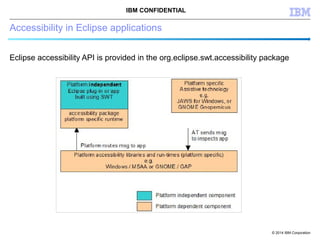
Eclipse accessibility API is provided in the org.eclipse.swt.accessibility package
© 2014 IBM Corporation 
Basic Accessibility considerations in Code 
 Keyboard shortcuts 
 Tab Order 
 Alternate Text 
 Colours 
 Associating Labels and Controls 
 Logical Groups 
 Setting Focus 
 Setting background color for high contrast mode 
 Using Accessible APIs
© 2014 IBM Corporation 
Keyboard Accessibility 
 Support for direct keyboard shortcuts or Mneumonics 
– Used for frequently used menu items. (Example - Ctrl+S for Save) 
Menu Strings Samples 
»menu.file = &File 
»menu.file.new = &New 
»menu.file.save = &Save 
– For less frequently used menu items use mneumonics 
• Place an ampersand (&) before the mnemonic character (such as Copy) 
Plugin.properties 
com.ibm.rational.rpe.studio.command.openTemplate = Open Document &Template... 
Plugin.xml 
<command 
categoryId="com.ibm.rational.rpe.studio" 
description="%com.ibm.rational.rpe.studio.command.description.openTemplate" 
id="com.ibm.rational.rpe.studio.commands.TemplateSelectionCommand" 
name="%com.ibm.rational.rpe.studio.command.openTemplate"> 
</command> 
 Support for accelerators (Using CTRL, ALT or SHIFT keys)
© 2014 IBM Corporation 
Tab Order 
 For most GUI systems, the default tab order is the order in which the controls are added to 
the GUI component hierarchy. 
 Typically the order should follow the physical placement of the visual controls. Often a 
left−to−right, top−to−bottom order is used, but other orders may be more effective 
depending on the actual layout. 
 Methods to override the behaviour 
»org.eclipse.swt.widgets.Composite getTabList 
»setTabList methods. 
 Sample 
Button b1 = new Button(shell, SWT.PUSH); b1.setText("Button1"); 
Button b2 = new Button(shell, SWT.PUSH); b2.setText("Button2"); 
Button b3 = new Button(shell, SWT.PUSH); b3.setText("Button3"); 
Control[] controls = new Control[] { b2, b1, b3 }; 
shell.setTabList(controls);
© 2014 IBM Corporation 
Colors & Fonts 
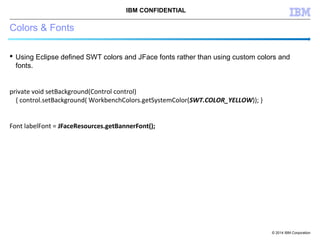
 Using Eclipse defined SWT colors and JFace fonts rather than using custom colors and 
fonts. 
private void setBackground(Control control) 
{ 
control.setBackground( WorkbenchColors.getSystemColor(SWT.COLOR_YELLOW)); 
} 
Font labelFont = JFaceResources.getBannerFont(); 
 Best practice is to inherit system colors and font sizes, which standard widgets do without 
modification 
 If you still want to override the system colors and have a color that you set yourself, you 
must have a way to adjust it for different color settings.
© 2014 IBM Corporation 
Associating Labels and Controls 
 Custom Labels and Controls should be used consistently for Screen Reader to read out 
CLabel fontLabel = getWidgetFactory().createCLabel(composite, 
StudioMessageBundle.getInstance().getMessage("tabbed.properties.view.font.font.label")) 
gridData = new GridData(SWT.BEGINNING, SWT.CENTER, false, false, 1, 1); 
fontLabel.setLayoutData(gridData); 
CCombo fontCombo = getWidgetFactory().createCCombo(composite1, SWT.LEFT); 
gridData = new GridData(SWT.FILL, SWT.CENTER, false, false, 2, 1); 
fontCombo.setLayoutData(gridData); 
 While SWT tries to use native widgets as much as possible, it can not fulfill all common 
requirements with the native widgets. Therefore some widgets extend the capabilities of 
the native platform. These are part of the org.eclipse.swt.custom package and usually start 
with the additional prefix C to indicate that they are custom widgets, e.g. CCombo. 
 Example - Compared to the Combo class, the CCombo class provides the ability to set the 
height of the widget. 
 In such cases, the right associations should be set
© 2014 IBM Corporation 
Logical Groups 
 A Group name in association with the widget name gives better context to the user 
Group group = new Group (shell, SWT.NONE); 
group.setText ("Contact preference"); 
Button button1 = new Button (group, SWT.RADIO); 
Button1.setText ("Standard ground mail"); 
Button button2 = new Button (group, SWT.RADIO); 
Button2.setText ("email"); 
Button button3 = new Button (group, SWT.RADIO); 
Button3.setText ("Telephone"); 
Button button4 = new Button (group, SWT.RADIO); 
Button4.setText ("Do not contact") 
 The group widget allows related widgets to be identified by an additional label for 
clarification when reading. The name of the group will be read in addition to the name of 
the widget with focus.
© 2014 IBM Corporation 
Setting Focus 
 For the elements which do not take focus, e.g Composite, we need to set focus explicitly 
on the selected element. 
 When a UI element is in focus, it will be read out. 
 Useful for dialogs that pop-up a while after they have been triggered 
 group.setFocus(); 
 In addition accessibility listener should be added to the element. 
group.getAccessible().addAccessibleListener(new AccessibleAdapter() 
{ 
public void getName(AccessibleEvent e) 
{ 
e.result = "Group Label"; 
} 
});
© 2014 IBM Corporation 
Ensuring Visibility in High Contrast mode 
 A Label will be visible in normal mode and in High Contrast mode, if it has both the 
background colour and the foreground colour set. The background colour should be set to 
white so that black characters are visible in normal mode. The foreground colour should be 
set to black so that the same characters will be visible in white colour in high contrast 
mode. . 
imageLabel = new Label(group, SWT.None); 
imageLabel.setImage(getIcon()); 
imageLabel.setLayoutData(new GridData(GridData.HORIZONTAL_ALIGN_CENTER | GridData.GRAB_HORIZONTAL)); 
imageLabel.setBackground(RCPCommonImageLibrary.getColor(RCPCommonImageLibrary.WHITE_COLOR)); 
imageLabel.setForeground(RCPCommonImageLibrary.getColor(RCPCommonImageLibrary.BLACK_COLOR)); 
 Visibility in High Contrast mode
© 2014 IBM Corporation 
Alternate Text 
 Use Images just for aesthetic purposes and using labels overs images for informative text 
Composite workArea = new Composite(parent, SWT.BORDER); 
setBackground(workArea); 
Label topLabel = new Label(workArea, SWT.NONE); 
topLabel.setImage(AccessibilityPlugin.getDefault().getImageRegistry().get(AccessibilityPlugin.LOGIN_IMAGE)); 
Label titleLabel = new Label(workArea, SWT.NONE); 
setLabelColors(titleLabel); 
titleLabel.setText("Welcome to RPE!"); 
 Use System images as they are already compatible with High contrast mode 
– Example - SWT.ICON_INFORMATION, SWT.ICON_ERROR
© 2014 IBM Corporation 
Using the AccessibleListener 
 Interface provided by eclipse. 
 Classes that implement this interface provide methods that deal with the events that are 
generated when an accessibility client sends a message to a control. 
 For example in the following code getName method sets the result on event which can be 
used by accessibility client. 
group.getAccessible().addAccessibleListener(new AccessibleAdapter() 
{ 
public void getName(AccessibleEvent e) 
{ 
e.result = "Group Label"; 
} 
}); 
 The accessible of the tree control is retrieved and an AccessibleListener is created and 
added. The method getName is provided. The results are passed back in the 
AccessibleEvent member result 
 Any control can be given a name which can be retrieved by the assistive technology.
© 2014 IBM Corporation 
SWT Accessibility API 
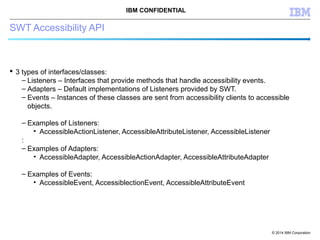
 3 types of interfaces/classes: 
– Listeners – Interfaces that provide methods that handle accessibility events. 
– Adapters – Default implementations of Listeners provided by SWT. 
– Events – Instances of these classes are sent from accessibility clients to accessible 
objects. 
– Examples of Listeners: 
• AccessibleActionListener, AccessibleAttributeListener, AccessibleListener 
: 
– Examples of Adapters: 
• AccessibleAdapter, AccessibleActionAdapter, AccessibleAttributeAdapter 
– Examples of Events: 
• AccessibleEvent, AccessibleSelectionEvent, AccessibleAttributeEvent
Best Practices for developing Accessible Eclipse applications 
 Ensure Keyboard shortcuts for all context menu items during design 
 Check your code for White Background for all controls to be visible in high 
contrast. 
 Create UI elements in the desired Tab order 
 Ensure all images have alternate text using the AccessibleListener 
 Use APIs provided by Eclipse Accessibility Framework to inherit 
Accessibility features of Eclipse 
© 2014 IBM Corporation
© 2014 IBM Corporation 
Useful Links 
–SWT Accessiblity APIs 
–Designing Accessible Plugins in Eclipse 
–Creating Accessible Eclipse Applications
© 2014 IBM Corporation 
Thank You

Demystify Accessibility

  • 1.
    Demystifying Accessibility Bestpractices to build Accessible Eclipse applications from Day One! © 2014 IBM Corporation Nithya Rajagopalan, Development Lead, IBM Rational Publishing Engine nithya_rajagopalan@in.ibm.com Shikha Aggarwal, Developer, IBM Rational Publishing Engine shikha.aggarwal@in.ibm.com
  • 2.
    © 2014 IBMCorporation Agenda  Introduction to Accessibility Why is Accessibility important to your business?  Testing for Accessibility  Eclipse Accessibility  Best practices with code samples  Demo of a working accessible application  Discussion
  • 3.
    © 2014 IBMCorporation Introduction to Accessibility What is Accessibility? Accessible [ak-ses-uh-buhl] adjective 1. Easy to approach, reach, enter, speak with, or use. 2. That can be used, entered, reached, etc. 3. Obtainable; attainable. Accessibility means making something usable by everyone—including people with disabilities. Examples of improving accessibility –Ramps – curb cuts – accessible doors International symbol of accessibility
  • 4.
    © 2014 IBMCorporation Introduction to Accessibility What is Software Accessibility? Software is being used in every aspect of life including education, employment, government, commerce, health care, recreation, and more. The content and functionality on your website should be available to anyone, regardless of disability, location or connection speed
  • 5.
    © 2014 IBMCorporation Why is Accessibility important? According to the World Health Organization, more than 750 million people worldwide have a disability and over 54 million are in the United States. Reasons to produce Accessible products – Social Responsibility • Organization’s commitment to people with disabilities – Business Case • People with disabilities who want and need to use technology have an estimated $175 billion in disposable income • In many cases, they are the untapped market – Legal Case • Commitment to comply with worldwide regulations and standards • US Section 508 is the standard that has been most critical • Your Organization checklists will include all of the requirements necessary to conform to this regulation
  • 6.
    © 2014 IBMCorporation Accessibility Assistive Tools Disability issues Low Vision – Cannot use the mouse for input, cannot see the screen – Assistive Technology - Need magnification and color contrast – Software should render well for High Contrast mode(Left ALT + left Shift + PrtSc ) Blind – Rely only on audio for navigation – Assistive technology - Need audio output – Software should be compatible for screen readers like Freedom Scientific's JAWS TM – Need alternate text (Alt+Text) Mobility – Do not have very good motor skills to use Mouse – Keyboard shortcuts should be present for all actions
  • 7.
    © 2014 IBMCorporation Measuring Accessibility Accessibility Testing – Testing for Eclipse applications • Keyboard shortcuts • Screen readers like Freedom Scientific's JAWS TM • Voice recognition software like IBM ViaVoice TM • Contrast mode – Testing for Web applications • Rational Policy Tester Accessibility Edition Checklist compliance – Organization checklists – Web accessibility - Web Content Accessibility Guidelines (WCAG) 2.0 conformance level AA
  • 8.
    © 2014 IBMCorporation Accessibility in Eclipse applications Eclipse accessibility API is provided in the org.eclipse.swt.accessibility package
  • 9.
    © 2014 IBMCorporation Basic Accessibility considerations in Code  Keyboard shortcuts  Tab Order  Alternate Text  Colours  Associating Labels and Controls  Logical Groups  Setting Focus  Setting background color for high contrast mode  Using Accessible APIs
  • 10.
    © 2014 IBMCorporation Keyboard Accessibility  Support for direct keyboard shortcuts or Mneumonics – Used for frequently used menu items. (Example - Ctrl+S for Save) Menu Strings Samples »menu.file = &File »menu.file.new = &New »menu.file.save = &Save – For less frequently used menu items use mneumonics • Place an ampersand (&) before the mnemonic character (such as Copy) Plugin.properties com.ibm.rational.rpe.studio.command.openTemplate = Open Document &Template... Plugin.xml <command categoryId="com.ibm.rational.rpe.studio" description="%com.ibm.rational.rpe.studio.command.description.openTemplate" id="com.ibm.rational.rpe.studio.commands.TemplateSelectionCommand" name="%com.ibm.rational.rpe.studio.command.openTemplate"> </command>  Support for accelerators (Using CTRL, ALT or SHIFT keys)
  • 11.
    © 2014 IBMCorporation Tab Order  For most GUI systems, the default tab order is the order in which the controls are added to the GUI component hierarchy.  Typically the order should follow the physical placement of the visual controls. Often a left−to−right, top−to−bottom order is used, but other orders may be more effective depending on the actual layout.  Methods to override the behaviour »org.eclipse.swt.widgets.Composite getTabList »setTabList methods.  Sample Button b1 = new Button(shell, SWT.PUSH); b1.setText("Button1"); Button b2 = new Button(shell, SWT.PUSH); b2.setText("Button2"); Button b3 = new Button(shell, SWT.PUSH); b3.setText("Button3"); Control[] controls = new Control[] { b2, b1, b3 }; shell.setTabList(controls);
  • 12.
    © 2014 IBMCorporation Colors & Fonts  Using Eclipse defined SWT colors and JFace fonts rather than using custom colors and fonts. private void setBackground(Control control) { control.setBackground( WorkbenchColors.getSystemColor(SWT.COLOR_YELLOW)); } Font labelFont = JFaceResources.getBannerFont();  Best practice is to inherit system colors and font sizes, which standard widgets do without modification  If you still want to override the system colors and have a color that you set yourself, you must have a way to adjust it for different color settings.
  • 13.
    © 2014 IBMCorporation Associating Labels and Controls  Custom Labels and Controls should be used consistently for Screen Reader to read out CLabel fontLabel = getWidgetFactory().createCLabel(composite, StudioMessageBundle.getInstance().getMessage("tabbed.properties.view.font.font.label")) gridData = new GridData(SWT.BEGINNING, SWT.CENTER, false, false, 1, 1); fontLabel.setLayoutData(gridData); CCombo fontCombo = getWidgetFactory().createCCombo(composite1, SWT.LEFT); gridData = new GridData(SWT.FILL, SWT.CENTER, false, false, 2, 1); fontCombo.setLayoutData(gridData);  While SWT tries to use native widgets as much as possible, it can not fulfill all common requirements with the native widgets. Therefore some widgets extend the capabilities of the native platform. These are part of the org.eclipse.swt.custom package and usually start with the additional prefix C to indicate that they are custom widgets, e.g. CCombo.  Example - Compared to the Combo class, the CCombo class provides the ability to set the height of the widget.  In such cases, the right associations should be set
  • 14.
    © 2014 IBMCorporation Logical Groups  A Group name in association with the widget name gives better context to the user Group group = new Group (shell, SWT.NONE); group.setText ("Contact preference"); Button button1 = new Button (group, SWT.RADIO); Button1.setText ("Standard ground mail"); Button button2 = new Button (group, SWT.RADIO); Button2.setText ("email"); Button button3 = new Button (group, SWT.RADIO); Button3.setText ("Telephone"); Button button4 = new Button (group, SWT.RADIO); Button4.setText ("Do not contact")  The group widget allows related widgets to be identified by an additional label for clarification when reading. The name of the group will be read in addition to the name of the widget with focus.
  • 15.
    © 2014 IBMCorporation Setting Focus  For the elements which do not take focus, e.g Composite, we need to set focus explicitly on the selected element.  When a UI element is in focus, it will be read out.  Useful for dialogs that pop-up a while after they have been triggered  group.setFocus();  In addition accessibility listener should be added to the element. group.getAccessible().addAccessibleListener(new AccessibleAdapter() { public void getName(AccessibleEvent e) { e.result = "Group Label"; } });
  • 16.
    © 2014 IBMCorporation Ensuring Visibility in High Contrast mode  A Label will be visible in normal mode and in High Contrast mode, if it has both the background colour and the foreground colour set. The background colour should be set to white so that black characters are visible in normal mode. The foreground colour should be set to black so that the same characters will be visible in white colour in high contrast mode. . imageLabel = new Label(group, SWT.None); imageLabel.setImage(getIcon()); imageLabel.setLayoutData(new GridData(GridData.HORIZONTAL_ALIGN_CENTER | GridData.GRAB_HORIZONTAL)); imageLabel.setBackground(RCPCommonImageLibrary.getColor(RCPCommonImageLibrary.WHITE_COLOR)); imageLabel.setForeground(RCPCommonImageLibrary.getColor(RCPCommonImageLibrary.BLACK_COLOR));  Visibility in High Contrast mode
  • 17.
    © 2014 IBMCorporation Alternate Text  Use Images just for aesthetic purposes and using labels overs images for informative text Composite workArea = new Composite(parent, SWT.BORDER); setBackground(workArea); Label topLabel = new Label(workArea, SWT.NONE); topLabel.setImage(AccessibilityPlugin.getDefault().getImageRegistry().get(AccessibilityPlugin.LOGIN_IMAGE)); Label titleLabel = new Label(workArea, SWT.NONE); setLabelColors(titleLabel); titleLabel.setText("Welcome to RPE!");  Use System images as they are already compatible with High contrast mode – Example - SWT.ICON_INFORMATION, SWT.ICON_ERROR
  • 18.
    © 2014 IBMCorporation Using the AccessibleListener  Interface provided by eclipse.  Classes that implement this interface provide methods that deal with the events that are generated when an accessibility client sends a message to a control.  For example in the following code getName method sets the result on event which can be used by accessibility client. group.getAccessible().addAccessibleListener(new AccessibleAdapter() { public void getName(AccessibleEvent e) { e.result = "Group Label"; } });  The accessible of the tree control is retrieved and an AccessibleListener is created and added. The method getName is provided. The results are passed back in the AccessibleEvent member result  Any control can be given a name which can be retrieved by the assistive technology.
  • 19.
    © 2014 IBMCorporation SWT Accessibility API  3 types of interfaces/classes: – Listeners – Interfaces that provide methods that handle accessibility events. – Adapters – Default implementations of Listeners provided by SWT. – Events – Instances of these classes are sent from accessibility clients to accessible objects. – Examples of Listeners: • AccessibleActionListener, AccessibleAttributeListener, AccessibleListener : – Examples of Adapters: • AccessibleAdapter, AccessibleActionAdapter, AccessibleAttributeAdapter – Examples of Events: • AccessibleEvent, AccessibleSelectionEvent, AccessibleAttributeEvent
  • 20.
    Best Practices fordeveloping Accessible Eclipse applications  Ensure Keyboard shortcuts for all context menu items during design  Check your code for White Background for all controls to be visible in high contrast.  Create UI elements in the desired Tab order  Ensure all images have alternate text using the AccessibleListener  Use APIs provided by Eclipse Accessibility Framework to inherit Accessibility features of Eclipse © 2014 IBM Corporation
  • 21.
    © 2014 IBMCorporation Useful Links –SWT Accessiblity APIs –Designing Accessible Plugins in Eclipse –Creating Accessible Eclipse Applications
  • 22.
    © 2014 IBMCorporation Thank You

Editor's Notes

  • #9 It is important to remember that, although written in JavaTM, Eclipse applications follow the accessibility API of the target desktop operating system. Eclipse provides a rich plug-in environment whereby the norm is to create plug-ins for native widgets. Most of the SWT widgets that come with Eclipse are actually JavaTM wrappers for native GUI widgets. (This is the complete opposite of a pure JavaTM GUI written in Swing in which higher level components do not translate to native operating system widgets.)  When a widget does not exist on all platforms, it is emulated in code on the deficient platform.  Therefore SWT Widgets utilize accessibility features of the underlying operating system widgets when available, and provide accessibility using MSAA and IAccessible2 in emulated widgets. The first of three components is the application (or plug-in) which is built using SWT. This component is platform independent because SWT isolates the application from the platform. The org.eclipse.swt.accessibility package runtime provides the bridge from the application to the platform. The second component is the platform accessibility framework, such as Windows® MSAA or GNOMETM GAP. The third component is the assistive technology, such as the JAWS screen reader. At runtime, the AT obtains information about the user interface elements by calling the platform accessibility framework, which in turn calls into the .swt.accessibilitypackage.
  • #13 SWT.COLOR_YELLOW is the example of SWT color. Similarly JFaceResources.getBannerFont is the font provided by JFACE
  • #14 Clabel is used with Ccombo. Had we used Combo, Label should be used.
  • #15 Here master group is added and there are two editors inside master group, user Editor and password editor. Example taken from RPE Remote services preferences.
  • #16 Group is a composite which does not take focus. We need to setFocus explicitly for such components to be accessible.
  • #20 AccessibleActionListener - Classes which implement this interface provide methods that handle AccessibleAction events. AccessibleAttributeListener - Classes which implement this interface provide methods that handle AccessibleAttribute events. AccessibleListener - Classes that implement this interface provide methods that deal with the events that are generated when an accessibility client sends a message to a control. AccessibleAdapter - This adapter class provides default implementations for the methods described by the AccessibleListener interface. AccessibleEvent - Instances of this class are sent as a result of accessibility clients sending messages to controls asking for information about the control instance