ECE4510/5510: Feedback Control Systems. 10–1
DIGITAL CONTROLLER IMPLEMENTATION
10.1: Some background in digital control
■ We can implement our controllers with op-amp circuits (cf. Chap. 7).
■ More commonly nowadays, we use digital computers (e.g.,
microcontrollers) to implement our control designs.
■ There are two main approaches to digital controller design:
1. Emulation of an analog controller—we look at this here.
2. Direct digital design—subject of more advanced course.
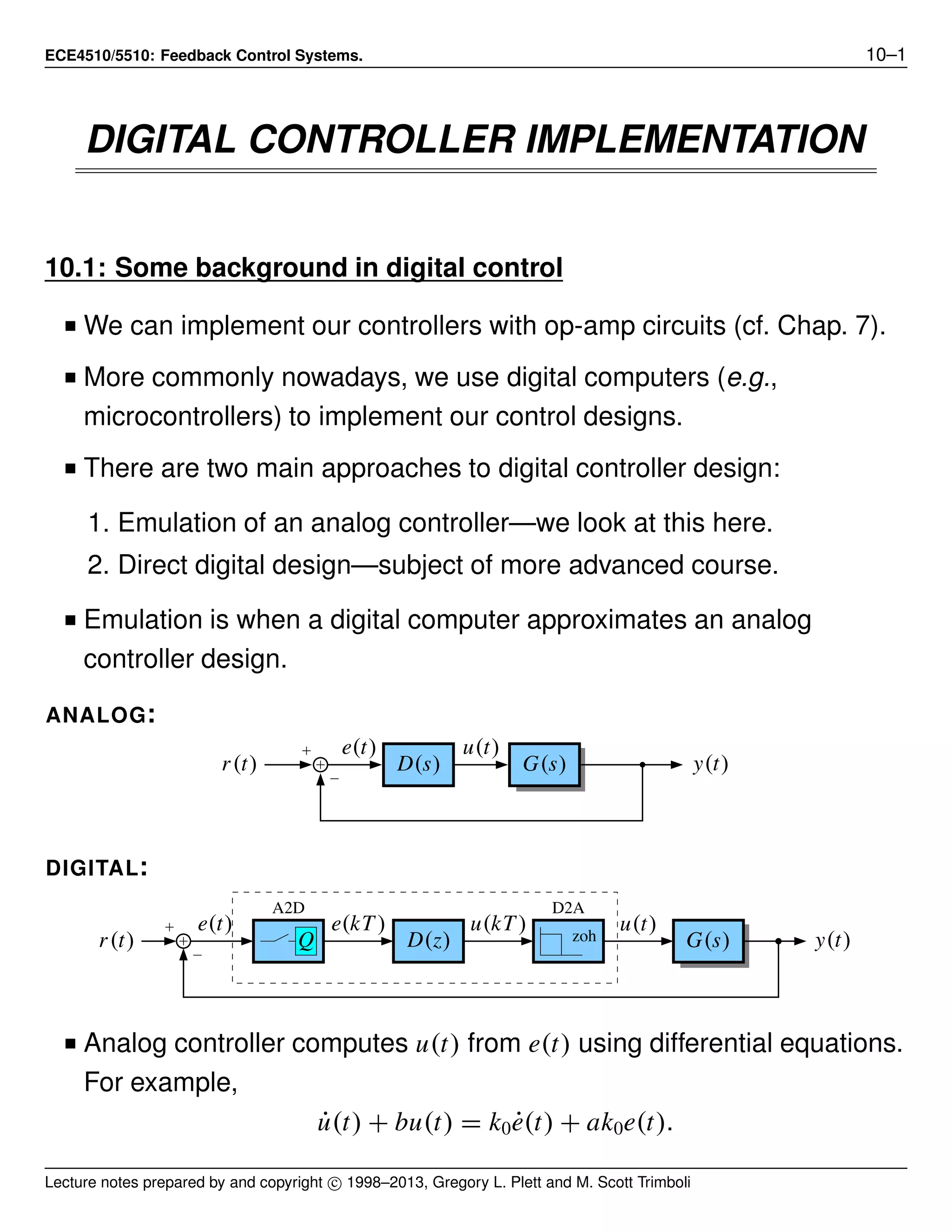
■ Emulation is when a digital computer approximates an analog
controller design.
ANALOG:
D(s) G(s) y(t)r(t)
u(t)e(t)
DIGITAL:
zoh
D2AA2D
D(z) G(s)Q y(t)r(t)
u(t)u(kT)e(t) e(kT )
■ Analog controller computes u(t) from e(t) using differential equations.
For example,
˙u(t) + bu(t) = k0 ˙e(t) + ak0e(t).
Lecture notes prepared by and copyright c⃝ 1998–2013, Gregory L. Plett and M. Scott Trimboli
ECE4510/ECE5510, DIGITAL CONTROLLER IMPLEMENTATION 10–2
■ Digital controller computes u(kT) from e(kT) using difference
equations. For example (we’ll see where this came from shortly),
u(kT) = (1 − bT)u((k − 1)T) + k0(aT − 1)e((k − 1)T) + k0e(kT).
■ To interface the computer controller to the “real world” we need an
analog-to-digital converter (to measure analog signals) and
digital-to-analog converter (to output signals).
■ Sampling and outputting usually done synchronously, at a constant
rate. If sampling period = T , frequency = 1/T .
■ The signals inside the computer (the sampled signals) are noted as
y(kT), or simply y [k]. y [k] is a discrete-time signal, where y(t) is a
continuous-time signal.
y(t) y(kT) = y[k]
■ So, we can write the prior difference equation as
u[k] = (1 − bT)u[k − 1] + k0(aT − 1)e[k − 1] + k0e[k].
■ Discrete-time signals are usually converted to continuous-time
signals using a zero-order hold:
e.g., to convert u [k] to u(t).
Efficient implementation
■ We look at some efficient pseudo-code for an implementation of
u[k] = (1 − bT)u[k − 1] + k0(aT − 1)e[k − 1] + k0e[k].
Lecture notes prepared by and copyright c⃝ 1998–2013, Gregory L. Plett and M. Scott Trimboli
ECE4510/ECE5510, DIGITAL CONTROLLER IMPLEMENTATION 10–3
■ Output of digital controller u[k] depends on previous output u[k − 1]
as well as the previous and current errors e[k − 1] and e[k].
Real-Time Controller Implementation
x = 0. (initialization of “past” values for first loop through)
Define constants:
α1 = 1 − bT .
α2 = k0(aT − 1).
READ A/D to obtain y[k] and r[k].
e[k] = r[k] − y[k].
u[k] = x + k0e[k].
OUTPUT u[k] to D/A and ZOH.
Now compute x for the next loop through:
x = α1u[k] + α2e[k].
Go back to “READ” when T seconds have elapsed since last READ.
■ Code is optimized to minimize latency between A2D read and D2A
write.
R = read. W = write.
C = compute. I = idle.
RRR CCC WWW III
T
Lecture notes prepared by and copyright c⃝ 1998–2013, Gregory L. Plett and M. Scott Trimboli
ECE4510/ECE5510, DIGITAL CONTROLLER IMPLEMENTATION 10–4
10.2: “Digitization” (emulation of analog controllers)
■ Continuous-time controllers are designed with Laplace-transform
techniques. The resulting controller is a function of “s”.
y(t) =
dx(t)
dt
x(t) s
■ So, “s” is a derivative operator. There are several ways of
approximating this in discrete time.
Forward-rectangular rule
■ We first look at the “forward rectangular” rule. We write:
˙x(t)
△
= lim
δt→0
δx(t)
δt
= lim
δt→0
x(t + δt) − x(t)
δt
.
■ If sampling interval T = tk+1 − tk is small,1
˙x(kT) ≈
x((k + 1)T) − x(kT)
T
i.e., ˙x[k] ≈
x[k + 1] − x[k]
T
.
Backward-rectangular rule
■ We could also write ˙x(t)
△
= lim
δt→0
δx(t)
δt
= lim
δt→0
x(t) − x(t − δt)
δt
.
■ Then, if T is small,
˙x(kT) ≈
x(T) − x((k − 1)T)
T
i.e., ˙x[k] ≈
x[k] − x[k − 1]
T
.
Bilinear (or Tustin) rule
■ We could also re-index the forward-rectangular rule as
˙x[k − 1] =
x[k] − x[k − 1]
T
to have the same right-hand-side as the backward-rectangular rule.
1
Rule of thumb: Sampling frequency must be ≈ 30 times the bandwidth of the analog
system being emulated for comparable performance.
Lecture notes prepared by and copyright c⃝ 1998–2013, Gregory L. Plett and M. Scott Trimboli
ECE4510/ECE5510, DIGITAL CONTROLLER IMPLEMENTATION 10–5
■ Then, we average these two forms:
˙x[k] + ˙x[k − 1]
2
=
x[k] − x[k − 1]
T
.
Digitizing a controller
■ Once we’ve chosen which rule to use, we “digitize” controller D(s) by
1. Writing U(s) = D(s)E(s).
2. Converting to differential equation:
n
k=0
ak
dk
u(t)
dtk
=
m
k=0
bk
dk
e(t)
dtk
.
3. Replacing derivatives with differences.
EXAMPLE: Digitize the lead or lag controller D(s) =
U(s)
E(s)
= k0
s + a
s + b
using
the forward-rectangular rule.
1. We write
U(s) = k0
s + a
s + b
E(s)
(s + b)U(s) = k0(s + a)E(s)
2. We take the inverse-Laplace transform of this result, term-by-term to
get
˙u(t) + bu(t) = k0 ˙e(t) + ak0e(t).
3. Use “forward-rectangular rule” to digitize
u[k + 1] − u[k]
T
+ bu[k] = k0
e[k + 1] − e[k]
T
+ ae[k]
u[k + 1] = u[k] +
T −bu[k] + k0
e[k + 1] − e[k]
T
+ ae[k]
= (1 − bT )u[k] + k0(aT − 1)e[k] + k0e[k + 1],
Lecture notes prepared by and copyright c⃝ 1998–2013, Gregory L. Plett and M. Scott Trimboli
ECE4510/ECE5510, DIGITAL CONTROLLER IMPLEMENTATION 10–6
or,
u[k] = (1 − bT)u[k − 1] + k0(aT − 1)e[k − 1] + k0e[k].
■ This is how we got the result at the beginning of this chapter of notes.
EXAMPLE: Digitize the lead or lag controller D(s) =
U(s)
E(s)
= k0
s + a
s + b
using
the backward-rectangular rule.
1. As before, we have
(s + b)U(s) = k0(s + a)E(s).
2. Again, we have
˙u(t) + bu(t) = k0 ˙e(t) + ak0e(t).
3. Use “backward-rectangular rule” to digitize
u[k] − u[k−1]
T
+ bu[k] = k0
e[k] − e[k−1]
T
+ ae[k]
u[k] = u[k−1] +
T −bu[k] + k0
e[k] − e[k−1]
T
+ ae[k]
(1 + bT) u[k] = u[k−1] + k0(aT + 1)e[k] − k0e[k−1]
u[k] =
1
1 + bT
(u[k−1] + k0(aT + 1)e[k] − k0e[k−1]) .
■ Notice that this is a different result from before.
EXAMPLE: Digitize the lead or lag controller D(s) =
U(s)
E(s)
= k0
s + a
s + b
using
the bilinear rule.
1. As before, we have (s + b)U(s) = k0(s + a)E(s).
2. Again, we have ˙u(t) + bu(t) = k0 ˙e(t) + ak0e(t).
Lecture notes prepared by and copyright c⃝ 1998–2013, Gregory L. Plett and M. Scott Trimboli
ECE4510/ECE5510, DIGITAL CONTROLLER IMPLEMENTATION 10–7
3. Using the bilinear rule is challenging since we need to have
derivatives in a specific format. We’ll use a trick here (ECE4540/5540
teaches more advanced techniques that don’t need this trick).
■ Re-index the differential equation:
˙u(t − T ) + bu(t − T ) = k0 ˙e(t − T ) + ak0e(t − T ).
■ Add this to the prior version, and divide by 2
˙u(t) + ˙u(t−T )
2
+ b
u(t) + u(t−T )
2
= k0
˙e(t) + ˙e(t−T)
2
+ ak0
e(t) + e(t−T )
2
u[k] − u[k−1]
T
+
b
2
[u[k] + u[k−1]] = k0
e[k] − e[k−1]
T
+
ak0
2
[e[k] + e[k−1]] .
■ Rearranging,
1 +
bT
2
u[k] = 1 −
bT
2
u[k−1] + k0 1 +
aT
2
e[k]
− k0 1 −
aT
2
e[k−1]
u[k] =
2 − bT
2 + bT
u[k−1] + k0
2 + aT
2 + bT
e[k] − k0
2 − aT
2 + aT
e[k−1].
■ Again, this is a different result from before.
Lecture notes prepared by and copyright c⃝ 1998–2013, Gregory L. Plett and M. Scott Trimboli
ECE4510/ECE5510, DIGITAL CONTROLLER IMPLEMENTATION 10–8
10.3: The impact of the zero-order hold
■ We illustrate the results of the prior three examples by substituting
numeric values.
■ Let D(s) = 70
(s + 2)
(s + 10)
, G(s) =
1
s(s + 1)
.
■ Choose to try a sample rate of 20 Hz and also try 40 Hz.
(Note, BW of analog system is ≈ 1Hz or so).
FORWARD-RECTANGULAR RULE: Digitizing D(s) gives
■ 20 Hz: u[k + 1] = 0.5u[k] + 70e[k + 1] − 63e[k].
■ 40 Hz: u[k + 1] = 0.75u[k] + 70e[k + 1] − 66.5e[k].
BACKWARD-RECTANGULAR RULE: Digitizing D(s) gives
■ 20 Hz: u[k + 1] = 0.6666u[k] + 51.3333e[k + 1] − 46.6666e[k].
■ 40 Hz: u[k + 1] = 0.8u[k] + 58.8e[k + 1] − 56e[k].
BILINEAR RULE: Digitizing D(s) gives
■ 20 Hz: u[k + 1] = 0.6u[k] + 58.8e[k + 1] − 53.2e[k].
■ 40 Hz: u[k + 1] = 0.7778u[k] + 63.7777e[k + 1] − 60.666e[k].
0 0.2 0.4 0.6 0.8 1
0
0.5
1
1.5
analog
forward
backward
bilinear
Time (sec)
Plantoutput
Sampled at 20Hz
0 0.2 0.4 0.6 0.8 1
0
0.5
1
1.5
analog
forward
backward
bilinear
Time (sec)
Plantoutput
Sampled at 40Hz
■ IMPORTANT NOTE: The digitized system has poorer damping than
the original analog system. This will always be true when emulating
an analog controller. We see why next . . .
Lecture notes prepared by and copyright c⃝ 1998–2013, Gregory L. Plett and M. Scott Trimboli
ECE4510/ECE5510, DIGITAL CONTROLLER IMPLEMENTATION 10–9
The D2A “Hold” Operation
u(t)
avg. u(t)
u(kT)u
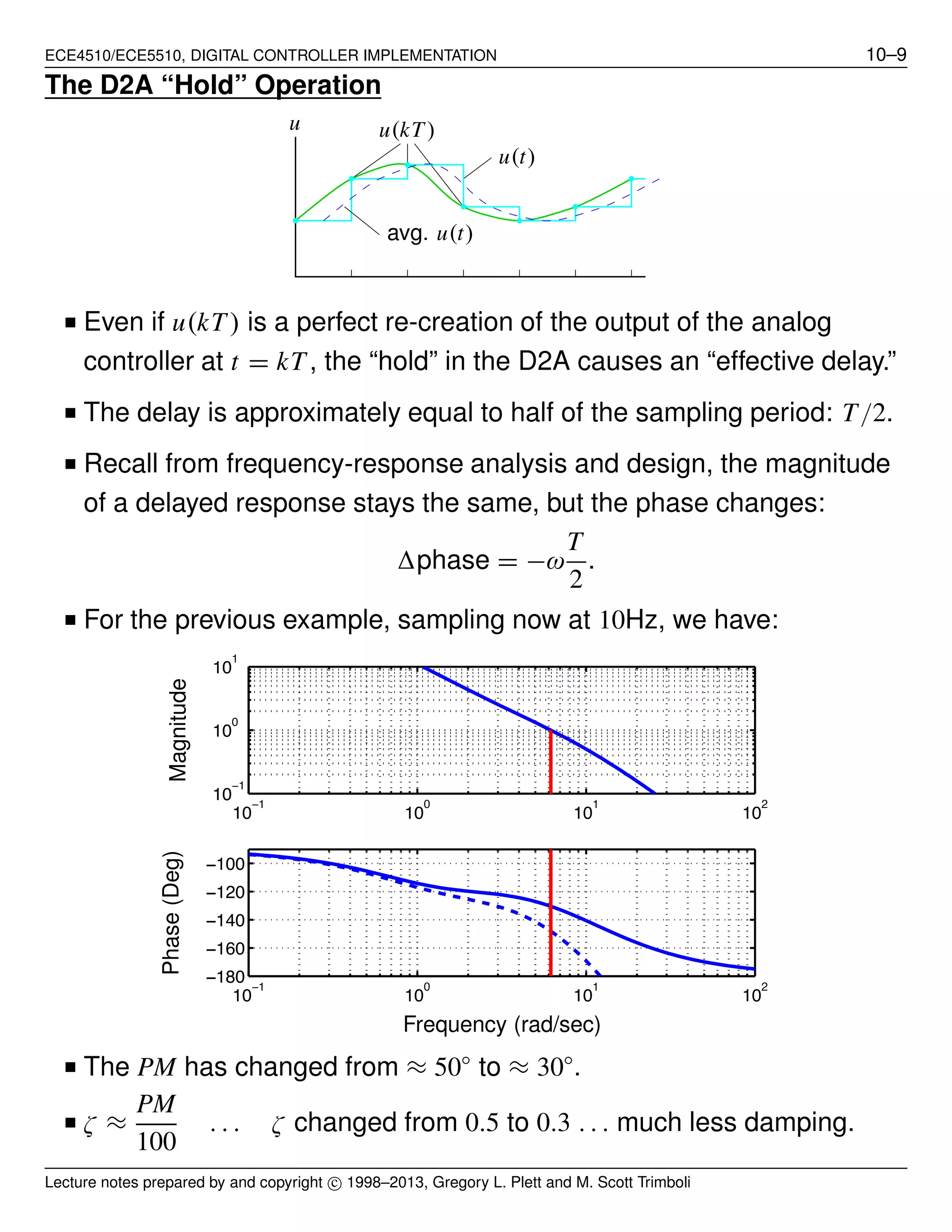
■ Even if u(kT) is a perfect re-creation of the output of the analog
controller at t = kT, the “hold” in the D2A causes an “effective delay.”
■ The delay is approximately equal to half of the sampling period: T/2.
■ Recall from frequency-response analysis and design, the magnitude
of a delayed response stays the same, but the phase changes:
phase = −ω
T
2
.
■ For the previous example, sampling now at 10Hz, we have:
10
−1
10
0
10
1
10
2
10
−1
10
0
10
1
10
−1
10
0
10
1
10
2
−180
−160
−140
−120
−100
Frequency (rad/sec)
MagnitudePhase(Deg)
■ The PM has changed from ≈ 50◦
to ≈ 30◦
.
■ ζ ≈
PM
100
. . . ζ changed from 0.5 to 0.3 . . . much less damping.
Lecture notes prepared by and copyright c⃝ 1998–2013, Gregory L. Plett and M. Scott Trimboli
ECE4510/ECE5510, DIGITAL CONTROLLER IMPLEMENTATION 10–10
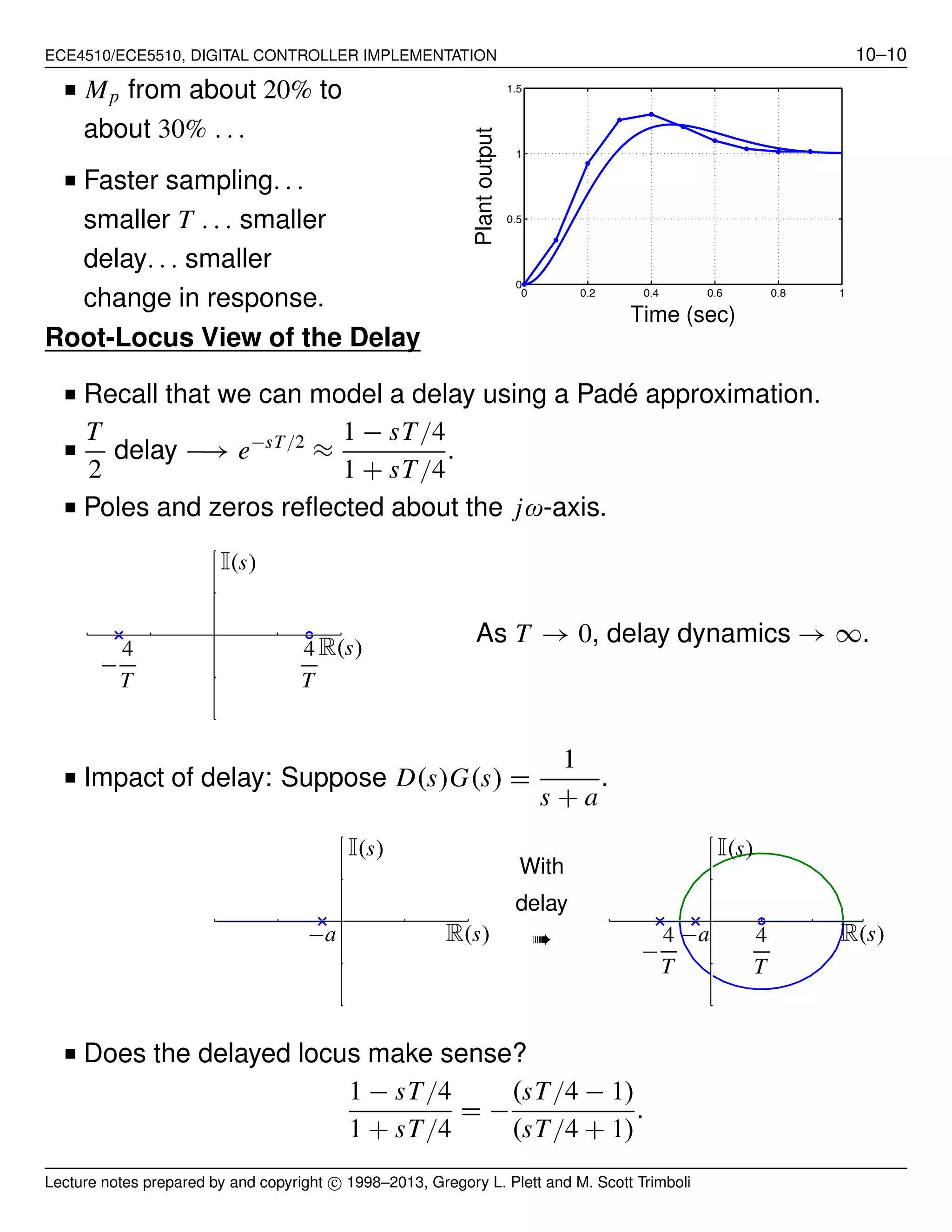
■ Mp from about 20% to
about 30% . . .
■ Faster sampling. . .
smaller T . . . smaller
delay. . . smaller
change in response. 0 0.2 0.4 0.6 0.8 1
0
0.5
1
1.5
Time (sec)
Plantoutput
Root-Locus View of the Delay
■ Recall that we can model a delay using a Padé approximation.
■
T
2
delay −→ e−sT/2
≈
1 − sT/4
1 + sT/4
.
■ Poles and zeros reflected about the jω-axis.
−
4
T
4
T
I(s)
R(s)
As T → 0, delay dynamics → ∞.
■ Impact of delay: Suppose D(s)G(s) =
1
s + a
.
−a
I(s)
R(s)
With
delay
➠ −
4
T
4
T
−a
I(s)
R(s)
■ Does the delayed locus make sense?
1 − sT/4
1 + sT/4
= −
(sT/4 − 1)
(sT/4 + 1)
.
Lecture notes prepared by and copyright c⃝ 1998–2013, Gregory L. Plett and M. Scott Trimboli
ECE4510/ECE5510, DIGITAL CONTROLLER IMPLEMENTATION 10–11
■ Gain is negative! We need to draw a 0◦
root locus, not the 180◦
locus
we are more familiar with.
■ Conclusion: Delay destabilizes the system.
PID Control via Emulation
P: u(t) = Ke(t)
I: u(t) =
t
0
K
TI
e(τ) dτ
D: u(t) = K TD ˙e(t)
⎫
⎪⎪⎪⎬
⎪⎪⎪⎭
PID: u(t) = K e(t) +
1
TI
t
0
e(τ) dτ + TD ˙e(t)
or, ˙u(t) = K ˙e(t) +
1
TI
e(t) + TD ¨e(t) .
■ Convert to discrete-time (use fwd. rule twice for ¨e(t)).
u[k] = u[k−1]+K 1 +
T
TI
+
TD
T
e[k] − 1 +
2TD
T
e[k − 1] +
TD
T
e[k − 2] .
EXAMPLE:
G(s) =
360000
(s + 60)(s + 600)
K = 5, TD = 0.0008, TI = 0.003.
Bode plot of cts-time OL system D(s)G(s) with the above PID D(s)
shows that BW ≈ 1800 rad/sec, ≈ 320Hz.
10 × BW ➠ T = 0.3 msec.
■ From above,
u[k] = u[k − 1] + 5 3.7667e[k] − 6.333e[k − 1] + 2.6667e[k − 2] .
■ Step response plotted to
the right.
■ Performance not great, so
tried again with T = 0.1
msec. Much better. 0 2 4 6 8 10
0
0.2
0.4
0.6
0.8
1
1.2
1.4
continuous
digital: T=0.3msec
digital: T=0.1msec
Time (msec)
Speed(rads/sec)
Lecture notes prepared by and copyright c⃝ 1998–2013, Gregory L. Plett and M. Scott Trimboli
ECE4510/ECE5510, DIGITAL CONTROLLER IMPLEMENTATION 10–12
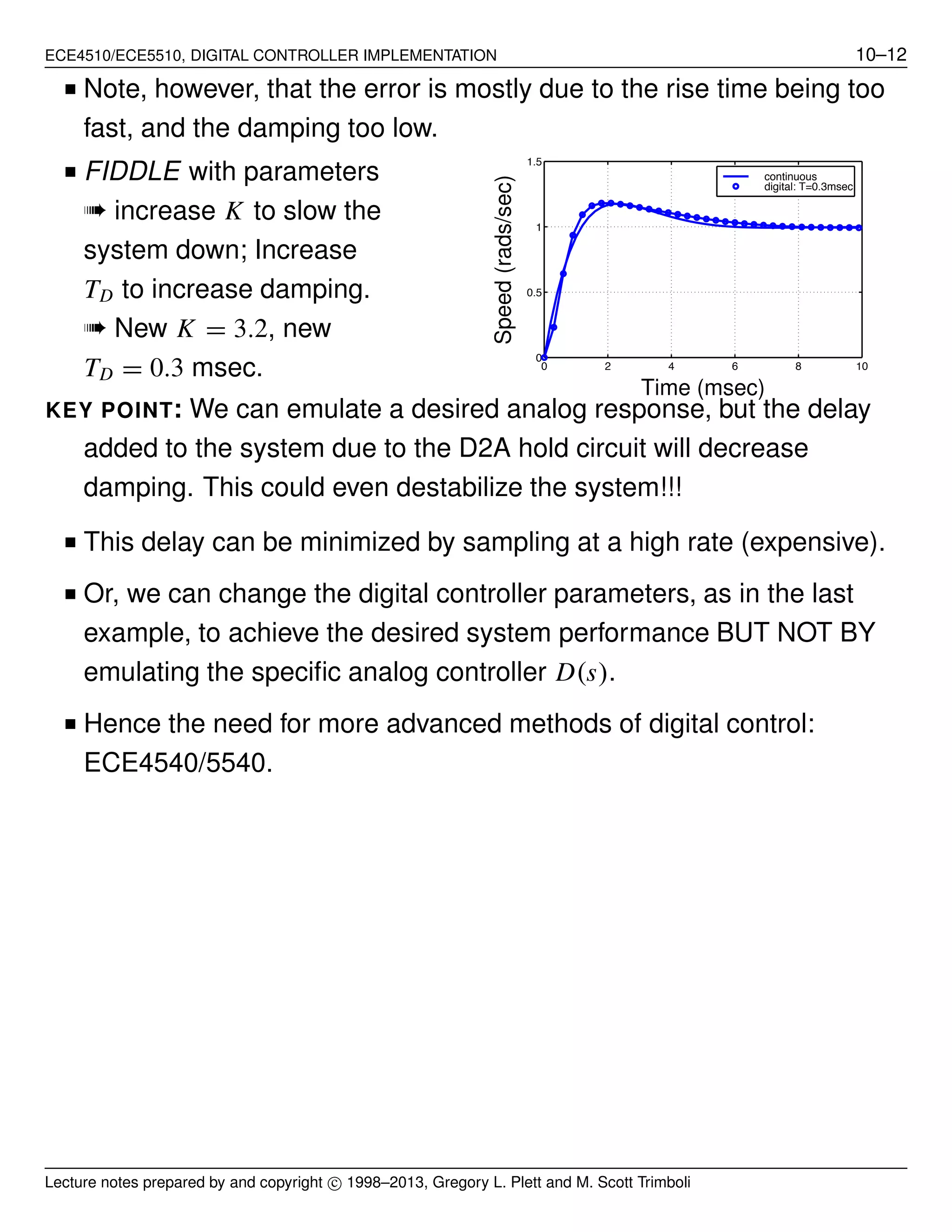
■ Note, however, that the error is mostly due to the rise time being too
fast, and the damping too low.
■ FIDDLE with parameters
➠ increase K to slow the
system down; Increase
TD to increase damping.
➠ New K = 3.2, new
TD = 0.3 msec. 0 2 4 6 8 10
0
0.5
1
1.5
continuous
digital: T=0.3msec
Time (msec)
Speed(rads/sec)
KEY POINT: We can emulate a desired analog response, but the delay
added to the system due to the D2A hold circuit will decrease
damping. This could even destabilize the system!!!
■ This delay can be minimized by sampling at a high rate (expensive).
■ Or, we can change the digital controller parameters, as in the last
example, to achieve the desired system performance BUT NOT BY
emulating the specific analog controller D(s).
■ Hence the need for more advanced methods of digital control:
ECE4540/5540.
Lecture notes prepared by and copyright c⃝ 1998–2013, Gregory L. Plett and M. Scott Trimboli

Ece4510 notes10

  • 1.
    ECE4510/5510: Feedback ControlSystems. 10–1 DIGITAL CONTROLLER IMPLEMENTATION 10.1: Some background in digital control ■ We can implement our controllers with op-amp circuits (cf. Chap. 7). ■ More commonly nowadays, we use digital computers (e.g., microcontrollers) to implement our control designs. ■ There are two main approaches to digital controller design: 1. Emulation of an analog controller—we look at this here. 2. Direct digital design—subject of more advanced course. ■ Emulation is when a digital computer approximates an analog controller design. ANALOG: D(s) G(s) y(t)r(t) u(t)e(t) DIGITAL: zoh D2AA2D D(z) G(s)Q y(t)r(t) u(t)u(kT)e(t) e(kT ) ■ Analog controller computes u(t) from e(t) using differential equations. For example, ˙u(t) + bu(t) = k0 ˙e(t) + ak0e(t). Lecture notes prepared by and copyright c⃝ 1998–2013, Gregory L. Plett and M. Scott Trimboli
  • 2.
    ECE4510/ECE5510, DIGITAL CONTROLLERIMPLEMENTATION 10–2 ■ Digital controller computes u(kT) from e(kT) using difference equations. For example (we’ll see where this came from shortly), u(kT) = (1 − bT)u((k − 1)T) + k0(aT − 1)e((k − 1)T) + k0e(kT). ■ To interface the computer controller to the “real world” we need an analog-to-digital converter (to measure analog signals) and digital-to-analog converter (to output signals). ■ Sampling and outputting usually done synchronously, at a constant rate. If sampling period = T , frequency = 1/T . ■ The signals inside the computer (the sampled signals) are noted as y(kT), or simply y [k]. y [k] is a discrete-time signal, where y(t) is a continuous-time signal. y(t) y(kT) = y[k] ■ So, we can write the prior difference equation as u[k] = (1 − bT)u[k − 1] + k0(aT − 1)e[k − 1] + k0e[k]. ■ Discrete-time signals are usually converted to continuous-time signals using a zero-order hold: e.g., to convert u [k] to u(t). Efficient implementation ■ We look at some efficient pseudo-code for an implementation of u[k] = (1 − bT)u[k − 1] + k0(aT − 1)e[k − 1] + k0e[k]. Lecture notes prepared by and copyright c⃝ 1998–2013, Gregory L. Plett and M. Scott Trimboli
  • 3.
    ECE4510/ECE5510, DIGITAL CONTROLLERIMPLEMENTATION 10–3 ■ Output of digital controller u[k] depends on previous output u[k − 1] as well as the previous and current errors e[k − 1] and e[k]. Real-Time Controller Implementation x = 0. (initialization of “past” values for first loop through) Define constants: α1 = 1 − bT . α2 = k0(aT − 1). READ A/D to obtain y[k] and r[k]. e[k] = r[k] − y[k]. u[k] = x + k0e[k]. OUTPUT u[k] to D/A and ZOH. Now compute x for the next loop through: x = α1u[k] + α2e[k]. Go back to “READ” when T seconds have elapsed since last READ. ■ Code is optimized to minimize latency between A2D read and D2A write. R = read. W = write. C = compute. I = idle. RRR CCC WWW III T Lecture notes prepared by and copyright c⃝ 1998–2013, Gregory L. Plett and M. Scott Trimboli
  • 4.
    ECE4510/ECE5510, DIGITAL CONTROLLERIMPLEMENTATION 10–4 10.2: “Digitization” (emulation of analog controllers) ■ Continuous-time controllers are designed with Laplace-transform techniques. The resulting controller is a function of “s”. y(t) = dx(t) dt x(t) s ■ So, “s” is a derivative operator. There are several ways of approximating this in discrete time. Forward-rectangular rule ■ We first look at the “forward rectangular” rule. We write: ˙x(t) △ = lim δt→0 δx(t) δt = lim δt→0 x(t + δt) − x(t) δt . ■ If sampling interval T = tk+1 − tk is small,1 ˙x(kT) ≈ x((k + 1)T) − x(kT) T i.e., ˙x[k] ≈ x[k + 1] − x[k] T . Backward-rectangular rule ■ We could also write ˙x(t) △ = lim δt→0 δx(t) δt = lim δt→0 x(t) − x(t − δt) δt . ■ Then, if T is small, ˙x(kT) ≈ x(T) − x((k − 1)T) T i.e., ˙x[k] ≈ x[k] − x[k − 1] T . Bilinear (or Tustin) rule ■ We could also re-index the forward-rectangular rule as ˙x[k − 1] = x[k] − x[k − 1] T to have the same right-hand-side as the backward-rectangular rule. 1 Rule of thumb: Sampling frequency must be ≈ 30 times the bandwidth of the analog system being emulated for comparable performance. Lecture notes prepared by and copyright c⃝ 1998–2013, Gregory L. Plett and M. Scott Trimboli
  • 5.
    ECE4510/ECE5510, DIGITAL CONTROLLERIMPLEMENTATION 10–5 ■ Then, we average these two forms: ˙x[k] + ˙x[k − 1] 2 = x[k] − x[k − 1] T . Digitizing a controller ■ Once we’ve chosen which rule to use, we “digitize” controller D(s) by 1. Writing U(s) = D(s)E(s). 2. Converting to differential equation: n k=0 ak dk u(t) dtk = m k=0 bk dk e(t) dtk . 3. Replacing derivatives with differences. EXAMPLE: Digitize the lead or lag controller D(s) = U(s) E(s) = k0 s + a s + b using the forward-rectangular rule. 1. We write U(s) = k0 s + a s + b E(s) (s + b)U(s) = k0(s + a)E(s) 2. We take the inverse-Laplace transform of this result, term-by-term to get ˙u(t) + bu(t) = k0 ˙e(t) + ak0e(t). 3. Use “forward-rectangular rule” to digitize u[k + 1] − u[k] T + bu[k] = k0 e[k + 1] − e[k] T + ae[k] u[k + 1] = u[k] + T −bu[k] + k0 e[k + 1] − e[k] T + ae[k] = (1 − bT )u[k] + k0(aT − 1)e[k] + k0e[k + 1], Lecture notes prepared by and copyright c⃝ 1998–2013, Gregory L. Plett and M. Scott Trimboli
  • 6.
    ECE4510/ECE5510, DIGITAL CONTROLLERIMPLEMENTATION 10–6 or, u[k] = (1 − bT)u[k − 1] + k0(aT − 1)e[k − 1] + k0e[k]. ■ This is how we got the result at the beginning of this chapter of notes. EXAMPLE: Digitize the lead or lag controller D(s) = U(s) E(s) = k0 s + a s + b using the backward-rectangular rule. 1. As before, we have (s + b)U(s) = k0(s + a)E(s). 2. Again, we have ˙u(t) + bu(t) = k0 ˙e(t) + ak0e(t). 3. Use “backward-rectangular rule” to digitize u[k] − u[k−1] T + bu[k] = k0 e[k] − e[k−1] T + ae[k] u[k] = u[k−1] + T −bu[k] + k0 e[k] − e[k−1] T + ae[k] (1 + bT) u[k] = u[k−1] + k0(aT + 1)e[k] − k0e[k−1] u[k] = 1 1 + bT (u[k−1] + k0(aT + 1)e[k] − k0e[k−1]) . ■ Notice that this is a different result from before. EXAMPLE: Digitize the lead or lag controller D(s) = U(s) E(s) = k0 s + a s + b using the bilinear rule. 1. As before, we have (s + b)U(s) = k0(s + a)E(s). 2. Again, we have ˙u(t) + bu(t) = k0 ˙e(t) + ak0e(t). Lecture notes prepared by and copyright c⃝ 1998–2013, Gregory L. Plett and M. Scott Trimboli
  • 7.
    ECE4510/ECE5510, DIGITAL CONTROLLERIMPLEMENTATION 10–7 3. Using the bilinear rule is challenging since we need to have derivatives in a specific format. We’ll use a trick here (ECE4540/5540 teaches more advanced techniques that don’t need this trick). ■ Re-index the differential equation: ˙u(t − T ) + bu(t − T ) = k0 ˙e(t − T ) + ak0e(t − T ). ■ Add this to the prior version, and divide by 2 ˙u(t) + ˙u(t−T ) 2 + b u(t) + u(t−T ) 2 = k0 ˙e(t) + ˙e(t−T) 2 + ak0 e(t) + e(t−T ) 2 u[k] − u[k−1] T + b 2 [u[k] + u[k−1]] = k0 e[k] − e[k−1] T + ak0 2 [e[k] + e[k−1]] . ■ Rearranging, 1 + bT 2 u[k] = 1 − bT 2 u[k−1] + k0 1 + aT 2 e[k] − k0 1 − aT 2 e[k−1] u[k] = 2 − bT 2 + bT u[k−1] + k0 2 + aT 2 + bT e[k] − k0 2 − aT 2 + aT e[k−1]. ■ Again, this is a different result from before. Lecture notes prepared by and copyright c⃝ 1998–2013, Gregory L. Plett and M. Scott Trimboli
  • 8.
    ECE4510/ECE5510, DIGITAL CONTROLLERIMPLEMENTATION 10–8 10.3: The impact of the zero-order hold ■ We illustrate the results of the prior three examples by substituting numeric values. ■ Let D(s) = 70 (s + 2) (s + 10) , G(s) = 1 s(s + 1) . ■ Choose to try a sample rate of 20 Hz and also try 40 Hz. (Note, BW of analog system is ≈ 1Hz or so). FORWARD-RECTANGULAR RULE: Digitizing D(s) gives ■ 20 Hz: u[k + 1] = 0.5u[k] + 70e[k + 1] − 63e[k]. ■ 40 Hz: u[k + 1] = 0.75u[k] + 70e[k + 1] − 66.5e[k]. BACKWARD-RECTANGULAR RULE: Digitizing D(s) gives ■ 20 Hz: u[k + 1] = 0.6666u[k] + 51.3333e[k + 1] − 46.6666e[k]. ■ 40 Hz: u[k + 1] = 0.8u[k] + 58.8e[k + 1] − 56e[k]. BILINEAR RULE: Digitizing D(s) gives ■ 20 Hz: u[k + 1] = 0.6u[k] + 58.8e[k + 1] − 53.2e[k]. ■ 40 Hz: u[k + 1] = 0.7778u[k] + 63.7777e[k + 1] − 60.666e[k]. 0 0.2 0.4 0.6 0.8 1 0 0.5 1 1.5 analog forward backward bilinear Time (sec) Plantoutput Sampled at 20Hz 0 0.2 0.4 0.6 0.8 1 0 0.5 1 1.5 analog forward backward bilinear Time (sec) Plantoutput Sampled at 40Hz ■ IMPORTANT NOTE: The digitized system has poorer damping than the original analog system. This will always be true when emulating an analog controller. We see why next . . . Lecture notes prepared by and copyright c⃝ 1998–2013, Gregory L. Plett and M. Scott Trimboli
  • 9.
    ECE4510/ECE5510, DIGITAL CONTROLLERIMPLEMENTATION 10–9 The D2A “Hold” Operation u(t) avg. u(t) u(kT)u ■ Even if u(kT) is a perfect re-creation of the output of the analog controller at t = kT, the “hold” in the D2A causes an “effective delay.” ■ The delay is approximately equal to half of the sampling period: T/2. ■ Recall from frequency-response analysis and design, the magnitude of a delayed response stays the same, but the phase changes: phase = −ω T 2 . ■ For the previous example, sampling now at 10Hz, we have: 10 −1 10 0 10 1 10 2 10 −1 10 0 10 1 10 −1 10 0 10 1 10 2 −180 −160 −140 −120 −100 Frequency (rad/sec) MagnitudePhase(Deg) ■ The PM has changed from ≈ 50◦ to ≈ 30◦ . ■ ζ ≈ PM 100 . . . ζ changed from 0.5 to 0.3 . . . much less damping. Lecture notes prepared by and copyright c⃝ 1998–2013, Gregory L. Plett and M. Scott Trimboli
  • 10.
    ECE4510/ECE5510, DIGITAL CONTROLLERIMPLEMENTATION 10–10 ■ Mp from about 20% to about 30% . . . ■ Faster sampling. . . smaller T . . . smaller delay. . . smaller change in response. 0 0.2 0.4 0.6 0.8 1 0 0.5 1 1.5 Time (sec) Plantoutput Root-Locus View of the Delay ■ Recall that we can model a delay using a Padé approximation. ■ T 2 delay −→ e−sT/2 ≈ 1 − sT/4 1 + sT/4 . ■ Poles and zeros reflected about the jω-axis. − 4 T 4 T I(s) R(s) As T → 0, delay dynamics → ∞. ■ Impact of delay: Suppose D(s)G(s) = 1 s + a . −a I(s) R(s) With delay ➠ − 4 T 4 T −a I(s) R(s) ■ Does the delayed locus make sense? 1 − sT/4 1 + sT/4 = − (sT/4 − 1) (sT/4 + 1) . Lecture notes prepared by and copyright c⃝ 1998–2013, Gregory L. Plett and M. Scott Trimboli
  • 11.
    ECE4510/ECE5510, DIGITAL CONTROLLERIMPLEMENTATION 10–11 ■ Gain is negative! We need to draw a 0◦ root locus, not the 180◦ locus we are more familiar with. ■ Conclusion: Delay destabilizes the system. PID Control via Emulation P: u(t) = Ke(t) I: u(t) = t 0 K TI e(τ) dτ D: u(t) = K TD ˙e(t) ⎫ ⎪⎪⎪⎬ ⎪⎪⎪⎭ PID: u(t) = K e(t) + 1 TI t 0 e(τ) dτ + TD ˙e(t) or, ˙u(t) = K ˙e(t) + 1 TI e(t) + TD ¨e(t) . ■ Convert to discrete-time (use fwd. rule twice for ¨e(t)). u[k] = u[k−1]+K 1 + T TI + TD T e[k] − 1 + 2TD T e[k − 1] + TD T e[k − 2] . EXAMPLE: G(s) = 360000 (s + 60)(s + 600) K = 5, TD = 0.0008, TI = 0.003. Bode plot of cts-time OL system D(s)G(s) with the above PID D(s) shows that BW ≈ 1800 rad/sec, ≈ 320Hz. 10 × BW ➠ T = 0.3 msec. ■ From above, u[k] = u[k − 1] + 5 3.7667e[k] − 6.333e[k − 1] + 2.6667e[k − 2] . ■ Step response plotted to the right. ■ Performance not great, so tried again with T = 0.1 msec. Much better. 0 2 4 6 8 10 0 0.2 0.4 0.6 0.8 1 1.2 1.4 continuous digital: T=0.3msec digital: T=0.1msec Time (msec) Speed(rads/sec) Lecture notes prepared by and copyright c⃝ 1998–2013, Gregory L. Plett and M. Scott Trimboli
  • 12.
    ECE4510/ECE5510, DIGITAL CONTROLLERIMPLEMENTATION 10–12 ■ Note, however, that the error is mostly due to the rise time being too fast, and the damping too low. ■ FIDDLE with parameters ➠ increase K to slow the system down; Increase TD to increase damping. ➠ New K = 3.2, new TD = 0.3 msec. 0 2 4 6 8 10 0 0.5 1 1.5 continuous digital: T=0.3msec Time (msec) Speed(rads/sec) KEY POINT: We can emulate a desired analog response, but the delay added to the system due to the D2A hold circuit will decrease damping. This could even destabilize the system!!! ■ This delay can be minimized by sampling at a high rate (expensive). ■ Or, we can change the digital controller parameters, as in the last example, to achieve the desired system performance BUT NOT BY emulating the specific analog controller D(s). ■ Hence the need for more advanced methods of digital control: ECE4540/5540. Lecture notes prepared by and copyright c⃝ 1998–2013, Gregory L. Plett and M. Scott Trimboli