PERSENTATION ON
            SLIP TEST ON
SALIENT POLE SYNCHRONOUS MACHINE
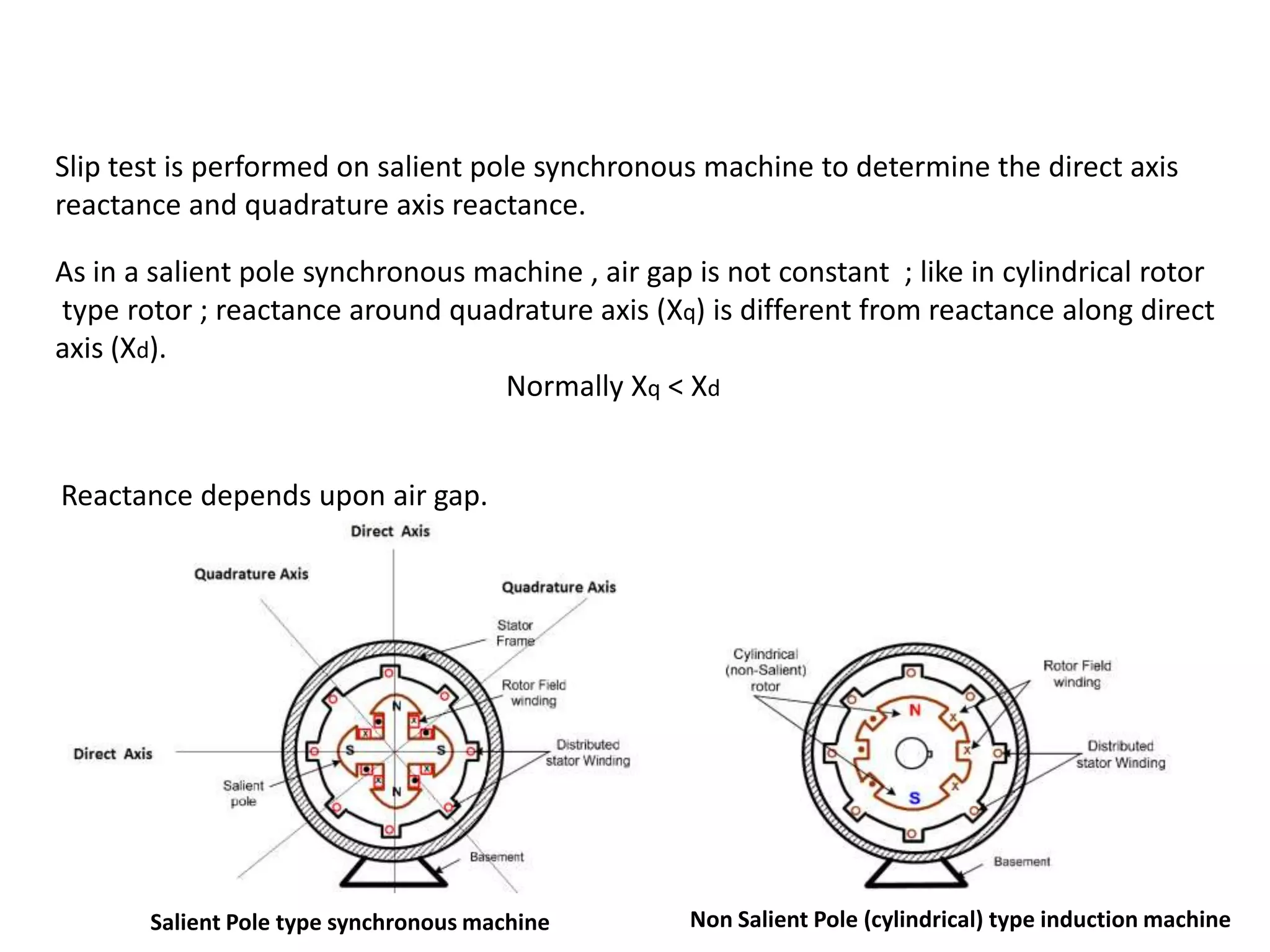
Slip test is performed on salient pole synchronous machine to determine the direct axis
reactance and quadrature axis reactance.

As in a salient pole synchronous machine , air gap is not constant ; like in cylindrical rotor
type rotor ; reactance around quadrature axis (Xq) is different from reactance along direct
axis (Xd).
                                   Normally Xq < Xd


Reactance depends upon air gap.


       Salient Pole type synchronous machine       Non Salient Pole (cylindrical) type induction machine
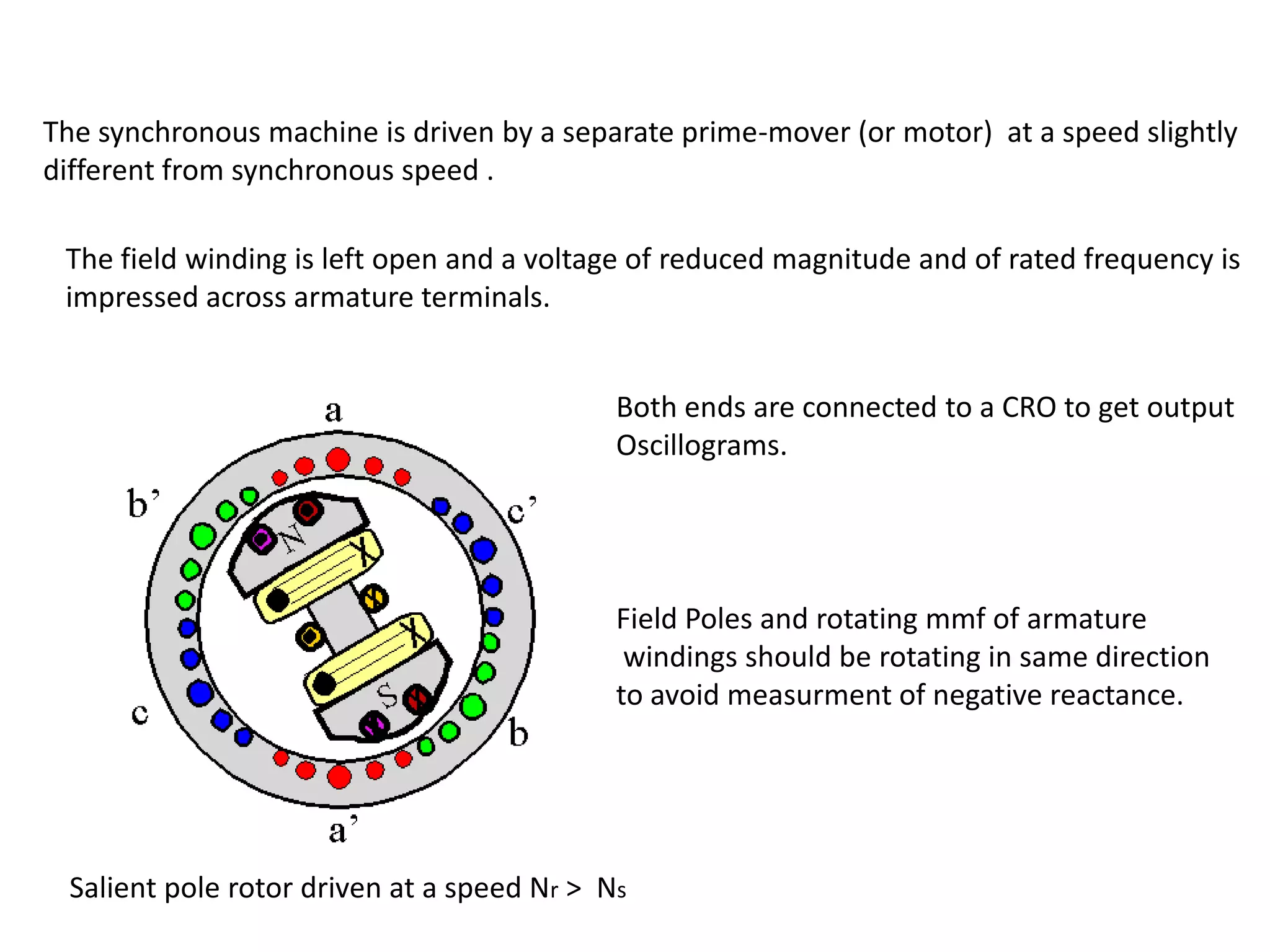
The synchronous machine is driven by a separate prime-mover (or motor) at a speed slightly
different from synchronous speed .

 The field winding is left open and a voltage of reduced magnitude and of rated frequency is
 impressed across armature terminals.


                                            Both ends are connected to a CRO to get output
                                            Oscillograms.


                                            Field Poles and rotating mmf of armature
                                             windings should be rotating in same direction
                                            to avoid measurment of negative reactance.


 Salient pole rotor driven at a speed Nr > Ns
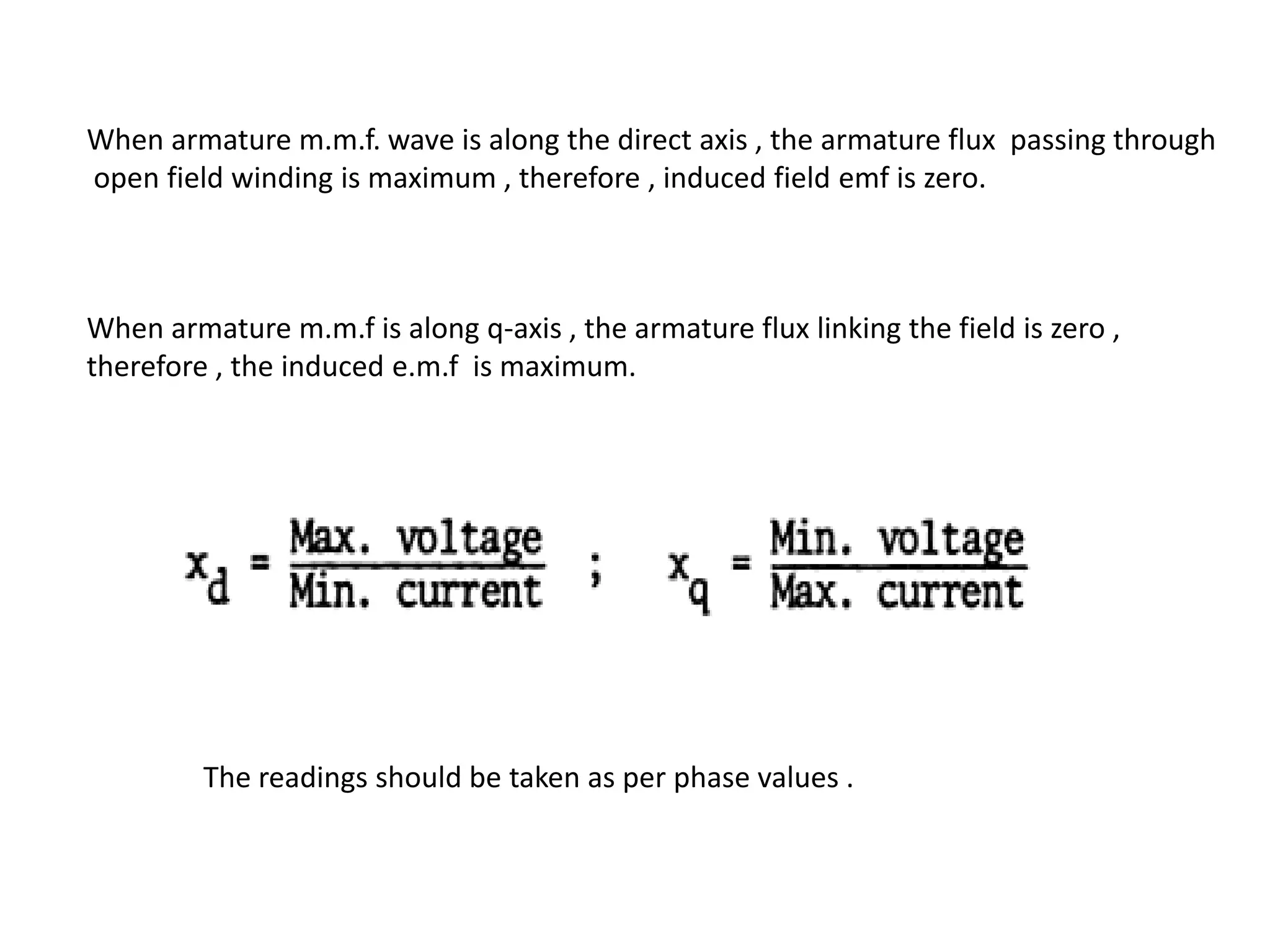
At one instant , whe the peak of armature m.m.f is in line with field poles or direct axis,
the reluctance offered by small air gap is minimum .


At that instant the impressed terminal voltage per phase divided by corresponding
armature current per phase gives d-axis synchronous reactance (Xd)


After one-quarter of slip cycle , the peak of armature m.m.f wave acts on the interpolar
region or q-axis and the reluctance offered by long air gap is maximum.

At that instant , the ratio of armature terminal voltage per phase to the corresponding
armature current per phase gives q-axis synchronous reactance (Xq)
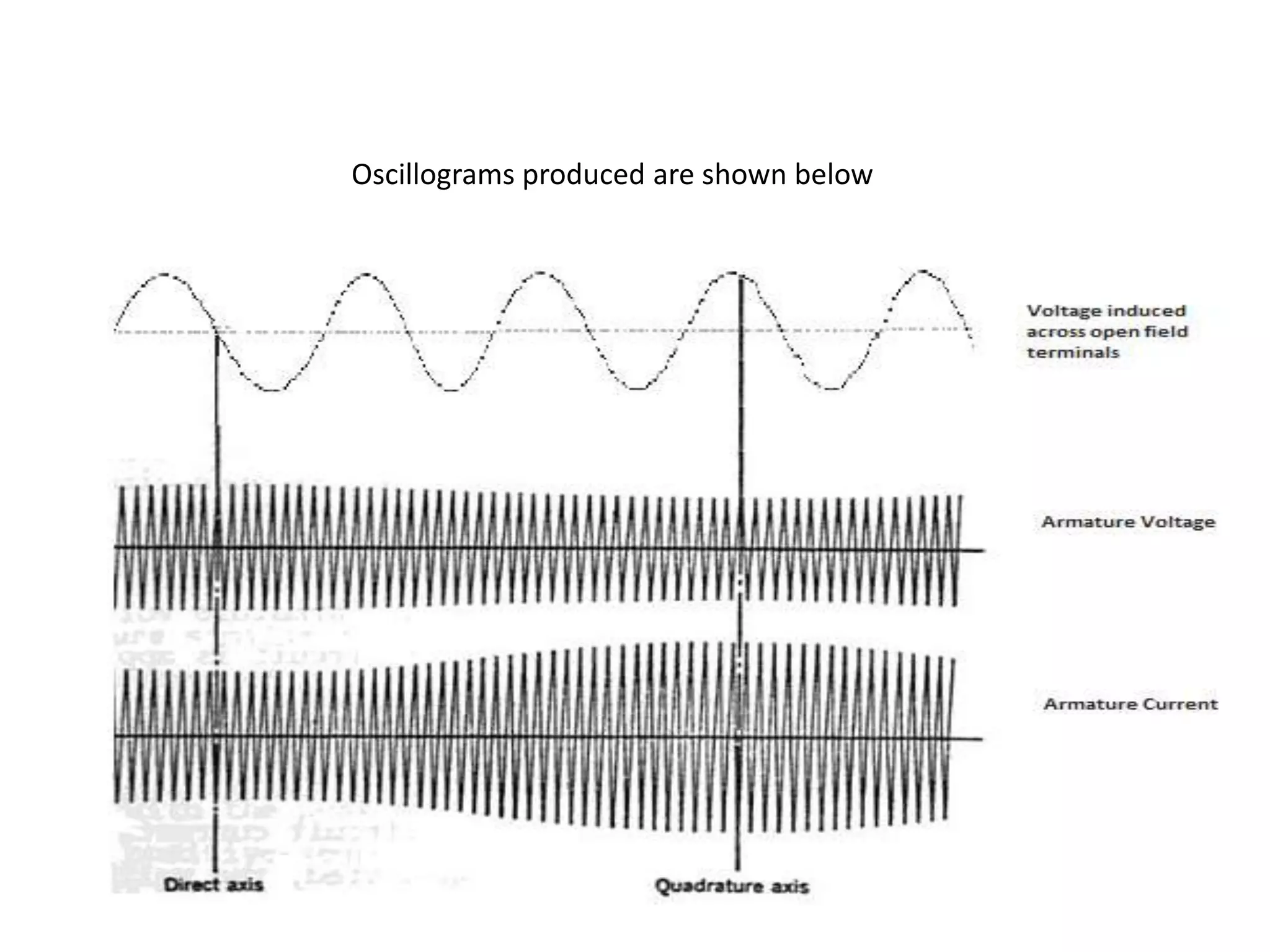
Oscillograms produced are shown below
When armature m.m.f. wave is along the direct axis , the armature flux passing through
open field winding is maximum , therefore , induced field emf is zero.


When armature m.m.f is along q-axis , the armature flux linking the field is zero ,
therefore , the induced e.m.f is maximum.


         The readings should be taken as per phase values .
If oscillograms can’t be taken , then an ammeter and a voltmeter can be used across the
machine to get desired values of voltages and currents


While performing the test , the slip(Ns – Nr) should be made as small as possible to
avoid large errors in measurments.


 Oscillogram method is more oftenly used than voltmeter-ammeter method as:-

 • Large slip speeds can be achieved

 • Elemination of inertia effect
Slip test on Synchronous Machine

Slip test on Synchronous Machine

  • 1.
    PERSENTATION ON SLIP TEST ON SALIENT POLE SYNCHRONOUS MACHINE
  • 2.
    Slip test isperformed on salient pole synchronous machine to determine the direct axis reactance and quadrature axis reactance. As in a salient pole synchronous machine , air gap is not constant ; like in cylindrical rotor type rotor ; reactance around quadrature axis (Xq) is different from reactance along direct axis (Xd). Normally Xq < Xd Reactance depends upon air gap. Salient Pole type synchronous machine Non Salient Pole (cylindrical) type induction machine
  • 3.
    The synchronous machineis driven by a separate prime-mover (or motor) at a speed slightly different from synchronous speed . The field winding is left open and a voltage of reduced magnitude and of rated frequency is impressed across armature terminals. Both ends are connected to a CRO to get output Oscillograms. Field Poles and rotating mmf of armature windings should be rotating in same direction to avoid measurment of negative reactance. Salient pole rotor driven at a speed Nr > Ns
  • 4.
    At one instant, whe the peak of armature m.m.f is in line with field poles or direct axis, the reluctance offered by small air gap is minimum . At that instant the impressed terminal voltage per phase divided by corresponding armature current per phase gives d-axis synchronous reactance (Xd) After one-quarter of slip cycle , the peak of armature m.m.f wave acts on the interpolar region or q-axis and the reluctance offered by long air gap is maximum. At that instant , the ratio of armature terminal voltage per phase to the corresponding armature current per phase gives q-axis synchronous reactance (Xq)
  • 5.
  • 6.
    When armature m.m.f.wave is along the direct axis , the armature flux passing through open field winding is maximum , therefore , induced field emf is zero. When armature m.m.f is along q-axis , the armature flux linking the field is zero , therefore , the induced e.m.f is maximum. The readings should be taken as per phase values .
  • 7.
    If oscillograms can’tbe taken , then an ammeter and a voltmeter can be used across the machine to get desired values of voltages and currents While performing the test , the slip(Ns – Nr) should be made as small as possible to avoid large errors in measurments. Oscillogram method is more oftenly used than voltmeter-ammeter method as:- • Large slip speeds can be achieved • Elemination of inertia effect