A Course Material on
EC6202 ELECTRONIC DEVICES AND CIRCUITS
By
Dr Gnanasekaran Thangavel
Mr Marimuthu Gajendran
DEPARTMENT OF ELECTRONICS AND INSTRUMENTATION
ENGINEERING
RMK ENGINEERING COLLEGE
KAVRAIPETTAI– 601 206
EC6202 ELECTRONIC DEVICES AND CIRCUITS L T P C
3 1 0 4
OBJECTIVES:
The student should be made to:
 Be familiar with the structure of basic electronic devices.
 Be exposed to the operation and applications of electronic devices.
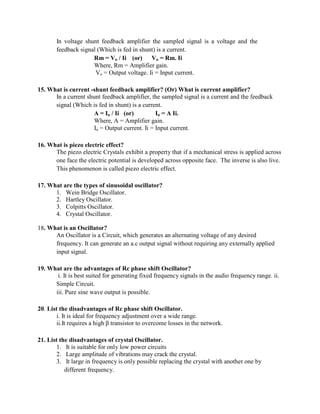
UNIT I PN JUNCTION DEVICES 9
PN junction diode –structure, operation and V-I characteristics, diffusion and transient capacitance -
Rectifiers – Half Wave and Full Wave Rectifier,– Display devices- LED, Laser diodes- Zener diode
characteristics-Zener Reverse characteristics – Zener as regulator
UNIT II
TRANSISTORS 9
BJT, JFET, MOSFET- structure, operation, characteristics and Biasing UJT, Thyristor and IGBT
Structure and characteristics.
UNIT III AMPLIFIERS 9
BJT small signal model – Analysis of CE, CB, CC amplifiers- Gain and frequency response –
MOSFET small signal model – Analysis of CS and Source follower – Gain and frequency response-
High frequency analysis.
UNIT IV MULTISTAGE AMPLIFIERS AND DIFFERENTIAL AMPLIFIER 9
BIMOS cascade amplifier, Differential amplifier – Common mode and Difference mode analysis –
FET input stages – Single tuned amplifiers – Gain and frequency response – Neutralization methods,
power amplifiers –Types (Qualitative analysis).
UNIT V FEEDBACK AMPLIFIERS AND OSCILLATORS 9
Advantages of negative feedback – voltage / current, series , Shunt feedback –positive feedback –
Condition for oscillations, phase shift – Wien bridge, Hartley, Colpitts and Crystal oscillators.
OUTCOMES:
 To explain the structure of the basic electronic devices.
 To design applications using the basic electronic devices.
TOTAL (L:45+T:15): 60 PERIODS
TEXT BOOKS:
1. David A. Bell,”Electronic Devices and Circuits”, Prentice Hall of India, 2004.
2. Sedra and smith, “Microelectronic Circuits “ Oxford University Press, 2004.
REFERENCES:
1. Rashid, “Micro Electronic Circuits” Thomson publications, 1999.
2. Floyd, “Electron Devices” Pearson Asia 5th Edition, 2001.
3. Donald A Neamen, “Electronic Circuit Analysis and Design” Tata McGraw Hill, 3 Edition, 2003.
4. Robert L.Boylestad, “Electronic Devices and Circuit theory”, 2002.
5. Robert B. Northrop, “Analysis and Application of Analog Electronic Circuits to Biomedical
Instrumentation”, CRC Press, 2004.
S. No
Electronic Devices and Circuits- S.Shalivahanan,
McGraw Hill Education (India) Pvt. Ltd, 4th
Edition,2017
Chap. No Page No
UNIT – I : PN JUNCTION DEVICES
1 PN junction diode –structure, operation and 4
4.29 – 4.50
2 V-I characteristics 4
3 Diffusion capacitance and Transient capacitance 4 4.50 – 4.54
4 Rectifiers – Half Wave Rectifier and 18
18.12 – 18.33
5 Full Wave Rectifier 18
6 Display devices- LED 22 22.15
7 Laser diodes Refer Notes
8 Zener diode characteristics- Zener Reverse characteristics 5 5.1 – 5.4
9 Zener as regulator 18 18.35 – 18.41
UNIT – II : TRANSISTORS
1 BJT- structure, operation, characteristics 6
6.1 – 6.57
2 BJT Biasing 6
3 JFET- structure, operation, characteristics 7 7.1 – 7.12
4 JFET Biasing 7 7.45 – 7.68
5 MOSFET- structure, operation, characteristics 7 7.13 – 7.15
6 MOSFET Biasing 7 7.48 – 7.59
7 UJT - Structure and characteristics
8 Thyristor - Structure and characteristics 8 8.1 – 8.39
9 TRIAC 8 8.10 – 8.11
10 IGBT - Structure and characteristics, Revision Refer Notes
UNIT – III : AMPLIFIERS
1 BJT small signal model 9
9.1 – 9.60
2 Analysis of CE amplifiers 9
3 Analysis of CB amplifiers 9
4 Analysis of CC amplifiers 9
5 Gain and frequency response - High frequency analysis 9
6 MOSFET small signal model 9 9.63 – 9.68
7 Analysis of CS 9
9.77 – 9.87
8 Analysis of Source follower
9 Gain and frequency response - High frequency analysis 11 11.19 – 11.42
UNIT – IV : MULTISTAGE AMPLIFIERS AND DIFFERENTIAL AMPLIFIER
1 BIMOS cascade amplifier Refer Notes
2 Differential amplifier 9
9.87 – 9.1093 Common mode and Difference mode analysis 9
4 FET input stages 9
5 Single tuned amplifiers 13
13.1 – 13.13
6 Gain and frequency response 13
7 Neutralization methods 13 13.32 – 13.34
8 Power amplifiers –Types 12
12.1 – 12.24
9 Power amplifiers types (Qualitative analysis) 12
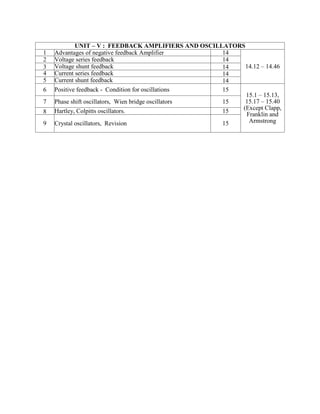
UNIT – V : FEEDBACK AMPLIFIERS AND OSCILLATORS
1 Advantages of negative feedback Amplifier 14
14.12 – 14.46
2 Voltage series feedback 14
3 Voltage shunt feedback 14
4 Current series feedback 14
5 Current shunt feedback 14
6 Positive feedback - Condition for oscillations 15
15.1 – 15.13,
15.17 – 15.40
(Except Clapp,
Franklin and
Armstrong
7 Phase shift oscillators, Wien bridge oscillators 15
8 Hartley, Colpitts oscillators. 15
9 Crystal oscillators, Revision 15
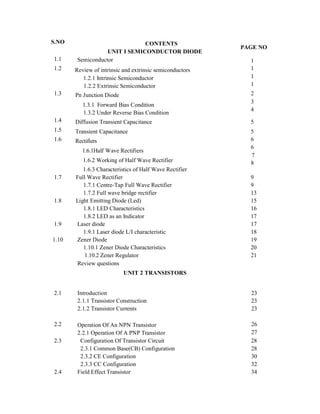
S.NO CONTENTS
UNIT I SEMICONDUCTOR DIODE
PAGE NO
1.1 Semiconductor 1
1.2 Review of intrinsic and extrinsic semiconductors 1
1.2.1 Intrinsic Semiconductor 1
1.2.2 Extrinsic Semiconductor 1
1.3 Pn Junction Diode 2
1.3.1 Forward Bias Condition
3
1.3.2 Under Reverse Bias Condition
4
1.4 Diffusion Transient Capacitance 5
1.5 Transient Capacitance 5
1.6 Rectifiers 6
1.6.1Half Wave Rectifiers
6
7
1.6.2 Working of Half Wave Rectifier 8
1.6.3 Characteristics of Half Wave Rectifier
1.7 Full Wave Rectifier 9
1.7.1 Centre-Tap Full Wave Rectifier 9
1.7.2 Full wave bridge rectifier 13
1.8 Light Emitting Diode (Led) 15
1.8.1 LED Characteristics 16
1.8.2 LED as an Indicator 17
1.9 Laser diode 17
1.9.1 Laser diode L/I characteristic 18
1.10 Zener Diode 19
1.10.1 Zener Diode Characteristics 20
1.10.2 Zener Regulator 21
Review questions
UNIT 2 TRANSISTORS
2.1 Introduction 23
2.1.1 Transistor Construction 23
2.1.2 Transistor Currents 23
2.2 Operation Of An NPN Transistor 26
2.2.1 Operation Of A PNP Transistor 27
2.3 Configuration Of Transistor Circuit 28
2.3.1 Common Base(CB) Configuration 28
2.3.2 CE Configuration 30
2.3.3 CC Configuration 32
2.4 Field Effect Transistor 34
3.4.1 Effect of various capacitors on frequency response 86
3.5 MOSFET small signal model Amplifiers 87
3.5.1 MOSFET low frequency A.C Equivalent circuit 87
3.5.2Common source amplifier with self bias(Bypassed Rs) 89
3.6 High frequency analysis of MOSFET: 92
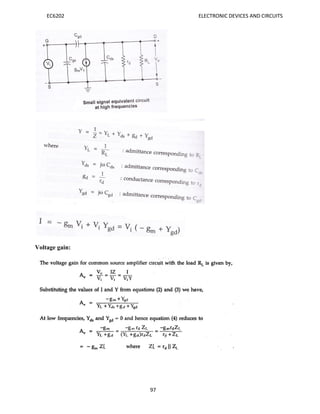
3.6.1 Common source amplifier at high frequencies 97
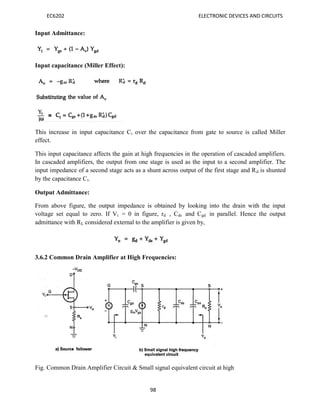
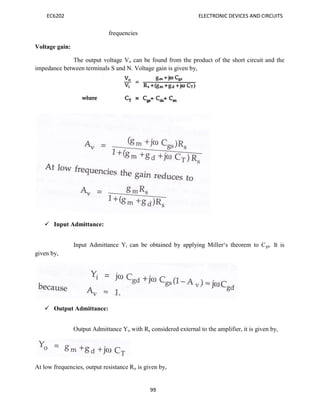
3.6.2 Common Drain Amplifier at High Frequencies 99
Review Questions
2.4.1 Operation of FET 35
2.5 MOSFET (Metal Oxide Semiconductor Field Effect Transistor) 39
2.5.1 Depletion mode-MOSFET 39
2.5.2 Construction 40
2.5.3 Operation of N-channel D-MOSFET 41
2.5.4 Enhancement- Mode MOSFET 42
2.6 BIASING 45
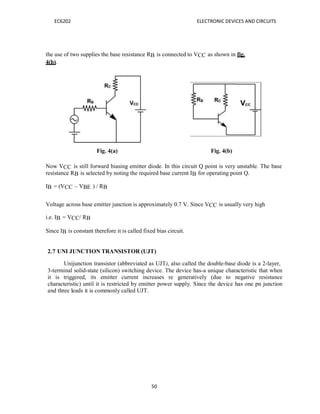
2.6.1 Fixed Bias or Base Bias 45
2.7 UNI JUNCTION TRANSISTOR (UJT) 50
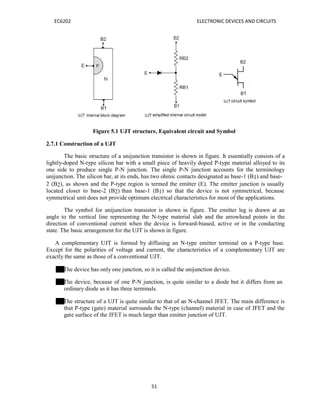
2.7.1 Construction of a UJT 51
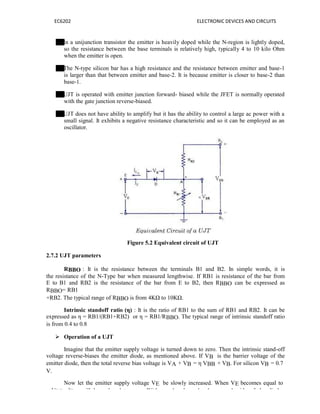
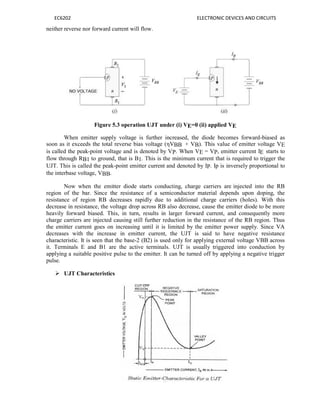
2.7.2 UJT parameters 52
2.7.3 Applications of UJT
53
2.8 SILICON CONTROLLED RECTIFIER (SCR) 54
2.8.1 Introduction 56
2.8.2 VI characteristics of SCR 58
2.8.3 DIAC (DIODE A.C. SWITCH) 58
2.8.4 TRIAC 61
2.8.5 INSULATED GATE BIPOLAR TRANSISTOR 64
Review questions
UNIT 3 AMPLIFIERS
3.1 Bjt Small Signal Model 69
3.1.1 CE, CB And CC Amplifiers 69
3.1.2 Common Emitter Amplifier Circuit: 70
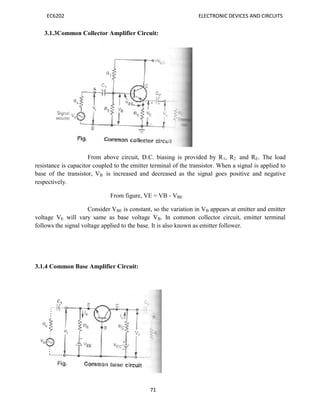
3.1.3Common Collector Amplifier Circuit 72
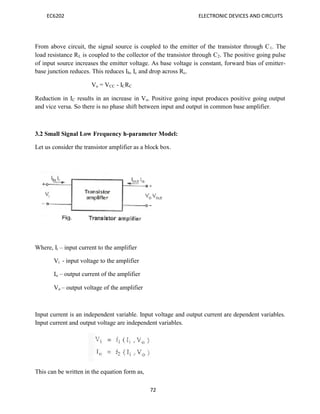
3.1.4 Common Base Amplifier Circuit 72
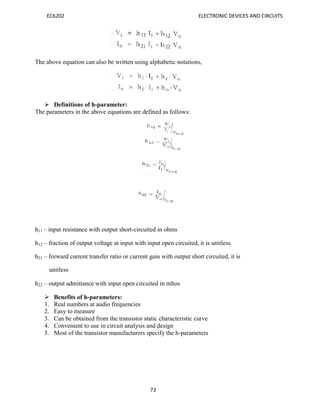
3.2 Small Signal Low Frequency h-parameter Model 73
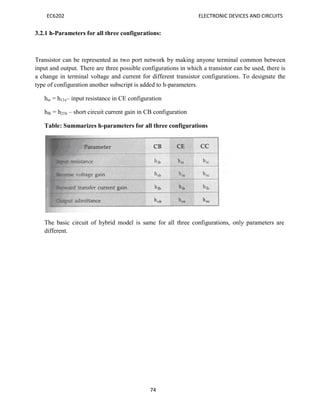
3.2.1 h-Parameters for all three configurations 75
3.2.2 Method for analysis of a transistor circuit 78
3.3 General shape of frequency response of amplifiers 81
3.3.1 Definition of cut-off frequencies and bandwidth: 82
3.4 Low frequency analysis of amplifier to obtain lower cut-off 82
frequency:
UNIT 4 MULTISTAGE AMPLIFIERS AND
DIFFERENTIAL AMPLIFIER
4.1 Multistage Amplifiers
4.1.1 Need for Cascading
4.1.2 Advantages of Representation of Gain in Decibels
4.2 Introduction of Differential Amplifier
4.2.1 Basics of Differential Amplifier
4.2.2 Transistorised Differential Amplifier
4.2.3 Differential Mode Operation
4.2.4 common Mode operation
4.2.5 D.C. Analysis of Differential Amplifier
4.3 Tuned amplifier
4.3.1 Need for tuned circuits
4.3.2 Single tuned amplifier
4.4 General shape of frequency response of amplifiers
4.4.1 Definition of cut-off frequencies and bandwidth
4.5 Neutralization Methods
106
106
108
111
112
114
115
116
118
120
121
121
122
123
124
4.5.1 Neutralization using coil
124
4.6 Power Amplifiers 126
4.6.1 Transformer-Coupled Class A Amplifiers 127
4.6.2 Class B Amplifiers 128
4.6.3 Class C Amplifiers 129
Review Questions
UNIT 5
FEED BACK AMPLIFIERSAND OSCILLATORS
5.1 Feedback 128
5.2 Principles of Negative Voltage Feedback In Amplifiers 129
5.3 Gain of Negative Voltage Feedback Amplifier 130
5.4 Advantages of Negative Voltage Feedback 131
5.5 Effects of Negative Current Feedback 137
5.6 The Feedback Voltage Amplifier (Series-Shunt) 138
5.7 Oscillators: 140
5.8 The Hartley Oscillator 141
5.9 The Colpitts Oscillator 142
5.10 Wien Bridge Oscillator 145
5.11 Quartz Crystal Oscillators 150
Review Questions
EC6202 ELECTRONIC DEVICES AND CIRCUITS
1
UNIT I PN JUNCTION DEVICES
1.1 SEMICONDUCTOR
A semiconductor is a material which has electrical conductivity to a degree between that of
a metal (such as copper) and that of an insulator (such as glass). Semiconductors are the foundation
of modern electronics, including transistors, solar cells, light -emitting diodes (LEDs), quantum dots
and digital and analog integrated circuits.
DIODE
Diode – Di + ode
Di means two and ode means electrode. So physical contact of two electrodes is known as
diode and its important function is alternative current to direct current.
1.2 REVIEW OF INTRINSIC AND EXTRINSIC SEMICONDUCTORS
1.2.1 INTRINSIC SEMICONDUCTOR
An intrinsic semiconductor is one, which is pure enough that impurities do not
appreciably affect its electrical behavior. In this case, all carriers are created due to thermally or
optically excited electrons from the full valence band into the empty y conduction band.
Thus equal numbers of electrons and holes are present in an intrinsic semiconductor. Electrons and
holes flow in opposite directions in an electric field, though they contribute to current in the
same direction since they are oppositely charged. Hole current and electron current are not
necessarily equal in an intrinsic semiconductor, however, because electrons and holes have
different effective masses (crystalline analogues to free inertial masses).
The concentration of carriers is strongly dependent on the temperature. At low temperatures,
the valence band is completely full making the material an insulator. Increasing the temperature
leads to an increase in the number of carriers and a corresponding increase in conductivity.
This characteristic shown by intrinsic semiconductor is different from the behaviour of most
metals, which tend to become less conductive at higher temperatures due to increased phonon
scattering.
Both silicon and germanium are tetravalent, i.e. each has four electrons (valence
electrons) in their outermost shell. Both elements crystallize with a diamond-like structure, i.e. in
such a way that each atom in the crystal is inside a tetrahedron formed by the four atoms which are
closest to it. Each atom shares its four valence electrons with its four immediate neighbors, so that
each atom is involved in four covalent bonds.
1.2.2 EXTRINSIC SEMICONDUCTOR
An extrinsic semiconductor is one that has been doped with impurities to modify the
number and type of free charge carriers. An extrinsic semiconductor is a semiconductor that has
been doped, that is, into which a doping agent has been introduced, giving it different electrical
properties than the intrinsic (pure) semiconductor.
Doping involves adding doping atoms to an intrinsic semiconductor, which changes the
electron and hole carrier concentrations of the semiconductor at thermal equilibrium. Dominant
EC6202 ELECTRONIC DEVICES AND CIRCUITS
2
carrier concentrations in an extrinsic semiconductor classify it as either an n-type or p-type
semiconductor.
A pure or intrinsic conductor has thermally generated holes and electrons. However these
are relatively few in number. An enormous increase in the number of charge carriers can by
achieved by introducing impurities into the semiconductor in a controlled manner. The result is
the formation of an extrinsic semiconductor. This process is referred to as doping. There are
basically two types of impurities: donor impurities and acceptor impurities. Donor impurities are
made up of atoms (arsenic for example) which have five valence electrons. Acceptor impurities are
made up of atoms (gallium for example) which have three valence electrons.
The two types of extrinsic semiconductor are
 N-TYPE SEMICONDUCTORS
Extrinsic semiconductors with a larger electron concentration than hole concentration are
known as n-type semiconductors. The phrase ‘n-type’ comes from the negative charge of the
electron. In n-type semiconductors, electrons are the majority y carriers and holes are the
minority carriers. N-type semiconductors are created by doping an intrinsic semiconductor with
donor impurities.
In an n-type semiconductor, the Fermi energy level is greater than that of the intrinsic
semiconductor and lies closer to the conduction band than the valence band. Arsenic has 5 valence
electrons, however, only 4 of them form part of covalent bonds. The 5th electron is then free to
take part in conduction. The electrons are said to be the majority carriers and the holes are said to be
the minority carriers.
 P-TYPE SEMICONDUCTORS
As opposed to n-type semiconductors, p-type semiconductors have a larger hole
concentration than electron concentration. The phrase 'p-type' refers to the positive charge of the
hole. In p- type semiconductors, holes are the majority carriers and electrons are the minority
y carriers. P-type semiconductors are created by doping an intrinsic semiconductor with acceptor
impurities. P-type semiconductors have Fermi energy levels below the intrinsic Fermi energy level.
The Fermi energy level lies closer to the valence band than the conduction band in a p- type
semiconductor. Gallium has 3 valence electrons; however, there are 4 covalent bonds to fill. The 4th
bond therefore remains vacant producing a hole. The holes are said to be the majority carriers and
the electrons are said to be the minority carriers.
1.3 PN JUNCTION DIODE
When the N and P-type semiconductor materials are first joined together a very large density
gradient exists between both sides of the junction so some of the free electrons from the donor
impurity atoms begin to migrate across this newly formed junction to fill up the holes in the P-
type material producing negative ions.
1.3.1 FORWARD BIAS CONDITION
When positive terminal of the battery is connected to the P-type and negative terminal to
N-type of the PN junction diode that is known as forward bias condition.
EC6202 ELECTRONIC DEVICES AND CIRCUITS
3
 Operation
The applied potential in external battery acts in opposition to the internal potential barrier which
disturbs the equilibrium.
As soon as equilibrium is disturbed by the application of an external voltage, the Fermi level is no
longer continuous across the junction.
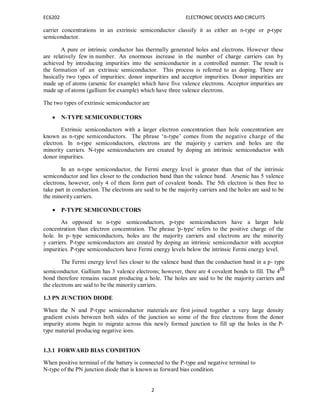
Under the forward bias condition the applied positive potential repels the holes in P type region so
that the holes move towards the junction and the applied positive potential repels the electrons in N
type region so that the electrons move towards the junction.
When the applied potential is more than the internal barrier potential the depletion region and
internal potential barrier disappear.
Figure PN junctions under forward bias
 V-I Characteristics
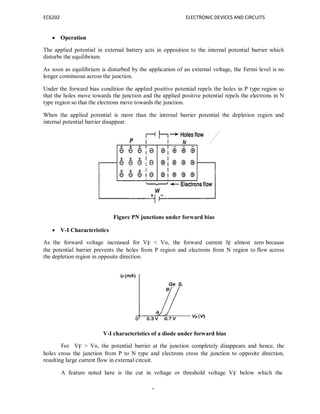
As the forward voltage increased for VF < Vo, the forward current IF almost zero because
the potential barrier prevents the holes from P region and electrons from N region to flow across
the depletion region in opposite direction.
V-I characteristics of a diode under forward bias
For VF > Vo, the potential barrier at the junction completely disappears and hence, the
holes cross the junction from P to N type and electrons cross the junction to opposite direction,
resulting large current flow in external circuit.
A feature noted here is the cut in voltage or threshold voltage VF below which the
EC6202 ELECTRONIC DEVICES AND CIRCUITS
4
current is very small. At this voltage the potential barrier is overcome and the current through
the junction starts to increase rapidly.
 Cut in voltage is 0.3V for germanium and 0.7 for silicon.
1.3.2 UNDER REVERSE BIAS CONDITION
When the negative terminal of the battery is connected to the P-type and positive terminal to N-type
of the PN junction diode that is known as forward bias condition.
 Operation
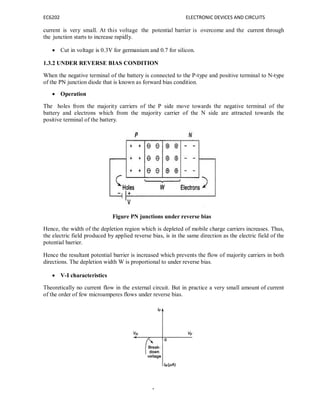
The holes from the majority carriers of the P side move towards the negative terminal of the
battery and electrons which from the majority carrier of the N side are attracted towards the
positive terminal of the battery.
Figure PN junctions under reverse bias
Hence, the width of the depletion region which is depleted of mobile charge carriers increases. Thus,
the electric field produced by applied reverse bias, is in the same direction as the electric field of the
potential barrier.
Hence the resultant potential barrier is increased which prevents the flow of majority carriers in both
directions. The depletion width W is proportional to under reverse bias.
 V-I characteristics
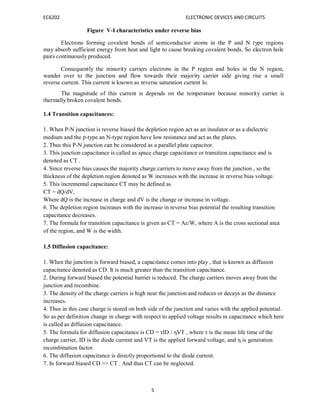
Theoretically no current flow in the external circuit. But in practice a very small amount of current
of the order of few microamperes flows under reverse bias.
EC6202 ELECTRONIC DEVICES AND CIRCUITS
5
Figure V-I characteristics under reverse bias
Electrons forming covalent bonds of semiconductor atoms in the P and N type regions
may absorb sufficient energy from heat and light to cause breaking covalent bonds. So electron hole
pairs continuously produced.
Consequently the minority carriers electrons in the P region and holes in the N region,
wander over to the junction and flow towards their majority carrier side giving rise a small
reverse current. This current is known as reverse saturation current Io.
The magnitude of this current is depends on the temperature because minority carrier is
thermally broken covalent bonds.
1.4 Transition capacitances:
1. When P-N junction is reverse biased the depletion region act as an insulator or as a dielectric
medium and the p-type an N-type region have low resistance and act as the plates.
2. Thus this P-N junction can be considered as a parallel plate capacitor.
3. This junction capacitance is called as space charge capacitance or transition capacitance and is
denoted as CT .
4. Since reverse bias causes the majority charge carriers to move away from the junction , so the
thickness of the depletion region denoted as W increases with the increase in reverse bias voltage.
5. This incremental capacitance CT may be defined as
CT = dQ/dV,
Where dQ is the increase in charge and dV is the change or increase in voltage.
6. The depletion region increases with the increase in reverse bias potential the resulting transition
capacitance decreases.
7. The formula for transition capacitance is given as CT = Aε/W, where A is the cross sectional area
of the region, and W is the width.
1.5 Diffusion capacitance:
1. When the junction is forward biased, a capacitance comes into play , that is known as diffusion
capacitance denoted as CD. It is much greater than the transition capacitance.
2. During forward biased the potential barrier is reduced. The charge carriers moves away from the
junction and recombine.
3. The density of the charge carriers is high near the junction and reduces or decays as the distance
increases.
4. Thus in this case charge is stored on both side of the junction and varies with the applied potential.
So as per definition change in charge with respect to applied voltage results in capacitance which here
is called as diffusion capacitance.
5. The formula for diffusion capacitance is CD = τID / ηVT , where τ is the mean life time of the
charge carrier, ID is the diode current and VT is the applied forward voltage, and η is generation
recombination factor.
6. The diffusion capacitance is directly proportional to the diode current.
7. In forward biased CD >> CT . And thus CT can be neglected.
EC6202 ELECTRONIC DEVICES AND CIRCUITS
6
1.6 RECTIFIERS
Rectifiers are classified according to the period of conduction.
They are
 Half Wave Rectifier
 Full Wave Rectifier
1.6.1 Half Wave Rectifier:
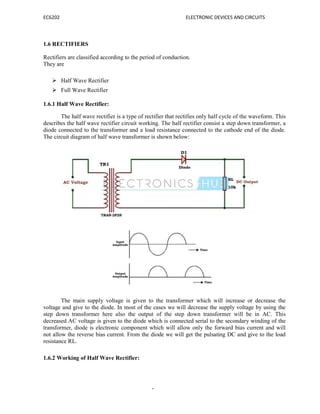
The half wave rectifier is a type of rectifier that rectifies only half cycle of the waveform. This
describes the half wave rectifier circuit working. The half rectifier consist a step down transformer, a
diode connected to the transformer and a load resistance connected to the cathode end of the diode.
The circuit diagram of half wave transformer is shown below:
The main supply voltage is given to the transformer which will increase or decrease the
voltage and give to the diode. In most of the cases we will decrease the supply voltage by using the
step down transformer here also the output of the step down transformer will be in AC. This
decreased AC voltage is given to the diode which is connected serial to the secondary winding of the
transformer, diode is electronic component which will allow only the forward bias current and will
not allow the reverse bias current. From the diode we will get the pulsating DC and give to the load
resistance RL.
1.6.2 Working of Half Wave Rectifier:
EC6202 ELECTRONIC DEVICES AND CIRCUITS
7
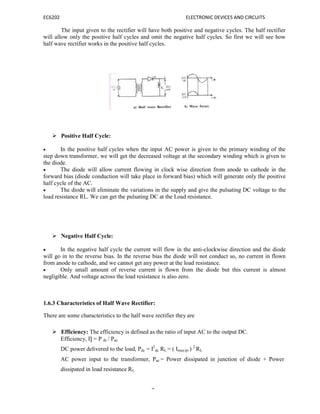
The input given to the rectifier will have both positive and negative cycles. The half rectifier
will allow only the positive half cycles and omit the negative half cycles. So first we will see how
half wave rectifier works in the positive half cycles.
 Positive Half Cycle:
 In the positive half cycles when the input AC power is given to the primary winding of the
step down transformer, we will get the decreased voltage at the secondary winding which is given to
the diode.
 The diode will allow current flowing in clock wise direction from anode to cathode in the
forward bias (diode conduction will take place in forward bias) which will generate only the positive
half cycle of the AC.
 The diode will eliminate the variations in the supply and give the pulsating DC voltage to the
load resistance RL. We can get the pulsating DC at the Load resistance.
 Negative Half Cycle:
 In the negative half cycle the current will flow in the anti-clockwise direction and the diode
will go in to the reverse bias. In the reverse bias the diode will not conduct so, no current in flown
from anode to cathode, and we cannot get any power at the load resistance.
 Only small amount of reverse current is flown from the diode but this current is almost
negligible. And voltage across the load resistance is also zero.
1.6.3 Characteristics of Half Wave Rectifier:
There are some characteristics to the half wave rectifier they are
 Efficiency: The efficiency is defined as the ratio of input AC to the output DC.
Efficiency, Ƞ = P dc / Pac
DC power delivered to the load, Pdc = I2
dc RL = ( Imax/pi ) 2
RL
AC power input to the transformer, Pac = Power dissipated in junction of diode + Power
dissipated in load resistance RL
EC6202 ELECTRONIC DEVICES AND CIRCUITS
8
dc f
= I2
rms RF + I2
rms RL = {I2
MAX/4}[RF + RL]
Rectification Efficiency, Ƞ = Pdc / Pac = {4/ 2
}[RL/ (RF + RL)] = 0.406/{1+ RF/RL }
If RF is neglected, the efficiency of half wave rectifier is 40.6%.
 Ripple factor: It is defined as the amount of AC content in the output DC. It nothing but
amount of AC noise in the output DC. Less the ripple factor, performance of the rectifier is
more. The ripple factor of half wave rectifier is about 1.21 (full wave rectifier has about
0.48). It can be calculated as follows:
The effective value of the load current I is given as sum of the rms values of
harmonic currents I1, I2, I3, I4 and DC current Idc.
I2
=I2
dc+I2
1+I2
2+I2
4 = I2
dc +I2
ac
Ripple factor, is given as γ = I ac / Idc = (I2
– I2
dc) / Idc = {( I rms / I 2
)-1} = K 2
– 1)
Where Kf is the form factor of the input voltage. Form factor is given as
Kf = Irms /Iavg = (Imax/2)/ (Imax/pi) = pi/2 = 1.57
So, ripple factor, γ = (1.572
– 1) = 1.21
 Peak Inverse Voltage: It is defined as the maximum voltage that a diode can with stand in
reverse bias. During the reverse bias as the diode do not conduct total voltage drops across the
diode. Thus peak inverse voltage is equal to the input voltage Vs.
 Transformer Utilization Factor (TUF): The TUF is defined as the ratio of DC power is
delivered to the load and the AC rating of the transformer secondary. Half wave rectifier has
around 0.287 and full wave rectifier has around 0.693.
Half wave rectifier is mainly used in the low power circuits. It has very low performance when it is
compared with the other rectifiers.
1.7 FULL WAVE RECTIFIER
Full wave rectifier rectifies the full cycle in the waveform i.e. it rectifies both the positive and
negative cycles in the waveform. We have already seen the characteristics and working of Half
Wave Rectifier. This Full wave rectifier has an advantage over the half wave i.e. it has average
output higher than that of half wave rectifier. The number of AC components in the output is less
than that of the input.
The full wave rectifier can be further divided mainly into following types.
EC6202 ELECTRONIC DEVICES AND CIRCUITS
9
1. Center Tapped Full Wave Rectifier
2. Full Wave Bridge Rectifier
1.7.1 Centre-Tap Full Wave Rectifier
We have already discussed the Full Wave Bridge Rectifier, which uses four diodes, arranged
as a bridge, to convert the input alternating current (AC) in both half cycles to direct current (DC).
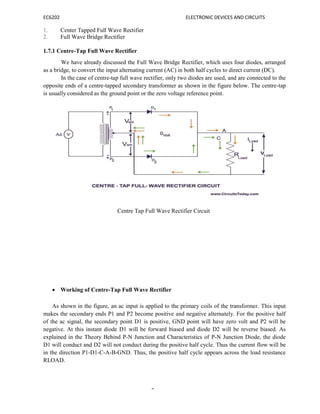
In the case of centre-tap full wave rectifier, only two diodes are used, and are connected to the
opposite ends of a centre-tapped secondary transformer as shown in the figure below. The centre-tap
is usually considered as the ground point or the zero voltage reference point.
Centre Tap Full Wave Rectifier Circuit
 Working of Centre-Tap Full Wave Rectifier
As shown in the figure, an ac input is applied to the primary coils of the transformer. This input
makes the secondary ends P1 and P2 become positive and negative alternately. For the positive half
of the ac signal, the secondary point D1 is positive, GND point will have zero volt and P2 will be
negative. At this instant diode D1 will be forward biased and diode D2 will be reverse biased. As
explained in the Theory Behind P-N Junction and Characteristics of P-N Junction Diode, the diode
D1 will conduct and D2 will not conduct during the positive half cycle. Thus the current flow will be
in the direction P1-D1-C-A-B-GND. Thus, the positive half cycle appears across the load resistance
RLOAD.
EC6202 ELECTRONIC DEVICES AND CIRCUITS
10
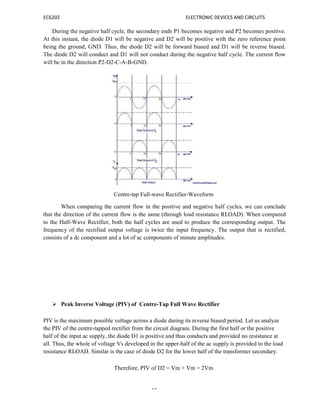
During the negative half cycle, the secondary ends P1 becomes negative and P2 becomes positive.
At this instant, the diode D1 will be negative and D2 will be positive with the zero reference point
being the ground, GND. Thus, the diode D2 will be forward biased and D1 will be reverse biased.
The diode D2 will conduct and D1 will not conduct during the negative half cycle. The current flow
will be in the direction P2-D2-C-A-B-GND.
Centre-tap Full-wave Rectifier-Waveform
When comparing the current flow in the positive and negative half cycles, we can conclude
that the direction of the current flow is the same (through load resistance RLOAD). When compared
to the Half-Wave Rectifier, both the half cycles are used to produce the corresponding output. The
frequency of the rectified output voltage is twice the input frequency. The output that is rectified,
consists of a dc component and a lot of ac components of minute amplitudes.
 Peak Inverse Voltage (PIV) of Centre-Tap Full Wave Rectifier
PIV is the maximum possible voltage across a diode during its reverse biased period. Let us analyze
the PIV of the centre-tapped rectifier from the circuit diagram. During the first half or the positive
half of the input ac supply, the diode D1 is positive and thus conducts and provided no resistance at
all. Thus, the whole of voltage Vs developed in the upper-half of the ac supply is provided to the load
resistance RLOAD. Similar is the case of diode D2 for the lower half of the transformer secondary.
Therefore, PIV of D2 = Vm + Vm = 2Vm
EC6202 ELECTRONIC DEVICES AND CIRCUITS
11
PIV of D1 = 2Vm
Centre-Tap Rectifier Circuit Analysis
 Peak Current
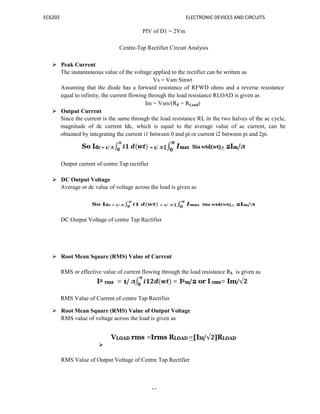
The instantaneous value of the voltage applied to the rectifier can be written as
Vs = Vsm Sinwt
Assuming that the diode has a forward resistance of RFWD ohms and a reverse resistance
equal to infinity, the current flowing through the load resistance RLOAD is given as
Im = Vsm/(RF + RLoad)
 Output Current
Since the current is the same through the load resistance RL in the two halves of the ac cycle,
magnitude of dc current Idc, which is equal to the average value of ac current, can be
obtained by integrating the current i1 between 0 and pi or current i2 between pi and 2pi.
Output current of centre Tap rectifier
 DC Output Voltage
Average or dc value of voltage across the load is given as
DC Output Voltage of centre Tap Rectifier
 Root Mean Square (RMS) Value of Current
RMS or effective value of current flowing through the load resistance RL is given as
RMS Value of Current of centre Tap Rectifier
 Root Mean Square (RMS) Value of Output Voltage
RMS value of voltage across the load is given as

RMS Value of Output Voltage of Centre Tap Rectifier
EC6202 ELECTRONIC DEVICES AND CIRCUITS
12
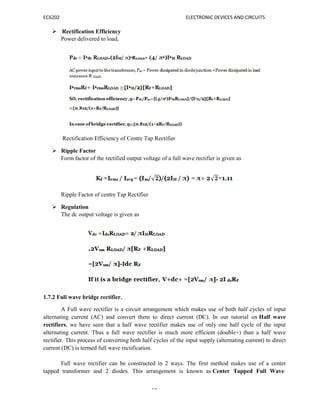
 Rectification Efficiency
Power delivered to load,
Rectification Efficiency of Centre Tap Rectifier
 Ripple Factor
Form factor of the rectified output voltage of a full wave rectifier is given as
Ripple Factor of centre Tap Rectifier
 Regulation
The dc output voltage is given as
1.7.2 Full wave bridge rectifier.
A Full wave rectifier is a circuit arrangement which makes use of both half cycles of input
alternating current (AC) and convert them to direct current (DC). In our tutorial on Half wave
rectifiers, we have seen that a half wave rectifier makes use of only one half cycle of the input
alternating current. Thus a full wave rectifier is much more efficient (double+) than a half wave
rectifier. This process of converting both half cycles of the input supply (alternating current) to direct
current (DC) is termed full wave rectification.
Full wave rectifier can be constructed in 2 ways. The first method makes use of a center
tapped transformer and 2 diodes. This arrangement is known as Center Tapped Full Wave
EC6202 ELECTRONIC DEVICES AND CIRCUITS
13
Rectifier. The second method uses a normal transformer with 4 diodes arranged as a bridge. This
arrangement is known as a Bridge Rectifier.
Full Wave Rectifier Theory
To understand full wave bridge rectifier theory perfectly, you need to learn half wave rectifier
first. In the tutorial of half wave rectifier we have clearly explained the basic working of a rectifier. In
addition we have also explained the theory behind a pn junction and the characteristics of a pn
junction diode.
Full Wave Rectifier Working & Operation
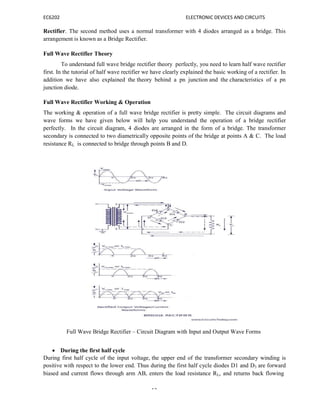
The working & operation of a full wave bridge rectifier is pretty simple. The circuit diagrams and
wave forms we have given below will help you understand the operation of a bridge rectifier
perfectly. In the circuit diagram, 4 diodes are arranged in the form of a bridge. The transformer
secondary is connected to two diametrically opposite points of the bridge at points A & C. The load
resistance RL is connected to bridge through points B and D.
Full Wave Bridge Rectifier – Circuit Diagram with Input and Output Wave Forms
 During the first half cycle
During first half cycle of the input voltage, the upper end of the transformer secondary winding is
positive with respect to the lower end. Thus during the first half cycle diodes D1 and D3 are forward
biased and current flows through arm AB, enters the load resistance RL, and returns back flowing
EC6202 ELECTRONIC DEVICES AND CIRCUITS
14
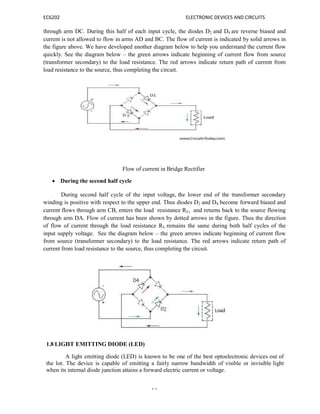
through arm DC. During this half of each input cycle, the diodes D2 and D4 are reverse biased and
current is not allowed to flow in arms AD and BC. The flow of current is indicated by solid arrows in
the figure above. We have developed another diagram below to help you understand the current flow
quickly. See the diagram below – the green arrows indicate beginning of current flow from source
(transformer secondary) to the load resistance. The red arrows indicate return path of current from
load resistance to the source, thus completing the circuit.
Flow of current in Bridge Rectifier
 During the second half cycle
During second half cycle of the input voltage, the lower end of the transformer secondary
winding is positive with respect to the upper end. Thus diodes D2 and D4 become forward biased and
current flows through arm CB, enters the load resistance RL, and returns back to the source flowing
through arm DA. Flow of current has been shown by dotted arrows in the figure. Thus the direction
of flow of current through the load resistance RL remains the same during both half cycles of the
input supply voltage. See the diagram below – the green arrows indicate beginning of current flow
from source (transformer secondary) to the load resistance. The red arrows indicate return path of
current from load resistance to the source, thus completing the circuit.
1.8 LIGHT EMITTING DIODE (LED)
A light emitting diode (LED) is known to be one of the best optoelectronic devices out of
the lot. The device is capable of emitting a fairly narrow bandwidth of visible or invisible light
when its internal diode junction attains a forward electric current or voltage.
EC6202 ELECTRONIC DEVICES AND CIRCUITS
15
The visible lights that an LED emits are usually orange, red, yellow, or green. The invisible
light includes the infrared light. The biggest advantage of this device is its high power to light
conversion efficiency. That is, the efficiency is almost 50 times greater than a simple tungsten
lamp.
The response time of the LED is also known to be very fast in the range of 0.1
microseconds when compared with 100 milliseconds for a tungsten lamp. Due to these advantages,
the device wide applications as visual indicators and as dancing light displays.
We know that a P-N junction can connect the absorbed light energy into its proportional
electric current. The same process is reversed here. That is, the P-N junction emits light when
energy is applied on it. This phenomenon is generally called electro luminance, which can be
defined as the emission of light from a semi-conductor under the influence of an electric field.
The charge carriers recombine in a forward P-N junction as the electrons cross from the N-
region and recombine with the holes existing in the P-region. Free electrons are in the conduction
band of energy levels, while holes are in the valence energy band.
Thus the energy level of the holes will be lesser than the energy levels of the electrons.
Some part of the energy must be dissipated in order to recombine the electrons and the holes.
This energy is emitted in the form of heat and light.
The electrons dissipate energy in the form of heat for silicon and germanium diodes. But in
Gallium- Arsenide-phosphorous (GaAsP) and Gallium-phosphorous (GaP) semiconductors, the
electrons dissipate energy by emitting photons. If the semiconductor is translucent, the junction
becomes the source of light as it is emitted, thus becoming a light emitting diode (LED). But
when the junction is reverse biased no light will be produced by the LED, and, on the contrary
the device may also get damaged.
All the semiconductors listed above can be used. An N-type epitaxial layer is grown
upon a substrate, and the P-region is produced by diffusion. The P-region that includes the
recombination of charge carriers is shown is the top. Thus the P-region becomes the device surface.
In order to allow more surface area for the light to be emitted the metal anode connections
are made at the outer edges of the P-layer.
For the light to be reflected as much as possible towards the surface of the device, a gold
film is applied to the surface bottom. This setting also enables to provide a cathode connection. The
re-absorption problem is fixed by including domed lenses for the device. All the wires in the
electronic circuits of the device is protected by encasing the device.
The light emitted by athe device depends on the type of semiconductor material used.
Infrared light is produced by using Gallium Arsenide (GaAs) as semiconductor. Red or
yellowlight is produced by using Gallium -Arsenide-Phosphorus (GaAsP) as semiconductor.
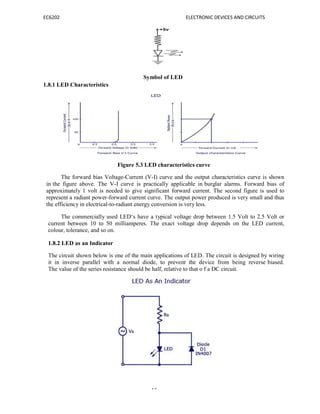
 LED Circuit Symbol
The circuit symbol of LED consists of two arrow marks which indicate the radiation emitted by the
diode.
EC6202 ELECTRONIC DEVICES AND CIRCUITS
16
1.8.1 LED Characteristics
Symbol of LED
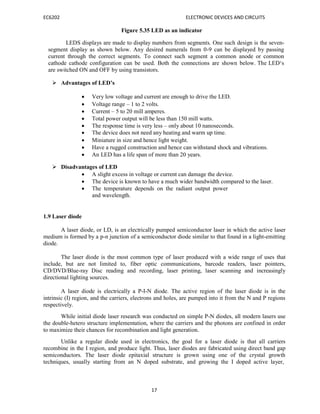
Figure 5.3 LED characteristics curve
The forward bias Voltage-Current (V-I) curve and the output characteristics curve is shown
in the figure above. The V-I curve is practically applicable in burglar alarms. Forward bias of
approximately 1 volt is needed to give significant forward current. The second figure is used to
represent a radiant power-forward current curve. The output power produced is very small and thus
the efficiency in electrical-to-radiant energy conversion is very less.
The commercially used LED‘s have a typical voltage drop between 1.5 Volt to 2.5 Volt or
current between 10 to 50 milliamperes. The exact voltage drop depends on the LED current,
colour, tolerance, and so on.
1.8.2 LED as an Indicator
The circuit shown below is one of the main applications of LED. The circuit is designed by wiring
it in inverse parallel with a normal diode, to prevent the device from being reverse biased.
The value of the series resistance should be half, relative to that o f a DC circuit.
EC6202 ELECTRONIC DEVICES AND CIRCUITS
17
Figure 5.35 LED as an indicator
LEDS displays are made to display numbers from segments. One such design is the seven-
segment display as shown below. Any desired numerals from 0-9 can be displayed by passing
current through the correct segments. To connect such segment a common anode or common
cathode cathode configuration can be used. Both the connections are shown below. The LED‘s
are switched ON and OFF by using transistors.
 Advantages of LED’s
 Very low voltage and current are enough to drive the LED.
 Voltage range – 1 to 2 volts.
 Current – 5 to 20 mill amperes.
 Total power output will be less than 150 mill watts.
 The response time is very less – only about 10 nanoseconds.
 The device does not need any heating and warm up time.
 Miniature in size and hence light weight.
 Have a rugged construction and hence can withstand shock and vibrations.
 An LED has a life span of more than 20 years.
 Disadvantages of LED
 A slight excess in voltage or current can damage the device.
 The device is known to have a much wider bandwidth compared to the laser.
 The temperature depends on the radiant output power
and wavelength.
1.9 Laser diode
A laser diode, or LD, is an electrically pumped semiconductor laser in which the active laser
medium is formed by a p-n junction of a semiconductor diode similar to that found in a light-emitting
diode.
The laser diode is the most common type of laser produced with a wide range of uses that
include, but are not limited to, fiber optic communications, barcode readers, laser pointers,
CD/DVD/Blue-ray Disc reading and recording, laser printing, laser scanning and increasingly
directional lighting sources.
A laser diode is electrically a P-I-N diode. The active region of the laser diode is in the
intrinsic (I) region, and the carriers, electrons and holes, are pumped into it from the N and P regions
respectively.
While initial diode laser research was conducted on simple P-N diodes, all modern lasers use
the double-hetero structure implementation, where the carriers and the photons are confined in order
to maximize their chances for recombination and light generation.
Unlike a regular diode used in electronics, the goal for a laser diode is that all carriers
recombine in the I region, and produce light. Thus, laser diodes are fabricated using direct band gap
semiconductors. The laser diode epitaxial structure is grown using one of the crystal growth
techniques, usually starting from an N doped substrate, and growing the I doped active layer,
EC6202 ELECTRONIC DEVICES AND CIRCUITS
18
followed by the P doped cladding, and a contact layer. The active layer most often consists of
quantum wells,
1.9.1Laser diode L/I characteristic
One of the most commonly used and important laser diode specifications or characteristics is
the L/I curve. It plots the drive current supplied against the light output.
This laser diode specification is used to determine the current required to obtain a particular
level of light output at a given current. It can also be seen that the light output is also very dependent
upon the temperature.
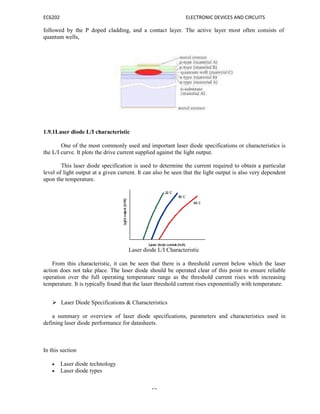
Laser diode L/I Characteristic
From this characteristic, it can be seen that there is a threshold current below which the laser
action does not take place. The laser diode should be operated clear of this point to ensure reliable
operation over the full operating temperature range as the threshold current rises with increasing
temperature. It is typically found that the laser threshold current rises exponentially with temperature.
 Laser Diode Specifications & Characteristics
a summary or overview of laser diode specifications, parameters and characteristics used in
defining laser diode performance for datasheets.
In this section
 Laser diode technology
 Laser diode types
EC6202 ELECTRONIC DEVICES AND CIRCUITS
19
 Structure & materials
 Theory & operation
 Specs & characteristics
 Lifetime, failure & reliability
 Other diodes
When using a laser diode it is essential to know its performance characteristics. Accordingly laser
diode specifications are required when designing equipment using laser diodes or for maintenance
using near equivalents.
Like any electronics components, many of the specifications are relatively generic, but other
parameters will tend to be more focussed on the particular component. This is true for laser diode
specifications and characteristics.
There are a number of laser diode specifications, or laser diode characteristics that are key to the
overall performance and these are outlined.
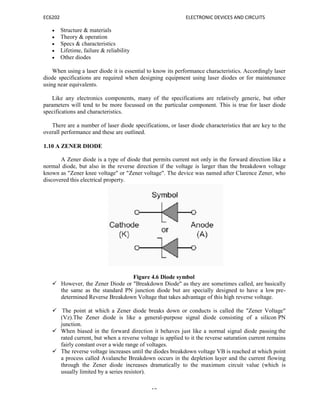
1.10 A ZENER DIODE
A Zener diode is a type of diode that permits current not only in the forward direction like a
normal diode, but also in the reverse direction if the voltage is larger than the breakdown voltage
known as "Zener knee voltage" or "Zener voltage". The device was named after Clarence Zener, who
discovered this electrical property.
Figure 4.6 Diode symbol
 However, the Zener Diode or "Breakdown Diode" as they are sometimes called, are basically
the same as the standard PN junction diode but are specially designed to have a low pre-
determined Reverse Breakdown Voltage that takes advantage of this high reverse voltage.
 The point at which a Zener diode breaks down or conducts is called the "Zener Voltage"
(Vz).The Zener diode is like a general-purpose signal diode consisting of a silicon PN
junction.
 When biased in the forward direction it behaves just like a normal signal diode passing the
rated current, but when a reverse voltage is applied to it the reverse saturation current remains
fairly constant over a wide range of voltages.
 The reverse voltage increases until the diodes breakdown voltage VB is reached at which point
a process called Avalanche Breakdown occurs in the depletion layer and the current flowing
through the Zener diode increases dramatically to the maximum circuit value (which is
usually limited by a series resistor).
EC6202 ELECTRONIC DEVICES AND CIRCUITS
 This breakdown voltage point is called the "Zener voltage" for Zener diodes.
 Avalanche Breakdown: There is a limit for the reverse voltage. Reverse voltage can increase
until the diode breakdown voltage reaches. This point is called Avalanche Break down region.
At this stage maximum current will flow through the Zener diode. This breakdown point is
referred as ―Zener voltage‖.
The point at which current flows can be very accurately controlled (to less than 1%tolerance) in
the doping stage of the diodes construction giving the diode a specific Zener breakdown voltage, (Vz)
ranging from a few volts up to a few hundred volts. This Zener breakdown voltage on the I-V curve is
almost a vertical straight line.
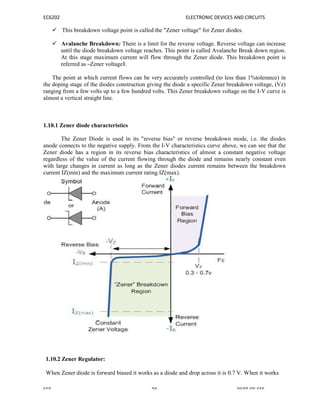
1.10.1 Zener diode characteristics
The Zener Diode is used in its "reverse bias" or reverse breakdown mode, i.e. the diodes
anode connects to the negative supply. From the I-V characteristics curve above, we can see that the
Zener diode has a region in its reverse bias characteristics of almost a constant negative voltage
regardless of the value of the current flowing through the diode and remains nearly constant even
with large changes in current as long as the Zener diodes current remains between the breakdown
current IZ(min) and the maximum current rating IZ(max).
1.10.2 Zener Regulator:
When Zener diode is forward biased it works as a diode and drop across it is 0.7 V. When it works
SCE 20 DEPT OF EEE
EC6202 ELECTRONIC DEVICES AND CIRCUITS
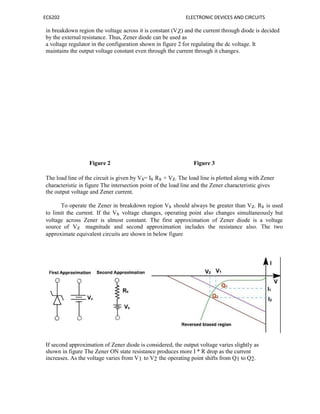
in breakdown region the voltage across it is constant (VZ) and the current through diode is decided
by the external resistance. Thus, Zener diode can be used as
a voltage regulator in the configuration shown in figure 2 for regulating the dc voltage. It
maintains the output voltage constant even through the current through it changes.
Figure 2 Figure 3
The load line of the circuit is given by Vs= Is Rs + Vz. The load line is plotted along with Zener
characteristic in figure The intersection point of the load line and the Zener characteristic gives
the output voltage and Zener current.
To operate the Zener in breakdown region Vs should always be greater than Vz. Rs is used
to limit the current. If the Vs voltage changes, operating point also changes simultaneously but
voltage across Zener is almost constant. The first approximation of Zener diode is a voltage
source of Vz magnitude and second approximation includes the resistance also. The two
approximate equivalent circuits are shown in below figure
If second approximation of Zener diode is considered, the output voltage varies slightly as
shown in figure The Zener ON state resistance produces more I * R drop as the current
increases. As the voltage varies from V1 to V2 the operating point shifts from Q1 to Q2.
EC6202 ELECTRONIC DEVICES AND CIRCUITS
The voltage at Q1 is
V1 = I1 RZ +VZ
and at Q2
V2 = I2 RZ +VZ
Thus, change in voltage is V2 – V1 = ( I2 – I1 ) RZ
Review Questions
PART-B
1. With a neat diagram explain the working of a PN junction diode in forward bias and
reverse bias and show the effect of temperature on its V-I characteristics. (16)
2. Explain V-I characteristics of Zener diode. (8)
3. Draw the circuit diagram and explain the working of full wave bridge rectifier and derive the
expression for average output current and rectification efficiency. (8)
4. Explain the operation of FWR with centre tap transformer. Also derive the following for this
transformer dc output voltage (4) dc output current (2) (iv) RMS output voltage. (4)
5. Explain the following regulator circuits : (i) Transistorized shunt regulator. (8) (ii) Zener diode
shunt regulator. (8)
6. Draw the circuit diagram and explain the operation of full wave rectifier using center tap
transformer and using bridge rectifier without center tap transformer. Obtain the
expression for peak inverse voltage. (16)
7. With neat diagram explain the construction and working of LED. (8)
EC6202
2.1 INTRODUCTION
The transistor is the main
device and it comes in two gen
Effect Transistor (FET).
It is named as transistor whi
that the internal resistance of transi
biasing voltage applied to
TRANSISTOR.
A bipolar transistor (BJT)
depends on the interaction of both
The voltage between two
called current controlled device. This
It can be used as amplifier and lo
Collector : C
Base : B
Emitter : E
 TYPES
There are two types of bipo
NPN transistor and
PNP transistor.
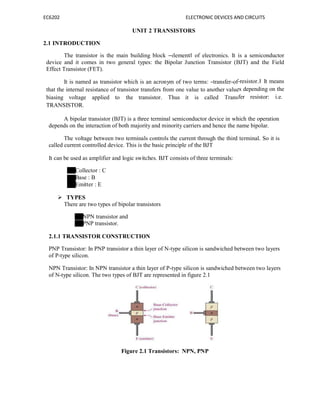
2.1.1 TRANSISTOR CONSTR
PNP Transistor: In PNP transistor a
of P-type silicon.
NPN Transistor: In NPN transistor a
of N-type silicon. The two types of
Fig
ELECTRONIC DEVICES AN
UNIT 2 TRANSISTORS
in building block ―element‖ of electronics. It is
neral types: the Bipolar Junction Transistor (B
tor which is an acronym of two terms: ―transfer-of-
nsistor transfers from one value to another value
the transistor. Thus it is called Transfe
is a three terminal semiconductor device in whi
both majority and minority carriers and hence the n
terminals controls the current through the third
. This is the basic principle of the BJT
ogic switches. BJT consists of three terminals:
polar transistors
nd
RUCTION
tor a thin layer of N-type silicon is sandwiched be
tor a thin layer of P-type silicon is sandwiched be
s of BJT are represented in figure 2.1
igure 2.1 Transistors: NPN, PNP
ND CIRCUITS
is a semiconductor
BJT) and the Field
f-resistor.‖ It means
es depending on the
fer resistor: i.e.
which the operation
the name bipolar.
terminal. So it is
etween two layers
etween two layers
EC6202 ELECTRONIC DEVICES AND CIRCUITS
The symbolic representation of the two types of the BJT is shown in figure 2.2
Area:[C>E>B]
Figure 2.2 circuit symbol: NPN transistor ,PNP transistor
The area of collector layer is largest. So it can dissipate heat quickly.
Area of base layer is smallest and it is very thin layer.
Area of emitter layer is medium.
Doping level:[E>C>B]
Collector layer is moderately doped. So it has medium number of charges.
Base layer is lightly doped. So it has a very few number of charges.
Emitter layer is heavily doped. So it has largest number of charges.
Junctions:
There are two junctions in this transistor – junction J-1 and junction J-2.
The junction between
or C-B junction.
collector layer and base layer is called as collector-base junction
The junction between base layer and emitter layer is called as base-emitter junction
or B-E junction. The two junctions have almost same potential barrier voltage of 0.6V to
0.7V, just like in a diode.
Equivalent diode representation:
The transistor formed by back to back connection of two diodes
Figure 2.3 The equivalent diode representation for the NPN and PNP transistors
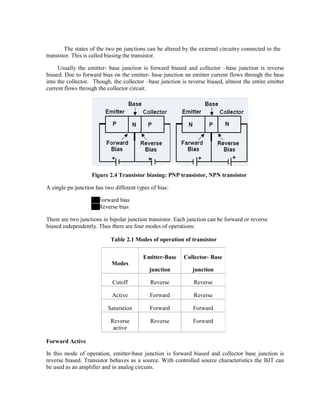
The states of the two pn junctions can be altered by the external circuitry connected to the
transistor. This is called biasing the transistor.
Usually the emitter- base junction is forward biased and collector –base junction is reverse
biased. Due to forward bias on the emitter- base junction an emitter current flows through the base
into the collector. Though, the collector –base junction is reverse biased, almost the entire emitter
current flows through the collector circuit.
Figure 2.4 Transistor biasing: PNP transistor, NPN transistor
A single pn junction has two different types of bias:
Forward bias
Reverse bias
There are two junctions in bipolar junction transistor. Each junction can be forward or reverse
biased independently. Thus there are four modes of operations:
Table 2.1 Modes of operation of transistor
Modes
Emitter-Base
junction
Collector- Base
junction
Cutoff Reverse Reverse
Active Forward Reverse
Saturation Forward Forward
Reverse
active
Reverse Forward
Forward Active
In this mode of operation, emitter-base junction is forward biased and collector base junction is
reverse biased. Transistor behaves as a source. With controlled source characteristics the BJT can
be used as an amplifier and in analog circuits.
EC6202 ELECTRONIC DEVICES AND CIRCUITS
Cut off
When both junctions are reverse biased it is called cut off mode. In this situation there is nearly
zero current and transistor behaves as an open switch.
Saturation
In saturation mode both junctions are forward biased large collector current flows with a small
voltage across collector base junction. Transistor behaves as an closed switch.
Reverse Active
It is opposite to forward active mode because in this emitter base junction is reverse biased and
collector base junction is forward biased. It is called inverted mode. It is no suitable for
amplification. However the reverse active mode has application in digital circuits and certain
analog switching circuits.
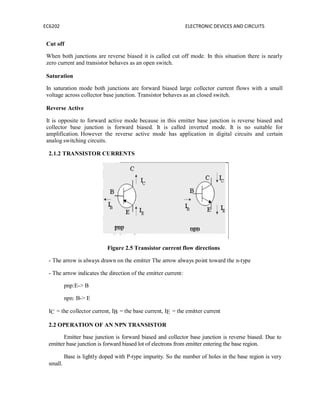
2.1.2 TRANSISTOR CURRENTS
Figure 2.5 Transistor current flow directions
- The arrow is always drawn on the emitter The arrow always point toward the n-type
- The arrow indicates the direction of the emitter current:
pnp:E-> B
npn: B-> E
IC = the collector current, IB = the base current, IE = the emitter current
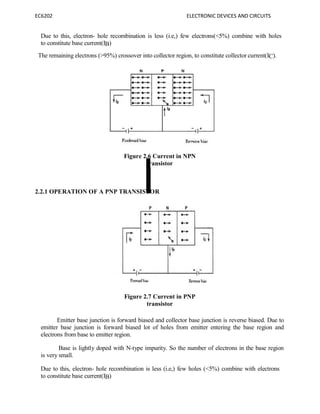
2.2 OPERATION OF AN NPN TRANSISTOR
Emitter base junction is forward biased and collector base junction is reverse biased. Due to
emitter base junction is forward biased lot of electrons from emitter entering the base region.
small.
Base is lightly doped with P-type impurity. So the number of holes in the base region is very
EC6202 ELECTRONIC DEVICES AND CIRCUITS
Due to this, electron- hole recombination is less (i.e,) few electrons(<5%) combine with holes
to constitute base current(IB)
The remaining electrons (>95%) crossover into collector region, to constitute collector current(IC).
Figure 2.6 Current in NPN
transistor
2.2.1 OPERATION OF A PNP TRANSISTOR
Figure 2.7 Current in PNP
transistor
Emitter base junction is forward biased and collector base junction is reverse biased. Due to
emitter base junction is forward biased lot of holes from emitter entering the base region and
electrons from base to emitter region.
Base is lightly doped with N-type impurity. So the number of electrons in the base region
is very small.
Due to this, electron- hole recombination is less (i.e,) few holes (<5%) combine with electrons
to constitute base current(IB)
EC6202 ELECTRONIC DEVICES AND CIRCUITS
2.3 CONFIGURATION OF TRANSISTOR CIRCUIT
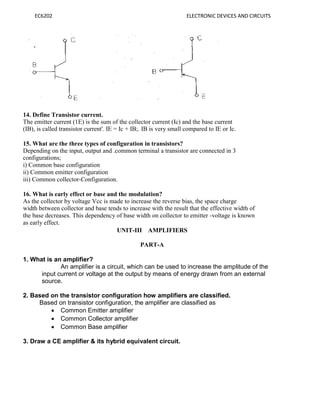
A transistor is a three terminal device. But require ‗4‘ terminals for connecting it in a
circuits.
(i.e.) 2 terminals for input, 2 terminals for output.
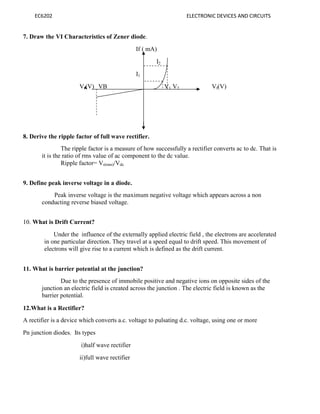
Hence one of the terminal is made common to the input and output circuits.
Common terminal is grounded.
 TYPES OF CONFIGURATIONS
Three types of configuration is available
1) Common base(CB) configuration
2) Common emitter (CE) configuration
3) Common collector (CC) configuration
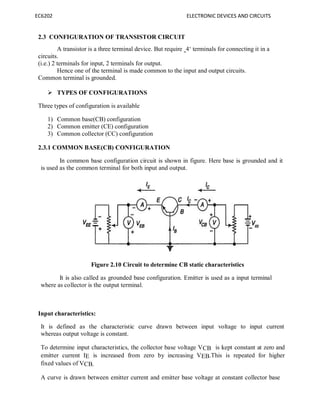
2.3.1 COMMON BASE(CB) CONFIGURATION
In common base configuration circuit is shown in figure. Here base is grounded and it
is used as the common terminal for both input and output.
Figure 2.10 Circuit to determine CB static characteristics
It is also called as grounded base configuration. Emitter is used as a input terminal
where as collector is the output terminal.
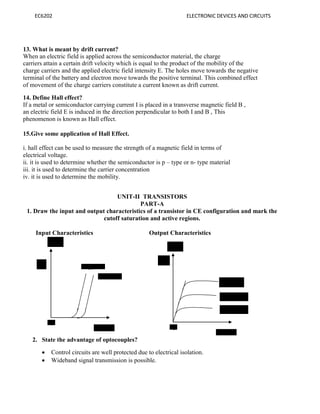
Input characteristics:
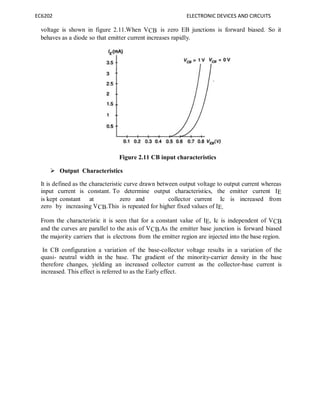
It is defined as the characteristic curve drawn between input voltage to input current
whereas output voltage is constant.
To determine input characteristics, the collector base voltage VCB is kept constant at zero and
emitter current IE is increased from zero by increasing VEB.This is repeated for higher
fixed values of VCB.
A curve is drawn between emitter current and emitter base voltage at constant collector base
EC6202 ELECTRONIC DEVICES AND CIRCUITS
voltage is shown in figure 2.11.When VCB is zero EB junctions is forward biased. So it
behaves as a diode so that emitter current increases rapidly.
Figure 2.11 CB input characteristics
 Output Characteristics
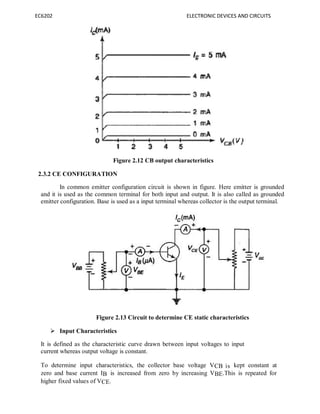
It is defined as the characteristic curve drawn between output voltage to output current whereas
input current is constant. To determine output characteristics, the emitter current IE
is kept constant at zero and collector current Ic is increased from
zero by increasing VCB.This is repeated for higher fixed values of IE.
From the characteristic it is seen that for a constant value of IE, Ic is independent of VCB
and the curves are parallel to the axis of VCB.As the emitter base junction is forward biased
the majority carriers that is electrons from the emitter region are injected into the base region.
In CB configuration a variation of the base-collector voltage results in a variation of the
quasi- neutral width in the base. The gradient of the minority-carrier density in the base
therefore changes, yielding an increased collector current as the collector-base current is
increased. This effect is referred to as the Early effect.
EC6202 ELECTRONIC DEVICES AND CIRCUITS
Figure 2.12 CB output characteristics
2.3.2 CE CONFIGURATION
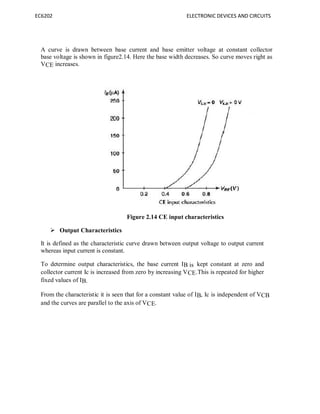
In common emitter configuration circuit is shown in figure. Here emitter is grounded
and it is used as the common terminal for both input and output. It is also called as grounded
emitter configuration. Base is used as a input terminal whereas collector is the output terminal.
Figure 2.13 Circuit to determine CE static characteristics
 Input Characteristics
It is defined as the characteristic curve drawn between input voltages to input
current whereas output voltage is constant.
To determine input characteristics, the collector base voltage VCB is kept constant at
zero and base current IB is increased from zero by increasing VBE.This is repeated for
higher fixed values of VCE.
EC6202 ELECTRONIC DEVICES AND CIRCUITS
A curve is drawn between base current and base emitter voltage at constant collector
base voltage is shown in figure2.14. Here the base width decreases. So curve moves right as
VCE increases.
Figure 2.14 CE input characteristics
 Output Characteristics
It is defined as the characteristic curve drawn between output voltage to output current
whereas input current is constant.
To determine output characteristics, the base current IB is kept constant at zero and
collector current Ic is increased from zero by increasing VCE.This is repeated for higher
fixed values of IB.
From the characteristic it is seen that for a constant value of IB, Ic is independent of VCB
and the curves are parallel to the axis of VCE.
EC6202 ELECTRONIC DEVICES AND CIRCUITS
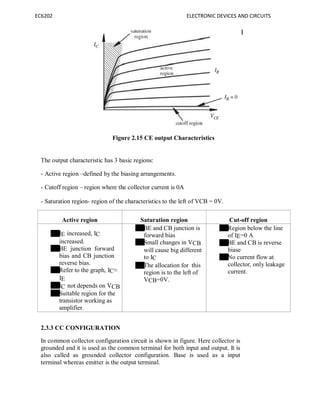
Figure 2.15 CE output Characteristics
The output characteristic has 3 basic regions:
- Active region –defined by the biasing arrangements.
- Cutoff region – region where the collector current is 0A
- Saturation region- region of the characteristics to the left of VCB = 0V.
Active region Saturation region Cut-off region
IE increased, IC
increased.
BE junction forward
bias and CB junction
reverse bias.
Refer to the graph, IC≈
IE
IC not depends on VCB
Suitable region for the
transistor working as
amplifier.
BE and CB junction is
forward bias
Small changes in VCB
will cause big different
to IC
The allocation for this
region is to the left of
VCB=0V.
Region below the line
of IE=0 A
BE and CB is reverse
biase
No current flow at
collector, only leakage
current.
2.3.3 CC CONFIGURATION
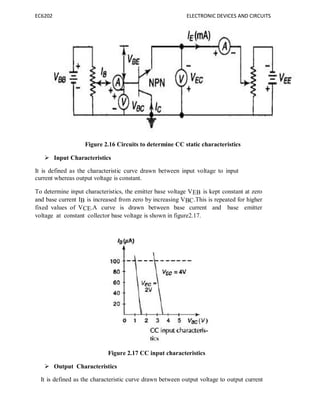
In common collector configuration circuit is shown in figure. Here collector is
grounded and it is used as the common terminal for both input and output. It is
also called as grounded collector configuration. Base is used as a input
terminal whereas emitter is the output terminal.
EC6202 ELECTRONIC DEVICES AND CIRCUITS
Figure 2.16 Circuits to determine CC static characteristics
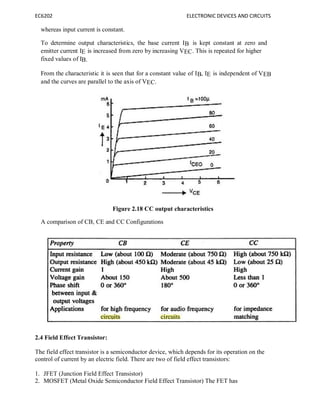
 Input Characteristics
It is defined as the characteristic curve drawn between input voltage to input
current whereas output voltage is constant.
To determine input characteristics, the emitter base voltage VEB is kept constant at zero
and base current IB is increased from zero by increasing VBC.This is repeated for higher
fixed values of VCE.A curve is drawn between base current and base emitter
voltage at constant collector base voltage is shown in figure2.17.
Figure 2.17 CC input characteristics
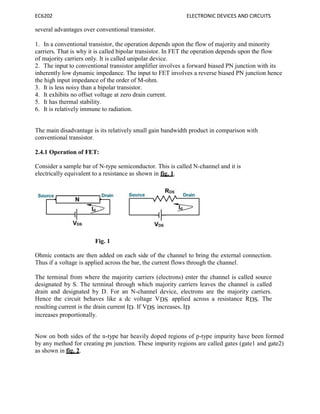
 Output Characteristics
It is defined as the characteristic curve drawn between output voltage to output current
EC6202 ELECTRONIC DEVICES AND CIRCUITS
whereas input current is constant.
To determine output characteristics, the base current IB is kept constant at zero and
emitter current IE is increased from zero by increasing VEC. This is repeated for higher
fixed values of IB.
From the characteristic it is seen that for a constant value of IB, IE is independent of VEB
and the curves are parallel to the axis of VEC.
Figure 2.18 CC output characteristics
A comparison of CB, CE and CC Configurations
2.4 Field Effect Transistor:
The field effect transistor is a semiconductor device, which depends for its operation on the
control of current by an electric field. There are two of field effect transistors:
1. JFET (Junction Field Effect Transistor)
2. MOSFET (Metal Oxide Semiconductor Field Effect Transistor) The FET has
EC6202 ELECTRONIC DEVICES AND CIRCUITS
several advantages over conventional transistor.
1. In a conventional transistor, the operation depends upon the flow of majority and minority
carriers. That is why it is called bipolar transistor. In FET the operation depends upon the flow
of majority carriers only. It is called unipolar device.
2. The input to conventional transistor amplifier involves a forward biased PN junction with its
inherently low dynamic impedance. The input to FET involves a reverse biased PN junction hence
the high input impedance of the order of M-ohm.
3. It is less noisy than a bipolar transistor.
4. It exhibits no offset voltage at zero drain current.
5. It has thermal stability.
6. It is relatively immune to radiation.
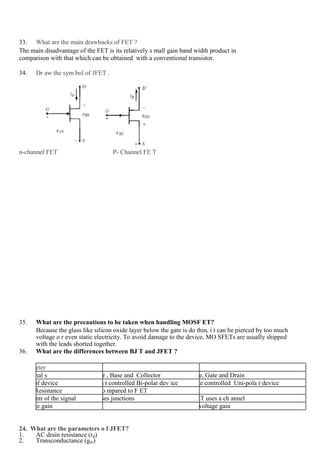
The main disadvantage is its relatively small gain bandwidth product in comparison with
conventional transistor.
2.4.1 Operation of FET:
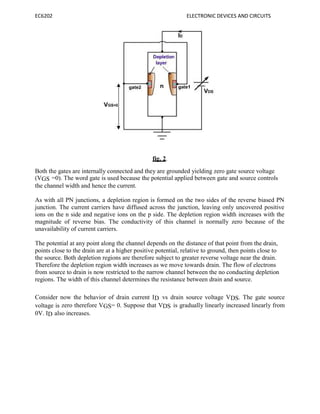
Consider a sample bar of N-type semiconductor. This is called N-channel and it is
electrically equivalent to a resistance as shown in fig. 1.
Fig. 1
Ohmic contacts are then added on each side of the channel to bring the external connection.
Thus if a voltage is applied across the bar, the current flows through the channel.
The terminal from where the majority carriers (electrons) enter the channel is called source
designated by S. The terminal through which majority carriers leaves the channel is called
drain and designated by D. For an N-channel device, electrons are the majority carriers.
Hence the circuit behaves like a dc voltage VDS applied across a resistance RDS. The
resulting current is the drain current ID. If VDS increases, ID
increases proportionally.
Now on both sides of the n-type bar heavily doped regions of p-type impurity have been formed
by any method for creating pn junction. These impurity regions are called gates (gate1 and gate2)
as shown in fig. 2.
EC6202 ELECTRONIC DEVICES AND CIRCUITS
fig. 2.
Both the gates are internally connected and they are grounded yielding zero gate source voltage
(VGS =0). The word gate is used because the potential applied between gate and source controls
the channel width and hence the current.
As with all PN junctions, a depletion region is formed on the two sides of the reverse biased PN
junction. The current carriers have diffused across the junction, leaving only uncovered positive
ions on the n side and negative ions on the p side. The depletion region width increases with the
magnitude of reverse bias. The conductivity of this channel is normally zero because of the
unavailability of current carriers.
The potential at any point along the channel depends on the distance of that point from the drain,
points close to the drain are at a higher positive potential, relative to ground, then points close to
the source. Both depletion regions are therefore subject to greater reverse voltage near the drain.
Therefore the depletion region width increases as we move towards drain. The flow of electrons
from source to drain is now restricted to the narrow channel between the no conducting depletion
regions. The width of this channel determines the resistance between drain and source.
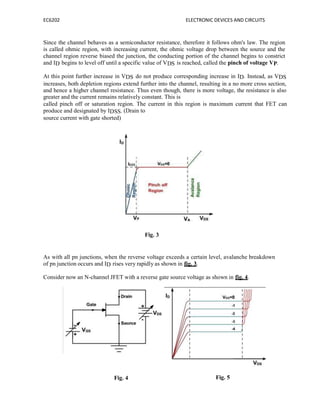
Consider now the behavior of drain current ID vs drain source voltage VDS. The gate source
voltage is zero therefore VGS= 0. Suppose that VDS is gradually linearly increased linearly from
0V. ID also increases.
EC6202 ELECTRONIC DEVICES AND CIRCUITS
Since the channel behaves as a semiconductor resistance, therefore it follows ohm's law. The region
is called ohmic region, with increasing current, the ohmic voltage drop between the source and the
channel region reverse biased the junction, the conducting portion of the channel begins to constrict
and ID begins to level off until a specific value of VDS is reached, called the pinch of voltage VP.
At this point further increase in VDS do not produce corresponding increase in ID. Instead, as VDS
increases, both depletion regions extend further into the channel, resulting in a no more cross section,
and hence a higher channel resistance. Thus even though, there is more voltage, the resistance is also
greater and the current remains relatively constant. This is
called pinch off or saturation region. The current in this region is maximum current that FET can
produce and designated by IDSS. (Drain to
source current with gate shorted)
Fig. 3
As with all pn junctions, when the reverse voltage exceeds a certain level, avalanche breakdown
of pn junction occurs and ID rises very rapidly as shown in fig. 3.
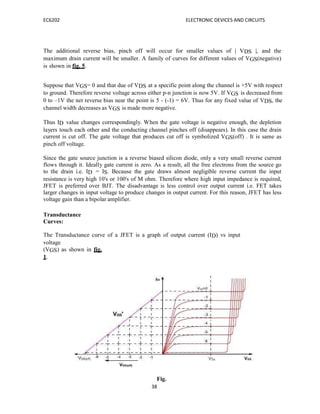
Consider now an N-channel JFET with a reverse gate source voltage as shown in fig. 4.
Fig. 4 Fig. 5
EC6202 ELECTRONIC DEVICES AND CIRCUITS
38
The additional reverse bias, pinch off will occur for smaller values of | VDS |, and the
maximum drain current will be smaller. A family of curves for different values of VGS(negative)
is shown in fig. 5.
Suppose that VGS= 0 and that due of VDS at a specific point along the channel is +5V with respect
to ground. Therefore reverse voltage across either p-n junction is now 5V. If VGS is decreased from
0 to –1V the net reverse bias near the point is 5 - (-1) = 6V. Thus for any fixed value of VDS, the
channel width decreases as VGS is made more negative.
Thus ID value changes correspondingly. When the gate voltage is negative enough, the depletion
layers touch each other and the conducting channel pinches off (disappears). In this case the drain
current is cut off. The gate voltage that produces cut off is symbolized VGS(off) . It is same as
pinch off voltage.
Since the gate source junction is a reverse biased silicon diode, only a very small reverse current
flows through it. Ideally gate current is zero. As a result, all the free electrons from the source go
to the drain i.e. ID = IS. Because the gate draws almost negligible reverse current the input
resistance is very high 10's or 100's of M ohm. Therefore where high input impedance is required,
JFET is preferred over BJT. The disadvantage is less control over output current i.e. FET takes
larger changes in input voltage to produce changes in output current. For this reason, JFET has less
voltage gain than a bipolar amplifier.
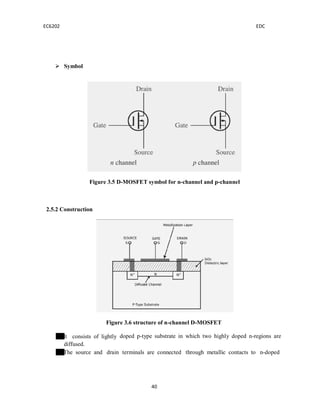
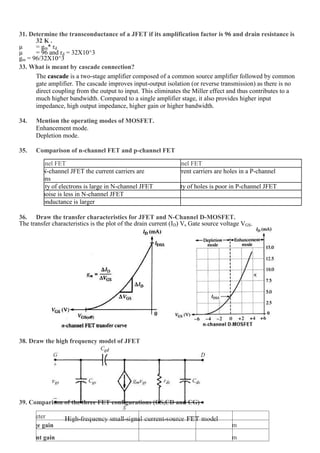
Transductance
Curves:
The Transductance curve of a JFET is a graph of output current (ID) vs input
voltage
(VGS) as shown in fig.
1.
Fig.
EC6202 ELECTRONIC DEVICES AND CIRCUITS
39
1
By reading the value of ID and VGS for a particular value of VDS, the transconductance curve
can be
plotted. The transconductance curve is a part of parabola. It has an equation of
Data sheet provides only IDSS and VGS(off) value. Using these values the transconductance curve
can be plotted.
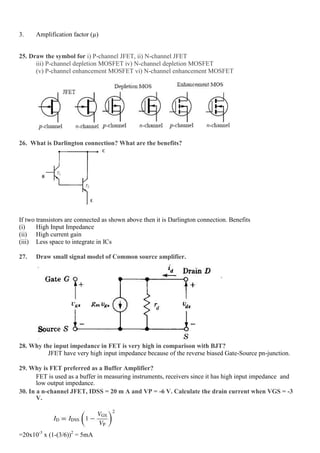
2.5 MOSFET (Metal Oxide Semiconductor Field Effect Transistor)
Like JFET, it has a source, Drain and Gate.
It is also called IGFET (Insulated Gate FET) because gate terminal is insulated from
channel. Therefore it has extremely high input resistance.
 Types of MOSFET
It has two types
Depletion mode MOSFET
N-channel
P-channel
Enhancement mode MOSFET
N-channel
P-channel
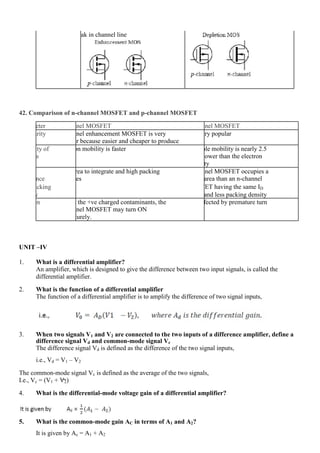
The enhancement-type MOSFET is usually referred to as an E-MOSFET, and the depletion
type, a D-MOSFET. The drain current in a MOSFET is controlled by the gate-source voltage VGS.
2.5.1 Depletion mode-MOSFET [D-MOSFET]
In depletion mode of operation the bias voltage on the gate reduce the number of charge
carriers in the channel and therefore reduce the drain current ID.It operates in both
depletion
mode and enhancement mode.
EC6202
 Symbol
Figure 3.5 D-M
2.5.2 Construction
Figure 3.6
It consists of lightly
diffused.
dop
The source and drain te
40
MOSFET symbol for n-channel and p-channel
3.6 structure of n-channel D-MOSFET
oped p-type substrate in which two highly dop
erminals are connected through metallic cont
EDC
l
oped n-regions are
tacts to n-doped
41
EC6202 ELECTRONIC DEVICES AND CIRCUITS
regions linked by an n-channel. The gate is also connected to a metal contact surface but
remains insulated from the n-channel by a very thin silicon dioxide (SiO2) layer. SiO2 is
a particular type of insulator referred to as a dielectric that sets up opposing (as revealed
by the prefix di-) electric fields within the dielectric when exposed to an externally
applied field.
Then the thin layer of metal aluminium is formed over the Sio2 layer. This metal overs the
entire channel region and it forms the gate(G).
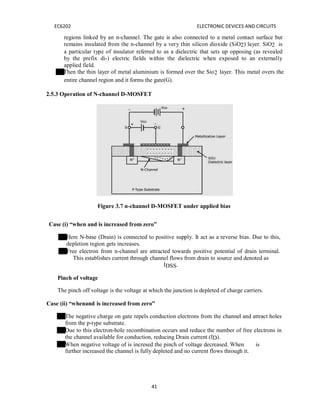
2.5.3 Operation of N-channel D-MOSFET
Figure 3.7 n-channel D-MOSFET under applied bias
Case (i) “when and is increased from zero”
Here N-base (Drain) is connected to positive supply. It act as a reverse bias. Due to this,
depletion region gets increases.
Free electron from n-channel are attracted towards positive potential of drain terminal.
This establishes current through channel flows from drain to source and denoted as
IDSS.
Pinch of voltage
The pinch off voltage is the voltage at which the junction is depleted of charge carriers.
Case (ii) “whenand is increased from zero”
The negative charge on gate repels conduction electrons from the channel and attract holes
from the p-type substrate.
Due to this electron-hole recombination occurs and reduce the number of free electrons in
the channel available for conduction, reducing Drain current (ID).
When negative voltage of is incresed the pinch of voltage decreased. When is
further increased the channel is fully depleted and no current flows through it.
42
EC6202 ELECTRONIC DEVICES AND CIRCUITS
The negative voltage depletion MOSFET.
 Characteristics curve
Two types
Drain characteristics [ ]
Transfer characteristics [ ]
D-MOSFET‘s are biased to operate in two modes :depletion or enhancement mode.
Figure 3.8 Drain and transfer characteristics
2.5.4 ENHANCEMENT- MODE MOSFET [E-MOSFET]
o In this mode bias on the gate increases the number of charge carriers in the
channel and increases the drain current (ID).
o It operates only in the enhancement mode and has no depletion mode of
operation. It has no physical channel.
43
EC6202 ELECTRONIC DEVICES AND CIRCUITS
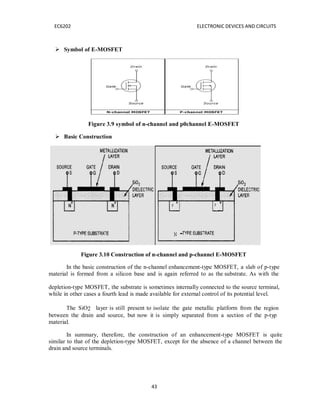
 Symbol of E-MOSFET
Figure 3.9 symbol of n-channel and p0channel E-MOSFET
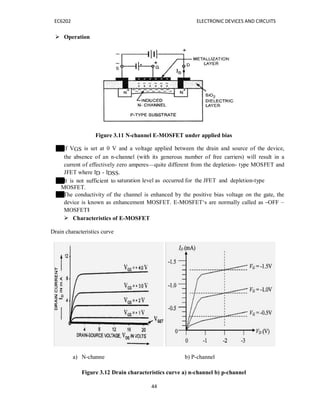
 Basic Construction
Figure 3.10 Construction of n-channel and p-channel E-MOSFET
In the basic construction of the n-channel enhancement-type MOSFET, a slab of p-type
material is formed from a silicon base and is again referred to as the substrate. As with the
depletion-type MOSFET, the substrate is sometimes internally connected to the source terminal,
while in other cases a fourth lead is made available for external control of its potential level.
The SiO2 layer is still present to isolate the gate metallic platform from the region
between the drain and source, but now it is simply separated from a
material.
section of the p-typ
In summary, therefore, the construction of an enhancement-type MOSFET is quite
similar to that of the depletion-type MOSFET, except for the absence of a channel between the
drain and source terminals.
44
EC6202 ELECTRONIC DEVICES AND CIRCUITS
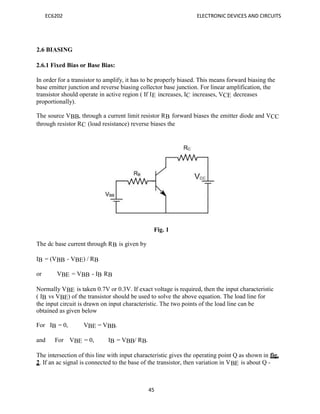
 Operation
Figure 3.11 N-channel E-MOSFET under applied bias
If VGS is set at 0 V and a voltage applied between the drain and source of the device,
the absence of an n-channel (with its generous number of free carriers) will result in a
current of effectively zero amperes—quite different from the depletion- type MOSFET and
JFET where ID - IDSS.
It is not sufficient to saturation level as occurred for the JFET and depletion-type
MOSFET.
The conductivity of the channel is enhanced by the positive bias voltage on the gate, the
device is known as enhancement MOSFET. E-MOSFET‘s are normally called as ―OFF –
MOSFET‖
 Characteristics of E-MOSFET
Drain characteristics curve
a) N-channe b) P-channel
Figure 3.12 Drain characteristics curve a) n-channel b) p-channel
EC6202 ELECTRONIC DEVICES AND CIRCUITS
45
2.6 BIASING
2.6.1 Fixed Bias or Base Bias:
In order for a transistor to amplify, it has to be properly biased. This means forward biasing the
base emitter junction and reverse biasing collector base junction. For linear amplification, the
transistor should operate in active region ( If IE increases, IC increases, VCE decreases
proportionally).
The source VBB, through a current limit resistor RB forward biases the emitter diode and VCC
through resistor RC (load resistance) reverse biases the
Fig. 1
The dc base current through RB is given by
IB = (VBB - VBE) / RB
or VBE = VBB - IB RB
Normally VBE is taken 0.7V or 0.3V. If exact voltage is required, then the input characteristic
( IB vs VBE) of the transistor should be used to solve the above equation. The load line for
the input circuit is drawn on input characteristic. The two points of the load line can be
obtained as given below
For IB = 0, VBE = VBB.
and For VBE = 0, IB = VBB/ RB.
The intersection of this line with input characteristic gives the operating point Q as shown in fig.
2. If an ac signal is connected to the base of the transistor, then variation in VBE is about Q -
EC6202 ELECTRONIC DEVICES AND CIRCUITS
46
point. This gives variation in IB and hence IC.
In the output circuit, the load equation can be written as
VCE = VCC- IC RC
This equation involves two unknown VCE and IC and therefore can not be solved. To solve
this equation output characteristic ( ICvs VCE) is used.
The load equation is the equation of a straight line and given by two points: IC= 0,
VCE = VCC
& VCE = 0, IC= VCC / RC
The intersection of this line which is also called dc load line and the characteristic gives the
operating point Q as shown in fig. 3.
EC6202 ELECTRONIC DEVICES AND CIRCUITS
47
Fig. 3
The point at which the load line intersects with IB = 0 characteristic is known as cut off point.
At this point base current is zero and collector current is almost negligibly small. At cut off the
emitter diode comes out of forward bias and normal transistor action is lost. To a close
approximation.
VCE ( cut off)VCC (approximately).
The intersection of the load line and IB = IB(max) characteristic is known as saturation point
. At this point IB= IB(max), IC= IC(sat). At this point collector diodes comes out of reverse
bias and again transistor action is lost. To a close approximation,
IC(sat) VCC / RC(approximately ).
The IB(sat) is the minimum current required to operate the transistor in saturation region. If the
IB is less than IB (sat), the transistor will operate in active region. If IB > IB (sat) it always
operates in saturation region.
If the transistor operates at saturation or cut off points and nowhere else then it is
operating as a switch is shown in fig. 4.
EC6202 ELECTRONIC DEVICES AND CIRCUITS
48
Fig. 4
VBB = IB RB+ VBE
IB = (VBB – VBE ) / RB
If IB> IB(sat), then it operates at saturation, If IB = 0, then it operates at cut off.
If a transistor is operating as an amplifier then Q point must be selected carefully. Although we
can select the operating point any where in the active region by choosing different values of RB
& RC but the various transistor ratings such as maximum collector dissipation PC(max)
maximum collector voltage VC(max) and IC(max) & VBE(max) limit the operating range.
Once the Q point is established an ac input is connected. Due to this the ac source the base
current varies. As a result of this collector current and collector voltage also varies and the
amplified output is obtained.
If the Q-point is not selected properly then the output waveform will not be exactly the input
waveform. i.e. It may be clipped from one side or both sides or it may be distorted one.
 Stability of Operating Point
Let us consider three operating points of transistor operating in common emitter
amplifier.
1. Near cut off
2. Near saturation
3. In the middle of active region
If the operating point is selected near the cutoff region, the output is clipped in negative half
cycle as shown in fig. 1.
EC6202 ELECTRONIC DEVICES AND CIRCUITS
49
Fig. 1
If the operating point is selected near saturation region, then the output is clipped in positive
cycle as shown in fig. 2.
Fig. 2 Fig. 3
If the operating point is selected in the middle of active region, then there is no clipping and the
output follows input faithfully as shown in fig. 3. If input is large then clipping at both sides will
take place. The first circuit for biasing the transistor is CE configuration is fixed bias.
In biasing circuit shown in fig. 4(a), two different power supplies are required. To avoid
EC6202 ELECTRONIC DEVICES AND CIRCUITS
50
the use of two supplies the base resistance RB is connected to VCC as shown in fig.
4(b).
Fig. 4(a) Fig. 4(b)
Now VCC is still forward biasing emitter diode. In this circuit Q point is very unstable. The base
resistance RB is selected by noting the required base current IB for operating point Q.
IB = (VCC – VBE ) / RB
Voltage across base emitter junction is approximately 0.7 V. Since VCC is usually very high
i.e. IB = VCC/ RB
Since IB is constant therefore it is called fixed bias circuit.
2.7 UNI JUNCTION TRANSISTOR (UJT)
Unijunction transistor (abbreviated as UJT), also called the double-base diode is a 2-layer,
3-terminal solid-state (silicon) switching device. The device has-a unique characteristic that when
it is triggered, its emitter current increases re generatively (due to negative resistance
characteristic) until it is restricted by emitter power supply. Since the device has one pn junction
and three leads it is commonly called UJT.
EC6202 ELECTRONIC DEVICES AND CIRCUITS
51
Figure 5.1 UJT structure, Equivalent circuit and Symbol
2.7.1 Construction of a UJT
The basic structure of a unijunction transistor is shown in figure. It essentially consists of a
lightly-doped N-type silicon bar with a small piece of heavily doped P-type material alloyed to its
one side to produce single P-N junction. The single P-N junction accounts for the terminology
unijunction. The silicon bar, at its ends, has two ohmic contacts designated as base-1 (B1) and base-
2 (B2), as shown and the P-type region is termed the emitter (E). The emitter junction is usually
located closer to base-2 (B2) than base-1 (B1) so that the device is not symmetrical, because
symmetrical unit does not provide optimum electrical characteristics for most of the applications.
The symbol for unijunction transistor is shown in figure. The emitter leg is drawn at an
angle to the vertical line representing the N-type material slab and the arrowhead points in the
direction of conventional current when the device is forward-biased, active or in the conducting
state. The basic arrangement for the UJT is shown in figure.
A complementary UJT is formed by diffusing an N-type emitter terminal on a P-type base.
Except for the polarities of voltage and current, the characteristics of a complementary UJT are
exactly the same as those of a conventional UJT.
The device has only one junction, so it is called the unijunction device.
The device, because of one P-N junction, is quite similar to a diode but it differs from an
ordinary diode as it has three terminals.
The structure of a UJT is quite similar to that of an N-channel JFET. The main difference is
that P-type (gate) material surrounds the N-type (channel) material in case of JFET and the
gate surface of the JFET is much larger than emitter junction of UJT.
EC6202 ELECTRONIC DEVICES AND CIRCUITS
In a unijunction transistor the emitter is heavily doped while the N-region is lightly doped,
so the resistance between the base terminals is relatively high, typically 4 to 10 kilo Ohm
when the emitter is open.
The N-type silicon bar has a high resistance and the resistance between emitter and base-1
is larger than that between emitter and base-2. It is because emitter is closer to base-2 than
base-1.
UJT is operated with emitter junction forward- biased while the JFET is normally operated
with the gate junction reverse-biased.
UJT does not have ability to amplify but it has the ability to control a large ac power with a
small signal. It exhibits a negative resistance characteristic and so it can be employed as an
oscillator.
Figure 5.2 Equivalent circuit of UJT
2.7.2 UJT parameters
RBBO : It is the resistance between the terminals B1 and B2. In simple words, it is
the resistance of the N-Type bar when measured lengthwise. If RB1 is resistance of the bar from
E to B1 and RB2 is the resistance of the bar from E to B2, then RBBO can be expressed as
RBBO= RB1
+RB2. The typical range of RBBO is from 4KΩ to 10KΩ.
Intrinsic standoff ratio (η) : It is the ratio of RB1 to the sum of RB1 and RB2. It can be
expressed as η = RB1/(RB1+RB2) or η = RB1/RBBO. The typical range of intrinsic standoff ratio
is from 0.4 to 0.8
 Operation of a UJT
Imagine that the emitter supply voltage is turned down to zero. Then the intrinsic stand-off
voltage reverse-biases the emitter diode, as mentioned above. If VB is the barrier voltage of the
emitter diode, then the total reverse bias voltage is VA + VB = η VBB + VB. For silicon VB = 0.7
V.
Now let the emitter supply voltage VE be slowly increased. When VE becomes equal to
η VBB, IEo will be reduced to zero. With equal voltage levels on each side of the diode,
EC6202 ELECTRONIC DEVICES AND CIRCUITS
neither reverse nor forward current will flow.
Figure 5.3 operation UJT under (i) VE=0 (ii) applied VE
When emitter supply voltage is further increased, the diode becomes forward-biased as
soon as it exceeds the total reverse bias voltage (ηVBB + VB). This value of emitter voltage VE
is called the peak-point voltage and is denoted by VP. When VE = VP, emitter current IE starts to
flow through RB1 to ground, that is B1. This is the minimum current that is required to trigger the
UJT. This is called the peak-point emitter current and denoted by IP. Ip is inversely proportional to
the interbase voltage, VBB.
Now when the emitter diode starts conducting, charge carriers are injected into the RB
region of the bar. Since the resistance of a semiconductor material depends upon doping, the
resistance of region RB decreases rapidly due to additional charge carriers (holes). With this
decrease in resistance, the voltage drop across RB also decrease, cause the emitter diode to be more
heavily forward biased. This, in turn, results in larger forward current, and consequently more
charge carriers are injected causing still further reduction in the resistance of the RB region. Thus
the emitter current goes on increasing until it is limited by the emitter power supply. Since VA
decreases with the increase in emitter current, the UJT is said to have negative resistance
characteristic. It is seen that the base-2 (B2) is used only for applying external voltage VBB across
it. Terminals E and B1 are the active terminals. UJT is usually triggered into conduction by
applying a suitable positive pulse to the emitter. It can be turned off by applying a negative trigger
pulse.
 UJT Characteristics
Figure 5.4 static Emitter Characteristics for a UJT
54
EC6202 ELECTRONIC DEVICES AND CIRCUITS
The static emitter characteristic (a curve showing the relation between emitter voltage VE
and emitter current IE) of a UJT at a given inter base voltage VBB is shown in figure. From figure
it is noted that for emitter potentials to the left of peak point, emitter current IE never exceeds
IEo . The current IEo corresponds very closely to the reverse leakage current ICo of the
conventional BJT. This region, as shown in the figure, is called the cut-off region. Once
conduction is established at VE = VP the emitter potential VE starts decreasing with the
increase in emitter current IE. This Corresponds exactly with the decrease in resistance RB for
increasing current IE. This device, therefore, has a negative resistance region which is stable
enough to be used with a great deal of reliability in the areas of applications listed earlier.
Eventually, the valley point reaches, and any further increase in emitter current IE places the
device in the saturation region, as shown in the figure5.4.
Three other important parameters for the UJT are IP, VV and IV and are defined below:
Peak-Point Emitter Current Ip : It is the emitter current at the peak point. It represents the
rnimrnum current that is required to trigger the device (UJT). It is inversely proportional to the
interbase voltage VBB.
Valley Point Voltage VV: The valley point voltage is the emitter voltage at the valley point. The
valley voltage increases with the increase in interbase voltage VBB.
Valley Point Current IV: The valley point current is the emitter current at the valley point. It
increases with the increase in inter-base voltage VBB.
 Special Features of UJT.
The special features of a UJT are :
1. A stable triggering voltage (VP)— a fixed fraction of applied inter base voltage VBB.
2. A very low value of triggering current.
3. A high pulse current capability.
4. A negative resistance characteristic.
5. Low cost.
2.7.3 Applications of UJT.
 Relaxation oscillators.
 Switching Thyristors like SCR, TRIAC etc.
 Magnetic flux sensors.
 Voltage or current limiting circuit.
 Bistable oscillators.
 Voltage or current regulators.
 Phase control circuits.
EC6202 ELECTRONIC DEVICES AND CIRCUITS
 UJT relaxation oscillator.
Figure 5.5 UJT relaxation oscillator
The circuit diagram of a UJT relaxation oscillator is given shown above. R1 and R2 are
current limiting resistors. Resistor R and capacitor C determines the frequency of the oscillator.
The frequency of the UJT relaxation oscillator can be expressed by the equation
Where η is the intrinsic standoff ratio and ln stand for natural logarithm.
When power supply is switched ON the capacitor C starts charging through resistor R. The
capacitor keeps on charging until the voltage across it becomes equal to 0.7V plus ηVbb. This
voltage is the peak voltage point ―Vp‖ denoted in the characteristics curve (Fig:2). After this point
the emitter to RB1 resistance drops drastically and the capacitor starts discharging through this
path. When the capacitor is discharged to the valley point voltage ―Vv‖ (refer Fig : 1) the emitter to
RB1 resistance climbs again and the capacitor starts charging. This cycle is repeated and results in
a sort of sawtooth waveform across the capacitor. The saw tooth waveform across the capacitor of
a typical UJT relaxation oscillator is shown in the figure below.
Figure 5.6 wave across the capacitor in a UJT relaxation oscillator
EC6202 ELECTRONIC DEVICES AND CIRCUITS
2.8 SILICON CONTROLLED RECTIFIER (SCR)
2.8.1 Introduction
The SCR stand for Silicon Control Rectifier, it is used in industries because it can handle
high values of current and voltage.
Three terminals
Anode - P-layer
Cathode - N-layer (opposite end)
Gate - P-layer near the cathode
Three junctions - four layers
Connect power such that the anode is positive with respect to the cathode - no current will flow
A silicon controlled rectifier is a semiconductor device that acts as a true electronic switch. It can
change alternating current and at the same time can control the amount of power fed to the load.
SCR combines the features of a rectifier and a transistor.
Figure 5.7 Basic Structure, equivalent transistor model and symbol of SCR
 Construction
When a pn junction is added to a junction transistor the resulting three pn junction
device is called a SCR. ordinary rectifier (pn) and a junction transistor (npn) combined in one
unit to form pnpn device.
Three terminals are taken : one from the outer p- type material called anode a second from
the outer n- type material called cathode K and the third from the base of transistor called Gate.
GSCR is a solid state equivalent of thyratron. The gate anode and cathode of SCR
correspond to the grid plate and cathode of thyratron SCR is called thyristor.
 Working Principle
Load is connected in
potential w.r.t cathode.
series with anode the anode is always kept at positive
EC6202 ELECTRONIC DEVICES AND CIRCUITS
57
 SCR Operation / Working
The Silicon Control Rectifier SCR start conduction when it is forward biased. For this
purpose the cathode is kept at negative and anode at positive. When positive clock pulse is applied
at the gate the SCR turns ON.
When forward bias voltage is applied to the Silicon Control Rectifier SCR, the junction J1
and J3 become forward bias while the junction J2 become reverse bias.
When we apply a clock pulse at the gate terminal, the junction J2 become forward bias and
the Silicon Control Rectifier SCR start conduction.The Silicon Control Rectifier SCR turn ON and
OFF very quickly, At the OFF state the Silicon Control Rectifier SCR provide infinity resistance
and in ON state, it offers very low resistance, which is in the range of 0.01O to 1O.
 SCR Firing & Triggering
The Silicon Control Rectifier SCR is normally operated below the forward break over voltage
(VBO). To turn ON the Silicon Control Rectifier SCR we apply clock pulse at the gate terminal
which called triggering of Silicon Control Rectifier, but when the Silicon Control Rectifier SCR
turned ON, now if we remove the triggering voltage, the Silicon Control Rectifier SCR will remain
in ON state. This voltage is called Firing voltage.
 When Gate is Open
No voltage applied to the gate, j2 is reverse biased while j1 and j3 are FB . J1 and J3 is
just in npn transistor with base open .no current flows through the load RL and SCR is cut off. If
the applied voltage is gradually increased a stage is reached when RB junction J2 breakdown .the
SCR now conducts heavily and is said to be ON state. the applied voltage at which SCR
conducts heavily without gate voltage is called Break over Voltage.
 When Gate is Positive w.r.to Cathode:-
The SCR can be made to conduct heavily at smaller applied voltage by applying small
positive potential to the gate.J3 is FB and J2 is RB the electron from n type material start moving
across J3 towards left holes from p type toward right. Electrons from j3 are attracted across
junction J2 and gate current starts flowing. as soon as gate current flows anode current
increases. the increased anode current in turn makes more electrons available at J2 breakdown
and SCR starts conducting heavily. the gate loses all control if the gate voltage is removed
anode current does not decrease at all. The only way to stop conduction is to reduce the applied
voltage to zero.
 Break over Voltage
It is the minimum forward voltage gate being open at which SCR starts conducting
heavily i.e turned on.
 Peak Reverse Voltage ( PRV)
It is the maximum reverse voltage applied to an SCR without conducting in the reverse direction.
 Holding Current
It is the maximum anode current gate being open at which SCR is turned off from on
conditions.
EC6202 ELECTRONIC DEVICES AND CIRCUITS
2.8.2 V-I Characteristics of SCR
Figure 5.9 V-I Characteristics of SCR
 Forward Characteristics When anode is +vew.r.t cathode the curve between V &I
is called Forward
characteristics. OABC is theforward characteristics of the SCR at Ig =0. if the
suppliedvoltage is increased from zero point A is reached .SCR starts conducting voltage
across SCR
suddenly drops (dotted curve AB) most of supply voltage appears across RL
 Reverse Characteristics
When anode is –ve w.r.t cathode the curve b/w V&I is known as reverse characteristics
reverse voltage come across SCR when it is operated with ac supply reverse voltage is increased
anode current remains small avalanche breakdown occurs and SCR starts conducting heavily is
known as reverse breakdown voltage.
 Application
 SCR as a switch
 SCR Half and Full wave rectifier
 SCR as a static contactor
 SCR for power control
 SCR for speed control of d.c.shunt motor
 Over light detector
2.8.3 DIAC (DIODE A.C. SWITCH)
The DIAC is a full-wave or bi-directional semiconductor switch that can be turned on in
both forward and reverse polarities.The DIAC gains its name from the contraction of the words
DIode Alternating Current.
The DIAC is widely used to assist even triggering of a TRIAC when used in AC switches.
EC6202 ELECTRONIC DEVICES AND CIRCUITS
DIACs are mainly used in dimmer applications and also in starter circuits for florescent lamps.
A Diac is two terminal , three layer bi directional device which can be switched from its
off state for either polarity of applied voltage.
 Circuit symbol
The DIAC circuit symbol is generated from the two triangles held between two lines as
shown below. In some way this demonstrates the structure of the device which can be considered
also as two junctions
Figure 5.10 symbol of DIAC
The two terminals of the device are normally designated either Anode 1 and Anode 2 or
Main Terminals 1 and 2, i.e. MT1 and MT2.
 Construction
The DIAC can be constructed in either npn or pnp form. The two leads are connected to p
regions of silicon separated by an n- region. The structure of DIAC is similar to that of a
transistor differences are
 There is no terminal attached to the base layer
 The three regions are nearly identical in size. The doping concentrations are identical to
give the device symmetrical properties.
The DIAC can e fabricated as either a two layer or a five layer structure. In the three layer
structure the switching occurs when the junction that is reverse biased experiences reverse
breakdown. The three layer version of the device is the more common and can have a break-over
voltage of around 30 V. Operation is almost symmetrical owing to the symmetry of the device.
A five layer DIAC structure is also available. This does not act in quite the same manner,
although it produces an I-V curve that is very similar to the three layer version. It can be considered
as two break-over diodes connected back to back.
Figure 5.11 The structure of a DIAC
EC6202 ELECTRONIC DEVICES AND CIRCUITS
For most applications a three layer version of the DIAC is used. It provides sufficient
improvement in switching characteristics. For some applications the five layer device may be used.
 Operation
When a positive or negative voltage is applied across the terminals of Diac only a small
leakage current Ibo will flow through the device as the applied voltage is increased , the leakage
current will continue to flow until the voltage reaches breakover voltage Vbo at this point
avalanche breakdown of the reverse biased junction occurs and the device exhibits negative
resistance i.e current through the device increases with the decreasing values of applied voltage
the voltage across the device then drops to break back voltage Vw.
 V- I characteristics of a DIAC
Figure 5.11 V- I characteristics of a DIAC
For applied positive voltage less than + Vbo and Negative voltage less than -Vbo , a
small leakage current flows thrugh the device. Under such conditions the diac blocks flow of
current and behaves as an open circuit. the voltage +Vbo and -Vbo are the breakdown voltages
and usually have range of 30 to 50 volts.
When the positive or negative applied voltage is equal to or greater than tha breakdown
voltage Diac begins to conduct and voltage drop across it beco mes a few volts conduction then
continues until the device current drops below its holding current breakover voltage and holding
current values are identical for the forward and reverse regions of operation.
 Applications
Diacs are used for triggering of triacs in adjustable phase control of a c mains power.
Applications are light dimming heat control universal motor speed control.Typically the DIAC is
placed in series with the gate of a TRIAC. DIACs are often used in conjunction with TRIACs
because these devices do not fire symmetrically as a result of slight differences between the two
halves of the device. This results in harmonics being generated, and the less symmetrical the device
fires, the greater the level of harmonics produced. It is generally undesirable to have high levels of
harmonics in a power system.
EC6202 ELECTRONIC DEVICES AND CIRCUITS
Figure 5.12 Typical DIAC / TRIAC circuit configuration
To help in overcoming this problem, a DIAC is often placed in series with the gate. This
device helps make the switching more even for both halves of the cycle. This results from the fact
that its switching characteristic is far more even than that of the TRIAC. Since the DIAC prevents
any gate current flowing until the trigger voltage has reached a certain voltage in either direction,
this makes the firing point of the TRIAC more even in both directions.
2.8.4 TRIAC
The TRIAC is a three terminal semiconductor device for controlling current. It gains its
name from the term TRIode for Alternating Current.
It is effectively a development of the SCR or thyristor, but unlike the thyristor which is only
able to conduct in one direction, the TRIAC is a bidirectional device.
 TRIAC symbol
The circuit symbol recognises the way in which the TRIAC operates. Seen from the outside
it may be viewed as two back to back thyristors and this is what the circuit symbol indicates.
Figure 5.13 TRIAC symbol for circuit diagrams
On the TRIAC symbol there are three terminals. These are the Gate and two other terminals
are often referred to as an "Anode" or "Main Terminal". As the TRIAC has two of these they are
labelled either Anode 1 and Anode 2 or Main Terminal, MT1 and MT2.
 TRIAC basics
The TRIAC is a component that is effectively based on the thyristor. It provides AC
switching for electrical systems. Like the thyristor, the TRIACs are used in many electrical
switching applications. They find particular use for circuits in light dimmers, etc., where they
enable both halves of the AC cycle to be used.
This makes them more efficient in terms of the usage of the power available. While it is
possible to use two thyristors back to back, this is not always cost effective for low cost and
relatively low power applications.
EC6202
It is possible to view the operation of a
Figure 5.14 T
One of the drawbacks of
have an offset, switching at di
additional harmonics which is not
the system
In order to improve the
symmetrical is to use a device ex
in series with the gate is the norma
Figure 5.15 DI
 Operation
With switch S open, ther
current the triac can be turned o
voltage.
When switch S is closed,
voltage of triac can be varie
wheather MT2 is positive or neg
ELECTRONIC DEVIC
on of a TRIAC in terms of two thyristors placed b
5.14 TRIAC symbol, equivalent as two thyristors
the TRIAC is that it does not switch symmetr
different gate voltages for each half of the c
not good for EMC performance and also provid
he switching of the current waveform and
xternal to the TRIAC to time the triggering puls
al method of achieving this.
5.15 DIAC and TRIAC connected together
re will be no gate current and the triac is cut
on provided the supply voltage becomes equa
d, the gate current starts flowing in the gate
ed by making proper currnt flow. Triac
gative w.r.t MT1.
CES AND CIRCUITS
back to back.
rically. It will often
cycle. This creates
ovides an imbalance in
ensure it is more
pulse. A DIAC placed
off. Even with no
al to the breakover
circuit. Breakover
starts to conduct
EC6202 ELECTRONIC DEVICES AND CIRCUITS
Figure 5.16 TRIAC operation under biasing
If terminal MT2 is positive w.r.t MT1 the TRIAC is on and the conventional current will
flow from MT2 to MT1. If terminal MT2 is negative w.r.t MT1 the TRIAC is again turned on
and the conventional current will flow from MT1 to MT2.
 Characteristics
Figure 5.16 The V-I Characteristics curve for TRIAC
The V-I curve for triac in the Ist and IIIrd quadrants are essentially identical to SCR in the
Ist quadrant.The triac can be operated with either positive or negative gate control voltage but in
normal operation usually the gate voltage is positive in quadrant I and negative in quadrant III.
The supply voltage at which the triac is ON depends upon gate current. The greater gate current
and smaller supply voltage at which triac is turned on. This permits to use triac to control a,c.
power in a load from zero to full power in a smooth and continuous manner with no loss in the
controlling device.
 Advantages and disadvantages
When requiring to switch both halves of an AC waveform there are two options that are
normally considered. One is to use a TRIAC, and the other is to use two thyristors connected back
to back - one thyristor is used to switch one half of the cycle and the second connected in the
reverse direction operates on the other half cycle.As there are two options the advantages and
disadvantages of using a TRIAC must be weighed up.
 Advantages
EC6202 ELECTRONIC DEVICES AND CIRCUITS
Can switch both halves of an AC waveform
Single component can
 Disadvantages
be used for full AC switching
A TRIAC does not fire symmetrically on both sides of the waveform
Switching gives rise to high level of harmonics due to non-symmetrical switching
More susceptible to EMI problems as a result of the non-symmetrical switching
Care must be taken to ensure the TRIAC turns off fully when used with inductive loads.
 Applications
TRIACs are used in a number of applications. However they tend not to be used in high
power switching applications - one of the reasons for this is the non-symmetrical switching
characteristics. For high power applications this creates a number of difficulties, especially with
electromagnetic interference.
However TRIACs are still used for many electrical switching applications:
 Domestic light dimmers
 Electric fan speed controls
 Small motor controls
 Control of small AC powered domestic appliances
2.8.5 INSULATED GATE BIPOLAR TRANSISTOR
The Insulated Gate Bipolar Transistor also called an IGBT for short, is something of a cross
between a conventional Bipolar Junction Transistor, (BJT) and a Field Effect Transistor, (MOSFET)
making it ideal as a semiconductor switching device.
The IGBT transistor takes the best parts of these two types of transistors, the high input
impedance and high switching speeds of a MOSFET with the low saturation voltage of a bipolar
transistor, and combines them together to produce another type of transistor switching device that is
capable of handling large collector-emitter currents with virtually zero gate current drive.
 Typical IGBT
EC6202 ELECTRONIC DEVICES AND CIRCUITS
The Insulated Gate Bipolar Transistor, (IGBT) uses the insulated gate (hence the first part of its
name) technology of the MOSFET with the output performance characteristics of a conventional
bipolar transistor, (hence the second part of its name). The result of this hybrid combination is that
the ―IGBT Transistor‖ has the output switching and conduction characteristics of a bipolar transistor
but is voltage-controlled like a MOSFET.
IGBTs are mainly used in power electronics applications, such as inverters, converters and power
supplies, were the demands of the solid state switching device are not fully met by power bipolars
and power MOSFETs. High-current and high-voltage bipolars are available, but their switching
speeds are slow, while power MOSFETs may have high switching speeds, but high-voltage and high-
current devices are expensive and hard to achieve.
The advantage gained by the insulated gate bipolar transistor device over a BJT or MOSFET is
that it offers greater power gain than the bipolar type together with the higher voltage operation and
lower input losses of the MOSFET. In effect it is an FET integrated with a bipolar transistor in a form
of Darlington configuration as shown.
 Insulated Gate Bipolar Transistor
We can see that the insulated gate bipolar transistor is a three terminal, transconductance
device that combines an insulated gate N-channel MOSFET input with a PNP bipolar transistor
output connected in a type of Darlington configuration. As a result the terminals are labelled as:
Collector, Emitter and Gate. Two of its terminals (C-E) are associated with a conductance path and
the third terminal (G) associated with its control.
The amount of amplification achieved by the insulated gate bipolar transistor is a ratio
between its output signal and its input signal. For a conventional bipolar junction transistor, (BJT) the
amount of gain is approximately equal to the ratio of the output current to the input current, called
Beta.
For a metal oxide semiconductor field effect transistor or MOSFET, there is no input current
as the gate is isolated from the main current carrying channel. Therefore, an FET‘s gain is equal to
the ratio of output current change to input voltage change, making it a transconductance device and
this is also true of the IGBT. Then we can treat the IGBT as a power BJT whose base current is
provided by a MOSFET.
EC6202 ELECTRONIC DEVICES AND CIRCUITS
The Insulated Gate Bipolar Transistor can be used in small signal amplifier circuits in much
the same way as the BJT or MOSFET type transistors. But as the IGBT combines the low conduction
loss of a BJT with the high switching speed of a power MOSFET an optimal solid state switch exists
which is ideal for use in power electronics applications.
Also, the IGBT has a much lower ―on-state‖ resistance, RON than an equivalent MOSFET.
This means that the I2
R drop across the bipolar output structure for a given switching current is much
lower. The forward blocking operation of the IGBT transistor is identical to a power MOSFET.
When used as static controlled switch, the insulated gate bipolar transistor has voltage and
current ratings similar to that of the bipolar transistor. However, the presence of an isolated gate in an
IGBT makes it a lot simpler to drive than the BJT as much less drive power is needed.
An insulated gate bipolar transistor is simply turned ―ON‖ or ―OFF‖ by activating and
deactivating its Gate terminal. A constant positive voltage input signal across the Gate and the
Emitter will keep the device in its ―ON‖ state, while removal of the input signal will cause it to turn
―OFF‖ in much the same way as a bipolar transistor or MOSFET.
 IGBT Characteristics
Because the IGBT is a voltage-controlled device, it only requires a small voltage on the Gate
to maintain conduction through the device unlike BJT‘s which require that the Base current is
continuously supplied in a sufficient enough quantity to maintain saturation.
Also the IGBT is a unidirectional device, meaning it can only switch current in the ―forward
direction‖, that is from Collector to Emitter unlike MOSFET‘s which have bi-directional current
switching capabilities (controlled in the forward direction and uncontrolled in the reverse direction).
The principal of operation and Gate drive circuits for the insulated gate bipolar transistor are
very similar to that of the N-channel power MOSFET. The basic difference is that the resistance
offered by the main conducting channel when current flows through the device in its ―ON‖ state is
very much smaller in the IGBT. Because of this, the current ratings are much higher when compared
with an equivalent power MOSFET.
The main advantages of using the Insulated Gate Bipolar Transistor over other types of
transistor devices are its high voltage capability, low ON-resistance, ease of drive, relatively fast
switching speeds and combined with zero gate drive current makes it a good choice for moderate
speed, high voltage applications such as in pulse-width modulated (PWM), variable speed control,
EC6202 ELECTRONIC DEVICES AND CIRCUITS
switch-mode power supplies or solar powered DC-AC inverter and frequency converter applications
operating in the hundreds of kilohertz range.
A general comparison between BJT‘s, MOSFET‘s and IGBT‘s is given in the following table.
IGBT Comparison Table
Device
Characteristic
Power
Bipolar
Power
MOSFET
IGBT
Voltage Rating High <1kV High <1kV Very High >1kV
Current Rating High <500A Low <200A High >500A
Input Drive
Current
20-200 hFE
Voltage
VGS 3-10V
Voltage
VGE 4-8V
Input Impedance Low High High
Output Impedance Low Medium Low
Switching Speed Slow (uS) Fast (nS) Medium
Cost Low Medium High
We have seen that the Insulated Gate Bipolar Transistor is semiconductor switching device
that has the output characteristics of a bipolar junction transistor, BJT, but is controlled like a metal
oxide field effect transistor, MOSFET.
One of the main advantages of the IGBT transistor is the simplicity by which it can be driven
ON or OFF or in its linear active region as a power amplifier. With its lower on-state conduction
losses and its ability to switch high voltages without damage makes this transistor ideal for driving
inductive loads such as coil windings, electromagnets and DC motors.
Review questions:
1. Compare the following DMOSFET& EMOSFET (8)
2. N-channel MOSFET & P-channel MOSFET. (8)
3. Explain the biasing technique for JFET. (16)
4. Explain the construction and characteristics of JFET. (16)
5. Explain the construction and characteristics of EMOSFET. (16)
6. Explain the construction and characteristics of DMOSFET. (16)
7. Explain the biasing characteristics of MOSFET. (16)
8. Explain the working and principle of operation of UJT and mention its applications.(16)
9. Explain the working and characteristics of SCR and its applications. (16)
10. Briefly explain the operation of DIAC (8)
11. Briefly explain the operation of TRIAC (8)
EC6202 ELECTRONIC DEVICES AND CIRCUITS
UNIT 3 AMPLIFIERS
3.1BJT SMALL SIGNAL MODEL
3.1.1 CE, CB and CC Amplifiers:
An amplifier is used to increase the signal level. It is used to get a larger signal output from
a small signal input. Assume a sinusoidal signal at the input of the amplifier. At the output, signal
must remain sinusoidal in waveform with frequency same as that of input. To make the transistor
work as an amplifier, it is to be biased to operate in active region. It means base-emitter junction is
forward biased and base-collector junction is reverse biased.
Let us consider the common emitter amplifier circuit using voltage divider bias.
In the absence of input signal, only D.C. voltage is present in the circuit. It is known as zero signal
or no signal condition or quiescent condition. D.C. collector-emitter voltage VCE, D.C. collector
current IC and base current IB is the quiescent operating point for the amplifier. Due to this base
current varies sinusoidaly as shown in the below figure.
Fig. IBQ is quiescent DC base current
If the transistor is biased to operate in active region, output is linearly proportional to the input.
The collector current is β times larger than the input base current in CE configuration. The
EC6202 ELECTRONIC DEVICES AND CIRCUITS
69
collector current will also vary sinusoidally about its quiescent value ICQ. The output voltage will
also vary sinusoidally as shown in the below figure.
Variations in the collector current and voltage between collector and emitter due to change in base
current are shown graphically with the help of load line in the above figure.
3.1.2 Common Emitter Amplifier Circuit:
Fig. Practical common-emitter amplifier circuit
From above circuit, it consists of different circuit components. The functions of these components
are as follows:
1. Biasing Circuit:
Resistors R1, R2 and RE forms the voltage divider biasing circuit for CE amplifier and it sets
the proper operating point for CE amplifier.
2. Input Capacitor C1:
EC6202 ELECTRONIC DEVICES AND CIRCUITS
70
C1 couples the signal to base of the transistor. It blocks any D.C. component present in the
signal and passes only A.C. signal for amplification.
3. Emitter Bypass Capacitor CE:
CE is connected in parallel with emitter resistance RE to provide a low reactance path to the
amplified A.C. This will reduce the output voltage and reducing the gain value.
4. Output Coupling Capacitor C2:
C2 couples the output of the amplifier to the load or to the next stage of the
amplifier. It blocks D.C. and passes only A.C. part of the amplified signal.
Need for C1, C2, and CE:
The impedance of the capacitor is given by,
XC = 1/ (2∏fc)
Phase reversal:
The phase relationship between the input and output voltages can be
determined by considering the effect of positive and negative half cycle separately. The
collector current is β times the base current, so the collector current will also increases. This
increases the voltage drop across RC.
VC = VCC - ICRC
Increase in IC results in a drop in collector voltage VC, as VCC is constant. Vi
increases in a positive direction, Vo goes in negative direction and negative half cycle of output
voltage can be obtained for positive half cycle at the input.
In negative half cycle of input, A.C. and D.C. voltage will oppose each other.
This will reduce the base current. Accordingly collector current and drop across RC both will
reduce and it increases the output voltage. So positive half cycle at the output for negative half
cycle at the input can be obtained. So there is a phase shift of 180º between input and output
voltages for a common emitter amplifier.
EC6202 ELECTRONIC DEVICES AND CIRCUITS
71
3.1.3Common Collector Amplifier Circuit:
From above circuit, D.C. biasing is provided by R1, R2 and RE. The load
resistance is capacitor coupled to the emitter terminal of the transistor. When a signal is applied to
base of the transistor, VB is increased and decreased as the signal goes positive and negative
respectively.
From figure, VE = VB - VBE
Consider VBE is constant, so the variation in VB appears at emitter and emitter
voltage VE will vary same as base voltage VB. In common collector circuit, emitter terminal
follows the signal voltage applied to the base. It is also known as emitter follower.
3.1.4 Common Base Amplifier Circuit:
EC6202 ELECTRONIC DEVICES AND CIRCUITS
72
From above circuit, the signal source is coupled to the emitter of the transistor through C1. The
load resistance RL is coupled to the collector of the transistor through C2. The positive going pulse
of input source increases the emitter voltage. As base voltage is constant, forward bias of emitter-
base junction reduces. This reduces Ib, Ic and drop across Rc.
Vo = VCC - ICRC
Reduction in IC results in an increase in Vo. Positive going input produces positive going output
and vice versa. So there is no phase shift between input and output in common base amplifier.
3.2 Small Signal Low Frequency h-parameter Model:
Let us consider the transistor amplifier as a block box.
Where, Ii – input current to the amplifier
Vi - input voltage to the amplifier
Io – output current of the amplifier
Vo – output voltage of the amplifier
Input current is an independent variable. Input voltage and output current are dependent variables.
Input current and output voltage are independent variables.
This can be written in the equation form as,
EC6202 ELECTRONIC DEVICES AND CIRCUITS
73
The above equation can also be written using alphabetic notations,
 Definitions of h-parameter:
The parameters in the above equations are defined as follows:
h11 – input resistance with output short-circuited in ohms
h12 – fraction of output voltage at input with input open circuited, it is unitless
h21 – forward current transfer ratio or current gain with output short circuited, it is
unitless
h22 – output admittance with input open circuited in mhos
 Benefits of h-parameters:
1. Real numbers at audio frequencies
2. Easy to measure
3. Can be obtained from the transistor static characteristic curve
4. Convenient to use in circuit analysis and design
5. Most of the transistor manufacturers specify the h-parameters
EC6202 ELECTRONIC DEVICES AND CIRCUITS
74
3.2.1 h-Parameters for all three configurations:
Transistor can be represented as two port network by making anyone terminal common between
input and output. There are three possible configurations in which a transistor can be used, there is
a change in terminal voltage and current for different transistor configurations. To designate the
type of configuration another subscript is added to h-parameters.
hie = h11e– input resistance in CE configuration
hfb = h21b – short circuit current gain in CB configuration
Table: Summarizes h-parameters for all three configurations
The basic circuit of hybrid model is same for all three configurations, only parameters are
different.
EC6202 ELECTRONIC DEVICES AND CIRCUITS
75
The circuit and equations are valid for either NPN or PNP transistor and are independent of the
type of load or method of biasing.
 Determination of h-parameters from characteristics:
Consider CE configuration, its functional relationship can be defined from the following
equations:
The input characteristic curve gives the relationship between input voltage VBE and input
current IB for different values of output voltage VCE. The following figure shows the typical
input characteristic curve for CE configuration.
EC6202 ELECTRONIC DEVICES AND CIRCUITS
76
 Determination of hie and hre from characteristic curve:
Parameter hie:
Parameter hre:
The output characteristic curve gives the relationship between output current IC and output
voltage VCE for different values of input current IB.
 Determination of hfe and hoe from output characteristic curve:
Parameter hfe:
EC6202 ELECTRONIC DEVICES AND CIRCUITS
77
Parameter hoe:
hoe =
3.2.2 Method for analysis of a transistor circuit:
The analysis of transistor circuits for small signal behaviour can be made by following simple
guidelines. These guidelines are,
1. Draw the actual circuit diagram
2. Replace coupling capacitors and emitter bypass capacitor by short circuit
3. Replace D.C. source by a short circuit
4. Mark the points B, E, C on the circuit diagram and locate these points as the start of the
equivalent circuit
5. Replace the transistor by its h-parameter model
Problem 1:
For the common base circuit shown in figure, transistor parameters are hib = 22Ω,
hfb = -0.98, hob = 0.49µA/V, hrb = 2.9*10-4
. Calculate the values of input resistance, output
resistance, current gain and voltage gain for the given circuit.
Solution:
Change the given figure into h-parameter equivalent model.
EC6202 ELECTRONIC DEVICES AND CIRCUITS
78
a) Current gain
b) Input Resistance
c) Voltage gain
d) Overall voltage gain
e) Overall current gain
EC6202 ELECTRONIC DEVICES AND CIRCUITS
79
Ro
f) Output Resistance
‘
= Ro || RL‘ = 1.21M || 5.45K = 5.425KΩ
Comparison of Transistor Configurations:
EC6202 ELECTRONIC DEVICES AND CIRCUITS
80
3.3 General shape of frequency response of amplifiers:
An audio frequency amplifier which operates over audio frequency range extending from
20 Hz to 20 kHz. Audio frequency amplifiers are used in radio receivers, large public meeting and
various announcements to be made for the passengers on railway platforms. Over the range of
frequencies at which it is to be used an amplifier should ideally provide the same amplification for
all frequencies. The degree to which this is done is usually indicated by the curve known as
frequency response curve of the amplifier.
To plot this curve, input voltage to the amplifier is kept constant and frequency of input
signal is continuously varied. The output voltage at each frequency of input signal is noted and the
gain of the amplifier is calculated. For an audio frequency amplifier, the frequency range is quite
large from 20 Hz to 20 kHz. In this frequency response, the gain of the amplifier remains constant
in mid-frequency while the gain varies with frequency in low and high frequency regions of the
curve. Only at low and high frequency ends, gain deviates from ideal characteristics. The decrease
in voltage gain with frequency is called roll-off.
EC6202 ELECTRONIC DEVICES AND CIRCUITS
81
3.3.1 Definition of cut-off frequencies and bandwidth:
The range of frequencies can be specified over which the gain does not deviate more than
70.7% of the maximum gain at some reference mid-frequency.
From above figure, the frequencies f1 & f2 are called lower cut-off and upper cut-off frequencies.
Bandwidth of the amplifier is defined as the difference between f2 & f1.
Bandwidth of the amplifier = f2 - f1
The frequency f2 lies in high frequency region while frequency f1 lies in low frequency
region. These two frequencies are also called as half-power frequencies since gain or output
voltage drops to 70.7% of maximum value and this represents a power level of one half the power
at the reference frequency in mid-frequency region.
3.4 Low frequency analysis of amplifier to obtain lower cut-off frequency:
 Decibel Unit:
The decibel is a logarithmic measurement of the ratio of one power to another or one
voltage to another. Voltage gain of the amplifier is represented in decibels (dBs). It is given by,
EC6202 ELECTRONIC DEVICES AND CIRCUITS
82
Voltage gain in dB = 20 log Av
Power gain in decibels is given by,
Power gain in dB = 10 log Ap
Where Av is greater than one, gain is positive and when Av is less than one, gain is
negative. The positive and negative gain indicates that the amplification and attenuation
respectively. Usually the maximum gain is called mid frequency range gain is assigned a 0 db
value. Any value of gain below mid frequency range can be referred as 0 db and expressed as a
negative db value.
Example:
Assume that mid frequency gain of a certain amplifier is 100. Then,
Voltage gain = 20 log 100 = 40 db
At f1 and f2 Av = 100/√2 = 70.7
Voltage gain at f1 = Voltage gain at f2 = 20 log 70.7 = 37 db
Fig. Normalized voltage gain vs frequency
From above figure, it shows that the voltage gain at f1 and f2 is less than 3db of the maximum
voltage gain. Due to this the frequencies f1 and f2 are also called as 3 db frequencies. At f1 & f2
power gain drops by 3 db. For all frequencies within the bandwidth, amplifier power gain is at
least half of the maximum power gain. This bandwidth is also referred to as 3 db bandwidth.
 Significance of octaves and decades:
EC6202 ELECTRONIC DEVICES AND CIRCUITS
83
The octaves and decades are the measures of change in frequency. A ten times
change in frequency is called a decade. Otherwise, an octave corresponds to a doubling or halving
of the frequency.
Example:
An increase in frequency from 100 Hz to 200 Hz is an octave.
A decrease in frequency from 100 kHz to 50 kHz is also an octave.
Fig. Frequency response showing significance of decade and octave
At lower and higher frequencies the decrease in the gain of amplifiers is often indicated in terms of
db/decades or db/octaves. If the attenuation in gain is 20 db for each decade, then it is indicated by
line having slope of 20 db/decade. A rate of -20 db/decade is approximately equivalent to -
6db/octave. A rate of -40 db/decade is approximately equivalent to -12db/octave.
 Midband gain:
It is defined as the band of frequencies between 10 f1 and 0.1 f2. It is denoted as midband
gain or Amid.
The voltage gain of the amplifier outside the midband is approximately given as,
EC6202 ELECTRONIC DEVICES AND CIRCUITS
84
 Problem:
In midband,
Midband:
Below the midband,
As a result, the equation becomes,
Below midband:
Above midband,
As a result, the equation becomes,
Above midband:
For an amplifier, midband gain = 100 and lower cutoff frequency is 1 kHz. Find the gain of an
amplifier at frequency 20 Hz.
EC6202 ELECTRONIC DEVICES AND CIRCUITS
85
Solution:
Below midband:
3.4.1 Effect of various capacitors on frequency response:
 Effect of coupling capacitors:
The reactance of the capacitor is Xc = 1/2∏fc
At medium and high frequencies, the factor f makes Xc very small, so that all coupling
capacitors behave as short circuits. At low frequencies, Xc increases. This increase in Xc drops the
signal voltage across the capacitor and reduces the circuit gain. As signal frequencies decrease,
capacitor reactance increase and gain continues to fall, reducing the output voltage.
 Effect of Bypass capacitors:
At lower frequencies, bypass capacitor CE is not a short. So emitter is not at ac ground.
Xc in parallel with RE creates an impedance. The signal voltage drops across this impedance
reducing the circuit gain.
 Effect of internal transistor capacitances:
At high frequencies, coupling and bypass capacitors act as short circuit and do not affect
the amplifier frequency response. At high frequencies, internal capacitances, commonly known as
junction capacitances. The following figure shows the junction capacitances for both BJT and
FET. Incase of BJT, Cbe is the base emitter junction capacitance and Cbc is the base collector
junction capacitance. Incase of FET, Cgs is the internal capacitance between gate and source and
Cgd is the internal capacitance between gate and drain.
EC6202 ELECTRONIC DEVICES AND CIRCUITS
86
Fig. Internal transistor capacitances
3.5 MOSFET small signal model Amplifiers
It provides an excellent voltage gain with high input impedance. Due to these
characteristics, it is often preferred over BJT.
Three basic FET configurations
Common source, common drain and common gate
3.5.1 MOSFET low frequency a.c Equivalent circuit
Figure shows the small signal low frequency a.c Equivalent circuit for n-channel JFET.
Fig3.1 small signal model of JFET
 Common Source Amplifier With Fixed Bias
Figure shows Common Source Amplifier With Fixed Bias. The coupling capacitor C1 and C2
which are used to isolate the d.c biasing from the applied ac signal act as short circuits for ac
analysis.
EC6202 ELECTRONIC DEVICES AND CIRCUITS
87
Fig3.2 Common source circuit of JFET
The following figure shows the low frequency equivalent model for Common Source Amplifier
With Fixed Bias. It is drawn by replacing
 All capacitors and d.c supply voltages with short circuit
 JFET with its low frequency a.c Equivalent circuit
Fig3.3 small signal model of CS MOSFET amplifier
 Input Impedance Zi
o Zi = RG
 Output Impedance Zo
Fig3.4 Equivalent circuit model of MOSFET for output
It is the impedance measured looking from the output side with input voltage Vi equal to Zero.
As Vi=0,Vgs =0 and hence gmVgs =0 . And it allows current source to be replaced by an open
circuit.
EC6202 ELECTRONIC DEVICES AND CIRCUITS
88
So,
If the resistance rd is sufficiently large compared to RD, then
3.5.2Common source amplifier with self bias(Bypassed Rs)
Figure shows Common Source Amplifier With self Bias. The coupling capacitor C1 and C2 which
are used to isolate the d.c biasing from the applied ac signal act as short circuits for ac analysis.
Bypass capacitor Cs also acts as a short circuits for low frequency analysis.
EC6202 ELECTRONIC DEVICES AND CIRCUITS
89
Fig3.5 Common source amplifier model of MOSFET
The following figure shows the low frequency equivalent model for Common Source Amplifier
With self Bias.
Fig3.6 Small signal model for Common source amplifier model of MOSFET
The negative sign in the voltage gain indicates there is a 180o
phase shift between input and output
voltages.
EC6202 ELECTRONIC DEVICES AND CIRCUITS
90
 Common source amplifier with self bias (unbypassed Rs)
Fig3.7 Common source amplifier model of MOSFET
Now Rs will be the part of low frequency equivalent model as shown in figure.
Fig3.8 Small signal model for Common source amplifier model of MOSFET
 Input Impedance Zi
o Zi = RG
 Output Impedance Zo
It is given by
EC6202 ELECTRONIC DEVICES AND CIRCUITS
91
 Voltage gain (Av)
It is given by
EC6202 ELECTRONIC DEVICES AND CIRCUITS
92
 Common source amplifier with Voltage divider bias(Bypassed Rs)
Figure shows Common Source Amplifier With voltage divider Bias. The coupling capacitor C1
and C2 which are used to isolate the d.c biasing from the applied ac signal act as short circuits for
ac analysis. Bypass capacitor Cs also acts as a short circuits for low frequency analysis.
Fig3.9 Common source amplifier with Voltage divider bias(Bypassed Rs)
The following figure shows the low frequency equivalent model for Common Source Amplifier
With voltage divider Bias
EC6202 ELECTRONIC DEVICES AND CIRCUITS
93
Fig3.10 small model of Common source amplifier with Voltage divider bias(Bypassed Rs)
The parameters are given by
The negative sign in the voltage gain indicates there is a 180o
phase shift between input and output
voltages.
 Common Drain Amplifier
In this circuit, input is applied between gate and source and output is taken between source and
drain.
EC6202 ELECTRONIC DEVICES AND CIRCUITS
94
Fig3.12 Circuit of Common Drain amplifier
In this circuit, the source voltage is
Vs = VG+VGS
When a signal is applied to the MOSFET gate via C1 ,VG varies with the signal. As VGS is fairly
constant and Vs = VG+VGS, Vs varies with Vi.
The following figure shows the low frequency equivalent model for common drain circuit.
Fig3.13 small model of Common Drain amplifier
Input Impedance Zi
Fig3.13 Simplified small model of Common Drain amplifier
EC6202 ELECTRONIC DEVICES AND CIRCUITS
95
Zi = RG
Output Impedance Zo
It is given by
But Vgs = Vo, so
Voltage gain (Av)
It is given by
But
EC6202 ELECTRONIC DEVICES AND CIRCUITS
96
Substitute the value Vo and Vi. Then
Common drain circuit does not provide voltage gain.& there is no phase shift between input and
output voltages.
Table summarizes the performance of common drain amplifier
3.6 High frequency analysis of MOSFET:
3.6.1 Common source amplifier at high frequencies:
EC6202 ELECTRONIC DEVICES AND CIRCUITS
97
Voltage gain:
EC6202 ELECTRONIC DEVICES AND CIRCUITS
98
Input Admittance:
Input capacitance (Miller Effect):
This increase in input capacitance Ci over the capacitance from gate to source is called Miller
effect.
This input capacitance affects the gain at high frequencies in the operation of cascaded amplifiers.
In cascaded amplifiers, the output from one stage is used as the input to a second amplifier. The
input impedance of a second stage acts as a shunt across output of the first stage and Rd is shunted
by the capacitance Ci.
Output Admittance:
From above figure, the output impedance is obtained by looking into the drain with the input
voltage set equal to zero. If Vi = 0 in figure, rd , Cds and Cgd in parallel. Hence the output
admittance with RL considered external to the amplifier is given by,
3.6.2 Common Drain Amplifier at High Frequencies:
Fig. Common Drain Amplifier Circuit & Small signal equivalent circuit at high
EC6202 ELECTRONIC DEVICES AND CIRCUITS
99
frequencies
Voltage gain:
The output voltage Vo can be found from the product of the short circuit and the
impedance between terminals S and N. Voltage gain is given by,
 Input Admittance:
given by,
Input Admittance Yi can be obtained by applying Miller‘s theorem to Cgs. It is
 Output Admittance:
Output Admittance Yo with Rs considered external to the amplifier, it is given by,
At low frequencies, output resistance Ro is given by,
EC6202 ELECTRONIC DEVICES AND CIRCUITS
100
3.7 Frequency Response of Common Source Amplifier:
Let us consider a typical common source amplifier as shown in the above figure.
EC6202 ELECTRONIC DEVICES AND CIRCUITS
101
From above figure, it shows the high frequency equivalent circuit for the given amplifier circuit. It
shows that at high frequencies coupling and bypass capacitors act as short circuits and do not
affect the amplifier high frequency response. The equivalent circuit shows internal capacitances
which affect the high frequency response.
Using Miller theorem, this high frequency equivalent circuit can be further simplified as follows:
The internal capacitance Cgd can be splitted into Cin(miller) and Cout(miller) as shown in the following
figure.
Where
EC6202 ELECTRONIC DEVICES AND CIRCUITS
102
From simplified high frequency equivalent circuit, it has two RC networks which affect the high
frequency response of the amplifier. These are,
1. Input RC network
2. Output RC network
Input RC network:
Fig. Input RC network
From above figure,
This network is further reduced as follows since Rs << RG
Fig. Reduced input RC network
The critical frequency for the reduced input RC network is,
EC6202 ELECTRONIC DEVICES AND CIRCUITS
103
Output RC network:
Fig. Output RC network
The critical frequency for the above circuit is,
fc =
It is not necessary that these frequencies should be equal. The network which has lower critical
frequency than other network is called dominant network.
The phase shift in high frequency is
EC6202 ELECTRONIC DEVICES AND CIRCUITS
Review questions.
PART-B
1. Describe the methods of determination of h-parameters from its static Input and output
characteristics. (8)
2. Draw and explain the h-parameter equivalent circuit of a transistor in CC configuration.
derive the expressions for input impedance ,output impedance, voltage gain and current gain
(16)
3. Explain the switching characteristics of a transistor with neat sketch. (10)
4. Describe the static input and output characteristics of CB configuration of a transistor with
neat circuit diagram. (16)
5. Derive the expression for current gain, input impedance and voltage gain of a CE
Transistor Amplifier. (16)
6. Draw the circuit for determining the transistor common base characteristics and explain how
the characteristics are measured and draw the graphs. (16)
7. For a common emitter circuit draw the h-parameter equivalent circuit and write the
expressions for input impedance, output impedance and voltage gain. (16)
8. Explain the midband analysis of single stage CE, CB and CC amplifiers. (16)
9. Explain the analysis of low frequency response of RC coupled amplifiers. (16)
10. Compare the characteristics of the different configurations of BJT amplifiers.(8)
11. Draw and explain the hybrid π model of a CE configuration of a transistor and derive the
necessary expressions.(16)
12. Draw and explain the h-parameter equivalent circuit of a transistor in CE configuration.
derive the expressions for input impedance ,output impedance, voltage gain and current gain
(16)
EC6202 ELECTRONIC DEVICES AND CIRCUITS
UNIT 4 MULTISTAGE AMPLIFIERS AND DIFFERENTIAL AMPLIFIER
4.1 Multistage Amplifiers
In practice, we need amplifier which can amplify a signal from a very weak source such
as a microphone, to a level which is suitable for the operation of another transducer
such as loudspeaker . This is achieved by cascading number of amplifier stages, known
as multistage amplifier
4.1.1 Need for Cascading
For faithful amplification amplifier should have desired voltage gain, current gain and it
should match its input impedance with the source and output impedance with the load.
Many times these primary requirements of the amplifier can not be achieved with single
stage amplifier, because of the limitation of the transistor/FET parameters. In such
situations more than one amplifier stages are cascaded such that input and output stages
provide impedance matching requirements with some amplification and remaining
middle stages provide most of the amplification.
We can say that,
 When the amplification of a single stage amplifier is not sufficient, or,
 When the input or output impedance is not of the correct magnitude, for a particular
application two or more amplifier stages are connected, in cascade. Such amplifier,with
two or more stages is also known as multistage amplifier.

Two Stage Cascaded Amplifier
Vi1 is the input of the first stage and Vo2 is the output of second stage.
So,Vo2/Vi1 is the overall voltage gain of two stage amplifier.
EC6202 ELECTRONIC DEVICES AND CIRCUITS
n-Stage Cascaded Amplifier
Voltage gain :
The resultant voltage gain of the multistage amplifier is the product of voltage gains of
the various stages.
Av = Avl Av2 ... Avn
Gain in Decibels
In many situations it is found very convenient to compare two powers on logarithmic
scale rather than on a linear scale. The unit of this logarithmic scale is called decibel
(abbreviated dB). The number N decibels by which a power P2 exceeds the power P1 is
defined by
Decibel, dB denotes power ratio. Negative values of number of dB means that the power
P2 is less than the reference power P1 and positive value of number of dB means the
power P2 is greater than the reference power P1.
For an amplifier, P1 may represent input power, and P2 may represent output power.
Both can be given as
Where Ri and Ro are the input and output impedances of the amplifier
respectively.Then,
If the input and output impedances of the amplifier are equal i.e. Ri = Ro= R, then
Gain of Multistage Amplifier in dB
The gain of a multistage amplifier can be easily calculated if the gain of the individual
stages are known in dB, as shown below
EC6202 ELECTRONIC DEVICES AND CIRCUITS
20 log10 Av = 20 log10 Avl + 20 log10Av2 +… + 20 log10 Avn
Thus, the overall voltage gain in dB of a multistage amplifier is the decibel voltage
gains of the individual stages. It can be given as
AvdB = AvldB + Av2dB + ... + AvndB
4.1.2 Advantages of Representation of Gain in Decibels
Logarithmic scale is preferred over linear scale to represent voltage and power gains
because of the following reasons :
 In multistage amplifiers, it permits to add individual gains of the stages to calculate
overall gain.
 It allows us to denote, both very small as well as very large quantities of linear, scale
by considerably small figures.
For example, voltage gain of 0.0000001 can be represented as -140 dB and voltage gain
of 1,00,000 can be represented as 100 dB.
 Many times output of the amplifier is fed to loudspeakers to produce sound which is
received by the human ear. It is important to note that the ear responds to the sound
intensities on a proportional or logarithmic scale rather than linear scale. Thus use of dB
unit is more appropriate for representation of amplifier gains.
Methods of coupling Multistage Amplifiers
In multistage amplifier, the output signal of preceding stage is to be coupled to the input
circuit of succeeding stage. For this interstage coupling, different types of coupling
elements can be employed. These are :
1. RC coupling 2. Transformer coupling 3. Direct coupling
 RC coupling
Figure shows RC coupled amplifier using transistors. The output signal of first stage is
coupled to the input of the next stage through coupling capacitor and resistive load at
the output terminal of first stage
The coupling does not affect the quiescent point of the next stage since the coupling
capacitor Cc blocks the d.c. voltage of the first stage from reaching the base of the
second stage. The RC network is broadband in nature. Therefore, it gives a wideband
EC6202 ELECTRONIC DEVICES AND CIRCUITS
frequency response without peak at any frequency and hence used to cover a complete
A.F amplifier bands. However its frequency response drops off at very low frequencies
due to coupling capacitors and also at high frequencies due to shunt capacitors such as
stray capacitance.
 Transformer Coupling
Figure shows transformer coupled amplifier using transistors. The output signal of first
stage is coupled to the input of the next stage through an impedance matching
transformer
This type of coupling is used to match the impedance between output an input
cascaded stage. Usually, it is used to match the larger output resistance of AF power
amplifier to a low impedance load like loudspeaker. As we know, transformer blocks
d.c, providing d.c. isolation between the two stages. Therefore, transformer coupling
does not affect the quiescent point of the next stage.
Frequency response of transformer coupled amplifier is poor in comparison with that an
RC coupled amplifier. Its leakage inductance and inter winding capacitances does not
allow amplifier to amplify the signals of different frequencies equally well. Inter
winding capacitance of the transformer coupled may give rise resonance at certain
frequency which makes amplifier to give very high gain at that frequency. By putting
shunting capacitors across each winding of the transformer, we can get resonance at any
desired RF frequency. Such amplifiers are called tuned voltage amplifiers. These
provide high gain at the desired of frequency, i.e. they amplify selective frequencies. For
EC6202 ELECTRONIC DEVICES AND CIRCUITS
this reason, the transformer-coupled amplifiers are used in radio and TV receivers for
amplifying RF signals. As d.c. resistance of the transformer winding is very low, almost
all d.c. voltage applied by Vcc is available at the collector. Due to the absence of
collector resistance it eliminates unnecessary power loss in the resistor.
 Direct Coupling
Figure shows direct coupled amplifier using transistors. The output signal of first stage
is directly connected to the input of the next stage. This direct coupling allows the
quiescent d.c. collector current of first stage to pass through base of the next stage,
affecting its biasing conditions.
Due to absence of RC components, frequency response is good but at higher
frequencies shunting capacitors such as stray capacitances reduce gain of the amplifier.
The transistor parameters such as VBE and β change with temperature causing the
collector current and voltage to change. Because of direct coupling these changes appear
at the base of next stage, and hence in the output. Such an unwanted change in the
output is called drift and it is serious problem in the direct coupled amplifiers.
EC6202 ELECTRONIC DEVICES AND CIRCUITS
4.2 Introduction of Differential Amplifier
A device which accepts an input signal and produces an output signal proportional to
the input, is called an amplifier. An amplifier which amplifies the difference between
The two input signals is called differential amplifier. The differential amplifier
configuration is used in variety of analog circuits. The. differential amplifier is an
essential and basic building block in modern IC amplifier .The Integrated Circuit (IC)
technology is well known now a days, due to which the design of complex circuits
become very simple. The IC version of operational amplifier is inexpensive, takes up
less space and consumes less power. The. differential amplifier is the basic building
block of such IC operational amplifier.
4.2.1 Basics of Differential Amplifier
The Differential Amplifier amplifies the difference between two input voltage signal.
Hence it is also called as difference amplifier.
Consider an ideal differential amplifier shown in the Fig. A
V1 and V2 are the two input signals while Vo is the output. Each signal is measured with
respect to the ground.
In an ideal differential amplifier, the output voltage Vo is proportional to the
difference between the two input signals. Hence we can write,
From Equation 1 we can write,
where AD is the constant of proportionality. The AD is the gain with which
differential amplifier amplifies the difference between two input signals. Thus it is
called differential gain of the differential amplifier.
Thus, Ad = Differential gain
The difference between the two inputs (V1 - V2) is generally called difference voltage
EC6202 ELECTRONIC DEVICES AND CIRCUITS
and denoted as Vd.
...(3)
Hence the differential gain can be expressed as,
...(4)
Generally the differential gain is expressed in its decibel (dB) value as,
...(5)
 Common Mode Gain Ac
If we apply two input voltages which are equal in all the respects to the differential
amplifier i.e. V1 = Vz then ideally the output voltage Vo = (V1 - V2) Ad, must be
zero.But the output voltage of the practical differential amplifier not only depends on
thedifference voltage but also depends on the average common level of the two inputs.
Such an average level of the two input signals is called common mode signal denoted
as VC
...(6)
Practically, the differential amplifier produces the output voltage proportional to such
common mode signal, also.
The gain with wich it amplifies the common mode signal to produce the output is called
common mode gain of the differential amplifier AC.
..(7)
Thus there exists some finite output for V1 = V2 due to such common mode gain AC,
in case of practical differential amplifiers.
So the total output of any differential amplifier can be expressed as,
..(8)
For an ideal differential amplifier, the differential gain Ad, must be infinite
while the common mode gain must be zero.
But due to mismatch in the internal circuitry, there is some output available for
V1 = V2 and gain AC is not practically zero. The value of such common mode gain AC
very small while the value of the differential gain Ad is always very large.
 Common Mode Rejection Ratio (CMRR)
When the same voltage is applied to both the inputs, the differential amplifier is said to
be operated in a common mode configuration. Many disturbance signals, noise signal
appear as a common input signal to both the input terminals of the differential
amplifier. Such a common signal should be rejected by the differential amplifier.
The ability of a differential amplifier to reject a common mode signal is expressed by
a ratio called common mode rejection ratio denoted as CMRR.
It is defined as the ratio of the differential voltage gain Ad to common mode voltage
gain AC
….(9)
EC6202 ELECTRONIC DEVICES AND CIRCUITS
…..(10)
4.2.2 Transistorised Differential Amplifier
The transistorised differential amplifier basically uses the emitter biased circuits
which are identical in characteristics. Such two identical emitter biased circuits are
The two transistors Q1 and Q2 have exactly matched characteristics. The two collector
Resistors R C1 and R C2 are equal while the two emitter resistances R E1 and R E2
are equal.
The magnitudes of + Vcc and – V EE are also same. The differential amplifier can be
obtained by using such two emitter biased circuits. This is achieved by connectinemitter
E1 of Q1 to the emitter E2 of Q2. Due to this, R E1 appears in parallel with R E2and the
combination can be replaced by a single resistance denoted as R E. The base B1of Q1 is
connected to the input 1 which is V S1 while the base B 2 of Q2 is connected tothe input
2 which is Vs2. The supply voltages are measured with respect to ground. Thebalanced
output is taken between the collector C1 of Q1 and the collector C2 of Q 2. Suchan
amplifier is called emitter coupled differential amplifier. The two collectorresistances
are same hence can be denoted as R C..
The output can be taken between two collectors or in between one of the twocollectors
and the ground. When the output is taken between the two collectors, none of
them is grounded then it is called balanced output, double ended output or
floatingoutput. When the output is taken between any of the collectors and the ground, it
is calledunbalanced output or single ended output. The complete circuit diagram of such
a basicdual input, balanced output differential amplifier is shown in the Fig.
EC6202 ELECTRONIC DEVICES AND CIRCUITS
As the output is taken between two output terminals, none of them is grounded, it is
called balanced output differential amplifier.
Let us study the circuit operation in the two modes namely
i) Differential mode operation
ii)Common mode operation
4.2.3 Differential Mode Operation
In the differential mode, the two input signals are different from each other. Consider
the two input signals which are same in magnitude but 180" out of phase. These signals,
with opposite phase can be obtained from the center tap transformer. The circuit used in
differential mode operation is shown in the Fig..
Assume that the sine wave on the base of Q 1is positive going while on the base of Q 2
is negative going. With a positive going signal on the base of Q 1, m amplified negative
going signal develops on the collector of Q1. Due to positive going signal, current
through R E also increases and hence a positive going wave is developed across R E. Due
to negative going signal on the base of Q2, an amplified positive going signal develops
on the collector of Q 2. And a negative going signal develops across R E, because of
emitter follower action of Q 2. So signal voltages across R E, due to the effect of Q1 and
Q2 are equal in magnitude and 180o out of phase, due to matched pair of transistors.
Hence these two signals cancel each other and there is no signal across the emitter
resistance. Hence there is no a.c. signal current flowing through the emitter resistance.
EC6202 ELECTRONIC DEVICES AND CIRCUITS
Hence R E in this case does not introduce negative feedback. While Vo is the output
taken across collector of Q1 and collector of Q 2. The two outputs on collector L and 2
are equal in magnitude but opposite in polarity. And Vo is the difference between these
two signals, e.g. +10 - (-10) = + 20.
Hence the difference output Vo is twice as large as the signal voltage from
either collector to ground
4.2.4 common Mode operation
In this mode, the signals applied to the base of Q1 and Q2 are derived from the same
source. So the two signals are equal in magnitude as well as in phase. The circuit
diagram is shown in the Fig.
In phase signal voltages at the bases of Q1 and Q2 causes in phase signal voltages to
appear across R E, which add together. Hence R E carries a signal current and provides a
negative feedback. This feedback reduces the common mode gain of differential
amplifier.
While the two signals causes in phase signal voltages of equal magnitude to appear
across the two collectors of Q 1 and Q2. Now the output voltage is the difference
between the two collector voltages, which are equal and also same in phase,
Eg. (20) - (20) = 0. Thus the difference output Vo is almost zero, negligibly small.
ideally it should be zero.
 Configurations of Differential Amplifier
The differential amplifier, in the difference amplifier stage in the op-amp, can be used in
four configurations :
i) Dual input balanced output differential amplifier.
ii) Dual input, unbalanced output differential amplifier.
iii) Single input, balanced output differential amplifier.
iv) Single input, unbalanced output differential amplifier.
The differential amplifier uses two transistors in common emitter configuration. If
output is taken between the two collectors it is called balanced output or double ended
output. While if the output is taken between one collector with respect to ground it
iscalled unbalanced output or single ended output. If the signal is given to both the input
terminals it is called dual input, while if the signal is given to only one input terminal
and other terminal is grounded it is called single input or single ended input Out of these
four configurations the dual input, balanced output is the basic differential amplifier
configuration. This is shown in the Fig. (a). The dual input,unbalanced output
differential amplifier is shown in the Fig.(b). The single input,balanced output
EC6202 ELECTRONIC DEVICES AND CIRCUITS
differential amplifier is shown in the Fig (c) and the single input,unbalanced output
differential amplifier is shown in the Fig. (d).
4.2.5 D.C. Analysis of Differential Amplifier
The d.c. analysis means to obtain the operating point values i.e. I Cq and V CEQ for the
transistors used. The supply voltages are d.c. while the input signals are a.c., so d.c.
equivalent circuit can be obtained simply by reducing the input a.c. signals to zero. The
d.c. equivalent circuit thus obtained is shown in the Fig.. Assuming Rs 1 = R S2, the
source resistance is simply denoted by Rs ,
EC6202 ELECTRONIC DEVICES AND CIRCUITS
.
The transistors Q1 and Q 2 are matched transistors and hence for such a matched pair
we can assume :
i) Both the transistors have the same characteristics.
ii) R E1 = R E2 hence R E= R E1 ll R E2.
iii) R C1 = R c 2 hence denoted as R C.
iv) lV CCI = lV EE I and both are measured with respect to ground.
As the two transistors are matched and circuit is symmetrical, it is enough to find out
operating point I CQ and V CEQ, for any one of the two transistors. The same is applicable
for the other transistor.
Apply-g KVL to base-emitter loop of the transistor Q1,
….(1)
….(2)
….(3)
EC6202
4.3 Tuned amplifier
 Communication circuit wid
& SW radio frequency 550 KH
phones 470 - 990 MHz
 Band width is 3 dB frequen
 Tune amplifiers are also cl
on conduction angle of devices.
Series resonant circuit
Series resonant features minimum
 f r = ½√LC; q = L/Rs at reson
 It behaves as purely resistan
resonance
Paralel resonant circuit
 Paralel resonance features m
ELECTRONIC DEVICES AN
widely uses tuned amplifier and they are used
Hz – 16 MHz, 54 – 88 MHz, FM 88 – 108 MHz,
ncy interval of pass band and –30 dB frequency i
lassified as A, B, C similar to power amplifier
s.
um impedance (RS) at resonant.
sonance L=1/c, BW=fr/Q
nce at resonance, capacitive below and inductive
maximum impedance at resonance = L/RsC
ND CIRCUITS
in MW
, cell
interval
ers based
ve above
EC6202 ELECTRONIC DEVICES AND CIRCUITS
 At resonance Fr=1/2√1/(LC-Rs2/L2); if Rs=0, fr=1/2√(LC)
 At resonance it exhibits pure resistance and elow fr parallel circuit exhibits
inductive and above
capacitive impedance
4.3.1 Need for tuned circuits:
To understand tuned circuits, we first have to understand the phenomenon of self-
induction. And to understand this, we need to know about induction. The first discovery
about the interaction between electric current and magnetism was the realization that an
electric current created a magnetic field around the conductor. It was then discovered
that this effect could be enhanced greatly by winding the conductor into a coil. The
effect proved to be two-way: If a conductor, maybe in the form of a coil was placed in a
changing magnetic field, a current could be made to flow in it; this is called induction.
So imagine a coil, and imagine that we apply a voltage to it. As current starts to flow, a
magnetic field is created. But this means that our coil is in a changing magnetic field,
and this induces a current in the coil. The induced current runs contrary to the applied
current, effectively diminishing it. We have discovered self-induction. What happens is
that the self-induction delays the build-up of current in the coil, but eventually the
current will reach its maximum and stabilize at a value only determined by the ohmic
resistance in the coil and the voltage applied. We now have a steady current and a
steady magnetic field. During the buildup of the field, energy was supplied to the coil,
where did that energy go? It went into the magnetic field, and as long as the magnetic
field exists, it will be stored there.
Now imagine that we remove the current source. Without a steady current to uphold it,
the magnetic field starts to disappear, but this means our coil is again in a variable field
which induces a current into it. This time the current is in the direction of the applied
current, delaying the decay of the current and the magnetic field till the stored energy is
spent. This can give a funny effect: Since the coil must get rid of the stored energy, the
voltage over it rises indefinitely until a current can run somewhere! This means you can
get a surprising amount of sparks and arching when coils are involved. If the coil is
large enough, you can actually get an electric shock from a low-voltage source like an
ohmmeter.
4.3.2 Single tuned amplifier.
Single Tuned Amplifiers consist of only one Tank Circuit and the amplifying frequency
range isdetermined by it. By giving signal to its input terminal of various Frequency
Ranges. The Tank Circuit onits collector delivers High Impedance on resonant
Frequency, Thus the amplified signal is CompletelyAvailable on the output Terminal.
And for input signals other than Resonant Frequency, the tank circuit provides lower
impedance, hence most of the signals get attenuated at collector Terminal.
EC6202 ELECTRONIC DEVICES AND CIRCUITS
Ri- input resistance of the next stage
R0-output resistance of the generator gmVb‘e
Cc & CE are negligible small
The equivalent circuit is simplified by
Simplified equivalent circuit
Where,
A-Voltage gain of the amplifier
C-tuned circuit capacitance
EC6202 ELECTRONIC DEVICES AND CIRCUITS
4.4 General shape of frequency response of amplifiers:
An audio frequency amplifier which operates over audio frequency range extending
from 20 Hz to 20 kHz. Audio frequency amplifiers are used in radio receivers, large
public meeting and various announcements to be made for the passengers on railway
platforms. Over the range of frequencies at which it is to be used an amplifier should
ideally provide the same amplification for all frequencies. The degree to which this is
done is usually indicated by the curve known as frequency response curve of the
amplifier.
To plot this curve, input voltage to the amplifier is kept constant and frequency of input
signal is continuously varied. The output voltage at each frequency of input signal is
noted and the gain of the amplifier is calculated. For an audio frequency amplifier, the
frequency range is quite large from 20 Hz to 20 kHz. In this frequency response, the
gain of the amplifier remains constant in mid-frequency while the gain varies with
frequency in low and high frequency regions of the curve. Only at low and high
frequency ends, gain deviates from ideal characteristics. The decrease in voltage gain
with frequency is called roll-off.
4.4.1 Definition of cut-off frequencies and bandwidth:
The range of frequencies can be specified over which the gain does not deviate more
than 70.7% of the maximum gain at some reference mid-frequency.
EC6202 ELECTRONIC DEVICES AND CIRCUITS
From above figure, the frequencies f1 & f2 are called lower cut-off and upper cut-off
frequencies.
Bandwidth of the amplifier is defined as the difference between f2 & f1.
Bandwidth of the amplifier = f2 - f1
The frequency f2 lies in high frequency region while frequency f1 lies in low frequency
region. These two frequencies are also called as half-power frequencies since gain or
output voltage drops to 70.7% of maximum value and this represents a power level of
one half the power at the reference frequency in mid-frequency region.
4.5 NEUTRALIZATION METHODS
EC6202 ELECTRONIC DEVICES AND CIRCUITS
4.5.1 Neutralization using coil
4.6 POWER AMPLIFIERS :
The ideal amplifier would deliver 100 percent of the power it draws from the dc power
supply to its load. In practice, 100 percent efficiency cannot be achieved (at this time)
because every amplifier uses some percentage of the power it draws from the dc power
supply.
The efficiency of an amplifier is the ratio of ac output power to dc input power, written
as a percentage. By formula:
The lower the position of the Q-point on the dc load line, the higher the maximum
theoretical efficiency of a given amplifier. Typical Q-point locations for class A, B, AB,
and C amplifiers are shown in Figure 11.1 of the text.
AC Load Lines
EC6202 ELECTRONIC DEVICES AND CIRCUITS
The ac load line is a graph of all possible combinations of ic and vce for a given
amplifier. Under normal circumstances, the ac and dc load lines for a given amplifier are
not identical (see Figure 11.3 of the text).
Amplifier Compliance
The compliance (PP) of an amplifier is the limit that the output circuit places on its
peak-to-peak output voltage. The compliance for a given amplifier is found using the
following equations:
PP = 2lCQrC and PP = 2VCEQ
These equations are developed as illustrated in Figure 11.1.
FIGURE 11.1 Amplifier compliance.
The compliance of an amplifier is determined by solving both PP equations and using
the lower of the two results, as demonstrated in Example 11.1 of the text. Note the
following:
 When an amplifier has a value of PP = 2VCEQ, exceeding the value of PP results in
saturation clipping.
 When an amplifier has a value of PP = 2lCQrC, exceeding the value of PP results in
cutoff clipping. However, the circuit will experience nonlinear distortion before the
amplifier peak-to-peak output reaches the value of PP.
4.6.1 Transformer-Coupled Class A Amplifiers
A transformer-coupled class A amplifier is shown in Figure 11.2. The transformer is
used to couple the amplifier output signal to its load.
EC6202 ELECTRONIC DEVICES AND CIRCUITS
FIGURE 11.2 A transformer-coupled class A amplifier.
The dc biasing of the transformer-coupled class A amplifier is similar to that of other
amplifiers, outside of the fact that the value of VCEQ is designed to be as close as
possible to the value of VCC.
Plotting the ac load line of a transformer-coupled class A amplifier is demonstrated in
Section 11.3.3 of the text. The following are typical characteristics for the transformer-
coupled circuit:
 VCEQ is very close to the value of VCC.
 The maximum output voltage is very close to 2VCEQ and therefore, can approach the
value of 2VCC.
The maximum theoretical efficiency of a transformer-coupled class A amplifier is 50%.
In practice, the transformer-coupled amplifier has a value of < 25%. The high
theoretical value is a result of assuming that VCEQ = VCC and ignoring transformer (and
other) circuit losses. The efficiency of a transformer-coupled circuit is calculated as
shown in Example 11.7 of the text.
The transformer-coupled class A amplifier has the following advantages over the RC-
coupled circuit:
 Higher efficiency.
 It is relatively simple to match the amplifier and load impedance using a transformer.
 A transformer-coupled circuit can easily be converted to a tuned amplifier; that is, a
circuit that provides a specific value of gain over a specified range of operating
frequencies.
4.6.2 Class B Amplifiers
The class B amplifier is a two-transistor circuit that is designed to improve on the
efficiency characteristics of class A amplifiers. A class B amplifier is shown in Figure
11.3. The Q-point values for the circuit in Figure 11.3 are found using
where ICO is the collector cutoff current rating for the transistor.
EC6202 ELECTRONIC DEVICES AND CIRCUITS
FIGURE 11.3 Class B amplifier.
The circuit shown in Figure 11.3 is a complementary-symmetry amplifier, or a push-pull
emitter follower. The circuit contains one npn transistor (Q1) and one pnp transistor
(Q2). The circuit contains complementary transistors; that is, npn and pnp transistors
with identical characteristics
4.6.3 Class C Amplifiers
Class C amplifiers were briefly mentioned in Chapter 11. The transistor in a class C
amplifier conducts for less than 180° of the input cycle. A basic class C amplifier is
illustrated in Figure 17.14.
FIGURE 17.14 Class C amplifier.
The most important aspect of the dc operation of this amplifier is that it is biased deeply
into cutoff, meaning that VCEQ VCC and ICQ 0 A. If a negative supply is used to bias
the base circuit, the value of VBB usually fulfills the following relationship:
–VBB = 1 V – Vin(pk)
The ac operation of the class C amplifier is based on the characteristics of the parallel-
resonant tank circuit. If a single current pulse is applied to the tank circuit, the result is a
decaying sinusoidal waveform (as shown in Figure 17.43b of the text). The waveform
EC6202 ELECTRONIC DEVICES AND CIRCUITS
shown is a result of the charge/discharge cycle of the capacitor and inductor in the tank
circuit, and is commonly referred to as the flywheel effect.
To produce a sine wave that does not decay, we must repeatedly apply a current pulse
during each full cycle. At the peak of each positive alternation of the input signal, the
tank circuit in a class C amplifier gets the current pulse it needs to produce a complete
sine wave at the output. This concept is illustrated in Figure 17.44 of the text. Note that
T1, T2, and T3 are inverted at the output relative to the input. This is due to the fact that a
common-emitter amplifier produces a 180° voltage phase shift. Note that the bandwidth,
Q, and QL characteristics of a class C amplifier are the same as those for any tuned
discrete amplifier.
One final point about the class C amplifier. In order for this amplifier to work properly,
the tank circuit must be tuned to the same frequency as the input signal, or to some
harmonic of that frequency. For instance, you could tune the class C amplifier to the
third harmonic of the input and have an output that is three times the input frequency.
As such, the class C amplifier can be used as a frequency multiplier.
Review questions:
1. How to eliminate the cross over distortion.
2. Explain the heat sink design.
3. Explain neutralization techniques
4. Explain working about differential amplifier and derive expression for CMRR
5. Explain transfer characteristics of differential amplifier and derive expression for the
same.
6. Explain about single tuned amplifiers
7. Compare the characteristics power amplifiers.
8. Make complete analysis of single tuned amplifier &derive the necessary expressions.
9. Neutrodyne neutralization techniques
10. Hazeltine neutralization techniques
11. Draw a neat circuit diagram and explain working of cascade amplifier and derive the
expression for gain and frequency.
12. Describe the input stages of FET amplifiers.
EC6202 ELECTRONIC DEVICES AND CIRCUITS
UNIT 5
UNIT – I
FEED BACK AMPLIFIERS AND OSCILLATORS
INTRODUCTION
A practical amplifier has a gain of nearly one million i.e. its output is one million times
the input. Consequently, even a casual disturbance at the input will appear in the
amplified form in the output. There is a strong tendency in amplifiers to introduce
hum due to sudden temperature changes or stray electric and magnetic fields.
Therefore, every high gain amplifier tends to give noise along with signal in its output.
The noise in the output of an amplifier is undesirable and must be kept to as small a
level as possible. The noise level in amplifiers can be reduced considerably by the use
of negative feedback i.e. by injecting a fraction of output in phase opposition to the
input signal. The object of this chapter is to consider the effects and methods of
providing negative feedback in transistor amplifiers.
5.1 Feedback
The process of injecting a fraction of output energy of some device back to the input is
known as feedback. The principle of feedback is probably as old as the invention of
first machine but it is only some 50 years ago that feedback has come into use in
connection with electronic circuits. It has been found very useful in reducing noise in
amplifiers and making amplifier operation stable. Depending upon whether the
feedback energy aids or opposes the input signal, there are two basic types of feedback
in amplifiers viz positive feedback and negative feedback.
(i) Positive feedback. When the feedback energy (voltage or current) is in phase with
the input signal and thus aids it, it is called positive feedback. This is illustrated in Fig.
1.1. Both amplifier and feedback network introduce a phase shift of 180°. The result is a
360° phase shift around the loop, causing the feedback voltage Vf to be in phase with
the input signal Vin.
Figure 1.1
The positive feedback increases the gain of the amplifier. However, it has the
disadvantages of increased distortion and instability. Therefore, positive feedback is
seldom employed in amplifiers. One important use of positive feedback is in
oscillators. As we shall see in the next chapter, if positive feedback is sufficiently
EC6202 ELECTRONIC DEVICES AND CIRCUITS
large, it leads to oscillations. As a matter of fact, an oscillator is a device that converts
d.c. power into a.c. power of any desired frequency.
(ii) Negative feedback. When the feedback energy (voltage or current) is out of phase
with the input signal and thus opposes it, it is called negative feedback. This is
illustrated in Fig. 1.2. As you can see, the amplifier introduces a phase shift of 180° into
the circuit while the feedback network is so designed that it introduces no phase shift
(i.e., 0° phase shift). The result is that the feedback voltage Vf is 180° out of phase with
the input signal Vin.
Figure 1.2
Negative feedback reduces the gain of the amplifier. However, the advantages of
negative feedback are: reduction in distortion, stabilityingain, increased
bandwidth and improved input and output impedances. It is due to these
advantages that negative feedback is frequently employed in amplifiers.
5.2 Principles of Negative Voltage Feedback In Amplifiers
A feedback amplifier has two parts viz an amplifier and a feedback circuit. The
feedback circuit usually consists of resistors and returns a fraction of output energy
back to the input. Fig. 1.3 *shows the principles of negative voltage feedback in an
amplifier. Typical values have been assumed to make the treatment more illustrative.
The output of the amplifier is 10 V. The fraction mv of this output i.e. 100 mV is
fedback to the input where it is applied in series with the input signal of 101 mV. As
the feedback is negative, therefore, only 1 mV appears at the input terminals of the
amplifier. Referring to Fig. 1.3, we have, Gain of amplifier without feedback,
EC6202 ELECTRONIC DEVICES AND CIRCUITS
Figure 1.3
The following points are worth noting :
 When negative voltage feedback is applied, the gain of the amplifier is reduced.
Thus, the gain of above amplifier without feedback is 10,000 whereas with negative
feedback, it is only 100.
 When negative voltage feedback is employed, the voltage actually applied to the
amplifier is extremely small. In this case, the signal voltage is 101 mV and the
negative feedback is 100 mV so that voltage applied at the input of the amplifier is only
1 mV.
 In a negative voltage feedback circuit, the feedback fraction mv is always between 0
and 1.
 The gain with feedback is sometimes called closed-loop gain while the gain without
feedback is called open-loop gain. These terms come from the fact that amplifier and
feedback circuits form a ―loop‖. When the loop is ―opened‖ by disconnecting the
feedback circuit from the input, the amplifier's gain is Av, the ―open-loop‖ gain.
When the loop is ―closed‖ by connecting the feedback circuit, the gain decreases to
Avf , the ―closed-loop‖ gain.
5.3 Gain of Negative Voltage Feedback Amplifier
Consider the negative voltage feedback amplifier shown in Fig. 1.4. The gain of the
amplifier without feedback is Av. Negative feedback is then applied by feeding a
fraction mv of the output voltage e0 back to amplifier input. Therefore, the actual input
to the amplifier is the signal voltage eg minus feedback voltage mv e0 i.e.,
Actual input to amplifier = eg − mv e0
The output e0 must be equal to the input voltage eg − mv e0 multiplied by gain Av of
EC6202 ELECTRONIC DEVICES AND CIRCUITS
the amplifier i.e.,
But e0/eg is the voltage gain of the amplifier with feedback. Voltage gain with negative
feedback is
It may be seen that the gain of the amplifier without feedback is Av. However, when
negative voltage feedback is applied, the gain is reduced by a factor 1 + Av mv. It may
be noted that negative voltage feedback does not affect the current gain of the circuit.
5.4 Advantages of Negative Voltage Feedback
The following are the advantages of negative voltage feedback in amplifiers :
(i) Gain stability. An important advantage of negative voltage feedback is that the
resultant gain of the amplifier can be made independent of transistor parameters or the
supply voltage variations.
For negative voltage feedback in an amplifier to be effective, the designer deliberately
makes the product Av mv much greater than unity. Therefore, in the above relation, 1
can be neglected as compared to Av mv and the expression becomes :
EC6202 ELECTRONIC DEVICES AND CIRCUITS
It may be seen that the gain now depends only upon feedback fraction mv i.e.,
on the characteristics of feedback circuit. As feedback circuit is usually a voltage
divider (a resistive network), therefore, it is unaffected by changes in temperature,
variations in transistor parameters and frequency. Hence, the gain of the amplifier is
extremely stable.
(ii) Reduces non-linear distortion. A large signal stage has non-linear distortion
because its voltage gain changes at various points in the cycle. The negative voltage
feedback reduces the nonlinear distortion in large signal amplifiers. It can be proved
mathematically that :
It is clear that by applying negative voltage feedback to an amplifier, distortion is
reduced by a factor 1 + Av mv.
(iii) Improves frequency response. As feedback is usually obtained through a resistive
network, therefore, voltage gain of the amplifier is *independent of signal frequency.
The result is that voltage gain of the amplifier will be substantially constant over a wide
range of signal frequency. The negative voltage feedback, therefore, improves the
frequency response of the amplifier.
(iv) Increases circuit stability. The output of an ordinary amplifier is easily changed
due to variations in ambient temperature, frequency and signal amplitude. This changes
the gain of the amplifier, resulting in distortion. However, by applying negative voltage
feedback, voltage gain of the amplifier is stabilised or accurately fixed in value.
This can be easily explained. Suppose the output of a negative voltage feedback
amplifier has increased because of temperature change or due to some other
reason. This means more negative feedback since feedback is being given from the
output. This tends to oppose the increase in amplification and maintains it stable. The
same is true should the output voltage decrease. Consequently, the circuit stability is
considerably increased.
(v) Increases input impedance and decreases output impedance. The negative
voltage feedback increases the input impedance and decreases the output
impedance of amplifier. Such a change is profitable in practice as the amplifier can
then serve the purpose of impedance matching.
(a) Input impedance. The increase in input impedance with negative voltage feedback
can be explained by referring to Fig. 13.5. Suppose the input impedance of the amplifier
is Zin without feedback and Z ′in with negative feedback. Let us further assume that
input current is i1. Referring to Fig. 13.5, we have,
EC6202 ELECTRONIC DEVICES AND CIRCUITS
But eg/i1 = Z ′i n , the input impedance of the amplifier with negative voltage feedback.
Figure 1.5
It is clear that by applying negative voltage feedback, the input impedance of the
amplifier is increased by a factor 1 + Aν mv. As Aν mv is much greater than unity,
therefore, input impedance is increased considerably. This is an advantage, since the
amplifier will now present less of a load to its source circuit.
(b) Output impedance. Following similar line, we can show that output
impedance with negative voltage feedback is given by :
It is clear that by applying negative feedback, the output impedance of the amplifier is
decreased by a factor 1 + Aν mν. This is an added benefit of using negative voltage
feedback. With lower value of output impedance, the amplifier is much better suited to
drive low impedance loads.
Feedback Circuit
EC6202 ELECTRONIC DEVICES AND CIRCUITS
The function of the feedback circuit is to return a fraction of the output voltage to the
input of the amplifier. Fig. 13.6 shows the feedback circuit of negative voltage feedback
amplifier. It is essentially a potential divider consisting of resistances R1 and R2. The
output voltage of the amplifier is fed to this potential divider which gives the feedback
voltage to the input. Referring to Fig. 13.6, it is clear that :
Figure 1.6
Principles of Negative Current Feedback
In this method, a fraction of output current is fedback to the input of the amplifier. In
other words, the feedback current (If) is proportional to the output current (Iout) of the
amplifier. Fig. 1.7 shows the principles of negative current feedback. This circuit is
called current-shunt feedback circuit. A feedback resistor Rf is connected between input
and output of the amplifier. This amplifier has a current gain of Ai without feedback. It
means that a current I1 at the input terminals of the amplifier will appear as Ai I1 in the
output circuit i.e., Iout = Ai I1.
Now a fraction mi of this output current is fedback to the input through Rf.
The fact that arrowhead shows the feed current being fed forward is because it is
negative feedback.
EC6202 ELECTRONIC DEVICES AND CIRCUITS
Figure 1.7
Feedback current, If = mi Iout
Note that negative current feedback reduces the input current to the amplifier and hence
its current gain.
Current Gain with Negative Current Feedback
Referring to Fig. 13.6, we have, Iin = I1 + If = I1 + mi Iout
But Iout = Ai I1, where Ai is the current gain of the amplifier without feedback. Iin = I1
+ mi Ai I1 (ä Iout = Ai I1)
Current gain with negative current feedback is
This equation looks very much like that for the voltage gain of negative voltage
feedback amplifier. The only difference is that we are dealing with current gain rather
than the voltage gain.
The following points may be noted carefully :
(i) The current gain of the amplifier without feedback is Ai. However, when negative
current feedback is applied, the current gain is reduced by a factor (1 + mi Ai).
(ii) The feedback fraction (or current attenuation) mi has a value between 0 and 1.
(iii) The negative current feedback does not affect the voltage gain of the amplifier.
5.5 Effects of Negative Current Feedback
The negative current feedback has the following effects on the performance of
amplifiers :
(i) Decreases the input impedance. The negative current feedback decreases the
EC6202 ELECTRONIC DEVICES AND CIRCUITS
input impedance of most amplifiers.
Let
Zin = Input impedance of the amplifier without feedback
Z ′in = Input impedance of the amplifier with negative current feedback
Figure 1.8
Referring to Fig. 1.8, we have,
Thus the input impedance of the amplifier is decreased by the factor (1 + mi Ai). Note
the primary difference between negative current feedback and negative voltage
feedback. Negative current feedback decreases the input impedance of the amplifier
while negative voltage feedback increases the input impedance of the amplifier.
Increases the output impedance. It can be proved that with negative current
feedback, the output impedance of the amplifier is increased by a factor (1 + mi Ai).
Z ′out = Zout (1 + mi Ai)
where
Zout = output impedance of the amplifier without feedback
Z ′out = output impedance of the amplifier with negative current feedback
The reader may recall that with negative voltage feedback, the output impedance of
the amplifier is decreased.
EC6202 ELECTRONIC DEVICES AND CIRCUITS
Increases bandwidth. It can be shown that with negative current feedback, the
bandwidth of the amplifier is increased by the factor (1 + mi Ai).
BW′ = BW (1 + mi Ai)
where
BW = Bandwidth of the amplifier without feedback
BW′ = Bandwidth of the amplifier with negative current feedback
5.6 The Feedback Voltage Amplifier (Series-Shunt)
EC6202 ELECTRONIC DEVICES AND CIRCUITS
5.7 Oscillators:
An oscillator may be described as a source of alternating voltage. It is different than amplifier.
An amplifier delivers an output signal whose waveform corresponds to the input signal but
whose power level is higher. The additional power content in the output signal is supplied by
the DC power source used to bias the active device.
The amplifier can therefore be described as an energy converter, it accepts energy from the
DC power supply and converts it to energy at the signal frequency. The process of energy
conversion is controlled by the input signal, Thus if there is no input signal, no energy
conversion takes place and there is no output signal.
The oscillator, on the other hand, requires no external signal to initiate or maintain the energy
conversion process. Instead an output signals is produced as long as source of DC power is
connected. Fig. 1, shows the block diagram of an amplifier and an oscillator.
Oscillators may be classified in terms of their output waveform, frequency range components,
or circuit configuration.
If the output waveform is sinusoidal, it is called harmonic oscillator otherwise it is called
relaxation oscillator, which include square, triangular and saw tooth waveforms.
Oscillators employ both active and passive components. The active components provide
energy conversion mechanism. Typical active devices are transistor, FET etc.
Passive components normally determine the frequency of oscillation. They also influence
stability, which is a measure of the change in output frequency (drift) with time, temperature
or other factors. Passive devices may include resistors, inductors, capacitors, transformers, and
resonant crystals.
Capacitors used in oscillators circuits should be of high quality. Because of low losses and
EC6202 ELECTRONIC DEVICES AND CIRCUITS
Damped Oscillations
The frequency of the oscillatory voltage depends upon the value of the inductance and
capacitance in the LC tank circuit. We now know that for resonance to occur in the tank circuit,
there must be a frequency point were the value of XC, the capacitive reactance is the same as the
value of XL, the inductive reactance (XL = XC) and which will therefore cancel out each other
out leaving only the DC resistance in the circuit to oppose the flow of current.
If we now place the curve for inductive reactance on top of the curve for capacitive
reactance so that both curves are on the same axes, the point of intersection will give us the
resonance frequency point, ( ƒr or ωr ) as shown below.
Resonance Frequency
where: ƒr is in Hertz, L is in Henries and C is in Farads. Then the frequency at which this will happen
is given as:
EC6202 ELECTRONIC DEVICES AND CIRCUITS
Then by simplifying the above equation we get the final equation for Resonant
Frequency, ƒr in a tuned LC circuit as:
Resonant Frequency of a LC Oscillator
Where:
L is the Inductance in Henries C is the Capacitance in Farads ƒr is theOutput Frequency in Hertz
This equation shows that if either L or C are decreased, the frequency increases. This output
frequency is commonly given the abbreviation of ( ƒr ) to identify it as the "resonant frequency". To
keep the oscillations going in an LC tank circuit, we have to replace all the energy lost in each
oscillation and also maintain the amplitude of these oscillations at a constant level.
The amount of energy replaced must therefore be equal to the energy lost during each cycle. If
the energy replaced is too large the amplitude would increase until clipping of the supply rails
occurs. Alternatively, if the amount of energy replaced is too small the amplitude
would eventually decrease to zero over time and the oscillations would stop.
The simplest way of replacing this lost energy is to take part of the output from the LC tank
circuit, amplify it and then feed it back into the LC circuit again. This process can be achieved using
a voltage amplifier using an op-amp, FET or bipolar transistor as its active device.
However, if the loop gain of the feedback amplifier is too small, the desired oscillation decays to
zero and if it is too large, the waveform becomes distorted. To produce a constant oscillation,
the level of the energy fed back to the LC network must be accurately controlled.
Then there must be some form of automatic amplitude or gain control when the amplitude tries to
vary from a reference voltage either up or down. To maintain a stable oscillation the overall gain
EC6202 ELECTRONIC DEVICES AND CIRCUITS
of the circuit must be equal to one or unity. Any less and the oscillations will not start or die away
to zero,
EC6202 ELECTRONIC DEVICES AND CIRCUITS
any more the oscillations will occur but the amplitude will become clipped by the supply rails
causing distortion. Consider the circuit below.
Basic Transistor LC Oscillator Circuit
A Bipolar Transistor is used as the LC oscillators amplifier with the tuned LC tank circuit acts as the
collector load. Another coil L2 is connected between the base and the emitter of the transistor
whose electromagnetic field is "mutually" coupled with that of coil L. Mutual inductance exists
between the two circuits.
The changing current flowing in one coil circuit induces, by electromagnetic induction, a potential
voltage in the other (transformer effect) so as the oscillations occur in the tuned circuit,
electromagnetic energy is transferred from coil L to coil L2 and a voltage of the same frequency
as that in the tuned circuit is applied between the base and emitter of the transistor.
In this way the necessary automatic feedback voltage is applied to the amplifying transistor.
The amount of feedback can be increased or decreased by altering the coupling between the
two coils L and L2. When the circuit is oscillating its impedance is resistive and the collector
and base voltages are 180 out of phase. In order to maintain oscillations (called frequency
stability) the voltage applied to the tuned circuit must be "in-phase" with the oscillations occurring in
the tuned circuit.
Therefore, we must introduce an additional 180
o
phase shift into the feedback path between the
collector and the base. This is achieved by winding the coil of L2 in the correct direction relative to
coil L giving us the correct amplitude and phase relationships for the Oscillatorscircuit or by
connecting a phase shift network between the output and input of the amplifier.
TheLC Oscillator is therefore a "Sinusoidal Oscillator" or a "Harmonic Oscillator" as it is more
commonly called. LC oscillators can generate high frequency sine waves for use in radio
frequency (RF) type applications with the transistor amplifier being of a Bipolar Transistor or FET.
Harmonic Oscillators come in many different forms because there are many different ways to
construct an LC filter network and amplifier with the most common being the Hartley LC Oscillator,
Colpitts LC Oscillator, Armstrong OscillatorandClapp Oscillator to name a few.
EC6202 ELECTRONIC DEVICES AND CIRCUITS
5.8 The Hartley Oscillator
The main disadvantages of the basic LC Oscillator circuit we looked at in the previous tutorial is that
they have no means of controlling the amplitude of the oscillations and also, it is difficult to tune the
oscillator to the required frequency.
If the cumulative electromagnetic coupling between L1 and L2 is too small there would be
insufficient feedback and the oscillations would eventually die away to zero Likewise if the
feedback was too strong the oscillations would continue to increase in amplitude until they
were limited by the circuit conditions producing signal distortion. So it becomesvery
difficult to "tune" the oscillator.
However, it is possible to feed back exactly the right amount of voltage for constant amplitude
oscillations. If we feed back more than is necessary the amplitude of the oscillations can be
controlled by biasing the amplifier in such a way that if the oscillations increase in amplitude, the
bias is increased and the gain of the amplifier is reduced.
If the amplitude of the oscillations decreases the bias decreases and the gain of the amplifier
increases, thus increasing the feedback. In this way the amplitude of the oscillations are
kept constant using a process known as Automatic Base Bias.
One big advantage of automatic base bias in a voltage controlled oscillator, is that the oscillator
can be made more efficient by providing a Class-B bias or even a Class-C bias condition of the
transistor. This has the advantage that the collector current only flows during part of the
oscillation cycle so the quiescent collector current is very small.
Then this "self-tuning" base oscillator circuit forms one of the most common types of LC
parallel resonant feedback oscillator configurations called the Hartley Oscillator circuit.
Hartley Oscillator Tuned Circuit
In the Hartley Oscillator the tuned LC circuit is connected between the collector and the
base of the transistor amplifier. As far as the oscillatory voltage is concerned, the emitter is
connected to a tapping point on the tuned circuit coil.
EC6202 ELECTRONIC DEVICES AND CIRCUITS
The feedback of the tuned tank circuit is taken from the centre tap of the inductor coil or
even two separate coils in series which are in parallel with a variable capacitor, C as shown.
The Hartley circuit is often referred to as a split-inductance oscillator because coil L is centre-
tapped. In effect, inductance L acts like two separate coils in very close proximity with the
current flowing through coil section XY induces a signal into coil section YZ below.
An Hartley Oscillator circuit can be made from any configuration that uses either a single
tapped coil (similar to an autotransformer) or a pair of series connected coils in parallel with a
single capacitor as shown below.
Basic Hartley Oscillator Circuit
When the circuit is oscillating, the voltage at point X (collector), relative to point Y (emitter), is
180
o
out-of-phase with the voltage at point Z (base) relative to point Y. At the frequency of
oscillation, the impedance of the Collector load is resistive and an increase in Base voltage causes
a decrease in the Collector voltage.
Then there is a 180 phase change in the voltage between the Base and Collector and this
along with the original 180 phase shift in the feedback loop provides the correct phase relationship of
positive feedback for oscillations to be maintained.
The amount of feedback depends upon the position of the "tapping point" of the inductor. If
this is moved nearer to the collector the amount of feedback is increased, but the output taken
between the Collector and earth is reduced and vice versa.
Resistors, R1 and R2 provide the usual stabilizing DC bias for the transistor in the normal manner
while the capacitors act as DC-blocking capacitors.
In this Hartley Oscillator circuit, the DC Collector current flows through part of the coil and for
this reason the circuit is said to be "Series-fed" with the frequency of oscillation of the Hartley
Oscillator being given as.
EC6202 ELECTRONIC DEVICES AND CIRCUITS
The frequency of oscillations can be adjusted by varying the "tuning" capacitor, C or by
varying the position of the iron-dust core inside the coil (inductive tuning) giving an output over a
wide range of frequencies making it very easy to tune. Also the Hartley Oscillator produces
an output amplitude which is constant over the entire frequency range.
As well as the Series-fed Hartley Oscillator above, it is also possible to connect the tuned
tank circuit across the amplifier as a shunt-fed oscillator as shown below.
EC6202 ELECTRONIC DEVICES AND CIRCUITS
Shunt-fed Hartley Oscillator Cricuit
In the Shunt-fed Hartley Oscillator both the AC and DC components of the Collector current have
separate paths around the circuit. Since the DC component is blocked by the capacitor, C2 no DC
flows through the inductive coil, L and less power is wasted in the tuned circuit.
The Radio Frequency Coil (RFC), L2 is an RF choke which has a high reactance at the
frequency of oscillations so that most of the RF current is applied to the LC tuning tank circuit via
capacitor, C2 as the DC component passes through L2 to the power supply. A resistor could be
used in place of the RFC coil, L2 but the efficiency would be less.
5.9 The Colpitts Oscillator
The Colpitts Oscillator, named after its inventor Edwin Colpitts is another type of LC
oscillator design. In many ways, the Colpitts oscillator is the exact opposite of the Hartley
Oscillator we looked at in the previous tutorial. Just like the Hartley oscillator, the tuned tank
circuit consists of an LC resonance sub-circuit connected between the collector and the base of a
single stage transistor amplifier producing a sinusoidal output waveform.
The basic configuration of the Colpitts Oscillator resembles that of the Hartley Oscillator
but the difference this time is that the centre tapping of the tank sub-circuit is now made at the
junction of a "capacitive voltage divider" network instead of a tapped autotransformer type
inductor as in the Hartley oscillator.
EC6202 ELECTRONIC DEVICES AND CIRCUITS
Colpitts Oscillator Circuit
The Colpitts oscillator uses a capacitor voltage divider as its feedback source.
The two capacitors, C1 and C2 are placed across a common inductor, L as shown so that C1, C2 and
L forms the tuned tank circuit the same as for the Hartley oscillator circuit.
The advantage of this type of tank circuit configuration is that with less self and mutual
inductance in the tank circuit, frequency stability is improved along with a more simple design.
As with the Hartley oscillator, the Colpitts oscillator uses a single stage bipolar transistor
amplifier as the gain element which produces a sinusoidal output. Consider the circuit below.
Basic Colpitts Oscillator Circuit
The transistor amplifiers emitter is connected to the junction of capacitors, C1 and C2 which are
connected in series and act as a simple voltage divider. When the power supply is firstly
applied, capacitors C1 and C2 charge up and then discharge through the coil L. The oscillations
across the capacitors are applied to the base-emitter junction and appear in the amplified at the
collector output. The amount of feedback depends on the values of C1 and C2 with the smaller
the values of C the greater will be the feedback.
The required external phase shift is obtained in a similar manner to that in the Hartley oscillator
circuit with the required positive feedback obtained for sustained un-damped
oscillations. The amount of feedback is determined by the ratio of C1 and C2 which are generally
"ganged" together to provide a constant amount of feedback so as one is adjusted the other
automatically follows.
The frequency of oscillations for a Colpitts oscillator is determined by the resonant
frequency of the LC tank circuit and is given as:
where CT is the capacitance of C1 and C2 connected in series and is given as:.
EC6202 ELECTRONIC DEVICES AND CIRCUITS
The configuration of the transistor amplifier is of a Common Emitter Amplifier with the
output signal 180
o
out of phase with regards to the input signal. The additional 180
o
phase
shift require for oscillation is achieved by the fact that the two capacitors are connected together in
series but
in parallel with the inductive coil resulting in overall phase shift of the circuit being zero or
o
360 .
Resistors, R1 and R2 provide the usual stabilizing DC bias for the transistor in the normal manner
while the capacitor acts as a DC-blocking capacitors. The radio-frequency choke (RFC) is used to
provide a high reactance (ideally open circuit) at thefrequency of oscillation, ( ƒr ) and a low resistance at DC.
Colpitts Oscillator using an Op-amp
As well as using a bipolar junction transistor (BJT) as the amplifiers active stage of the
Colpitts oscillator, we can also use either a field effect transistor, (FET) or an operational amplifier,
(op- amp). The operation of an Op-amp Colpitts Oscillator is exactly the same as for the
transistorised version with the frequency of operation calculated in the same manner. Consider the
circuit below.
Colpitts Oscillator Op-amp Circuit
The advantages of the Colpitts Oscillatorover the Hartley oscillators are that the Colpitts
oscillator produces a more purer sinusoidal waveform due to the low impedance paths of the
capacitors at high frequencies. Also due to these capacitive reactance properties the Colpitts
oscillator can operate at very high frequencies into the microwave region.
5.10 WIEN BRIDGE OSCILLATOR
One of the simplest sine wave oscillators which uses a RC network in place of the conventional
LC tuned tank circuit to produce a sinusoidal output waveform, is the Wien Bridge Oscillator.
The Wien Bridge Oscillator is so called because the circuit is based on a frequency-selective form of
the Whetstone bridge circuit. The Wien Bridge oscillator is a two-stage RC coupled amplifier
circuit that has good stability at its resonant frequency, low distortion and is very easy to tune
making it a popular circuit as an audio frequency oscillator
EC6202 ELECTRONIC DEVICES AND CIRCUITS
Wien Bridge Oscillator
The output of the operational amplifier is fed back to both the inputs of the amplifier. One part of the
feedback signal is connected to the inverting input terminal (negative feedback) via the
resistor divider network of R1 and R2 which allows the amplifiers voltage gain to be adjusted
within narrow limits.
The other part is fed back to the non-inverting input terminal (positive feedback) via the
RC Wien Bridge network. The RC network is connected in the positive feedback path of the
amplifier and has zero phase shift a just one frequency. Then at the selected resonant frequency,
( ƒr ) the voltages applied to the inverting and non-inverting inputs will be equal and "in-phase" so
the positive feedback will cancel out the negative feedback signal causing the circuit to oscillate.
Also the voltage gain of the amplifier circuit MUST be equal to three "Gain =3" for oscillations to
start. This value is set by the feedback resistor network, R1 and R2 for an inverting amplifier and is
given as the ratio -R1/R2.
Also, due to the open-loop gain limitations of operational amplifiers, frequencies
above
1MHz are unachievable without the use of special high frequency op-amps. Then for
oscillations to occur in a Wien Bridge Oscillator circuit the following conditions must apply.
1. With no input signal the Wien Bridge Oscillator produces output oscillations.
2. The Wien Bridge Oscillator can produce a large range of frequencies.
3. The Voltage gain of the amplifier must be at least 3.
4. The network can be used with a Non-inverting amplifier.
5. The input resistance of the amplifier must be high compared to R so that the RC network
is not overloaded and alter the required conditions.
6. The output resistance of the amplifier must be low so that the effect of external loading
EC6202 ELECTRONIC DEVICES AND CIRCUITS
is minimised.
7. Some method of stabilizing the amplitude of the oscillations must be provided because if
the voltage gain of the amplifier is too small the desired oscillation will decay and stop and if it is
too large the output amplitude rises to the value of the supply rails, which saturates the op-amp and
causes the output waveform to become distorted.
8. With amplitude stabilisation in the form of feedback diodes, oscillations from the oscillator can go
on indefinitely.
5.11 Quartz Crystal Oscillators
One of the most important features of any oscillator is its frequency stability, or in other words its
ability to provide a constant frequency output under varying load conditions. Some of the
factors that affect the frequency stability of an oscillator include: temperature, variations in the load
and changes in the DC power supply.
Frequency stability of the output signal can be improved by the proper selection of the
components used for the resonant feedback circuit including the amplifier but there is a limit
to the stability that can be obtained from normal LC and RC tank circuits.
To obtain a very high level of oscillator stability a Quartz Crystalis generally used as the frequency
Crystal Oscillator
When a voltage source is applied to a small thin piece of quartz crystal, it begins to change
shape producing a characteristic known as the Piezo-electric effect.
This piezo-electric effect is the property of a crystal by which an electrical charge produces a
mechanical force by changing the shape of the crystal and vice versa, a mechanical force applied to
the crystal produces an electrical charge.
Then, piezo-electric devices can be classed as Transducersas they convert energy of one
kind into energy of another (electrical to mechanical or mechanical to electrical).
This piezo-electric effect produces mechanical vibrations or oscillations which are used to replace the
EC6202 ELECTRONIC DEVICES AND CIRCUITS
LC tank circuit in the previous oscillators.
There are many different types of crystal substances which can be used as oscillators with the
most important of these for electronic circuits being the quartz minerals because of their
greater mechanical strength.
The quartz crystal used in a Quartz Crystal Oscillator is a very small, thin piece or wafer of
cut quartz with the two parallel surfaces metallised to make the required electrical connections. The
physical size and thickness of a piece of quartz crystal is tightly controlled since it affects the final
frequency of oscillations and is called the crystals "characteristic frequency". Then once cut and
shaped, the crystal can not be used at any other frequency. In other words, its size and shape
determines its frequency.
.
Quartz Crystal
The equivalent circuit for the quartz crystal shows an RLC series circuit, which represents the
mechanical vibrations of the crystal, in parallel with a capacitance, Cp which represents the electrical
connections to the crystal. Quartz crystal oscillators operate at "parallel resonance", and the
equivalent impedance of the crystal has a series resonance where Cs resonates with inductance, L
and a parallel resonance where L resonates with the series combination of Cs and Cp as shown.
Crystal Reactance
The slope of the reactance against frequency above, shows that the series reactance at frequency ƒs
is inversely proportional to Cs because below ƒs and above ƒp the crystal appears capacitive,
i.e. dX/dƒ, where X is the reactance.
EC6202 ELECTRONIC DEVICES AND CIRCUITS
The slope of the reactance against frequency above, shows that the series reactance at
frequency fs is inversely proportional to Cs because below fs and above fp
the crystal appears capacitive, i.e. dX/d f, where X is the reactance. Between
frequencies ƒs and ƒp, the crystal appears inductive as the two parallel capacitances
cancel out. The point where the reactance values of the capacitances and inductance cancel each
other out Xc = XL is the fundamental frequency of the crystal.
A quartz crystal has a resonant frequency similar to that of a electrically tuned tank circuit
butwith a much higher Q factor due to its low resistance, with typical frequencies ranging from
4kHz to
10MHz. The cut of the crystal also determines how it will behave as some crystals will vibrate at
more than one frequency. Also, if the crystal is not of a parallel or uniform thickness it has
two or more resonant frequencies having both a fundamental frequency and harmonics such as
second or third harmonics. However, usually the fundamental frequency is more stronger or
pronounced than the others and this is the one used. The equivalent circuit above has three reactive
components and there are two resonant frequencies, the lowest is a series type frequency and
the highest a parallel type resonant frequency.
We have seen in the previous tutorials, that an amplifier circuit will oscillate if it has a loop gain
greater or equal to one and the feedback is positive. In a Quartz Crystal Oscillator circuit
the oscillator will oscillate at the crystals fundamental parallel resonant frequency as the crystal
always wants to oscillate when a voltage source is applied to it.
Colpitts Crystal Oscillator:
The design of a Crystal Oscillator is very similar to the design of the Colpitts Oscillator
we looked at in the previous tutorial, except that the LC tank circuit has been replaced by a quartz
crystal as shown below.
EC6202 ELECTRONIC DEVICES AND CIRCUITS
140
These types of Crystal Oscillators are designed around the common emitter amplifier stage of a
Colpitts Oscillator. The input signal to the base of the transistor is inverted at the transistors output.
The output signal at the collector is then taken through a 180
o
phase shifting network which
includes the crystal operating in a series resonant mode. The output is also fed back to the
input which is "in-phase"
with the input providing the necessary positive feedback. Resistors, R1 and R2 bias the resistor in
aClass
A type operation while resistor
Re is chosen so that the loop gain is slightly greater than unity.
Capacitors, C1 and C2 are made as large as possible in order that the frequency of
oscillations can approximate to the series resonant mode of the crystal and is not dependant
upon the values of these capacitors.
The circuit diagram above of the Colpitts Crystal Oscillator circuit shows that capacitors, C1 and
C2 shunt the output of the transistor which reduces the feedback signal.
Therefore, the gain of the transistor limits the maximum values of C1 and C2.
The output amplitude should be kept low in order to avoid excessive power dissipation in the crystal
otherwise could destroy itself by excessive vibration.
Pierce Oscillator
The Pierce oscillator is a crystal oscillator that uses the crystal as part of its feedback path and
therefore has no resonant tank circuit. The Pierce Oscillator uses a JFET as its amplifying device as
it provides a very high input impedance with the crystal connected between the output Drain
terminal and the input Gate terminal as shown below.
EC6202 ELECTRONIC DEVICES AND CIRCUITS
140
Pierce Crystal Oscillator
EC6202 ELECTRONIC DEVICES AND CIRCUITS
140
In this simple circuit, the crystal determines the frequency of oscillations and operates on its
series resonant frequency giving a low impedance path between output and input.
There is a 180° phase shift at resonance, making the feedback positive. The amplitude of the
output sine wave is limited to the maximum voltage range at the Drain terminal.
Resistor, R1 controls the amount of feedback and crystal drive while the voltage across the
radio frequency choke, RFC reverses during each cycle. Most digital clocks, watches and timers
use a Pierce Oscillator in some form or other as it can be implemented using the minimum of
components.
Review questions:
1. Explain voltage series and shunt feedback amplifier with an example. (16)
2. Describe the characteristics of Negative feedback. (8)
3. Describe the characteristics Positive feedback. (8)
4. Explain the current series and shunt feedback amplifier with an example. (16)
5. Explain the principle of operation and derive the expression for wein bridge
oscillator.(16)
6. Explain the principle of operation and derive the expression for colpitts oscillator.(16)
7. Derive the expression and characteristics of oscillator i.
RC Phase shift. (8)
ii. Hartley. (8)
8. Explain the operation and advantages of crystal oscillators. (16)
EC6202 ELECTRONIC DEVICES AND CIRCUITS
9. Comparison of positive and negative feedback(8)
10. Explain the voltage series and current shunt feedback amplifier with an example. (16)
11. Explain the current series and voltage shunt feedback amplifier with an example. (16)
12. Explain about high frequency oscillator working principle.(16)
EC6202 ELECTRONIC DEVICES AND CIRCUITS
UNIT-I PN JUNCTION DEVICES
PART-A
1.What is a PN Junction ?How is it formed? Nov 2014
In a piece of semiconductor material if one half is doped by P-type impurity and other
half is doped by N-type impurity, a PN Junction diode is formed. The plane dividing the two
halves (or) zones is called PN Junction.
2. What is meant by diffusion capacitance (CD)?MAY 2008
The capacitance that exists in a forward bias junction is called a diffusion (or) storage
capacitance (Cp) whose value is usually much larger than Cr, which exists in reverse based
junction. This also defined as the rate of change of injected charge with applied voltage
Cp = (dQ/dW),
where
dQ -» represents the change in the number of minority carriers stored outside the
depletion region when a change in voltage across the diode,
dv is applied.
3.What is Zener diode?
Zener diode is a specially designed PN junction diode. A reverse biased heavily doped
PN junction diode. A reverse biased heavily doped PN junction diode which is operated in the
breakdown region is known as Zener diode. It is also called as voltage regulator diode or
breakdown diode.
4. List out the applications of LED.
 LEDs are more popularly used in display clocks , audio and video equipments ,traffic
lights.
 It is also used as light source in optical fibre communication.
5. Define transition capacitance of P-N diode. NOV 2013
When a diode is reverse biased , the holes in the p- side and the electrons in the n-side
drift away from the junction , thereby uncovering more immobile charges. As a result the
thickness of depletion increases . this leads to capacitance effect across the region called
transition capacitance.
6. Distinguish between shunt and series voltage regulator. NOV 2013
 Series regulator
In a series regulator the regulating element is in series with the load and the regulation
is done by varying the voltage across the series element.
 Shunt regulator
In a shunt regulator the regulating element is in shunt with the load and the regulation
is done by varying the current across the shunt element.
EC6202 ELECTRONIC DEVICES AND CIRCUITS
7. Draw the VI Characteristics of Zener diode.
If ( mA)
I2
Vr(V) VB
I1
V1 V2 Vf(V)
8. Derive the ripple factor of full wave rectifier.
The ripple factor is a measure of how successfully a rectifier converts ac to dc. That is
it is the ratio of rms value of ac component to the dc value.
Ripple factor= Vr(rms)/Vdc
9. Define peak inverse voltage in a diode.
Peak inverse voltage is the maximum negative voltage which appears across a non
conducting reverse biased voltage.
10. What is Drift Current?
Under the influence of the externally applied electric field , the electrons are accelerated
in one particular direction. They travel at a speed equal to drift speed. This movement of
electrons will give rise to a current which is defined as the drift current.
11. What is barrier potential at the junction?
Due to the presence of immobile positive and negative ions on opposite sides of the
junction an electric field is created across the junction . The electric field is known as the
barrier potential.
12.What is a Rectifier?
A rectifier is a device which converts a.c. voltage to pulsating d.c. voltage, using one or more
Pn junction diodes. Its types
i)half wave rectifier
ii)full wave rectifier
EC6202 ELECTRONIC DEVICES AND CIRCUITS
13. What is meant by drift current?
When an electric field is applied across the semiconductor material, the charge
carriers attain a certain drift velocity which is equal to the product of the mobility of the
charge carriers and the applied electric field intensity E. The holes move towards the negative
terminal of the battery and electron move towards the positive terminal. This combined effect
of movement of the charge carriers constitute a current known as drift current.
14. Define Hall effect?
If a metal or semiconductor carrying current I is placed in a transverse magnetic field B ,
an electric field E is induced in the direction perpendicular to both I and B , This
phenomenon is known as Hall effect.
15.Give some application of Hall Effect.
i. hall effect can be used to measure the strength of a magnetic field in terms of
electrical voltage.
ii. it is used to determine whether the semiconductor is p – type or n- type material
iii. it is used to determine the carrier concentration
iv. it is used to determine the mobility.
UNIT-II TRANSISTORS
PART-A
1. Draw the input and output characteristics of a transistor in CE configuration and mark the
cutoff saturation and active regions.
Input Characteristics Output Characteristics
µA
mA
I
IC
VCE =
VCE =
IB=60

IB=40A
IB=20A
0
VBE( 0
VCE(
2. State the advantage of optocouples?
 Control circuits are well protected due to electrical isolation.
 Wideband signal transmission is possible.
EC6202 ELECTRONIC DEVICES AND CIRCUITS
 Due to unidirected signal transfer , noise from the output side does not get coupled to the
input side.
 Interfacing with logic circuit is easily possible.
3. Why is collector region wider than emitter region in BJT?
In BJT collector region is wider and base region is thinner. The collector is made wider
so as make heat dissipation easier whereas thinner base will increase the value of β of the
transistor.
4. In a BJT,the emitter current is 12 mA and the emitter current is 1.02 times the
collector current. Find the base current.
IE= IC + IB = 1.02 IC (Given)
IB = 0.02 IC
But IC = IE / 1.02
= 12/1.02
= 11.76 Ma
IB = 0.02 * 11.76 *10-3
= 235.2 µA.
5. Differentiate FET and BJT (any two)?
FET BJT
Unipolar device (that is current
conduction by only one type of either
electron or hole).
Bipolar device (current conduction by both
electron and hole).
High input impedance due to reverse
bias.
Low input impedance due to forward bias.
Gain is characterized by trans
conductance
Gain is characterized by voltage gain
Low noise level High noise level
6. Define pinch off voltage in FET.
The pinch off voltage VP is defined as the value of VDS beyond which the drain current
becomes constant.
EC6202 ELECTRONIC DEVICES AND CIRCUITS
7. Why are power transistor provided with heat sinks?
To avoid thermal runway , which will damage the transistor due to internal heating the
power transistor provided with heat sinks.
8. What are the special features of FET
 It is a voltage controlled device.
 It is equivalent to a controlled current source.
 The gate source junction is always reverse biased.
 Very small gate current.
 High input resistance and input capacitance.
 Can be used as a switch or as an amplifier.
 It can be used as voltage variable resistance VVR.
9. Will a transistor result if two diodes are connected back to back?
No, because
 The diode equivalent circuit cannot give the integrated effect of the transistor and the
base terminal has no control over the current flowing through the diode.
 The reverse biased diode representing the collector junction will not allow the current
reverse to flow.
10. Why FET is called unipolar device?
FET is a unipolar device, that means the current flowing through it is only due to one
type of charge particles, holes or electrons . Transistor on the other hand is a bipolar device as
holes and electrons both contribute to the flow of current.
11. What is a bipolar junction transistor?
A bipolar junction transistor is a three terminal semiconductor deice in which the
operation depends on the interaction of both majority and minority carriers.
12. Define the different operating regions of transistor.
The different operating regions of transistor are
Active Region: It is defined in which transistor function is biased in reverse
direction and emitter function in forward direction.
Cutoff Region: The region in which the collector and emitter functions are both
reverse biased.
Saturation Region: The region in which both the collector and emitter functions are
forward biased.
13. Explaip npn and pnp transistor.
npn Transistor: In npn transistor, P-type semiconductor is sandwiched between two
n-type semiconductors. The emitter region is made up of n-type semiconductor base region is
made of p-type semiconductor, collector region is made of n-type semiconductor.
pnp Transistor: In pnp transistor, n-type semiconductor is sandwiched between two
P-type semiconductor. Emitter region is made of P-type, collector region is made of P-type
and the base region is made of n-type, semiconductor.
EC6202 ELECTRONIC DEVICES AND CIRCUITS
14. Define Transistor current.
The emitter current (1E) is the sum of the collector current (Ic) and the base current
(IB), is called transistor current'. IE = Ic + IB;. IB is very small compared to IE or Ic.
15. What are the three types of configuration in transistors?
Depending on the input, output and .common terminal a transistor are connected in 3
configurations;
i) Common base configuration
ii) Common emitter configuration
iii) Common collector-Configuration.
16. What is early effect or base and the modulation?
As the collector by voltage Vcc is made to increase the reverse bias, the space charge
width between collector and base tends to increase with the result that the effective width of
the base decreases. This dependency of base width on collector to emitter -voltage is known
as early effect.
UNIT-III AMPLIFIERS
PART-A
1. What is an amplifier?
An amplifier is a circuit, which can be used to increase the amplitude of the
input current or voltage at the output by means of energy drawn from an external
source.
2. Based on the transistor configuration how amplifiers are classified.
Based on transistor configuration, the amplifier are classified as
 Common Emitter amplifier
 Common Collector amplifier
 Common Base amplifier
3. Draw a CE amplifier & its hybrid equivalent circuit.
EC6202 ELECTRONIC DEVICES AND CIRCUITS
4. Draw a CC amplifier & its hybrid equivalent circuit.
5. Write the Hybrid parameters equation for transistor amplifier?
Vi = hi Ii + hrVo
Io = hf Ii + hoVo
6. Draw a CB amplifier & its hybrid equivalent circuit
7. Which amplifier is called as voltage follower? Why?
The common collector transistor amplifier configuration is called as voltage
follower. Since it has unity voltage gain and because of its very high input impedance.
It doesn’t draw any input current from the signal. So, the input signal is coupled to the
output circuit without making any distortion.
8. Write the input impedance, output impedance, voltage gain and current gain of the
common emitter amplifier in terms of h parameters for the fixed bias condition?
Current gain Ai = -hfe
Voltage gain Av = (hfeRC)/hie
Input Impedance Zi = hie
Output Impedance Zo = RL ||RC
EC6202 ELECTRONIC DEVICES AND CIRCUITS
9. What are the limitations of h parameters?
The h parameters has the following limitations,
The accurate calculation of h parameters is difficult.
A transistor behaves as a two port network for small signals only, hence h
parameters can be used to analyze only the small signal amplifiers.
10. Why hybrid parameters are called so? Define them?
The dimensions of the hybrid parameters are not alike, that is they are hybrid in
nature so they are called hybrid parameters.
h11 = [ V1/I1] at V2=0; h11 = Inpu,t impedance with output port short circuited.
h12 = [ V1/V2] at I1=0; h12 = Reverse voltage gain with input port open circuited.
h21 = [ I2/I1] at V2=0; h11 = Forward current gain with output port short circuited.
h22 = [I2/V2] at I1=0; h11 = output impedance with input port open circuited.
11. What is transresistance amplifier?
In voltage shunt feedback amplifier the sampled signal is a voltage and the feedback
signal (Which is fed in shunt) is a current.
Rm = Vo / Ii (or) Vo = Rm. Ii
Where, Rm = Amplifier gain.
Vo = Output voltage.
Ii = Input current.
12. What does bootstrapping mean? Why bootstrapping is done in a buffer amplifier?
(Nov, 10)
In the emitter follower amplifier AV tends to unity. If a resistor is connected between input and output
of the emitter follower, the change in the voltage at one end of the resistor changes the voltage at the
other end of the resistor by same value. It is as if resistor is pulling itself up by its bootstraps. Such
effect is known as boot strapping.
13. Draw the Darlington emitter follower circuit. (May,14,13)
EC6202 ELECTRONIC DEVICES AND CIRCUITS
14. How can a DC equivalent circuit of an amplifier be obtained?
The analysis of transistor circuits for small signal behaviour can be made by following simple
guidelines. These guidelines are,
 Draw the actual circuit diagram
 Replace coupling capacitors and emitter bypass capacitor by short circuit
 Replace D.C. source by a short circuit
 Mark the points B, E, C on the circuit diagram and locate these points as the start of the
equivalent circuit
 Replace the transistor by its h-parameter model
15. State Miller’s Theorem. (May,15)
It states that the effect of resistance Z on the input circuit is a ratio of input voltage to the
current which flows from the input to the output.
Z1 =
It states that the effect of resistance Z on the output circuit is the ratio of output
voltage to the current which flows from the output to input.
Z2 =
UNIT-IV MULTISTAGE AMPLIFIERS AND DIFFERENTIAL AMPLIFIER
PART-A
1. Mention The Two Applications of tuned amplifiers.[ NOV/DEC 2007, NOV/DEC 2008]
i) They are used in IF amplifiers in Radio and TV receivers.
ii) They are used in wireless communication systems.
2. State two advantages and two disadvantages of tuned amplifiers. [MAY/JUNE 2012]
Advantages:
i) They amplify defined frequencies
EC6202 ELECTRONIC DEVICES AND CIRCUITS
ii) Signal to noise ratio (SNR) at output is good.
iii) They are suited for radio transmitters and receivers.
Disadvantages:
i) They are not suitable to amplify audio frequencies.
ii) Circuit is bulky and costly.
iii) The design is complex.
3. Define CMRR.
Common mode rejection ratio (CMRR) is the ability of a differential amplifier to reject
the common mode signal successfully. It is defined as the differential gain Ad and common
mode gain AO. It is denoted by letter ―ρ‖.
4. Write the expression for differential gain.
VO= Ad(V1-V2)
Where Ad = differential gain
Ad = 20 Log10(Ad ) in Db
5. What is neutralization in tuned amplifiers?
The effect of collector to base capacitance of the transistor is neutralized by introducing
a signal that cancels the signal coupled through collector base capacitance. This process is
called neutralization .
6. What is narrow band neutralization?
A process of cancelling the instability effect due to the collector to base capacitance of
the transistor in tuned circuits by introducing a signal which cancels the signal coupled through
the collector to base capacitance is called narrow band neutralization.
7. Why we go for differential amplifier? (or) What is the need of differential amplifier?
The need for differential amplifier arises in many physical measurements, in medical
electronics and in direct coupled amplifier applications. In this amplifier, there will be no
output voltage resulting from thermal drifts or any other changes provided, changes in both
halves of the circuits are equal.
8. What are the advantages of differential amplifier?
The advantages of differential amplifier are,
 Very stable
 Low noise, low drift,
 Variations in supply voltage, temperature etc., will not change the gain of
the amplitude.
 Does not require any coupling capacitor.
 Frequency response is better.
9. What are the applications of a differential amplifier?
The applications of a differential amplifier are,
 To measure many physical quantities,
 Can be used as a direct coupled amplifier,
EC6202 ELECTRONIC DEVICES AND CIRCUITS
 Used in operational amplifier.
10. Write the need for constant current source for difference amplifier?
The necessary for constant current source for differential amplifier to increase
the common mode rejection ratio without changing the quiescent current and without
lowering the forward current gain.
11. What is Common mode voltage swing?
The common mode voltage swing is defined as the maximum peak input voltage
which may be applied to either the input terminal without causing abnormal operation
or damage. Typically with power supplies of +6v or –6V, the common mode voltage
swing should not exceed +2V.
12. Why Re is replaced by a constant current bias in a differential amplifier?
The emitter supply VBE used for biasing purpose must become larger as Re is increased
in order to maintain the quiescent current at its proper value. If the operating currents of the
transistors are allowed to decrease, this will lead to higher hie values and will tend to decrease
CMRR. To overcome this practical limitations RE is replaced by a constant current bias.
13. What are the advantages of Representation of Gain in Decibels.
Logarithmic scale is preferred over linear scale to represent voltage and power gains because of the
following reasons :
 In multistage amplifiers, it permits to add individual gains of the stages to calculate overall
gain.
 It allows us to denote, both very small as well as very large quantities of linear, scale by
considerably small figures.
For example, voltage gain of 0.0000001 can be represented as -140 dB and voltage gain of
1,00,000 can be represented as 100 dB.
 Many times output of the amplifier is fed to loudspeakers to produce sound which is received
by the human ear. It is important to note that the ear responds to the sound intensities on a
proportional or logarithmic scale rather than linear scale. Thus use of dB unit is more
appropriate for representation of amplifier gains.
14. What is the coupling schemes used in multistage amplifiers? (May,10)
In multistage amplifier, the output signal of preceding stage is to be coupled to the input circuit
of succeeding stage. For this interstage coupling, different types of coupling elements can be
employed.
These are : 1. RC coupling
2. Transformer coupling
3. Direct coupling
EC6202 ELECTRONIC DEVICES AND CIRCUITS
15. Define i) Differential gain ii) Common mode gain
The gain with which differential amplifier amplifies the difference between two input signals
is called differential gain of the differential amplifier denoted as A D. The gain with which it amplifies
the common mode signal to produce the output is called common mode gain of the differential
amplifier denoted as A C.
UNIT-V FEEDBACK AMPLIFIERS AND OSCILLATORS
PART-A
1. What is the necessary condition for a Wien bridge oscillator circuit to have sustained
oscillations? [MAY/JUNE 2013]
Then for oscillations to occur in a Wien Bridge Oscillator circuit the following conditions must
apply.
 With no input signal the Wien Bridge Oscillator produces output oscillations.
 The Wien Bridge Oscillator can produce a large range of frequencies.
 The Voltage gain of the amplifier must be at least 3.
 The network can be used with a Non-inverting amplifier.
 The input resistance of the amplifier must be high compared to R so that the RC network isnot
overloaded and alter the required conditions.
 The output resistance of the amplifier must be low so that the effect of external loading is
minimised.

2. Define piezoelectric effect.[MAY/JUNE 2006]
The piezo electric Crystals exhibit a property that if a mechanical stress is applied across one face the
electric potential is developed across opposite face and viceversa. This phenomenon is called piezo
electric effect.
3. Differentiate oscillator from amplifier.[NOV/DEC 2013]
Oscillators Amplifiers
1. They are self-generating circuits. They
generate waveforms like sine, square and
triangular waveforms of their own. Without
having input signal.
1. They are not self-generating
circuits. They need a signal at the
input and they just increase the level
of the input waveform.
2. It have infinite gain 2. It have finite gain
3. Oscillator uses positive feedback. 3. Amplifier uses negative feedback.
EC6202 ELECTRONIC DEVICES AND CIRCUITS
4. State Barkhausen criterion for sustained oscillation. What will happen to the oscillation if
the magnitude of the loop gain is greater than unity?[NOV/DEC 2013]
The conditions for oscillator to produce oscillation are given by Barkhausan criterion. They are :
i) The total phase shift produced by the circuit should be 360o or 0o
ii) The Magnitude of loop gain must be greater than or equal to 1 (ie)|Aβ|≥1
In practice loop gain is kept slightily greater than unity to ensure that oscillator work even if there is a
slight change in the circuit parameters.
5. State any two methods of achieving sweep linearity of a time-base
waveform.(NOV/DEC2012)
 Exponential charging
 Constant current charging
 Miller circuit
 Bootstrap circuit.
6. Draw the equivalent circuit of a pulse transformer. Name the various elements in
it.(NOV/DEC 2011,NOV/DEC 2009)
R1=Primary winding and source resistance
R2=Total resistance reflected to primary side
=Leakage inductance
L=Magnetizing inductance
C=Total effective shunt capacitance
7. What is the function of time base circuit?(APRIL/MAY 2010)
A linear time base generator produces an output waveform, which produces a
portion which exhibits a linear variation of voltage or current with respect to time.
8. Define feedback. What are the types of it?
The process of combining a fraction or part of output energy back to the input is known
as feedback. The different types of feedback are:
a. Positive feedback, b. Negative feedback
9. What is meant by a) positive feedback b) negative feedback?
Positive feedback
If feedback signal applied is in phase with the input signal and thus increases the input,
it is called as positive feedback. It is also known as regenerative feedback.
Negative feedback
If the feedback signal applied to the input is out of phase with the input signal and thus
signal decrease, it is called negative feedback. It is also known as degenerative feedback.
10. What are the advantages of negative feedback?
 It improves the stability of the circuit.
 It improves the frequency response of the amplifier.
 It improves the percentage of harmonic distortion.
EC6202 ELECTRONIC DEVICES AND CIRCUITS
 It improves the signal to noise ratio (SNR).
 It reduces the gain of the circuit.
11. Define the feedback factor β?
It is the ratio between the feedback voltages to the output voltage of the amplifier.
β = Vf/ Vo
Where, β is a feedback factor (or) feedback ratio, Vf is the feedback voltage, Vo is the
output voltage.
12. What is transresistance amplifier?
In voltage shunt feedback amplifier the sampled signal is a voltage and the feedback
signal (Which is fed in shunt) is a current.
Rm = Vo / Ii (or) Vo = Rm. Ii
Where, Rm = Amplifier gain.
Vo = Output voltage.
Ii = Input current.
13.How does an oscillator differ from an amplifier?
Oscillators Amplifiers
 They are self-
generating
circuits. They generate
waveforms like sine,
square and triangular
waveforms of their
own. Without having
input signal.
 They are not self-generating
circuits. They need a signal at the input
and they just increase the level of the
input waveform.
 It have infinite gain  It have finite gain
 Oscillator uses positive
feedback.
 Amplifier uses negative feedback.
14.What is Barkhausan criterion?
 The conditions for oscillator to produce oscillation are given by
Barkhausan criterion. They are:
 The total phase shift produced by the circuit should be 360o or 0o
 The Magnitude of loop gain must be greater than or equal to 1
15. List the disadvantages of crystal Oscillator.
 It is suitable for only low power circuits
EC6202 ELECTRONIC DEVICES AND CIRCUITS
 Large amplitude of vibrations may crack the crystal.
 It large in frequency is only possible replacing the crystal with another one by different
frequency.
16. Write the expression for frequency of Oscillation of a colpitts oscillator.
√
UNIT I - PN JUNCTION DEVICES
1. What is depletion region in PN junction?
The region around the junction from which the mobile charge carriers (electrons and holes) are
depleted is called as depletion region. Since this region has immobile ions, which are electrically
charged, the depletion region is also known as space charge region.
2. Give the other names of depletion region?
i. Space charge region
ii. Transition region
3. What is barrier potential?
The oppositely charged ions present on both sides of PN junction an electric potential is established
across the junction even without any external voltage source which is termed as barrier potential.
4. What is meant by biasing a PN junction?
Connecting a PN junction to an external voltage source is biasing a PN junction.
5. What are the types of biasing a PN junction?
i. Forward bias
ii. Reverse bias.
6. What is forward bias and reverse bias in a PN junction?
When positive terminal of the external supply is connected to P region and negative terminal to N
region, the PN junction is said to be forward biased. Under forward biased condition the PN region
offers a very low resistance and a large amount of current flows through it.
7. What is reverse bias in a PN junction?
When positive terminal of the external supply is connected to N type and negative terminal to P type
then the PN junction is said to be in reverse bias. Under reverse biased condition the PN region
offers a very high resistance and a small amount of current flows through it.
8. What is Reverse saturation current?
The current due to the minority carriers in reverse bias is said to be reverse saturation current. This
current is independent of the value of the reverse bias voltage.
9. Why contact differences of potential exist in PN junction?
When a PN junction is formed by placing a p-type and n-type material in intimate contact, the Fermi
level throughout the newly formed specimen is not constant at equilibrium. There will be transfer of
electron and energy until Fermi levels in the two sides did line up. But the valence and conduction
band in p-side cannot be at the same level as in n-side, this shift in energy level results in contact
difference of potential.
10. What is the static resistance of a diode?
Static resistance R of a diode can be defined as the ratio of voltage V across the diode to the current
flowing through the diode. R = V/ I
Where R - Static resistance of a diode
V - Voltage across the diode
I - current across the diode
11. Define dynamic resistance.
Dynamic resistance of a diode can be defined as the ratio of change in voltage across the diode to
the change in current through the diode.
r = V / I
Where r - Dynamic resistance of a diode
V - change in voltage across the diode
I - change in current through the diode
12. What is meant by zener break down?
When a PN junction is heavily doped, the depletion region is very narrow. So under reverse bias
condition, the electric field across the depletion region is intense. Such an intense field is enough to
pull the electrons out of the valence band of the stable atoms. Such a creation of free electrons is
called zener effect. These minority carriers constitute very large current and the mechanism is called
zener break down.
13. Differentiate between drift and diffusion currents.
Drift current Diffusion current
It is developed due to potential gradient It is developed due to charge concentration
gradient
This phenomenon is found both in
metals and semiconductors
This is found only in semiconductors
14. Differentiate between avalanche and zener break down.
Zener break down Avalanche breakdown
Breakdown occurs due to heavily doped
junction and applied strong electric field
Breakdown occurs due to avalanche
multiplication between thermally generated
ions
Doping level is high Doping level is low
Breakdown occurs at lower voltage
compared to avalanche breakdown
Break down occurs at higher voltage
The temperature coefficient is negative The temperature coefficient is Positive
This occurs for zener diodes with Vz
less than 6V
This occurs for zener diodes with Vz
greater than 6V
15. List the diode parameters
i. Bulk resistance
ii. Static resistance
iii. Dynamic resistance
iv. Reverse resistance
v. Knee voltage
vi. Break down voltage
vii. Reverse current or leakage current
16. What is an amplifier?
An amplifier is a device which produces a large electrical output of similar characteristics to that of
the input parameters.
17. Why do we choose q point at the center of the load line?
The operating point of a transistor is kept fixed usually at the center of the active region in order that
the input signal is well amplified. If the point is fixed in the saturation region or the cut off region
the positive and negative half cycle gets clipped off respectively.
18. When does a transistor act as a switch?
The transistor acts as a switch when it is operated at either cutoff region or saturation region.
19. What is biasing?
To use the transistor in any application it is necessary to provide sufficient voltage and current to
operate the transistor. This is called biasing.
20. What is operating point?
For the proper operation of the transistor a fixed level of current and voltages are required. This
values of currents and voltages defined at a point at which the transistor operate is called operating
point.
21. Define luminescence
Light can be emitted by a solid when it is stimulated by the source of incident energy. This
phenomenon is called luminescence
22. What are the types of luminescence?
i. Photoluminescenc
ii. Electroluminescence
23. Define photoluminescence
It is incident energy is in the form of photons, then it is called photoluminescence
24. Define electroluminescence
If the radiation is produced by the application of an electric field, it is termed as electroluminescence
25. Which colour of light is emitted by GaAs, Gp, GaAsp
GaAs - Infra red radiation (invisible) GaP - Red or Green
GaAsP - Red or Yellow
26. Define injection laser diode
When the emitted light is coherent, (ie) essentially monochromatic, then such a diode is referred to
as an injection laser diode
27. What are the limitations of LCD?
i. It requires an external or internal light source
ii. Temperature range is limited to about 60oC
iii. Lime time is limited due to chemical degeneration
28. What are the two types of LCDs?
i. Dynamic scattering type LCD
ii. Field effect LCD
29. Name the crystal materials used to LCD?
i. Nematic b.Cholesteric
30. What is a filter?
Filter is a frequency selective circuit that passes signal of specified band of frequencies and
attenuates the signals of frequencies outside the band
31. What are the demerits of passive filters?
Passive filters works well for high frequencies. But at audio frequencies, the inductors become
problematic, as they become large, heavy and expensive. For low frequency applications, more
number of turns of wire must be used which in turn adds to the series resistance degrading
inductor’s performance ie, low Q, resulting in high power dissipation.
32. What are the advantages of active filters?
Active filters used op- amp as the active element and resistors and capacitors as passive elements.
By enclosing a capacitor in the feed back loop , inductor less active filters can be obtained. Op-amp
used in non – inverting configuration offers high input impedance and low output impedance, thus
improving the load drive capacity.
33. Define Knee Voltage of a diode
The minimum voltage at which the diode starts conducting and current starts increasing
Exponentially is called knee voltage of a diode.
34. What is peak inverse voltage
In reverse biased, opposite polarity voltage appears across diode. The maximum voltage which
diode can withstand without breakdown is called peak inverse voltage.
35. Differentiate drift and diffusion current
When a voltage is applied to a material, the free electrons move towards the positive of the battery.
While moving them collide with the adjacent atoms and keep changing their directions randomly.
In case of diffusion current, the external voltage is not required.
36. What is a PN Junction diode
There are two electrodes each from p-type and n-type materials and due to these two electrodes; the
device is called a diode. It conducts only in one direction.
37. What are the advantages of bridge rectifier over its centre tapped counterpart?
a. No centre tap is required in the transformer secondary. Hence, wherever possible a.c Voltage can be
directly applied to the bridge.
b. Due to pure alternating current in secondary of transformer, the transformer gets utilized effectively.
38. Calculate the speed of electron when is falls by a potential of 300 k volts
i. Speed of electron V = 2Qv m/s
ii. Q = charge on electron = 1.6*10 c
iii. M = mass of electron = 9.107*10 kg
iv. V = 2*1.6*10*30010 = 324.8*10
39. What are the advantage and limitations of LCD Displays
Less power consumption is the advantage of LCD displays. -Poor reliability is the limitation of LCD
Display.
40. Define static and dynamic resistance of a PN diode.
a. The forward resistance of p-n junction diode when p-n junction is used in d.c Circuit and the applied
forward voltage is d.c. is called static resistance
b. The resistance offered by the p-n junction diode under a.c. conditions is called dynamic Resistance
of diode.
c.
41. What is LED? Draw its symbol
LED is a light emitting diode which emits light when forward biased.
UNIT II
1. Define a Transistor.
Transistor consists of two junctions formed by sandwiching either P-type or N-type semiconductor
between a pair of opposite types.
2. Write the current amplification factor for a CB transistor.
a = Change in Collector Current at constant VCB / Change in emitter current.
3. Write the formula for input resistance in a CB transistor
Input resistance = Change in base - emitter voltage / Change in emitter current at constant VCB
4. Write the current amplification factor for a CE transistor.
b = Change in Collector Current / Change in base current at constant VCE
5. Define transistor action.
A transistor consists of 2 coupled PN junctions. The base is a common region to both junctions and
makes a coupling between them. Since the base regions are smaller, a significant interaction
between junctions will be available. This is called transistor actions.
6. Define delay time
It is defined as the time required for the current to rise from 0 to 10% of its maximum value.
7. Define rise time
It is the time required for the current to rise from 0 to 90 percentage of the maximum value.
8. Define turn-on time
It is the time required for the current to rise from 0 to 90 percentage of the maximum value ton = td
+ tr
9. Define fall time
It is the time required for the Collector current to fall from 90 to 10 percentages of Ics.
10. Define Storage time
It is the time required to fall from 100 to 90 percent of Ics.
11. Define turn-off time
It is the time required to fall from 100 to 90 percent of Ics. Toff=ts+tr
12. Define hybrid parameters.
Any linear circuit having input and output terminals can be analysed by four parameters(one
measured on ohm, one in mho and two dimensionless) called hybrid or h-parameters.
13. What are the use of h - Parameters?
It perfectly isolates the input and output circuits. Its source and load currents are taken into account.
14. Define power transistors
Power transistors are those which handle a large amount of current and also dissipates large amount
of power across collector base junction.
15. Define current amplification factor in CC transistor.
g =Change in emitter current /Change in base current at constant VCE
16. Which is the most commonly used transistor configuration?Why?
The CE Configuration is most commonly used. The reasons are,
i. High Current gain
ii. High voltage gain
iii. High power
iv. Moderate input to output ratio.
17. What are the values of input resistance in CB, CE & CC Configuration
CB - Low about 75 CE - Medium About 750 CC - Very high about 750.
18. Write the voltage and current equation for hybrid parameters.
V1 = h11I1 + h12V2 I2 = h21I1 + h22V2
19. What are the values of h-parameters?
h11 = V1/ I1 ; h12 = V1 / V2 ; h21 = I2 / I1 ; h22 = I2 / V2
20. h – parameter is applied to linear circuit : True or False?
True
21. What are the advantages of FET?
i. Input impedance is very high. This allows high degree of Isolation between the input & output
Circuit.
ii. Current carriers are not crossing the junctions hence noise is highly reduced.
iii. It has a negative temperature Co-efficient of resistance. This avoids the thermal runaway.
22. What are the advantages of MOSFET compared to JFET?
The input impedance of MOSFET is higher than that of JFET
23. What are the two modes of MOSFET?
i. Depletion mode
ii. Enhancement mode
24. Why UJT is called so?
UJT has only one PN junction so it is called as uni junction transistor.
25. What are the advantages of SCR and TRIAC?
SCR performs rectification, inversion and regulation of power flow
TRIAC is a bidirectional switch and hence it can conduct in both the direction.
26. Define breakdown voltage
The applied voltage at which the thyristors conducts heavily without gate voltage.
27. Define latching current
It is the minimum current required to latch the device from OFF to ON state.
28. Define holding current
It is defined as the minimum current required to hold the device into conduction.
29. Define turn - on time
It is the time taken by the SCR to reach to its full conduction from the time the trigger is applied.
30. Define turn - off time.
It is the finite time taken by the SCR after application of the reverse voltage to switch the device off.
31. What are the advantages of SCR?
Switching speed is high No moving parts. So it gives noiseless operation at high frequency It
controls large current in the load by means of small gate current Occupies less space.
32. Give some applications of thyristor?
i. Used for power control
ii. Used for speed control of a d.c shunt motor.
33. Define finger voltage
It is defined as the minimum voltage which is required between anode and the cathode of thyristor
to trigger into conduction
34. What is the name for solid state equivalent of thyristor?
Thyratron.
35. Define inter-base resistance
It is the resistance offered by the silicon bar.
36. Define pinch-off voltage
It is the drain source voltage above which the drain current becomes constant.
37. What are the differences between JFET & BJT
JFET BJT
Unipolar Device Bipolar device
High input impedance Low input impedance due to forward bias
Voltage driven device Current driven device
Low noise level High noise level
38. Compare JFET & MOSFET
JFET MOSFET
Gate is not insulated from
channel
Gate is insulated from channel by a thin layer of
SiO2
There are two types – N-
channel and P-channel
Four types - P-channel enhancement, P-channel
depletion, N-channel enhancement, N-
channel depletion
Cannot be operated in
depletion and
enhancement modes
Can be operated in depletion and
enhancement modes
There is a continuous
channel
There is a continuous channel only in
depletion type, but not in enhancement type
39. What is amplification factor
It is the product of drain résistance and transconductance m=Rd x gm Rd=Drain resistance,
gm=Transconductance
40. Define drain resistance
It is the ratio of change in drain source voltage to change in drain current at constant gate source voltage.
41. What is Reverse saturation current?
The current due to the minority carriers in reverse bias is said to be reverse saturation current. This current
is independent of the value of the reverse bias voltage.
42. Calculate β of a transistor when α = 0.98
Β = α/1-α = 0.98/1-0.98 = 49
43. Among CE,CB and CC configurations, which one is the popular? Why?
The CE configuration is widely used because it provides both voltage gain as well as current gain
greater than unity.
44. Draw the circuit of NPN transistor in CB configuration?
45. What are power transistors? List it’s applications.
Power transistors are designed for power amplification which means that the operating voltage and
must be large.
Applications:
1. They are used in switching power supplies.
2. They are used in audio power amplifiers.
46. What is the relation between IB,IE and IC in CB configuration?
Emitter current IE=IB+IC
47. Name the operating modes of a transistor?
 Cut off
 Active
 Saturation
48. When does a transistor acts as a switch?
The transistor acts as a switch when it is operated at either cutoff region or saturation region.
UNIT III – AMPLIFIERS
1. What is an amplifier?
An amplifier is a device which produces a large electrical output of similar Characteristics to that of
the input parameters.
2. Why do we choose q point at the center of the load line?
The operating point of a transistor is kept fixed usually at the center of the active regionin order that
the input signal is well amplified. If the point is fixed in the saturation region or the cut off region
the positive and negative half cycle gets clipped off respectively.
3. When does a transistor act as a switch?
The transistor acts as a switch when it is operated at either cutoff region or saturation region.
4. What is biasing?
To use the transistor in any application it is necessary to provide sufficient voltage and current to
operate the transistor. This is called biasing.
5. What is operating point?
For the proper operation of the transistor a fixed level of current and voltages are required. This
values of currents and voltages defined at a point at which the transistor operate is called operating
point.
6. What is d.c load line?
The d.c load line is defined as a line on the output characteristics of the transistor which gives the
value of Ic & VCE corresponding to zero signal condition.
7. What is the necessary of the coupling capacitor?
It is used to block the DC signal to the transistor amplifier. It allows ac & blocks the dc
8. Why is the operating point selected at the Centre of the active region?
The operating point is selected at the Centre of the active region to get to perfect amplification.
Moreover there is no distortion.
9. Define an operational amplifier.
An operational amplifier is a direct-coupled, high gain amplifier consisting of one or more
differential amplifier. By properly selecting the external components, it can be used to perform a
variety of mathematical operations.
10. Mention the characteristics of an ideal op-amp.
i. Open loop voltage gain is infinity.
ii. Input impedance is infinity.
iii. Output impedance is zero.
iv. Bandwidth is infinity.
v. Zero offset.
11. What happens when the common terminal of V+ and V- sources is not grounded?
If the common point of the two supplies is not grounded, twice the supply voltage will get applied
and it may damage the op-amp.
12. Define input offset voltage.
A small voltage applied to the input terminals to make the output voltage as zero when the two input
terminals are grounded is called input offset voltage
13. Define input offset current. State the reasons for the offset currents at the input of the op-amp.
The difference between the bias currents at the input terminals of the op-amp is called as input offset
current. The input terminals conduct a small value of dc current to bias the input transistors .Since
the input transistors cannot be made identical, there exists a difference in bias currents.
14. Define CMRR of an op-amp.
The relative sensitivity of an op-amp to a difference signal as compared to a common – mode signal
is called the common –mode rejection ratio. It is expressed in decibels.
CMRR= Ad/Ac
15. In practical op-amps, what is the effect of high frequency on its performance?
The open-loop gain of op-amp decreases at higher frequencies due to the presence of parasitic
capacitance. The closed-loop gain increases at higher frequencies and leads to instability
16. Define slew rate.
The slew rate is defined as the maximum rate of change of output voltage caused by a step input
voltage. An ideal slew rate is infinite which means that op-amp’s output voltage should change
instantaneously in response to input step voltage.
17. Why do you call FET as field effect transistor?
The name “field effect” is derived from the fact that the current is controlled by an electric field set
up in the device by an external voltage, applied across gate and source terminals, which reverse bias
the junctions.
18. What is a FET?
A field effect (FET) is a three terminal semiconductor device in which current conduction takes
place by only one type of carriers (either holes or electron) and is controlled by an electric field.
19. Why FET is called an unipolar device?
The operation of FET depends upon the flow of majority carriers only (either holes or electrons) so
the FET is said to be an unipolar device.
20. Define pinch off voltage?
It is the voltage at which the channel is pinched off, i.e. all the free charge from the channel get
removed. At Pinch-off voltage VP the drain current becomes constant.
21. Define drain resistance?
Drain resistance (rd) is defined as the ratio of small change in drain to source voltage ( Vds) to the
corresponding change in drain current ( Id) at constant gate to source voltage (Vgs).
rd = Vds / Id at constant gate to source voltage (Vgs)
22. Write down the relationship between various FET parameters?
Amplification factor = drain resistance * Transconductance µ = rd * gm
23. Mention the applications of FET.
i. FET is used as a buffer in measuring instruments, receivers since it has high i/p impedance and low
o/p impedance.
ii. FETS are used in RF amplifiers in FM tuners and communication equipment for the low noise level.
iii. Since the device is voltage controlled, it is used as a voltage variable resistor in op-amps and tone
controls.
iv. Used as phase shift oscillator because frequency drifts is low.
24. Why the input impedance of FET is more than that of a BJT?
The input impedance of FET is more than that of a BJT because the input circuit of FET is reverse
biased whereas the input circuit of BJT is forward biased.
25. What is meant by gate source threshold voltage of a FET?
The voltage at which the channel is completely cur off and the drain current becomes zero is called
as gate source threshold voltage. Also called as VGS(off).
26. Why N channel FET’s are preferred over P channel FET’s?
In N channel FET the charge carriers are the electrons which have a mobility of
about 1300 cm2/ VS, whereas in P channel FET’s the charge carriers are the holes which have a
mobility of about 500 cm2 /VS. the current in a semiconductor is directly proportional to mobility.
Therefore the current in N channel FET is more than that of P channel FET.
27. How FET devices are classified?
The Field Effect Transistor (FET) can be broadly classified into following categories:
28. What are the operating regions of a JFET?
i. Ohmic region
ii. Pinch-off region
iii. Breakdown region
29. Give the drain current equation of JFET.
the relationship is quadratic: where VP is the pinch-off voltage and IDSS is the saturation drain
current for VGS = 0 (i.e. gate shorted to source).
30. Define the amplification factor in the JFET
Amplification factor (µ) is the negative of rate of change of drain voltage vDS with gate voltage
VGS with keeping ID constant.
Thus, µ ≡ vDS / vGS
31. What are the special features of FET?
It s operation depends upon the flow of majority carriers only. It is therefore a unipolar ( one type of
carrier) device.
a. It is simpler to fabricate and occupies less space in integrated form.
b. It exhibits a high input resistance, typically many Mega ohm s.
c. It is less noisy than a bipolar transistor.
d. It exhibits zero offset voltage at zero drain current, and hence makes an excellent signal chopper
32. List the advantages of FE T.
I. Input impedance is very high. This al lows high degree of isolation between the input & output
circuit.
II. Current carriers are not crossing the junctions hence noise is highly reduced.
III. It has a negative temperature Co-efficient of resistance. This avoids the thermal runaway.
IV. It has a smaller size, longer life high efficiency.
33. What are the main drawbacks of FET ?
The main disadvantage of the FET is its relatively s mall gain band width product in
comparison with that which can be obtained with a conventional transistor.
34. Dr aw the sym bol of JFET .
n-channel FET P- Channel FE T
35. What are the precautions to be taken when handling MOSF ET?
Because the glass like silicon oxide layer below the gate is do thin, i t can be pierced by too much
voltage o r even static electricity. To avoid damage to the device, MO SFETs are usually shipped
with the leads shorted together.
36. What are the differences between BJ T and JFET ?
Parameter BJT FET
Terminal s Emitter , Base and Collector Sourc e, Gate and Drain
Type of device Curren t controlled Bi-polar dev ice Voltage controlled Uni-pola r device
Input Resistance Low co mpared to F ET High
To Contr ol the signal BJT uses junctions A JF ET uses a ch annel
Voltage gain High lower voltage gain
24. What are the parameters o f JFET?
1. AC drain resistance (rd)
2. Transconductance (gm)
3. Amplification factor (µ)
25. Draw the symbol for i) P-channel JFET, ii) N-channel JFET
iii) P-channel depletion MOSFET iv) N-channel depletion MOSFET
(v) P-channel enhancement MOSFET vi) N-channel enhancement MOSFET
26. What is Darlington connection? What are the benefits?
If two transistors are connected as shown above then it is Darlington connection. Benefits
(i) High Input Impedance
(ii) High current gain
(iii) Less space to integrate in ICs
27. Draw small signal model of Common source amplifier.
28. Why the input impedance in FET is very high in comparison with BJT?
JFET have very high input impedance because of the reverse biased Gate-Source pn-junction.
29. Why is FET preferred as a Buffer Amplifier?
FET is used as a buffer in measuring instruments, receivers since it has high input impedance and
low output impedance.
30. In a n-channel JFET, IDSS = 20 m A and VP = -6 V. Calculate the drain current when VGS = -3
V.
=20x10-3
x (1-(3/6))2
= 5mA
31. Determine the transconductance of a JFET if its amplification factor is 96 and drain resistance is
32 K .
µ = gm* rd
µ = 96 and rd = 32X10^3
gm = 96/32X10^3
33. What is meant by cascade connection?
The cascade is a two-stage amplifier composed of a common source amplifier followed by common
gate amplifier. The cascade improves input-output isolation (or reverse transmission) as there is no
direct coupling from the output to input. This eliminates the Miller effect and thus contributes to a
much higher bandwidth. Compared to a single amplifier stage, it also provides higher input
impedance, high output impedance, higher gain or higher bandwidth.
34. Mention the operating modes of MOSFET.
Enhancement mode.
Depletion mode.
35. Comparison of n-channel FET and p-channel FET
n-channel FET p-channel FET
In an N-channel JFET the current carriers are the current carriers are holes in a P-channel
electrons JFET.
Mobility of electrons is large in N-channel JFET mobility of holes is poor in P-channel JFET
input noise is less in N-channel JFET high
transconductance is larger less
36. Draw the transfer characteristics for JFET and N-Channel D-MOSFET.
The transfer characteristics is the plot of the drain current (ID) Vs Gate source voltage VGS.
38. Draw the high frequency model of JFET
39. Comparison of the three FET configurations (CS,CD and CG)
Parameter CG CD CS
Voltage gain High Low Medium
Current gain Low High Medium
Power gain Low Medium High
Input / output phase relationship 0° 0° 180°
Input resistance Low High Medium
Output resistance High Low Medium
Application Current Voltage Inverts
Buffer Buffer Input
40. What are the differences between JFET and MOSFET?
Parameter JFET MOSFET
Basic The transverse electric field applied The transverse electric field applied
difference in across the reverse biased pn-junction across the insulating layer deposited
operation controls the conductivity of the channel on the semiconductor material
controls the conductivity of the
channel
Input 108
ohm 1010
to 1015
ohm
Resistance
Gate leakage 10-9
A 10-12
A
current
Drain 0.1 to 1Mohm 1 to 50Kohm
resistance
Out put Much flatter because of high drain Not much flatter
characteristic resistance
Handling Not much care is needed Careful handling is a must
precautions
Fabrication Not easy to fabricate Easy to fabricate
Operation Operated only in depletion mode DMOSFET can be operated in
enhancement mode and depletion
mode
Advantages High input impedance and low output Zero offset voltage
and uses impedance, low noise levels Symmetrical (drain and source can
be interchange)
Very useful in analog signal
switching and digital VLSI
41. Comparison of E – only MOSFET and DMOSFET
Parameter E – only MOSFET DMOSFET
Modes of E- only (Enhancement mode only) Two modes of operation
operation Depletion as well as enhancement
mode.
Constructional There is no channel in between A channel is diffused between the
difference Source and drain source and drain based on the type of
FET for (n-channel MOSFET a n-type
channel is diffused between source and
drain.
Symbol Non continuous channel is indicated The channel line is continuous.
by Break in channel line
42. Comparison of n-channel MOSFET and p-channel MOSFET
Parameter n-channel MOSFET p-channel MOSFET
popularity p-channel enhancement MOSFET is very Not very popular
popular because easier and cheaper to produce
Mobility of Electron mobility is faster The hole mobility is nearly 2.5
carriers times lower than the electron
mobility
Drain Less area to integrate and high packing p-channel MOSFET occupies a
resistance densities larger area than an n-channel
and Packing MOSFET having the same ID
density rating and less packing density
Turn on Due to the +ve charged contaminants, the Not affected by premature turn
n-channel MOSFET may turn ON on.
prematurely.
UNIT –IV
1. What is a differential amplifier?
An amplifier, which is designed to give the difference between two input signals, is called the
differential amplifier.
2. What is the function of a differential amplifier
The function of a differential amplifier is to amplify the difference of two signal inputs,
3. When two signals V1 and V2 are connected to the two inputs of a difference amplifier, define a
difference signal Vd and common-mode signal Vc
The difference signal Vd is defined as the difference of the two signal inputs,
i.e., Vd = V1 – V2
The common-mode signal Vc is defined as the average of the two signals,
I.e., Vc = (V1 + V2)
4. What is the differential-mode voltage gain of a differential amplifier?
5. What is the common-mode gain AC in terms of A1 and A2?
It is given by Ac = A1 + A2
6. Define CMRR.
The common-mode rejection ratio(CMRR) of a differential amplifier is defined as the ratio of the
differential-mode gain to common-mode gain.
CMRR = |Ad|Ac|
7. What are the ideal values of Ad and Ac with reference to the differential amplifier?
Ideally, Ac should be zero and Ad should be large, ideally infinite.
8. Express CMRR in d B.
CMRR (dB) = 20 log Ad – 20log Ac.
9. What are advantages of differential amplifier?
It has high gain and high CMRR.
10. List some applications of differential amplifiers?
Used in IC applications, AGC circuits and phase inverters.
11. Define (i) feedback (ii) positive feedback and (iii) negative feedback.
i. Feedback: The process of combining a fraction of the output (of a Device-amplifier) back to its
input is called feedback.
ii. Positive Feedback: If the feedback is in phase to the input, it is called positive feedback.
iii. Negative Feedback: When the feedback is in opposition (out of phase) to the input, it is called
negative feedback. Here
12. What loop gain of a feedback amplifier.
In a feedback amplifier, when the signal passes through an amplifier
Discuss in detail about the following
(i). Cascade amplifier
(ii). Cascode amplifier
UNIT V FEEDBACK AMPLIFIERS AND OSCILLATORS
1. Mention any two audio frequency oscillators.
` RC phase shift oscillator
Wein bridge oscillator
2. What is meant by feedback?
The process of combining a fraction or part of output energy back to the input is known as
feedback.
3. What is meant by negative feedback? (Or) Define degenerative feedback.
If the feedback signal applied to the input is out of phase with the input signal and thus
signal decrease, it is called negative feedback. It is also known as degenerative feedback.
4. What are the types of feedback?
The different types of feedback are:
1. Positive feedback,
2. Negative feedback.
5. What is meant by positive feedback?
If feedback signal applied is in phase with the input signal and thus increases the input, it is
called as positive feedback. It is also known as regenerative feedback.
6. How are the amplifiers classified based on the input and output.
The amplifier is basically classified into four types based on the input given and output obtained.
They are
1).Voltage amplifier.
2). Current amplifier.
3).Transconductance amplifier.
4).Transresistance amplifier.
7. What are the effects of negative feedback?
1. It improves the stability of the circuit.
2. It improves the frequency response of the amplifier.
3. It improves the percentage of harmonic distortion.
4. It improves the signal to noise ratio (SNR).
5. It reduces the gain of the circuit.
8. What are the classifications of feedback amplifiers?
1. Current series feedback.
2. Current shunt feedback.
3. Voltage series feedback.
4. Voltage shunt feedback.
9. Define the feedback factor β.
It is the ratio between the feedback voltages to the output voltage of the amplifier.
β = Vf/ Vo
Where, β is a feedback factor, Vf is the feedback voltage, Vo is the output voltage.
10. What is current-series feedback amplifier? (or) What is transconductance amplifier?
In a current series feedback amplifier the sampled signal is a current and the feedback
signal (Which is fed in series) is a voltage.
Gm =Io / Vi
Where, Gm = Amplifier gain.
Io = Output current. Ii = Input current.
11. Name two low frequency Oscillators.
1. RC phase shift. 2.Wein Bridge Oscillator.
12. Name two high frequency Oscillators.
i. Hartley Oscillator.
ii. Colpitts Oscillator.
iii.Crystal Oscillator.
13. What is voltage series feedback amplifier? (Or) What is voltage amplifier?
In a voltage series feedback amplifier the sampled signal is a voltage and feedback signal
(Which is fed in series) is also a voltage.
A = Vo/ Vi
Where, A = Amplifier gain.
Vo = Output voltage. Vi = Input voltage.
14. What is Voltage shunt feedback? (Or) What is transresistance amplifier?
In voltage shunt feedback amplifier the sampled signal is a voltage and the
feedback signal (Which is fed in shunt) is a current.
Rm = Vo / Ii (or) Vo = Rm. Ii
Where, Rm = Amplifier gain.
Vo = Output voltage. Ii = Input current.
15. What is current -shunt feedback amplifier? (Or) What is current amplifier?
In a current shunt feedback amplifier, the sampled signal is a current and the feedback
signal (Which is fed in shunt) is a current.
A = Io / Ii (or) Io = A Ii.
Where, A = Amplifier gain.
Io = Output current. Ii = Input current.
16. What is piezo electric effect?
The piezo electric Crystals exhibit a property that if a mechanical stress is applied across
one face the electric potential is developed across opposite face. The inverse is also live.
This phenomenon is called piezo electric effect.
17. What are the types of sinusoidal oscillator?
1. Wein Bridge Oscillator.
2. Hartley Oscillator.
3. Colpitts Oscillator.
4. Crystal Oscillator.
18. What is an Oscillator?
An Oscillator is a Circuit, which generates an alternating voltage of any desired
frequency. It can generate an a.c output signal without requiring any externally applied
input signal.
19. What are the advantages of Rc phase shift Oscillator?
i. It is best suited for generating fixed frequency signals in the audio frequency range. ii.
Simple Circuit.
iii. Pure sine wave output is possible.
20. List the disadvantages of Rc phase shift Oscillator.
i. It is ideal for frequency adjustment over a wide range.
ii.It requires a high β transistor to overcome losses in the network.
21. List the disadvantages of crystal Oscillator.
1. It is suitable for only low power circuits
2. Large amplitude of vibrations may crack the crystal.
3. It large in frequency is only possible replacing the crystal with another one by
different frequency.
UNIT -1
1. For the bridge rectifier, the rms secondary voltage of a transformer is 12.7 volts. Assume ideal
diodes and RL =1kΏ. Find peak current, Dc load current and DC load voltage, RMS current and
PIV, ripple factor and rectification efficiency.
2. A silicon diode has a saturation current of 10 nA at 27°C. Calculate the saturation current at 87°
C.
3. Calculate the diode current for the forward bias voltage of 0.6 V at 25ºC. The reverse saturation
current of a silicon PN junction diode is 10 μA.
4. A 6.2VZener diode has a resistance of 20 Ohms. Calculate the terminal voltage when the current
is 20 mA?
5. For an amplifier, midband gain=100 and lower cut-off frequency is 1KHz.Find the gain of an
amplifier at a frequency of 20 Hz.
6. A silicon diode has a saturation current of 7.5 µA at room temperature to 300 °K. Calculate the
saturation current at 400 ° K.
7. A silicon diode conducts 5mA at room temperature in forward bias condition at 0.7 v. Calculate
its reverse saturation current. If the forward voltage is increased to 0.75v, calculate the new
current through the diode at room temperature. Take η=2 and VT=26mV.
8. A half wave rectifier circuit is supplied from a 230V,50Hz supply with a step down ratio of 3:1
to a resistive load of 10KΩ. The diode forward resistance is 75Ω, while transformer secondary
resistance is 10Ω. Calculate maximum current, average current, RMS value of current, DC
output voltage, efficiency of rectification, regulation and PIV.
9. The Single phase full wave center-tapped rectifier is supplied from a 120V, 60Hz, Source
Through a step-down center tapped transformer with turns ratio n=10:2. The load resistance RL
is 5 ohm. Determine a) V0(avg) b)I0(avg) c)V0(rms) d) I0(rms) e) RF f) Vr(rms)g) ID(avg)
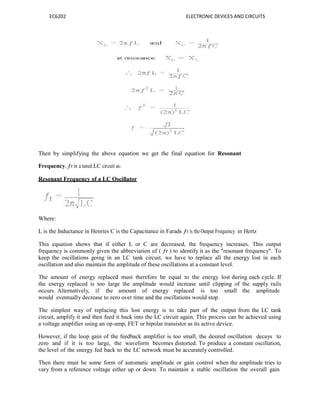
h)ID(rms) i) PIV j)P0(ac) k) P0(dc)l)fr(ripple freq.)m) Input Power factor.
10. In a bridge rectifier the transformer is connected to 220V, 60Hz mains and the turns ratio of the
step down transformer is 11:1. Assuming the diode to be ideal, find: i) Idc ii) voltage across the
load iii) PIV assume load resistance to be 1kJ
11. A bridge rectifier uses four identical diodes having forward resistance of 5J and the secondary
voltage of 30V(rms). Determine the dc output voltage for IDC=200mA and the value of the
ripple voltage.
12. Design a Zener voltage regulator and calculate the values of RMIN and RMAX with following
parameters. Wattage PZ=500 mW, IZMIN=10 mA, Zener voltage VZ=5V, load current IL=20 mA,
VIN(MIN)=9V, VIN(MAX)=15V.
13. (ii) Also calculate the value of Zener current IZ, if the series resistor is fixed at 100 Ω and
VIN=15V.
UNIT -2
1. For an amplifier mid band gain = 100 lower cutoff frequency = 1 KHz. Find the gain of the
amplifier at a frequency of 20 Hz.
2. Measure the value of ideal voltage gain, A certain JFET has a of 4 mS. with an external drain
resistance of 1.5 K ohms.
3. In a CE germanium transistor amplifier circuit the bias is provided by self bias as shown in
figure. The various parameters are VCC=16V,RC=3KΩ,RE=2KΩ,R1=56KΩ,R2=20KΩ and α =
0.985. Determine a) coordinates of operating point b) stability factor S
4. Determine the following for the network of fig.1 ifRD=2kΩ, IDSS=10mA, Vp= -8V, VGG= 2V
(i) VGSQ (ii) IDQ (iii) VDS (iv) VD (v) VG (vi) VS
5. For the Emitter bias circuit shown in fig.2 find the Q-point if VCC = 20V, RC = 4.7KΩ,
RB = 100KΩ,RE = 10kΩ,VEE= -20V
6. In a N channel JFET, IDSS=20mA, Vp= - 6v, Calculate ID when VGS= - 3v.
7. In the common drain FET amplifier of above let RS=4kΩ, µ=50 and rd=35kΩ.Evaluate voltage
gain
8. For a self-bais n-channel JFET circuit, VDD=24 V, ID=0.8 mA, IDSS=1.65 mA, VP= - 2 V.
Calculate the following parameters: (i) VGS (ii) RS (iii) gm
9.
10.
UNIT -3
1. The hybrid parameters for a transistor used in CE configuration are hie = 1000Ω; hfe = 150; hre =
1.2 X 10⁻⁴
; hoe = 25 X 10-6
ohms. The transistor has a load resistance of 10 KΩ in the collector
and is supplied from a signal source of resistance 5 KΩ. Compute the value of input impedance,
output impedance, current gain and voltage gain.
2. For CS amplifier, the operating point is defined by VGSQ = -2.5V, Vp = -6V, IdQ = 2.5mA with
IDSS = 8mA. Also RG = 1MΩ, Rs = 1KΩ, RD = 2.2KΩ, VDD = 15V. Calculate gm, rd, Zi, Zo & Av.
For a JFET IDSS=10mA,VGS(off) = - 4V and Vp= - 4V. Find the value of Id
3. A transistor is connected in Common Collector configuration and its h-parameters are: hie =
1100Ω ; hre = 2.5 x 10⁻⁴
; hfe = 50 ; hoe = 24µA/V. The circuit uses RL = 10KΩ and RS = 1KΩ.
Calculate the following parameters for CC and CE (i) AI (ii) AV (iii) input resistance of
Amplifier (iv) input resistance of the circuit (v) output resistance of the amplifier (vi) Output
resistance of the circuit.
4.
5.
UNIT -4
1. For a differential amplifier circuit operated from +/- 5v, assume VBE=0.7v and β=50, collector
resistance of each is 47KΩ. Calculate RE so that quiescent voltage for each transistor is 5v.
2. Calculate the operating point values, differential gain, common mode gain, CMRR If
VS1 = 60mV (peak to peak) at 1 KHz and VS2 = 40 mV (peak to peak) at 1 KHz for the
Differential amplifier. Assume the transistor made of silicon with hie =3.2KΩ, VCC=12V
RC1=RC2=4.5KΩ, RS1=RS2=120Ω, RE = 5.6KΩ, -VEE = -12V, hfe = 100
UNIT -5
1. Calculate the voltage gain, input and output resistances of a voltage series feed back Amplifier
having a AV = 300, RI = 1.5 k, Ro =50 k and feedback factor β = 1/15
2. In a negative feedback amplifier, the gain without feedback is 50 and 10% of the output is
feedback to the input. Calculate its gain with feedback.
3. Give the open and closed loop gains. The distortion in an amplifier is found to be 3%, when the
feedback ratio of the negative feedback amplifier is 0.04.when the feedback is removed, the
distortion becomes 15%.
4. A wein bridge oscillator has a frequency of 500 kHz. If the value of C is 1000 pF, determine the
value of R.
5.
E-rB
Reg.irlo.:'
Question Paper Codez 27L86
B.E./B.Tech.DEGREE EXAMINATION, NOVEMBER/DECEMBER 2015.
Third Semester
Electrical and ElectronicsEngineering
EC 6202- ELECTRONIC DEVICES AND CIRCUITS
(Commonto Electronicsand Instrumentation Engineering, Instrumentation and.
Control Engineering, Roboticsand Automation Engineering, Biomedical
Engineering, and Medical Electronics)
|
(Also Commonto Second.Semesterfor Biomedical Engineering and Medical
Fllectronics)
(Regulations2013)
Time : Three hours Maximum : 100marks
Answer AtL questions.
A-(10 x2=20 marks)
a
1. Draw the symbol of the following devices.
(a) PN diode
(b) Zener diode
(c) LED
(d) uJr.
a 2. Calculate the diffusion Capacitance for a silicon diode with a 15 m4 forward
current, if the charge carrier transit time is 7Onsec
3. Calculate Ic and Ie for a transistor that has au" = 0.99 and Ia = l5Op A.
Determine the value of Fa" for the transistor.
4. Show how an SCR can be triggered on by the application of a pulse to the gate
terminal.
5. Draw the small signal equivalent circuit of a CS JFET.
6. What,is the needof coupling capacito.rsin amplifier design?
7. Define CMRR. What is its ideal value?
8. What is the need for neutralization?
)5ts b Gn
9.
10.
Mention the advantagesof negativefeedbackcircuits.
What is the advantage of a Colpitts oscillator compared to a phase shift
oscillator?
11. (a) (t
PARTB-(5x16=80marks)
With necessary diagrams, explain the forward. and reverse
characteristicsof PN junction diode. (8)
(ir) Draw the circuit diagram of a half wave rectifier for producing a
positive output voltage.Explain the circuit operation and sketchthe
waveforms. (8)
,Or
(b) With neat diagram, explain the operation of Zener diode and its forward
and reverse characteristics. Also distinguish between Avalanche and
Zener Break downs. (16)
12. (a) (r) Explain the selection of Q point for a transistor bias circuit and
discussthe lirnitations on the output voltage swing. (8)
(ii) Draw the cross section diagram for an N type enhancementmode
MOSFET. Briefly explain its operation.
Or
(8)
(b) (r)
13. (a) (t
Draw the basic construction and equivalent circuit of a Uni
Junction Transistor. Briefly explain the deviceoperation. (S)
(D Sketch the four layer construction of an SCR and the two transistor
equivalent circuit Explain the deviceoperation.
(ir)
(8)
Discuss the factors involved in the selectionof Ic, Rc and Rn for a
single stage common emitter BJT amplifier circuit, using voltage
divider bias. (8)
A Cc'amplifier shown in below figure lias Vcc = 15 V, Rs = 75frC)
and Ro = 9100 The p of the silicon transistor.is 100 and the load
resistor is 600Q Find n,' and A". (8)
Or
27L86
(b) (il TheMOSFETshow4in belowfigurehasthe followingparameters.
Determine the input impedanceand voltage gain.
IlJr*
I
(8)
(8)
(ii) with neat cir'cuit diagram, perform ac analysis for common source
using equivalent circuit NMOSFET amplifier:
L4' (a) With neat sketch,explainthe BJT differential amplifier with activeload
and derivefor Ad,Ac and CMRR.How CMRRcanbeimproved. (16)
Or
(b) (r) Explain with circuit diagramclassB poweramplifier andderivefor
its efficiency. (8)
(ii) Witl neat circuit,.explain and derive the gain and Band width of a
single tuned amplifrer. (g)
15. . (a) Sketch the circuit diagram of a two-stage capacitor coupledBJT amplifi.er'
that uses series voltage negative feedback. Briefly explain how the feed.
back operates.
Or
(b) Describe and explain the operation of the following oscillators.
(t Wien bridge oscillator (5)
(ii) Design a Wien bridge oscillator iircuit to osciLlateat a frequency of
20kHa
(ur) Crysteloscillator.
(5)
(6)
27188
Reg.No. :
B.E./B.Tech.DEGREEEXAMINATION,APRIL/I,{AY2017.
, : Second/ThirdSemester
Electrical and ElectronicsEngineering
IjC6202-ELECTRONICDEVICESANDCIRCUITS
(Commonto Biomed,icalEngineering,Electronicsand Instrumentation Engineering'
Instrumentatlon und Controt Erigineering,Mcdical ElectronicsEngineering'
Roboticsand Automation Engineering)
(Regulations2013)
Time : Three hours Maximum : 100marks
Answer ALL questions'
t
PARTA-(10 x2=20 marks)
L. Differentiate between zenerbreakdown and avalanchebreakdown'
2. Mention someof the applicatio'nsof laser diod'e
3. ' Draw the two transistor equivalent circuit of SCR'
4. A transistor has a typical f of 100.If the collectorcurrent is 40 mA' what is
the value of emitter current?
5. A cornmonernitter ampli.fierhas an *p": resistance 2'5 I?O and voJ'tagegain
I of 200. If the input signal voltage is 5mV, tr'ind the base current of the
amplifier.
6. Define an intrinsic stand off ratio of uJT and d'rawits equivalent circuit'
7. Comparethe performancesof CE and CC configuration'
8'Defineacommonmod'erejectionratioforad.ifferentialamplifier.Whatisthe
value of CMRR for ideal cases?
9. A tuned. circuit has a resonant frequency of 1600 kHz a'nd a bandwidth of '
10kHz. What is the value of its Q factor?
10. Give the two Barkhausen conditions required for sinusoidal oscillation to be
sustained'.
- PART B - (5 x 13 = 65 marks)
11. .(a) Drary the circuit diagram and explain the working of .full wave bridge
. rectifier with output filter and derive the expr-essionof averageoutput
currenr and ripple factor. (13)
Or
(b) (r) Drive the expressionfor fiffusion capacitanceof PN junction diode.
(7)
Explain how zenerdiodecan be acts as a voltageregulator.(ii)
(r)
(6)
71723
12. (a) Explain the drain and transfer characteristicsof Enhdncernenttype
MOSFET. (7)
(ii): Describe the working of Silicon controlled rectifier with neat
diagram (6)
Or
, (b) (il Describethe construction and working of IGBT with neat diagram.
(7)
(ii) Sketch and explain the typical shape of drain characteristics of
JFET for Vcs = 0 with indication of four region clea'rly. (6)
13. (a) Draw the circuit diagram of a common drain MOSFET amplifier. Derive
the expressicln for its voltage gain, input resistance and output
resistance (13)
(b) Fi$ure 13(b) shows a common-emitter amplifier. Determine the input
resistance,acload resistance,voltage gain and output voltage. (13)
fVcc'12V
Fr - tOOltO
Rc' l0 kfl
Q"
lc
fFr*i
lls'3
+t*
sr-5o fr* I lS
Figure13ft)
.()
u*- tOmV
14. (a) Draw the circuit diagram and explain the working of a differential
amplifier using FET. Derive the expressionfor differential modegain and
common mode gain. (13)
Or
(b) Describethe working of classA and class C power amplifier in details
with relevant diagrams. (1S)
15. (a) With a neat block diagram, explain the operation of foilowing feedback
amplifiers
(i) Voltage seriesfeedbackamplifier
(ii) Current shunt feedbackamplifier.
(7)
(6)
Or
(b) Explain with neat circuit diagram, the working of Hartley oscillator
using transistor. Derive an expressionfor frequencyof oscillation. figl
PARTC-(1 x15=15marks)
16. (a) Design an oscillator to operate at a frequencyof 10 kHz which gives an
extremely pure sine wave output; good frequency stability and highly
stabilized amplitude. Discuss the operation of this oscillator as an aud.io
signalgenerators. (15)
Or
(b) Design a voltage divider bias circuit for transistor to establish the
quiescentpoint at Vcn= L2Y,Ic =1.5mA; stabilityfactor S<8, F=50,
Vsp= 0.7V, Vcc= 22.5V andRc = 5.6kO (15)
71729
Reg. No. :
Question Paper Code z 21526
B.E./B.Tech.DEGREE EXAMINATION, NOVEMBER/DECEMBER20L5.,
Third Semester
Electronicsand Instrunientation Engineering
Er22BM35/Ec120el08030K3t3rT3#ir3.r- ELEcrRoNrcDEVrcEs
' (Commonto Instrumentation and Controi Engineering)
(Regulations 2008/2010)
Time : Three hours 00 rnarks
Answer ALI, questions.
Maximum : 1
PARTA-(10x2=20marks)
1. Write a brief note on varactor diode.
2. What is thermal runaway?
3 When I/"" of a FET changesfrom -3.1 V to -3 V, the d.rain current changes
from1mAto1.3mA.Computethevalireoftranscond.uctance.
4. Distinguish betweenSCR and Triac.
5. Draw the hybrid modelofcommon ernitter amplifier.
6. What is cross-overdistortion?
V. Distinguish betweennegativeand positive feedback.
8. What is the role of RadioFrequencyChoke(RFC)in the Hartley oscillator?
9. Draw the negativeclipper circuit using diode.
lb. Draw the block diagram of SMPS.
PARTB-(nx 16=80marks)
11, (a) (t Explain the operation of tunnel diode with the aid of
VI characteristiccurve and energylevel diagram. (10)
(D Write a note on DC and AC load line of Transistor- (6)
Or
(b) Calculate the value of emitter current and.Vgt in the circuit shown in
Figure 11.(b).
1..': /5V
lo krr- lR-rr.
L2.
rigri.o)
(a) Explain the operation of enhancementand depletion
with neat sketch.
5K-r
Write detailednoteon : :
(i) UJT
(ii) scR.
Draw the hybrid model of
expression for current gain,
impedance.
.rl
!Ev
grkrr-
common base amplifier
input resistance, voltage
mode of MOSFET
:(8)
(8)
derive the
and output
Or
(b)
13. (a)
L4. (a)
and
gain
Or
(b) (r) Explain complementary symmetry (classB) Fush-Pull amplifier in
detail.
(ii) Write a detailed note on class 'C' power amplifier.
Draw the block diagram of voltage-seriesfeed back (i.e., part of the
output voltage feed back in series with the input signal) and derive the
expression for gain with feed back, input impedance with feed back,
output impedancewith feedback.
Or
(r) Explain the operation of Wien bridge oscillator with circuit diagram
and alsoderive the expressionfor frequencyofoscillation. (12)
(ii) Write a short note on crystal oscillator. (4)
2L526
I
(10)
(6)
(b)
15. (a) Explain the following with circuit diagram and wave form.
(6)(i) Clampers
(ir) Schmitt Trigger. (10)
Or
(b) Discussthe operation of transistorised seriesvoltage regulator with neat
sketch.
2r526
Reg.No.
QuestionPaperCoder 51526
B.EiB. Tech. DEGREEEXAMINATION, MAY/JUNE 2016
Third Semester
ElectronicsandInstrumentationEngineering
NI22O3IEI35/EC1209/O8O3OOOO2/10T33EE 305- ELECTRONICDEVICESAND
CIRCUITS
(Commonto InstrumentationandControlEngineering)
(Regulations2008/2010)
Time : Three Hours Maximum : 100Marks
Answer ALL questions.
PART-A(10 x2:20 Marks)
1. What arethe applicationsof SchottyDiode ?
2. What is Thermal Runawav?
3. Discussthecharacteristicsof JFET?
4. List out the applicationsof TRIAC ?
5. Explain the term voltagegain andcurrentgain of an amplifier ?
6. What is the needof dc load line ?
7. What arethe typesof feedbackconnectionin an amplifier ?
8. Define the termsDampedandUndampedOscillations.
9. How Schmitt trigger is different from multivibrator ?
10. What is meantby switchedmodepower supply ?
1 51526
11.
PART-B(5x16=80Marks)
(a) (i) Draw and explain the VI characteristicsof junction diode when it is
forward biasedandreversebiased. (10)
(ii) Derive the expressionfor diode currentequation. (6)
OR
(b) (i) Explain the factorsaffectingthe e-point andsrability factor. (6)
(ii) What arethemethodsof transistorbiasing? Explain anythreein detail. (10)
(a) (i) Explain with the help of a neat diagram the structureof N-channel FET
andits volt-amperecharacteristics.In what way it is different from BJT ? (10)
(ii) Bring out the comparisonof JFET andMOSFET. (6)
OR
(b) (i) What is UJT ? Explain in detail about its operation and characteristics.
Also give the reasonfor why it is called as current controlled negative
resistancedevice. i0.Z)
(ii) Give the differencebetweenSCR andTRIAC. g)
12.
13. (a) Find the expressionfor voltagegain, currentgain, input impedanceof CE
amplifierswith voltagedividerbias andhavingemitterbypasscapacitorand
loadresisterRr. (16)
OR
(b) Whataretheclassificationof poweramplifiersandexplainin detailaboutclass-
14.
A amplifier.
(a) Explain briefly about the feedback amplifiers and its advantages
disadvantages.
OR
(b) What are the classification of the oscillator and explain in detail about
Weinbridgeoscillator
(16)
and
(16)
the
(16)
15. (a) Explainin detailaboutthefollowing:
(i) Astablemultivibrator
(iD Bistablemultivibrator
OR
(b) Explaintheworkingprincipleof threephasebridgerectifierswith neatdiagram.
Obtaintheexpressionfor theaverageoutputvoltage.
(8)
(8)
(16)
5r526
Reg. No. :
Time qThreehours .
.
.AnswerALL questions.
pART 4, (10x Z= ZOmarks)
^ 1. What is varactor.diode?
Question Paper Code : 60526
{.,.
B.E.lB.Tech.DEGREEEXAMINATION;NOVEMBER/DECEMBER2AL6.
Third Semester
FlectronicsandInstrumentationEngineering
EI22O3/EI35/EC1209/O8O3OOOO2/10133EE 305_ ELECTRONICDEVICESAND
CIRCUITSL
(Commonto Instrumentatig4 and Control Engineering) i,. l
Ma<rmum : 100marks
2. Define Stability factor.
3. Define pinch off voltage
+. .hlowcan an SCRbe iurned'ON'or OFFI?
I
5. What is an Emitter follower?
6. What is meant by power conversion efficiency of a power amplifisp?
'
ll. What are the merits of.legative feedback?
8. iCrystal oscillators ppssessan exceptionally high degreeof frequency stability'.
Justifu. .
9. . Draw the circuit of Schmitt trigger. .
. I
10. . 'What is mqant by voltage regulation?
PARTB-(5x 16=80marks)
11. (a) (i) Describe the behavior of PN junction diode under forward and
reversebias conditions'
(S)
(il) Distinguish.betweenAvalanche and Zenerbreakdown mechanisms' '"
(8)
Or
(b) What is bias stabihty? Draw'and describethe working qf'self bias circuit
l
-'
for siabilizing the operating point. Analyze the circuit fot
.l':
, perfortnance'frhat is load line?
. t2. (a)" (i) with neat sketch describethe working of a D-MOSFET'What it !l:
,"i*tiottrhip betweenthe d.raincurrglt and gatevoltage?
^ ,
(8)
(ii) What is SCR's?Draw a typical lrolt u-p"re characteristics for an
SCR.Explainwhyyouget-suchcharacteristics.(8)
'Or
(b) (t What is the differencebetweena FET and a bipolar transistor? (4)
I parameters and establish the relationship between
13. (a) DraW the mid frequency equivalent circuit of a cE BJT amplifrer and
, (r) Voltage gain
(iil) InPut ImPedanceand
,
,, or
i :
o) (t show that the maximyl nossihle power:convels^ib_neffrciency o{^1
-
double end.edpush pull Class B configuration is '18.5o/o (8)
r
t I r r n -
, (ii) Explain hor,tlcross over distortion is produced. What mea-sr:foeswill
r+. (a) Explain with neat block diagrams all the possible topolog 'ies-9ffeedback
e shift osciliator and' explain its
(i'DrawthecircuitofRCphas^eshrftoscrlll'o".1"l.expra'',iH'-:'
*o*i"g. Derive the expression for frgquencYof oscillation. (10)
2 60526
. s t
:
lb. (a). (i) Draw the aircuit of a biased positive clipper and explain with
(ii) Draw a hrrghpass:RC eircuit and how it acts as a differentiatg1 ,
',
(8)-:
Or'. :
'.(b)('.Desc1ibe'1heworkingprincip1eof.atransistorized,shuntvoltag9
regulatorwiththehe1pofacircuit]c[iagram. . e
i
(D Explain .the op_e-rationof a Schmitt .trigger circuit and derive
t 
3 60526
Reg. No. :
QuestionPaper Code 273522
B.E./B.Tech.DEGREEEXAMINATION,APRILA{AY20L7.
Third Semester
ElectronicsandInstrumentationEngineering
EI22O3IEI35/EC 1209110133EE 305/O8O3OOOO2- ELECTRONICDEVICESANO
CIRCUITS
(CommontoInstrumentation
"i* 3iln:Lfllfi""*t"g,
ElectricalandElebtronics
(Regulations2008/2010)
Time : Three hours. Maximum,: 100marks
Answer ALL questions.
PARTA-(10 x2=20 marks)
1. Define depletion region.
2. What is biasing?
3. When V6" of a FET changesfrom.-3.l" V to -B V, the drain current changes
from 1 mA to 1.3mA. Computethe value of trans conductance.
4. Distinguish betweenSCRand.Triac.
5. Why is commoncollectoramplifier called as.emitter follower?
6. What is the condition for centering Q-point on the AC load-Iine in class A
power arnplifier?
7. What type of feedbackis usedin emitter follower circ'uit?
8. A Wein bridge osiiilator has.a frequency of 500 kHz. If the value of C is
1000pF, determinethe valueof R.
9. List the important characteristicsof a voltage,regulator.
10. What is a Schmitt trigger?
11. (a)
(b)
L2. (a)
PARTB*(5x 16=80marks)
Explain the V-I characteristics of zerLetdiode with neat diagram.
Or
Explain the operation of
(i) voltage divider bias
(ii) entitter bias.
Explain the operation of enhancement
with neat sketch.
and depletion'mode of MOSFET
Or
'
(b) Writedetailednoteon
(r) UJT
(ii) scR.
13. (a) (1) Draw ,1t" ft-parameter model of a
h- parameters.
Or
(b) (i) In a classA arnplifier, Vcnlmax;=
efficiency for
(1) series-fedload,
(?) transfor'mercoupled.load..
(8)
(8)
CE transistor and define the
(8)
(8)
16V, Ycpr.in)= 1V. Find the overall
(4)
(4)
(ii) For the CE amplifier shown in figure, calcuiate the mid frequency
voltage gain and lower 3-dB point. The transistor has h-parameters
life = 400 and hi" = t0 kO. The circuit details are R" =5kO,
Rs =600Q, RE=lkf), Vcc = 12 V, Rr =15kO, R2=2.2kQ, and
Cn=50PF.
(iil Derive the conversionefficiencyand the relation betweerrmaximum
power output and maximum power dissipation for classB push-pull
(8)
78592
power amplifier.
:!i
14. (a) Derive the expressionfor voltage gain, inBut impedanceand output
impedancewrth negativefeedbackin a current-shuntfeedb".Ou*OUlii*l
15. (a)
(b)
(b)
Or
With neat circuit, explain the working principle of colpitts oscillator and
.derivethe expressionfor frequencyofoscillation. (16)
Explain the working and waveformsof MonostableMultivibrator. (16)
Or
(i) Draw the block diagram gf switchedmodepower supply and explain
the operation.
(ii) A diodewhoseinternal resistanceis 20 ohms is to supply power to a
load frorrra 110V(RMS) sourceof supply. Calculate
(1) Peakloadcurrent
(2) DCloadcurrent
(B) AC loadcurrent
(4) DC diodevoltage
(5) Totalinput powerto thecircuit
(6) %regulationfrom noloadto the givenload.
(8)
(8)
786r,2

EC6202 ELECTRONIC DEVICES AND CIRCUITS NOTES

  • 1.
    A Course Materialon EC6202 ELECTRONIC DEVICES AND CIRCUITS By Dr Gnanasekaran Thangavel Mr Marimuthu Gajendran DEPARTMENT OF ELECTRONICS AND INSTRUMENTATION ENGINEERING RMK ENGINEERING COLLEGE KAVRAIPETTAI– 601 206
  • 2.
    EC6202 ELECTRONIC DEVICESAND CIRCUITS L T P C 3 1 0 4 OBJECTIVES: The student should be made to:  Be familiar with the structure of basic electronic devices.  Be exposed to the operation and applications of electronic devices. UNIT I PN JUNCTION DEVICES 9 PN junction diode –structure, operation and V-I characteristics, diffusion and transient capacitance - Rectifiers – Half Wave and Full Wave Rectifier,– Display devices- LED, Laser diodes- Zener diode characteristics-Zener Reverse characteristics – Zener as regulator UNIT II TRANSISTORS 9 BJT, JFET, MOSFET- structure, operation, characteristics and Biasing UJT, Thyristor and IGBT Structure and characteristics. UNIT III AMPLIFIERS 9 BJT small signal model – Analysis of CE, CB, CC amplifiers- Gain and frequency response – MOSFET small signal model – Analysis of CS and Source follower – Gain and frequency response- High frequency analysis. UNIT IV MULTISTAGE AMPLIFIERS AND DIFFERENTIAL AMPLIFIER 9 BIMOS cascade amplifier, Differential amplifier – Common mode and Difference mode analysis – FET input stages – Single tuned amplifiers – Gain and frequency response – Neutralization methods, power amplifiers –Types (Qualitative analysis). UNIT V FEEDBACK AMPLIFIERS AND OSCILLATORS 9 Advantages of negative feedback – voltage / current, series , Shunt feedback –positive feedback – Condition for oscillations, phase shift – Wien bridge, Hartley, Colpitts and Crystal oscillators. OUTCOMES:  To explain the structure of the basic electronic devices.  To design applications using the basic electronic devices. TOTAL (L:45+T:15): 60 PERIODS TEXT BOOKS: 1. David A. Bell,”Electronic Devices and Circuits”, Prentice Hall of India, 2004. 2. Sedra and smith, “Microelectronic Circuits “ Oxford University Press, 2004. REFERENCES: 1. Rashid, “Micro Electronic Circuits” Thomson publications, 1999. 2. Floyd, “Electron Devices” Pearson Asia 5th Edition, 2001. 3. Donald A Neamen, “Electronic Circuit Analysis and Design” Tata McGraw Hill, 3 Edition, 2003. 4. Robert L.Boylestad, “Electronic Devices and Circuit theory”, 2002. 5. Robert B. Northrop, “Analysis and Application of Analog Electronic Circuits to Biomedical Instrumentation”, CRC Press, 2004.
  • 3.
    S. No Electronic Devicesand Circuits- S.Shalivahanan, McGraw Hill Education (India) Pvt. Ltd, 4th Edition,2017 Chap. No Page No UNIT – I : PN JUNCTION DEVICES 1 PN junction diode –structure, operation and 4 4.29 – 4.50 2 V-I characteristics 4 3 Diffusion capacitance and Transient capacitance 4 4.50 – 4.54 4 Rectifiers – Half Wave Rectifier and 18 18.12 – 18.33 5 Full Wave Rectifier 18 6 Display devices- LED 22 22.15 7 Laser diodes Refer Notes 8 Zener diode characteristics- Zener Reverse characteristics 5 5.1 – 5.4 9 Zener as regulator 18 18.35 – 18.41 UNIT – II : TRANSISTORS 1 BJT- structure, operation, characteristics 6 6.1 – 6.57 2 BJT Biasing 6 3 JFET- structure, operation, characteristics 7 7.1 – 7.12 4 JFET Biasing 7 7.45 – 7.68 5 MOSFET- structure, operation, characteristics 7 7.13 – 7.15 6 MOSFET Biasing 7 7.48 – 7.59 7 UJT - Structure and characteristics 8 Thyristor - Structure and characteristics 8 8.1 – 8.39 9 TRIAC 8 8.10 – 8.11 10 IGBT - Structure and characteristics, Revision Refer Notes UNIT – III : AMPLIFIERS 1 BJT small signal model 9 9.1 – 9.60 2 Analysis of CE amplifiers 9 3 Analysis of CB amplifiers 9 4 Analysis of CC amplifiers 9 5 Gain and frequency response - High frequency analysis 9 6 MOSFET small signal model 9 9.63 – 9.68 7 Analysis of CS 9 9.77 – 9.87 8 Analysis of Source follower 9 Gain and frequency response - High frequency analysis 11 11.19 – 11.42 UNIT – IV : MULTISTAGE AMPLIFIERS AND DIFFERENTIAL AMPLIFIER 1 BIMOS cascade amplifier Refer Notes 2 Differential amplifier 9 9.87 – 9.1093 Common mode and Difference mode analysis 9 4 FET input stages 9 5 Single tuned amplifiers 13 13.1 – 13.13 6 Gain and frequency response 13 7 Neutralization methods 13 13.32 – 13.34 8 Power amplifiers –Types 12 12.1 – 12.24 9 Power amplifiers types (Qualitative analysis) 12
  • 4.
    UNIT – V: FEEDBACK AMPLIFIERS AND OSCILLATORS 1 Advantages of negative feedback Amplifier 14 14.12 – 14.46 2 Voltage series feedback 14 3 Voltage shunt feedback 14 4 Current series feedback 14 5 Current shunt feedback 14 6 Positive feedback - Condition for oscillations 15 15.1 – 15.13, 15.17 – 15.40 (Except Clapp, Franklin and Armstrong 7 Phase shift oscillators, Wien bridge oscillators 15 8 Hartley, Colpitts oscillators. 15 9 Crystal oscillators, Revision 15
  • 5.
    S.NO CONTENTS UNIT ISEMICONDUCTOR DIODE PAGE NO 1.1 Semiconductor 1 1.2 Review of intrinsic and extrinsic semiconductors 1 1.2.1 Intrinsic Semiconductor 1 1.2.2 Extrinsic Semiconductor 1 1.3 Pn Junction Diode 2 1.3.1 Forward Bias Condition 3 1.3.2 Under Reverse Bias Condition 4 1.4 Diffusion Transient Capacitance 5 1.5 Transient Capacitance 5 1.6 Rectifiers 6 1.6.1Half Wave Rectifiers 6 7 1.6.2 Working of Half Wave Rectifier 8 1.6.3 Characteristics of Half Wave Rectifier 1.7 Full Wave Rectifier 9 1.7.1 Centre-Tap Full Wave Rectifier 9 1.7.2 Full wave bridge rectifier 13 1.8 Light Emitting Diode (Led) 15 1.8.1 LED Characteristics 16 1.8.2 LED as an Indicator 17 1.9 Laser diode 17 1.9.1 Laser diode L/I characteristic 18 1.10 Zener Diode 19 1.10.1 Zener Diode Characteristics 20 1.10.2 Zener Regulator 21 Review questions UNIT 2 TRANSISTORS 2.1 Introduction 23 2.1.1 Transistor Construction 23 2.1.2 Transistor Currents 23 2.2 Operation Of An NPN Transistor 26 2.2.1 Operation Of A PNP Transistor 27 2.3 Configuration Of Transistor Circuit 28 2.3.1 Common Base(CB) Configuration 28 2.3.2 CE Configuration 30 2.3.3 CC Configuration 32 2.4 Field Effect Transistor 34
  • 6.
    3.4.1 Effect ofvarious capacitors on frequency response 86 3.5 MOSFET small signal model Amplifiers 87 3.5.1 MOSFET low frequency A.C Equivalent circuit 87 3.5.2Common source amplifier with self bias(Bypassed Rs) 89 3.6 High frequency analysis of MOSFET: 92 3.6.1 Common source amplifier at high frequencies 97 3.6.2 Common Drain Amplifier at High Frequencies 99 Review Questions 2.4.1 Operation of FET 35 2.5 MOSFET (Metal Oxide Semiconductor Field Effect Transistor) 39 2.5.1 Depletion mode-MOSFET 39 2.5.2 Construction 40 2.5.3 Operation of N-channel D-MOSFET 41 2.5.4 Enhancement- Mode MOSFET 42 2.6 BIASING 45 2.6.1 Fixed Bias or Base Bias 45 2.7 UNI JUNCTION TRANSISTOR (UJT) 50 2.7.1 Construction of a UJT 51 2.7.2 UJT parameters 52 2.7.3 Applications of UJT 53 2.8 SILICON CONTROLLED RECTIFIER (SCR) 54 2.8.1 Introduction 56 2.8.2 VI characteristics of SCR 58 2.8.3 DIAC (DIODE A.C. SWITCH) 58 2.8.4 TRIAC 61 2.8.5 INSULATED GATE BIPOLAR TRANSISTOR 64 Review questions UNIT 3 AMPLIFIERS 3.1 Bjt Small Signal Model 69 3.1.1 CE, CB And CC Amplifiers 69 3.1.2 Common Emitter Amplifier Circuit: 70 3.1.3Common Collector Amplifier Circuit 72 3.1.4 Common Base Amplifier Circuit 72 3.2 Small Signal Low Frequency h-parameter Model 73 3.2.1 h-Parameters for all three configurations 75 3.2.2 Method for analysis of a transistor circuit 78 3.3 General shape of frequency response of amplifiers 81 3.3.1 Definition of cut-off frequencies and bandwidth: 82 3.4 Low frequency analysis of amplifier to obtain lower cut-off 82 frequency:
  • 7.
    UNIT 4 MULTISTAGEAMPLIFIERS AND DIFFERENTIAL AMPLIFIER 4.1 Multistage Amplifiers 4.1.1 Need for Cascading 4.1.2 Advantages of Representation of Gain in Decibels 4.2 Introduction of Differential Amplifier 4.2.1 Basics of Differential Amplifier 4.2.2 Transistorised Differential Amplifier 4.2.3 Differential Mode Operation 4.2.4 common Mode operation 4.2.5 D.C. Analysis of Differential Amplifier 4.3 Tuned amplifier 4.3.1 Need for tuned circuits 4.3.2 Single tuned amplifier 4.4 General shape of frequency response of amplifiers 4.4.1 Definition of cut-off frequencies and bandwidth 4.5 Neutralization Methods 106 106 108 111 112 114 115 116 118 120 121 121 122 123 124 4.5.1 Neutralization using coil 124 4.6 Power Amplifiers 126 4.6.1 Transformer-Coupled Class A Amplifiers 127 4.6.2 Class B Amplifiers 128 4.6.3 Class C Amplifiers 129 Review Questions UNIT 5 FEED BACK AMPLIFIERSAND OSCILLATORS 5.1 Feedback 128 5.2 Principles of Negative Voltage Feedback In Amplifiers 129 5.3 Gain of Negative Voltage Feedback Amplifier 130 5.4 Advantages of Negative Voltage Feedback 131 5.5 Effects of Negative Current Feedback 137 5.6 The Feedback Voltage Amplifier (Series-Shunt) 138 5.7 Oscillators: 140 5.8 The Hartley Oscillator 141 5.9 The Colpitts Oscillator 142 5.10 Wien Bridge Oscillator 145
  • 8.
    5.11 Quartz CrystalOscillators 150 Review Questions
  • 9.
    EC6202 ELECTRONIC DEVICESAND CIRCUITS 1 UNIT I PN JUNCTION DEVICES 1.1 SEMICONDUCTOR A semiconductor is a material which has electrical conductivity to a degree between that of a metal (such as copper) and that of an insulator (such as glass). Semiconductors are the foundation of modern electronics, including transistors, solar cells, light -emitting diodes (LEDs), quantum dots and digital and analog integrated circuits. DIODE Diode – Di + ode Di means two and ode means electrode. So physical contact of two electrodes is known as diode and its important function is alternative current to direct current. 1.2 REVIEW OF INTRINSIC AND EXTRINSIC SEMICONDUCTORS 1.2.1 INTRINSIC SEMICONDUCTOR An intrinsic semiconductor is one, which is pure enough that impurities do not appreciably affect its electrical behavior. In this case, all carriers are created due to thermally or optically excited electrons from the full valence band into the empty y conduction band. Thus equal numbers of electrons and holes are present in an intrinsic semiconductor. Electrons and holes flow in opposite directions in an electric field, though they contribute to current in the same direction since they are oppositely charged. Hole current and electron current are not necessarily equal in an intrinsic semiconductor, however, because electrons and holes have different effective masses (crystalline analogues to free inertial masses). The concentration of carriers is strongly dependent on the temperature. At low temperatures, the valence band is completely full making the material an insulator. Increasing the temperature leads to an increase in the number of carriers and a corresponding increase in conductivity. This characteristic shown by intrinsic semiconductor is different from the behaviour of most metals, which tend to become less conductive at higher temperatures due to increased phonon scattering. Both silicon and germanium are tetravalent, i.e. each has four electrons (valence electrons) in their outermost shell. Both elements crystallize with a diamond-like structure, i.e. in such a way that each atom in the crystal is inside a tetrahedron formed by the four atoms which are closest to it. Each atom shares its four valence electrons with its four immediate neighbors, so that each atom is involved in four covalent bonds. 1.2.2 EXTRINSIC SEMICONDUCTOR An extrinsic semiconductor is one that has been doped with impurities to modify the number and type of free charge carriers. An extrinsic semiconductor is a semiconductor that has been doped, that is, into which a doping agent has been introduced, giving it different electrical properties than the intrinsic (pure) semiconductor. Doping involves adding doping atoms to an intrinsic semiconductor, which changes the electron and hole carrier concentrations of the semiconductor at thermal equilibrium. Dominant
  • 10.
    EC6202 ELECTRONIC DEVICESAND CIRCUITS 2 carrier concentrations in an extrinsic semiconductor classify it as either an n-type or p-type semiconductor. A pure or intrinsic conductor has thermally generated holes and electrons. However these are relatively few in number. An enormous increase in the number of charge carriers can by achieved by introducing impurities into the semiconductor in a controlled manner. The result is the formation of an extrinsic semiconductor. This process is referred to as doping. There are basically two types of impurities: donor impurities and acceptor impurities. Donor impurities are made up of atoms (arsenic for example) which have five valence electrons. Acceptor impurities are made up of atoms (gallium for example) which have three valence electrons. The two types of extrinsic semiconductor are  N-TYPE SEMICONDUCTORS Extrinsic semiconductors with a larger electron concentration than hole concentration are known as n-type semiconductors. The phrase ‘n-type’ comes from the negative charge of the electron. In n-type semiconductors, electrons are the majority y carriers and holes are the minority carriers. N-type semiconductors are created by doping an intrinsic semiconductor with donor impurities. In an n-type semiconductor, the Fermi energy level is greater than that of the intrinsic semiconductor and lies closer to the conduction band than the valence band. Arsenic has 5 valence electrons, however, only 4 of them form part of covalent bonds. The 5th electron is then free to take part in conduction. The electrons are said to be the majority carriers and the holes are said to be the minority carriers.  P-TYPE SEMICONDUCTORS As opposed to n-type semiconductors, p-type semiconductors have a larger hole concentration than electron concentration. The phrase 'p-type' refers to the positive charge of the hole. In p- type semiconductors, holes are the majority carriers and electrons are the minority y carriers. P-type semiconductors are created by doping an intrinsic semiconductor with acceptor impurities. P-type semiconductors have Fermi energy levels below the intrinsic Fermi energy level. The Fermi energy level lies closer to the valence band than the conduction band in a p- type semiconductor. Gallium has 3 valence electrons; however, there are 4 covalent bonds to fill. The 4th bond therefore remains vacant producing a hole. The holes are said to be the majority carriers and the electrons are said to be the minority carriers. 1.3 PN JUNCTION DIODE When the N and P-type semiconductor materials are first joined together a very large density gradient exists between both sides of the junction so some of the free electrons from the donor impurity atoms begin to migrate across this newly formed junction to fill up the holes in the P- type material producing negative ions. 1.3.1 FORWARD BIAS CONDITION When positive terminal of the battery is connected to the P-type and negative terminal to N-type of the PN junction diode that is known as forward bias condition.
  • 11.
    EC6202 ELECTRONIC DEVICESAND CIRCUITS 3  Operation The applied potential in external battery acts in opposition to the internal potential barrier which disturbs the equilibrium. As soon as equilibrium is disturbed by the application of an external voltage, the Fermi level is no longer continuous across the junction. Under the forward bias condition the applied positive potential repels the holes in P type region so that the holes move towards the junction and the applied positive potential repels the electrons in N type region so that the electrons move towards the junction. When the applied potential is more than the internal barrier potential the depletion region and internal potential barrier disappear. Figure PN junctions under forward bias  V-I Characteristics As the forward voltage increased for VF < Vo, the forward current IF almost zero because the potential barrier prevents the holes from P region and electrons from N region to flow across the depletion region in opposite direction. V-I characteristics of a diode under forward bias For VF > Vo, the potential barrier at the junction completely disappears and hence, the holes cross the junction from P to N type and electrons cross the junction to opposite direction, resulting large current flow in external circuit. A feature noted here is the cut in voltage or threshold voltage VF below which the
  • 12.
    EC6202 ELECTRONIC DEVICESAND CIRCUITS 4 current is very small. At this voltage the potential barrier is overcome and the current through the junction starts to increase rapidly.  Cut in voltage is 0.3V for germanium and 0.7 for silicon. 1.3.2 UNDER REVERSE BIAS CONDITION When the negative terminal of the battery is connected to the P-type and positive terminal to N-type of the PN junction diode that is known as forward bias condition.  Operation The holes from the majority carriers of the P side move towards the negative terminal of the battery and electrons which from the majority carrier of the N side are attracted towards the positive terminal of the battery. Figure PN junctions under reverse bias Hence, the width of the depletion region which is depleted of mobile charge carriers increases. Thus, the electric field produced by applied reverse bias, is in the same direction as the electric field of the potential barrier. Hence the resultant potential barrier is increased which prevents the flow of majority carriers in both directions. The depletion width W is proportional to under reverse bias.  V-I characteristics Theoretically no current flow in the external circuit. But in practice a very small amount of current of the order of few microamperes flows under reverse bias.
  • 13.
    EC6202 ELECTRONIC DEVICESAND CIRCUITS 5 Figure V-I characteristics under reverse bias Electrons forming covalent bonds of semiconductor atoms in the P and N type regions may absorb sufficient energy from heat and light to cause breaking covalent bonds. So electron hole pairs continuously produced. Consequently the minority carriers electrons in the P region and holes in the N region, wander over to the junction and flow towards their majority carrier side giving rise a small reverse current. This current is known as reverse saturation current Io. The magnitude of this current is depends on the temperature because minority carrier is thermally broken covalent bonds. 1.4 Transition capacitances: 1. When P-N junction is reverse biased the depletion region act as an insulator or as a dielectric medium and the p-type an N-type region have low resistance and act as the plates. 2. Thus this P-N junction can be considered as a parallel plate capacitor. 3. This junction capacitance is called as space charge capacitance or transition capacitance and is denoted as CT . 4. Since reverse bias causes the majority charge carriers to move away from the junction , so the thickness of the depletion region denoted as W increases with the increase in reverse bias voltage. 5. This incremental capacitance CT may be defined as CT = dQ/dV, Where dQ is the increase in charge and dV is the change or increase in voltage. 6. The depletion region increases with the increase in reverse bias potential the resulting transition capacitance decreases. 7. The formula for transition capacitance is given as CT = Aε/W, where A is the cross sectional area of the region, and W is the width. 1.5 Diffusion capacitance: 1. When the junction is forward biased, a capacitance comes into play , that is known as diffusion capacitance denoted as CD. It is much greater than the transition capacitance. 2. During forward biased the potential barrier is reduced. The charge carriers moves away from the junction and recombine. 3. The density of the charge carriers is high near the junction and reduces or decays as the distance increases. 4. Thus in this case charge is stored on both side of the junction and varies with the applied potential. So as per definition change in charge with respect to applied voltage results in capacitance which here is called as diffusion capacitance. 5. The formula for diffusion capacitance is CD = τID / ηVT , where τ is the mean life time of the charge carrier, ID is the diode current and VT is the applied forward voltage, and η is generation recombination factor. 6. The diffusion capacitance is directly proportional to the diode current. 7. In forward biased CD >> CT . And thus CT can be neglected.
  • 14.
    EC6202 ELECTRONIC DEVICESAND CIRCUITS 6 1.6 RECTIFIERS Rectifiers are classified according to the period of conduction. They are  Half Wave Rectifier  Full Wave Rectifier 1.6.1 Half Wave Rectifier: The half wave rectifier is a type of rectifier that rectifies only half cycle of the waveform. This describes the half wave rectifier circuit working. The half rectifier consist a step down transformer, a diode connected to the transformer and a load resistance connected to the cathode end of the diode. The circuit diagram of half wave transformer is shown below: The main supply voltage is given to the transformer which will increase or decrease the voltage and give to the diode. In most of the cases we will decrease the supply voltage by using the step down transformer here also the output of the step down transformer will be in AC. This decreased AC voltage is given to the diode which is connected serial to the secondary winding of the transformer, diode is electronic component which will allow only the forward bias current and will not allow the reverse bias current. From the diode we will get the pulsating DC and give to the load resistance RL. 1.6.2 Working of Half Wave Rectifier:
  • 15.
    EC6202 ELECTRONIC DEVICESAND CIRCUITS 7 The input given to the rectifier will have both positive and negative cycles. The half rectifier will allow only the positive half cycles and omit the negative half cycles. So first we will see how half wave rectifier works in the positive half cycles.  Positive Half Cycle:  In the positive half cycles when the input AC power is given to the primary winding of the step down transformer, we will get the decreased voltage at the secondary winding which is given to the diode.  The diode will allow current flowing in clock wise direction from anode to cathode in the forward bias (diode conduction will take place in forward bias) which will generate only the positive half cycle of the AC.  The diode will eliminate the variations in the supply and give the pulsating DC voltage to the load resistance RL. We can get the pulsating DC at the Load resistance.  Negative Half Cycle:  In the negative half cycle the current will flow in the anti-clockwise direction and the diode will go in to the reverse bias. In the reverse bias the diode will not conduct so, no current in flown from anode to cathode, and we cannot get any power at the load resistance.  Only small amount of reverse current is flown from the diode but this current is almost negligible. And voltage across the load resistance is also zero. 1.6.3 Characteristics of Half Wave Rectifier: There are some characteristics to the half wave rectifier they are  Efficiency: The efficiency is defined as the ratio of input AC to the output DC. Efficiency, Ƞ = P dc / Pac DC power delivered to the load, Pdc = I2 dc RL = ( Imax/pi ) 2 RL AC power input to the transformer, Pac = Power dissipated in junction of diode + Power dissipated in load resistance RL
  • 16.
    EC6202 ELECTRONIC DEVICESAND CIRCUITS 8 dc f = I2 rms RF + I2 rms RL = {I2 MAX/4}[RF + RL] Rectification Efficiency, Ƞ = Pdc / Pac = {4/ 2 }[RL/ (RF + RL)] = 0.406/{1+ RF/RL } If RF is neglected, the efficiency of half wave rectifier is 40.6%.  Ripple factor: It is defined as the amount of AC content in the output DC. It nothing but amount of AC noise in the output DC. Less the ripple factor, performance of the rectifier is more. The ripple factor of half wave rectifier is about 1.21 (full wave rectifier has about 0.48). It can be calculated as follows: The effective value of the load current I is given as sum of the rms values of harmonic currents I1, I2, I3, I4 and DC current Idc. I2 =I2 dc+I2 1+I2 2+I2 4 = I2 dc +I2 ac Ripple factor, is given as γ = I ac / Idc = (I2 – I2 dc) / Idc = {( I rms / I 2 )-1} = K 2 – 1) Where Kf is the form factor of the input voltage. Form factor is given as Kf = Irms /Iavg = (Imax/2)/ (Imax/pi) = pi/2 = 1.57 So, ripple factor, γ = (1.572 – 1) = 1.21  Peak Inverse Voltage: It is defined as the maximum voltage that a diode can with stand in reverse bias. During the reverse bias as the diode do not conduct total voltage drops across the diode. Thus peak inverse voltage is equal to the input voltage Vs.  Transformer Utilization Factor (TUF): The TUF is defined as the ratio of DC power is delivered to the load and the AC rating of the transformer secondary. Half wave rectifier has around 0.287 and full wave rectifier has around 0.693. Half wave rectifier is mainly used in the low power circuits. It has very low performance when it is compared with the other rectifiers. 1.7 FULL WAVE RECTIFIER Full wave rectifier rectifies the full cycle in the waveform i.e. it rectifies both the positive and negative cycles in the waveform. We have already seen the characteristics and working of Half Wave Rectifier. This Full wave rectifier has an advantage over the half wave i.e. it has average output higher than that of half wave rectifier. The number of AC components in the output is less than that of the input. The full wave rectifier can be further divided mainly into following types.
  • 17.
    EC6202 ELECTRONIC DEVICESAND CIRCUITS 9 1. Center Tapped Full Wave Rectifier 2. Full Wave Bridge Rectifier 1.7.1 Centre-Tap Full Wave Rectifier We have already discussed the Full Wave Bridge Rectifier, which uses four diodes, arranged as a bridge, to convert the input alternating current (AC) in both half cycles to direct current (DC). In the case of centre-tap full wave rectifier, only two diodes are used, and are connected to the opposite ends of a centre-tapped secondary transformer as shown in the figure below. The centre-tap is usually considered as the ground point or the zero voltage reference point. Centre Tap Full Wave Rectifier Circuit  Working of Centre-Tap Full Wave Rectifier As shown in the figure, an ac input is applied to the primary coils of the transformer. This input makes the secondary ends P1 and P2 become positive and negative alternately. For the positive half of the ac signal, the secondary point D1 is positive, GND point will have zero volt and P2 will be negative. At this instant diode D1 will be forward biased and diode D2 will be reverse biased. As explained in the Theory Behind P-N Junction and Characteristics of P-N Junction Diode, the diode D1 will conduct and D2 will not conduct during the positive half cycle. Thus the current flow will be in the direction P1-D1-C-A-B-GND. Thus, the positive half cycle appears across the load resistance RLOAD.
  • 18.
    EC6202 ELECTRONIC DEVICESAND CIRCUITS 10 During the negative half cycle, the secondary ends P1 becomes negative and P2 becomes positive. At this instant, the diode D1 will be negative and D2 will be positive with the zero reference point being the ground, GND. Thus, the diode D2 will be forward biased and D1 will be reverse biased. The diode D2 will conduct and D1 will not conduct during the negative half cycle. The current flow will be in the direction P2-D2-C-A-B-GND. Centre-tap Full-wave Rectifier-Waveform When comparing the current flow in the positive and negative half cycles, we can conclude that the direction of the current flow is the same (through load resistance RLOAD). When compared to the Half-Wave Rectifier, both the half cycles are used to produce the corresponding output. The frequency of the rectified output voltage is twice the input frequency. The output that is rectified, consists of a dc component and a lot of ac components of minute amplitudes.  Peak Inverse Voltage (PIV) of Centre-Tap Full Wave Rectifier PIV is the maximum possible voltage across a diode during its reverse biased period. Let us analyze the PIV of the centre-tapped rectifier from the circuit diagram. During the first half or the positive half of the input ac supply, the diode D1 is positive and thus conducts and provided no resistance at all. Thus, the whole of voltage Vs developed in the upper-half of the ac supply is provided to the load resistance RLOAD. Similar is the case of diode D2 for the lower half of the transformer secondary. Therefore, PIV of D2 = Vm + Vm = 2Vm
  • 19.
    EC6202 ELECTRONIC DEVICESAND CIRCUITS 11 PIV of D1 = 2Vm Centre-Tap Rectifier Circuit Analysis  Peak Current The instantaneous value of the voltage applied to the rectifier can be written as Vs = Vsm Sinwt Assuming that the diode has a forward resistance of RFWD ohms and a reverse resistance equal to infinity, the current flowing through the load resistance RLOAD is given as Im = Vsm/(RF + RLoad)  Output Current Since the current is the same through the load resistance RL in the two halves of the ac cycle, magnitude of dc current Idc, which is equal to the average value of ac current, can be obtained by integrating the current i1 between 0 and pi or current i2 between pi and 2pi. Output current of centre Tap rectifier  DC Output Voltage Average or dc value of voltage across the load is given as DC Output Voltage of centre Tap Rectifier  Root Mean Square (RMS) Value of Current RMS or effective value of current flowing through the load resistance RL is given as RMS Value of Current of centre Tap Rectifier  Root Mean Square (RMS) Value of Output Voltage RMS value of voltage across the load is given as  RMS Value of Output Voltage of Centre Tap Rectifier
  • 20.
    EC6202 ELECTRONIC DEVICESAND CIRCUITS 12  Rectification Efficiency Power delivered to load, Rectification Efficiency of Centre Tap Rectifier  Ripple Factor Form factor of the rectified output voltage of a full wave rectifier is given as Ripple Factor of centre Tap Rectifier  Regulation The dc output voltage is given as 1.7.2 Full wave bridge rectifier. A Full wave rectifier is a circuit arrangement which makes use of both half cycles of input alternating current (AC) and convert them to direct current (DC). In our tutorial on Half wave rectifiers, we have seen that a half wave rectifier makes use of only one half cycle of the input alternating current. Thus a full wave rectifier is much more efficient (double+) than a half wave rectifier. This process of converting both half cycles of the input supply (alternating current) to direct current (DC) is termed full wave rectification. Full wave rectifier can be constructed in 2 ways. The first method makes use of a center tapped transformer and 2 diodes. This arrangement is known as Center Tapped Full Wave
  • 21.
    EC6202 ELECTRONIC DEVICESAND CIRCUITS 13 Rectifier. The second method uses a normal transformer with 4 diodes arranged as a bridge. This arrangement is known as a Bridge Rectifier. Full Wave Rectifier Theory To understand full wave bridge rectifier theory perfectly, you need to learn half wave rectifier first. In the tutorial of half wave rectifier we have clearly explained the basic working of a rectifier. In addition we have also explained the theory behind a pn junction and the characteristics of a pn junction diode. Full Wave Rectifier Working & Operation The working & operation of a full wave bridge rectifier is pretty simple. The circuit diagrams and wave forms we have given below will help you understand the operation of a bridge rectifier perfectly. In the circuit diagram, 4 diodes are arranged in the form of a bridge. The transformer secondary is connected to two diametrically opposite points of the bridge at points A & C. The load resistance RL is connected to bridge through points B and D. Full Wave Bridge Rectifier – Circuit Diagram with Input and Output Wave Forms  During the first half cycle During first half cycle of the input voltage, the upper end of the transformer secondary winding is positive with respect to the lower end. Thus during the first half cycle diodes D1 and D3 are forward biased and current flows through arm AB, enters the load resistance RL, and returns back flowing
  • 22.
    EC6202 ELECTRONIC DEVICESAND CIRCUITS 14 through arm DC. During this half of each input cycle, the diodes D2 and D4 are reverse biased and current is not allowed to flow in arms AD and BC. The flow of current is indicated by solid arrows in the figure above. We have developed another diagram below to help you understand the current flow quickly. See the diagram below – the green arrows indicate beginning of current flow from source (transformer secondary) to the load resistance. The red arrows indicate return path of current from load resistance to the source, thus completing the circuit. Flow of current in Bridge Rectifier  During the second half cycle During second half cycle of the input voltage, the lower end of the transformer secondary winding is positive with respect to the upper end. Thus diodes D2 and D4 become forward biased and current flows through arm CB, enters the load resistance RL, and returns back to the source flowing through arm DA. Flow of current has been shown by dotted arrows in the figure. Thus the direction of flow of current through the load resistance RL remains the same during both half cycles of the input supply voltage. See the diagram below – the green arrows indicate beginning of current flow from source (transformer secondary) to the load resistance. The red arrows indicate return path of current from load resistance to the source, thus completing the circuit. 1.8 LIGHT EMITTING DIODE (LED) A light emitting diode (LED) is known to be one of the best optoelectronic devices out of the lot. The device is capable of emitting a fairly narrow bandwidth of visible or invisible light when its internal diode junction attains a forward electric current or voltage.
  • 23.
    EC6202 ELECTRONIC DEVICESAND CIRCUITS 15 The visible lights that an LED emits are usually orange, red, yellow, or green. The invisible light includes the infrared light. The biggest advantage of this device is its high power to light conversion efficiency. That is, the efficiency is almost 50 times greater than a simple tungsten lamp. The response time of the LED is also known to be very fast in the range of 0.1 microseconds when compared with 100 milliseconds for a tungsten lamp. Due to these advantages, the device wide applications as visual indicators and as dancing light displays. We know that a P-N junction can connect the absorbed light energy into its proportional electric current. The same process is reversed here. That is, the P-N junction emits light when energy is applied on it. This phenomenon is generally called electro luminance, which can be defined as the emission of light from a semi-conductor under the influence of an electric field. The charge carriers recombine in a forward P-N junction as the electrons cross from the N- region and recombine with the holes existing in the P-region. Free electrons are in the conduction band of energy levels, while holes are in the valence energy band. Thus the energy level of the holes will be lesser than the energy levels of the electrons. Some part of the energy must be dissipated in order to recombine the electrons and the holes. This energy is emitted in the form of heat and light. The electrons dissipate energy in the form of heat for silicon and germanium diodes. But in Gallium- Arsenide-phosphorous (GaAsP) and Gallium-phosphorous (GaP) semiconductors, the electrons dissipate energy by emitting photons. If the semiconductor is translucent, the junction becomes the source of light as it is emitted, thus becoming a light emitting diode (LED). But when the junction is reverse biased no light will be produced by the LED, and, on the contrary the device may also get damaged. All the semiconductors listed above can be used. An N-type epitaxial layer is grown upon a substrate, and the P-region is produced by diffusion. The P-region that includes the recombination of charge carriers is shown is the top. Thus the P-region becomes the device surface. In order to allow more surface area for the light to be emitted the metal anode connections are made at the outer edges of the P-layer. For the light to be reflected as much as possible towards the surface of the device, a gold film is applied to the surface bottom. This setting also enables to provide a cathode connection. The re-absorption problem is fixed by including domed lenses for the device. All the wires in the electronic circuits of the device is protected by encasing the device. The light emitted by athe device depends on the type of semiconductor material used. Infrared light is produced by using Gallium Arsenide (GaAs) as semiconductor. Red or yellowlight is produced by using Gallium -Arsenide-Phosphorus (GaAsP) as semiconductor.  LED Circuit Symbol The circuit symbol of LED consists of two arrow marks which indicate the radiation emitted by the diode.
  • 24.
    EC6202 ELECTRONIC DEVICESAND CIRCUITS 16 1.8.1 LED Characteristics Symbol of LED Figure 5.3 LED characteristics curve The forward bias Voltage-Current (V-I) curve and the output characteristics curve is shown in the figure above. The V-I curve is practically applicable in burglar alarms. Forward bias of approximately 1 volt is needed to give significant forward current. The second figure is used to represent a radiant power-forward current curve. The output power produced is very small and thus the efficiency in electrical-to-radiant energy conversion is very less. The commercially used LED‘s have a typical voltage drop between 1.5 Volt to 2.5 Volt or current between 10 to 50 milliamperes. The exact voltage drop depends on the LED current, colour, tolerance, and so on. 1.8.2 LED as an Indicator The circuit shown below is one of the main applications of LED. The circuit is designed by wiring it in inverse parallel with a normal diode, to prevent the device from being reverse biased. The value of the series resistance should be half, relative to that o f a DC circuit.
  • 25.
    EC6202 ELECTRONIC DEVICESAND CIRCUITS 17 Figure 5.35 LED as an indicator LEDS displays are made to display numbers from segments. One such design is the seven- segment display as shown below. Any desired numerals from 0-9 can be displayed by passing current through the correct segments. To connect such segment a common anode or common cathode cathode configuration can be used. Both the connections are shown below. The LED‘s are switched ON and OFF by using transistors.  Advantages of LED’s  Very low voltage and current are enough to drive the LED.  Voltage range – 1 to 2 volts.  Current – 5 to 20 mill amperes.  Total power output will be less than 150 mill watts.  The response time is very less – only about 10 nanoseconds.  The device does not need any heating and warm up time.  Miniature in size and hence light weight.  Have a rugged construction and hence can withstand shock and vibrations.  An LED has a life span of more than 20 years.  Disadvantages of LED  A slight excess in voltage or current can damage the device.  The device is known to have a much wider bandwidth compared to the laser.  The temperature depends on the radiant output power and wavelength. 1.9 Laser diode A laser diode, or LD, is an electrically pumped semiconductor laser in which the active laser medium is formed by a p-n junction of a semiconductor diode similar to that found in a light-emitting diode. The laser diode is the most common type of laser produced with a wide range of uses that include, but are not limited to, fiber optic communications, barcode readers, laser pointers, CD/DVD/Blue-ray Disc reading and recording, laser printing, laser scanning and increasingly directional lighting sources. A laser diode is electrically a P-I-N diode. The active region of the laser diode is in the intrinsic (I) region, and the carriers, electrons and holes, are pumped into it from the N and P regions respectively. While initial diode laser research was conducted on simple P-N diodes, all modern lasers use the double-hetero structure implementation, where the carriers and the photons are confined in order to maximize their chances for recombination and light generation. Unlike a regular diode used in electronics, the goal for a laser diode is that all carriers recombine in the I region, and produce light. Thus, laser diodes are fabricated using direct band gap semiconductors. The laser diode epitaxial structure is grown using one of the crystal growth techniques, usually starting from an N doped substrate, and growing the I doped active layer,
  • 26.
    EC6202 ELECTRONIC DEVICESAND CIRCUITS 18 followed by the P doped cladding, and a contact layer. The active layer most often consists of quantum wells, 1.9.1Laser diode L/I characteristic One of the most commonly used and important laser diode specifications or characteristics is the L/I curve. It plots the drive current supplied against the light output. This laser diode specification is used to determine the current required to obtain a particular level of light output at a given current. It can also be seen that the light output is also very dependent upon the temperature. Laser diode L/I Characteristic From this characteristic, it can be seen that there is a threshold current below which the laser action does not take place. The laser diode should be operated clear of this point to ensure reliable operation over the full operating temperature range as the threshold current rises with increasing temperature. It is typically found that the laser threshold current rises exponentially with temperature.  Laser Diode Specifications & Characteristics a summary or overview of laser diode specifications, parameters and characteristics used in defining laser diode performance for datasheets. In this section  Laser diode technology  Laser diode types
  • 27.
    EC6202 ELECTRONIC DEVICESAND CIRCUITS 19  Structure & materials  Theory & operation  Specs & characteristics  Lifetime, failure & reliability  Other diodes When using a laser diode it is essential to know its performance characteristics. Accordingly laser diode specifications are required when designing equipment using laser diodes or for maintenance using near equivalents. Like any electronics components, many of the specifications are relatively generic, but other parameters will tend to be more focussed on the particular component. This is true for laser diode specifications and characteristics. There are a number of laser diode specifications, or laser diode characteristics that are key to the overall performance and these are outlined. 1.10 A ZENER DIODE A Zener diode is a type of diode that permits current not only in the forward direction like a normal diode, but also in the reverse direction if the voltage is larger than the breakdown voltage known as "Zener knee voltage" or "Zener voltage". The device was named after Clarence Zener, who discovered this electrical property. Figure 4.6 Diode symbol  However, the Zener Diode or "Breakdown Diode" as they are sometimes called, are basically the same as the standard PN junction diode but are specially designed to have a low pre- determined Reverse Breakdown Voltage that takes advantage of this high reverse voltage.  The point at which a Zener diode breaks down or conducts is called the "Zener Voltage" (Vz).The Zener diode is like a general-purpose signal diode consisting of a silicon PN junction.  When biased in the forward direction it behaves just like a normal signal diode passing the rated current, but when a reverse voltage is applied to it the reverse saturation current remains fairly constant over a wide range of voltages.  The reverse voltage increases until the diodes breakdown voltage VB is reached at which point a process called Avalanche Breakdown occurs in the depletion layer and the current flowing through the Zener diode increases dramatically to the maximum circuit value (which is usually limited by a series resistor).
  • 28.
    EC6202 ELECTRONIC DEVICESAND CIRCUITS  This breakdown voltage point is called the "Zener voltage" for Zener diodes.  Avalanche Breakdown: There is a limit for the reverse voltage. Reverse voltage can increase until the diode breakdown voltage reaches. This point is called Avalanche Break down region. At this stage maximum current will flow through the Zener diode. This breakdown point is referred as ―Zener voltage‖. The point at which current flows can be very accurately controlled (to less than 1%tolerance) in the doping stage of the diodes construction giving the diode a specific Zener breakdown voltage, (Vz) ranging from a few volts up to a few hundred volts. This Zener breakdown voltage on the I-V curve is almost a vertical straight line. 1.10.1 Zener diode characteristics The Zener Diode is used in its "reverse bias" or reverse breakdown mode, i.e. the diodes anode connects to the negative supply. From the I-V characteristics curve above, we can see that the Zener diode has a region in its reverse bias characteristics of almost a constant negative voltage regardless of the value of the current flowing through the diode and remains nearly constant even with large changes in current as long as the Zener diodes current remains between the breakdown current IZ(min) and the maximum current rating IZ(max). 1.10.2 Zener Regulator: When Zener diode is forward biased it works as a diode and drop across it is 0.7 V. When it works SCE 20 DEPT OF EEE
  • 29.
    EC6202 ELECTRONIC DEVICESAND CIRCUITS in breakdown region the voltage across it is constant (VZ) and the current through diode is decided by the external resistance. Thus, Zener diode can be used as a voltage regulator in the configuration shown in figure 2 for regulating the dc voltage. It maintains the output voltage constant even through the current through it changes. Figure 2 Figure 3 The load line of the circuit is given by Vs= Is Rs + Vz. The load line is plotted along with Zener characteristic in figure The intersection point of the load line and the Zener characteristic gives the output voltage and Zener current. To operate the Zener in breakdown region Vs should always be greater than Vz. Rs is used to limit the current. If the Vs voltage changes, operating point also changes simultaneously but voltage across Zener is almost constant. The first approximation of Zener diode is a voltage source of Vz magnitude and second approximation includes the resistance also. The two approximate equivalent circuits are shown in below figure If second approximation of Zener diode is considered, the output voltage varies slightly as shown in figure The Zener ON state resistance produces more I * R drop as the current increases. As the voltage varies from V1 to V2 the operating point shifts from Q1 to Q2.
  • 30.
    EC6202 ELECTRONIC DEVICESAND CIRCUITS The voltage at Q1 is V1 = I1 RZ +VZ and at Q2 V2 = I2 RZ +VZ Thus, change in voltage is V2 – V1 = ( I2 – I1 ) RZ Review Questions PART-B 1. With a neat diagram explain the working of a PN junction diode in forward bias and reverse bias and show the effect of temperature on its V-I characteristics. (16) 2. Explain V-I characteristics of Zener diode. (8) 3. Draw the circuit diagram and explain the working of full wave bridge rectifier and derive the expression for average output current and rectification efficiency. (8) 4. Explain the operation of FWR with centre tap transformer. Also derive the following for this transformer dc output voltage (4) dc output current (2) (iv) RMS output voltage. (4) 5. Explain the following regulator circuits : (i) Transistorized shunt regulator. (8) (ii) Zener diode shunt regulator. (8) 6. Draw the circuit diagram and explain the operation of full wave rectifier using center tap transformer and using bridge rectifier without center tap transformer. Obtain the expression for peak inverse voltage. (16) 7. With neat diagram explain the construction and working of LED. (8)
  • 31.
    EC6202 2.1 INTRODUCTION The transistoris the main device and it comes in two gen Effect Transistor (FET). It is named as transistor whi that the internal resistance of transi biasing voltage applied to TRANSISTOR. A bipolar transistor (BJT) depends on the interaction of both The voltage between two called current controlled device. This It can be used as amplifier and lo Collector : C Base : B Emitter : E  TYPES There are two types of bipo NPN transistor and PNP transistor. 2.1.1 TRANSISTOR CONSTR PNP Transistor: In PNP transistor a of P-type silicon. NPN Transistor: In NPN transistor a of N-type silicon. The two types of Fig ELECTRONIC DEVICES AN UNIT 2 TRANSISTORS in building block ―element‖ of electronics. It is neral types: the Bipolar Junction Transistor (B tor which is an acronym of two terms: ―transfer-of- nsistor transfers from one value to another value the transistor. Thus it is called Transfe is a three terminal semiconductor device in whi both majority and minority carriers and hence the n terminals controls the current through the third . This is the basic principle of the BJT ogic switches. BJT consists of three terminals: polar transistors nd RUCTION tor a thin layer of N-type silicon is sandwiched be tor a thin layer of P-type silicon is sandwiched be s of BJT are represented in figure 2.1 igure 2.1 Transistors: NPN, PNP ND CIRCUITS is a semiconductor BJT) and the Field f-resistor.‖ It means es depending on the fer resistor: i.e. which the operation the name bipolar. terminal. So it is etween two layers etween two layers
  • 32.
    EC6202 ELECTRONIC DEVICESAND CIRCUITS The symbolic representation of the two types of the BJT is shown in figure 2.2 Area:[C>E>B] Figure 2.2 circuit symbol: NPN transistor ,PNP transistor The area of collector layer is largest. So it can dissipate heat quickly. Area of base layer is smallest and it is very thin layer. Area of emitter layer is medium. Doping level:[E>C>B] Collector layer is moderately doped. So it has medium number of charges. Base layer is lightly doped. So it has a very few number of charges. Emitter layer is heavily doped. So it has largest number of charges. Junctions: There are two junctions in this transistor – junction J-1 and junction J-2. The junction between or C-B junction. collector layer and base layer is called as collector-base junction The junction between base layer and emitter layer is called as base-emitter junction or B-E junction. The two junctions have almost same potential barrier voltage of 0.6V to 0.7V, just like in a diode. Equivalent diode representation: The transistor formed by back to back connection of two diodes Figure 2.3 The equivalent diode representation for the NPN and PNP transistors
  • 33.
    The states ofthe two pn junctions can be altered by the external circuitry connected to the transistor. This is called biasing the transistor. Usually the emitter- base junction is forward biased and collector –base junction is reverse biased. Due to forward bias on the emitter- base junction an emitter current flows through the base into the collector. Though, the collector –base junction is reverse biased, almost the entire emitter current flows through the collector circuit. Figure 2.4 Transistor biasing: PNP transistor, NPN transistor A single pn junction has two different types of bias: Forward bias Reverse bias There are two junctions in bipolar junction transistor. Each junction can be forward or reverse biased independently. Thus there are four modes of operations: Table 2.1 Modes of operation of transistor Modes Emitter-Base junction Collector- Base junction Cutoff Reverse Reverse Active Forward Reverse Saturation Forward Forward Reverse active Reverse Forward Forward Active In this mode of operation, emitter-base junction is forward biased and collector base junction is reverse biased. Transistor behaves as a source. With controlled source characteristics the BJT can be used as an amplifier and in analog circuits.
  • 34.
    EC6202 ELECTRONIC DEVICESAND CIRCUITS Cut off When both junctions are reverse biased it is called cut off mode. In this situation there is nearly zero current and transistor behaves as an open switch. Saturation In saturation mode both junctions are forward biased large collector current flows with a small voltage across collector base junction. Transistor behaves as an closed switch. Reverse Active It is opposite to forward active mode because in this emitter base junction is reverse biased and collector base junction is forward biased. It is called inverted mode. It is no suitable for amplification. However the reverse active mode has application in digital circuits and certain analog switching circuits. 2.1.2 TRANSISTOR CURRENTS Figure 2.5 Transistor current flow directions - The arrow is always drawn on the emitter The arrow always point toward the n-type - The arrow indicates the direction of the emitter current: pnp:E-> B npn: B-> E IC = the collector current, IB = the base current, IE = the emitter current 2.2 OPERATION OF AN NPN TRANSISTOR Emitter base junction is forward biased and collector base junction is reverse biased. Due to emitter base junction is forward biased lot of electrons from emitter entering the base region. small. Base is lightly doped with P-type impurity. So the number of holes in the base region is very
  • 35.
    EC6202 ELECTRONIC DEVICESAND CIRCUITS Due to this, electron- hole recombination is less (i.e,) few electrons(<5%) combine with holes to constitute base current(IB) The remaining electrons (>95%) crossover into collector region, to constitute collector current(IC). Figure 2.6 Current in NPN transistor 2.2.1 OPERATION OF A PNP TRANSISTOR Figure 2.7 Current in PNP transistor Emitter base junction is forward biased and collector base junction is reverse biased. Due to emitter base junction is forward biased lot of holes from emitter entering the base region and electrons from base to emitter region. Base is lightly doped with N-type impurity. So the number of electrons in the base region is very small. Due to this, electron- hole recombination is less (i.e,) few holes (<5%) combine with electrons to constitute base current(IB)
  • 36.
    EC6202 ELECTRONIC DEVICESAND CIRCUITS 2.3 CONFIGURATION OF TRANSISTOR CIRCUIT A transistor is a three terminal device. But require ‗4‘ terminals for connecting it in a circuits. (i.e.) 2 terminals for input, 2 terminals for output. Hence one of the terminal is made common to the input and output circuits. Common terminal is grounded.  TYPES OF CONFIGURATIONS Three types of configuration is available 1) Common base(CB) configuration 2) Common emitter (CE) configuration 3) Common collector (CC) configuration 2.3.1 COMMON BASE(CB) CONFIGURATION In common base configuration circuit is shown in figure. Here base is grounded and it is used as the common terminal for both input and output. Figure 2.10 Circuit to determine CB static characteristics It is also called as grounded base configuration. Emitter is used as a input terminal where as collector is the output terminal. Input characteristics: It is defined as the characteristic curve drawn between input voltage to input current whereas output voltage is constant. To determine input characteristics, the collector base voltage VCB is kept constant at zero and emitter current IE is increased from zero by increasing VEB.This is repeated for higher fixed values of VCB. A curve is drawn between emitter current and emitter base voltage at constant collector base
  • 37.
    EC6202 ELECTRONIC DEVICESAND CIRCUITS voltage is shown in figure 2.11.When VCB is zero EB junctions is forward biased. So it behaves as a diode so that emitter current increases rapidly. Figure 2.11 CB input characteristics  Output Characteristics It is defined as the characteristic curve drawn between output voltage to output current whereas input current is constant. To determine output characteristics, the emitter current IE is kept constant at zero and collector current Ic is increased from zero by increasing VCB.This is repeated for higher fixed values of IE. From the characteristic it is seen that for a constant value of IE, Ic is independent of VCB and the curves are parallel to the axis of VCB.As the emitter base junction is forward biased the majority carriers that is electrons from the emitter region are injected into the base region. In CB configuration a variation of the base-collector voltage results in a variation of the quasi- neutral width in the base. The gradient of the minority-carrier density in the base therefore changes, yielding an increased collector current as the collector-base current is increased. This effect is referred to as the Early effect.
  • 38.
    EC6202 ELECTRONIC DEVICESAND CIRCUITS Figure 2.12 CB output characteristics 2.3.2 CE CONFIGURATION In common emitter configuration circuit is shown in figure. Here emitter is grounded and it is used as the common terminal for both input and output. It is also called as grounded emitter configuration. Base is used as a input terminal whereas collector is the output terminal. Figure 2.13 Circuit to determine CE static characteristics  Input Characteristics It is defined as the characteristic curve drawn between input voltages to input current whereas output voltage is constant. To determine input characteristics, the collector base voltage VCB is kept constant at zero and base current IB is increased from zero by increasing VBE.This is repeated for higher fixed values of VCE.
  • 39.
    EC6202 ELECTRONIC DEVICESAND CIRCUITS A curve is drawn between base current and base emitter voltage at constant collector base voltage is shown in figure2.14. Here the base width decreases. So curve moves right as VCE increases. Figure 2.14 CE input characteristics  Output Characteristics It is defined as the characteristic curve drawn between output voltage to output current whereas input current is constant. To determine output characteristics, the base current IB is kept constant at zero and collector current Ic is increased from zero by increasing VCE.This is repeated for higher fixed values of IB. From the characteristic it is seen that for a constant value of IB, Ic is independent of VCB and the curves are parallel to the axis of VCE.
  • 40.
    EC6202 ELECTRONIC DEVICESAND CIRCUITS Figure 2.15 CE output Characteristics The output characteristic has 3 basic regions: - Active region –defined by the biasing arrangements. - Cutoff region – region where the collector current is 0A - Saturation region- region of the characteristics to the left of VCB = 0V. Active region Saturation region Cut-off region IE increased, IC increased. BE junction forward bias and CB junction reverse bias. Refer to the graph, IC≈ IE IC not depends on VCB Suitable region for the transistor working as amplifier. BE and CB junction is forward bias Small changes in VCB will cause big different to IC The allocation for this region is to the left of VCB=0V. Region below the line of IE=0 A BE and CB is reverse biase No current flow at collector, only leakage current. 2.3.3 CC CONFIGURATION In common collector configuration circuit is shown in figure. Here collector is grounded and it is used as the common terminal for both input and output. It is also called as grounded collector configuration. Base is used as a input terminal whereas emitter is the output terminal.
  • 41.
    EC6202 ELECTRONIC DEVICESAND CIRCUITS Figure 2.16 Circuits to determine CC static characteristics  Input Characteristics It is defined as the characteristic curve drawn between input voltage to input current whereas output voltage is constant. To determine input characteristics, the emitter base voltage VEB is kept constant at zero and base current IB is increased from zero by increasing VBC.This is repeated for higher fixed values of VCE.A curve is drawn between base current and base emitter voltage at constant collector base voltage is shown in figure2.17. Figure 2.17 CC input characteristics  Output Characteristics It is defined as the characteristic curve drawn between output voltage to output current
  • 42.
    EC6202 ELECTRONIC DEVICESAND CIRCUITS whereas input current is constant. To determine output characteristics, the base current IB is kept constant at zero and emitter current IE is increased from zero by increasing VEC. This is repeated for higher fixed values of IB. From the characteristic it is seen that for a constant value of IB, IE is independent of VEB and the curves are parallel to the axis of VEC. Figure 2.18 CC output characteristics A comparison of CB, CE and CC Configurations 2.4 Field Effect Transistor: The field effect transistor is a semiconductor device, which depends for its operation on the control of current by an electric field. There are two of field effect transistors: 1. JFET (Junction Field Effect Transistor) 2. MOSFET (Metal Oxide Semiconductor Field Effect Transistor) The FET has
  • 43.
    EC6202 ELECTRONIC DEVICESAND CIRCUITS several advantages over conventional transistor. 1. In a conventional transistor, the operation depends upon the flow of majority and minority carriers. That is why it is called bipolar transistor. In FET the operation depends upon the flow of majority carriers only. It is called unipolar device. 2. The input to conventional transistor amplifier involves a forward biased PN junction with its inherently low dynamic impedance. The input to FET involves a reverse biased PN junction hence the high input impedance of the order of M-ohm. 3. It is less noisy than a bipolar transistor. 4. It exhibits no offset voltage at zero drain current. 5. It has thermal stability. 6. It is relatively immune to radiation. The main disadvantage is its relatively small gain bandwidth product in comparison with conventional transistor. 2.4.1 Operation of FET: Consider a sample bar of N-type semiconductor. This is called N-channel and it is electrically equivalent to a resistance as shown in fig. 1. Fig. 1 Ohmic contacts are then added on each side of the channel to bring the external connection. Thus if a voltage is applied across the bar, the current flows through the channel. The terminal from where the majority carriers (electrons) enter the channel is called source designated by S. The terminal through which majority carriers leaves the channel is called drain and designated by D. For an N-channel device, electrons are the majority carriers. Hence the circuit behaves like a dc voltage VDS applied across a resistance RDS. The resulting current is the drain current ID. If VDS increases, ID increases proportionally. Now on both sides of the n-type bar heavily doped regions of p-type impurity have been formed by any method for creating pn junction. These impurity regions are called gates (gate1 and gate2) as shown in fig. 2.
  • 44.
    EC6202 ELECTRONIC DEVICESAND CIRCUITS fig. 2. Both the gates are internally connected and they are grounded yielding zero gate source voltage (VGS =0). The word gate is used because the potential applied between gate and source controls the channel width and hence the current. As with all PN junctions, a depletion region is formed on the two sides of the reverse biased PN junction. The current carriers have diffused across the junction, leaving only uncovered positive ions on the n side and negative ions on the p side. The depletion region width increases with the magnitude of reverse bias. The conductivity of this channel is normally zero because of the unavailability of current carriers. The potential at any point along the channel depends on the distance of that point from the drain, points close to the drain are at a higher positive potential, relative to ground, then points close to the source. Both depletion regions are therefore subject to greater reverse voltage near the drain. Therefore the depletion region width increases as we move towards drain. The flow of electrons from source to drain is now restricted to the narrow channel between the no conducting depletion regions. The width of this channel determines the resistance between drain and source. Consider now the behavior of drain current ID vs drain source voltage VDS. The gate source voltage is zero therefore VGS= 0. Suppose that VDS is gradually linearly increased linearly from 0V. ID also increases.
  • 45.
    EC6202 ELECTRONIC DEVICESAND CIRCUITS Since the channel behaves as a semiconductor resistance, therefore it follows ohm's law. The region is called ohmic region, with increasing current, the ohmic voltage drop between the source and the channel region reverse biased the junction, the conducting portion of the channel begins to constrict and ID begins to level off until a specific value of VDS is reached, called the pinch of voltage VP. At this point further increase in VDS do not produce corresponding increase in ID. Instead, as VDS increases, both depletion regions extend further into the channel, resulting in a no more cross section, and hence a higher channel resistance. Thus even though, there is more voltage, the resistance is also greater and the current remains relatively constant. This is called pinch off or saturation region. The current in this region is maximum current that FET can produce and designated by IDSS. (Drain to source current with gate shorted) Fig. 3 As with all pn junctions, when the reverse voltage exceeds a certain level, avalanche breakdown of pn junction occurs and ID rises very rapidly as shown in fig. 3. Consider now an N-channel JFET with a reverse gate source voltage as shown in fig. 4. Fig. 4 Fig. 5
  • 46.
    EC6202 ELECTRONIC DEVICESAND CIRCUITS 38 The additional reverse bias, pinch off will occur for smaller values of | VDS |, and the maximum drain current will be smaller. A family of curves for different values of VGS(negative) is shown in fig. 5. Suppose that VGS= 0 and that due of VDS at a specific point along the channel is +5V with respect to ground. Therefore reverse voltage across either p-n junction is now 5V. If VGS is decreased from 0 to –1V the net reverse bias near the point is 5 - (-1) = 6V. Thus for any fixed value of VDS, the channel width decreases as VGS is made more negative. Thus ID value changes correspondingly. When the gate voltage is negative enough, the depletion layers touch each other and the conducting channel pinches off (disappears). In this case the drain current is cut off. The gate voltage that produces cut off is symbolized VGS(off) . It is same as pinch off voltage. Since the gate source junction is a reverse biased silicon diode, only a very small reverse current flows through it. Ideally gate current is zero. As a result, all the free electrons from the source go to the drain i.e. ID = IS. Because the gate draws almost negligible reverse current the input resistance is very high 10's or 100's of M ohm. Therefore where high input impedance is required, JFET is preferred over BJT. The disadvantage is less control over output current i.e. FET takes larger changes in input voltage to produce changes in output current. For this reason, JFET has less voltage gain than a bipolar amplifier. Transductance Curves: The Transductance curve of a JFET is a graph of output current (ID) vs input voltage (VGS) as shown in fig. 1. Fig.
  • 47.
    EC6202 ELECTRONIC DEVICESAND CIRCUITS 39 1 By reading the value of ID and VGS for a particular value of VDS, the transconductance curve can be plotted. The transconductance curve is a part of parabola. It has an equation of Data sheet provides only IDSS and VGS(off) value. Using these values the transconductance curve can be plotted. 2.5 MOSFET (Metal Oxide Semiconductor Field Effect Transistor) Like JFET, it has a source, Drain and Gate. It is also called IGFET (Insulated Gate FET) because gate terminal is insulated from channel. Therefore it has extremely high input resistance.  Types of MOSFET It has two types Depletion mode MOSFET N-channel P-channel Enhancement mode MOSFET N-channel P-channel The enhancement-type MOSFET is usually referred to as an E-MOSFET, and the depletion type, a D-MOSFET. The drain current in a MOSFET is controlled by the gate-source voltage VGS. 2.5.1 Depletion mode-MOSFET [D-MOSFET] In depletion mode of operation the bias voltage on the gate reduce the number of charge carriers in the channel and therefore reduce the drain current ID.It operates in both depletion mode and enhancement mode.
  • 48.
    EC6202  Symbol Figure 3.5D-M 2.5.2 Construction Figure 3.6 It consists of lightly diffused. dop The source and drain te 40 MOSFET symbol for n-channel and p-channel 3.6 structure of n-channel D-MOSFET oped p-type substrate in which two highly dop erminals are connected through metallic cont EDC l oped n-regions are tacts to n-doped
  • 49.
    41 EC6202 ELECTRONIC DEVICESAND CIRCUITS regions linked by an n-channel. The gate is also connected to a metal contact surface but remains insulated from the n-channel by a very thin silicon dioxide (SiO2) layer. SiO2 is a particular type of insulator referred to as a dielectric that sets up opposing (as revealed by the prefix di-) electric fields within the dielectric when exposed to an externally applied field. Then the thin layer of metal aluminium is formed over the Sio2 layer. This metal overs the entire channel region and it forms the gate(G). 2.5.3 Operation of N-channel D-MOSFET Figure 3.7 n-channel D-MOSFET under applied bias Case (i) “when and is increased from zero” Here N-base (Drain) is connected to positive supply. It act as a reverse bias. Due to this, depletion region gets increases. Free electron from n-channel are attracted towards positive potential of drain terminal. This establishes current through channel flows from drain to source and denoted as IDSS. Pinch of voltage The pinch off voltage is the voltage at which the junction is depleted of charge carriers. Case (ii) “whenand is increased from zero” The negative charge on gate repels conduction electrons from the channel and attract holes from the p-type substrate. Due to this electron-hole recombination occurs and reduce the number of free electrons in the channel available for conduction, reducing Drain current (ID). When negative voltage of is incresed the pinch of voltage decreased. When is further increased the channel is fully depleted and no current flows through it.
  • 50.
    42 EC6202 ELECTRONIC DEVICESAND CIRCUITS The negative voltage depletion MOSFET.  Characteristics curve Two types Drain characteristics [ ] Transfer characteristics [ ] D-MOSFET‘s are biased to operate in two modes :depletion or enhancement mode. Figure 3.8 Drain and transfer characteristics 2.5.4 ENHANCEMENT- MODE MOSFET [E-MOSFET] o In this mode bias on the gate increases the number of charge carriers in the channel and increases the drain current (ID). o It operates only in the enhancement mode and has no depletion mode of operation. It has no physical channel.
  • 51.
    43 EC6202 ELECTRONIC DEVICESAND CIRCUITS  Symbol of E-MOSFET Figure 3.9 symbol of n-channel and p0channel E-MOSFET  Basic Construction Figure 3.10 Construction of n-channel and p-channel E-MOSFET In the basic construction of the n-channel enhancement-type MOSFET, a slab of p-type material is formed from a silicon base and is again referred to as the substrate. As with the depletion-type MOSFET, the substrate is sometimes internally connected to the source terminal, while in other cases a fourth lead is made available for external control of its potential level. The SiO2 layer is still present to isolate the gate metallic platform from the region between the drain and source, but now it is simply separated from a material. section of the p-typ In summary, therefore, the construction of an enhancement-type MOSFET is quite similar to that of the depletion-type MOSFET, except for the absence of a channel between the drain and source terminals.
  • 52.
    44 EC6202 ELECTRONIC DEVICESAND CIRCUITS  Operation Figure 3.11 N-channel E-MOSFET under applied bias If VGS is set at 0 V and a voltage applied between the drain and source of the device, the absence of an n-channel (with its generous number of free carriers) will result in a current of effectively zero amperes—quite different from the depletion- type MOSFET and JFET where ID - IDSS. It is not sufficient to saturation level as occurred for the JFET and depletion-type MOSFET. The conductivity of the channel is enhanced by the positive bias voltage on the gate, the device is known as enhancement MOSFET. E-MOSFET‘s are normally called as ―OFF – MOSFET‖  Characteristics of E-MOSFET Drain characteristics curve a) N-channe b) P-channel Figure 3.12 Drain characteristics curve a) n-channel b) p-channel
  • 53.
    EC6202 ELECTRONIC DEVICESAND CIRCUITS 45 2.6 BIASING 2.6.1 Fixed Bias or Base Bias: In order for a transistor to amplify, it has to be properly biased. This means forward biasing the base emitter junction and reverse biasing collector base junction. For linear amplification, the transistor should operate in active region ( If IE increases, IC increases, VCE decreases proportionally). The source VBB, through a current limit resistor RB forward biases the emitter diode and VCC through resistor RC (load resistance) reverse biases the Fig. 1 The dc base current through RB is given by IB = (VBB - VBE) / RB or VBE = VBB - IB RB Normally VBE is taken 0.7V or 0.3V. If exact voltage is required, then the input characteristic ( IB vs VBE) of the transistor should be used to solve the above equation. The load line for the input circuit is drawn on input characteristic. The two points of the load line can be obtained as given below For IB = 0, VBE = VBB. and For VBE = 0, IB = VBB/ RB. The intersection of this line with input characteristic gives the operating point Q as shown in fig. 2. If an ac signal is connected to the base of the transistor, then variation in VBE is about Q -
  • 54.
    EC6202 ELECTRONIC DEVICESAND CIRCUITS 46 point. This gives variation in IB and hence IC. In the output circuit, the load equation can be written as VCE = VCC- IC RC This equation involves two unknown VCE and IC and therefore can not be solved. To solve this equation output characteristic ( ICvs VCE) is used. The load equation is the equation of a straight line and given by two points: IC= 0, VCE = VCC & VCE = 0, IC= VCC / RC The intersection of this line which is also called dc load line and the characteristic gives the operating point Q as shown in fig. 3.
  • 55.
    EC6202 ELECTRONIC DEVICESAND CIRCUITS 47 Fig. 3 The point at which the load line intersects with IB = 0 characteristic is known as cut off point. At this point base current is zero and collector current is almost negligibly small. At cut off the emitter diode comes out of forward bias and normal transistor action is lost. To a close approximation. VCE ( cut off)VCC (approximately). The intersection of the load line and IB = IB(max) characteristic is known as saturation point . At this point IB= IB(max), IC= IC(sat). At this point collector diodes comes out of reverse bias and again transistor action is lost. To a close approximation, IC(sat) VCC / RC(approximately ). The IB(sat) is the minimum current required to operate the transistor in saturation region. If the IB is less than IB (sat), the transistor will operate in active region. If IB > IB (sat) it always operates in saturation region. If the transistor operates at saturation or cut off points and nowhere else then it is operating as a switch is shown in fig. 4.
  • 56.
    EC6202 ELECTRONIC DEVICESAND CIRCUITS 48 Fig. 4 VBB = IB RB+ VBE IB = (VBB – VBE ) / RB If IB> IB(sat), then it operates at saturation, If IB = 0, then it operates at cut off. If a transistor is operating as an amplifier then Q point must be selected carefully. Although we can select the operating point any where in the active region by choosing different values of RB & RC but the various transistor ratings such as maximum collector dissipation PC(max) maximum collector voltage VC(max) and IC(max) & VBE(max) limit the operating range. Once the Q point is established an ac input is connected. Due to this the ac source the base current varies. As a result of this collector current and collector voltage also varies and the amplified output is obtained. If the Q-point is not selected properly then the output waveform will not be exactly the input waveform. i.e. It may be clipped from one side or both sides or it may be distorted one.  Stability of Operating Point Let us consider three operating points of transistor operating in common emitter amplifier. 1. Near cut off 2. Near saturation 3. In the middle of active region If the operating point is selected near the cutoff region, the output is clipped in negative half cycle as shown in fig. 1.
  • 57.
    EC6202 ELECTRONIC DEVICESAND CIRCUITS 49 Fig. 1 If the operating point is selected near saturation region, then the output is clipped in positive cycle as shown in fig. 2. Fig. 2 Fig. 3 If the operating point is selected in the middle of active region, then there is no clipping and the output follows input faithfully as shown in fig. 3. If input is large then clipping at both sides will take place. The first circuit for biasing the transistor is CE configuration is fixed bias. In biasing circuit shown in fig. 4(a), two different power supplies are required. To avoid
  • 58.
    EC6202 ELECTRONIC DEVICESAND CIRCUITS 50 the use of two supplies the base resistance RB is connected to VCC as shown in fig. 4(b). Fig. 4(a) Fig. 4(b) Now VCC is still forward biasing emitter diode. In this circuit Q point is very unstable. The base resistance RB is selected by noting the required base current IB for operating point Q. IB = (VCC – VBE ) / RB Voltage across base emitter junction is approximately 0.7 V. Since VCC is usually very high i.e. IB = VCC/ RB Since IB is constant therefore it is called fixed bias circuit. 2.7 UNI JUNCTION TRANSISTOR (UJT) Unijunction transistor (abbreviated as UJT), also called the double-base diode is a 2-layer, 3-terminal solid-state (silicon) switching device. The device has-a unique characteristic that when it is triggered, its emitter current increases re generatively (due to negative resistance characteristic) until it is restricted by emitter power supply. Since the device has one pn junction and three leads it is commonly called UJT.
  • 59.
    EC6202 ELECTRONIC DEVICESAND CIRCUITS 51 Figure 5.1 UJT structure, Equivalent circuit and Symbol 2.7.1 Construction of a UJT The basic structure of a unijunction transistor is shown in figure. It essentially consists of a lightly-doped N-type silicon bar with a small piece of heavily doped P-type material alloyed to its one side to produce single P-N junction. The single P-N junction accounts for the terminology unijunction. The silicon bar, at its ends, has two ohmic contacts designated as base-1 (B1) and base- 2 (B2), as shown and the P-type region is termed the emitter (E). The emitter junction is usually located closer to base-2 (B2) than base-1 (B1) so that the device is not symmetrical, because symmetrical unit does not provide optimum electrical characteristics for most of the applications. The symbol for unijunction transistor is shown in figure. The emitter leg is drawn at an angle to the vertical line representing the N-type material slab and the arrowhead points in the direction of conventional current when the device is forward-biased, active or in the conducting state. The basic arrangement for the UJT is shown in figure. A complementary UJT is formed by diffusing an N-type emitter terminal on a P-type base. Except for the polarities of voltage and current, the characteristics of a complementary UJT are exactly the same as those of a conventional UJT. The device has only one junction, so it is called the unijunction device. The device, because of one P-N junction, is quite similar to a diode but it differs from an ordinary diode as it has three terminals. The structure of a UJT is quite similar to that of an N-channel JFET. The main difference is that P-type (gate) material surrounds the N-type (channel) material in case of JFET and the gate surface of the JFET is much larger than emitter junction of UJT.
  • 60.
    EC6202 ELECTRONIC DEVICESAND CIRCUITS In a unijunction transistor the emitter is heavily doped while the N-region is lightly doped, so the resistance between the base terminals is relatively high, typically 4 to 10 kilo Ohm when the emitter is open. The N-type silicon bar has a high resistance and the resistance between emitter and base-1 is larger than that between emitter and base-2. It is because emitter is closer to base-2 than base-1. UJT is operated with emitter junction forward- biased while the JFET is normally operated with the gate junction reverse-biased. UJT does not have ability to amplify but it has the ability to control a large ac power with a small signal. It exhibits a negative resistance characteristic and so it can be employed as an oscillator. Figure 5.2 Equivalent circuit of UJT 2.7.2 UJT parameters RBBO : It is the resistance between the terminals B1 and B2. In simple words, it is the resistance of the N-Type bar when measured lengthwise. If RB1 is resistance of the bar from E to B1 and RB2 is the resistance of the bar from E to B2, then RBBO can be expressed as RBBO= RB1 +RB2. The typical range of RBBO is from 4KΩ to 10KΩ. Intrinsic standoff ratio (η) : It is the ratio of RB1 to the sum of RB1 and RB2. It can be expressed as η = RB1/(RB1+RB2) or η = RB1/RBBO. The typical range of intrinsic standoff ratio is from 0.4 to 0.8  Operation of a UJT Imagine that the emitter supply voltage is turned down to zero. Then the intrinsic stand-off voltage reverse-biases the emitter diode, as mentioned above. If VB is the barrier voltage of the emitter diode, then the total reverse bias voltage is VA + VB = η VBB + VB. For silicon VB = 0.7 V. Now let the emitter supply voltage VE be slowly increased. When VE becomes equal to η VBB, IEo will be reduced to zero. With equal voltage levels on each side of the diode,
  • 61.
    EC6202 ELECTRONIC DEVICESAND CIRCUITS neither reverse nor forward current will flow. Figure 5.3 operation UJT under (i) VE=0 (ii) applied VE When emitter supply voltage is further increased, the diode becomes forward-biased as soon as it exceeds the total reverse bias voltage (ηVBB + VB). This value of emitter voltage VE is called the peak-point voltage and is denoted by VP. When VE = VP, emitter current IE starts to flow through RB1 to ground, that is B1. This is the minimum current that is required to trigger the UJT. This is called the peak-point emitter current and denoted by IP. Ip is inversely proportional to the interbase voltage, VBB. Now when the emitter diode starts conducting, charge carriers are injected into the RB region of the bar. Since the resistance of a semiconductor material depends upon doping, the resistance of region RB decreases rapidly due to additional charge carriers (holes). With this decrease in resistance, the voltage drop across RB also decrease, cause the emitter diode to be more heavily forward biased. This, in turn, results in larger forward current, and consequently more charge carriers are injected causing still further reduction in the resistance of the RB region. Thus the emitter current goes on increasing until it is limited by the emitter power supply. Since VA decreases with the increase in emitter current, the UJT is said to have negative resistance characteristic. It is seen that the base-2 (B2) is used only for applying external voltage VBB across it. Terminals E and B1 are the active terminals. UJT is usually triggered into conduction by applying a suitable positive pulse to the emitter. It can be turned off by applying a negative trigger pulse.  UJT Characteristics Figure 5.4 static Emitter Characteristics for a UJT
  • 62.
    54 EC6202 ELECTRONIC DEVICESAND CIRCUITS The static emitter characteristic (a curve showing the relation between emitter voltage VE and emitter current IE) of a UJT at a given inter base voltage VBB is shown in figure. From figure it is noted that for emitter potentials to the left of peak point, emitter current IE never exceeds IEo . The current IEo corresponds very closely to the reverse leakage current ICo of the conventional BJT. This region, as shown in the figure, is called the cut-off region. Once conduction is established at VE = VP the emitter potential VE starts decreasing with the increase in emitter current IE. This Corresponds exactly with the decrease in resistance RB for increasing current IE. This device, therefore, has a negative resistance region which is stable enough to be used with a great deal of reliability in the areas of applications listed earlier. Eventually, the valley point reaches, and any further increase in emitter current IE places the device in the saturation region, as shown in the figure5.4. Three other important parameters for the UJT are IP, VV and IV and are defined below: Peak-Point Emitter Current Ip : It is the emitter current at the peak point. It represents the rnimrnum current that is required to trigger the device (UJT). It is inversely proportional to the interbase voltage VBB. Valley Point Voltage VV: The valley point voltage is the emitter voltage at the valley point. The valley voltage increases with the increase in interbase voltage VBB. Valley Point Current IV: The valley point current is the emitter current at the valley point. It increases with the increase in inter-base voltage VBB.  Special Features of UJT. The special features of a UJT are : 1. A stable triggering voltage (VP)— a fixed fraction of applied inter base voltage VBB. 2. A very low value of triggering current. 3. A high pulse current capability. 4. A negative resistance characteristic. 5. Low cost. 2.7.3 Applications of UJT.  Relaxation oscillators.  Switching Thyristors like SCR, TRIAC etc.  Magnetic flux sensors.  Voltage or current limiting circuit.  Bistable oscillators.  Voltage or current regulators.  Phase control circuits.
  • 63.
    EC6202 ELECTRONIC DEVICESAND CIRCUITS  UJT relaxation oscillator. Figure 5.5 UJT relaxation oscillator The circuit diagram of a UJT relaxation oscillator is given shown above. R1 and R2 are current limiting resistors. Resistor R and capacitor C determines the frequency of the oscillator. The frequency of the UJT relaxation oscillator can be expressed by the equation Where η is the intrinsic standoff ratio and ln stand for natural logarithm. When power supply is switched ON the capacitor C starts charging through resistor R. The capacitor keeps on charging until the voltage across it becomes equal to 0.7V plus ηVbb. This voltage is the peak voltage point ―Vp‖ denoted in the characteristics curve (Fig:2). After this point the emitter to RB1 resistance drops drastically and the capacitor starts discharging through this path. When the capacitor is discharged to the valley point voltage ―Vv‖ (refer Fig : 1) the emitter to RB1 resistance climbs again and the capacitor starts charging. This cycle is repeated and results in a sort of sawtooth waveform across the capacitor. The saw tooth waveform across the capacitor of a typical UJT relaxation oscillator is shown in the figure below. Figure 5.6 wave across the capacitor in a UJT relaxation oscillator
  • 64.
    EC6202 ELECTRONIC DEVICESAND CIRCUITS 2.8 SILICON CONTROLLED RECTIFIER (SCR) 2.8.1 Introduction The SCR stand for Silicon Control Rectifier, it is used in industries because it can handle high values of current and voltage. Three terminals Anode - P-layer Cathode - N-layer (opposite end) Gate - P-layer near the cathode Three junctions - four layers Connect power such that the anode is positive with respect to the cathode - no current will flow A silicon controlled rectifier is a semiconductor device that acts as a true electronic switch. It can change alternating current and at the same time can control the amount of power fed to the load. SCR combines the features of a rectifier and a transistor. Figure 5.7 Basic Structure, equivalent transistor model and symbol of SCR  Construction When a pn junction is added to a junction transistor the resulting three pn junction device is called a SCR. ordinary rectifier (pn) and a junction transistor (npn) combined in one unit to form pnpn device. Three terminals are taken : one from the outer p- type material called anode a second from the outer n- type material called cathode K and the third from the base of transistor called Gate. GSCR is a solid state equivalent of thyratron. The gate anode and cathode of SCR correspond to the grid plate and cathode of thyratron SCR is called thyristor.  Working Principle Load is connected in potential w.r.t cathode. series with anode the anode is always kept at positive
  • 65.
    EC6202 ELECTRONIC DEVICESAND CIRCUITS 57  SCR Operation / Working The Silicon Control Rectifier SCR start conduction when it is forward biased. For this purpose the cathode is kept at negative and anode at positive. When positive clock pulse is applied at the gate the SCR turns ON. When forward bias voltage is applied to the Silicon Control Rectifier SCR, the junction J1 and J3 become forward bias while the junction J2 become reverse bias. When we apply a clock pulse at the gate terminal, the junction J2 become forward bias and the Silicon Control Rectifier SCR start conduction.The Silicon Control Rectifier SCR turn ON and OFF very quickly, At the OFF state the Silicon Control Rectifier SCR provide infinity resistance and in ON state, it offers very low resistance, which is in the range of 0.01O to 1O.  SCR Firing & Triggering The Silicon Control Rectifier SCR is normally operated below the forward break over voltage (VBO). To turn ON the Silicon Control Rectifier SCR we apply clock pulse at the gate terminal which called triggering of Silicon Control Rectifier, but when the Silicon Control Rectifier SCR turned ON, now if we remove the triggering voltage, the Silicon Control Rectifier SCR will remain in ON state. This voltage is called Firing voltage.  When Gate is Open No voltage applied to the gate, j2 is reverse biased while j1 and j3 are FB . J1 and J3 is just in npn transistor with base open .no current flows through the load RL and SCR is cut off. If the applied voltage is gradually increased a stage is reached when RB junction J2 breakdown .the SCR now conducts heavily and is said to be ON state. the applied voltage at which SCR conducts heavily without gate voltage is called Break over Voltage.  When Gate is Positive w.r.to Cathode:- The SCR can be made to conduct heavily at smaller applied voltage by applying small positive potential to the gate.J3 is FB and J2 is RB the electron from n type material start moving across J3 towards left holes from p type toward right. Electrons from j3 are attracted across junction J2 and gate current starts flowing. as soon as gate current flows anode current increases. the increased anode current in turn makes more electrons available at J2 breakdown and SCR starts conducting heavily. the gate loses all control if the gate voltage is removed anode current does not decrease at all. The only way to stop conduction is to reduce the applied voltage to zero.  Break over Voltage It is the minimum forward voltage gate being open at which SCR starts conducting heavily i.e turned on.  Peak Reverse Voltage ( PRV) It is the maximum reverse voltage applied to an SCR without conducting in the reverse direction.  Holding Current It is the maximum anode current gate being open at which SCR is turned off from on conditions.
  • 66.
    EC6202 ELECTRONIC DEVICESAND CIRCUITS 2.8.2 V-I Characteristics of SCR Figure 5.9 V-I Characteristics of SCR  Forward Characteristics When anode is +vew.r.t cathode the curve between V &I is called Forward characteristics. OABC is theforward characteristics of the SCR at Ig =0. if the suppliedvoltage is increased from zero point A is reached .SCR starts conducting voltage across SCR suddenly drops (dotted curve AB) most of supply voltage appears across RL  Reverse Characteristics When anode is –ve w.r.t cathode the curve b/w V&I is known as reverse characteristics reverse voltage come across SCR when it is operated with ac supply reverse voltage is increased anode current remains small avalanche breakdown occurs and SCR starts conducting heavily is known as reverse breakdown voltage.  Application  SCR as a switch  SCR Half and Full wave rectifier  SCR as a static contactor  SCR for power control  SCR for speed control of d.c.shunt motor  Over light detector 2.8.3 DIAC (DIODE A.C. SWITCH) The DIAC is a full-wave or bi-directional semiconductor switch that can be turned on in both forward and reverse polarities.The DIAC gains its name from the contraction of the words DIode Alternating Current. The DIAC is widely used to assist even triggering of a TRIAC when used in AC switches.
  • 67.
    EC6202 ELECTRONIC DEVICESAND CIRCUITS DIACs are mainly used in dimmer applications and also in starter circuits for florescent lamps. A Diac is two terminal , three layer bi directional device which can be switched from its off state for either polarity of applied voltage.  Circuit symbol The DIAC circuit symbol is generated from the two triangles held between two lines as shown below. In some way this demonstrates the structure of the device which can be considered also as two junctions Figure 5.10 symbol of DIAC The two terminals of the device are normally designated either Anode 1 and Anode 2 or Main Terminals 1 and 2, i.e. MT1 and MT2.  Construction The DIAC can be constructed in either npn or pnp form. The two leads are connected to p regions of silicon separated by an n- region. The structure of DIAC is similar to that of a transistor differences are  There is no terminal attached to the base layer  The three regions are nearly identical in size. The doping concentrations are identical to give the device symmetrical properties. The DIAC can e fabricated as either a two layer or a five layer structure. In the three layer structure the switching occurs when the junction that is reverse biased experiences reverse breakdown. The three layer version of the device is the more common and can have a break-over voltage of around 30 V. Operation is almost symmetrical owing to the symmetry of the device. A five layer DIAC structure is also available. This does not act in quite the same manner, although it produces an I-V curve that is very similar to the three layer version. It can be considered as two break-over diodes connected back to back. Figure 5.11 The structure of a DIAC
  • 68.
    EC6202 ELECTRONIC DEVICESAND CIRCUITS For most applications a three layer version of the DIAC is used. It provides sufficient improvement in switching characteristics. For some applications the five layer device may be used.  Operation When a positive or negative voltage is applied across the terminals of Diac only a small leakage current Ibo will flow through the device as the applied voltage is increased , the leakage current will continue to flow until the voltage reaches breakover voltage Vbo at this point avalanche breakdown of the reverse biased junction occurs and the device exhibits negative resistance i.e current through the device increases with the decreasing values of applied voltage the voltage across the device then drops to break back voltage Vw.  V- I characteristics of a DIAC Figure 5.11 V- I characteristics of a DIAC For applied positive voltage less than + Vbo and Negative voltage less than -Vbo , a small leakage current flows thrugh the device. Under such conditions the diac blocks flow of current and behaves as an open circuit. the voltage +Vbo and -Vbo are the breakdown voltages and usually have range of 30 to 50 volts. When the positive or negative applied voltage is equal to or greater than tha breakdown voltage Diac begins to conduct and voltage drop across it beco mes a few volts conduction then continues until the device current drops below its holding current breakover voltage and holding current values are identical for the forward and reverse regions of operation.  Applications Diacs are used for triggering of triacs in adjustable phase control of a c mains power. Applications are light dimming heat control universal motor speed control.Typically the DIAC is placed in series with the gate of a TRIAC. DIACs are often used in conjunction with TRIACs because these devices do not fire symmetrically as a result of slight differences between the two halves of the device. This results in harmonics being generated, and the less symmetrical the device fires, the greater the level of harmonics produced. It is generally undesirable to have high levels of harmonics in a power system.
  • 69.
    EC6202 ELECTRONIC DEVICESAND CIRCUITS Figure 5.12 Typical DIAC / TRIAC circuit configuration To help in overcoming this problem, a DIAC is often placed in series with the gate. This device helps make the switching more even for both halves of the cycle. This results from the fact that its switching characteristic is far more even than that of the TRIAC. Since the DIAC prevents any gate current flowing until the trigger voltage has reached a certain voltage in either direction, this makes the firing point of the TRIAC more even in both directions. 2.8.4 TRIAC The TRIAC is a three terminal semiconductor device for controlling current. It gains its name from the term TRIode for Alternating Current. It is effectively a development of the SCR or thyristor, but unlike the thyristor which is only able to conduct in one direction, the TRIAC is a bidirectional device.  TRIAC symbol The circuit symbol recognises the way in which the TRIAC operates. Seen from the outside it may be viewed as two back to back thyristors and this is what the circuit symbol indicates. Figure 5.13 TRIAC symbol for circuit diagrams On the TRIAC symbol there are three terminals. These are the Gate and two other terminals are often referred to as an "Anode" or "Main Terminal". As the TRIAC has two of these they are labelled either Anode 1 and Anode 2 or Main Terminal, MT1 and MT2.  TRIAC basics The TRIAC is a component that is effectively based on the thyristor. It provides AC switching for electrical systems. Like the thyristor, the TRIACs are used in many electrical switching applications. They find particular use for circuits in light dimmers, etc., where they enable both halves of the AC cycle to be used. This makes them more efficient in terms of the usage of the power available. While it is possible to use two thyristors back to back, this is not always cost effective for low cost and relatively low power applications.
  • 70.
    EC6202 It is possibleto view the operation of a Figure 5.14 T One of the drawbacks of have an offset, switching at di additional harmonics which is not the system In order to improve the symmetrical is to use a device ex in series with the gate is the norma Figure 5.15 DI  Operation With switch S open, ther current the triac can be turned o voltage. When switch S is closed, voltage of triac can be varie wheather MT2 is positive or neg ELECTRONIC DEVIC on of a TRIAC in terms of two thyristors placed b 5.14 TRIAC symbol, equivalent as two thyristors the TRIAC is that it does not switch symmetr different gate voltages for each half of the c not good for EMC performance and also provid he switching of the current waveform and xternal to the TRIAC to time the triggering puls al method of achieving this. 5.15 DIAC and TRIAC connected together re will be no gate current and the triac is cut on provided the supply voltage becomes equa d, the gate current starts flowing in the gate ed by making proper currnt flow. Triac gative w.r.t MT1. CES AND CIRCUITS back to back. rically. It will often cycle. This creates ovides an imbalance in ensure it is more pulse. A DIAC placed off. Even with no al to the breakover circuit. Breakover starts to conduct
  • 71.
    EC6202 ELECTRONIC DEVICESAND CIRCUITS Figure 5.16 TRIAC operation under biasing If terminal MT2 is positive w.r.t MT1 the TRIAC is on and the conventional current will flow from MT2 to MT1. If terminal MT2 is negative w.r.t MT1 the TRIAC is again turned on and the conventional current will flow from MT1 to MT2.  Characteristics Figure 5.16 The V-I Characteristics curve for TRIAC The V-I curve for triac in the Ist and IIIrd quadrants are essentially identical to SCR in the Ist quadrant.The triac can be operated with either positive or negative gate control voltage but in normal operation usually the gate voltage is positive in quadrant I and negative in quadrant III. The supply voltage at which the triac is ON depends upon gate current. The greater gate current and smaller supply voltage at which triac is turned on. This permits to use triac to control a,c. power in a load from zero to full power in a smooth and continuous manner with no loss in the controlling device.  Advantages and disadvantages When requiring to switch both halves of an AC waveform there are two options that are normally considered. One is to use a TRIAC, and the other is to use two thyristors connected back to back - one thyristor is used to switch one half of the cycle and the second connected in the reverse direction operates on the other half cycle.As there are two options the advantages and disadvantages of using a TRIAC must be weighed up.  Advantages
  • 72.
    EC6202 ELECTRONIC DEVICESAND CIRCUITS Can switch both halves of an AC waveform Single component can  Disadvantages be used for full AC switching A TRIAC does not fire symmetrically on both sides of the waveform Switching gives rise to high level of harmonics due to non-symmetrical switching More susceptible to EMI problems as a result of the non-symmetrical switching Care must be taken to ensure the TRIAC turns off fully when used with inductive loads.  Applications TRIACs are used in a number of applications. However they tend not to be used in high power switching applications - one of the reasons for this is the non-symmetrical switching characteristics. For high power applications this creates a number of difficulties, especially with electromagnetic interference. However TRIACs are still used for many electrical switching applications:  Domestic light dimmers  Electric fan speed controls  Small motor controls  Control of small AC powered domestic appliances 2.8.5 INSULATED GATE BIPOLAR TRANSISTOR The Insulated Gate Bipolar Transistor also called an IGBT for short, is something of a cross between a conventional Bipolar Junction Transistor, (BJT) and a Field Effect Transistor, (MOSFET) making it ideal as a semiconductor switching device. The IGBT transistor takes the best parts of these two types of transistors, the high input impedance and high switching speeds of a MOSFET with the low saturation voltage of a bipolar transistor, and combines them together to produce another type of transistor switching device that is capable of handling large collector-emitter currents with virtually zero gate current drive.  Typical IGBT
  • 73.
    EC6202 ELECTRONIC DEVICESAND CIRCUITS The Insulated Gate Bipolar Transistor, (IGBT) uses the insulated gate (hence the first part of its name) technology of the MOSFET with the output performance characteristics of a conventional bipolar transistor, (hence the second part of its name). The result of this hybrid combination is that the ―IGBT Transistor‖ has the output switching and conduction characteristics of a bipolar transistor but is voltage-controlled like a MOSFET. IGBTs are mainly used in power electronics applications, such as inverters, converters and power supplies, were the demands of the solid state switching device are not fully met by power bipolars and power MOSFETs. High-current and high-voltage bipolars are available, but their switching speeds are slow, while power MOSFETs may have high switching speeds, but high-voltage and high- current devices are expensive and hard to achieve. The advantage gained by the insulated gate bipolar transistor device over a BJT or MOSFET is that it offers greater power gain than the bipolar type together with the higher voltage operation and lower input losses of the MOSFET. In effect it is an FET integrated with a bipolar transistor in a form of Darlington configuration as shown.  Insulated Gate Bipolar Transistor We can see that the insulated gate bipolar transistor is a three terminal, transconductance device that combines an insulated gate N-channel MOSFET input with a PNP bipolar transistor output connected in a type of Darlington configuration. As a result the terminals are labelled as: Collector, Emitter and Gate. Two of its terminals (C-E) are associated with a conductance path and the third terminal (G) associated with its control. The amount of amplification achieved by the insulated gate bipolar transistor is a ratio between its output signal and its input signal. For a conventional bipolar junction transistor, (BJT) the amount of gain is approximately equal to the ratio of the output current to the input current, called Beta. For a metal oxide semiconductor field effect transistor or MOSFET, there is no input current as the gate is isolated from the main current carrying channel. Therefore, an FET‘s gain is equal to the ratio of output current change to input voltage change, making it a transconductance device and this is also true of the IGBT. Then we can treat the IGBT as a power BJT whose base current is provided by a MOSFET.
  • 74.
    EC6202 ELECTRONIC DEVICESAND CIRCUITS The Insulated Gate Bipolar Transistor can be used in small signal amplifier circuits in much the same way as the BJT or MOSFET type transistors. But as the IGBT combines the low conduction loss of a BJT with the high switching speed of a power MOSFET an optimal solid state switch exists which is ideal for use in power electronics applications. Also, the IGBT has a much lower ―on-state‖ resistance, RON than an equivalent MOSFET. This means that the I2 R drop across the bipolar output structure for a given switching current is much lower. The forward blocking operation of the IGBT transistor is identical to a power MOSFET. When used as static controlled switch, the insulated gate bipolar transistor has voltage and current ratings similar to that of the bipolar transistor. However, the presence of an isolated gate in an IGBT makes it a lot simpler to drive than the BJT as much less drive power is needed. An insulated gate bipolar transistor is simply turned ―ON‖ or ―OFF‖ by activating and deactivating its Gate terminal. A constant positive voltage input signal across the Gate and the Emitter will keep the device in its ―ON‖ state, while removal of the input signal will cause it to turn ―OFF‖ in much the same way as a bipolar transistor or MOSFET.  IGBT Characteristics Because the IGBT is a voltage-controlled device, it only requires a small voltage on the Gate to maintain conduction through the device unlike BJT‘s which require that the Base current is continuously supplied in a sufficient enough quantity to maintain saturation. Also the IGBT is a unidirectional device, meaning it can only switch current in the ―forward direction‖, that is from Collector to Emitter unlike MOSFET‘s which have bi-directional current switching capabilities (controlled in the forward direction and uncontrolled in the reverse direction). The principal of operation and Gate drive circuits for the insulated gate bipolar transistor are very similar to that of the N-channel power MOSFET. The basic difference is that the resistance offered by the main conducting channel when current flows through the device in its ―ON‖ state is very much smaller in the IGBT. Because of this, the current ratings are much higher when compared with an equivalent power MOSFET. The main advantages of using the Insulated Gate Bipolar Transistor over other types of transistor devices are its high voltage capability, low ON-resistance, ease of drive, relatively fast switching speeds and combined with zero gate drive current makes it a good choice for moderate speed, high voltage applications such as in pulse-width modulated (PWM), variable speed control,
  • 75.
    EC6202 ELECTRONIC DEVICESAND CIRCUITS switch-mode power supplies or solar powered DC-AC inverter and frequency converter applications operating in the hundreds of kilohertz range. A general comparison between BJT‘s, MOSFET‘s and IGBT‘s is given in the following table. IGBT Comparison Table Device Characteristic Power Bipolar Power MOSFET IGBT Voltage Rating High <1kV High <1kV Very High >1kV Current Rating High <500A Low <200A High >500A Input Drive Current 20-200 hFE Voltage VGS 3-10V Voltage VGE 4-8V Input Impedance Low High High Output Impedance Low Medium Low Switching Speed Slow (uS) Fast (nS) Medium Cost Low Medium High We have seen that the Insulated Gate Bipolar Transistor is semiconductor switching device that has the output characteristics of a bipolar junction transistor, BJT, but is controlled like a metal oxide field effect transistor, MOSFET. One of the main advantages of the IGBT transistor is the simplicity by which it can be driven ON or OFF or in its linear active region as a power amplifier. With its lower on-state conduction losses and its ability to switch high voltages without damage makes this transistor ideal for driving inductive loads such as coil windings, electromagnets and DC motors. Review questions: 1. Compare the following DMOSFET& EMOSFET (8) 2. N-channel MOSFET & P-channel MOSFET. (8) 3. Explain the biasing technique for JFET. (16) 4. Explain the construction and characteristics of JFET. (16) 5. Explain the construction and characteristics of EMOSFET. (16) 6. Explain the construction and characteristics of DMOSFET. (16) 7. Explain the biasing characteristics of MOSFET. (16) 8. Explain the working and principle of operation of UJT and mention its applications.(16) 9. Explain the working and characteristics of SCR and its applications. (16) 10. Briefly explain the operation of DIAC (8) 11. Briefly explain the operation of TRIAC (8)
  • 76.
    EC6202 ELECTRONIC DEVICESAND CIRCUITS UNIT 3 AMPLIFIERS 3.1BJT SMALL SIGNAL MODEL 3.1.1 CE, CB and CC Amplifiers: An amplifier is used to increase the signal level. It is used to get a larger signal output from a small signal input. Assume a sinusoidal signal at the input of the amplifier. At the output, signal must remain sinusoidal in waveform with frequency same as that of input. To make the transistor work as an amplifier, it is to be biased to operate in active region. It means base-emitter junction is forward biased and base-collector junction is reverse biased. Let us consider the common emitter amplifier circuit using voltage divider bias. In the absence of input signal, only D.C. voltage is present in the circuit. It is known as zero signal or no signal condition or quiescent condition. D.C. collector-emitter voltage VCE, D.C. collector current IC and base current IB is the quiescent operating point for the amplifier. Due to this base current varies sinusoidaly as shown in the below figure. Fig. IBQ is quiescent DC base current If the transistor is biased to operate in active region, output is linearly proportional to the input. The collector current is β times larger than the input base current in CE configuration. The
  • 77.
    EC6202 ELECTRONIC DEVICESAND CIRCUITS 69 collector current will also vary sinusoidally about its quiescent value ICQ. The output voltage will also vary sinusoidally as shown in the below figure. Variations in the collector current and voltage between collector and emitter due to change in base current are shown graphically with the help of load line in the above figure. 3.1.2 Common Emitter Amplifier Circuit: Fig. Practical common-emitter amplifier circuit From above circuit, it consists of different circuit components. The functions of these components are as follows: 1. Biasing Circuit: Resistors R1, R2 and RE forms the voltage divider biasing circuit for CE amplifier and it sets the proper operating point for CE amplifier. 2. Input Capacitor C1:
  • 78.
    EC6202 ELECTRONIC DEVICESAND CIRCUITS 70 C1 couples the signal to base of the transistor. It blocks any D.C. component present in the signal and passes only A.C. signal for amplification. 3. Emitter Bypass Capacitor CE: CE is connected in parallel with emitter resistance RE to provide a low reactance path to the amplified A.C. This will reduce the output voltage and reducing the gain value. 4. Output Coupling Capacitor C2: C2 couples the output of the amplifier to the load or to the next stage of the amplifier. It blocks D.C. and passes only A.C. part of the amplified signal. Need for C1, C2, and CE: The impedance of the capacitor is given by, XC = 1/ (2∏fc) Phase reversal: The phase relationship between the input and output voltages can be determined by considering the effect of positive and negative half cycle separately. The collector current is β times the base current, so the collector current will also increases. This increases the voltage drop across RC. VC = VCC - ICRC Increase in IC results in a drop in collector voltage VC, as VCC is constant. Vi increases in a positive direction, Vo goes in negative direction and negative half cycle of output voltage can be obtained for positive half cycle at the input. In negative half cycle of input, A.C. and D.C. voltage will oppose each other. This will reduce the base current. Accordingly collector current and drop across RC both will reduce and it increases the output voltage. So positive half cycle at the output for negative half cycle at the input can be obtained. So there is a phase shift of 180º between input and output voltages for a common emitter amplifier.
  • 79.
    EC6202 ELECTRONIC DEVICESAND CIRCUITS 71 3.1.3Common Collector Amplifier Circuit: From above circuit, D.C. biasing is provided by R1, R2 and RE. The load resistance is capacitor coupled to the emitter terminal of the transistor. When a signal is applied to base of the transistor, VB is increased and decreased as the signal goes positive and negative respectively. From figure, VE = VB - VBE Consider VBE is constant, so the variation in VB appears at emitter and emitter voltage VE will vary same as base voltage VB. In common collector circuit, emitter terminal follows the signal voltage applied to the base. It is also known as emitter follower. 3.1.4 Common Base Amplifier Circuit:
  • 80.
    EC6202 ELECTRONIC DEVICESAND CIRCUITS 72 From above circuit, the signal source is coupled to the emitter of the transistor through C1. The load resistance RL is coupled to the collector of the transistor through C2. The positive going pulse of input source increases the emitter voltage. As base voltage is constant, forward bias of emitter- base junction reduces. This reduces Ib, Ic and drop across Rc. Vo = VCC - ICRC Reduction in IC results in an increase in Vo. Positive going input produces positive going output and vice versa. So there is no phase shift between input and output in common base amplifier. 3.2 Small Signal Low Frequency h-parameter Model: Let us consider the transistor amplifier as a block box. Where, Ii – input current to the amplifier Vi - input voltage to the amplifier Io – output current of the amplifier Vo – output voltage of the amplifier Input current is an independent variable. Input voltage and output current are dependent variables. Input current and output voltage are independent variables. This can be written in the equation form as,
  • 81.
    EC6202 ELECTRONIC DEVICESAND CIRCUITS 73 The above equation can also be written using alphabetic notations,  Definitions of h-parameter: The parameters in the above equations are defined as follows: h11 – input resistance with output short-circuited in ohms h12 – fraction of output voltage at input with input open circuited, it is unitless h21 – forward current transfer ratio or current gain with output short circuited, it is unitless h22 – output admittance with input open circuited in mhos  Benefits of h-parameters: 1. Real numbers at audio frequencies 2. Easy to measure 3. Can be obtained from the transistor static characteristic curve 4. Convenient to use in circuit analysis and design 5. Most of the transistor manufacturers specify the h-parameters
  • 82.
    EC6202 ELECTRONIC DEVICESAND CIRCUITS 74 3.2.1 h-Parameters for all three configurations: Transistor can be represented as two port network by making anyone terminal common between input and output. There are three possible configurations in which a transistor can be used, there is a change in terminal voltage and current for different transistor configurations. To designate the type of configuration another subscript is added to h-parameters. hie = h11e– input resistance in CE configuration hfb = h21b – short circuit current gain in CB configuration Table: Summarizes h-parameters for all three configurations The basic circuit of hybrid model is same for all three configurations, only parameters are different.
  • 83.
    EC6202 ELECTRONIC DEVICESAND CIRCUITS 75 The circuit and equations are valid for either NPN or PNP transistor and are independent of the type of load or method of biasing.  Determination of h-parameters from characteristics: Consider CE configuration, its functional relationship can be defined from the following equations: The input characteristic curve gives the relationship between input voltage VBE and input current IB for different values of output voltage VCE. The following figure shows the typical input characteristic curve for CE configuration.
  • 84.
    EC6202 ELECTRONIC DEVICESAND CIRCUITS 76  Determination of hie and hre from characteristic curve: Parameter hie: Parameter hre: The output characteristic curve gives the relationship between output current IC and output voltage VCE for different values of input current IB.  Determination of hfe and hoe from output characteristic curve: Parameter hfe:
  • 85.
    EC6202 ELECTRONIC DEVICESAND CIRCUITS 77 Parameter hoe: hoe = 3.2.2 Method for analysis of a transistor circuit: The analysis of transistor circuits for small signal behaviour can be made by following simple guidelines. These guidelines are, 1. Draw the actual circuit diagram 2. Replace coupling capacitors and emitter bypass capacitor by short circuit 3. Replace D.C. source by a short circuit 4. Mark the points B, E, C on the circuit diagram and locate these points as the start of the equivalent circuit 5. Replace the transistor by its h-parameter model Problem 1: For the common base circuit shown in figure, transistor parameters are hib = 22Ω, hfb = -0.98, hob = 0.49µA/V, hrb = 2.9*10-4 . Calculate the values of input resistance, output resistance, current gain and voltage gain for the given circuit. Solution: Change the given figure into h-parameter equivalent model.
  • 86.
    EC6202 ELECTRONIC DEVICESAND CIRCUITS 78 a) Current gain b) Input Resistance c) Voltage gain d) Overall voltage gain e) Overall current gain
  • 87.
    EC6202 ELECTRONIC DEVICESAND CIRCUITS 79 Ro f) Output Resistance ‘ = Ro || RL‘ = 1.21M || 5.45K = 5.425KΩ Comparison of Transistor Configurations:
  • 88.
    EC6202 ELECTRONIC DEVICESAND CIRCUITS 80 3.3 General shape of frequency response of amplifiers: An audio frequency amplifier which operates over audio frequency range extending from 20 Hz to 20 kHz. Audio frequency amplifiers are used in radio receivers, large public meeting and various announcements to be made for the passengers on railway platforms. Over the range of frequencies at which it is to be used an amplifier should ideally provide the same amplification for all frequencies. The degree to which this is done is usually indicated by the curve known as frequency response curve of the amplifier. To plot this curve, input voltage to the amplifier is kept constant and frequency of input signal is continuously varied. The output voltage at each frequency of input signal is noted and the gain of the amplifier is calculated. For an audio frequency amplifier, the frequency range is quite large from 20 Hz to 20 kHz. In this frequency response, the gain of the amplifier remains constant in mid-frequency while the gain varies with frequency in low and high frequency regions of the curve. Only at low and high frequency ends, gain deviates from ideal characteristics. The decrease in voltage gain with frequency is called roll-off.
  • 89.
    EC6202 ELECTRONIC DEVICESAND CIRCUITS 81 3.3.1 Definition of cut-off frequencies and bandwidth: The range of frequencies can be specified over which the gain does not deviate more than 70.7% of the maximum gain at some reference mid-frequency. From above figure, the frequencies f1 & f2 are called lower cut-off and upper cut-off frequencies. Bandwidth of the amplifier is defined as the difference between f2 & f1. Bandwidth of the amplifier = f2 - f1 The frequency f2 lies in high frequency region while frequency f1 lies in low frequency region. These two frequencies are also called as half-power frequencies since gain or output voltage drops to 70.7% of maximum value and this represents a power level of one half the power at the reference frequency in mid-frequency region. 3.4 Low frequency analysis of amplifier to obtain lower cut-off frequency:  Decibel Unit: The decibel is a logarithmic measurement of the ratio of one power to another or one voltage to another. Voltage gain of the amplifier is represented in decibels (dBs). It is given by,
  • 90.
    EC6202 ELECTRONIC DEVICESAND CIRCUITS 82 Voltage gain in dB = 20 log Av Power gain in decibels is given by, Power gain in dB = 10 log Ap Where Av is greater than one, gain is positive and when Av is less than one, gain is negative. The positive and negative gain indicates that the amplification and attenuation respectively. Usually the maximum gain is called mid frequency range gain is assigned a 0 db value. Any value of gain below mid frequency range can be referred as 0 db and expressed as a negative db value. Example: Assume that mid frequency gain of a certain amplifier is 100. Then, Voltage gain = 20 log 100 = 40 db At f1 and f2 Av = 100/√2 = 70.7 Voltage gain at f1 = Voltage gain at f2 = 20 log 70.7 = 37 db Fig. Normalized voltage gain vs frequency From above figure, it shows that the voltage gain at f1 and f2 is less than 3db of the maximum voltage gain. Due to this the frequencies f1 and f2 are also called as 3 db frequencies. At f1 & f2 power gain drops by 3 db. For all frequencies within the bandwidth, amplifier power gain is at least half of the maximum power gain. This bandwidth is also referred to as 3 db bandwidth.  Significance of octaves and decades:
  • 91.
    EC6202 ELECTRONIC DEVICESAND CIRCUITS 83 The octaves and decades are the measures of change in frequency. A ten times change in frequency is called a decade. Otherwise, an octave corresponds to a doubling or halving of the frequency. Example: An increase in frequency from 100 Hz to 200 Hz is an octave. A decrease in frequency from 100 kHz to 50 kHz is also an octave. Fig. Frequency response showing significance of decade and octave At lower and higher frequencies the decrease in the gain of amplifiers is often indicated in terms of db/decades or db/octaves. If the attenuation in gain is 20 db for each decade, then it is indicated by line having slope of 20 db/decade. A rate of -20 db/decade is approximately equivalent to - 6db/octave. A rate of -40 db/decade is approximately equivalent to -12db/octave.  Midband gain: It is defined as the band of frequencies between 10 f1 and 0.1 f2. It is denoted as midband gain or Amid. The voltage gain of the amplifier outside the midband is approximately given as,
  • 92.
    EC6202 ELECTRONIC DEVICESAND CIRCUITS 84  Problem: In midband, Midband: Below the midband, As a result, the equation becomes, Below midband: Above midband, As a result, the equation becomes, Above midband: For an amplifier, midband gain = 100 and lower cutoff frequency is 1 kHz. Find the gain of an amplifier at frequency 20 Hz.
  • 93.
    EC6202 ELECTRONIC DEVICESAND CIRCUITS 85 Solution: Below midband: 3.4.1 Effect of various capacitors on frequency response:  Effect of coupling capacitors: The reactance of the capacitor is Xc = 1/2∏fc At medium and high frequencies, the factor f makes Xc very small, so that all coupling capacitors behave as short circuits. At low frequencies, Xc increases. This increase in Xc drops the signal voltage across the capacitor and reduces the circuit gain. As signal frequencies decrease, capacitor reactance increase and gain continues to fall, reducing the output voltage.  Effect of Bypass capacitors: At lower frequencies, bypass capacitor CE is not a short. So emitter is not at ac ground. Xc in parallel with RE creates an impedance. The signal voltage drops across this impedance reducing the circuit gain.  Effect of internal transistor capacitances: At high frequencies, coupling and bypass capacitors act as short circuit and do not affect the amplifier frequency response. At high frequencies, internal capacitances, commonly known as junction capacitances. The following figure shows the junction capacitances for both BJT and FET. Incase of BJT, Cbe is the base emitter junction capacitance and Cbc is the base collector junction capacitance. Incase of FET, Cgs is the internal capacitance between gate and source and Cgd is the internal capacitance between gate and drain.
  • 94.
    EC6202 ELECTRONIC DEVICESAND CIRCUITS 86 Fig. Internal transistor capacitances 3.5 MOSFET small signal model Amplifiers It provides an excellent voltage gain with high input impedance. Due to these characteristics, it is often preferred over BJT. Three basic FET configurations Common source, common drain and common gate 3.5.1 MOSFET low frequency a.c Equivalent circuit Figure shows the small signal low frequency a.c Equivalent circuit for n-channel JFET. Fig3.1 small signal model of JFET  Common Source Amplifier With Fixed Bias Figure shows Common Source Amplifier With Fixed Bias. The coupling capacitor C1 and C2 which are used to isolate the d.c biasing from the applied ac signal act as short circuits for ac analysis.
  • 95.
    EC6202 ELECTRONIC DEVICESAND CIRCUITS 87 Fig3.2 Common source circuit of JFET The following figure shows the low frequency equivalent model for Common Source Amplifier With Fixed Bias. It is drawn by replacing  All capacitors and d.c supply voltages with short circuit  JFET with its low frequency a.c Equivalent circuit Fig3.3 small signal model of CS MOSFET amplifier  Input Impedance Zi o Zi = RG  Output Impedance Zo Fig3.4 Equivalent circuit model of MOSFET for output It is the impedance measured looking from the output side with input voltage Vi equal to Zero. As Vi=0,Vgs =0 and hence gmVgs =0 . And it allows current source to be replaced by an open circuit.
  • 96.
    EC6202 ELECTRONIC DEVICESAND CIRCUITS 88 So, If the resistance rd is sufficiently large compared to RD, then 3.5.2Common source amplifier with self bias(Bypassed Rs) Figure shows Common Source Amplifier With self Bias. The coupling capacitor C1 and C2 which are used to isolate the d.c biasing from the applied ac signal act as short circuits for ac analysis. Bypass capacitor Cs also acts as a short circuits for low frequency analysis.
  • 97.
    EC6202 ELECTRONIC DEVICESAND CIRCUITS 89 Fig3.5 Common source amplifier model of MOSFET The following figure shows the low frequency equivalent model for Common Source Amplifier With self Bias. Fig3.6 Small signal model for Common source amplifier model of MOSFET The negative sign in the voltage gain indicates there is a 180o phase shift between input and output voltages.
  • 98.
    EC6202 ELECTRONIC DEVICESAND CIRCUITS 90  Common source amplifier with self bias (unbypassed Rs) Fig3.7 Common source amplifier model of MOSFET Now Rs will be the part of low frequency equivalent model as shown in figure. Fig3.8 Small signal model for Common source amplifier model of MOSFET  Input Impedance Zi o Zi = RG  Output Impedance Zo It is given by
  • 99.
    EC6202 ELECTRONIC DEVICESAND CIRCUITS 91  Voltage gain (Av) It is given by
  • 100.
    EC6202 ELECTRONIC DEVICESAND CIRCUITS 92  Common source amplifier with Voltage divider bias(Bypassed Rs) Figure shows Common Source Amplifier With voltage divider Bias. The coupling capacitor C1 and C2 which are used to isolate the d.c biasing from the applied ac signal act as short circuits for ac analysis. Bypass capacitor Cs also acts as a short circuits for low frequency analysis. Fig3.9 Common source amplifier with Voltage divider bias(Bypassed Rs) The following figure shows the low frequency equivalent model for Common Source Amplifier With voltage divider Bias
  • 101.
    EC6202 ELECTRONIC DEVICESAND CIRCUITS 93 Fig3.10 small model of Common source amplifier with Voltage divider bias(Bypassed Rs) The parameters are given by The negative sign in the voltage gain indicates there is a 180o phase shift between input and output voltages.  Common Drain Amplifier In this circuit, input is applied between gate and source and output is taken between source and drain.
  • 102.
    EC6202 ELECTRONIC DEVICESAND CIRCUITS 94 Fig3.12 Circuit of Common Drain amplifier In this circuit, the source voltage is Vs = VG+VGS When a signal is applied to the MOSFET gate via C1 ,VG varies with the signal. As VGS is fairly constant and Vs = VG+VGS, Vs varies with Vi. The following figure shows the low frequency equivalent model for common drain circuit. Fig3.13 small model of Common Drain amplifier Input Impedance Zi Fig3.13 Simplified small model of Common Drain amplifier
  • 103.
    EC6202 ELECTRONIC DEVICESAND CIRCUITS 95 Zi = RG Output Impedance Zo It is given by But Vgs = Vo, so Voltage gain (Av) It is given by But
  • 104.
    EC6202 ELECTRONIC DEVICESAND CIRCUITS 96 Substitute the value Vo and Vi. Then Common drain circuit does not provide voltage gain.& there is no phase shift between input and output voltages. Table summarizes the performance of common drain amplifier 3.6 High frequency analysis of MOSFET: 3.6.1 Common source amplifier at high frequencies:
  • 105.
    EC6202 ELECTRONIC DEVICESAND CIRCUITS 97 Voltage gain:
  • 106.
    EC6202 ELECTRONIC DEVICESAND CIRCUITS 98 Input Admittance: Input capacitance (Miller Effect): This increase in input capacitance Ci over the capacitance from gate to source is called Miller effect. This input capacitance affects the gain at high frequencies in the operation of cascaded amplifiers. In cascaded amplifiers, the output from one stage is used as the input to a second amplifier. The input impedance of a second stage acts as a shunt across output of the first stage and Rd is shunted by the capacitance Ci. Output Admittance: From above figure, the output impedance is obtained by looking into the drain with the input voltage set equal to zero. If Vi = 0 in figure, rd , Cds and Cgd in parallel. Hence the output admittance with RL considered external to the amplifier is given by, 3.6.2 Common Drain Amplifier at High Frequencies: Fig. Common Drain Amplifier Circuit & Small signal equivalent circuit at high
  • 107.
    EC6202 ELECTRONIC DEVICESAND CIRCUITS 99 frequencies Voltage gain: The output voltage Vo can be found from the product of the short circuit and the impedance between terminals S and N. Voltage gain is given by,  Input Admittance: given by, Input Admittance Yi can be obtained by applying Miller‘s theorem to Cgs. It is  Output Admittance: Output Admittance Yo with Rs considered external to the amplifier, it is given by, At low frequencies, output resistance Ro is given by,
  • 108.
    EC6202 ELECTRONIC DEVICESAND CIRCUITS 100 3.7 Frequency Response of Common Source Amplifier: Let us consider a typical common source amplifier as shown in the above figure.
  • 109.
    EC6202 ELECTRONIC DEVICESAND CIRCUITS 101 From above figure, it shows the high frequency equivalent circuit for the given amplifier circuit. It shows that at high frequencies coupling and bypass capacitors act as short circuits and do not affect the amplifier high frequency response. The equivalent circuit shows internal capacitances which affect the high frequency response. Using Miller theorem, this high frequency equivalent circuit can be further simplified as follows: The internal capacitance Cgd can be splitted into Cin(miller) and Cout(miller) as shown in the following figure. Where
  • 110.
    EC6202 ELECTRONIC DEVICESAND CIRCUITS 102 From simplified high frequency equivalent circuit, it has two RC networks which affect the high frequency response of the amplifier. These are, 1. Input RC network 2. Output RC network Input RC network: Fig. Input RC network From above figure, This network is further reduced as follows since Rs << RG Fig. Reduced input RC network The critical frequency for the reduced input RC network is,
  • 111.
    EC6202 ELECTRONIC DEVICESAND CIRCUITS 103 Output RC network: Fig. Output RC network The critical frequency for the above circuit is, fc = It is not necessary that these frequencies should be equal. The network which has lower critical frequency than other network is called dominant network. The phase shift in high frequency is
  • 112.
    EC6202 ELECTRONIC DEVICESAND CIRCUITS Review questions. PART-B 1. Describe the methods of determination of h-parameters from its static Input and output characteristics. (8) 2. Draw and explain the h-parameter equivalent circuit of a transistor in CC configuration. derive the expressions for input impedance ,output impedance, voltage gain and current gain (16) 3. Explain the switching characteristics of a transistor with neat sketch. (10) 4. Describe the static input and output characteristics of CB configuration of a transistor with neat circuit diagram. (16) 5. Derive the expression for current gain, input impedance and voltage gain of a CE Transistor Amplifier. (16) 6. Draw the circuit for determining the transistor common base characteristics and explain how the characteristics are measured and draw the graphs. (16) 7. For a common emitter circuit draw the h-parameter equivalent circuit and write the expressions for input impedance, output impedance and voltage gain. (16) 8. Explain the midband analysis of single stage CE, CB and CC amplifiers. (16) 9. Explain the analysis of low frequency response of RC coupled amplifiers. (16) 10. Compare the characteristics of the different configurations of BJT amplifiers.(8) 11. Draw and explain the hybrid π model of a CE configuration of a transistor and derive the necessary expressions.(16) 12. Draw and explain the h-parameter equivalent circuit of a transistor in CE configuration. derive the expressions for input impedance ,output impedance, voltage gain and current gain (16)
  • 113.
    EC6202 ELECTRONIC DEVICESAND CIRCUITS UNIT 4 MULTISTAGE AMPLIFIERS AND DIFFERENTIAL AMPLIFIER 4.1 Multistage Amplifiers In practice, we need amplifier which can amplify a signal from a very weak source such as a microphone, to a level which is suitable for the operation of another transducer such as loudspeaker . This is achieved by cascading number of amplifier stages, known as multistage amplifier 4.1.1 Need for Cascading For faithful amplification amplifier should have desired voltage gain, current gain and it should match its input impedance with the source and output impedance with the load. Many times these primary requirements of the amplifier can not be achieved with single stage amplifier, because of the limitation of the transistor/FET parameters. In such situations more than one amplifier stages are cascaded such that input and output stages provide impedance matching requirements with some amplification and remaining middle stages provide most of the amplification. We can say that,  When the amplification of a single stage amplifier is not sufficient, or,  When the input or output impedance is not of the correct magnitude, for a particular application two or more amplifier stages are connected, in cascade. Such amplifier,with two or more stages is also known as multistage amplifier.  Two Stage Cascaded Amplifier Vi1 is the input of the first stage and Vo2 is the output of second stage. So,Vo2/Vi1 is the overall voltage gain of two stage amplifier.
  • 114.
    EC6202 ELECTRONIC DEVICESAND CIRCUITS n-Stage Cascaded Amplifier Voltage gain : The resultant voltage gain of the multistage amplifier is the product of voltage gains of the various stages. Av = Avl Av2 ... Avn Gain in Decibels In many situations it is found very convenient to compare two powers on logarithmic scale rather than on a linear scale. The unit of this logarithmic scale is called decibel (abbreviated dB). The number N decibels by which a power P2 exceeds the power P1 is defined by Decibel, dB denotes power ratio. Negative values of number of dB means that the power P2 is less than the reference power P1 and positive value of number of dB means the power P2 is greater than the reference power P1. For an amplifier, P1 may represent input power, and P2 may represent output power. Both can be given as Where Ri and Ro are the input and output impedances of the amplifier respectively.Then, If the input and output impedances of the amplifier are equal i.e. Ri = Ro= R, then Gain of Multistage Amplifier in dB The gain of a multistage amplifier can be easily calculated if the gain of the individual stages are known in dB, as shown below
  • 115.
    EC6202 ELECTRONIC DEVICESAND CIRCUITS 20 log10 Av = 20 log10 Avl + 20 log10Av2 +… + 20 log10 Avn Thus, the overall voltage gain in dB of a multistage amplifier is the decibel voltage gains of the individual stages. It can be given as AvdB = AvldB + Av2dB + ... + AvndB 4.1.2 Advantages of Representation of Gain in Decibels Logarithmic scale is preferred over linear scale to represent voltage and power gains because of the following reasons :  In multistage amplifiers, it permits to add individual gains of the stages to calculate overall gain.  It allows us to denote, both very small as well as very large quantities of linear, scale by considerably small figures. For example, voltage gain of 0.0000001 can be represented as -140 dB and voltage gain of 1,00,000 can be represented as 100 dB.  Many times output of the amplifier is fed to loudspeakers to produce sound which is received by the human ear. It is important to note that the ear responds to the sound intensities on a proportional or logarithmic scale rather than linear scale. Thus use of dB unit is more appropriate for representation of amplifier gains. Methods of coupling Multistage Amplifiers In multistage amplifier, the output signal of preceding stage is to be coupled to the input circuit of succeeding stage. For this interstage coupling, different types of coupling elements can be employed. These are : 1. RC coupling 2. Transformer coupling 3. Direct coupling  RC coupling Figure shows RC coupled amplifier using transistors. The output signal of first stage is coupled to the input of the next stage through coupling capacitor and resistive load at the output terminal of first stage The coupling does not affect the quiescent point of the next stage since the coupling capacitor Cc blocks the d.c. voltage of the first stage from reaching the base of the second stage. The RC network is broadband in nature. Therefore, it gives a wideband
  • 116.
    EC6202 ELECTRONIC DEVICESAND CIRCUITS frequency response without peak at any frequency and hence used to cover a complete A.F amplifier bands. However its frequency response drops off at very low frequencies due to coupling capacitors and also at high frequencies due to shunt capacitors such as stray capacitance.  Transformer Coupling Figure shows transformer coupled amplifier using transistors. The output signal of first stage is coupled to the input of the next stage through an impedance matching transformer This type of coupling is used to match the impedance between output an input cascaded stage. Usually, it is used to match the larger output resistance of AF power amplifier to a low impedance load like loudspeaker. As we know, transformer blocks d.c, providing d.c. isolation between the two stages. Therefore, transformer coupling does not affect the quiescent point of the next stage. Frequency response of transformer coupled amplifier is poor in comparison with that an RC coupled amplifier. Its leakage inductance and inter winding capacitances does not allow amplifier to amplify the signals of different frequencies equally well. Inter winding capacitance of the transformer coupled may give rise resonance at certain frequency which makes amplifier to give very high gain at that frequency. By putting shunting capacitors across each winding of the transformer, we can get resonance at any desired RF frequency. Such amplifiers are called tuned voltage amplifiers. These provide high gain at the desired of frequency, i.e. they amplify selective frequencies. For
  • 117.
    EC6202 ELECTRONIC DEVICESAND CIRCUITS this reason, the transformer-coupled amplifiers are used in radio and TV receivers for amplifying RF signals. As d.c. resistance of the transformer winding is very low, almost all d.c. voltage applied by Vcc is available at the collector. Due to the absence of collector resistance it eliminates unnecessary power loss in the resistor.  Direct Coupling Figure shows direct coupled amplifier using transistors. The output signal of first stage is directly connected to the input of the next stage. This direct coupling allows the quiescent d.c. collector current of first stage to pass through base of the next stage, affecting its biasing conditions. Due to absence of RC components, frequency response is good but at higher frequencies shunting capacitors such as stray capacitances reduce gain of the amplifier. The transistor parameters such as VBE and β change with temperature causing the collector current and voltage to change. Because of direct coupling these changes appear at the base of next stage, and hence in the output. Such an unwanted change in the output is called drift and it is serious problem in the direct coupled amplifiers.
  • 118.
    EC6202 ELECTRONIC DEVICESAND CIRCUITS 4.2 Introduction of Differential Amplifier A device which accepts an input signal and produces an output signal proportional to the input, is called an amplifier. An amplifier which amplifies the difference between The two input signals is called differential amplifier. The differential amplifier configuration is used in variety of analog circuits. The. differential amplifier is an essential and basic building block in modern IC amplifier .The Integrated Circuit (IC) technology is well known now a days, due to which the design of complex circuits become very simple. The IC version of operational amplifier is inexpensive, takes up less space and consumes less power. The. differential amplifier is the basic building block of such IC operational amplifier. 4.2.1 Basics of Differential Amplifier The Differential Amplifier amplifies the difference between two input voltage signal. Hence it is also called as difference amplifier. Consider an ideal differential amplifier shown in the Fig. A V1 and V2 are the two input signals while Vo is the output. Each signal is measured with respect to the ground. In an ideal differential amplifier, the output voltage Vo is proportional to the difference between the two input signals. Hence we can write, From Equation 1 we can write, where AD is the constant of proportionality. The AD is the gain with which differential amplifier amplifies the difference between two input signals. Thus it is called differential gain of the differential amplifier. Thus, Ad = Differential gain The difference between the two inputs (V1 - V2) is generally called difference voltage
  • 119.
    EC6202 ELECTRONIC DEVICESAND CIRCUITS and denoted as Vd. ...(3) Hence the differential gain can be expressed as, ...(4) Generally the differential gain is expressed in its decibel (dB) value as, ...(5)  Common Mode Gain Ac If we apply two input voltages which are equal in all the respects to the differential amplifier i.e. V1 = Vz then ideally the output voltage Vo = (V1 - V2) Ad, must be zero.But the output voltage of the practical differential amplifier not only depends on thedifference voltage but also depends on the average common level of the two inputs. Such an average level of the two input signals is called common mode signal denoted as VC ...(6) Practically, the differential amplifier produces the output voltage proportional to such common mode signal, also. The gain with wich it amplifies the common mode signal to produce the output is called common mode gain of the differential amplifier AC. ..(7) Thus there exists some finite output for V1 = V2 due to such common mode gain AC, in case of practical differential amplifiers. So the total output of any differential amplifier can be expressed as, ..(8) For an ideal differential amplifier, the differential gain Ad, must be infinite while the common mode gain must be zero. But due to mismatch in the internal circuitry, there is some output available for V1 = V2 and gain AC is not practically zero. The value of such common mode gain AC very small while the value of the differential gain Ad is always very large.  Common Mode Rejection Ratio (CMRR) When the same voltage is applied to both the inputs, the differential amplifier is said to be operated in a common mode configuration. Many disturbance signals, noise signal appear as a common input signal to both the input terminals of the differential amplifier. Such a common signal should be rejected by the differential amplifier. The ability of a differential amplifier to reject a common mode signal is expressed by a ratio called common mode rejection ratio denoted as CMRR. It is defined as the ratio of the differential voltage gain Ad to common mode voltage gain AC ….(9)
  • 120.
    EC6202 ELECTRONIC DEVICESAND CIRCUITS …..(10) 4.2.2 Transistorised Differential Amplifier The transistorised differential amplifier basically uses the emitter biased circuits which are identical in characteristics. Such two identical emitter biased circuits are The two transistors Q1 and Q2 have exactly matched characteristics. The two collector Resistors R C1 and R C2 are equal while the two emitter resistances R E1 and R E2 are equal. The magnitudes of + Vcc and – V EE are also same. The differential amplifier can be obtained by using such two emitter biased circuits. This is achieved by connectinemitter E1 of Q1 to the emitter E2 of Q2. Due to this, R E1 appears in parallel with R E2and the combination can be replaced by a single resistance denoted as R E. The base B1of Q1 is connected to the input 1 which is V S1 while the base B 2 of Q2 is connected tothe input 2 which is Vs2. The supply voltages are measured with respect to ground. Thebalanced output is taken between the collector C1 of Q1 and the collector C2 of Q 2. Suchan amplifier is called emitter coupled differential amplifier. The two collectorresistances are same hence can be denoted as R C.. The output can be taken between two collectors or in between one of the twocollectors and the ground. When the output is taken between the two collectors, none of them is grounded then it is called balanced output, double ended output or floatingoutput. When the output is taken between any of the collectors and the ground, it is calledunbalanced output or single ended output. The complete circuit diagram of such a basicdual input, balanced output differential amplifier is shown in the Fig.
  • 121.
    EC6202 ELECTRONIC DEVICESAND CIRCUITS As the output is taken between two output terminals, none of them is grounded, it is called balanced output differential amplifier. Let us study the circuit operation in the two modes namely i) Differential mode operation ii)Common mode operation 4.2.3 Differential Mode Operation In the differential mode, the two input signals are different from each other. Consider the two input signals which are same in magnitude but 180" out of phase. These signals, with opposite phase can be obtained from the center tap transformer. The circuit used in differential mode operation is shown in the Fig.. Assume that the sine wave on the base of Q 1is positive going while on the base of Q 2 is negative going. With a positive going signal on the base of Q 1, m amplified negative going signal develops on the collector of Q1. Due to positive going signal, current through R E also increases and hence a positive going wave is developed across R E. Due to negative going signal on the base of Q2, an amplified positive going signal develops on the collector of Q 2. And a negative going signal develops across R E, because of emitter follower action of Q 2. So signal voltages across R E, due to the effect of Q1 and Q2 are equal in magnitude and 180o out of phase, due to matched pair of transistors. Hence these two signals cancel each other and there is no signal across the emitter resistance. Hence there is no a.c. signal current flowing through the emitter resistance.
  • 122.
    EC6202 ELECTRONIC DEVICESAND CIRCUITS Hence R E in this case does not introduce negative feedback. While Vo is the output taken across collector of Q1 and collector of Q 2. The two outputs on collector L and 2 are equal in magnitude but opposite in polarity. And Vo is the difference between these two signals, e.g. +10 - (-10) = + 20. Hence the difference output Vo is twice as large as the signal voltage from either collector to ground 4.2.4 common Mode operation In this mode, the signals applied to the base of Q1 and Q2 are derived from the same source. So the two signals are equal in magnitude as well as in phase. The circuit diagram is shown in the Fig. In phase signal voltages at the bases of Q1 and Q2 causes in phase signal voltages to appear across R E, which add together. Hence R E carries a signal current and provides a negative feedback. This feedback reduces the common mode gain of differential amplifier. While the two signals causes in phase signal voltages of equal magnitude to appear across the two collectors of Q 1 and Q2. Now the output voltage is the difference between the two collector voltages, which are equal and also same in phase, Eg. (20) - (20) = 0. Thus the difference output Vo is almost zero, negligibly small. ideally it should be zero.  Configurations of Differential Amplifier The differential amplifier, in the difference amplifier stage in the op-amp, can be used in four configurations : i) Dual input balanced output differential amplifier. ii) Dual input, unbalanced output differential amplifier. iii) Single input, balanced output differential amplifier. iv) Single input, unbalanced output differential amplifier. The differential amplifier uses two transistors in common emitter configuration. If output is taken between the two collectors it is called balanced output or double ended output. While if the output is taken between one collector with respect to ground it iscalled unbalanced output or single ended output. If the signal is given to both the input terminals it is called dual input, while if the signal is given to only one input terminal and other terminal is grounded it is called single input or single ended input Out of these four configurations the dual input, balanced output is the basic differential amplifier configuration. This is shown in the Fig. (a). The dual input,unbalanced output differential amplifier is shown in the Fig.(b). The single input,balanced output
  • 123.
    EC6202 ELECTRONIC DEVICESAND CIRCUITS differential amplifier is shown in the Fig (c) and the single input,unbalanced output differential amplifier is shown in the Fig. (d). 4.2.5 D.C. Analysis of Differential Amplifier The d.c. analysis means to obtain the operating point values i.e. I Cq and V CEQ for the transistors used. The supply voltages are d.c. while the input signals are a.c., so d.c. equivalent circuit can be obtained simply by reducing the input a.c. signals to zero. The d.c. equivalent circuit thus obtained is shown in the Fig.. Assuming Rs 1 = R S2, the source resistance is simply denoted by Rs ,
  • 124.
    EC6202 ELECTRONIC DEVICESAND CIRCUITS . The transistors Q1 and Q 2 are matched transistors and hence for such a matched pair we can assume : i) Both the transistors have the same characteristics. ii) R E1 = R E2 hence R E= R E1 ll R E2. iii) R C1 = R c 2 hence denoted as R C. iv) lV CCI = lV EE I and both are measured with respect to ground. As the two transistors are matched and circuit is symmetrical, it is enough to find out operating point I CQ and V CEQ, for any one of the two transistors. The same is applicable for the other transistor. Apply-g KVL to base-emitter loop of the transistor Q1, ….(1) ….(2) ….(3)
  • 125.
    EC6202 4.3 Tuned amplifier Communication circuit wid & SW radio frequency 550 KH phones 470 - 990 MHz  Band width is 3 dB frequen  Tune amplifiers are also cl on conduction angle of devices. Series resonant circuit Series resonant features minimum  f r = ½√LC; q = L/Rs at reson  It behaves as purely resistan resonance Paralel resonant circuit  Paralel resonance features m ELECTRONIC DEVICES AN widely uses tuned amplifier and they are used Hz – 16 MHz, 54 – 88 MHz, FM 88 – 108 MHz, ncy interval of pass band and –30 dB frequency i lassified as A, B, C similar to power amplifier s. um impedance (RS) at resonant. sonance L=1/c, BW=fr/Q nce at resonance, capacitive below and inductive maximum impedance at resonance = L/RsC ND CIRCUITS in MW , cell interval ers based ve above
  • 126.
    EC6202 ELECTRONIC DEVICESAND CIRCUITS  At resonance Fr=1/2√1/(LC-Rs2/L2); if Rs=0, fr=1/2√(LC)  At resonance it exhibits pure resistance and elow fr parallel circuit exhibits inductive and above capacitive impedance 4.3.1 Need for tuned circuits: To understand tuned circuits, we first have to understand the phenomenon of self- induction. And to understand this, we need to know about induction. The first discovery about the interaction between electric current and magnetism was the realization that an electric current created a magnetic field around the conductor. It was then discovered that this effect could be enhanced greatly by winding the conductor into a coil. The effect proved to be two-way: If a conductor, maybe in the form of a coil was placed in a changing magnetic field, a current could be made to flow in it; this is called induction. So imagine a coil, and imagine that we apply a voltage to it. As current starts to flow, a magnetic field is created. But this means that our coil is in a changing magnetic field, and this induces a current in the coil. The induced current runs contrary to the applied current, effectively diminishing it. We have discovered self-induction. What happens is that the self-induction delays the build-up of current in the coil, but eventually the current will reach its maximum and stabilize at a value only determined by the ohmic resistance in the coil and the voltage applied. We now have a steady current and a steady magnetic field. During the buildup of the field, energy was supplied to the coil, where did that energy go? It went into the magnetic field, and as long as the magnetic field exists, it will be stored there. Now imagine that we remove the current source. Without a steady current to uphold it, the magnetic field starts to disappear, but this means our coil is again in a variable field which induces a current into it. This time the current is in the direction of the applied current, delaying the decay of the current and the magnetic field till the stored energy is spent. This can give a funny effect: Since the coil must get rid of the stored energy, the voltage over it rises indefinitely until a current can run somewhere! This means you can get a surprising amount of sparks and arching when coils are involved. If the coil is large enough, you can actually get an electric shock from a low-voltage source like an ohmmeter. 4.3.2 Single tuned amplifier. Single Tuned Amplifiers consist of only one Tank Circuit and the amplifying frequency range isdetermined by it. By giving signal to its input terminal of various Frequency Ranges. The Tank Circuit onits collector delivers High Impedance on resonant Frequency, Thus the amplified signal is CompletelyAvailable on the output Terminal. And for input signals other than Resonant Frequency, the tank circuit provides lower impedance, hence most of the signals get attenuated at collector Terminal.
  • 127.
    EC6202 ELECTRONIC DEVICESAND CIRCUITS Ri- input resistance of the next stage R0-output resistance of the generator gmVb‘e Cc & CE are negligible small The equivalent circuit is simplified by Simplified equivalent circuit Where, A-Voltage gain of the amplifier C-tuned circuit capacitance
  • 128.
    EC6202 ELECTRONIC DEVICESAND CIRCUITS 4.4 General shape of frequency response of amplifiers: An audio frequency amplifier which operates over audio frequency range extending from 20 Hz to 20 kHz. Audio frequency amplifiers are used in radio receivers, large public meeting and various announcements to be made for the passengers on railway platforms. Over the range of frequencies at which it is to be used an amplifier should ideally provide the same amplification for all frequencies. The degree to which this is done is usually indicated by the curve known as frequency response curve of the amplifier. To plot this curve, input voltage to the amplifier is kept constant and frequency of input signal is continuously varied. The output voltage at each frequency of input signal is noted and the gain of the amplifier is calculated. For an audio frequency amplifier, the frequency range is quite large from 20 Hz to 20 kHz. In this frequency response, the gain of the amplifier remains constant in mid-frequency while the gain varies with frequency in low and high frequency regions of the curve. Only at low and high frequency ends, gain deviates from ideal characteristics. The decrease in voltage gain with frequency is called roll-off. 4.4.1 Definition of cut-off frequencies and bandwidth: The range of frequencies can be specified over which the gain does not deviate more than 70.7% of the maximum gain at some reference mid-frequency.
  • 129.
    EC6202 ELECTRONIC DEVICESAND CIRCUITS From above figure, the frequencies f1 & f2 are called lower cut-off and upper cut-off frequencies. Bandwidth of the amplifier is defined as the difference between f2 & f1. Bandwidth of the amplifier = f2 - f1 The frequency f2 lies in high frequency region while frequency f1 lies in low frequency region. These two frequencies are also called as half-power frequencies since gain or output voltage drops to 70.7% of maximum value and this represents a power level of one half the power at the reference frequency in mid-frequency region. 4.5 NEUTRALIZATION METHODS
  • 130.
  • 131.
    EC6202 ELECTRONIC DEVICESAND CIRCUITS 4.5.1 Neutralization using coil 4.6 POWER AMPLIFIERS : The ideal amplifier would deliver 100 percent of the power it draws from the dc power supply to its load. In practice, 100 percent efficiency cannot be achieved (at this time) because every amplifier uses some percentage of the power it draws from the dc power supply. The efficiency of an amplifier is the ratio of ac output power to dc input power, written as a percentage. By formula: The lower the position of the Q-point on the dc load line, the higher the maximum theoretical efficiency of a given amplifier. Typical Q-point locations for class A, B, AB, and C amplifiers are shown in Figure 11.1 of the text. AC Load Lines
  • 132.
    EC6202 ELECTRONIC DEVICESAND CIRCUITS The ac load line is a graph of all possible combinations of ic and vce for a given amplifier. Under normal circumstances, the ac and dc load lines for a given amplifier are not identical (see Figure 11.3 of the text). Amplifier Compliance The compliance (PP) of an amplifier is the limit that the output circuit places on its peak-to-peak output voltage. The compliance for a given amplifier is found using the following equations: PP = 2lCQrC and PP = 2VCEQ These equations are developed as illustrated in Figure 11.1. FIGURE 11.1 Amplifier compliance. The compliance of an amplifier is determined by solving both PP equations and using the lower of the two results, as demonstrated in Example 11.1 of the text. Note the following:  When an amplifier has a value of PP = 2VCEQ, exceeding the value of PP results in saturation clipping.  When an amplifier has a value of PP = 2lCQrC, exceeding the value of PP results in cutoff clipping. However, the circuit will experience nonlinear distortion before the amplifier peak-to-peak output reaches the value of PP. 4.6.1 Transformer-Coupled Class A Amplifiers A transformer-coupled class A amplifier is shown in Figure 11.2. The transformer is used to couple the amplifier output signal to its load.
  • 133.
    EC6202 ELECTRONIC DEVICESAND CIRCUITS FIGURE 11.2 A transformer-coupled class A amplifier. The dc biasing of the transformer-coupled class A amplifier is similar to that of other amplifiers, outside of the fact that the value of VCEQ is designed to be as close as possible to the value of VCC. Plotting the ac load line of a transformer-coupled class A amplifier is demonstrated in Section 11.3.3 of the text. The following are typical characteristics for the transformer- coupled circuit:  VCEQ is very close to the value of VCC.  The maximum output voltage is very close to 2VCEQ and therefore, can approach the value of 2VCC. The maximum theoretical efficiency of a transformer-coupled class A amplifier is 50%. In practice, the transformer-coupled amplifier has a value of < 25%. The high theoretical value is a result of assuming that VCEQ = VCC and ignoring transformer (and other) circuit losses. The efficiency of a transformer-coupled circuit is calculated as shown in Example 11.7 of the text. The transformer-coupled class A amplifier has the following advantages over the RC- coupled circuit:  Higher efficiency.  It is relatively simple to match the amplifier and load impedance using a transformer.  A transformer-coupled circuit can easily be converted to a tuned amplifier; that is, a circuit that provides a specific value of gain over a specified range of operating frequencies. 4.6.2 Class B Amplifiers The class B amplifier is a two-transistor circuit that is designed to improve on the efficiency characteristics of class A amplifiers. A class B amplifier is shown in Figure 11.3. The Q-point values for the circuit in Figure 11.3 are found using where ICO is the collector cutoff current rating for the transistor.
  • 134.
    EC6202 ELECTRONIC DEVICESAND CIRCUITS FIGURE 11.3 Class B amplifier. The circuit shown in Figure 11.3 is a complementary-symmetry amplifier, or a push-pull emitter follower. The circuit contains one npn transistor (Q1) and one pnp transistor (Q2). The circuit contains complementary transistors; that is, npn and pnp transistors with identical characteristics 4.6.3 Class C Amplifiers Class C amplifiers were briefly mentioned in Chapter 11. The transistor in a class C amplifier conducts for less than 180° of the input cycle. A basic class C amplifier is illustrated in Figure 17.14. FIGURE 17.14 Class C amplifier. The most important aspect of the dc operation of this amplifier is that it is biased deeply into cutoff, meaning that VCEQ VCC and ICQ 0 A. If a negative supply is used to bias the base circuit, the value of VBB usually fulfills the following relationship: –VBB = 1 V – Vin(pk) The ac operation of the class C amplifier is based on the characteristics of the parallel- resonant tank circuit. If a single current pulse is applied to the tank circuit, the result is a decaying sinusoidal waveform (as shown in Figure 17.43b of the text). The waveform
  • 135.
    EC6202 ELECTRONIC DEVICESAND CIRCUITS shown is a result of the charge/discharge cycle of the capacitor and inductor in the tank circuit, and is commonly referred to as the flywheel effect. To produce a sine wave that does not decay, we must repeatedly apply a current pulse during each full cycle. At the peak of each positive alternation of the input signal, the tank circuit in a class C amplifier gets the current pulse it needs to produce a complete sine wave at the output. This concept is illustrated in Figure 17.44 of the text. Note that T1, T2, and T3 are inverted at the output relative to the input. This is due to the fact that a common-emitter amplifier produces a 180° voltage phase shift. Note that the bandwidth, Q, and QL characteristics of a class C amplifier are the same as those for any tuned discrete amplifier. One final point about the class C amplifier. In order for this amplifier to work properly, the tank circuit must be tuned to the same frequency as the input signal, or to some harmonic of that frequency. For instance, you could tune the class C amplifier to the third harmonic of the input and have an output that is three times the input frequency. As such, the class C amplifier can be used as a frequency multiplier. Review questions: 1. How to eliminate the cross over distortion. 2. Explain the heat sink design. 3. Explain neutralization techniques 4. Explain working about differential amplifier and derive expression for CMRR 5. Explain transfer characteristics of differential amplifier and derive expression for the same. 6. Explain about single tuned amplifiers 7. Compare the characteristics power amplifiers. 8. Make complete analysis of single tuned amplifier &derive the necessary expressions. 9. Neutrodyne neutralization techniques 10. Hazeltine neutralization techniques 11. Draw a neat circuit diagram and explain working of cascade amplifier and derive the expression for gain and frequency. 12. Describe the input stages of FET amplifiers.
  • 136.
    EC6202 ELECTRONIC DEVICESAND CIRCUITS UNIT 5 UNIT – I FEED BACK AMPLIFIERS AND OSCILLATORS INTRODUCTION A practical amplifier has a gain of nearly one million i.e. its output is one million times the input. Consequently, even a casual disturbance at the input will appear in the amplified form in the output. There is a strong tendency in amplifiers to introduce hum due to sudden temperature changes or stray electric and magnetic fields. Therefore, every high gain amplifier tends to give noise along with signal in its output. The noise in the output of an amplifier is undesirable and must be kept to as small a level as possible. The noise level in amplifiers can be reduced considerably by the use of negative feedback i.e. by injecting a fraction of output in phase opposition to the input signal. The object of this chapter is to consider the effects and methods of providing negative feedback in transistor amplifiers. 5.1 Feedback The process of injecting a fraction of output energy of some device back to the input is known as feedback. The principle of feedback is probably as old as the invention of first machine but it is only some 50 years ago that feedback has come into use in connection with electronic circuits. It has been found very useful in reducing noise in amplifiers and making amplifier operation stable. Depending upon whether the feedback energy aids or opposes the input signal, there are two basic types of feedback in amplifiers viz positive feedback and negative feedback. (i) Positive feedback. When the feedback energy (voltage or current) is in phase with the input signal and thus aids it, it is called positive feedback. This is illustrated in Fig. 1.1. Both amplifier and feedback network introduce a phase shift of 180°. The result is a 360° phase shift around the loop, causing the feedback voltage Vf to be in phase with the input signal Vin. Figure 1.1 The positive feedback increases the gain of the amplifier. However, it has the disadvantages of increased distortion and instability. Therefore, positive feedback is seldom employed in amplifiers. One important use of positive feedback is in oscillators. As we shall see in the next chapter, if positive feedback is sufficiently
  • 137.
    EC6202 ELECTRONIC DEVICESAND CIRCUITS large, it leads to oscillations. As a matter of fact, an oscillator is a device that converts d.c. power into a.c. power of any desired frequency. (ii) Negative feedback. When the feedback energy (voltage or current) is out of phase with the input signal and thus opposes it, it is called negative feedback. This is illustrated in Fig. 1.2. As you can see, the amplifier introduces a phase shift of 180° into the circuit while the feedback network is so designed that it introduces no phase shift (i.e., 0° phase shift). The result is that the feedback voltage Vf is 180° out of phase with the input signal Vin. Figure 1.2 Negative feedback reduces the gain of the amplifier. However, the advantages of negative feedback are: reduction in distortion, stabilityingain, increased bandwidth and improved input and output impedances. It is due to these advantages that negative feedback is frequently employed in amplifiers. 5.2 Principles of Negative Voltage Feedback In Amplifiers A feedback amplifier has two parts viz an amplifier and a feedback circuit. The feedback circuit usually consists of resistors and returns a fraction of output energy back to the input. Fig. 1.3 *shows the principles of negative voltage feedback in an amplifier. Typical values have been assumed to make the treatment more illustrative. The output of the amplifier is 10 V. The fraction mv of this output i.e. 100 mV is fedback to the input where it is applied in series with the input signal of 101 mV. As the feedback is negative, therefore, only 1 mV appears at the input terminals of the amplifier. Referring to Fig. 1.3, we have, Gain of amplifier without feedback,
  • 138.
    EC6202 ELECTRONIC DEVICESAND CIRCUITS Figure 1.3 The following points are worth noting :  When negative voltage feedback is applied, the gain of the amplifier is reduced. Thus, the gain of above amplifier without feedback is 10,000 whereas with negative feedback, it is only 100.  When negative voltage feedback is employed, the voltage actually applied to the amplifier is extremely small. In this case, the signal voltage is 101 mV and the negative feedback is 100 mV so that voltage applied at the input of the amplifier is only 1 mV.  In a negative voltage feedback circuit, the feedback fraction mv is always between 0 and 1.  The gain with feedback is sometimes called closed-loop gain while the gain without feedback is called open-loop gain. These terms come from the fact that amplifier and feedback circuits form a ―loop‖. When the loop is ―opened‖ by disconnecting the feedback circuit from the input, the amplifier's gain is Av, the ―open-loop‖ gain. When the loop is ―closed‖ by connecting the feedback circuit, the gain decreases to Avf , the ―closed-loop‖ gain. 5.3 Gain of Negative Voltage Feedback Amplifier Consider the negative voltage feedback amplifier shown in Fig. 1.4. The gain of the amplifier without feedback is Av. Negative feedback is then applied by feeding a fraction mv of the output voltage e0 back to amplifier input. Therefore, the actual input to the amplifier is the signal voltage eg minus feedback voltage mv e0 i.e., Actual input to amplifier = eg − mv e0 The output e0 must be equal to the input voltage eg − mv e0 multiplied by gain Av of
  • 139.
    EC6202 ELECTRONIC DEVICESAND CIRCUITS the amplifier i.e., But e0/eg is the voltage gain of the amplifier with feedback. Voltage gain with negative feedback is It may be seen that the gain of the amplifier without feedback is Av. However, when negative voltage feedback is applied, the gain is reduced by a factor 1 + Av mv. It may be noted that negative voltage feedback does not affect the current gain of the circuit. 5.4 Advantages of Negative Voltage Feedback The following are the advantages of negative voltage feedback in amplifiers : (i) Gain stability. An important advantage of negative voltage feedback is that the resultant gain of the amplifier can be made independent of transistor parameters or the supply voltage variations. For negative voltage feedback in an amplifier to be effective, the designer deliberately makes the product Av mv much greater than unity. Therefore, in the above relation, 1 can be neglected as compared to Av mv and the expression becomes :
  • 140.
    EC6202 ELECTRONIC DEVICESAND CIRCUITS It may be seen that the gain now depends only upon feedback fraction mv i.e., on the characteristics of feedback circuit. As feedback circuit is usually a voltage divider (a resistive network), therefore, it is unaffected by changes in temperature, variations in transistor parameters and frequency. Hence, the gain of the amplifier is extremely stable. (ii) Reduces non-linear distortion. A large signal stage has non-linear distortion because its voltage gain changes at various points in the cycle. The negative voltage feedback reduces the nonlinear distortion in large signal amplifiers. It can be proved mathematically that : It is clear that by applying negative voltage feedback to an amplifier, distortion is reduced by a factor 1 + Av mv. (iii) Improves frequency response. As feedback is usually obtained through a resistive network, therefore, voltage gain of the amplifier is *independent of signal frequency. The result is that voltage gain of the amplifier will be substantially constant over a wide range of signal frequency. The negative voltage feedback, therefore, improves the frequency response of the amplifier. (iv) Increases circuit stability. The output of an ordinary amplifier is easily changed due to variations in ambient temperature, frequency and signal amplitude. This changes the gain of the amplifier, resulting in distortion. However, by applying negative voltage feedback, voltage gain of the amplifier is stabilised or accurately fixed in value. This can be easily explained. Suppose the output of a negative voltage feedback amplifier has increased because of temperature change or due to some other reason. This means more negative feedback since feedback is being given from the output. This tends to oppose the increase in amplification and maintains it stable. The same is true should the output voltage decrease. Consequently, the circuit stability is considerably increased. (v) Increases input impedance and decreases output impedance. The negative voltage feedback increases the input impedance and decreases the output impedance of amplifier. Such a change is profitable in practice as the amplifier can then serve the purpose of impedance matching. (a) Input impedance. The increase in input impedance with negative voltage feedback can be explained by referring to Fig. 13.5. Suppose the input impedance of the amplifier is Zin without feedback and Z ′in with negative feedback. Let us further assume that input current is i1. Referring to Fig. 13.5, we have,
  • 141.
    EC6202 ELECTRONIC DEVICESAND CIRCUITS But eg/i1 = Z ′i n , the input impedance of the amplifier with negative voltage feedback. Figure 1.5 It is clear that by applying negative voltage feedback, the input impedance of the amplifier is increased by a factor 1 + Aν mv. As Aν mv is much greater than unity, therefore, input impedance is increased considerably. This is an advantage, since the amplifier will now present less of a load to its source circuit. (b) Output impedance. Following similar line, we can show that output impedance with negative voltage feedback is given by : It is clear that by applying negative feedback, the output impedance of the amplifier is decreased by a factor 1 + Aν mν. This is an added benefit of using negative voltage feedback. With lower value of output impedance, the amplifier is much better suited to drive low impedance loads. Feedback Circuit
  • 142.
    EC6202 ELECTRONIC DEVICESAND CIRCUITS The function of the feedback circuit is to return a fraction of the output voltage to the input of the amplifier. Fig. 13.6 shows the feedback circuit of negative voltage feedback amplifier. It is essentially a potential divider consisting of resistances R1 and R2. The output voltage of the amplifier is fed to this potential divider which gives the feedback voltage to the input. Referring to Fig. 13.6, it is clear that : Figure 1.6 Principles of Negative Current Feedback In this method, a fraction of output current is fedback to the input of the amplifier. In other words, the feedback current (If) is proportional to the output current (Iout) of the amplifier. Fig. 1.7 shows the principles of negative current feedback. This circuit is called current-shunt feedback circuit. A feedback resistor Rf is connected between input and output of the amplifier. This amplifier has a current gain of Ai without feedback. It means that a current I1 at the input terminals of the amplifier will appear as Ai I1 in the output circuit i.e., Iout = Ai I1. Now a fraction mi of this output current is fedback to the input through Rf. The fact that arrowhead shows the feed current being fed forward is because it is negative feedback.
  • 143.
    EC6202 ELECTRONIC DEVICESAND CIRCUITS Figure 1.7 Feedback current, If = mi Iout Note that negative current feedback reduces the input current to the amplifier and hence its current gain. Current Gain with Negative Current Feedback Referring to Fig. 13.6, we have, Iin = I1 + If = I1 + mi Iout But Iout = Ai I1, where Ai is the current gain of the amplifier without feedback. Iin = I1 + mi Ai I1 (ä Iout = Ai I1) Current gain with negative current feedback is This equation looks very much like that for the voltage gain of negative voltage feedback amplifier. The only difference is that we are dealing with current gain rather than the voltage gain. The following points may be noted carefully : (i) The current gain of the amplifier without feedback is Ai. However, when negative current feedback is applied, the current gain is reduced by a factor (1 + mi Ai). (ii) The feedback fraction (or current attenuation) mi has a value between 0 and 1. (iii) The negative current feedback does not affect the voltage gain of the amplifier. 5.5 Effects of Negative Current Feedback The negative current feedback has the following effects on the performance of amplifiers : (i) Decreases the input impedance. The negative current feedback decreases the
  • 144.
    EC6202 ELECTRONIC DEVICESAND CIRCUITS input impedance of most amplifiers. Let Zin = Input impedance of the amplifier without feedback Z ′in = Input impedance of the amplifier with negative current feedback Figure 1.8 Referring to Fig. 1.8, we have, Thus the input impedance of the amplifier is decreased by the factor (1 + mi Ai). Note the primary difference between negative current feedback and negative voltage feedback. Negative current feedback decreases the input impedance of the amplifier while negative voltage feedback increases the input impedance of the amplifier. Increases the output impedance. It can be proved that with negative current feedback, the output impedance of the amplifier is increased by a factor (1 + mi Ai). Z ′out = Zout (1 + mi Ai) where Zout = output impedance of the amplifier without feedback Z ′out = output impedance of the amplifier with negative current feedback The reader may recall that with negative voltage feedback, the output impedance of the amplifier is decreased.
  • 145.
    EC6202 ELECTRONIC DEVICESAND CIRCUITS Increases bandwidth. It can be shown that with negative current feedback, the bandwidth of the amplifier is increased by the factor (1 + mi Ai). BW′ = BW (1 + mi Ai) where BW = Bandwidth of the amplifier without feedback BW′ = Bandwidth of the amplifier with negative current feedback 5.6 The Feedback Voltage Amplifier (Series-Shunt)
  • 146.
  • 147.
    EC6202 ELECTRONIC DEVICESAND CIRCUITS 5.7 Oscillators: An oscillator may be described as a source of alternating voltage. It is different than amplifier. An amplifier delivers an output signal whose waveform corresponds to the input signal but whose power level is higher. The additional power content in the output signal is supplied by the DC power source used to bias the active device. The amplifier can therefore be described as an energy converter, it accepts energy from the DC power supply and converts it to energy at the signal frequency. The process of energy conversion is controlled by the input signal, Thus if there is no input signal, no energy conversion takes place and there is no output signal. The oscillator, on the other hand, requires no external signal to initiate or maintain the energy conversion process. Instead an output signals is produced as long as source of DC power is connected. Fig. 1, shows the block diagram of an amplifier and an oscillator. Oscillators may be classified in terms of their output waveform, frequency range components, or circuit configuration. If the output waveform is sinusoidal, it is called harmonic oscillator otherwise it is called relaxation oscillator, which include square, triangular and saw tooth waveforms. Oscillators employ both active and passive components. The active components provide energy conversion mechanism. Typical active devices are transistor, FET etc. Passive components normally determine the frequency of oscillation. They also influence stability, which is a measure of the change in output frequency (drift) with time, temperature or other factors. Passive devices may include resistors, inductors, capacitors, transformers, and resonant crystals. Capacitors used in oscillators circuits should be of high quality. Because of low losses and
  • 148.
    EC6202 ELECTRONIC DEVICESAND CIRCUITS Damped Oscillations The frequency of the oscillatory voltage depends upon the value of the inductance and capacitance in the LC tank circuit. We now know that for resonance to occur in the tank circuit, there must be a frequency point were the value of XC, the capacitive reactance is the same as the value of XL, the inductive reactance (XL = XC) and which will therefore cancel out each other out leaving only the DC resistance in the circuit to oppose the flow of current. If we now place the curve for inductive reactance on top of the curve for capacitive reactance so that both curves are on the same axes, the point of intersection will give us the resonance frequency point, ( ƒr or ωr ) as shown below. Resonance Frequency where: ƒr is in Hertz, L is in Henries and C is in Farads. Then the frequency at which this will happen is given as:
  • 149.
    EC6202 ELECTRONIC DEVICESAND CIRCUITS Then by simplifying the above equation we get the final equation for Resonant Frequency, ƒr in a tuned LC circuit as: Resonant Frequency of a LC Oscillator Where: L is the Inductance in Henries C is the Capacitance in Farads ƒr is theOutput Frequency in Hertz This equation shows that if either L or C are decreased, the frequency increases. This output frequency is commonly given the abbreviation of ( ƒr ) to identify it as the "resonant frequency". To keep the oscillations going in an LC tank circuit, we have to replace all the energy lost in each oscillation and also maintain the amplitude of these oscillations at a constant level. The amount of energy replaced must therefore be equal to the energy lost during each cycle. If the energy replaced is too large the amplitude would increase until clipping of the supply rails occurs. Alternatively, if the amount of energy replaced is too small the amplitude would eventually decrease to zero over time and the oscillations would stop. The simplest way of replacing this lost energy is to take part of the output from the LC tank circuit, amplify it and then feed it back into the LC circuit again. This process can be achieved using a voltage amplifier using an op-amp, FET or bipolar transistor as its active device. However, if the loop gain of the feedback amplifier is too small, the desired oscillation decays to zero and if it is too large, the waveform becomes distorted. To produce a constant oscillation, the level of the energy fed back to the LC network must be accurately controlled. Then there must be some form of automatic amplitude or gain control when the amplitude tries to vary from a reference voltage either up or down. To maintain a stable oscillation the overall gain
  • 150.
    EC6202 ELECTRONIC DEVICESAND CIRCUITS of the circuit must be equal to one or unity. Any less and the oscillations will not start or die away to zero,
  • 151.
    EC6202 ELECTRONIC DEVICESAND CIRCUITS any more the oscillations will occur but the amplitude will become clipped by the supply rails causing distortion. Consider the circuit below. Basic Transistor LC Oscillator Circuit A Bipolar Transistor is used as the LC oscillators amplifier with the tuned LC tank circuit acts as the collector load. Another coil L2 is connected between the base and the emitter of the transistor whose electromagnetic field is "mutually" coupled with that of coil L. Mutual inductance exists between the two circuits. The changing current flowing in one coil circuit induces, by electromagnetic induction, a potential voltage in the other (transformer effect) so as the oscillations occur in the tuned circuit, electromagnetic energy is transferred from coil L to coil L2 and a voltage of the same frequency as that in the tuned circuit is applied between the base and emitter of the transistor. In this way the necessary automatic feedback voltage is applied to the amplifying transistor. The amount of feedback can be increased or decreased by altering the coupling between the two coils L and L2. When the circuit is oscillating its impedance is resistive and the collector and base voltages are 180 out of phase. In order to maintain oscillations (called frequency stability) the voltage applied to the tuned circuit must be "in-phase" with the oscillations occurring in the tuned circuit. Therefore, we must introduce an additional 180 o phase shift into the feedback path between the collector and the base. This is achieved by winding the coil of L2 in the correct direction relative to coil L giving us the correct amplitude and phase relationships for the Oscillatorscircuit or by connecting a phase shift network between the output and input of the amplifier. TheLC Oscillator is therefore a "Sinusoidal Oscillator" or a "Harmonic Oscillator" as it is more commonly called. LC oscillators can generate high frequency sine waves for use in radio frequency (RF) type applications with the transistor amplifier being of a Bipolar Transistor or FET. Harmonic Oscillators come in many different forms because there are many different ways to construct an LC filter network and amplifier with the most common being the Hartley LC Oscillator, Colpitts LC Oscillator, Armstrong OscillatorandClapp Oscillator to name a few.
  • 152.
    EC6202 ELECTRONIC DEVICESAND CIRCUITS 5.8 The Hartley Oscillator The main disadvantages of the basic LC Oscillator circuit we looked at in the previous tutorial is that they have no means of controlling the amplitude of the oscillations and also, it is difficult to tune the oscillator to the required frequency. If the cumulative electromagnetic coupling between L1 and L2 is too small there would be insufficient feedback and the oscillations would eventually die away to zero Likewise if the feedback was too strong the oscillations would continue to increase in amplitude until they were limited by the circuit conditions producing signal distortion. So it becomesvery difficult to "tune" the oscillator. However, it is possible to feed back exactly the right amount of voltage for constant amplitude oscillations. If we feed back more than is necessary the amplitude of the oscillations can be controlled by biasing the amplifier in such a way that if the oscillations increase in amplitude, the bias is increased and the gain of the amplifier is reduced. If the amplitude of the oscillations decreases the bias decreases and the gain of the amplifier increases, thus increasing the feedback. In this way the amplitude of the oscillations are kept constant using a process known as Automatic Base Bias. One big advantage of automatic base bias in a voltage controlled oscillator, is that the oscillator can be made more efficient by providing a Class-B bias or even a Class-C bias condition of the transistor. This has the advantage that the collector current only flows during part of the oscillation cycle so the quiescent collector current is very small. Then this "self-tuning" base oscillator circuit forms one of the most common types of LC parallel resonant feedback oscillator configurations called the Hartley Oscillator circuit. Hartley Oscillator Tuned Circuit In the Hartley Oscillator the tuned LC circuit is connected between the collector and the base of the transistor amplifier. As far as the oscillatory voltage is concerned, the emitter is connected to a tapping point on the tuned circuit coil.
  • 153.
    EC6202 ELECTRONIC DEVICESAND CIRCUITS The feedback of the tuned tank circuit is taken from the centre tap of the inductor coil or even two separate coils in series which are in parallel with a variable capacitor, C as shown. The Hartley circuit is often referred to as a split-inductance oscillator because coil L is centre- tapped. In effect, inductance L acts like two separate coils in very close proximity with the current flowing through coil section XY induces a signal into coil section YZ below. An Hartley Oscillator circuit can be made from any configuration that uses either a single tapped coil (similar to an autotransformer) or a pair of series connected coils in parallel with a single capacitor as shown below. Basic Hartley Oscillator Circuit When the circuit is oscillating, the voltage at point X (collector), relative to point Y (emitter), is 180 o out-of-phase with the voltage at point Z (base) relative to point Y. At the frequency of oscillation, the impedance of the Collector load is resistive and an increase in Base voltage causes a decrease in the Collector voltage. Then there is a 180 phase change in the voltage between the Base and Collector and this along with the original 180 phase shift in the feedback loop provides the correct phase relationship of positive feedback for oscillations to be maintained. The amount of feedback depends upon the position of the "tapping point" of the inductor. If this is moved nearer to the collector the amount of feedback is increased, but the output taken between the Collector and earth is reduced and vice versa. Resistors, R1 and R2 provide the usual stabilizing DC bias for the transistor in the normal manner while the capacitors act as DC-blocking capacitors. In this Hartley Oscillator circuit, the DC Collector current flows through part of the coil and for this reason the circuit is said to be "Series-fed" with the frequency of oscillation of the Hartley Oscillator being given as.
  • 154.
    EC6202 ELECTRONIC DEVICESAND CIRCUITS The frequency of oscillations can be adjusted by varying the "tuning" capacitor, C or by varying the position of the iron-dust core inside the coil (inductive tuning) giving an output over a wide range of frequencies making it very easy to tune. Also the Hartley Oscillator produces an output amplitude which is constant over the entire frequency range. As well as the Series-fed Hartley Oscillator above, it is also possible to connect the tuned tank circuit across the amplifier as a shunt-fed oscillator as shown below.
  • 155.
    EC6202 ELECTRONIC DEVICESAND CIRCUITS Shunt-fed Hartley Oscillator Cricuit In the Shunt-fed Hartley Oscillator both the AC and DC components of the Collector current have separate paths around the circuit. Since the DC component is blocked by the capacitor, C2 no DC flows through the inductive coil, L and less power is wasted in the tuned circuit. The Radio Frequency Coil (RFC), L2 is an RF choke which has a high reactance at the frequency of oscillations so that most of the RF current is applied to the LC tuning tank circuit via capacitor, C2 as the DC component passes through L2 to the power supply. A resistor could be used in place of the RFC coil, L2 but the efficiency would be less. 5.9 The Colpitts Oscillator The Colpitts Oscillator, named after its inventor Edwin Colpitts is another type of LC oscillator design. In many ways, the Colpitts oscillator is the exact opposite of the Hartley Oscillator we looked at in the previous tutorial. Just like the Hartley oscillator, the tuned tank circuit consists of an LC resonance sub-circuit connected between the collector and the base of a single stage transistor amplifier producing a sinusoidal output waveform. The basic configuration of the Colpitts Oscillator resembles that of the Hartley Oscillator but the difference this time is that the centre tapping of the tank sub-circuit is now made at the junction of a "capacitive voltage divider" network instead of a tapped autotransformer type inductor as in the Hartley oscillator.
  • 156.
    EC6202 ELECTRONIC DEVICESAND CIRCUITS Colpitts Oscillator Circuit The Colpitts oscillator uses a capacitor voltage divider as its feedback source. The two capacitors, C1 and C2 are placed across a common inductor, L as shown so that C1, C2 and L forms the tuned tank circuit the same as for the Hartley oscillator circuit. The advantage of this type of tank circuit configuration is that with less self and mutual inductance in the tank circuit, frequency stability is improved along with a more simple design. As with the Hartley oscillator, the Colpitts oscillator uses a single stage bipolar transistor amplifier as the gain element which produces a sinusoidal output. Consider the circuit below. Basic Colpitts Oscillator Circuit The transistor amplifiers emitter is connected to the junction of capacitors, C1 and C2 which are connected in series and act as a simple voltage divider. When the power supply is firstly applied, capacitors C1 and C2 charge up and then discharge through the coil L. The oscillations across the capacitors are applied to the base-emitter junction and appear in the amplified at the collector output. The amount of feedback depends on the values of C1 and C2 with the smaller the values of C the greater will be the feedback. The required external phase shift is obtained in a similar manner to that in the Hartley oscillator circuit with the required positive feedback obtained for sustained un-damped oscillations. The amount of feedback is determined by the ratio of C1 and C2 which are generally "ganged" together to provide a constant amount of feedback so as one is adjusted the other automatically follows. The frequency of oscillations for a Colpitts oscillator is determined by the resonant frequency of the LC tank circuit and is given as: where CT is the capacitance of C1 and C2 connected in series and is given as:.
  • 157.
    EC6202 ELECTRONIC DEVICESAND CIRCUITS The configuration of the transistor amplifier is of a Common Emitter Amplifier with the output signal 180 o out of phase with regards to the input signal. The additional 180 o phase shift require for oscillation is achieved by the fact that the two capacitors are connected together in series but in parallel with the inductive coil resulting in overall phase shift of the circuit being zero or o 360 . Resistors, R1 and R2 provide the usual stabilizing DC bias for the transistor in the normal manner while the capacitor acts as a DC-blocking capacitors. The radio-frequency choke (RFC) is used to provide a high reactance (ideally open circuit) at thefrequency of oscillation, ( ƒr ) and a low resistance at DC. Colpitts Oscillator using an Op-amp As well as using a bipolar junction transistor (BJT) as the amplifiers active stage of the Colpitts oscillator, we can also use either a field effect transistor, (FET) or an operational amplifier, (op- amp). The operation of an Op-amp Colpitts Oscillator is exactly the same as for the transistorised version with the frequency of operation calculated in the same manner. Consider the circuit below. Colpitts Oscillator Op-amp Circuit The advantages of the Colpitts Oscillatorover the Hartley oscillators are that the Colpitts oscillator produces a more purer sinusoidal waveform due to the low impedance paths of the capacitors at high frequencies. Also due to these capacitive reactance properties the Colpitts oscillator can operate at very high frequencies into the microwave region. 5.10 WIEN BRIDGE OSCILLATOR One of the simplest sine wave oscillators which uses a RC network in place of the conventional LC tuned tank circuit to produce a sinusoidal output waveform, is the Wien Bridge Oscillator. The Wien Bridge Oscillator is so called because the circuit is based on a frequency-selective form of the Whetstone bridge circuit. The Wien Bridge oscillator is a two-stage RC coupled amplifier circuit that has good stability at its resonant frequency, low distortion and is very easy to tune making it a popular circuit as an audio frequency oscillator
  • 158.
    EC6202 ELECTRONIC DEVICESAND CIRCUITS Wien Bridge Oscillator The output of the operational amplifier is fed back to both the inputs of the amplifier. One part of the feedback signal is connected to the inverting input terminal (negative feedback) via the resistor divider network of R1 and R2 which allows the amplifiers voltage gain to be adjusted within narrow limits. The other part is fed back to the non-inverting input terminal (positive feedback) via the RC Wien Bridge network. The RC network is connected in the positive feedback path of the amplifier and has zero phase shift a just one frequency. Then at the selected resonant frequency, ( ƒr ) the voltages applied to the inverting and non-inverting inputs will be equal and "in-phase" so the positive feedback will cancel out the negative feedback signal causing the circuit to oscillate. Also the voltage gain of the amplifier circuit MUST be equal to three "Gain =3" for oscillations to start. This value is set by the feedback resistor network, R1 and R2 for an inverting amplifier and is given as the ratio -R1/R2. Also, due to the open-loop gain limitations of operational amplifiers, frequencies above 1MHz are unachievable without the use of special high frequency op-amps. Then for oscillations to occur in a Wien Bridge Oscillator circuit the following conditions must apply. 1. With no input signal the Wien Bridge Oscillator produces output oscillations. 2. The Wien Bridge Oscillator can produce a large range of frequencies. 3. The Voltage gain of the amplifier must be at least 3. 4. The network can be used with a Non-inverting amplifier. 5. The input resistance of the amplifier must be high compared to R so that the RC network is not overloaded and alter the required conditions. 6. The output resistance of the amplifier must be low so that the effect of external loading
  • 159.
    EC6202 ELECTRONIC DEVICESAND CIRCUITS is minimised. 7. Some method of stabilizing the amplitude of the oscillations must be provided because if the voltage gain of the amplifier is too small the desired oscillation will decay and stop and if it is too large the output amplitude rises to the value of the supply rails, which saturates the op-amp and causes the output waveform to become distorted. 8. With amplitude stabilisation in the form of feedback diodes, oscillations from the oscillator can go on indefinitely. 5.11 Quartz Crystal Oscillators One of the most important features of any oscillator is its frequency stability, or in other words its ability to provide a constant frequency output under varying load conditions. Some of the factors that affect the frequency stability of an oscillator include: temperature, variations in the load and changes in the DC power supply. Frequency stability of the output signal can be improved by the proper selection of the components used for the resonant feedback circuit including the amplifier but there is a limit to the stability that can be obtained from normal LC and RC tank circuits. To obtain a very high level of oscillator stability a Quartz Crystalis generally used as the frequency Crystal Oscillator When a voltage source is applied to a small thin piece of quartz crystal, it begins to change shape producing a characteristic known as the Piezo-electric effect. This piezo-electric effect is the property of a crystal by which an electrical charge produces a mechanical force by changing the shape of the crystal and vice versa, a mechanical force applied to the crystal produces an electrical charge. Then, piezo-electric devices can be classed as Transducersas they convert energy of one kind into energy of another (electrical to mechanical or mechanical to electrical). This piezo-electric effect produces mechanical vibrations or oscillations which are used to replace the
  • 160.
    EC6202 ELECTRONIC DEVICESAND CIRCUITS LC tank circuit in the previous oscillators. There are many different types of crystal substances which can be used as oscillators with the most important of these for electronic circuits being the quartz minerals because of their greater mechanical strength. The quartz crystal used in a Quartz Crystal Oscillator is a very small, thin piece or wafer of cut quartz with the two parallel surfaces metallised to make the required electrical connections. The physical size and thickness of a piece of quartz crystal is tightly controlled since it affects the final frequency of oscillations and is called the crystals "characteristic frequency". Then once cut and shaped, the crystal can not be used at any other frequency. In other words, its size and shape determines its frequency. . Quartz Crystal The equivalent circuit for the quartz crystal shows an RLC series circuit, which represents the mechanical vibrations of the crystal, in parallel with a capacitance, Cp which represents the electrical connections to the crystal. Quartz crystal oscillators operate at "parallel resonance", and the equivalent impedance of the crystal has a series resonance where Cs resonates with inductance, L and a parallel resonance where L resonates with the series combination of Cs and Cp as shown. Crystal Reactance The slope of the reactance against frequency above, shows that the series reactance at frequency ƒs is inversely proportional to Cs because below ƒs and above ƒp the crystal appears capacitive, i.e. dX/dƒ, where X is the reactance.
  • 161.
    EC6202 ELECTRONIC DEVICESAND CIRCUITS The slope of the reactance against frequency above, shows that the series reactance at frequency fs is inversely proportional to Cs because below fs and above fp the crystal appears capacitive, i.e. dX/d f, where X is the reactance. Between frequencies ƒs and ƒp, the crystal appears inductive as the two parallel capacitances cancel out. The point where the reactance values of the capacitances and inductance cancel each other out Xc = XL is the fundamental frequency of the crystal. A quartz crystal has a resonant frequency similar to that of a electrically tuned tank circuit butwith a much higher Q factor due to its low resistance, with typical frequencies ranging from 4kHz to 10MHz. The cut of the crystal also determines how it will behave as some crystals will vibrate at more than one frequency. Also, if the crystal is not of a parallel or uniform thickness it has two or more resonant frequencies having both a fundamental frequency and harmonics such as second or third harmonics. However, usually the fundamental frequency is more stronger or pronounced than the others and this is the one used. The equivalent circuit above has three reactive components and there are two resonant frequencies, the lowest is a series type frequency and the highest a parallel type resonant frequency. We have seen in the previous tutorials, that an amplifier circuit will oscillate if it has a loop gain greater or equal to one and the feedback is positive. In a Quartz Crystal Oscillator circuit the oscillator will oscillate at the crystals fundamental parallel resonant frequency as the crystal always wants to oscillate when a voltage source is applied to it. Colpitts Crystal Oscillator: The design of a Crystal Oscillator is very similar to the design of the Colpitts Oscillator we looked at in the previous tutorial, except that the LC tank circuit has been replaced by a quartz crystal as shown below.
  • 162.
    EC6202 ELECTRONIC DEVICESAND CIRCUITS 140 These types of Crystal Oscillators are designed around the common emitter amplifier stage of a Colpitts Oscillator. The input signal to the base of the transistor is inverted at the transistors output. The output signal at the collector is then taken through a 180 o phase shifting network which includes the crystal operating in a series resonant mode. The output is also fed back to the input which is "in-phase" with the input providing the necessary positive feedback. Resistors, R1 and R2 bias the resistor in aClass A type operation while resistor Re is chosen so that the loop gain is slightly greater than unity. Capacitors, C1 and C2 are made as large as possible in order that the frequency of oscillations can approximate to the series resonant mode of the crystal and is not dependant upon the values of these capacitors. The circuit diagram above of the Colpitts Crystal Oscillator circuit shows that capacitors, C1 and C2 shunt the output of the transistor which reduces the feedback signal. Therefore, the gain of the transistor limits the maximum values of C1 and C2. The output amplitude should be kept low in order to avoid excessive power dissipation in the crystal otherwise could destroy itself by excessive vibration. Pierce Oscillator The Pierce oscillator is a crystal oscillator that uses the crystal as part of its feedback path and therefore has no resonant tank circuit. The Pierce Oscillator uses a JFET as its amplifying device as it provides a very high input impedance with the crystal connected between the output Drain terminal and the input Gate terminal as shown below.
  • 163.
    EC6202 ELECTRONIC DEVICESAND CIRCUITS 140 Pierce Crystal Oscillator
  • 164.
    EC6202 ELECTRONIC DEVICESAND CIRCUITS 140 In this simple circuit, the crystal determines the frequency of oscillations and operates on its series resonant frequency giving a low impedance path between output and input. There is a 180° phase shift at resonance, making the feedback positive. The amplitude of the output sine wave is limited to the maximum voltage range at the Drain terminal. Resistor, R1 controls the amount of feedback and crystal drive while the voltage across the radio frequency choke, RFC reverses during each cycle. Most digital clocks, watches and timers use a Pierce Oscillator in some form or other as it can be implemented using the minimum of components. Review questions: 1. Explain voltage series and shunt feedback amplifier with an example. (16) 2. Describe the characteristics of Negative feedback. (8) 3. Describe the characteristics Positive feedback. (8) 4. Explain the current series and shunt feedback amplifier with an example. (16) 5. Explain the principle of operation and derive the expression for wein bridge oscillator.(16) 6. Explain the principle of operation and derive the expression for colpitts oscillator.(16) 7. Derive the expression and characteristics of oscillator i. RC Phase shift. (8) ii. Hartley. (8) 8. Explain the operation and advantages of crystal oscillators. (16)
  • 165.
    EC6202 ELECTRONIC DEVICESAND CIRCUITS 9. Comparison of positive and negative feedback(8) 10. Explain the voltage series and current shunt feedback amplifier with an example. (16) 11. Explain the current series and voltage shunt feedback amplifier with an example. (16) 12. Explain about high frequency oscillator working principle.(16)
  • 166.
    EC6202 ELECTRONIC DEVICESAND CIRCUITS UNIT-I PN JUNCTION DEVICES PART-A 1.What is a PN Junction ?How is it formed? Nov 2014 In a piece of semiconductor material if one half is doped by P-type impurity and other half is doped by N-type impurity, a PN Junction diode is formed. The plane dividing the two halves (or) zones is called PN Junction. 2. What is meant by diffusion capacitance (CD)?MAY 2008 The capacitance that exists in a forward bias junction is called a diffusion (or) storage capacitance (Cp) whose value is usually much larger than Cr, which exists in reverse based junction. This also defined as the rate of change of injected charge with applied voltage Cp = (dQ/dW), where dQ -» represents the change in the number of minority carriers stored outside the depletion region when a change in voltage across the diode, dv is applied. 3.What is Zener diode? Zener diode is a specially designed PN junction diode. A reverse biased heavily doped PN junction diode. A reverse biased heavily doped PN junction diode which is operated in the breakdown region is known as Zener diode. It is also called as voltage regulator diode or breakdown diode. 4. List out the applications of LED.  LEDs are more popularly used in display clocks , audio and video equipments ,traffic lights.  It is also used as light source in optical fibre communication. 5. Define transition capacitance of P-N diode. NOV 2013 When a diode is reverse biased , the holes in the p- side and the electrons in the n-side drift away from the junction , thereby uncovering more immobile charges. As a result the thickness of depletion increases . this leads to capacitance effect across the region called transition capacitance. 6. Distinguish between shunt and series voltage regulator. NOV 2013  Series regulator In a series regulator the regulating element is in series with the load and the regulation is done by varying the voltage across the series element.  Shunt regulator In a shunt regulator the regulating element is in shunt with the load and the regulation is done by varying the current across the shunt element.
  • 167.
    EC6202 ELECTRONIC DEVICESAND CIRCUITS 7. Draw the VI Characteristics of Zener diode. If ( mA) I2 Vr(V) VB I1 V1 V2 Vf(V) 8. Derive the ripple factor of full wave rectifier. The ripple factor is a measure of how successfully a rectifier converts ac to dc. That is it is the ratio of rms value of ac component to the dc value. Ripple factor= Vr(rms)/Vdc 9. Define peak inverse voltage in a diode. Peak inverse voltage is the maximum negative voltage which appears across a non conducting reverse biased voltage. 10. What is Drift Current? Under the influence of the externally applied electric field , the electrons are accelerated in one particular direction. They travel at a speed equal to drift speed. This movement of electrons will give rise to a current which is defined as the drift current. 11. What is barrier potential at the junction? Due to the presence of immobile positive and negative ions on opposite sides of the junction an electric field is created across the junction . The electric field is known as the barrier potential. 12.What is a Rectifier? A rectifier is a device which converts a.c. voltage to pulsating d.c. voltage, using one or more Pn junction diodes. Its types i)half wave rectifier ii)full wave rectifier
  • 168.
    EC6202 ELECTRONIC DEVICESAND CIRCUITS 13. What is meant by drift current? When an electric field is applied across the semiconductor material, the charge carriers attain a certain drift velocity which is equal to the product of the mobility of the charge carriers and the applied electric field intensity E. The holes move towards the negative terminal of the battery and electron move towards the positive terminal. This combined effect of movement of the charge carriers constitute a current known as drift current. 14. Define Hall effect? If a metal or semiconductor carrying current I is placed in a transverse magnetic field B , an electric field E is induced in the direction perpendicular to both I and B , This phenomenon is known as Hall effect. 15.Give some application of Hall Effect. i. hall effect can be used to measure the strength of a magnetic field in terms of electrical voltage. ii. it is used to determine whether the semiconductor is p – type or n- type material iii. it is used to determine the carrier concentration iv. it is used to determine the mobility. UNIT-II TRANSISTORS PART-A 1. Draw the input and output characteristics of a transistor in CE configuration and mark the cutoff saturation and active regions. Input Characteristics Output Characteristics µA mA I IC VCE = VCE = IB=60  IB=40A IB=20A 0 VBE( 0 VCE( 2. State the advantage of optocouples?  Control circuits are well protected due to electrical isolation.  Wideband signal transmission is possible.
  • 169.
    EC6202 ELECTRONIC DEVICESAND CIRCUITS  Due to unidirected signal transfer , noise from the output side does not get coupled to the input side.  Interfacing with logic circuit is easily possible. 3. Why is collector region wider than emitter region in BJT? In BJT collector region is wider and base region is thinner. The collector is made wider so as make heat dissipation easier whereas thinner base will increase the value of β of the transistor. 4. In a BJT,the emitter current is 12 mA and the emitter current is 1.02 times the collector current. Find the base current. IE= IC + IB = 1.02 IC (Given) IB = 0.02 IC But IC = IE / 1.02 = 12/1.02 = 11.76 Ma IB = 0.02 * 11.76 *10-3 = 235.2 µA. 5. Differentiate FET and BJT (any two)? FET BJT Unipolar device (that is current conduction by only one type of either electron or hole). Bipolar device (current conduction by both electron and hole). High input impedance due to reverse bias. Low input impedance due to forward bias. Gain is characterized by trans conductance Gain is characterized by voltage gain Low noise level High noise level 6. Define pinch off voltage in FET. The pinch off voltage VP is defined as the value of VDS beyond which the drain current becomes constant.
  • 170.
    EC6202 ELECTRONIC DEVICESAND CIRCUITS 7. Why are power transistor provided with heat sinks? To avoid thermal runway , which will damage the transistor due to internal heating the power transistor provided with heat sinks. 8. What are the special features of FET  It is a voltage controlled device.  It is equivalent to a controlled current source.  The gate source junction is always reverse biased.  Very small gate current.  High input resistance and input capacitance.  Can be used as a switch or as an amplifier.  It can be used as voltage variable resistance VVR. 9. Will a transistor result if two diodes are connected back to back? No, because  The diode equivalent circuit cannot give the integrated effect of the transistor and the base terminal has no control over the current flowing through the diode.  The reverse biased diode representing the collector junction will not allow the current reverse to flow. 10. Why FET is called unipolar device? FET is a unipolar device, that means the current flowing through it is only due to one type of charge particles, holes or electrons . Transistor on the other hand is a bipolar device as holes and electrons both contribute to the flow of current. 11. What is a bipolar junction transistor? A bipolar junction transistor is a three terminal semiconductor deice in which the operation depends on the interaction of both majority and minority carriers. 12. Define the different operating regions of transistor. The different operating regions of transistor are Active Region: It is defined in which transistor function is biased in reverse direction and emitter function in forward direction. Cutoff Region: The region in which the collector and emitter functions are both reverse biased. Saturation Region: The region in which both the collector and emitter functions are forward biased. 13. Explaip npn and pnp transistor. npn Transistor: In npn transistor, P-type semiconductor is sandwiched between two n-type semiconductors. The emitter region is made up of n-type semiconductor base region is made of p-type semiconductor, collector region is made of n-type semiconductor. pnp Transistor: In pnp transistor, n-type semiconductor is sandwiched between two P-type semiconductor. Emitter region is made of P-type, collector region is made of P-type and the base region is made of n-type, semiconductor.
  • 171.
    EC6202 ELECTRONIC DEVICESAND CIRCUITS 14. Define Transistor current. The emitter current (1E) is the sum of the collector current (Ic) and the base current (IB), is called transistor current'. IE = Ic + IB;. IB is very small compared to IE or Ic. 15. What are the three types of configuration in transistors? Depending on the input, output and .common terminal a transistor are connected in 3 configurations; i) Common base configuration ii) Common emitter configuration iii) Common collector-Configuration. 16. What is early effect or base and the modulation? As the collector by voltage Vcc is made to increase the reverse bias, the space charge width between collector and base tends to increase with the result that the effective width of the base decreases. This dependency of base width on collector to emitter -voltage is known as early effect. UNIT-III AMPLIFIERS PART-A 1. What is an amplifier? An amplifier is a circuit, which can be used to increase the amplitude of the input current or voltage at the output by means of energy drawn from an external source. 2. Based on the transistor configuration how amplifiers are classified. Based on transistor configuration, the amplifier are classified as  Common Emitter amplifier  Common Collector amplifier  Common Base amplifier 3. Draw a CE amplifier & its hybrid equivalent circuit.
  • 172.
    EC6202 ELECTRONIC DEVICESAND CIRCUITS 4. Draw a CC amplifier & its hybrid equivalent circuit. 5. Write the Hybrid parameters equation for transistor amplifier? Vi = hi Ii + hrVo Io = hf Ii + hoVo 6. Draw a CB amplifier & its hybrid equivalent circuit 7. Which amplifier is called as voltage follower? Why? The common collector transistor amplifier configuration is called as voltage follower. Since it has unity voltage gain and because of its very high input impedance. It doesn’t draw any input current from the signal. So, the input signal is coupled to the output circuit without making any distortion. 8. Write the input impedance, output impedance, voltage gain and current gain of the common emitter amplifier in terms of h parameters for the fixed bias condition? Current gain Ai = -hfe Voltage gain Av = (hfeRC)/hie Input Impedance Zi = hie Output Impedance Zo = RL ||RC
  • 173.
    EC6202 ELECTRONIC DEVICESAND CIRCUITS 9. What are the limitations of h parameters? The h parameters has the following limitations, The accurate calculation of h parameters is difficult. A transistor behaves as a two port network for small signals only, hence h parameters can be used to analyze only the small signal amplifiers. 10. Why hybrid parameters are called so? Define them? The dimensions of the hybrid parameters are not alike, that is they are hybrid in nature so they are called hybrid parameters. h11 = [ V1/I1] at V2=0; h11 = Inpu,t impedance with output port short circuited. h12 = [ V1/V2] at I1=0; h12 = Reverse voltage gain with input port open circuited. h21 = [ I2/I1] at V2=0; h11 = Forward current gain with output port short circuited. h22 = [I2/V2] at I1=0; h11 = output impedance with input port open circuited. 11. What is transresistance amplifier? In voltage shunt feedback amplifier the sampled signal is a voltage and the feedback signal (Which is fed in shunt) is a current. Rm = Vo / Ii (or) Vo = Rm. Ii Where, Rm = Amplifier gain. Vo = Output voltage. Ii = Input current. 12. What does bootstrapping mean? Why bootstrapping is done in a buffer amplifier? (Nov, 10) In the emitter follower amplifier AV tends to unity. If a resistor is connected between input and output of the emitter follower, the change in the voltage at one end of the resistor changes the voltage at the other end of the resistor by same value. It is as if resistor is pulling itself up by its bootstraps. Such effect is known as boot strapping. 13. Draw the Darlington emitter follower circuit. (May,14,13)
  • 174.
    EC6202 ELECTRONIC DEVICESAND CIRCUITS 14. How can a DC equivalent circuit of an amplifier be obtained? The analysis of transistor circuits for small signal behaviour can be made by following simple guidelines. These guidelines are,  Draw the actual circuit diagram  Replace coupling capacitors and emitter bypass capacitor by short circuit  Replace D.C. source by a short circuit  Mark the points B, E, C on the circuit diagram and locate these points as the start of the equivalent circuit  Replace the transistor by its h-parameter model 15. State Miller’s Theorem. (May,15) It states that the effect of resistance Z on the input circuit is a ratio of input voltage to the current which flows from the input to the output. Z1 = It states that the effect of resistance Z on the output circuit is the ratio of output voltage to the current which flows from the output to input. Z2 = UNIT-IV MULTISTAGE AMPLIFIERS AND DIFFERENTIAL AMPLIFIER PART-A 1. Mention The Two Applications of tuned amplifiers.[ NOV/DEC 2007, NOV/DEC 2008] i) They are used in IF amplifiers in Radio and TV receivers. ii) They are used in wireless communication systems. 2. State two advantages and two disadvantages of tuned amplifiers. [MAY/JUNE 2012] Advantages: i) They amplify defined frequencies
  • 175.
    EC6202 ELECTRONIC DEVICESAND CIRCUITS ii) Signal to noise ratio (SNR) at output is good. iii) They are suited for radio transmitters and receivers. Disadvantages: i) They are not suitable to amplify audio frequencies. ii) Circuit is bulky and costly. iii) The design is complex. 3. Define CMRR. Common mode rejection ratio (CMRR) is the ability of a differential amplifier to reject the common mode signal successfully. It is defined as the differential gain Ad and common mode gain AO. It is denoted by letter ―ρ‖. 4. Write the expression for differential gain. VO= Ad(V1-V2) Where Ad = differential gain Ad = 20 Log10(Ad ) in Db 5. What is neutralization in tuned amplifiers? The effect of collector to base capacitance of the transistor is neutralized by introducing a signal that cancels the signal coupled through collector base capacitance. This process is called neutralization . 6. What is narrow band neutralization? A process of cancelling the instability effect due to the collector to base capacitance of the transistor in tuned circuits by introducing a signal which cancels the signal coupled through the collector to base capacitance is called narrow band neutralization. 7. Why we go for differential amplifier? (or) What is the need of differential amplifier? The need for differential amplifier arises in many physical measurements, in medical electronics and in direct coupled amplifier applications. In this amplifier, there will be no output voltage resulting from thermal drifts or any other changes provided, changes in both halves of the circuits are equal. 8. What are the advantages of differential amplifier? The advantages of differential amplifier are,  Very stable  Low noise, low drift,  Variations in supply voltage, temperature etc., will not change the gain of the amplitude.  Does not require any coupling capacitor.  Frequency response is better. 9. What are the applications of a differential amplifier? The applications of a differential amplifier are,  To measure many physical quantities,  Can be used as a direct coupled amplifier,
  • 176.
    EC6202 ELECTRONIC DEVICESAND CIRCUITS  Used in operational amplifier. 10. Write the need for constant current source for difference amplifier? The necessary for constant current source for differential amplifier to increase the common mode rejection ratio without changing the quiescent current and without lowering the forward current gain. 11. What is Common mode voltage swing? The common mode voltage swing is defined as the maximum peak input voltage which may be applied to either the input terminal without causing abnormal operation or damage. Typically with power supplies of +6v or –6V, the common mode voltage swing should not exceed +2V. 12. Why Re is replaced by a constant current bias in a differential amplifier? The emitter supply VBE used for biasing purpose must become larger as Re is increased in order to maintain the quiescent current at its proper value. If the operating currents of the transistors are allowed to decrease, this will lead to higher hie values and will tend to decrease CMRR. To overcome this practical limitations RE is replaced by a constant current bias. 13. What are the advantages of Representation of Gain in Decibels. Logarithmic scale is preferred over linear scale to represent voltage and power gains because of the following reasons :  In multistage amplifiers, it permits to add individual gains of the stages to calculate overall gain.  It allows us to denote, both very small as well as very large quantities of linear, scale by considerably small figures. For example, voltage gain of 0.0000001 can be represented as -140 dB and voltage gain of 1,00,000 can be represented as 100 dB.  Many times output of the amplifier is fed to loudspeakers to produce sound which is received by the human ear. It is important to note that the ear responds to the sound intensities on a proportional or logarithmic scale rather than linear scale. Thus use of dB unit is more appropriate for representation of amplifier gains. 14. What is the coupling schemes used in multistage amplifiers? (May,10) In multistage amplifier, the output signal of preceding stage is to be coupled to the input circuit of succeeding stage. For this interstage coupling, different types of coupling elements can be employed. These are : 1. RC coupling 2. Transformer coupling 3. Direct coupling
  • 177.
    EC6202 ELECTRONIC DEVICESAND CIRCUITS 15. Define i) Differential gain ii) Common mode gain The gain with which differential amplifier amplifies the difference between two input signals is called differential gain of the differential amplifier denoted as A D. The gain with which it amplifies the common mode signal to produce the output is called common mode gain of the differential amplifier denoted as A C. UNIT-V FEEDBACK AMPLIFIERS AND OSCILLATORS PART-A 1. What is the necessary condition for a Wien bridge oscillator circuit to have sustained oscillations? [MAY/JUNE 2013] Then for oscillations to occur in a Wien Bridge Oscillator circuit the following conditions must apply.  With no input signal the Wien Bridge Oscillator produces output oscillations.  The Wien Bridge Oscillator can produce a large range of frequencies.  The Voltage gain of the amplifier must be at least 3.  The network can be used with a Non-inverting amplifier.  The input resistance of the amplifier must be high compared to R so that the RC network isnot overloaded and alter the required conditions.  The output resistance of the amplifier must be low so that the effect of external loading is minimised.  2. Define piezoelectric effect.[MAY/JUNE 2006] The piezo electric Crystals exhibit a property that if a mechanical stress is applied across one face the electric potential is developed across opposite face and viceversa. This phenomenon is called piezo electric effect. 3. Differentiate oscillator from amplifier.[NOV/DEC 2013] Oscillators Amplifiers 1. They are self-generating circuits. They generate waveforms like sine, square and triangular waveforms of their own. Without having input signal. 1. They are not self-generating circuits. They need a signal at the input and they just increase the level of the input waveform. 2. It have infinite gain 2. It have finite gain 3. Oscillator uses positive feedback. 3. Amplifier uses negative feedback.
  • 178.
    EC6202 ELECTRONIC DEVICESAND CIRCUITS 4. State Barkhausen criterion for sustained oscillation. What will happen to the oscillation if the magnitude of the loop gain is greater than unity?[NOV/DEC 2013] The conditions for oscillator to produce oscillation are given by Barkhausan criterion. They are : i) The total phase shift produced by the circuit should be 360o or 0o ii) The Magnitude of loop gain must be greater than or equal to 1 (ie)|Aβ|≥1 In practice loop gain is kept slightily greater than unity to ensure that oscillator work even if there is a slight change in the circuit parameters. 5. State any two methods of achieving sweep linearity of a time-base waveform.(NOV/DEC2012)  Exponential charging  Constant current charging  Miller circuit  Bootstrap circuit. 6. Draw the equivalent circuit of a pulse transformer. Name the various elements in it.(NOV/DEC 2011,NOV/DEC 2009) R1=Primary winding and source resistance R2=Total resistance reflected to primary side =Leakage inductance L=Magnetizing inductance C=Total effective shunt capacitance 7. What is the function of time base circuit?(APRIL/MAY 2010) A linear time base generator produces an output waveform, which produces a portion which exhibits a linear variation of voltage or current with respect to time. 8. Define feedback. What are the types of it? The process of combining a fraction or part of output energy back to the input is known as feedback. The different types of feedback are: a. Positive feedback, b. Negative feedback 9. What is meant by a) positive feedback b) negative feedback? Positive feedback If feedback signal applied is in phase with the input signal and thus increases the input, it is called as positive feedback. It is also known as regenerative feedback. Negative feedback If the feedback signal applied to the input is out of phase with the input signal and thus signal decrease, it is called negative feedback. It is also known as degenerative feedback. 10. What are the advantages of negative feedback?  It improves the stability of the circuit.  It improves the frequency response of the amplifier.  It improves the percentage of harmonic distortion.
  • 179.
    EC6202 ELECTRONIC DEVICESAND CIRCUITS  It improves the signal to noise ratio (SNR).  It reduces the gain of the circuit. 11. Define the feedback factor β? It is the ratio between the feedback voltages to the output voltage of the amplifier. β = Vf/ Vo Where, β is a feedback factor (or) feedback ratio, Vf is the feedback voltage, Vo is the output voltage. 12. What is transresistance amplifier? In voltage shunt feedback amplifier the sampled signal is a voltage and the feedback signal (Which is fed in shunt) is a current. Rm = Vo / Ii (or) Vo = Rm. Ii Where, Rm = Amplifier gain. Vo = Output voltage. Ii = Input current. 13.How does an oscillator differ from an amplifier? Oscillators Amplifiers  They are self- generating circuits. They generate waveforms like sine, square and triangular waveforms of their own. Without having input signal.  They are not self-generating circuits. They need a signal at the input and they just increase the level of the input waveform.  It have infinite gain  It have finite gain  Oscillator uses positive feedback.  Amplifier uses negative feedback. 14.What is Barkhausan criterion?  The conditions for oscillator to produce oscillation are given by Barkhausan criterion. They are:  The total phase shift produced by the circuit should be 360o or 0o  The Magnitude of loop gain must be greater than or equal to 1 15. List the disadvantages of crystal Oscillator.  It is suitable for only low power circuits
  • 180.
    EC6202 ELECTRONIC DEVICESAND CIRCUITS  Large amplitude of vibrations may crack the crystal.  It large in frequency is only possible replacing the crystal with another one by different frequency. 16. Write the expression for frequency of Oscillation of a colpitts oscillator. √
  • 181.
    UNIT I -PN JUNCTION DEVICES 1. What is depletion region in PN junction? The region around the junction from which the mobile charge carriers (electrons and holes) are depleted is called as depletion region. Since this region has immobile ions, which are electrically charged, the depletion region is also known as space charge region. 2. Give the other names of depletion region? i. Space charge region ii. Transition region 3. What is barrier potential? The oppositely charged ions present on both sides of PN junction an electric potential is established across the junction even without any external voltage source which is termed as barrier potential. 4. What is meant by biasing a PN junction? Connecting a PN junction to an external voltage source is biasing a PN junction. 5. What are the types of biasing a PN junction? i. Forward bias ii. Reverse bias. 6. What is forward bias and reverse bias in a PN junction? When positive terminal of the external supply is connected to P region and negative terminal to N region, the PN junction is said to be forward biased. Under forward biased condition the PN region offers a very low resistance and a large amount of current flows through it. 7. What is reverse bias in a PN junction? When positive terminal of the external supply is connected to N type and negative terminal to P type then the PN junction is said to be in reverse bias. Under reverse biased condition the PN region offers a very high resistance and a small amount of current flows through it. 8. What is Reverse saturation current? The current due to the minority carriers in reverse bias is said to be reverse saturation current. This current is independent of the value of the reverse bias voltage. 9. Why contact differences of potential exist in PN junction? When a PN junction is formed by placing a p-type and n-type material in intimate contact, the Fermi level throughout the newly formed specimen is not constant at equilibrium. There will be transfer of electron and energy until Fermi levels in the two sides did line up. But the valence and conduction band in p-side cannot be at the same level as in n-side, this shift in energy level results in contact difference of potential. 10. What is the static resistance of a diode? Static resistance R of a diode can be defined as the ratio of voltage V across the diode to the current flowing through the diode. R = V/ I Where R - Static resistance of a diode V - Voltage across the diode I - current across the diode 11. Define dynamic resistance. Dynamic resistance of a diode can be defined as the ratio of change in voltage across the diode to the change in current through the diode. r = V / I Where r - Dynamic resistance of a diode V - change in voltage across the diode I - change in current through the diode 12. What is meant by zener break down?
  • 182.
    When a PNjunction is heavily doped, the depletion region is very narrow. So under reverse bias condition, the electric field across the depletion region is intense. Such an intense field is enough to pull the electrons out of the valence band of the stable atoms. Such a creation of free electrons is called zener effect. These minority carriers constitute very large current and the mechanism is called zener break down. 13. Differentiate between drift and diffusion currents. Drift current Diffusion current It is developed due to potential gradient It is developed due to charge concentration gradient This phenomenon is found both in metals and semiconductors This is found only in semiconductors 14. Differentiate between avalanche and zener break down. Zener break down Avalanche breakdown Breakdown occurs due to heavily doped junction and applied strong electric field Breakdown occurs due to avalanche multiplication between thermally generated ions Doping level is high Doping level is low Breakdown occurs at lower voltage compared to avalanche breakdown Break down occurs at higher voltage The temperature coefficient is negative The temperature coefficient is Positive This occurs for zener diodes with Vz less than 6V This occurs for zener diodes with Vz greater than 6V 15. List the diode parameters i. Bulk resistance ii. Static resistance iii. Dynamic resistance iv. Reverse resistance v. Knee voltage vi. Break down voltage vii. Reverse current or leakage current 16. What is an amplifier? An amplifier is a device which produces a large electrical output of similar characteristics to that of the input parameters. 17. Why do we choose q point at the center of the load line? The operating point of a transistor is kept fixed usually at the center of the active region in order that the input signal is well amplified. If the point is fixed in the saturation region or the cut off region the positive and negative half cycle gets clipped off respectively. 18. When does a transistor act as a switch? The transistor acts as a switch when it is operated at either cutoff region or saturation region. 19. What is biasing? To use the transistor in any application it is necessary to provide sufficient voltage and current to operate the transistor. This is called biasing. 20. What is operating point? For the proper operation of the transistor a fixed level of current and voltages are required. This values of currents and voltages defined at a point at which the transistor operate is called operating point. 21. Define luminescence Light can be emitted by a solid when it is stimulated by the source of incident energy. This phenomenon is called luminescence 22. What are the types of luminescence?
  • 183.
    i. Photoluminescenc ii. Electroluminescence 23.Define photoluminescence It is incident energy is in the form of photons, then it is called photoluminescence 24. Define electroluminescence If the radiation is produced by the application of an electric field, it is termed as electroluminescence 25. Which colour of light is emitted by GaAs, Gp, GaAsp GaAs - Infra red radiation (invisible) GaP - Red or Green GaAsP - Red or Yellow 26. Define injection laser diode When the emitted light is coherent, (ie) essentially monochromatic, then such a diode is referred to as an injection laser diode 27. What are the limitations of LCD? i. It requires an external or internal light source ii. Temperature range is limited to about 60oC iii. Lime time is limited due to chemical degeneration 28. What are the two types of LCDs? i. Dynamic scattering type LCD ii. Field effect LCD 29. Name the crystal materials used to LCD? i. Nematic b.Cholesteric 30. What is a filter? Filter is a frequency selective circuit that passes signal of specified band of frequencies and attenuates the signals of frequencies outside the band 31. What are the demerits of passive filters? Passive filters works well for high frequencies. But at audio frequencies, the inductors become problematic, as they become large, heavy and expensive. For low frequency applications, more number of turns of wire must be used which in turn adds to the series resistance degrading inductor’s performance ie, low Q, resulting in high power dissipation. 32. What are the advantages of active filters? Active filters used op- amp as the active element and resistors and capacitors as passive elements. By enclosing a capacitor in the feed back loop , inductor less active filters can be obtained. Op-amp used in non – inverting configuration offers high input impedance and low output impedance, thus improving the load drive capacity. 33. Define Knee Voltage of a diode The minimum voltage at which the diode starts conducting and current starts increasing Exponentially is called knee voltage of a diode. 34. What is peak inverse voltage In reverse biased, opposite polarity voltage appears across diode. The maximum voltage which diode can withstand without breakdown is called peak inverse voltage. 35. Differentiate drift and diffusion current When a voltage is applied to a material, the free electrons move towards the positive of the battery. While moving them collide with the adjacent atoms and keep changing their directions randomly. In case of diffusion current, the external voltage is not required. 36. What is a PN Junction diode There are two electrodes each from p-type and n-type materials and due to these two electrodes; the device is called a diode. It conducts only in one direction.
  • 184.
    37. What arethe advantages of bridge rectifier over its centre tapped counterpart? a. No centre tap is required in the transformer secondary. Hence, wherever possible a.c Voltage can be directly applied to the bridge. b. Due to pure alternating current in secondary of transformer, the transformer gets utilized effectively. 38. Calculate the speed of electron when is falls by a potential of 300 k volts i. Speed of electron V = 2Qv m/s ii. Q = charge on electron = 1.6*10 c iii. M = mass of electron = 9.107*10 kg iv. V = 2*1.6*10*30010 = 324.8*10 39. What are the advantage and limitations of LCD Displays Less power consumption is the advantage of LCD displays. -Poor reliability is the limitation of LCD Display. 40. Define static and dynamic resistance of a PN diode. a. The forward resistance of p-n junction diode when p-n junction is used in d.c Circuit and the applied forward voltage is d.c. is called static resistance b. The resistance offered by the p-n junction diode under a.c. conditions is called dynamic Resistance of diode. c. 41. What is LED? Draw its symbol LED is a light emitting diode which emits light when forward biased. UNIT II 1. Define a Transistor. Transistor consists of two junctions formed by sandwiching either P-type or N-type semiconductor between a pair of opposite types. 2. Write the current amplification factor for a CB transistor. a = Change in Collector Current at constant VCB / Change in emitter current.
  • 185.
    3. Write theformula for input resistance in a CB transistor Input resistance = Change in base - emitter voltage / Change in emitter current at constant VCB 4. Write the current amplification factor for a CE transistor. b = Change in Collector Current / Change in base current at constant VCE 5. Define transistor action. A transistor consists of 2 coupled PN junctions. The base is a common region to both junctions and makes a coupling between them. Since the base regions are smaller, a significant interaction between junctions will be available. This is called transistor actions. 6. Define delay time It is defined as the time required for the current to rise from 0 to 10% of its maximum value. 7. Define rise time It is the time required for the current to rise from 0 to 90 percentage of the maximum value. 8. Define turn-on time It is the time required for the current to rise from 0 to 90 percentage of the maximum value ton = td + tr 9. Define fall time It is the time required for the Collector current to fall from 90 to 10 percentages of Ics. 10. Define Storage time It is the time required to fall from 100 to 90 percent of Ics. 11. Define turn-off time It is the time required to fall from 100 to 90 percent of Ics. Toff=ts+tr 12. Define hybrid parameters. Any linear circuit having input and output terminals can be analysed by four parameters(one measured on ohm, one in mho and two dimensionless) called hybrid or h-parameters. 13. What are the use of h - Parameters? It perfectly isolates the input and output circuits. Its source and load currents are taken into account. 14. Define power transistors Power transistors are those which handle a large amount of current and also dissipates large amount of power across collector base junction. 15. Define current amplification factor in CC transistor. g =Change in emitter current /Change in base current at constant VCE 16. Which is the most commonly used transistor configuration?Why? The CE Configuration is most commonly used. The reasons are, i. High Current gain ii. High voltage gain iii. High power iv. Moderate input to output ratio. 17. What are the values of input resistance in CB, CE & CC Configuration CB - Low about 75 CE - Medium About 750 CC - Very high about 750. 18. Write the voltage and current equation for hybrid parameters. V1 = h11I1 + h12V2 I2 = h21I1 + h22V2 19. What are the values of h-parameters? h11 = V1/ I1 ; h12 = V1 / V2 ; h21 = I2 / I1 ; h22 = I2 / V2 20. h – parameter is applied to linear circuit : True or False? True 21. What are the advantages of FET? i. Input impedance is very high. This allows high degree of Isolation between the input & output Circuit.
  • 186.
    ii. Current carriersare not crossing the junctions hence noise is highly reduced. iii. It has a negative temperature Co-efficient of resistance. This avoids the thermal runaway. 22. What are the advantages of MOSFET compared to JFET? The input impedance of MOSFET is higher than that of JFET 23. What are the two modes of MOSFET? i. Depletion mode ii. Enhancement mode 24. Why UJT is called so? UJT has only one PN junction so it is called as uni junction transistor. 25. What are the advantages of SCR and TRIAC? SCR performs rectification, inversion and regulation of power flow TRIAC is a bidirectional switch and hence it can conduct in both the direction. 26. Define breakdown voltage The applied voltage at which the thyristors conducts heavily without gate voltage. 27. Define latching current It is the minimum current required to latch the device from OFF to ON state. 28. Define holding current It is defined as the minimum current required to hold the device into conduction. 29. Define turn - on time It is the time taken by the SCR to reach to its full conduction from the time the trigger is applied. 30. Define turn - off time. It is the finite time taken by the SCR after application of the reverse voltage to switch the device off. 31. What are the advantages of SCR? Switching speed is high No moving parts. So it gives noiseless operation at high frequency It controls large current in the load by means of small gate current Occupies less space. 32. Give some applications of thyristor? i. Used for power control ii. Used for speed control of a d.c shunt motor. 33. Define finger voltage It is defined as the minimum voltage which is required between anode and the cathode of thyristor to trigger into conduction 34. What is the name for solid state equivalent of thyristor? Thyratron. 35. Define inter-base resistance It is the resistance offered by the silicon bar. 36. Define pinch-off voltage It is the drain source voltage above which the drain current becomes constant. 37. What are the differences between JFET & BJT JFET BJT Unipolar Device Bipolar device High input impedance Low input impedance due to forward bias Voltage driven device Current driven device Low noise level High noise level 38. Compare JFET & MOSFET
  • 187.
    JFET MOSFET Gate isnot insulated from channel Gate is insulated from channel by a thin layer of SiO2 There are two types – N- channel and P-channel Four types - P-channel enhancement, P-channel depletion, N-channel enhancement, N- channel depletion Cannot be operated in depletion and enhancement modes Can be operated in depletion and enhancement modes There is a continuous channel There is a continuous channel only in depletion type, but not in enhancement type 39. What is amplification factor It is the product of drain résistance and transconductance m=Rd x gm Rd=Drain resistance, gm=Transconductance 40. Define drain resistance It is the ratio of change in drain source voltage to change in drain current at constant gate source voltage. 41. What is Reverse saturation current? The current due to the minority carriers in reverse bias is said to be reverse saturation current. This current is independent of the value of the reverse bias voltage. 42. Calculate β of a transistor when α = 0.98 Β = α/1-α = 0.98/1-0.98 = 49 43. Among CE,CB and CC configurations, which one is the popular? Why? The CE configuration is widely used because it provides both voltage gain as well as current gain greater than unity. 44. Draw the circuit of NPN transistor in CB configuration? 45. What are power transistors? List it’s applications. Power transistors are designed for power amplification which means that the operating voltage and must be large. Applications: 1. They are used in switching power supplies. 2. They are used in audio power amplifiers. 46. What is the relation between IB,IE and IC in CB configuration? Emitter current IE=IB+IC
  • 188.
    47. Name theoperating modes of a transistor?  Cut off  Active  Saturation 48. When does a transistor acts as a switch? The transistor acts as a switch when it is operated at either cutoff region or saturation region. UNIT III – AMPLIFIERS 1. What is an amplifier? An amplifier is a device which produces a large electrical output of similar Characteristics to that of the input parameters. 2. Why do we choose q point at the center of the load line? The operating point of a transistor is kept fixed usually at the center of the active regionin order that the input signal is well amplified. If the point is fixed in the saturation region or the cut off region the positive and negative half cycle gets clipped off respectively. 3. When does a transistor act as a switch? The transistor acts as a switch when it is operated at either cutoff region or saturation region. 4. What is biasing? To use the transistor in any application it is necessary to provide sufficient voltage and current to operate the transistor. This is called biasing. 5. What is operating point? For the proper operation of the transistor a fixed level of current and voltages are required. This values of currents and voltages defined at a point at which the transistor operate is called operating point. 6. What is d.c load line? The d.c load line is defined as a line on the output characteristics of the transistor which gives the value of Ic & VCE corresponding to zero signal condition. 7. What is the necessary of the coupling capacitor? It is used to block the DC signal to the transistor amplifier. It allows ac & blocks the dc 8. Why is the operating point selected at the Centre of the active region? The operating point is selected at the Centre of the active region to get to perfect amplification. Moreover there is no distortion. 9. Define an operational amplifier. An operational amplifier is a direct-coupled, high gain amplifier consisting of one or more differential amplifier. By properly selecting the external components, it can be used to perform a variety of mathematical operations. 10. Mention the characteristics of an ideal op-amp. i. Open loop voltage gain is infinity. ii. Input impedance is infinity. iii. Output impedance is zero. iv. Bandwidth is infinity. v. Zero offset. 11. What happens when the common terminal of V+ and V- sources is not grounded? If the common point of the two supplies is not grounded, twice the supply voltage will get applied and it may damage the op-amp. 12. Define input offset voltage. A small voltage applied to the input terminals to make the output voltage as zero when the two input terminals are grounded is called input offset voltage
  • 189.
    13. Define inputoffset current. State the reasons for the offset currents at the input of the op-amp. The difference between the bias currents at the input terminals of the op-amp is called as input offset current. The input terminals conduct a small value of dc current to bias the input transistors .Since the input transistors cannot be made identical, there exists a difference in bias currents. 14. Define CMRR of an op-amp. The relative sensitivity of an op-amp to a difference signal as compared to a common – mode signal is called the common –mode rejection ratio. It is expressed in decibels. CMRR= Ad/Ac 15. In practical op-amps, what is the effect of high frequency on its performance? The open-loop gain of op-amp decreases at higher frequencies due to the presence of parasitic capacitance. The closed-loop gain increases at higher frequencies and leads to instability 16. Define slew rate. The slew rate is defined as the maximum rate of change of output voltage caused by a step input voltage. An ideal slew rate is infinite which means that op-amp’s output voltage should change instantaneously in response to input step voltage. 17. Why do you call FET as field effect transistor? The name “field effect” is derived from the fact that the current is controlled by an electric field set up in the device by an external voltage, applied across gate and source terminals, which reverse bias the junctions. 18. What is a FET? A field effect (FET) is a three terminal semiconductor device in which current conduction takes place by only one type of carriers (either holes or electron) and is controlled by an electric field. 19. Why FET is called an unipolar device? The operation of FET depends upon the flow of majority carriers only (either holes or electrons) so the FET is said to be an unipolar device. 20. Define pinch off voltage? It is the voltage at which the channel is pinched off, i.e. all the free charge from the channel get removed. At Pinch-off voltage VP the drain current becomes constant. 21. Define drain resistance? Drain resistance (rd) is defined as the ratio of small change in drain to source voltage ( Vds) to the corresponding change in drain current ( Id) at constant gate to source voltage (Vgs). rd = Vds / Id at constant gate to source voltage (Vgs) 22. Write down the relationship between various FET parameters? Amplification factor = drain resistance * Transconductance µ = rd * gm 23. Mention the applications of FET. i. FET is used as a buffer in measuring instruments, receivers since it has high i/p impedance and low o/p impedance. ii. FETS are used in RF amplifiers in FM tuners and communication equipment for the low noise level. iii. Since the device is voltage controlled, it is used as a voltage variable resistor in op-amps and tone controls. iv. Used as phase shift oscillator because frequency drifts is low. 24. Why the input impedance of FET is more than that of a BJT? The input impedance of FET is more than that of a BJT because the input circuit of FET is reverse biased whereas the input circuit of BJT is forward biased. 25. What is meant by gate source threshold voltage of a FET? The voltage at which the channel is completely cur off and the drain current becomes zero is called as gate source threshold voltage. Also called as VGS(off). 26. Why N channel FET’s are preferred over P channel FET’s?
  • 190.
    In N channelFET the charge carriers are the electrons which have a mobility of about 1300 cm2/ VS, whereas in P channel FET’s the charge carriers are the holes which have a mobility of about 500 cm2 /VS. the current in a semiconductor is directly proportional to mobility. Therefore the current in N channel FET is more than that of P channel FET. 27. How FET devices are classified? The Field Effect Transistor (FET) can be broadly classified into following categories: 28. What are the operating regions of a JFET? i. Ohmic region ii. Pinch-off region iii. Breakdown region 29. Give the drain current equation of JFET. the relationship is quadratic: where VP is the pinch-off voltage and IDSS is the saturation drain current for VGS = 0 (i.e. gate shorted to source). 30. Define the amplification factor in the JFET Amplification factor (µ) is the negative of rate of change of drain voltage vDS with gate voltage VGS with keeping ID constant. Thus, µ ≡ vDS / vGS 31. What are the special features of FET? It s operation depends upon the flow of majority carriers only. It is therefore a unipolar ( one type of carrier) device. a. It is simpler to fabricate and occupies less space in integrated form. b. It exhibits a high input resistance, typically many Mega ohm s. c. It is less noisy than a bipolar transistor. d. It exhibits zero offset voltage at zero drain current, and hence makes an excellent signal chopper 32. List the advantages of FE T. I. Input impedance is very high. This al lows high degree of isolation between the input & output circuit. II. Current carriers are not crossing the junctions hence noise is highly reduced. III. It has a negative temperature Co-efficient of resistance. This avoids the thermal runaway. IV. It has a smaller size, longer life high efficiency.
  • 191.
    33. What arethe main drawbacks of FET ? The main disadvantage of the FET is its relatively s mall gain band width product in comparison with that which can be obtained with a conventional transistor. 34. Dr aw the sym bol of JFET . n-channel FET P- Channel FE T 35. What are the precautions to be taken when handling MOSF ET? Because the glass like silicon oxide layer below the gate is do thin, i t can be pierced by too much voltage o r even static electricity. To avoid damage to the device, MO SFETs are usually shipped with the leads shorted together. 36. What are the differences between BJ T and JFET ? Parameter BJT FET Terminal s Emitter , Base and Collector Sourc e, Gate and Drain Type of device Curren t controlled Bi-polar dev ice Voltage controlled Uni-pola r device Input Resistance Low co mpared to F ET High To Contr ol the signal BJT uses junctions A JF ET uses a ch annel Voltage gain High lower voltage gain 24. What are the parameters o f JFET? 1. AC drain resistance (rd) 2. Transconductance (gm)
  • 192.
    3. Amplification factor(µ) 25. Draw the symbol for i) P-channel JFET, ii) N-channel JFET iii) P-channel depletion MOSFET iv) N-channel depletion MOSFET (v) P-channel enhancement MOSFET vi) N-channel enhancement MOSFET 26. What is Darlington connection? What are the benefits? If two transistors are connected as shown above then it is Darlington connection. Benefits (i) High Input Impedance (ii) High current gain (iii) Less space to integrate in ICs 27. Draw small signal model of Common source amplifier. 28. Why the input impedance in FET is very high in comparison with BJT? JFET have very high input impedance because of the reverse biased Gate-Source pn-junction. 29. Why is FET preferred as a Buffer Amplifier? FET is used as a buffer in measuring instruments, receivers since it has high input impedance and low output impedance. 30. In a n-channel JFET, IDSS = 20 m A and VP = -6 V. Calculate the drain current when VGS = -3 V. =20x10-3 x (1-(3/6))2 = 5mA
  • 193.
    31. Determine thetransconductance of a JFET if its amplification factor is 96 and drain resistance is 32 K . µ = gm* rd µ = 96 and rd = 32X10^3 gm = 96/32X10^3 33. What is meant by cascade connection? The cascade is a two-stage amplifier composed of a common source amplifier followed by common gate amplifier. The cascade improves input-output isolation (or reverse transmission) as there is no direct coupling from the output to input. This eliminates the Miller effect and thus contributes to a much higher bandwidth. Compared to a single amplifier stage, it also provides higher input impedance, high output impedance, higher gain or higher bandwidth. 34. Mention the operating modes of MOSFET. Enhancement mode. Depletion mode. 35. Comparison of n-channel FET and p-channel FET n-channel FET p-channel FET In an N-channel JFET the current carriers are the current carriers are holes in a P-channel electrons JFET. Mobility of electrons is large in N-channel JFET mobility of holes is poor in P-channel JFET input noise is less in N-channel JFET high transconductance is larger less 36. Draw the transfer characteristics for JFET and N-Channel D-MOSFET. The transfer characteristics is the plot of the drain current (ID) Vs Gate source voltage VGS. 38. Draw the high frequency model of JFET 39. Comparison of the three FET configurations (CS,CD and CG) Parameter CG CD CS Voltage gain High Low Medium Current gain Low High Medium
  • 194.
    Power gain LowMedium High Input / output phase relationship 0° 0° 180° Input resistance Low High Medium Output resistance High Low Medium Application Current Voltage Inverts Buffer Buffer Input 40. What are the differences between JFET and MOSFET? Parameter JFET MOSFET Basic The transverse electric field applied The transverse electric field applied difference in across the reverse biased pn-junction across the insulating layer deposited operation controls the conductivity of the channel on the semiconductor material controls the conductivity of the channel Input 108 ohm 1010 to 1015 ohm Resistance Gate leakage 10-9 A 10-12 A current Drain 0.1 to 1Mohm 1 to 50Kohm resistance Out put Much flatter because of high drain Not much flatter characteristic resistance Handling Not much care is needed Careful handling is a must precautions Fabrication Not easy to fabricate Easy to fabricate Operation Operated only in depletion mode DMOSFET can be operated in enhancement mode and depletion mode Advantages High input impedance and low output Zero offset voltage and uses impedance, low noise levels Symmetrical (drain and source can be interchange) Very useful in analog signal switching and digital VLSI 41. Comparison of E – only MOSFET and DMOSFET Parameter E – only MOSFET DMOSFET Modes of E- only (Enhancement mode only) Two modes of operation operation Depletion as well as enhancement mode. Constructional There is no channel in between A channel is diffused between the difference Source and drain source and drain based on the type of FET for (n-channel MOSFET a n-type channel is diffused between source and drain. Symbol Non continuous channel is indicated The channel line is continuous.
  • 195.
    by Break inchannel line 42. Comparison of n-channel MOSFET and p-channel MOSFET Parameter n-channel MOSFET p-channel MOSFET popularity p-channel enhancement MOSFET is very Not very popular popular because easier and cheaper to produce Mobility of Electron mobility is faster The hole mobility is nearly 2.5 carriers times lower than the electron mobility Drain Less area to integrate and high packing p-channel MOSFET occupies a resistance densities larger area than an n-channel and Packing MOSFET having the same ID density rating and less packing density Turn on Due to the +ve charged contaminants, the Not affected by premature turn n-channel MOSFET may turn ON on. prematurely. UNIT –IV 1. What is a differential amplifier? An amplifier, which is designed to give the difference between two input signals, is called the differential amplifier. 2. What is the function of a differential amplifier The function of a differential amplifier is to amplify the difference of two signal inputs, 3. When two signals V1 and V2 are connected to the two inputs of a difference amplifier, define a difference signal Vd and common-mode signal Vc The difference signal Vd is defined as the difference of the two signal inputs, i.e., Vd = V1 – V2 The common-mode signal Vc is defined as the average of the two signals, I.e., Vc = (V1 + V2) 4. What is the differential-mode voltage gain of a differential amplifier? 5. What is the common-mode gain AC in terms of A1 and A2? It is given by Ac = A1 + A2
  • 196.
    6. Define CMRR. Thecommon-mode rejection ratio(CMRR) of a differential amplifier is defined as the ratio of the differential-mode gain to common-mode gain. CMRR = |Ad|Ac| 7. What are the ideal values of Ad and Ac with reference to the differential amplifier? Ideally, Ac should be zero and Ad should be large, ideally infinite. 8. Express CMRR in d B. CMRR (dB) = 20 log Ad – 20log Ac. 9. What are advantages of differential amplifier? It has high gain and high CMRR. 10. List some applications of differential amplifiers? Used in IC applications, AGC circuits and phase inverters. 11. Define (i) feedback (ii) positive feedback and (iii) negative feedback. i. Feedback: The process of combining a fraction of the output (of a Device-amplifier) back to its input is called feedback. ii. Positive Feedback: If the feedback is in phase to the input, it is called positive feedback. iii. Negative Feedback: When the feedback is in opposition (out of phase) to the input, it is called negative feedback. Here 12. What loop gain of a feedback amplifier. In a feedback amplifier, when the signal passes through an amplifier Discuss in detail about the following (i). Cascade amplifier (ii). Cascode amplifier UNIT V FEEDBACK AMPLIFIERS AND OSCILLATORS 1. Mention any two audio frequency oscillators. ` RC phase shift oscillator Wein bridge oscillator 2. What is meant by feedback? The process of combining a fraction or part of output energy back to the input is known as feedback. 3. What is meant by negative feedback? (Or) Define degenerative feedback. If the feedback signal applied to the input is out of phase with the input signal and thus signal decrease, it is called negative feedback. It is also known as degenerative feedback. 4. What are the types of feedback? The different types of feedback are: 1. Positive feedback, 2. Negative feedback. 5. What is meant by positive feedback? If feedback signal applied is in phase with the input signal and thus increases the input, it is called as positive feedback. It is also known as regenerative feedback. 6. How are the amplifiers classified based on the input and output.
  • 197.
    The amplifier isbasically classified into four types based on the input given and output obtained. They are 1).Voltage amplifier. 2). Current amplifier. 3).Transconductance amplifier. 4).Transresistance amplifier. 7. What are the effects of negative feedback? 1. It improves the stability of the circuit. 2. It improves the frequency response of the amplifier. 3. It improves the percentage of harmonic distortion. 4. It improves the signal to noise ratio (SNR). 5. It reduces the gain of the circuit. 8. What are the classifications of feedback amplifiers? 1. Current series feedback. 2. Current shunt feedback. 3. Voltage series feedback. 4. Voltage shunt feedback. 9. Define the feedback factor β. It is the ratio between the feedback voltages to the output voltage of the amplifier. β = Vf/ Vo Where, β is a feedback factor, Vf is the feedback voltage, Vo is the output voltage. 10. What is current-series feedback amplifier? (or) What is transconductance amplifier? In a current series feedback amplifier the sampled signal is a current and the feedback signal (Which is fed in series) is a voltage. Gm =Io / Vi Where, Gm = Amplifier gain. Io = Output current. Ii = Input current. 11. Name two low frequency Oscillators. 1. RC phase shift. 2.Wein Bridge Oscillator. 12. Name two high frequency Oscillators. i. Hartley Oscillator. ii. Colpitts Oscillator. iii.Crystal Oscillator. 13. What is voltage series feedback amplifier? (Or) What is voltage amplifier? In a voltage series feedback amplifier the sampled signal is a voltage and feedback signal (Which is fed in series) is also a voltage. A = Vo/ Vi Where, A = Amplifier gain. Vo = Output voltage. Vi = Input voltage. 14. What is Voltage shunt feedback? (Or) What is transresistance amplifier?
  • 198.
    In voltage shuntfeedback amplifier the sampled signal is a voltage and the feedback signal (Which is fed in shunt) is a current. Rm = Vo / Ii (or) Vo = Rm. Ii Where, Rm = Amplifier gain. Vo = Output voltage. Ii = Input current. 15. What is current -shunt feedback amplifier? (Or) What is current amplifier? In a current shunt feedback amplifier, the sampled signal is a current and the feedback signal (Which is fed in shunt) is a current. A = Io / Ii (or) Io = A Ii. Where, A = Amplifier gain. Io = Output current. Ii = Input current. 16. What is piezo electric effect? The piezo electric Crystals exhibit a property that if a mechanical stress is applied across one face the electric potential is developed across opposite face. The inverse is also live. This phenomenon is called piezo electric effect. 17. What are the types of sinusoidal oscillator? 1. Wein Bridge Oscillator. 2. Hartley Oscillator. 3. Colpitts Oscillator. 4. Crystal Oscillator. 18. What is an Oscillator? An Oscillator is a Circuit, which generates an alternating voltage of any desired frequency. It can generate an a.c output signal without requiring any externally applied input signal. 19. What are the advantages of Rc phase shift Oscillator? i. It is best suited for generating fixed frequency signals in the audio frequency range. ii. Simple Circuit. iii. Pure sine wave output is possible. 20. List the disadvantages of Rc phase shift Oscillator. i. It is ideal for frequency adjustment over a wide range. ii.It requires a high β transistor to overcome losses in the network. 21. List the disadvantages of crystal Oscillator. 1. It is suitable for only low power circuits 2. Large amplitude of vibrations may crack the crystal. 3. It large in frequency is only possible replacing the crystal with another one by different frequency.
  • 199.
    UNIT -1 1. Forthe bridge rectifier, the rms secondary voltage of a transformer is 12.7 volts. Assume ideal diodes and RL =1kΏ. Find peak current, Dc load current and DC load voltage, RMS current and PIV, ripple factor and rectification efficiency. 2. A silicon diode has a saturation current of 10 nA at 27°C. Calculate the saturation current at 87° C. 3. Calculate the diode current for the forward bias voltage of 0.6 V at 25ºC. The reverse saturation current of a silicon PN junction diode is 10 μA. 4. A 6.2VZener diode has a resistance of 20 Ohms. Calculate the terminal voltage when the current is 20 mA? 5. For an amplifier, midband gain=100 and lower cut-off frequency is 1KHz.Find the gain of an amplifier at a frequency of 20 Hz. 6. A silicon diode has a saturation current of 7.5 µA at room temperature to 300 °K. Calculate the saturation current at 400 ° K. 7. A silicon diode conducts 5mA at room temperature in forward bias condition at 0.7 v. Calculate its reverse saturation current. If the forward voltage is increased to 0.75v, calculate the new current through the diode at room temperature. Take η=2 and VT=26mV. 8. A half wave rectifier circuit is supplied from a 230V,50Hz supply with a step down ratio of 3:1 to a resistive load of 10KΩ. The diode forward resistance is 75Ω, while transformer secondary resistance is 10Ω. Calculate maximum current, average current, RMS value of current, DC output voltage, efficiency of rectification, regulation and PIV. 9. The Single phase full wave center-tapped rectifier is supplied from a 120V, 60Hz, Source Through a step-down center tapped transformer with turns ratio n=10:2. The load resistance RL is 5 ohm. Determine a) V0(avg) b)I0(avg) c)V0(rms) d) I0(rms) e) RF f) Vr(rms)g) ID(avg) h)ID(rms) i) PIV j)P0(ac) k) P0(dc)l)fr(ripple freq.)m) Input Power factor. 10. In a bridge rectifier the transformer is connected to 220V, 60Hz mains and the turns ratio of the step down transformer is 11:1. Assuming the diode to be ideal, find: i) Idc ii) voltage across the load iii) PIV assume load resistance to be 1kJ 11. A bridge rectifier uses four identical diodes having forward resistance of 5J and the secondary voltage of 30V(rms). Determine the dc output voltage for IDC=200mA and the value of the ripple voltage.
  • 200.
    12. Design aZener voltage regulator and calculate the values of RMIN and RMAX with following parameters. Wattage PZ=500 mW, IZMIN=10 mA, Zener voltage VZ=5V, load current IL=20 mA, VIN(MIN)=9V, VIN(MAX)=15V. 13. (ii) Also calculate the value of Zener current IZ, if the series resistor is fixed at 100 Ω and VIN=15V. UNIT -2 1. For an amplifier mid band gain = 100 lower cutoff frequency = 1 KHz. Find the gain of the amplifier at a frequency of 20 Hz. 2. Measure the value of ideal voltage gain, A certain JFET has a of 4 mS. with an external drain resistance of 1.5 K ohms. 3. In a CE germanium transistor amplifier circuit the bias is provided by self bias as shown in figure. The various parameters are VCC=16V,RC=3KΩ,RE=2KΩ,R1=56KΩ,R2=20KΩ and α = 0.985. Determine a) coordinates of operating point b) stability factor S 4. Determine the following for the network of fig.1 ifRD=2kΩ, IDSS=10mA, Vp= -8V, VGG= 2V (i) VGSQ (ii) IDQ (iii) VDS (iv) VD (v) VG (vi) VS
  • 201.
    5. For theEmitter bias circuit shown in fig.2 find the Q-point if VCC = 20V, RC = 4.7KΩ, RB = 100KΩ,RE = 10kΩ,VEE= -20V 6. In a N channel JFET, IDSS=20mA, Vp= - 6v, Calculate ID when VGS= - 3v. 7. In the common drain FET amplifier of above let RS=4kΩ, µ=50 and rd=35kΩ.Evaluate voltage gain 8. For a self-bais n-channel JFET circuit, VDD=24 V, ID=0.8 mA, IDSS=1.65 mA, VP= - 2 V. Calculate the following parameters: (i) VGS (ii) RS (iii) gm 9. 10.
  • 202.
    UNIT -3 1. Thehybrid parameters for a transistor used in CE configuration are hie = 1000Ω; hfe = 150; hre = 1.2 X 10⁻⁴ ; hoe = 25 X 10-6 ohms. The transistor has a load resistance of 10 KΩ in the collector and is supplied from a signal source of resistance 5 KΩ. Compute the value of input impedance, output impedance, current gain and voltage gain. 2. For CS amplifier, the operating point is defined by VGSQ = -2.5V, Vp = -6V, IdQ = 2.5mA with IDSS = 8mA. Also RG = 1MΩ, Rs = 1KΩ, RD = 2.2KΩ, VDD = 15V. Calculate gm, rd, Zi, Zo & Av. For a JFET IDSS=10mA,VGS(off) = - 4V and Vp= - 4V. Find the value of Id 3. A transistor is connected in Common Collector configuration and its h-parameters are: hie = 1100Ω ; hre = 2.5 x 10⁻⁴ ; hfe = 50 ; hoe = 24µA/V. The circuit uses RL = 10KΩ and RS = 1KΩ. Calculate the following parameters for CC and CE (i) AI (ii) AV (iii) input resistance of Amplifier (iv) input resistance of the circuit (v) output resistance of the amplifier (vi) Output resistance of the circuit. 4. 5.
  • 203.
    UNIT -4 1. Fora differential amplifier circuit operated from +/- 5v, assume VBE=0.7v and β=50, collector resistance of each is 47KΩ. Calculate RE so that quiescent voltage for each transistor is 5v. 2. Calculate the operating point values, differential gain, common mode gain, CMRR If VS1 = 60mV (peak to peak) at 1 KHz and VS2 = 40 mV (peak to peak) at 1 KHz for the Differential amplifier. Assume the transistor made of silicon with hie =3.2KΩ, VCC=12V RC1=RC2=4.5KΩ, RS1=RS2=120Ω, RE = 5.6KΩ, -VEE = -12V, hfe = 100 UNIT -5 1. Calculate the voltage gain, input and output resistances of a voltage series feed back Amplifier having a AV = 300, RI = 1.5 k, Ro =50 k and feedback factor β = 1/15 2. In a negative feedback amplifier, the gain without feedback is 50 and 10% of the output is feedback to the input. Calculate its gain with feedback. 3. Give the open and closed loop gains. The distortion in an amplifier is found to be 3%, when the feedback ratio of the negative feedback amplifier is 0.04.when the feedback is removed, the distortion becomes 15%. 4. A wein bridge oscillator has a frequency of 500 kHz. If the value of C is 1000 pF, determine the value of R. 5.
  • 208.
    E-rB Reg.irlo.:' Question Paper Codez27L86 B.E./B.Tech.DEGREE EXAMINATION, NOVEMBER/DECEMBER 2015. Third Semester Electrical and ElectronicsEngineering EC 6202- ELECTRONIC DEVICES AND CIRCUITS (Commonto Electronicsand Instrumentation Engineering, Instrumentation and. Control Engineering, Roboticsand Automation Engineering, Biomedical Engineering, and Medical Electronics) | (Also Commonto Second.Semesterfor Biomedical Engineering and Medical Fllectronics) (Regulations2013) Time : Three hours Maximum : 100marks Answer AtL questions. A-(10 x2=20 marks) a 1. Draw the symbol of the following devices. (a) PN diode (b) Zener diode (c) LED (d) uJr. a 2. Calculate the diffusion Capacitance for a silicon diode with a 15 m4 forward current, if the charge carrier transit time is 7Onsec 3. Calculate Ic and Ie for a transistor that has au" = 0.99 and Ia = l5Op A. Determine the value of Fa" for the transistor. 4. Show how an SCR can be triggered on by the application of a pulse to the gate terminal. 5. Draw the small signal equivalent circuit of a CS JFET. 6. What,is the needof coupling capacito.rsin amplifier design? 7. Define CMRR. What is its ideal value? 8. What is the need for neutralization? )5ts b Gn
  • 209.
    9. 10. Mention the advantagesofnegativefeedbackcircuits. What is the advantage of a Colpitts oscillator compared to a phase shift oscillator? 11. (a) (t PARTB-(5x16=80marks) With necessary diagrams, explain the forward. and reverse characteristicsof PN junction diode. (8) (ir) Draw the circuit diagram of a half wave rectifier for producing a positive output voltage.Explain the circuit operation and sketchthe waveforms. (8) ,Or (b) With neat diagram, explain the operation of Zener diode and its forward and reverse characteristics. Also distinguish between Avalanche and Zener Break downs. (16) 12. (a) (r) Explain the selection of Q point for a transistor bias circuit and discussthe lirnitations on the output voltage swing. (8) (ii) Draw the cross section diagram for an N type enhancementmode MOSFET. Briefly explain its operation. Or (8) (b) (r) 13. (a) (t Draw the basic construction and equivalent circuit of a Uni Junction Transistor. Briefly explain the deviceoperation. (S) (D Sketch the four layer construction of an SCR and the two transistor equivalent circuit Explain the deviceoperation. (ir) (8) Discuss the factors involved in the selectionof Ic, Rc and Rn for a single stage common emitter BJT amplifier circuit, using voltage divider bias. (8) A Cc'amplifier shown in below figure lias Vcc = 15 V, Rs = 75frC) and Ro = 9100 The p of the silicon transistor.is 100 and the load resistor is 600Q Find n,' and A". (8) Or 27L86
  • 210.
    (b) (il TheMOSFETshow4inbelowfigurehasthe followingparameters. Determine the input impedanceand voltage gain. IlJr* I (8) (8) (ii) with neat cir'cuit diagram, perform ac analysis for common source using equivalent circuit NMOSFET amplifier: L4' (a) With neat sketch,explainthe BJT differential amplifier with activeload and derivefor Ad,Ac and CMRR.How CMRRcanbeimproved. (16) Or (b) (r) Explain with circuit diagramclassB poweramplifier andderivefor its efficiency. (8) (ii) Witl neat circuit,.explain and derive the gain and Band width of a single tuned amplifrer. (g) 15. . (a) Sketch the circuit diagram of a two-stage capacitor coupledBJT amplifi.er' that uses series voltage negative feedback. Briefly explain how the feed. back operates. Or (b) Describe and explain the operation of the following oscillators. (t Wien bridge oscillator (5) (ii) Design a Wien bridge oscillator iircuit to osciLlateat a frequency of 20kHa (ur) Crysteloscillator. (5) (6) 27188
  • 217.
    Reg.No. : B.E./B.Tech.DEGREEEXAMINATION,APRIL/I,{AY2017. , :Second/ThirdSemester Electrical and ElectronicsEngineering IjC6202-ELECTRONICDEVICESANDCIRCUITS (Commonto Biomed,icalEngineering,Electronicsand Instrumentation Engineering' Instrumentatlon und Controt Erigineering,Mcdical ElectronicsEngineering' Roboticsand Automation Engineering) (Regulations2013) Time : Three hours Maximum : 100marks Answer ALL questions' t PARTA-(10 x2=20 marks) L. Differentiate between zenerbreakdown and avalanchebreakdown' 2. Mention someof the applicatio'nsof laser diod'e 3. ' Draw the two transistor equivalent circuit of SCR' 4. A transistor has a typical f of 100.If the collectorcurrent is 40 mA' what is the value of emitter current? 5. A cornmonernitter ampli.fierhas an *p": resistance 2'5 I?O and voJ'tagegain I of 200. If the input signal voltage is 5mV, tr'ind the base current of the amplifier. 6. Define an intrinsic stand off ratio of uJT and d'rawits equivalent circuit' 7. Comparethe performancesof CE and CC configuration' 8'Defineacommonmod'erejectionratioforad.ifferentialamplifier.Whatisthe value of CMRR for ideal cases? 9. A tuned. circuit has a resonant frequency of 1600 kHz a'nd a bandwidth of ' 10kHz. What is the value of its Q factor? 10. Give the two Barkhausen conditions required for sinusoidal oscillation to be sustained'.
  • 218.
    - PART B- (5 x 13 = 65 marks) 11. .(a) Drary the circuit diagram and explain the working of .full wave bridge . rectifier with output filter and derive the expr-essionof averageoutput currenr and ripple factor. (13) Or (b) (r) Drive the expressionfor fiffusion capacitanceof PN junction diode. (7) Explain how zenerdiodecan be acts as a voltageregulator.(ii) (r) (6) 71723 12. (a) Explain the drain and transfer characteristicsof Enhdncernenttype MOSFET. (7) (ii): Describe the working of Silicon controlled rectifier with neat diagram (6) Or , (b) (il Describethe construction and working of IGBT with neat diagram. (7) (ii) Sketch and explain the typical shape of drain characteristics of JFET for Vcs = 0 with indication of four region clea'rly. (6) 13. (a) Draw the circuit diagram of a common drain MOSFET amplifier. Derive the expressicln for its voltage gain, input resistance and output resistance (13) (b) Fi$ure 13(b) shows a common-emitter amplifier. Determine the input resistance,acload resistance,voltage gain and output voltage. (13) fVcc'12V Fr - tOOltO Rc' l0 kfl Q" lc fFr*i lls'3 +t* sr-5o fr* I lS Figure13ft) .() u*- tOmV
  • 219.
    14. (a) Drawthe circuit diagram and explain the working of a differential amplifier using FET. Derive the expressionfor differential modegain and common mode gain. (13) Or (b) Describethe working of classA and class C power amplifier in details with relevant diagrams. (1S) 15. (a) With a neat block diagram, explain the operation of foilowing feedback amplifiers (i) Voltage seriesfeedbackamplifier (ii) Current shunt feedbackamplifier. (7) (6) Or (b) Explain with neat circuit diagram, the working of Hartley oscillator using transistor. Derive an expressionfor frequencyof oscillation. figl PARTC-(1 x15=15marks) 16. (a) Design an oscillator to operate at a frequencyof 10 kHz which gives an extremely pure sine wave output; good frequency stability and highly stabilized amplitude. Discuss the operation of this oscillator as an aud.io signalgenerators. (15) Or (b) Design a voltage divider bias circuit for transistor to establish the quiescentpoint at Vcn= L2Y,Ic =1.5mA; stabilityfactor S<8, F=50, Vsp= 0.7V, Vcc= 22.5V andRc = 5.6kO (15) 71729
  • 220.
    Reg. No. : QuestionPaper Code z 21526 B.E./B.Tech.DEGREE EXAMINATION, NOVEMBER/DECEMBER20L5., Third Semester Electronicsand Instrunientation Engineering Er22BM35/Ec120el08030K3t3rT3#ir3.r- ELEcrRoNrcDEVrcEs ' (Commonto Instrumentation and Controi Engineering) (Regulations 2008/2010) Time : Three hours 00 rnarks Answer ALI, questions. Maximum : 1 PARTA-(10x2=20marks) 1. Write a brief note on varactor diode. 2. What is thermal runaway? 3 When I/"" of a FET changesfrom -3.1 V to -3 V, the d.rain current changes from1mAto1.3mA.Computethevalireoftranscond.uctance. 4. Distinguish betweenSCR and Triac. 5. Draw the hybrid modelofcommon ernitter amplifier. 6. What is cross-overdistortion? V. Distinguish betweennegativeand positive feedback. 8. What is the role of RadioFrequencyChoke(RFC)in the Hartley oscillator? 9. Draw the negativeclipper circuit using diode. lb. Draw the block diagram of SMPS.
  • 221.
    PARTB-(nx 16=80marks) 11, (a)(t Explain the operation of tunnel diode with the aid of VI characteristiccurve and energylevel diagram. (10) (D Write a note on DC and AC load line of Transistor- (6) Or (b) Calculate the value of emitter current and.Vgt in the circuit shown in Figure 11.(b). 1..': /5V lo krr- lR-rr. L2. rigri.o) (a) Explain the operation of enhancementand depletion with neat sketch. 5K-r Write detailednoteon : : (i) UJT (ii) scR. Draw the hybrid model of expression for current gain, impedance. .rl !Ev grkrr- common base amplifier input resistance, voltage mode of MOSFET :(8) (8) derive the and output Or (b) 13. (a) L4. (a) and gain Or (b) (r) Explain complementary symmetry (classB) Fush-Pull amplifier in detail. (ii) Write a detailed note on class 'C' power amplifier. Draw the block diagram of voltage-seriesfeed back (i.e., part of the output voltage feed back in series with the input signal) and derive the expression for gain with feed back, input impedance with feed back, output impedancewith feedback. Or (r) Explain the operation of Wien bridge oscillator with circuit diagram and alsoderive the expressionfor frequencyofoscillation. (12) (ii) Write a short note on crystal oscillator. (4) 2L526 I (10) (6) (b)
  • 222.
    15. (a) Explainthe following with circuit diagram and wave form. (6)(i) Clampers (ir) Schmitt Trigger. (10) Or (b) Discussthe operation of transistorised seriesvoltage regulator with neat sketch. 2r526
  • 223.
    Reg.No. QuestionPaperCoder 51526 B.EiB. Tech.DEGREEEXAMINATION, MAY/JUNE 2016 Third Semester ElectronicsandInstrumentationEngineering NI22O3IEI35/EC1209/O8O3OOOO2/10T33EE 305- ELECTRONICDEVICESAND CIRCUITS (Commonto InstrumentationandControlEngineering) (Regulations2008/2010) Time : Three Hours Maximum : 100Marks Answer ALL questions. PART-A(10 x2:20 Marks) 1. What arethe applicationsof SchottyDiode ? 2. What is Thermal Runawav? 3. Discussthecharacteristicsof JFET? 4. List out the applicationsof TRIAC ? 5. Explain the term voltagegain andcurrentgain of an amplifier ? 6. What is the needof dc load line ? 7. What arethe typesof feedbackconnectionin an amplifier ? 8. Define the termsDampedandUndampedOscillations. 9. How Schmitt trigger is different from multivibrator ? 10. What is meantby switchedmodepower supply ? 1 51526
  • 224.
    11. PART-B(5x16=80Marks) (a) (i) Drawand explain the VI characteristicsof junction diode when it is forward biasedandreversebiased. (10) (ii) Derive the expressionfor diode currentequation. (6) OR (b) (i) Explain the factorsaffectingthe e-point andsrability factor. (6) (ii) What arethemethodsof transistorbiasing? Explain anythreein detail. (10) (a) (i) Explain with the help of a neat diagram the structureof N-channel FET andits volt-amperecharacteristics.In what way it is different from BJT ? (10) (ii) Bring out the comparisonof JFET andMOSFET. (6) OR (b) (i) What is UJT ? Explain in detail about its operation and characteristics. Also give the reasonfor why it is called as current controlled negative resistancedevice. i0.Z) (ii) Give the differencebetweenSCR andTRIAC. g) 12. 13. (a) Find the expressionfor voltagegain, currentgain, input impedanceof CE amplifierswith voltagedividerbias andhavingemitterbypasscapacitorand loadresisterRr. (16) OR (b) Whataretheclassificationof poweramplifiersandexplainin detailaboutclass- 14. A amplifier. (a) Explain briefly about the feedback amplifiers and its advantages disadvantages. OR (b) What are the classification of the oscillator and explain in detail about Weinbridgeoscillator (16) and (16) the (16) 15. (a) Explainin detailaboutthefollowing: (i) Astablemultivibrator (iD Bistablemultivibrator OR (b) Explaintheworkingprincipleof threephasebridgerectifierswith neatdiagram. Obtaintheexpressionfor theaverageoutputvoltage. (8) (8) (16) 5r526
  • 225.
    Reg. No. : TimeqThreehours . . .AnswerALL questions. pART 4, (10x Z= ZOmarks) ^ 1. What is varactor.diode? Question Paper Code : 60526 {.,. B.E.lB.Tech.DEGREEEXAMINATION;NOVEMBER/DECEMBER2AL6. Third Semester FlectronicsandInstrumentationEngineering EI22O3/EI35/EC1209/O8O3OOOO2/10133EE 305_ ELECTRONICDEVICESAND CIRCUITSL (Commonto Instrumentatig4 and Control Engineering) i,. l Ma<rmum : 100marks 2. Define Stability factor. 3. Define pinch off voltage +. .hlowcan an SCRbe iurned'ON'or OFFI? I 5. What is an Emitter follower? 6. What is meant by power conversion efficiency of a power amplifisp? ' ll. What are the merits of.legative feedback? 8. iCrystal oscillators ppssessan exceptionally high degreeof frequency stability'. Justifu. . 9. . Draw the circuit of Schmitt trigger. . . I 10. . 'What is mqant by voltage regulation?
  • 226.
    PARTB-(5x 16=80marks) 11. (a)(i) Describe the behavior of PN junction diode under forward and reversebias conditions' (S) (il) Distinguish.betweenAvalanche and Zenerbreakdown mechanisms' '" (8) Or (b) What is bias stabihty? Draw'and describethe working qf'self bias circuit l -' for siabilizing the operating point. Analyze the circuit fot .l': , perfortnance'frhat is load line? . t2. (a)" (i) with neat sketch describethe working of a D-MOSFET'What it !l: ,"i*tiottrhip betweenthe d.raincurrglt and gatevoltage? ^ , (8) (ii) What is SCR's?Draw a typical lrolt u-p"re characteristics for an SCR.Explainwhyyouget-suchcharacteristics.(8) 'Or (b) (t What is the differencebetweena FET and a bipolar transistor? (4) I parameters and establish the relationship between 13. (a) DraW the mid frequency equivalent circuit of a cE BJT amplifrer and , (r) Voltage gain (iil) InPut ImPedanceand , ,, or i : o) (t show that the maximyl nossihle power:convels^ib_neffrciency o{^1 - double end.edpush pull Class B configuration is '18.5o/o (8) r t I r r n - , (ii) Explain hor,tlcross over distortion is produced. What mea-sr:foeswill r+. (a) Explain with neat block diagrams all the possible topolog 'ies-9ffeedback e shift osciliator and' explain its (i'DrawthecircuitofRCphas^eshrftoscrlll'o".1"l.expra'',iH'-:' *o*i"g. Derive the expression for frgquencYof oscillation. (10) 2 60526
  • 227.
    . s t : lb.(a). (i) Draw the aircuit of a biased positive clipper and explain with (ii) Draw a hrrghpass:RC eircuit and how it acts as a differentiatg1 , ', (8)-: Or'. : '.(b)('.Desc1ibe'1heworkingprincip1eof.atransistorized,shuntvoltag9 regulatorwiththehe1pofacircuit]c[iagram. . e i (D Explain .the op_e-rationof a Schmitt .trigger circuit and derive t 3 60526
  • 228.
    Reg. No. : QuestionPaperCode 273522 B.E./B.Tech.DEGREEEXAMINATION,APRILA{AY20L7. Third Semester ElectronicsandInstrumentationEngineering EI22O3IEI35/EC 1209110133EE 305/O8O3OOOO2- ELECTRONICDEVICESANO CIRCUITS (CommontoInstrumentation "i* 3iln:Lfllfi""*t"g, ElectricalandElebtronics (Regulations2008/2010) Time : Three hours. Maximum,: 100marks Answer ALL questions. PARTA-(10 x2=20 marks) 1. Define depletion region. 2. What is biasing? 3. When V6" of a FET changesfrom.-3.l" V to -B V, the drain current changes from 1 mA to 1.3mA. Computethe value of trans conductance. 4. Distinguish betweenSCRand.Triac. 5. Why is commoncollectoramplifier called as.emitter follower? 6. What is the condition for centering Q-point on the AC load-Iine in class A power arnplifier? 7. What type of feedbackis usedin emitter follower circ'uit? 8. A Wein bridge osiiilator has.a frequency of 500 kHz. If the value of C is 1000pF, determinethe valueof R. 9. List the important characteristicsof a voltage,regulator. 10. What is a Schmitt trigger?
  • 229.
    11. (a) (b) L2. (a) PARTB*(5x16=80marks) Explain the V-I characteristics of zerLetdiode with neat diagram. Or Explain the operation of (i) voltage divider bias (ii) entitter bias. Explain the operation of enhancement with neat sketch. and depletion'mode of MOSFET Or ' (b) Writedetailednoteon (r) UJT (ii) scR. 13. (a) (1) Draw ,1t" ft-parameter model of a h- parameters. Or (b) (i) In a classA arnplifier, Vcnlmax;= efficiency for (1) series-fedload, (?) transfor'mercoupled.load.. (8) (8) CE transistor and define the (8) (8) 16V, Ycpr.in)= 1V. Find the overall (4) (4) (ii) For the CE amplifier shown in figure, calcuiate the mid frequency voltage gain and lower 3-dB point. The transistor has h-parameters life = 400 and hi" = t0 kO. The circuit details are R" =5kO, Rs =600Q, RE=lkf), Vcc = 12 V, Rr =15kO, R2=2.2kQ, and Cn=50PF. (iil Derive the conversionefficiencyand the relation betweerrmaximum power output and maximum power dissipation for classB push-pull (8) 78592 power amplifier.
  • 230.
    :!i 14. (a) Derivethe expressionfor voltage gain, inBut impedanceand output impedancewrth negativefeedbackin a current-shuntfeedb".Ou*OUlii*l 15. (a) (b) (b) Or With neat circuit, explain the working principle of colpitts oscillator and .derivethe expressionfor frequencyofoscillation. (16) Explain the working and waveformsof MonostableMultivibrator. (16) Or (i) Draw the block diagram gf switchedmodepower supply and explain the operation. (ii) A diodewhoseinternal resistanceis 20 ohms is to supply power to a load frorrra 110V(RMS) sourceof supply. Calculate (1) Peakloadcurrent (2) DCloadcurrent (B) AC loadcurrent (4) DC diodevoltage (5) Totalinput powerto thecircuit (6) %regulationfrom noloadto the givenload. (8) (8) 786r,2