Angela Heimburger
Americas Researcher, Women’s Rights Division
Women Deliver Conference, London, October 19, 2007
EC Access UnderThreat
Anoption, anecessity, aright*
Human Rights Watch
October 2007
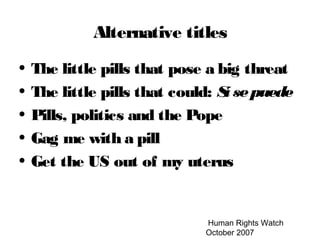
Alternative titles
• The little pills that pose a big threat
• The little pills that could: Sí sepuede
• Pills, politics and the Pope
• Gag me with a pill
• Get the US out of my uterus
Human Rights Watch
October 2007
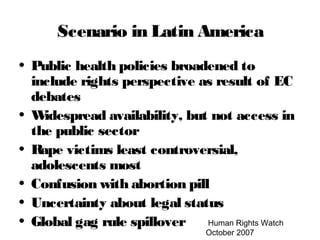
Scenario in Latin America
• Public health policies broadened to
include rights perspective as result of EC
debates
• Widespread availability, but not access in
the public sector
• Rape victims least controversial,
adolescents most
• Confusion with abortion pill
• Uncertainty about legal status
• Global gag rule spillover
Human Rights Watch
October 2007
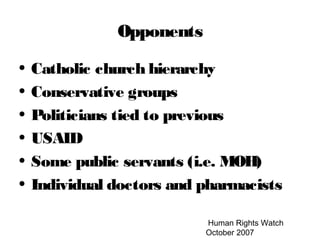
Opponents
• Catholic church hierarchy
• Conservative groups
• Politicians tied to previous
• USAID
• Some public servants (i.e. MOH)
• Individual doctors and pharmacists
Human Rights Watch
October 2007
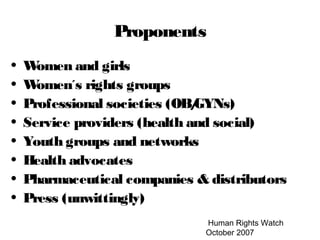
Proponents
• Women and girls
• Women´s rights groups
• Professional societies (OB/GYNs)
• Service providers (health and social)
• Youth groups and networks
• Health advocates
• Pharmaceutical companies & distributors
• Press (unwittingly)
Human Rights Watch
October 2007
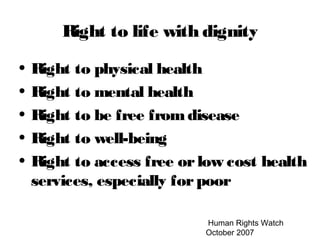
Right to life with dignity
• Right to physical health
• Right to mental health
• Right to be free fromdisease
• Right to well-being
• Right to access free orlow cost health
services, especially forpoor
Human Rights Watch
October 2007
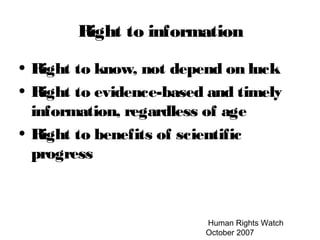
Right to information
• Right to know, not depend on luck
• Right to evidence-based and timely
information, regardless of age
• Right to benefits of scientific
progress
Human Rights Watch
October 2007
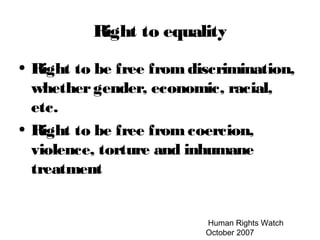
Right to equality
• Right to be free from discrimination,
whethergender, economic, racial,
etc.
• Right to be free from coercion,
violence, torture and inhumane
treatment
Human Rights Watch
October 2007
Right to autonomy
• Right to bodily integrity
• Right to privacy and confidentiality
• Right to decide if and when to have children and
space pregnancies
• Right to refuse treatment
• Right to liberty of conscience
Human Rights Watch
October 2007
Long-termObligations of the State
• Approve necessary laws (via reforms orproposals) in
health and justice systems
• Review criminal code; impose sanctions fornon-
compliance
• Evaluate fulfillment of laws through data collection
and analysis
• Establish referral system forcomplaint monitoring
• Redress grievances
• Ensure that rights violations are not repeated
• Reduce maternal morbidity and mortality
Human Rights Watch
October 2007
Immediate Obligations of the State
• Informthe general public and correct misinformation
• Disseminate evidence-based information
• Offerfree orlow cost services in the public sector
• Support public sectorproviders in service delivery
• Ensure that rape victims have priority access to EC as
part of package
• Respect adolescents’ rights to decision making while
protecting theirinterests
• Disallow funding conditionalities that restrict legal
service delivery and violate rights
• Teach comprehensive sexuality education in schools
• Distribute wide range of contraceptive supplies and info
• Provide access to safe abortion services, within law
Human Rights Watch
October 2007
Gracias
Contact information
www.hrw.org/women
heimbua@hrw.org
Faundes A, Tavara L, Brache V and Alvarez F. May 2007. Emergency
Contraception underAttackin Latin America: Response of the
Medical Establishment and Civil Society. Reproductive Health
Matters (15) 29: 130-8.
PROMSEX. 2007. Free Choice Restricted. USAID’s Reactionary
Policies and the case of Emergency Contraception in Peru.
www.promsex.org

Ec

  • 1.
    Angela Heimburger Americas Researcher,Women’s Rights Division Women Deliver Conference, London, October 19, 2007 EC Access UnderThreat Anoption, anecessity, aright*
  • 2.
    Human Rights Watch October2007 Alternative titles • The little pills that pose a big threat • The little pills that could: Sí sepuede • Pills, politics and the Pope • Gag me with a pill • Get the US out of my uterus
  • 3.
    Human Rights Watch October2007 Scenario in Latin America • Public health policies broadened to include rights perspective as result of EC debates • Widespread availability, but not access in the public sector • Rape victims least controversial, adolescents most • Confusion with abortion pill • Uncertainty about legal status • Global gag rule spillover
  • 4.
    Human Rights Watch October2007 Opponents • Catholic church hierarchy • Conservative groups • Politicians tied to previous • USAID • Some public servants (i.e. MOH) • Individual doctors and pharmacists
  • 5.
    Human Rights Watch October2007 Proponents • Women and girls • Women´s rights groups • Professional societies (OB/GYNs) • Service providers (health and social) • Youth groups and networks • Health advocates • Pharmaceutical companies & distributors • Press (unwittingly)
  • 6.
    Human Rights Watch October2007 Right to life with dignity • Right to physical health • Right to mental health • Right to be free fromdisease • Right to well-being • Right to access free orlow cost health services, especially forpoor
  • 7.
    Human Rights Watch October2007 Right to information • Right to know, not depend on luck • Right to evidence-based and timely information, regardless of age • Right to benefits of scientific progress
  • 8.
    Human Rights Watch October2007 Right to equality • Right to be free from discrimination, whethergender, economic, racial, etc. • Right to be free from coercion, violence, torture and inhumane treatment
  • 9.
    Human Rights Watch October2007 Right to autonomy • Right to bodily integrity • Right to privacy and confidentiality • Right to decide if and when to have children and space pregnancies • Right to refuse treatment • Right to liberty of conscience
  • 10.
    Human Rights Watch October2007 Long-termObligations of the State • Approve necessary laws (via reforms orproposals) in health and justice systems • Review criminal code; impose sanctions fornon- compliance • Evaluate fulfillment of laws through data collection and analysis • Establish referral system forcomplaint monitoring • Redress grievances • Ensure that rights violations are not repeated • Reduce maternal morbidity and mortality
  • 11.
    Human Rights Watch October2007 Immediate Obligations of the State • Informthe general public and correct misinformation • Disseminate evidence-based information • Offerfree orlow cost services in the public sector • Support public sectorproviders in service delivery • Ensure that rape victims have priority access to EC as part of package • Respect adolescents’ rights to decision making while protecting theirinterests • Disallow funding conditionalities that restrict legal service delivery and violate rights • Teach comprehensive sexuality education in schools • Distribute wide range of contraceptive supplies and info • Provide access to safe abortion services, within law
  • 12.
    Human Rights Watch October2007 Gracias Contact information www.hrw.org/women heimbua@hrw.org Faundes A, Tavara L, Brache V and Alvarez F. May 2007. Emergency Contraception underAttackin Latin America: Response of the Medical Establishment and Civil Society. Reproductive Health Matters (15) 29: 130-8. PROMSEX. 2007. Free Choice Restricted. USAID’s Reactionary Policies and the case of Emergency Contraception in Peru. www.promsex.org

Editor's Notes

  • #2 Title thanks to friend and colleague, Dr. Ana Guezmes, technical advisor to UNFPA in the Mexico office
  • #4 Start on positive note: in some countries, like Mexico, the introduction of EC and surrounding debates have actually served to broaden the focus of some public health policies to include specific argumentation based on a rights perspective, as Julio Frenk mentioned yesterday Increased availability– many dedicated products now available– but access now limited Includes notes about what percentage of pop depends on public sector services, especially poor and vulnerable populations like rape victims. Also in the course of other presentations at this conference, we have seen how Latin America is the region with the greatest discrepancies between the rich and poor, between urban and rural, and between racial and ethnic groups (i.e. afro-descendant and indigenous groups). Therefore, access in the public sector is absolutley crucial Adolescents pose a different challenge, even rural adolescents with money. Still a problem for adolescents because may not have identity cards, don’t want families to know, are discriminated against in services, are not “supposed” to be sexually active, pharmacy access is expensive
  • #5 Largely Catholic church, especially more conservative sectors like Opus Dei and Sodalicio Individual doctors or pharmacists may object conscientiously, if they truly have some personal conviction against the method. But this objection must not interfere with the patient’s treatment, and some one must be available immediately to dispense method. Some of the objection might be based on erroneous information, or convenient “moral” display in public to “save face” while profiting in private sector– doble discurso USAID resistance in Peru and Bolivia most notably
  • #7 Right to life is the overarching right that can be said to house social, cultural and economic rights such as the right to health Co-opted by the anti-choice groups as exclusive domain of fetal rights protectors; refer to pro-choice activists as promoters of a death culture Actually, right to life is one of the most basic civil rights that has prompted all kinds of traditional human rights campaigns against the death penalty, against torture, against arbitrary detention, etc.. Actually the right to health is a social, cultural and economic right that is firmly embedded within the right to life
  • #8 Protected in public sphere as part of transparency measures– right to public disclosure of information Unique woman-controlled method to prevent unwanted pregnancy after intercourse, forced or wanted– active measure to prevent a crisis and preserve health
  • #11 State has the OBLIGATION, not OPTION, to respect, protect and fulfill rights. Citizens are entitled to demand their rights. As Julio Frenk mentioned yesterday, States need to have clear priorities before strengthening systems. These priorities must be based on international human rights law and the States’ obligations to uphold them, even in the face of controversy and ongoing public debate Secular states must uphold secular laws. What is not expressly forbidden is permitted. Mejor pedir perdon que permiso Laws will never prescribe the list of medical service delivery do’s and don’ts– that is what norms, protocols and guidelines are for However, those standards always lag behind technology, so there will be a gap. Still, norms must be updated to state individual institutional policy, avoid confusion and support doctors and other health professionals in their decision making Very important that in the fight to reduce maternal deaths, we do not overlook maternal morbidity. Collectively we need to articulate or strengthen the argument unwanted pregnancies are part of maternal morbidity. While maternal mortality in the region may be declining and very small in absolute numbers, maternal morbidity is not declining, and actually includes a very large number of women with unwanted pregnancies, some of which are carried full term and others are not.
  • #12 Respect, protect and fulfill