(Ebook) Allen Physics JEE Module by ALLEN Experts Faculty
(Ebook) Allen Physics JEE Module by ALLEN Experts Faculty
(Ebook) Allen Physics JEE Module by ALLEN Experts Faculty
(Ebook) Allen Physics JEE Module by ALLEN Experts Faculty
(Ebook) Allen Physics JEE Module by ALLEN Experts Faculty
1.
Instant Ebook Access,One Click Away – Begin at ebooknice.com
(Ebook) Allen Physics JEE Module by ALLEN Experts
Faculty
https://ebooknice.com/product/allen-physics-jee-
module-47817378
OR CLICK BUTTON
DOWLOAD EBOOK
Get Instant Ebook Downloads – Browse at https://ebooknice.com
2.
Instant digital products(PDF, ePub, MOBI) ready for you
Download now and discover formats that fit your needs...
Start reading on any device today!
(Ebook) Allen Handbook of Physics for jee by Allen Kota
https://ebooknice.com/product/allen-handbook-of-physics-for-jee-36096844
ebooknice.com
(Ebook) Allen Class 11 Mathematics Module-4 by Allen
https://ebooknice.com/product/allen-class-11-mathematics-module-4-36096874
ebooknice.com
(Ebook) Allen Class 11 Inorganic Module by Allen Kota
https://ebooknice.com/product/allen-class-11-inorganic-module-36096948
ebooknice.com
(Ebook) Allen Class 11 Mathematics Module-3 by Allen Kota
https://ebooknice.com/product/allen-class-11-mathematics-module-3-36096864
ebooknice.com
3.
(Ebook) Allen Class11 Mathematics Module-2 by Allen Kota
https://ebooknice.com/product/allen-class-11-mathematics-module-2-36096916
ebooknice.com
(Ebook) Allen Chemistry Handbook for JEE/NEET by Allen
https://ebooknice.com/product/allen-chemistry-handbook-for-jee-neet-11212756
ebooknice.com
(Ebook) Allen Handbook of Mathematics For jee by Allen Kota
https://ebooknice.com/product/allen-handbook-of-mathematics-for-jee-36096846
ebooknice.com
(Ebook) ALLEN PHYSICS HANDBOOK FOR NEET by ALLEN
https://ebooknice.com/product/allen-physics-handbook-for-neet-28173346
ebooknice.com
(Ebook) Hydrocarbons Notes For IIT-JEE by Brij (Allen Chemistry HOD)
https://ebooknice.com/product/hydrocarbons-notes-for-iit-jee-49138800
ebooknice.com
5.
node06B0B0-BAKotaJEE(Advanced)NurturePhySheetUnit
&
Dimension,
Basic
Maths
and
VectorEng.p65
Unit & Dimension,Basic Maths and Vector
ALLEN 1
E
PHYSICAL QUANTITIES AND UNITS
Physical quantities :
All quantities that can be measured are called physical quantities. eg. time, length, mass, force, work
done, etc. In physics we study about physical quantities and their inter relationship.
Measurement :
Measurement is the comparison of a quantity with a standard of the same physical quantity.
Classification :
Physical quantities can be classified on the following bases :
I. Based on their directional properties
1. Scalars:The physical quantitieswhich have only magnitude but nodirection are called scalarquantities.
Ex. mass, density, volume, time, etc.
2. Vectors : The physical quantitieswhich have both magnitude and direction and obey laws of vector
algebra are called vector quantities. Ex. displacement, force, velocity, etc.
II. Based on their dependency
1. Fundamental or basequantities : A set of physical quantities which are completely independent of
each other and all other physical quantities can be expressed in terms of these physical quantities is
called Set of Fundamental Quantities.
2. Derived quantities : The quantities which can be expressed in terms of the fundamental quantities
are known as derived quantities. Ex. Speed (= distance/time), volume, acceleration, force, pressure,
etc.
Physical quantities can also be classified as dimensional and dimensionless quantities or constants
and variables.
Ex. Classify thequantities displacement, mass, force, time, speed, velocity, acceleration, moment of inertia,
pressure and work under the following categories :
(a) base and scalar (b) base and vector (c) derived and scalar (d) derived and vector
Ans. (a) mass, time (b) displacement (c) speed, pressure, work
(d) force, velocity, acceleration
Units of Physical Quantities
The chosen reference standard of measurement in multiples of which, a physical quantity is expressed
is called the unit of that quantity. Four basic properties of units are :
1. They must be well defined.
2. They should be easily available and reproducible.
3. They should be invariable e.g. step as a unit of length is not invariable.
4. They should be accepted to all.
System of Units :
1. FPS or British Engineering system :
In this system length, mass and time are taken as fundamental quantities and their base units are foot
(ft), pound (lb) and second (s) respectively.
KEY CONCEPT
UNIT & DIMENSION, BASIC MATHS AND VECTOR
6.
node06B0B0-BAKotaJEE(Advanced)NurturePhySheetUnit
&
Dimension,
Basic
Maths
and
VectorEng.p65
2 JEE-Physics ALLEN
E
2.CGS or Gaussian system :
In this system the fundamental quantities are length, mass and time and their respective units are
centimetre (cm), gram (g) and second (s).
3. MKS system :
In this system also the fundamental quantities are length, mass and time but their fundamental units
are metre (m), kilogram (kg) and second (s) respectively.
4. International system (SI) of units :
This system is modification over the MKS system and so it is also known as Rationalised MKS
system. Besides the three base units of MKS system four fundamental and two supplementary units
are also included in this system.
Classification of Units : The units of physical quantities can be classified as follows :
1. Fundamental or base units :
The units of fundamental quantities are called base units. In SI there are seven base units.
SI BASE QUANTITIES AND THEIR UNITS
S.No. Physical quantity SI unit Symbol
1. Length metre m
2. Mass kilogram kg
3. Time second s
4. Temperature Kelvin K
5. Electric current ampere A
6. Luminous intensity candela cd
7. Amount of substance mole mol
2. Derived units :
The units of derived quantities or the units that can be expressed in terms of the base units are called
derived units
Ex. Unit of speed =
1
unit of distance metre
ms
unit of time second
-
= =
Some derived units are named in honour of great scientists.
• Unit of force – newton (N) • Unit of frequency – hertz (Hz) etc.
UNITS OF SOME PHYSICAL QUANTITIES IN DIFFERENT SYSTEMS
Type of
Physical
Quantity
Physical
Quantity
CGS
(Originated in
France)
MKS
(Originated in
France)
FPS
(Originated in
Britain)
Length cm m ft
Mass g kg lb
Fundamental
Time s s s
Force dyne newton(N) poundal
Work or
Energy
erg joule(J) ft-poundal
Derived
Power erg/s watt(W) ft-poundal/s
7.
node06B0B0-BAKotaJEE(Advanced)NurturePhySheetUnit
&
Dimension,
Basic
Maths
and
VectorEng.p65
Unit & Dimension,Basic Maths and Vector
ALLEN 3
E
Dimensions :
Dimensions of a physical quantity are the powers (or exponents) to which the base quantities are
raised to represent that quantity. To make it clear, consider the physical quantity force. As we shall
learn later, force is equal to mass times acceleration. Acceleration is change in velocity divided by
time interval. Velocity is length divided by time interval. Thus,
force = mass × acceleration
= mass ×
velocity
time
= mass ×
length / time
time
= mass × length × (time)–2
Thus, the dimensions of force are 1 in mass, 1 in length and –2 in time. The dimensions in all other
base quantities are zero.
1. Dimensional formula :
The physical quantity that is expressed in terms of the base quantities is enclosed insquare brackets to
remind that the equation is amongthe dimensions and not among the magnitudes. Thusabove equation
may be written as [force]= MLT–2
.
Such an expression for a physical quantity in terms of the base quantities is called the dimensional
formula. Thus,the dimensional formula of force is MLT–2
. The two versions given beloware equivalent
and are used interchangeably.
(a) The dimensional formula of force is MLT–2
.
(b) The dimensions of force are 1 in mass, 1 in length and –2 in time.
The dimensional formula of any physical quantity isthat expression which represents how and which
of the base quantities are included in that quantity.
Ex. Dimensional formula of mass is [M1
L0
T0
] and that of speed (= distance/time) is [M0
L1
T–1
]
2. Applications of dimensional analysis :
(i) To convert a physical quantity from one system of units to the other :
This is based on a fact that magnitude of a physical quantity
remains same whatever system is used for measurement
i.e. magnitude = numeric value (n) ×
unit (u) = constant or n1
u1
= n2
u2
So if a quantity is represented by [Ma
Lb
Tc
]
n = numerical value in II system
M = unitofmass in I system
M = unitofmass in II system
L = unitoflengthin Isystem
L = unitof lengthinII system
T = unitof time inIsystem
T = unitof time inIIsystem
2
1
2
1
2
1
2
n = numerical value in Isystem
1
Then
a b c
1 1 1 1
2 1 1
2 2 2 2
u M L T
n n n
u M L T
é ù é ù é ù é ù
= =
ê ú ê ú ê ú ê ú
ë û ë û ë û ë û
Ex. 1m = 100 cm= 3.28 ft = 39.4 inch
(SI) (CGS) (FPS)
Ex. The acceleration due to gravity is 9.8 m s–2
. Give its value in ft s–2
Sol. As 1m = 3.2 ft 9.8 m/s2
= 9.8 × 3.28 ft/s2
= 32.14 ft/s2
» 32 ft/s2
Ex. Convert 1 newton (SI unit of force) into dyne (CGS unit of force)
Sol. The dimensional equation of force is [F] = [M1
L1
T–2
]
Therefore if n1
, u1
, and n2
, u2
corresponds to SI & CGS units respectively, then
n2
=
1 1 2
1 1 1
1
2 2 2
M L T
n
M L T
-
é ù é ù é ù
ê ú ê ú ê ú
ë û ë û ë û
= 1
2
kg m s
g cm s
-
é ù é ù é ù
ê ú ê ú ê ú
ë û ë û ë û
= 1 × 1000 × 100 × 1= 105
1 newton = 105
dyne.
8.
node06B0B0-BAKotaJEE(Advanced)NurturePhySheetUnit
&
Dimension,
Basic
Maths
and
VectorEng.p65
4 JEE-Physics ALLEN
E
Q.The value of Gravitational constant G in MKS system is 6.67 × 10⁻¹¹
N–m2
/kg2
.
What will be its value in CGS system ?
Ans. 6.67 × 10⁻⁸
cm3
/g s2
(ii) To check the dimensional correctness of a given physical relation :
If in a given relation, the terms on both the sides have the same dimensions, then the relation is
dimensionally correct. This is known as the principle of homogeneity of dimensions.
Ex. Check the accuracy of the relation T =
L
2
g
p for a simple pendulum using dimensional analysis.
Sol. The dimensions of LHS = the dimension of T = [M0
L0
T1
]
The dimensions of RHS =
1 2
dimensions of length
dimensions of acceleration
æ ö
ç ÷
è ø
(Q 2p is a dimensionless constant)
=
1 2
2
L
LT-
æ ö
ç ÷
è ø
= (T2
)1/2
= [T] = [ M0
L0
T1
]
Since the dimensions are same on both the sides, the relation is correct.
(iii) To derive relationship between different physical quantities :
Using the sameprinciple of homogeneity of dimensions new relations among physical quantities can
be derived if the dependent quantities are known.
Ex. It is known that the time of revolution T of a satellite around the earth depends on the universal
gravitational constant G, the mass of the earth M, and the radius of the circular orbit R. Obtain an
expression for T using dimensional analysis.
Sol. We have [T] = [G]a
[M]b
[R]c
[M]0
[L]0
[T]1
= [M]–a
[L]3a
[T]–2a
× [M]b
× [L]c
= [M]b–a
[L]c+3a
[T]–2a
Comparing the exponents
For [T] : 1 = –2a Þ a = –
1
2
For [M] : 0 = b – a Þ b = a = –
1
2
For [L] : 0 = c + 3a Þ c = –3a =
3
2
Putting the values we get T = G–1/2
M–1/2
R3/2
=
3
R
GM
So the actual expression is T =
3
R
2
GM
p
Limitations of this method :
(i) In Mechanics the formula for a physical quantity depending on more than three physical quantities
cannot be derived. It can only be checked.
(ii) This method can be used only if the dependency is of multiplication type. The formulae containing
exponential, trigonometrical and logarithmic functions can't be derived using this method. Formulae
containing more than one term which are added or subtracted like s = ut +at2
/2 also can't be derived.
9.
node06B0B0-BAKotaJEE(Advanced)NurturePhySheetUnit
&
Dimension,
Basic
Maths
and
VectorEng.p65
Unit & Dimension,Basic Maths and Vector
ALLEN 5
E
(iii) The relation derived fromthismethodgives noinformation about the dimensionlessconstants.
(iv) If dimensions are given, physical quantity may not be unique as many physical quantities have the
same dimensions.
(v) It gives no information whether a physical quantity is a scalar or a vector.
Units and Dimensionsof Physical Quantities
Quantity Common Symbol SI unit Dimension
Displacement s METRE (m) L
Mass m, M KILOGRAM (kg) M
Time t SECOND (s) T
Area A m2
L2
Volume V m3
L3
Density r kg/m3
M/L3
Velocity v, u m/s L/T
Acceleration a m/s2
L/T2
Force F newton (N) ML/T2
Work W joule (J) (=N – m) ML2
/T2
Energy E, U, K joule (J) ML2
/T2
Power P watt (W) (=J/s) ML2
/T3
Momentum p kg-m/s ML/T
Gravitational constant G N-m2
/kg2
L3
/MT2
Angle q, j radian
Angular velocity w radian/s T–1
Angular acceleration a radian/s2
T–2
Angular momentum L kg-m2
/s ML2
/T
Moment of inertia I kg-m2
ML2
Torque t N-m ML2
/T2
Angular frequency w radian/s T–1
Frequency v hertz (Hz) T–1
Period T s T
Young's modulus Y N/m2
M/LT2
Bulk modulus B N/m2
M/LT2
Shear modulus h N/m2
M/LT2
Surface tension S N/m M/T2
Coefficient of viscosity h N-s/m2
M/LT
Pressure P, p N/m2
, Pa M/LT2
Wavelength l m L
Intensity of wave I W/m2
M/T3
Temperature T KELVIN (K) K
Specific heat capacity c J/kg–K L2
/T2
K
Stefan's constant s W/m2
–K4
M/T3
K4
Heat Q J ML2
/T2
Thermal conductivity K W/m–K ML/T3
K
10.
node06B0B0-BAKotaJEE(Advanced)NurturePhySheetUnit
&
Dimension,
Basic
Maths
and
VectorEng.p65
6 JEE-Physics ALLEN
E
BasicMathematics used in physics
Plane–angle
It is measure of change in direction.
If a line rotates in a plane about one of its ends, the other end sweeps an arc.
Angle (q) between two orientation of the line is defined by ratio of the arc
length(s) to length of the line(r)
s
radian
r
q =
Angles measured in anticlockwise and clockwise directions are usually taken positive and negative
respectively.
Angle is measured in radians (rad) or degrees. One radian is the angle subtended at the centre of a
circle by an arc of the circle, whose length is equal to the radius of the circle.
p rad= 180° p= 3.1415 =
22
7
1°= 60'
(minute), 1' (minute) = 60"
(sec)
Example
Write expression for circumference of a circle of radius 'r'.
Solution
s = (Total angle about a point) r = 2pr
Trigonometrical ratios (or T–ratios)
Let two fixed lines XOX' and YOY' intersecting at right angles to each other at point O.
• Point O is called origin.
• Line XOX'
is known as x–axis and YOY'
as y–axis.
• Regions XOY, YOX'
, X'
OY'
and Y'
OX are called I, II, III and IV quadrant respectively.
Consider a line OP making angle q with OX as shown. Line PM
is perpendicular drawn from P on OX. In the right angled triangle
OPM, side OP is called hypotenuse, the side OM adjacent to angle
q is called base and the side PM opposite to angle q is called the
perpendicular.
Following ratios of the sides of a right angled triangle are known as
trigonometrical ratios or T-ratio
sin q =
perpendicular MP
hypotenuse OP
= cos q =
base OM
hypotenuse OP
= tan q =
perpendicular MP
base OM
=
cot q =
base OM
perpendicular MP
= sec q =
hypotenuse OP
base OM
= cosec q =
hypotenuse OP
perpendicular MP
=
1
cosec =
sin
q
q
1
sec
cos
q =
q
1
cot
tan
q =
q
Some trigonometric identities
sin2
q + cos2
q = 1 1 + tan2
q = sec2
q 1 + cot2
q = cosec2
q
11.
node06B0B0-BAKotaJEE(Advanced)NurturePhySheetUnit
&
Dimension,
Basic
Maths
and
VectorEng.p65
Unit & Dimension,Basic Maths and Vector
ALLEN 7
E
Example
Given sin q =
3
5
. Find all the other T–ratios, if q lies in the first quadrant.
Solution
In D OMP , sin q =
3
5
So MP = 3 and OP = 5 Q OM = 2 2
(5) (3)
- = 25 9
- = 16 = 4
Now cos q =
OM
OP
=
4
5
tan q =
MP
OM
=
3
4
cot q =
OM
MP
=
4
3
sec q =
OP
OM
=
5
4
cosec q =
OP
MP
=
5
3
T–ratios of some commonly used angles
0 rad
6
p
rad
4
p
rad
3
p
rad
2
p
rad
Angle (q)
0° 30° 45° 60° 90°
sin q 0
1
2
1
2
3
2
1
cos q 1
3
2
1
2
1
2
0
tan q 0
1
3
1 3 ¥
sin (180° sin
cos (180° cos
tan (180° tan
q q
q q
q q
)=
)=
)=
–
– –
– –
sin (180°+ )= sin
q
cos (180°+ )= cos
tan (180°+ )=tan
–
–
q
q q
q q
sin (360° )= sin
cos (360° )= cos
tan (360° )= tan
q q
q q
q q
– –
–
– –
sin ( )=-sin
cos ( )=cos
tan ( )= tan
–
–
– –
q q
q q
q q
sin (90°+ )=cos
cos (90°+ )= sin
tan (90°+ )= cot
q q
q q
q q
–
–
sin (90°– )=cos
cos (90° )=sin
tan (90° )=cot
q q
q q
q q
–
–
• When q is very small we can use following approximations : cos q » 1
sin
If
tan
is in radians
q qü
ý
q qþ
q
;
;
tan q » sin q.
• In the given right angled triangle we have very commonly used T-ratios
3
sin37
5
° =
4
cos37
5
° =
3
tan37
4
° =
3
5
4
37°
53°
4
sin 53
5
° =
3
cos53
5
° =
4
tan 53
3
° =
12.
node06B0B0-BAKotaJEE(Advanced)NurturePhySheetUnit
&
Dimension,
Basic
Maths
and
VectorEng.p65
8 JEE-Physics ALLEN
E
Example
Findthe value of (i) cos (–60°) (ii) tan 210° (iii) sin 300°
(iv) cos 120°
Solution
(i) cos (–60°) = cos 60° =
1
2
(ii) tan 210° = tan (180° + 30°) = tan 30° =
1
3
(iii) sin 300° = sin (270° + 30°) = – cos 30° =
3
2
-
(iv) cos 120° = cos (180° – 60°) = – cos60° = –
1
2
VECTORS
Precise description of laws of physics and physical phenomena requires expressing them in form of
mathematical equations. In doing so we encounter several physical quantities, some of them have
only magnitude and other have direction in addition to magnitude. Quantities of the former kind are
referred as scalars and the latter as vectors and mathematical operations with vectors are collectively
known as vector analysis.
Vectors
A vector has both magnitude and sense of direction, and follows triangle law of vector addition.
For example, displacement, velocity, and force are vectors.
Vector quantities are usually denoted by putting an arrow over the corresponding letter, as A
r
or a
r .
Sometimes in print work (books) vector quantities are usually denoted by boldface letters as A or a.
Magnitude of a vector A
r
is a positive scalar and written as A
r
or A.
Geometrical Representation of Vectors.
A vector is represented by a directed straight line, having the magnitude and direction of the quantity
represented by it.
e.g. if we want to represent a force of 5 N acting 45° N of E
(i) We choose direction coordinates.
(ii) We choose a convenient scale like 1 cm º 1N
(iii) We draw a line of length equal in magnitude and in the direction of
vector to the chosen quantity.
(iv) We put arrow in the direction of vector.
B
A
Magnitudeof vector:
B
A = 5N
By definition magnitude of a vector quantity is scalar and is always positive.
13.
node06B0B0-BAKotaJEE(Advanced)NurturePhySheetUnit
&
Dimension,
Basic
Maths
and
VectorEng.p65
Unit & Dimension,Basic Maths and Vector
ALLEN 9
E
3. TERMINOLOGY OF VECTORS
Parallel vector: If two vectors have same direction, they are parallel to each other. They may be
located anywhere in the space.
Antiparallel vectors: When twovectors are in oppositedirection they are said tobe antiparallel vectors.
Equality of vectors: When two vectors have equal magnitude and are in same direction and represent
the same physical quantity, they are equal.
i.e. b
a
r
r
=
Thus when two parallel vectors have same magnitude they are equal. (Their initial point & terminal
point may not be same)
Negative of a vector: When a vector have equal magnitude and is in opposite direction, it is said to be
negative vector of the former.
i.e. b
a
r
r
-
= or a
b
r
r
-
=
Thus when two antiparallel vectors have same magnitude they are negative of each other.
Remark : Vector shifting is allowed without change in their direction.
2. Angle Between two Vectors
It is the smaller angle formed when the initial points or the terminal points of the two vectors are
brought together. It should be noted that 0º £ q £ 180º .
3. Addition Of Vectors:
Parallelogram law of addition:
Steps:
(i) Keep two vectors such that there tails coincide.
(ii) Draw parallel vectors to both of them considering both of them as sides of a parallelogram.
(iii) Then the diagonal drawn from the point where tails coincide represents the sum of two vectors,
with its tail at point of coincidence of the two vectors.
14.
node06B0B0-BAKotaJEE(Advanced)NurturePhySheetUnit
&
Dimension,
Basic
Maths
and
VectorEng.p65
10 JEE-Physics ALLEN
E
(i)(ii) (iii) b
a
AC
r
r
+
=
Addition of more than two Vectors
The triangle law can be extended to define addition of more than two
vectors. Accordingly, if vectors to be added are drawn in head to tail
fashion, resultant is defined by a vector drawn from the tail of the first
vector to the head of the last vector. This is also known as the polygon
rule for vector addition.
Operation of addition of three vectors A, B
r r
and C
r
and their resultant P
r
are shown in figure.
A B C P
+ + =
r r
r r
Here it is not necessary that three or more vectors and their resultant are coplanar. In fact, the vectors
to be added and their resultant may be in different planes. However if all the vectors to be added are
coplanar, their resultant must also be in the same plane containing the vectors.
Subtraction of Vectors
A vector opposite in direction but equal in magnitude to another vector A
r
is known as negative
vector of A
r
. It is written as A
-
r
. Addition of a vector and its negative vector results a vector of zero
magnitude, which is known as a null vector. A null vector is denoted by arrowed zero ( )
0
r
.
The idea of negative vector explainsoperationof subtraction as addition of negative vector. Accordingly
to subtract a vector from another consider vectors A
r
and B
r
shown in the figure. To subtract B
r
from
A
r
, the negative vector – B
r
is added to A
r
according to the triangle law as shown in figure-II.
If two vectors a & b
r
r
are represented byOA & OB
uuur uuu
r
then theirsum a b
+
r
r
is a vector represented byOC
uuu
r
,
where OC is the diagonal of the parallelogram OACB.
• a b b a
+ = +
r r
r r
(commutative) • ( ) ( )
r r r r r r
a b c a b c
+ + = + + (associativity)
• a 0 a 0 a
+ = = +
r r
r r r
• ( ) ( )
a a 0 a a
+ - = = - +
r
r r r r
• | a b | | a | | b |
+ £ +
r r
r r
• | a b | || a | | b ||
- ³ -
r r
r r
• b
a
r
r
± = 2 2
| a | | b | 2 | a || b | cos
+ ± q
r r
r r
where q is the angle between the vectors
15.
node06B0B0-BAKotaJEE(Advanced)NurturePhySheetUnit
&
Dimension,
Basic
Maths
and
VectorEng.p65
Unit & Dimension,Basic Maths and Vector
ALLEN 11
E
Some Important Results :
(1) If q = 0° Þ b
||
a
r
r
then, |
b
|
|
a
|
|
R
|
r
r
r
+
= & |
R
|
r
is maximum
(2) If q = p Þ a
r
anti || b
r
then, |
b
|
|
a
|
|
R
|
r
r
r
-
= & |
R
|
r
is minimum
(3) If q = p/2 Þ a
r
^ b
r
R = 2
2
b
a +
& tan a = b/a (a is angle made by R
r
with a
r
)
(4) |
a
|
r
= |
b
|
r
= a
|
R
|
r
= 2acosq/2 & a = q/2
(5) If |
a
|
r
= |
b
|
r
= a & q = 120°
then |
R
|
r
= a
4. Multiplication Of A Vector By A Scalar:
Ifa
r
is avector & m is a scalar,then m a
r
isa vector parallelto a
r
whosemodulus is ½m½times that of a
r
.
Thismultiplication iscalled SCALAR MULTIPLICATION. If a
r
and b
r
are vectors & m, n are scalars, then:
m (a) (a) m ma
= =
r r r
m (na) n(ma) (mn)a
= =
r r r
(m n) a ma na
+ = +
r r r
m (a b) ma mb
+ = +
r r
r
Resolution of a Vector into Components
Following laws of vector addition, a vector can be represented as a sum of two (in two-dimensional
space) or three (in three-dimensional space) vectors each along predetermined directions. These
directions are called axes and parts of the original vector along these axes are called components of
the vector.
UNIT VECTOR:
A unit vector is a vector of magnitude of 1, with no units. Its only purpose is to point, i.e. to describe
a direction in space.
A unit vector in direction of vector A
r
is represented as Â
& Â =
|
A
|
A
r
r
or A
r
can be expressed in terms of a unit vector in its direction i.e. A
r
= Â
|
A
|
r
Unit Vectors along three coordinates axes:–
unit vector along x-axis is î
unit vector along y-axis is ĵ
unit vector along z-axis is k̂
16.
node06B0B0-BAKotaJEE(Advanced)NurturePhySheetUnit
&
Dimension,
Basic
Maths
and
VectorEng.p65
12 JEE-Physics ALLEN
E
Cartesiancomponents in two dimensions
If a vector is resolved into its components along mutually perpendicular
directions, the components are called Cartesian or rectangular
components.
In figure is shown, a vector A
r
resolved into its Cartesian components
x
A
r
and y
A
r
along the x and y-axis. Magnitudes Ax
and Ay
of these
components are given by the following equation.
Ax
=Acosq and Ay
= Asinq
x y
ˆ ˆ
A A i A j
= +
r
2 2
x y
A A A
= +
Here î and ĵ are the unit vectors for x and y coordinates respectively.
Mathematical operations e.g. addition, subtraction, differentiation and integration can be performed
independently on thesecomponents. This iswhy in most of the problems use of Cartesian components
becomes desirable.
Cartesian components in three dimensions
A vector A
r
resolved into its three Cartesian components one
along each of the directions x, y, and z-axis is shown in the figure.
x y z x y z
ˆ ˆ ˆ
A A A A A i A j A k
= + + = + +
r r r r
2 2 2
x y z
A A A A
= + +
Product of Vectors
In all physical situation, whose description involve product of two vectors, only two categories are
observed. One category where product is also a vector involves multiplication of magnitudes of two
vectors and sine of the angle between them, while the other category where product is a scalar involves
multiplication of magnitudes of two vectors and cosine of the angle between them. Accordingly, we
define two kinds of product operation. The former category is known as vector or cross product and
the latter category as scalar or dot product.
Scalar or dot product of two vectors
The scalar product of two vectors A
r
and B
r
equals to the product of
their magnitudes and the cosine of the angle q between them.
A B ABcos OA OB cos
× = q = × × q
r r
The above equation can also be written in the following ways.
( )
A B Acos B OP OB
× = q = ×
r r
( )
A B A Bcos OA OQ
× = q = ×
r r
17.
node06B0B0-BAKotaJEE(Advanced)NurturePhySheetUnit
&
Dimension,
Basic
Maths
and
VectorEng.p65
Unit & Dimension,Basic Maths and Vector
ALLEN 13
E
Above two equationsand figures, suggest a scalar product as product of magnitude of the one vector and
magnitude of the component of another vector in thedirection of the former vector.
KEY POINTS
• Dot product of two vectors iscommutative: A B B A
× = ×
r r
r r
• If two vectors are perpendicular, their dot product is zero. A B 0
× =
r r
,if A B
^
r r
• Dot product of a vector by itself is known asself-product. 2
A A A A A A
× = Þ = ×
r r r r
• The angle between the vectors 1 A B
cos
AB
- æ ö
×
q = ç ÷
è ø
r r
• (a) Component of A
r
indirection of B
r
( ) ( )
|||
A.B A.B
ˆ ˆ ˆ ˆ ˆ
A A cos B A B B A.B B
B
A B
æ ö æ ö
= q = = =
ç ÷ ç ÷
è ø è ø
r r
r r
r r r r
r r
r
(b) Component of A
r
perpendicular to B
r
: || |
A A A
^ = -
r r r
• Dot product of Cartesian unit vectors: ˆ ˆ ˆ ˆ ˆ ˆ
i i j j k k 1
ˆ ˆ ˆ ˆ
ˆ ˆ
i j j k k i 0
× = × = × =
× = × = × =
• If x y z
ˆ ˆ ˆ
A A i A j A k
= + +
r
and x y z
ˆ ˆ ˆ
B B i B j B k
= + +
r
, their dot product is given by
x x y y z z
A B A B A B A B
× = + +
r r
Solved Examples
1. Two displacementvectors of same magnitudeare arranged in thefollowing manner
(I) 1200
(II) 300
(III) 900
(IV) 450
Magnitudeof resultantismaximumfor
(A) case I (B) case II (C) case III (D) case IV
Ans. (B)
Sol. Magnitude of Resultantof A
r
and B
r
= 2 2
A B 2ABcos
+ + q which ismaximum for 0
30
q =
2. Two vectors
r
P and
r
Q areadded, the magnitude ofresultant is 15 units.If
r
Q isreversed and added to
r
P
resultant has a magnitude 113 units. The resultantof
r
P and a vector perpendicular to
r
P and equal in
magnitude to
r
Q hasa magnitude
(A) 13 units (B) 17 units (C) 19 units (D) 20 units
Ans. (A)
18.
node06B0B0-BAKotaJEE(Advanced)NurturePhySheetUnit
&
Dimension,
Basic
Maths
and
VectorEng.p65
14 JEE-Physics ALLEN
E
Sol.P2
+ Q2
+ 2PQcosq = 225 ...(i)
P2
+ Q2
– 2PQcosq = 113 ...(ii)
By adding (i) & (ii) 2(P2
+Q2
) = 338
R=15
Q
P
-Q
Ö
1
1
3
P
P2
+ Q2
= 169 2 2
13
P Q
Þ + =
3. Three forces are acting on a body to make it in equilibrium, which set can not do it?
(A) 3 N, 3 N, 7 N (B) 2 N, 3 N, 6 N (C) 2 N, 1 N, 1 N (D) 8 N, 6 N, 1 N
Ans. (A, B, D)
Sol. They must form a triangle. (a + b ³ c)
4. Keeping one vector constant, if direction of other to be addedin the first vectoris changed continuously,
tip of the resultant vector describes a circle. In the following figure vector
r
a is kept constant. When
vector
r
b added to r
a changes its direction, the tip of the resultant vector = +
r
r r
r a b describes circle of
radius b with its center at the tip of vector a
r
. Maximum angle between vector a
r
and the resultant
= +
r
r r
r a b is
r
b
a
q
(A)
1
tan
b
r
- æ ö
ç ÷
è ø (B)
1
2 2
tan
b
a b
- æ ö
ç ÷
è ø
-
(C) cos–1
(r/a) (D) cos–1
(a/r)
Ans. (A,B,C)
Sol.
r
Angle between r
r and b
r
is maximum when r
r is tangent to circle.
5. If ˆ ˆ ˆ
A 2i j k
= + +
r
and ˆ ˆ ˆ
B 10i 5j 5k
= + +
r
, if the magnitude of component of ( )
B A
-
r
r
along A
r
is 4 x .
Then x will be.
Ans. 6
Sol. ( )
ˆ ˆ ˆ
r B A 4 2i j k
= - = + +
r
r
( )
4 4 1 1
r.A
r cos 4 6
A 6
+ +
q = = =
r
r
x = 6
6. The component of ˆ ˆ ˆ
A i j 5k
= + +
r
perpendicular to ˆ ˆ
B 3i 4j
= +
r
is
(A)
4 3
ˆ ˆ ˆ
i j 5k
25 25
- + + (B)
8 6
ˆ ˆ ˆ
i j 5k
25 25
- - + (C)
4 3
ˆ ˆ ˆ
i j 5k
25 25
- + (D)
8 6
ˆ ˆ ˆ
i j 5k
25 25
+ - +
Ans. (C)
19.
node06B0B0-BAKotaJEE(Advanced)NurturePhySheetUnit
&
Dimension,
Basic
Maths
and
VectorEng.p65
Unit & Dimension,Basic Maths and Vector
ALLEN 15
E
Sol. q
A
Acosq
B
||
A B
A Acos A
AB
æ ö
×
= q = ç ÷
è ø
r r
r
A B 3 4 7
B 5 5
× +
= = =
r r
( )
||
ˆ ˆ
7 3i 4j 7 ˆ ˆ
A 3i 4j
5 5 25
æ ö
+
= = +
ç ÷
ç ÷
è ø
r
||
21 28
ˆ ˆ
A i j
25 25
= +
r
( ) 21 28
ˆ ˆ ˆ ˆ
ˆ
A i j 5k i j
25 25
^
æ ö
= + + - +
ç ÷
è ø
r
=
4 3
ˆ ˆ ˆ
i j 5k
25 25
- +
ALGEBRA : SOME USEFUL FORMULAE
Quadratic equation and its solution
An algebraic equation of second order (highest power of the variable is equal to 2) iscalled aquadratic
equation. General quadratic equation is ax2
+ bx + c = 0. The general solution of the above quadratic
equation or value of variable x is x =
2
b b 4ac
2a
- ± -
Þ
2 2
1 2
b b 4ac b b 4ac
x and x
2a 2a
- + - - - -
= =
Example
Solve 2x2
+ 5x – 12 = 0
Solution
By comparison with the standard quadratic equation a = 2, b = 5 and c = –12
x =
2
5 (5) 4 2 ( 12)
2 2
- ± - ´ ´ -
´
=
5 121
4
- ±
=
5 11
4
- ±
=
6
4
+
,
16
4
-
Þ x =
3
2
, – 4
Binomial approximation
In case, x is very small, then terms containing higher powers of x can be neglected. In such a case,
(1 + x)n
= 1 + nx
Also (1 + x)–n
= 1–nx and (1 – x)n
=1–nx and (1 – x)–n
= 1 + nx
20.
node06B0B0-BAKotaJEE(Advanced)NurturePhySheetUnit
&
Dimension,
Basic
Maths
and
VectorEng.p65
16 JEE-Physics ALLEN
E
ExponentialExpansion
ex
= 1 + x +
2 3
x x
........
2! 3!
+ + and e–x
= 1 – x +
2 3
x x
........
2! 3!
- +
Componendo and dividendo theorem :
If
p a
q b
= then by componendo and dividendo theorem
p q a b
p q a b
+ +
=
- -
Determinant
a b
D ad bc
c d
= = - , For example
3 3 2 4
12 , 6
5 1 3 3
- -
= = -
- -
D =
1 2 3
1 2 3
1 2 3
a a a
b b b
c c c
3 3
2 1 1 2
1 2 3
3 3
2 1 1 2
b b
b b b b
a a a
c c
c c c c
= - +
Example
5 4 3
2 1 6
7 8 9
+ - +
1 6 2 6 2 1
5 4 3
8 9 7 9 7 8
= - + = 5 (9 – 48) – 4(18 – 42) + 3(16–7) = –72
Logarithm
loge
x = ln x (base e) log x = log10
x (base 10)
(a) Product formula log mn = log m + log n (b) Quotient formula
m
log =
n
logm – logn
(c) Power formula log mn
= n log m
GEOMETRY : SOME USEFUL FORMULAE
Formulae for determination of area :
• Area of a square = (side)2
• Area of rectangle = length × breadth
• Area of a triangle = (1/2) × base × height
• Area of a trapezoid =(1/2) × (distance between parallel sides) × (sum of parallel sides)
• Area enclosed by a circle = pr2
(where r = radius)
• Area of a sector a circle = 2
1
2
r
q (where r =is radius and q isangle subtended ata centre)
• Area of ellipse = p ab (where a and b are semi major and semi minor
axis respectively)
• Surface area of a sphere = 4pr2
(where r = radius)
• Area of a parallelogram = base × height
• Area of curved surface of cylinder = 2prl (where r = radius and l = length)
21.
node06B0B0-BAKotaJEE(Advanced)NurturePhySheetUnit
&
Dimension,
Basic
Maths
and
VectorEng.p65
Unit & Dimension,Basic Maths and Vector
ALLEN 17
E
• Area of whole surfaceof cylinder = 2pr(r + l) (where l = length)
• Surface area of a cube = 6(side)2
• Total surface area of a cone = pr2
+prl [where prl = pr 2 2
r h
+ = lateral area (h=height)]
Formulae for determination of volume :
• Volume of a rectangular slab = length × breadth × height = abt
• Volume of acube = (side)3
• Volume of a sphere =
4
3
p r3
(where r = radius)
• Volume of a cylinder = p r2
l (where r = radius and l = length)
• Volume of acone =
1
3
p r2
h (where r = radius and h = height)
22.
node06B0B0-BAKotaJEE(Advanced)NurturePhySheetUnit
&
Dimension,
Basic
Maths
and
VectorEng.p65
18 JEE-Physics ALLEN
E
EXERCISE(S-1)
Units & Dimensions
1. Aparticleisinaunidirectionalpotentialfieldwherethepotentialenergy(U)ofaparticledependsonthex-
coordinate given by Ux
= k (1 –cos ax) & kand 'a' areconstants. Find thephysical dimensions of 'a'& k.
UD0001
2. The equation for the speed of sound in a gasstates that /
B
v k T m
= g . Speed v is measured in m/s, g is
a dimensionlessconstant, T is temperature in kelvin (K), and m is mass inkg. Find the SI unit for the
Boltzmann constant, kB
?
UD0002
3. Thetimeperiod(T)of aspringmasssystemdependsuponmass(m)&springconstant(k)&lengthofthe
spring (l)
Force
k
length
é ù
=
ê ú
ë û
. Find the relationamong T, m, l& k using dimensional method.
UD0003
4. Thedistancemovedbyaparticleintimetfromcentreofaringundertheinfluenceofitsgravityisgivenby
x = a sinwt, where a & ware constants. If wisfound to depend on the radius of the ring (r), its mass (m)
and universalgravitationalconstant (G). Usingdimensional analysisfind anexpressionfor wintermsofr,
mandG.
UD0004
5. A satellite isorbiting around a planet. Its orbital velocity (v0
) is foundto depend upon
(A) Radiusof orbit (R)
(B) Mass of planet (M)
(C) Universalgravitationconstant (G)
Usingdimensionalanalysisfindanexpressionrelatingorbitalvelocity(v0
)totheabovephysicalquantities.
UD0005
6. Assume thatthe largest stone ofmass'm' that canbe moved by aflowing river depends upon the velocity
of flow v, the density d & the acceleration due to gravity g. If 'm'varies as the Kth
power of the velocity of
flow, then findthevalueofK.
UD0006
7. Given
a
F
t
=
r
r
wheresymbolshavetheir usualmeaning. Thedimensionsofais.
UD0007
23.
node06B0B0-BAKotaJEE(Advanced)NurturePhySheetUnit
&
Dimension,
Basic
Maths
and
VectorEng.p65
Unit & Dimension,Basic Maths and Vector
ALLEN 19
E
Addition of vectors
8. A blockis appliedtwo forcesof magnitude 5N each. Oneforce is actingtowards East and theother acting
along 60°North of East. The resultant of the two forces (in N) isof magnitude :-
UD0008
9. Two forcesact on a particlesimultaneously as shown inthe figure. Find netforce in milli newton on the
particle. [Dyneis the CGS unit of force]
100 dyne
1.0 mili newton
60°
UD0009
10. Themaximumandminimummagnitudesoftheresultantoftwoforcesare35Nand5Nrespectively.Find
the magnitude ofresultant force when act orthogonally to each other.
UD0010
11. Three forcesof magnitudes 2 N, 3 N and 6 N act at cornersof a cube along three sides as shown in figure.
Find theresultant of these forcesin N.
3N
2N
6N
UD0011
Resolution of vectors and unit vector
12. The farmhouse shown in figure has rectangular shape and has sides parallel to the chosen x and y axes.
The position vector of corner A is 125 m at 53° and corner Cis 100 m at37° from x axis.Find the length
ofthefencingrequiredinmeter.
B
A
C
D
53°
37°
y
x
UD0012
13. Vector B hasx, y and z components of 4.00, 6.00 and 3.00 units, respectively. Calculatethe magnitude of
B and the angles that B makes with the coordinates axes.
UD0013
24.
node06B0B0-BAKotaJEE(Advanced)NurturePhySheetUnit
&
Dimension,
Basic
Maths
and
VectorEng.p65
20 JEE-Physics ALLEN
E
14.ThreeantsP, QandRarepulling agrain with forcesof magnitude6N, 3 3N and 3 2N asshowninthe
figure. Findthe magnitude of resultantforce (in N) actingon the grain.
R
P
30°
45°
3 3N
Ö
y
Q
6N
x
3 2N
Ö
UD0014
15. Three boys are pushing horizontally a box placedon horizontal table. One is pushing towardsnorth with a
5 3N force. The second is pushing towards east and third pushes with a force 10 N such that the box is
in equilibrium. Findthemagnitude of theforce, second boy isapplying innewton.
UD0015
Scalar product of vectors
16. Consider the two vectors : k̂
3
j
ˆ
2
î
1
L +
+
=
r
and k̂
6
j
ˆ
5
î
4 +
+
=
l
r
. Find the value of the scalar a such
that the vector l
r
r
a
-
L is perpendicular to L
r
. UD0016
17. Find components of vector ˆ
ˆ ˆ 3
a i j k
= + +
r
indirectionsparallel toand perpendicular to vector ˆ ˆ
b i j
= +
r
.
UD0017
18. (a) Calculate c
b
a
r
r
r
r
r
+
-
= where k̂
6
j
ˆ
4
î
5
a -
+
=
r
, k̂
3
ĵ
2
î
2
b +
+
-
=
r
and k̂
2
ĵ
3
î
4
c +
+
=
r
.
(b) Calculate the angle between r
r
and the z-axis.
(c) Find theangle between b
and
a
r
r
UD0018
19. If the velocity ofa particle is ( ˆ ˆ ˆ
2i 3j 4k
+ - ) and its accelerationis ( ˆ ˆ ˆ
i 2j k
- + + ) and angle between them
is
n
4
p
. The valueof n is. UD0019
Method of approximation
20. Quito, a city in Ecuador and Kampala, a city situatedin Uganda both lieon the Equator. The longitude of
Quito is 82°30' W and that of Kampala is 37°30' E. Whatis the distance from Quito to Kampala.
(a) along the shortest surface path
(b) along a direct(through-the-Earth) path? (Theradius of theEarth is 6.4 ×10⁶
m) UD0020
21. Usethe approximation ( )
1 1 , 1
n
x nx x
+ » + << , to find approximatevalue for
(a) 99 (b)
1
1.01
UD0021
22. Use thesmall angle approximations to find approximate values for (A) sin 8° and(B) tan 5°
UD0022
25.
node06B0B0-BAKotaJEE(Advanced)NurturePhySheetUnit
&
Dimension,
Basic
Maths
and
VectorEng.p65
Unit & Dimension,Basic Maths and Vector
ALLEN 21
E
EXERCISE (S-2)
1. The equation ofstatefor a realgas at high temperature isgivenby
( )
1/2
nRT a
P
V b T V V b
= -
- +
wheren,P,
V & T are number of moles, pressure, volume & temperature respectively & R is the universal gas
constant. Find thedimensions of constant a in the above equation.
UD0023
2. If Energy (E), velocity (v) and time (T) are fundamental units. What will be the dimensionof surface
tension?
UD0024
3. In system called the star system we have 1 star kilogram = 1020
kg. 1starmeter = 108
m,
1 starsecond = 103
s then calculate the value of 1 joule inthis system.
UD0025
4. A vector A
r
of length 10 units makes an angle of 60° with the vector B
r
of length 6 units. Find the
magnitude of thevector difference A B
-
r r
&the angle it makeswith vector A
r
.
UD0026
5. A bird is at a point P (4, –1, –5) andsees two points P1
(–1, –1, 0) and P2
(3, –1, –3). Attime t = 0,it starts
flying with aconstant speed of 10 m/sto be in linewith pointsP1
andP2
inminimum possibletimet. Find
t, if allcoordinatesarein kilometers.
UD0027
6. In the figure, F1
and F2
, the twounknown forces give a resultant force of 80 3 Nalong the y–axis. It is
requiredthat F2
musthave minimum magnitude. Find themagnitudesof F1
and F2
.
q
30°
F2
x
y
F1
UD0028
7. A particle isdisplaced from A º (2, 2, 4) to B º (5, –3, –1). A constant forceof 34 N actsin the direction
of AP
r
, where P º (10, 2, –11). (Coordinates are in m).
(i) Find the F
r
. (ii) Find the work done by theforce to cause the displacement.
UD0029
26.
node06B0B0-BAKotaJEE(Advanced)NurturePhySheetUnit
&
Dimension,
Basic
Maths
and
VectorEng.p65
22 JEE-Physics ALLEN
E
EXERCISE(O-1)
SINGLE CORRECT TYPE QUESTIONS
Units & Dimensions
1. The dimensional formula for which of the following pair is not the same
(A) impulse and momentum (B) torque and work
(C) stress and pressure (D)momentumandangularmomentum
UD0030
2. Which of thefollowing can be a setof fundamentalquantities
(A)length,velocity,time (B)momentum,mass,velocity
(C) force,mass, velocity (D)momentum,time,frequency
UD0031
3. Which of thefollowing functions of Aand B may be performedif A and Bpossess different dimensions?
(A)
A
B
(B) A + B (C) A – B (D) None
UD0032
4. The velocity v of a particle at time t is given by v = at +
b
t c
+
, where a, b and c are constants. The
dimensions of a, b and c are respectively :–
(A) LT–2
, Land T (B) L2
, T and LT2
(C) LT2
, LT and L (D) L, LT and T2
UD0033
5. If area (A), velocity (v), and density (r) are base units, then the dimensional formula of force can be
represented as :-
(A)Avr (B)Av2
r (C) Avr2
(D)A2
vr
UD0034
6. Density of wood is 0.5 g/ ccin the CGS system of units. The correspondingvalue in MKS unitsis :-
(A) 500 (B) 5 (C) 0.5 (D) 5000
UD0035
7. In a book, the answer for a particular question is expressed as
2
1
ma k
b
k ma
é ù
= +
ê ú
ë û
l
here m represents
mass, a represents acceleration, l represents length. The unit of b should be :-
(A) m/s (B)m/s2
(C) meter (D) /sec
UD0036
8. The frequency f of vibrations of a mass m suspended from a spring of spring constant k is given by
f=Cmx
ky
, where C is a dimensionless constant. The values of x and y are, respectively
(A)
1
2
,
1
2
(B)
1 1
,
2 2
- - (C)
1 1
,
2 2
- (D)
1 1
,
2 2
-
UD0037
27.
node06B0B0-BAKotaJEE(Advanced)NurturePhySheetUnit
&
Dimension,
Basic
Maths
and
VectorEng.p65
Unit & Dimension,Basic Maths and Vector
ALLEN 23
E
9. Ifforce,accelerationandtimearetakenasfundamentalquantities,thenthedimensionsoflengthwillbe:
(A) FT2
(B) F–1
A2
T–1
(C) FA2
T (D)AT2
UD0038
10. Inaparticularsystemtheunitsoflength,massandtimearechosentobe10cm,10g and0.1srespectively.
The unitof force in thissystem will be equalto :-
(A) 0.1 N (B) 1 N (C) 10 N (D) 100 N
UD0039
11. The units of three physical quantities x, y and z are gcm2
s–5
, gs–1
and cms–2
respectively. The relation
among the units of x, y and z is :-
(A) z = x2
y (B) y2
= xz (C) x = yz2
(D) x = y2
z
UD0040
12. The angle subtended by the moon's diameter at a point on the earth is about 0.50°. Use this and the fact
that themoon is about 384000 km away to find the approximate diameter of the moon.
D
q
rm
D
(A) 192000 km (B) 3350 km (C) 1600 km (D) 1920 km
UD0041
13. Statement 1 : Method ofdimensions cannot tell whether anequation is correct.
and
Statement 2 : A dimensionally incorrect equation may be correct.
(A) Statement-1 is true, statement-2 is true and statement-2 is correct explanation for statement-1.
(B) Statement-1 is true, statement-2 is true and statement-2 is NOT the correct explanation for
statement-1.
(C) Statement-1 is true, statement-2 is false.
(D) Statement-1 isfalse, statement-2 is true.
UD0042
14. Theequation of thestationarywave is
2 ct 2 x
y 2Asin cos
p p
æ ö æ ö
= ç ÷ ç ÷
l l
è ø è ø
whichofthefollowingstatementis
wrong?
(A) The unit of ct is same as that of l. (B) The unit of x is same as that of l.
(C) The unit of
2 c
p
l
is same asthat of
2 x
t
p
l
(D) The unit of
c
l
is same as that of
x
l
UD0043
15. Due tosome unknown interaction, forceF experienced by aparticle is givenbythe following equation.
3
A
F r
r
= -
r r
Where A ispositive constant and r distance of theparticlefrom origin of acoordinate system. Dimensions
of constant A are :-
(A) ML2
T–2
(B) ML3
T–2
(C) ML4
T–2
(D) ML0
T0
UD0044
28.
node06B0B0-BAKotaJEE(Advanced)NurturePhySheetUnit
&
Dimension,
Basic
Maths
and
VectorEng.p65
24 JEE-Physics ALLEN
E
Additionof vectors
16. Three concurrent forces of the same magnitude are in equilibrium. What is the angle between the force?
Also name thetriangle formed by the forceas sides :-
(A) 60°equilateraltriangle (B) 120°equilateraltriangle
(C) 120°, 30°, 30° an isosceles triangle (D) 120° anobtuse angled triangle
UD0045
17. The resultant of two forces, one double the other in magnitude is perpendicular to the smaller of the two
forces. The angle between two forces is :-
(A) 150° (B) 90° (C) 60° (D) 120°
UD0046
18. Theresultantoftwoforcesacting atanangleof120°is10kgwtandisperpendiculartooneoftheforces.
Thatforceis:
(A) 10 3 kg wt (B) 20 3 kg wt (C) 10 kg wt (D)
10
3
kg wt
UD0047
19. If the resultant of two forces of magnitudes P and Q acting at a point at an angle of 60° is Ö7 Q, then
P/Q is :-
(A) 1 (B)
3
2
(C) 2 (D) 4
UD0048
20. There are two force vectors, one of 5N and other of 12N at what angle the two vectors beadded to get
resultant vector of 17N, 7N and 13N respectively.
(A) 0°, 180° and 90° (B) 0°, 90° and 180°
(C) 0°, 90° and 90° (D) 180°, 0° and 90°
UD0049
21. A body placed in free space, is simultaneously acted upon bythreeforces 1
F
r
, 2
F
r
and 3
F
r
. The body isin
equilibrium and the forces 1
F
r
and 2
F
r
are known to be 36 N due north and 27 N due east respectively.
Whichof the following best describes the force 3
F
r
?
(A) 36 N due south. (B) 53 N due 60° south of east
(C) 45 N due 53° south of west (D) 45 N due 37° north of west
UD0050
22. Theratio of maximum and minimum magnitudes of the resultant of two vectors A
r
and B
r
is3 : 2. The
relationbetweenA and Bis
(A) A = 5B (B) 5A = B (C) A = 3B (D) A = 4B
UD0051
23. Find the resultant ofthe following twovectors A
r
and B
r
.
A
r
: 40 units due east and ; B
r
: 25 units 37° northof west
(A) 25 units37° north of west (B) 25 units 37° north of east
(C) 40 units 53° north of west (D) 40 units 53° north of east
UD0052
29.
node06B0B0-BAKotaJEE(Advanced)NurturePhySheetUnit
&
Dimension,
Basic
Maths
and
VectorEng.p65
Unit & Dimension,Basic Maths and Vector
ALLEN 25
E
24. Two vectors a
r and b
r
add togive a resultant c a b
= +
r
r r . In which ofthesecases angle between a
r and b
r
is maximum: (a, b, c represent the magnitudesof respective vectors)
(A) c = a + b (B) c2
= a2
+ b2
(C) c = a – b (D) cannot bedetermined
UD0053
25. If the angle between the unit vectors â and b̂ is 60°, then ˆ
â b
- is :-
(A) 0 (B) 1 (C) 2 (D) 4
UD0054
26. A man moves towards 3 m north then 4 m towards east and finally 5 m towards 37° south of west. His
displacementfromoriginis:-
(A) 5Ö2m (B)0m (C) 1 m (D) 12 m
UD0055
Resolution of vectors and unit vector
27. The projection of a vector, ˆ
ˆ ˆ
3 2
r i j k
= + +
r
, on the x–y plane hasmagnitude :–
(A) 3 (B) 4 (C) 14 (D) 10
UD0056
28. A birdmoves from point (1, –2) to (4, 2). If the speed of the bird is 10m/s, then the velocity vector of the
birdis
(A) ( )
ˆ ˆ
5 2
i j
- (B) ( )
ˆ ˆ
5 4 2
i j
+ (C) ˆ
0.6 0.8
i j
+ (D) ˆ ˆ
6 8
i j
+
UD0057
29. Personnel at anair post control tower track a UFO. At11:02 am it waslocated at position Aand at 11:12
am is was located at position B. Displacement vector of UFO is :
37°
53°
E
z
y
N 1200m
800m
1000m
2000m
x
A
B
(A) k̂
400
ĵ
2200
î
400 +
+ (B) k̂
800
ĵ
1000
î
1200 +
+
(C) k̂
2000
ĵ
2200
î
2000 +
+ (D) k̂
400
j
ˆ
1000
î
400 +
+
UD0058
30. A person pushes a box kept on a horizontal surface with force of 100N. In unit vector notation force F
r
can be expressed as :
45°
y
x
F
(A) 100 )
j
ˆ
î
( + (B) 100 )
j
ˆ
î
( - (C) 2
50 )
j
ˆ
î
( - (D) 2
50 )
j
ˆ
î
( +
UD0059
30.
node06B0B0-BAKotaJEE(Advanced)NurturePhySheetUnit
&
Dimension,
Basic
Maths
and
VectorEng.p65
26 JEE-Physics ALLEN
E
31.For thegiven vector ˆ ˆ ˆ
A 3i 4j 10k
= - +
r
, theratio of magnitudeof its componenton the x-y planeand the
component on z–axis is :-
(A) 2 (B)
1
2
(C) 1 (D) None
UD0060
32. Afterfiring,abulletisfoundtomoveatan angleof37°to horizontal. Itsaccelerationis10m/s2
downwards.
Find thecomponentof acceleration in the directionof the velocity.
(A) – 6 m/s2
(B) – 4 m/s2
(C) – 8 m/s2
(D) – 5 m/s2
UD0061
Scalar product of vectors
33. In a methane (CH4
) molecule each hydrogen atom is at acorner of a regular tetrahedron with the carbon
atom at thecentre. In coordinates where oneof theC–H bonds is in the direction of k̂
j
ˆ
î +
+ ,anadjacent
C–H bondin the k̂
j
ˆ
î -
- direction. Then angle between these two bonds :-
(A) cos–1 ÷
ø
ö
ç
è
æ
-
3
2
(B) cos–1 ÷
ø
ö
ç
è
æ
3
2
(C) cos–1 ÷
ø
ö
ç
è
æ
-
3
1
(D) cos–1 ÷
ø
ö
ç
è
æ
3
1
UD0062
34. If a
r
and b
r
are two unit vectors suchthat b
a
r
r
2
+ and b
a
r
r
4
5 - are perpendicular to each other then the
angle between a
r
and b
r
is :-
(A) 45° (B) 60° (C) cos-1
÷
ø
ö
ç
è
æ
3
1
(D) cos-1
÷
ø
ö
ç
è
æ
7
2
UD0063
35. Thevelocity ofaparticleis ˆ ˆ ˆ
v 6i 2j 2k
= + -
r
.Thecomponentofthevelocityofaparticleparalleltovector
ˆ ˆ ˆ
a i j k
= + +
r
is :-
(A) ˆ ˆ ˆ
6i 2 j 2k
+ + (B) ˆ ˆ ˆ
2i 2 j 2k
+ + (C) ˆ ˆ ˆ
i j k
+ + (D) ˆ ˆ ˆ
6i 2 j 2k
+ -
UD0064
36. A particle moves from a position ˆ ˆ ˆ
3i 2j 6k
+ - to a position + +
ˆ ˆ ˆ
14i 13j 9k inm and a uniformforce of
ˆ ˆ ˆ
4i j 3k
+ + N acts on it. The work done by the forceis :-
(A) 200 J (B) 100 J (C) 300 J (D) 500 J
UD0065
37. Which ofthe followingis perpendicularto ˆ
ˆ ˆ
i j k
- - ?
(A) ˆ
ˆ ˆ
i j k
+ + (B) ˆ
ˆ ˆ
i j k
- + + (C) ˆ
ˆ ˆ
i j k
+ - (D) noneof these
UD0066
MULTIPLE CORRECT TYPE QUESTIONS
38. Which of the following statements about the sum ofthe two vectors A
r
and B
r
, is/are correct?
(A) A B A B
+ £ +
r r
(B) A B A B
+ ³ +
r r
(C) A B A B
+ ³ -
r r
r r
(D) + ³ -
r r
A B A B
UD0067
31.
node06B0B0-BAKotaJEE(Advanced)NurturePhySheetUnit
&
Dimension,
Basic
Maths
and
VectorEng.p65
Unit & Dimension,Basic Maths and Vector
ALLEN 27
E
39. Priyasaysthatthesumoftwovectorsbytheparallelogrammethodis ˆ
5
R i
=
r
.Subhangisaysitis ˆ ˆ
4
R i j
= +
r
.
Both used the parallelogram method, but one used the wrong diagonal. Which one of the vector pairs
below contains theoriginal two vectors?
(A) ˆ ˆ
3 2
A i j
= + -
r
; ˆ ˆ
2 2
B i j
= - +
r
(B) ˆ ˆ
ˆ ˆ
3 2 ; 2 2
A i j B i j
= - - = + +
r r
(C) ˆ ˆ
ˆ ˆ
3 2 ; 2 2
= + + = + -
r r
A i j B i j (D) ˆ ˆ
ˆ ˆ
3 2 ; 2 2
A i j B i j
= + + = - +
r r
UD0068
40. For the equationx = AC sin (Bt) +D e (BCt)
, where x and t represent position and time respectively, which
of the following is/are CORRECT:-
(A)DimensionofACisLT–1
(B)Dimensionof BisT–1
(C) Dimension of ACand Daresame (D) Dimensionof CisT–1
UD0069
COMPREHENSION TYPE QUESTIONS
Paragraph for Question no. 41 to 43
In acertainsystem of absoluteunitstheacceleration produced by gravityin abody falling freely isdenoted
by 5, the kinetic energy of a 500 kg shotmoving with velocity 400metres per second isdenoted by 2000
& itsmomentum by 100.
41. Theunitoflengthis:-
(A) 15 m (B) 50 m (C) 25 m (D) 100 m
UD0070
42. Theunit oftimeis:-
(A) 10 s (B) 20 s (C) 5 s (D) 15 s
UD0070
43. The unit ofmass is :-
(A) 200 kg (B) 400 kg (C) 800 kg (D) 1200 kg
UD0070
Paragraph for Question Nos. 44 and 45
For any particle moving with some velocity ( )
v
r
& acceleration ( )
a
r
, tangential acceleration& normal
acceleration aredefinedasfollows
Tangential acceleration –The component ofacceleration in thedirection of velocity.
Normal acceleration –The component of acceleration in the directionperpendicular to velocity.
If at agiven instant, velocity & acceleration of a particleare given by.
ˆ ˆ
v 4i 3j
= +
r
ˆ ˆ ˆ
a 10i 15j 20k
= + +
r
44. Find thetangential accelerationof theparticleat the giveninstant :-
(A) ( )
ˆ ˆ
17 4i 3j
+ (B) ( )
17 ˆ ˆ
4i 3j
5
+ (C) ( )
ˆ ˆ
17 4i 3j
- (D) ( )
17 ˆ ˆ
4i 3j
5
-
UD0071
45. Find thenormal acceleration of theparticle at the given instant :-
(A)
ˆ ˆ ˆ
9i 12j 50k
5
- + +
(B)
ˆ ˆ ˆ
9i 12j 50k
5
- -
(C)
ˆ ˆ ˆ
18i 24j 100k
5
- + +
(D)
ˆ ˆ ˆ
18i 24j 100k
5
- -
UD0071
32.
node06B0B0-BAKotaJEE(Advanced)NurturePhySheetUnit
&
Dimension,
Basic
Maths
and
VectorEng.p65
28 JEE-Physics ALLEN
E
MATRIXMATCH TYPE QUESTION
46. Two particles A and B start from origin of a coordinate system towards point P (10, 20) and
Q (20, 10) respectively with speed 5Ö5 each. Both continue their motion for 10 s and then stop. There
after particle B moves towardsparticle A with speed 2Ö2 andafter particle B meetsparticle A, they both
return to origin following a straight line path with speed 5Ö5. Match the items of column-I with suitable
itemsofColumn-II.
Column-I Column-II
(A) InitialvelocityvectorofA (P) ( )
ˆ ˆ
5 10
i j
- -
(B) Initial velocity of B (Q) ( )
ˆ ˆ
5 10
i j
+
(C) Velocity vector of B while it moves towards A (R) ( )
ˆ ˆ
10 5
i j
+
(D) Velocity vector of A and B while they return to origin (S) ( )
ˆ ˆ
2 2
i j
-
(T) ( )
ˆ ˆ
2 2
i j
- +
UD0072
47. Column-I show vector diagram relating three vectors b
,
a
r
r
and c
r
. Match the vector equation in
column-II, with vector diagram in column-I :
Column-I Column-II
(A)
a
b
c
(P) 0
)
c
b
(
a =
+
-
r
r
r
(B)
a
c
b (Q) a
c
b
r
r
r
=
-
(C)
a b
c
(R) c
b
a
r
r
r
-
=
+
(D)
b
c
a (S) c
b
a
r
r
r
=
+
UD0073
33.
node06B0B0-BAKotaJEE(Advanced)NurturePhySheetUnit
&
Dimension,
Basic
Maths
and
VectorEng.p65
Unit & Dimension,Basic Maths and Vector
ALLEN 29
E
48. In a regular hexagon two vectors PQ A, RP B
= =
uuu
r uuu
r
r r
. Expressother vector's in term of them :-
T S
R
U
P Q
A
B
Column–I Column–II
(A) PS
uur
(P) 2B 3A
- -
r
r
(B) PT
uuu
r
(Q) B A
- -
r
r
(C) RS
uuu
r
(R) B 2A
- -
r
r
(D) TS
uur
(S) 2(B A)
- +
r
r
(T) A
r
UD0074
49. Show a vector a
r
at angle q as shown in the figure column-II. Show its unit vector representation.
Column–I Column–II
(A) q
a
x
y
(P) ĵ
cos
a
î
sin
a
a q
+
q
=
r
(B)
q
a
x
(Q) j
ˆ
sin
a
î
cos
a
a q
+
q
-
=
r
(C)
q
a
x
(R) j
ˆ
cos
a
î
sin
a
a q
-
q
-
=
r
(D) q
a
x
(S) ĵ
sin
a
î
cos
a
a q
-
q
=
r
UD0075
34.
node06B0B0-BAKotaJEE(Advanced)NurturePhySheetUnit
&
Dimension,
Basic
Maths
and
VectorEng.p65
30 JEE-Physics ALLEN
E
EXERCISE(O-2)
SINGLE CORRECT TYPE QUESTIONS
1. Inacertainsystem of units,1unitoftimeis5 sec,1unitofmassis20kgand 1unitoflengthis10m.Inthis
system, oneunit of power willcorrespond to :-
(A) 16 watts (B)
1
16
watts (C) 25 watts (D) noneof these
UD0076
2. If theunitoflength bedoubledthenthenumerical valueoftheuniversalgravitationconstantGwillbecome
(with respect to present value)
(A) Double (B)Half (C) 8 times (D) 1/8 times
UD0077
3. If in a system, the force of attraction between two point masses of 1 kg each situated 1 km apart is
taken as a unit of force and is called notwen (newton written in reverse order) & if
G = 6.67× 10⁻¹¹
N–m2
kg–2
in SI units then which of the following is true?
(A) 1 notwen = 6.67 × 10⁻¹¹
newton (B) 1 newton = 6.67 × 10⁻¹⁷
notwen
(C) 1 notwen = 6.67 × 10⁻¹⁷
newton (D) 1 newton = 6.67 × 10⁻¹²
notwen
UD0078
4. In two different systems of units an acceleration is represented by the same number, while a velocity is
represented by numbersin the ratio 1: 3. The ratios of unit of length andtime are respectively
(A) 3, 9 (B) 9, 3 (C) 1, 1 (D) None of these
UD0079
5. Statement–1: Whenever the unit of measurement of a quantity is changed, its numerical value changes.
and
Statement–2: Smaller theunit of measurementsmaller isits numericalvalue.
(A) Statement-1 is true, statement-2 is true and statement-2 is correct explanation for statement-1.
(B) Statement-1 is true, statement-2 is true and statement-2 is NOT the correct explanation for
statement-1.
(C) Statement-1 is true, statement-2 is false.
(D) Statement-1 isfalse, statement-2 is true.
UD0080
6. Forces proportional to AB, BC and 2CA act along the sides of triangle ABC in order. Their resultant
represented in magnitude and direction as
(A) CA (B) AC (C) BC (D) CB
UD0081
35.
node06B0B0-BAKotaJEE(Advanced)NurturePhySheetUnit
&
Dimension,
Basic
Maths
and
VectorEng.p65
Unit & Dimension,Basic Maths and Vector
ALLEN 31
E
7. A manrows a boat with aspeed of 18km/hr in north–west direction. The shoreline makes anangle of 15°
south of west. Obtain the component of the velocity of the boatalong the shoreline.
(A) 9 km/hr (B)
3
18
2
km/hr
(C) 18 cos (15°) km/hr (D) 18cos (75°) km/hr
UD0082
8. Statement 1: Unit vector has aunit though its magnitude is one
and
Statement 2 : Unitvector is obtained by dividing a vector byits own magnitude.
(A) Statement-1 is true, statement-2 is true and statement-2 is correct explanation for statement-1.
(B) Statement-1 is true, statement-2 is true and statement-2 is NOT the correct explanation for
statement-1.
(C) Statement-1 is true, statement-2 is false.
(D) Statement-1 isfalse, statement-2 is true.
UD0083
9. A vector of magnitude 10 m in the direction37° south of westhasits initial point at (5 m, 2 m). If positive
x–axis representsthe east and positive y–axis the north, the coordinates of its terminalpoint are
(A) (–3 m, –4 m) (B) (3 m, 4 m) (C) (–4 m, 6 m) (D) (–4m,–6 m)
UD0084
10. A plumber steps down 1 m out of his truck and walks 50 m east and then 25 m south, and then takes an
elevator to the basement of the building 9 m below street level. If the east, the north and the upward
directionarerepresentedby thepositivex,yandz–axes,whichoneofthefollowingrepresentsdisplacement
(meters) of the plumber?
(A) ˆ
ˆ ˆ
50 25 9
i j k
- - (B) ˆ
ˆ ˆ
50 25 9
i j k
+ -
(C) ˆ
ˆ ˆ
50 25 10
i j k
- - (D) ˆ
ˆ ˆ
50 25 10
i j k
+ -
UD0085
11. A bodymovesin anticlockwisedirection ona circular path inthex-y plane. The radiusof thecircular path
is5 m and its centreis at theorigin.In a certain intervalof time, displacement ofthebody is observed tobe
6 min the positive y-direction.Which of the followingis true?
(A)Itsinitialposition vector is ˆ
5i m. (B)Itsinitialposition vector is ˆ ˆ
( 3 4 )
i j
- + m.
(C) Its finalposition vector is ( )
ˆ ˆ
4 3
i j
+ m. (D) Itsfinal position vector is ˆ
6 j m.
UD0086
12. AboyAisstanding20Ö3mawayinadirection30°northofeast fromhisfriendB.AnotherboyCstanding
somewhere east of B can reach A, if he walks in a direction 60° north of east. In a Cartesian coordinate
system with its x–axis towards theeast, the position of C with respect to A is
(A) ( )
ˆ ˆ
20 10
i j
- + - m (B) ( )
ˆ ˆ
10 10 3
i j
- - m
(C) ( )
ˆ ˆ
10 10 3
i j
+ m (D) It depends on where we chose the origin.
UD0087
36.
node06B0B0-BAKotaJEE(Advanced)NurturePhySheetUnit
&
Dimension,
Basic
Maths
and
VectorEng.p65
32 JEE-Physics ALLEN
E
13.Find the component of r
r inthe directionof a
r:–
(A)
( . )
²
r a a
a
r r r
(B)
( . )
r a a
a
r r r
(C)
×
r r
ˆ
( )
r a r
r
(D)
×
r r
2
ˆ
( )
r a r
r
UD0088
14. Consider three vectors ˆ ˆ ˆ
A i j 2k
= + -
r
, ˆ ˆ ˆ
B i j k
= - +
r
and ˆ ˆ ˆ
C 2i 3j 4k
= - +
r
. A vector X
r
of the form
A B
a +b
r r
(a and b are numbers) is perpendicular to C
r
. The ratio of a and b is
(A) 1 : 1 (B) 2 : 1 (C) –1 : 1 (D) 3 : 1
UD0089
15. A string connected with bob is suspended by the point (O) such that it sweeps out conical surface in
horizontal plane. Here r
r is the position vector of bob, v
r is its velocity and z
r is the axisof swept cone
as shown. Select INCORRECT statement :-
(origin)
r
v
O
z
(A) r.z
r r
is always zero (B) r.v
r r
is always zero
(C) z v
×
r r is always constant (D) r z
×
r r
isalwaysnon zeroconstant
UD0090
16. x-component of avector A
r
istwice of its y-component and 2 times of its z-component. Find out the
anglemadebythevectorfromy-axis.
(A) 1 2
cos
7
- æ ö
ç ÷
è ø
(B) 1 1
cos
7
- æ ö
ç ÷
è ø
(C)
1 1
cos
6
- æ ö
ç ÷
è ø
(D) 1 2
cos
6
- æ ö
ç ÷
è ø
UD0091
17. Given the vectors ˆ ˆ ˆ
A 2i 3j k
= + -
r
; ˆ ˆ ˆ
B 3i 2j 2k
= - -
r
& ˆ ˆ ˆ
C pi pj 2pk
= + +
r
. Find the angle between
(A B)
-
r r
& C
r
(A) 1 2
cos
3
- æ ö
q = ç ÷
è ø
(B) 1 3
cos
2
-
æ ö
q = ç ÷
ç ÷
è ø
(C) 1 2
cos
3
-
æ ö
q = ç ÷
ç ÷
è ø
(D)noneofthese
UD0092
MULTIPLE CORRECT TYPE QUESTIONS
18. Four forcesacting on a particle keep it in equilibrium, then :-
(A) the force must be coplanar.
(B) the forcescannot be coplanar.
(C) the forces may or may not be coplanar.
(D) if three of these forcesare coplanar, so must be the fourth. UD0093
37.
node06B0B0-BAKotaJEE(Advanced)NurturePhySheetUnit
&
Dimension,
Basic
Maths
and
VectorEng.p65
Unit & Dimension,Basic Maths and Vector
ALLEN 33
E
19. A manis standing at point (x = 5 m, y = 0). Then hewalks along straight line to (x =0, y = 5m). A second
man walks from the same initial position along the x-axis to the origin and then along the
y-axis to (x = 0, y = 5m). Mark the CORRECT statement(s) :
(A) Displacement vector of first man and second man are equal
(B) Distance travelled by second man is greater
(C) Magnitude of displacement of second man is same that of first man but direction is different
(D) Magnitudeof displacement is 50 m for 2nd
man.
UD0094
20. The vector i + xj + 3k is rotated through an angle q and doubled in magnitude, then it becomes
4i + (4x – 2) j + 2k. The values of x are
(A)
2
3
- (B)
1
3
(C)
2
3
(D) 2
UD0095
21. The value of A B C D
+ - +
r r
r r
can be zero if :–
(A) | A | 5, B 3, C 4; D 13
= = = =
r r
r r
(B) | A | 2 2, B 2, C 2; D 5
= = = =
r r
r r
(C) | A | 2 2, B 2, C 2; D 10
= = = =
r r
r r
(D) | A | 5, B 4, C 3; D 8
= = = =
r r
r r
UD0096
22. Thefourpairsofforce vectorsaregiven, whichpairsofforcevectorscannotbe added togive aresultant
vector of magnitude10 N?
(A) 2N, 13 N (B) 5N, 16 N
(C) 7N, 8N (D) 100N, 105 N
UD0097
23. Select CORRECTstatement(s) for threevectors = - + - = - +
r
r ˆ ˆ
ˆ ˆ
ˆ ˆ
3 2 , 3 5
a i j k b i j k and ˆ ˆ ˆ
c 2i j 4k
= + -
r
(A) Theabovevectors canform triangle.
(B) Component of a
r
along c
r
is3.
(C) a
r
makes angle
1 2
cos
7
-
withy-axis.
(D) Avectorhaving magnitude twicethevector a
r and antiparallel to vector b
r
is ( )
2 ˆ ˆ ˆ
2i 6j 10k
5
- + -
UD0098
24. If a vector P
r
makes an angle a, b, g with x, y, z axis respectively then it can be represented as
ˆ ˆ ˆ
P P cos i cos j cos k
é ù
= a + b + g
ë û
r
. Choose the CORRECT option(s) :-
(A) cos2
a + cos2
b + cos2
g = 1 (B) 2
P.P P
=
r r
(C) -
r
ˆ ˆ
P.(i k) = P(cos a – cos g) (D) ˆ
P.i
r
= cos a
UD0099
38.
node06B0B0-BAKotaJEE(Advanced)NurturePhySheetUnit
&
Dimension,
Basic
Maths
and
VectorEng.p65
34 JEE-Physics ALLEN
E
COMPREHENSIONTYPE QUESTIONS
Paragraph for Question no. 25 to 27
A boy lost in a jungle finds a note. In the note was written the following things.
Displacements
1. 300 m 53° South of East.
2. 400 m 37° North of East
3. 500 m North
4. 500 Ö2 m North-West
5. 500 m South
He starts walking at constant speed 2 m/s following these displacements in the given order.
25. How far and in which direction is he from the starting point after 5 min. and 50 s?
(A) 500 m due East (B) 500 m due West
(C) 700 m due South-West (D) 700 m due North-East
UD0100
26. How far and in which direction ishe from the starting pointafter 10 minutes?
(A) 500 Ö2 m due North(B) 1200 m due North-East
(C) 500Ö2 m due North-East (D) 900 m due 37° North of East
UD0100
27. How far and in which directionhas hefinally displacedafter all the displacementsin thenote?
(A) 500Ö2 m due North-East (B) 500 m due North
(C) 866 m due North-West (D) 500Ö3 m due 60° North of West
UD0100
Paragraph for Question Nos. 28 to 30
A physical quantity is a physical property of a phenomenon, body, or substance, that can be quantified
by measurement.
The magnitude of the components of a vector are to be considered dimensionally distinct. For example,
rather than an undifferentiated length unit L, we may represent length in the x direction as Lx
, and so
forth. This requirement stems ultimately from the requirement that each component of a physically
meaningful equation (scalar or vector) must be dimensionally consistent. Asan example, supposewe
wish to calculate the drift S of a swimmer crossing a river flowing with velocity Vx
and of width D
and he is swimming in direction perpendicular to the river flow with velocity Vy
relative to river,
assuming no use of directed lengths, the quantities of interest are then Vx
, Vy
both dimensioned as
L
T
,
S the drift and D width of river both having dimension L. With these four quantities, we may conclude
that the equation for the drift S may be written: S µ Vx
a
Vy
b
Dc
Or dimensionally L =
a b
L
T
+
æ ö
ç ÷
è ø
× (L)c
from which we may deduce that a +b + c = 1and a+ b= 0, which
leavesoneoftheseexponentsundetermined.If,however, weusedirectedlength dimensions,then Vx
will
be dimensioned as
x
L
T
, Vy
as
y
L
T
, S as Lx
and D as Ly
. The dimensional equation becomes :
( )
b
a
c
y
x
x y
L
L
L L
T T
æ ö
æ ö
= ç ÷
ç ÷
è ø è ø
and we may solve completely as a = 1, b = –1 and c = 1. The increase in
deductive powergainedbytheuseofdirectedlengthdimensionsisapparent.
39.
node06B0B0-BAKotaJEE(Advanced)NurturePhySheetUnit
&
Dimension,
Basic
Maths
and
VectorEng.p65
Unit & Dimension,Basic Maths and Vector
ALLEN 35
E
28. Whichofthefollowingisnotaphysicalquantity
(A) Height of a boy (B) Weight of a boy
(C) Fever of a boy (D)Speedof arunningboy
UD0101
29. Fromtheconceptofdirecteddimensionwhatistheformulaforarange(R)ofacannonballwhenitisfired
withverticalvelocitycomponentVy
andahorizontal velocitycomponentVx
assumingitisfiredonaflat
surface. [Rangealsodependsuponaccelerationdueto gravity, gandkisnumericalconstant]
(A) R =
( )
x y
k V V
g
(B) R =
( )
2
x
k V
g
(C) R =
( )
3
x
y
k V
V g
(D) R =
( )
3
y
x
k V
V g
UD0101
30. AconveyerbeltofwidthDismovingalongx-axiswithvelocityV.AmanmovingwithvelocityUonthebelt
inthedirectionperpendicularto thebelt'svelocitywithrespecttobelt wantsto crossthebelt.Thecorrect
expression forthedrift(S)sufferedbymanisgivenby(kisnumericalconstant)
(A) S = k
UD
V
(B) S =
VD
k
U
(C) S =
2
2
U D
k
V
(D) S =
2
2
V D
k
U
UD0101
MATCHING LIST TYPE (4 × 4 × 4) MULTIPLE OPTION CORRECT
(THREE COLUMNS AND FOUR ROWS)
Answer Q.31, Q.32 and Q.33 by appropriately matching the information given in the three
columns of the following table.
L, M and T are units of length, Mass and Time respectively in a system of units.
Coloumn–1 Column-2 Column-3
(I) L = 10 m (i) M = 100 gm (P) T = 0.1 sec
(II) L = 10 cm (ii) M = 10 kg (Q) T = 10 ms
(III) L = 0.1 mm (iii) M = 10 gm (R) T = 10 sec
(IV) L = 1 km (iv) M = 1 tonne (S) T = 0.01 sec
31. In which of the following combinations unit of force is 106
dyne.
(A) (IV) (i) (P) (B)(II) (iii)(S) (C) (III)(iv) (P) (D) (I) (ii) (Q)
UD0102
32. In whichof the following system, unit of energy is 109
erg
(A) (III) (i) (S) (B)(IV)(iii) (R) (C) (II)(iv) (Q) (D)(I)(iii)(P)
UD0103
33. Inwhichofthefollowingsystem,unitforcoefficientof viscosityis100poiseuille
(A) (III)(ii) (S) (B) (II) (i) (Q) (C)(III)(iii)(R) (D) (IV) (iv) (P)
UD0104
40.
node06B0B0-BAKotaJEE(Advanced)NurturePhySheetUnit
&
Dimension,
Basic
Maths
and
VectorEng.p65
36 JEE-Physics ALLEN
E
MATRIXMATCH TYPE QUESTION
34. In anewsystem of unitsknown as RMP, length is measuredin 'retem',mass is measured in'marg' and time
is measuredin 'pal'.
100 retem = 1.0 meter
1.0 marg = 10–3
kilogram
10 pal = 1.0 second
In the given table some unit conversion factors are given. Suggest suitable match.
Column-I Column-II
(A) One SI unit of force (P) 102
units of RMP
(B) One SI unit of potential energy (Q) 103
units of RMP
(C) One SI unit of power (R) 104
units of RMP
(D) One SI unit of momentum (S) 105
units of RMP
(T) 106
unitsof RMP
UD0105
35. Referthefollowingtable,wherein thefirstcolumnfourpairsoftwovectors areshownandinthesecond
column some possibleoutcomes of basic mathematical operation on these vectors are given. Suggest
suitablematch(s).
Column-I Column-II
(A)
y
x
B
r
A
r
(P) X-component of A B
+
r r
ispositive
(B)
-x
-y
B
r
A
r (Q) Y-component of A B
+
r r
is negative
(C)
y
x
B
r
A
r (R) X-component of A B
-
r r
is positive
(D) -x
-y
B
r
A
r
(S) Y-componentof A B
-
r r
isnegative
(T) B. A
r
r
ispositive
UD0106
node06B0B0-BAKotaJEE(Advanced)NurturePhySheetUnit
&
Dimension,
Basic
Maths
and
VectorEng.p65
38 JEE-Physics ALLEN
E
EXERCISE(J-M)
1. An ideal gas enclosed in a vertical cylindrical container supports a freely moving piston of mass M.
The piston and the cylinder have equal cross sectional area A. When the piston is in equilibrium, the
volume of the gas is V0
and its pressure is P0
. The piston is slightly displaced from the equilibrium
position and released. Assuming that the system is completely isolated from its surrounding, the
piston executes a simple harmonic motion with frequency. [JEE Main-2013]
(1)
0
0
A P
1
2 V M
g
p (2)
0 0
2
V MP
1
2 A
p g
(3)
2
0
0
A P
1
2 MV
g
p
(4)
0
0
MV
1
2 A P
p g
UD0108
43.
node06B0B0-BAKotaJEE(Advanced)NurturePhySheetUnit
&
Dimension,
Basic
Maths
and
VectorEng.p65
Unit & Dimension,Basic Maths and Vector
ALLEN 39
E
EXERCISE (J-A)
1. Match List Iwith List II and select the correct answer using the codes given belowthe lists :
List I List II [JEE Advanced-2013]
P. Boltzmann constant 1. [ML2
T–1
]
Q. Coefficient of viscosity 2. [ML–1
T–1
]
R. Planck constant 3. [MLT–3
K–1
]
S. Thermal conductivity 4. [ML2
T–2
K–1
]
Codes :
P Q R S
(A) 3 1 2 4
(B) 3 2 1 4
(C) 4 2 1 3
(D) 4 1 2 3
UD0109
2. Tofindthedistancedoverwhich asignalcanbeseenclearlyinfoggyconditions,arailwaysengineer uses
dimensional analysis and assumes that the distance depends on the mass density r of the fog, intensity
(power/area) S of the light from the signal and itsfrequency f. The engineerfinds that d isproportional to
S
1/n
. The value of n is. [JEE Advanced-2014]
UD0110
3. In termsof potentialdifferenceV, electriccurrentI, permittivitye0
,permeabilityµ0
andspeedoflightc, the
dimensionallycorrectequation(s)is(are) [JEE Advanced-2015]
(A) µ0
I2
= e0
V2
(B) e0
I = µ0
V (C) I = e0
cV (D) µ0
cI = e0
V
UD0111
4. Three vectors P,Q
r
r
and R
r
are shown in the figure. Let S be any point on the vector R
r
. The distance
between the points P and S is b R
r
. The general relation among vectors P,Q
r
r
and S
r
is :
[JEE Advanced-2017]
b|R|
R = Q – P
S
Q
Q
S
P
X
O
Y
P
(A) ( ) 2
S 1 b P b Q
= - +
r r
r
(B) ( )
S b 1 P bQ
= - +
r r
r
(C) ( )
S 1 b P bQ
= - +
r r
r
(D) ( )
2
S 1 b P bQ
= - +
r r
r
UD0112
44.
node06B0B0-BAKotaJEE(Advanced)NurturePhySheetUnit
&
Dimension,
Basic
Maths
and
VectorEng.p65
40 JEE-Physics ALLEN
E
5.Two vectors A
r
and B
r
are defined as ˆ
A ai
=
r
and ( )
ˆ ˆ
B a cos ti sin t j
= w + w
r
, whre a is a constant and
w = p/6 rad s–1
. If A B 3 A B
+ = -
r r
r r
at time t = t for the first time, the value of t, in seconds, is
_____. [JEE Advanced-2018]
UD0113
PARAGRAPH "X"
In electromagnetic theory, the electric and magnetic phenomena are related to each other. Therefore,
the dimensions of electric and magnetic quantities must also be related to each other. In the questions
below, [E] and [B] stand for dimensions of electric and magnetic fields respectively, while [Î0
] and
[µ0
] stand for dimensions of the permittivity and permeability of free space respectively. [L] and [T]
are dimensions of length and time respectively. All the quantities are given in SI units.
(There are two questions based on Paragraph "X", the question given below is one of them)
6. The relation between [E] and [B] is :- [JEE Advanced-2018]
(A) [E]= [B][L][T] (B) [E] = [B][L]
–1
[T] (C) [E] = [B][L][T]
–1
(D) [E] = [B][L]
–1
[T]
–1
UD0114
PARAGRAPH "X"
In electromagnetic theory, the electric and magnetic phenomena are related to each other. Therefore,
the dimensions of electric and magnetic quantities must also be related to each other. In the questions
below, [E] and [B] stand for dimensions of electric and magnetic fields respectively, while [Î0
] and
[µ0
] stand for dimensions of the permittivity and permeability of free space respectively. [L] and [T]
are dimensions of length and time respectively. All the quantities are given in SI units.
(There are two questions based on Paragraph "X", the question given below is one of them)
7. The relation between [Î0
] and [µ0
] is :- [JEE Advanced-2018]
(A) [µ0
] = [Î0
][L]2
[T]–2
(B) [µ0
] = [Î0
][L]–2
[T]2
(C) [µ0
] = [Î0
]
–1
[L]
2
[T]
–2
(D) [µ0
] = [Î0
]
–1
[L]
–2
[T]
2
UD0114
8. Let us consider a system of unitsin which mass andangular momentum are dimensionless. If length has
dimension ofL, which of thefollowing statement (s) is/arecorrect ? [JEE Advanced-2019]
(1) The dimension of force is L
–3
(2) The dimension of energy is L
–2
(3) The dimension of power is L
–5
(4) Thedimensionoflinear momentumisL
–1
UD0115
45.
node06B0B0-BAKotaJEE(Advanced)NurturePhySheetUnit
&
Dimension,
Basic
Maths
and
VectorEng.p65
Unit & Dimension,Basic Maths and Vector
ALLEN 41
E
ANSWER KEY
EXERCISE (S-1)
1. Ans. L–1
, ML2
T–2
2. Ans. kg.m2
.s–2
.K–1
3. Ans.
m
T a
k
= 4. Ans. 3
GM
K
r
w =
5. Ans. 0 =
GM
v k
R
6. Ans. K = 6 7. Ans. [MLT–1
] 8. Ans. 75
9. Ans. 1 10. Ans. 25 11. Ans. 7 12. Ans. 90 m
13. Ans.
4
cos
61
æ ö
a = ç ÷
è ø
,
6
cos
61
æ ö
b = ç ÷
è ø
3
cos
61
æ ö
g = ç ÷
è ø
, 61
magnitude = 14. Ans. 3
15. Ans. 5 16. Ans.
7
16
17. Ans. ˆ ˆ
ˆ, 3k
i j
+
18. Ans. (a) k̂
7
j
ˆ
5
î
11 -
+ , (b) ÷
ø
ö
ç
è
æ -
-
195
7
cos 1
, (c) ÷
ø
ö
ç
è
æ -
-
1309
20
cos 1
19. Ans. 2
20. Ans. (a) 6
2
6.4 10
3
m
p
´ ´ , (b) 6
3 6.4 10
´ ´ m 21. Ans. (a) 9.95, (b) 0.99
22. Ans. 0.14, 0.09
EXERCISE (S-2)
1. Ans. ML5
T–2
K1/2
2. Ans. [S] = Ev–2
T–2
3. Ans. 10–30
star joule
4. Ans. 2 19 , cos–1
7
2 19
or tan–1
3 3
7
5. Ans. 100 s 6. Ans. 120 N, 40 3 N
7. Ans. ˆ
ˆ
16 30 ,198
i k J
-
EXERCISE (O-1)
1.Ans. (D) 2. Ans. (C) 3. Ans. (A) 4. Ans. (A) 5. Ans. (B) 6. Ans. (A)
7. Ans. (C) 8. Ans. (D) 9. Ans. (D) 10. Ans. (A) 11. Ans. (C) 12. Ans. (B)
13. Ans. (C) 14. Ans. (D) 15. Ans. (B) 16. Ans. (B) 17. Ans. (D) 18. Ans. (D)
19. Ans. (C) 20. Ans. (A) 21. Ans. (C) 22. Ans. (A) 23. Ans. (B) 24. Ans. (C)
25. Ans. (B) 26. Ans. (B) 27. Ans. (D) 28. Ans. (D) 29. Ans. (A) 30. Ans. (C)
31. Ans. (B) 32. Ans. (A) 33. Ans. (C) 34. Ans. (B) 35. Ans. (B) 36. Ans. (B)
37. Ans. (D) 38. Ans. (A,D) 39. Ans. (C,D) 40. Ans. (B, C) 41. Ans. (B) 42. Ans. (C)
43. Ans. (A) 44. Ans. (B) 45. Ans. (C)
46. Ans. (A) ® (Q); (B) ® (R); (C) ® (T); (D) ® (P)
47.Ans. (A)-R; (B)-S; (C)-P; (D)-Q
48. Ans. (A) ® (S); (B) ® (P); (C) ® (R); (D) ® (T)
49. Ans. (A)-S; (B)-P; (C)-Q; (D)-R
46.
node06B0B0-BAKotaJEE(Advanced)NurturePhySheetUnit
&
Dimension,
Basic
Maths
and
VectorEng.p65
42 JEE-Physics ALLEN
E
EXERCISE(O-2)
1. Ans. (A) 2. Ans. (D) 3. Ans. (C) 4. Ans. (B) 5. Ans. (C) 6. Ans. (A)
7. Ans. (A) 8. Ans. (D) 9. Ans. (A) 10. Ans. (C) 11. Ans. (C) 12. Ans. (B)
13. Ans. (A) 14. Ans. (A) 15. Ans. (A) 16. Ans. (B) 17.Ans. (C) 18. Ans. (C, D)
19. Ans. (A,B,D) 20. Ans. (A, D) 21. Ans. (B,D) 22. Ans. (A,B) 23. Ans. (A,C,D)
24. Ans. (A, B, C) 25. Ans. (A) 26. Ans. (C) 27. Ans. (B) 28. Ans. (C)
29. Ans. (A) 30. Ans. (B) 31. Ans. (B,C) 32. Ans. (B,D) 33. Ans. (B)
34. Ans. (A) ® (Q); (B) ® (S); (C) ® (R); (D) ® (R)
35. Ans. (A) ® (P,R,T); (B) ® (P,R,T); (C) ® (P,Q,R,S,T); (D) ® (P,Q,R,S,T)
36. Ans. (A) R (B) Q (C) P
EXERCISE (J-M)
1. Ans. (3)
EXERCISE (J-A)
1. Ans. (C) 2. Ans. 3 3. Ans. (A,C) 4. Ans. (C) 5. Ans. 2 [1.99, 2.01]
6. Ans. (C) 7. Ans. (D) 8. Ans. (1,2,4)
47.
node06B0B0-BAKotaJEE(Advanced)EnthusePhysicsSheetError
in
measurements
&
instrumentsEng01_Exercises.p65
Error in measurements& instruments
29
E
EXERCISE (S)
1. How manysignificant figuresare giveninthefollowing quantities ?
(A) 343 g (B) 2.20 (C) 1.103 N (D) 0.4142 s
(E) 0.0145 m (F) 1.0080 V (G) 9.1 × 10⁴
km (H) 1.124 × 10⁻³
V
ER0001
2. Performthefollowingoperations:
(A) 703 + 7 + 0.66 (B) 2.21 × 0.3 (C) 12.4 × 84 (D) 14.28/0.714
ER0002
3. Solve withdueregardto significant digits
(i) 32
.
6
5
.
6 (ii)
080
.
0
3842
.
0
91
.
2
ER0003
4. The main scale ofa vernier calipers reads in millimeter and its vernier is divided into 10 divisions which
coincide with 9 divisions of the main scale. When the two jaws of the instrument touch each other the
seventhdivisionofthe vernier scalecoincide witha scaledivisionandthe zero ofthe vernier liesto the right
ofthe zero ofmainscale. Furthermore, when a cylinder is tightlyplaced along its lengthbetween the two
jaws, thezero ofthe vernierscale lies slightlyto the left of3.2cm;and the fourthvernier divisioncoincides
witha scale division. Calculate the measured lengthofthe cylinder.
ER0004
5. The VC shown in the diagramhas zero error in it (as you cansee). It is giventhat 9 msd = 10 vsd.
(i) What is the magnitude ofthe zero error? (1msd = 1 mm)
1 9
5 13
2 6 14
3 11
7
4 12
8
(ii) The observedreading ofthe lengthofa rod measuredbythis VC comes out to be 5.4 mm.Ifthevernier
had been error free then reading ofmain scale would be ___ and the coinciding division ofvernier scale
would be _____.
ER0005
6. Consider a home made vernier scale as showninthe figure.
P
Q
Inthisdiagram,we are interestedinmeasuringthelengthofthelinePQ.Ifboththe inclinesare identicaland
their angles are equalto then what is the least count ofthe instrument.
ER0065
48.
node06B0B0-BAKotaJEE(Advanced)EnthusePhysicsSheetError
in
measurements
&
instrumentsEng01_Exercises.p65
30 JEE-Physics
E
7.The pitch of a screw gauge is 0.5 mm and there are 50 divisions on the circular scale. In measuring the
thicknessofa metalplate, therearefive divisions onthe pitchscale (ormainscale) and thirtyfourthdivision
coincides withthe reference line. Calculate the thickness ofthe metalplate.
ER0006
8. The pitch ofa screw gauge is 1 mmand there are 50 divisions on itscap. Whennothing is put in between
the studs, 44th
division ofthe circular scale coincideswith the reference line zero ofthe mainscale is not
visible. Whenaglass plate is placedbetweenthe studs, the mainscale reads three divisionsand the circular
scale reads 26 divisions. Calculate the thicknessofthe plate.
ER0007
9. Inagivenopticalbench, aneedle oflength10cmis used to estimate bencherror.Theobject needle, image
needle &lens holder have their reading as shown.
x0 = 1.1 cm xI = 21.0 cm xL = 10.9 cm
Estimate the bencherrorswhich are present inimage needle holder and object needle holder.Also find the
focallengthofthe convexlens when.
x0 = 0.6 cm xI = 22.5 cm xL= 11.4 cm
ER0066
10. Make theappropriate connections inthemeter bridge set upshown. Resistance boxisconnected between
___. Unknown resistance is connected between___. Batteryis connected between ______.
A B C D
E F
ER0008
11. Abodytravels uniformlya distance of(13.8 ± 0.2)min time (4.0 ± 0.3) sec. Calculate its velocity.
ER0009
12. Consider S = x cos () for x = (2.0 ± 0.2) cm, = 53 ± 2 °. Find S.
ER0010
13. Two resistance R1
and R2
are connectedin(i) series and(ii) parallel.What is theequivalent resistance with
limit ofpossible percentage error in each case ofR1
= 5.0 ± 0.2 and R2
= 10.0 ± 0.1 .
ER0011
14. 5.74gmofasubstanceoccupiesavolumeof1.2cm3.Calculateitsdensitywithdueregardforsignificantfigures.
ER0012
15. The time period ofoscillation ofa simple pendulumis givenbyT = g
/
2 l
. The lengthofthe pendulum
is measured as l = 10.0 ± 0.1cmand the time period as T = 0.50 ± 0.02 s. Determine percentage error in
the valueofg.
ER0013
16. In a Searle's experiment, the diameter ofthe wire asmeasured bya screw gauge ofleast count 0.001 cm
is 0.050 cm.The length, measured bya scale ofleast count 0.1 cm, is 110.0 cm. When a weight of50 N
is suspended from the wire, the extension is measured to be 0.125 cm by a micrometer of least count
0.001 cm.Findthemaximumerror inthe measurement ofYoung'smodulusofthematerialofthewire from
thesedata. [JEE 2004]
ER0014
49.
node06B0B0-BAKotaJEE(Advanced)EnthusePhysicsSheetError
in
measurements
&
instrumentsEng01_Exercises.p65
Error in measurements& instruments
31
E
17. The pitchofa screw gaugeis 1 mmandthere are 100 divisions on the circular scale.While measuring the
diameter ofa wire, the linear scale reads 1 mm and 47th divisionon the circular scale coincideswith the
reference line. The length of the wire is 5.6 cm. Find the curved surface area (in cm2) of the wire in
appropriate numberofsignificant figures. [JEE 2004]
ER0015
18. Aphysical quantityP is related to four observablesA, B, C and D as P = )
D
C
/(
B
A
4 2
3
2
The percentage error of the measurement in A, B, C and D are 1%, 3% and 2%, 4% respectively.
Determine the percentage error & absolute error in the quantityP. Value ofPis calculated 3.763.
ER0067
19. Aglass prismofangleA= 60° gives minimum angle ofdeviation = 30° withthe max. error of10 when
a beamofparallel light passed throughthe prismduring anexperiment. Find the permissible error in the
measurement ofrefractive index ofthe materialofthe prism.
ER0068
20. Inavernier calipers the mainscale and the vernierscale are made upofdifferent materials. Whenthe room
temperature increases byT°C, it is found the reading ofthe instrument remains the same. Earlier it was
observed that the front edge of the wooden rod placed for measurement crossed the Nth main scale
divisionand (N+ 2) msd coincided withthe 2nd vsd.Initially, 10 vsd coincidedwith9 msd. Ifcoefficient of
linear expansion ofthe mainscale is 1 andthat ofthe vernier scale is 2 thenwhat is the valueof1/ 2?
(Ignore the expansion ofthe rod on heating)
ER0069
21. In a vernier callipers, n divisions ofits main scale match with (n + 1) divisions on its vernier scale. Each
divisionofthe main scale isa units. Using the vernier principle, calculate its least count.
[JEE 2003]
ER0070
22. The period ofoscillation of a simple pendulum in an experiment is recorded as 2.63 sec, 2.56 sec, 2.42
sec, 2.71 sec and 2.80 sec respectively. Find the time period, the absolute error in each observation,
average absolute error and the percentage error.
ER0016
23. The sideofa cube ismeasured byvernier callipers(10 divisions ofavernier scale coincide with9 divisions
ofmain scale, where 1 division ofmain scale is 1 mm). The main scale reads 10 mm and first division of
vernier scale coincides with the main scale. Mass of the cube is 2.736 g. Find the density ofthe cube in
appropriate significant figures. [JEE 2005]
ER0017
autioon yksinäisyyteen. Sittenkatse sammui. Pimeys saapui
pikamarssissa suurelle tasangolle. Tähdet syttyivät. Ja ennen muita
eräs komea, kultainen tähti, jolla oli syvä, ihmeellinen loisto.
Se oli Maa.
52.
XIII.
PÄIVÄLLISATERIA.
Ainoastaan maapallolla jamuutamien kirjailijain, kuten Ponson du
Terrailin, Conan Doylen ja Övre Richter-Frichin, romaaneissa ihmiset
putoilevat taidokkaiden laskuvarjostimien avulla. Falunilaisen John
Anderssonin nykyisessä olopaikassa ei turvauduttu sentapaisiin
etsittyihin, vaikka kylläkin erinomaisiin kojeisiin.
Kuten kirjoitimme: hän katosi! Mutta asia oli sangen selvä. Hän
yksinkertaisesti astui eräitä portaita alas. Ja pyramiidien ajoilta asti
ovat portaat olleet maailman yksinkertaisimpia ilmiöitä. Neliön pysty-
ja vaakasuoria viivoja ovat rakentajat palvoneet Ramses II:sta
lähtien Macody Lundiin saakka.
Ei siis tarvitse kenenkään kummastella jos John Andersson
laskeutuikin alas portaita, jotka olivat rakennetut nelisärmäisistä,
ennenmainittua kiinteätä kautsumaista ainetta olevista lohkareista.
Tämä aine muistutti asfalttia, mutta oli pehmeämpää ja — kuten
myöhemmin ilmeni — paljon kevyempää.
53.
Sydän raskaana hänvaelsi alas näitä portaita, jotka muuten olivat
sekä leveät että hauskat. Mutta hän kulki kuin se, joka etsii itselleen
vapaaehtoista vankilaa: mitä ihmeellisimmät tunteet kalvoivat hänen
sydänjuuriansa.
Mutta alhaalla John Anderssonia ei odottanutkaan vankila, vaan
jonkinlainen avonainen ja hyvin valaistu tori! Valaistus ei tullut
ylhäältä, multakatossa olevista reijistä, vaan valolähteinä olivat
suuret nelisärmäiset paadet, joita oli määrättyjen välimatkojen
päässä paljaalla maaperällä. Ne levittivät miellyttävää valoa tuohon
ihmeelliseen maisemaan, joka olisi hämmästyttänyt ketä ihmistä
tahansa. Mutta John Andersson ei ihmetellyt, sillä hän oli melkein
vuoden päivät totutellut itseään tähän maanalaiseen kaupunkiin,
joka siinä avautui hänen sattumalta niin surullisille katseilleen.
Niin kauas kuin silmä kantoi, näkyi valaistuja, pieniä, neliömäisiä
karsinoita, joiden väliseinämät oli muurattu tuosta ruskeankeltaisesta
aineesta, joka tuntui olevan tämän taivaankappaleen
enimminkäytettyä rakennusainetta. Näistä kamalan yksitoikkoisista ja
säännöllisistä ikkunattomista ja katottomista majoista levisi
ympäristöön ystävällinen ja kutsuva hohde. Ei näkynyt ainoatakaan
olentoa niillä leveillä väliaukeamilla, joita maapallolla olisi nimitetty
kaduiksi, mutta heikko, vuoroin kiihtyvä ja laimeneva palpatus
osoitti, ettei kaupunki ollut asukkaita vailla.
Tämä palpatus, joka vähän muistutti kyyhkysen kuherrusta,
hukkui kuitenkin osittain siihen kohinaan ja pulpahteluun, joka jo oli
kuulunut ylös pinnallekin. Oli selvää, mistä tämä johtui. Sillä myöskin
kaupunki — jos nyt uskallamme sitä siksi nimittää — oli
metrinlevyisten kanavien leikkelemä. Vettä virtasi kaikkialla,
huoneiden läpi, katujen poikki, raikasta, kuparinvihreää vettä. Se
54.
täytti ilman suloisellaviileydellä ja tuoksulla ja muodosti solisevia
kevätpuroja tuohon alastomaan loppumattomaan
ruskeankeltaisuuteen.
John Andersson asteli verkalleen yli torin ja hyräili erästä
ruotsalaista kansanlaulua. Hän pysähtyi erään karsinan eteen.
Äskeinen suuri sammakkokoira ryömi ulos reiästä ja lausui hänet
tervetulleeksi muutamin hyvin valituin sanoin, joissa kerakeaines oli
vahvasti edustettu. Näytti todella siltä kuin eläin olisi viisaasti ja
toverillisesti lukenut nuoren miehen sinisistä silmistä tämän
alakuloisuuden ja halunnut antaa hänelle muutamia lohduttavia
sanoja ennen kuin tämä astui huoneeseen.
Ruotsalainen katsahti eläimeen ystävällisesti ja ryömi sitten
aukosta sisään. Hän tuli suureen huoneeseen, jonka nurkat olivat
jaetut pieniksi lavitsoiksi. Hän hyppäsi yli vesikanavan, jonka
keskikohdan muodosti neliönmuotoinen allas. Siitä levisi hillitty,
vihertävä hohde olentoihin, jotka istuivat altaan ympärillä ja
katselivat tulijaa lempeänystävällisin katsein. Siinä oli hyvin
erityyppisiä olentoja.
Ihmismäisintä tyyppiä edusti eräs vanha pariskunta, mies ja
vaimo, joiden ikää ei voitu lukea heidän otsarypyistään vaan heidän
hipiänsä harmahtavasta väritunnusta. He olivat ilmeisesti tuon
nuoren naisolennon vanhemmat. Tämä itse hääräsi jonkinlaisissa
päivällispuuhissa, järjestellen ruoka-annoksia ruskeankeltaisiin
astioihin.
Paitsi näitä kolmea ja tuota sammakkomaista koiraa, joka ihan
tuntui kuuluvan perheeseen ja asui sen parissa, oli siellä vielä eräs
pantterimainen eläin, jolla oli pitkä, käärmemäinen, voimakas
karvaton ruumis. Sen pää ei kuitenkaan sanottavasti muistuttanut
55.
kissansukua. Otsa olivahvarakenteinen ja korvat näyttivät ihan
alkeellisilta. Silmät olivat kesyt ja viisaat, pitkäripsiset. Keskustelu,
joka taukosi Anderssonin astuessa huoneeseen, otti nyt taas vauhtia.
Ja selvää oli, että huonekunnan eri jäseniä eroitti toisistaan
korkeintaan heidän yhteiskunnallinen asemansa. He pälpättivät
kaikki samaa kieltä — eläinten näköiset ehkä käyttivät hieman
kunnioittavampaa äänensävyä, aivan kuin kohteliaat palvelijat
isäntäväkeään puhutellessaan… Ja Andersson pälpätti sekaan,
parhaan kykynsä mukaan. Tuntui siltä kuin hän ja kissamainen
olento eivät olisi olleet oikein samaa mieltä eräistä asioista, jolloin
sammakkokoira rankaisi toveriaan, muuten kohteliaan
maailmanmiehen tavalla.
Omituisen perhekunnan seurustelussa oli ylimalkaan hyvin lempeä
ja sovinnollinen sävy. Oli vain kaksi surullista silmäparia koko
seurueessa, nimittäin Andersonin ja sen olennon, jota me lyhyyden
vuoksi nimitämme nuoreksi tytöksi.
Pian sitten syötiin päivällinen.
Ruskeankeltaiset astiat, jotka muutamia minuutteja olivat
porisseet eräällä maidonvalkoisella levyllä, jaettiin nyt talon
asukkaille — nuori tyttö oli jakajana — sama annos sekä ihmisille
että eläimille. Mikään erikoisen herkullinen päivällinen se ei
tosiaankaan ollut. Mutta kaikille se näytti maistuvan. Se näytti
heinistä keitetyltä liemeltä, mutta huoneen ryytituoksuinen ilma
todisti, että oli siinä muutakin kuin pelkkiä kuivia heiniä. Kolme
ihmismäistä olentoa kaatoi liemen varovasti suuhunsa, koira hotkaisi
sen mahtavaan kitaansa, pitäen suurta meteliä, ja pantterikissa
käytteli hyvällä menestyksellä pitkää mustaa kieltänsä.
56.
Koko tuon yksinkertaisenkasvis-aterian aikana ei virketty
ainoatakaan sanaa. Vallitsi yleinen äänettömyys. Koko maanalainen
kaupunki oli näköjään kuollut. Se aterioitsi.
Päivällisellä ei näyttänyt olevan elähdyttävää vaikutusta puhe-
elimiin. Päinvastoin. Oli kuin unetar itse olisi tullut verkkaan kävellen
perheen luo ja jaellut haukotuksia ja raskaita silmäluomia jokaiselle.
Eläimet menivät pilttuisiinsa, vanhukset horjuivat samantapaisiin ja
Andersson ryömi omaan nurkkaukseensa. Tämä oli toisennäköinen
kuin muiden. Siinä oli sisustuksena jokin riippumatontapainen, joka
oli koottu monesta erilaisesta esineestä ja riippui katosta paksujen
köysien varassa. Lähempi tarkastus näytti, että se oli muodostettu
laskuvarjostimen jätteistä. Seinällä riippui revolveri, vanhanaikainen
hopeakello, Zeiss-kiikari koteloineen ja Ruotsin lippu. Näytti
kerrassaan hauskalta. Mutta John Andersson huokasi taas. Sitten
hän asettui riippumattoon. Kuului heikkoa surinaa, aivan kuin
taalalaiskellon ruvetessa lyömään, ja sitten valo sammui.
Nuori tyttö kävi viimeisenä levolle. Hän hiipi varovasti John
Anderssonin huoneeseen, ryömi sen perimmäiseen nurkkaan ja
asettui nukkumaan silkinpehmoisista heinistä tehdylle tilalle.
57.
XIV.
ILMAPALLO "THULE".
Yöllä onaina omat tapansa. Pimeys tasoittaa kaiken. Se hiipii
kaikkiin maailman avaruuden soppiin Sallimuksen määrääminä
aikoina, se peittää vanhurskaat ja riettaat. Vain aurinko, tuo ankara
hallitsija, ei nuku milloinkaan.
Yö on kaikkien salaisuuksien vartija. Sen musta huntu ei peitä
yksistään kuorsaavaa ihmismatoa — se peittää myös kauniisti ja
tunnollisesti valveilla nähdyt unet, syvimmät ja hienoimmat
lemmenmuistot sekä rohkeimmat suunnittelut sarastavaa päivää
varten.
Ilman yötä jäisivät kaikki päivän suurteot suorittamatta. Ennen
unen tuloa keksii valtiomies nerokkaimmat juonensa, liikemies
parhaat saalistustemppunsa, rikollinen pirullisimmat suunnitelmansa
ja runoilijasäveltäjä ihanimmat rytminsä. Mitä auringon ja luonnon
näkyvät muodot eivät kykene synnyttämään ihmissydämessä, sen
luo tyhjästä pimeys — tuo suuri hiljainen innoittaja.
58.
John Andersson eiollut valtiomies, liikemies eikä rikollinen.
Luultavasti ei milloinkaan ole maakamaralla kävellyt siivompaa
kaveria.
Hän oli ollut rautatyöntekijä, päässyt konesepäksi, ja levottomat
sota-ajat olivat lähettäneet hänet sotilaaksi Ruotsin ilmalaivastoon.
Mutta yö oli kuitenkin hänen paras ystävänsä. Joka kerta kun hän
kuuli tuon ihmeellisen surinan, joka ennusti pimeyden tuloa, hän
tunsi itsensä merkillisen tyytyväiseksi. Silloin hän unohti
yksinäisyytensä. Silloin hän suuntasi katseensa takaisin kaikkeen
siihen, minkä hän oli kadottanut — nuoruuteensa, lemmittyynsä,
toivoonsa ja työhönsä.
Hän unohti ihmeellisen kummittelunsa tuossa tuntemattomassa
maailmassa, jota hän ymmärsi niin vaillinaisesti, ja eläytyi kokonaan
siihen kirkkauteen ja onneen, jonka hän oli kadottanut kaksitoista
kuukautta sitten. Silloin hymyili hänelle hänen morsiamensa ja tarjoili
ruusunpunaista suutansa. Ja hän kuuli suurten tehtaiden
höyrykoneiden jyminää ja näki raudan punaisina liekkeinä
vääntäytyvän ulos isoista uuneista.
Tuollaisina yönhetkinä valvoskellessaan John Andersson saattoi
pitää pitkiä keskusteluja itsensä kanssa omalla äidinkielellään. Ja
vanhat laulut paisuttivat säveliään hänen kurkussaan ja kantoivat
hänet siivillään takaisin Taalainmaahan, noille vanhoille tutuille
poluille, Siljanin vihannille rannoille. Niin, tuntikaupalla hän saattoi
avoimin silmin uneksia isänmaastansa ja haastella ystäviensä kanssa
mitä joutavimmista asioista, ja silloin aina entinen ilo ikäänkuin suhisi
hänen ympärillään, eikä hän huomannut lainkaan noita kummallisia
olentoja, joiden pariin kohtalo oli hänet heittänyt ja jotka nukkuivat
päästellen syviä kurkkuääniä.
59.
Hän eli runoilijainelämää. Ei niinkuin ne herrat, jotka kirjoittavat
säkeitä ja runoja savukkeista, tyttölapsista vaikka minkä nimisistä,
auringon säteistä, lumesta ja vuodenajoista, vaan niinkuin ne
poloiset, joiden toivorikkaat sydämet pakahtuvat juuri siitä, mitä
eivät milloinkaan saavuta. Niinkuin kirjoittamattomat runot jostakin
selittämättömästä syystä ovat aina parhaat, niin voi myös väittää,
että ne runoilijat, jotka eivät kirjoita, ovat etevimmät.
Ja niin ollen voi sanoa, että John Andersson oli runoilija Jumalan
armosta — lyyrikko, jonka soittimen kieliä värähdytti vuorokaudet
läpeensä kaipaus maan kadotettuun paratiisiin. Mutta varsinkin yön
ensimmäisinä hetkinä, jolloin uni ei tahtonut tulla silmään, hän
huokaili ilmoille rytmittömiä, kirjoittamattomia runojaan. Silloin hän
myös hieman katkerana muisteli elämänsä onnettomuutta, ilmapallo
"Thulea." Tämän "Thulen" oli rakentanut eräs insinööri, joka
kokonaisen ihmisiän oli puuhannut lentokysymysten kimpussa.
Moottorin ja potkurin sijasta oli "Thuleen" pantu pieni kaasutehdas,
jonka valmistamalla kaasulla oli kerrassaan hämmästyttävät
ominaisuudet. Samalla tuo vanha ilmapallomies oli keksinyt
pallokankaan, josta ei kuutiosenttigrammaakaan kaasua päässyt
haihtumaan ohjaajan nimenomaan päästämättä.
Tämä otus aiottiin lähettää ilmaan saavuttamaan aavistamattomia
korkeuksia. Keksijä itse oli käynyt vanhaksi ja ahdashenkiseksi, eikä
hän enää ollut kylliksi huimapäinen yrittääkseen korkeussaavutuksia,
hän saattoi siis levätä maankamaralla. Mutta hän lupasi
suurenpuoleisen rahasumman sille, joka halusi yrittää. John
Andersson olisi mielellään mennyt naimisiin mahdollisimman pian.
Hän havaitsi olevansa juuri kysymyksessä olevain rahain tarpeessa ja
ilmoittautui siis muiden mukana. Hän tuli onnettomuudekseen
valituksi, hänelle varattiin matkaan hyvät happivehkeet,
60.
automaattinen korkeusmittari sekäajanmukainen laskuvarjostin.
Hänen oli määrä yrittää niin ylös, kuin hän itse ja varustukset suinkin
saattoivat kestää.
John Andersson oli vaaleansinisilmäinen optimisti. Hän antoi
palttua varoituksille ja peloitteluille, suuteli morsiantansa ja kohosi
kohti taivasta eräänä tyynenä kesäaamuna Upsalan vieressä olevalta
harjoituskentältä. Tuuli henkäili heikosti idästä, niin ettei näyttänyt
tarvitsevan pelätä Pohjanlahdelle joutumista.
Vanha keksijä seurasi pallonsa nousua kiikari silmillä ja pirullinen
hymy suupielessä. Keksintö oli nimittäin osittain vioittanut hänen
aivokoneistoansa ja venyttänyt hänen omaatuntoansa. Hän oli mitä
yksityiskohtaisimmin neuvonut Anderssonille kaikki pallonhoitoon
kuuluvat temput, mutta hän oli ehdoin tahdoin sekä nautinnokseen
unohtanut mainita, että kaikki tavalliset kaasun uloslaskuventtiilit,
joiden avulla pallo voitiin pakottaa laskeutumaan, olivat mitä
ihanimmassa epäkunnossa: toisin sanoen, ne eivät lainkaan
toimineet.
Pallo nousi nousemistaan ja Anderssonin pää saattoi vielä
tänäänkin mennä pyörälle tästä nousemisesta. Alhaalla Fyris-joen
rannalla seisoi parvi tiedemiehiä, jotka hekin joutuivat päästänsä
pyörälle valtaisiin putkiin tirkistelemisestä. Vaikka ilma oli
mahdollisimman kirkas, niin he kadottivat pallon näkyvistä. Ja
keksijä, tuo vanha karaistu ilmakarhu, hykersi käsiään nähdessään
vanhuutensa hedelmän muuttuvan pisteeksi ja viimein häviävän
eetteriin kuni pienen pieni ilmakupla.
"Hän nousee hamaan taivaaseen, hyvät herrat", virkkoi keksijä
huulillaan profeetallinen hymy. Tiedemiehet olivat hiukan
huolestuneen näköisiä. Heitä tavallaan kauhistutti John Anderssonin
61.
kohtalo, ja hepaaduttivat sydämensä ajatellessaan pientä
taalalaistyttöä, joka alla päin vaelsi takaisin kaupunkiin ja sieltä
junalla Moran pitäjään, jossa lehmät, lampaat ja vuohet odottivat
hänen taitavaa hoitoansa.
Ah — hän sai odottaa kauan, tuo tyttö. Viikkoja ja kuukausia. Ei
kukaan kuullut mitään pallosta.
Tiedustelusähkösanomia lähetettiin maailman joka haaralle. Ei
kukaan muistanut enää John Anderssonia. Keksijän laskelmien
mukaan hän oli tukehtunut joko ilmanpaineeseen tai
ilmanpuutteeseen. Mutta olihan pallon toki pakko palata takaisin
tavalla tai toisella.
John Andersson tiesi nämä asiat paremmin. Niiden ajatteleminen
johti hänen mieleensä kertomukset noitien tanssista. Hänen
jouduttuaan mahdottoman korkealle rupesi eräänä päivänä
happikone mutkittelemaan, ja hän tunsi kuinka hänen tajuntansa ei
kadonnut vaan tylsistyi, kun hän ensin moneen kertaan oli tehnyt
epätoivoisia yrityksiä kaasun poispäästämiseksi tuosta itsepäisesti
taivasta kohti kohoavasta pallosta. Hän luisui suureen
hervottomuuteen. Kuinka kauan tätä kesti, ei hän tiennyt. Siinä
saattoi kulua päiviä, viikkoja, jopa kuukausiakin. Hän ikäänkuin liukui
kamalata vauhtia pitkin mahtavia valoaaltoja. Lopuksi koko pallo
joutui hirmuisen pyörremyrskyn kynsiin, joka imaisi sen uusien
tähtiratojen piiriin. Eräänä päivänä hän heräsi tajuntaan. Paine oli
vähentynyt. Mutta hän huomasi olevansa nälkäkuoleman
kynnyksellä. Tekoansa punnitsematta hän heittäytyi ulos gondoolista
selässään patentti-laskuvarjostin.
Silloin hän menetti tajuntansa kokonaan.
62.
XV.
KOHTI TAPAUSTEN AAMUA.
Kaikkeatätä John Andersson ajatteli tuona ihmeellisenä yönä
valvoessaan. Oli kuin maankaipuu olisi kerännyt kaikki nuo vanhat
näyt hänen eteensä. Taikka ehkä hänen tajuntansa, joka
yksinäisyydessä oli saanut uusia herätteitä, ilmoitti hänelle, että hän
nyt seisoi peräti ihmeellisten tapausten kynnyksellä! Kukaan ei tiedä.
Mutta varma asia on, että nuori koneseppä teki jonkinlaista tiliä
niistä elämänkokemuksista, joita hänellä oli sattunut sen aamun
jälkeen, jona hän näki maan häipyvän näkyvistään.
Oli suuria aukkoja hänen muistoissansa. Kuinka hän oli liidellyt
laskuvarjostimen varassa, ei hän tiennyt eikä saisi milloinkaan
tietoonsa. Hän oli herännyt, äärettömän heikkona, jollakin
ruoholäjällä. Jokin merkillinen olento seisoi hänen vieressään, malja
käpälämäisessä, karvaisessa kädessä. Ei ollut mitään erikoista
ihmismäisyyttä tuossa ilmestyksessä, mutta Andersson keksi pari
hyvää, lempeää ja viisasta silmää tämän naaman ryppyjen keskeltä.
Se rauhoitti häntä ja hän joi. Ei mikään viina olisi tehnyt häneen
parempaa vaikutusta kuin tämä, joka valuessaan alas hänen kuivasta
63.
kurkustaan virkisti januorensi ihan mahdottomasti. Ei kestänyt
kauan, kun hän jo oli entisellään. Ja koska hän oli tyyni ja
kylmäverinen mies, jolla oli tukevat elämäntavat, niin hän tottui pian
kohtaloonsa. Hän vertaili toisiinsa eri asioita, muisteli, mitä oli
aikoinaan lukenut kansantajuisista kirjasista, ja pääsi verrattain pian
siihen johtopäätökseen, että hän oli pudonnut johonkin toiseen
kiertotähteen. Mutta mihin — siitä hänellä ei ollut aavistustakaan!
Ainoastaan Jules Vernen kirjoissa professorit ja tiedemiehet joutuvat
vaaroihin, voidakseen opettaa kaikille muille luonnontieteen
ongelmia.
Niinpä sitten kävi, että John Andersson, jota vieraan tähden
asukkaat katselivat kuin jotakin harvinaista ja arvokasta museo-
esinettä ja palvoivat jonkinlaisena puuttuvana renkaana, kotiutui
nopeasti uuteen yhteiskuntaan. Aluksi hän terävä-älyisten
seminaarilaisten tapaan arvosteli outoa ympäristöänsä joksikin
alemmalla tasolla olevaksi. Mutta vähitellen hänen oli pakko vaihtaa
käsityksensä toiseksi. Häntä ympäröivät ja hänelle huomaavaisuutta
osoittavat olennot olivat vain ihan toisenlaisia kuin ihmiset. He olivat
kehittyneet toisten edellytysten ilmapiirissä, vaelsivat toisia teitä —
eikä siellä ollut mitään ehdotonta henkistä eroavaisuutta n.s.
ihmisten ja eläinten välillä.
Vähin erin hän oppi huonosti mutta kuitenkin auttavasti puhumaan
tuon pienen tähden kieltä. Eräs sikäläisistä tietäjistä, joka asui
valkoisen aurinkovuoren varjossa, otti hänet hoiviinsa, ja John
Andersson tunsi — huolimatta melkoisen hyvistä ja terveistä maan
asioihin kohdistuvista tiedoistaan — itsensä lopulta pienemmäksi,
vähäpätöisemmäksi hengeksi kuin tämä dalai-laama, joka ohjaili
luonnonvoimia suurten, mahtavien ja salaperäisten oppien mukaan.
64.
Mutta tämä vanhatietäjä, joka näytti eläneen vuosisatoja ja oli
kerännyt ympärilleen kokonaisen esikunnan viisaita miehiä, jotka
kaikki asuivat tuon tasangosta kohoavan, valtaista majakkaa
muistuttavan aurinkovuoren ympärillä, tämä vanhus ei nähtävästi
arvioinut John Anderssonia miksikään erikoisuudeksi. Tutkittuaan
kaikkia ruotsalaisen matkassa olleita pikkuesineitä ja pidettyään
hänestä esitelmän toisille valkohapsisille, äijä määräsi hänet
työmehiläisten luokkaan tuossa omituisessa maanalaisessa mehiläis-
tai muurahaisyhteiskunnassa, joka tuntui aina elävän rauhassa
itsensä ja ympäristönsä kanssa, ja lähetti hänet näiden luo asumaan.
Se sopikin paraiten Anderssonille. Hänen kielitaitonsa riitti hädin
tuskin yleisimpien ajatuskuvien ymmärtämiseen. Kun äijä rupesi
tutkimaan hänen käsitystänsä korkeammista asioista, oli Anderssonin
pakko antautua. Sillä olihan hän vain sivistymätön mies, joka ei
milloinkaan ollut vaivannut päätänsä pilventakaisten asiain
ajattelemisella. Ja olikin hänen horisontissaan laajuutta vain sen
verran, että siitä hyvin lyhyessä ajassa saattoi muodostaa yleiskuvan.
Hieman pettyneenä oli äijä lähettänyt hänet luotaan. Tämä tuskin
oli se tarujen korkea olento — se järki, jota etsittiin maailman
avaruudesta ja joka oli elänyt vuosituhansia jonkinlaisena
aavistuksena jo kaukaisessa kaaoksessa.
Ja kun Andersson oli pumpannut itseensä sen vähäisen kielitaidon,
joka oli tarpeen kaikkein tavallisimpien asioiden ylimalkaiseen
pohtimiseen, rupesi aika käymään hänelle pitkäksi. Ei kukaan
vaatinut mitään häneltä, kaikki kohtelivat häntä huomaavaisesti, ei
kylläkään minään korkeampana olentona, vaan harvinaisuutena,
omituisena ilmestyksenä, hyödyttömänä, mutta mieltä kiinnittävänä
tieteellisenä ylellisyysesineenä.
65.
Andersson oli olluthyvä ja ahkera työmies, ja hän kaipasi työtä.
Mutta tämä taivaankappale ei tarjonnut hänelle mitään sellaista, jota
hän ymmärsi. Ei niin, ettei täällä olisi tehty mitään, ei toki, työtä
tehtiin kyllä ja kovastikin. Maanalaisten kaupunkien asukkaat
ahersivat tavattomasti. He kaivoivat kanavia, sekä ihmiset että
eläimet, he ryömivät kääpiöinä aurinkovuoren sisään, he käyttivät
koneita, joista Andersson ei ollut koskaan edes unta nähnyt, ja kaikki
suoritettiin tavalla, joka teki ikäänkuin suoraviivaisen, itsetoimivan
vaikutuksen, kuten yleensä koko tämä mahtava suorakulmainen
yhteiskunta. Ihan sillä tavalla. Ja läpikotaisin onnellisia olivat kaikki
— kerrassaan kaikki. Ne jotka suunnittelivat työn ja ne jotka sen
tekivät, elivät samanlaisissa olosuhteissa. Eivät he koskaan riidelleet,
eivät tyrkkineet toisiaan, eikä siellä ollut ketään pahansuopaa,
lahjakasta Kainia, joka olisi saattanut tai tahtonut lyödä kuoliaaksi
hyvän, mutta vähälahjaisen Aapelin.
Tämä antoi Anderssonille yhtä ja toista ajateltavaa. Hän oli
aikoinaan ollut vankka sosialisti. Eikä häneltä ollut puuttunut
erinomaisia lahjoja silloin, kun oli pitänyt haukkua toisiin leireihin
kuuluvia. Hän oli pohjaltaan sangen tuima mies, osasi käyttää sekä
käsiä että hampaita — mitä milloinkin tarvittiin.
Mutta nyt — niin, nyt hän kauhistuen ajatteli kaikkea tätä. Mikä
peeveli se pani ihmiset tappelemaan? Häneen oli iskenyt sellainen
lempeys ja rauhallisuus jota hän ei itsekään ymmärtänyt. Ei mikään
suututtanut häntä enää.
Jos hän olisi ollut lukeneempi, niin hän olisi syyttänyt tuota
ainaista heinäpuuroa, joka oli tämän avaruuden saarekkeen
jokapäiväinen ruoka, kaikesta nykyisestä levollisuudestaan ja
66.
mielensä tasapainosta. Silläravintojärjestys tekee ihmeitä, kuten
tiedetään. Sehän se luo sekä leijonan että lampaan…
No niin — Andersson mietti ja haaveili koko tuon yön. Ikäänkuin
hänen nahassaan olisi hiiviskellyt jokin aavistus. Hän heittelehti
edestakaisin riippumatontapaisessaan ja joka kerta, kun hän sulki
silmänsä, oli kuin maa olisi tullut lentäen häntä vastaan. Niin — nyt
täytyi tapahtua jotakin.
Päivän sarastaessa tapahtuikin todella jotakin.
Maanalaisen kaupungin valot syttyivät puolta tuntia aikaisemmin
kuin tavallisesti. Ja aurinkovuoren äijä, jonka iho oli kuin
harmaansinipunainen varjo, seisoi Anderssonin vuoteen vieressä. Ja
silmät kiiluivat kuin hehkulamput hänen leveässä voimakkaassa
eläinkallossaan.
"Khrein khli", virkahti hän.
Se kai merkitsi jotakin sentapaista kuin: seuraa minua! Sillä
Andersson vääntäytyi alas riippumatosta ja ravasi, minkä käpälistään
irti sai vanhuksen perään, jonka käynti oli nopea kuin varjon.
Kun he olivat päässeet ylösjohtavien portaiden yläpäähän, oli
aurinko juuri nousemassa. Valtainen tulipallo sokaisi Anderssonin
silmät. Mutta hän oli nähnyt parin sadan metrin päässä jotakin, joka
melkein salpasi häneltä hengen.
Se oli lentokone.
67.
XVI.
OUTOJA VIERAITA.
Anderssonin kiitokseksion mainittava, ettei hän kotvaan uskonut
omia silmiään. Kun on totuttautunut neliöihin ja kanaviin aamuin,
päivin ja illoin kokonaisen vuoden ajan, niin on oikeus arvella
näköhäiriöksi uudenaikaista lentokonetta, jonka malli on selvästi
maasta kotoisin.
Mutta suotta hän hieroi silmiään: lentokone seisoi siinä
sienimäisellä nurmikolla, muistuttaen jättiläisalbatrossia, ja esiintyi
hyvin edukseen, valkoisena ja kiiltävänä, koko häikäisevä
auringonloiste yllään. Pikku äijä kohotti ryppyiset kasvonsa John
Andessonia kohti, joka tällä haavaa näytti hämmästyneemmältä kuin
sanoilla voidaan kuvata.
"Trkhi, khitl, klokh?" kysyi hän hiukan terävämmin kuin äsken.
"Lentokone", vastasi Andersson ajatuksissaan ruotsiksi…
"Jumalauta, eikö se vain olekin oikea eurooppalainen yksitaso!"
Ukko katsoi häneen ystävällisesti, ihan samoin kuin hän luultavasti
olisi katsonut hulluun mieheen, joka kaipasi rauhoittamista.
68.
"Tla pliskl?" kysyihän taas.
Andersson aikoi vastata, mutta hänen kielensä kieltäytyi
tottelemasta. Nuo vaaralliset kerakkeet takertuivat auttamattomasti
hänen huuliinsa. Hän laukaisi joitakin ihmeellisiä murahduksia ja
alkoi sitten juosta hirviötä kohti… Mutta vaikka hän pani liikkeelle
parhaan juoksutaitonsa, ei vanha herra väistynyt hänen sivultaan,
huolimatta siitä että tämä vain näytti kävelevän!
He tulivat siis perille yhtaikaa.
Aurinko oli jo kohonnut kappaleen matkaa taivaanrannasta. Heikko
maan uumenista kuuluva jyminä todisti, että maanalaisissa tehtaissa
oli työ alkanut, mutta ainoatakaan olentoa ei ilmestynyt näkyviin.
Kanavat, jotka olivat olleet ehdottoman liikkumattomia, rupesivat
virtailemaan ja kuohumaan, ja etäisiä, vihreitä välähdyksiä, aivan
kuin jonkin majakan heittämiä, näkyi aurinkotunturin kalkinkeltaisillla
neliöpaasilla.
Oli tukahduttavan lämmintä, mutta kumpaakaan heistä se ei
tuntunut vaivaavan. Pikku äijän kostea hipiä oli saanut heikosti
vihertävän värisävyn, kun hän erikoisesti ponnistelematta kapusi
siiville. Hän näytti jättiläis-sisiliskolta istuessaan siellä ylhäällä ja
tirkistellessään hyttiin tämän kapeista lasiruuduista, jotka
muistuttivat kahta tylsää kalansilmää. Pyrki ihan naurattamaan kun
näki, kuinka äijän hipiän vihreä väistyi tummanruskean vivahduksen
tieltä, samalla kun hänen tyynestä katseestaan kuvastui jotakin
pelontapaista.
Seuraavassa tuokiossa oli John Andersson hänen vieressään. Hän
tarttui kädellään pienen oven kahvaan. Se oli melkein juuttunut
69.
kiinni, mutta ruotsalaisenlihaksissa oli rautaa ja parin voimakkaan
tempaisun perästä se lensi auki.
"Täällähän on oikeita ihmisiä", kirkui hän ja tanssi ympäri kuin
hullu. Mutta hänen mieletön ilonsa katosi nopeasti, kun hän sai
nähdä lentokoneen matkustajat lähempää.
Sillä kahdella etumaisella istuimelle istui aivan oikein mies ja
nainen. He olivat köytetyt kiinni istuimiinsa, eikä heidän asentonsa
kertonut mitään erikoista. Naisen pää nojasi luottavasti miehen
olkaan. Näytti siltä kuin hän olisi nukkunut ja nähnyt kauniita, hyviä
unia. Miehen kädet olivat kiinni ohjauspyörässä ja hänen kasvonsa
olivat suunnatut suoraan kohti hänen edessään olevaa lasiluukkua.
Mutta John Andersson näki samalla että molemmat olivat
kauheasti laihtuneet ja että heidän kalmankalpeissa kasvoissaan
näkyi pitkällisen nälän merkkejä. Eivätkä he kääntäneet katsettaan
eivätkä osoittaneet muutakaan elonmerkkiä. Nuori ruotsalainen
väänteli käsiään. Olikohan toivo saada seuraa hänet nyt pettävä…
Hän ei tosiaankaan tiennyt mitä tekisi kahdella vainajalla!
Epätoivoissaan hän katsahti äijään ja kohtasi tämän rauhalliset ja
kirkkaat silmät. Oli ihan erikoinen itsetietoinen rauhallisuus tuon
vanhan ryppyisen olennon eleissä. Ja se sai Anderssoninkin
malttamaan mielensä. Hukkaamatta aikaa pitempiin puheisiin äijä
ryhtyi kantamaan noita onnettomia ihmisiä ulos lentokoneesta.
Tehtävä oli vaikeanpuoleinen. Sillä mies ja nainen olivat ikäänkuin
kiinnikasvaneet istuimiinsa, eikä ollut helppo saada heitä erilleen
toisistaan, koska nuoren tytön hienot valkoiset käsivarret olivat
kietoutuneet miehen ympärille melkein purkamattomaksi syleilyksi.
Mutta Andersson oli kärsivällinen ja aurinkovuoren vanha tietäjä
antoi hänelle monta hyvää ja hyödyllistä neuvoa kauhealla
70.
siansaksallansa. Viimein hänenonnistui varovasti saada nuo
näköjään hengettömät ihmiset ylös siivelle, missä pikkuäijä kietaisi
ihmeelliset eturaajansa niiden ympärille ja kantoi ne alas nurmelle,
käyttäen tällöin nopeutta ja kätevyyttä, jotka todistivat sekä voimia
että harjaannusta.
Sitten vanhus kumartui alas niiden yli. Lääkärin varovaisuudella
hän tunnusteli heidän hipiäänsä, ja kohotti heidän silmäluomiaan.
John Andersson seurasi tarkkaavasti äijän hommailua ja huomasi
ilokseen, että tämän iho muuttui heikosti sinertäväksi. Vanhus otti
nyt esiin pienen nelisärmäisen metallisauvan jostakin ruohopukunsa
poimusta ja hieroi sillä vuorotellen molempien otsia omituisin,
rytmillisin liikkein.
"Tla pliskl", sanoi hän ja kääntyi Anderssoniin päin.
Nuori mies teki ilmahypyn, niin että rääsyt lentelivät hänen
ympärillään.
"Mitä sinä sanot?" kysyi hän ruotsiksi, muistamatta, että
maapallon kielitiede oli vielä tuolle vanhalle tietäjälle silkkaa
hepreaa… "Elävätkö he?… Ja tointuvatko he pian?"…
Hän päästeli ilmoille riemuhuutoja, niin että laaja tasanko
kajahteli.
"Tlopl, tilitl, tliml", torui ukko häntä. "Stal, slimtl, sloli", lisäsi
vanhus käskevästi ja jatkoi sauvahierontaansa.
John Anderssonille ei tarvinnut sanoa tätä kahdesti. Hän juoksi
kuin antilooppi takaisin samaa tietä, jota he olivat tulleet, syöksyi
71.
alas portaita maanalaiseenkaupunkiin, jossa nyt kuhisi ja vilisi
työskenteleviä olentoja. Perille päästyään hän huusi:
"Tlo pi lopl!"
Nuori tyttö oli seuraavassa tuokiossa hänen vieressään. Tytön hipiä
sai ensin vaaleanpunaisen värin, ja muuttui sitten vihertäväksi. Mutta
hän ei osoittanut uteliaisuuttansa muulla tavoin, vaan ojensi
Andersonille sen nelisärmäisen ruukun, jota tämä oli pyytänyt.
Enemmittä selityksittä Andersson riensi takaisin, kuin marathon-
juoksija.
Äijä kyyrötti samassa asennossa yhä edelleen. Hänen hipiänsä oli
nyt syvästi merensininen ja eroittui merkillisesti hänen komean,
melkein vihreän pukunsa väristä. Andersson ojensi hänelle hänen
pyytämänsä ruukun ja vilkaisi noihin kahteen ihmiseen, joka
makasivat siinä vierekkäin sienimäisen ruohon suojellessa heitä
auringonsäteiltä. Ei kuuna päivänä ennen hän ollut nähnyt mitään
niin kaunista kuin oli tämä nuori nainen kalpeakultaisine hipiöineen
ja pitkine silmäripsineen, jotka juuri heikosti liikahtivat ikäänkuin
lausuakseen ensitervehdyksen auringolle ja elämälle. Ja tuo mies
tuossa kovine ja selvästi eroittuvine kasvonpiirteineen ja syvine
silmäkuoppineen oli aivan sitä tyyppiä, josta John Andersson piti.
Tuon kanssa en tahtoisi tapella, ajatteli hän ja katseli voimakkaan
täyteläistä vartaloa, jonka jokainen tuuma, jokainen lihas puhui
henkisestä ja ruumiillisesta keskityksestä. Hän ei saanut aikaa
enempään ajattelemiseen. Sillä mies oli aukaissut silmänsä ja
kohonnut toisen kyynärpäänsä varaan. Siinäpä hemmetin kauniit
silmät, ajatteli Andersson ja nyökkäsi ystävällisesti miehelle.
72.
Mutta mies eiollut huomaavinaankaan. Hän etsi kadonnutta
muistiaan. Sitten hän yhtäkkiä kääntyi ja näki vieressään olevan
naisen. Samassa tämäkin avasi silmänsä. Molemmat katselivat
toisiaan muutamia sekunteja. Oli kuin heidän katseensa olisivat
uponneet toistensa sisään saaden sanomattoman onnellisen ilmeen.
Silloin äijä nosti maasta ruukun ja sanoi käskevästi:
"Stlulp!"
Ja oli kuin nuo kaksi olisivat ymmärtäneet sanan, sillä molemmat
veivät huulensa ruukun laitaan ja joivat — niin, joivat itselleen
elämän.
73.
XVII.
KAKSI VELJESTÄ.
Mahtoi ollaihan erikoista elämänjuomaa se, jota aurinkovuoren
äijä juotti noille kahdelle oudolle vieraalle. Kumminkaan se ei ollut
muuta kuin sitä kasviskeittoa, josta koko tämän taivaankappaleen
väestö eli.
Joku maapallon tietomies on joskus viittaillut siihen
mahdollisuuteen, että tulevaisuudessa ihmisille ehkä syötetään
keskitettyä ravintoa, joka sisältää sopivat määrät kaikkia niitä aineita,
joita elimistö tarvitsee. Toisin sanoen, että joka päivä jaetaan
jokaiselle muutamia kuutioita, jotka sisältävät rasvaa, hiilihydraatteja
ja munanvalkuaista ne määrät, jotka fysiologia katsoo riittäviksi
tekemään itsekustakin kelpo ihmisen. Näin muka luotaisiin
pitkäikäinen sukukunta — iloksi askeeteille, kieltolakimiehille,
huonovatsaisille ja vanhainkodeille.
Mutta käänneltäköön asiata päin tai toisin, yksi on varma: sille
paheelliselle ja oikkuilevalle suvulle, jota nimitetään ihmiseksi, antaa
yksilöllisen leiman juuri se seikka, etteivät suvun jäsenet —
luultavasti päinvastoin kuin toisten taivaankappalten asukkaat — elä
74.
pelkästään kasvikeitosta eivätkäkuutioista. Täytyy valitettavasti
tunnustaa, että paljo liha tekee ihmiset tulisiksi mutta pahanilkisiksi,
paljo rasva edistää tylsyyttä ja laiskuutta, vihannekset synnyttävät
kuivakiskoisuutta ja kateutta, ja suuret makeisannokset tekevät
syöjistään lihavia, välinpitämättömiä ja sukupuolettomia. Kahvi
panee juoruamaan, vesi on sopimatonta järjelle — mitähän me
oikeastaan saisimme syödä ja mitä juoda?
Niin — ainakin pieniä hurmaavia alkoholimääriä ja herkullisia… ei,
lopettakaamme haaveilumme tähän, ja tyytykäämme kohtaloomme,
vaikka surren ja haikein mielin, sekä jatkakaamme siitä mihin
lopetimme, tuon meille tuntemattoman taivaankappaleen
ihmeellisestä kasviskeitosta.
Nuo kaksi ihmistä näyttivät saavan aavistamattomia voimia. Mies
nousi jaloilleen melkein heti, mutta hän horjui sinne tänne. Hän
aukaisi suunsa, mutta ilmoille tuli vain syvä murahdus kurkusta, joka
tuntui nälän ja janon kokoonkuristamalta. Sitten hän kohotti kätensä
ja viittasi lentokoneeseen. Siihen hänen voimansa toistaiseksi
loppuivatkin, hänen polvensa pettivät ja heikosti huohottaen hän
vaipui maahan nuoren naisen viereen, joka nyt oli ummistanut
silmänsä ja onnellinen hymy huulillaan odotti suonissaan virtailevan
uuden lämmön aikaansaamaa voimiensa palautumista.
John Andersson jäi neuvotonna seisomaan — kykenemättä
suutansa avaamaan. Tämä ihmeellinen ja odottamaton tapaus oli
lukinnut hänen huulensa. Ja mitä tarkoitti tuo mies, jolla oli nuo
syvät mustat silmät?… Hän noudatti kuitenkin viittausta ja meni
lentokoneen luo. Se näytti olevan ihan vahingoittumaton,
lukuunottamatta toista etupyörää, joka oli hieman vioittunut maahan
75.
laskeuduttaessa, ja siipiä,joissa näkyi muutamia isojen kuulien
tekemiä arpia.
Andersson tutki tavallaan jännittyneenä bensiinisäiliötä, joka
ulottui hyvin toisesta päästä toiseen ja oli tavattoman tilava.
Pettymyksekseen hän totesi sen sisältävän ainoastaan noin
viisikymmentä litraa. Ainakaan tällä koneella hän ei voinut
ajatellakaan paluumatkaa maahan. Bensiinin valmistaminen
sikäläisellä kiertotähdellä oli nimittäin hänen mielestään
mahdottomuus.
Hän aikoi taas palata vieraiden luo, mutta tulisilmäinen mies
viittasi uudestaan ja tällä kertaa hyvin innokkaasti lentokoneeseen.
Andersson meni hermostuneen vieraan mieliksi jälleen yksitason
luo ja alkoi tarkastaa sitä perinpohjin. Tällöin hän tuli heittäneeksi
silmäyksen hyttiinkin ja sai nähdä näyn, joka pani hänet kovasti
ihmettelemään. Siellähän makasi eräs vanhahko mustapukuinen
mies, käpristyneenä yhteen kasaan, ihan hytin perällä. Andersson
tarrasi kiinni hänen toiseen jalkaansa ja monen vaikean tempun
jälkeen hänen onnistui saada päivän valoon pappispukuinen
herrasmies, jonka naama kukoisti alkoholipaheen vaikutuksesta. Hän
ei ollut yhtä kärsineen näköinen kuin nuo toiset, mikä tietysti on
katsottava alkoholin säilyttävän vaikutuksen aikaansaannokseksi.
Mutta loistava ei hänen tilansa ollut. Olipa nipin napin, että hän pysyi
tajussaan. Hän ei kyennyt itse auttamaan itseään, ja hänen
silmissään oli rukous, jota Andersson ei aluksi ollenkaan
ymmärtänyt.
Tällä välin oli tietäjä-ukko liittynyt seuraan ja uusi hoidokki sai
liemiannoksensa, jolla häneenkin oli hyvin elvyttävä vaikutus. Mutta
76.
hänen kätensä tutisivat,hänen silmistään vuoti vettä, ja hän lipoi
vimmatusti paksulla kielellään kuivia huuliansa.
"Konjak", kuiskasi mies äänellä, joka särisi kuin tyhjä pullo
raastinraudan päällä.
Andersson ei ymmärtänyt ranskaa. Mutta "konjak" on kauneimpia
kansainvälisiä sanoja, mitä tavataan. Ja sanalla oli hyvä kaiku,
myöskin ruotsalaisen korvissa.
"Täällä ei ole konjakkia", sanoi Andersson. "En ole nähnyt ryyppyä
kahteentoista kuukauteen".
Mutta punanenäinen pappismies ei hellittänyt niin vähällä.
"Konjakkia", kuiskasi hän käheästi. "Pikku tuikku, monsieur!"
Mutta Andersson vain ravisteli päätään. Silloin ruohossa makaava
mies käänsi harhailevat silmänsä äijään. Sitä hänen ei olisi pitänyt
tehdä. Ensin niihin tuli ihmettelevä — tutkiva ilme, joka sitten
muuttui ajattelevaksi — sisäänkääntyneeksi, vaihtuen lopulta
huolekkaaksi ja viimein pelästyneeksi. Andersson oli juopottelun
alalta nähnyt yhtä ja toista. Ei kuulu harvinaisuuksiin, että
varakkaanpuoleisissa työläispiireissä mies saa odottamatta
juoppohulluuskohtauksen.
Ja nyt — tuo mustapukuinen oli ilmeisesti matkalla kamalien
näkyjen maahan. Hän ei ollut kestänyt pitkällistä ryypyttömyyttä. Ja
mitä hirveätä hän nyt näkikään?… Kummallisen olennon, puoleksi
ihmisen, puoleksi sammakon, jolla oli pitkät käpälämäiset käsivarret
ja karvapeitteiset kynnet!… Tätä nykyähän juoppohullut
tavallisimmin näkevät kärpäsiä. Monien kieltolakien vaikutuksesta on
77.
nimittäin tämä hulluudenlaji vaihtanut luonnetta. Mutta siitä ei ole
vielä kauan, kun eräs arvoisa kansalainen saadessaan delirium
tremensin näki Upsalan arkkipiispan täydessä juhlapuvussaan. Ja
siitä oli leikki kaukana. Eikä mahtanut aikalaisista tuntua
mieltäylentävältä sekään kohtaus, jonka aikana sama mies näki
entisen valtioneuvoksen Abrahamsenin kohoavan ylös
whiskymaljasta, kolme varoittavaa karvaa nenällä. On muutenkin
ylimalkaan hieman hullulla tolalla koko tämä delirium, se kun ei
hyökkää rehellisen juomarin kimppuun silloin kun tämä juo, vaan
silloin kun hän on raittiina. Ei näin ollen ihmetyttäne ketään se
seikka, että tämän pappispukuisen ranskalaisen syvä alkoholismi sai
noin vaikean luonteen, hänen nähdessään tuon eriskummallisen
otuksen puurovati kädessä. Hän ummisti silmänsä, hän väänteli
itseään, hän ulvoi ja vaahto pursui hänen suupielistään. Mitä sitten
tapahtui?
Niin, kummittelijalta näyttävä äijä kumartui kirkuvan miehen yli.
Hänen silmissään oli hellä säälivä ilme, ja hänen hipiänsä oli saanut
toivorikkaan ruskean värisävyn. Hänellä oli tuo aluminin tapainen
sauva sormien välissä ja hän alkoi hieroa sillä miehen ohimoita
tasaisin ja varmoin liikkein.
Vanhus taisi kyllä enemmän kuin "isämeitänsä" — jota hän
muuten tuskin ymmärsikään. Mutta joka tapauksessa
pappispukuinen herrasmies kohosi muutaman minuutin kuluttua
jaloilleen, katseessa rauhallinen ilme. Hän aikoi sanoa jotakin, mutta
hänen kävi niin kuin toistenkin tulokkaiden — hänen oli vaikea löytää
sanoja.
Samassa seisoi keskellä ryhmää se mies, jota Andersson oli ensin
hoitanut. Hän oli kalmankalpea, mutta leveähköjen kasvojen
78.
jättiläistarmo esiintyi sitäselvempänä. Hän kääntyi suoraa päätä
puhuttelemaan John Anderssonia, luotuaan tutkivan katseen
omituiseen maisemaan.
"Me emme luultavasti ole maapallolla?" kysyi hän englanniksi.
"Emme", vastasi Andersson.
"Missä olemme?"
"En tiedä."
"Ette puhu hyvää englantia. Mihin kansallisuuteen kuulutte?"
"Ruotsalaiseen. Nimeni on John Andersson".
"Merkillistä. Minä olen norjalainen. Nimeni on John Lange."
79.
XVIII.
VAKAVIA VALMISTELUJA.
"Nähkääs", sanoiJohn Langeksi itseään nimittävä mies
Anderssonille, "me emme ole naimisissa."
Andersson rykäisi paheksuvasti. Hän oli hyvistä tavoista kiinni
pitävä mies.
"Me olimme juuri vihityttämässä itseämme", jatkoi toinen
rauhallisesti. "Pappi oli tilattu paikalle, mutta sitten tuli jotakin väliin.
Me lähdimme karkuun."
"Karkuun? — Oliko se välttämätöntä?"… Anderssonin siveelliset
epäilykset valveutuivat yhä enemmän.
"Oli", vastasi toinen kylmäverisesti. "Se oli ihan välttämätöntä,
jotta
Claire ja minä pääsisimme naimisiin."
"Claire?"
80.
"Niin, Claire Debusson.Hän on erään ranskalaisen kemistin ja
tehtailijan ainoa tytär. Me tutustuimme sodassa. Minä olin lentäjänä
muukalaislegioonassa, hän oli sairaanhoitajatar — te ymmärrätte?"
Andersson ymmärsi todella ja hänen silmiinsä tuli kaihoisa ilme.
Hän ajatteli taalalaistyttöänsä.
"Sitten menetin palveluskykyni", jatkoi Lange. "Myrkkykaasut.
Tulin sokeaksi. Hän pelasti henkeni."
"Ihastuttava neiti", mutisi Andersson miettiväisenä. "Mutta minä
en pidä siitä, että teitä ei ole vihitty. Ja täällä lienee sitä vaikea saada
toimeen. Eihän täällä ole kirkkoa eikä raatihuonetta."
Lange katsahti kummastellen häneen.
"Tepä olette turkasen moraalinen, vaikka asutte näin kaukana
maasta", sanoi hän. "Mutta voitte rauhoittua. Ettekö vielä ole
käsittänyt, että meillä on pappi matkassamme? Hän ei ole juuri niitä
hienoimpia, mutta hänellä on taskussa vihkimäkaava sekä paperia.
Onko teillä mitään todistajana olemista vastaan?"
Andersson suoristihe ja kumarsi sangen sirosti. Hän ei suotta ollut
ruotsalainen.
"Se on oleva iloni", sanoi hän. "Mutta saatte tyytyä minuun sen
näköisenä kuin olen. Musta pukuni homehtuu Falunissa."
"Ah, minusta tuo puku on säilynyt oikein hyvin. Ruotsin armeijan
khaki mahtaa olla lujaa. Kaksitoistako kuukautta sanoitte?"
"Niille paikoin. Enhän tiedä ovatko täkäläiset päivät maan päivien
pituisia. Totta puhuakseni ne tuntuvat minusta hiton paljoa
81.
pitemmiltä. Mutta siihenhänvoi olla muitakin syitä. Onko teillä
kello?"
"Luonnollisesti."
"No, silloinhan voimme heti tutkia asiaa. Aurinko on laskenut 367
kertaa minun täällä ollessani. Ja siitähän pitäisi tulla suunnilleen
vuosi."
"Minusta tuntuu täällä olevan hyvin lämmin", mutisi Lange.
"Lämminkö?… Pinnalla on suorastaan niin kuin helvetissä. Te ette
voisi kestää sitä enempää kuin puoli tuntia kerrallaan. Sen vuoksi
täällä harvoin näkee eläviä olentoja, jotka tavallisesti pysyttelevät
muutamia metrejä pinnan alla."
"Entä vuodenajat?"
"Sellaisia ei ole lainkaan. Täällä on aina samannäköistä. Ei kukkaa,
ei kunnon puuta. Ainoastaan tätä sienimäistä ruohoa, joka näyttää
uusiutuvan itsestään. En ole milloinkaan nähnyt sen kellastuvan.
Luulen, että aurinko syö kaiken lakastuneen. Mutta kun en ole
tiedemies, en osaa sanoa, miten sen asian laita on. Täällä ei
ylimalkaan ole mitään silmäruokaa. Maisemamaalari ei viihtyisi täällä.
Mutta rientäkäämme alas, muuten me sulamme tässä kuumuudessa.
Ja sitten onhan meidän jouduttava häihinkin!"
John Lange suoristautui äkkiä. Nuo kovat, terävä- ja melkein
karkeapiirteiset kasvot saivat omituisen hohteen ja kullanruskea
puna lehahti ahavoituneelle hipiälle. Hän aikoi sanoa jotakin, mutta
sanat takertuivat hänen kurkkuunsa. Sitten hän teki kärsimättömän
82.
Welcome to ourwebsite – the ideal destination for book lovers and
knowledge seekers. With a mission to inspire endlessly, we offer a
vast collection of books, ranging from classic literary works to
specialized publications, self-development books, and children's
literature. Each book is a new journey of discovery, expanding
knowledge and enriching the soul of the reade
Our website is not just a platform for buying books, but a bridge
connecting readers to the timeless values of culture and wisdom. With
an elegant, user-friendly interface and an intelligent search system,
we are committed to providing a quick and convenient shopping
experience. Additionally, our special promotions and home delivery
services ensure that you save time and fully enjoy the joy of reading.
Let us accompany you on the journey of exploring knowledge and
personal growth!
ebooknice.com




![node06B0B0-BAKotaJEE(Advanced)NurturePhySheetUnit
&
Dimension,
Basic
Maths
and
VectorEng.p65
Unit & Dimension, Basic Maths and Vector
ALLEN 3
E
Dimensions :
Dimensions of a physical quantity are the powers (or exponents) to which the base quantities are
raised to represent that quantity. To make it clear, consider the physical quantity force. As we shall
learn later, force is equal to mass times acceleration. Acceleration is change in velocity divided by
time interval. Velocity is length divided by time interval. Thus,
force = mass × acceleration
= mass ×
velocity
time
= mass ×
length / time
time
= mass × length × (time)–2
Thus, the dimensions of force are 1 in mass, 1 in length and –2 in time. The dimensions in all other
base quantities are zero.
1. Dimensional formula :
The physical quantity that is expressed in terms of the base quantities is enclosed insquare brackets to
remind that the equation is amongthe dimensions and not among the magnitudes. Thusabove equation
may be written as [force]= MLT–2
.
Such an expression for a physical quantity in terms of the base quantities is called the dimensional
formula. Thus,the dimensional formula of force is MLT–2
. The two versions given beloware equivalent
and are used interchangeably.
(a) The dimensional formula of force is MLT–2
.
(b) The dimensions of force are 1 in mass, 1 in length and –2 in time.
The dimensional formula of any physical quantity isthat expression which represents how and which
of the base quantities are included in that quantity.
Ex. Dimensional formula of mass is [M1
L0
T0
] and that of speed (= distance/time) is [M0
L1
T–1
]
2. Applications of dimensional analysis :
(i) To convert a physical quantity from one system of units to the other :
This is based on a fact that magnitude of a physical quantity
remains same whatever system is used for measurement
i.e. magnitude = numeric value (n) ×
unit (u) = constant or n1
u1
= n2
u2
So if a quantity is represented by [Ma
Lb
Tc
]
n = numerical value in II system
M = unitofmass in I system
M = unitofmass in II system
L = unitoflengthin Isystem
L = unitof lengthinII system
T = unitof time inIsystem
T = unitof time inIIsystem
2
1
2
1
2
1
2
n = numerical value in Isystem
1
Then
a b c
1 1 1 1
2 1 1
2 2 2 2
u M L T
n n n
u M L T
é ù é ù é ù é ù
= =
ê ú ê ú ê ú ê ú
ë û ë û ë û ë û
Ex. 1m = 100 cm= 3.28 ft = 39.4 inch
(SI) (CGS) (FPS)
Ex. The acceleration due to gravity is 9.8 m s–2
. Give its value in ft s–2
Sol. As 1m = 3.2 ft 9.8 m/s2
= 9.8 × 3.28 ft/s2
= 32.14 ft/s2
» 32 ft/s2
Ex. Convert 1 newton (SI unit of force) into dyne (CGS unit of force)
Sol. The dimensional equation of force is [F] = [M1
L1
T–2
]
Therefore if n1
, u1
, and n2
, u2
corresponds to SI & CGS units respectively, then
n2
=
1 1 2
1 1 1
1
2 2 2
M L T
n
M L T
-
é ù é ù é ù
ê ú ê ú ê ú
ë û ë û ë û
= 1
2
kg m s
g cm s
-
é ù é ù é ù
ê ú ê ú ê ú
ë û ë û ë û
= 1 × 1000 × 100 × 1= 105
1 newton = 105
dyne.](https://image.slidesharecdn.com/95634756-250323013505-15c5029b/75/Ebook-Allen-Physics-JEE-Module-by-ALLEN-Experts-Faculty-7-2048.jpg)
![node06B0B0-BAKotaJEE(Advanced)NurturePhySheetUnit
&
Dimension,
Basic
Maths
and
VectorEng.p65
4 JEE-Physics ALLEN
E
Q. The value of Gravitational constant G in MKS system is 6.67 × 10⁻¹¹
N–m2
/kg2
.
What will be its value in CGS system ?
Ans. 6.67 × 10⁻⁸
cm3
/g s2
(ii) To check the dimensional correctness of a given physical relation :
If in a given relation, the terms on both the sides have the same dimensions, then the relation is
dimensionally correct. This is known as the principle of homogeneity of dimensions.
Ex. Check the accuracy of the relation T =
L
2
g
p for a simple pendulum using dimensional analysis.
Sol. The dimensions of LHS = the dimension of T = [M0
L0
T1
]
The dimensions of RHS =
1 2
dimensions of length
dimensions of acceleration
æ ö
ç ÷
è ø
(Q 2p is a dimensionless constant)
=
1 2
2
L
LT-
æ ö
ç ÷
è ø
= (T2
)1/2
= [T] = [ M0
L0
T1
]
Since the dimensions are same on both the sides, the relation is correct.
(iii) To derive relationship between different physical quantities :
Using the sameprinciple of homogeneity of dimensions new relations among physical quantities can
be derived if the dependent quantities are known.
Ex. It is known that the time of revolution T of a satellite around the earth depends on the universal
gravitational constant G, the mass of the earth M, and the radius of the circular orbit R. Obtain an
expression for T using dimensional analysis.
Sol. We have [T] = [G]a
[M]b
[R]c
[M]0
[L]0
[T]1
= [M]–a
[L]3a
[T]–2a
× [M]b
× [L]c
= [M]b–a
[L]c+3a
[T]–2a
Comparing the exponents
For [T] : 1 = –2a Þ a = –
1
2
For [M] : 0 = b – a Þ b = a = –
1
2
For [L] : 0 = c + 3a Þ c = –3a =
3
2
Putting the values we get T = G–1/2
M–1/2
R3/2
=
3
R
GM
So the actual expression is T =
3
R
2
GM
p
Limitations of this method :
(i) In Mechanics the formula for a physical quantity depending on more than three physical quantities
cannot be derived. It can only be checked.
(ii) This method can be used only if the dependency is of multiplication type. The formulae containing
exponential, trigonometrical and logarithmic functions can't be derived using this method. Formulae
containing more than one term which are added or subtracted like s = ut +at2
/2 also can't be derived.](https://image.slidesharecdn.com/95634756-250323013505-15c5029b/75/Ebook-Allen-Physics-JEE-Module-by-ALLEN-Experts-Faculty-8-2048.jpg)

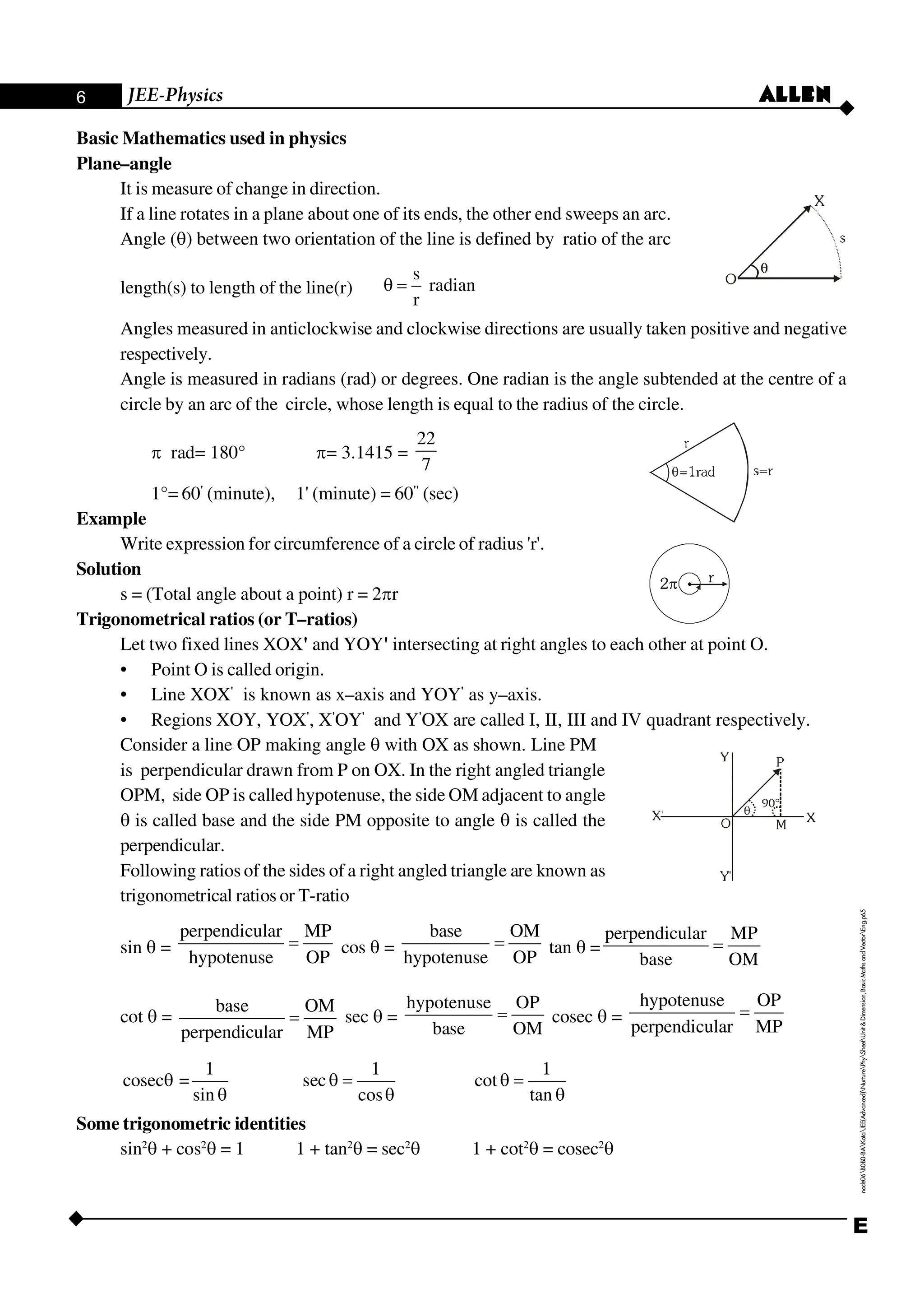


![node06B0B0-BAKotaJEE(Advanced)NurturePhySheetUnit
&
Dimension,
Basic
Maths
and
VectorEng.p65
Unit & Dimension, Basic Maths and Vector
ALLEN 17
E
• Area of whole surfaceof cylinder = 2pr(r + l) (where l = length)
• Surface area of a cube = 6(side)2
• Total surface area of a cone = pr2
+prl [where prl = pr 2 2
r h
+ = lateral area (h=height)]
Formulae for determination of volume :
• Volume of a rectangular slab = length × breadth × height = abt
• Volume of acube = (side)3
• Volume of a sphere =
4
3
p r3
(where r = radius)
• Volume of a cylinder = p r2
l (where r = radius and l = length)
• Volume of acone =
1
3
p r2
h (where r = radius and h = height)](https://image.slidesharecdn.com/95634756-250323013505-15c5029b/75/Ebook-Allen-Physics-JEE-Module-by-ALLEN-Experts-Faculty-21-2048.jpg)

![node06B0B0-BAKotaJEE(Advanced)NurturePhySheetUnit
&
Dimension,
Basic
Maths
and
VectorEng.p65
Unit & Dimension, Basic Maths and Vector
ALLEN 19
E
Addition of vectors
8. A blockis appliedtwo forcesof magnitude 5N each. Oneforce is actingtowards East and theother acting
along 60°North of East. The resultant of the two forces (in N) isof magnitude :-
UD0008
9. Two forcesact on a particlesimultaneously as shown inthe figure. Find netforce in milli newton on the
particle. [Dyneis the CGS unit of force]
100 dyne
1.0 mili newton
60°
UD0009
10. Themaximumandminimummagnitudesoftheresultantoftwoforcesare35Nand5Nrespectively.Find
the magnitude ofresultant force when act orthogonally to each other.
UD0010
11. Three forcesof magnitudes 2 N, 3 N and 6 N act at cornersof a cube along three sides as shown in figure.
Find theresultant of these forcesin N.
3N
2N
6N
UD0011
Resolution of vectors and unit vector
12. The farmhouse shown in figure has rectangular shape and has sides parallel to the chosen x and y axes.
The position vector of corner A is 125 m at 53° and corner Cis 100 m at37° from x axis.Find the length
ofthefencingrequiredinmeter.
B
A
C
D
53°
37°
y
x
UD0012
13. Vector B hasx, y and z components of 4.00, 6.00 and 3.00 units, respectively. Calculatethe magnitude of
B and the angles that B makes with the coordinates axes.
UD0013](https://image.slidesharecdn.com/95634756-250323013505-15c5029b/75/Ebook-Allen-Physics-JEE-Module-by-ALLEN-Experts-Faculty-23-2048.jpg)


![node06B0B0-BAKotaJEE(Advanced)NurturePhySheetUnit
&
Dimension,
Basic
Maths
and
VectorEng.p65
Unit & Dimension, Basic Maths and Vector
ALLEN 35
E
28. Whichofthefollowingisnotaphysicalquantity
(A) Height of a boy (B) Weight of a boy
(C) Fever of a boy (D)Speedof arunningboy
UD0101
29. Fromtheconceptofdirecteddimensionwhatistheformulaforarange(R)ofacannonballwhenitisfired
withverticalvelocitycomponentVy
andahorizontal velocitycomponentVx
assumingitisfiredonaflat
surface. [Rangealsodependsuponaccelerationdueto gravity, gandkisnumericalconstant]
(A) R =
( )
x y
k V V
g
(B) R =
( )
2
x
k V
g
(C) R =
( )
3
x
y
k V
V g
(D) R =
( )
3
y
x
k V
V g
UD0101
30. AconveyerbeltofwidthDismovingalongx-axiswithvelocityV.AmanmovingwithvelocityUonthebelt
inthedirectionperpendicularto thebelt'svelocitywithrespecttobelt wantsto crossthebelt.Thecorrect
expression forthedrift(S)sufferedbymanisgivenby(kisnumericalconstant)
(A) S = k
UD
V
(B) S =
VD
k
U
(C) S =
2
2
U D
k
V
(D) S =
2
2
V D
k
U
UD0101
MATCHING LIST TYPE (4 × 4 × 4) MULTIPLE OPTION CORRECT
(THREE COLUMNS AND FOUR ROWS)
Answer Q.31, Q.32 and Q.33 by appropriately matching the information given in the three
columns of the following table.
L, M and T are units of length, Mass and Time respectively in a system of units.
Coloumn–1 Column-2 Column-3
(I) L = 10 m (i) M = 100 gm (P) T = 0.1 sec
(II) L = 10 cm (ii) M = 10 kg (Q) T = 10 ms
(III) L = 0.1 mm (iii) M = 10 gm (R) T = 10 sec
(IV) L = 1 km (iv) M = 1 tonne (S) T = 0.01 sec
31. In which of the following combinations unit of force is 106
dyne.
(A) (IV) (i) (P) (B)(II) (iii)(S) (C) (III)(iv) (P) (D) (I) (ii) (Q)
UD0102
32. In whichof the following system, unit of energy is 109
erg
(A) (III) (i) (S) (B)(IV)(iii) (R) (C) (II)(iv) (Q) (D)(I)(iii)(P)
UD0103
33. Inwhichofthefollowingsystem,unitforcoefficientof viscosityis100poiseuille
(A) (III)(ii) (S) (B) (II) (i) (Q) (C)(III)(iii)(R) (D) (IV) (iv) (P)
UD0104](https://image.slidesharecdn.com/95634756-250323013505-15c5029b/75/Ebook-Allen-Physics-JEE-Module-by-ALLEN-Experts-Faculty-39-2048.jpg)


![node06B0B0-BAKotaJEE(Advanced)NurturePhySheetUnit
&
Dimension,
Basic
Maths
and
VectorEng.p65
38 JEE-Physics ALLEN
E
EXERCISE (J-M)
1. An ideal gas enclosed in a vertical cylindrical container supports a freely moving piston of mass M.
The piston and the cylinder have equal cross sectional area A. When the piston is in equilibrium, the
volume of the gas is V0
and its pressure is P0
. The piston is slightly displaced from the equilibrium
position and released. Assuming that the system is completely isolated from its surrounding, the
piston executes a simple harmonic motion with frequency. [JEE Main-2013]
(1)
0
0
A P
1
2 V M
g
p (2)
0 0
2
V MP
1
2 A
p g
(3)
2
0
0
A P
1
2 MV
g
p
(4)
0
0
MV
1
2 A P
p g
UD0108](https://image.slidesharecdn.com/95634756-250323013505-15c5029b/75/Ebook-Allen-Physics-JEE-Module-by-ALLEN-Experts-Faculty-42-2048.jpg)
![node06B0B0-BAKotaJEE(Advanced)NurturePhySheetUnit
&
Dimension,
Basic
Maths
and
VectorEng.p65
Unit & Dimension, Basic Maths and Vector
ALLEN 39
E
EXERCISE (J-A)
1. Match List Iwith List II and select the correct answer using the codes given belowthe lists :
List I List II [JEE Advanced-2013]
P. Boltzmann constant 1. [ML2
T–1
]
Q. Coefficient of viscosity 2. [ML–1
T–1
]
R. Planck constant 3. [MLT–3
K–1
]
S. Thermal conductivity 4. [ML2
T–2
K–1
]
Codes :
P Q R S
(A) 3 1 2 4
(B) 3 2 1 4
(C) 4 2 1 3
(D) 4 1 2 3
UD0109
2. Tofindthedistancedoverwhich asignalcanbeseenclearlyinfoggyconditions,arailwaysengineer uses
dimensional analysis and assumes that the distance depends on the mass density r of the fog, intensity
(power/area) S of the light from the signal and itsfrequency f. The engineerfinds that d isproportional to
S
1/n
. The value of n is. [JEE Advanced-2014]
UD0110
3. In termsof potentialdifferenceV, electriccurrentI, permittivitye0
,permeabilityµ0
andspeedoflightc, the
dimensionallycorrectequation(s)is(are) [JEE Advanced-2015]
(A) µ0
I2
= e0
V2
(B) e0
I = µ0
V (C) I = e0
cV (D) µ0
cI = e0
V
UD0111
4. Three vectors P,Q
r
r
and R
r
are shown in the figure. Let S be any point on the vector R
r
. The distance
between the points P and S is b R
r
. The general relation among vectors P,Q
r
r
and S
r
is :
[JEE Advanced-2017]
b|R|
R = Q – P
S
Q
Q
S
P
X
O
Y
P
(A) ( ) 2
S 1 b P b Q
= - +
r r
r
(B) ( )
S b 1 P bQ
= - +
r r
r
(C) ( )
S 1 b P bQ
= - +
r r
r
(D) ( )
2
S 1 b P bQ
= - +
r r
r
UD0112](https://image.slidesharecdn.com/95634756-250323013505-15c5029b/75/Ebook-Allen-Physics-JEE-Module-by-ALLEN-Experts-Faculty-43-2048.jpg)
![node06B0B0-BAKotaJEE(Advanced)NurturePhySheetUnit
&
Dimension,
Basic
Maths
and
VectorEng.p65
40 JEE-Physics ALLEN
E
5. Two vectors A
r
and B
r
are defined as ˆ
A ai
=
r
and ( )
ˆ ˆ
B a cos ti sin t j
= w + w
r
, whre a is a constant and
w = p/6 rad s–1
. If A B 3 A B
+ = -
r r
r r
at time t = t for the first time, the value of t, in seconds, is
_____. [JEE Advanced-2018]
UD0113
PARAGRAPH "X"
In electromagnetic theory, the electric and magnetic phenomena are related to each other. Therefore,
the dimensions of electric and magnetic quantities must also be related to each other. In the questions
below, [E] and [B] stand for dimensions of electric and magnetic fields respectively, while [Î0
] and
[µ0
] stand for dimensions of the permittivity and permeability of free space respectively. [L] and [T]
are dimensions of length and time respectively. All the quantities are given in SI units.
(There are two questions based on Paragraph "X", the question given below is one of them)
6. The relation between [E] and [B] is :- [JEE Advanced-2018]
(A) [E]= [B][L][T] (B) [E] = [B][L]
–1
[T] (C) [E] = [B][L][T]
–1
(D) [E] = [B][L]
–1
[T]
–1
UD0114
PARAGRAPH "X"
In electromagnetic theory, the electric and magnetic phenomena are related to each other. Therefore,
the dimensions of electric and magnetic quantities must also be related to each other. In the questions
below, [E] and [B] stand for dimensions of electric and magnetic fields respectively, while [Î0
] and
[µ0
] stand for dimensions of the permittivity and permeability of free space respectively. [L] and [T]
are dimensions of length and time respectively. All the quantities are given in SI units.
(There are two questions based on Paragraph "X", the question given below is one of them)
7. The relation between [Î0
] and [µ0
] is :- [JEE Advanced-2018]
(A) [µ0
] = [Î0
][L]2
[T]–2
(B) [µ0
] = [Î0
][L]–2
[T]2
(C) [µ0
] = [Î0
]
–1
[L]
2
[T]
–2
(D) [µ0
] = [Î0
]
–1
[L]
–2
[T]
2
UD0114
8. Let us consider a system of unitsin which mass andangular momentum are dimensionless. If length has
dimension ofL, which of thefollowing statement (s) is/arecorrect ? [JEE Advanced-2019]
(1) The dimension of force is L
–3
(2) The dimension of energy is L
–2
(3) The dimension of power is L
–5
(4) Thedimensionoflinear momentumisL
–1
UD0115](https://image.slidesharecdn.com/95634756-250323013505-15c5029b/75/Ebook-Allen-Physics-JEE-Module-by-ALLEN-Experts-Faculty-44-2048.jpg)
![node06B0B0-BAKotaJEE(Advanced)NurturePhySheetUnit
&
Dimension,
Basic
Maths
and
VectorEng.p65
Unit & Dimension, Basic Maths and Vector
ALLEN 41
E
ANSWER KEY
EXERCISE (S-1)
1. Ans. L–1
, ML2
T–2
2. Ans. kg.m2
.s–2
.K–1
3. Ans.
m
T a
k
= 4. Ans. 3
GM
K
r
w =
5. Ans. 0 =
GM
v k
R
6. Ans. K = 6 7. Ans. [MLT–1
] 8. Ans. 75
9. Ans. 1 10. Ans. 25 11. Ans. 7 12. Ans. 90 m
13. Ans.
4
cos
61
æ ö
a = ç ÷
è ø
,
6
cos
61
æ ö
b = ç ÷
è ø
3
cos
61
æ ö
g = ç ÷
è ø
, 61
magnitude = 14. Ans. 3
15. Ans. 5 16. Ans.
7
16
17. Ans. ˆ ˆ
ˆ, 3k
i j
+
18. Ans. (a) k̂
7
j
ˆ
5
î
11 -
+ , (b) ÷
ø
ö
ç
è
æ -
-
195
7
cos 1
, (c) ÷
ø
ö
ç
è
æ -
-
1309
20
cos 1
19. Ans. 2
20. Ans. (a) 6
2
6.4 10
3
m
p
´ ´ , (b) 6
3 6.4 10
´ ´ m 21. Ans. (a) 9.95, (b) 0.99
22. Ans. 0.14, 0.09
EXERCISE (S-2)
1. Ans. ML5
T–2
K1/2
2. Ans. [S] = Ev–2
T–2
3. Ans. 10–30
star joule
4. Ans. 2 19 , cos–1
7
2 19
or tan–1
3 3
7
5. Ans. 100 s 6. Ans. 120 N, 40 3 N
7. Ans. ˆ
ˆ
16 30 ,198
i k J
-
EXERCISE (O-1)
1.Ans. (D) 2. Ans. (C) 3. Ans. (A) 4. Ans. (A) 5. Ans. (B) 6. Ans. (A)
7. Ans. (C) 8. Ans. (D) 9. Ans. (D) 10. Ans. (A) 11. Ans. (C) 12. Ans. (B)
13. Ans. (C) 14. Ans. (D) 15. Ans. (B) 16. Ans. (B) 17. Ans. (D) 18. Ans. (D)
19. Ans. (C) 20. Ans. (A) 21. Ans. (C) 22. Ans. (A) 23. Ans. (B) 24. Ans. (C)
25. Ans. (B) 26. Ans. (B) 27. Ans. (D) 28. Ans. (D) 29. Ans. (A) 30. Ans. (C)
31. Ans. (B) 32. Ans. (A) 33. Ans. (C) 34. Ans. (B) 35. Ans. (B) 36. Ans. (B)
37. Ans. (D) 38. Ans. (A,D) 39. Ans. (C,D) 40. Ans. (B, C) 41. Ans. (B) 42. Ans. (C)
43. Ans. (A) 44. Ans. (B) 45. Ans. (C)
46. Ans. (A) ® (Q); (B) ® (R); (C) ® (T); (D) ® (P)
47.Ans. (A)-R; (B)-S; (C)-P; (D)-Q
48. Ans. (A) ® (S); (B) ® (P); (C) ® (R); (D) ® (T)
49. Ans. (A)-S; (B)-P; (C)-Q; (D)-R](https://image.slidesharecdn.com/95634756-250323013505-15c5029b/75/Ebook-Allen-Physics-JEE-Module-by-ALLEN-Experts-Faculty-45-2048.jpg)
![node06B0B0-BAKotaJEE(Advanced)NurturePhySheetUnit
&
Dimension,
Basic
Maths
and
VectorEng.p65
42 JEE-Physics ALLEN
E
EXERCISE (O-2)
1. Ans. (A) 2. Ans. (D) 3. Ans. (C) 4. Ans. (B) 5. Ans. (C) 6. Ans. (A)
7. Ans. (A) 8. Ans. (D) 9. Ans. (A) 10. Ans. (C) 11. Ans. (C) 12. Ans. (B)
13. Ans. (A) 14. Ans. (A) 15. Ans. (A) 16. Ans. (B) 17.Ans. (C) 18. Ans. (C, D)
19. Ans. (A,B,D) 20. Ans. (A, D) 21. Ans. (B,D) 22. Ans. (A,B) 23. Ans. (A,C,D)
24. Ans. (A, B, C) 25. Ans. (A) 26. Ans. (C) 27. Ans. (B) 28. Ans. (C)
29. Ans. (A) 30. Ans. (B) 31. Ans. (B,C) 32. Ans. (B,D) 33. Ans. (B)
34. Ans. (A) ® (Q); (B) ® (S); (C) ® (R); (D) ® (R)
35. Ans. (A) ® (P,R,T); (B) ® (P,R,T); (C) ® (P,Q,R,S,T); (D) ® (P,Q,R,S,T)
36. Ans. (A) R (B) Q (C) P
EXERCISE (J-M)
1. Ans. (3)
EXERCISE (J-A)
1. Ans. (C) 2. Ans. 3 3. Ans. (A,C) 4. Ans. (C) 5. Ans. 2 [1.99, 2.01]
6. Ans. (C) 7. Ans. (D) 8. Ans. (1,2,4)](https://image.slidesharecdn.com/95634756-250323013505-15c5029b/75/Ebook-Allen-Physics-JEE-Module-by-ALLEN-Experts-Faculty-46-2048.jpg)

![node06B0B0-BAKotaJEE(Advanced)EnthusePhysicsSheetError
in
measurements
&
instrumentsEng01_Exercises.p65
30 JEE-Physics
E
7. The pitch of a screw gauge is 0.5 mm and there are 50 divisions on the circular scale. In measuring the
thicknessofa metalplate, therearefive divisions onthe pitchscale (ormainscale) and thirtyfourthdivision
coincides withthe reference line. Calculate the thickness ofthe metalplate.
ER0006
8. The pitch ofa screw gauge is 1 mmand there are 50 divisions on itscap. Whennothing is put in between
the studs, 44th
division ofthe circular scale coincideswith the reference line zero ofthe mainscale is not
visible. Whenaglass plate is placedbetweenthe studs, the mainscale reads three divisionsand the circular
scale reads 26 divisions. Calculate the thicknessofthe plate.
ER0007
9. Inagivenopticalbench, aneedle oflength10cmis used to estimate bencherror.Theobject needle, image
needle &lens holder have their reading as shown.
x0 = 1.1 cm xI = 21.0 cm xL = 10.9 cm
Estimate the bencherrorswhich are present inimage needle holder and object needle holder.Also find the
focallengthofthe convexlens when.
x0 = 0.6 cm xI = 22.5 cm xL= 11.4 cm
ER0066
10. Make theappropriate connections inthemeter bridge set upshown. Resistance boxisconnected between
___. Unknown resistance is connected between___. Batteryis connected between ______.
A B C D
E F
ER0008
11. Abodytravels uniformlya distance of(13.8 ± 0.2)min time (4.0 ± 0.3) sec. Calculate its velocity.
ER0009
12. Consider S = x cos () for x = (2.0 ± 0.2) cm, = 53 ± 2 °. Find S.
ER0010
13. Two resistance R1
and R2
are connectedin(i) series and(ii) parallel.What is theequivalent resistance with
limit ofpossible percentage error in each case ofR1
= 5.0 ± 0.2 and R2
= 10.0 ± 0.1 .
ER0011
14. 5.74gmofasubstanceoccupiesavolumeof1.2cm3.Calculateitsdensitywithdueregardforsignificantfigures.
ER0012
15. The time period ofoscillation ofa simple pendulumis givenbyT = g
/
2 l
. The lengthofthe pendulum
is measured as l = 10.0 ± 0.1cmand the time period as T = 0.50 ± 0.02 s. Determine percentage error in
the valueofg.
ER0013
16. In a Searle's experiment, the diameter ofthe wire asmeasured bya screw gauge ofleast count 0.001 cm
is 0.050 cm.The length, measured bya scale ofleast count 0.1 cm, is 110.0 cm. When a weight of50 N
is suspended from the wire, the extension is measured to be 0.125 cm by a micrometer of least count
0.001 cm.Findthemaximumerror inthe measurement ofYoung'smodulusofthematerialofthewire from
thesedata. [JEE 2004]
ER0014](https://image.slidesharecdn.com/95634756-250323013505-15c5029b/75/Ebook-Allen-Physics-JEE-Module-by-ALLEN-Experts-Faculty-48-2048.jpg)
![node06B0B0-BAKotaJEE(Advanced)EnthusePhysicsSheetError
in
measurements
&
instrumentsEng01_Exercises.p65
Error in measurements & instruments
31
E
17. The pitchofa screw gaugeis 1 mmandthere are 100 divisions on the circular scale.While measuring the
diameter ofa wire, the linear scale reads 1 mm and 47th divisionon the circular scale coincideswith the
reference line. The length of the wire is 5.6 cm. Find the curved surface area (in cm2) of the wire in
appropriate numberofsignificant figures. [JEE 2004]
ER0015
18. Aphysical quantityP is related to four observablesA, B, C and D as P = )
D
C
/(
B
A
4 2
3
2
The percentage error of the measurement in A, B, C and D are 1%, 3% and 2%, 4% respectively.
Determine the percentage error & absolute error in the quantityP. Value ofPis calculated 3.763.
ER0067
19. Aglass prismofangleA= 60° gives minimum angle ofdeviation = 30° withthe max. error of10 when
a beamofparallel light passed throughthe prismduring anexperiment. Find the permissible error in the
measurement ofrefractive index ofthe materialofthe prism.
ER0068
20. Inavernier calipers the mainscale and the vernierscale are made upofdifferent materials. Whenthe room
temperature increases byT°C, it is found the reading ofthe instrument remains the same. Earlier it was
observed that the front edge of the wooden rod placed for measurement crossed the Nth main scale
divisionand (N+ 2) msd coincided withthe 2nd vsd.Initially, 10 vsd coincidedwith9 msd. Ifcoefficient of
linear expansion ofthe mainscale is 1 andthat ofthe vernier scale is 2 thenwhat is the valueof1/ 2?
(Ignore the expansion ofthe rod on heating)
ER0069
21. In a vernier callipers, n divisions ofits main scale match with (n + 1) divisions on its vernier scale. Each
divisionofthe main scale isa units. Using the vernier principle, calculate its least count.
[JEE 2003]
ER0070
22. The period ofoscillation of a simple pendulum in an experiment is recorded as 2.63 sec, 2.56 sec, 2.42
sec, 2.71 sec and 2.80 sec respectively. Find the time period, the absolute error in each observation,
average absolute error and the percentage error.
ER0016
23. The sideofa cube ismeasured byvernier callipers(10 divisions ofavernier scale coincide with9 divisions
ofmain scale, where 1 division ofmain scale is 1 mm). The main scale reads 10 mm and first division of
vernier scale coincides with the main scale. Mass of the cube is 2.736 g. Find the density ofthe cube in
appropriate significant figures. [JEE 2005]
ER0017](https://image.slidesharecdn.com/95634756-250323013505-15c5029b/75/Ebook-Allen-Physics-JEE-Module-by-ALLEN-Experts-Faculty-49-2048.jpg)


