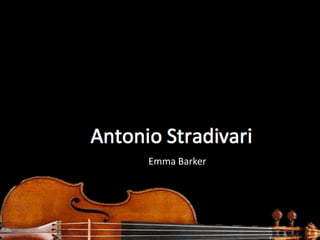
Emma Barker
The History of Stringed Instruments
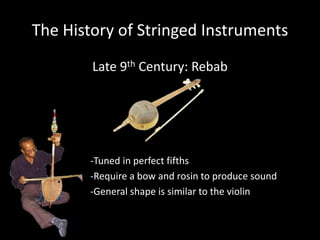
Late 9th Century: Rebab
-Tuned in perfect fifths
-Require a bow and rosin to produce sound
-General shape is similar to the violin
The History of Stringed Instruments
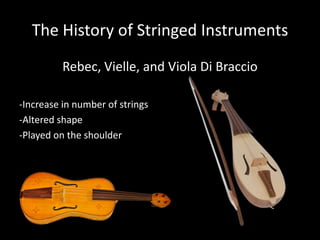
Rebec, Vielle, and Viola Di Braccio
-Increase in number of strings
-Altered shape
-Played on the shoulder
The History of Stringed Instruments
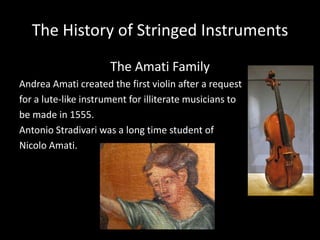
The Amati Family
Andrea Amati created the first violin after a request
for a lute-like instrument for illiterate musicians to
be made in 1555.
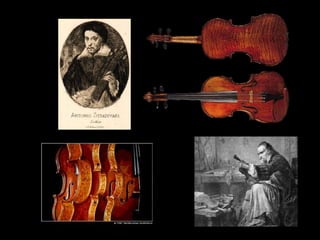
Antonio Stradivari was a long time student of
Nicolo Amati.
Stradivari’s Early Days
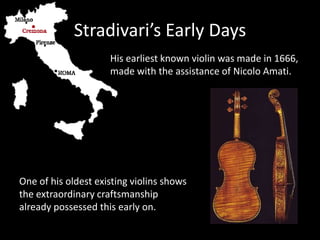
His earliest known violin was made in 1666,
made with the assistance of Nicolo Amati.
One of his oldest existing violins shows
the extraordinary craftsmanship
already possessed this early on.
Innovations in Violin Making
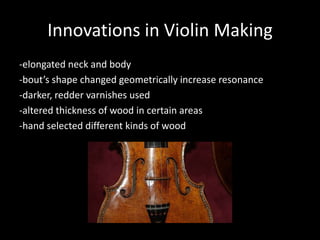
-elongated neck and body
-bout’s shape changed geometrically increase resonance
-darker, redder varnishes used
-altered thickness of wood in certain areas
-hand selected different kinds of wood
Stradivari’s Sons
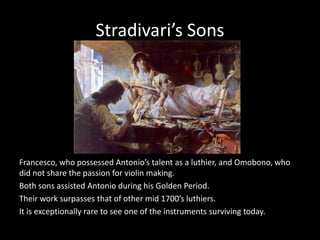
Francesco, who possessed Antonio’s talent as a luthier, and Omobono, who
did not share the passion for violin making.
Both sons assisted Antonio during his Golden Period.
Their work surpasses that of other mid 1700’s luthiers.
It is exceptionally rare to see one of the instruments surviving today.
Current Value of Stradivarius
Instruments
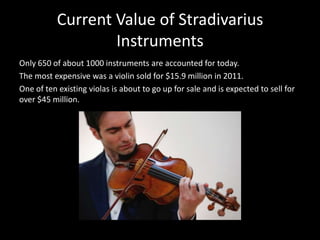
Only 650 of about 1000 instruments are accounted for today.
The most expensive was a violin sold for $15.9 million in 2011.
One of ten existing violas is about to go up for sale and is expected to sell for
over $45 million.
Stradivarius Copies
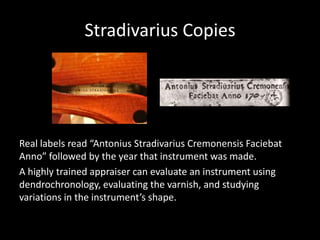
Real labels read “Antonius Stradivarius Cremonensis Faciebat
Anno” followed by the year that instrument was made.
A highly trained appraiser can evaluate an instrument using
dendrochronology, evaluating the varnish, and studying
variations in the instrument’s shape.
Stradivari’s Varnish
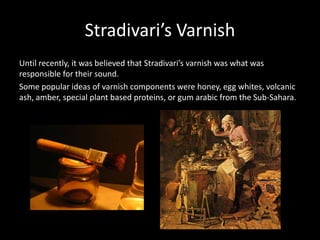
Until recently, it was believed that Stradivari’s varnish was what was
responsible for their sound.
Some popular ideas of varnish components were honey, egg whites, volcanic
ash, amber, special plant based proteins, or gum arabic from the Sub-Sahara.
Stradivari’s Varnish
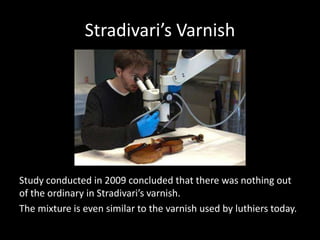
Study conducted in 2009 concluded that there was nothing out
of the ordinary in Stradivari’s varnish.
The mixture is even similar to the varnish used by luthiers today.
Stradivarius Violins Today
Instruments of choice for most virtuosos today
Used by violinists like Itzhak Perlman, David Oistrakh, and Joshua
Bell
Thievery
Stradivarius violins are notoriously a target for thieves.
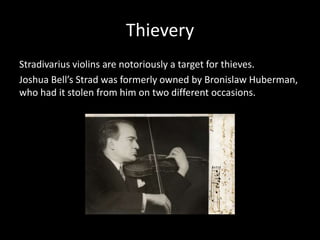
Joshua Bell’s Strad was formerly owned by Bronislaw Huberman,
who had it stolen from him on two different occasions.
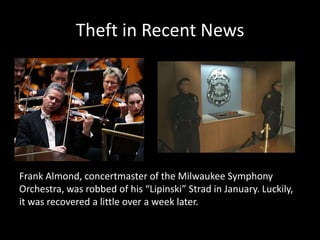
Theft in Recent News
Frank Almond, concertmaster of the Milwaukee Symphony
Orchestra, was robbed of his “Lipinski” Strad in January. Luckily,
it was recovered a little over a week later.
http://wordspringblog.files.wordpress.com/2013/08/strad.jpg
http://en.wikipedia.org/wiki/File:HellierBack.jpg
http://images.publicradio.org/content/2014/02/06/20140206_frank-almond-in-orchestra_33.jpg
http://www.susato.com/konakart/images/vielles/Alto%20Vielle.jpg
http://upload.wikimedia.org/wikipedia/commons/4/40/Andrea_Amati_violin_-_Met_Museum_NY.jpg
http://upload.wikimedia.org/wikipedia/commons/8/8b/Antonio_Stradivari_portrait.jpg
http://www.thecultureconcept.com/circle/wp-content/uploads/2013/07/antonio_stradivari.jpg
http://thenypost.files.wordpress.com/2014/03/auction-viola_.jpg
http://info.music.indiana.edu/faculty/images/8665.jpg
http://www.losoviolins.ca/images/cremonamap.gif
http://bronislawhuberman.com/wp-content/uploads/2011/12/Hubermanpcphotoandquote.jpg
http://www.coppiardi.com/picture/img_1367.jpg?pictureId=12410409&asGalleryImage=true
http://www.artiquesroadshow.com/images/Stradivarius_label.jpg
http://i1.wp.com/beta.fox11online.com/sites/default/files/sites/20/2014/02/VIOLIN-RAW.jpg
http://upload.wikimedia.org/wikipedia/en/thumb/2/27/Molitor_top.jpg/220px-Molitor_top.jpg
http://www.bach-cantatas.com/Pic-Bio-BIG/Perlman-Itzhak-03.jpg
http://s2.reutersmedia.net/resources/r/?m=02&d=20091204&t=2&i=26681936&w=580&fh=&fw=&ll=&pl=&r=
2009-12-04T193006Z_01_BTRE5B31I6F00_RTROPTP_0_FRANCE
http://www.rickshriver.net/images/rebabguy.gif
http://rebecforsale.com/wp-content/uploads/2013/09/Rebec-For-Sale.jpg
http://static---andreasinc.app-hosted.com/media/img/andreasinc/W1003-H752-Bffffff/S/spkf_v1_1.jpg
http://www.nndb.com/people/167/000097873/stradivari-4-sized.jpg
http://upload.wikimedia.org/wikipedia/commons/d/d8/Stradshp.jpg
http://1.bp.blogspot.com/_EJndrn1J25E/SXtPxQquF6I/AAAAAAAACko/VH8HAudwTFU/s400/The+Mendelssohn
,+Stradivarius+violin.jpg

Ebarker ppt

Editor's Notes

  • #2 Today I’m going to be talking about the famous Italian violin maker Antonio Stradivari and why his work has been held to such high regard to this day. The violin took centuries to evolve into the instrument we know today. Over time, changes continued to be made to improve overall sound quality and enhance aesthetics, resulting in the creation of some of the most perfect and widely sought-after instruments in the world.
  • #3 The first instruments found resembling violins came from the Middle East. Called the rebab (ri-BOB), these late 9th century instruments have many similarities to modern day violins because they’re tuned in perfect fifths, require a bow and rosin to produce sound, and they even have a similar general shape.
  • #4 Over time, European countries such as Spain and France started producing the rebec, vielle, and viola di braccio. These instruments differed from the rebab in that the number of strings increased, the shape was altered, and the intended playing position was on the shoulder instead of the lap. It was not until the mid-1500’s, however, when the first violin-like instruments started appearing in Cremona, Italy.
  • #5 An Italian statesman by the name of Lorenzo di Medici wrote to luthier Andrea Amati in 1555, requesting a lute-like instrument that would be simple for illiterate musicians to play. Thus, the world’s first violin was born. The prestigious Amati family continued making violins for years until a student of Nicolo Amati revolutionized the Amati style. Antonio Stradivari, who worked closely with Nicolo Amati for approximately 15 years, forever transformed the way violins and other stringed orchestral instruments were made.
  • #6 Antonio Stradivari was born in Italy in 1644 and worked, like most other luthiers of his time, in Cremona for most of his life. The earliest made Stradivari violin on record was made in 1666. Its label claimed that it was made with the assistance of Nicolo Amati, which led researchers to believe that Stradivari was, indeed, a student of Amati’s. Not many instruments from Stradivari’s early days as a luthier have been found, but one, the “Hellier” violin, made in 1679, demonstrates the extraordinary craftsmanship, artistry, and innovation that Stradivari already possessed this early on.
  • #7 Though he still used the Amati violins as a basic outline from which he constructed his famed instruments, Stradivari began making significant changes to the form of the body of the violin. He elongated many parts like the neck and the instrument’s entire body, tested different ways to change the bout’s shape geometrically to increase resonation, experimented with darker, redder varnishes that were believed to be made of a special, secret formula, altered the thickness of the wood in some areas of the violin, and hand selected different kinds of wood with which to make the violins. After Antonio Stradivari perfected these changes, he reached what many call his Golden Period in the early 1700’s, which lasted through the mid-1720’s. This was the time during which he used the brightest of varnishes, finest woods, and the most innovative designs to set the standard still used today in violin making.
  • #8 Antonio Stradivari was succeeded by his two sons, Francesco and Omobono, who also possessed the gift Antonio had for excellence as a luthier, though Omobono did not have the same passion for violin making. His two sons learned from the best and even assisted in making many of the violins during the beginning of Antonio’s Golden Period. Though not as highly sought after, their work still surpasses that of many other violin makers in the early to middle 1700’s. They continued to carry on his legacy after his death in 1737, though it is exceptionally rare to see one of their instruments surviving today.
  • #9 Antonio Stradivari created upwards of one thousand instruments, including violins, violas, cellos, harps, and guitars in his lifetime, though only about 650 of them are accounted for today. Each of his instruments come at a hefty price, the most expensive of which was a violin that sold for $15.9 million in 2011. Currently, one of his ten existing violas is about to go up in a rare sale and is expected to sell for more than $45 million.
  • #10 Because of his instruments’ rarity and overall excellence, countless copies have been made and sold throughout the world with labels falsely bearing the name of Antonio Stradivari by makers either hoping to trick uneducated buyers into paying over price for sub par instruments, or makers who are truly trying to replicate Stradivari’s work. Antonio Stradivari’s instruments do have a single unifying factor that distinguishes his work from most copies. His Latin inscriptions on the labels inside his instruments read, “Antonius Stradivarius CremonensisFaciebat Anno” followed by the year that specific instrument was made. However, the most accurate way to tell an authentic Stradivarius from a replica is to take the instrument to a highly trained appraiser. Comparing wood using dendrochronology, evaluating varnish choices, and studying variations in shape is truly the only way to be completely sure of a violin’s maker.
  • #11 Though the list goes on of what distinguishes Stradivari’s instruments from others, the one that has been the most talked about and studied is his varnish. Until recently, it was believed that it was the varnish on these antique instruments that gave them their illustrious voices. The varnish formulas used by Italian luthiers were said to always be well protected and passed down to only the most trusted partners in violin making. The speculation around Stradivari’s violins regarded what the varnish was composed of. Some popular ideas were honey, egg whites, volcanic ash, amber, special plant-based proteins, or gum Arabic from the Sub-Sahara.The varnish ingredient mystery even inspired the movie “The Red Violin” to be made, based off of the “Red Mendelssohn Stradivarius” violin’s bright red color. In this movie, a violin inexplicably entrances its five owners over time as the gruesome mystery behind the violin’s varnish components is eventually revealed.
  • #12 Recently, in 2009, a study was conducted using samples from three instruments of the Musee de la Musique’s Stradivarius exhibit’s prestigious collection that threw past speculations about Stradivari’s secret to success out the window. As it turns out, Antonio Stradivari’s varnish consisted of nothing out of the ordinary. The results showed that it was a combination of resin, oil, and some traces of orange and red pigmentations that made up the esteemed varnish. This mixture is nothing different than the varnish used on other instruments of the 1700’s or even from some violins made today. Jean-PhillipeEchard (AY-shard), a chemist at the museum where this experiment was conducted, speculates, “It’s a very basic recipe… The ingredients were simple, so probably the skill was in his hand and eye.” He also jokes, “Maybe a player, when seeing a beautiful instrument, he plays better. Maybe this is the secret.”The real mystery behind what exalts Antonio Stradivari’s fine instruments still remains unknown. Scientists and researchers are now toying with the idea that it comes down to the wood that Stradivari selected. One theory is that Stradivari used wood from an Ice Age. The cold temperatures would have caused the stunted growth of trees, making the wood unusually more dense. Other theories are that the wood’s age, type, or place of origin are the key to one of the greatest mysteries in the world of music.
  • #13 Stradivarius violins are the instruments of choice for the majority of the world’s most outstanding virtuosos today. World famous violinists like Itzhak Perlman, David Oistrakh, and Joshua Bell, to name a few, all play Stradivarius’s, whether they are personally owned or on loan. Bell explained what he knew about the causes for Stradivari’s successes in an interview with the Washington Post. “Our knowledge of acoustics is still incomplete,” Bell said, “but he, he just… knew.” Referring to his own Stradivarius violin, he says, “He made this to the perfect thickness at all parts. If you shaved off a millimeter of wood at any point, it would totally imbalance the sound.” Though it’s since been disproven, he also had commentary on the mysterious qualities of Antonio Stradivari’s varnish. “This has never been refinished. That’s his original varnish. People attribute aspects of the sound to the varnish. Each maker had his own secret formula.” This truly shows the meticulous work put in to each of Stradivari’s instruments; so much so, that they could almost be considered works of art.
  • #14 Just as works of art are occasionally stolen, Stradivarius violins are notoriously a target for thieves. Joshua Bell’s Strad, for example, has quite the history. BronislawHuberman, a Polish virtuoso and the violin’s previous owner, had his priceless instrument stolen from him on two occasions. In Vienna in 1919, it was stolen from his hotel room but was soon returned. Twenty years later, it was taken from him again in his dressing room in Carnegie Hall where it remained missing until 1985. It resurfaced when the man who took it confessed to his wife on his deathbed that he had stolen it and shortly thereafter tried to reproduce it.
  • #15 Recently, a different Stradivarius violin made headlines as Frank Almond, concertmaster of the Milwaukee Symphony Orchestra, was tased and robbed of his precious 1715 “LipinskyStrad” on his way out of a concert this past January. Luckily, this $3.5 million instrument was recovered a little over a week later.
  • #16 Antonio Stradivari was, without a doubt, the greatest luthier to ever make a stringed instrument. His exceptional work and revolutionary ideas led to the creation of beautiful instruments not only because of their sound, but also in their looks. He set the standardfor all of his successors and luthiers today. Stradivari created an undying legacy that has forever changed the face of musicworldwide.