Last Week: Japan’s historical development
• Japan as a tributary of China under the T’ang
dynasty, AD 618-906 (Chinese world order)
• Sakoku-jidai Tokugawa era (1600-1868)
• Rising industrial power - victory in Russo-
Japanese War, 1904-5 (Imperial world order)
• Militarism and colonialism (World War II)
• Anti-militarism and bilateralism post-1945
(Cold War order)
• Normalization, multilateralism post-Cold War, but
continued reliance upon bilateralism  towards
greater proactivity independence under Abe?
Unit 3. Explanation of Japan's
international relations:
structure, agency and norms
Prof. Glenn Hook
Aim
• to introduce structure, agency and norms
as the key conceptual tools at the heart of
the theoretical approach adopted to
Japan’s international relations as ‘normal’
Objectives
1) to discuss in what ways the approach adopted differs from other
approaches to the study of Japan’s international relations;
2) to demonstrate how structure, agency and norms can
be used to explain Japan’s international relations;
3) to illustrate through examples how structure, agency
and norms can be used to explain Japan’s
international relations.
The Approach: how does it differ from
other approaches to the study of
Japan’s international relations?
• An eclectic approach which draws upon the
collective insights and strengths of four traditions
in the study of international relations, whilst
striving to overcome their individual
shortcomings and weaknesses
(combining elements of realism, liberalism,
constructivism and policy making studies with IPE)
The political globe: its interactions can be
understood in terms of structure, agency and
norms
Explaining Japan’s international
relations: structure, agency and norms
• International structures: states,
institutions and regional frameworks
• Bipolarity and multi-polarity
• Constraints and opportunities
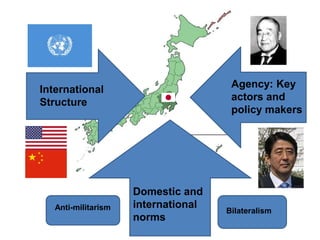
International
Structure
Agency: Key
actors and
policy makers
Domestic and
international
norms
Anti-militarism Bilateralism
Domestic agency
• Policy making models: central
bureaucracy, big business (zaikai) and the
governing party (tripartite elite model)
• MOFA, MOF and METI
• The Prime Minister and the Kantei
The influence of catch-all
party politics and business
• Liberal Democratic Party (LDP)
• Democratic Party of Japan (DPJ)
• Business community
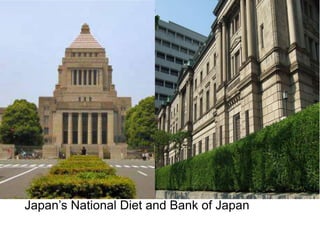
Japan’s National Diet and Bank of Japan
Other political parties
• Social Democratic Party of Japan
• People’s New Party
• Kōmei Party
• Liberal Party
• Japan Communist Party
Domestic Society
• Mass Media
• Think Tanks
• Academic Community
• Sub-state political authorities
• Pressure groups, non-governmental
organizations, social movements and public
opinion
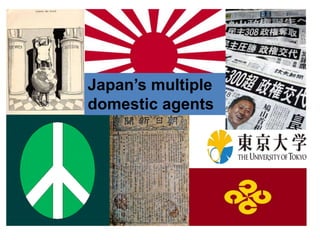
Japan’s multiple
domestic agents
Norms
• Internationally embedded norms:
Bilateralism, Asianism, Trilateralism,
Internationalism
• Domestically embedded norms: Anti-
militarism, Developmentalism, Economism
Reactivity and Proactivity: how structure,
agency and norms can be used to explain
Japan’s international relations
• Reactivity and immobilism
• Proactivity
• Normal reactivity and proactivity of the
Japanese state
Normal modes of
instrumentalization
• Crisis and long-term policy-making
• Formal, informal and proxy channels
• Sources of quiet diplomacy
• Cultural determinism?
• Unilateral, bilateral and multilateral levels
Instrumentalizing policy
• Primacy of economic power
• State and TNC’s combined use of economic
power as both “carrot” and “stick” to induce
cooperative behavior
• Continuation of seikei bunri (China, Burma)
• Inter-reliance with the US and China
Conclusion: key elements and variables
of structure, agency and norms
• Structure, agency and norms can be used in
combination to provide a distinct, eclectic
theoretical approach which can explain Japan’s
international relations;
• Key elements: structure of the international
system, agency of leading actors, norms which
inform actions;
• Changing structure, from bipolar to multipolar and
back again(?), increasing agency of the Prime
Minister, pre-eminence of bilateralism
internationally and antimilitarism domestically

Eas321 unit 3 lecture slides

  • 1.
    Last Week: Japan’shistorical development • Japan as a tributary of China under the T’ang dynasty, AD 618-906 (Chinese world order) • Sakoku-jidai Tokugawa era (1600-1868) • Rising industrial power - victory in Russo- Japanese War, 1904-5 (Imperial world order) • Militarism and colonialism (World War II) • Anti-militarism and bilateralism post-1945 (Cold War order) • Normalization, multilateralism post-Cold War, but continued reliance upon bilateralism  towards greater proactivity independence under Abe?
  • 2.
    Unit 3. Explanationof Japan's international relations: structure, agency and norms Prof. Glenn Hook
  • 3.
    Aim • to introducestructure, agency and norms as the key conceptual tools at the heart of the theoretical approach adopted to Japan’s international relations as ‘normal’
  • 4.
    Objectives 1) to discussin what ways the approach adopted differs from other approaches to the study of Japan’s international relations; 2) to demonstrate how structure, agency and norms can be used to explain Japan’s international relations; 3) to illustrate through examples how structure, agency and norms can be used to explain Japan’s international relations.
  • 5.
    The Approach: howdoes it differ from other approaches to the study of Japan’s international relations? • An eclectic approach which draws upon the collective insights and strengths of four traditions in the study of international relations, whilst striving to overcome their individual shortcomings and weaknesses (combining elements of realism, liberalism, constructivism and policy making studies with IPE)
  • 6.
    The political globe:its interactions can be understood in terms of structure, agency and norms
  • 7.
    Explaining Japan’s international relations:structure, agency and norms • International structures: states, institutions and regional frameworks • Bipolarity and multi-polarity • Constraints and opportunities
  • 8.
    International Structure Agency: Key actors and policymakers Domestic and international norms Anti-militarism Bilateralism
  • 9.
    Domestic agency • Policymaking models: central bureaucracy, big business (zaikai) and the governing party (tripartite elite model) • MOFA, MOF and METI • The Prime Minister and the Kantei
  • 10.
    The influence ofcatch-all party politics and business • Liberal Democratic Party (LDP) • Democratic Party of Japan (DPJ) • Business community
  • 11.
    Japan’s National Dietand Bank of Japan
  • 12.
    Other political parties •Social Democratic Party of Japan • People’s New Party • Kōmei Party • Liberal Party • Japan Communist Party
  • 13.
    Domestic Society • MassMedia • Think Tanks • Academic Community • Sub-state political authorities • Pressure groups, non-governmental organizations, social movements and public opinion
  • 14.
  • 15.
    Norms • Internationally embeddednorms: Bilateralism, Asianism, Trilateralism, Internationalism • Domestically embedded norms: Anti- militarism, Developmentalism, Economism
  • 16.
    Reactivity and Proactivity:how structure, agency and norms can be used to explain Japan’s international relations • Reactivity and immobilism • Proactivity • Normal reactivity and proactivity of the Japanese state
  • 17.
    Normal modes of instrumentalization •Crisis and long-term policy-making • Formal, informal and proxy channels • Sources of quiet diplomacy • Cultural determinism? • Unilateral, bilateral and multilateral levels
  • 18.
    Instrumentalizing policy • Primacyof economic power • State and TNC’s combined use of economic power as both “carrot” and “stick” to induce cooperative behavior • Continuation of seikei bunri (China, Burma) • Inter-reliance with the US and China
  • 19.
    Conclusion: key elementsand variables of structure, agency and norms • Structure, agency and norms can be used in combination to provide a distinct, eclectic theoretical approach which can explain Japan’s international relations; • Key elements: structure of the international system, agency of leading actors, norms which inform actions; • Changing structure, from bipolar to multipolar and back again(?), increasing agency of the Prime Minister, pre-eminence of bilateralism internationally and antimilitarism domestically