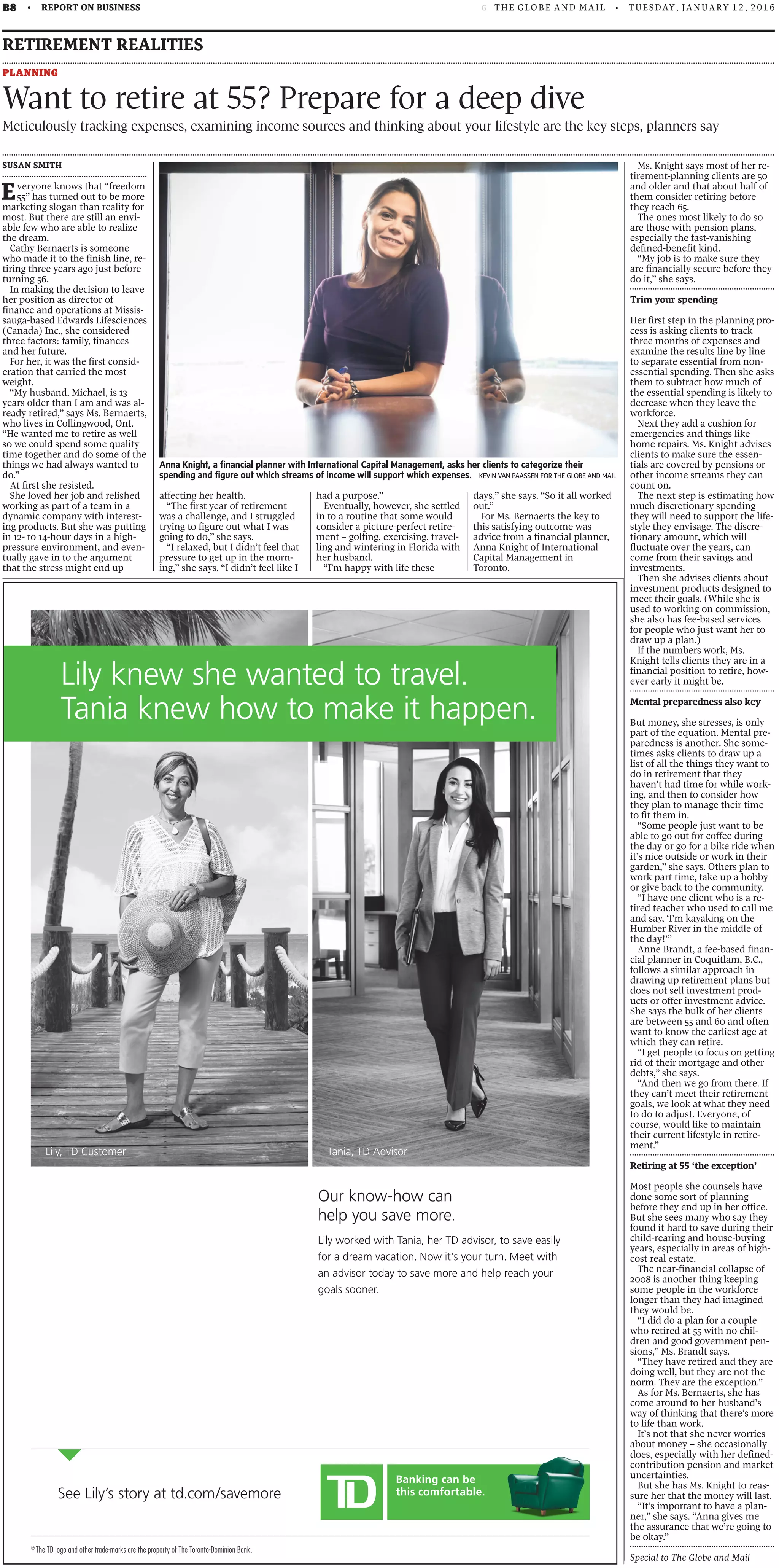
Our know-how can
help you save more.
Lily worked with Tania, her TD advisor, to save easily
for a dream vacation. Now it’s your turn. Meet with
an advisor today to save more and help reach your
goals sooner.
®
The TD logo and other trade-marks are the property of The Toronto-Dominion Bank.
See Lily’s story at td.com/savemore
Tania, TD AdvisorLily, TD Customer
Lily knew she wanted to travel.
Tania knew how to make it happen.
B8 G THE GLOBE AND MAIL • TUESDAY, JANUARY 12, 2016• REPORT ON BUSINESS
RETIREMENT REALITIES
Everyone knows that “freedom
55” has turned out to be more
marketing slogan than reality for
most. But there are still an envi-
able few who are able to realize
the dream.
Cathy Bernaerts is someone
who made it to the finish line, re-
tiring three years ago just before
turning 56.
In making the decision to leave
her position as director of
finance and operations at Missis-
sauga-based Edwards Lifesciences
(Canada) Inc., she considered
three factors: family, finances
and her future.
For her, it was the first consid-
eration that carried the most
weight.
“My husband, Michael, is 13
years older than I am and was al-
ready retired,” says Ms. Bernaerts,
who lives in Collingwood, Ont.
“He wanted me to retire as well
so we could spend some quality
time together and do some of the
things we had always wanted to
do.”
At first she resisted.
She loved her job and relished
working as part of a team in a
dynamic company with interest-
ing products. But she was putting
in 12- to 14-hour days in a high-
pressure environment, and even-
tually gave in to the argument
that the stress might end up
affecting her health.
“The first year of retirement
was a challenge, and I struggled
trying to figure out what I was
going to do,” she says.
“I relaxed, but I didn’t feel that
pressure to get up in the morn-
ing,” she says. “I didn’t feel like I
had a purpose.”
Eventually, however, she settled
in to a routine that some would
consider a picture-perfect retire-
ment – golfing, exercising, travel-
ling and wintering in Florida with
her husband.
“I’m happy with life these
days,” she says. “So it all worked
out.”
For Ms. Bernaerts the key to
this satisfying outcome was
advice from a financial planner,
Anna Knight of International
Capital Management in
Toronto.
Ms. Knight says most of her re-
tirement-planning clients are 50
and older and that about half of
them consider retiring before
they reach 65.
The ones most likely to do so
are those with pension plans,
especially the fast-vanishing
defined-benefit kind.
“My job is to make sure they
are financially secure before they
do it,” she says.
................................................................
Trim your spending
Her first step in the planning pro-
cess is asking clients to track
three months of expenses and
examine the results line by line
to separate essential from non-
essential spending. Then she asks
them to subtract how much of
the essential spending is likely to
decrease when they leave the
workforce.
Next they add a cushion for
emergencies and things like
home repairs. Ms. Knight advises
clients to make sure the essen-
tials are covered by pensions or
other income streams they can
count on.
The next step is estimating how
much discretionary spending
they will need to support the life-
style they envisage. The discre-
tionary amount, which will
fluctuate over the years, can
come from their savings and
investments.
Then she advises clients about
investment products designed to
meet their goals. (While she is
used to working on commission,
she also has fee-based services
for people who just want her to
draw up a plan.)
If the numbers work, Ms.
Knight tells clients they are in a
financial position to retire, how-
ever early it might be.
................................................................
Mental preparedness also key
But money, she stresses, is only
part of the equation. Mental pre-
paredness is another. She some-
times asks clients to draw up a
list of all the things they want to
do in retirement that they
haven’t had time for while work-
ing, and then to consider how
they plan to manage their time
to fit them in.
“Some people just want to be
able to go out for coffee during
the day or go for a bike ride when
it’s nice outside or work in their
garden,” she says. Others plan to
work part time, take up a hobby
or give back to the community.
“I have one client who is a re-
tired teacher who used to call me
and say, ‘I’m kayaking on the
Humber River in the middle of
the day!’”
Anne Brandt, a fee-based finan-
cial planner in Coquitlam, B.C.,
follows a similar approach in
drawing up retirement plans but
does not sell investment prod-
ucts or offer investment advice.
She says the bulk of her clients
are between 55 and 60 and often
want to know the earliest age at
which they can retire.
“I get people to focus on getting
rid of their mortgage and other
debts,” she says.
“And then we go from there. If
they can’t meet their retirement
goals, we look at what they need
to do to adjust. Everyone, of
course, would like to maintain
their current lifestyle in retire-
ment.”
................................................................
Retiring at 55 ‘the exception’
Most people she counsels have
done some sort of planning
before they end up in her office.
But she sees many who say they
found it hard to save during their
child-rearing and house-buying
years, especially in areas of high-
cost real estate.
The near-financial collapse of
2008 is another thing keeping
some people in the workforce
longer than they had imagined
they would be.
“I did do a plan for a couple
who retired at 55 with no chil-
dren and good government pen-
sions,” Ms. Brandt says.
“They have retired and they are
doing well, but they are not the
norm. They are the exception.”
As for Ms. Bernaerts, she has
come around to her husband’s
way of thinking that there’s more
to life than work.
It’s not that she never worries
about money – she occasionally
does, especially with her defined-
contribution pension and market
uncertainties.
But she has Ms. Knight to reas-
sure her that the money will last.
“It’s important to have a plan-
ner,” she says. “Anna gives me
the assurance that we’re going to
be okay.”
................................................................
Special to The Globe and Mail
.....................................................................................................................................................................................................................................................................................................................................................
PLANNING
Want to retire at 55? Prepare for a deep dive
Meticulously tracking expenses, examining income sources and thinking about your lifestyle are the key steps, planners say
.....................................................................................................................................................................................................................................................................................................................................................
SUSAN SMITH
................................................................
Anna Knight, a financial planner with International Capital Management, asks her clients to categorize their
spending and figure out which streams of income will support which expenses. KEVIN VAN PAASSEN FOR THE GLOBE AND MAIL

Early Retirement

  • 1.
    Our know-how can helpyou save more. Lily worked with Tania, her TD advisor, to save easily for a dream vacation. Now it’s your turn. Meet with an advisor today to save more and help reach your goals sooner. ® The TD logo and other trade-marks are the property of The Toronto-Dominion Bank. See Lily’s story at td.com/savemore Tania, TD AdvisorLily, TD Customer Lily knew she wanted to travel. Tania knew how to make it happen. B8 G THE GLOBE AND MAIL • TUESDAY, JANUARY 12, 2016• REPORT ON BUSINESS RETIREMENT REALITIES Everyone knows that “freedom 55” has turned out to be more marketing slogan than reality for most. But there are still an envi- able few who are able to realize the dream. Cathy Bernaerts is someone who made it to the finish line, re- tiring three years ago just before turning 56. In making the decision to leave her position as director of finance and operations at Missis- sauga-based Edwards Lifesciences (Canada) Inc., she considered three factors: family, finances and her future. For her, it was the first consid- eration that carried the most weight. “My husband, Michael, is 13 years older than I am and was al- ready retired,” says Ms. Bernaerts, who lives in Collingwood, Ont. “He wanted me to retire as well so we could spend some quality time together and do some of the things we had always wanted to do.” At first she resisted. She loved her job and relished working as part of a team in a dynamic company with interest- ing products. But she was putting in 12- to 14-hour days in a high- pressure environment, and even- tually gave in to the argument that the stress might end up affecting her health. “The first year of retirement was a challenge, and I struggled trying to figure out what I was going to do,” she says. “I relaxed, but I didn’t feel that pressure to get up in the morn- ing,” she says. “I didn’t feel like I had a purpose.” Eventually, however, she settled in to a routine that some would consider a picture-perfect retire- ment – golfing, exercising, travel- ling and wintering in Florida with her husband. “I’m happy with life these days,” she says. “So it all worked out.” For Ms. Bernaerts the key to this satisfying outcome was advice from a financial planner, Anna Knight of International Capital Management in Toronto. Ms. Knight says most of her re- tirement-planning clients are 50 and older and that about half of them consider retiring before they reach 65. The ones most likely to do so are those with pension plans, especially the fast-vanishing defined-benefit kind. “My job is to make sure they are financially secure before they do it,” she says. ................................................................ Trim your spending Her first step in the planning pro- cess is asking clients to track three months of expenses and examine the results line by line to separate essential from non- essential spending. Then she asks them to subtract how much of the essential spending is likely to decrease when they leave the workforce. Next they add a cushion for emergencies and things like home repairs. Ms. Knight advises clients to make sure the essen- tials are covered by pensions or other income streams they can count on. The next step is estimating how much discretionary spending they will need to support the life- style they envisage. The discre- tionary amount, which will fluctuate over the years, can come from their savings and investments. Then she advises clients about investment products designed to meet their goals. (While she is used to working on commission, she also has fee-based services for people who just want her to draw up a plan.) If the numbers work, Ms. Knight tells clients they are in a financial position to retire, how- ever early it might be. ................................................................ Mental preparedness also key But money, she stresses, is only part of the equation. Mental pre- paredness is another. She some- times asks clients to draw up a list of all the things they want to do in retirement that they haven’t had time for while work- ing, and then to consider how they plan to manage their time to fit them in. “Some people just want to be able to go out for coffee during the day or go for a bike ride when it’s nice outside or work in their garden,” she says. Others plan to work part time, take up a hobby or give back to the community. “I have one client who is a re- tired teacher who used to call me and say, ‘I’m kayaking on the Humber River in the middle of the day!’” Anne Brandt, a fee-based finan- cial planner in Coquitlam, B.C., follows a similar approach in drawing up retirement plans but does not sell investment prod- ucts or offer investment advice. She says the bulk of her clients are between 55 and 60 and often want to know the earliest age at which they can retire. “I get people to focus on getting rid of their mortgage and other debts,” she says. “And then we go from there. If they can’t meet their retirement goals, we look at what they need to do to adjust. Everyone, of course, would like to maintain their current lifestyle in retire- ment.” ................................................................ Retiring at 55 ‘the exception’ Most people she counsels have done some sort of planning before they end up in her office. But she sees many who say they found it hard to save during their child-rearing and house-buying years, especially in areas of high- cost real estate. The near-financial collapse of 2008 is another thing keeping some people in the workforce longer than they had imagined they would be. “I did do a plan for a couple who retired at 55 with no chil- dren and good government pen- sions,” Ms. Brandt says. “They have retired and they are doing well, but they are not the norm. They are the exception.” As for Ms. Bernaerts, she has come around to her husband’s way of thinking that there’s more to life than work. It’s not that she never worries about money – she occasionally does, especially with her defined- contribution pension and market uncertainties. But she has Ms. Knight to reas- sure her that the money will last. “It’s important to have a plan- ner,” she says. “Anna gives me the assurance that we’re going to be okay.” ................................................................ Special to The Globe and Mail ..................................................................................................................................................................................................................................................................................................................................................... PLANNING Want to retire at 55? Prepare for a deep dive Meticulously tracking expenses, examining income sources and thinking about your lifestyle are the key steps, planners say ..................................................................................................................................................................................................................................................................................................................................................... SUSAN SMITH ................................................................ Anna Knight, a financial planner with International Capital Management, asks her clients to categorize their spending and figure out which streams of income will support which expenses. KEVIN VAN PAASSEN FOR THE GLOBE AND MAIL