-
loculi

     cubicula


Via Latina Catacomb, Rome, 3rd century.
•Via Latina Catacomb, Rome, 3rd century.
Located in the right-hand arcosolium of Cubiculum N in
the Via Latina Catacomb, Hercules leads Alcestis back to
Admetus. The image from the third quarter of the fourth
century shows Hercules, with a club, lion skin and blue
halo, holding Cerberus, the hounds of hell. According to
the myth, when Admetus was fated to die, his wife Alcestis
chose to die in his place but was rescued from the hands
of death by Hercules who brought her back to her
husband
•Via Latina Catacomb, Rome, 3rd century.
                                                    This pagan Via Latina
                                                    catacomb           scene
                                                    presents Hercules in the
                                                    Garden of Hesperides
                                                    where the Golden Apples
                                                    could      be      found.
                                                    Obtaining an apple from
                                                    this garden was the
                                                    eleventh of twelve nearly
                                                    impossible tasks, called
                                                    the Labors of Hercules,
                                                    which         Eurystheus
                                                    required of Hercules
                                                    before he could be
                                                    cleaned and cleared of
                                                    his sins.

The presence of this Roman mythology reference within the catacombs attests to
a mixing of both pagan and Christian iconography among the tombs of
individuals who followed one or the other of these different cults
Hercules in the Garden of the Hesperides, Wall painting,
(84 x 74 cm., [33 x 29 1/8 in.], Via Latina Catacomb, Rome
Samson and the Lion, c. 350-400, Wall painting, (113 x 107 cm., [44
         1/2 x 42 1/8 in.]), Via Latina Catacomb, Rome.
                                             Samson is presented in this
                                             Via Latina catacomb image
                                             as he wrestles with a lion.
                                             The story of Samson is in
                                             the Old Testament book of
                                             Judges. The honey and
                                             bees that Samson finds in
                                             the mouth of the slain lion is
                                             symbolic of the sweetness of
                                             heaven that one can find
                                             after death.
Sacrifice of Isaac      A.D

                 In this fresco from the Via Latina
                 Catacomb        (cubiculum     C),
                 painted about AD 320, Abraham
                 raises his sword to slay his son.
                 The traditional iconography of
                 the scene presents a sacrificial
                 altar with burning wood and the
                 ram that God has provided to be
                 killed in Isaac's place. In the
                 above left, the hand of God is
                 missing from the scene. Below
                 is an extra textual scene of a
                 servant with a donkey.
cubiculum C
•Catacomb of Priscilla, Rome ,3rd century.
                  As with many of the decorative programs in the
                  catacombs, the late third-century paintings in the
                  vault and lunettes in this cubiculum, located in
                  the Catacomb of Priscilla, are organized
                  according to symmetrically disposed and linearly
                  defined regions. The vault features a central
                  medallion containing a depiction of the Good
                  Shepherd surrounded by four semicircular
                  regions containing peacocks alternating with
                  quail. Furthermore, birds occupy the corner
                  spaces that mark the transition between ceiling
                  and wall, and contribute further to the ceiling’s
                  imagery of paradise.
•Catacomb of Priscilla, Rome ,3rd century.
Gallery with loculus tombs, Catacomb of Priscilla, Rome
                           A loculus tomb is the most basic type of a
                           burial place to be found in a Christian
                           catacomb. This gallery in the Catacomb of
                           Priscilla shows how loculi are stacked one
                           on top of each other. Loculus tombs are
                           usually sealed with clay tiles or marble
                           slabs set in a mortar bed.


                                      -
sealed loculi with inscriptions in the area of the
     arenaria; Catacomb of Priscilla, Rome


                        These loculi in the Catacomb
                        of Priscilla are still preserved
                        in their original state. Different
                        materials - usually clay tiles or
                        marble slabs - were used to
                        seal the tombs. Depending on
                        the material used, the names
                        of the deceased were either
                        painted or engraved on the
                        sealed tomb.
•Catacomb of pietro & marcellinus, Rome, 4th century A.D.
                                   This Christian catacomb fresco
                                   represents Jonah being spewed out
                                   by a whale. In the biblical story,
                                   Jonah was thrown overboard to the
                                   whale. Then, the animal swallows
                                   him and after three days, regurgitates
                                   Jonah. In narrative depictions of the
                                   story, Jonah is generally shown lying
                                   upright in a 'sleeping' pose that was
                                   appropriated from pagan iconography
                                   representing the reclining figure of
                                   Endymion, the sleeping shepherd
                                   who was loved by Selene, the
                                   goddess of the moon.
•Catacomb of pietro & marcellinus, Rome, 4th century A.D.

                                       MORAL PAINTINGS
                                             -

                                        good shepherd

                                                 -
                                          abstract images.


                                     connection between
                                   roman style and Christian
                                                     theme
                                               -

                                              lunettes
Sarcophagus of Junius Bassus, St. Peter's,
Rome, 359 A.D Marble.


                                               -
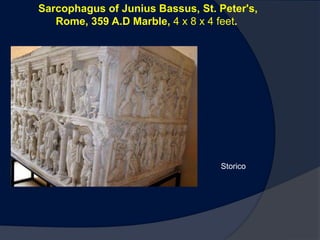
Sarcophagus of Junius Bassus, St. Peter's, Rome, 359 A.D
       Marble, 4 x 8 x 4 feet.


                                                 Junius Bassus


The Sarcophagus of Junius Bassus is a marble Early Christian sarcophagus used
for the burial of Junius Bassus, who died in 359. It has been described as "probably
the single most famous piece of early Christian relief sculpture."[1] The sarcophagus
was originally placed in or under Old St. Peter's Basilica, was rediscovered in
1597,[2] and is now below the modern basilica in the Museo Storico del Tesoro della
Basilica di San Pietro (Museum of Saint Peter's Basilica) in the Vatican. The base is
approximately 4 x 8 x 4 feet.
Sarcophagus of Junius Bassus, St. Peter's,
   Rome, 359 A.D Marble, 4 x 8 x 4 feet.


                                  Storico
-


    -

        .1
        .2
        .3
-

                                          .1
   columns pediment, cornice, arch ,

                                          .2


                                          .3

                                          .4

roman                                     .5
             style but Christian themes
Galla Palcidia, Ravenna, 425-50.
Mausoleum of Galla Placidia. Exterior. General view.
•Mosaic, Good Shepherd, Galla Palcidia, Ravenna, 425-50.


Mausoleum of Galla Placidia. Interior. Lunette over west entrance. Christ
                        the Good Shepherd.
•Mosaic, Good Shepherd, Galla Palcidia, Ravenna, 425-50.


                                        -

Early christain

  • 1.
  • 3.
    loculi cubicula Via Latina Catacomb, Rome, 3rd century.
  • 4.
    •Via Latina Catacomb,Rome, 3rd century. Located in the right-hand arcosolium of Cubiculum N in the Via Latina Catacomb, Hercules leads Alcestis back to Admetus. The image from the third quarter of the fourth century shows Hercules, with a club, lion skin and blue halo, holding Cerberus, the hounds of hell. According to the myth, when Admetus was fated to die, his wife Alcestis chose to die in his place but was rescued from the hands of death by Hercules who brought her back to her husband
  • 5.
    •Via Latina Catacomb,Rome, 3rd century. This pagan Via Latina catacomb scene presents Hercules in the Garden of Hesperides where the Golden Apples could be found. Obtaining an apple from this garden was the eleventh of twelve nearly impossible tasks, called the Labors of Hercules, which Eurystheus required of Hercules before he could be cleaned and cleared of his sins. The presence of this Roman mythology reference within the catacombs attests to a mixing of both pagan and Christian iconography among the tombs of individuals who followed one or the other of these different cults
  • 6.
    Hercules in theGarden of the Hesperides, Wall painting, (84 x 74 cm., [33 x 29 1/8 in.], Via Latina Catacomb, Rome
  • 7.
    Samson and theLion, c. 350-400, Wall painting, (113 x 107 cm., [44 1/2 x 42 1/8 in.]), Via Latina Catacomb, Rome. Samson is presented in this Via Latina catacomb image as he wrestles with a lion. The story of Samson is in the Old Testament book of Judges. The honey and bees that Samson finds in the mouth of the slain lion is symbolic of the sweetness of heaven that one can find after death.
  • 8.
    Sacrifice of Isaac A.D In this fresco from the Via Latina Catacomb (cubiculum C), painted about AD 320, Abraham raises his sword to slay his son. The traditional iconography of the scene presents a sacrificial altar with burning wood and the ram that God has provided to be killed in Isaac's place. In the above left, the hand of God is missing from the scene. Below is an extra textual scene of a servant with a donkey.
  • 9.
  • 10.
    •Catacomb of Priscilla,Rome ,3rd century. As with many of the decorative programs in the catacombs, the late third-century paintings in the vault and lunettes in this cubiculum, located in the Catacomb of Priscilla, are organized according to symmetrically disposed and linearly defined regions. The vault features a central medallion containing a depiction of the Good Shepherd surrounded by four semicircular regions containing peacocks alternating with quail. Furthermore, birds occupy the corner spaces that mark the transition between ceiling and wall, and contribute further to the ceiling’s imagery of paradise.
  • 11.
    •Catacomb of Priscilla,Rome ,3rd century.
  • 12.
    Gallery with loculustombs, Catacomb of Priscilla, Rome A loculus tomb is the most basic type of a burial place to be found in a Christian catacomb. This gallery in the Catacomb of Priscilla shows how loculi are stacked one on top of each other. Loculus tombs are usually sealed with clay tiles or marble slabs set in a mortar bed. -
  • 13.
    sealed loculi withinscriptions in the area of the arenaria; Catacomb of Priscilla, Rome These loculi in the Catacomb of Priscilla are still preserved in their original state. Different materials - usually clay tiles or marble slabs - were used to seal the tombs. Depending on the material used, the names of the deceased were either painted or engraved on the sealed tomb.
  • 14.
    •Catacomb of pietro& marcellinus, Rome, 4th century A.D. This Christian catacomb fresco represents Jonah being spewed out by a whale. In the biblical story, Jonah was thrown overboard to the whale. Then, the animal swallows him and after three days, regurgitates Jonah. In narrative depictions of the story, Jonah is generally shown lying upright in a 'sleeping' pose that was appropriated from pagan iconography representing the reclining figure of Endymion, the sleeping shepherd who was loved by Selene, the goddess of the moon.
  • 15.
    •Catacomb of pietro& marcellinus, Rome, 4th century A.D. MORAL PAINTINGS - good shepherd - abstract images. connection between roman style and Christian theme - lunettes
  • 16.
    Sarcophagus of JuniusBassus, St. Peter's, Rome, 359 A.D Marble. -
  • 17.
    Sarcophagus of JuniusBassus, St. Peter's, Rome, 359 A.D Marble, 4 x 8 x 4 feet. Junius Bassus The Sarcophagus of Junius Bassus is a marble Early Christian sarcophagus used for the burial of Junius Bassus, who died in 359. It has been described as "probably the single most famous piece of early Christian relief sculpture."[1] The sarcophagus was originally placed in or under Old St. Peter's Basilica, was rediscovered in 1597,[2] and is now below the modern basilica in the Museo Storico del Tesoro della Basilica di San Pietro (Museum of Saint Peter's Basilica) in the Vatican. The base is approximately 4 x 8 x 4 feet.
  • 18.
    Sarcophagus of JuniusBassus, St. Peter's, Rome, 359 A.D Marble, 4 x 8 x 4 feet. Storico
  • 19.
    - - .1 .2 .3
  • 22.
    - .1 columns pediment, cornice, arch , .2 .3 .4 roman .5 style but Christian themes
  • 23.
    Galla Palcidia, Ravenna,425-50. Mausoleum of Galla Placidia. Exterior. General view.
  • 24.
    •Mosaic, Good Shepherd,Galla Palcidia, Ravenna, 425-50. Mausoleum of Galla Placidia. Interior. Lunette over west entrance. Christ the Good Shepherd.
  • 25.
    •Mosaic, Good Shepherd,Galla Palcidia, Ravenna, 425-50. -