SeGA Guidance – Document
Accessibility / Accessible Maths
and other Symbolic Languages
Martyn Cooper (IET)
martyn.cooper@open.ac.uk
Rationale for SeGA Guidance
• To support Module Teams/LTS in producing
accessible learning resources
• To support Faculty Accessibility Specialists in
their role
• To provide up to date guidance given the
external environment and OU context
• To promote consistency for disabled students
in their interaction with learning resources
Document
Accessibility
• Documents delivered
over the web
• Word/PDF/XML (oXygen)
• What can authors do to
promote accessibility in
their documents?
• Electronic documents
have inherent
accessibility advantages
for some
• Key type of module
resource
Key Guidance – Document Accessibility
• Images
– Alt texts
– Scalable
• Tables
– Row/Column Titles
– Text in Cells
• Links
– Screenreaders give Lists of
Links
– Make link labels
meaningful (e.g. avoid
“click here”)
• Proper Use of Headings
– <Title>/<H1>/<H2>/ …
• Fonts
– Size/Style (sans serif)
– Line Spacing (minimum 1.5
lines)
• Technical Format
– Word (very accessible)
– PDF (handle with care)
– Use Structured Content
(oXygen)
• Justify (left or right)
Maths and other Symbolic Languages
• Maths, Music Notation, Chemistry
Equations, Computer Science Notation, …
• Distinct from text in that 2D position of
symbols significant
• Notation aids in language comprehension and
manipulation
• Key learning objective for the respective
disiplines
Key Guidance – Symbolic Languages
• Text alternatives
– Often only appropriate for
simple expressions
• Mark-up Languages
– MathML
– ChemML
– Not Supported by browsers
• Chuncking
– Way to deal with complex
expressions
• Need to teach the language
in its accessible form
– Graduateness
– Often not currently done
• Mathematicians often use
LaTeX
– Provide access to LaTeX
expression
– Cut and paste into
documents, forums and e-
mails
• Issue of what approach to
use at what level of study
– Text alternatives may be ok
for Level 1 modules but not
Level 3
• Alternative representations
– E.g. graphs of maths
expressions (with alt texts)
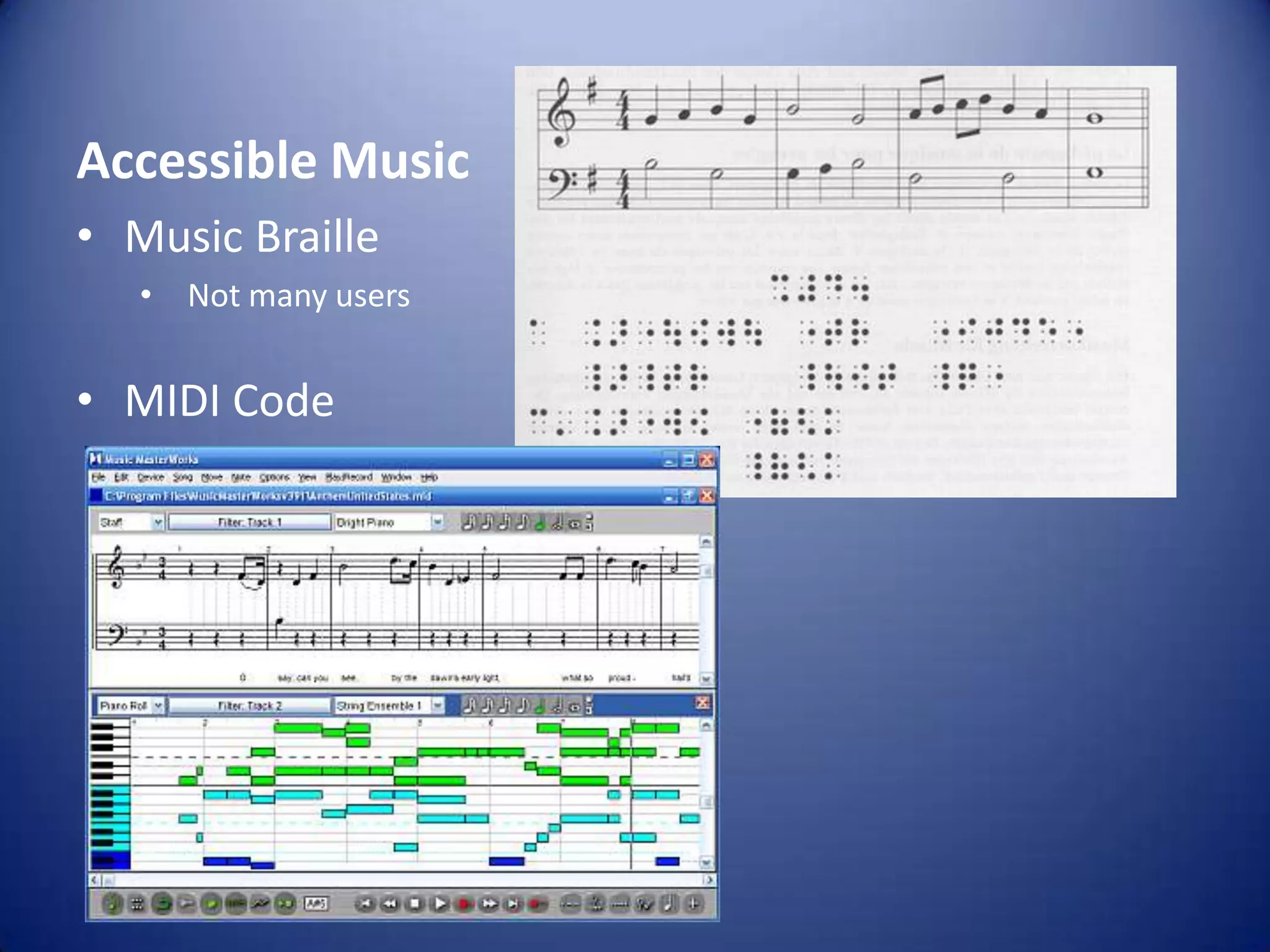
Accessible Music
• Music Braille
• Not many users
• MIDI Code
The Challenges of Producing
SeGA Guidance
• The audience
– Want brief “how to guidance”
– But the issues are often complex
• Changing external context
– E.g. browser developments (IE no longer supports
MathsML)
• Dependency on OU context
– E.g. VLE tools
• Issues at teaching and learning level not just the
language level
• Assessment consistent with teaching
– Alt txts can give answer away
Discussion and Questions

E lc april 2014 sega guidance – document accessibility - accessible maths and symbolic languages

  • 1.
    SeGA Guidance –Document Accessibility / Accessible Maths and other Symbolic Languages Martyn Cooper (IET) martyn.cooper@open.ac.uk
  • 2.
    Rationale for SeGAGuidance • To support Module Teams/LTS in producing accessible learning resources • To support Faculty Accessibility Specialists in their role • To provide up to date guidance given the external environment and OU context • To promote consistency for disabled students in their interaction with learning resources
  • 3.
    Document Accessibility • Documents delivered overthe web • Word/PDF/XML (oXygen) • What can authors do to promote accessibility in their documents? • Electronic documents have inherent accessibility advantages for some • Key type of module resource
  • 4.
    Key Guidance –Document Accessibility • Images – Alt texts – Scalable • Tables – Row/Column Titles – Text in Cells • Links – Screenreaders give Lists of Links – Make link labels meaningful (e.g. avoid “click here”) • Proper Use of Headings – <Title>/<H1>/<H2>/ … • Fonts – Size/Style (sans serif) – Line Spacing (minimum 1.5 lines) • Technical Format – Word (very accessible) – PDF (handle with care) – Use Structured Content (oXygen) • Justify (left or right)
  • 5.
    Maths and otherSymbolic Languages • Maths, Music Notation, Chemistry Equations, Computer Science Notation, … • Distinct from text in that 2D position of symbols significant • Notation aids in language comprehension and manipulation • Key learning objective for the respective disiplines
  • 6.
    Key Guidance –Symbolic Languages • Text alternatives – Often only appropriate for simple expressions • Mark-up Languages – MathML – ChemML – Not Supported by browsers • Chuncking – Way to deal with complex expressions • Need to teach the language in its accessible form – Graduateness – Often not currently done • Mathematicians often use LaTeX – Provide access to LaTeX expression – Cut and paste into documents, forums and e- mails • Issue of what approach to use at what level of study – Text alternatives may be ok for Level 1 modules but not Level 3 • Alternative representations – E.g. graphs of maths expressions (with alt texts)
  • 7.
    Accessible Music • MusicBraille • Not many users • MIDI Code
  • 8.
    The Challenges ofProducing SeGA Guidance • The audience – Want brief “how to guidance” – But the issues are often complex • Changing external context – E.g. browser developments (IE no longer supports MathsML) • Dependency on OU context – E.g. VLE tools • Issues at teaching and learning level not just the language level • Assessment consistent with teaching – Alt txts can give answer away
  • 9.