DynamoDB to ScyllaDB
A technical comparison and path to success
Tim Koopmans, Product Experience
Guilherme Nogueira, Solutions Architect
■ Introduction
■ Understanding ScyllaDB
■ Comparing DynamoDB and ScyllaDB
■ Migration Options and Tools
■ Case Studies and Best Practices
■ Conclusion
Presentation Agenda
About ScyllaDB
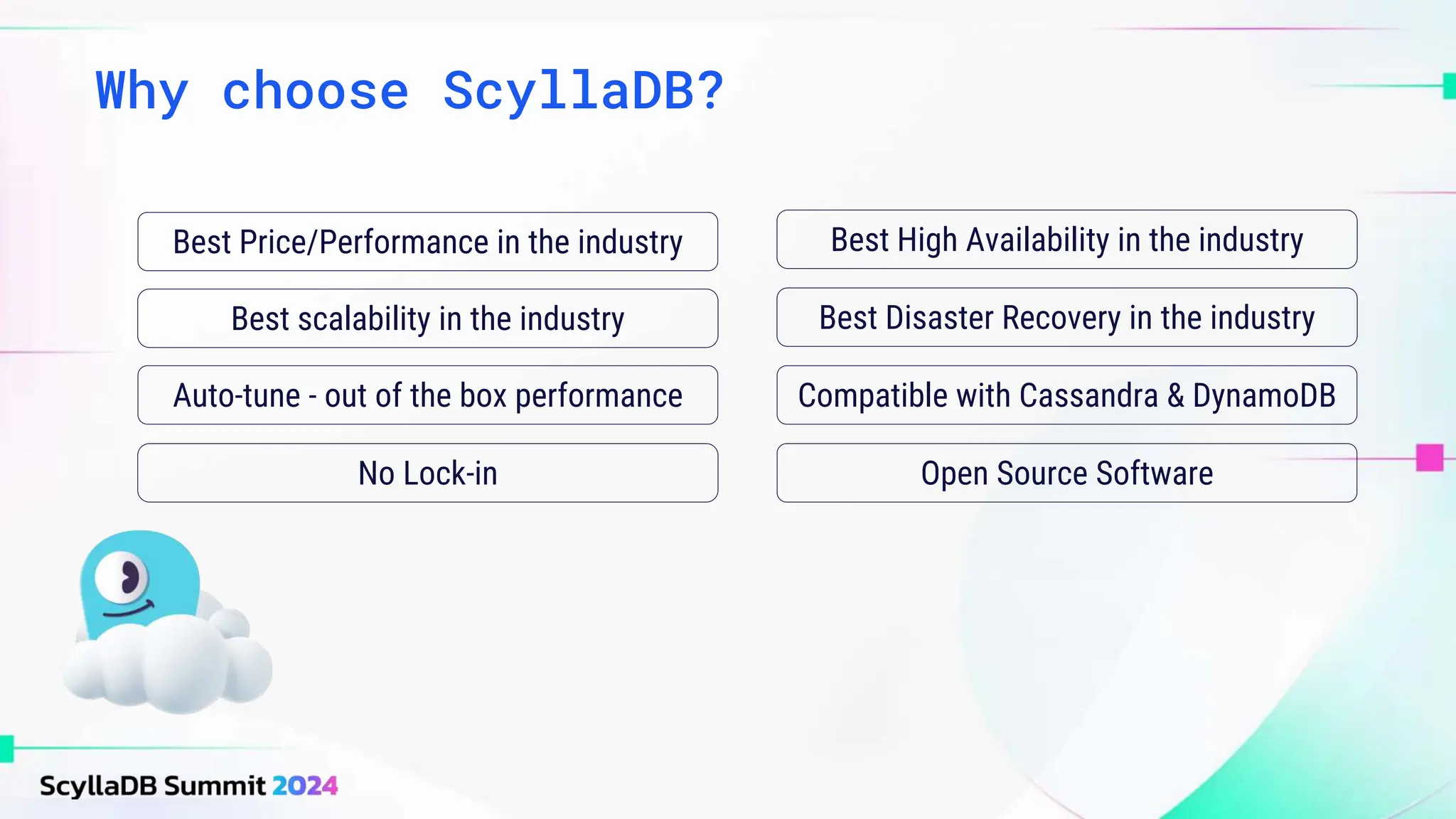
Why choose ScyllaDB?
Best High Availability in the industry
Best Disaster Recovery in the industry
Best scalability in the industry
Best Price/Performance in the industry
Auto-tune - out of the box performance Compatible with Cassandra & DynamoDB
No Lock-in Open Source Software
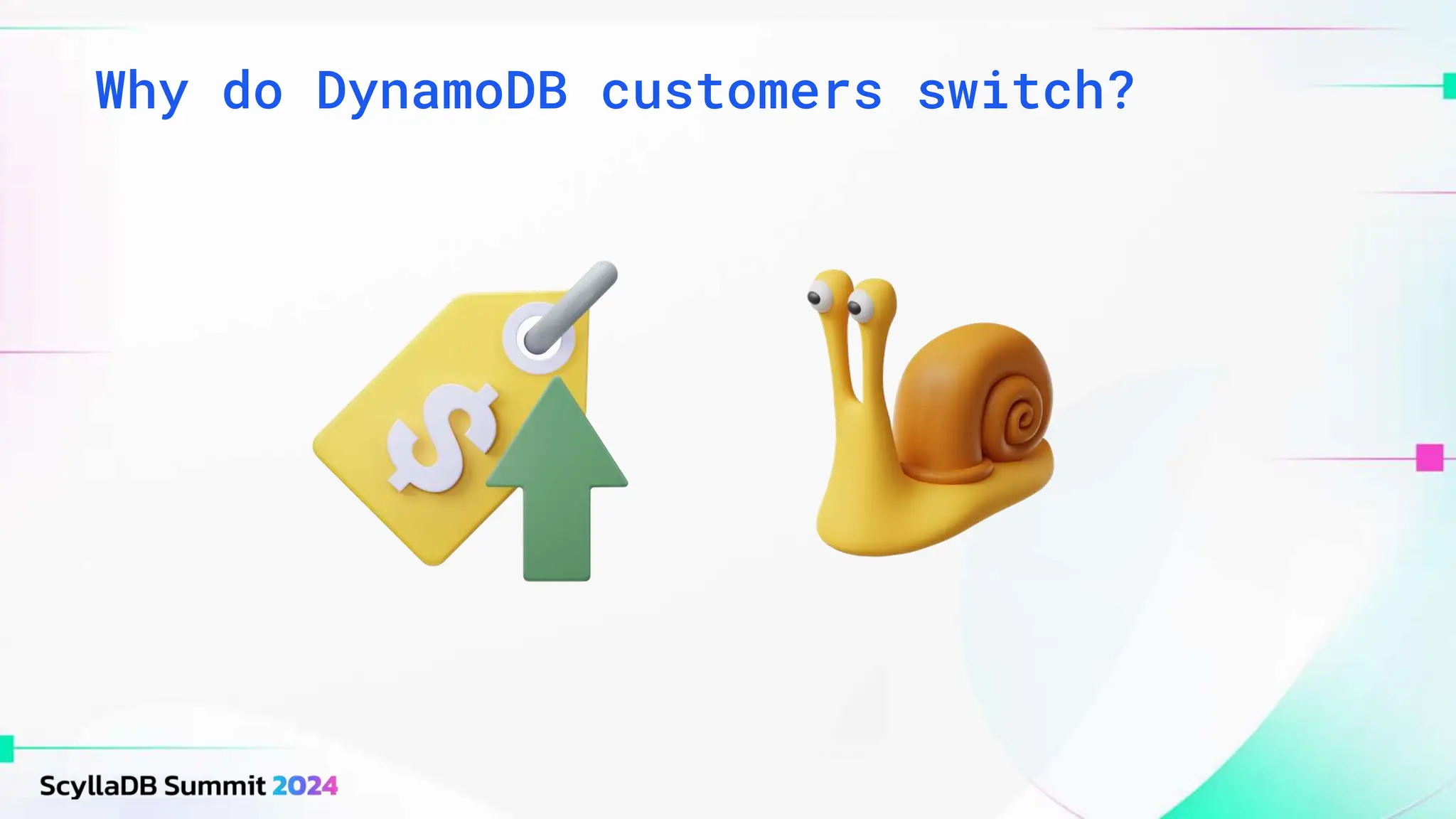
Why do DynamoDB customers switch?
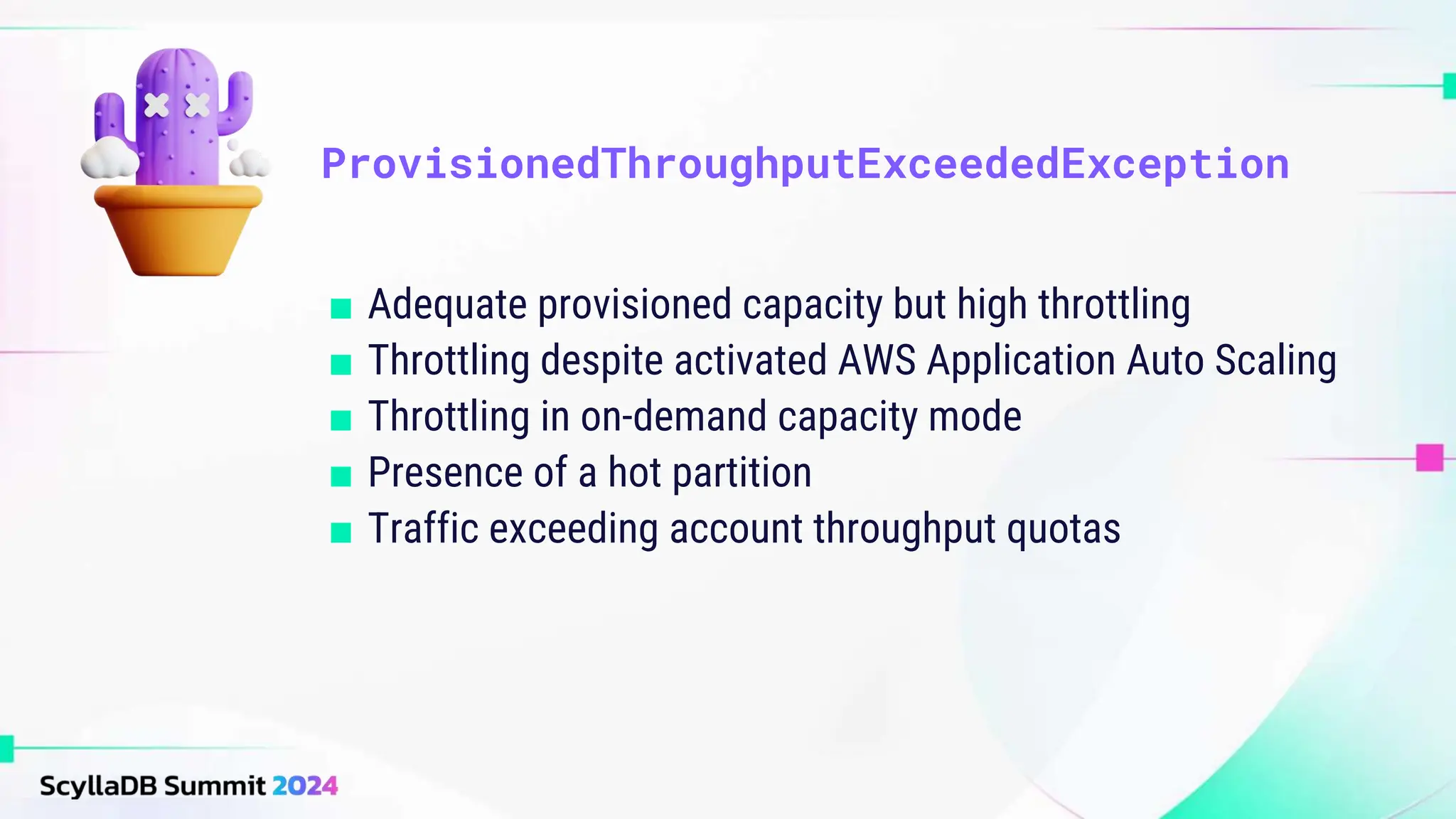
■ Adequate provisioned capacity but high throttling
■ Throttling despite activated AWS Application Auto Scaling
■ Throttling in on-demand capacity mode
■ Presence of a hot partition
■ Traffic exceeding account throughput quotas
ProvisionedThroughputExceededException
Comparing DynamoDB and
ScyllaDB
The benchmark
Provisioned Throughput
200K RCU
250K WCU
Cluster Size
i4i.2XL x 3
YCSB Loaders
c5.2XL x 8
18-150K ops/sec
lp.scylladb.com/price-performance-dynamoDB-benchmark-offer
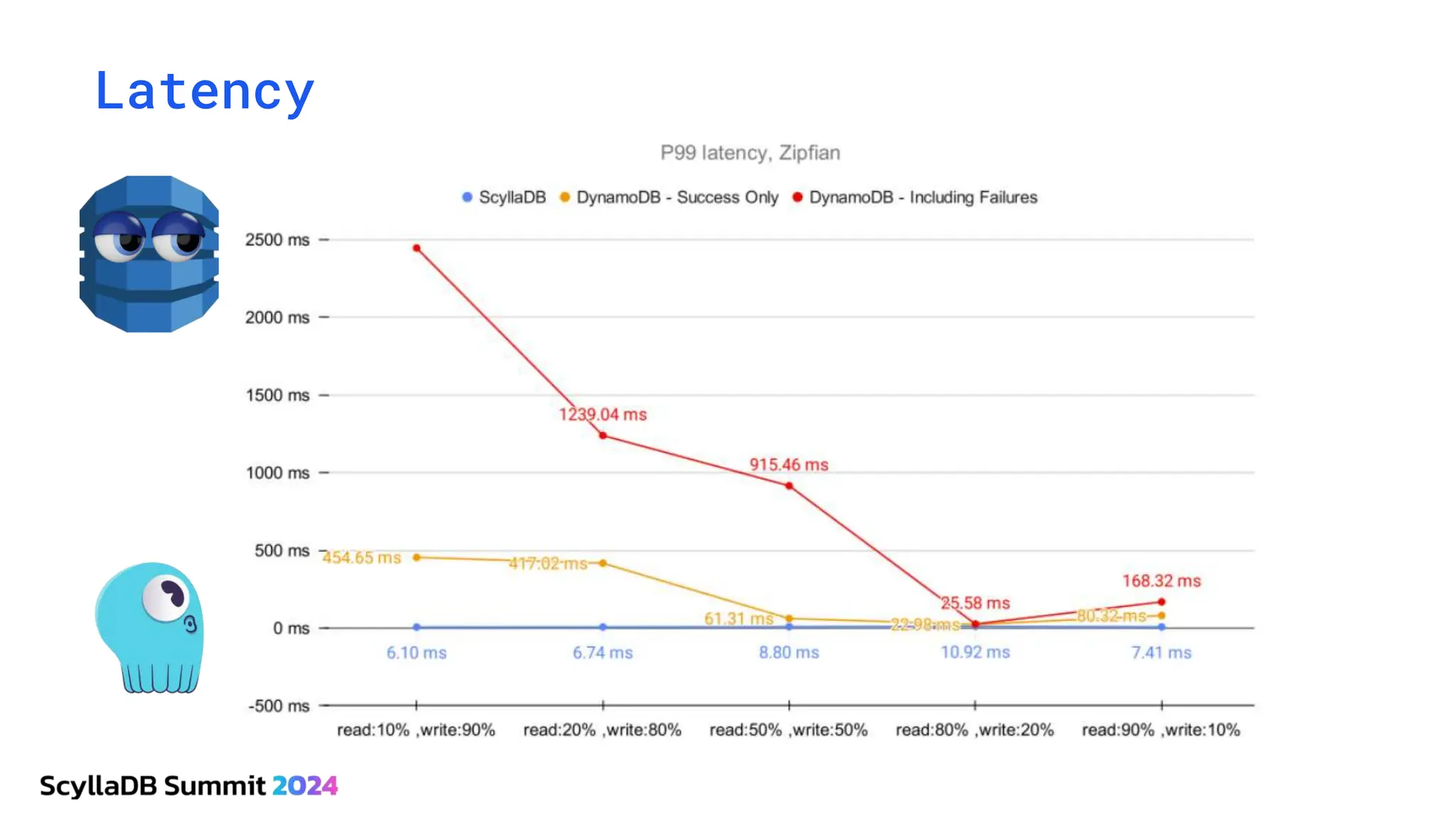
Latency
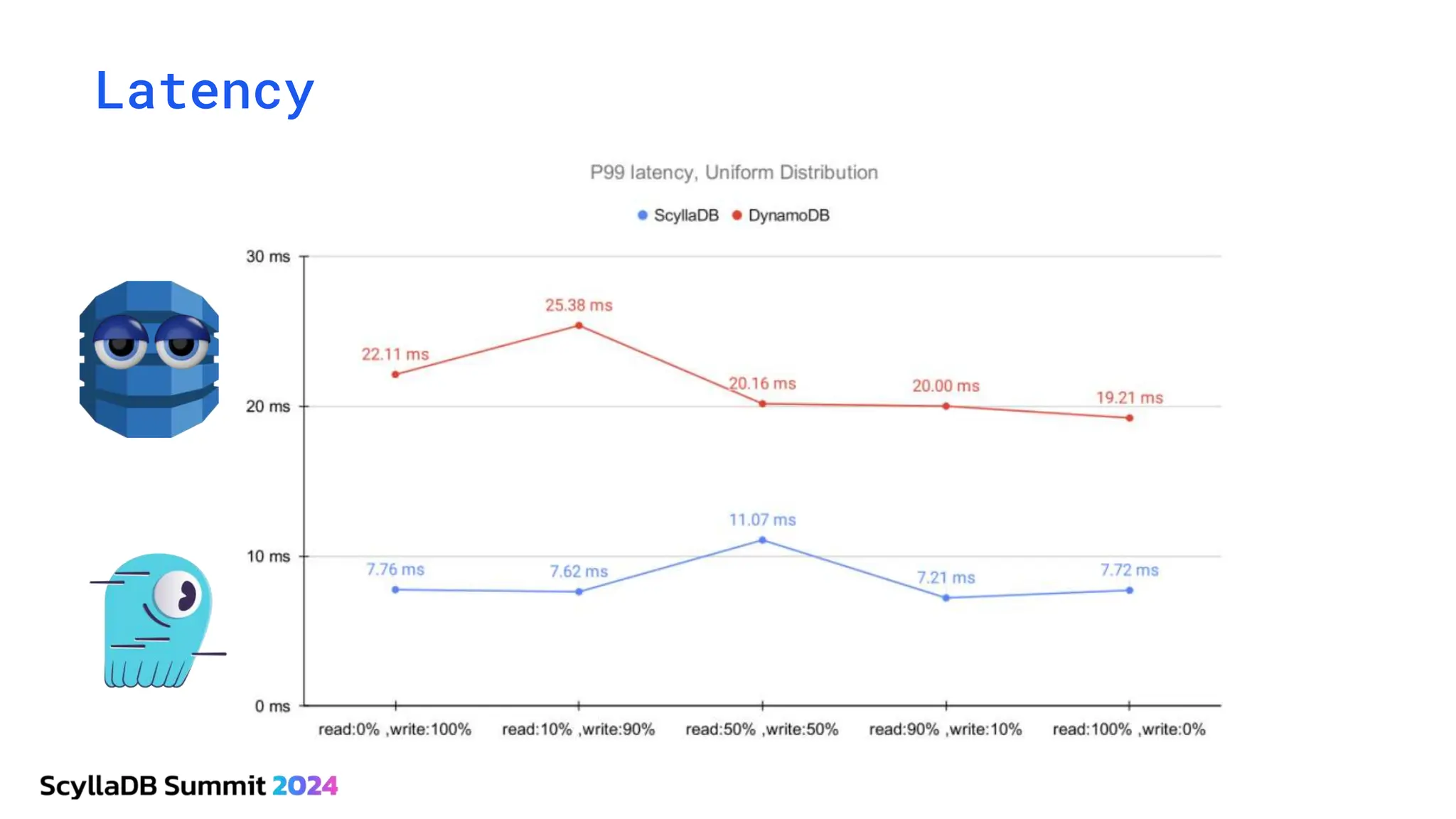
Latency
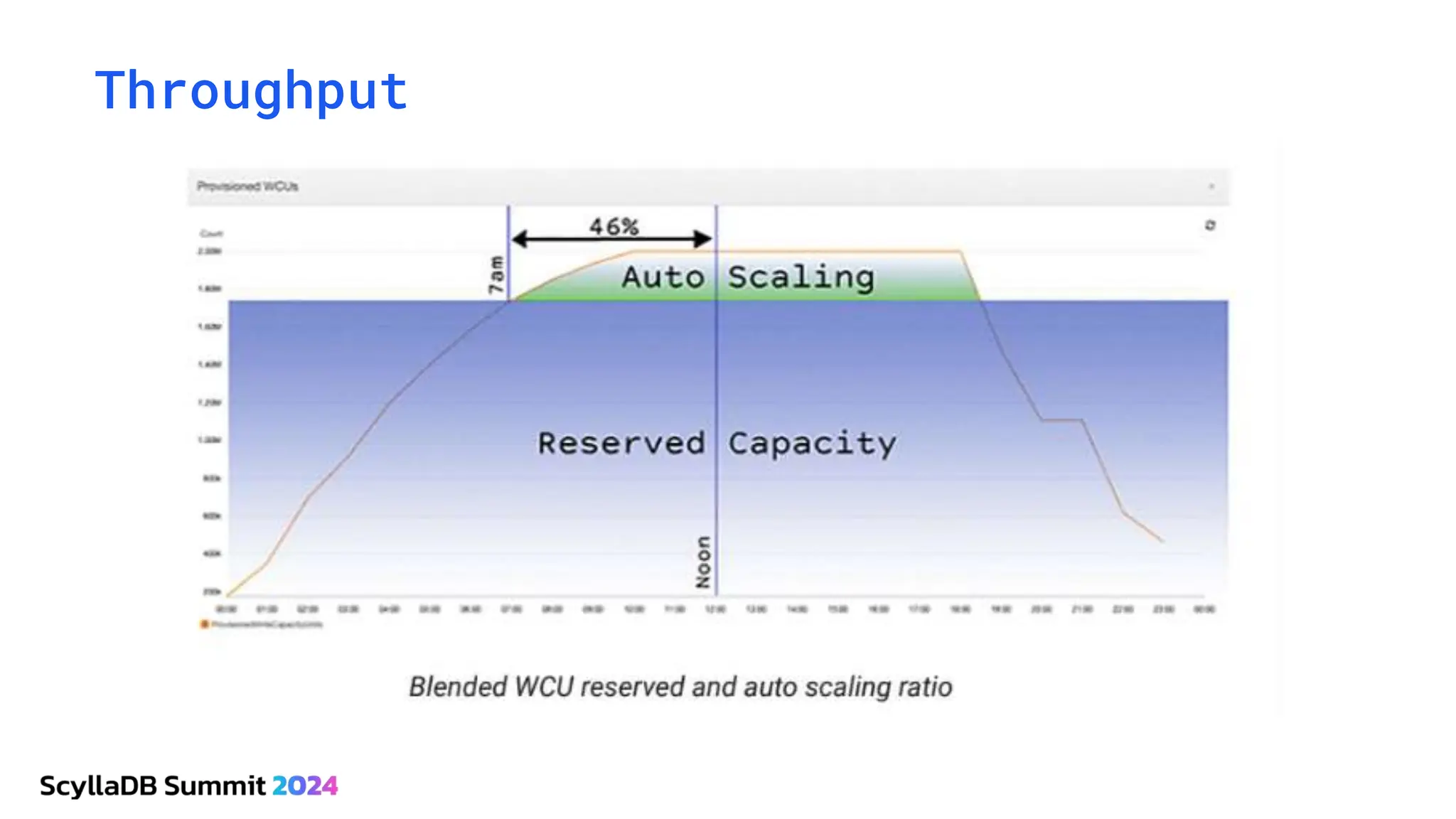
Throughput
Throughput
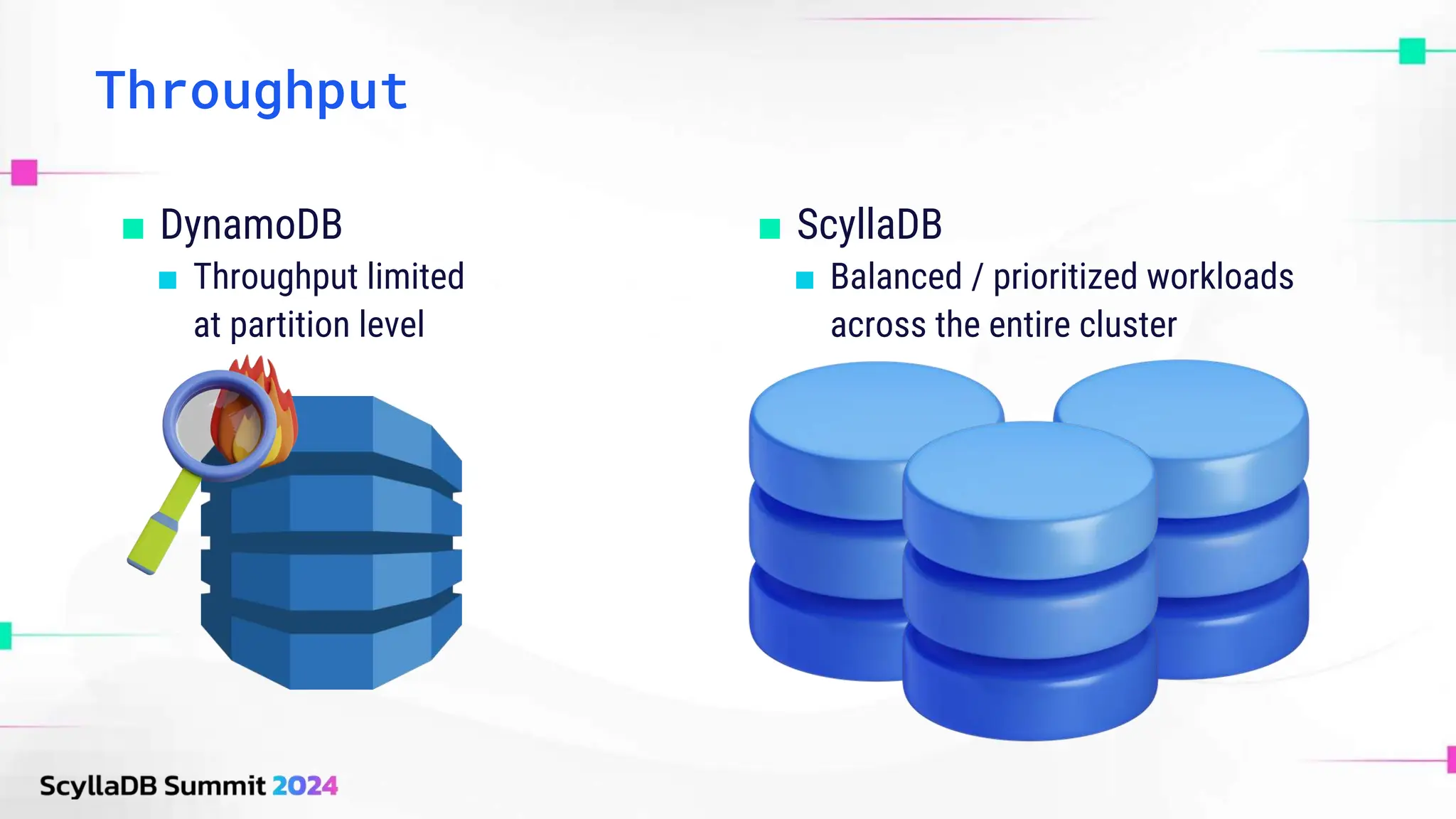
■ DynamoDB
■ Throughput limited
at partition level
■ ScyllaDB
■ Balanced / prioritized workloads
across the entire cluster
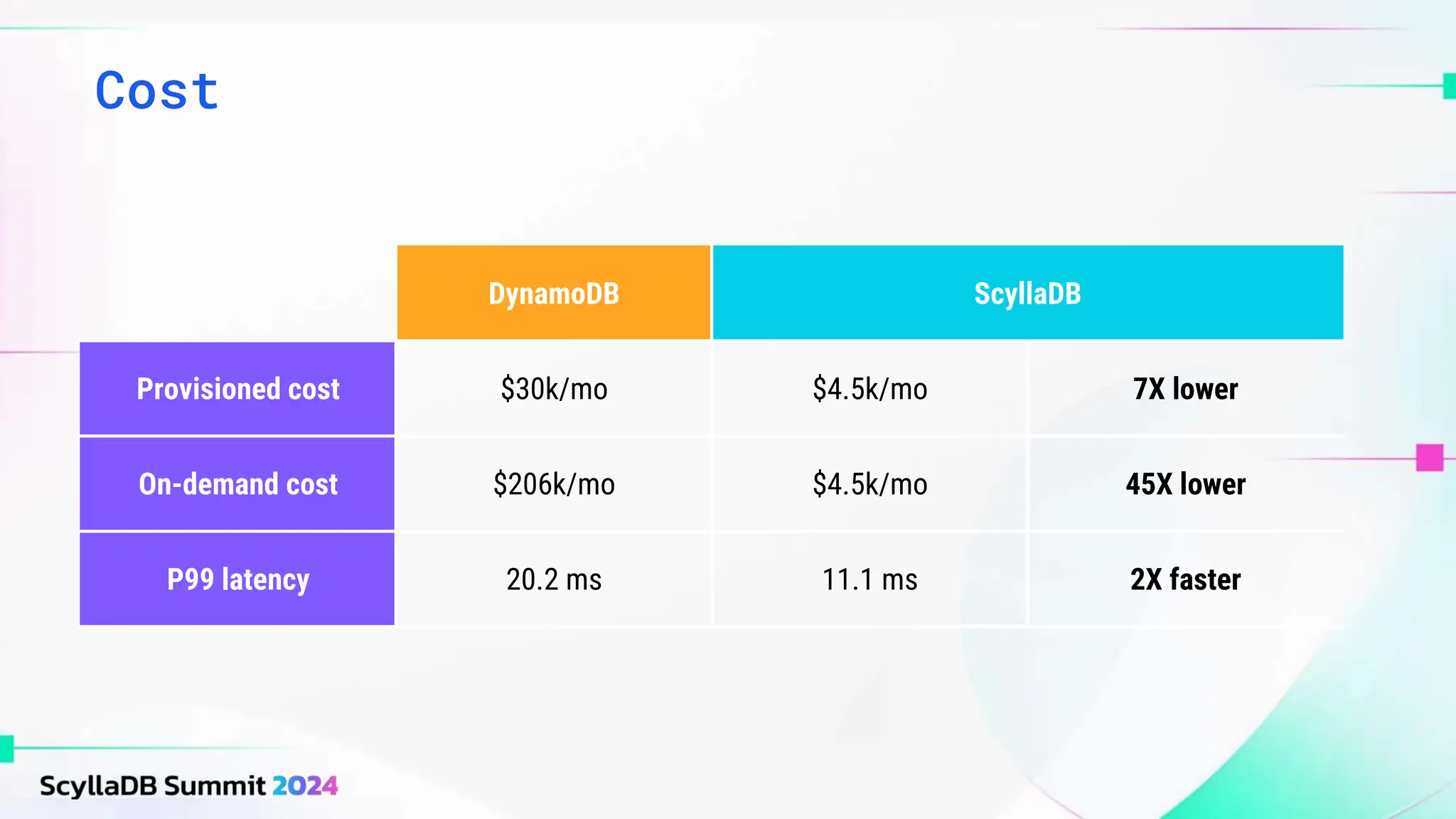
Cost
DynamoDB ScyllaDB
Provisioned cost $30k/mo $4.5k/mo 7X lower
On-demand cost $206k/mo $4.5k/mo 45X lower
P99 latency 20.2 ms 11.1 ms 2X faster
Migrating from
DynamoDB to ScyllaDB
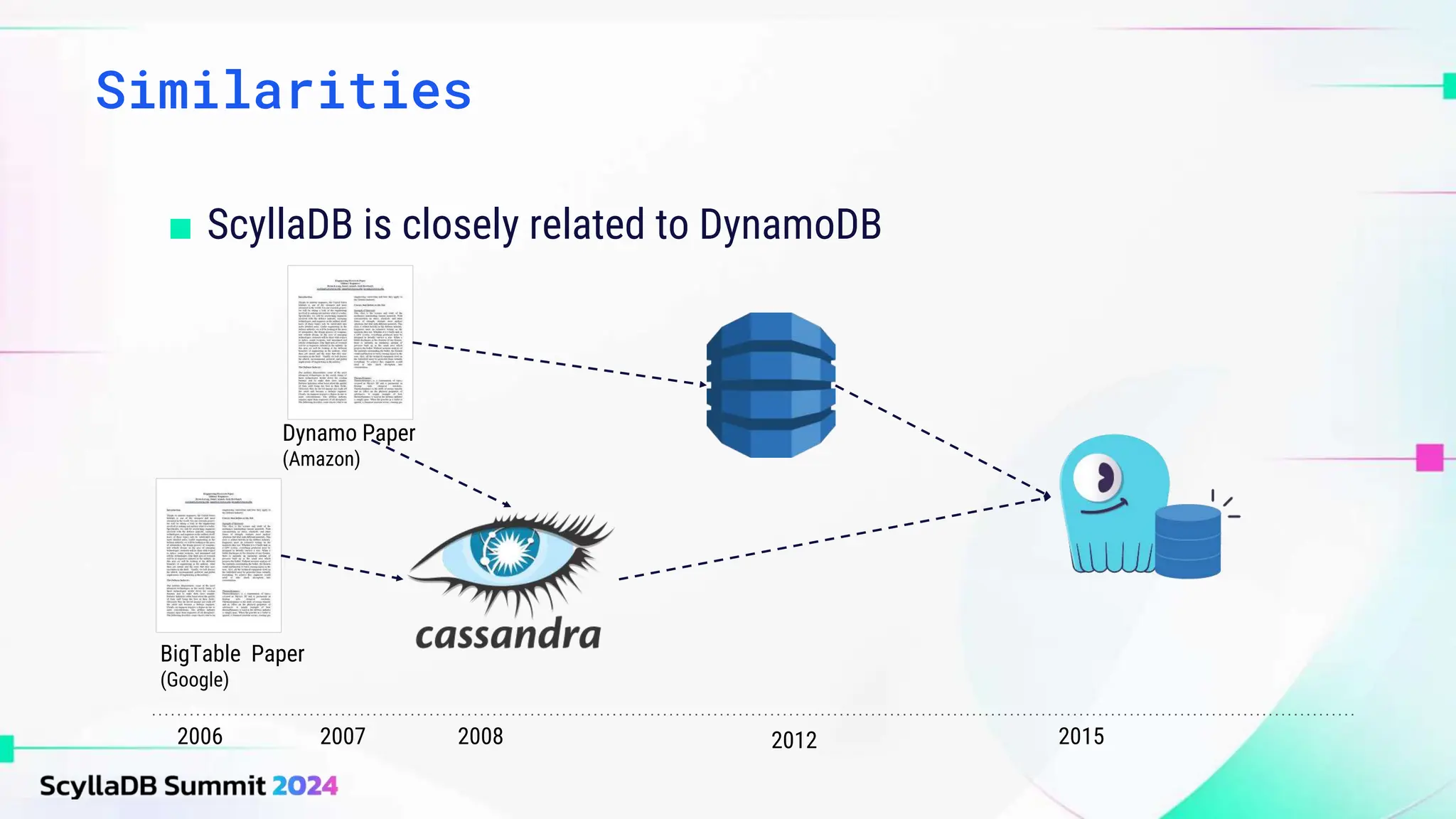
■ ScyllaDB is closely related to DynamoDB
Similarities
Dynamo Paper
(Amazon)
BigTable Paper
(Google)
2006 2007 2008 2015
2012
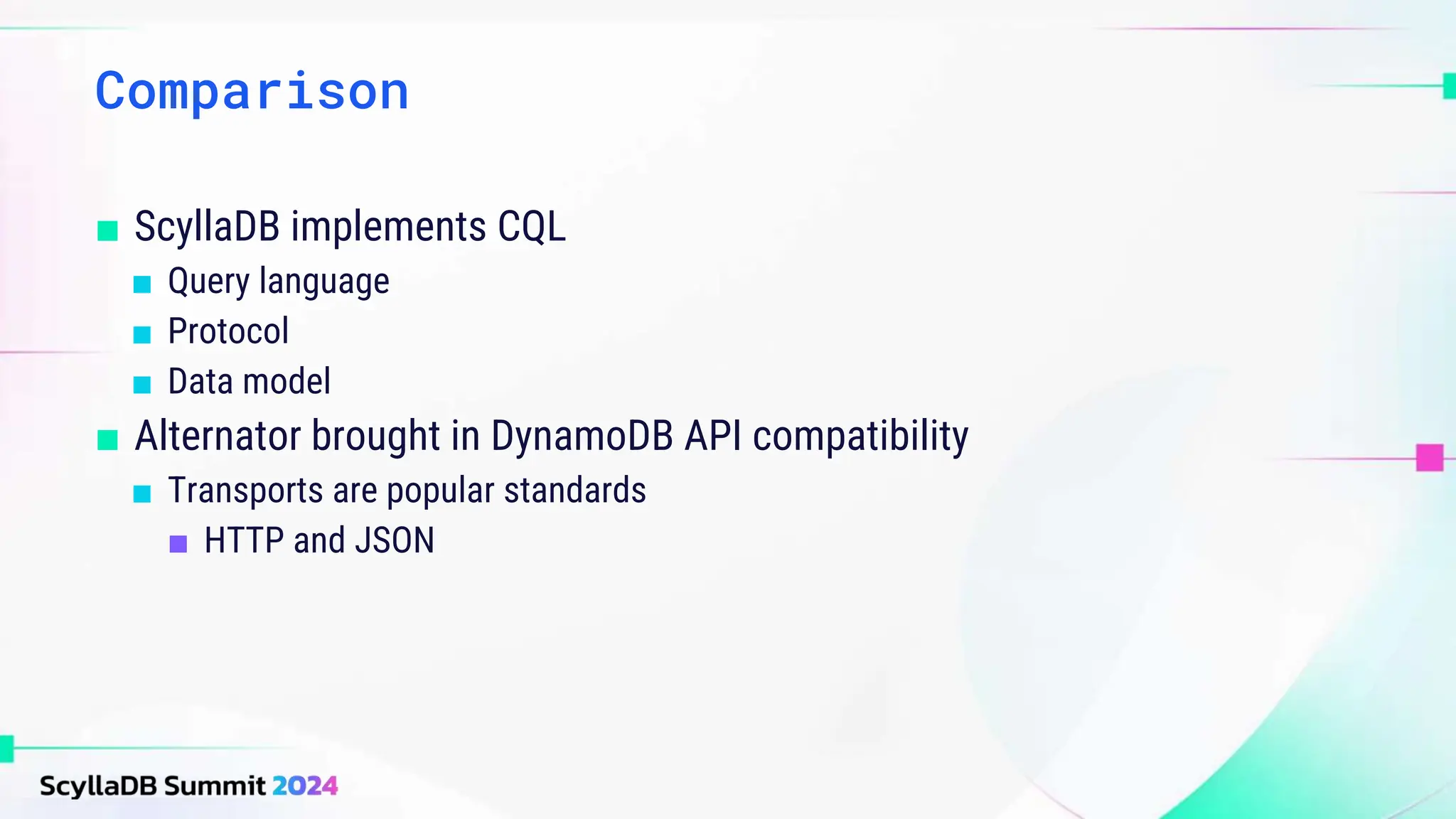
■ ScyllaDB implements CQL
■ Query language
■ Protocol
■ Data model
■ Alternator brought in DynamoDB API compatibility
■ Transports are popular standards
■ HTTP and JSON
Comparison
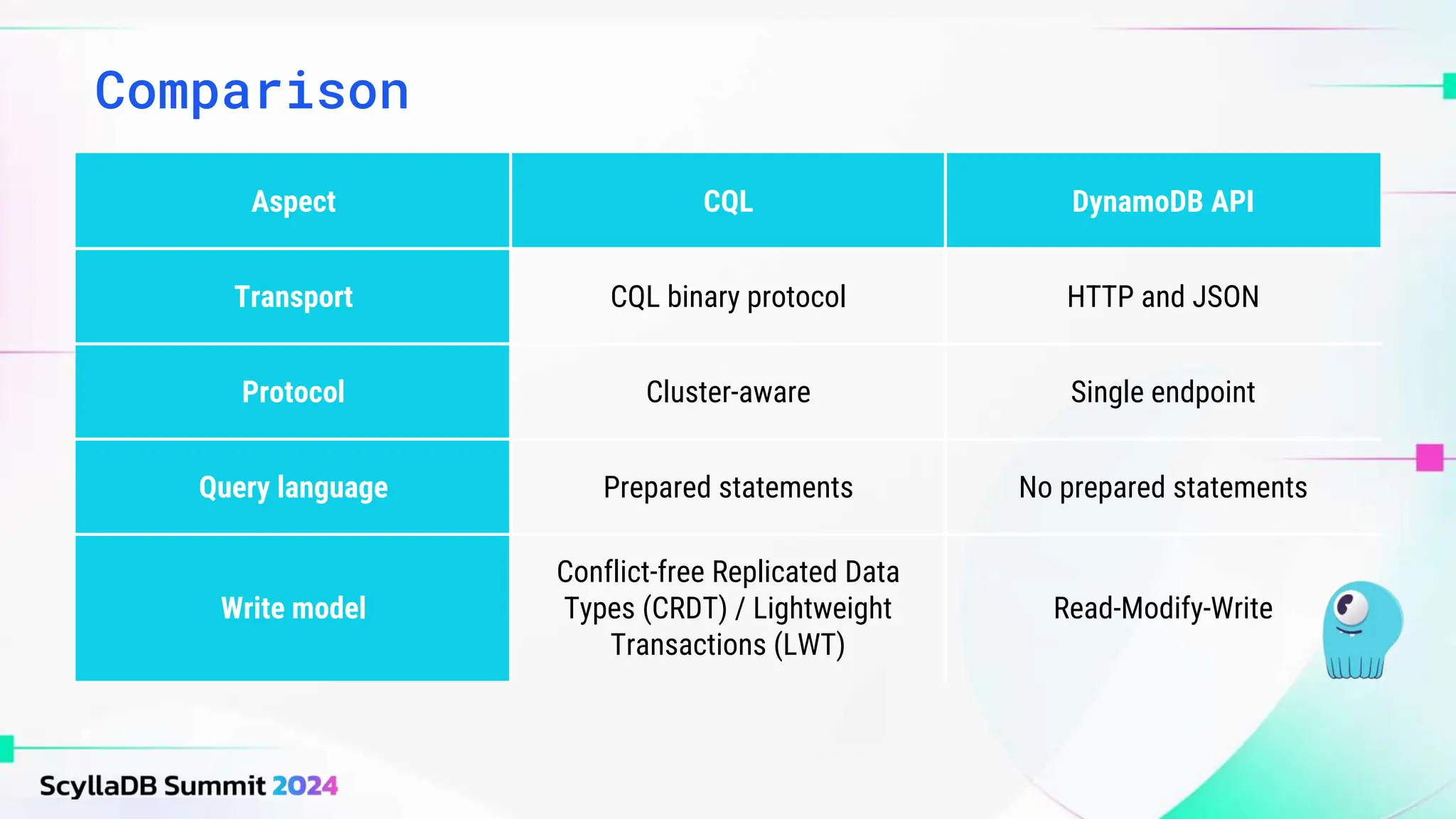
Comparison
Aspect CQL DynamoDB API
Transport CQL binary protocol HTTP and JSON
Protocol Cluster-aware Single endpoint
Query language Prepared statements No prepared statements
Write model
Conflict-free Replicated Data
Types (CRDT) / Lightweight
Transactions (LWT)
Read-Modify-Write
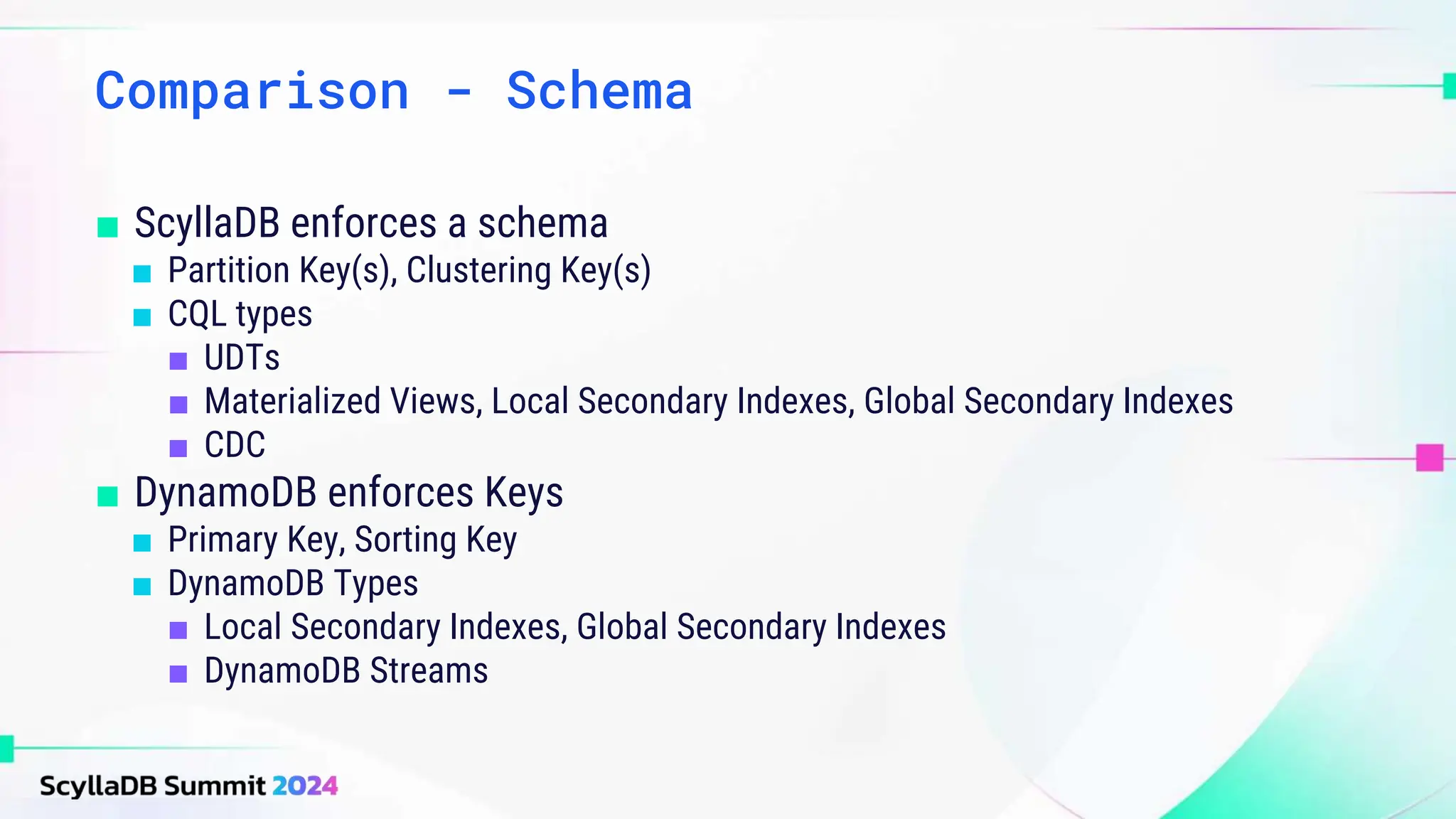
Comparison - Schema
■ ScyllaDB enforces a schema
■ Partition Key(s), Clustering Key(s)
■ CQL types
■ UDTs
■ Materialized Views, Local Secondary Indexes, Global Secondary Indexes
■ CDC
■ DynamoDB enforces Keys
■ Primary Key, Sorting Key
■ DynamoDB Types
■ Local Secondary Indexes, Global Secondary Indexes
■ DynamoDB Streams
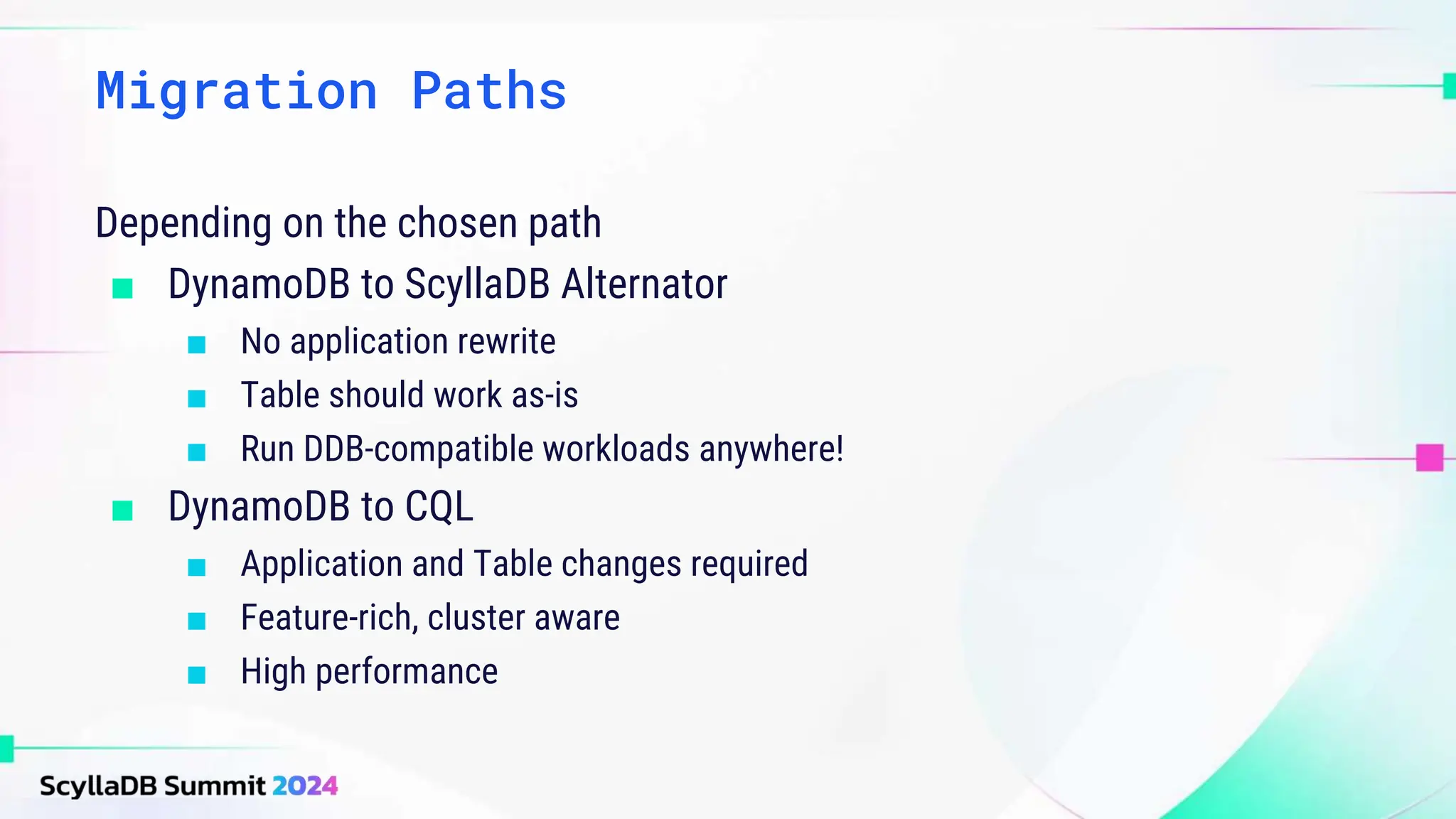
Depending on the chosen path
■ DynamoDB to ScyllaDB Alternator
■ No application rewrite
■ Table should work as-is
■ Run DDB-compatible workloads anywhere!
■ DynamoDB to CQL
■ Application and Table changes required
■ Feature-rich, cluster aware
■ High performance
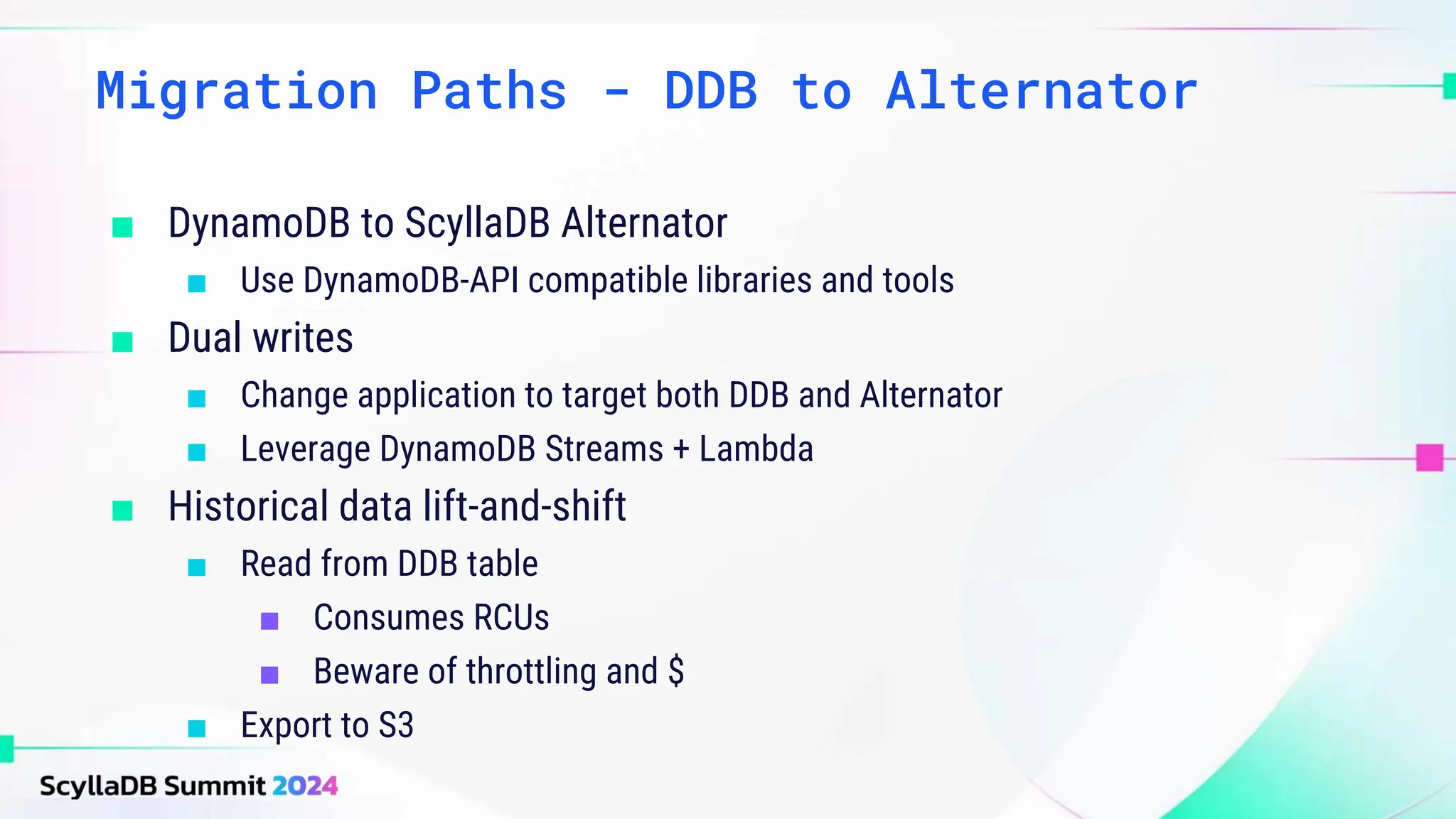
Migration Paths
■ DynamoDB to ScyllaDB Alternator
■ Use DynamoDB-API compatible libraries and tools
■ Dual writes
■ Change application to target both DDB and Alternator
■ Leverage DynamoDB Streams + Lambda
■ Historical data lift-and-shift
■ Read from DDB table
■ Consumes RCUs
■ Beware of throttling and $
■ Export to S3
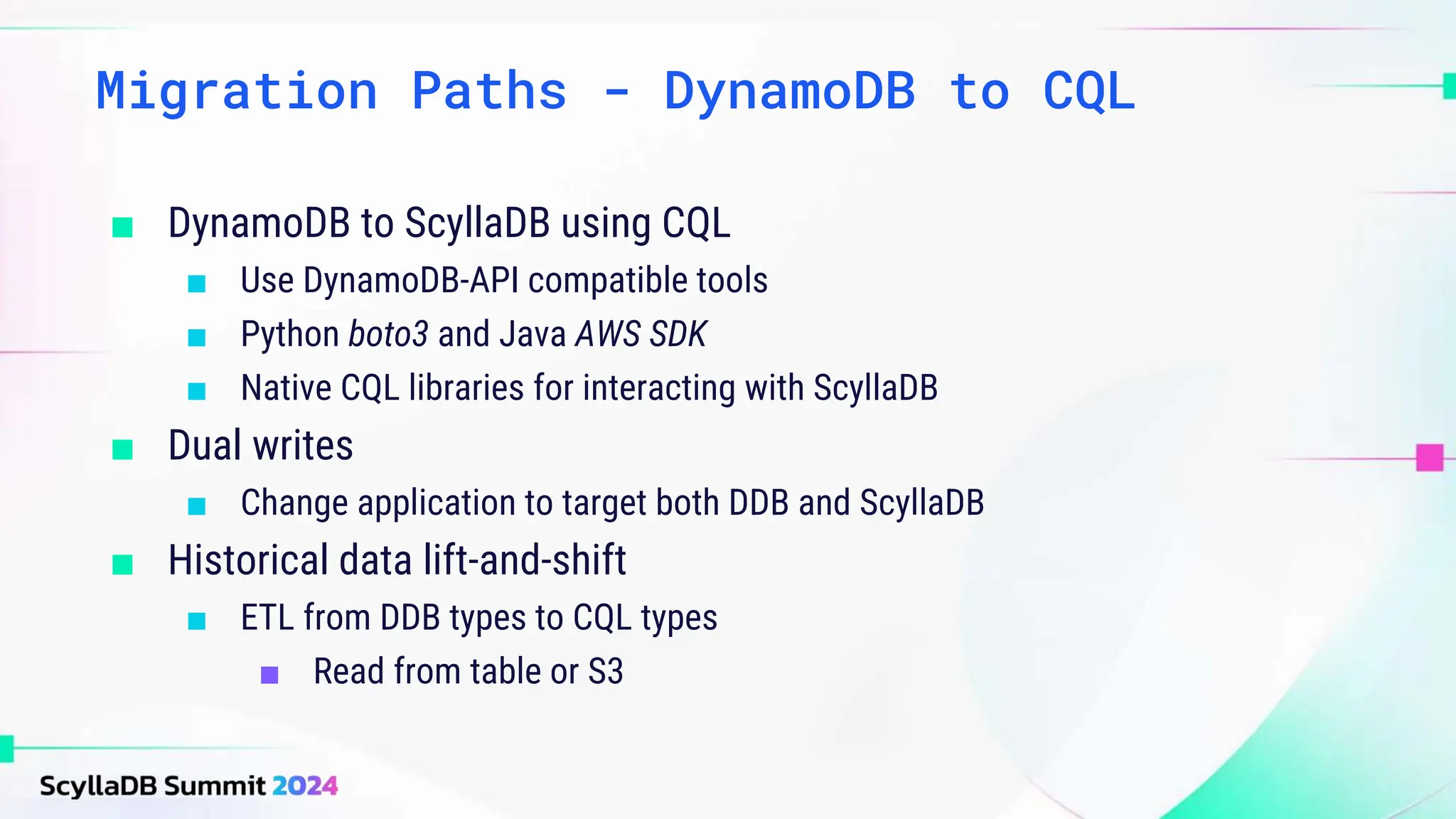
Migration Paths - DDB to Alternator
■ DynamoDB to ScyllaDB using CQL
■ Use DynamoDB-API compatible tools
■ Python boto3 and Java AWS SDK
■ Native CQL libraries for interacting with ScyllaDB
■ Dual writes
■ Change application to target both DDB and ScyllaDB
■ Historical data lift-and-shift
■ ETL from DDB types to CQL types
■ Read from table or S3
Migration Paths - DynamoDB to CQL
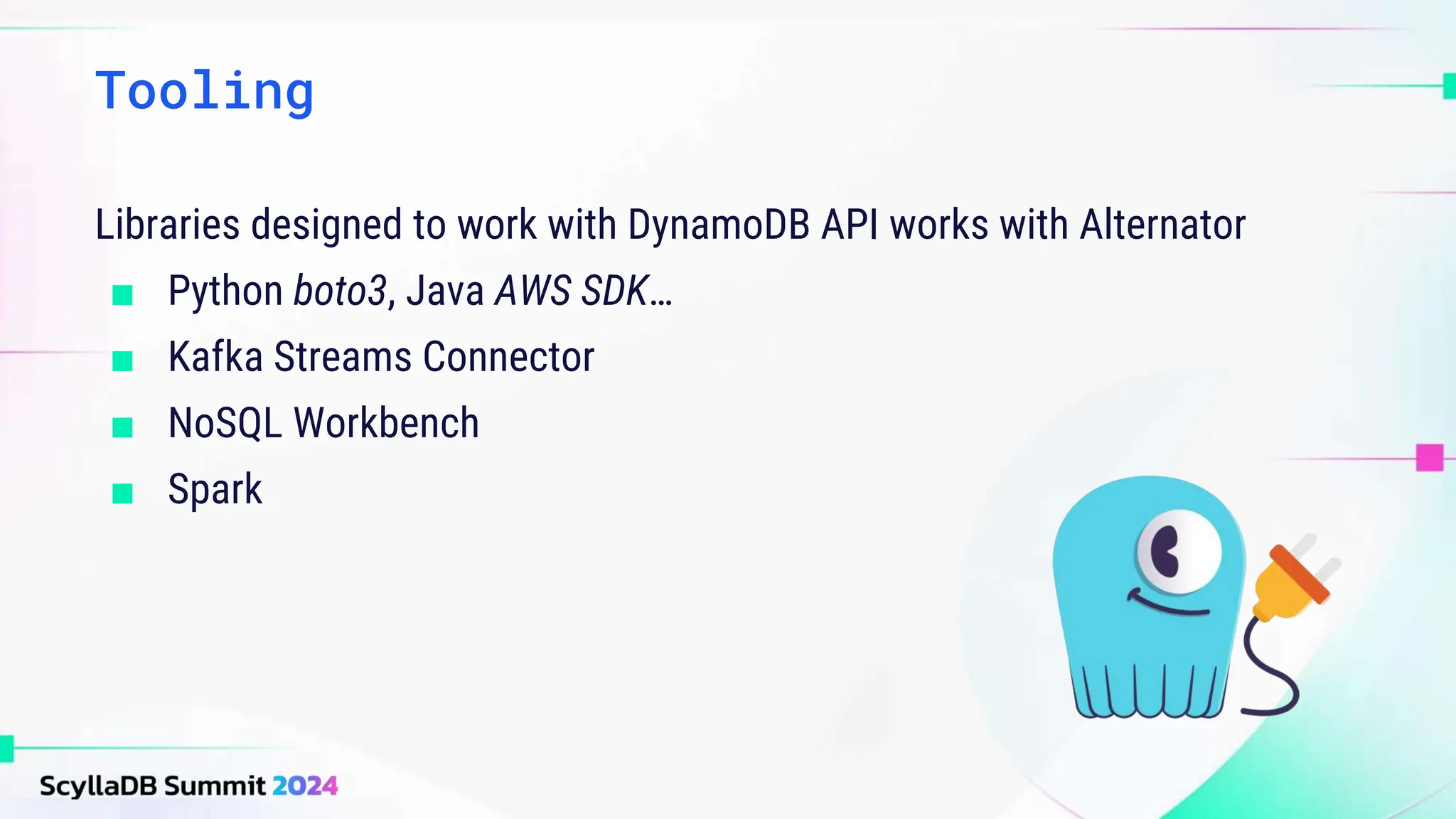
Libraries designed to work with DynamoDB API works with Alternator
■ Python boto3, Java AWS SDK…
■ Kafka Streams Connector
■ NoSQL Workbench
■ Spark
Tooling
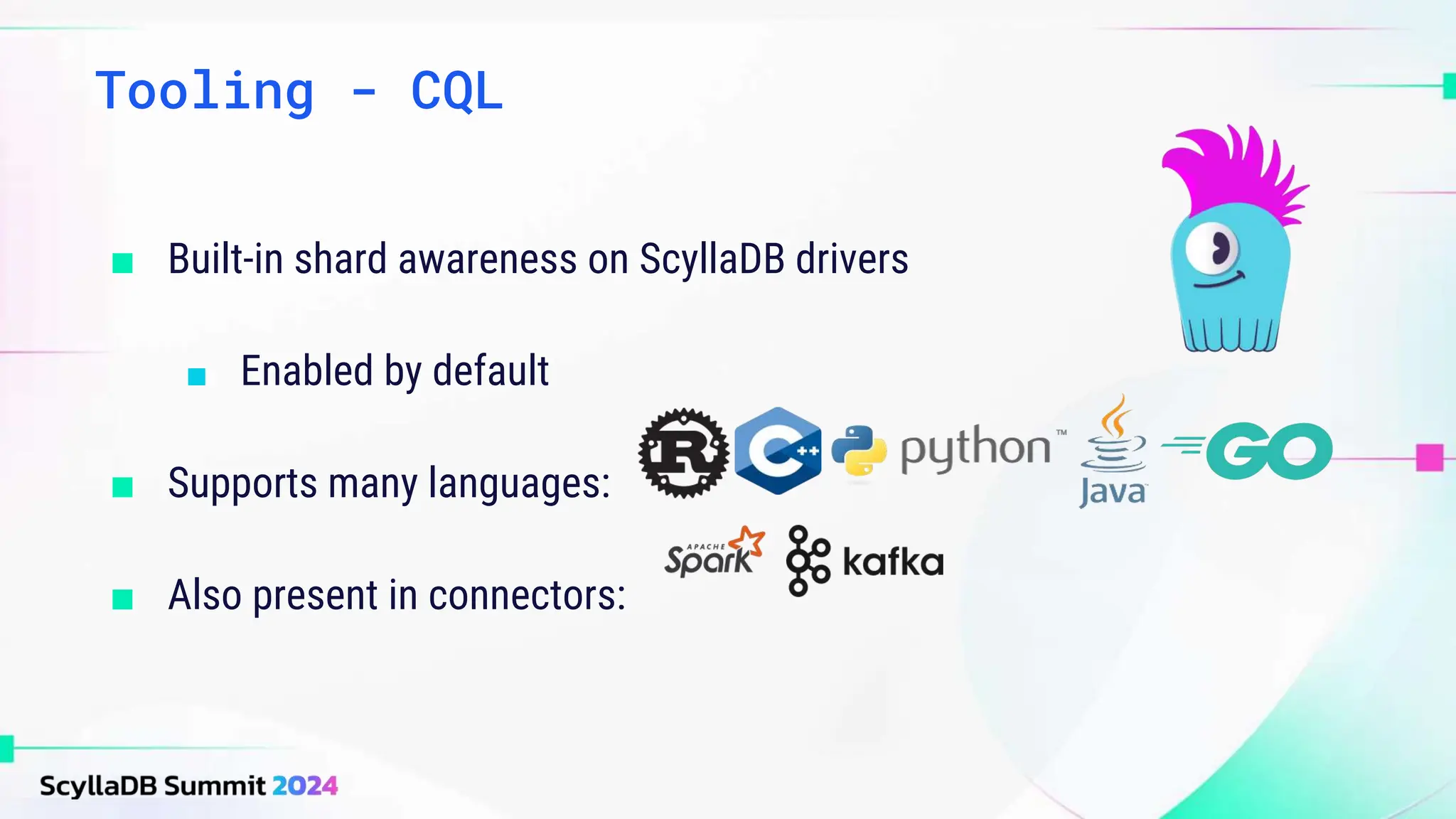
Tooling - CQL
■ Built-in shard awareness on ScyllaDB drivers
■ Enabled by default
■ Supports many languages:
■ Also present in connectors:
■ Reading tables can trip throttling
■ Impact to Production apps
■ Reading JSON from S3 has its challenges
■ Not everything abides to JSON standards
■ Better to stick with official libraries to import data
■ Schema changes over the years
Challenges
Case Studies And Best
Practices
■ Cost
■ Limited SDK
■ Write throughput
■ Why ScyllaDB?
■ Multi-region
■ ICS, CDC, Seastar shared-nothing, drivers
■ 1ms writes, single-digit read p99
Why did Disney Streaming move out of
DynamoDB?
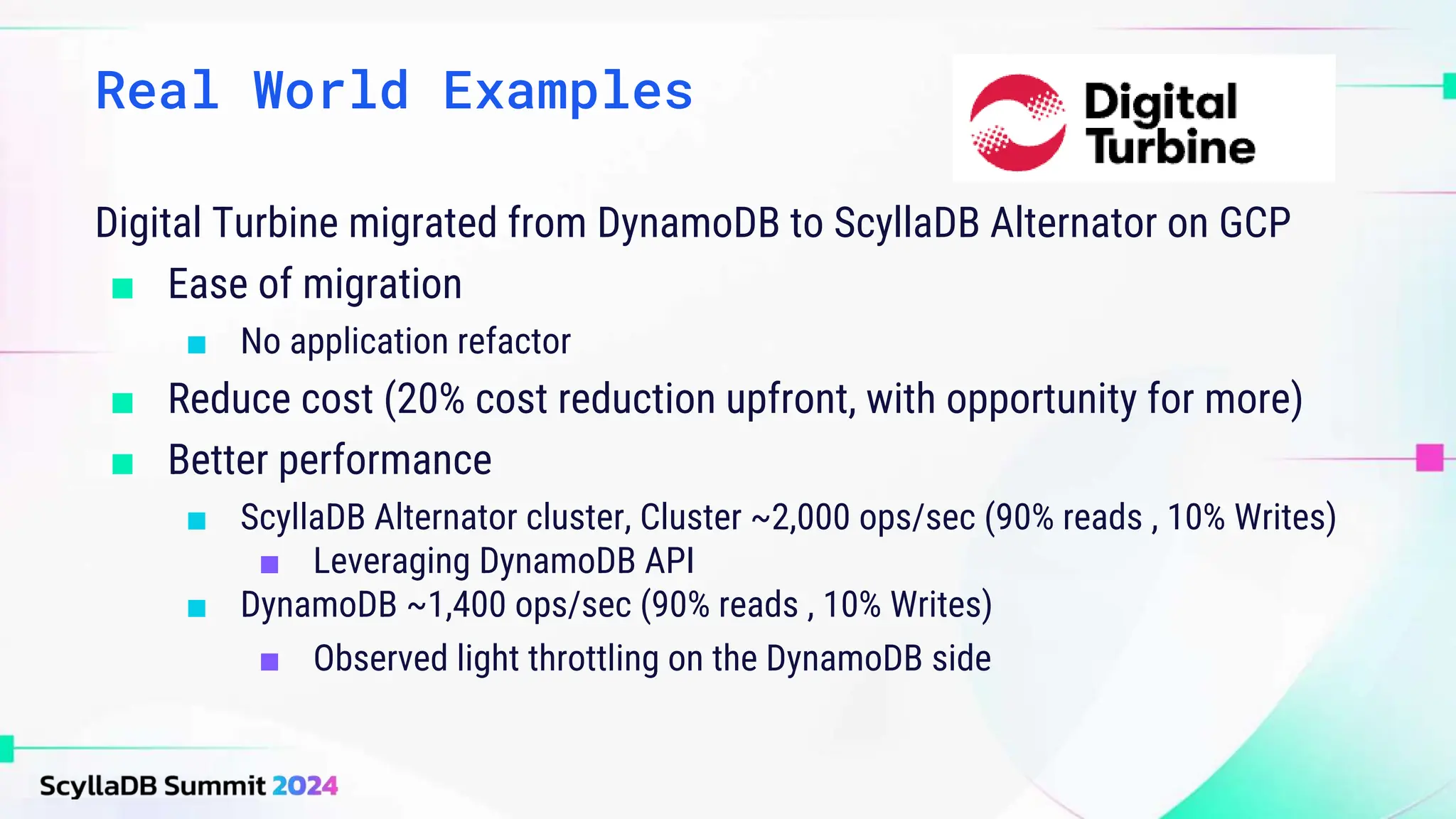
Real World Examples
Digital Turbine migrated from DynamoDB to ScyllaDB Alternator on GCP
■ Ease of migration
■ No application refactor
■ Reduce cost (20% cost reduction upfront, with opportunity for more)
■ Better performance
■ ScyllaDB Alternator cluster, Cluster ~2,000 ops/sec (90% reads , 10% Writes)
■ Leveraging DynamoDB API
■ DynamoDB ~1,400 ops/sec (90% reads , 10% Writes)
■ Observed light throttling on the DynamoDB side
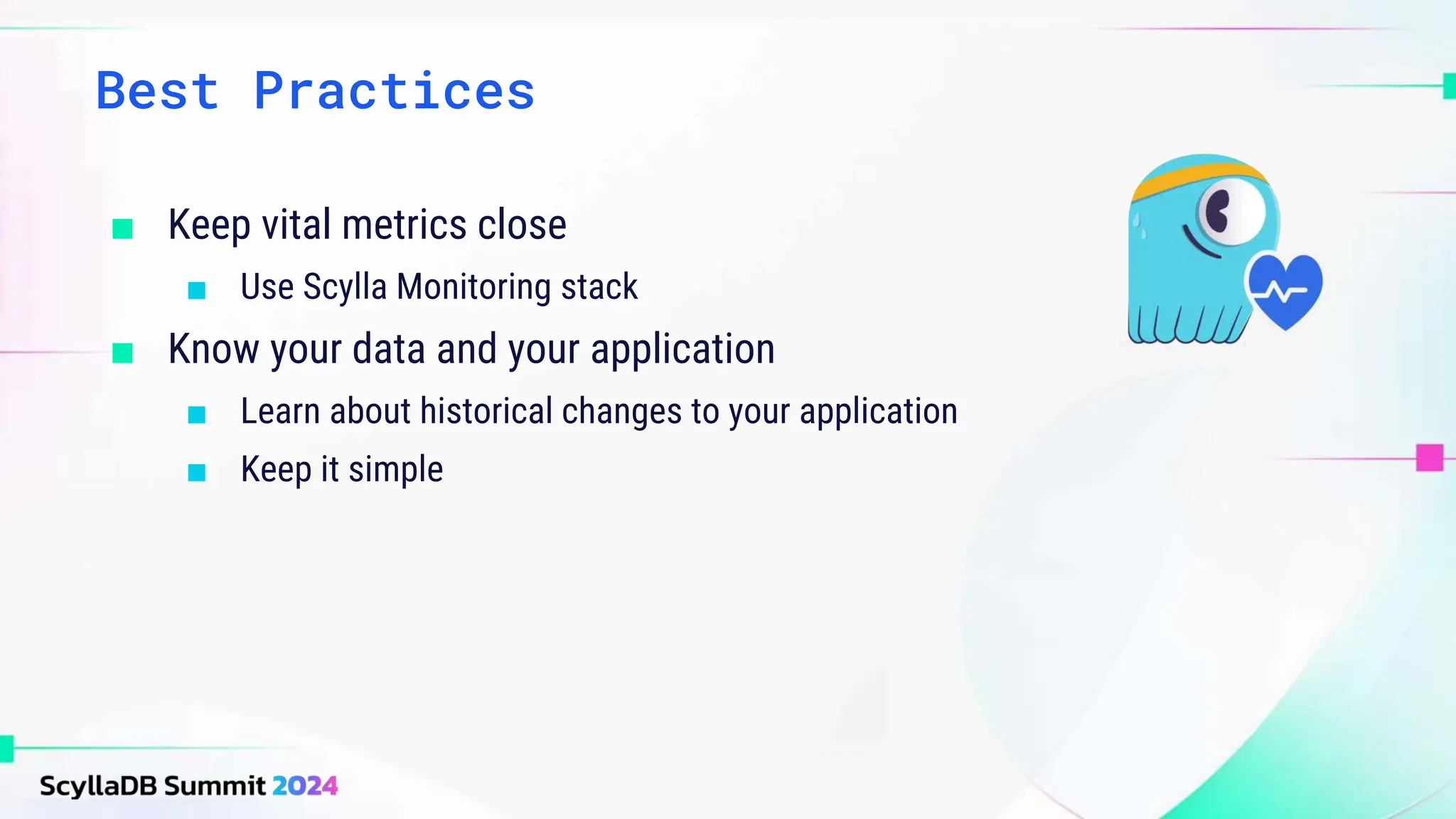
■ Keep vital metrics close
■ Use Scylla Monitoring stack
■ Know your data and your application
■ Learn about historical changes to your application
■ Keep it simple
Best Practices
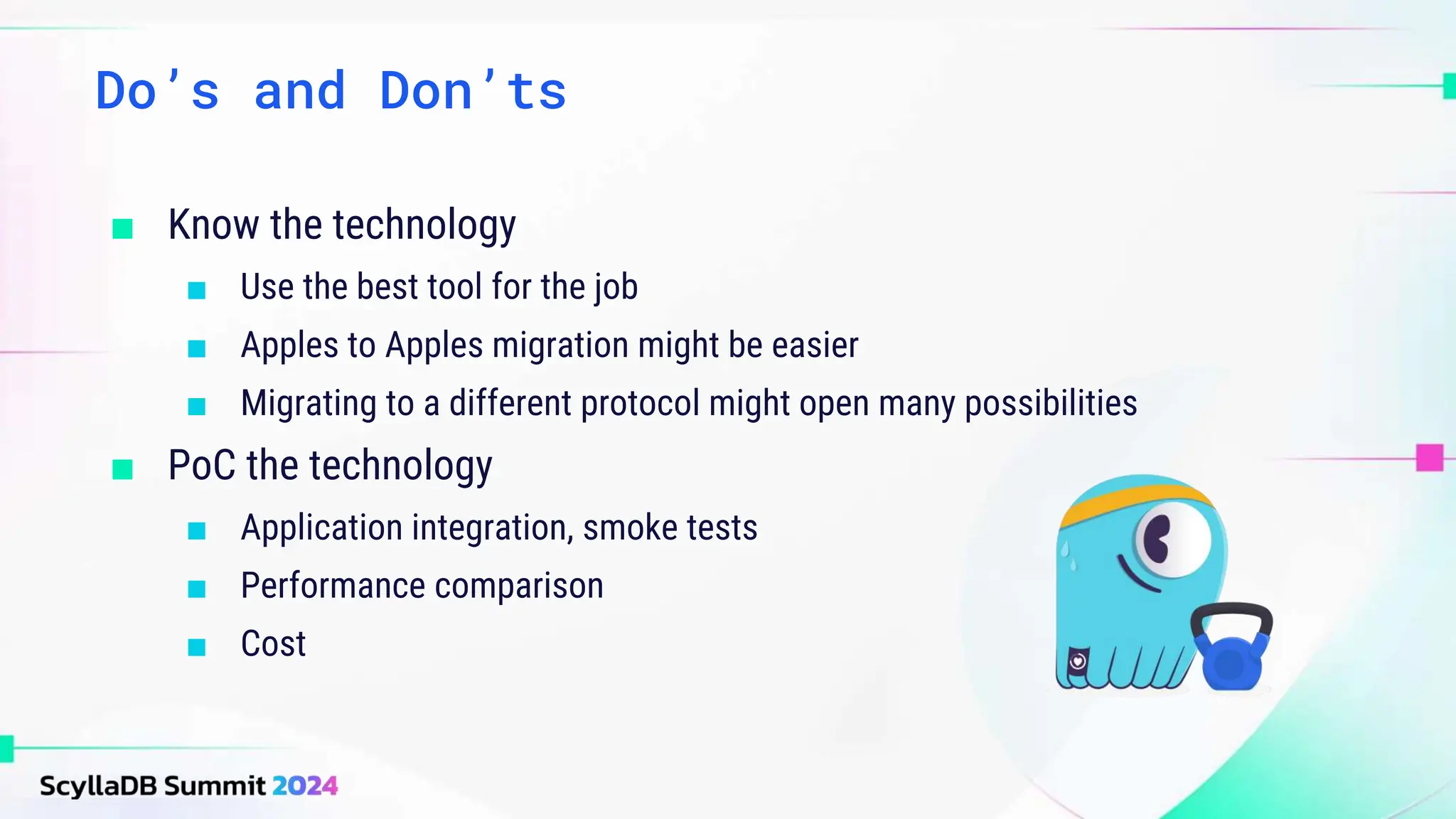
■ Know the technology
■ Use the best tool for the job
■ Apples to Apples migration might be easier
■ Migrating to a different protocol might open many possibilities
■ PoC the technology
■ Application integration, smoke tests
■ Performance comparison
■ Cost
Do’s and Don’ts
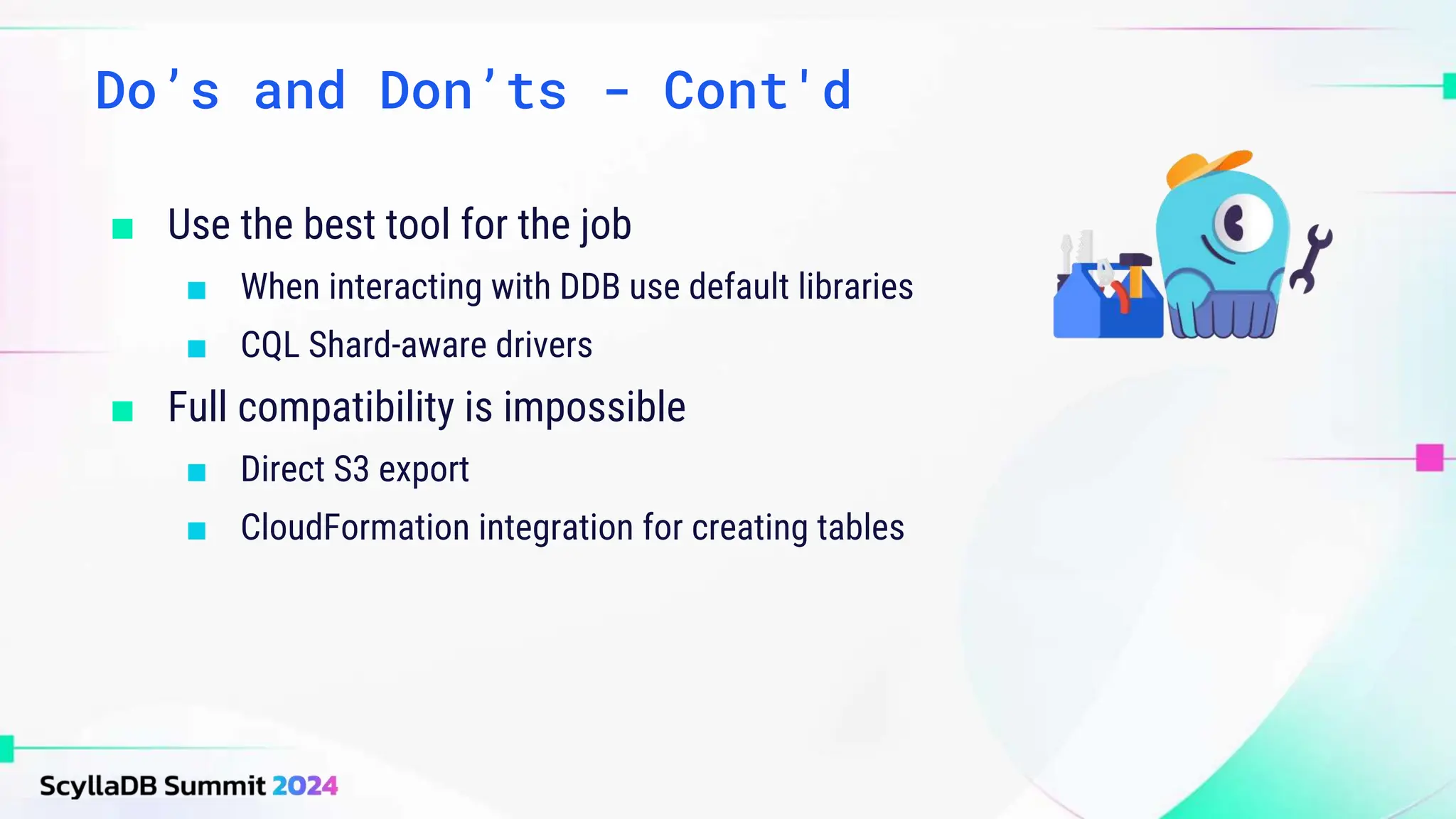
■ Use the best tool for the job
■ When interacting with DDB use default libraries
■ CQL Shard-aware drivers
■ Full compatibility is impossible
■ Direct S3 export
■ CloudFormation integration for creating tables
Do’s and Don’ts - Cont'd
Conclusion
Conclusion
- ScyllaDB University is 100% FREE
- Lessons on the DynamoDB API
- Migration
- Many useful blogs
- Customer stories
- Migrating from DynamoDB to ScyllaDB can be extremely beneficial
- Easy to get started
- Also available as a Managed Service
Thanks
Gui
guilherme.nogueira@scylladb.com
Tim
tim.koopmans@scylladb.com

DynamoDB to ScyllaDB: Technical Comparison and the Path to Success

  • 1.
    DynamoDB to ScyllaDB Atechnical comparison and path to success Tim Koopmans, Product Experience Guilherme Nogueira, Solutions Architect
  • 2.
    ■ Introduction ■ UnderstandingScyllaDB ■ Comparing DynamoDB and ScyllaDB ■ Migration Options and Tools ■ Case Studies and Best Practices ■ Conclusion Presentation Agenda
  • 3.
  • 4.
    Why choose ScyllaDB? BestHigh Availability in the industry Best Disaster Recovery in the industry Best scalability in the industry Best Price/Performance in the industry Auto-tune - out of the box performance Compatible with Cassandra & DynamoDB No Lock-in Open Source Software
  • 5.
    Why do DynamoDBcustomers switch?
  • 6.
    ■ Adequate provisionedcapacity but high throttling ■ Throttling despite activated AWS Application Auto Scaling ■ Throttling in on-demand capacity mode ■ Presence of a hot partition ■ Traffic exceeding account throughput quotas ProvisionedThroughputExceededException
  • 7.
  • 8.
    The benchmark Provisioned Throughput 200KRCU 250K WCU Cluster Size i4i.2XL x 3 YCSB Loaders c5.2XL x 8 18-150K ops/sec lp.scylladb.com/price-performance-dynamoDB-benchmark-offer
  • 9.
  • 10.
  • 11.
  • 12.
    Throughput ■ DynamoDB ■ Throughputlimited at partition level ■ ScyllaDB ■ Balanced / prioritized workloads across the entire cluster
  • 13.
    Cost DynamoDB ScyllaDB Provisioned cost$30k/mo $4.5k/mo 7X lower On-demand cost $206k/mo $4.5k/mo 45X lower P99 latency 20.2 ms 11.1 ms 2X faster
  • 14.
  • 15.
    ■ ScyllaDB isclosely related to DynamoDB Similarities Dynamo Paper (Amazon) BigTable Paper (Google) 2006 2007 2008 2015 2012
  • 16.
    ■ ScyllaDB implementsCQL ■ Query language ■ Protocol ■ Data model ■ Alternator brought in DynamoDB API compatibility ■ Transports are popular standards ■ HTTP and JSON Comparison
  • 17.
    Comparison Aspect CQL DynamoDBAPI Transport CQL binary protocol HTTP and JSON Protocol Cluster-aware Single endpoint Query language Prepared statements No prepared statements Write model Conflict-free Replicated Data Types (CRDT) / Lightweight Transactions (LWT) Read-Modify-Write
  • 18.
    Comparison - Schema ■ScyllaDB enforces a schema ■ Partition Key(s), Clustering Key(s) ■ CQL types ■ UDTs ■ Materialized Views, Local Secondary Indexes, Global Secondary Indexes ■ CDC ■ DynamoDB enforces Keys ■ Primary Key, Sorting Key ■ DynamoDB Types ■ Local Secondary Indexes, Global Secondary Indexes ■ DynamoDB Streams
  • 19.
    Depending on thechosen path ■ DynamoDB to ScyllaDB Alternator ■ No application rewrite ■ Table should work as-is ■ Run DDB-compatible workloads anywhere! ■ DynamoDB to CQL ■ Application and Table changes required ■ Feature-rich, cluster aware ■ High performance Migration Paths
  • 20.
    ■ DynamoDB toScyllaDB Alternator ■ Use DynamoDB-API compatible libraries and tools ■ Dual writes ■ Change application to target both DDB and Alternator ■ Leverage DynamoDB Streams + Lambda ■ Historical data lift-and-shift ■ Read from DDB table ■ Consumes RCUs ■ Beware of throttling and $ ■ Export to S3 Migration Paths - DDB to Alternator
  • 21.
    ■ DynamoDB toScyllaDB using CQL ■ Use DynamoDB-API compatible tools ■ Python boto3 and Java AWS SDK ■ Native CQL libraries for interacting with ScyllaDB ■ Dual writes ■ Change application to target both DDB and ScyllaDB ■ Historical data lift-and-shift ■ ETL from DDB types to CQL types ■ Read from table or S3 Migration Paths - DynamoDB to CQL
  • 22.
    Libraries designed towork with DynamoDB API works with Alternator ■ Python boto3, Java AWS SDK… ■ Kafka Streams Connector ■ NoSQL Workbench ■ Spark Tooling
  • 23.
    Tooling - CQL ■Built-in shard awareness on ScyllaDB drivers ■ Enabled by default ■ Supports many languages: ■ Also present in connectors:
  • 24.
    ■ Reading tablescan trip throttling ■ Impact to Production apps ■ Reading JSON from S3 has its challenges ■ Not everything abides to JSON standards ■ Better to stick with official libraries to import data ■ Schema changes over the years Challenges
  • 25.
    Case Studies AndBest Practices
  • 26.
    ■ Cost ■ LimitedSDK ■ Write throughput ■ Why ScyllaDB? ■ Multi-region ■ ICS, CDC, Seastar shared-nothing, drivers ■ 1ms writes, single-digit read p99 Why did Disney Streaming move out of DynamoDB?
  • 27.
    Real World Examples DigitalTurbine migrated from DynamoDB to ScyllaDB Alternator on GCP ■ Ease of migration ■ No application refactor ■ Reduce cost (20% cost reduction upfront, with opportunity for more) ■ Better performance ■ ScyllaDB Alternator cluster, Cluster ~2,000 ops/sec (90% reads , 10% Writes) ■ Leveraging DynamoDB API ■ DynamoDB ~1,400 ops/sec (90% reads , 10% Writes) ■ Observed light throttling on the DynamoDB side
  • 28.
    ■ Keep vitalmetrics close ■ Use Scylla Monitoring stack ■ Know your data and your application ■ Learn about historical changes to your application ■ Keep it simple Best Practices
  • 29.
    ■ Know thetechnology ■ Use the best tool for the job ■ Apples to Apples migration might be easier ■ Migrating to a different protocol might open many possibilities ■ PoC the technology ■ Application integration, smoke tests ■ Performance comparison ■ Cost Do’s and Don’ts
  • 30.
    ■ Use thebest tool for the job ■ When interacting with DDB use default libraries ■ CQL Shard-aware drivers ■ Full compatibility is impossible ■ Direct S3 export ■ CloudFormation integration for creating tables Do’s and Don’ts - Cont'd
  • 31.
  • 32.
    Conclusion - ScyllaDB Universityis 100% FREE - Lessons on the DynamoDB API - Migration - Many useful blogs - Customer stories - Migrating from DynamoDB to ScyllaDB can be extremely beneficial - Easy to get started - Also available as a Managed Service
  • 33.