10.00
6
DWLR, FLOAT WITH SHAFT ENCODER (SW)
Approval Date: 28 July 2009
Version: 6
Purpose
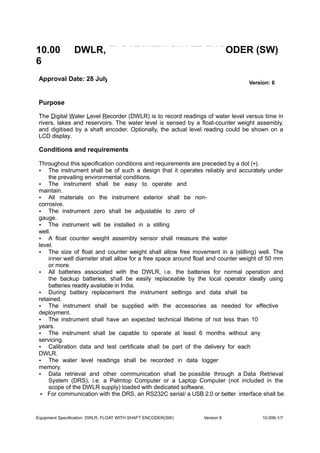
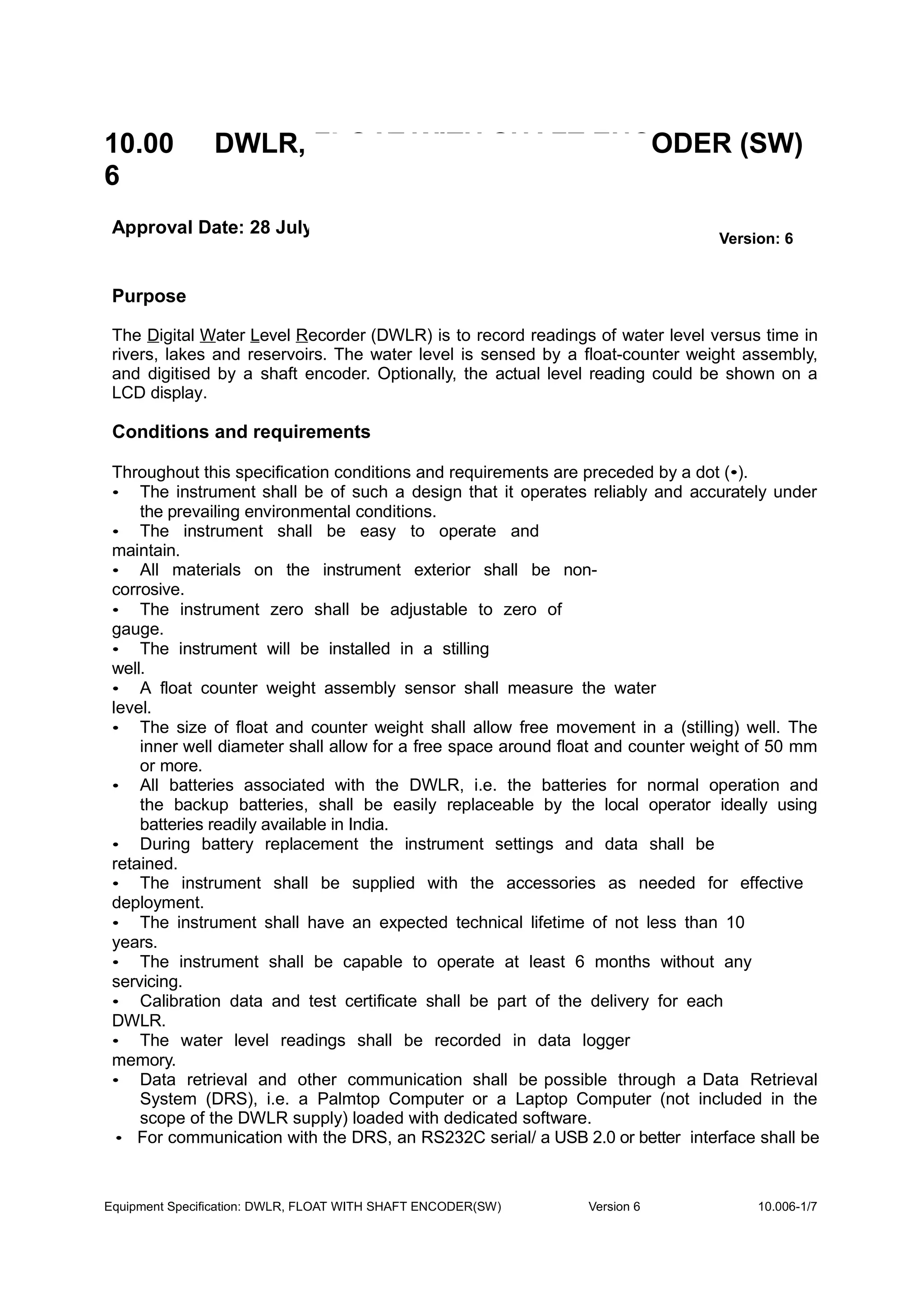
The Digital Water Level Recorder (DWLR) is to record readings of water level versus time in
rivers, lakes and reservoirs. The water level is sensed by a float-counter weight assembly,
and digitised by a shaft encoder. Optionally, the actual level reading could be shown on a
LCD display.
Conditions and requirements
Throughout this specification conditions and requirements are preceded by a dot (•).
• The instrument shall be of such a design that it operates reliably and accurately under
the prevailing environmental conditions.
• The instrument shall be easy to operate and
maintain.
• All materials on the instrument exterior shall be non-
corrosive.
• The instrument zero shall be adjustable to zero of
gauge.
• The instrument will be installed in a stilling
well.
• A float counter weight assembly sensor shall measure the water
level.
• The size of float and counter weight shall allow free movement in a (stilling) well. The
inner well diameter shall allow for a free space around float and counter weight of 50 mm
or more.
• All batteries associated with the DWLR, i.e. the batteries for normal operation and
the backup batteries, shall be easily replaceable by the local operator ideally using
batteries readily available in India.
• During battery replacement the instrument settings and data shall be
retained.
• The instrument shall be supplied with the accessories as needed for effective
deployment.
• The instrument shall have an expected technical lifetime of not less than 10
years.
• The instrument shall be capable to operate at least 6 months without any
servicing.
• Calibration data and test certificate shall be part of the delivery for each
DWLR.
• The water level readings shall be recorded in data logger
memory.
• Data retrieval and other communication shall be possible through a Data Retrieval
System (DRS), i.e. a Palmtop Computer or a Laptop Computer (not included in the
scope of the DWLR supply) loaded with dedicated software.
• For communication with the DRS, an RS232C serial/ a USB 2.0 or better interface shall be
Equipment Specification: DWLR, FLOAT WITH SHAFT ENCODER(SW) Version 6 10.006-1/7
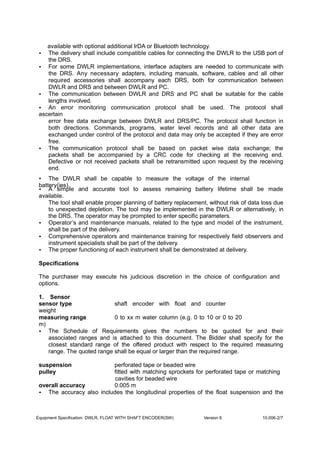
available with optional additional lrDA or Bluetooth technology.
• The delivery shall include compatible cables for connecting the DWLR to the USB port of
the DRS.
• For some DWLR implementations, interface adapters are needed to communicate with
the DRS. Any necessary adapters, including manuals, software, cables and all other
required accessories shall accompany each DRS, both for communication between
DWLR and DRS and between DWLR and PC.
• The communication between DWLR and DRS and PC shall be suitable for the cable
lengths involved.
• An error monitoring communication protocol shall be used. The protocol shall
ascertain
error free data exchange between DWLR and DRS/PC. The protocol shall function in
both directions. Commands, programs, water level records and all other data are
exchanged under control of the protocol and data may only be accepted if they are error
free.
• The communication protocol shall be based on packet wise data exchange; the
packets shall be accompanied by a CRC code for checking at the receiving end.
Defective or not received packets shall be retransmitted upon request by the receiving
end.
• The DWLR shall be capable to measure the voltage of the internal
battery(ies).
• A simple and accurate tool to assess remaining battery lifetime shall be made
available.
The tool shall enable proper planning of battery replacement, without risk of data loss due
to unexpected depletion. The tool may be implemented in the DWLR or alternatively, in
the DRS. The operator may be prompted to enter specific parameters.
• Operator’s and maintenance manuals, related to the type and model of the instrument,
shall be part of the delivery.
• Comprehensive operators and maintenance training for respectively field observers and
instrument specialists shall be part of the delivery.
• The proper functioning of each instrument shall be demonstrated at delivery.
Specifications
The purchaser may execute his judicious discretion in the choice of configuration and
options.
1. Sensor
sensor type shaft encoder with float and counter
weight
measuring range 0 to xx m water column (e.g. 0 to 10 or 0 to 20
m)
• The Schedule of Requirements gives the numbers to be quoted for and their
associated ranges and is attached to this document. The Bidder shall specify for the
closest standard range of the offered product with respect to the required measuring
range. The quoted range shall be equal or larger than the required range.
suspension perforated tape or beaded wire
pulley fitted with matching sprockets for perforated tape or matching
cavities for beaded wire
overall accuracy 0.005 m
• The accuracy also includes the longitudinal properties of the float suspension and the
Equipment Specification: DWLR, FLOAT WITH SHAFT ENCODER(SW) Version 6 10.006-2/7
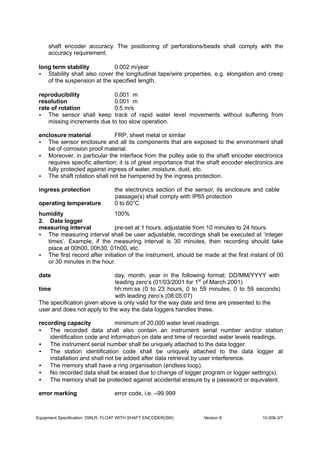
shaft encoder accuracy. The positioning of perforations/beads shall comply with the
accuracy requirement.
long term stability 0.002 m/year
• Stability shall also cover the longitudinal tape/wire properties, e.g. elongation and creep
of the suspension at the specified length.
reproducibility 0.001 m
resolution 0.001 m
rate of rotation 0.5 m/s
• The sensor shall keep track of rapid water level movements without suffering from
missing increments due to too slow operation.
enclosure material FRP, sheet metal or similar
• The sensor enclosure and all its components that are exposed to the environment shall
be of corrosion proof material.
• Moreover, in particular the interface from the pulley axle to the shaft encoder electronics
requires specific attention; it is of great importance that the shaft encoder electronics are
fully protected against ingress of water, moisture, dust, etc.
• The shaft rotation shall not be hampered by the ingress protection.
ingress protection the electronics section of the sensor, its enclosure and cable
passage(s) shall comply with IP65 protection
operating temperature 0 to 60°C
humidity 100%
2. Data logger
measuring interval pre-set at 1 hours, adjustable from 10 minutes to 24 hours.
• The measuring interval shall be user adjustable, recordings shall be executed at ‘integer
times’. Example, if the measuring interval is 30 minutes, then recording should take
place at 00h00, 00h30, 01h00, etc.
• The first record after initiation of the instrument, should be made at the first instant of 00
or 30 minutes in the hour.
date day, month, year in the following format: DD/MM/YYYY with
leading zero’s (01/03/2001 for 1st
of March 2001)
time hh:mm:ss (0 to 23 hours, 0 to 59 minutes, 0 to 59 seconds)
with leading zero’s (08:05:07)
The specification given above is only valid for the way date and time are presented to the
user and does not apply to the way the data loggers handles these.
recording capacity minimum of 20,000 water level readings.
• The recorded data shall also contain an instrument serial number and/or station
identification code and information on date and time of recorded water levels readings.
• The instrument serial number shall be uniquely attached to the data logger.
• The station identification code shall be uniquely attached to the data logger at
installation and shall not be added after data retrieval by user interference.
• The memory shall have a ring organisation (endless loop).
• No recorded data shall be erased due to change of logger program or logger setting(s).
• The memory shall be protected against accidental erasure by a password or equivalent.
error marking error code, i.e. –99.999
Equipment Specification: DWLR, FLOAT WITH SHAFT ENCODER(SW) Version 6 10.006-3/7
• Out of range data and errors shall be clearly and unambiguously marked and be
distinguishable from valid data. The error mark is an impossible value, which cannot be
generated by valid measurements.
recording resolution 0.001 m or better
memory type non volatile memory or volatile memory
• Volatile memory (RAM) shall be protected from data loss by a Lithium backup battery.
• The battery capacity shall be sufficient to retain memory contents more than one year
after main power disconnection (removal of the supply batteries).
set-up memory all settings, such as shaft encoder zero and scale as well as
the program settings, shall be retained in non-volatile memory
Lithium batteries
power supply in-built standard Lithium batteries, like AA, C or D size ideally readily
available in India
OR
Alkaline batteries
power supply in-built standard Alkaline batteries, like AA, C or D size ideally readily
available in India
• The delivery shall include sufficient batteries for at least one year of operation under the
following conditions:
• a recording interval of 30 minutes
• monthly access of the DWLR for data retrieval and monitoring purposes which may
affect the power autonomy
remaining battery lifetime indication on DRS and/or calculation scheme
data offload power use the power consumption shall allow for entire data offload of a
completely filled memory ≥6 times per annum during the rated
battery lifetime, and this including the normal data recording
and service visits. E.g. if rated battery capacity is 5 years than
≥30 full offloads shall be supported in that 5 years.
communication interface USB at DDRS/PC end with optional additional lrDA or Bluetooth
technology
• The communication hardware between DWLR and DRS and PC shall be suitable for the
cable lengths involved. In case of online monitoring is required, it should support at
GPRS interface.
operating temperature 0 to 60°C.
• The operating temperature range specification applies to all components of the DWLR,
like: sensor, wire/tape, data logger, batteries, etc. The temperature effect on sensor
reading (zero and scale effects) and wire/tape length shall be specified separately.
built in clock time keeping better than 1 minute per month
time resolution 1 second
over-voltage protection on all i/o lines, regardless mode of connection during
deployment
• Built-in over-voltage protection is required on the electronics unit, in particular on all
external connections, e.g. sensor supply and signal (also on optional sensors, e.g. for
water quality), external power supply and data communication interface.
Equipment Specification: DWLR, FLOAT WITH SHAFT ENCODER(SW) Version 6 10.006-4/7
water level indication LCD display with 0.001 m resolution (optional)
3. Enclosure for shaft encoder and data logger
• The sensor electronics, data logger, electronics, batteries and all other electrical
components shall be contained in one or more protective enclosures. The enclosure(s)
shall comply with the following specifications.
• All DWLR materials and combinations thereof shall be corrosion proof.
dimensions not specified
material FRP, sheet metal or similar.
• The enclosure and all its external components that are exposed to the environment shall
be of corrosion proof and UV resistant material.
ingress protection the enclosure and cable assembly shall have IP65 protection
operating temperature 0 to 60°C.
humidity 100%
4. DRS software
• The DRS software shall support functions for conversion of the collected data into ASCII
(text) tables, and for efficient visualisation of the time series in tabular and graphical
form.
• Graphical axes shall be generated automatically and be manually adjustable. Units
along the axes shall not be awkward but intuitive and easily understandable.
• All axes shall have sufficient graduation.
• The labels along the time axis shall be in sensible time intervals, i.e. hh:mm for relatively
short periods and dates, e.g.: DD/MM/YYYY, for long periods. The same applies for the
level axis.
• The unit-labels shall not (partly) cover each other.
• To enhance readability, adequate gridlines, both along time and level axes, shall be
generated automatically by the graphics functions, approximately 5 gridlines per axis.
• The gridlines shall also be user adjustable.
• The user interface shall support efficient functions to select and visualise subsets of the
time series, e.g. a single day or several days somewhere out of many weeks of data.
• Efficient window functions shall be available to visualise the data in the required
resolution, i.e. the level scale shall be user adjustable.
• Software that can only display sample counts or total duration or does not support axis
and grid adjustment is not permitted.
• The DRS software shall support error free transfer of the retrieved data to a PC.
• Note that in particular, the graphics capabilities are a major reason to apply a palmtop
or Laptop computer as DRS.
5. PC Software
• PC software shall be part of the delivery and will be used in the office, e.g. on a desktop
PC.
• The PC software shall transfer the collected data efficiently, reliably and error free from
the DRS to the PC environment.
• The PC software shall have functions for conversion of the collected data into ASCII
(text) tables for display.
• The PC software shall have functions for conversion of the collected data into ASCII
(text) files. The tabular data will be imported by other software packages, e.g. for
analysis and presentation in a spreadsheet and for storage in a database.
Equipment Specification: DWLR, FLOAT WITH SHAFT ENCODER(SW) Version 6 10.006-5/7
• The export file format is specified in Chapter 6.
• The PC software shall support the same and more tabular and graphical presentation
functions as specified under DRS software.
• The PC software shall be fully compatible with MS-Windows 95/98.
• The PC software shall basically be mouse driven.
6. Standard DWLR text file format
• The text file is the intermediate data representation that is used for loading of the data
into the hydrological data base system.
• The PC based software shall have a facility to generate a text file with water level data in
the standardised format.
• The text file formatting function may be part of the standard proprietary PC software.
Alternatively, the function may be implemented in a separate, MS-Windows XP/Vista
based program.
• The text file facility shall be easy to use.
• Only SI-units shall be presented, i.e. m and °C for levels and temperature respectively.
• Non-SI units like feet, inches, °F are not permitted.
• The text file shall have a section with header lines.
• The header lines shall precede the data lines.
• The header lines shall contain instrument serial number, reference level that was used
to convert from instrument reading in to water level.
• In case a software wave attenuation filter is implemented, the averaging number and the
sampling interval shall be presented in the header.
• The header may contain other data such as measuring range, station ID, installation
depth, top of casing reference relative to MSL, station co-ordinates and similar data.
• For each specific instrument make and model, the number of the header lines must be
fixed, i.e. all instruments of that make and model shall always generate the same
number of header lines, in the same format.
• The contents of the header lines is for use by the operator but will not be automatically
assessed by the Data Entry Software (SW/GW DES).
• All header lines shall be terminated by a <CR><LF> sequence.
• The data shall be organised in columns
• column 1: date in dd/mm/yyyy
Leading zero's shall be included, i.e. 06 February 2001 will be expressed as 06/02/2001.
The </> character may be omitted, then the format becomes ddmmyyyy.
• column 2: time in hh:mm:ss
Time shall be expressed in 24 hours. The AM/PM representation is not permitted.
Leading zero's shall be included, i.e. 6 o'clock in the morning shall be represented by
06:00:00.
The <:> character may be omitted, then the format becomes hhmmss.
• column 3: water level in metres with millimetre resolution, e.g. 49.640 m.
• column 4: in case temperature is measured then temperature shall be expressed in °C
with 0.1°C resolution, e.g. 32.8 °C.
• Alternative data sequences are not permitted.
• If a parameter can be negative, then a character position for the minus sign shall be
reserved.
• The column separator shall be one of the following: <space>, <tab>, <comma>, or
<semicolon>.
• Only one type of separator may be applied.
• End-of-line is indicated by <CR><LF> sequence.
• All data lines shall comply with this column format, empty lines or intermediate partly
Equipment Specification: DWLR, FLOAT WITH SHAFT ENCODER(SW) Version 6 10.006-6/7
filled lines, e.g. with date and/or time only, are not permitted.
• All columns shall be complete, i.e. each field in a column shall always contain data. If no
temperature data are measured, then column 4 may be omitted.
• Erroneous or missing water level data shall be indicated by -99.999.
• Erroneous or missing temperature data shall be indicated by -99.9.
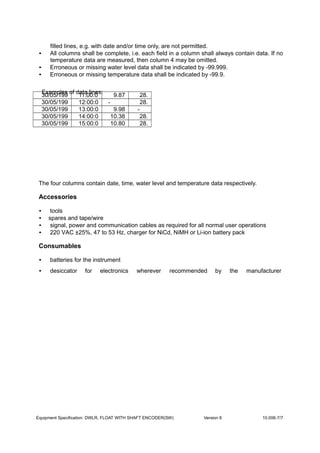
Examples of data lines:
30/05/199
8
11:00:0
0
9.87
5
28.
730/05/199
8
12:00:0
0
-
99.99
28.
730/05/199
8
13:00:0
0
9.98
9
-
99.30/05/199
8
14:00:0
0
10.38
0
28.
830/05/199
8
15:00:0
0
10.80
0
28.
7
The four columns contain date, time, water level and temperature data respectively.
Accessories
• tools
• spares and tape/wire
• signal, power and communication cables as required for all normal user operations
• 220 VAC ±25%, 47 to 53 Hz, charger for NiCd, NiMH or Li-ion battery pack
Consumables
• batteries for the instrument
• desiccator for electronics wherever recommended by the manufacturer
Equipment Specification: DWLR, FLOAT WITH SHAFT ENCODER(SW) Version 6 10.006-7/7

Dwlr, float type with shaft encoder (sw)

  • 1.
    10.00 6 DWLR, FLOAT WITHSHAFT ENCODER (SW) Approval Date: 28 July 2009 Version: 6 Purpose The Digital Water Level Recorder (DWLR) is to record readings of water level versus time in rivers, lakes and reservoirs. The water level is sensed by a float-counter weight assembly, and digitised by a shaft encoder. Optionally, the actual level reading could be shown on a LCD display. Conditions and requirements Throughout this specification conditions and requirements are preceded by a dot (•). • The instrument shall be of such a design that it operates reliably and accurately under the prevailing environmental conditions. • The instrument shall be easy to operate and maintain. • All materials on the instrument exterior shall be non- corrosive. • The instrument zero shall be adjustable to zero of gauge. • The instrument will be installed in a stilling well. • A float counter weight assembly sensor shall measure the water level. • The size of float and counter weight shall allow free movement in a (stilling) well. The inner well diameter shall allow for a free space around float and counter weight of 50 mm or more. • All batteries associated with the DWLR, i.e. the batteries for normal operation and the backup batteries, shall be easily replaceable by the local operator ideally using batteries readily available in India. • During battery replacement the instrument settings and data shall be retained. • The instrument shall be supplied with the accessories as needed for effective deployment. • The instrument shall have an expected technical lifetime of not less than 10 years. • The instrument shall be capable to operate at least 6 months without any servicing. • Calibration data and test certificate shall be part of the delivery for each DWLR. • The water level readings shall be recorded in data logger memory. • Data retrieval and other communication shall be possible through a Data Retrieval System (DRS), i.e. a Palmtop Computer or a Laptop Computer (not included in the scope of the DWLR supply) loaded with dedicated software. • For communication with the DRS, an RS232C serial/ a USB 2.0 or better interface shall be Equipment Specification: DWLR, FLOAT WITH SHAFT ENCODER(SW) Version 6 10.006-1/7
  • 2.
    available with optionaladditional lrDA or Bluetooth technology. • The delivery shall include compatible cables for connecting the DWLR to the USB port of the DRS. • For some DWLR implementations, interface adapters are needed to communicate with the DRS. Any necessary adapters, including manuals, software, cables and all other required accessories shall accompany each DRS, both for communication between DWLR and DRS and between DWLR and PC. • The communication between DWLR and DRS and PC shall be suitable for the cable lengths involved. • An error monitoring communication protocol shall be used. The protocol shall ascertain error free data exchange between DWLR and DRS/PC. The protocol shall function in both directions. Commands, programs, water level records and all other data are exchanged under control of the protocol and data may only be accepted if they are error free. • The communication protocol shall be based on packet wise data exchange; the packets shall be accompanied by a CRC code for checking at the receiving end. Defective or not received packets shall be retransmitted upon request by the receiving end. • The DWLR shall be capable to measure the voltage of the internal battery(ies). • A simple and accurate tool to assess remaining battery lifetime shall be made available. The tool shall enable proper planning of battery replacement, without risk of data loss due to unexpected depletion. The tool may be implemented in the DWLR or alternatively, in the DRS. The operator may be prompted to enter specific parameters. • Operator’s and maintenance manuals, related to the type and model of the instrument, shall be part of the delivery. • Comprehensive operators and maintenance training for respectively field observers and instrument specialists shall be part of the delivery. • The proper functioning of each instrument shall be demonstrated at delivery. Specifications The purchaser may execute his judicious discretion in the choice of configuration and options. 1. Sensor sensor type shaft encoder with float and counter weight measuring range 0 to xx m water column (e.g. 0 to 10 or 0 to 20 m) • The Schedule of Requirements gives the numbers to be quoted for and their associated ranges and is attached to this document. The Bidder shall specify for the closest standard range of the offered product with respect to the required measuring range. The quoted range shall be equal or larger than the required range. suspension perforated tape or beaded wire pulley fitted with matching sprockets for perforated tape or matching cavities for beaded wire overall accuracy 0.005 m • The accuracy also includes the longitudinal properties of the float suspension and the Equipment Specification: DWLR, FLOAT WITH SHAFT ENCODER(SW) Version 6 10.006-2/7
  • 3.
    shaft encoder accuracy.The positioning of perforations/beads shall comply with the accuracy requirement. long term stability 0.002 m/year • Stability shall also cover the longitudinal tape/wire properties, e.g. elongation and creep of the suspension at the specified length. reproducibility 0.001 m resolution 0.001 m rate of rotation 0.5 m/s • The sensor shall keep track of rapid water level movements without suffering from missing increments due to too slow operation. enclosure material FRP, sheet metal or similar • The sensor enclosure and all its components that are exposed to the environment shall be of corrosion proof material. • Moreover, in particular the interface from the pulley axle to the shaft encoder electronics requires specific attention; it is of great importance that the shaft encoder electronics are fully protected against ingress of water, moisture, dust, etc. • The shaft rotation shall not be hampered by the ingress protection. ingress protection the electronics section of the sensor, its enclosure and cable passage(s) shall comply with IP65 protection operating temperature 0 to 60°C humidity 100% 2. Data logger measuring interval pre-set at 1 hours, adjustable from 10 minutes to 24 hours. • The measuring interval shall be user adjustable, recordings shall be executed at ‘integer times’. Example, if the measuring interval is 30 minutes, then recording should take place at 00h00, 00h30, 01h00, etc. • The first record after initiation of the instrument, should be made at the first instant of 00 or 30 minutes in the hour. date day, month, year in the following format: DD/MM/YYYY with leading zero’s (01/03/2001 for 1st of March 2001) time hh:mm:ss (0 to 23 hours, 0 to 59 minutes, 0 to 59 seconds) with leading zero’s (08:05:07) The specification given above is only valid for the way date and time are presented to the user and does not apply to the way the data loggers handles these. recording capacity minimum of 20,000 water level readings. • The recorded data shall also contain an instrument serial number and/or station identification code and information on date and time of recorded water levels readings. • The instrument serial number shall be uniquely attached to the data logger. • The station identification code shall be uniquely attached to the data logger at installation and shall not be added after data retrieval by user interference. • The memory shall have a ring organisation (endless loop). • No recorded data shall be erased due to change of logger program or logger setting(s). • The memory shall be protected against accidental erasure by a password or equivalent. error marking error code, i.e. –99.999 Equipment Specification: DWLR, FLOAT WITH SHAFT ENCODER(SW) Version 6 10.006-3/7
  • 4.
    • Out ofrange data and errors shall be clearly and unambiguously marked and be distinguishable from valid data. The error mark is an impossible value, which cannot be generated by valid measurements. recording resolution 0.001 m or better memory type non volatile memory or volatile memory • Volatile memory (RAM) shall be protected from data loss by a Lithium backup battery. • The battery capacity shall be sufficient to retain memory contents more than one year after main power disconnection (removal of the supply batteries). set-up memory all settings, such as shaft encoder zero and scale as well as the program settings, shall be retained in non-volatile memory Lithium batteries power supply in-built standard Lithium batteries, like AA, C or D size ideally readily available in India OR Alkaline batteries power supply in-built standard Alkaline batteries, like AA, C or D size ideally readily available in India • The delivery shall include sufficient batteries for at least one year of operation under the following conditions: • a recording interval of 30 minutes • monthly access of the DWLR for data retrieval and monitoring purposes which may affect the power autonomy remaining battery lifetime indication on DRS and/or calculation scheme data offload power use the power consumption shall allow for entire data offload of a completely filled memory ≥6 times per annum during the rated battery lifetime, and this including the normal data recording and service visits. E.g. if rated battery capacity is 5 years than ≥30 full offloads shall be supported in that 5 years. communication interface USB at DDRS/PC end with optional additional lrDA or Bluetooth technology • The communication hardware between DWLR and DRS and PC shall be suitable for the cable lengths involved. In case of online monitoring is required, it should support at GPRS interface. operating temperature 0 to 60°C. • The operating temperature range specification applies to all components of the DWLR, like: sensor, wire/tape, data logger, batteries, etc. The temperature effect on sensor reading (zero and scale effects) and wire/tape length shall be specified separately. built in clock time keeping better than 1 minute per month time resolution 1 second over-voltage protection on all i/o lines, regardless mode of connection during deployment • Built-in over-voltage protection is required on the electronics unit, in particular on all external connections, e.g. sensor supply and signal (also on optional sensors, e.g. for water quality), external power supply and data communication interface. Equipment Specification: DWLR, FLOAT WITH SHAFT ENCODER(SW) Version 6 10.006-4/7
  • 5.
    water level indicationLCD display with 0.001 m resolution (optional) 3. Enclosure for shaft encoder and data logger • The sensor electronics, data logger, electronics, batteries and all other electrical components shall be contained in one or more protective enclosures. The enclosure(s) shall comply with the following specifications. • All DWLR materials and combinations thereof shall be corrosion proof. dimensions not specified material FRP, sheet metal or similar. • The enclosure and all its external components that are exposed to the environment shall be of corrosion proof and UV resistant material. ingress protection the enclosure and cable assembly shall have IP65 protection operating temperature 0 to 60°C. humidity 100% 4. DRS software • The DRS software shall support functions for conversion of the collected data into ASCII (text) tables, and for efficient visualisation of the time series in tabular and graphical form. • Graphical axes shall be generated automatically and be manually adjustable. Units along the axes shall not be awkward but intuitive and easily understandable. • All axes shall have sufficient graduation. • The labels along the time axis shall be in sensible time intervals, i.e. hh:mm for relatively short periods and dates, e.g.: DD/MM/YYYY, for long periods. The same applies for the level axis. • The unit-labels shall not (partly) cover each other. • To enhance readability, adequate gridlines, both along time and level axes, shall be generated automatically by the graphics functions, approximately 5 gridlines per axis. • The gridlines shall also be user adjustable. • The user interface shall support efficient functions to select and visualise subsets of the time series, e.g. a single day or several days somewhere out of many weeks of data. • Efficient window functions shall be available to visualise the data in the required resolution, i.e. the level scale shall be user adjustable. • Software that can only display sample counts or total duration or does not support axis and grid adjustment is not permitted. • The DRS software shall support error free transfer of the retrieved data to a PC. • Note that in particular, the graphics capabilities are a major reason to apply a palmtop or Laptop computer as DRS. 5. PC Software • PC software shall be part of the delivery and will be used in the office, e.g. on a desktop PC. • The PC software shall transfer the collected data efficiently, reliably and error free from the DRS to the PC environment. • The PC software shall have functions for conversion of the collected data into ASCII (text) tables for display. • The PC software shall have functions for conversion of the collected data into ASCII (text) files. The tabular data will be imported by other software packages, e.g. for analysis and presentation in a spreadsheet and for storage in a database. Equipment Specification: DWLR, FLOAT WITH SHAFT ENCODER(SW) Version 6 10.006-5/7
  • 6.
    • The exportfile format is specified in Chapter 6. • The PC software shall support the same and more tabular and graphical presentation functions as specified under DRS software. • The PC software shall be fully compatible with MS-Windows 95/98. • The PC software shall basically be mouse driven. 6. Standard DWLR text file format • The text file is the intermediate data representation that is used for loading of the data into the hydrological data base system. • The PC based software shall have a facility to generate a text file with water level data in the standardised format. • The text file formatting function may be part of the standard proprietary PC software. Alternatively, the function may be implemented in a separate, MS-Windows XP/Vista based program. • The text file facility shall be easy to use. • Only SI-units shall be presented, i.e. m and °C for levels and temperature respectively. • Non-SI units like feet, inches, °F are not permitted. • The text file shall have a section with header lines. • The header lines shall precede the data lines. • The header lines shall contain instrument serial number, reference level that was used to convert from instrument reading in to water level. • In case a software wave attenuation filter is implemented, the averaging number and the sampling interval shall be presented in the header. • The header may contain other data such as measuring range, station ID, installation depth, top of casing reference relative to MSL, station co-ordinates and similar data. • For each specific instrument make and model, the number of the header lines must be fixed, i.e. all instruments of that make and model shall always generate the same number of header lines, in the same format. • The contents of the header lines is for use by the operator but will not be automatically assessed by the Data Entry Software (SW/GW DES). • All header lines shall be terminated by a <CR><LF> sequence. • The data shall be organised in columns • column 1: date in dd/mm/yyyy Leading zero's shall be included, i.e. 06 February 2001 will be expressed as 06/02/2001. The </> character may be omitted, then the format becomes ddmmyyyy. • column 2: time in hh:mm:ss Time shall be expressed in 24 hours. The AM/PM representation is not permitted. Leading zero's shall be included, i.e. 6 o'clock in the morning shall be represented by 06:00:00. The <:> character may be omitted, then the format becomes hhmmss. • column 3: water level in metres with millimetre resolution, e.g. 49.640 m. • column 4: in case temperature is measured then temperature shall be expressed in °C with 0.1°C resolution, e.g. 32.8 °C. • Alternative data sequences are not permitted. • If a parameter can be negative, then a character position for the minus sign shall be reserved. • The column separator shall be one of the following: <space>, <tab>, <comma>, or <semicolon>. • Only one type of separator may be applied. • End-of-line is indicated by <CR><LF> sequence. • All data lines shall comply with this column format, empty lines or intermediate partly Equipment Specification: DWLR, FLOAT WITH SHAFT ENCODER(SW) Version 6 10.006-6/7
  • 7.
    filled lines, e.g.with date and/or time only, are not permitted. • All columns shall be complete, i.e. each field in a column shall always contain data. If no temperature data are measured, then column 4 may be omitted. • Erroneous or missing water level data shall be indicated by -99.999. • Erroneous or missing temperature data shall be indicated by -99.9. Examples of data lines: 30/05/199 8 11:00:0 0 9.87 5 28. 730/05/199 8 12:00:0 0 - 99.99 28. 730/05/199 8 13:00:0 0 9.98 9 - 99.30/05/199 8 14:00:0 0 10.38 0 28. 830/05/199 8 15:00:0 0 10.80 0 28. 7 The four columns contain date, time, water level and temperature data respectively. Accessories • tools • spares and tape/wire • signal, power and communication cables as required for all normal user operations • 220 VAC ±25%, 47 to 53 Hz, charger for NiCd, NiMH or Li-ion battery pack Consumables • batteries for the instrument • desiccator for electronics wherever recommended by the manufacturer Equipment Specification: DWLR, FLOAT WITH SHAFT ENCODER(SW) Version 6 10.006-7/7