IMPORTANT NOTICE
Feedback
We havedeveloped quality product and state-of-art service to ensure our customers interest. If you have any
suggestions, please feel free to contact us at feedback@dumpscafe.com
Support
If you have any questions about our product, please provide the following items:
exam code
screenshot of the question
login id/email
please contact us at and our technical experts will provide support within 24 hours.
support@dumpscafe.com
Copyright
The product of each order has its own encryption code, so you should use it independently. Any unauthorized
changes will inflict legal punishment. We reserve the right of final explanation for this statement.
3.
CompTIA - SY0-701
PassExam
1 of 7
Verified Solution - 100% Result
A.
B.
C.
D.
A.
B.
C.
D.
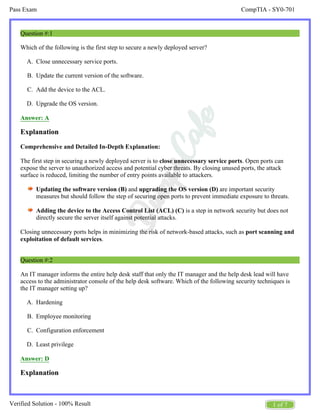
Question #:1
Which of the following is the first step to secure a newly deployed server?
Close unnecessary service ports.
Update the current version of the software.
Add the device to the ACL.
Upgrade the OS version.
Answer: A
Explanation
Comprehensive and Detailed In-Depth Explanation:
The first step in securing a newly deployed server is to . Open ports can
close unnecessary service ports
expose the server to unauthorized access and potential cyber threats. By closing unused ports, the attack
surface is reduced, limiting the number of entry points available to attackers.
Updating the software version (B) and are important security
upgrading the OS version (D)
measures but should follow the step of securing open ports to prevent immediate exposure to threats.
Adding the device to the Access Control List (ACL) (C) is a step in network security but does not
directly secure the server itself against potential attacks.
Closing unnecessary ports helps in minimizing the risk of network-based attacks, such as port scanning and
.
exploitation of default services
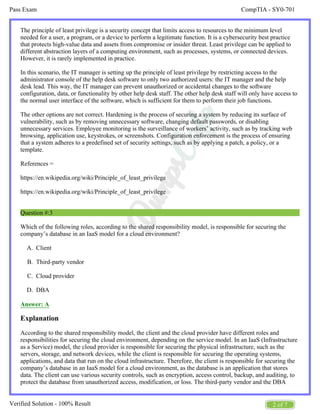
Question #:2
An IT manager informs the entire help desk staff that only the IT manager and the help desk lead will have
access to the administrator console of the help desk software. Which of the following security techniques is
the IT manager setting up?
Hardening
Employee monitoring
Configuration enforcement
Least privilege
Answer: D
Explanation
4.
CompTIA - SY0-701
PassExam
2 of 7
Verified Solution - 100% Result
A.
B.
C.
D.
The principle of least privilege is a security concept that limits access to resources to the minimum level
needed for a user, a program, or a device to perform a legitimate function. It is a cybersecurity best practice
that protects high-value data and assets from compromise or insider threat. Least privilege can be applied to
different abstraction layers of a computing environment, such as processes, systems, or connected devices.
However, it is rarely implemented in practice.
In this scenario, the IT manager is setting up the principle of least privilege by restricting access to the
administrator console of the help desk software to only two authorized users: the IT manager and the help
desk lead. This way, the IT manager can prevent unauthorized or accidental changes to the software
configuration, data, or functionality by other help desk staff. The other help desk staff will only have access to
the normal user interface of the software, which is sufficient for them to perform their job functions.
The other options are not correct. Hardening is the process of securing a system by reducing its surface of
vulnerability, such as by removing unnecessary software, changing default passwords, or disabling
unnecessary services. Employee monitoring is the surveillance of workers’ activity, such as by tracking web
browsing, application use, keystrokes, or screenshots. Configuration enforcement is the process of ensuring
that a system adheres to a predefined set of security settings, such as by applying a patch, a policy, or a
template.
References =
https://en.wikipedia.org/wiki/Principle_of_least_privilege
https://en.wikipedia.org/wiki/Principle_of_least_privilege
Question #:3
Which of the following roles, according to the shared responsibility model, is responsible for securing the
company’s database in an IaaS model for a cloud environment?
Client
Third-party vendor
Cloud provider
DBA
Answer: A
Explanation
According to the shared responsibility model, the client and the cloud provider have different roles and
responsibilities for securing the cloud environment, depending on the service model. In an IaaS (Infrastructure
as a Service) model, the cloud provider is responsible for securing the physical infrastructure, such as the
servers, storage, and network devices, while the client is responsible for securing the operating systems,
applications, and data that run on the cloud infrastructure. Therefore, the client is responsible for securing the
company’s database in an IaaS model for a cloud environment, as the database is an application that stores
data. The client can use various security controls, such as encryption, access control, backup, and auditing, to
protect the database from unauthorized access, modification, or loss. The third-party vendor and the DBA
5.
CompTIA - SY0-701
PassExam
3 of 7
Verified Solution - 100% Result
A.
B.
C.
D.
A.
B.
C.
D.
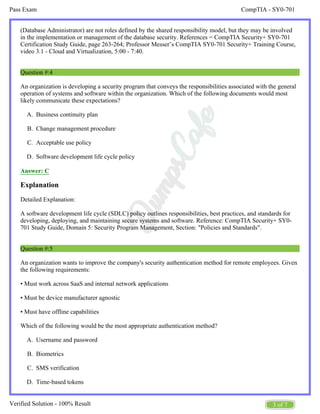
(Database Administrator) are not roles defined by the shared responsibility model, but they may be involved
in the implementation or management of the database security. References = CompTIA Security+ SY0-701
Certification Study Guide, page 263-264; Professor Messer’s CompTIA SY0-701 Security+ Training Course,
video 3.1 - Cloud and Virtualization, 5:00 - 7:40.
Question #:4
An organization is developing a security program that conveys the responsibilities associated with the general
operation of systems and software within the organization. Which of the following documents would most
likely communicate these expectations?
Business continuity plan
Change management procedure
Acceptable use policy
Software development life cycle policy
Answer: C
Explanation
Detailed Explanation:
A software development life cycle (SDLC) policy outlines responsibilities, best practices, and standards for
developing, deploying, and maintaining secure systems and software. Reference: CompTIA Security+ SY0-
701 Study Guide, Domain 5: Security Program Management, Section: "Policies and Standards".
Question #:5
An organization wants to improve the company's security authentication method for remote employees. Given
the following requirements:
• Must work across SaaS and internal network applications
• Must be device manufacturer agnostic
• Must have offline capabilities
Which of the following would be the most appropriate authentication method?
Username and password
Biometrics
SMS verification
Time-based tokens
6.
CompTIA - SY0-701
PassExam
4 of 7
Verified Solution - 100% Result
A.
B.
C.
D.
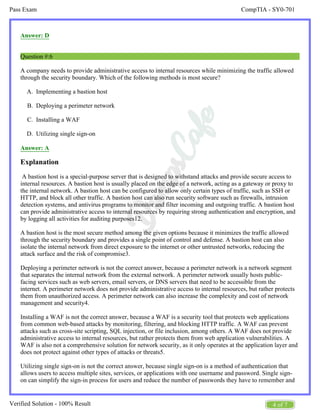
Answer: D
Question #:6
A company needs to provide administrative access to internal resources while minimizing the traffic allowed
through the security boundary. Which of the following methods is most secure?
Implementing a bastion host
Deploying a perimeter network
Installing a WAF
Utilizing single sign-on
Answer: A
Explanation
A bastion host is a special-purpose server that is designed to withstand attacks and provide secure access to
internal resources. A bastion host is usually placed on the edge of a network, acting as a gateway or proxy to
the internal network. A bastion host can be configured to allow only certain types of traffic, such as SSH or
HTTP, and block all other traffic. A bastion host can also run security software such as firewalls, intrusion
detection systems, and antivirus programs to monitor and filter incoming and outgoing traffic. A bastion host
can provide administrative access to internal resources by requiring strong authentication and encryption, and
by logging all activities for auditing purposes12.
A bastion host is the most secure method among the given options because it minimizes the traffic allowed
through the security boundary and provides a single point of control and defense. A bastion host can also
isolate the internal network from direct exposure to the internet or other untrusted networks, reducing the
attack surface and the risk of compromise3.
Deploying a perimeter network is not the correct answer, because a perimeter network is a network segment
that separates the internal network from the external network. A perimeter network usually hosts public-
facing services such as web servers, email servers, or DNS servers that need to be accessible from the
internet. A perimeter network does not provide administrative access to internal resources, but rather protects
them from unauthorized access. A perimeter network can also increase the complexity and cost of network
management and security4.
Installing a WAF is not the correct answer, because a WAF is a security tool that protects web applications
from common web-based attacks by monitoring, filtering, and blocking HTTP traffic. A WAF can prevent
attacks such as cross-site scripting, SQL injection, or file inclusion, among others. A WAF does not provide
administrative access to internal resources, but rather protects them from web application vulnerabilities. A
WAF is also not a comprehensive solution for network security, as it only operates at the application layer and
does not protect against other types of attacks or threats5.
Utilizing single sign-on is not the correct answer, because single sign-on is a method of authentication that
allows users to access multiple sites, services, or applications with one username and password. Single sign-
on can simplify the sign-in process for users and reduce the number of passwords they have to remember and
7.
CompTIA - SY0-701
PassExam
5 of 7
Verified Solution - 100% Result
A.
B.
C.
D.
A.
B.
C.
D.
manage. Single sign-on does not provide administrative access to internal resources, but rather enables access
to various resources that the user is authorized to use. Single sign-on can also introduce security risks if the
user’s credentials are compromised or if the single sign-on provider is breached6. References = 1: Bastion
host - Wikipedia, 2: 14 Best Practices to Secure SSH Bastion Host - goteleport.com, 3: The Importance Of
Bastion Hosts In Network Security, 4: What is the network perimeter? | Cloudflare, 5: What is a WAF? | Web
Application Firewall explained, 6: [What is single sign-on (SSO)? - Definition from WhatIs.com]
Question #:7
Which of the following teams combines both offensive and defensive testing techniques to protect an
organization's critical systems?
Red
Blue
Purple
Yellow
Answer: C
Explanation
Purple is the team that combines both offensive and defensive testing techniques to protect an organization’s
critical systems. Purple is not a separate team, but rather a collaboration between the red team and the blue
team. The red team is the offensive team that simulates attacks and exploits vulnerabilities in the organization’
s systems. The blue team is the defensive team that monitors and protects the organization’s systems from real
and simulated threats. The purple team exists to ensure and maximize the effectiveness of the red and blue
teams by integrating the defensive tactics and controls from the blue team with the threats and vulnerabilities
found by the red team into a single narrative that improves the overall security posture of the organization.
Red, blue, and yellow are other types of teams involved in security testing, but they do not combine both
offensive and defensive techniques. The yellow team is the team that builds software solutions, scripts, and
other programs that the blue team uses in the security testing. References: CompTIA Security+ Study Guide:
Exam SY0-701, 9th Edition, page 1331; Penetration Testing: Understanding Red, Blue, & Purple Teams3
Question #:8
A company requires hard drives to be securely wiped before sending decommissioned systems to recycling.
Which of the following best describes this policy?
Enumeration
Sanitization
Destruction
Inventory
8.
CompTIA - SY0-701
PassExam
6 of 7
Verified Solution - 100% Result
A.
B.
C.
D.
Answer: B
Explanation
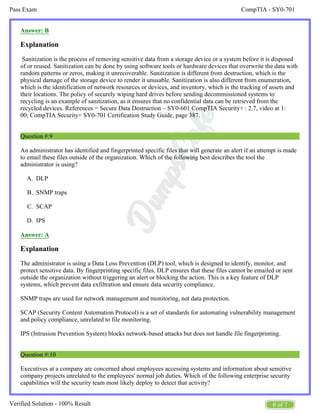
Sanitization is the process of removing sensitive data from a storage device or a system before it is disposed
of or reused. Sanitization can be done by using software tools or hardware devices that overwrite the data with
random patterns or zeros, making it unrecoverable. Sanitization is different from destruction, which is the
physical damage of the storage device to render it unusable. Sanitization is also different from enumeration,
which is the identification of network resources or devices, and inventory, which is the tracking of assets and
their locations. The policy of securely wiping hard drives before sending decommissioned systems to
recycling is an example of sanitization, as it ensures that no confidential data can be retrieved from the
recycled devices. References = Secure Data Destruction – SY0-601 CompTIA Security+ : 2.7, video at 1:
00; CompTIA Security+ SY0-701 Certification Study Guide, page 387.
Question #:9
An administrator has identified and fingerprinted specific files that will generate an alert if an attempt is made
to email these files outside of the organization. Which of the following best describes the tool the
administrator is using?
DLP
SNMP traps
SCAP
IPS
Answer: A
Explanation
The administrator is using a Data Loss Prevention (DLP) tool, which is designed to identify, monitor, and
protect sensitive data. By fingerprinting specific files, DLP ensures that these files cannot be emailed or sent
outside the organization without triggering an alert or blocking the action. This is a key feature of DLP
systems, which prevent data exfiltration and ensure data security compliance.
SNMP traps are used for network management and monitoring, not data protection.
SCAP (Security Content Automation Protocol) is a set of standards for automating vulnerability management
and policy compliance, unrelated to file monitoring.
IPS (Intrusion Prevention System) blocks network-based attacks but does not handle file fingerprinting.
Question #:10
Executives at a company are concerned about employees accessing systems and information about sensitive
company projects unrelated to the employees' normal job duties. Which of the following enterprise security
capabilities will the security team most likely deploy to detect that activity?
9.
CompTIA - SY0-701
PassExam
7 of 7
Verified Solution - 100% Result
A.
B.
C.
D.
UBA
EDR
NAC
DLP
Answer: A
10.
About dumpscafe.com
dumpscafe.com wasfounded in 2007. We provide latest & high quality IT / Business Certification Training Exam
Questions, Study Guides, Practice Tests.
We help you pass any IT / Business Certification Exams with 100% Pass Guaranteed or Full Refund. Especially
Cisco, CompTIA, Citrix, EMC, HP, Oracle, VMware, Juniper, Check Point, LPI, Nortel, EXIN and so on.
View list of all certification exams: All vendors
We prepare state-of-the art practice tests for certification exams. You can reach us at any of the email addresses
listed below.
Sales: sales@dumpscafe.com
Feedback: feedback@dumpscafe.com
Support: support@dumpscafe.com
Any problems about IT certification or our products, You can write us back and we will get back to you within 24
hours.
![CompTIA Security+
Exam 2025
Version: Demo
[ Total Questions: 10]
Web: www.dumpscafe.com
Email: support@dumpscafe.com
CompTIA
SY0-701](https://image.slidesharecdn.com/dumpscafecomptia-sy0-701-250512091558-7838b406/85/Dumpscafe-CompTIA-Security-SY0-701-Exam-Dumps-1-320.jpg)
![CompTIA Security+
Exam 2025
Version: Demo
[ Total Questions: 10]
Web: www.dumpscafe.com
Email: support@dumpscafe.com
CompTIA
SY0-701](https://image.slidesharecdn.com/dumpscafecomptia-sy0-701-250512091558-7838b406/75/Dumpscafe-CompTIA-Security-SY0-701-Exam-Dumps-1-2048.jpg)

![CompTIA - SY0-701
Pass Exam
5 of 7
Verified Solution - 100% Result
A.
B.
C.
D.
A.
B.
C.
D.
manage. Single sign-on does not provide administrative access to internal resources, but rather enables access
to various resources that the user is authorized to use. Single sign-on can also introduce security risks if the
user’s credentials are compromised or if the single sign-on provider is breached6. References = 1: Bastion
host - Wikipedia, 2: 14 Best Practices to Secure SSH Bastion Host - goteleport.com, 3: The Importance Of
Bastion Hosts In Network Security, 4: What is the network perimeter? | Cloudflare, 5: What is a WAF? | Web
Application Firewall explained, 6: [What is single sign-on (SSO)? - Definition from WhatIs.com]
Question #:7
Which of the following teams combines both offensive and defensive testing techniques to protect an
organization's critical systems?
Red
Blue
Purple
Yellow
Answer: C
Explanation
Purple is the team that combines both offensive and defensive testing techniques to protect an organization’s
critical systems. Purple is not a separate team, but rather a collaboration between the red team and the blue
team. The red team is the offensive team that simulates attacks and exploits vulnerabilities in the organization’
s systems. The blue team is the defensive team that monitors and protects the organization’s systems from real
and simulated threats. The purple team exists to ensure and maximize the effectiveness of the red and blue
teams by integrating the defensive tactics and controls from the blue team with the threats and vulnerabilities
found by the red team into a single narrative that improves the overall security posture of the organization.
Red, blue, and yellow are other types of teams involved in security testing, but they do not combine both
offensive and defensive techniques. The yellow team is the team that builds software solutions, scripts, and
other programs that the blue team uses in the security testing. References: CompTIA Security+ Study Guide:
Exam SY0-701, 9th Edition, page 1331; Penetration Testing: Understanding Red, Blue, & Purple Teams3
Question #:8
A company requires hard drives to be securely wiped before sending decommissioned systems to recycling.
Which of the following best describes this policy?
Enumeration
Sanitization
Destruction
Inventory](https://image.slidesharecdn.com/dumpscafecomptia-sy0-701-250512091558-7838b406/85/Dumpscafe-CompTIA-Security-SY0-701-Exam-Dumps-7-320.jpg)



![[2025] Prepare instantly with cc dumps isc2](https://cdn.slidesharecdn.com/ss_thumbnails/cc-241226074800-01604025-thumbnail.jpg?width=640&height=640&fit=bounds)


