DATA STRUCTURES USING JAVA LAB
1
203C1A0405
1a) i.write java program that use non –recursive function for implementation
linear search?
import java.util.Scanner;
class NrLinear
{
public static void main(String[]args)
{
int n,key;
Scanner sc = new Scanner(System.in);
System.out.print("Enter the number of elements:");
n = sc.nextInt();
int[]arr = new int[10];
System.out.println("Enter the elements of the array:");
for(int i=0;i<n;i++)
{
arr[i] = sc.nextInt();
}
System.out.println("Enter the key element:");
key = sc.nextInt();
int result = search(arr,n,key);
if(result == -1)
System.out.print("Element is not present in array");
else
System.out.print("Element is present at index"+(result));
}
public static int search(int arr[],int n,int key)
{
for(int i=0;i<n;i++)
{
if (arr[i]==key)
return i;
}
return-1;
}
}
DATA STRUCTURES USING JAVA LAB
2
203C1A0405
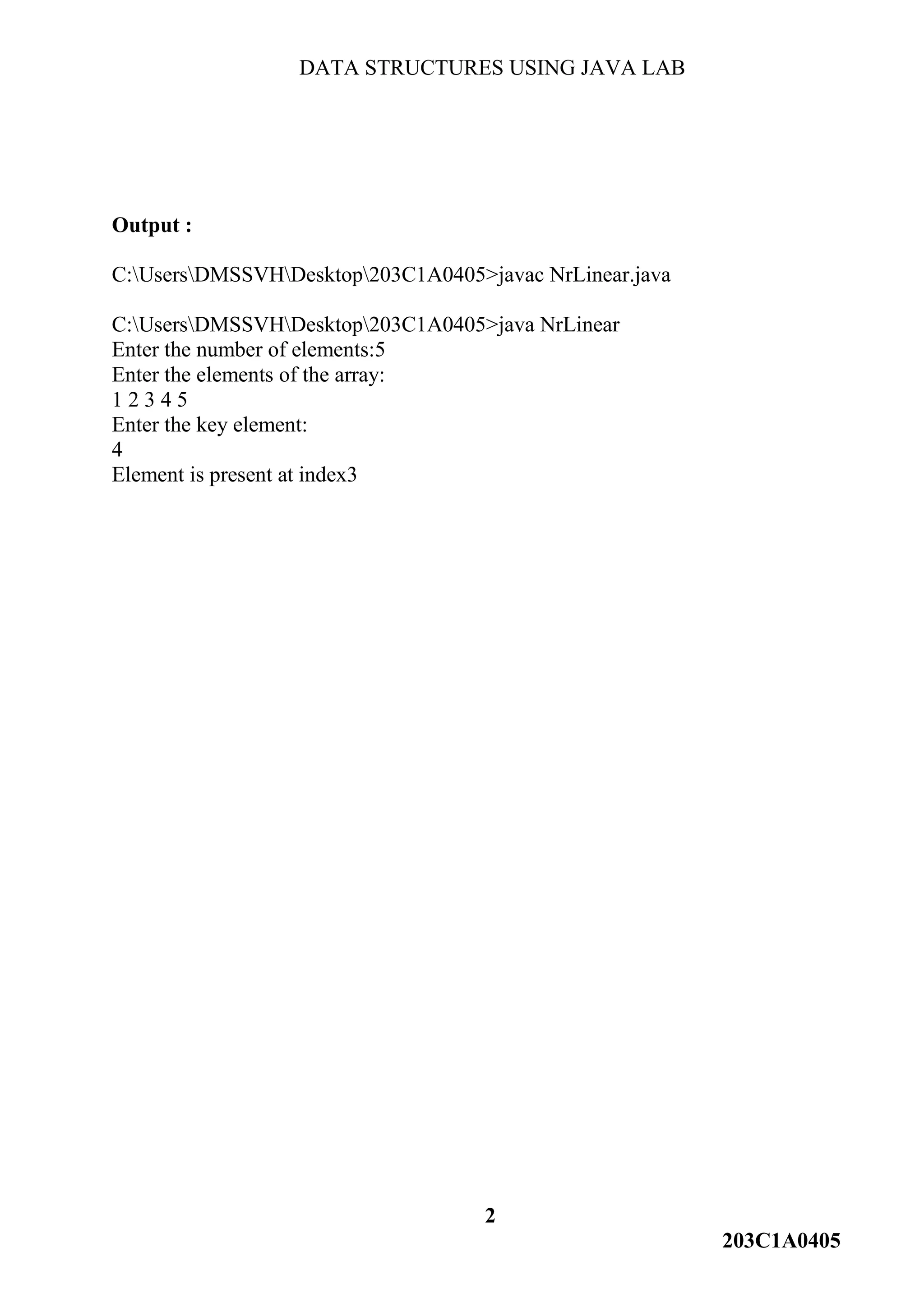
Output :
C:UsersDMSSVHDesktop203C1A0405>javac NrLinear.java
C:UsersDMSSVHDesktop203C1A0405>java NrLinear
Enter the number of elements:5
Enter the elements of the array:
1 2 3 4 5
Enter the key element:
4
Element is present at index3
DATA STRUCTURES USING JAVA LAB
3
203C1A0405
1a) ii .write java program that use recursive function for implementation linear
search?
import java.util.Scanner;
class RLinear
{
public static void main(String[]args)
{
int n,key;
Scanner sc = new Scanner(System.in);
System.out.print("Enter the number of elements:");
n = sc.nextInt();
int[]arr = new int[10];
System.out.println("Enter the elements of the array:");
for(int i=0;i<n;i++)
{arr[i] = sc.nextInt();
}
System.out.println("Enter the key element:");
key = sc.nextInt();
int result = search(arr,n,key);
if(result == -1)
System.out.print("Element is not present in array");
else
System.out.print("Element is present at index"+(result));
}
public static int search(int arr[],int n,int key)
{
n--;
if(n<0)
return-1;
if(arr[n]==key)
return n;
else
return search(arr,n,key);
}
}
DATA STRUCTURES USING JAVA LAB
4
203C1A0405
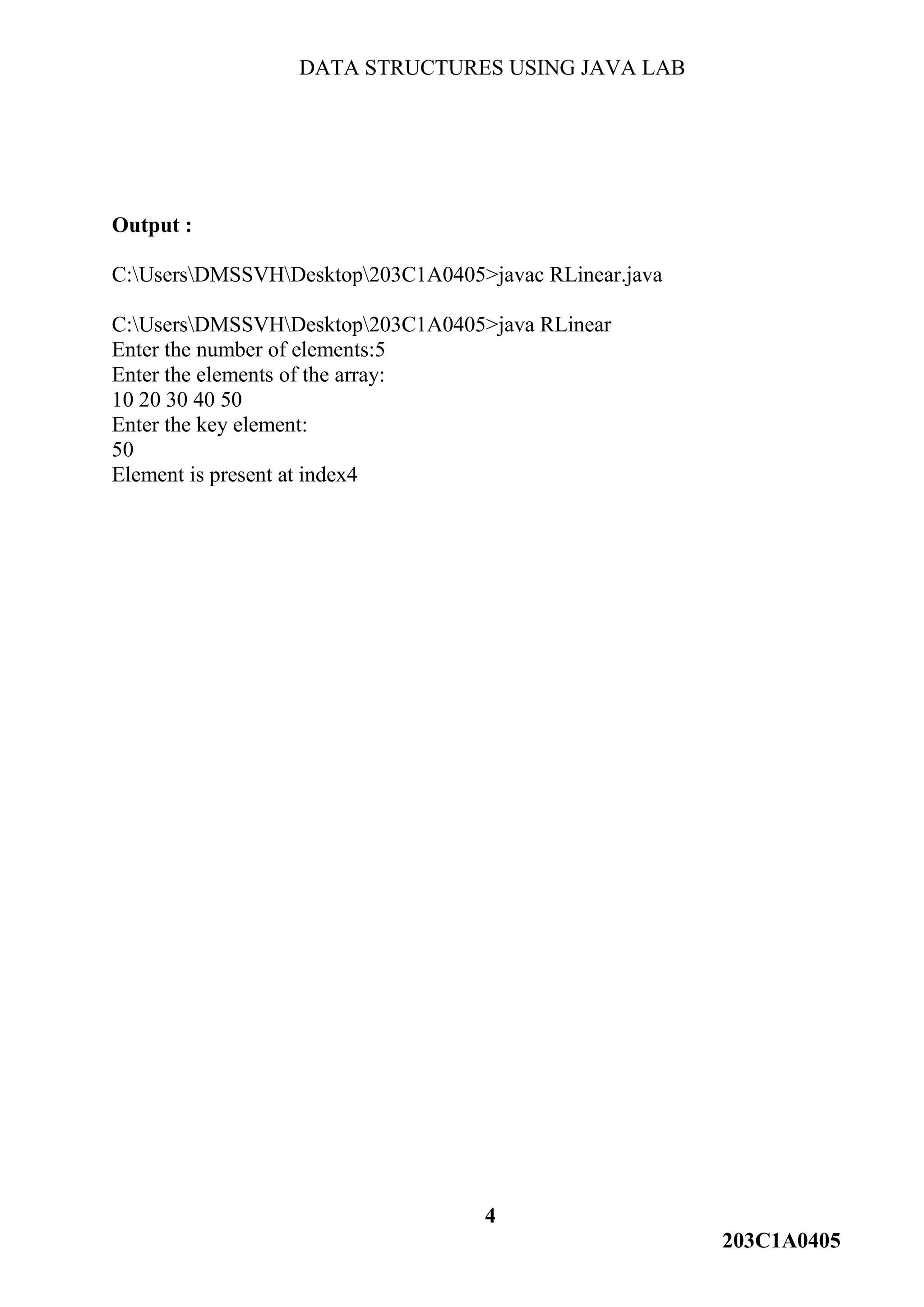
Output :
C:UsersDMSSVHDesktop203C1A0405>javac RLinear.java
C:UsersDMSSVHDesktop203C1A0405>java RLinear
Enter the number of elements:5
Enter the elements of the array:
10 20 30 40 50
Enter the key element:
50
Element is present at index4
DATA STRUCTURES USING JAVA LAB
5
203C1A0405
1b) i. Write java program that use a non-recursive function for implementing
Binary search?
import java.util.Scanner;
class NrBinary
{
public static void main(String[]args)
{
int n,key;
Scanner sc = new Scanner(System.in);
System.out.println("Enter the number of elements:");
n = sc.nextInt();
int[] arr = new int[10];
System.out.println("Enter the elements of the array:");
for(int i=0;i<n;i++)
{
arr[i] = sc.nextInt();
}
System.out.println("Enter the key element:");
key = sc.nextInt();
sort(arr,n);
System.out.println("The sorted elements are:");
for(int i=0;i<n;i++)
System.out.print(arr[i]+ " ");
System.out.println();
int result = binarySearch(arr,0,n-1,key);
if(result == -1)
System.out.print("Elements is not present in array");
else
System.out.print("Element is present at index" +(result+1));
}
public static int binarySearch(int arr[], int l, int r, int x)
{
while(l <= r)
{
int mid = (l+r)/2;
if(arr[mid] == x)
return mid;
DATA STRUCTURES USING JAVA LAB
6
203C1A0405
if(arr[mid] > x)
r = mid-1;
else
if(arr[mid] < x)
l = mid+1;
}
return -1;
}
public static void sort(int arr[],int n)
{
for(int i=0;i<n-1;i++)
for(int j=0;j<n-i-1;j++)
if(arr[j] > arr[j+1])
{
int temp = arr[j];
arr[j] = arr[j+1];
arr[j+1] = temp;
}
}
}
DATA STRUCTURES USING JAVA LAB
7
203C1A0405
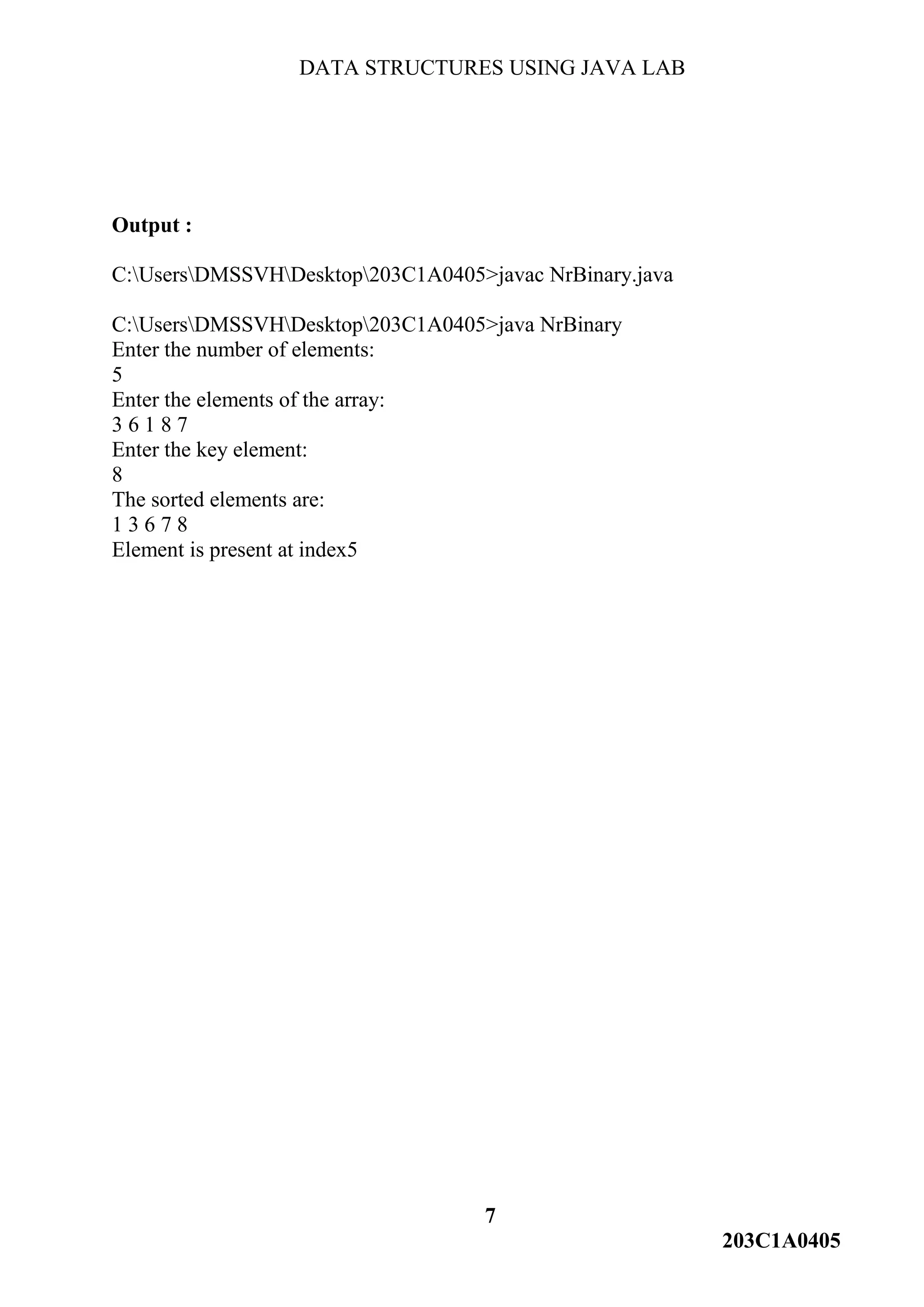
Output :
C:UsersDMSSVHDesktop203C1A0405>javac NrBinary.java
C:UsersDMSSVHDesktop203C1A0405>java NrBinary
Enter the number of elements:
5
Enter the elements of the array:
3 6 1 8 7
Enter the key element:
8
The sorted elements are:
1 3 6 7 8
Element is present at index5
DATA STRUCTURES USING JAVA LAB
8
203C1A0405
1b) ii. Write java program that use a Recursive function for implementing Binary
search?
import java.util.Scanner;
class RBinary
{
public static void main(String[]args)
{
int n,key;
Scanner sc = new Scanner(System.in);
System.out.println("Enter the number of elements:");
n = sc.nextInt();
int[]arr = new int[10];
System.out.println("Enter the elements of the array:");
for(int i=0;i<n;i++)
{
arr[i] = sc.nextInt();
}
System.out.println("Enter the key element:");
key = sc.nextInt();
sort(arr,n);
System.out.println("The sorted elements are:");
for(int i=0;i<n;i++)
System.out.print(arr[i]+ " ");
System.out.println();
int result = binarySearch(arr,0,n-1,key);
if(result == -1)
System.out.println("Element is not present in array");
else
System.out.println("Element is present at index" +(result+1));
}
public static int binarySearch(int arr[],int l,int x,int r)
{
if(l <= r)
{
int mid = (1+r)/2;
if(arr[mid] == x)
DATA STRUCTURES USING JAVA LAB
9
203C1A0405
return mid;
if(arr[mid] > x)
return binarySearch(arr,l,mid-1,x);
if(arr[mid] < x)
return binarySearch(arr,mid+1,r,x);
}
return-1;
}
public static void sort(int arr[],int n)
{
for(int i=0;i<n-1;i++)
for(int j=0;j<n-i-1;j++)
if(arr[j] > arr[j+1])
{
int temp = arr[j];
arr[j] = arr[j+1];
arr[j+1] = temp;
}
}
}
DATA STRUCTURES USING JAVA LAB
10
203C1A0405
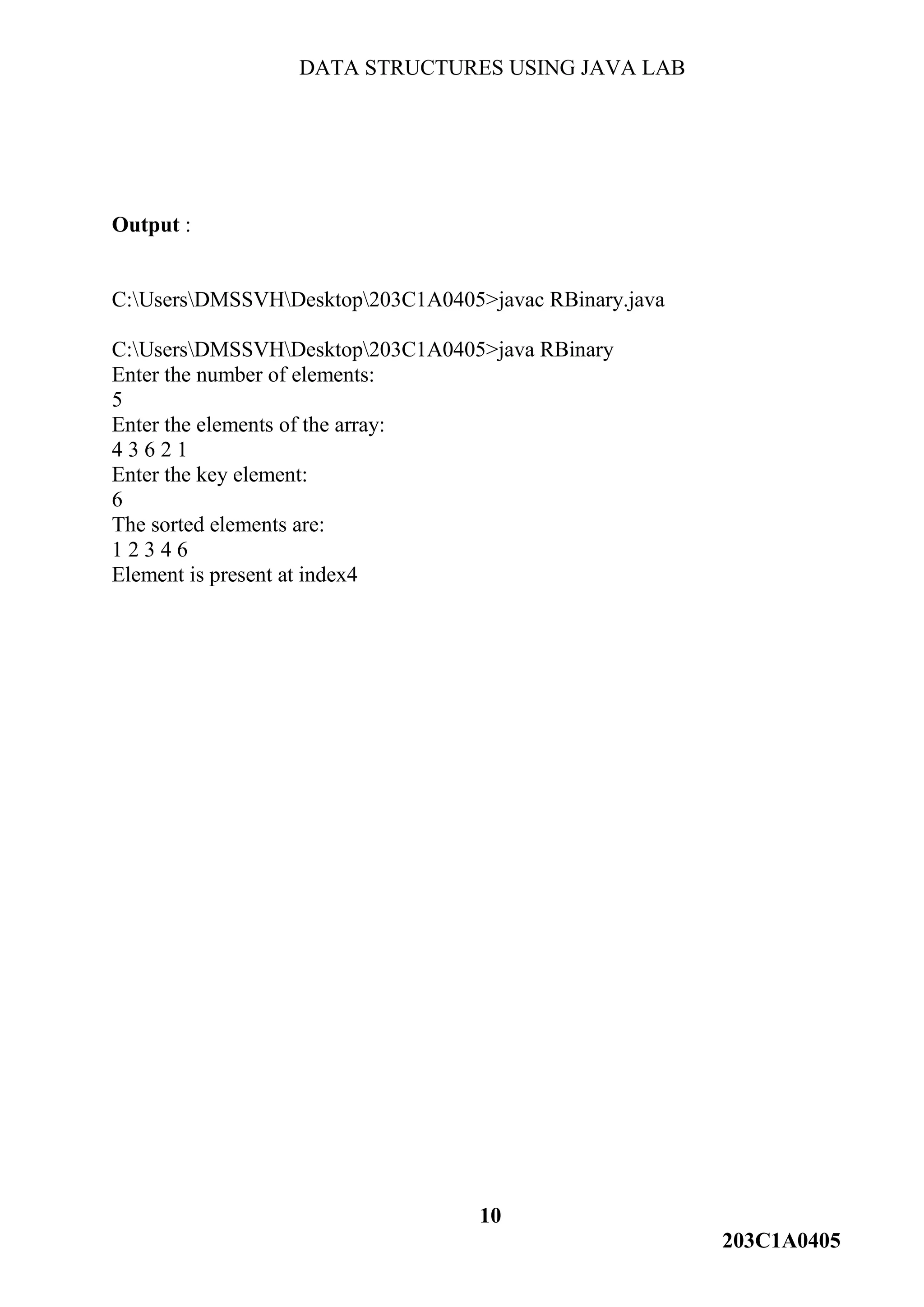
Output :
C:UsersDMSSVHDesktop203C1A0405>javac RBinary.java
C:UsersDMSSVHDesktop203C1A0405>java RBinary
Enter the number of elements:
5
Enter the elements of the array:
4 3 6 2 1
Enter the key element:
6
The sorted elements are:
1 2 3 4 6
Element is present at index4
DATA STRUCTURES USING JAVA LAB
11
203C1A0405
3) Write a java programs to implement the following using an array?
a) Stack ADT
import java.util.*;
class MyStack
{
private int top = -1;
int SIZE = 5;
private int stk[] = new int[SIZE];
boolean isFull()
{
if(top == SIZE-1)
return true;
else
return false;
}
boolean isEmpty()
{
if(top == -1)
return true;
else
return false;
}
void push(int num)
{
if(isFull())
{
System.out.println("Stack Overflow");
}
else
{
stk[++top] = num;
System.out.println("n"+num+"is inserted in stack");
}
}
int pop()
{
if(isEmpty())
DATA STRUCTURES USING JAVA LAB
12
203C1A0405
{
System.out.println("n Stack Underflow");
return 0;
}
else
{
int x = stk[top];
top--;
System.out.println("n"+x+"is removed from stack");
return x;
}
}
int peek()
{
if(isEmpty())
{
System.out.println("n Stack Underflow");
return 0;
}
else
{
System.out.println("the top element is:"+stk[top]);
return stk[top];
}
}
void display()
{
if(isEmpty())
{
System.out.println("n Stack Empty");
}
else
{
System.out.println("n Stack:");
for(int i=0;i<=top;i++)
{
System.out.println("|"+stk[i]);
}
}
}
}
class Stack
{
DATA STRUCTURES USING JAVA LAB
13
203C1A0405
public static void main(String[]args)
{
System.out.println("********** stack using Array **********");
boolean flag = true;
Scanner in = new Scanner(System.in);
int ch,num;
MyStack s = new MyStack();
while(flag)
{
System.out.println("n1.PUSHn2.POPn3.PEEKn4.DISPLAYn5.QUITn Enter
your choice:");
ch = in.nextInt();
switch(ch)
{
case 1:
System.out.println("Enter a number you want to insert in stack:");
num = in.nextInt();
s.push(num);
break;
case 2:
s.pop();
break;
case 3:
s.peek();
break;
case 4:
s.display();
break;
case 5:
flag = false;
break;
}
}
}
}
DATA STRUCTURES USING JAVA LAB
14
203C1A0405
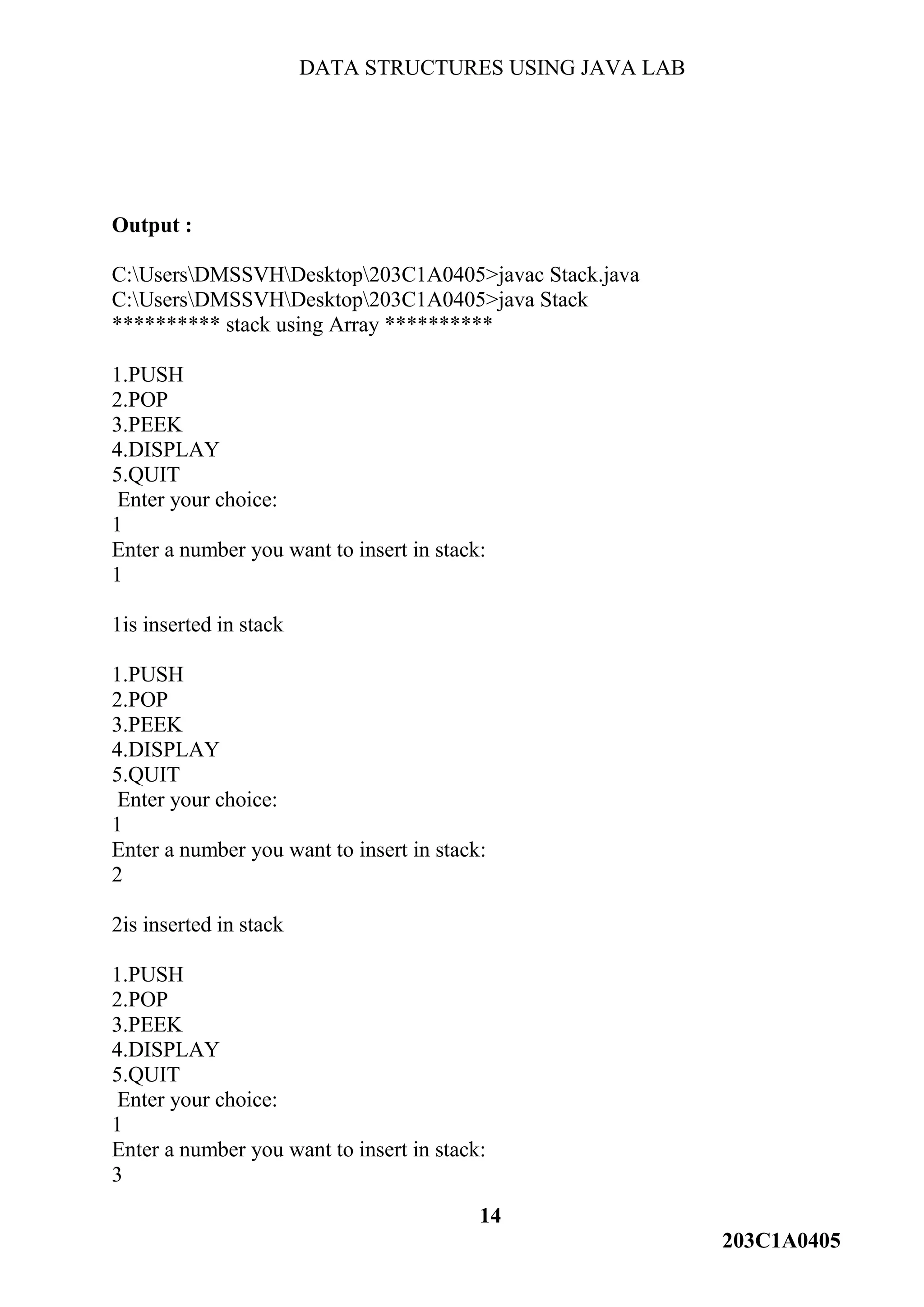
Output :
C:UsersDMSSVHDesktop203C1A0405>javac Stack.java
C:UsersDMSSVHDesktop203C1A0405>java Stack
********** stack using Array **********
1.PUSH
2.POP
3.PEEK
4.DISPLAY
5.QUIT
Enter your choice:
1
Enter a number you want to insert in stack:
1
1is inserted in stack
1.PUSH
2.POP
3.PEEK
4.DISPLAY
5.QUIT
Enter your choice:
1
Enter a number you want to insert in stack:
2
2is inserted in stack
1.PUSH
2.POP
3.PEEK
4.DISPLAY
5.QUIT
Enter your choice:
1
Enter a number you want to insert in stack:
3
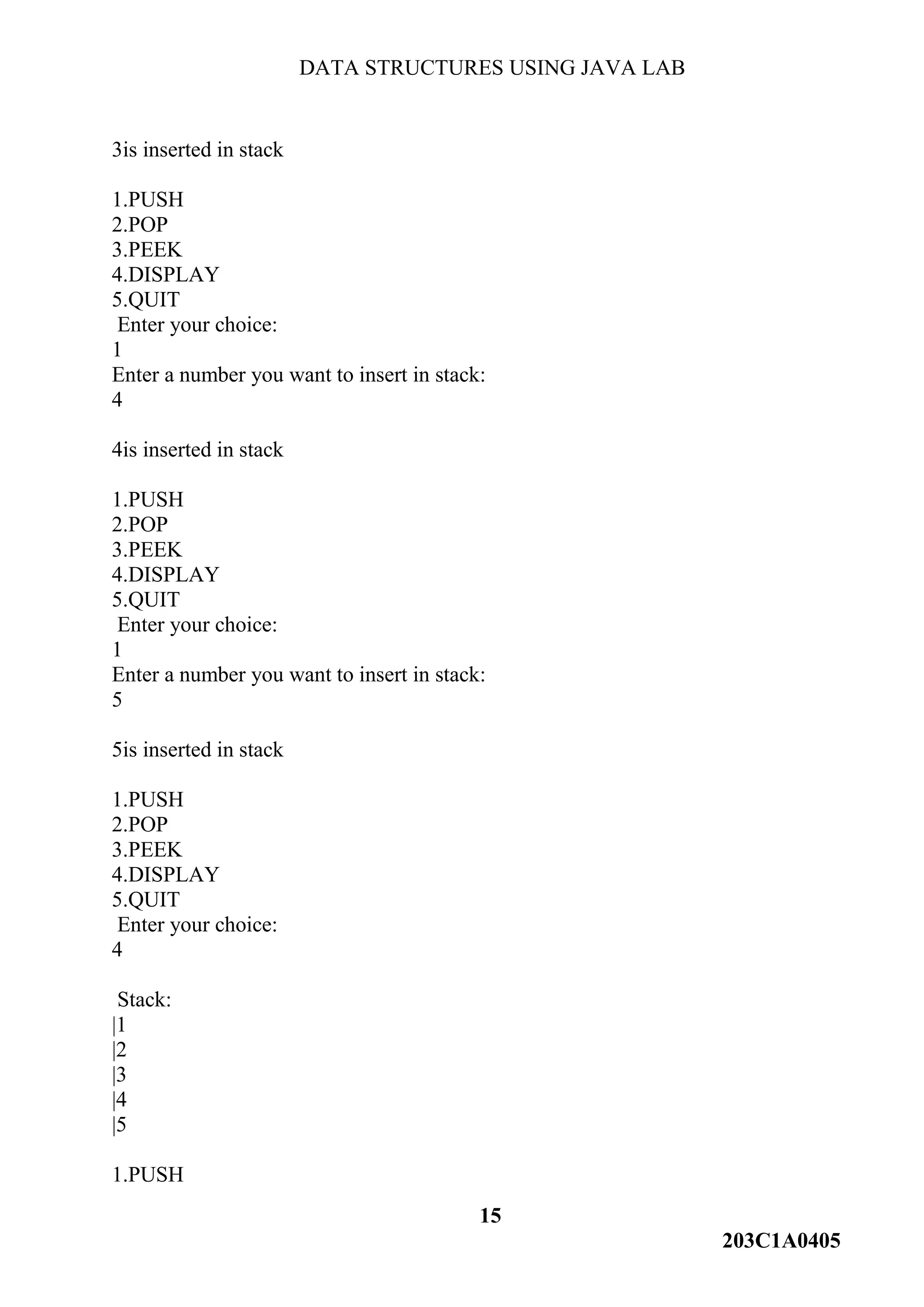
DATA STRUCTURES USING JAVA LAB
15
203C1A0405
3is inserted in stack
1.PUSH
2.POP
3.PEEK
4.DISPLAY
5.QUIT
Enter your choice:
1
Enter a number you want to insert in stack:
4
4is inserted in stack
1.PUSH
2.POP
3.PEEK
4.DISPLAY
5.QUIT
Enter your choice:
1
Enter a number you want to insert in stack:
5
5is inserted in stack
1.PUSH
2.POP
3.PEEK
4.DISPLAY
5.QUIT
Enter your choice:
4
Stack:
|1
|2
|3
|4
|5
1.PUSH
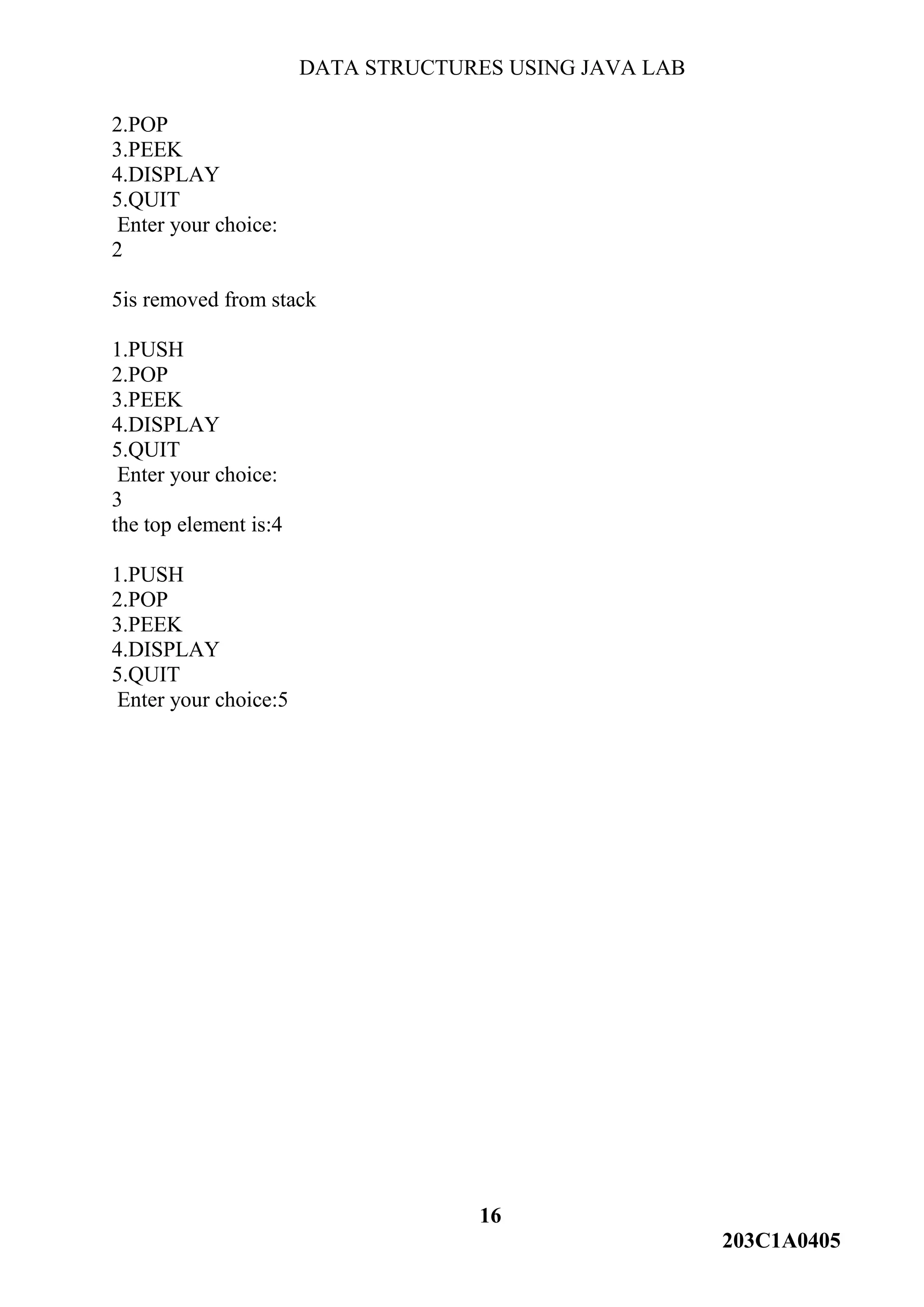
DATA STRUCTURES USING JAVA LAB
16
203C1A0405
2.POP
3.PEEK
4.DISPLAY
5.QUIT
Enter your choice:
2
5is removed from stack
1.PUSH
2.POP
3.PEEK
4.DISPLAY
5.QUIT
Enter your choice:
3
the top element is:4
1.PUSH
2.POP
3.PEEK
4.DISPLAY
5.QUIT
Enter your choice:5
DATA STRUCTURES USING JAVA LAB
17
203C1A0405
3) b . Write a java programs to implement the following using an array?
( Queue ADT)
import java.util.*;
class MyQueue
{
private int front = -1,rear = -1;
int SIZE = 5;
private int queue[] = new int[SIZE];
boolean isFull()
{
if(front == 0&&rear == SIZE-1)
return true;
else
return false;
}
boolean isEmpty()
{
if(front == -1)
return true;
else
return false;
}
void enQueue(int num)
{
if(isFull())
{
System.out.println("Queue Overflow");
}
else
{
if(front == -1)
{
front = 0;
}
rear++;
queue[rear] = num;
DATA STRUCTURES USING JAVA LAB
18
203C1A0405
System.out.println("n"+num+"is inserted in queue");
}
}
int deQueue()
{
int x;
if(isEmpty())
{
System.out.println("n Queue Underflow");
return 0;
}
else
{
x = queue[front];
front++;
if(front >= rear)
{
front = -1;
rear = -1;
}
System.out.println("n"+x+"is removed from Queue");
return x;
}
}
int peek()
{
if(isEmpty())
{
System.out.println("n Queue Underflow");
return 0;
}
else
{
System.out.println("the front element is:"+queue[front]);
return queue[front];
}
}
void display()
{
if(isEmpty())
{
System.out.println("n Queue Empty");
}
DATA STRUCTURES USING JAVA LAB
19
203C1A0405
else
{
System.out.println("n Queue:");
for(int i=front;i<=rear;i++)
{
System.out.println("|"+queue[i]);
}
}
}
}
class Queue
{
public static void main(String[]args)
{
System.out.println("********** Queue using Array **********");
boolean flag = true;
Scanner in = new Scanner(System.in);
int ch,num;
MyQueue q = new MyQueue();
while(flag)
{
System.out.println("n1.ENQUEUEn2.DEQUEUEn3.PEEKn4.DISPLAYn5.QUIT
n Enter your choice:");
ch = in.nextInt();
switch(ch)
{
case 1:
System.out.println("Enter a number you want to insert in queue:");
num = in.nextInt();
q.enQueue(num);
break;
case 2:
q.deQueue();
break;
case 3:
q.peek();
break;
case 4:
q.display();
break;
case 5:
flag = false;
DATA STRUCTURES USING JAVA LAB
20
203C1A0405
break;
}
}
}
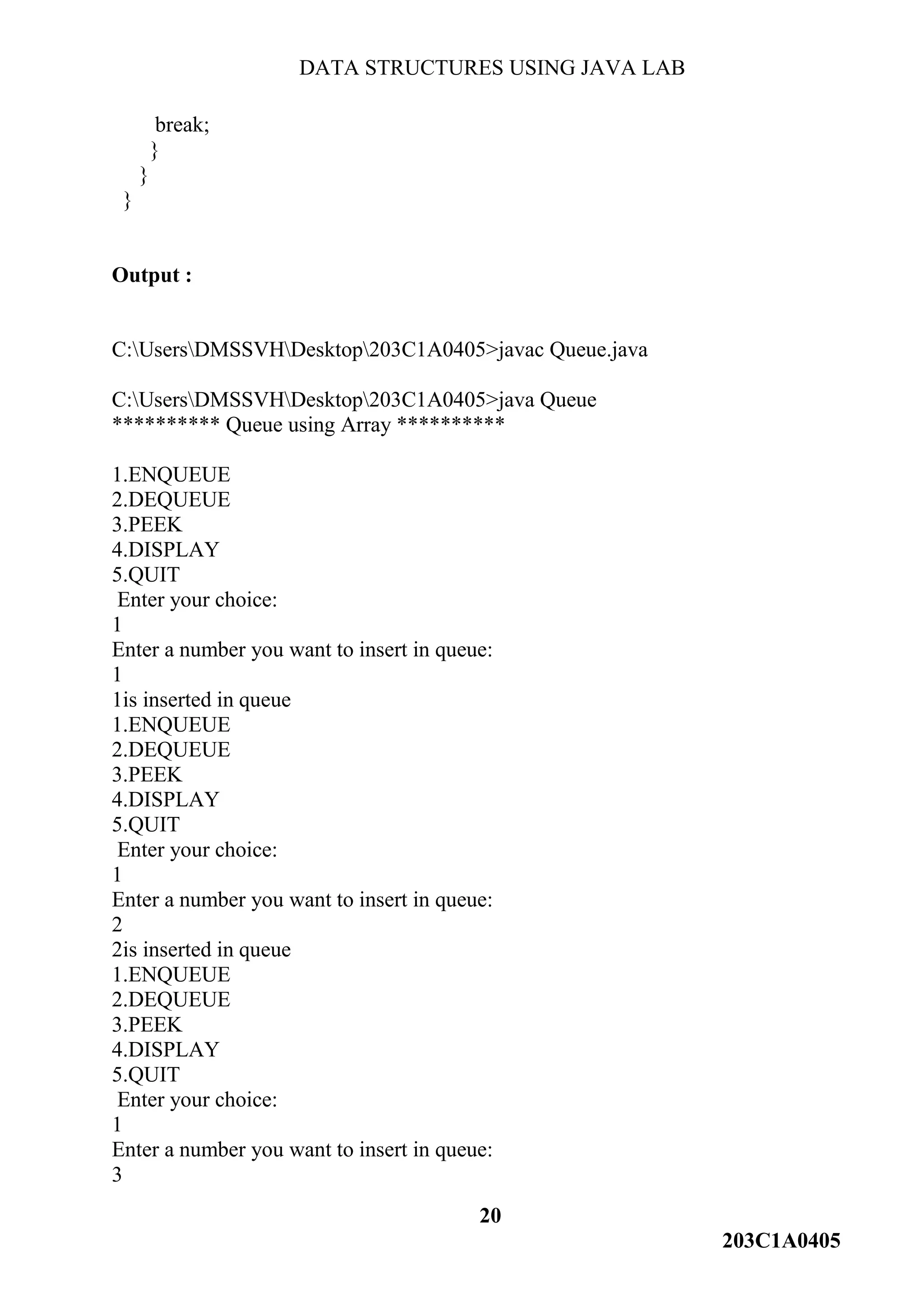
Output :
C:UsersDMSSVHDesktop203C1A0405>javac Queue.java
C:UsersDMSSVHDesktop203C1A0405>java Queue
********** Queue using Array **********
1.ENQUEUE
2.DEQUEUE
3.PEEK
4.DISPLAY
5.QUIT
Enter your choice:
1
Enter a number you want to insert in queue:
1
1is inserted in queue
1.ENQUEUE
2.DEQUEUE
3.PEEK
4.DISPLAY
5.QUIT
Enter your choice:
1
Enter a number you want to insert in queue:
2
2is inserted in queue
1.ENQUEUE
2.DEQUEUE
3.PEEK
4.DISPLAY
5.QUIT
Enter your choice:
1
Enter a number you want to insert in queue:
3
DATA STRUCTURES USING JAVA LAB
21
203C1A0405
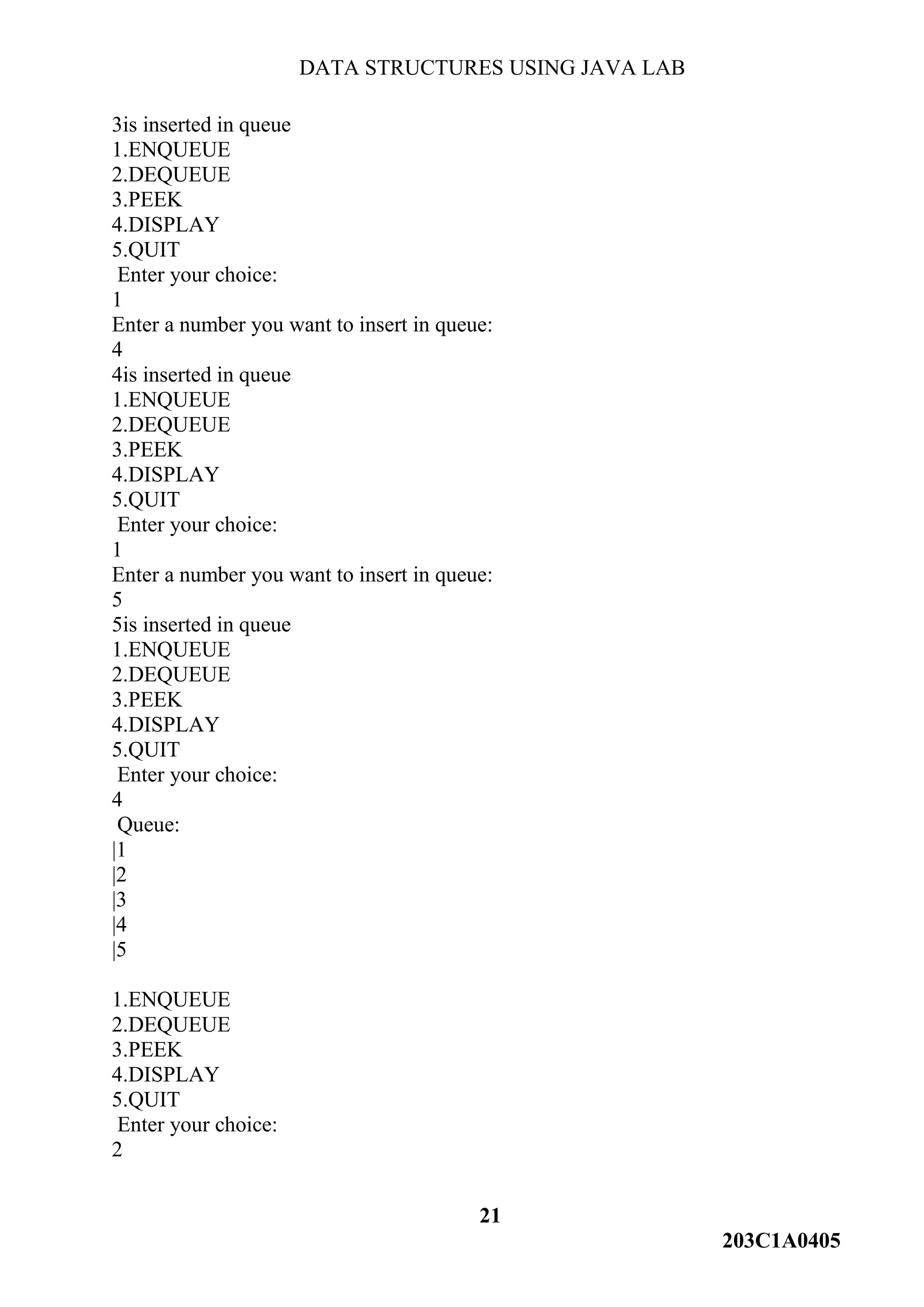
3is inserted in queue
1.ENQUEUE
2.DEQUEUE
3.PEEK
4.DISPLAY
5.QUIT
Enter your choice:
1
Enter a number you want to insert in queue:
4
4is inserted in queue
1.ENQUEUE
2.DEQUEUE
3.PEEK
4.DISPLAY
5.QUIT
Enter your choice:
1
Enter a number you want to insert in queue:
5
5is inserted in queue
1.ENQUEUE
2.DEQUEUE
3.PEEK
4.DISPLAY
5.QUIT
Enter your choice:
4
Queue:
|1
|2
|3
|4
|5
1.ENQUEUE
2.DEQUEUE
3.PEEK
4.DISPLAY
5.QUIT
Enter your choice:
2
DATA STRUCTURES USING JAVA LAB
22
203C1A0405
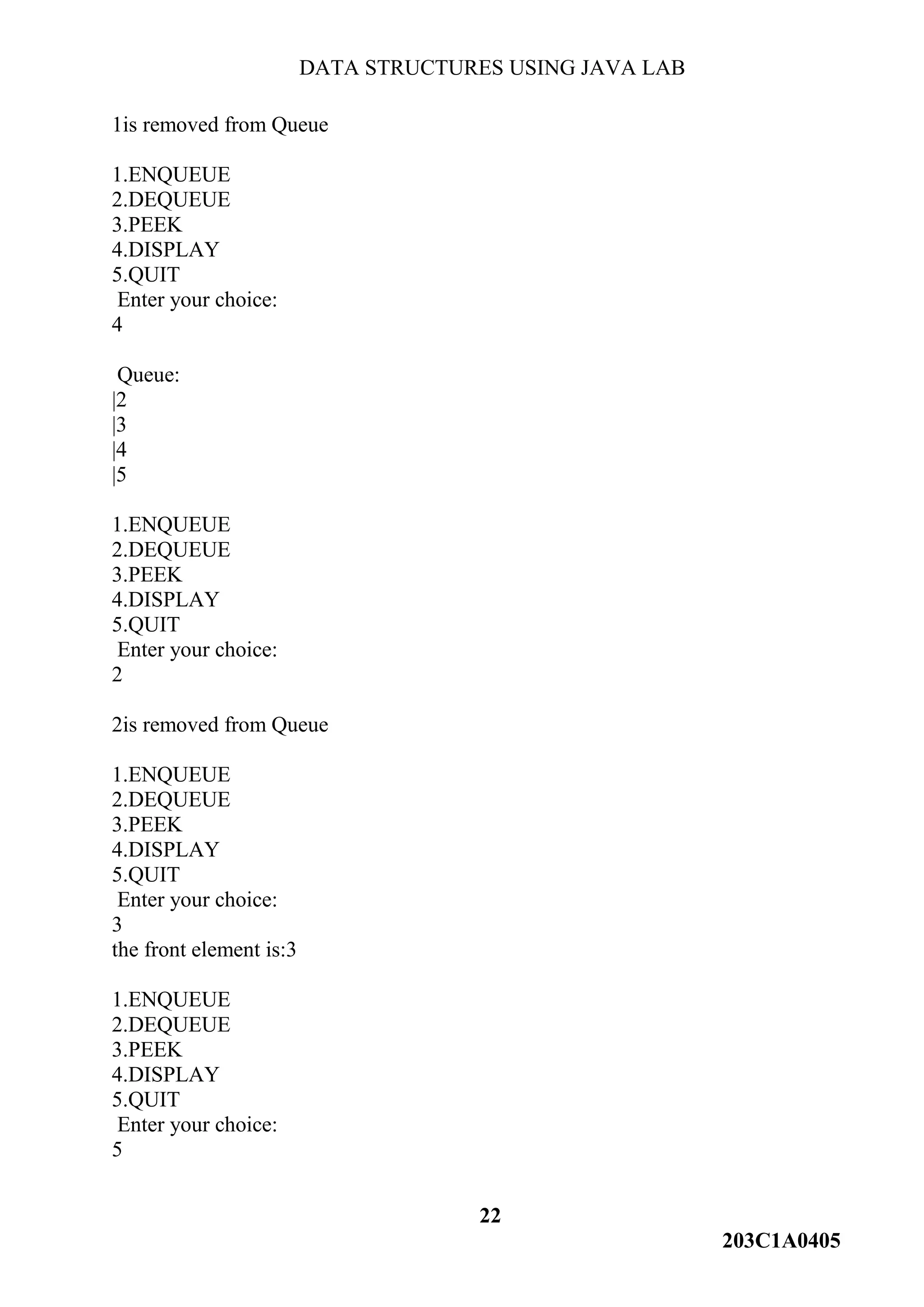
1is removed from Queue
1.ENQUEUE
2.DEQUEUE
3.PEEK
4.DISPLAY
5.QUIT
Enter your choice:
4
Queue:
|2
|3
|4
|5
1.ENQUEUE
2.DEQUEUE
3.PEEK
4.DISPLAY
5.QUIT
Enter your choice:
2
2is removed from Queue
1.ENQUEUE
2.DEQUEUE
3.PEEK
4.DISPLAY
5.QUIT
Enter your choice:
3
the front element is:3
1.ENQUEUE
2.DEQUEUE
3.PEEK
4.DISPLAY
5.QUIT
Enter your choice:
5
DATA STRUCTURES USING JAVA LAB
23
203C1A0405
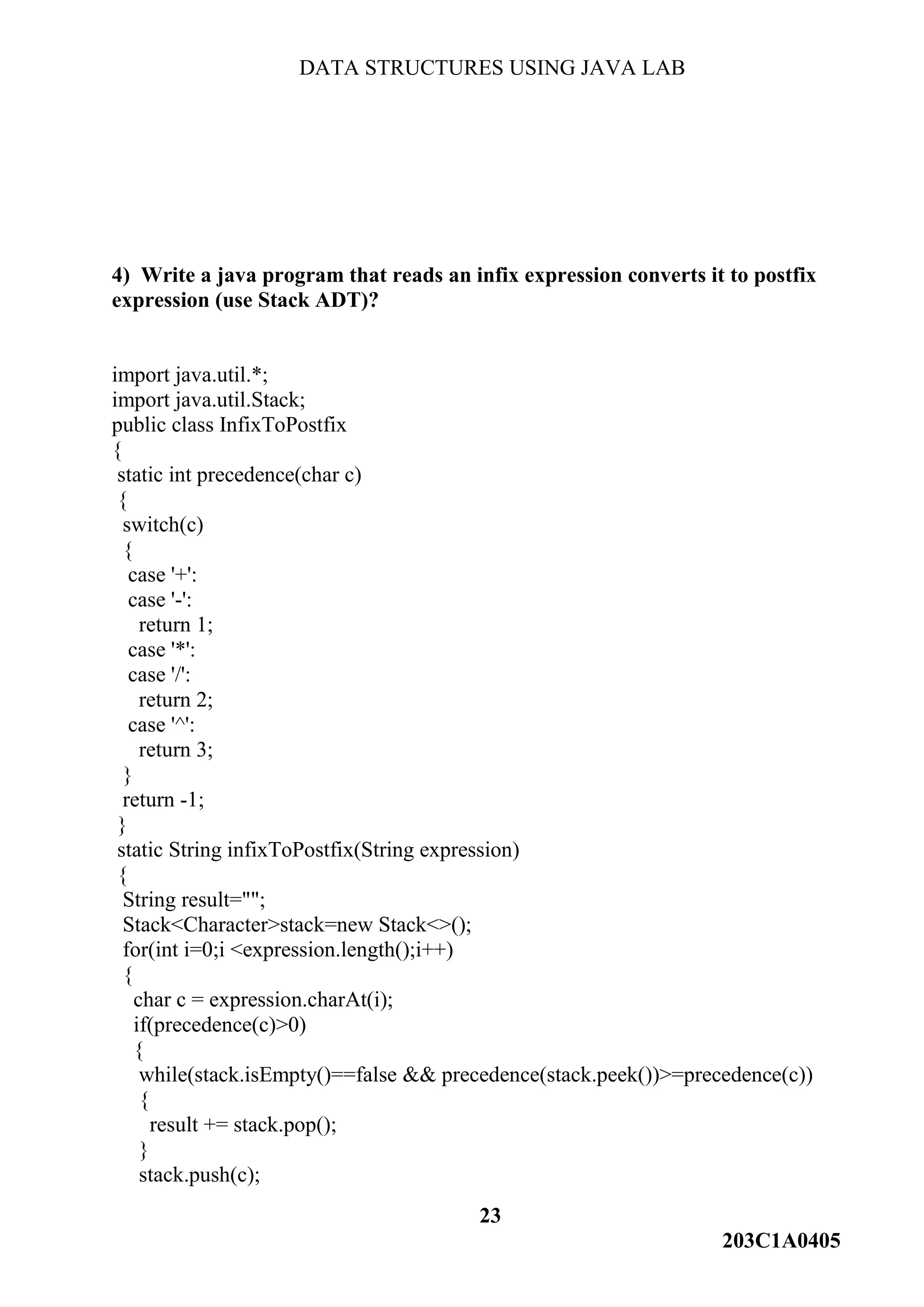
4) Write a java program that reads an infix expression converts it to postfix
expression (use Stack ADT)?
import java.util.*;
import java.util.Stack;
public class InfixToPostfix
{
static int precedence(char c)
{
switch(c)
{
case '+':
case '-':
return 1;
case '*':
case '/':
return 2;
case '^':
return 3;
}
return -1;
}
static String infixToPostfix(String expression)
{
String result="";
Stack<Character>stack=new Stack<>();
for(int i=0;i <expression.length();i++)
{
char c = expression.charAt(i);
if(precedence(c)>0)
{
while(stack.isEmpty()==false && precedence(stack.peek())>=precedence(c))
{
result += stack.pop();
}
stack.push(c);
DATA STRUCTURES USING JAVA LAB
24
203C1A0405
}
else
if(c==')')
{
char x = stack.pop();
while(x!='(')
{
result += x;
x = stack.pop();
}
}
else
if(c=='(')
{
stack.push(c);
}
else
{
result += c;
}
}
for(int i=0;i<=stack.size();i++)
{
result += stack.pop();
}
return result;
}
public static void main(String[]args)
{
Scanner sc = new Scanner(System.in);
System.out.println("Enter the expression:");
String exp = sc.nextLine();
System.out.println("Infix Expression:"+exp);
System.out.println("postfix Expression:"+infixToPostfix(exp));
}
}
DATA STRUCTURES USING JAVA LAB
25
203C1A0405
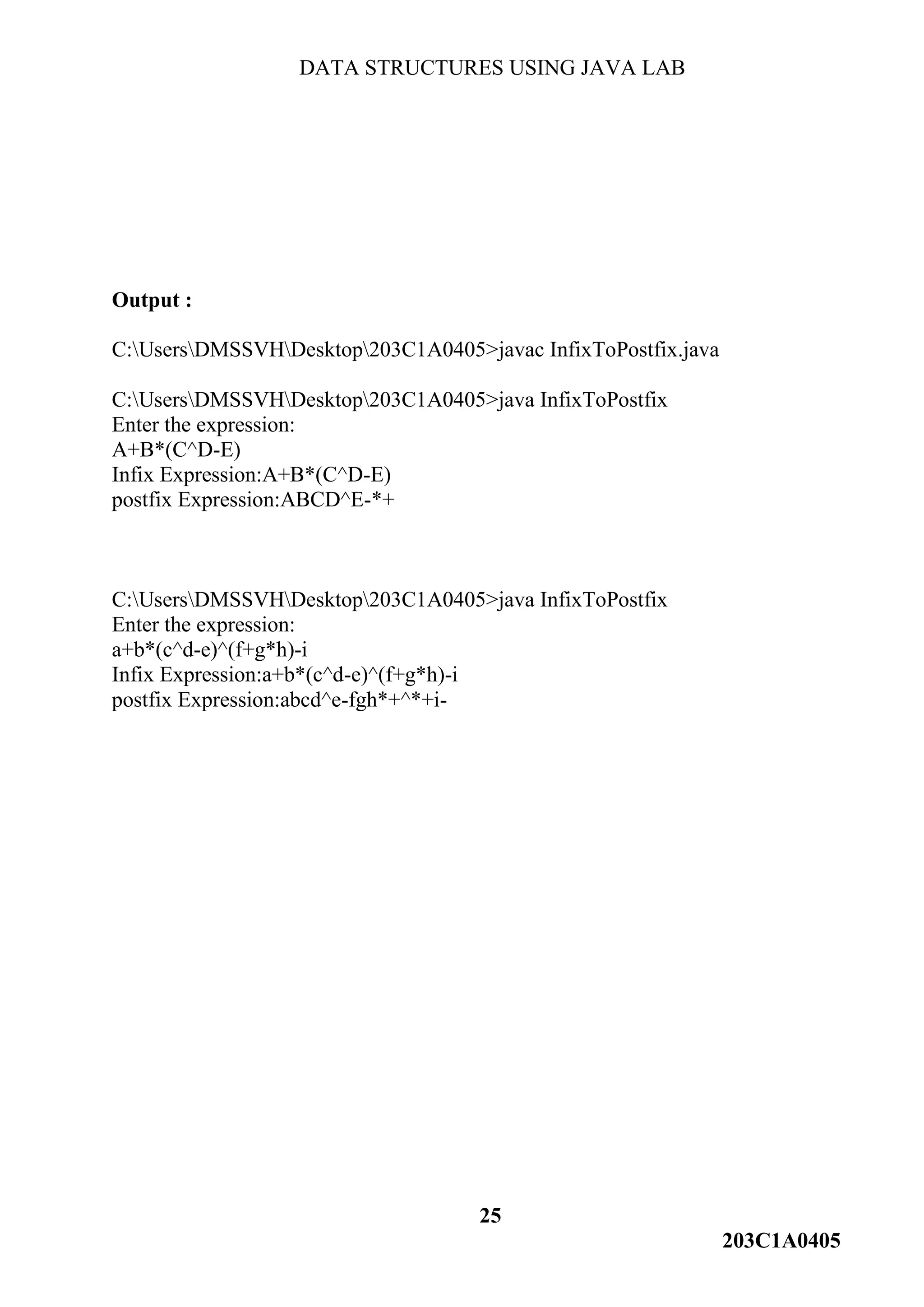
Output :
C:UsersDMSSVHDesktop203C1A0405>javac InfixToPostfix.java
C:UsersDMSSVHDesktop203C1A0405>java InfixToPostfix
Enter the expression:
A+B*(C^D-E)
Infix Expression:A+B*(C^D-E)
postfix Expression:ABCD^E-*+
C:UsersDMSSVHDesktop203C1A0405>java InfixToPostfix
Enter the expression:
a+b*(c^d-e)^(f+g*h)-i
Infix Expression:a+b*(c^d-e)^(f+g*h)-i
postfix Expression:abcd^e-fgh*+^*+i-
DATA STRUCTURES USING JAVA LAB
26
203C1A0405
5) a . Write a java program to implement the following using a singly linked
List (Stack ADT) ?
import java.util.*;
class Node
{
int data;
Node next;
public Node(int data)
{
this.data=data;
this.next= null;
}
}
class Stack
{
Node top = null;
public void push(int item)
{
Node temp = new Node(item);
if(temp == null)
{
System.out.println("n stack overflow");
}
else
{
temp.data = item;
temp.next = top;
top = temp;
}
}
public boolean isEmpty()
{
return top==null;
}
public void pop()
DATA STRUCTURES USING JAVA LAB
27
203C1A0405
{
if(isEmpty())
{
System.out.println("stack underflow");
}
else
{
int x = top.data;
System.out.println("n"+x+"is removed from stack");
top = top.next;
}
}
public void peek()
{
if(isEmpty())
{
System.out.println("stack underflow");
}
else
{
System.out.println("n Top element is:"+top.data);
}
}
public void display()
{
if(isEmpty())
{
System.out.println("n stack underflow");
}
else
{
Node temp = top;
while(temp != null)
{
System.out.println("|"+temp.data);
temp = temp.next;
}
}
}
}
public class StackII
{
public static void main(String[]args)
DATA STRUCTURES USING JAVA LAB
28
203C1A0405
{
System.out.println("********** stack using Linkedlist **********");
boolean flag = true;
Scanner in = new Scanner(System.in);
int ch,num;
Stack s = new Stack();
while(flag)
{
System.out.println("n1.PUSHn2.POPn3.PEEKn4.DISPLAYn5.QUITnEnter
your choice:");
ch = in.nextInt();
switch(ch)
{
case 1:
System.out.println("Enter a number you want to insert in stack:");
num = in.nextInt();
s.push(num);
break;
case 2:
s.pop();
break;
case 3:
s.peek();
break;
case 4:
s.display();
break;
case 5:
flag = false;
break;
}
}
}
}
DATA STRUCTURES USING JAVA LAB
29
203C1A0405
Output :
C:UsersDMSSVHDesktop203C1A0405>javac StackII.java
C:UsersDMSSVHDesktop203C1A0405>java StackII
********** stack using Linkedlist **********
1.PUSH
2.POP
3.PEEK
4.DISPLAY
5.QUIT
Enter your choice:
1
Enter a number you want to insert in stack:
15
1.PUSH
2.POP
3.PEEK
4.DISPLAY
5.QUIT
Enter your choice:
1
Enter a number you want to insert in stack:
16
1.PUSH
2.POP
3.PEEK
4.DISPLAY
5.QUIT
Enter your choice:
1
Enter a number you want to insert in stack:
17
DATA STRUCTURES USING JAVA LAB
30
203C1A0405
1.PUSH
2.POP
3.PEEK
4.DISPLAY
5.QUIT
Enter your choice:1
Enter a number you want to insert in stack:
18
1.PUSH
2.POP
3.PEEK
4.DISPLAY
5.QUIT
Enter your choice:
4
|18
|17
|16
|15
1.PUSH
2.POP
3.PEEK
4.DISPLAY
5.QUIT
Enter your choice:
2
18is removed from stack
1.PUSH
2.POP
3.PEEK
4.DISPLAY
5.QUIT
Enter your choice:
4
|17
|16
|15
1.PUSH
2.POP
DATA STRUCTURES USING JAVA LAB
31
203C1A0405
3.PEEK
4.DISPLAY
5.QUIT
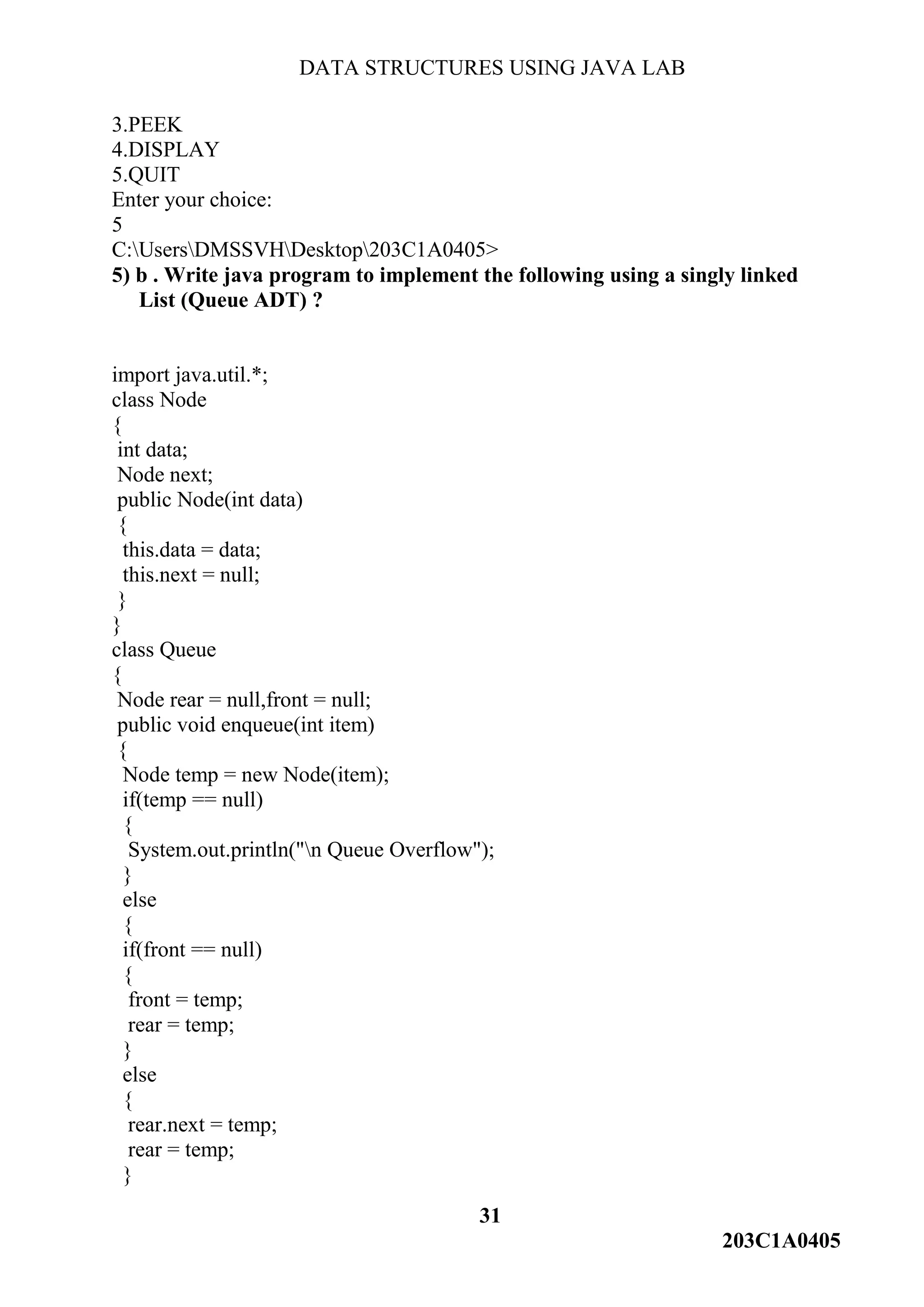
Enter your choice:
5
C:UsersDMSSVHDesktop203C1A0405>
5) b . Write java program to implement the following using a singly linked
List (Queue ADT) ?
import java.util.*;
class Node
{
int data;
Node next;
public Node(int data)
{
this.data = data;
this.next = null;
}
}
class Queue
{
Node rear = null,front = null;
public void enqueue(int item)
{
Node temp = new Node(item);
if(temp == null)
{
System.out.println("n Queue Overflow");
}
else
{
if(front == null)
{
front = temp;
rear = temp;
}
else
{
rear.next = temp;
rear = temp;
}
DATA STRUCTURES USING JAVA LAB
32
203C1A0405
}
}
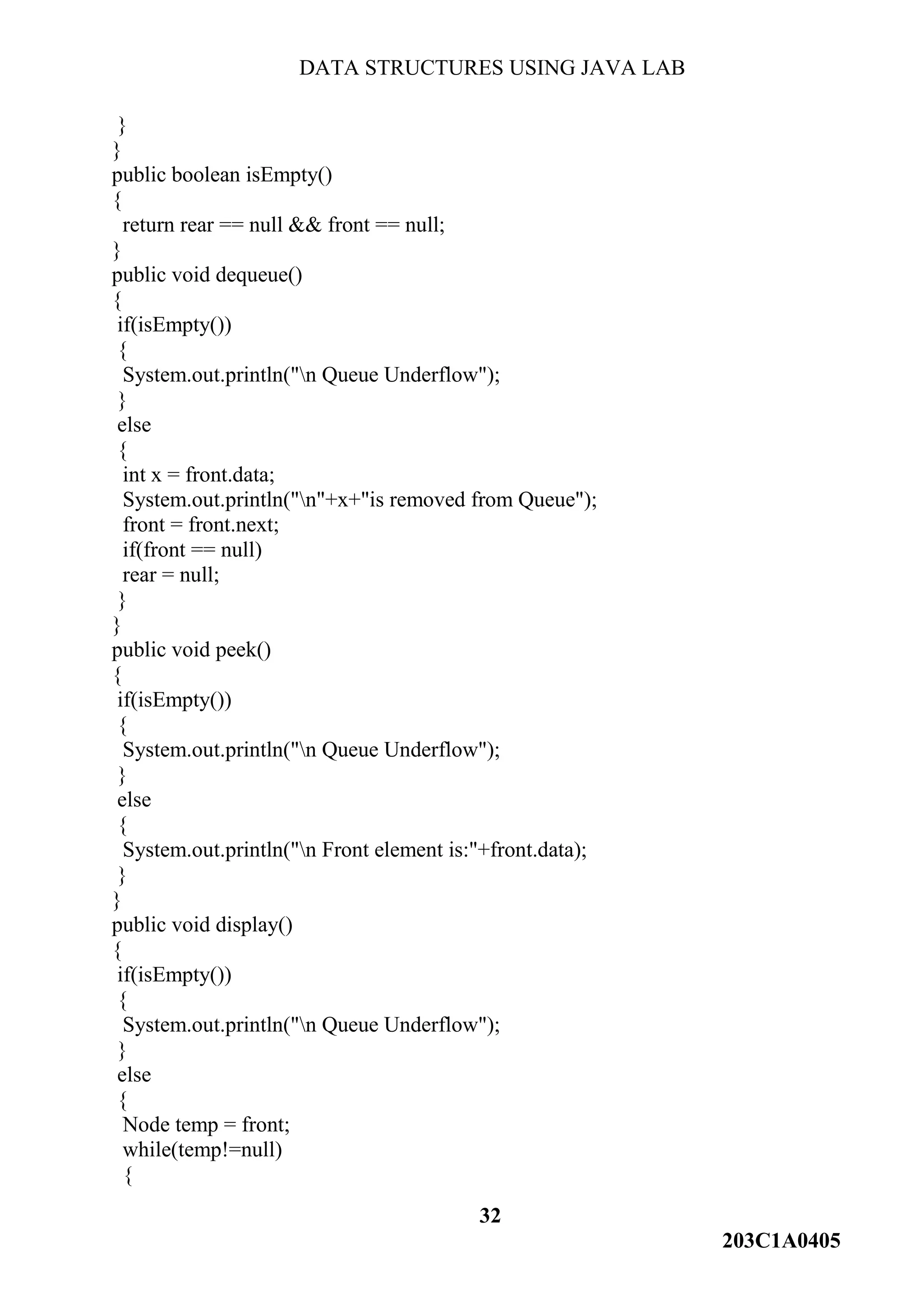
public boolean isEmpty()
{
return rear == null && front == null;
}
public void dequeue()
{
if(isEmpty())
{
System.out.println("n Queue Underflow");
}
else
{
int x = front.data;
System.out.println("n"+x+"is removed from Queue");
front = front.next;
if(front == null)
rear = null;
}
}
public void peek()
{
if(isEmpty())
{
System.out.println("n Queue Underflow");
}
else
{
System.out.println("n Front element is:"+front.data);
}
}
public void display()
{
if(isEmpty())
{
System.out.println("n Queue Underflow");
}
else
{
Node temp = front;
while(temp!=null)
{
DATA STRUCTURES USING JAVA LAB
33
203C1A0405
System.out.println("|"+temp.data);
temp = temp.next;
}
}
}
}
public class QueueII
{
public static void main(String[]args)
{
System.out.print("********** Queue using LinkedList **********");
boolean flag = true;
Scanner in = new Scanner(System.in);
int ch,num;
Queue q = new Queue();
while(flag)
{
System.out.println("n1.ENQUEUEn2.DEQUEUEn3.PEEKn4.DISPLAYn5.QUIT
n Enter your choice:");
ch = in.nextInt();
switch(ch)
{
case 1:
System.out.println("Enter a number you want to insert in Queue:");
num = in.nextInt();
q.enqueue(num);
break;
case 2:
q.dequeue();
break;
case 3:
q.peek();
case 4:
q.display();
break;
case 5:
flag = false;
break;
}
}
}
}
DATA STRUCTURES USING JAVA LAB
34
203C1A0405
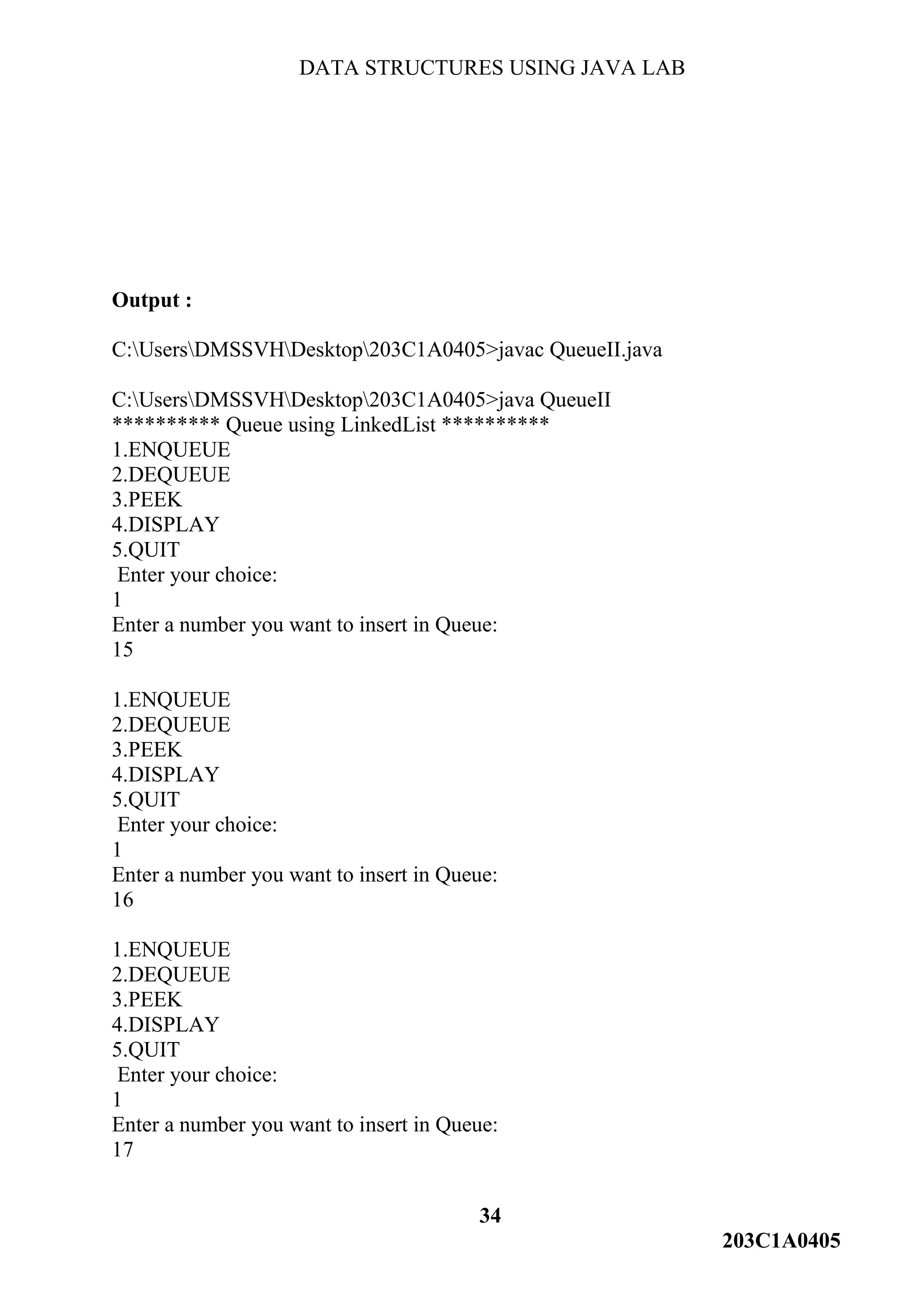
Output :
C:UsersDMSSVHDesktop203C1A0405>javac QueueII.java
C:UsersDMSSVHDesktop203C1A0405>java QueueII
********** Queue using LinkedList **********
1.ENQUEUE
2.DEQUEUE
3.PEEK
4.DISPLAY
5.QUIT
Enter your choice:
1
Enter a number you want to insert in Queue:
15
1.ENQUEUE
2.DEQUEUE
3.PEEK
4.DISPLAY
5.QUIT
Enter your choice:
1
Enter a number you want to insert in Queue:
16
1.ENQUEUE
2.DEQUEUE
3.PEEK
4.DISPLAY
5.QUIT
Enter your choice:
1
Enter a number you want to insert in Queue:
17
DATA STRUCTURES USING JAVA LAB
35
203C1A0405
1.ENQUEUE
2.DEQUEUE
3.PEEK
4.DISPLAY
5.QUIT
Enter your choice:
1
Enter a number you want to insert in Queue:
18
1.ENQUEUE
2.DEQUEUE
3.PEEK
4.DISPLAY
5.QUIT
Enter your choice:
1
Enter a number you want to insert in Queue:
19
1.ENQUEUE
2.DEQUEUE
3.PEEK
4.DISPLAY
5.QUIT
Enter your choice:
1
Enter a number you want to insert in Queue:
20
1.ENQUEUE
2.DEQUEUE
3.PEEK
4.DISPLAY
5.QUIT
Enter your choice:
4
|15
|16
|17
|18
|19
|20
DATA STRUCTURES USING JAVA LAB
36
203C1A0405
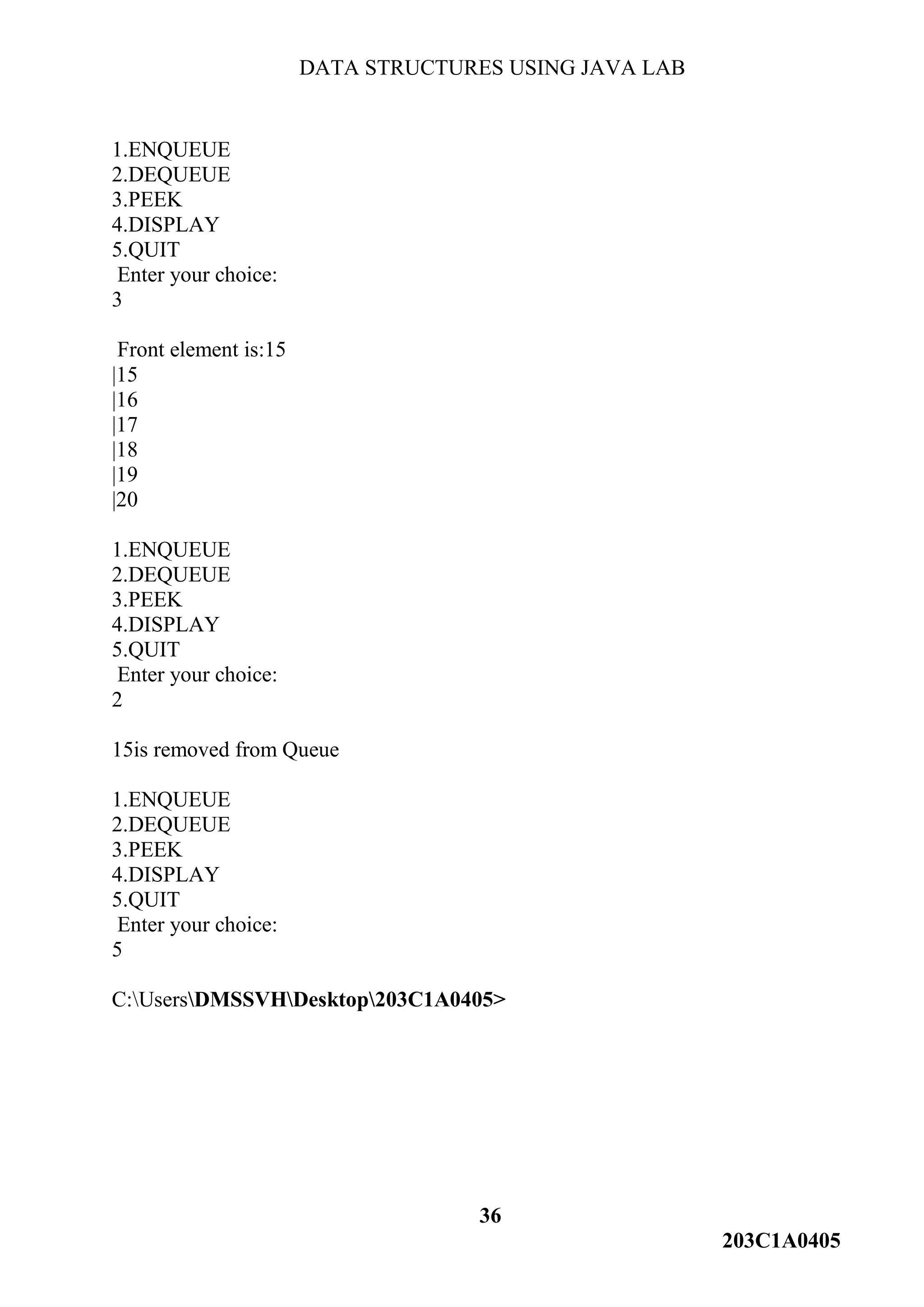
1.ENQUEUE
2.DEQUEUE
3.PEEK
4.DISPLAY
5.QUIT
Enter your choice:
3
Front element is:15
|15
|16
|17
|18
|19
|20
1.ENQUEUE
2.DEQUEUE
3.PEEK
4.DISPLAY
5.QUIT
Enter your choice:
2
15is removed from Queue
1.ENQUEUE
2.DEQUEUE
3.PEEK
4.DISPLAY
5.QUIT
Enter your choice:
5
C:UsersDMSSVHDesktop203C1A0405>
DATA STRUCTURES USING JAVA LAB
37
203C1A0405
6. write a java programs to implement the deque(double ended queue)ADT using
(a) // DEQUEUE USING CIRCULAR ARRAY//
import java.util.*;
class MyDeque
{
private int front=0,rear=-1,te=0;
int SIZE=10;
private int queue[]=new int[SIZE];
boolean isfull()
{
return te==SIZE;
}
boolean isempty()
{
return te==0;
}
void insertfront(int key)
{
if(isfull())
{
System.out.println("Overflow");
return;
}
if(front==0)
front=SIZE-1;
else
front=front-1;
queue[front]=key;
te++;
}
void insertrear(int key)
{
if(isfull())
{
System.out.println("Overflow");
return;
DATA STRUCTURES USING JAVA LAB
38
203C1A0405
}
rear=(rear+1)%SIZE;
queue[rear]=key;
te++;
}
void deletefront()
{
int x;
if(isempty())
{
System.out.println("Queue Underflown");
return;
}
else
{
x=queue[front];
front=(front+1)%SIZE;
System.out.println("n"+x+"is removed from front of queue");
te--;
}
}
void deleterear()
{
int x;
if(isempty())
{
System.out.println("Underflow");
return;
}
else
{
x=queue[rear];
if(rear==-1)
rear=SIZE-1;
System.out.println("n"+x+"is removed from rear of the Queue");
rear=rear-1;
te--;
}
}
int getfront()
{
if(isempty())
{
DATA STRUCTURES USING JAVA LAB
39
203C1A0405
System.out.println("Underflow");
return-1;
}
System.out.println("the front element is:"+queue[front]);
return queue[front];
}
int getrear()
{
if(isempty()||rear<0)
{
System.out.println("Underflown");
return-1;
}
System.out.println("The rear element is:"+queue[rear]);
return queue[rear];
}
void display()
{
int x,i;
if(isempty())
{
System.out.println("Underflown");
return;
}
else
{
x=front;
for(i=1;i<=te;i++)
{
System.out.println(+x+""+queue[x]);
x=(x+1)%SIZE;
}
}
}
}
class DeQue
{
public static void main(String[]args)
{
System.out.println("********** Dequeue using circular array **********");
boolean flag=true;
Scanner in=new Scanner(System.in);
DATA STRUCTURES USING JAVA LAB
40
203C1A0405
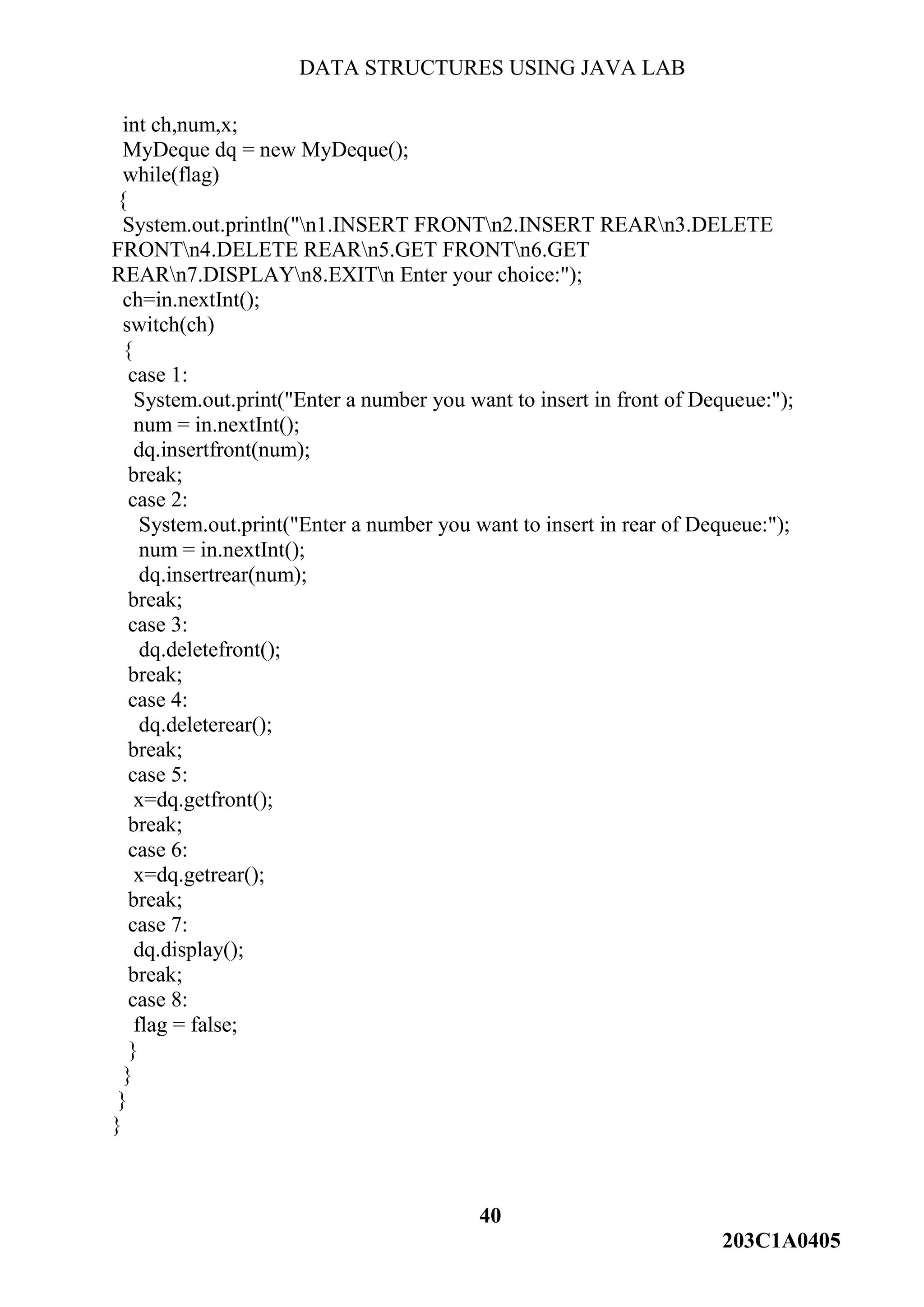
int ch,num,x;
MyDeque dq = new MyDeque();
while(flag)
{
System.out.println("n1.INSERT FRONTn2.INSERT REARn3.DELETE
FRONTn4.DELETE REARn5.GET FRONTn6.GET
REARn7.DISPLAYn8.EXITn Enter your choice:");
ch=in.nextInt();
switch(ch)
{
case 1:
System.out.print("Enter a number you want to insert in front of Dequeue:");
num = in.nextInt();
dq.insertfront(num);
break;
case 2:
System.out.print("Enter a number you want to insert in rear of Dequeue:");
num = in.nextInt();
dq.insertrear(num);
break;
case 3:
dq.deletefront();
break;
case 4:
dq.deleterear();
break;
case 5:
x=dq.getfront();
break;
case 6:
x=dq.getrear();
break;
case 7:
dq.display();
break;
case 8:
flag = false;
}
}
}
}
DATA STRUCTURES USING JAVA LAB
41
203C1A0405
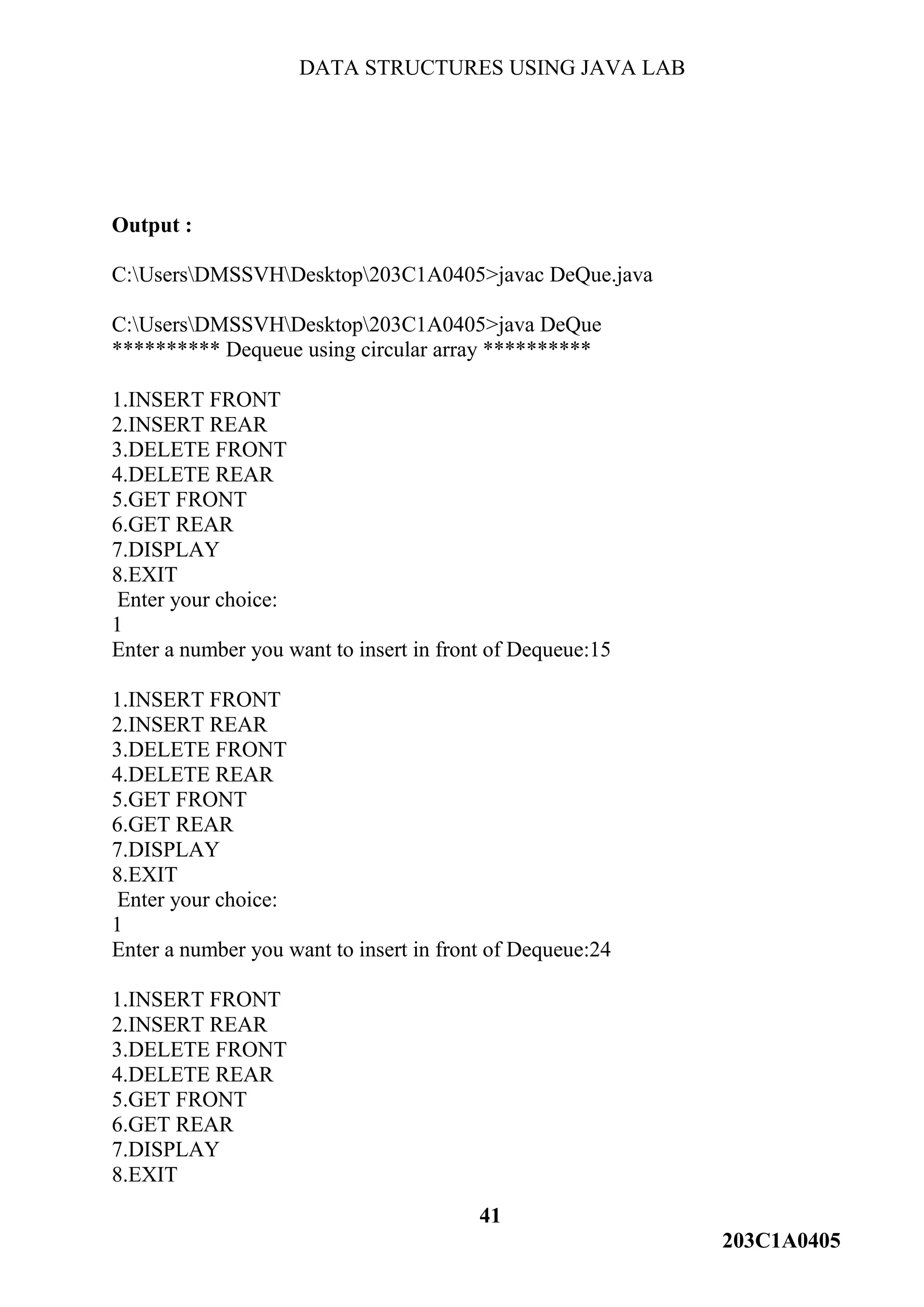
Output :
C:UsersDMSSVHDesktop203C1A0405>javac DeQue.java
C:UsersDMSSVHDesktop203C1A0405>java DeQue
********** Dequeue using circular array **********
1.INSERT FRONT
2.INSERT REAR
3.DELETE FRONT
4.DELETE REAR
5.GET FRONT
6.GET REAR
7.DISPLAY
8.EXIT
Enter your choice:
1
Enter a number you want to insert in front of Dequeue:15
1.INSERT FRONT
2.INSERT REAR
3.DELETE FRONT
4.DELETE REAR
5.GET FRONT
6.GET REAR
7.DISPLAY
8.EXIT
Enter your choice:
1
Enter a number you want to insert in front of Dequeue:24
1.INSERT FRONT
2.INSERT REAR
3.DELETE FRONT
4.DELETE REAR
5.GET FRONT
6.GET REAR
7.DISPLAY
8.EXIT
DATA STRUCTURES USING JAVA LAB
42
203C1A0405
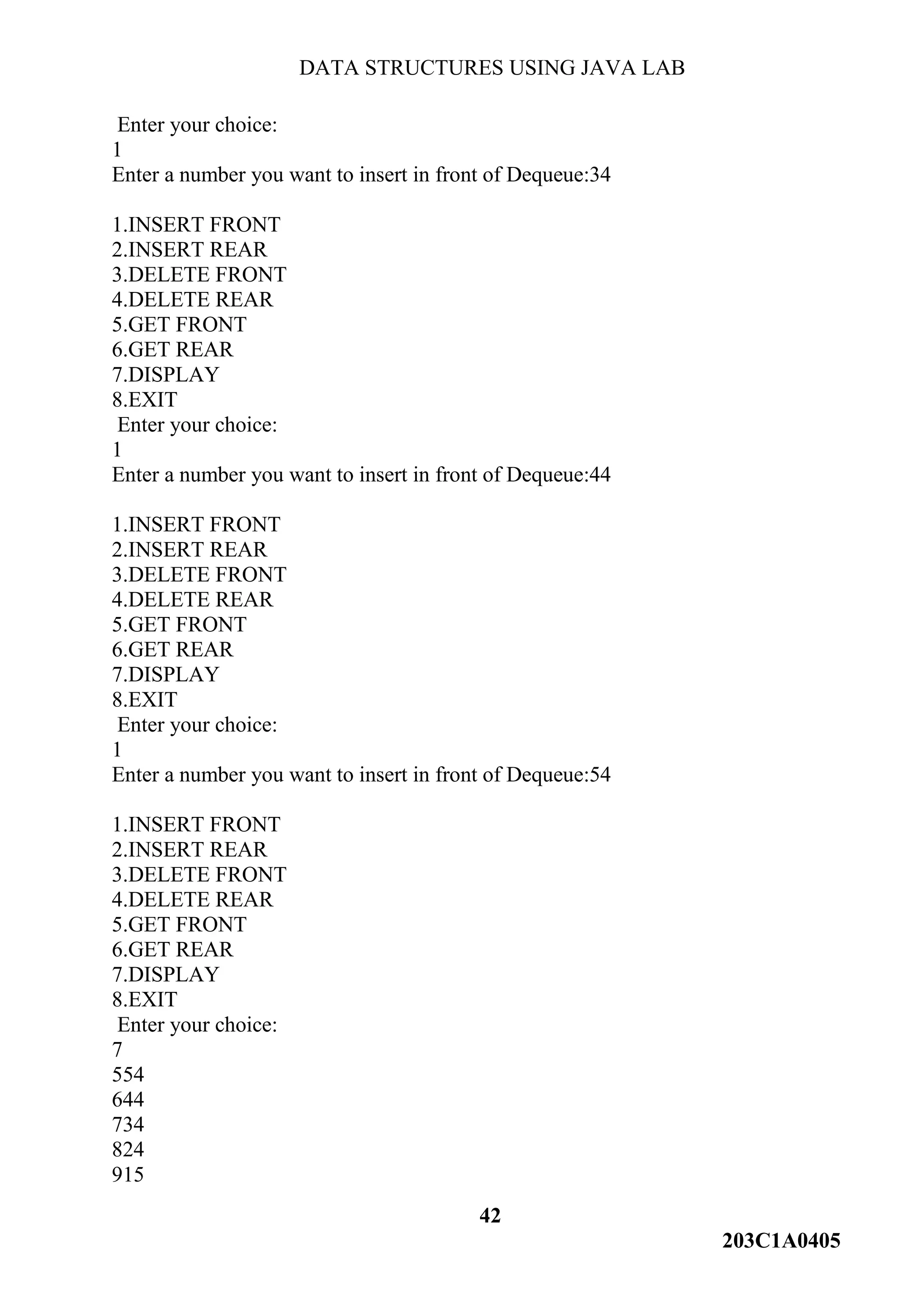
Enter your choice:
1
Enter a number you want to insert in front of Dequeue:34
1.INSERT FRONT
2.INSERT REAR
3.DELETE FRONT
4.DELETE REAR
5.GET FRONT
6.GET REAR
7.DISPLAY
8.EXIT
Enter your choice:
1
Enter a number you want to insert in front of Dequeue:44
1.INSERT FRONT
2.INSERT REAR
3.DELETE FRONT
4.DELETE REAR
5.GET FRONT
6.GET REAR
7.DISPLAY
8.EXIT
Enter your choice:
1
Enter a number you want to insert in front of Dequeue:54
1.INSERT FRONT
2.INSERT REAR
3.DELETE FRONT
4.DELETE REAR
5.GET FRONT
6.GET REAR
7.DISPLAY
8.EXIT
Enter your choice:
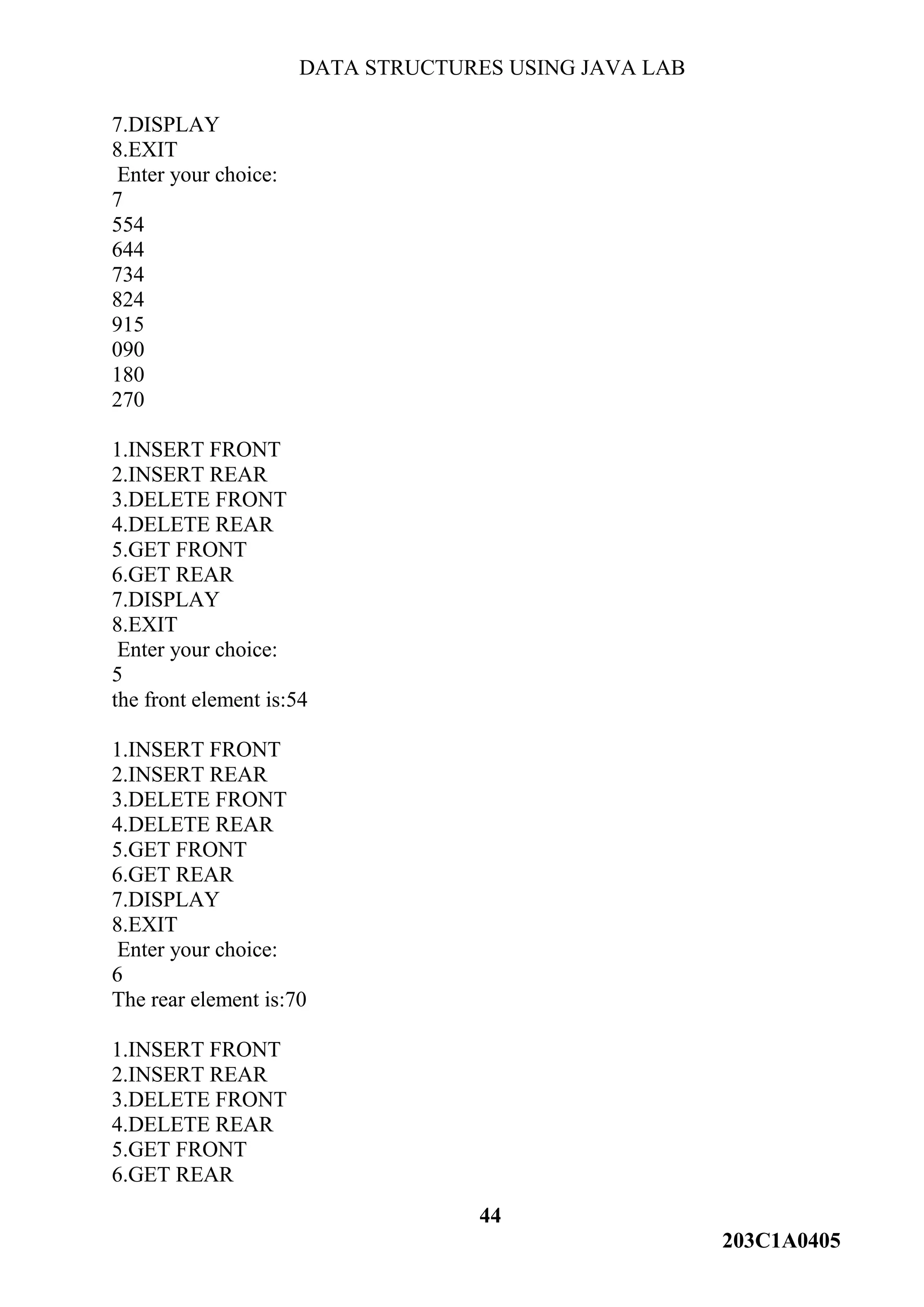
7
554
644
734
824
915
DATA STRUCTURES USING JAVA LAB
43
203C1A0405
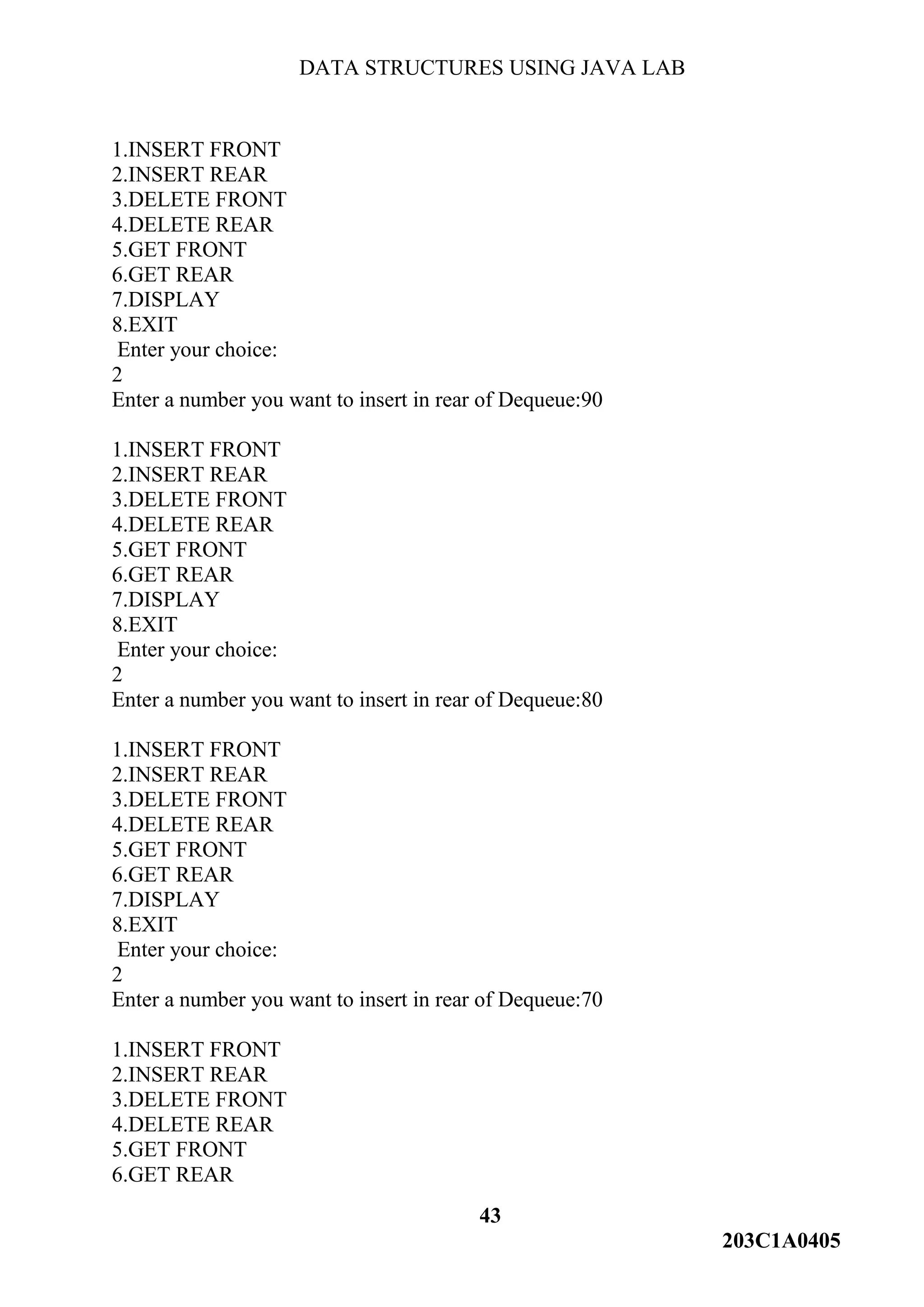
1.INSERT FRONT
2.INSERT REAR
3.DELETE FRONT
4.DELETE REAR
5.GET FRONT
6.GET REAR
7.DISPLAY
8.EXIT
Enter your choice:
2
Enter a number you want to insert in rear of Dequeue:90
1.INSERT FRONT
2.INSERT REAR
3.DELETE FRONT
4.DELETE REAR
5.GET FRONT
6.GET REAR
7.DISPLAY
8.EXIT
Enter your choice:
2
Enter a number you want to insert in rear of Dequeue:80
1.INSERT FRONT
2.INSERT REAR
3.DELETE FRONT
4.DELETE REAR
5.GET FRONT
6.GET REAR
7.DISPLAY
8.EXIT
Enter your choice:
2
Enter a number you want to insert in rear of Dequeue:70
1.INSERT FRONT
2.INSERT REAR
3.DELETE FRONT
4.DELETE REAR
5.GET FRONT
6.GET REAR
DATA STRUCTURES USING JAVA LAB
44
203C1A0405
7.DISPLAY
8.EXIT
Enter your choice:
7
554
644
734
824
915
090
180
270
1.INSERT FRONT
2.INSERT REAR
3.DELETE FRONT
4.DELETE REAR
5.GET FRONT
6.GET REAR
7.DISPLAY
8.EXIT
Enter your choice:
5
the front element is:54
1.INSERT FRONT
2.INSERT REAR
3.DELETE FRONT
4.DELETE REAR
5.GET FRONT
6.GET REAR
7.DISPLAY
8.EXIT
Enter your choice:
6
The rear element is:70
1.INSERT FRONT
2.INSERT REAR
3.DELETE FRONT
4.DELETE REAR
5.GET FRONT
6.GET REAR
DATA STRUCTURES USING JAVA LAB
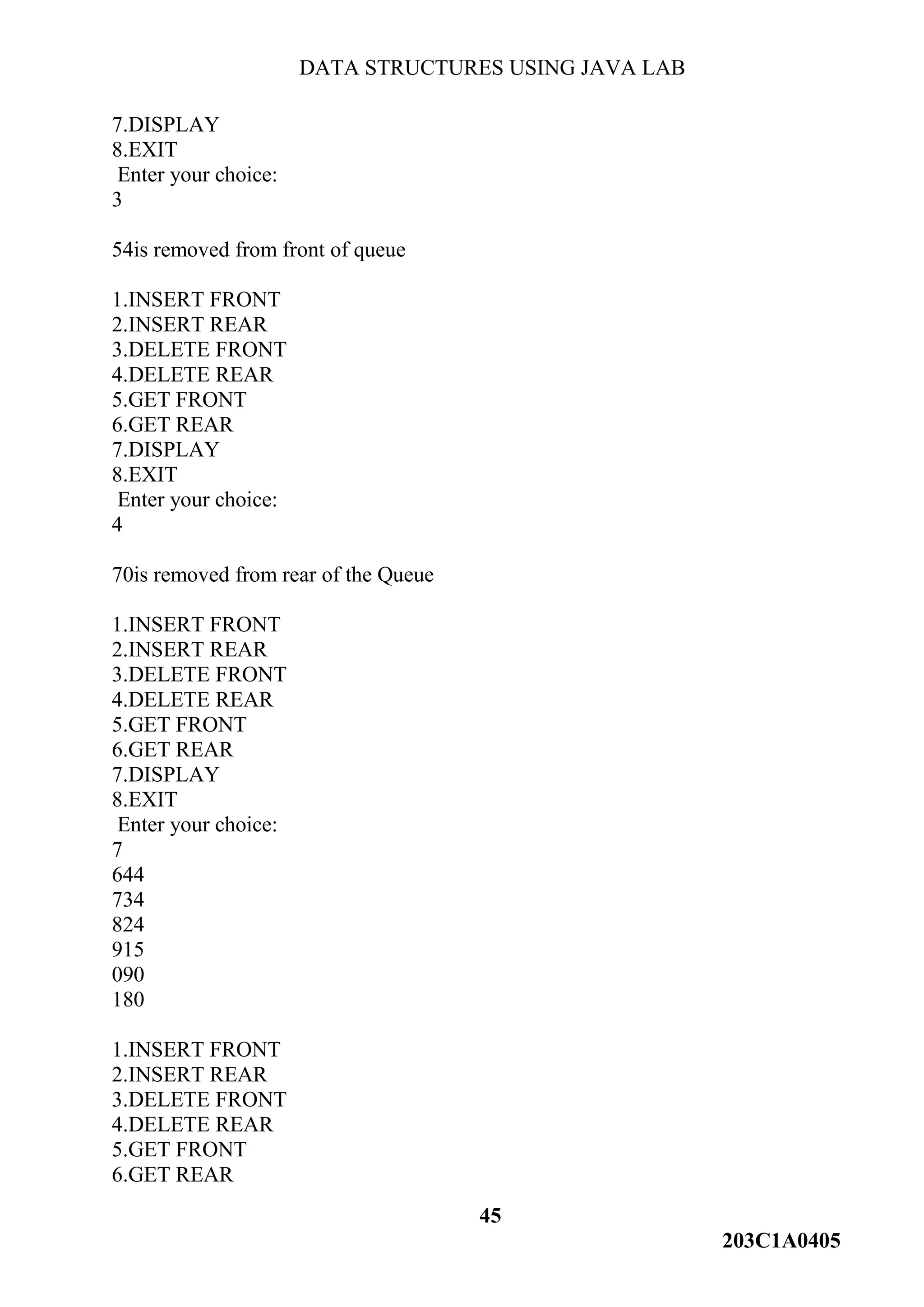
45
203C1A0405
7.DISPLAY
8.EXIT
Enter your choice:
3
54is removed from front of queue
1.INSERT FRONT
2.INSERT REAR
3.DELETE FRONT
4.DELETE REAR
5.GET FRONT
6.GET REAR
7.DISPLAY
8.EXIT
Enter your choice:
4
70is removed from rear of the Queue
1.INSERT FRONT
2.INSERT REAR
3.DELETE FRONT
4.DELETE REAR
5.GET FRONT
6.GET REAR
7.DISPLAY
8.EXIT
Enter your choice:
7
644
734
824
915
090
180
1.INSERT FRONT
2.INSERT REAR
3.DELETE FRONT
4.DELETE REAR
5.GET FRONT
6.GET REAR
DATA STRUCTURES USING JAVA LAB
46
203C1A0405
7.DISPLAY
8.EXIT
Enter your choice:
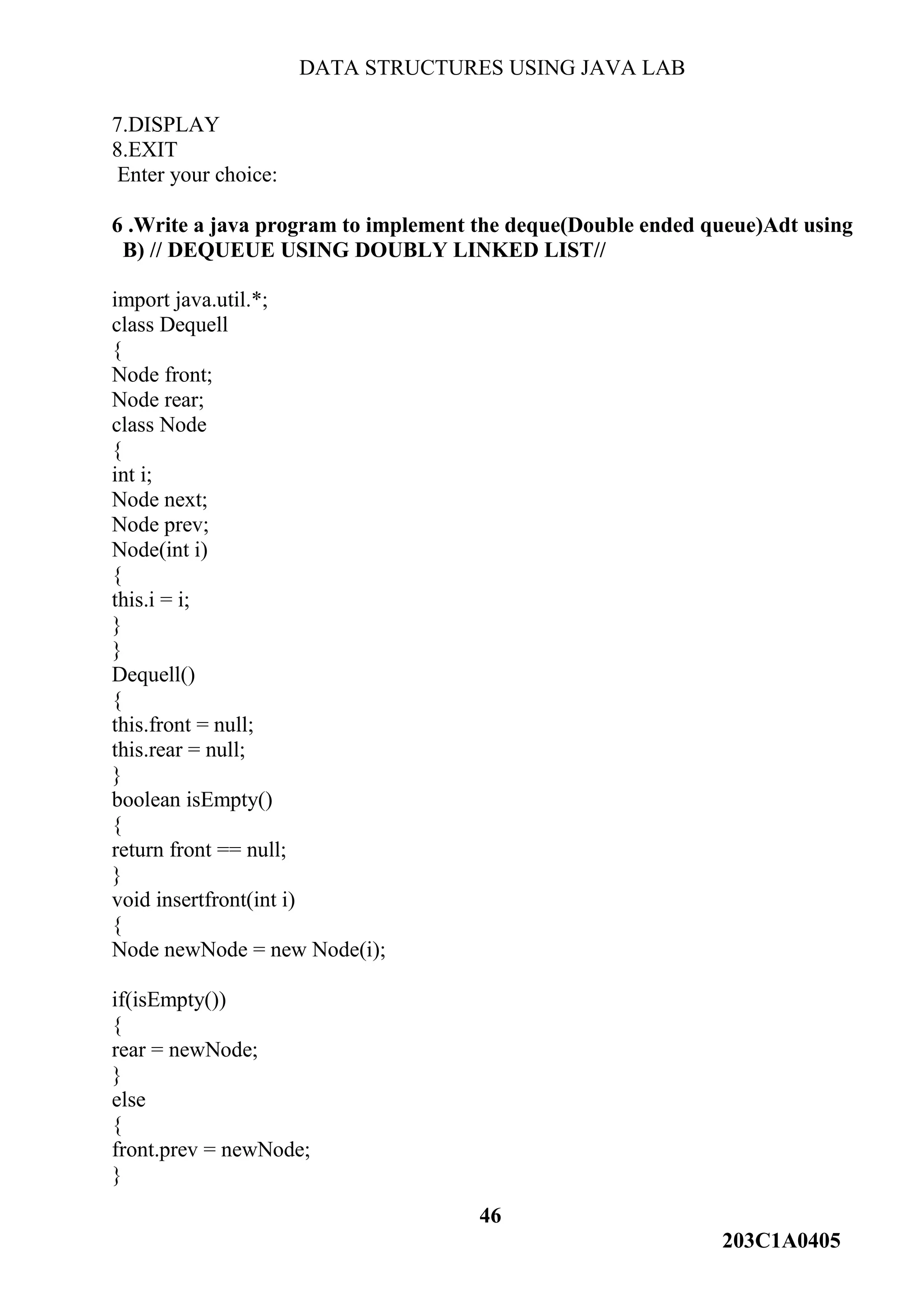
6 .Write a java program to implement the deque(Double ended queue)Adt using
B) // DEQUEUE USING DOUBLY LINKED LIST//
import java.util.*;
class Dequell
{
Node front;
Node rear;
class Node
{
int i;
Node next;
Node prev;
Node(int i)
{
this.i = i;
}
}
Dequell()
{
this.front = null;
this.rear = null;
}
boolean isEmpty()
{
return front == null;
}
void insertfront(int i)
{
Node newNode = new Node(i);
if(isEmpty())
{
rear = newNode;
}
else
{
front.prev = newNode;
}
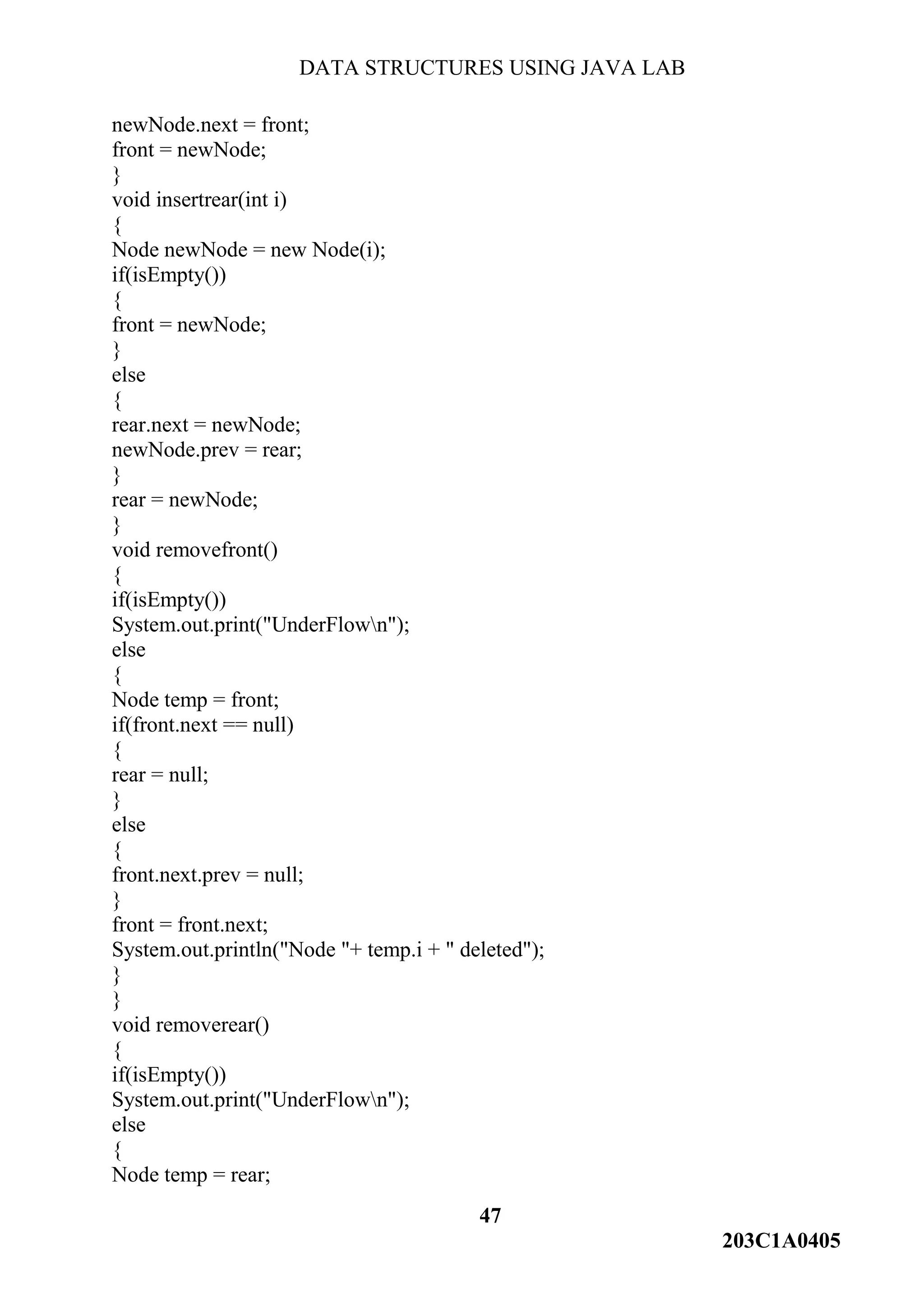
DATA STRUCTURES USING JAVA LAB
47
203C1A0405
newNode.next = front;
front = newNode;
}
void insertrear(int i)
{
Node newNode = new Node(i);
if(isEmpty())
{
front = newNode;
}
else
{
rear.next = newNode;
newNode.prev = rear;
}
rear = newNode;
}
void removefront()
{
if(isEmpty())
System.out.print("UnderFlown");
else
{
Node temp = front;
if(front.next == null)
{
rear = null;
}
else
{
front.next.prev = null;
}
front = front.next;
System.out.println("Node "+ temp.i + " deleted");
}
}
void removerear()
{
if(isEmpty())
System.out.print("UnderFlown");
else
{
Node temp = rear;
DATA STRUCTURES USING JAVA LAB
48
203C1A0405
if(rear.next == null)
{
front = null;
}
else
{
rear.prev.next = null;
}
rear = rear.prev;
System.out.println("Node "+ temp.i + " deleted");
}
}
void getfront()
{
if(isEmpty())
System.out.print("UnderFlown");
else
System.out.println("The front element is: "+front.i);
}
void getrear()
{
if(isEmpty())
System.out.print("UnderFlown");
else
System.out.println("The front element is: "+rear.i);
}
void displayforward()
{
Node current = front;
while(current != null)
{
System.out.print(current.i + " ");
current = current.next;
}
}
void displaybackward()
{
Node current = rear;
while(current != null)
{
System.out.print(current.i + " ");
current = current.prev;
DATA STRUCTURES USING JAVA LAB
49
203C1A0405
}
}
}
class Dql
{
public static void main(String[] args)
{
Dequell dq = new Dequell();
System.out.print("********** DeQueue using Doubly Linked List **********");
boolean flag=true;
Scanner in = new Scanner(System.in);
int ch, num,x;
while(flag)
{
System.out.print("n 1.INSERT FRONT n 2.INSERT REARn 3.REMOVE
FRONTn
4.REMOVE REARn 5.GET FRONTn 6.GET REARn 7.DISPLAY FORWARDn
8.DISPLAY
BACKWARD n 9.EXITnEnter your choice : ");
ch = in.nextInt();
switch(ch)
{
case 1:
System.out.print(" Enter a number you want to insert in front of Dequeue : ");
num = in.nextInt();
dq.insertfront(num);
break;
case 2:
System.out.print(" Enter a number you want to insert in rear of Dequeue : ");
num = in.nextInt();
dq.insertrear(num);
break;
case 3:
dq.removefront();
break;
case 4:
dq.removerear();
break;
case 5:
dq.getfront();
break;
case 6:
DATA STRUCTURES USING JAVA LAB
50
203C1A0405
dq.getrear();
break;
case 7:
dq.displayforward();
break;
case 8:
dq.displaybackward();
break;
case 9:
flag=false;
}
}
}
}
DATA STRUCTURES USING JAVA LAB
51
203C1A0405
Output :
C:UsersDMSSVHDesktop203C1A0405>javac Dequell.java
C:UsersDMSSVHDesktop203C1A0405>java Dequell
********** DeQueue using Doubly Linked List **********
1.INSERT FRONT
2.INSERT REAR
3.REMOVE FRONT
4.REMOVE REAR
5.GET FRONT
6.GET REAR
7.DISPLAY FORWARD
8.DISPLAY BACKWARD
9. EXIT
Enter your choice : 1
Enter a number you want to insert in front of Dequeue : 10
1.INSERT FRONT
2.INSERT REAR
3.REMOVE FRONT
4.REMOVE REAR
5.GET FRONT
6.GET REAR
7.DISPLAY FORWARD
8.DISPLAY BACKWARD
9. EXIT
Enter your choice : 1
Enter a number you want to insert in front of Dequeue : 20
1.INSERT FRONT
2.INSERT REAR
3.REMOVE FRONT
4.REMOVE REAR
5.GET FRONT
6.GET REAR
7.DISPLAY FORWARD
8.DISPLAY BACKWARD
9. EXIT
DATA STRUCTURES USING JAVA LAB
52
203C1A0405
Enter your choice : 1
Enter a number you want to insert in front of Dequeue : 30
1.INSERT FRONT
2.INSERT REAR
3.REMOVE FRONT
4.REMOVE REAR
5.GET FRONT
6.GET REAR
7.DISPLAY FORWARD
8.DISPLAY BACKWARD
9. EXIT
Enter your choice : 7
30 20 10
1.INSERT FRONT
2.INSERT REAR
3.REMOVE FRONT
4.REMOVE REAR
5.GET FRONT
6.GET REAR
7.DISPLAY FORWARD
8.DISPLAY BACKWARD
9. EXIT
Enter your choice : 2
Enter a number you want to insert in rear of Dequeue : 11
1.INSERT FRONT
2.INSERT REAR
3.REMOVE FRONT
4.REMOVE REAR
5.GET FRONT
6.GET REAR
7.DISPLAY FORWARD
8.DISPLAY BACKWARD
9. EXIT
Enter your choice : 2
Enter a number you want to insert in rear of Dequeue : 22
1.INSERT FRONT
2.INSERT REAR
3.REMOVE FRONT
4.REMOVE REAR
5.GET FRONT
6.GET REAR
7.DISPLAY FORWARD
DATA STRUCTURES USING JAVA LAB
53
203C1A0405
8.DISPLAY BACKWARD
9. EXIT
Enter your choice : 2
Enter a number you want to insert in rear of Dequeue : 33
1.INSERT FRONT
2.INSERT REAR
3.REMOVE FRONT
4.REMOVE REAR
5.GET FRONT
6.GET REAR
7.DISPLAY FORWARD
8.DISPLAY BACKWARD
9. EXIT
Enter your choice : 7
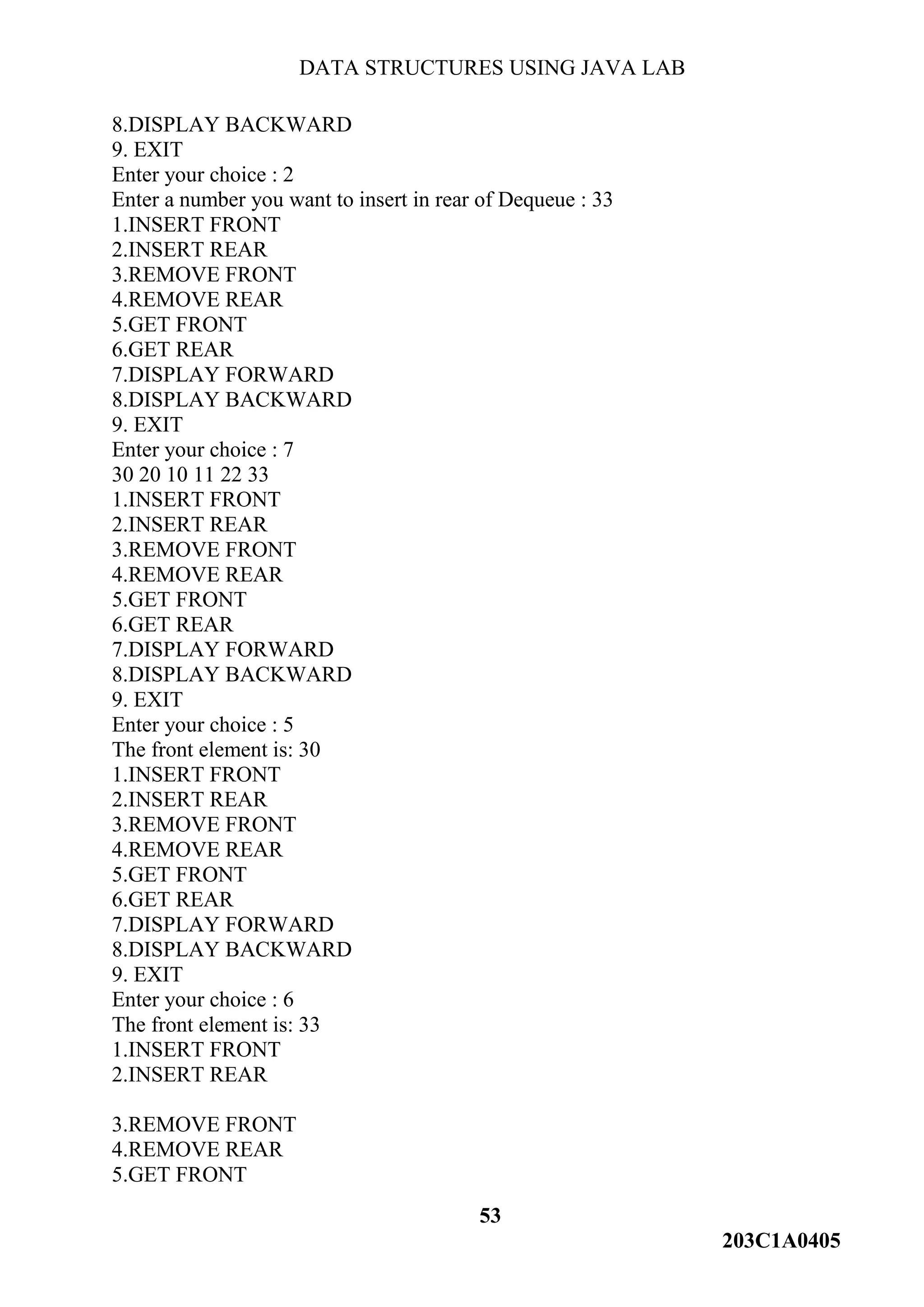
30 20 10 11 22 33
1.INSERT FRONT
2.INSERT REAR
3.REMOVE FRONT
4.REMOVE REAR
5.GET FRONT
6.GET REAR
7.DISPLAY FORWARD
8.DISPLAY BACKWARD
9. EXIT
Enter your choice : 5
The front element is: 30
1.INSERT FRONT
2.INSERT REAR
3.REMOVE FRONT
4.REMOVE REAR
5.GET FRONT
6.GET REAR
7.DISPLAY FORWARD
8.DISPLAY BACKWARD
9. EXIT
Enter your choice : 6
The front element is: 33
1.INSERT FRONT
2.INSERT REAR
3.REMOVE FRONT
4.REMOVE REAR
5.GET FRONT
DATA STRUCTURES USING JAVA LAB
54
203C1A0405
6.GET REAR
7.DISPLAY FORWARD
8.DISPLAY BACKWARD
9. EXIT
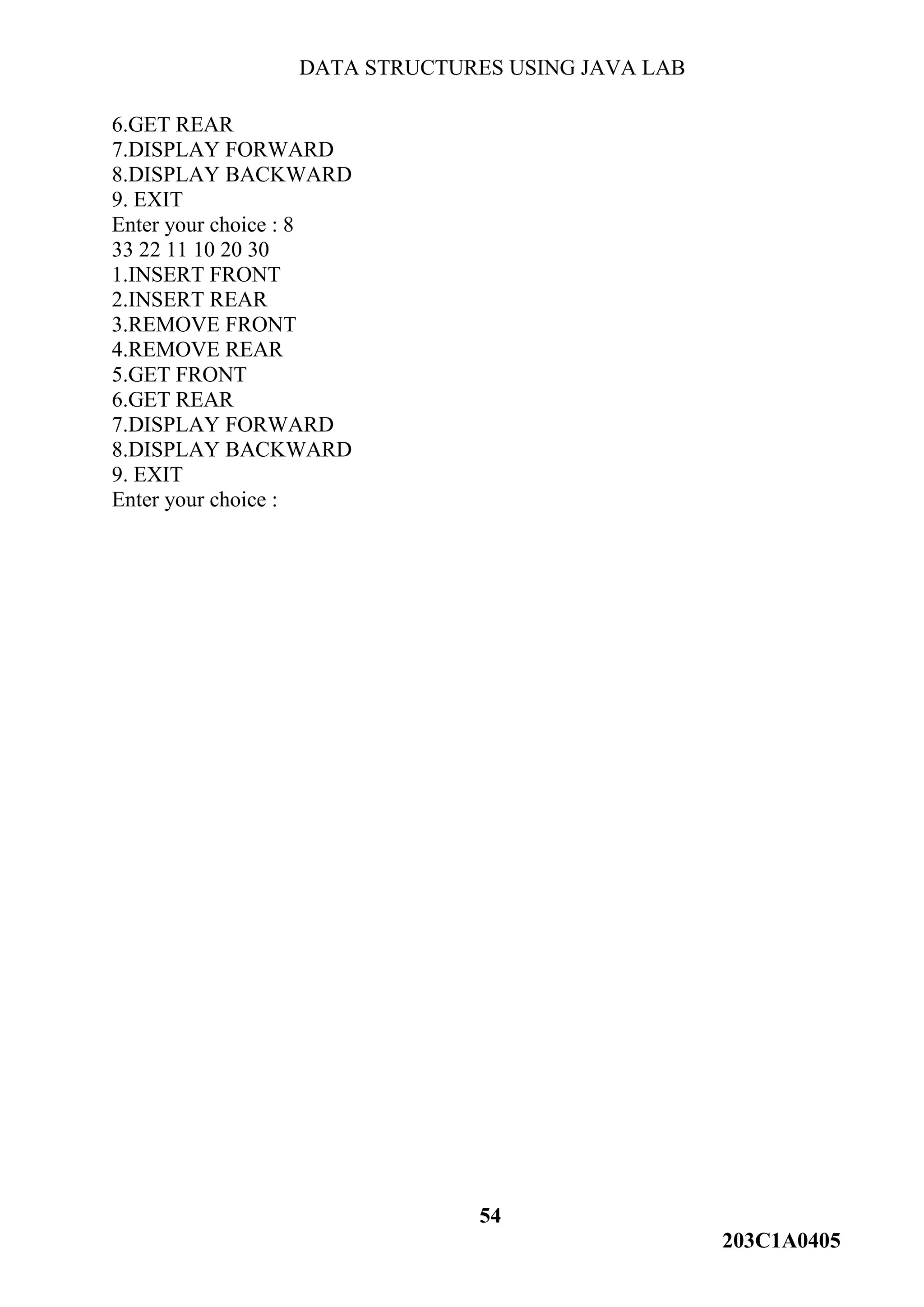
Enter your choice : 8
33 22 11 10 20 30
1.INSERT FRONT
2.INSERT REAR
3.REMOVE FRONT
4.REMOVE REAR
5.GET FRONT
6.GET REAR
7.DISPLAY FORWARD
8.DISPLAY BACKWARD
9. EXIT
Enter your choice :
DATA STRUCTURES USING JAVA LAB
55
203C1A0405
7.Write a java program to implement priority queue ADT?
import java.util.Scanner;
class Task
{
String job;
int priority;
public Task(String job, int priority)
{
this.job = job;
this.priority = priority;
}
public String toString()
{
return "Job Name : "+ job +"nPriority : "+ priority;
}
}
class PriQueue
{
Task[] heap;
int heapSize, capacity;
public PriQueue(int capacity)
{
this.capacity = capacity + 1;
heap = new Task[this.capacity];
heapSize = 0;
}
public void clear()
{
heap = new Task[capacity];
heapSize = 0;
}
public boolean isEmpty()
{
return heapSize == 0;
}
public boolean isFull()
{
DATA STRUCTURES USING JAVA LAB
56
203C1A0405
return heapSize == capacity - 1;
}
public int size()
{
return heapSize;
}
public void insert(String job, int priority)
{
Task newJob = new Task(job, priority);
heap[++heapSize] = newJob;
int pos = heapSize;
while (pos != 1 && newJob.priority > heap[pos/2].priority)
{
heap[pos] = heap[pos/2];
pos /=2;
}
heap[pos] = newJob;
}
public Task remove()
{
int parent, child;
Task item, temp;
item = heap[1];
temp = heap[heapSize--];
parent = 1;
child = 2;
while (child <= heapSize)
{
if (child < heapSize && heap[child].priority < heap[child + 1].priority)
child++;
if (temp.priority >= heap[child].priority)
break;
heap[parent] = heap[child];
parent = child;
child *= 2;
}
heap[parent] = temp;
return item;
}
public void display()
{
int i;
DATA STRUCTURES USING JAVA LAB
57
203C1A0405
System.out.print("JobName Priorityn");
for(i=1;i<=heapSize;i++)
System.out.println( heap[i].job +" "+ heap[i].priority);
}
}
public class PriQueueTest
{
public static void main(String[] args)
{
System.out.println("********** Priority Queue **********");
boolean flag=true;
Scanner in = new Scanner(System.in);
int ch, num,x;
System.out.print("Enter size of priority queue: ");
PriQueue pq = new PriQueue(in.nextInt() );
while(flag)
{
System.out.print("n1.Insertn2.Removen3.Check Emptyn4.Check
Fulln5.Clearn6.Sizen7.Displayn8.Exit nEnter your choice :");
ch = in.nextInt();
switch(ch)
{
case 1:if(pq.isFull())
System.out.println("Priority Queue Full");
else
{
System.out.println("Enter job name and priority");
pq.insert(in.next(), in.nextInt() );
}
break;
case 2 :if(pq.isEmpty())
System.out.println("Priority Queue Empty");
else
System.out.println("nJob removed nn"+ pq.remove());
break;
case 3 :
System.out.println("nEmpty Status : "+ pq.isEmpty() );
break;
case 4 :
System.out.println("nFull Status : "+ pq.isFull() );
break;
case 5 :
DATA STRUCTURES USING JAVA LAB
58
203C1A0405
System.out.println("nPriority Queue Cleared");
pq.clear();
break;
case 6 :
System.out.println("nSize = "+ pq.size() );
break;
case 7:
pq.display();
break;
case 8:
flag=false;
}
}
}
}
DATA STRUCTURES USING JAVA LAB
59
203C1A0405
Output :
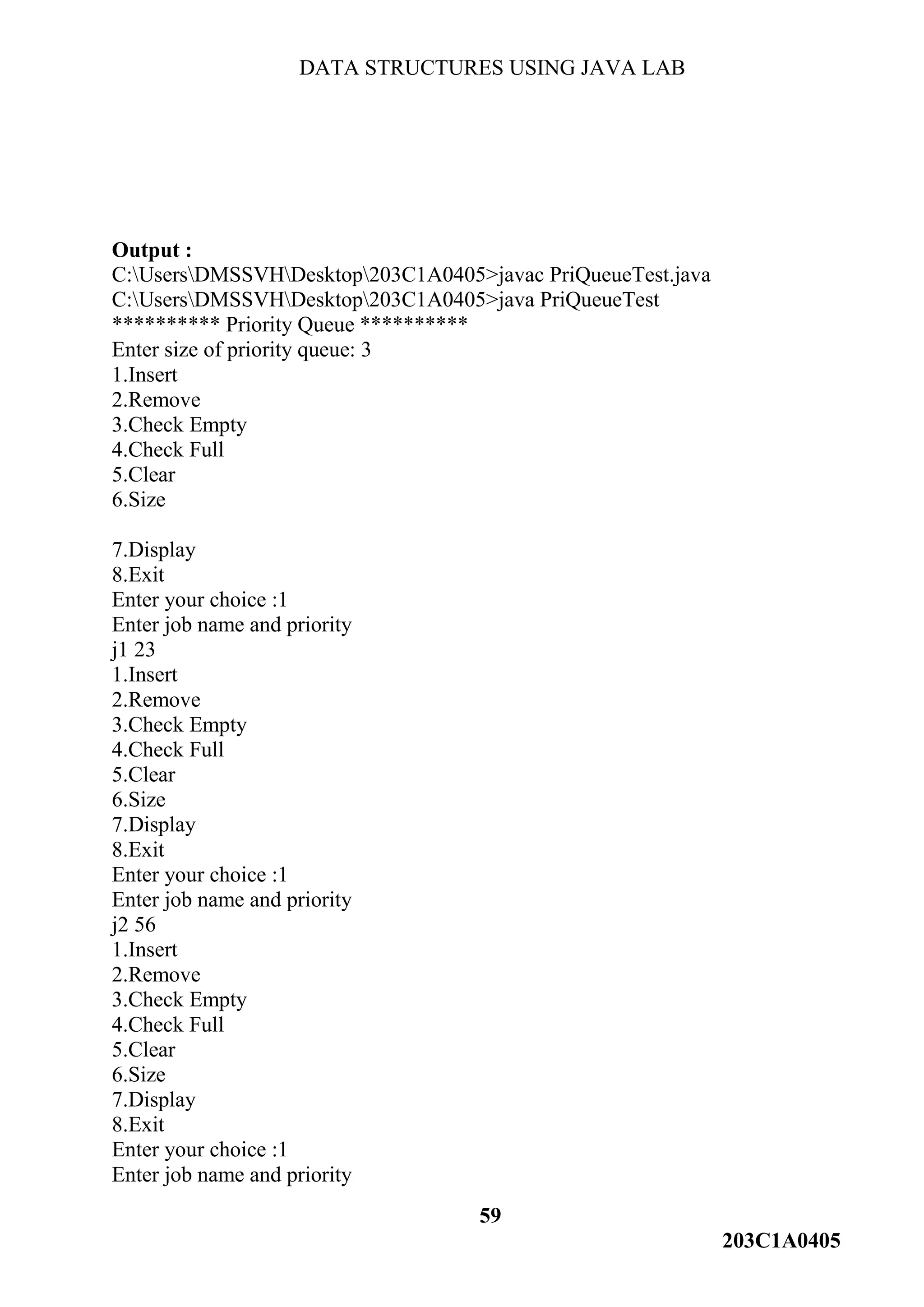
C:UsersDMSSVHDesktop203C1A0405>javac PriQueueTest.java
C:UsersDMSSVHDesktop203C1A0405>java PriQueueTest
********** Priority Queue **********
Enter size of priority queue: 3
1.Insert
2.Remove
3.Check Empty
4.Check Full
5.Clear
6.Size
7.Display
8.Exit
Enter your choice :1
Enter job name and priority
j1 23
1.Insert
2.Remove
3.Check Empty
4.Check Full
5.Clear
6.Size
7.Display
8.Exit
Enter your choice :1
Enter job name and priority
j2 56
1.Insert
2.Remove
3.Check Empty
4.Check Full
5.Clear
6.Size
7.Display
8.Exit
Enter your choice :1
Enter job name and priority
DATA STRUCTURES USING JAVA LAB
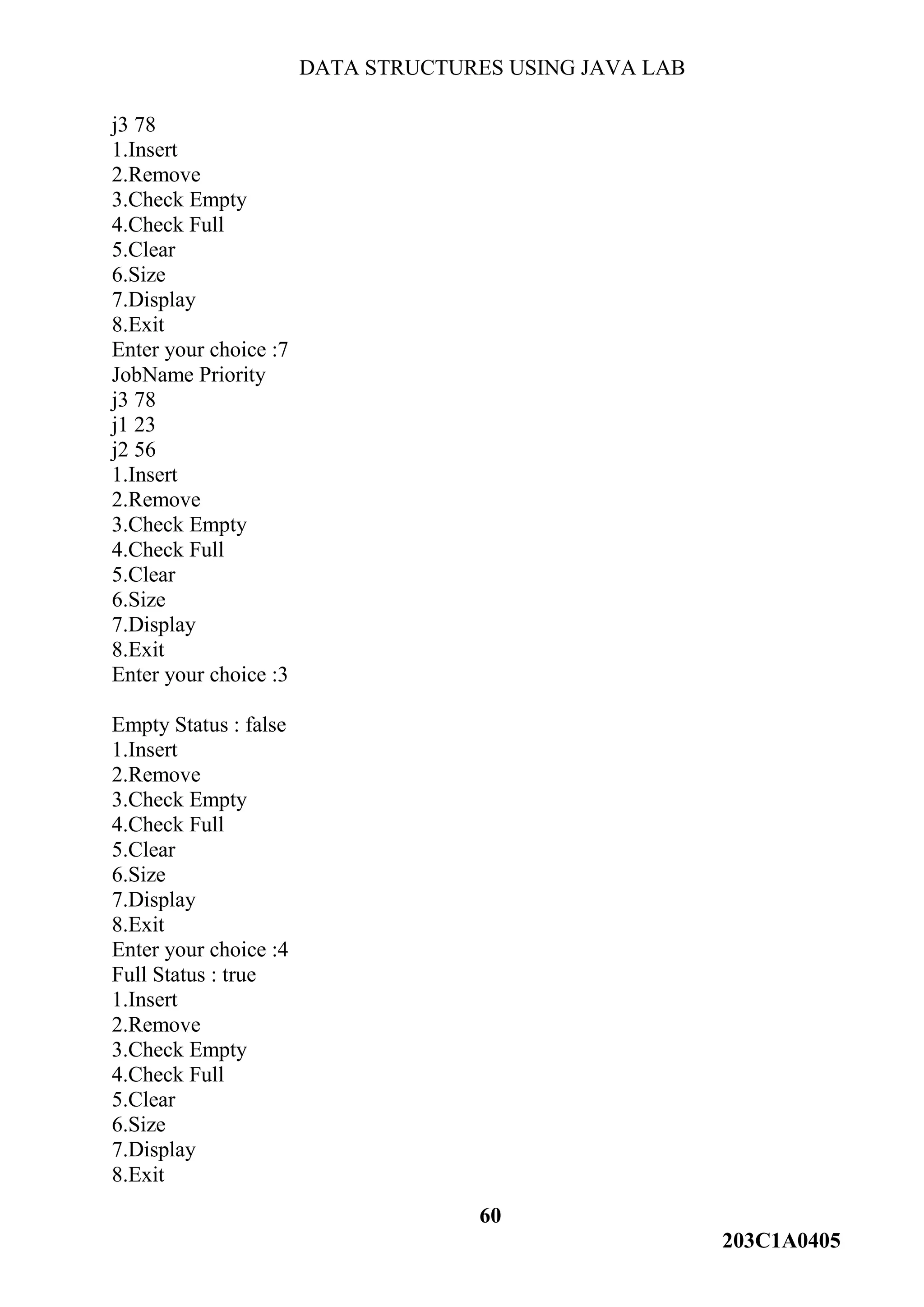
60
203C1A0405
j3 78
1.Insert
2.Remove
3.Check Empty
4.Check Full
5.Clear
6.Size
7.Display
8.Exit
Enter your choice :7
JobName Priority
j3 78
j1 23
j2 56
1.Insert
2.Remove
3.Check Empty
4.Check Full
5.Clear
6.Size
7.Display
8.Exit
Enter your choice :3
Empty Status : false
1.Insert
2.Remove
3.Check Empty
4.Check Full
5.Clear
6.Size
7.Display
8.Exit
Enter your choice :4
Full Status : true
1.Insert
2.Remove
3.Check Empty
4.Check Full
5.Clear
6.Size
7.Display
8.Exit
DATA STRUCTURES USING JAVA LAB
61
203C1A0405
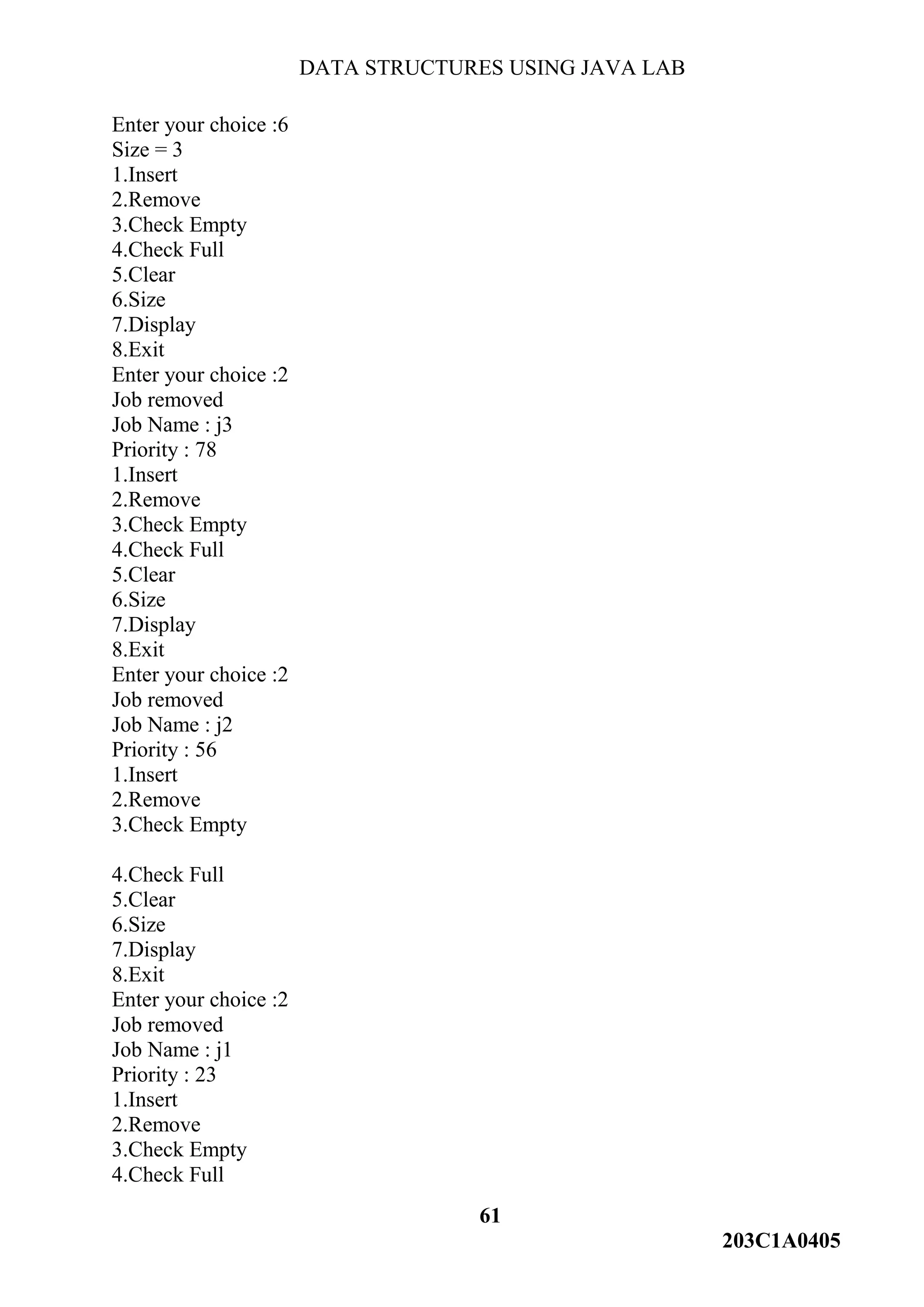
Enter your choice :6
Size = 3
1.Insert
2.Remove
3.Check Empty
4.Check Full
5.Clear
6.Size
7.Display
8.Exit
Enter your choice :2
Job removed
Job Name : j3
Priority : 78
1.Insert
2.Remove
3.Check Empty
4.Check Full
5.Clear
6.Size
7.Display
8.Exit
Enter your choice :2
Job removed
Job Name : j2
Priority : 56
1.Insert
2.Remove
3.Check Empty
4.Check Full
5.Clear
6.Size
7.Display
8.Exit
Enter your choice :2
Job removed
Job Name : j1
Priority : 23
1.Insert
2.Remove
3.Check Empty
4.Check Full
DATA STRUCTURES USING JAVA LAB
62
203C1A0405
5.Clear
6.Size
7.Display
8.Exit
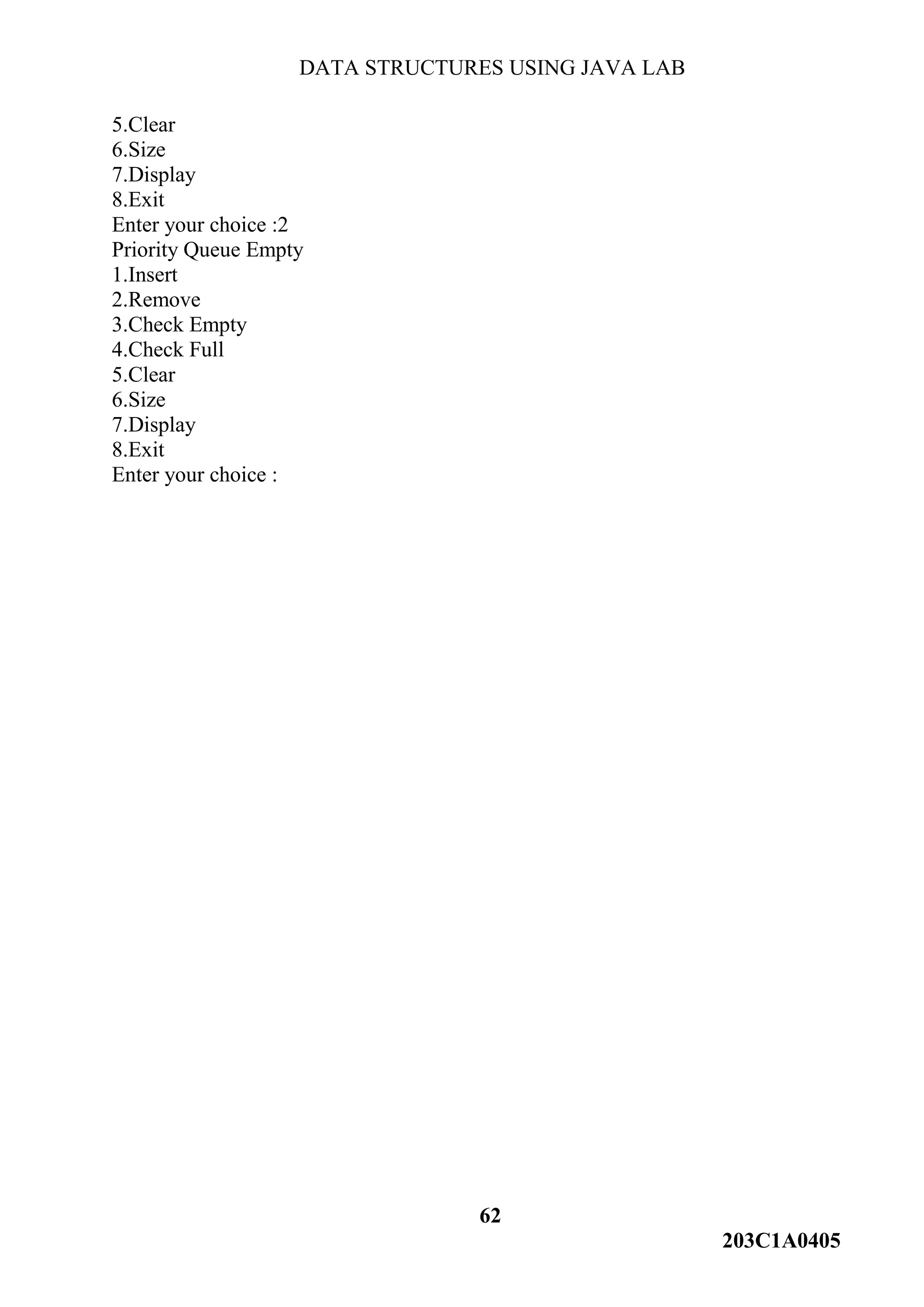
Enter your choice :2
Priority Queue Empty
1.Insert
2.Remove
3.Check Empty
4.Check Full
5.Clear
6.Size
7.Display
8.Exit
Enter your choice :
DATA STRUCTURES USING JAVA LAB
63
203C1A0405
8. Write Java programs that use recursive and non-recursive functions to
traverse the given binary tree in
(a) Preorder
(b) In order and
(c) Post order.
import java.util.Stack;
class Node
{
Object data;
Node left;
Node right;
Node( Object d ) // constructor
{
data = d;
}
}
class BinaryTree
{
Object tree[];
int maxSize;
Stack<Node>stk = new Stack<Node>();
BinaryTree( Object a[], int n ) // constructor
{
maxSize = n;
tree = new Object[maxSize];
for( int i=0; i<maxSize; i++ )
tree[i] = a[i];
}
public Node buildTree( int index )
{
Node p = null;
if( tree[index] != null )
{
p = new Node(tree[index]);
p.left = buildTree(2*index+1);
p.right = buildTree(2*index+2);
}
DATA STRUCTURES USING JAVA LAB
64
203C1A0405
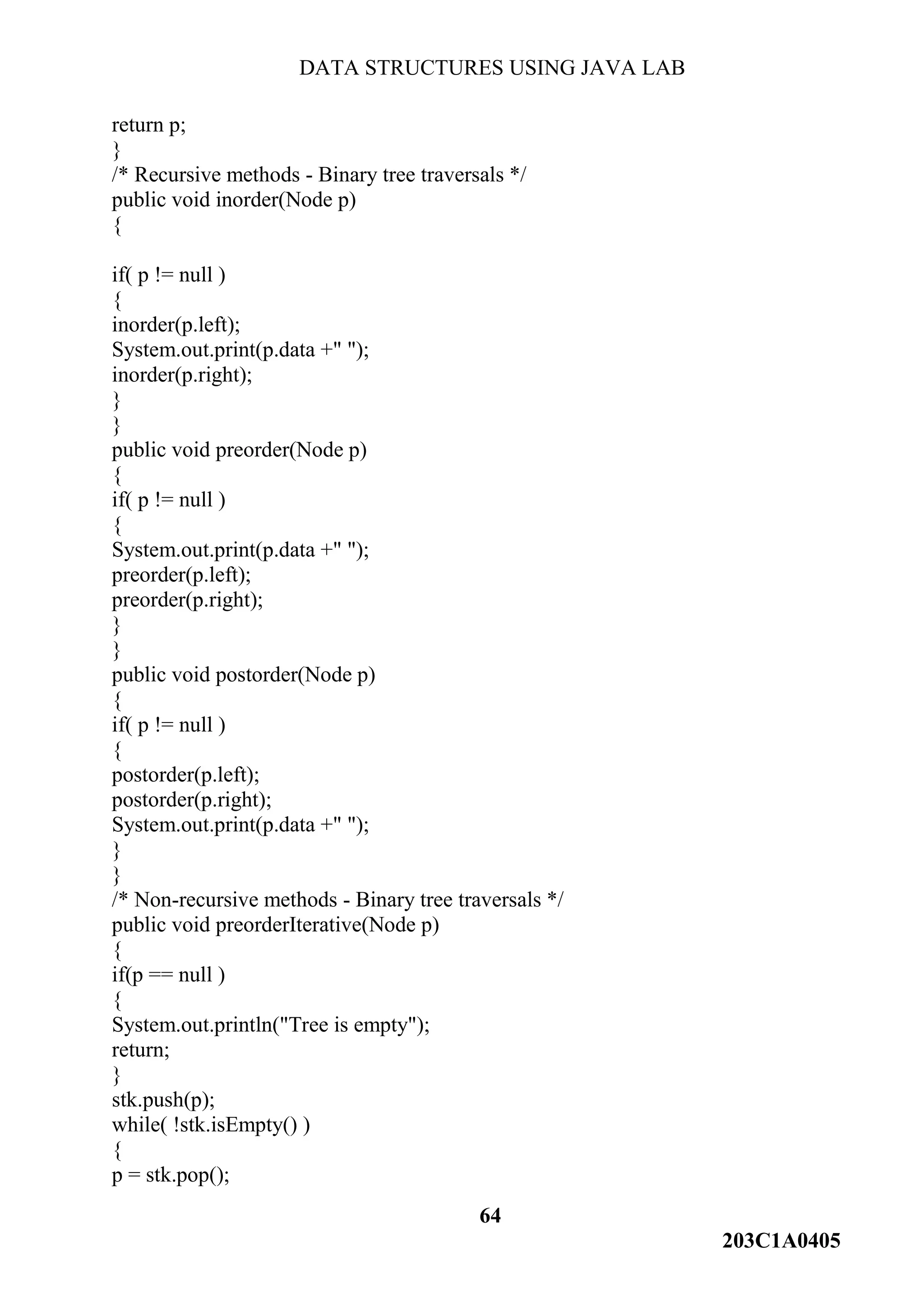
return p;
}
/* Recursive methods - Binary tree traversals */
public void inorder(Node p)
{
if( p != null )
{
inorder(p.left);
System.out.print(p.data +" ");
inorder(p.right);
}
}
public void preorder(Node p)
{
if( p != null )
{
System.out.print(p.data +" ");
preorder(p.left);
preorder(p.right);
}
}
public void postorder(Node p)
{
if( p != null )
{
postorder(p.left);
postorder(p.right);
System.out.print(p.data +" ");
}
}
/* Non-recursive methods - Binary tree traversals */
public void preorderIterative(Node p)
{
if(p == null )
{
System.out.println("Tree is empty");
return;
}
stk.push(p);
while( !stk.isEmpty() )
{
p = stk.pop();
DATA STRUCTURES USING JAVA LAB
65
203C1A0405
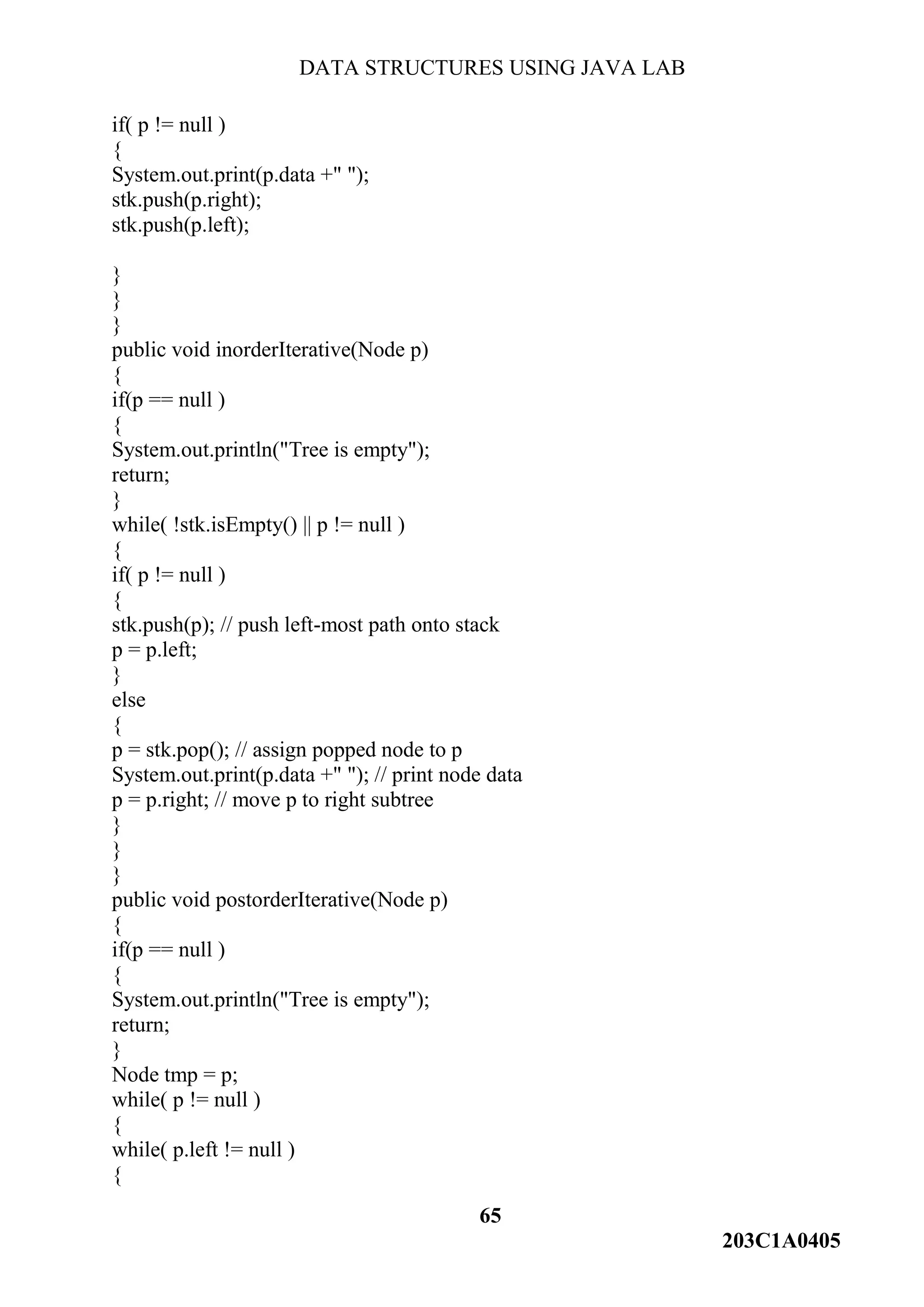
if( p != null )
{
System.out.print(p.data +" ");
stk.push(p.right);
stk.push(p.left);
}
}
}
public void inorderIterative(Node p)
{
if(p == null )
{
System.out.println("Tree is empty");
return;
}
while( !stk.isEmpty() || p != null )
{
if( p != null )
{
stk.push(p); // push left-most path onto stack
p = p.left;
}
else
{
p = stk.pop(); // assign popped node to p
System.out.print(p.data +" "); // print node data
p = p.right; // move p to right subtree
}
}
}
public void postorderIterative(Node p)
{
if(p == null )
{
System.out.println("Tree is empty");
return;
}
Node tmp = p;
while( p != null )
{
while( p.left != null )
{
DATA STRUCTURES USING JAVA LAB
66
203C1A0405
stk.push(p);
p = p.left;
}
while( p != null && (p.right == null || p.right == tmp ))
{
System.out.print(p.data +" "); // print node data
tmp = p;
if( stk.isEmpty() )
return;
p = stk.pop();
}
stk.push(p);
p = p.right;
}
}
} // end of BinaryTree class
class BinaryTreeTest
{
public static void main(String args[])
{
Object arr[] ={'A','B','C','D','E','F','G', null,
null, null, null, null, null, null, null };
BinaryTree t = new BinaryTree( arr, arr.length );
Node root = t.buildTree(0); // buildTree() returns reference to root
System.out.print("n Recursive Binary Tree Traversals:");
System.out.print("n inorder:");
t.inorder(root);
System.out.print("n preorder:");
t.preorder(root);
System.out.print("n postorder:");
t.postorder(root);
System.out.print("n Non-recursive Binary Tree Traversals:");
System.out.print("n inorder:");
t.inorderIterative(root);
System.out.print("n preorder:");
t.preorderIterative(root);
System.out.print("n postorder:");
t.postorderIterative(root);
}
}
DATA STRUCTURES USING JAVA LAB
67
203C1A0405
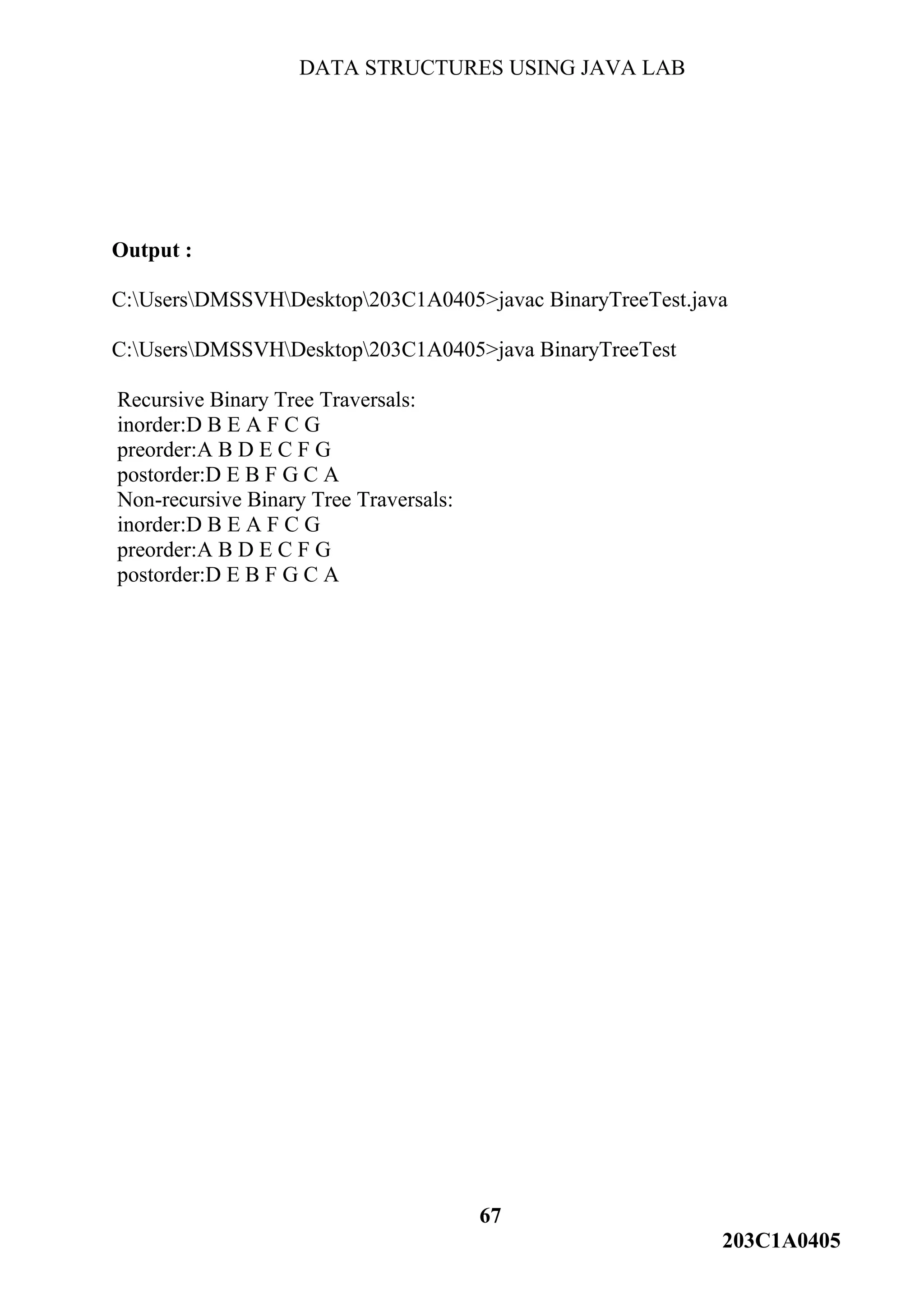
Output :
C:UsersDMSSVHDesktop203C1A0405>javac BinaryTreeTest.java
C:UsersDMSSVHDesktop203C1A0405>java BinaryTreeTest
Recursive Binary Tree Traversals:
inorder:D B E A F C G
preorder:A B D E C F G
postorder:D E B F G C A
Non-recursive Binary Tree Traversals:
inorder:D B E A F C G
preorder:A B D E C F G
postorder:D E B F G C A
DATA STRUCTURES USING JAVA LAB
68
203C1A0405
9. Write a Java program that displays node values in a level order traversal
(Traverse the tree one level at a time, starting at the root node) for a binary tree.
import java.util.Queue;
import java.util.LinkedList;
import java.util.*;
public class Tree
{
static Node root;
static class Node
{
int data;
Node left;
Node right;
Node( int d ) // constructor
{
this.data = d;
}
}
public Node BuildTree( int arr[], int i )
{
Node root=null;
if(i&lt;arr.length)
{
root=new Node(arr[i]);
root.left=BuildTree(arr,2*i+1);
root.right = BuildTree(arr,2*i+2);
}
return root;
}
public void printLevelOrder(Node root)
{
Queue&lt;Node&gt; queue = new LinkedList&lt;Node&gt;();
queue.add(root);
while (!queue.isEmpty()) {
Node tempNode = queue.poll();
System.out.print(tempNode.data + &quot; &quot;);
if (tempNode.left != null) {
DATA STRUCTURES USING JAVA LAB
69
203C1A0405
queue.add(tempNode.left);
}
if (tempNode.right != null) {
queue.add(tempNode.right);
}
}
}
public void inorder(Node p)
{
if( p != null )
{
inorder(p.left);
System.out.print(p.data + &quot; &quot;);
inorder(p.right);
}
}
public static void main(String args[])
{
Tree t=new Tree();
int[] arr=new int[6];
Scanner in = new Scanner(System.in);
int i;
for(i=0;i&lt;=5;i++)
arr[i]=in.nextInt();
t.root=t.BuildTree(arr,0);
System.out.print(&quot;n Level Order Traversal: &quot;);
t.printLevelOrder(root);
System.out.print(&quot;n InOrder Traversal: &quot;);
t.inorder(root);
}
}
DATA STRUCTURES USING JAVA LAB
70
203C1A0405
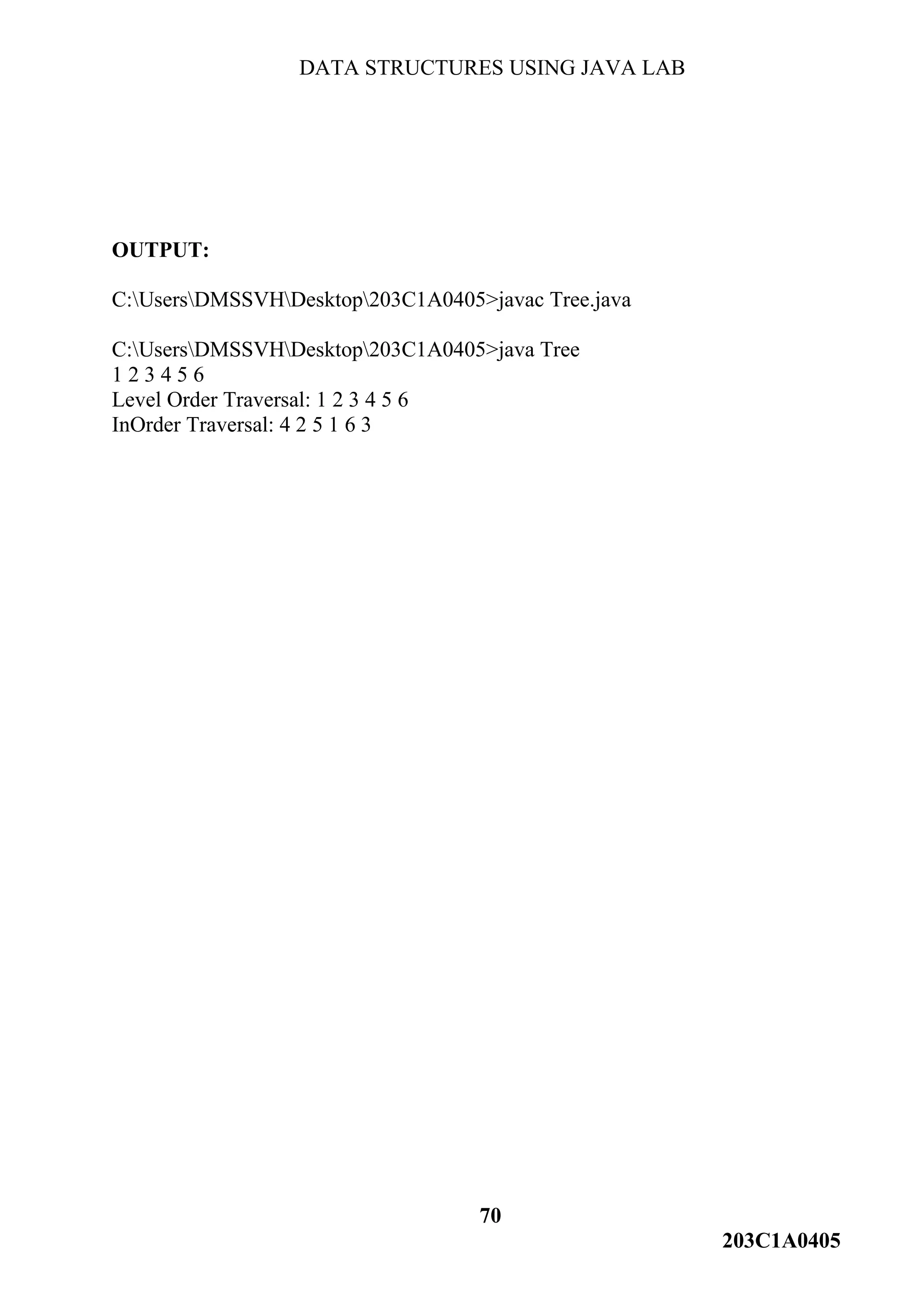
OUTPUT:
C:UsersDMSSVHDesktop203C1A0405>javac Tree.java
C:UsersDMSSVHDesktop203C1A0405>java Tree
1 2 3 4 5 6
Level Order Traversal: 1 2 3 4 5 6
InOrder Traversal: 4 2 5 1 6 3
DATA STRUCTURES USING JAVA LAB
71
203C1A0405
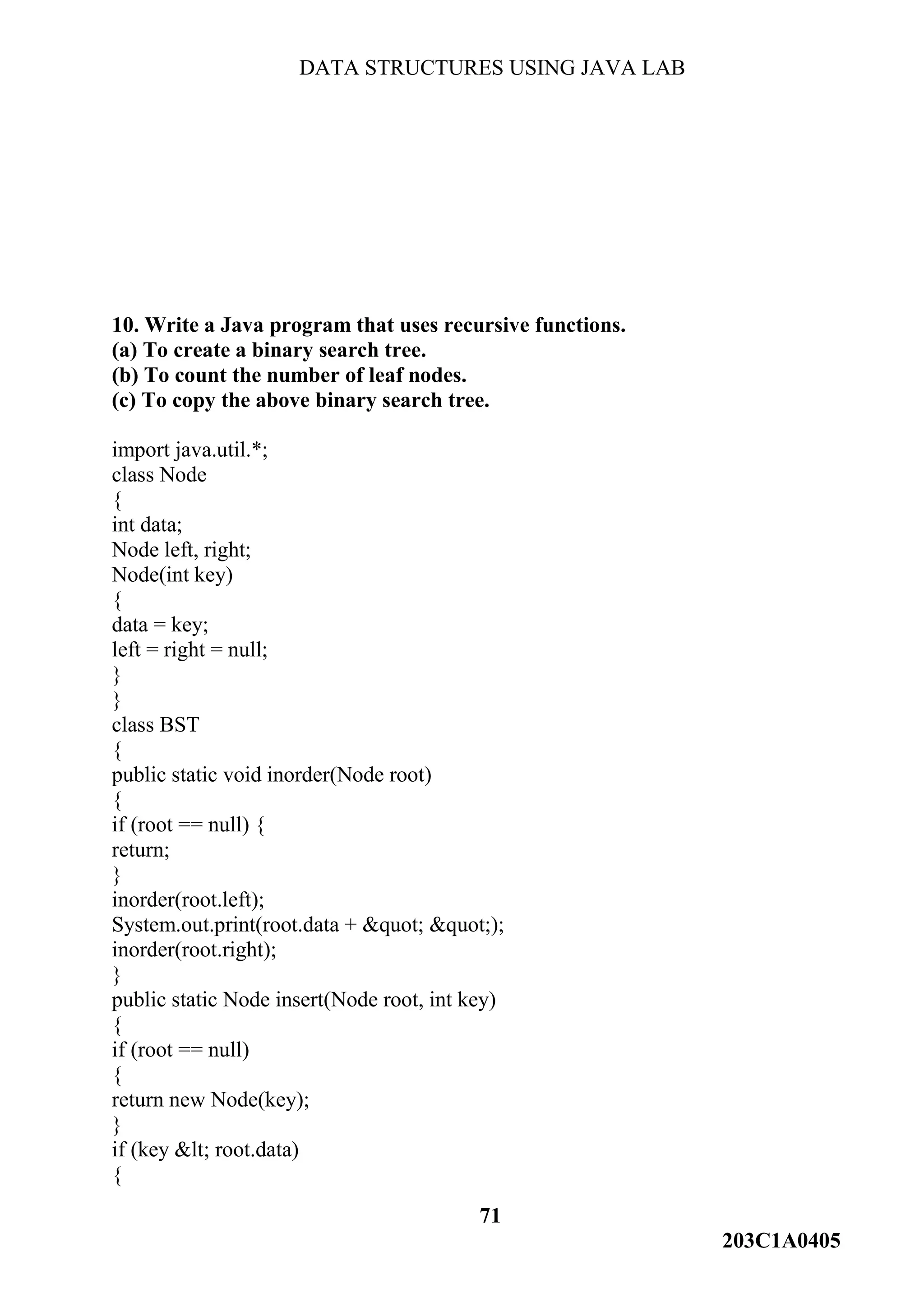
10. Write a Java program that uses recursive functions.
(a) To create a binary search tree.
(b) To count the number of leaf nodes.
(c) To copy the above binary search tree.
import java.util.*;
class Node
{
int data;
Node left, right;
Node(int key)
{
data = key;
left = right = null;
}
}
class BST
{
public static void inorder(Node root)
{
if (root == null) {
return;
}
inorder(root.left);
System.out.print(root.data + &quot; &quot;);
inorder(root.right);
}
public static Node insert(Node root, int key)
{
if (root == null)
{
return new Node(key);
}
if (key &lt; root.data)
{
DATA STRUCTURES USING JAVA LAB
72
203C1A0405
root.left = insert(root.left, key);
}
else
{
root.right = insert(root.right, key);
}
return root;
}
int getLeafCount(Node node)
{
if (node == null)
return 0;
if (node.left == null &amp;&amp; node.right == null)
return 1;
else
return getLeafCount(node.left) + getLeafCount(node.right);
}
Node cloneBST(Node root)
{
if (root == null)
{
return null;
}
Node root_copy = new Node(root.data);
root_copy.left = cloneBST(root.left);
root_copy.right = cloneBST(root.right);
return root_copy;
}
}
class BSTMain
{
public static void main(String[] args)
{
int key;
boolean flag=true;
Scanner in = new Scanner(System.in);
int ch, n;
Node root=null,root_copy=null;;
BST b=new BST();
while(flag)
{
System.out.print(&quot;n1.Create BSTn2.Count Leavesn3.Copy Treen4.Inorder
DATA STRUCTURES USING JAVA LAB
73
203C1A0405
traversaln5.ExitnEnter your Choice: &quot;);
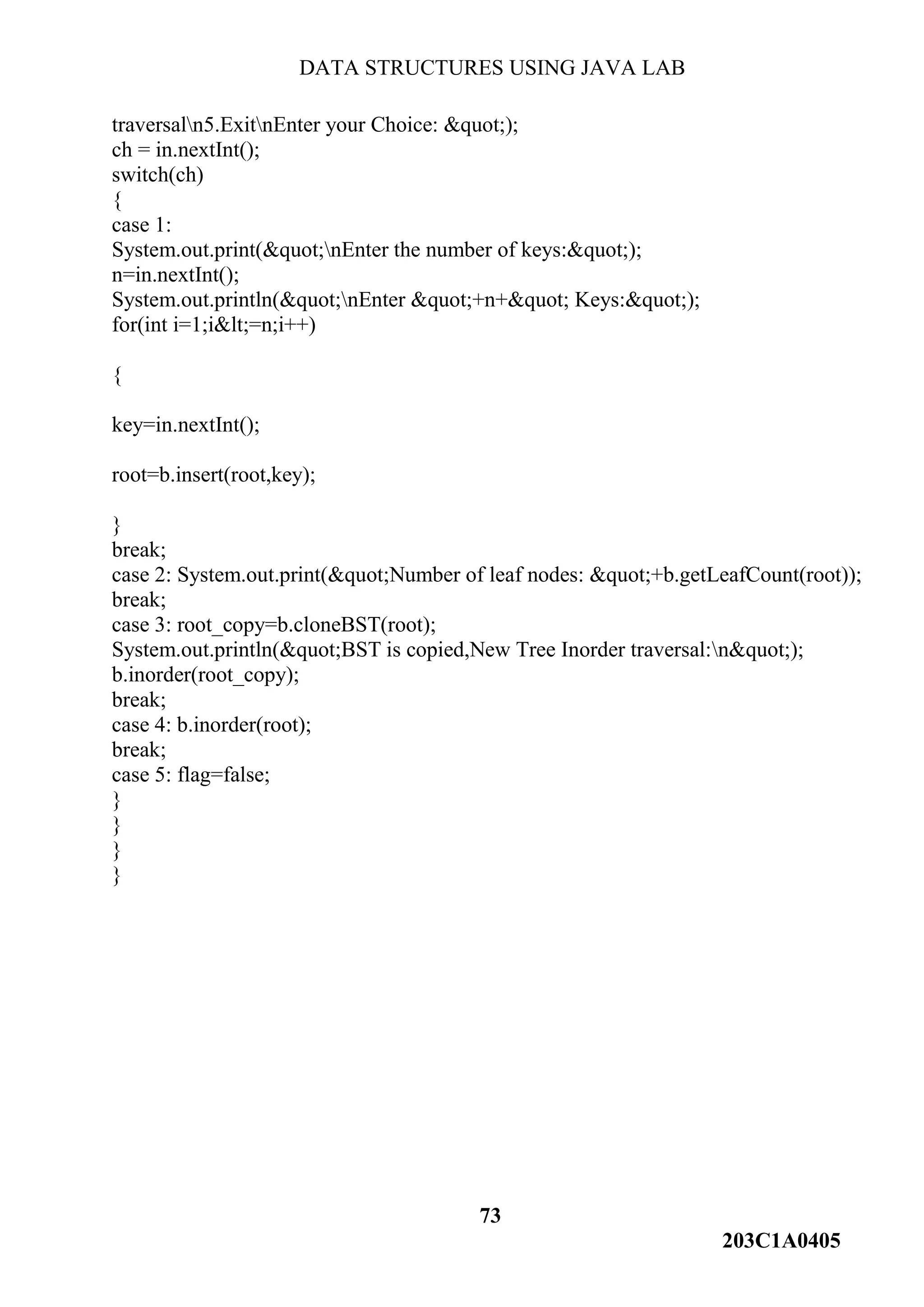
ch = in.nextInt();
switch(ch)
{
case 1:
System.out.print(&quot;nEnter the number of keys:&quot;);
n=in.nextInt();
System.out.println(&quot;nEnter &quot;+n+&quot; Keys:&quot;);
for(int i=1;i&lt;=n;i++)
{
key=in.nextInt();
root=b.insert(root,key);
}
break;
case 2: System.out.print(&quot;Number of leaf nodes: &quot;+b.getLeafCount(root));
break;
case 3: root_copy=b.cloneBST(root);
System.out.println(&quot;BST is copied,New Tree Inorder traversal:n&quot;);
b.inorder(root_copy);
break;
case 4: b.inorder(root);
break;
case 5: flag=false;
}
}
}
}
DATA STRUCTURES USING JAVA LAB
74
203C1A0405
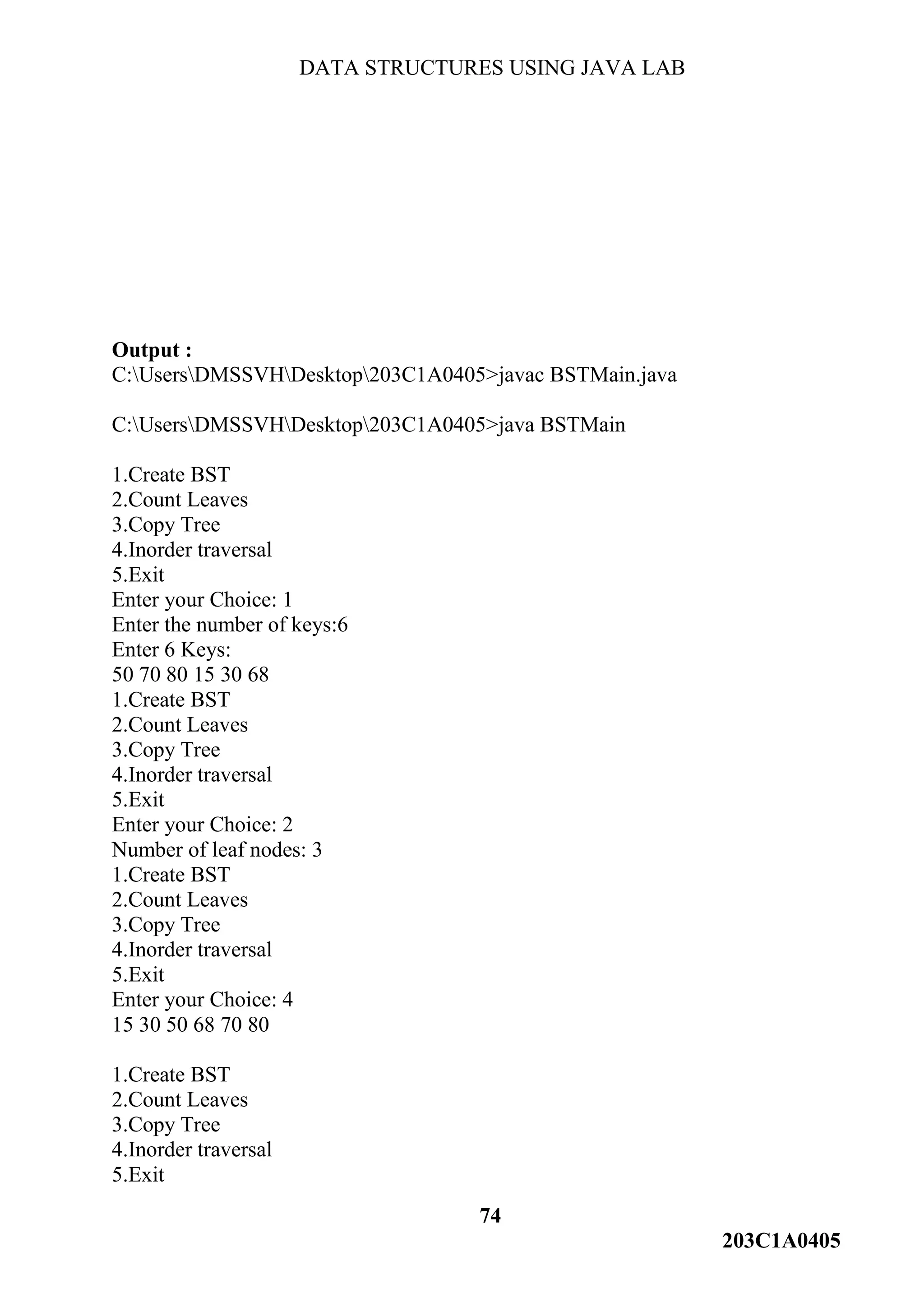
Output :
C:UsersDMSSVHDesktop203C1A0405>javac BSTMain.java
C:UsersDMSSVHDesktop203C1A0405>java BSTMain
1.Create BST
2.Count Leaves
3.Copy Tree
4.Inorder traversal
5.Exit
Enter your Choice: 1
Enter the number of keys:6
Enter 6 Keys:
50 70 80 15 30 68
1.Create BST
2.Count Leaves
3.Copy Tree
4.Inorder traversal
5.Exit
Enter your Choice: 2
Number of leaf nodes: 3
1.Create BST
2.Count Leaves
3.Copy Tree
4.Inorder traversal
5.Exit
Enter your Choice: 4
15 30 50 68 70 80
1.Create BST
2.Count Leaves
3.Copy Tree
4.Inorder traversal
5.Exit
DATA STRUCTURES USING JAVA LAB
75
203C1A0405
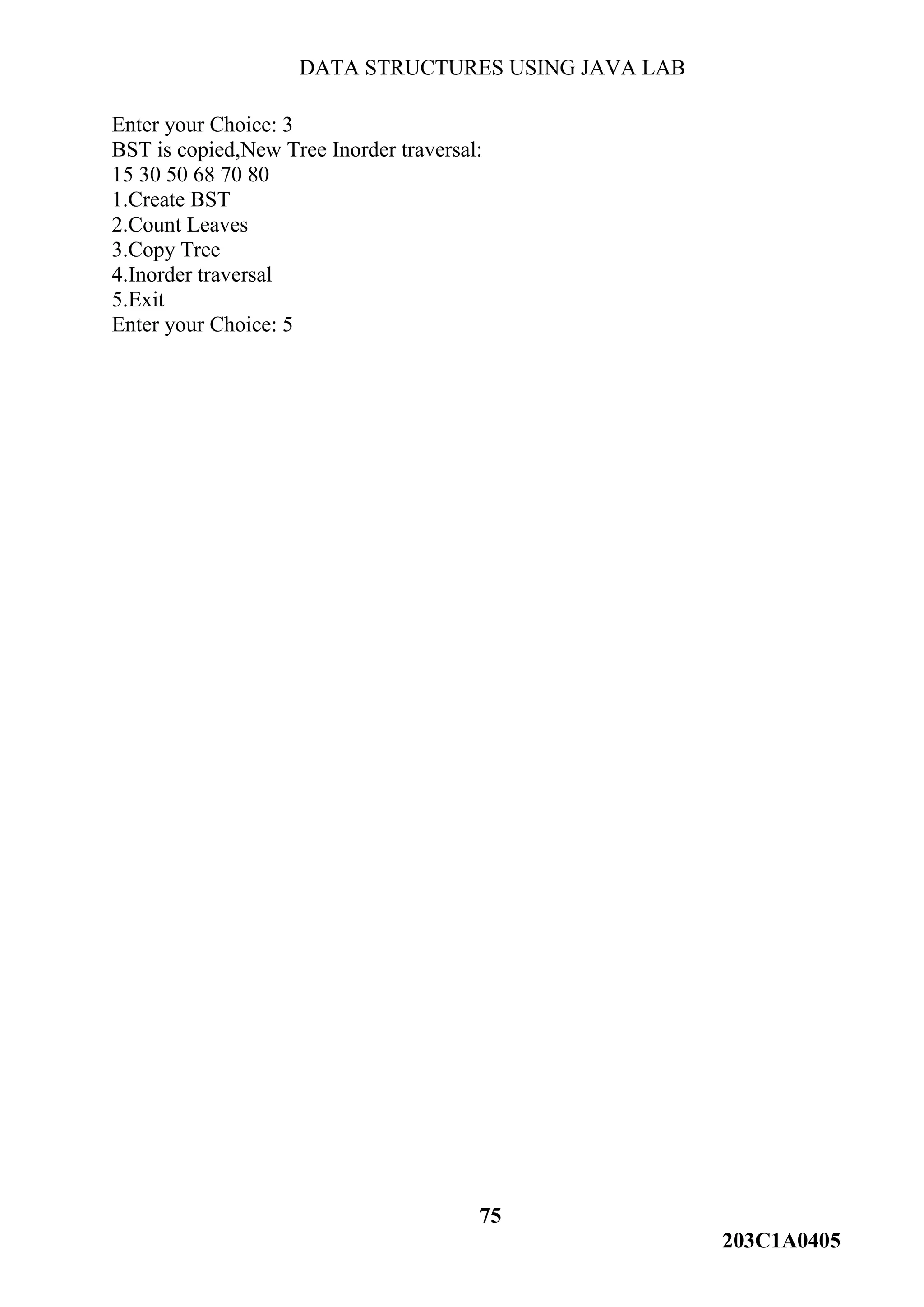
Enter your Choice: 3
BST is copied,New Tree Inorder traversal:
15 30 50 68 70 80
1.Create BST
2.Count Leaves
3.Copy Tree
4.Inorder traversal
5.Exit
Enter your Choice: 5
DATA STRUCTURES USING JAVA LAB
76
203C1A0405
11. Write Java programs for the implementation of bfs and dfs for a given
graph?
import java.util.*;
class GTraversal
{
int N;
int [][]adj;
int[] visited;
LinkedList<Integer> q=new LinkedList<Integer>();
GTraversal(int n)
{
N=n;
adj=new int[N][N];
visited=new int[N];
for(int i=0;i<N;i++)
visited[i]=0;
for(int i=0;i<N;i++)
for(int j=0;j<N;j++)
adj[i][j]=0;
}
void addEdge(int u,int v)
{
adj[u][v]=1;
adj[v][u]=1;
}
public void printMatrix()
{
for(int i=0;i<N;i++)
{
for(int j=0;j<N;j++)
{
System.out.print(+adj[i][j]+" ");
DATA STRUCTURES USING JAVA LAB
77
203C1A0405
}
System.out.print("n");
}
}
void BFS(int s)
{
q.add(s);
visited[s]=1;
while(!q.isEmpty())
{
int x=q.poll();
System.out.print(x+" ");
for(int i=0;i<N;i++)
{
if(adj[x][i]==1 && (visited[i]==0))
{
q.add(i);
visited[i]=1;
}
}
}
}
void DFS(int s)
{
int j;
System.out.print(s+" ");
visited[s]=1;
for(j=0;j<N;j++)
if(visited[j]==0&&adj[s][j]==1)
DFS(j);
}
public static void main(String[] args)
{
Scanner in = new Scanner(System.in);
int num,e,u,v;
System.out.println("Enter the number of vertices:");
num=in.nextInt();
GTraversal g=new GTraversal(num);
GTraversal g1=new GTraversal(num);
System.out.println("Enter the Number of Edges:");
DATA STRUCTURES USING JAVA LAB
78
203C1A0405
e=in.nextInt();
System.out.println("Enter the Edges:");
for(int i=1;i<=e;i++)
{
u=in.nextInt();
v=in.nextInt();
g.addEdge(u,v);
g1.addEdge(u,v);
}
g.printMatrix();
System.out.println("BFS");
g.BFS(0);
System.out.println("nDFS");
g1.DFS(0);
}
}
DATA STRUCTURES USING JAVA LAB
79
203C1A0405
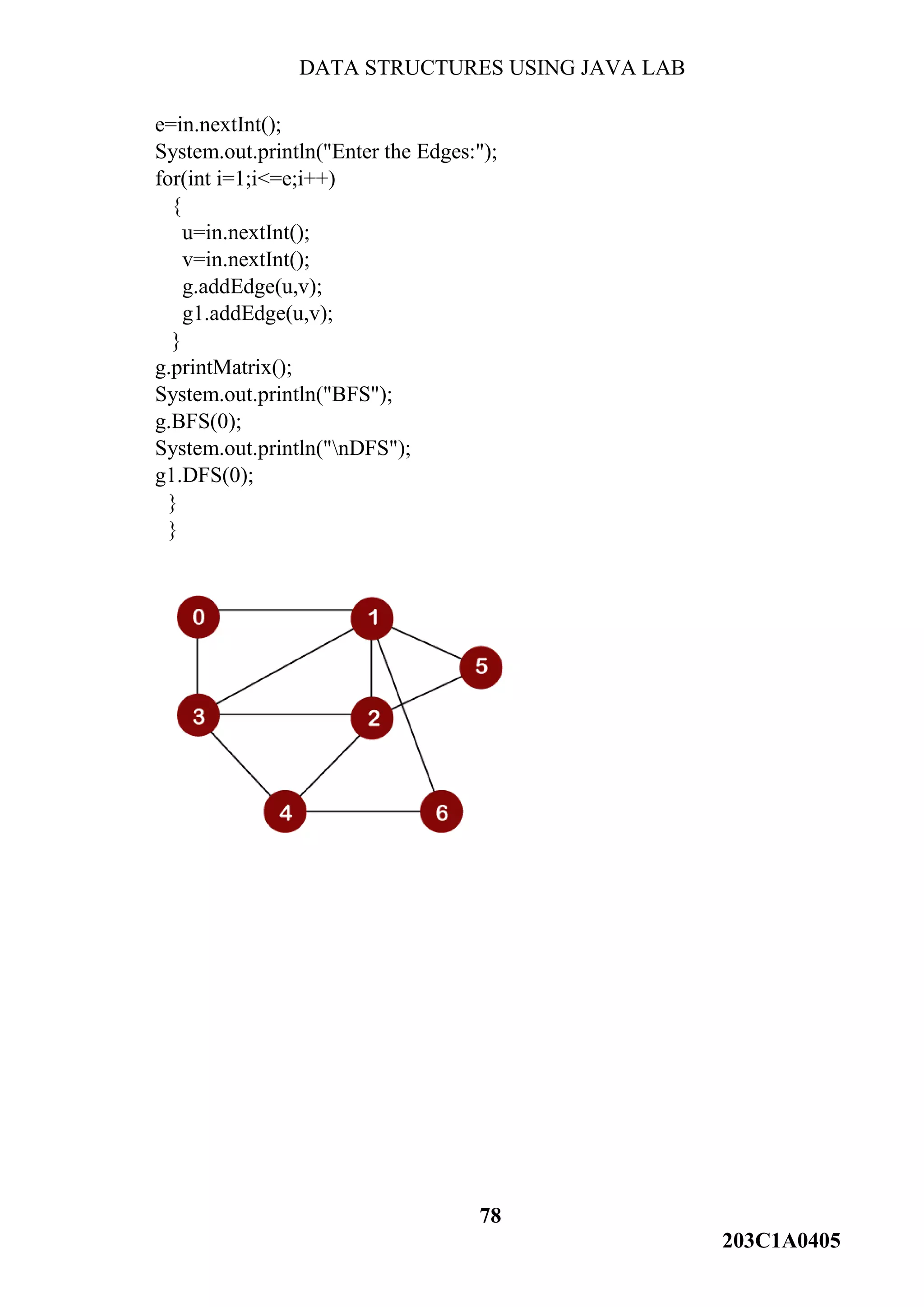
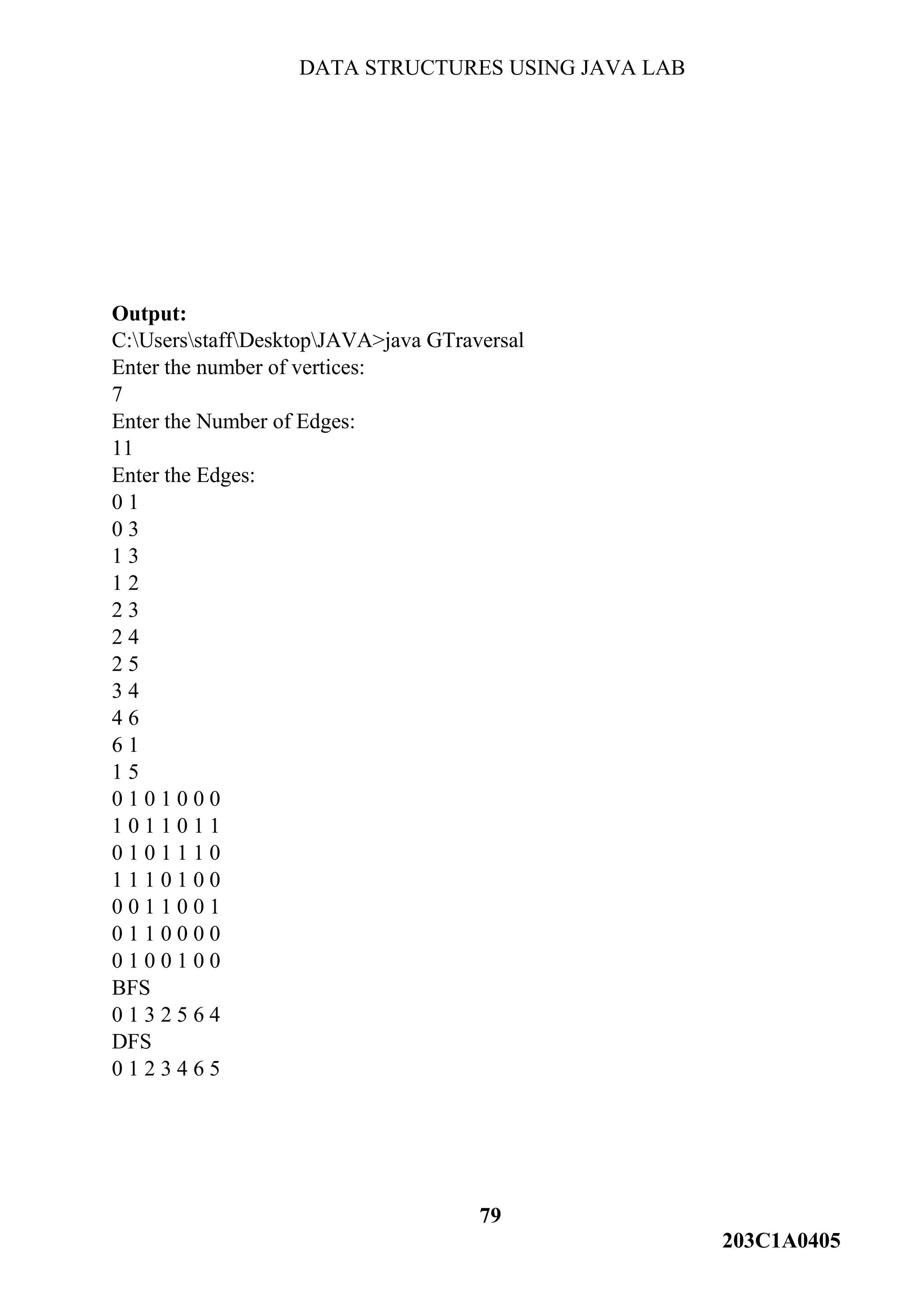
Output:
C:UsersstaffDesktopJAVA>java GTraversal
Enter the number of vertices:
7
Enter the Number of Edges:
11
Enter the Edges:
0 1
0 3
1 3
1 2
2 3
2 4
2 5
3 4
4 6
6 1
1 5
0 1 0 1 0 0 0
1 0 1 1 0 1 1
0 1 0 1 1 1 0
1 1 1 0 1 0 0
0 0 1 1 0 0 1
0 1 1 0 0 0 0
0 1 0 0 1 0 0
BFS
0 1 3 2 5 6 4
DFS
0 1 2 3 4 6 5
DATA STRUCTURES USING JAVA LAB
80
203C1A0405
12 . write java program for implementing the following sorting methods:
a) Bubble sort
import java.util.*;
class BubbleSort
{
void BubbleSort(int arr[],int n)
{
for(int i=0;i<n-1;i++)
for(int j=0;j<n-i-1;j++)
if(arr[j]>arr[j+1])
{
int temp = arr[j];
arr[j] = arr[j+1];
arr[j+1] = temp;
}
}
void printArray(int arr[])
{
int n=arr.length;
for(int i=0;i<n;i++)
System.out.print(arr[i]+" ");
System.out.println();
}
public static void main(String[]args)
{
BubbleSort ob = new BubbleSort();
int n;
Scanner sc = new Scanner(System.in);
System.out.print("Enter the number of elements:");
n=sc.nextInt();
int[]arr=new int[n];
System.out.println("Enter the elements of the array:");
for(int i=0;i<n;i++)
{
arr[i]=sc.nextInt();
}
DATA STRUCTURES USING JAVA LAB
81
203C1A0405
ob.BubbleSort(arr,n);
System.out.println("Sorted array-BubbleSort");
ob.printArray(arr);
}
}
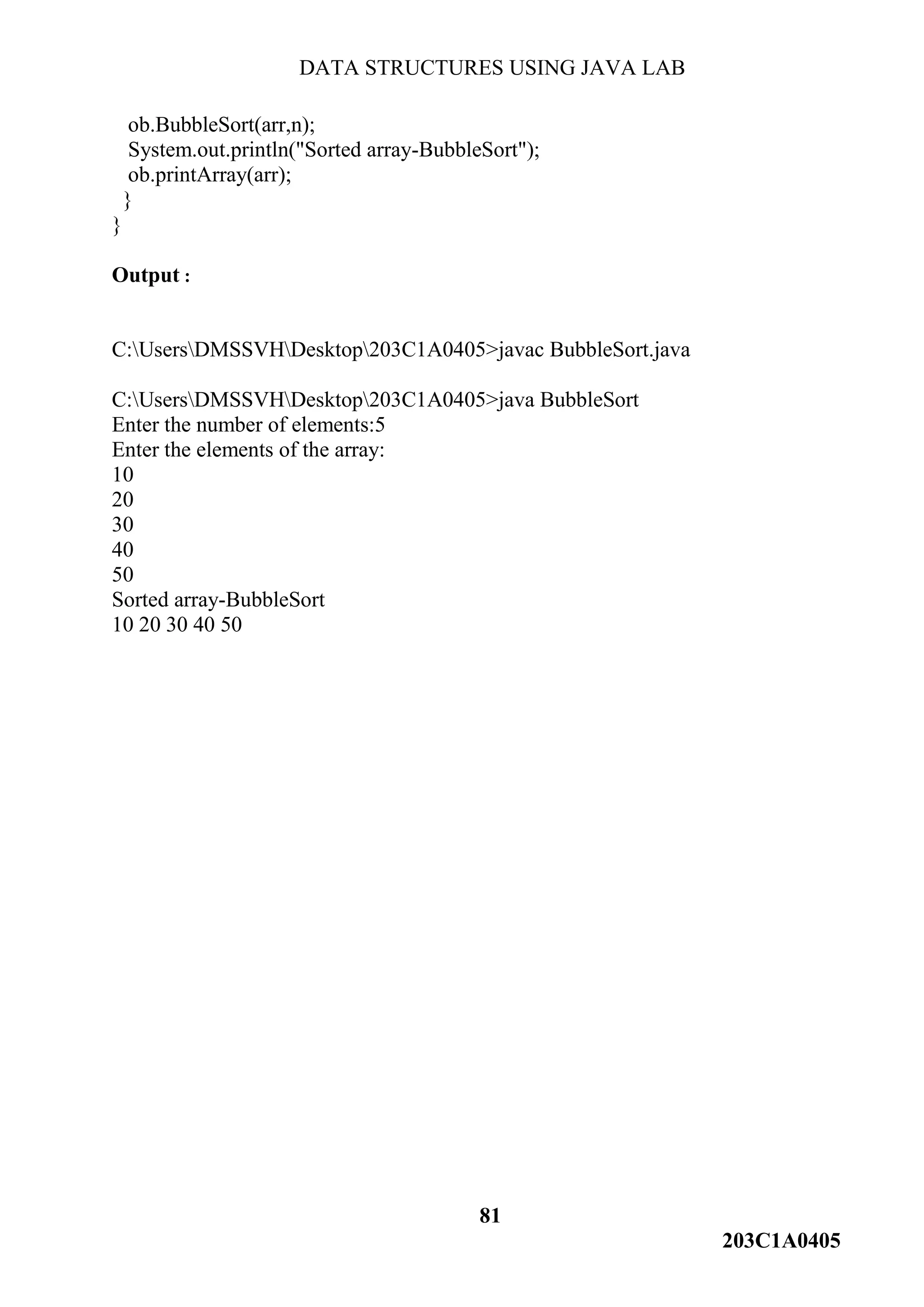
Output :
C:UsersDMSSVHDesktop203C1A0405>javac BubbleSort.java
C:UsersDMSSVHDesktop203C1A0405>java BubbleSort
Enter the number of elements:5
Enter the elements of the array:
10
20
30
40
50
Sorted array-BubbleSort
10 20 30 40 50
DATA STRUCTURES USING JAVA LAB
82
203C1A0405
b) Selection Sort
import java.util.*;
class SelectionSort
{
void SelectionSort(int arr[],int n)
{
int k,pos,temp;
for(k=0;k<n;k++)
{
pos = smallest(arr,k,n);
temp = arr[k];
arr[k] = arr[pos];
arr[pos] = temp;
}
}
int smallest(int arr[],int k,int n)
{
int pos = k,small=arr[k],i;
for(i=k+1;i<n;i++)
{
if(arr[i]<small)
{
small=arr[i];
pos=i;
}
}
return pos;
}
void printArray(int arr[])
{
int n=arr.length;
for(int i=0;i<n;i++)
System.out.print(arr[i]+" ");
System.out.println();
}
public static void main(String[]args)
DATA STRUCTURES USING JAVA LAB
83
203C1A0405
{
SelectionSort s = new SelectionSort();
int n;
Scanner sc = new Scanner(System.in);
System.out.print("Enter the number of elements:");
n=sc.nextInt();
int[]arr=new int[n];
System.out.println("Enter the elements of the array:");
for(int i=0;i<n;i++)
{
arr[i]=sc.nextInt();
}
s.SelectionSort(arr,n);
System.out.println("Sorted array-SelectionSort");
s.printArray(arr);
}
}
DATA STRUCTURES USING JAVA LAB
84
203C1A0405
Output :
C:UsersDMSSVHDesktop203C1A0405>javac SelectionSort.java
C:UsersDMSSVHDesktop203C1A0405>java SelectionSort
Enter the number of elements:5
Enter the elements of the array:
21
22
23
24
25
Sorted array-SelectionSort
21 22 23 24 25
DATA STRUCTURES USING JAVA LAB
85
203C1A0405
C) Insert Sort
import java.util.*;
public class InsertSort
{
void InsertSort(int arr[])
{
int n = arr.length;
for(int i=1;i<n;i++)
{
int key = arr[i];
int j=i-1;
while(j>=0&&arr[j]>key)
{
arr[j+1]=arr[j];
j = j-1;
}
arr[j+1]=key;
}
}
void printArray(int arr[])
{
int n=arr.length;
for(int i=0;i<n;i++)
System.out.print(arr[i]+" ");
System.out.println();
}
public static void main(String[]args)
{
SelectionSort s = new SelectionSort();
int n;
Scanner sc = new Scanner(System.in);
System.out.print("Enter the number of elements:");
n=sc.nextInt();
int[]arr1=new int[n];
System.out.println("Enter the elements of the array:");
for(int i=0;i<n;i++)
{
DATA STRUCTURES USING JAVA LAB
86
203C1A0405
arr1[i]=sc.nextInt();
}
InsertSort ob = new InsertSort();
ob.InsertSort(arr1);
ob.printArray(arr1)
}}
Output :
C:UsersDMSSVHDesktop203C1A0405>javac InsertSort.java
C:UsersDMSSVHDesktop203C1A0405>java InsertSort
Enter the number of elements:5
Enter the elements of the array:
71
72
73
74
75
71 72 73 74 75
DATA STRUCTURES USING JAVA LAB
87
203C1A0405
13. Write a Java program for implementing KMP pattern matching algorithm.
import java.util.*;
class KMP
{
void KMPSearch(String pat, String txt)
{
int M = pat.length();
int N = txt.length();
int lps[] = new int[M];
int j = 0;
computeLPSArray(pat, M, lps);
int i = 0;
while ((N - i) >= (M - j))
{
if (pat.charAt(j) == txt.charAt(i))
{
j++;
i++;
}
if (j == M)
{
System.out.println("Found pattern " + "at index " + (i - j));
j = lps[j - 1];
}
else
if (i < N && pat.charAt(j) != txt.charAt(i))
{
if (j != 0)
j = lps[j - 1];
else
DATA STRUCTURES USING JAVA LAB
88
203C1A0405
i = i + 1;
}
}
}
void computeLPSArray(String pat, int M, int lps[])
{
int len = 0;
int i = 1;
lps[0] = 0;
while (i < M)
{
if (pat.charAt(i) == pat.charAt(len))
{
len++;
lps[i] = len;
i++;
}
else
{
if (len != 0)
{
len = lps[len - 1];
}
else
{
lps[i] = len;
i++;
}
}
}
}
}
public static void main(String args[])
{
String txt,pat;
Scanner sc= new Scanner(System.in);
System.out.print("Enter a string: ");
txt=sc.nextLine();
System.out.print("enter the pattern string: ");
pat=sc.nextLine();
DATA STRUCTURES USING JAVA LAB
89
203C1A0405
new KMP().kmpSearch(pat,str);
}
}
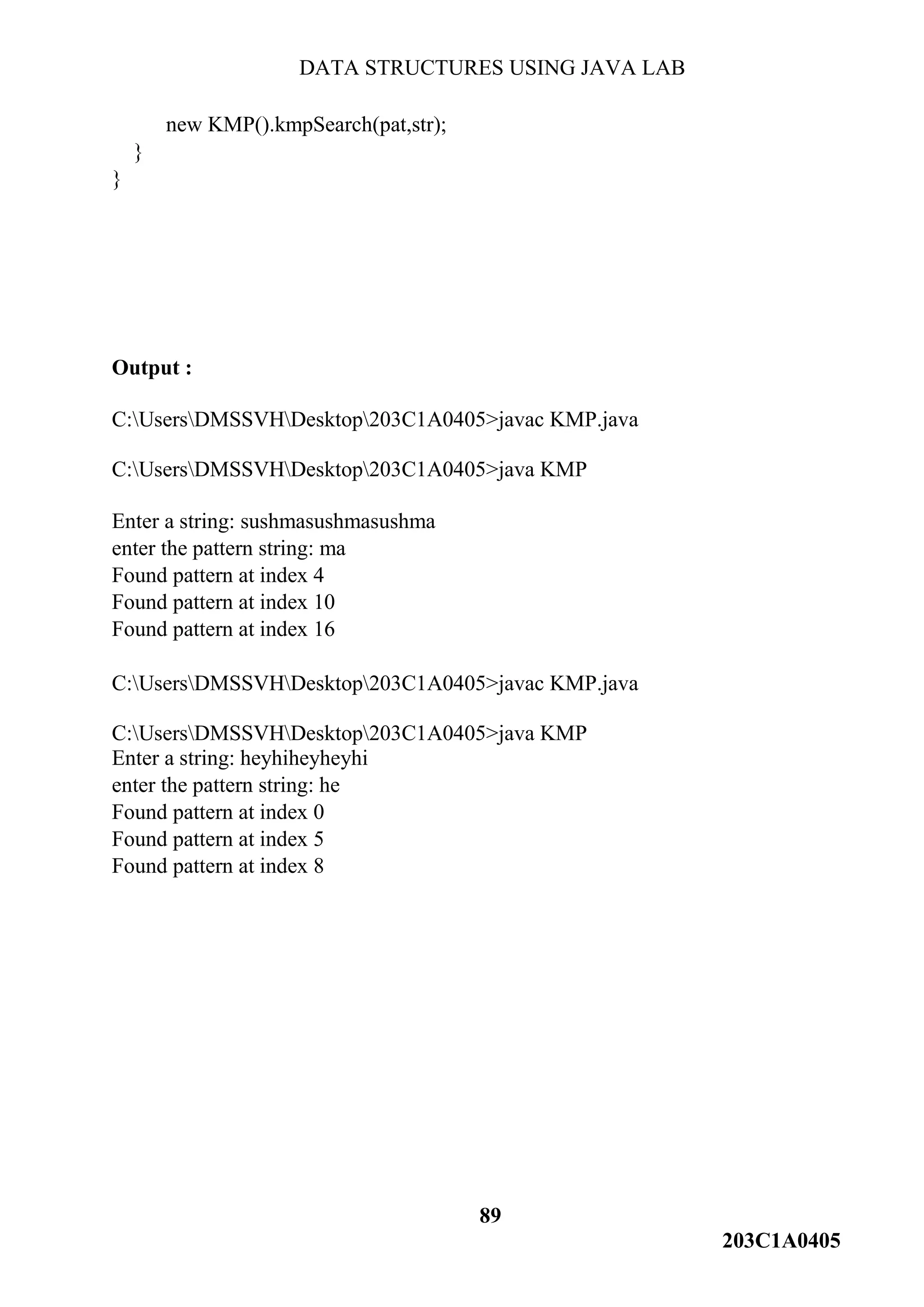
Output :
C:UsersDMSSVHDesktop203C1A0405>javac KMP.java
C:UsersDMSSVHDesktop203C1A0405>java KMP
Enter a string: sushmasushmasushma
enter the pattern string: ma
Found pattern at index 4
Found pattern at index 10
Found pattern at index 16
C:UsersDMSSVHDesktop203C1A0405>javac KMP.java
C:UsersDMSSVHDesktop203C1A0405>java KMP
Enter a string: heyhiheyheyhi
enter the pattern string: he
Found pattern at index 0
Found pattern at index 5
Found pattern at index 8

DS LAB RECORD.docx

  • 1.
    DATA STRUCTURES USINGJAVA LAB 1 203C1A0405 1a) i.write java program that use non –recursive function for implementation linear search? import java.util.Scanner; class NrLinear { public static void main(String[]args) { int n,key; Scanner sc = new Scanner(System.in); System.out.print("Enter the number of elements:"); n = sc.nextInt(); int[]arr = new int[10]; System.out.println("Enter the elements of the array:"); for(int i=0;i<n;i++) { arr[i] = sc.nextInt(); } System.out.println("Enter the key element:"); key = sc.nextInt(); int result = search(arr,n,key); if(result == -1) System.out.print("Element is not present in array"); else System.out.print("Element is present at index"+(result)); } public static int search(int arr[],int n,int key) { for(int i=0;i<n;i++) { if (arr[i]==key) return i; } return-1; } }
  • 2.
    DATA STRUCTURES USINGJAVA LAB 2 203C1A0405 Output : C:UsersDMSSVHDesktop203C1A0405>javac NrLinear.java C:UsersDMSSVHDesktop203C1A0405>java NrLinear Enter the number of elements:5 Enter the elements of the array: 1 2 3 4 5 Enter the key element: 4 Element is present at index3
  • 3.
    DATA STRUCTURES USINGJAVA LAB 3 203C1A0405 1a) ii .write java program that use recursive function for implementation linear search? import java.util.Scanner; class RLinear { public static void main(String[]args) { int n,key; Scanner sc = new Scanner(System.in); System.out.print("Enter the number of elements:"); n = sc.nextInt(); int[]arr = new int[10]; System.out.println("Enter the elements of the array:"); for(int i=0;i<n;i++) {arr[i] = sc.nextInt(); } System.out.println("Enter the key element:"); key = sc.nextInt(); int result = search(arr,n,key); if(result == -1) System.out.print("Element is not present in array"); else System.out.print("Element is present at index"+(result)); } public static int search(int arr[],int n,int key) { n--; if(n<0) return-1; if(arr[n]==key) return n; else return search(arr,n,key); } }
  • 4.
    DATA STRUCTURES USINGJAVA LAB 4 203C1A0405 Output : C:UsersDMSSVHDesktop203C1A0405>javac RLinear.java C:UsersDMSSVHDesktop203C1A0405>java RLinear Enter the number of elements:5 Enter the elements of the array: 10 20 30 40 50 Enter the key element: 50 Element is present at index4
  • 5.
    DATA STRUCTURES USINGJAVA LAB 5 203C1A0405 1b) i. Write java program that use a non-recursive function for implementing Binary search? import java.util.Scanner; class NrBinary { public static void main(String[]args) { int n,key; Scanner sc = new Scanner(System.in); System.out.println("Enter the number of elements:"); n = sc.nextInt(); int[] arr = new int[10]; System.out.println("Enter the elements of the array:"); for(int i=0;i<n;i++) { arr[i] = sc.nextInt(); } System.out.println("Enter the key element:"); key = sc.nextInt(); sort(arr,n); System.out.println("The sorted elements are:"); for(int i=0;i<n;i++) System.out.print(arr[i]+ " "); System.out.println(); int result = binarySearch(arr,0,n-1,key); if(result == -1) System.out.print("Elements is not present in array"); else System.out.print("Element is present at index" +(result+1)); } public static int binarySearch(int arr[], int l, int r, int x) { while(l <= r) { int mid = (l+r)/2; if(arr[mid] == x) return mid;
  • 6.
    DATA STRUCTURES USINGJAVA LAB 6 203C1A0405 if(arr[mid] > x) r = mid-1; else if(arr[mid] < x) l = mid+1; } return -1; } public static void sort(int arr[],int n) { for(int i=0;i<n-1;i++) for(int j=0;j<n-i-1;j++) if(arr[j] > arr[j+1]) { int temp = arr[j]; arr[j] = arr[j+1]; arr[j+1] = temp; } } }
  • 7.
    DATA STRUCTURES USINGJAVA LAB 7 203C1A0405 Output : C:UsersDMSSVHDesktop203C1A0405>javac NrBinary.java C:UsersDMSSVHDesktop203C1A0405>java NrBinary Enter the number of elements: 5 Enter the elements of the array: 3 6 1 8 7 Enter the key element: 8 The sorted elements are: 1 3 6 7 8 Element is present at index5
  • 8.
    DATA STRUCTURES USINGJAVA LAB 8 203C1A0405 1b) ii. Write java program that use a Recursive function for implementing Binary search? import java.util.Scanner; class RBinary { public static void main(String[]args) { int n,key; Scanner sc = new Scanner(System.in); System.out.println("Enter the number of elements:"); n = sc.nextInt(); int[]arr = new int[10]; System.out.println("Enter the elements of the array:"); for(int i=0;i<n;i++) { arr[i] = sc.nextInt(); } System.out.println("Enter the key element:"); key = sc.nextInt(); sort(arr,n); System.out.println("The sorted elements are:"); for(int i=0;i<n;i++) System.out.print(arr[i]+ " "); System.out.println(); int result = binarySearch(arr,0,n-1,key); if(result == -1) System.out.println("Element is not present in array"); else System.out.println("Element is present at index" +(result+1)); } public static int binarySearch(int arr[],int l,int x,int r) { if(l <= r) { int mid = (1+r)/2; if(arr[mid] == x)
  • 9.
    DATA STRUCTURES USINGJAVA LAB 9 203C1A0405 return mid; if(arr[mid] > x) return binarySearch(arr,l,mid-1,x); if(arr[mid] < x) return binarySearch(arr,mid+1,r,x); } return-1; } public static void sort(int arr[],int n) { for(int i=0;i<n-1;i++) for(int j=0;j<n-i-1;j++) if(arr[j] > arr[j+1]) { int temp = arr[j]; arr[j] = arr[j+1]; arr[j+1] = temp; } } }
  • 10.
    DATA STRUCTURES USINGJAVA LAB 10 203C1A0405 Output : C:UsersDMSSVHDesktop203C1A0405>javac RBinary.java C:UsersDMSSVHDesktop203C1A0405>java RBinary Enter the number of elements: 5 Enter the elements of the array: 4 3 6 2 1 Enter the key element: 6 The sorted elements are: 1 2 3 4 6 Element is present at index4
  • 11.
    DATA STRUCTURES USINGJAVA LAB 11 203C1A0405 3) Write a java programs to implement the following using an array? a) Stack ADT import java.util.*; class MyStack { private int top = -1; int SIZE = 5; private int stk[] = new int[SIZE]; boolean isFull() { if(top == SIZE-1) return true; else return false; } boolean isEmpty() { if(top == -1) return true; else return false; } void push(int num) { if(isFull()) { System.out.println("Stack Overflow"); } else { stk[++top] = num; System.out.println("n"+num+"is inserted in stack"); } } int pop() { if(isEmpty())
  • 12.
    DATA STRUCTURES USINGJAVA LAB 12 203C1A0405 { System.out.println("n Stack Underflow"); return 0; } else { int x = stk[top]; top--; System.out.println("n"+x+"is removed from stack"); return x; } } int peek() { if(isEmpty()) { System.out.println("n Stack Underflow"); return 0; } else { System.out.println("the top element is:"+stk[top]); return stk[top]; } } void display() { if(isEmpty()) { System.out.println("n Stack Empty"); } else { System.out.println("n Stack:"); for(int i=0;i<=top;i++) { System.out.println("|"+stk[i]); } } } } class Stack {
  • 13.
    DATA STRUCTURES USINGJAVA LAB 13 203C1A0405 public static void main(String[]args) { System.out.println("********** stack using Array **********"); boolean flag = true; Scanner in = new Scanner(System.in); int ch,num; MyStack s = new MyStack(); while(flag) { System.out.println("n1.PUSHn2.POPn3.PEEKn4.DISPLAYn5.QUITn Enter your choice:"); ch = in.nextInt(); switch(ch) { case 1: System.out.println("Enter a number you want to insert in stack:"); num = in.nextInt(); s.push(num); break; case 2: s.pop(); break; case 3: s.peek(); break; case 4: s.display(); break; case 5: flag = false; break; } } } }
  • 14.
    DATA STRUCTURES USINGJAVA LAB 14 203C1A0405 Output : C:UsersDMSSVHDesktop203C1A0405>javac Stack.java C:UsersDMSSVHDesktop203C1A0405>java Stack ********** stack using Array ********** 1.PUSH 2.POP 3.PEEK 4.DISPLAY 5.QUIT Enter your choice: 1 Enter a number you want to insert in stack: 1 1is inserted in stack 1.PUSH 2.POP 3.PEEK 4.DISPLAY 5.QUIT Enter your choice: 1 Enter a number you want to insert in stack: 2 2is inserted in stack 1.PUSH 2.POP 3.PEEK 4.DISPLAY 5.QUIT Enter your choice: 1 Enter a number you want to insert in stack: 3
  • 15.
    DATA STRUCTURES USINGJAVA LAB 15 203C1A0405 3is inserted in stack 1.PUSH 2.POP 3.PEEK 4.DISPLAY 5.QUIT Enter your choice: 1 Enter a number you want to insert in stack: 4 4is inserted in stack 1.PUSH 2.POP 3.PEEK 4.DISPLAY 5.QUIT Enter your choice: 1 Enter a number you want to insert in stack: 5 5is inserted in stack 1.PUSH 2.POP 3.PEEK 4.DISPLAY 5.QUIT Enter your choice: 4 Stack: |1 |2 |3 |4 |5 1.PUSH
  • 16.
    DATA STRUCTURES USINGJAVA LAB 16 203C1A0405 2.POP 3.PEEK 4.DISPLAY 5.QUIT Enter your choice: 2 5is removed from stack 1.PUSH 2.POP 3.PEEK 4.DISPLAY 5.QUIT Enter your choice: 3 the top element is:4 1.PUSH 2.POP 3.PEEK 4.DISPLAY 5.QUIT Enter your choice:5
  • 17.
    DATA STRUCTURES USINGJAVA LAB 17 203C1A0405 3) b . Write a java programs to implement the following using an array? ( Queue ADT) import java.util.*; class MyQueue { private int front = -1,rear = -1; int SIZE = 5; private int queue[] = new int[SIZE]; boolean isFull() { if(front == 0&&rear == SIZE-1) return true; else return false; } boolean isEmpty() { if(front == -1) return true; else return false; } void enQueue(int num) { if(isFull()) { System.out.println("Queue Overflow"); } else { if(front == -1) { front = 0; } rear++; queue[rear] = num;
  • 18.
    DATA STRUCTURES USINGJAVA LAB 18 203C1A0405 System.out.println("n"+num+"is inserted in queue"); } } int deQueue() { int x; if(isEmpty()) { System.out.println("n Queue Underflow"); return 0; } else { x = queue[front]; front++; if(front >= rear) { front = -1; rear = -1; } System.out.println("n"+x+"is removed from Queue"); return x; } } int peek() { if(isEmpty()) { System.out.println("n Queue Underflow"); return 0; } else { System.out.println("the front element is:"+queue[front]); return queue[front]; } } void display() { if(isEmpty()) { System.out.println("n Queue Empty"); }
  • 19.
    DATA STRUCTURES USINGJAVA LAB 19 203C1A0405 else { System.out.println("n Queue:"); for(int i=front;i<=rear;i++) { System.out.println("|"+queue[i]); } } } } class Queue { public static void main(String[]args) { System.out.println("********** Queue using Array **********"); boolean flag = true; Scanner in = new Scanner(System.in); int ch,num; MyQueue q = new MyQueue(); while(flag) { System.out.println("n1.ENQUEUEn2.DEQUEUEn3.PEEKn4.DISPLAYn5.QUIT n Enter your choice:"); ch = in.nextInt(); switch(ch) { case 1: System.out.println("Enter a number you want to insert in queue:"); num = in.nextInt(); q.enQueue(num); break; case 2: q.deQueue(); break; case 3: q.peek(); break; case 4: q.display(); break; case 5: flag = false;
  • 20.
    DATA STRUCTURES USINGJAVA LAB 20 203C1A0405 break; } } } Output : C:UsersDMSSVHDesktop203C1A0405>javac Queue.java C:UsersDMSSVHDesktop203C1A0405>java Queue ********** Queue using Array ********** 1.ENQUEUE 2.DEQUEUE 3.PEEK 4.DISPLAY 5.QUIT Enter your choice: 1 Enter a number you want to insert in queue: 1 1is inserted in queue 1.ENQUEUE 2.DEQUEUE 3.PEEK 4.DISPLAY 5.QUIT Enter your choice: 1 Enter a number you want to insert in queue: 2 2is inserted in queue 1.ENQUEUE 2.DEQUEUE 3.PEEK 4.DISPLAY 5.QUIT Enter your choice: 1 Enter a number you want to insert in queue: 3
  • 21.
    DATA STRUCTURES USINGJAVA LAB 21 203C1A0405 3is inserted in queue 1.ENQUEUE 2.DEQUEUE 3.PEEK 4.DISPLAY 5.QUIT Enter your choice: 1 Enter a number you want to insert in queue: 4 4is inserted in queue 1.ENQUEUE 2.DEQUEUE 3.PEEK 4.DISPLAY 5.QUIT Enter your choice: 1 Enter a number you want to insert in queue: 5 5is inserted in queue 1.ENQUEUE 2.DEQUEUE 3.PEEK 4.DISPLAY 5.QUIT Enter your choice: 4 Queue: |1 |2 |3 |4 |5 1.ENQUEUE 2.DEQUEUE 3.PEEK 4.DISPLAY 5.QUIT Enter your choice: 2
  • 22.
    DATA STRUCTURES USINGJAVA LAB 22 203C1A0405 1is removed from Queue 1.ENQUEUE 2.DEQUEUE 3.PEEK 4.DISPLAY 5.QUIT Enter your choice: 4 Queue: |2 |3 |4 |5 1.ENQUEUE 2.DEQUEUE 3.PEEK 4.DISPLAY 5.QUIT Enter your choice: 2 2is removed from Queue 1.ENQUEUE 2.DEQUEUE 3.PEEK 4.DISPLAY 5.QUIT Enter your choice: 3 the front element is:3 1.ENQUEUE 2.DEQUEUE 3.PEEK 4.DISPLAY 5.QUIT Enter your choice: 5
  • 23.
    DATA STRUCTURES USINGJAVA LAB 23 203C1A0405 4) Write a java program that reads an infix expression converts it to postfix expression (use Stack ADT)? import java.util.*; import java.util.Stack; public class InfixToPostfix { static int precedence(char c) { switch(c) { case '+': case '-': return 1; case '*': case '/': return 2; case '^': return 3; } return -1; } static String infixToPostfix(String expression) { String result=""; Stack<Character>stack=new Stack<>(); for(int i=0;i <expression.length();i++) { char c = expression.charAt(i); if(precedence(c)>0) { while(stack.isEmpty()==false && precedence(stack.peek())>=precedence(c)) { result += stack.pop(); } stack.push(c);
  • 24.
    DATA STRUCTURES USINGJAVA LAB 24 203C1A0405 } else if(c==')') { char x = stack.pop(); while(x!='(') { result += x; x = stack.pop(); } } else if(c=='(') { stack.push(c); } else { result += c; } } for(int i=0;i<=stack.size();i++) { result += stack.pop(); } return result; } public static void main(String[]args) { Scanner sc = new Scanner(System.in); System.out.println("Enter the expression:"); String exp = sc.nextLine(); System.out.println("Infix Expression:"+exp); System.out.println("postfix Expression:"+infixToPostfix(exp)); } }
  • 25.
    DATA STRUCTURES USINGJAVA LAB 25 203C1A0405 Output : C:UsersDMSSVHDesktop203C1A0405>javac InfixToPostfix.java C:UsersDMSSVHDesktop203C1A0405>java InfixToPostfix Enter the expression: A+B*(C^D-E) Infix Expression:A+B*(C^D-E) postfix Expression:ABCD^E-*+ C:UsersDMSSVHDesktop203C1A0405>java InfixToPostfix Enter the expression: a+b*(c^d-e)^(f+g*h)-i Infix Expression:a+b*(c^d-e)^(f+g*h)-i postfix Expression:abcd^e-fgh*+^*+i-
  • 26.
    DATA STRUCTURES USINGJAVA LAB 26 203C1A0405 5) a . Write a java program to implement the following using a singly linked List (Stack ADT) ? import java.util.*; class Node { int data; Node next; public Node(int data) { this.data=data; this.next= null; } } class Stack { Node top = null; public void push(int item) { Node temp = new Node(item); if(temp == null) { System.out.println("n stack overflow"); } else { temp.data = item; temp.next = top; top = temp; } } public boolean isEmpty() { return top==null; } public void pop()
  • 27.
    DATA STRUCTURES USINGJAVA LAB 27 203C1A0405 { if(isEmpty()) { System.out.println("stack underflow"); } else { int x = top.data; System.out.println("n"+x+"is removed from stack"); top = top.next; } } public void peek() { if(isEmpty()) { System.out.println("stack underflow"); } else { System.out.println("n Top element is:"+top.data); } } public void display() { if(isEmpty()) { System.out.println("n stack underflow"); } else { Node temp = top; while(temp != null) { System.out.println("|"+temp.data); temp = temp.next; } } } } public class StackII { public static void main(String[]args)
  • 28.
    DATA STRUCTURES USINGJAVA LAB 28 203C1A0405 { System.out.println("********** stack using Linkedlist **********"); boolean flag = true; Scanner in = new Scanner(System.in); int ch,num; Stack s = new Stack(); while(flag) { System.out.println("n1.PUSHn2.POPn3.PEEKn4.DISPLAYn5.QUITnEnter your choice:"); ch = in.nextInt(); switch(ch) { case 1: System.out.println("Enter a number you want to insert in stack:"); num = in.nextInt(); s.push(num); break; case 2: s.pop(); break; case 3: s.peek(); break; case 4: s.display(); break; case 5: flag = false; break; } } } }
  • 29.
    DATA STRUCTURES USINGJAVA LAB 29 203C1A0405 Output : C:UsersDMSSVHDesktop203C1A0405>javac StackII.java C:UsersDMSSVHDesktop203C1A0405>java StackII ********** stack using Linkedlist ********** 1.PUSH 2.POP 3.PEEK 4.DISPLAY 5.QUIT Enter your choice: 1 Enter a number you want to insert in stack: 15 1.PUSH 2.POP 3.PEEK 4.DISPLAY 5.QUIT Enter your choice: 1 Enter a number you want to insert in stack: 16 1.PUSH 2.POP 3.PEEK 4.DISPLAY 5.QUIT Enter your choice: 1 Enter a number you want to insert in stack: 17
  • 30.
    DATA STRUCTURES USINGJAVA LAB 30 203C1A0405 1.PUSH 2.POP 3.PEEK 4.DISPLAY 5.QUIT Enter your choice:1 Enter a number you want to insert in stack: 18 1.PUSH 2.POP 3.PEEK 4.DISPLAY 5.QUIT Enter your choice: 4 |18 |17 |16 |15 1.PUSH 2.POP 3.PEEK 4.DISPLAY 5.QUIT Enter your choice: 2 18is removed from stack 1.PUSH 2.POP 3.PEEK 4.DISPLAY 5.QUIT Enter your choice: 4 |17 |16 |15 1.PUSH 2.POP
  • 31.
    DATA STRUCTURES USINGJAVA LAB 31 203C1A0405 3.PEEK 4.DISPLAY 5.QUIT Enter your choice: 5 C:UsersDMSSVHDesktop203C1A0405> 5) b . Write java program to implement the following using a singly linked List (Queue ADT) ? import java.util.*; class Node { int data; Node next; public Node(int data) { this.data = data; this.next = null; } } class Queue { Node rear = null,front = null; public void enqueue(int item) { Node temp = new Node(item); if(temp == null) { System.out.println("n Queue Overflow"); } else { if(front == null) { front = temp; rear = temp; } else { rear.next = temp; rear = temp; }
  • 32.
    DATA STRUCTURES USINGJAVA LAB 32 203C1A0405 } } public boolean isEmpty() { return rear == null && front == null; } public void dequeue() { if(isEmpty()) { System.out.println("n Queue Underflow"); } else { int x = front.data; System.out.println("n"+x+"is removed from Queue"); front = front.next; if(front == null) rear = null; } } public void peek() { if(isEmpty()) { System.out.println("n Queue Underflow"); } else { System.out.println("n Front element is:"+front.data); } } public void display() { if(isEmpty()) { System.out.println("n Queue Underflow"); } else { Node temp = front; while(temp!=null) {
  • 33.
    DATA STRUCTURES USINGJAVA LAB 33 203C1A0405 System.out.println("|"+temp.data); temp = temp.next; } } } } public class QueueII { public static void main(String[]args) { System.out.print("********** Queue using LinkedList **********"); boolean flag = true; Scanner in = new Scanner(System.in); int ch,num; Queue q = new Queue(); while(flag) { System.out.println("n1.ENQUEUEn2.DEQUEUEn3.PEEKn4.DISPLAYn5.QUIT n Enter your choice:"); ch = in.nextInt(); switch(ch) { case 1: System.out.println("Enter a number you want to insert in Queue:"); num = in.nextInt(); q.enqueue(num); break; case 2: q.dequeue(); break; case 3: q.peek(); case 4: q.display(); break; case 5: flag = false; break; } } } }
  • 34.
    DATA STRUCTURES USINGJAVA LAB 34 203C1A0405 Output : C:UsersDMSSVHDesktop203C1A0405>javac QueueII.java C:UsersDMSSVHDesktop203C1A0405>java QueueII ********** Queue using LinkedList ********** 1.ENQUEUE 2.DEQUEUE 3.PEEK 4.DISPLAY 5.QUIT Enter your choice: 1 Enter a number you want to insert in Queue: 15 1.ENQUEUE 2.DEQUEUE 3.PEEK 4.DISPLAY 5.QUIT Enter your choice: 1 Enter a number you want to insert in Queue: 16 1.ENQUEUE 2.DEQUEUE 3.PEEK 4.DISPLAY 5.QUIT Enter your choice: 1 Enter a number you want to insert in Queue: 17
  • 35.
    DATA STRUCTURES USINGJAVA LAB 35 203C1A0405 1.ENQUEUE 2.DEQUEUE 3.PEEK 4.DISPLAY 5.QUIT Enter your choice: 1 Enter a number you want to insert in Queue: 18 1.ENQUEUE 2.DEQUEUE 3.PEEK 4.DISPLAY 5.QUIT Enter your choice: 1 Enter a number you want to insert in Queue: 19 1.ENQUEUE 2.DEQUEUE 3.PEEK 4.DISPLAY 5.QUIT Enter your choice: 1 Enter a number you want to insert in Queue: 20 1.ENQUEUE 2.DEQUEUE 3.PEEK 4.DISPLAY 5.QUIT Enter your choice: 4 |15 |16 |17 |18 |19 |20
  • 36.
    DATA STRUCTURES USINGJAVA LAB 36 203C1A0405 1.ENQUEUE 2.DEQUEUE 3.PEEK 4.DISPLAY 5.QUIT Enter your choice: 3 Front element is:15 |15 |16 |17 |18 |19 |20 1.ENQUEUE 2.DEQUEUE 3.PEEK 4.DISPLAY 5.QUIT Enter your choice: 2 15is removed from Queue 1.ENQUEUE 2.DEQUEUE 3.PEEK 4.DISPLAY 5.QUIT Enter your choice: 5 C:UsersDMSSVHDesktop203C1A0405>
  • 37.
    DATA STRUCTURES USINGJAVA LAB 37 203C1A0405 6. write a java programs to implement the deque(double ended queue)ADT using (a) // DEQUEUE USING CIRCULAR ARRAY// import java.util.*; class MyDeque { private int front=0,rear=-1,te=0; int SIZE=10; private int queue[]=new int[SIZE]; boolean isfull() { return te==SIZE; } boolean isempty() { return te==0; } void insertfront(int key) { if(isfull()) { System.out.println("Overflow"); return; } if(front==0) front=SIZE-1; else front=front-1; queue[front]=key; te++; } void insertrear(int key) { if(isfull()) { System.out.println("Overflow"); return;
  • 38.
    DATA STRUCTURES USINGJAVA LAB 38 203C1A0405 } rear=(rear+1)%SIZE; queue[rear]=key; te++; } void deletefront() { int x; if(isempty()) { System.out.println("Queue Underflown"); return; } else { x=queue[front]; front=(front+1)%SIZE; System.out.println("n"+x+"is removed from front of queue"); te--; } } void deleterear() { int x; if(isempty()) { System.out.println("Underflow"); return; } else { x=queue[rear]; if(rear==-1) rear=SIZE-1; System.out.println("n"+x+"is removed from rear of the Queue"); rear=rear-1; te--; } } int getfront() { if(isempty()) {
  • 39.
    DATA STRUCTURES USINGJAVA LAB 39 203C1A0405 System.out.println("Underflow"); return-1; } System.out.println("the front element is:"+queue[front]); return queue[front]; } int getrear() { if(isempty()||rear<0) { System.out.println("Underflown"); return-1; } System.out.println("The rear element is:"+queue[rear]); return queue[rear]; } void display() { int x,i; if(isempty()) { System.out.println("Underflown"); return; } else { x=front; for(i=1;i<=te;i++) { System.out.println(+x+""+queue[x]); x=(x+1)%SIZE; } } } } class DeQue { public static void main(String[]args) { System.out.println("********** Dequeue using circular array **********"); boolean flag=true; Scanner in=new Scanner(System.in);
  • 40.
    DATA STRUCTURES USINGJAVA LAB 40 203C1A0405 int ch,num,x; MyDeque dq = new MyDeque(); while(flag) { System.out.println("n1.INSERT FRONTn2.INSERT REARn3.DELETE FRONTn4.DELETE REARn5.GET FRONTn6.GET REARn7.DISPLAYn8.EXITn Enter your choice:"); ch=in.nextInt(); switch(ch) { case 1: System.out.print("Enter a number you want to insert in front of Dequeue:"); num = in.nextInt(); dq.insertfront(num); break; case 2: System.out.print("Enter a number you want to insert in rear of Dequeue:"); num = in.nextInt(); dq.insertrear(num); break; case 3: dq.deletefront(); break; case 4: dq.deleterear(); break; case 5: x=dq.getfront(); break; case 6: x=dq.getrear(); break; case 7: dq.display(); break; case 8: flag = false; } } } }
  • 41.
    DATA STRUCTURES USINGJAVA LAB 41 203C1A0405 Output : C:UsersDMSSVHDesktop203C1A0405>javac DeQue.java C:UsersDMSSVHDesktop203C1A0405>java DeQue ********** Dequeue using circular array ********** 1.INSERT FRONT 2.INSERT REAR 3.DELETE FRONT 4.DELETE REAR 5.GET FRONT 6.GET REAR 7.DISPLAY 8.EXIT Enter your choice: 1 Enter a number you want to insert in front of Dequeue:15 1.INSERT FRONT 2.INSERT REAR 3.DELETE FRONT 4.DELETE REAR 5.GET FRONT 6.GET REAR 7.DISPLAY 8.EXIT Enter your choice: 1 Enter a number you want to insert in front of Dequeue:24 1.INSERT FRONT 2.INSERT REAR 3.DELETE FRONT 4.DELETE REAR 5.GET FRONT 6.GET REAR 7.DISPLAY 8.EXIT
  • 42.
    DATA STRUCTURES USINGJAVA LAB 42 203C1A0405 Enter your choice: 1 Enter a number you want to insert in front of Dequeue:34 1.INSERT FRONT 2.INSERT REAR 3.DELETE FRONT 4.DELETE REAR 5.GET FRONT 6.GET REAR 7.DISPLAY 8.EXIT Enter your choice: 1 Enter a number you want to insert in front of Dequeue:44 1.INSERT FRONT 2.INSERT REAR 3.DELETE FRONT 4.DELETE REAR 5.GET FRONT 6.GET REAR 7.DISPLAY 8.EXIT Enter your choice: 1 Enter a number you want to insert in front of Dequeue:54 1.INSERT FRONT 2.INSERT REAR 3.DELETE FRONT 4.DELETE REAR 5.GET FRONT 6.GET REAR 7.DISPLAY 8.EXIT Enter your choice: 7 554 644 734 824 915
  • 43.
    DATA STRUCTURES USINGJAVA LAB 43 203C1A0405 1.INSERT FRONT 2.INSERT REAR 3.DELETE FRONT 4.DELETE REAR 5.GET FRONT 6.GET REAR 7.DISPLAY 8.EXIT Enter your choice: 2 Enter a number you want to insert in rear of Dequeue:90 1.INSERT FRONT 2.INSERT REAR 3.DELETE FRONT 4.DELETE REAR 5.GET FRONT 6.GET REAR 7.DISPLAY 8.EXIT Enter your choice: 2 Enter a number you want to insert in rear of Dequeue:80 1.INSERT FRONT 2.INSERT REAR 3.DELETE FRONT 4.DELETE REAR 5.GET FRONT 6.GET REAR 7.DISPLAY 8.EXIT Enter your choice: 2 Enter a number you want to insert in rear of Dequeue:70 1.INSERT FRONT 2.INSERT REAR 3.DELETE FRONT 4.DELETE REAR 5.GET FRONT 6.GET REAR
  • 44.
    DATA STRUCTURES USINGJAVA LAB 44 203C1A0405 7.DISPLAY 8.EXIT Enter your choice: 7 554 644 734 824 915 090 180 270 1.INSERT FRONT 2.INSERT REAR 3.DELETE FRONT 4.DELETE REAR 5.GET FRONT 6.GET REAR 7.DISPLAY 8.EXIT Enter your choice: 5 the front element is:54 1.INSERT FRONT 2.INSERT REAR 3.DELETE FRONT 4.DELETE REAR 5.GET FRONT 6.GET REAR 7.DISPLAY 8.EXIT Enter your choice: 6 The rear element is:70 1.INSERT FRONT 2.INSERT REAR 3.DELETE FRONT 4.DELETE REAR 5.GET FRONT 6.GET REAR
  • 45.
    DATA STRUCTURES USINGJAVA LAB 45 203C1A0405 7.DISPLAY 8.EXIT Enter your choice: 3 54is removed from front of queue 1.INSERT FRONT 2.INSERT REAR 3.DELETE FRONT 4.DELETE REAR 5.GET FRONT 6.GET REAR 7.DISPLAY 8.EXIT Enter your choice: 4 70is removed from rear of the Queue 1.INSERT FRONT 2.INSERT REAR 3.DELETE FRONT 4.DELETE REAR 5.GET FRONT 6.GET REAR 7.DISPLAY 8.EXIT Enter your choice: 7 644 734 824 915 090 180 1.INSERT FRONT 2.INSERT REAR 3.DELETE FRONT 4.DELETE REAR 5.GET FRONT 6.GET REAR
  • 46.
    DATA STRUCTURES USINGJAVA LAB 46 203C1A0405 7.DISPLAY 8.EXIT Enter your choice: 6 .Write a java program to implement the deque(Double ended queue)Adt using B) // DEQUEUE USING DOUBLY LINKED LIST// import java.util.*; class Dequell { Node front; Node rear; class Node { int i; Node next; Node prev; Node(int i) { this.i = i; } } Dequell() { this.front = null; this.rear = null; } boolean isEmpty() { return front == null; } void insertfront(int i) { Node newNode = new Node(i); if(isEmpty()) { rear = newNode; } else { front.prev = newNode; }
  • 47.
    DATA STRUCTURES USINGJAVA LAB 47 203C1A0405 newNode.next = front; front = newNode; } void insertrear(int i) { Node newNode = new Node(i); if(isEmpty()) { front = newNode; } else { rear.next = newNode; newNode.prev = rear; } rear = newNode; } void removefront() { if(isEmpty()) System.out.print("UnderFlown"); else { Node temp = front; if(front.next == null) { rear = null; } else { front.next.prev = null; } front = front.next; System.out.println("Node "+ temp.i + " deleted"); } } void removerear() { if(isEmpty()) System.out.print("UnderFlown"); else { Node temp = rear;
  • 48.
    DATA STRUCTURES USINGJAVA LAB 48 203C1A0405 if(rear.next == null) { front = null; } else { rear.prev.next = null; } rear = rear.prev; System.out.println("Node "+ temp.i + " deleted"); } } void getfront() { if(isEmpty()) System.out.print("UnderFlown"); else System.out.println("The front element is: "+front.i); } void getrear() { if(isEmpty()) System.out.print("UnderFlown"); else System.out.println("The front element is: "+rear.i); } void displayforward() { Node current = front; while(current != null) { System.out.print(current.i + " "); current = current.next; } } void displaybackward() { Node current = rear; while(current != null) { System.out.print(current.i + " "); current = current.prev;
  • 49.
    DATA STRUCTURES USINGJAVA LAB 49 203C1A0405 } } } class Dql { public static void main(String[] args) { Dequell dq = new Dequell(); System.out.print("********** DeQueue using Doubly Linked List **********"); boolean flag=true; Scanner in = new Scanner(System.in); int ch, num,x; while(flag) { System.out.print("n 1.INSERT FRONT n 2.INSERT REARn 3.REMOVE FRONTn 4.REMOVE REARn 5.GET FRONTn 6.GET REARn 7.DISPLAY FORWARDn 8.DISPLAY BACKWARD n 9.EXITnEnter your choice : "); ch = in.nextInt(); switch(ch) { case 1: System.out.print(" Enter a number you want to insert in front of Dequeue : "); num = in.nextInt(); dq.insertfront(num); break; case 2: System.out.print(" Enter a number you want to insert in rear of Dequeue : "); num = in.nextInt(); dq.insertrear(num); break; case 3: dq.removefront(); break; case 4: dq.removerear(); break; case 5: dq.getfront(); break; case 6:
  • 50.
    DATA STRUCTURES USINGJAVA LAB 50 203C1A0405 dq.getrear(); break; case 7: dq.displayforward(); break; case 8: dq.displaybackward(); break; case 9: flag=false; } } } }
  • 51.
    DATA STRUCTURES USINGJAVA LAB 51 203C1A0405 Output : C:UsersDMSSVHDesktop203C1A0405>javac Dequell.java C:UsersDMSSVHDesktop203C1A0405>java Dequell ********** DeQueue using Doubly Linked List ********** 1.INSERT FRONT 2.INSERT REAR 3.REMOVE FRONT 4.REMOVE REAR 5.GET FRONT 6.GET REAR 7.DISPLAY FORWARD 8.DISPLAY BACKWARD 9. EXIT Enter your choice : 1 Enter a number you want to insert in front of Dequeue : 10 1.INSERT FRONT 2.INSERT REAR 3.REMOVE FRONT 4.REMOVE REAR 5.GET FRONT 6.GET REAR 7.DISPLAY FORWARD 8.DISPLAY BACKWARD 9. EXIT Enter your choice : 1 Enter a number you want to insert in front of Dequeue : 20 1.INSERT FRONT 2.INSERT REAR 3.REMOVE FRONT 4.REMOVE REAR 5.GET FRONT 6.GET REAR 7.DISPLAY FORWARD 8.DISPLAY BACKWARD 9. EXIT
  • 52.
    DATA STRUCTURES USINGJAVA LAB 52 203C1A0405 Enter your choice : 1 Enter a number you want to insert in front of Dequeue : 30 1.INSERT FRONT 2.INSERT REAR 3.REMOVE FRONT 4.REMOVE REAR 5.GET FRONT 6.GET REAR 7.DISPLAY FORWARD 8.DISPLAY BACKWARD 9. EXIT Enter your choice : 7 30 20 10 1.INSERT FRONT 2.INSERT REAR 3.REMOVE FRONT 4.REMOVE REAR 5.GET FRONT 6.GET REAR 7.DISPLAY FORWARD 8.DISPLAY BACKWARD 9. EXIT Enter your choice : 2 Enter a number you want to insert in rear of Dequeue : 11 1.INSERT FRONT 2.INSERT REAR 3.REMOVE FRONT 4.REMOVE REAR 5.GET FRONT 6.GET REAR 7.DISPLAY FORWARD 8.DISPLAY BACKWARD 9. EXIT Enter your choice : 2 Enter a number you want to insert in rear of Dequeue : 22 1.INSERT FRONT 2.INSERT REAR 3.REMOVE FRONT 4.REMOVE REAR 5.GET FRONT 6.GET REAR 7.DISPLAY FORWARD
  • 53.
    DATA STRUCTURES USINGJAVA LAB 53 203C1A0405 8.DISPLAY BACKWARD 9. EXIT Enter your choice : 2 Enter a number you want to insert in rear of Dequeue : 33 1.INSERT FRONT 2.INSERT REAR 3.REMOVE FRONT 4.REMOVE REAR 5.GET FRONT 6.GET REAR 7.DISPLAY FORWARD 8.DISPLAY BACKWARD 9. EXIT Enter your choice : 7 30 20 10 11 22 33 1.INSERT FRONT 2.INSERT REAR 3.REMOVE FRONT 4.REMOVE REAR 5.GET FRONT 6.GET REAR 7.DISPLAY FORWARD 8.DISPLAY BACKWARD 9. EXIT Enter your choice : 5 The front element is: 30 1.INSERT FRONT 2.INSERT REAR 3.REMOVE FRONT 4.REMOVE REAR 5.GET FRONT 6.GET REAR 7.DISPLAY FORWARD 8.DISPLAY BACKWARD 9. EXIT Enter your choice : 6 The front element is: 33 1.INSERT FRONT 2.INSERT REAR 3.REMOVE FRONT 4.REMOVE REAR 5.GET FRONT
  • 54.
    DATA STRUCTURES USINGJAVA LAB 54 203C1A0405 6.GET REAR 7.DISPLAY FORWARD 8.DISPLAY BACKWARD 9. EXIT Enter your choice : 8 33 22 11 10 20 30 1.INSERT FRONT 2.INSERT REAR 3.REMOVE FRONT 4.REMOVE REAR 5.GET FRONT 6.GET REAR 7.DISPLAY FORWARD 8.DISPLAY BACKWARD 9. EXIT Enter your choice :
  • 55.
    DATA STRUCTURES USINGJAVA LAB 55 203C1A0405 7.Write a java program to implement priority queue ADT? import java.util.Scanner; class Task { String job; int priority; public Task(String job, int priority) { this.job = job; this.priority = priority; } public String toString() { return "Job Name : "+ job +"nPriority : "+ priority; } } class PriQueue { Task[] heap; int heapSize, capacity; public PriQueue(int capacity) { this.capacity = capacity + 1; heap = new Task[this.capacity]; heapSize = 0; } public void clear() { heap = new Task[capacity]; heapSize = 0; } public boolean isEmpty() { return heapSize == 0; } public boolean isFull() {
  • 56.
    DATA STRUCTURES USINGJAVA LAB 56 203C1A0405 return heapSize == capacity - 1; } public int size() { return heapSize; } public void insert(String job, int priority) { Task newJob = new Task(job, priority); heap[++heapSize] = newJob; int pos = heapSize; while (pos != 1 && newJob.priority > heap[pos/2].priority) { heap[pos] = heap[pos/2]; pos /=2; } heap[pos] = newJob; } public Task remove() { int parent, child; Task item, temp; item = heap[1]; temp = heap[heapSize--]; parent = 1; child = 2; while (child <= heapSize) { if (child < heapSize && heap[child].priority < heap[child + 1].priority) child++; if (temp.priority >= heap[child].priority) break; heap[parent] = heap[child]; parent = child; child *= 2; } heap[parent] = temp; return item; } public void display() { int i;
  • 57.
    DATA STRUCTURES USINGJAVA LAB 57 203C1A0405 System.out.print("JobName Priorityn"); for(i=1;i<=heapSize;i++) System.out.println( heap[i].job +" "+ heap[i].priority); } } public class PriQueueTest { public static void main(String[] args) { System.out.println("********** Priority Queue **********"); boolean flag=true; Scanner in = new Scanner(System.in); int ch, num,x; System.out.print("Enter size of priority queue: "); PriQueue pq = new PriQueue(in.nextInt() ); while(flag) { System.out.print("n1.Insertn2.Removen3.Check Emptyn4.Check Fulln5.Clearn6.Sizen7.Displayn8.Exit nEnter your choice :"); ch = in.nextInt(); switch(ch) { case 1:if(pq.isFull()) System.out.println("Priority Queue Full"); else { System.out.println("Enter job name and priority"); pq.insert(in.next(), in.nextInt() ); } break; case 2 :if(pq.isEmpty()) System.out.println("Priority Queue Empty"); else System.out.println("nJob removed nn"+ pq.remove()); break; case 3 : System.out.println("nEmpty Status : "+ pq.isEmpty() ); break; case 4 : System.out.println("nFull Status : "+ pq.isFull() ); break; case 5 :
  • 58.
    DATA STRUCTURES USINGJAVA LAB 58 203C1A0405 System.out.println("nPriority Queue Cleared"); pq.clear(); break; case 6 : System.out.println("nSize = "+ pq.size() ); break; case 7: pq.display(); break; case 8: flag=false; } } } }
  • 59.
    DATA STRUCTURES USINGJAVA LAB 59 203C1A0405 Output : C:UsersDMSSVHDesktop203C1A0405>javac PriQueueTest.java C:UsersDMSSVHDesktop203C1A0405>java PriQueueTest ********** Priority Queue ********** Enter size of priority queue: 3 1.Insert 2.Remove 3.Check Empty 4.Check Full 5.Clear 6.Size 7.Display 8.Exit Enter your choice :1 Enter job name and priority j1 23 1.Insert 2.Remove 3.Check Empty 4.Check Full 5.Clear 6.Size 7.Display 8.Exit Enter your choice :1 Enter job name and priority j2 56 1.Insert 2.Remove 3.Check Empty 4.Check Full 5.Clear 6.Size 7.Display 8.Exit Enter your choice :1 Enter job name and priority
  • 60.
    DATA STRUCTURES USINGJAVA LAB 60 203C1A0405 j3 78 1.Insert 2.Remove 3.Check Empty 4.Check Full 5.Clear 6.Size 7.Display 8.Exit Enter your choice :7 JobName Priority j3 78 j1 23 j2 56 1.Insert 2.Remove 3.Check Empty 4.Check Full 5.Clear 6.Size 7.Display 8.Exit Enter your choice :3 Empty Status : false 1.Insert 2.Remove 3.Check Empty 4.Check Full 5.Clear 6.Size 7.Display 8.Exit Enter your choice :4 Full Status : true 1.Insert 2.Remove 3.Check Empty 4.Check Full 5.Clear 6.Size 7.Display 8.Exit
  • 61.
    DATA STRUCTURES USINGJAVA LAB 61 203C1A0405 Enter your choice :6 Size = 3 1.Insert 2.Remove 3.Check Empty 4.Check Full 5.Clear 6.Size 7.Display 8.Exit Enter your choice :2 Job removed Job Name : j3 Priority : 78 1.Insert 2.Remove 3.Check Empty 4.Check Full 5.Clear 6.Size 7.Display 8.Exit Enter your choice :2 Job removed Job Name : j2 Priority : 56 1.Insert 2.Remove 3.Check Empty 4.Check Full 5.Clear 6.Size 7.Display 8.Exit Enter your choice :2 Job removed Job Name : j1 Priority : 23 1.Insert 2.Remove 3.Check Empty 4.Check Full
  • 62.
    DATA STRUCTURES USINGJAVA LAB 62 203C1A0405 5.Clear 6.Size 7.Display 8.Exit Enter your choice :2 Priority Queue Empty 1.Insert 2.Remove 3.Check Empty 4.Check Full 5.Clear 6.Size 7.Display 8.Exit Enter your choice :
  • 63.
    DATA STRUCTURES USINGJAVA LAB 63 203C1A0405 8. Write Java programs that use recursive and non-recursive functions to traverse the given binary tree in (a) Preorder (b) In order and (c) Post order. import java.util.Stack; class Node { Object data; Node left; Node right; Node( Object d ) // constructor { data = d; } } class BinaryTree { Object tree[]; int maxSize; Stack<Node>stk = new Stack<Node>(); BinaryTree( Object a[], int n ) // constructor { maxSize = n; tree = new Object[maxSize]; for( int i=0; i<maxSize; i++ ) tree[i] = a[i]; } public Node buildTree( int index ) { Node p = null; if( tree[index] != null ) { p = new Node(tree[index]); p.left = buildTree(2*index+1); p.right = buildTree(2*index+2); }
  • 64.
    DATA STRUCTURES USINGJAVA LAB 64 203C1A0405 return p; } /* Recursive methods - Binary tree traversals */ public void inorder(Node p) { if( p != null ) { inorder(p.left); System.out.print(p.data +" "); inorder(p.right); } } public void preorder(Node p) { if( p != null ) { System.out.print(p.data +" "); preorder(p.left); preorder(p.right); } } public void postorder(Node p) { if( p != null ) { postorder(p.left); postorder(p.right); System.out.print(p.data +" "); } } /* Non-recursive methods - Binary tree traversals */ public void preorderIterative(Node p) { if(p == null ) { System.out.println("Tree is empty"); return; } stk.push(p); while( !stk.isEmpty() ) { p = stk.pop();
  • 65.
    DATA STRUCTURES USINGJAVA LAB 65 203C1A0405 if( p != null ) { System.out.print(p.data +" "); stk.push(p.right); stk.push(p.left); } } } public void inorderIterative(Node p) { if(p == null ) { System.out.println("Tree is empty"); return; } while( !stk.isEmpty() || p != null ) { if( p != null ) { stk.push(p); // push left-most path onto stack p = p.left; } else { p = stk.pop(); // assign popped node to p System.out.print(p.data +" "); // print node data p = p.right; // move p to right subtree } } } public void postorderIterative(Node p) { if(p == null ) { System.out.println("Tree is empty"); return; } Node tmp = p; while( p != null ) { while( p.left != null ) {
  • 66.
    DATA STRUCTURES USINGJAVA LAB 66 203C1A0405 stk.push(p); p = p.left; } while( p != null && (p.right == null || p.right == tmp )) { System.out.print(p.data +" "); // print node data tmp = p; if( stk.isEmpty() ) return; p = stk.pop(); } stk.push(p); p = p.right; } } } // end of BinaryTree class class BinaryTreeTest { public static void main(String args[]) { Object arr[] ={'A','B','C','D','E','F','G', null, null, null, null, null, null, null, null }; BinaryTree t = new BinaryTree( arr, arr.length ); Node root = t.buildTree(0); // buildTree() returns reference to root System.out.print("n Recursive Binary Tree Traversals:"); System.out.print("n inorder:"); t.inorder(root); System.out.print("n preorder:"); t.preorder(root); System.out.print("n postorder:"); t.postorder(root); System.out.print("n Non-recursive Binary Tree Traversals:"); System.out.print("n inorder:"); t.inorderIterative(root); System.out.print("n preorder:"); t.preorderIterative(root); System.out.print("n postorder:"); t.postorderIterative(root); } }
  • 67.
    DATA STRUCTURES USINGJAVA LAB 67 203C1A0405 Output : C:UsersDMSSVHDesktop203C1A0405>javac BinaryTreeTest.java C:UsersDMSSVHDesktop203C1A0405>java BinaryTreeTest Recursive Binary Tree Traversals: inorder:D B E A F C G preorder:A B D E C F G postorder:D E B F G C A Non-recursive Binary Tree Traversals: inorder:D B E A F C G preorder:A B D E C F G postorder:D E B F G C A
  • 68.
    DATA STRUCTURES USINGJAVA LAB 68 203C1A0405 9. Write a Java program that displays node values in a level order traversal (Traverse the tree one level at a time, starting at the root node) for a binary tree. import java.util.Queue; import java.util.LinkedList; import java.util.*; public class Tree { static Node root; static class Node { int data; Node left; Node right; Node( int d ) // constructor { this.data = d; } } public Node BuildTree( int arr[], int i ) { Node root=null; if(i&lt;arr.length) { root=new Node(arr[i]); root.left=BuildTree(arr,2*i+1); root.right = BuildTree(arr,2*i+2); } return root; } public void printLevelOrder(Node root) { Queue&lt;Node&gt; queue = new LinkedList&lt;Node&gt;(); queue.add(root); while (!queue.isEmpty()) { Node tempNode = queue.poll(); System.out.print(tempNode.data + &quot; &quot;); if (tempNode.left != null) {
  • 69.
    DATA STRUCTURES USINGJAVA LAB 69 203C1A0405 queue.add(tempNode.left); } if (tempNode.right != null) { queue.add(tempNode.right); } } } public void inorder(Node p) { if( p != null ) { inorder(p.left); System.out.print(p.data + &quot; &quot;); inorder(p.right); } } public static void main(String args[]) { Tree t=new Tree(); int[] arr=new int[6]; Scanner in = new Scanner(System.in); int i; for(i=0;i&lt;=5;i++) arr[i]=in.nextInt(); t.root=t.BuildTree(arr,0); System.out.print(&quot;n Level Order Traversal: &quot;); t.printLevelOrder(root); System.out.print(&quot;n InOrder Traversal: &quot;); t.inorder(root); } }
  • 70.
    DATA STRUCTURES USINGJAVA LAB 70 203C1A0405 OUTPUT: C:UsersDMSSVHDesktop203C1A0405>javac Tree.java C:UsersDMSSVHDesktop203C1A0405>java Tree 1 2 3 4 5 6 Level Order Traversal: 1 2 3 4 5 6 InOrder Traversal: 4 2 5 1 6 3
  • 71.
    DATA STRUCTURES USINGJAVA LAB 71 203C1A0405 10. Write a Java program that uses recursive functions. (a) To create a binary search tree. (b) To count the number of leaf nodes. (c) To copy the above binary search tree. import java.util.*; class Node { int data; Node left, right; Node(int key) { data = key; left = right = null; } } class BST { public static void inorder(Node root) { if (root == null) { return; } inorder(root.left); System.out.print(root.data + &quot; &quot;); inorder(root.right); } public static Node insert(Node root, int key) { if (root == null) { return new Node(key); } if (key &lt; root.data) {
  • 72.
    DATA STRUCTURES USINGJAVA LAB 72 203C1A0405 root.left = insert(root.left, key); } else { root.right = insert(root.right, key); } return root; } int getLeafCount(Node node) { if (node == null) return 0; if (node.left == null &amp;&amp; node.right == null) return 1; else return getLeafCount(node.left) + getLeafCount(node.right); } Node cloneBST(Node root) { if (root == null) { return null; } Node root_copy = new Node(root.data); root_copy.left = cloneBST(root.left); root_copy.right = cloneBST(root.right); return root_copy; } } class BSTMain { public static void main(String[] args) { int key; boolean flag=true; Scanner in = new Scanner(System.in); int ch, n; Node root=null,root_copy=null;; BST b=new BST(); while(flag) { System.out.print(&quot;n1.Create BSTn2.Count Leavesn3.Copy Treen4.Inorder
  • 73.
    DATA STRUCTURES USINGJAVA LAB 73 203C1A0405 traversaln5.ExitnEnter your Choice: &quot;); ch = in.nextInt(); switch(ch) { case 1: System.out.print(&quot;nEnter the number of keys:&quot;); n=in.nextInt(); System.out.println(&quot;nEnter &quot;+n+&quot; Keys:&quot;); for(int i=1;i&lt;=n;i++) { key=in.nextInt(); root=b.insert(root,key); } break; case 2: System.out.print(&quot;Number of leaf nodes: &quot;+b.getLeafCount(root)); break; case 3: root_copy=b.cloneBST(root); System.out.println(&quot;BST is copied,New Tree Inorder traversal:n&quot;); b.inorder(root_copy); break; case 4: b.inorder(root); break; case 5: flag=false; } } } }
  • 74.
    DATA STRUCTURES USINGJAVA LAB 74 203C1A0405 Output : C:UsersDMSSVHDesktop203C1A0405>javac BSTMain.java C:UsersDMSSVHDesktop203C1A0405>java BSTMain 1.Create BST 2.Count Leaves 3.Copy Tree 4.Inorder traversal 5.Exit Enter your Choice: 1 Enter the number of keys:6 Enter 6 Keys: 50 70 80 15 30 68 1.Create BST 2.Count Leaves 3.Copy Tree 4.Inorder traversal 5.Exit Enter your Choice: 2 Number of leaf nodes: 3 1.Create BST 2.Count Leaves 3.Copy Tree 4.Inorder traversal 5.Exit Enter your Choice: 4 15 30 50 68 70 80 1.Create BST 2.Count Leaves 3.Copy Tree 4.Inorder traversal 5.Exit
  • 75.
    DATA STRUCTURES USINGJAVA LAB 75 203C1A0405 Enter your Choice: 3 BST is copied,New Tree Inorder traversal: 15 30 50 68 70 80 1.Create BST 2.Count Leaves 3.Copy Tree 4.Inorder traversal 5.Exit Enter your Choice: 5
  • 76.
    DATA STRUCTURES USINGJAVA LAB 76 203C1A0405 11. Write Java programs for the implementation of bfs and dfs for a given graph? import java.util.*; class GTraversal { int N; int [][]adj; int[] visited; LinkedList<Integer> q=new LinkedList<Integer>(); GTraversal(int n) { N=n; adj=new int[N][N]; visited=new int[N]; for(int i=0;i<N;i++) visited[i]=0; for(int i=0;i<N;i++) for(int j=0;j<N;j++) adj[i][j]=0; } void addEdge(int u,int v) { adj[u][v]=1; adj[v][u]=1; } public void printMatrix() { for(int i=0;i<N;i++) { for(int j=0;j<N;j++) { System.out.print(+adj[i][j]+" ");
  • 77.
    DATA STRUCTURES USINGJAVA LAB 77 203C1A0405 } System.out.print("n"); } } void BFS(int s) { q.add(s); visited[s]=1; while(!q.isEmpty()) { int x=q.poll(); System.out.print(x+" "); for(int i=0;i<N;i++) { if(adj[x][i]==1 && (visited[i]==0)) { q.add(i); visited[i]=1; } } } } void DFS(int s) { int j; System.out.print(s+" "); visited[s]=1; for(j=0;j<N;j++) if(visited[j]==0&&adj[s][j]==1) DFS(j); } public static void main(String[] args) { Scanner in = new Scanner(System.in); int num,e,u,v; System.out.println("Enter the number of vertices:"); num=in.nextInt(); GTraversal g=new GTraversal(num); GTraversal g1=new GTraversal(num); System.out.println("Enter the Number of Edges:");
  • 78.
    DATA STRUCTURES USINGJAVA LAB 78 203C1A0405 e=in.nextInt(); System.out.println("Enter the Edges:"); for(int i=1;i<=e;i++) { u=in.nextInt(); v=in.nextInt(); g.addEdge(u,v); g1.addEdge(u,v); } g.printMatrix(); System.out.println("BFS"); g.BFS(0); System.out.println("nDFS"); g1.DFS(0); } }
  • 79.
    DATA STRUCTURES USINGJAVA LAB 79 203C1A0405 Output: C:UsersstaffDesktopJAVA>java GTraversal Enter the number of vertices: 7 Enter the Number of Edges: 11 Enter the Edges: 0 1 0 3 1 3 1 2 2 3 2 4 2 5 3 4 4 6 6 1 1 5 0 1 0 1 0 0 0 1 0 1 1 0 1 1 0 1 0 1 1 1 0 1 1 1 0 1 0 0 0 0 1 1 0 0 1 0 1 1 0 0 0 0 0 1 0 0 1 0 0 BFS 0 1 3 2 5 6 4 DFS 0 1 2 3 4 6 5
  • 80.
    DATA STRUCTURES USINGJAVA LAB 80 203C1A0405 12 . write java program for implementing the following sorting methods: a) Bubble sort import java.util.*; class BubbleSort { void BubbleSort(int arr[],int n) { for(int i=0;i<n-1;i++) for(int j=0;j<n-i-1;j++) if(arr[j]>arr[j+1]) { int temp = arr[j]; arr[j] = arr[j+1]; arr[j+1] = temp; } } void printArray(int arr[]) { int n=arr.length; for(int i=0;i<n;i++) System.out.print(arr[i]+" "); System.out.println(); } public static void main(String[]args) { BubbleSort ob = new BubbleSort(); int n; Scanner sc = new Scanner(System.in); System.out.print("Enter the number of elements:"); n=sc.nextInt(); int[]arr=new int[n]; System.out.println("Enter the elements of the array:"); for(int i=0;i<n;i++) { arr[i]=sc.nextInt(); }
  • 81.
    DATA STRUCTURES USINGJAVA LAB 81 203C1A0405 ob.BubbleSort(arr,n); System.out.println("Sorted array-BubbleSort"); ob.printArray(arr); } } Output : C:UsersDMSSVHDesktop203C1A0405>javac BubbleSort.java C:UsersDMSSVHDesktop203C1A0405>java BubbleSort Enter the number of elements:5 Enter the elements of the array: 10 20 30 40 50 Sorted array-BubbleSort 10 20 30 40 50
  • 82.
    DATA STRUCTURES USINGJAVA LAB 82 203C1A0405 b) Selection Sort import java.util.*; class SelectionSort { void SelectionSort(int arr[],int n) { int k,pos,temp; for(k=0;k<n;k++) { pos = smallest(arr,k,n); temp = arr[k]; arr[k] = arr[pos]; arr[pos] = temp; } } int smallest(int arr[],int k,int n) { int pos = k,small=arr[k],i; for(i=k+1;i<n;i++) { if(arr[i]<small) { small=arr[i]; pos=i; } } return pos; } void printArray(int arr[]) { int n=arr.length; for(int i=0;i<n;i++) System.out.print(arr[i]+" "); System.out.println(); } public static void main(String[]args)
  • 83.
    DATA STRUCTURES USINGJAVA LAB 83 203C1A0405 { SelectionSort s = new SelectionSort(); int n; Scanner sc = new Scanner(System.in); System.out.print("Enter the number of elements:"); n=sc.nextInt(); int[]arr=new int[n]; System.out.println("Enter the elements of the array:"); for(int i=0;i<n;i++) { arr[i]=sc.nextInt(); } s.SelectionSort(arr,n); System.out.println("Sorted array-SelectionSort"); s.printArray(arr); } }
  • 84.
    DATA STRUCTURES USINGJAVA LAB 84 203C1A0405 Output : C:UsersDMSSVHDesktop203C1A0405>javac SelectionSort.java C:UsersDMSSVHDesktop203C1A0405>java SelectionSort Enter the number of elements:5 Enter the elements of the array: 21 22 23 24 25 Sorted array-SelectionSort 21 22 23 24 25
  • 85.
    DATA STRUCTURES USINGJAVA LAB 85 203C1A0405 C) Insert Sort import java.util.*; public class InsertSort { void InsertSort(int arr[]) { int n = arr.length; for(int i=1;i<n;i++) { int key = arr[i]; int j=i-1; while(j>=0&&arr[j]>key) { arr[j+1]=arr[j]; j = j-1; } arr[j+1]=key; } } void printArray(int arr[]) { int n=arr.length; for(int i=0;i<n;i++) System.out.print(arr[i]+" "); System.out.println(); } public static void main(String[]args) { SelectionSort s = new SelectionSort(); int n; Scanner sc = new Scanner(System.in); System.out.print("Enter the number of elements:"); n=sc.nextInt(); int[]arr1=new int[n]; System.out.println("Enter the elements of the array:"); for(int i=0;i<n;i++) {
  • 86.
    DATA STRUCTURES USINGJAVA LAB 86 203C1A0405 arr1[i]=sc.nextInt(); } InsertSort ob = new InsertSort(); ob.InsertSort(arr1); ob.printArray(arr1) }} Output : C:UsersDMSSVHDesktop203C1A0405>javac InsertSort.java C:UsersDMSSVHDesktop203C1A0405>java InsertSort Enter the number of elements:5 Enter the elements of the array: 71 72 73 74 75 71 72 73 74 75
  • 87.
    DATA STRUCTURES USINGJAVA LAB 87 203C1A0405 13. Write a Java program for implementing KMP pattern matching algorithm. import java.util.*; class KMP { void KMPSearch(String pat, String txt) { int M = pat.length(); int N = txt.length(); int lps[] = new int[M]; int j = 0; computeLPSArray(pat, M, lps); int i = 0; while ((N - i) >= (M - j)) { if (pat.charAt(j) == txt.charAt(i)) { j++; i++; } if (j == M) { System.out.println("Found pattern " + "at index " + (i - j)); j = lps[j - 1]; } else if (i < N && pat.charAt(j) != txt.charAt(i)) { if (j != 0) j = lps[j - 1]; else
  • 88.
    DATA STRUCTURES USINGJAVA LAB 88 203C1A0405 i = i + 1; } } } void computeLPSArray(String pat, int M, int lps[]) { int len = 0; int i = 1; lps[0] = 0; while (i < M) { if (pat.charAt(i) == pat.charAt(len)) { len++; lps[i] = len; i++; } else { if (len != 0) { len = lps[len - 1]; } else { lps[i] = len; i++; } } } } } public static void main(String args[]) { String txt,pat; Scanner sc= new Scanner(System.in); System.out.print("Enter a string: "); txt=sc.nextLine(); System.out.print("enter the pattern string: "); pat=sc.nextLine();
  • 89.
    DATA STRUCTURES USINGJAVA LAB 89 203C1A0405 new KMP().kmpSearch(pat,str); } } Output : C:UsersDMSSVHDesktop203C1A0405>javac KMP.java C:UsersDMSSVHDesktop203C1A0405>java KMP Enter a string: sushmasushmasushma enter the pattern string: ma Found pattern at index 4 Found pattern at index 10 Found pattern at index 16 C:UsersDMSSVHDesktop203C1A0405>javac KMP.java C:UsersDMSSVHDesktop203C1A0405>java KMP Enter a string: heyhiheyheyhi enter the pattern string: he Found pattern at index 0 Found pattern at index 5 Found pattern at index 8