DRAFTING
COMPLAINT
PRETRIAL SKILLS
Introduction
 A complaint in a civil personal injury automobile
negligence case is usually filed after a demand for
settlement has expired or after an unsuccessful
mediation conference, and the plaintiff/client has
reached maximum medical improvement.
 During this phase of litigation the emphasis shifts from
gathering the facts to applying the facts to the issues
for presentation to a judge or jury.
Trial Notebook
 The notebook system works best when it contains
enough tabbed sections to make the contents easily
accessible. The following sections are commonly
incorporated in trial notebooks:
 Facts: This section should contain all reports, witness
statements, diagrams, charts, and other factual materials.
It should also contain a summary sheet that recites the
parties, attorneys, the counts of the complaint or
indictment, and the essential facts and chronology of
events involved.
 Pleadings: This section should contain the complaint or
indictment, answer, and other pleadings of each party to
the suit. The pleadings should be in chronological order.
Organization of Files
 One of the first steps in preparing for trial is to ensure
that the files are in order. All files must be organized,
divided, and indexed to provide immediate and accurate
access to the contents during trial.
 Everyone develops their own systems for the types of
cases they routinely handle. The important point is to
remember that your system must be logical, clearly
indexed, and bound whenever possible, so that records
can be retrieved quickly and accurately.
 In both small and large cases, it is often easier to store
the records on the computer. For trial purposes, the
computer can be hooked up to a large screen and the
exhibits can be retrieved at trial by the computer and
projected onto the screen.
Theory of the Case
 It is essential for the lawyer to develop a theory of the case
before trial and act in accordance with it throughout the trial
itself
 A theory of the case is simply the lawyer’s position on, and
approach to, all the undisputed and disputed evidence that will
presented at trial
 The lawyer must integrate the undisputed facts with his or her
version of the disputed facts to create a cohesive, logical
position at trial
 That position must remain consistent during each phase of the
trial. At the conclusion of the trial, this position must be the
more plausible explanation of “what really happen” to the jury
 The theory of the case must be developed before the trial begins
because the approach to each phase of the trial is dependent on
the theory.
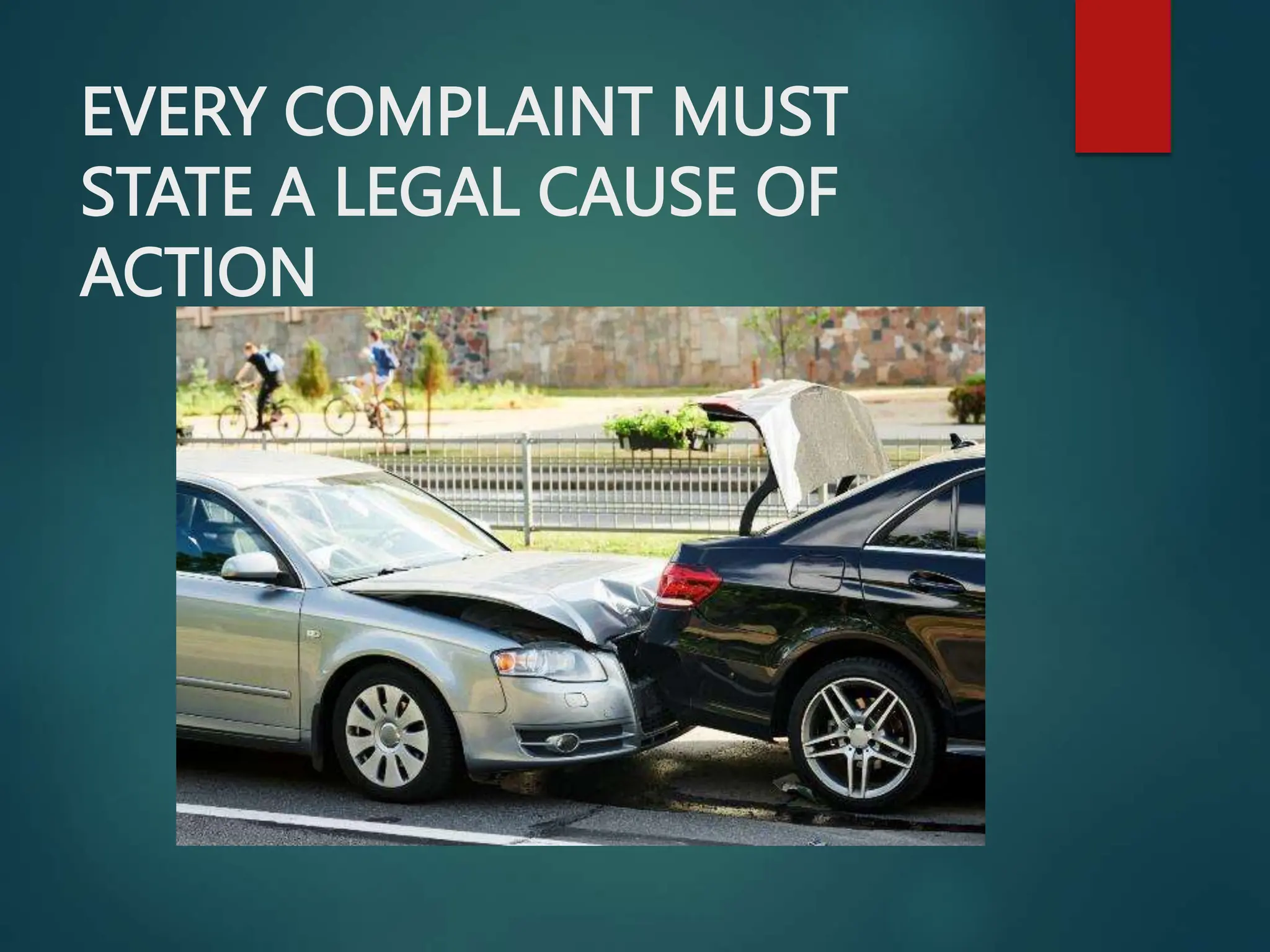
EVERY COMPLAINT MUST
STATE A LEGAL CAUSE OF
ACTION
ELEMENTS OF NEGLIGENCE
 EVERY CAUSE OF ACTION HAS LEGAL ELEMENTS:
 DUTY
 Negligence is the failure to use reasonable care,
which is the care that a reasonably careful person
would use under like circumstances.
 Negligence is doing something that a reasonably
careful person would not do under like circumstances
or failing to do something that a reasonably careful
person would do under like circumstances.
 PRESUMPTION OF NEGLIGENCE
BREACH OF DUTY
 FAILURE TO USE REASONABLE CARE
 EXAMPLES:
 VIOLATION OF A TRAFFIC ORDINANCE RESULTING IN
MVA
 NEGLIGENT ENTRUSTMENT OF VEHICLE
 FAILURE TO PROPERLY MAINTAIN EQUIPMENT
 DISTRACTED DRIVING – CELL PHONE
 DRUNK DRIVING
 ADMISSION IN TRAFFIC COURT
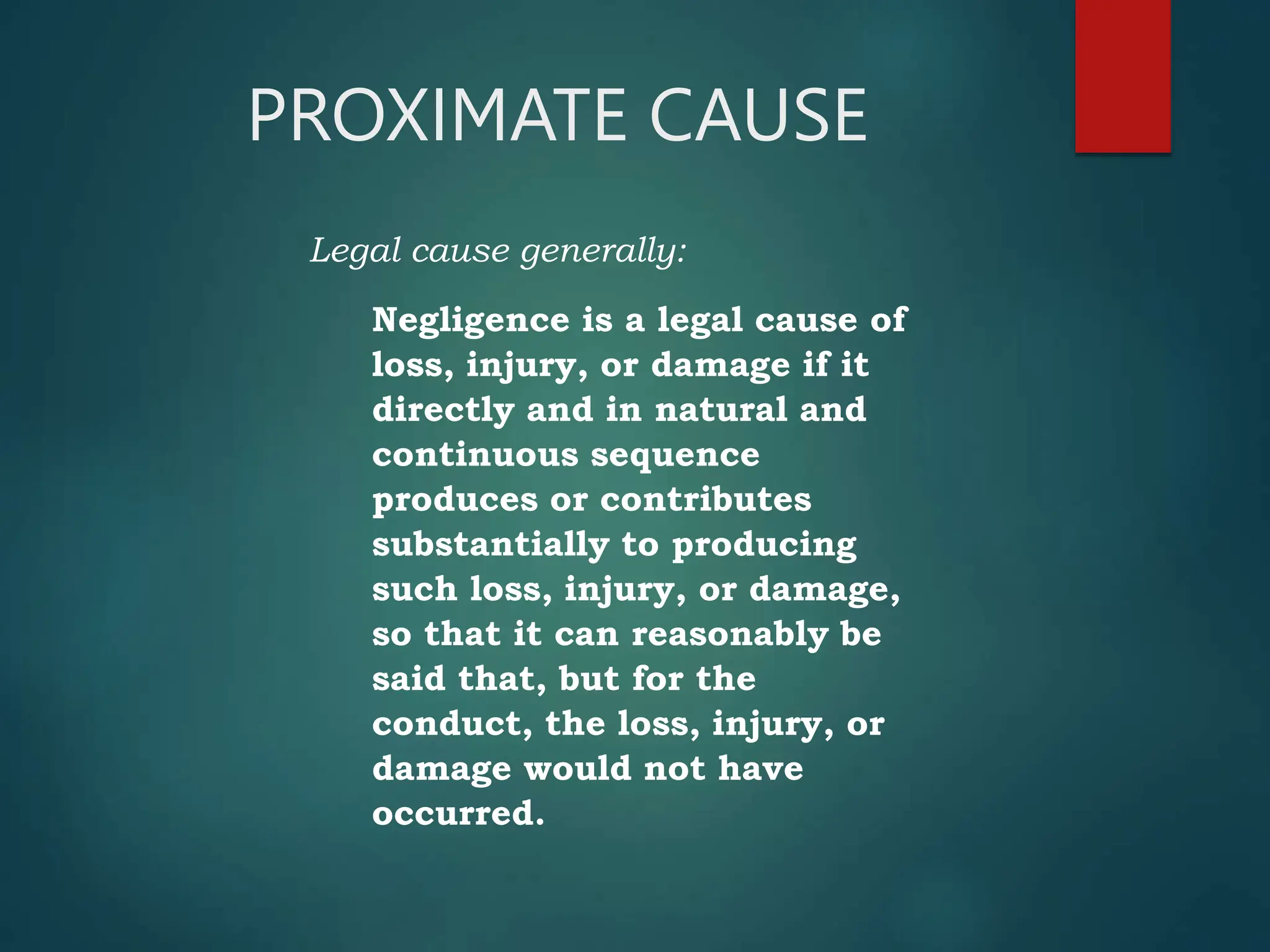
PROXIMATE CAUSE
Legal cause generally:
Negligence is a legal cause of
loss, injury, or damage if it
directly and in natural and
continuous sequence
produces or contributes
substantially to producing
such loss, injury, or damage,
so that it can reasonably be
said that, but for the
conduct, the loss, injury, or
damage would not have
occurred.
CONCURRENT CAUSE
In order to be regarded as a legal
cause of loss, injury or damage]
negligence need not be the only cause.
Negligence may be a legal cause of
loss, injury or damage even though it
operates in combination with the act
of another, some natural cause, or
some other cause if the negligence
contributes substantially to producing
such loss, injury or damage. EGS
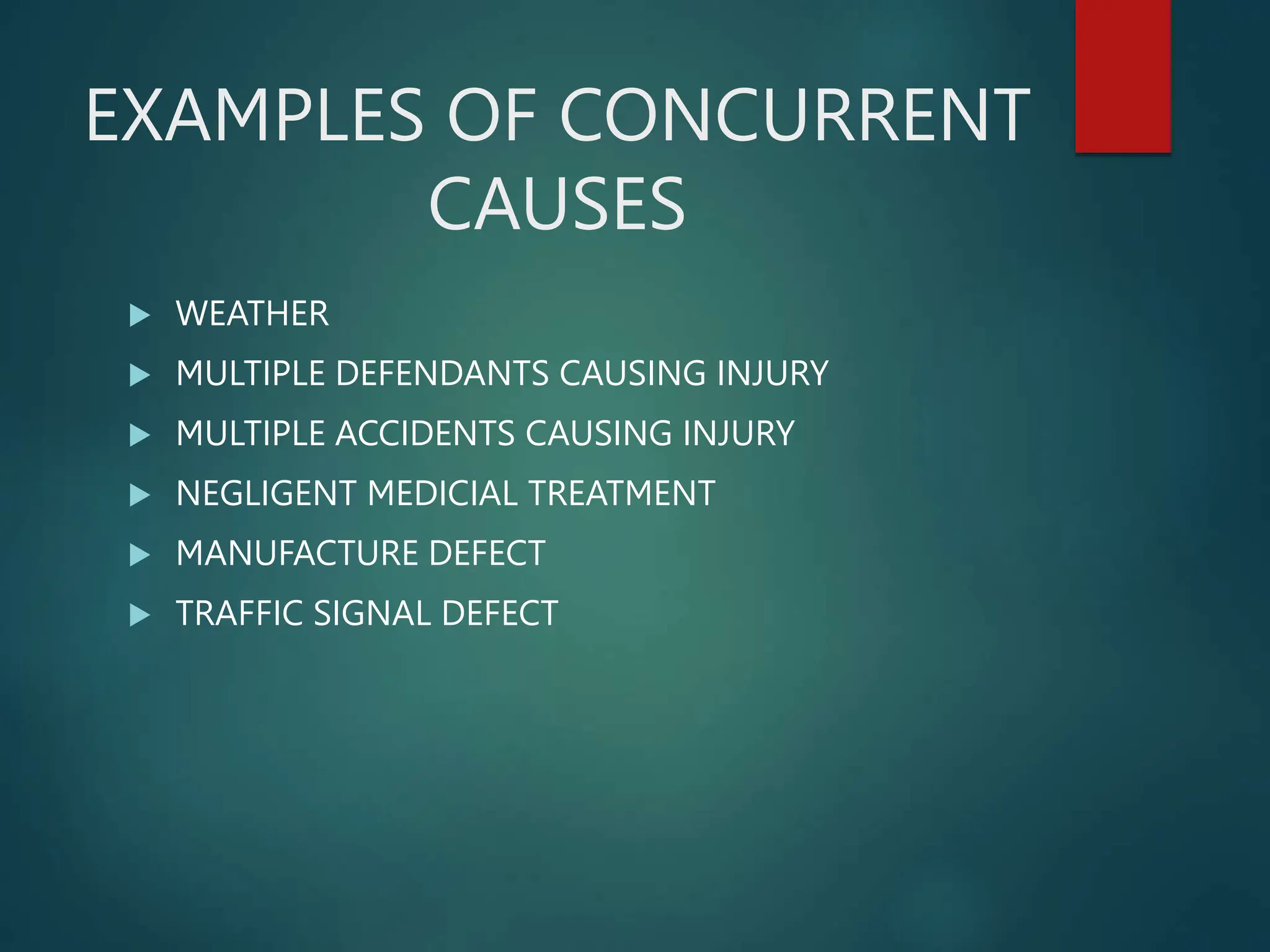
EXAMPLES OF CONCURRENT
CAUSES
 WEATHER
 MULTIPLE DEFENDANTS CAUSING INJURY
 MULTIPLE ACCIDENTS CAUSING INJURY
 NEGLIGENT MEDICIAL TREATMENT
 MANUFACTURE DEFECT
 TRAFFIC SIGNAL DEFECT
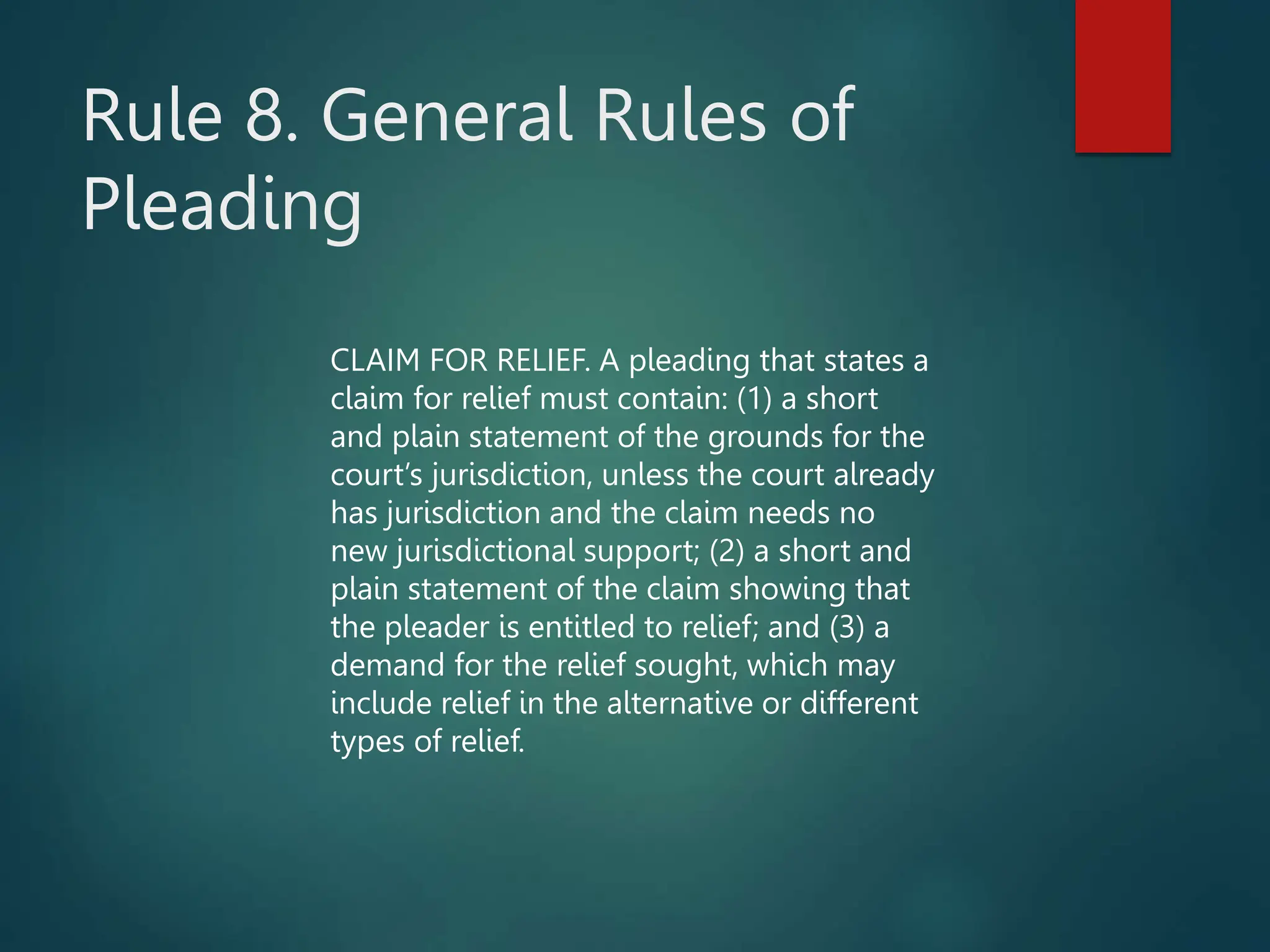
Rule 8. General Rules of
Pleading
CLAIM FOR RELIEF. A pleading that states a
claim for relief must contain: (1) a short
and plain statement of the grounds for the
court’s jurisdiction, unless the court already
has jurisdiction and the claim needs no
new jurisdictional support; (2) a short and
plain statement of the claim showing that
the pleader is entitled to relief; and (3) a
demand for the relief sought, which may
include relief in the alternative or different
types of relief.
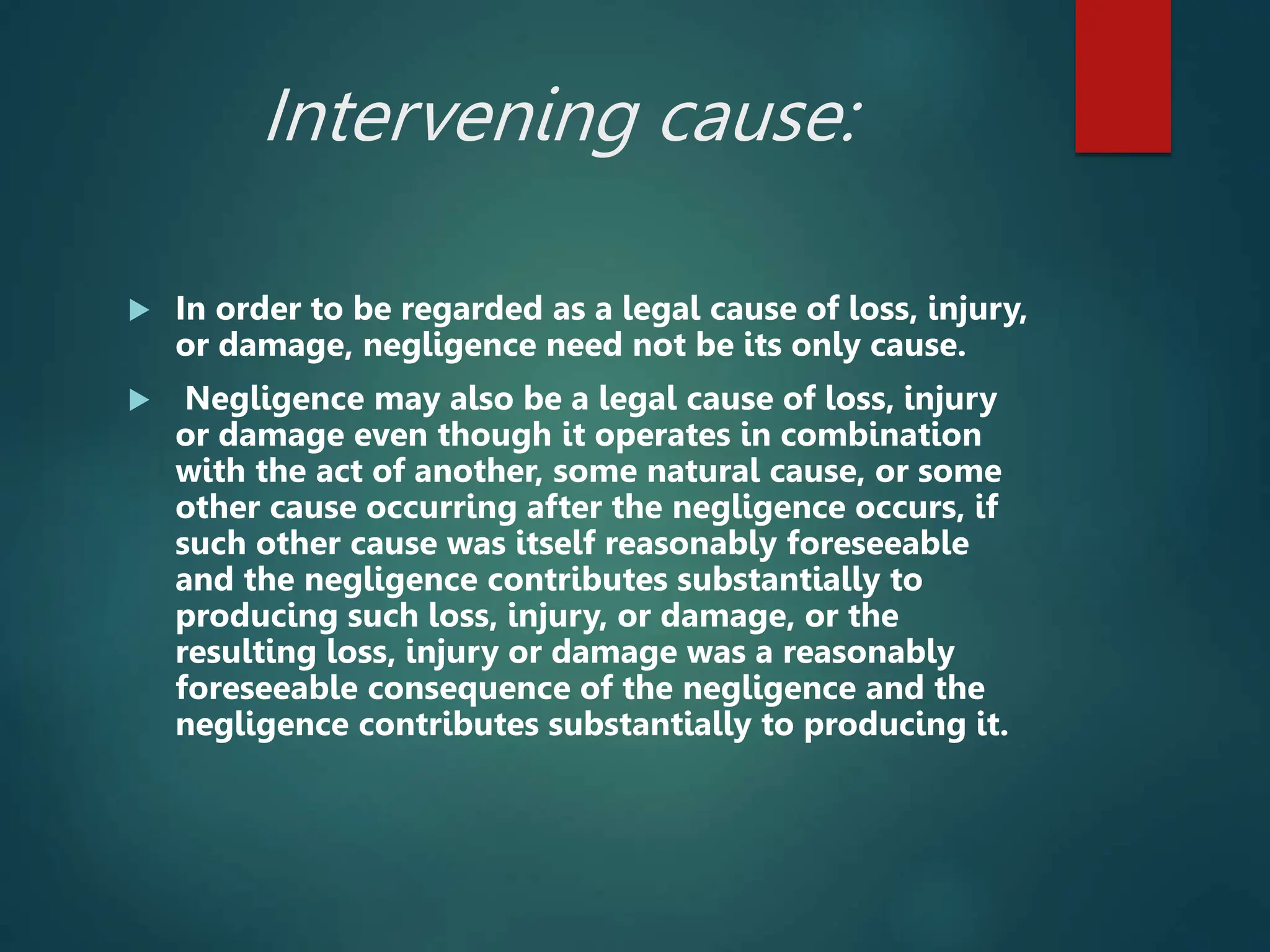
Intervening cause:
 In order to be regarded as a legal cause of loss, injury,
or damage, negligence need not be its only cause.
 Negligence may also be a legal cause of loss, injury
or damage even though it operates in combination
with the act of another, some natural cause, or some
other cause occurring after the negligence occurs, if
such other cause was itself reasonably foreseeable
and the negligence contributes substantially to
producing such loss, injury, or damage, or the
resulting loss, injury or damage was a reasonably
foreseeable consequence of the negligence and the
negligence contributes substantially to producing it.
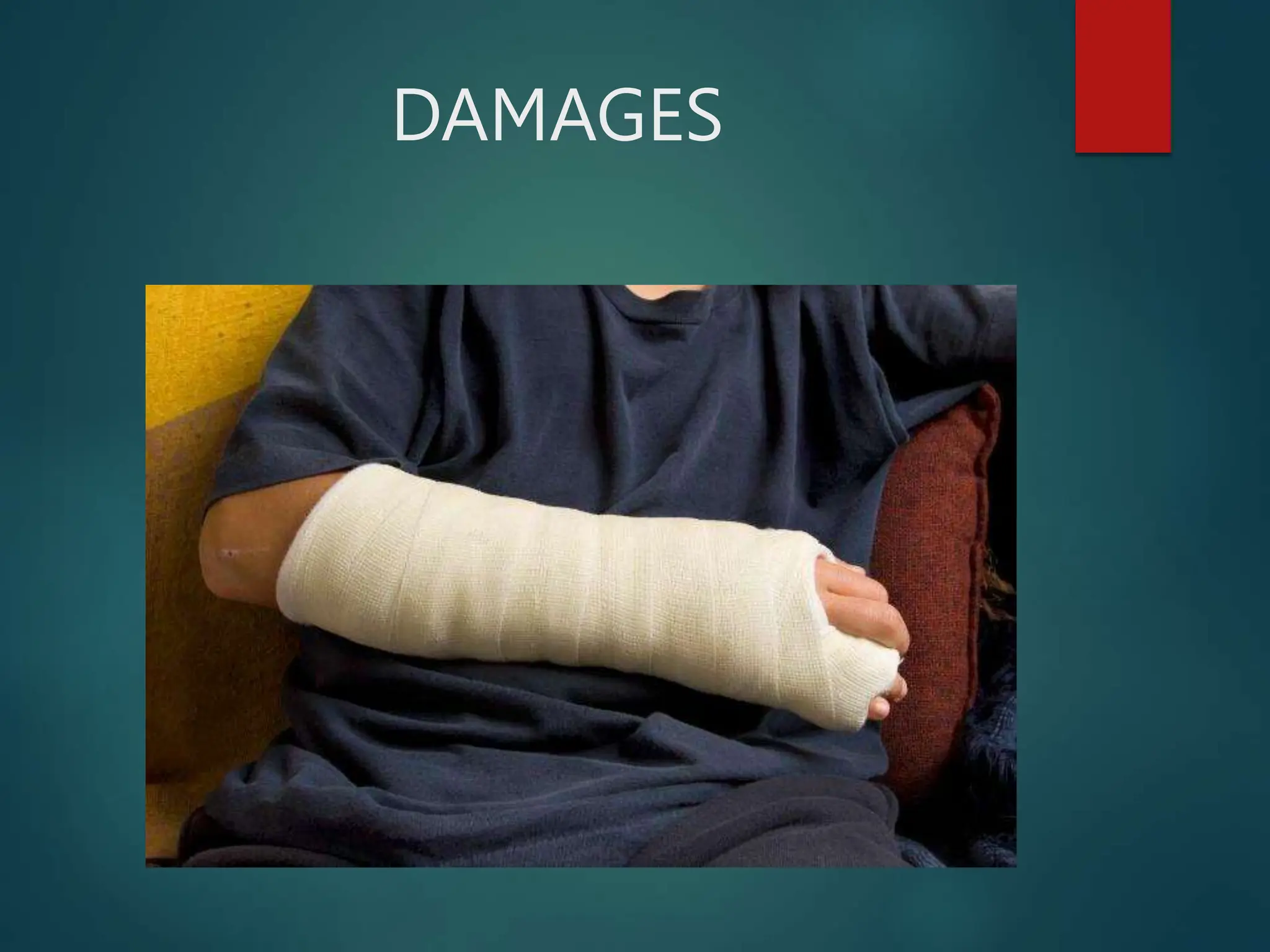
DAMAGES
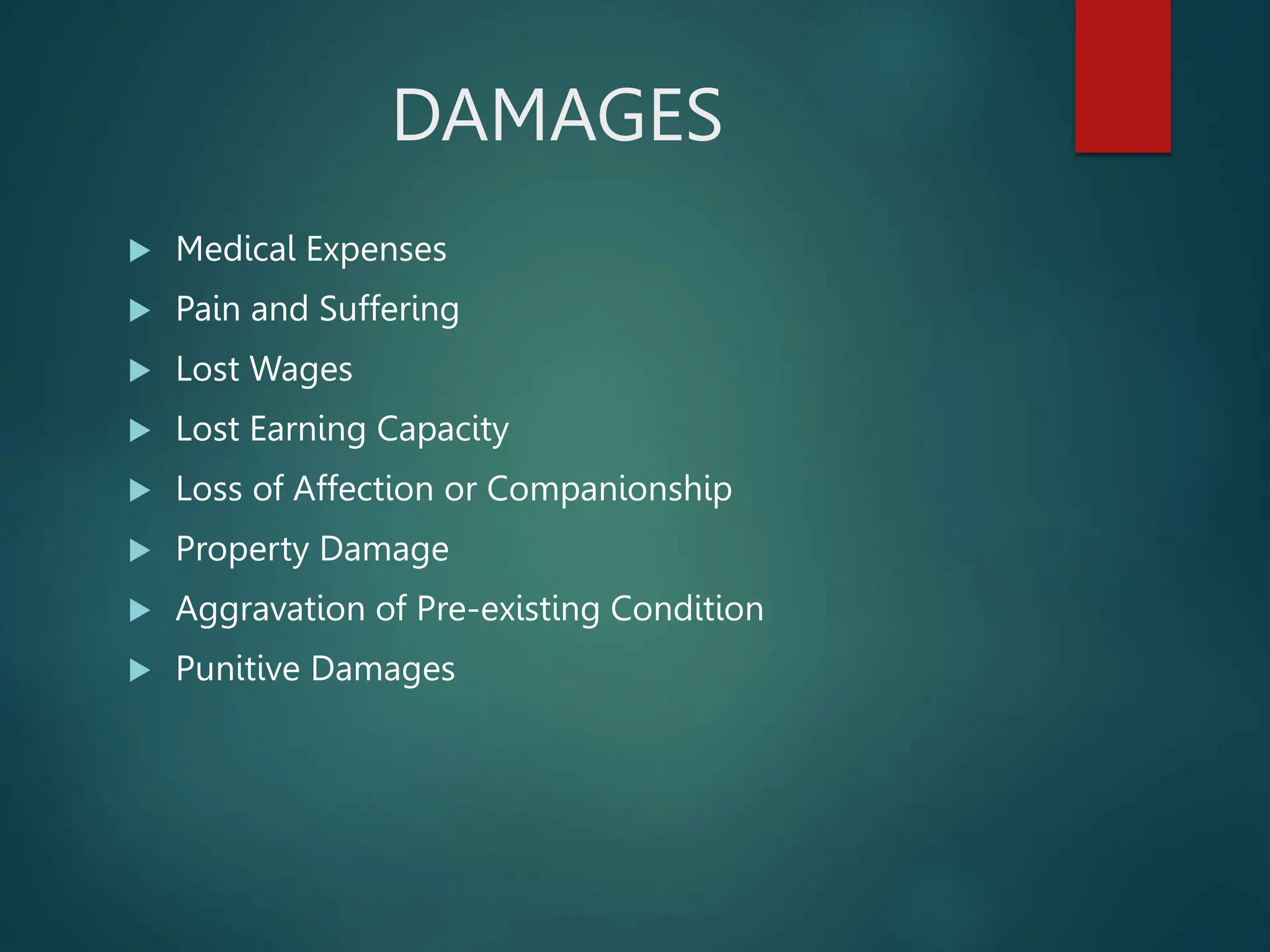
DAMAGES
 Medical Expenses
 Pain and Suffering
 Lost Wages
 Lost Earning Capacity
 Loss of Affection or Companionship
 Property Damage
 Aggravation of Pre-existing Condition
 Punitive Damages
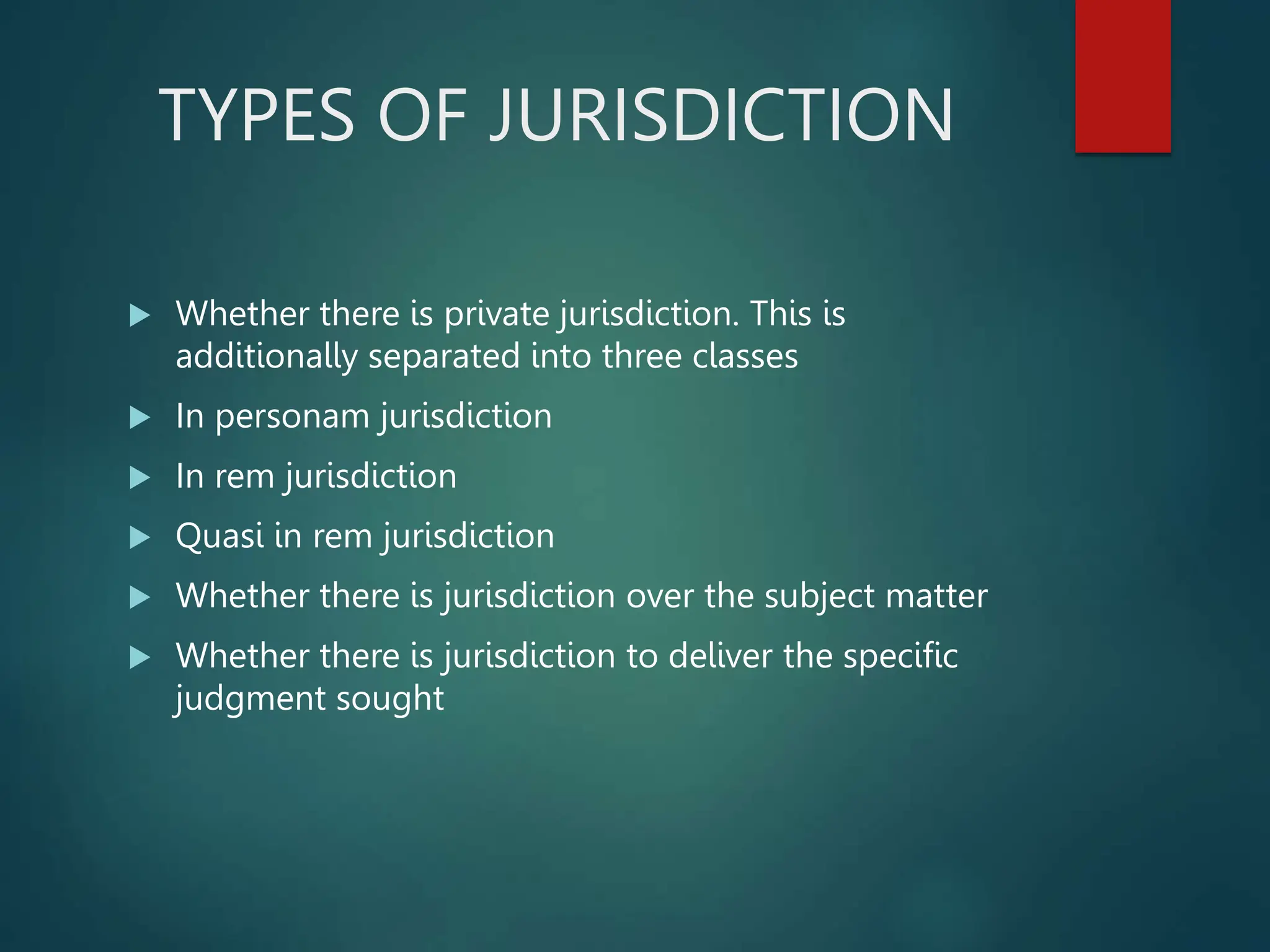
TYPES OF JURISDICTION
 Whether there is private jurisdiction. This is
additionally separated into three classes
 In personam jurisdiction
 In rem jurisdiction
 Quasi in rem jurisdiction
 Whether there is jurisdiction over the subject matter
 Whether there is jurisdiction to deliver the specific
judgment sought
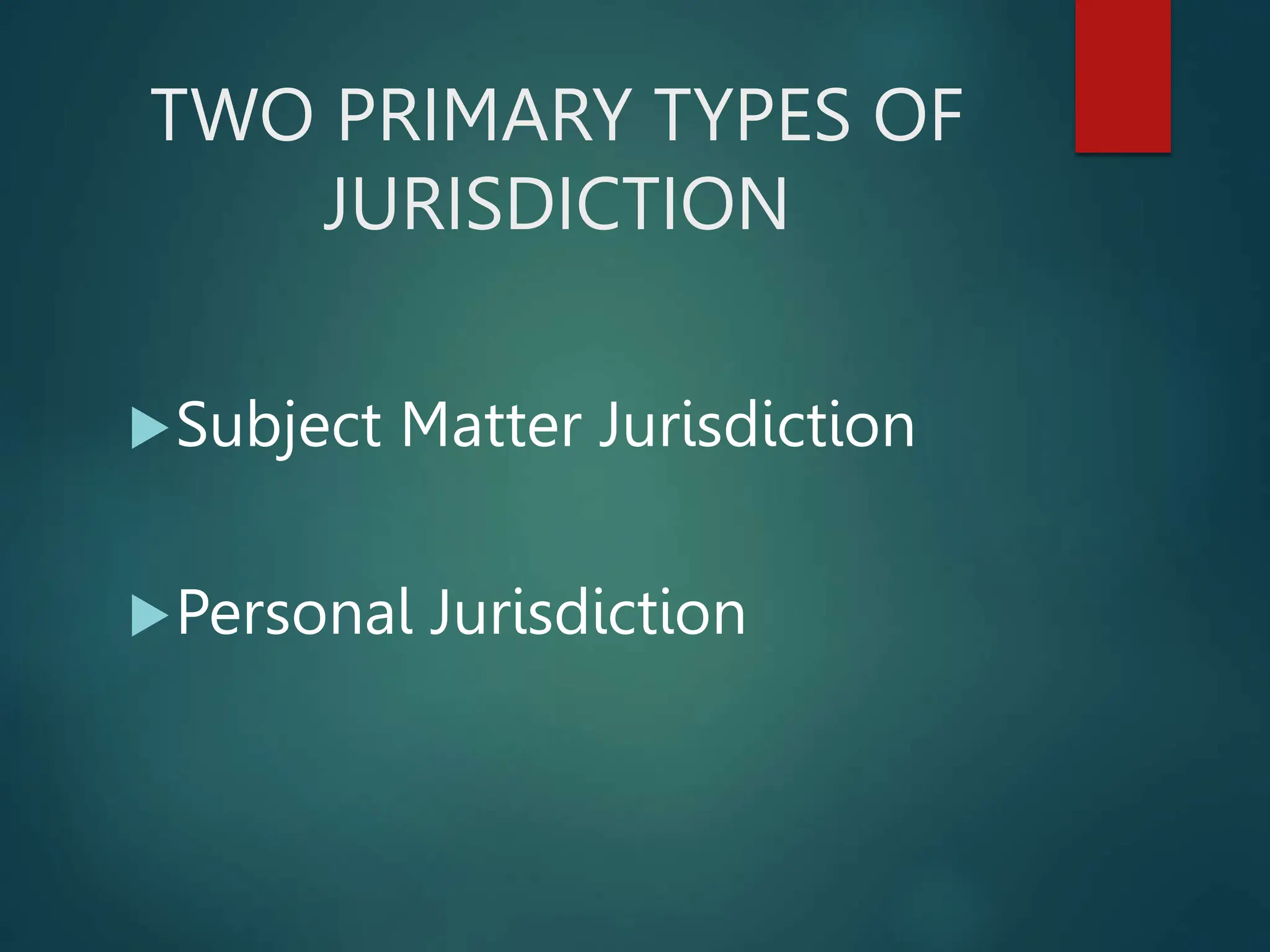
TWO PRIMARY TYPES OF
JURISDICTION
Subject Matter Jurisdiction
Personal Jurisdiction
Federal Subject Matter
Jurisdiction
 Federal subject matter jurisdiction refers to the authority of
federal courts to hear and decide on cases based on federal law.
There are several types of federal subject matter jurisdiction,
including federal question jurisdiction and diversity jurisdiction.
 Federal question jurisdiction refers to cases under the U.S.
Constitution, federal laws, or treaties. It means that the case
involves a question of federal law, and the federal court has the
authority to hear and decide on the matter. Examples of topics
under federal question jurisdiction include disputes involving
federal civil rights, bankruptcy, and patent law.
 Diversity jurisdiction, on the other hand, refers to cases that
involve citizens of different states and an amount in controversy
exceeding $75,000. The federal court has the authority to hear
and decide on the matter because of the diversity of the parties
involved.
State Subject Matter
Jurisdiction
 State subject matter jurisdiction refers to the authority
of state courts to hear and decide on cases based on
state law. State courts have subject matter jurisdiction
over cases that are not within the federal court’s
subject matter jurisdiction or involve state law.
Examples of cases that fall under state subject matter
jurisdiction include family law matters, probate, and
contract disputes.
CONCURRENT
JURISDICTION
 In some cases, both federal and state
courts may have subject matter
jurisdiction over a particular case.
When this occurs, the parties involved
may choose to file the case in either
court, depending on their legal
strategy.
FEDERAL AND STATE COURT
INTERACTION
 The federal government and the states each have their own set
of laws and their own court systems. Federal and state courts
vary in structure, with significant differences between the federal
and state judiciaries as well as variation among the different
states. Federal and state courts generally operate separately, but
there is not an absolute division between the federal and state
judicial systems.
 Sometimes, state courts decide questions of state law and
federal courts decide questions of federal law. However, state
courts can also hear many types of federal law claims, and there
are circumstances in which federal courts apply state law. Federal
courts can also review state court decisions that may conflict
with the U.S. Constitution or federal law. In addition, cases or
legal issues can move between the two judicial systems
SUBJECT MATTER
JURISDICTION
 Subject matter jurisdiction is the power of a court to
hear a specific kind of lawsuit or legal dispute.
 In simpler terms, it is the power of a court to
adjudicate or decide on a specific legal matter. It is a
critical legal concept that ensures that cases are heard
by the appropriate court, which has the legal authority
to decide on the specific issue.
Personal Jurisdiction
 Refers to the court’s authority over the
parties involved in a case.
 Personal jurisdiction concerns whether
a particular court can exercise power
over a defendant or respondent.
34.01 Jurisdiction of county
court.
 (1) County courts shall have original jurisdiction:(a) In
all misdemeanor cases not cognizable by the circuit
courts.
 (b) Of all violations of municipal and county ordinances.
 (c) Of all actions at law, except those within the exclusive
jurisdiction of the circuit courts, in which the matter in
controversy does not exceed, exclusive of interest, costs,
and attorney fees:1. If filed on or before December 31,
2019, the sum of $15,000.
 2. If filed on or after January 1, 2020, the sum of
$30,000.
 3. If filed on or after January 1, 2023, the sum of
$50,000.
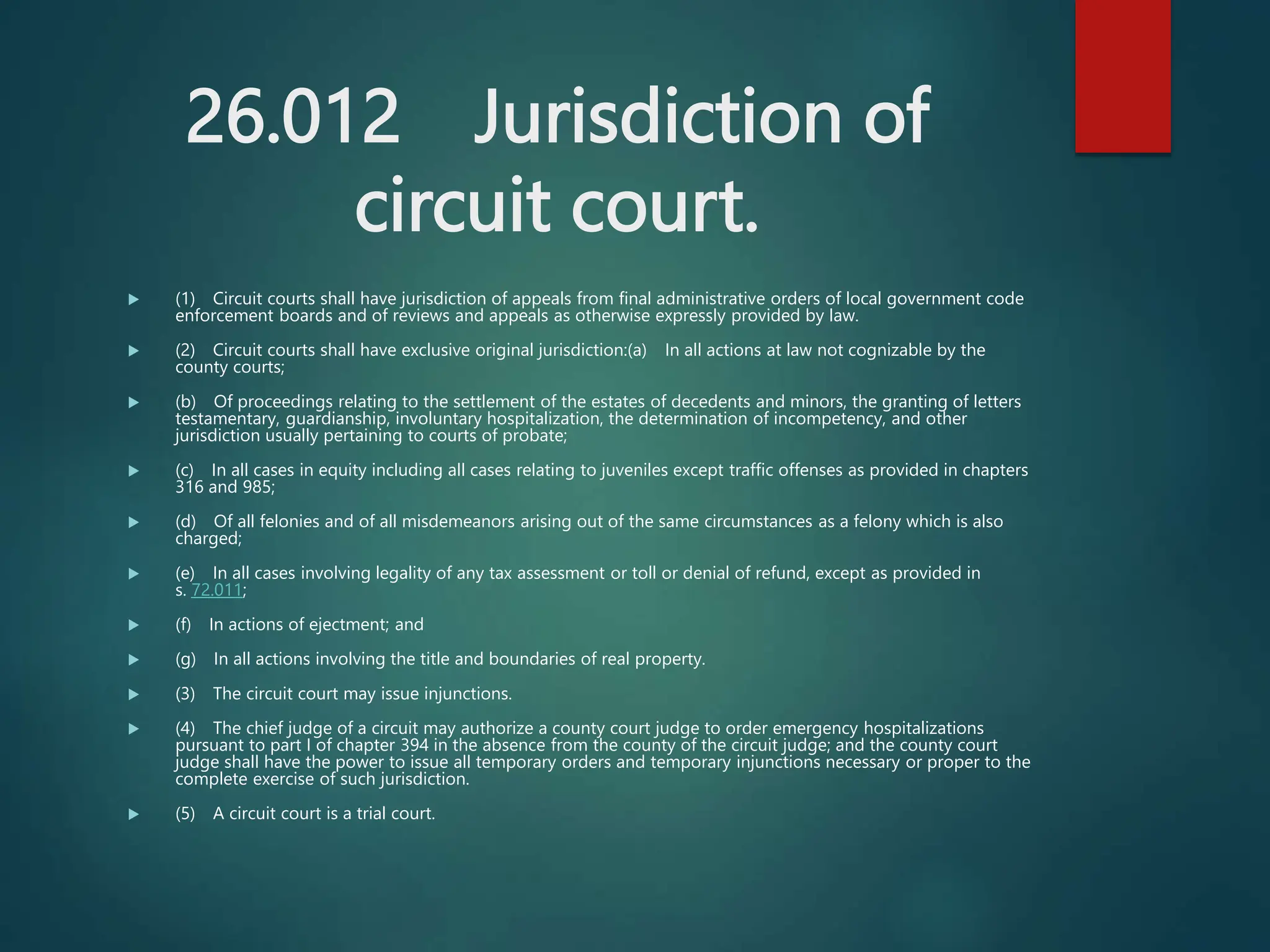
26.012 Jurisdiction of
circuit court.
 (1) Circuit courts shall have jurisdiction of appeals from final administrative orders of local government code
enforcement boards and of reviews and appeals as otherwise expressly provided by law.
 (2) Circuit courts shall have exclusive original jurisdiction:(a) In all actions at law not cognizable by the
county courts;
 (b) Of proceedings relating to the settlement of the estates of decedents and minors, the granting of letters
testamentary, guardianship, involuntary hospitalization, the determination of incompetency, and other
jurisdiction usually pertaining to courts of probate;
 (c) In all cases in equity including all cases relating to juveniles except traffic offenses as provided in chapters
316 and 985;
 (d) Of all felonies and of all misdemeanors arising out of the same circumstances as a felony which is also
charged;
 (e) In all cases involving legality of any tax assessment or toll or denial of refund, except as provided in
s. 72.011;
 (f) In actions of ejectment; and
 (g) In all actions involving the title and boundaries of real property.
 (3) The circuit court may issue injunctions.
 (4) The chief judge of a circuit may authorize a county court judge to order emergency hospitalizations
pursuant to part I of chapter 394 in the absence from the county of the circuit judge; and the county court
judge shall have the power to issue all temporary orders and temporary injunctions necessary or proper to the
complete exercise of such jurisdiction.
 (5) A circuit court is a trial court.
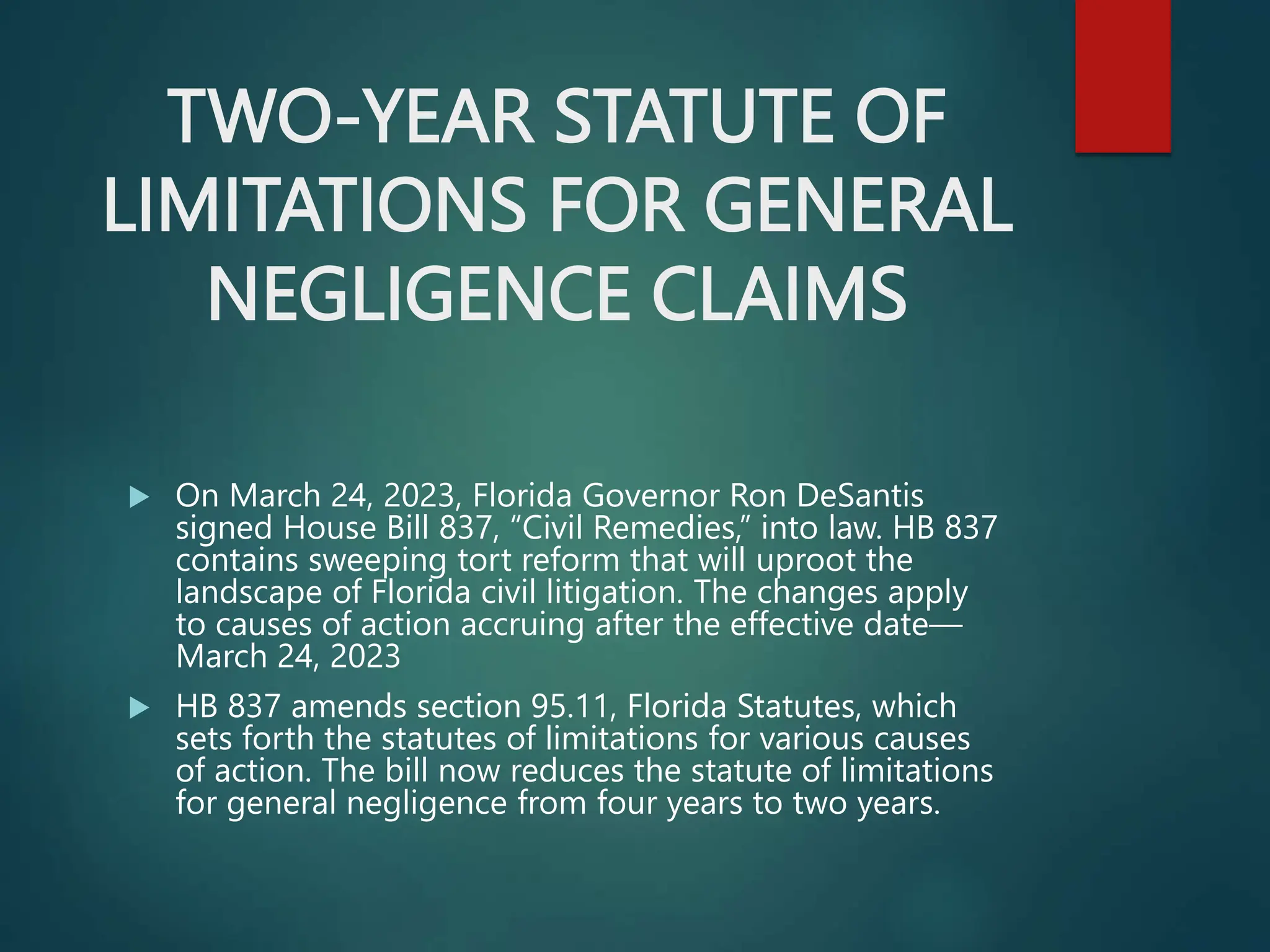
TWO-YEAR STATUTE OF
LIMITATIONS FOR GENERAL
NEGLIGENCE CLAIMS
 On March 24, 2023, Florida Governor Ron DeSantis
signed House Bill 837, “Civil Remedies,” into law. HB 837
contains sweeping tort reform that will uproot the
landscape of Florida civil litigation. The changes apply
to causes of action accruing after the effective date—
March 24, 2023
 HB 837 amends section 95.11, Florida Statutes, which
sets forth the statutes of limitations for various causes
of action. The bill now reduces the statute of limitations
for general negligence from four years to two years.
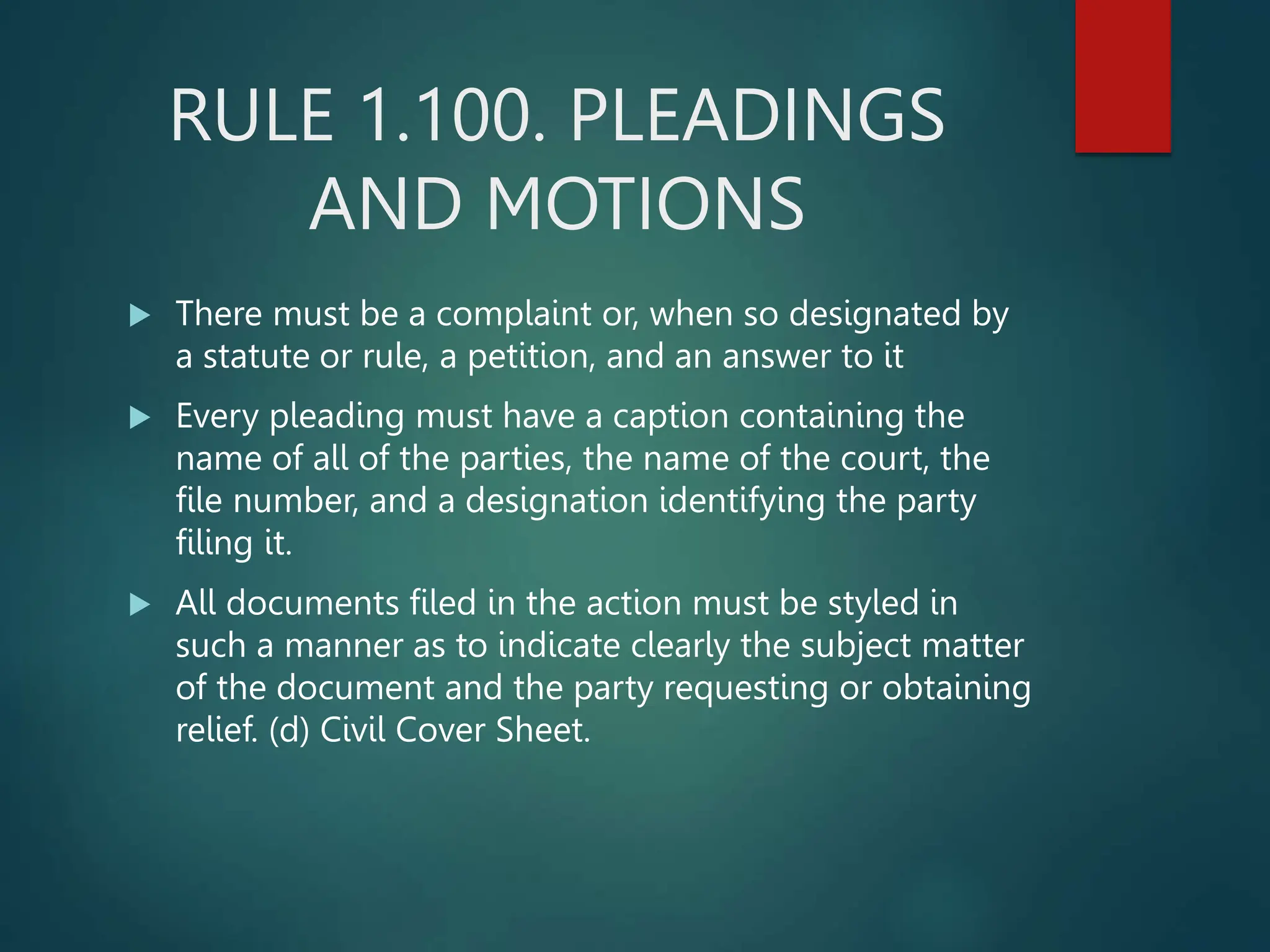
RULE 1.100. PLEADINGS
AND MOTIONS
 There must be a complaint or, when so designated by
a statute or rule, a petition, and an answer to it
 Every pleading must have a caption containing the
name of all of the parties, the name of the court, the
file number, and a designation identifying the party
filing it.
 All documents filed in the action must be styled in
such a manner as to indicate clearly the subject matter
of the document and the party requesting or obtaining
relief. (d) Civil Cover Sheet.
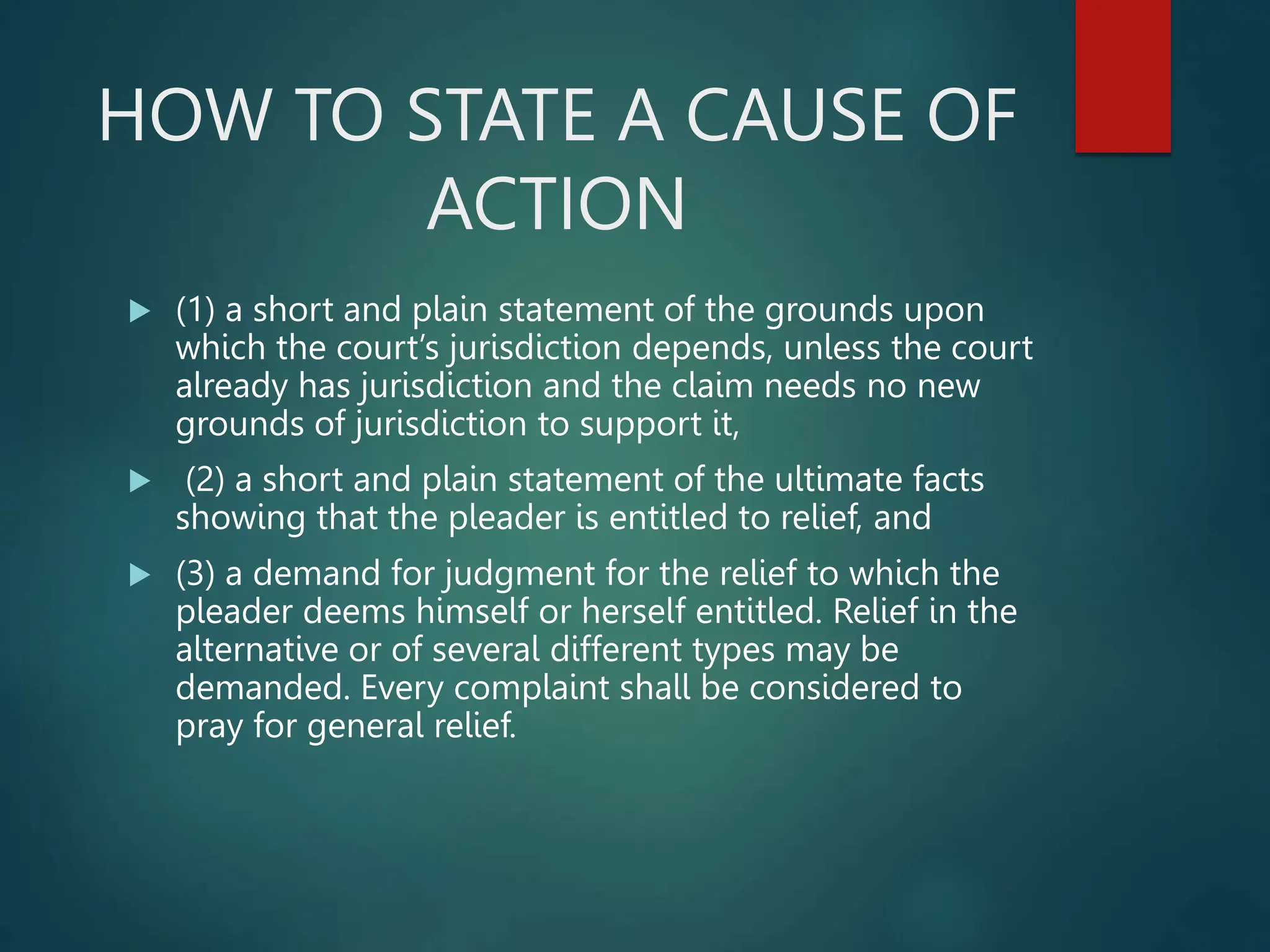
HOW TO STATE A CAUSE OF
ACTION
 (1) a short and plain statement of the grounds upon
which the court’s jurisdiction depends, unless the court
already has jurisdiction and the claim needs no new
grounds of jurisdiction to support it,
 (2) a short and plain statement of the ultimate facts
showing that the pleader is entitled to relief, and
 (3) a demand for judgment for the relief to which the
pleader deems himself or herself entitled. Relief in the
alternative or of several different types may be
demanded. Every complaint shall be considered to
pray for general relief.
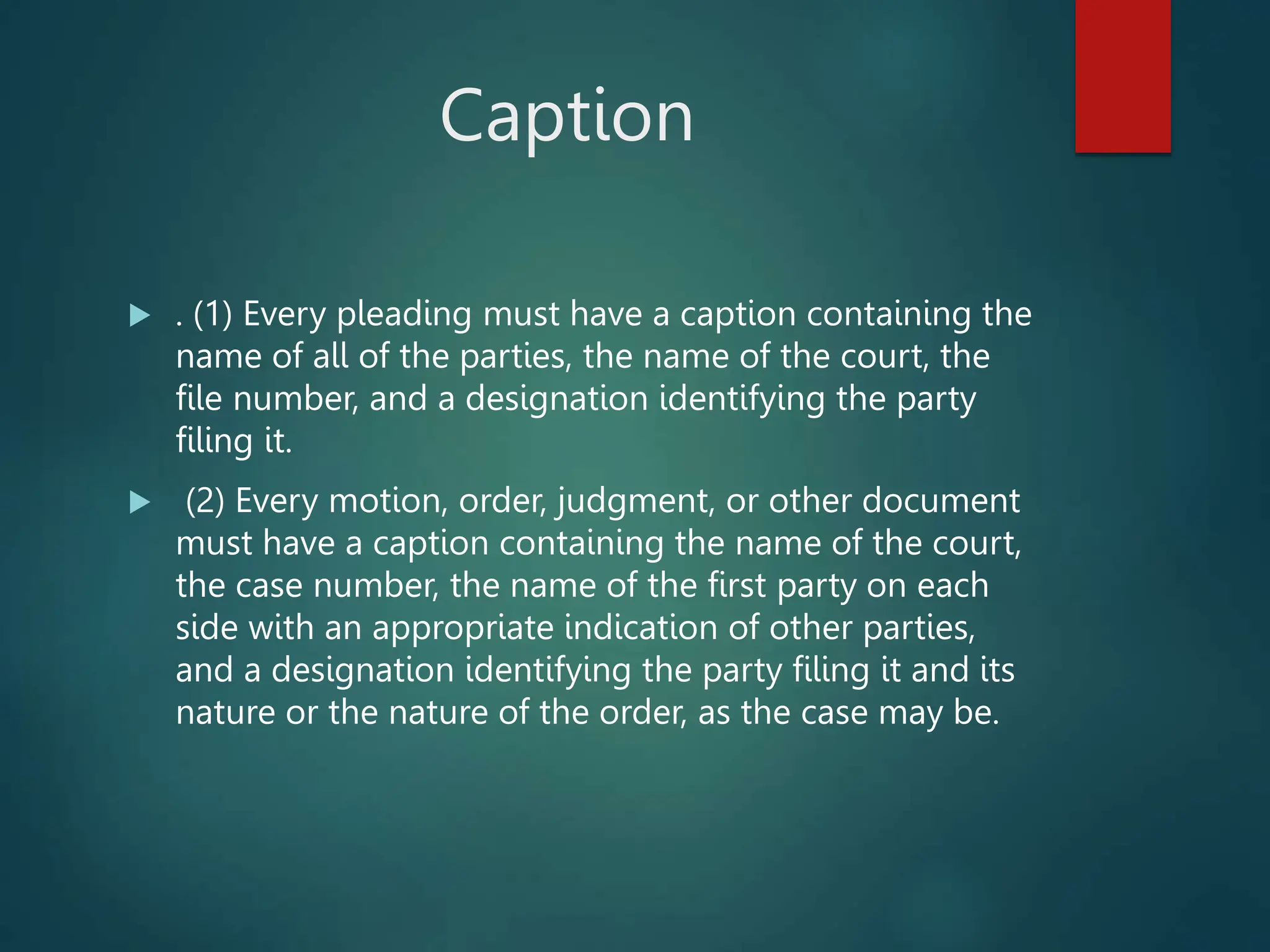
Caption
 . (1) Every pleading must have a caption containing the
name of all of the parties, the name of the court, the
file number, and a designation identifying the party
filing it.
 (2) Every motion, order, judgment, or other document
must have a caption containing the name of the court,
the case number, the name of the first party on each
side with an appropriate indication of other parties,
and a designation identifying the party filing it and its
nature or the nature of the order, as the case may be.
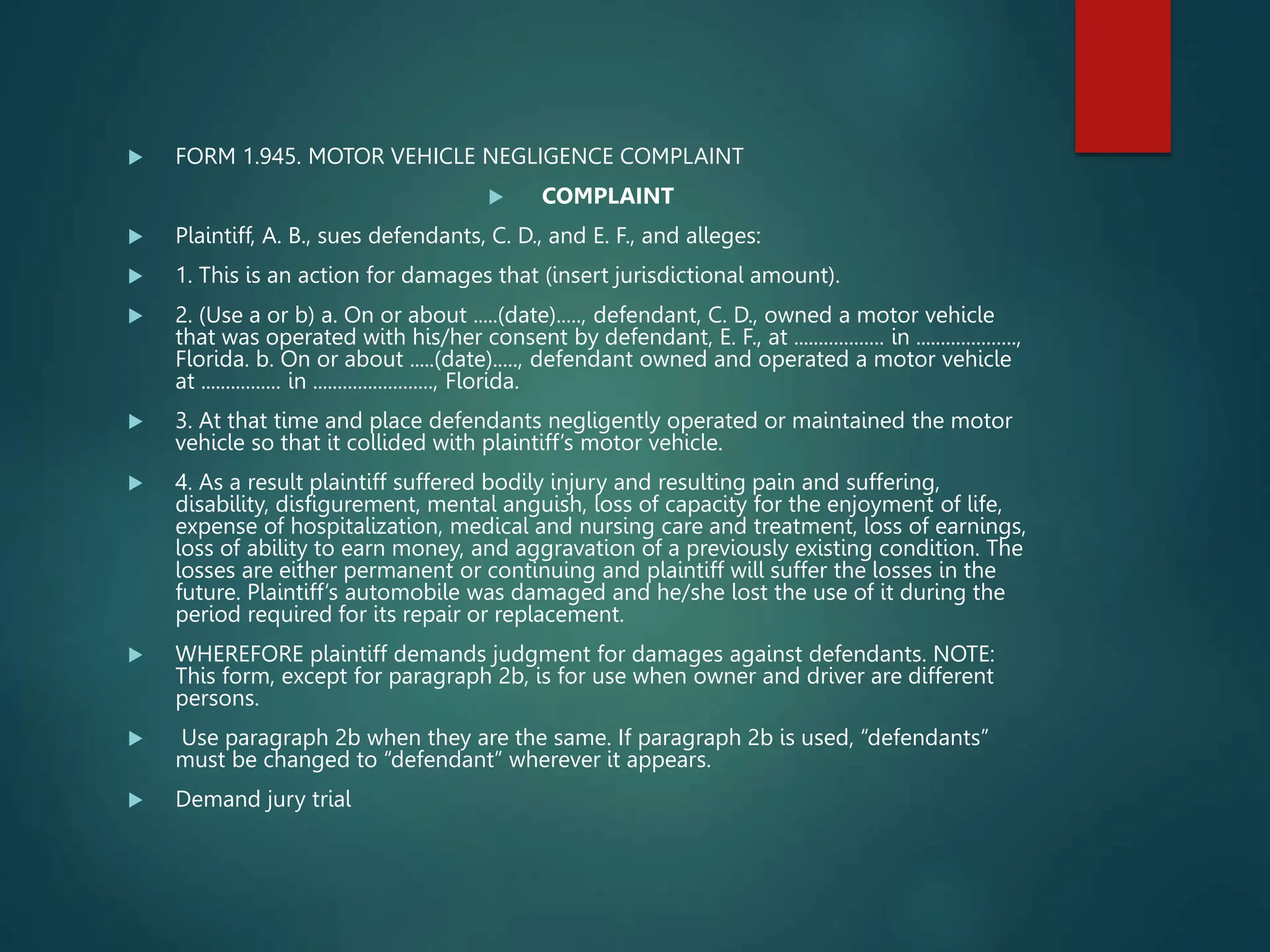
 FORM 1.945. MOTOR VEHICLE NEGLIGENCE COMPLAINT
 COMPLAINT
 Plaintiff, A. B., sues defendants, C. D., and E. F., and alleges:
 1. This is an action for damages that (insert jurisdictional amount).
 2. (Use a or b) a. On or about .....(date)....., defendant, C. D., owned a motor vehicle
that was operated with his/her consent by defendant, E. F., at .................. in ....................,
Florida. b. On or about .....(date)....., defendant owned and operated a motor vehicle
at ................ in ........................, Florida.
 3. At that time and place defendants negligently operated or maintained the motor
vehicle so that it collided with plaintiff’s motor vehicle.
 4. As a result plaintiff suffered bodily injury and resulting pain and suffering,
disability, disfigurement, mental anguish, loss of capacity for the enjoyment of life,
expense of hospitalization, medical and nursing care and treatment, loss of earnings,
loss of ability to earn money, and aggravation of a previously existing condition. The
losses are either permanent or continuing and plaintiff will suffer the losses in the
future. Plaintiff’s automobile was damaged and he/she lost the use of it during the
period required for its repair or replacement.
 WHEREFORE plaintiff demands judgment for damages against defendants. NOTE:
This form, except for paragraph 2b, is for use when owner and driver are different
persons.
 Use paragraph 2b when they are the same. If paragraph 2b is used, “defendants”
must be changed to “defendant” wherever it appears.
 Demand jury trial
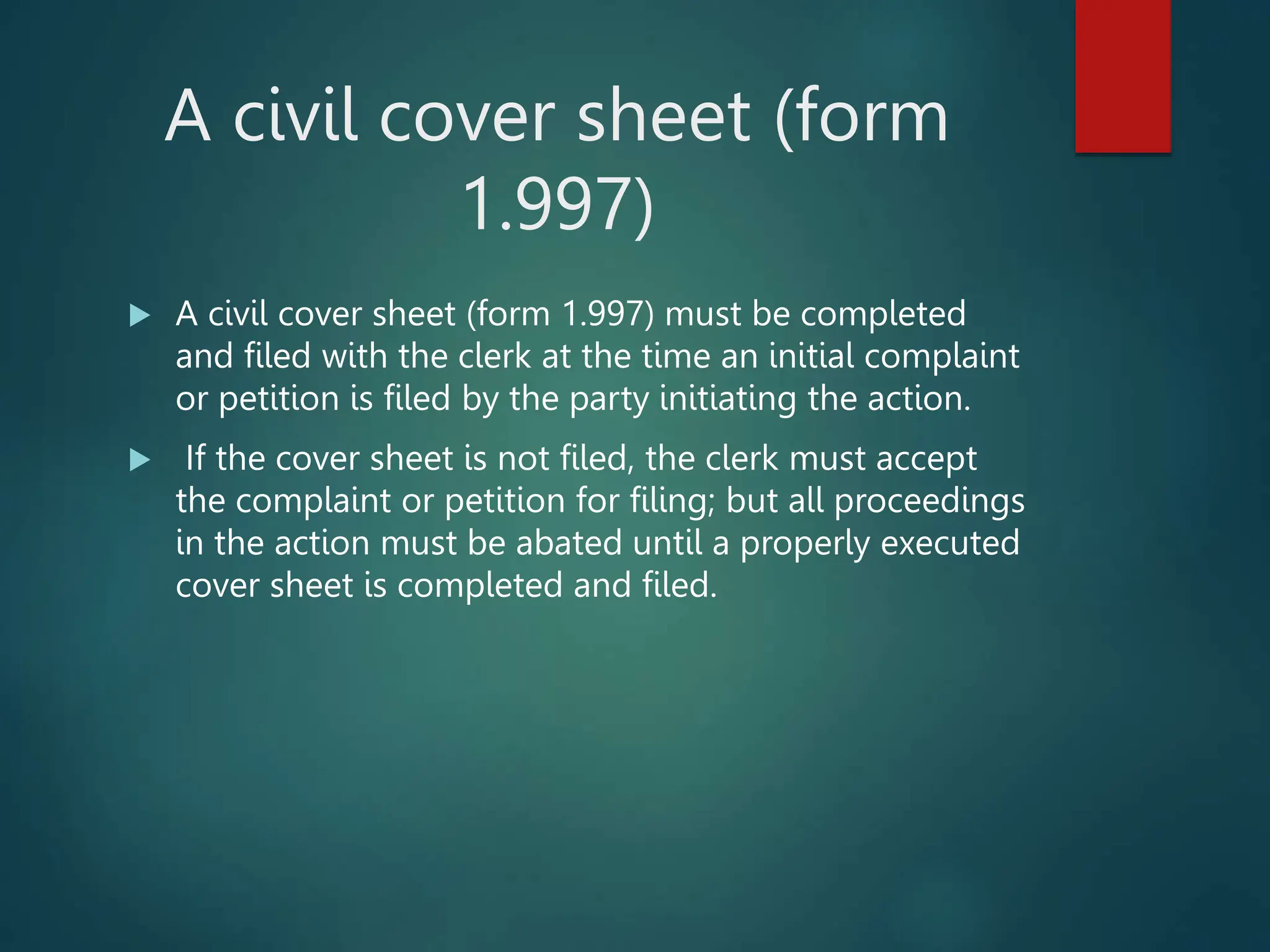
A civil cover sheet (form
1.997)
 A civil cover sheet (form 1.997) must be completed
and filed with the clerk at the time an initial complaint
or petition is filed by the party initiating the action.
 If the cover sheet is not filed, the clerk must accept
the complaint or petition for filing; but all proceedings
in the action must be abated until a properly executed
cover sheet is completed and filed.
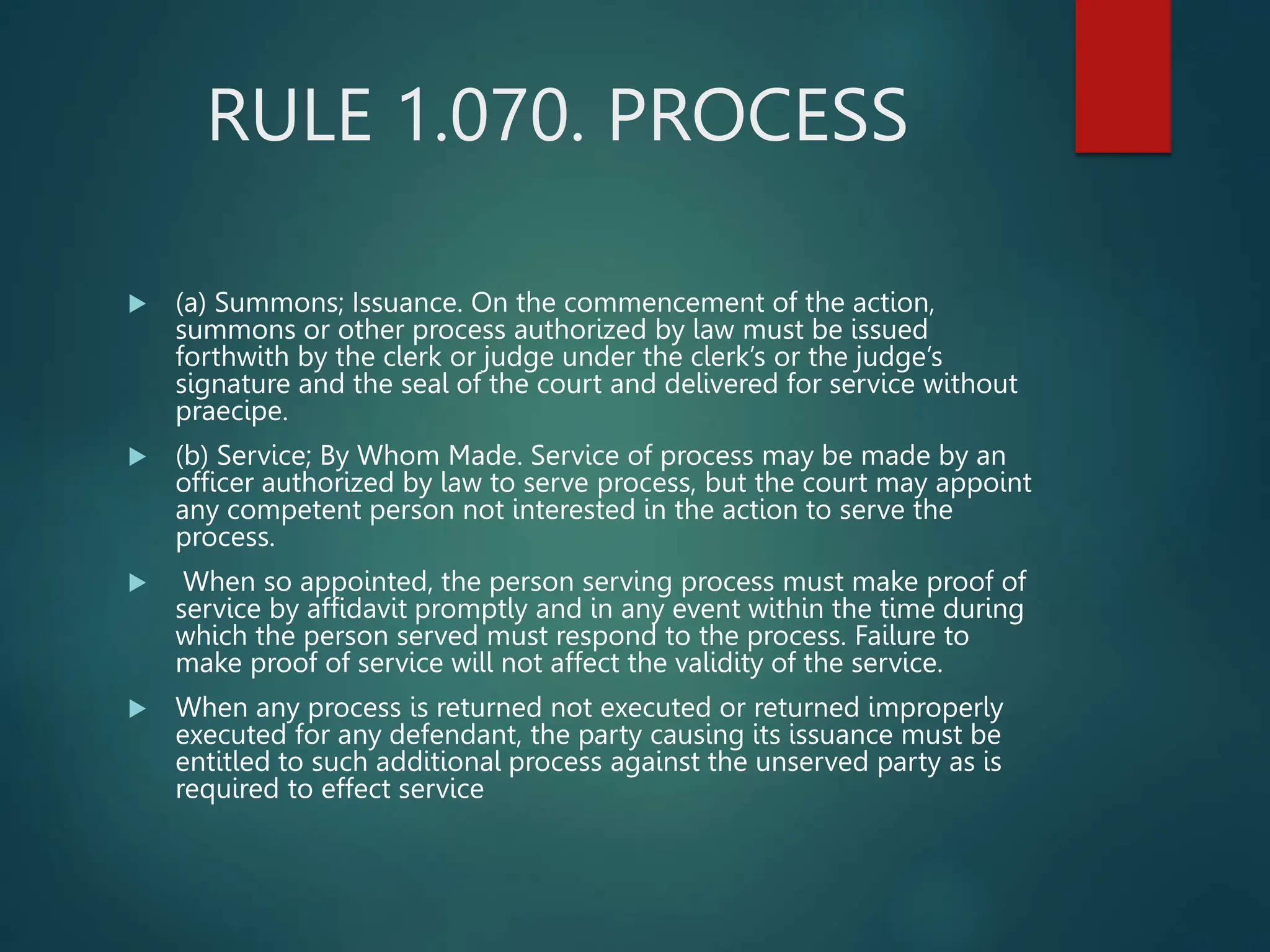
RULE 1.070. PROCESS
 (a) Summons; Issuance. On the commencement of the action,
summons or other process authorized by law must be issued
forthwith by the clerk or judge under the clerk’s or the judge’s
signature and the seal of the court and delivered for service without
praecipe.
 (b) Service; By Whom Made. Service of process may be made by an
officer authorized by law to serve process, but the court may appoint
any competent person not interested in the action to serve the
process.
 When so appointed, the person serving process must make proof of
service by affidavit promptly and in any event within the time during
which the person served must respond to the process. Failure to
make proof of service will not affect the validity of the service.
 When any process is returned not executed or returned improperly
executed for any defendant, the party causing its issuance must be
entitled to such additional process against the unserved party as is
required to effect service
FORM 1.902. SUMMONS (a)
General Form
 SUMMONS
 THE STATE OF FLORIDA:
 To Each Sheriff of the State:
 YOU ARE COMMANDED to serve this summons and a copy of the complaint or petition in this action on
defendant ...........
 Each defendant is required to serve written defenses to the complaint or petition on ………. plaintiff’s attorney,
whose address is ………., within 20 days1 after service of this summons on that defendant, exclusive of the day
of service, and to file the original of the defenses with the clerk of this court either before service on plaintiff’s
attorney or immediately thereafter.
 If a defendant fails to do so, a default will be entered against that defendant for the relief demanded in the
complaint or petition.
 DATED on ……….
 (Name of Clerk) As Clerk of the Court By .
 As Deputy Clerk SUMMONS
 THE STATE OF FLORIDA:
 To Each Sheriff of the State: 1 Except when suit is brought pursuant to section 768.28, Florida Statutes, if the
State of Florida, one of its agencies, or one of its officials or employees sued in his or her official capacity is a
defendant, the time to be inserted as to it is 40 days. When suit is brought pursuant to section 768.28, Florida
Statutes, the time to be inserted is 30 days.
summons
 YOU ARE COMMANDED to serve this summons and a copy of the complaint in this law-suit on
defendant………….
 DATED on ....................
 CLERK OF THE CIRCUIT COURT
 (SEAL)
 (Name of Clerk) As Clerk of the Court
 By . As Deputy Clerk
 IMPORTANT
 A lawsuit has been filed against you. You have 20 calendar days after this summons is served on you to file a
written response to the attached complaint with the clerk of this court. A phone call will not protect you. Your
written response, including the case number given above and the names of the parties, must be filed if you
want the court to hear your side of the case. If you do not file your response on time, you may lose the case,
and your wages, money, and property may thereafter be taken without further warning from the court. There
are other legal requirements. You may want to call an attorney right away. If you do not know an attorney,
you may call an attorney referral service or a legal aid office (listed in the phone book).
 If you choose to file a written response yourself, at the same time you file your written response to the court
you must also mail or take a copy of your written response to the “Plaintiff/Plaintiff’s Attorney” named below.
If you are a person with a disability who needs any accommodation in order to participate in this proceeding,
you are entitled, at no cost to you, to the provision of certain assistance. Please contact [identify applicable
court personnel by name, address, and telephone number] at least 7 days before your scheduled court
appearance, or immediately upon receiving this notification if the time before the scheduled appear
 If you are a person with a disability who needs any
accommodation in order to participate in this
proceeding, you are entitled, at no cost to you, to the
provision of certain assistance. Please contact [identify
applicable court personnel by name, address, and
telephone number] at least 7 days before your
scheduled court appearance, or immediately upon
receiving this notification if the time before the
scheduled appearance is less than 7 days; if you are
hearing or voice impaired, call 711.
Drafting Complaint - Learn how to draft a law school level complaint.

Drafting Complaint - Learn how to draft a law school level complaint.

  • 1.
  • 2.
    Introduction  A complaintin a civil personal injury automobile negligence case is usually filed after a demand for settlement has expired or after an unsuccessful mediation conference, and the plaintiff/client has reached maximum medical improvement.  During this phase of litigation the emphasis shifts from gathering the facts to applying the facts to the issues for presentation to a judge or jury.
  • 3.
    Trial Notebook  Thenotebook system works best when it contains enough tabbed sections to make the contents easily accessible. The following sections are commonly incorporated in trial notebooks:  Facts: This section should contain all reports, witness statements, diagrams, charts, and other factual materials. It should also contain a summary sheet that recites the parties, attorneys, the counts of the complaint or indictment, and the essential facts and chronology of events involved.  Pleadings: This section should contain the complaint or indictment, answer, and other pleadings of each party to the suit. The pleadings should be in chronological order.
  • 4.
    Organization of Files One of the first steps in preparing for trial is to ensure that the files are in order. All files must be organized, divided, and indexed to provide immediate and accurate access to the contents during trial.  Everyone develops their own systems for the types of cases they routinely handle. The important point is to remember that your system must be logical, clearly indexed, and bound whenever possible, so that records can be retrieved quickly and accurately.  In both small and large cases, it is often easier to store the records on the computer. For trial purposes, the computer can be hooked up to a large screen and the exhibits can be retrieved at trial by the computer and projected onto the screen.
  • 5.
    Theory of theCase  It is essential for the lawyer to develop a theory of the case before trial and act in accordance with it throughout the trial itself  A theory of the case is simply the lawyer’s position on, and approach to, all the undisputed and disputed evidence that will presented at trial  The lawyer must integrate the undisputed facts with his or her version of the disputed facts to create a cohesive, logical position at trial  That position must remain consistent during each phase of the trial. At the conclusion of the trial, this position must be the more plausible explanation of “what really happen” to the jury  The theory of the case must be developed before the trial begins because the approach to each phase of the trial is dependent on the theory.
  • 6.
    EVERY COMPLAINT MUST STATEA LEGAL CAUSE OF ACTION
  • 7.
    ELEMENTS OF NEGLIGENCE EVERY CAUSE OF ACTION HAS LEGAL ELEMENTS:  DUTY  Negligence is the failure to use reasonable care, which is the care that a reasonably careful person would use under like circumstances.  Negligence is doing something that a reasonably careful person would not do under like circumstances or failing to do something that a reasonably careful person would do under like circumstances.  PRESUMPTION OF NEGLIGENCE
  • 8.
    BREACH OF DUTY FAILURE TO USE REASONABLE CARE  EXAMPLES:  VIOLATION OF A TRAFFIC ORDINANCE RESULTING IN MVA  NEGLIGENT ENTRUSTMENT OF VEHICLE  FAILURE TO PROPERLY MAINTAIN EQUIPMENT  DISTRACTED DRIVING – CELL PHONE  DRUNK DRIVING  ADMISSION IN TRAFFIC COURT
  • 9.
    PROXIMATE CAUSE Legal causegenerally: Negligence is a legal cause of loss, injury, or damage if it directly and in natural and continuous sequence produces or contributes substantially to producing such loss, injury, or damage, so that it can reasonably be said that, but for the conduct, the loss, injury, or damage would not have occurred.
  • 10.
    CONCURRENT CAUSE In orderto be regarded as a legal cause of loss, injury or damage] negligence need not be the only cause. Negligence may be a legal cause of loss, injury or damage even though it operates in combination with the act of another, some natural cause, or some other cause if the negligence contributes substantially to producing such loss, injury or damage. EGS
  • 11.
    EXAMPLES OF CONCURRENT CAUSES WEATHER  MULTIPLE DEFENDANTS CAUSING INJURY  MULTIPLE ACCIDENTS CAUSING INJURY  NEGLIGENT MEDICIAL TREATMENT  MANUFACTURE DEFECT  TRAFFIC SIGNAL DEFECT
  • 12.
    Rule 8. GeneralRules of Pleading CLAIM FOR RELIEF. A pleading that states a claim for relief must contain: (1) a short and plain statement of the grounds for the court’s jurisdiction, unless the court already has jurisdiction and the claim needs no new jurisdictional support; (2) a short and plain statement of the claim showing that the pleader is entitled to relief; and (3) a demand for the relief sought, which may include relief in the alternative or different types of relief.
  • 13.
    Intervening cause:  Inorder to be regarded as a legal cause of loss, injury, or damage, negligence need not be its only cause.  Negligence may also be a legal cause of loss, injury or damage even though it operates in combination with the act of another, some natural cause, or some other cause occurring after the negligence occurs, if such other cause was itself reasonably foreseeable and the negligence contributes substantially to producing such loss, injury, or damage, or the resulting loss, injury or damage was a reasonably foreseeable consequence of the negligence and the negligence contributes substantially to producing it.
  • 14.
  • 15.
    DAMAGES  Medical Expenses Pain and Suffering  Lost Wages  Lost Earning Capacity  Loss of Affection or Companionship  Property Damage  Aggravation of Pre-existing Condition  Punitive Damages
  • 16.
    TYPES OF JURISDICTION Whether there is private jurisdiction. This is additionally separated into three classes  In personam jurisdiction  In rem jurisdiction  Quasi in rem jurisdiction  Whether there is jurisdiction over the subject matter  Whether there is jurisdiction to deliver the specific judgment sought
  • 17.
    TWO PRIMARY TYPESOF JURISDICTION Subject Matter Jurisdiction Personal Jurisdiction
  • 18.
    Federal Subject Matter Jurisdiction Federal subject matter jurisdiction refers to the authority of federal courts to hear and decide on cases based on federal law. There are several types of federal subject matter jurisdiction, including federal question jurisdiction and diversity jurisdiction.  Federal question jurisdiction refers to cases under the U.S. Constitution, federal laws, or treaties. It means that the case involves a question of federal law, and the federal court has the authority to hear and decide on the matter. Examples of topics under federal question jurisdiction include disputes involving federal civil rights, bankruptcy, and patent law.  Diversity jurisdiction, on the other hand, refers to cases that involve citizens of different states and an amount in controversy exceeding $75,000. The federal court has the authority to hear and decide on the matter because of the diversity of the parties involved.
  • 19.
    State Subject Matter Jurisdiction State subject matter jurisdiction refers to the authority of state courts to hear and decide on cases based on state law. State courts have subject matter jurisdiction over cases that are not within the federal court’s subject matter jurisdiction or involve state law. Examples of cases that fall under state subject matter jurisdiction include family law matters, probate, and contract disputes.
  • 20.
    CONCURRENT JURISDICTION  In somecases, both federal and state courts may have subject matter jurisdiction over a particular case. When this occurs, the parties involved may choose to file the case in either court, depending on their legal strategy.
  • 21.
    FEDERAL AND STATECOURT INTERACTION  The federal government and the states each have their own set of laws and their own court systems. Federal and state courts vary in structure, with significant differences between the federal and state judiciaries as well as variation among the different states. Federal and state courts generally operate separately, but there is not an absolute division between the federal and state judicial systems.  Sometimes, state courts decide questions of state law and federal courts decide questions of federal law. However, state courts can also hear many types of federal law claims, and there are circumstances in which federal courts apply state law. Federal courts can also review state court decisions that may conflict with the U.S. Constitution or federal law. In addition, cases or legal issues can move between the two judicial systems
  • 22.
    SUBJECT MATTER JURISDICTION  Subjectmatter jurisdiction is the power of a court to hear a specific kind of lawsuit or legal dispute.  In simpler terms, it is the power of a court to adjudicate or decide on a specific legal matter. It is a critical legal concept that ensures that cases are heard by the appropriate court, which has the legal authority to decide on the specific issue.
  • 23.
    Personal Jurisdiction  Refersto the court’s authority over the parties involved in a case.  Personal jurisdiction concerns whether a particular court can exercise power over a defendant or respondent.
  • 25.
    34.01 Jurisdiction ofcounty court.  (1) County courts shall have original jurisdiction:(a) In all misdemeanor cases not cognizable by the circuit courts.  (b) Of all violations of municipal and county ordinances.  (c) Of all actions at law, except those within the exclusive jurisdiction of the circuit courts, in which the matter in controversy does not exceed, exclusive of interest, costs, and attorney fees:1. If filed on or before December 31, 2019, the sum of $15,000.  2. If filed on or after January 1, 2020, the sum of $30,000.  3. If filed on or after January 1, 2023, the sum of $50,000.
  • 26.
    26.012 Jurisdiction of circuitcourt.  (1) Circuit courts shall have jurisdiction of appeals from final administrative orders of local government code enforcement boards and of reviews and appeals as otherwise expressly provided by law.  (2) Circuit courts shall have exclusive original jurisdiction:(a) In all actions at law not cognizable by the county courts;  (b) Of proceedings relating to the settlement of the estates of decedents and minors, the granting of letters testamentary, guardianship, involuntary hospitalization, the determination of incompetency, and other jurisdiction usually pertaining to courts of probate;  (c) In all cases in equity including all cases relating to juveniles except traffic offenses as provided in chapters 316 and 985;  (d) Of all felonies and of all misdemeanors arising out of the same circumstances as a felony which is also charged;  (e) In all cases involving legality of any tax assessment or toll or denial of refund, except as provided in s. 72.011;  (f) In actions of ejectment; and  (g) In all actions involving the title and boundaries of real property.  (3) The circuit court may issue injunctions.  (4) The chief judge of a circuit may authorize a county court judge to order emergency hospitalizations pursuant to part I of chapter 394 in the absence from the county of the circuit judge; and the county court judge shall have the power to issue all temporary orders and temporary injunctions necessary or proper to the complete exercise of such jurisdiction.  (5) A circuit court is a trial court.
  • 27.
    TWO-YEAR STATUTE OF LIMITATIONSFOR GENERAL NEGLIGENCE CLAIMS  On March 24, 2023, Florida Governor Ron DeSantis signed House Bill 837, “Civil Remedies,” into law. HB 837 contains sweeping tort reform that will uproot the landscape of Florida civil litigation. The changes apply to causes of action accruing after the effective date— March 24, 2023  HB 837 amends section 95.11, Florida Statutes, which sets forth the statutes of limitations for various causes of action. The bill now reduces the statute of limitations for general negligence from four years to two years.
  • 28.
    RULE 1.100. PLEADINGS ANDMOTIONS  There must be a complaint or, when so designated by a statute or rule, a petition, and an answer to it  Every pleading must have a caption containing the name of all of the parties, the name of the court, the file number, and a designation identifying the party filing it.  All documents filed in the action must be styled in such a manner as to indicate clearly the subject matter of the document and the party requesting or obtaining relief. (d) Civil Cover Sheet.
  • 29.
    HOW TO STATEA CAUSE OF ACTION  (1) a short and plain statement of the grounds upon which the court’s jurisdiction depends, unless the court already has jurisdiction and the claim needs no new grounds of jurisdiction to support it,  (2) a short and plain statement of the ultimate facts showing that the pleader is entitled to relief, and  (3) a demand for judgment for the relief to which the pleader deems himself or herself entitled. Relief in the alternative or of several different types may be demanded. Every complaint shall be considered to pray for general relief.
  • 30.
    Caption  . (1)Every pleading must have a caption containing the name of all of the parties, the name of the court, the file number, and a designation identifying the party filing it.  (2) Every motion, order, judgment, or other document must have a caption containing the name of the court, the case number, the name of the first party on each side with an appropriate indication of other parties, and a designation identifying the party filing it and its nature or the nature of the order, as the case may be.
  • 31.
     FORM 1.945.MOTOR VEHICLE NEGLIGENCE COMPLAINT  COMPLAINT  Plaintiff, A. B., sues defendants, C. D., and E. F., and alleges:  1. This is an action for damages that (insert jurisdictional amount).  2. (Use a or b) a. On or about .....(date)....., defendant, C. D., owned a motor vehicle that was operated with his/her consent by defendant, E. F., at .................. in ...................., Florida. b. On or about .....(date)....., defendant owned and operated a motor vehicle at ................ in ........................, Florida.  3. At that time and place defendants negligently operated or maintained the motor vehicle so that it collided with plaintiff’s motor vehicle.  4. As a result plaintiff suffered bodily injury and resulting pain and suffering, disability, disfigurement, mental anguish, loss of capacity for the enjoyment of life, expense of hospitalization, medical and nursing care and treatment, loss of earnings, loss of ability to earn money, and aggravation of a previously existing condition. The losses are either permanent or continuing and plaintiff will suffer the losses in the future. Plaintiff’s automobile was damaged and he/she lost the use of it during the period required for its repair or replacement.  WHEREFORE plaintiff demands judgment for damages against defendants. NOTE: This form, except for paragraph 2b, is for use when owner and driver are different persons.  Use paragraph 2b when they are the same. If paragraph 2b is used, “defendants” must be changed to “defendant” wherever it appears.  Demand jury trial
  • 32.
    A civil coversheet (form 1.997)  A civil cover sheet (form 1.997) must be completed and filed with the clerk at the time an initial complaint or petition is filed by the party initiating the action.  If the cover sheet is not filed, the clerk must accept the complaint or petition for filing; but all proceedings in the action must be abated until a properly executed cover sheet is completed and filed.
  • 33.
    RULE 1.070. PROCESS (a) Summons; Issuance. On the commencement of the action, summons or other process authorized by law must be issued forthwith by the clerk or judge under the clerk’s or the judge’s signature and the seal of the court and delivered for service without praecipe.  (b) Service; By Whom Made. Service of process may be made by an officer authorized by law to serve process, but the court may appoint any competent person not interested in the action to serve the process.  When so appointed, the person serving process must make proof of service by affidavit promptly and in any event within the time during which the person served must respond to the process. Failure to make proof of service will not affect the validity of the service.  When any process is returned not executed or returned improperly executed for any defendant, the party causing its issuance must be entitled to such additional process against the unserved party as is required to effect service
  • 34.
    FORM 1.902. SUMMONS(a) General Form  SUMMONS  THE STATE OF FLORIDA:  To Each Sheriff of the State:  YOU ARE COMMANDED to serve this summons and a copy of the complaint or petition in this action on defendant ...........  Each defendant is required to serve written defenses to the complaint or petition on ………. plaintiff’s attorney, whose address is ………., within 20 days1 after service of this summons on that defendant, exclusive of the day of service, and to file the original of the defenses with the clerk of this court either before service on plaintiff’s attorney or immediately thereafter.  If a defendant fails to do so, a default will be entered against that defendant for the relief demanded in the complaint or petition.  DATED on ……….  (Name of Clerk) As Clerk of the Court By .  As Deputy Clerk SUMMONS  THE STATE OF FLORIDA:  To Each Sheriff of the State: 1 Except when suit is brought pursuant to section 768.28, Florida Statutes, if the State of Florida, one of its agencies, or one of its officials or employees sued in his or her official capacity is a defendant, the time to be inserted as to it is 40 days. When suit is brought pursuant to section 768.28, Florida Statutes, the time to be inserted is 30 days.
  • 35.
    summons  YOU ARECOMMANDED to serve this summons and a copy of the complaint in this law-suit on defendant………….  DATED on ....................  CLERK OF THE CIRCUIT COURT  (SEAL)  (Name of Clerk) As Clerk of the Court  By . As Deputy Clerk  IMPORTANT  A lawsuit has been filed against you. You have 20 calendar days after this summons is served on you to file a written response to the attached complaint with the clerk of this court. A phone call will not protect you. Your written response, including the case number given above and the names of the parties, must be filed if you want the court to hear your side of the case. If you do not file your response on time, you may lose the case, and your wages, money, and property may thereafter be taken without further warning from the court. There are other legal requirements. You may want to call an attorney right away. If you do not know an attorney, you may call an attorney referral service or a legal aid office (listed in the phone book).  If you choose to file a written response yourself, at the same time you file your written response to the court you must also mail or take a copy of your written response to the “Plaintiff/Plaintiff’s Attorney” named below. If you are a person with a disability who needs any accommodation in order to participate in this proceeding, you are entitled, at no cost to you, to the provision of certain assistance. Please contact [identify applicable court personnel by name, address, and telephone number] at least 7 days before your scheduled court appearance, or immediately upon receiving this notification if the time before the scheduled appear
  • 36.
     If youare a person with a disability who needs any accommodation in order to participate in this proceeding, you are entitled, at no cost to you, to the provision of certain assistance. Please contact [identify applicable court personnel by name, address, and telephone number] at least 7 days before your scheduled court appearance, or immediately upon receiving this notification if the time before the scheduled appearance is less than 7 days; if you are hearing or voice impaired, call 711.