©British Medical Association
Dr. Krishna Kasaraneni
GPC Executive Team
support@bma.org.uk
West Pennine LMC
Annual General Meeting
15 November, 2019
©British Medical Association
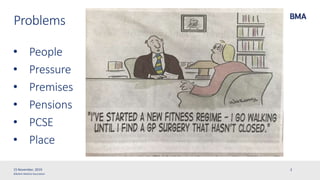
Problems
• People
• Pressure
• Premises
• Pensions
• PCSE
• Place
15 November, 2019 2
©British Medical Association
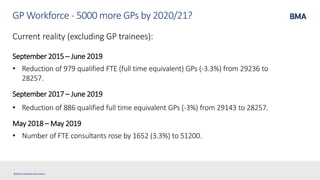
Current reality (excluding GP trainees):
September 2015 – June 2019
• Reduction of 979 qualified FTE (full time equivalent) GPs (-3.3%) from 29236 to
28257.
September 2017 – June 2019
• Reduction of 886 qualified full time equivalent GPs (-3%) from 29143 to 28257.
May 2018 – May 2019
• Number of FTE consultants rose by 1652 (3.3%) to 51200.
GP Workforce - 5000 more GPs by 2020/21?
©British Medical Association
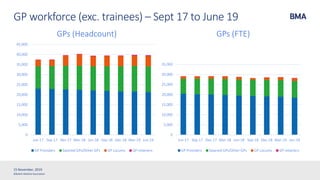
GP workforce (exc. trainees) – Sept 17 to June 19
15 November, 2019
0
5,000
10,000
15,000
20,000
25,000
30,000
35,000
40,000
45,000
Jun-17 Sep-17 Dec-17 Mar-18 Jun-18 Sep-18 Dec-18 Mar-19 Jun-19
GPs (Headcount)
GP Providers Salaried GPs/Other GPs GP Locums GP retainers
0
5,000
10,000
15,000
20,000
25,000
30,000
35,000
Jun-17 Sep-17 Dec-17 Mar-18 Jun-18 Sep-18 Dec-18 Mar-19 Jun-19
GPs (FTE)
GP Providers Salaried GPs/Other GPs GP Locums GP retainers
©British Medical Association
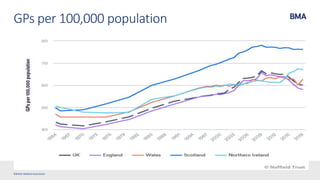
GPs per 100,000 population
©British Medical Association
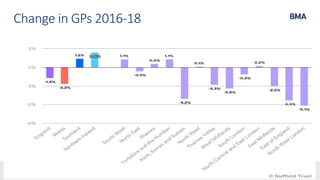
Change in GPs 2016-18
©British Medical Association
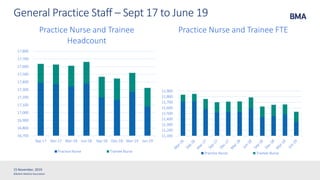
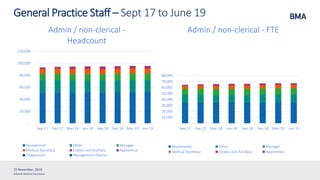
General Practice Staff – Sept 17 to June 19
15 November, 2019
16,700
16,800
16,900
17,000
17,100
17,200
17,300
17,400
17,500
17,600
17,700
17,800
Sep-17 Dec-17 Mar-18 Jun-18 Sep-18 Dec-18 Mar-19 Jun-19
Practice Nurse and Trainee
Headcount
Practice Nurse Trainee Nurse
11,100
11,200
11,300
11,400
11,500
11,600
11,700
11,800
11,900
Practice Nurse and Trainee FTE
Practice Nurse Trainee Nurse
©British Medical Association
15 November, 2019
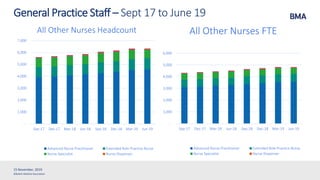
General Practice Staff – Sept 17 to June 19
-
1,000
2,000
3,000
4,000
5,000
6,000
7,000
Sep-17 Dec-17 Mar-18 Jun-18 Sep-18 Dec-18 Mar-19 Jun-19
All Other Nurses Headcount
Advanced Nurse Practitioner Extended Role Practice Nurse
Nurse Specialist Nurse Dispenser
-
1,000
2,000
3,000
4,000
5,000
6,000
Sep-17 Dec-17 Mar-18 Jun-18 Sep-18 Dec-18 Mar-19 Jun-19
All Other Nurses FTE
Advanced Nurse Practitioner Extended Role Practice Nurse
Nurse Specialist Nurse Dispenser
©British Medical Association
15 November, 2019
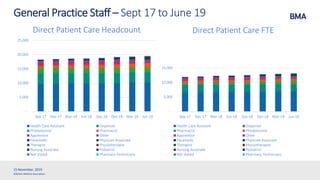
General Practice Staff – Sept 17 to June 19
-
5,000
10,000
15,000
20,000
25,000
Sep-17 Dec-17 Mar-18 Jun-18 Sep-18 Dec-18 Mar-19 Jun-19
Direct Patient Care Headcount
Health Care Assistant Dispenser
Phlebotomist Pharmacist
Apprentice Other
Paramedic Physician Associate
Therapist Physiotherapist
Nursing Associate Podiatrist
Not stated Pharmacy Technicians
-
5,000
10,000
15,000
Sep-17 Dec-17 Mar-18 Jun-18 Sep-18 Dec-18 Mar-19 Jun-19
Direct Patient Care FTE
Health Care Assistant Dispenser
Pharmacist Phlebotomist
Apprentice Other
Paramedic Physician Associate
Therapist Physiotherapist
Nursing Associate Podiatrist
Not stated Pharmacy Technicians
©British Medical Association
15 November, 2019
General Practice Staff – Sept 17 to June 19
-
20,000
40,000
60,000
80,000
100,000
120,000
Sep-17 Dec-17 Mar-18 Jun-18 Sep-18 Dec-18 Mar-19 Jun-19
Admin / non-clerical -
Headcount
Receptionist Other Manager
Medical Secretary Estates and Ancillary Apprentice
Telephonist Management Partner
-
10,000
20,000
30,000
40,000
50,000
60,000
70,000
80,000
Sep-17 Dec-17 Mar-18 Jun-18 Sep-18 Dec-18 Mar-19 Jun-19
Admin / non-clerical - FTE
Receptionist Other Manager
Medical Secretary Estates and Ancillary Apprentice
©British Medical Association
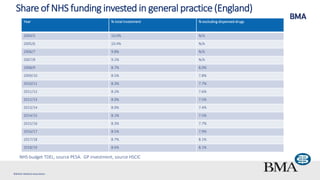
Share of NHS funding invested in general practice (England)
NHS budget TDEL, source PESA. GP investment, source HSCIC
Year % total investment % excluding dispensed drugs
2004/5 10.0% N/A
2005/6 10.4% N/A
2006/7 9.8% N/A
2007/8 9.2% N/A
2008/9 8.7% 8.0%
2009/10 8.5% 7.8%
2010/11 8.3% 7.7%
2011/12 8.2% 7.6%
2012/13 8.0% 7.5%
2013/14 8.0% 7.4%
2014/15 8.1% 7.5%
2015/16 8.3% 7.7%
2016/17 8.5% 7.9%
2017/18 8.7% 8.1%
2018/19 8.6% 8.1%
©British Medical Association
15 November, 2019 12
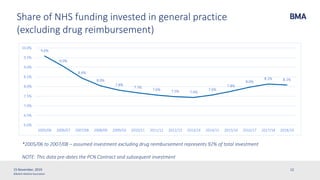
Share of NHS funding invested in general practice
(excluding drug reimbursement)
*2005/06 to 2007/08 – assumed investment excluding drug reimbursement represents 92% of total investment
NOTE: This data pre-dates the PCN Contract and subsequent investment
9.6%
9.0%
8.4%
8.0%
7.8%
7.7%
7.6% 7.5% 7.4%
7.6%
7.8%
8.0%
8.1% 8.1%
6.0%
6.5%
7.0%
7.5%
8.0%
8.5%
9.0%
9.5%
10.0%
2005/06 2006/07 2007/08 2008/09 2009/10 2010/11 2011/12 2012/13 2013/14 2014/15 2015/16 2016/17 2017/18 2018/19
©British Medical Association
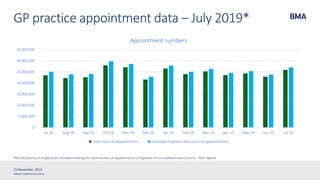
GP practice appointment data – July 2019*
15 November, 2019
*Not all practices in England are included meaning the total number of appointments in England is not accurately known (Source – NHS Digital)
0
5,000,000
10,000,000
15,000,000
20,000,000
25,000,000
30,000,000
35,000,000
Jul-18 Aug-18 Sep-18 Oct-18 Nov-18 Dec-18 Jan-19 Feb-19 Mar-19 Apr-19 May-19 Jun-19 Jul-19
Appointment numbers
Total count of appointments Estimated England total count of appointments1
©British Medical Association
• Total number of GP appointments in England rose to 26,210,000
• Total number of registered patients rose by 718,000 to 59,700,000
• GP average of 2089 patients, the highest figure on record
• 11% rise in appointments involving a wait of over a week, to 7.7 million
• 32% of all GP appointments now involve a wait of over a week
• Patients waiting over 2 weeks, up 15% to 4.3 million
• Patients waiting over 4 weeks, up 12% to 1.1 million
• GP practices delivered 1.1 million more face-to-face appointments
• Political pressure for access targets
Workload change: 2018-2019
15 November, 2019
©British Medical Association
Managing and reducing workload
• Recognising safe limits
• Improving work-life balance
• reducing sessions (does not equate to “part-time working”)
• portfolio working
• defining working pattern e.g. salaried and locum GP
• Care navigation and patient empowerment
• Enhanced practice management
• Valuing and using GPs as specialists – delegating tasks and increased skill mix
• Shared working between practices and across a PCN/Federation
• Saying “no”!
15 November, 2019 15
©British Medical Association
Premises
• GPC premises survey 2018
• Only 2 in 10 practices considered their premises fit for the future (population growth) (similar to
2005)
• Only half of practices considered their premises to be fit for present needs (lower than 2005 when
60% thought their premises were fit for present needs)
• The last significant modification/extension to premises took place in the mid-2000s (2005) pre-
dating many of the increases in patient demand and population growth
• NHS Property Services
• Reducing risk - “Last person standing”
• Premises review
15 November, 2019 16
©British Medical Association
Pensions
• Annual Allowance and tapering
• Pension flexibilities
• Statement delays
• Annualisation
• Death in service for locums
15 November, 2019 17
©British Medical Association
PCSE
• Cervical smear letter failures
• 160,000 records wrongly archived
• Pension information and payments
• Performers list delays
• Poor customer service
15 November, 2019 18
©British Medical Association
Place - GP at Hand
• Ipsos MORI evaluation – May 2019
 94% patients under 45y, younger, more affluent and healthier
 Telephone preferred to video consultation
 Higher GP/patient ratio and workforce mainly working from home
 28% de-register (London average 16%), commonly de-register after 2 weeks and 47%
return to previous practice
 Implications for health inequalities
 Affordability
• Digital-first and out of area regulations review
• Digital investment for every practice
15 November, 2019 19
©British Medical Association
Digital and access
• Commitment to provide recommended specification for IT and digital to be provided by CCGs
• Increased digital options:
 Offer and promote electronic ordering of repeat prescriptions and using electronic repeat dispensing for all
patients for whom it is clinically appropriate by April 2019;
 No fax machines for NHS work or patient correspondence, by April 2020;
 Ensure they have an up-to-date and informative online presence by April 2020;
 At least 25% of appointments available for online booking by July 2019
 Online access to records
 Video consultations
• Digitalise remaining paper records over next 3 years
• £20m in to global sum for Subject Access Requests
• NHS111 direct booking: 1/3000 patients per day (after clinical triage) - £30m in to global sum
15 November, 2019 20
©British Medical Association
Primary Care Networks
• Primary Care Networks build on the GMS contract – not ICP contract
• Maintains and strengthens community focus and continuity of care
• Workforce expansion to reduce GP workload
• Community workforce to be aligned, with PCN taking leadership role
• Extended hours DES funding and responsibility transferred to PCN in July 2019 and
increasingly integrated with access funding £6pp
• Delivery of NHS Long Term Plan service specifications
• Care Homes, medicines reviews, anticipatory care, personalisation, cancer from 2020
• CVD and prevention from 2021
• Linked to new workforce and involvement of community staff
15 November, 2019 21
©British Medical Association
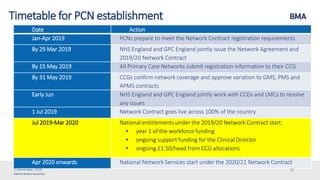
Timetable for PCN establishment
Date Action
Jan-Apr 2019 PCNs prepare to meet the Network Contract registration requirements
By 29 Mar 2019 NHS England and GPC England jointly issue the Network Agreement and
2019/20 Network Contract
By 15 May 2019 All Primary Care Networks submit registration information to their CCG
By 31 May 2019 CCGs confirm network coverage and approve variation to GMS, PMS and
APMS contracts
Early Jun NHS England and GPC England jointly work with CCGs and LMCs to resolve
any issues
1 Jul 2019 Network Contract goes live across 100% of the country
Jul 2019-Mar 2020 National entitlements under the 2019/20 Network Contract start:
• year 1 of the workforce funding
• ongoing support funding for the Clinical Director
• ongoing £1.50/head from CCG allocations
Apr 2020 onwards National Network Services start under the 2020/21 Network Contract
15 November, 2019 22
©British Medical Association
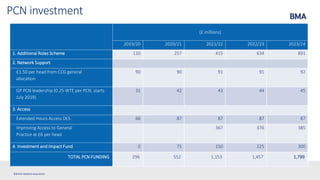
PCN investment
(£ millions)
2019/20 2020/21 2021/22 2022/23 2023/24
1. Additional Roles Scheme 110 257 415 634 891
2. Network Support
£1.50 per head from CCG general
allocation
90 90 91 91 92
GP PCN leadership (0.25 WTE per PCN, starts
July 2019)
31 42 43 44 45
3. Access
Extended Hours Access DES 66 87 87 87 87
Improving Access to General
Practice at £6 per head
367 376 385
4. Investment and Impact Fund 0 75 150 225 300
TOTAL PCN FUNDING 296 552 1,153 1,457 1,799
©British Medical Association
15 November, 2019 24
©British Medical Association
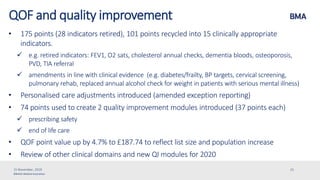
QOF and quality improvement
• 175 points (28 indicators retired), 101 points recycled into 15 clinically appropriate
indicators.
 e.g. retired indicators: FEV1, O2 sats, cholesterol annual checks, dementia bloods, osteoporosis,
PVD, TIA referral
 amendments in line with clinical evidence (e.g. diabetes/frailty, BP targets, cervical screening,
pulmonary rehab, replaced annual alcohol check for weight in patients with serious mental illness)
• Personalised care adjustments introduced (amended exception reporting)
• 74 points used to create 2 quality improvement modules introduced (37 points each)
 prescribing safety
 end of life care
• QOF point value up by 4.7% to £187.74 to reflect list size and population increase
• Review of other clinical domains and new QI modules for 2020
15 November, 2019 25
©British Medical Association
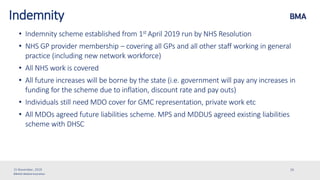
Indemnity
• Indemnity scheme established from 1st April 2019 run by NHS Resolution
• NHS GP provider membership – covering all GPs and all other staff working in general
practice (including new network workforce)
• All NHS work is covered
• All future increases will be borne by the state (i.e. government will pay any increases in
funding for the scheme due to inflation, discount rate and pay outs)
• Individuals still need MDO cover for GMC representation, private work etc
• All MDOs agreed future liabilities scheme. MPS and MDDUS agreed existing liabilities
scheme with DHSC
15 November, 2019 26
©British Medical Association
Dealing with the problems to release potential
• Increased investment
• Expanded workforce
• Improved IT
• Reducing risks – indemnity, premises
• Rebuilding, reconnecting and reinvigorating the primary and
community healthcare team
• Improving quality of care
• Restoring GP morale – improving recruitment and retention
15 November, 2019 27
©British Medical Association
Next Year onwards
• Collaborating with others
• New workforce – Capitated payment
• Local funding and support for PCNs
• Working together to support each other
15 November, 2019 28
©British Medical Association
2019
• Extended Hours access integrated into networks – same requirements as the DES, for 100% of network population
2020
• Structured medication review
• Enhanced health in care homes
• Anticipatory care
• Personalised care
• Supporting early cancer diagnosis
2021
• Cardiovascular disease prevention and diagnosis, through case finding
• Action to tackle inequalities
15 November, 2019 29
Network services
©British Medical Association
Development of service specifications
NHS England will work with the full range of relevant
stakeholders in developing the draft specifications, prior to formal
contract discussions with GPC. This includes for example the RCGP,
relevant voluntary sector partners, patients, care home providers,
and local system leaders. The specifications will be published in
draft before being finalised.
P42, 6.10
15 November, 2019 30
©British Medical Association
What will PCNs do?
• Collaborative structures to support the
partnership model of general practice
• Putting general practice back at the center of
community care
• Providing better care for patients by
diversifying and expanding our teams.
• Controlling the workload
15 November, 2019 31
©British Medical Association
What will PCNs not do?
• Solve every problem in the NHS
• Address third world debt
• Rid the world of nuclear arms
• Reverse global warming
• Enable time travel
• Resolve the impasse on Brexit
15 November, 2019 32
©British Medical Association
15 November, 2019 33
©British Medical Association
15 November, 2019 34
©British Medical Association
15 November, 2019 35
PCN Community
©British Medical Association
15 November, 2019 36

Dr Krishna Kasaraneni - Primary Care Networks

  • 1.
    ©British Medical Association Dr.Krishna Kasaraneni GPC Executive Team support@bma.org.uk West Pennine LMC Annual General Meeting 15 November, 2019
  • 2.
    ©British Medical Association Problems •People • Pressure • Premises • Pensions • PCSE • Place 15 November, 2019 2
  • 3.
    ©British Medical Association Currentreality (excluding GP trainees): September 2015 – June 2019 • Reduction of 979 qualified FTE (full time equivalent) GPs (-3.3%) from 29236 to 28257. September 2017 – June 2019 • Reduction of 886 qualified full time equivalent GPs (-3%) from 29143 to 28257. May 2018 – May 2019 • Number of FTE consultants rose by 1652 (3.3%) to 51200. GP Workforce - 5000 more GPs by 2020/21?
  • 4.
    ©British Medical Association GPworkforce (exc. trainees) – Sept 17 to June 19 15 November, 2019 0 5,000 10,000 15,000 20,000 25,000 30,000 35,000 40,000 45,000 Jun-17 Sep-17 Dec-17 Mar-18 Jun-18 Sep-18 Dec-18 Mar-19 Jun-19 GPs (Headcount) GP Providers Salaried GPs/Other GPs GP Locums GP retainers 0 5,000 10,000 15,000 20,000 25,000 30,000 35,000 Jun-17 Sep-17 Dec-17 Mar-18 Jun-18 Sep-18 Dec-18 Mar-19 Jun-19 GPs (FTE) GP Providers Salaried GPs/Other GPs GP Locums GP retainers
  • 5.
    ©British Medical Association GPsper 100,000 population
  • 6.
  • 7.
    ©British Medical Association GeneralPractice Staff – Sept 17 to June 19 15 November, 2019 16,700 16,800 16,900 17,000 17,100 17,200 17,300 17,400 17,500 17,600 17,700 17,800 Sep-17 Dec-17 Mar-18 Jun-18 Sep-18 Dec-18 Mar-19 Jun-19 Practice Nurse and Trainee Headcount Practice Nurse Trainee Nurse 11,100 11,200 11,300 11,400 11,500 11,600 11,700 11,800 11,900 Practice Nurse and Trainee FTE Practice Nurse Trainee Nurse
  • 8.
    ©British Medical Association 15November, 2019 General Practice Staff – Sept 17 to June 19 - 1,000 2,000 3,000 4,000 5,000 6,000 7,000 Sep-17 Dec-17 Mar-18 Jun-18 Sep-18 Dec-18 Mar-19 Jun-19 All Other Nurses Headcount Advanced Nurse Practitioner Extended Role Practice Nurse Nurse Specialist Nurse Dispenser - 1,000 2,000 3,000 4,000 5,000 6,000 Sep-17 Dec-17 Mar-18 Jun-18 Sep-18 Dec-18 Mar-19 Jun-19 All Other Nurses FTE Advanced Nurse Practitioner Extended Role Practice Nurse Nurse Specialist Nurse Dispenser
  • 9.
    ©British Medical Association 15November, 2019 General Practice Staff – Sept 17 to June 19 - 5,000 10,000 15,000 20,000 25,000 Sep-17 Dec-17 Mar-18 Jun-18 Sep-18 Dec-18 Mar-19 Jun-19 Direct Patient Care Headcount Health Care Assistant Dispenser Phlebotomist Pharmacist Apprentice Other Paramedic Physician Associate Therapist Physiotherapist Nursing Associate Podiatrist Not stated Pharmacy Technicians - 5,000 10,000 15,000 Sep-17 Dec-17 Mar-18 Jun-18 Sep-18 Dec-18 Mar-19 Jun-19 Direct Patient Care FTE Health Care Assistant Dispenser Pharmacist Phlebotomist Apprentice Other Paramedic Physician Associate Therapist Physiotherapist Nursing Associate Podiatrist Not stated Pharmacy Technicians
  • 10.
    ©British Medical Association 15November, 2019 General Practice Staff – Sept 17 to June 19 - 20,000 40,000 60,000 80,000 100,000 120,000 Sep-17 Dec-17 Mar-18 Jun-18 Sep-18 Dec-18 Mar-19 Jun-19 Admin / non-clerical - Headcount Receptionist Other Manager Medical Secretary Estates and Ancillary Apprentice Telephonist Management Partner - 10,000 20,000 30,000 40,000 50,000 60,000 70,000 80,000 Sep-17 Dec-17 Mar-18 Jun-18 Sep-18 Dec-18 Mar-19 Jun-19 Admin / non-clerical - FTE Receptionist Other Manager Medical Secretary Estates and Ancillary Apprentice
  • 11.
    ©British Medical Association Shareof NHS funding invested in general practice (England) NHS budget TDEL, source PESA. GP investment, source HSCIC Year % total investment % excluding dispensed drugs 2004/5 10.0% N/A 2005/6 10.4% N/A 2006/7 9.8% N/A 2007/8 9.2% N/A 2008/9 8.7% 8.0% 2009/10 8.5% 7.8% 2010/11 8.3% 7.7% 2011/12 8.2% 7.6% 2012/13 8.0% 7.5% 2013/14 8.0% 7.4% 2014/15 8.1% 7.5% 2015/16 8.3% 7.7% 2016/17 8.5% 7.9% 2017/18 8.7% 8.1% 2018/19 8.6% 8.1%
  • 12.
    ©British Medical Association 15November, 2019 12 Share of NHS funding invested in general practice (excluding drug reimbursement) *2005/06 to 2007/08 – assumed investment excluding drug reimbursement represents 92% of total investment NOTE: This data pre-dates the PCN Contract and subsequent investment 9.6% 9.0% 8.4% 8.0% 7.8% 7.7% 7.6% 7.5% 7.4% 7.6% 7.8% 8.0% 8.1% 8.1% 6.0% 6.5% 7.0% 7.5% 8.0% 8.5% 9.0% 9.5% 10.0% 2005/06 2006/07 2007/08 2008/09 2009/10 2010/11 2011/12 2012/13 2013/14 2014/15 2015/16 2016/17 2017/18 2018/19
  • 13.
    ©British Medical Association GPpractice appointment data – July 2019* 15 November, 2019 *Not all practices in England are included meaning the total number of appointments in England is not accurately known (Source – NHS Digital) 0 5,000,000 10,000,000 15,000,000 20,000,000 25,000,000 30,000,000 35,000,000 Jul-18 Aug-18 Sep-18 Oct-18 Nov-18 Dec-18 Jan-19 Feb-19 Mar-19 Apr-19 May-19 Jun-19 Jul-19 Appointment numbers Total count of appointments Estimated England total count of appointments1
  • 14.
    ©British Medical Association •Total number of GP appointments in England rose to 26,210,000 • Total number of registered patients rose by 718,000 to 59,700,000 • GP average of 2089 patients, the highest figure on record • 11% rise in appointments involving a wait of over a week, to 7.7 million • 32% of all GP appointments now involve a wait of over a week • Patients waiting over 2 weeks, up 15% to 4.3 million • Patients waiting over 4 weeks, up 12% to 1.1 million • GP practices delivered 1.1 million more face-to-face appointments • Political pressure for access targets Workload change: 2018-2019 15 November, 2019
  • 15.
    ©British Medical Association Managingand reducing workload • Recognising safe limits • Improving work-life balance • reducing sessions (does not equate to “part-time working”) • portfolio working • defining working pattern e.g. salaried and locum GP • Care navigation and patient empowerment • Enhanced practice management • Valuing and using GPs as specialists – delegating tasks and increased skill mix • Shared working between practices and across a PCN/Federation • Saying “no”! 15 November, 2019 15
  • 16.
    ©British Medical Association Premises •GPC premises survey 2018 • Only 2 in 10 practices considered their premises fit for the future (population growth) (similar to 2005) • Only half of practices considered their premises to be fit for present needs (lower than 2005 when 60% thought their premises were fit for present needs) • The last significant modification/extension to premises took place in the mid-2000s (2005) pre- dating many of the increases in patient demand and population growth • NHS Property Services • Reducing risk - “Last person standing” • Premises review 15 November, 2019 16
  • 17.
    ©British Medical Association Pensions •Annual Allowance and tapering • Pension flexibilities • Statement delays • Annualisation • Death in service for locums 15 November, 2019 17
  • 18.
    ©British Medical Association PCSE •Cervical smear letter failures • 160,000 records wrongly archived • Pension information and payments • Performers list delays • Poor customer service 15 November, 2019 18
  • 19.
    ©British Medical Association Place- GP at Hand • Ipsos MORI evaluation – May 2019  94% patients under 45y, younger, more affluent and healthier  Telephone preferred to video consultation  Higher GP/patient ratio and workforce mainly working from home  28% de-register (London average 16%), commonly de-register after 2 weeks and 47% return to previous practice  Implications for health inequalities  Affordability • Digital-first and out of area regulations review • Digital investment for every practice 15 November, 2019 19
  • 20.
    ©British Medical Association Digitaland access • Commitment to provide recommended specification for IT and digital to be provided by CCGs • Increased digital options:  Offer and promote electronic ordering of repeat prescriptions and using electronic repeat dispensing for all patients for whom it is clinically appropriate by April 2019;  No fax machines for NHS work or patient correspondence, by April 2020;  Ensure they have an up-to-date and informative online presence by April 2020;  At least 25% of appointments available for online booking by July 2019  Online access to records  Video consultations • Digitalise remaining paper records over next 3 years • £20m in to global sum for Subject Access Requests • NHS111 direct booking: 1/3000 patients per day (after clinical triage) - £30m in to global sum 15 November, 2019 20
  • 21.
    ©British Medical Association PrimaryCare Networks • Primary Care Networks build on the GMS contract – not ICP contract • Maintains and strengthens community focus and continuity of care • Workforce expansion to reduce GP workload • Community workforce to be aligned, with PCN taking leadership role • Extended hours DES funding and responsibility transferred to PCN in July 2019 and increasingly integrated with access funding £6pp • Delivery of NHS Long Term Plan service specifications • Care Homes, medicines reviews, anticipatory care, personalisation, cancer from 2020 • CVD and prevention from 2021 • Linked to new workforce and involvement of community staff 15 November, 2019 21
  • 22.
    ©British Medical Association Timetablefor PCN establishment Date Action Jan-Apr 2019 PCNs prepare to meet the Network Contract registration requirements By 29 Mar 2019 NHS England and GPC England jointly issue the Network Agreement and 2019/20 Network Contract By 15 May 2019 All Primary Care Networks submit registration information to their CCG By 31 May 2019 CCGs confirm network coverage and approve variation to GMS, PMS and APMS contracts Early Jun NHS England and GPC England jointly work with CCGs and LMCs to resolve any issues 1 Jul 2019 Network Contract goes live across 100% of the country Jul 2019-Mar 2020 National entitlements under the 2019/20 Network Contract start: • year 1 of the workforce funding • ongoing support funding for the Clinical Director • ongoing £1.50/head from CCG allocations Apr 2020 onwards National Network Services start under the 2020/21 Network Contract 15 November, 2019 22
  • 23.
    ©British Medical Association PCNinvestment (£ millions) 2019/20 2020/21 2021/22 2022/23 2023/24 1. Additional Roles Scheme 110 257 415 634 891 2. Network Support £1.50 per head from CCG general allocation 90 90 91 91 92 GP PCN leadership (0.25 WTE per PCN, starts July 2019) 31 42 43 44 45 3. Access Extended Hours Access DES 66 87 87 87 87 Improving Access to General Practice at £6 per head 367 376 385 4. Investment and Impact Fund 0 75 150 225 300 TOTAL PCN FUNDING 296 552 1,153 1,457 1,799
  • 24.
  • 25.
    ©British Medical Association QOFand quality improvement • 175 points (28 indicators retired), 101 points recycled into 15 clinically appropriate indicators.  e.g. retired indicators: FEV1, O2 sats, cholesterol annual checks, dementia bloods, osteoporosis, PVD, TIA referral  amendments in line with clinical evidence (e.g. diabetes/frailty, BP targets, cervical screening, pulmonary rehab, replaced annual alcohol check for weight in patients with serious mental illness) • Personalised care adjustments introduced (amended exception reporting) • 74 points used to create 2 quality improvement modules introduced (37 points each)  prescribing safety  end of life care • QOF point value up by 4.7% to £187.74 to reflect list size and population increase • Review of other clinical domains and new QI modules for 2020 15 November, 2019 25
  • 26.
    ©British Medical Association Indemnity •Indemnity scheme established from 1st April 2019 run by NHS Resolution • NHS GP provider membership – covering all GPs and all other staff working in general practice (including new network workforce) • All NHS work is covered • All future increases will be borne by the state (i.e. government will pay any increases in funding for the scheme due to inflation, discount rate and pay outs) • Individuals still need MDO cover for GMC representation, private work etc • All MDOs agreed future liabilities scheme. MPS and MDDUS agreed existing liabilities scheme with DHSC 15 November, 2019 26
  • 27.
    ©British Medical Association Dealingwith the problems to release potential • Increased investment • Expanded workforce • Improved IT • Reducing risks – indemnity, premises • Rebuilding, reconnecting and reinvigorating the primary and community healthcare team • Improving quality of care • Restoring GP morale – improving recruitment and retention 15 November, 2019 27
  • 28.
    ©British Medical Association NextYear onwards • Collaborating with others • New workforce – Capitated payment • Local funding and support for PCNs • Working together to support each other 15 November, 2019 28
  • 29.
    ©British Medical Association 2019 •Extended Hours access integrated into networks – same requirements as the DES, for 100% of network population 2020 • Structured medication review • Enhanced health in care homes • Anticipatory care • Personalised care • Supporting early cancer diagnosis 2021 • Cardiovascular disease prevention and diagnosis, through case finding • Action to tackle inequalities 15 November, 2019 29 Network services
  • 30.
    ©British Medical Association Developmentof service specifications NHS England will work with the full range of relevant stakeholders in developing the draft specifications, prior to formal contract discussions with GPC. This includes for example the RCGP, relevant voluntary sector partners, patients, care home providers, and local system leaders. The specifications will be published in draft before being finalised. P42, 6.10 15 November, 2019 30
  • 31.
    ©British Medical Association Whatwill PCNs do? • Collaborative structures to support the partnership model of general practice • Putting general practice back at the center of community care • Providing better care for patients by diversifying and expanding our teams. • Controlling the workload 15 November, 2019 31
  • 32.
    ©British Medical Association Whatwill PCNs not do? • Solve every problem in the NHS • Address third world debt • Rid the world of nuclear arms • Reverse global warming • Enable time travel • Resolve the impasse on Brexit 15 November, 2019 32
  • 33.
  • 34.
  • 35.
    ©British Medical Association 15November, 2019 35 PCN Community
  • 36.

Editor's Notes

  • #4 Need to caveat these figures as NHS Digital had to estimate data for around 12% of practices in September 2015 and continue to do this for around 5-6% even now. Improvements have been made to the collection for locum data over the last two and a half years too. The trends we are seeing are also a likely consequence of national efforts to improve flexible working for GPs, and they indicate that the 5000 target may in fact be insufficient given GPs’ desire for better work-life balance. Have excluded GP trainee data because they are supernumerary, the greater service provision burden falls on the qualified GP workforce and workload intensity is a significant contributing factor to qualified GPs reducing their weekly sessions or leaving the profession altogether. The 5000 additional GPs should really be qualified for the target to be met. Source: General and Personal Medical Services, England: Final 31 December 2017 and Provisional 31 March 2018, experimental statistics, NHS Digital (May 2018) - https://digital.nhs.uk/data-and-information/publications/statistical/general-and-personal-medical-services/final-31-december-2017-and-provisional-31-march-2018-experimental-statistics
  • #8 A number of employers did not state what type of nurse they employed in March 2016 – hence the anomaly in the graphs above. The vast majority of those that did not have their type stated were not practice nurses, but it was easier to illustrate them here rather than include them in the graphs for ‘other nurses’ on the next slide. The general trend for practice nurse numbers being in decline is still evident.