Visit https://testbankmall.com to download the full version and
explore more testbank or solutions manual
Solution Manual for Intermediate Accounting 3rd
Edition by Wahlen
_____ Click the link below to download _____
https://testbankmall.com/product/solution-manual-for-
intermediate-accounting-3rd-edition-by-wahlen/
Explore and download more testbank or solutions manual at testbankmall.com
Here are some recommended products that we believe you will be
interested in. You can click the link to download.
Solution Manual for Intermediate Accounting Reporting and
Analysis 1st Edition by Wahlen
https://testbankmall.com/product/solution-manual-for-intermediate-
accounting-reporting-and-analysis-1st-edition-by-wahlen/
Test Bank for Intermediate Accounting: Reporting and
Analysis, 3rd Edition, James M. Wahlen
https://testbankmall.com/product/test-bank-for-intermediate-
accounting-reporting-and-analysis-3rd-edition-james-m-wahlen/
Test Bank for Intermediate Accounting Reporting and
Analysis 1st Edition by Wahlen
https://testbankmall.com/product/test-bank-for-intermediate-
accounting-reporting-and-analysis-1st-edition-by-wahlen/
Intermediate Accounting Reporting and Analysis 2nd Edition
Wahlen Test Bank
https://testbankmall.com/product/intermediate-accounting-reporting-
and-analysis-2nd-edition-wahlen-test-bank/
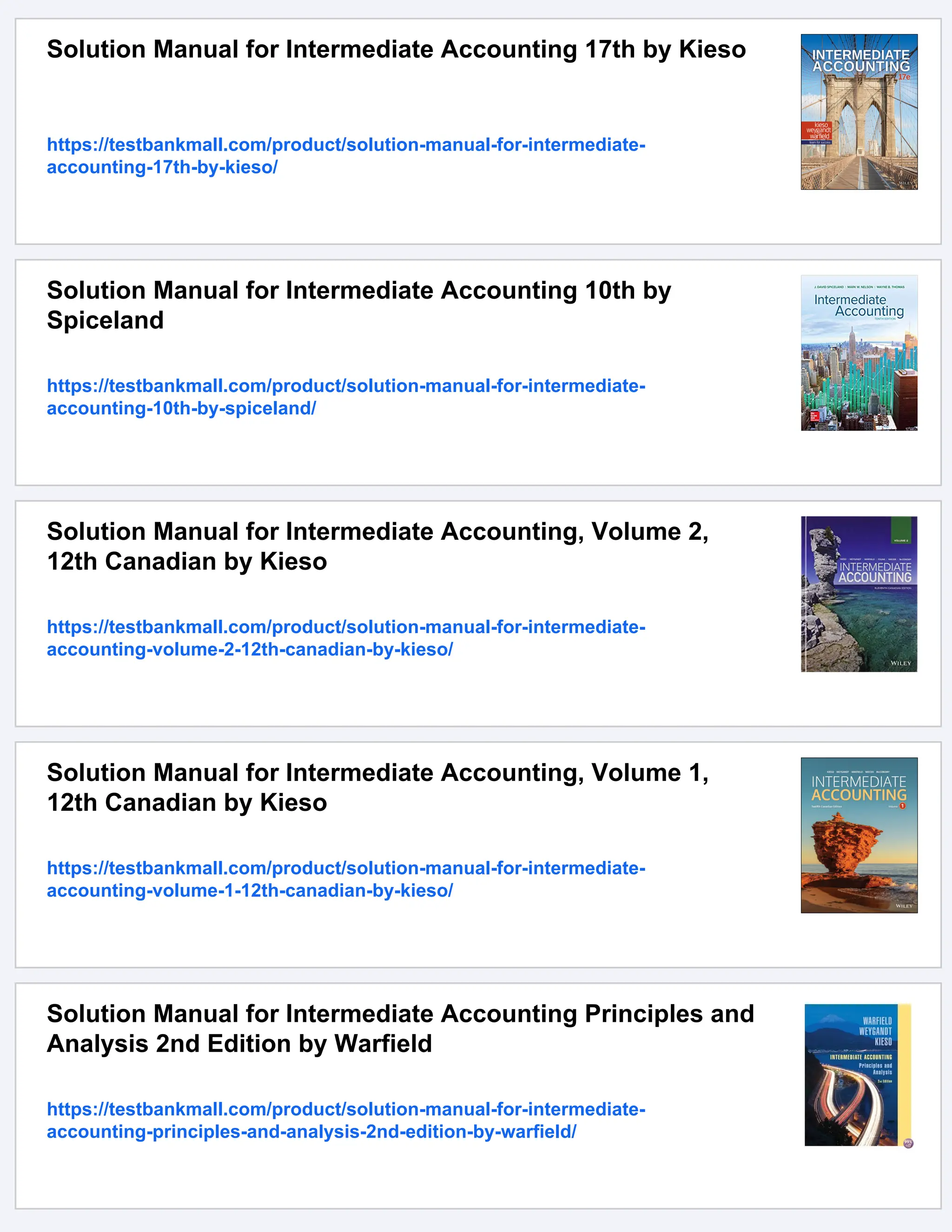
Solution Manual for Intermediate Accounting 17th by Kieso
https://testbankmall.com/product/solution-manual-for-intermediate-
accounting-17th-by-kieso/
Solution Manual for Intermediate Accounting 10th by
Spiceland
https://testbankmall.com/product/solution-manual-for-intermediate-
accounting-10th-by-spiceland/
Solution Manual for Intermediate Accounting, Volume 2,
12th Canadian by Kieso
https://testbankmall.com/product/solution-manual-for-intermediate-
accounting-volume-2-12th-canadian-by-kieso/
Solution Manual for Intermediate Accounting, Volume 1,
12th Canadian by Kieso
https://testbankmall.com/product/solution-manual-for-intermediate-
accounting-volume-1-12th-canadian-by-kieso/
Solution Manual for Intermediate Accounting Principles and
Analysis 2nd Edition by Warfield
https://testbankmall.com/product/solution-manual-for-intermediate-
accounting-principles-and-analysis-2nd-edition-by-warfield/
1-2
©
2020
Cengage
Learning.
All
Rights
Reserved.
May
not
be
scanned,
copied
or
duplicated,
or
posted
to
a
publicly
accessible
website,
in
whole
or
in
part.
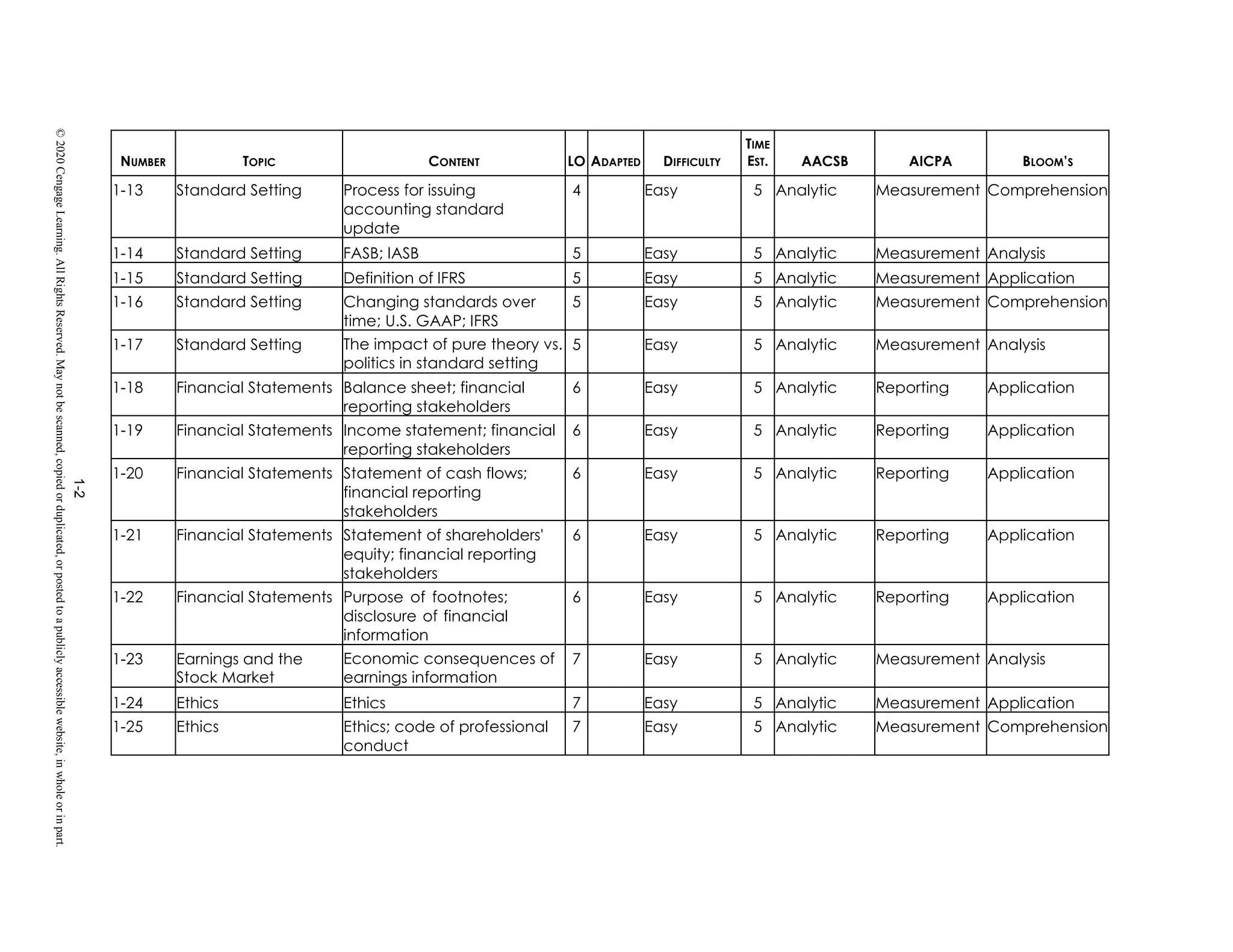
NUMBER TOPIC CONTENT LO ADAPTED DIFFICULTY
TIME
EST. AACSB AICPA BLOOM’S
1-13 Standard Setting Process for issuing
accounting standard
update
4 Easy 5 Analytic Measurement Comprehension
1-14 Standard Setting FASB; IASB 5 Easy 5 Analytic Measurement Analysis
1-15 Standard Setting Definition of IFRS 5 Easy 5 Analytic Measurement Application
1-16 Standard Setting Changing standards over
time; U.S. GAAP; IFRS
5 Easy 5 Analytic Measurement Comprehension
1-17 Standard Setting The impact of pure theory vs.
politics in standard setting
5 Easy 5 Analytic Measurement Analysis
1-18 Financial Statements Balance sheet; financial
reporting stakeholders
6 Easy 5 Analytic Reporting Application
1-19 Financial Statements Income statement; financial
reporting stakeholders
6 Easy 5 Analytic Reporting Application
1-20 Financial Statements Statement of cash flows;
financial reporting
stakeholders
6 Easy 5 Analytic Reporting Application
1-21 Financial Statements Statement of shareholders'
equity; financial reporting
stakeholders
6 Easy 5 Analytic Reporting Application
1-22 Financial Statements Purpose of footnotes;
disclosure of financial
information
6 Easy 5 Analytic Reporting Application
1-23 Earnings and the
Stock Market
Economic consequences of
earnings information
7 Easy 5 Analytic Measurement Analysis
1-24 Ethics Ethics 7 Easy 5 Analytic Measurement Application
1-25 Ethics Ethics; code of professional
conduct
7 Easy 5 Analytic Measurement Comprehension
1-3
©
2020
Cengage
Learning.
All
Rights
Reserved.
May
not
be
scanned,
copied
or
duplicated,
or
posted
to
a
publicly
accessible
website,
in
whole
or
in
part.
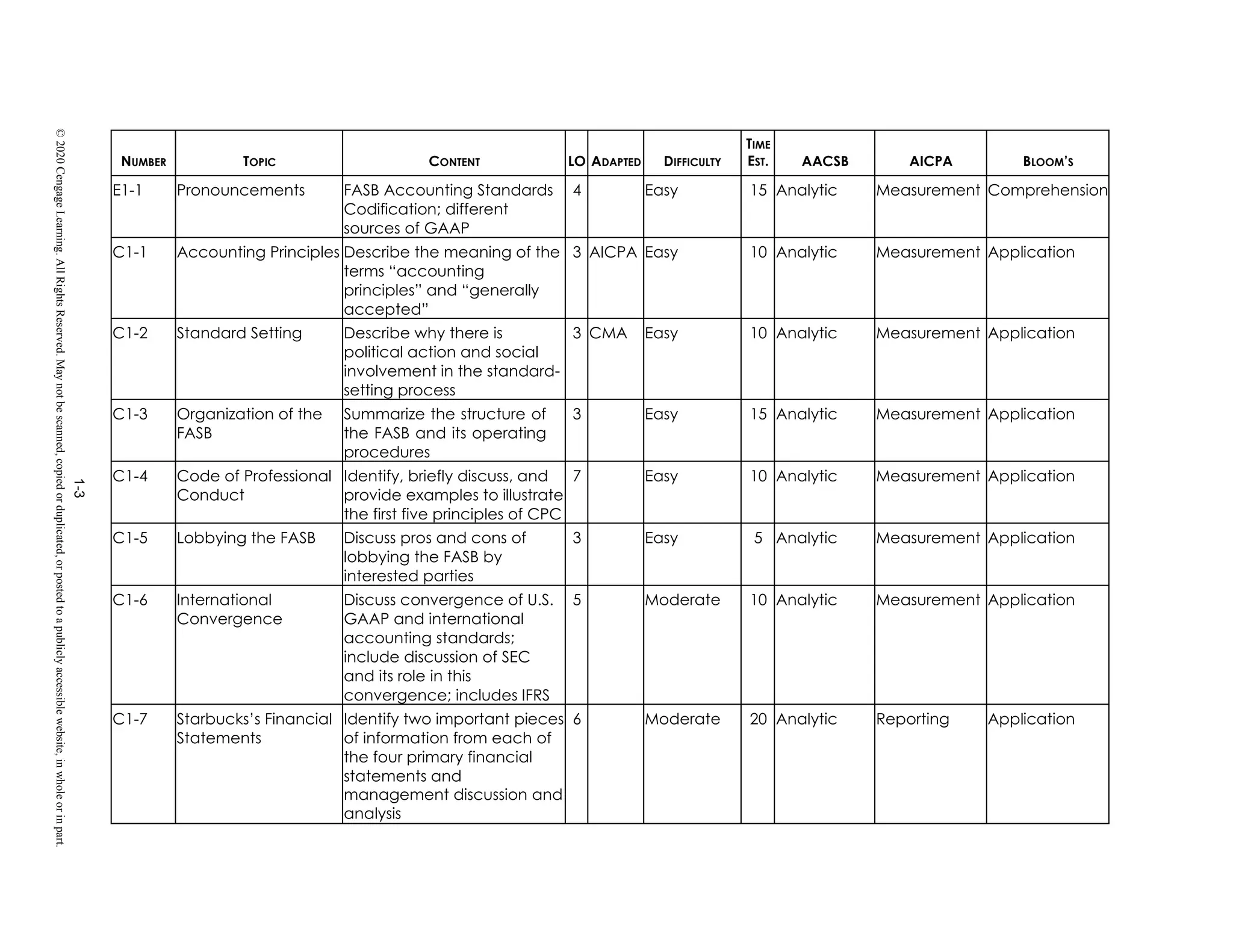
NUMBER TOPIC CONTENT LO ADAPTED DIFFICULTY
TIME
EST. AACSB AICPA BLOOM’S
E1-1 Pronouncements FASB Accounting Standards
Codification; different
sources of GAAP
4 Easy 15 Analytic Measurement Comprehension
C1-1 Accounting Principles Describe the meaning of the
terms “accounting
principles” and “generally
accepted”
3 AICPA Easy 10 Analytic Measurement Application
C1-2 Standard Setting Describe why there is
political action and social
involvement in the standard-
setting process
3 CMA Easy 10 Analytic Measurement Application
C1-3 Organization of the
FASB
Summarize the structure of
the FASB and its operating
procedures
3 Easy 15 Analytic Measurement Application
C1-4 Code of Professional
Conduct
Identify, briefly discuss, and
provide examples to illustrate
the first five principles of CPC
7 Easy 10 Analytic Measurement Application
C1-5 Lobbying the FASB Discuss pros and cons of
lobbying the FASB by
interested parties
3 Easy 5 Analytic Measurement Application
C1-6 International
Convergence
Discuss convergence of U.S.
GAAP and international
accounting standards;
include discussion of SEC
and its role in this
convergence; includes IFRS
5 Moderate 10 Analytic Measurement Application
C1-7 Starbucks’s Financial
Statements
Identify two important pieces
of information from each of
the four primary financial
statements and
management discussion and
analysis
6 Moderate 20 Analytic Reporting Application
1-4
©
2020
Cengage
Learning.
All
Rights
Reserved.
May
not
be
scanned,
copied
or
duplicated,
or
posted
to
a
publicly
accessible
website,
in
whole
or
in
part.
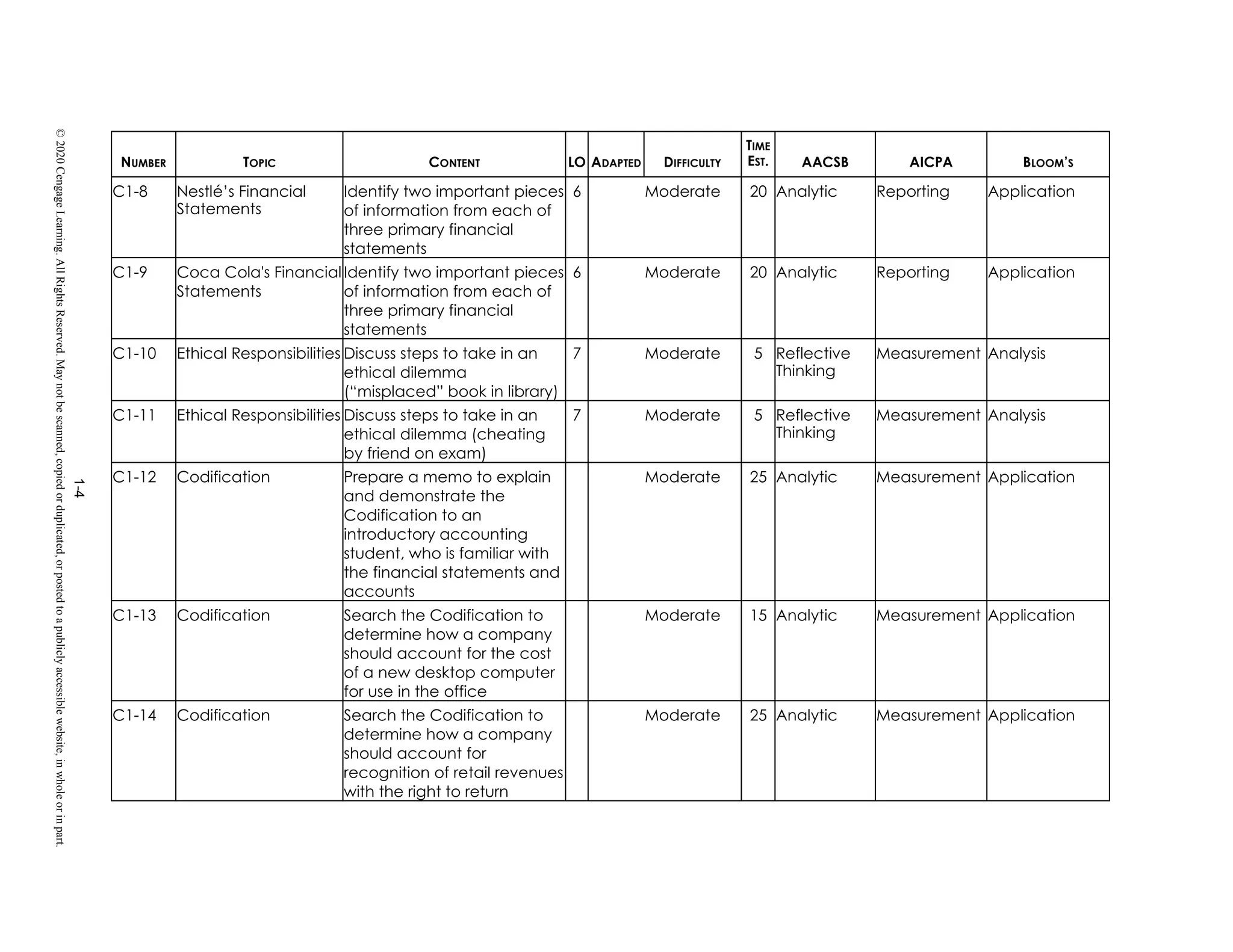
NUMBER TOPIC CONTENT LO ADAPTED DIFFICULTY
TIME
AACSB AICPA BLOOM’S
EST.
C1-8 Nestlé’s Financial Identify two important pieces
of information from each of
three primary financial
statements
6 Moderate 20 Analytic Reporting Application
Statements
C1-9 Coca Cola's Financial
Statements
Identify two important pieces
of information from each of
three primary financial
statements
6 Moderate 20 Analytic Reporting Application
C1-10 Ethical Responsibilities Discuss steps to take in an
ethical dilemma
(“misplaced” book in library)
7 Moderate 5 Reflective Measurement Analysis
Thinking
C1-11 Ethical Responsibilities Discuss steps to take in an
ethical dilemma (cheating
by friend on exam)
7 Moderate 5 Reflective Measurement Analysis
Thinking
C1-12 Codification Prepare a memo to explain
and demonstrate the
Codification to an
introductory accounting
student, who is familiar with
the financial statements and
accounts
Moderate 25 Analytic Measurement Application
C1-13 Codification Search the Codification to
determine how a company
should account for the cost
of a new desktop computer
for use in the office
Moderate 15 Analytic Measurement Application
C1-14 Codification Search the Codification to
determine how a company
should account for
recognition of retail revenues
with the right to return
Moderate 25 Analytic Measurement Application
1-5
© 2020 Cengage Learning. All Rights Reserved. May not be scanned, copied or duplicated, or posted to a publicly accessible website, in whole or in part.
ANSWERS TO GOT IT?
1-1 The role of financial accounting is to identify, measure, record, and report relevant
and reliable financial information about companies to present and potential future
stakeholders. Financial reporting is the process of communicating financial
accounting information about a company to existing and potential future investors,
creditors, and other external decision makers and stakeholders. An important way a
company’s financial accounting information is reported is in its quarterly and annual
reports. The role of financial reporting is to inform investors, creditors, and other
stakeholders. Financial reporting also provides information to mitigate agency
problems which stem from the separation of ownership and control of resources.
1-2 The primary stakeholders that are important users of financial information include
investors, creditors, banks, suppliers, customers, employees, executives, labor unions,
pension funds, government regulatory authorities, tax authorities, local communities,
and many others (see Exhibit 1.1). The instructor can discuss how these stakeholders
can be divided into two major categories: external users and internal users. These two
groups do not have the same decision-making information needs because of their
differing relationships with the company providing economic information. Of these
groups, FASB has stated the primary purpose of financial reporting is to inform
investors and creditors.
1-3 Investors and creditors take different risks and enjoy different potential upside gains
from investing or lending. Equity investors are the residual risk bearers of corporations,
but stand to enjoy potentially greater upside if the company is successful and
profitable. Creditors face less risk of loss of their investments because they have
superior claim in bankruptcy over equity investors. But creditors do not share in the
same upside potential as equity investors. As a result of these differences, their
information needs differ. Equity investors are more concerned with profitability,
whereas creditors tend to be more focused on cash flows.
1-4 Information asymmetry arises from the separation of ownership and control of
resources. Financial reporting helps reduce (but not eliminate) information
asymmetry problems by enabling managers (agents) to provide relevant and
faithfully represented information to investors and creditors (principals), thereby
reducing information asymmetry.
1-5 The demand for financial accounting information, as an economic good in society,
arises from the needs of equity shareholders, creditors, and various other stakeholders
for information to make resource allocation decisions. This demand arises because
businesses have to compete for and attract scarce economic resources, such as
equity and debt capital, productive resources, employees, supplier and customer
relationships, and so forth. In order to compete for these valuable resources,
companies must provide relevant and faithfully represented information to those who
can provide the resources.
1-6
© 2020 Cengage Learning. All Rights Reserved. May not be scanned, copied or duplicated, or posted to a publicly accessible website, in whole or in part.
1-6 To solve the problems that would arise from biases in a self-reporting accounting
system, a natural demand arises for accounting standards and audits. The demand
for accounting information drives the demand for professionally established
accounting standards that provide authoritative guidance on how to measure and
report economic activities in financial statements. In addition, the demand for
accounting information also drives the demand for auditing—independent
verification and attestation of whether the financial statements have been fairly
presented in accordance with professional accounting standards.
1-7 Generally Accepted Accounting Principles (GAAP) are the principles, concepts,
guidelines, procedures, and practices that U.S. companies that are listed in the
United States and subject to SEC regulation are required to use in recording and
reporting the accounting information in audited financial statements.
1-8 The supply of accounting information that companies report to external stakeholders
is determined primarily by the interactions between two sets of forces:
• The authoritative professional accounting standards that govern in the
company’s country of incorporation, such as U.S. GAAP or IFRS, and
• the many choices, methods, estimates, and judgments that the company must
make in order to apply those accounting standards to measure and report their
financial statements.
1-9 The stated mission of the U.S. Securities and Exchange Commission is to “protect
investors, maintain fair, orderly, and efficient markets, and facilitate capital
formation.” The U.S. Congress created the SEC to administer the Securities Act of 1933
and the Securities Exchange Act of 1934. Under these Acts, the SEC has the legal
authority to prescribe accounting principles and reporting practices for all
corporations issuing publicly traded securities within the U.S. capital markets. The SEC
has mandated that the information communicated to external users in financial
reporting must be based on professionally established accounting principles, such as
GAAP for U.S companies and IFRS for non-U.S. companies.
The SEC delegates the authority over standard setting to private standard-setting
bodies within the accounting profession, such as the Financial Accounting Standards
Board (FASB) establishing GAAP for U.S. companies and the International Accounting
Standards Board (IASB) establishing IFRS for companies from many other countries
around the world. The SEC monitors closely and oversees the standards being
developed by these standard setters. From time to time, the SEC exerts pressure on
the standard setters to adopt, or not adopt, specific standards.
1-10 The FASB is responsible for identifying financial accounting issues, conducting
research to address these issues, and resolving them by issuing new accounting
standards applicable to U.S. companies. The FASB fulfills its responsibility by:
• establishing standards that are the most acceptable, given the various affected
constituencies, and
• continually monitoring the consequences of its actions so that revised standards
can be issued where appropriate.
1-7
© 2020 Cengage Learning. All Rights Reserved. May not be scanned, copied or duplicated, or posted to a publicly accessible website, in whole or in part.
1-11 In assisting the FASB, the primary objectives of the EITF are:
• to identify significant emerging accounting issues (i.e., unique transactions and
accounting problems) that it feels the FASB should address.
• to develop consensus positions on the implementation issues involving the
application of standards. In some cases, these consensus positions may be
viewed as the ‘‘best available guidance’’ on GAAP, particularly as they relate to
new accounting issues.
1-12 The Codification is an electronic database that integrates and topically organizes
the U.S. GAAP into one coherent body of literature. There are six levels in the
framework of Codification: Areas, Topics, Subtopics, Sections, Subsections, and
Paragraphs. The Topics level contains a collection of related guidance on a
particular subject Area. The Subtopics level includes subsets of a Topic. The Sections
level characterizes the nature of the content in a Subtopic (e.g., Recognition,
Measurement, Disclosure). The Subsections level provides finer breakdown of the
content in a Section. Paragraphs contain the guidance that constitutes GAAP.
The FASB issued six types of pronouncements prior to the Codification:
1. Statements of Financial Accounting Standards. These pronouncements
established GAAP. They indicated the methods and procedures required on
specific accounting issues.
2. Interpretations. These pronouncements provided clarifications of conflicting or
unclear issues relating to previously issued FASB Statements of Financial
Accounting Standards, APB Opinions, or Accounting Research Bulletins.
3. Staff Positions. The staff of the FASB issued these pronouncements to provide more
timely and consistent application guidance in regard to FASB literature, as well as
to make narrow and limited revisions of GAAP.
4. Technical Bulletins. The staff of the FASB issued these pronouncements to clarify,
explain, and elaborate on accounting and reporting issues related to Statements
of Standards or Interpretations.
5. Statements of Financial Accounting Concepts. These pronouncements
established a theoretical foundation upon which to base GAAP. They are the
output of the FASB’s “conceptual framework” project.
6. Other Pronouncements. On a major topic, the staff of the FASB may have issued
a Guide for Implementation.
The Codification did not change GAAP per se, in that it did not issue or rescind any
standards. Instead, the FASB developed the Codification to achieve three goals:
• Simplify user access by codifying all authoritative U.S. GAAP in one spot.
• Ensure the codified content accurately represented all authoritative U.S. GAAP.
• Create a codification research system that is up to date, including the most
recently released standards.
1-8
© 2020 Cengage Learning. All Rights Reserved. May not be scanned, copied or duplicated, or posted to a publicly accessible website, in whole or in part.
1-13 Before issuing an Accounting Standards Update, the FASB generally completes a
multistage process as follows:
(1) identifies topic
(2) appoints task force
(3) conducts research
(4) issues Discussion Memorandum or Invitation to Comment
(5) holds public hearings
(6) deliberates on findings
(7) issues Exposure Draft
(8) holds public hearings
(9) modifies Exposure Draft
(10) votes
After a super-majority vote (five votes out of seven) is attained, the FASB issues an
Accounting Standards Update.
1-14 The FASB and IASB are structured very similarly, in organizations that are overseen and
supported by Boards of Trustees, and supported by large staffs of professional and
technical experts and administrative support. Both Boards follow similar open, careful
due processes in deliberating new accounting standards. Whereas the FASB is a
seven-member Board consisting of only U.S. members, the IASB is larger, with 16 full-
time members. The composition of the IASB is structured to contain representation
from different countries and regions of the world. The IASB issues International
Financial Reporting Standards (IFRS). To do so, its operating procedures include study
of the topic, issuance of an Exposure Draft, evaluation of comments, and
consideration of a revised draft. If approved by at least nine members of the IASB,
the International Financial Reporting Standard is issued.
1-15 They are the principles, concepts, guidelines, procedures, and practices that
companies from the roughly 130 countries that have adopted IFRS are required to
use in recording and reporting the accounting information in audited financial
statements. In the United States, the SEC has decided to allow non-U.S. companies
that are listed in the United States and subject to SEC regulation to use IFRS for
preparation of financial statements filed with the SEC.
1-16 The FASB and the IASB have worked together toward convergence since the
“Norwalk Agreement” in 2002. At that time, the two Boards entered into this
agreement to work together on the development of high-quality, compatible
accounting standards that could be used for both “domestic” and “cross-border”
financial reporting. The Boards in 2009 and 2010 identified a number of major
projects they undertook jointly. The Boards have completed most of these major
projects. These joint projects have helped achieve greater convergence in
accounting standard for revenue recognition (issued 2014), consolidated financial
statements (issued 2011), fair value measurement (issued 2011), and financial
statement presentation (amendments to reporting comprehensive income
completed in 2011; other joint work discontinued).
1-9
© 2020 Cengage Learning. All Rights Reserved. May not be scanned, copied or duplicated, or posted to a publicly accessible website, in whole or in part.
1-17 Because of the substantial economic consequences of new standards, key
constituents often disagree about the objectives for new standards. Because the
Boards hold public hearings and open meetings, various external user groups (e.g.,
investors and creditors) and other interested parties (e.g., affected corporations and
CPA firms) exert pressure to influence the new standards, continue existing standards,
or change existing standards in their own best interests. In addition, research results
about the likely effects of new standards are sometimes conflicting, and only “best
guesses” can be made of the future consequences of current standards. A particular
difficulty is that costs of complying with new standards are often significant and
measurable, whereas the benefits of new information to decision makers are diffuse
and hard to quantify. As a consequence, the FASB and the IASB often make
decisions about new accounting standards that sometimes require compromise
between conflicting views and interests.
1-18 The balance sheet, or statement of financial position, presents a snapshot of the
resources of a firm (assets) and the claims on the company (liabilities and
shareholders’ equity) as of a specific date (usually the last day of the fiscal quarter or
the fiscal year). The balance sheet reports the following equality:
Assets = Liabilities + Shareholders’ Equity
Most stakeholders in a company, particularly investors and creditors, will be interested
in balance sheet information because it reports the financial position (resources and
obligations) of the company.
1-19 The income statement measures and reports the financial results of a firm’s
performance for a period of time, usually a quarter or a year. The income statement
provides information about the profits (or losses) the firm has generated during the
period by conducting operating, investing, and financing activities. Most
stakeholders in a company, particularly equity investors, will be interested in income
statement information because it reports the profits and losses that accrue to the
common equity shareholders of the company. The chapter shows empirical research
evidence on how changes in earnings are associated with changes in stock prices.
1-20 The statement of cash flows reports for a period of time the net cash flows (inflows
minus outflows) from the three principal categories of business activities: operating,
investing, and financing. The purpose of the statement of cash flows is important but
simple: to provide useful information about how a firm is generating and using cash.
The statement of cash flows provides information to complement the income
statement, demonstrating how cash flows differ from accrual-based income.
Cash flow information is very helpful to financial statement users who want to gauge
how the firm is executing its strategy. The statement is particularly useful to creditors
and other stakeholders with claims on future cash flows of a firm. The statement of
cash flows helps them evaluate the firm’s cash-generating ability, giving them
information about the likelihood of future cash flows for future payments of their
obligations.
1-10
© 2020 Cengage Learning. All Rights Reserved. May not be scanned, copied or duplicated, or posted to a publicly accessible website, in whole or in part.
1-21 The statement of shareholders’ equity (sometimes called the statement of changes in
shareholders’ equity) provides information about the common shareholders’ equity
claims on the company, and how those claims changed during the period. The year-
end amounts reported in this statement for the various common shareholders’ equity
accounts will match the amounts reported in the shareholders’ equity section of the
balance sheet. Equity investors will be particularly interested in the information in this
statement.
1-22 A firm’s accounting system records the results of transactions, events, and
commercial arrangements and generates the financial statements, but the financial
statements do not stand alone. To provide more relevant and representationally
faithful information for financial statement users, firms typically provide a substantial
amount of important additional information with the financial statements, including
the Notes, Management Discussion and Analysis, and Managers’ and Independent
Auditors’ Attestations. The notes to the statements explain the methods, assumptions,
and estimates the firm has used in measuring and reporting the accounting
information in the financial statements.
1-23 To illustrate the striking links between accounting earnings and stock returns, the
chapter provides a brief discussion of the results from empirical research by D. Craig
Nichols and James Wahlen. They studied the average cumulative market-adjusted
stock returns generated by firms during the 12 months leading up to and including
the month in which each firm announced annual earnings numbers. For a sample of
31,923 firm-years between 1988 and 2001, they found that the average firm that
announced an increase in earnings (over the prior year’s earnings) experienced
stock returns that beat market average returns by roughly 19.2 percent. On the other
hand, the average firm that announced a decrease in earnings experienced stock
returns that were roughly 16.4 percent lower than the market average. Their results
suggest that merely the sign of the change in earnings was associated with a 35.6
percent stock return differential in one year, on average, over their sample period.
The results show that earnings information has important economic consequences,
because changes in earnings are strongly associated with significant changes in
share prices.
1-24 As accountants, we create valuable financial information that stakeholders use to
make informed resource allocation decisions about companies. Accounting
information triggers substantial economic consequences for a wide array of different
stakeholders in a company. Because accounting information has such important
consequences for so many different stakeholders, being an accountant requires the
ability to bear this great responsibility while behaving ethically.
1-25 The Code of Professional Conduct is a document published by the AICPA to help
guide members in public practice, industry, government, and education in
performing their responsibilities in an ethical and professional manner. The six areas
covered by the Principles include: (1) responsibilities, (2) public interest, (3) integrity,
(4) objectivity and independence, (5) due care, and (6) scope and nature of
services.
1-11
© 2020 Cengage Learning. All Rights Reserved. May not be scanned, copied or duplicated, or posted to a publicly accessible website, in whole or in part.
SOLUTION TO EXERCISE
E1-1
1. e 2. c 3. b 4. d 5. f 6. a 7. f
ANSWERS TO CASES
C1-1 [AICPA Adapted]
1. The term “accounting principles” in the auditor’s report includes not only accounting
principles but also concepts, practices, and the methods of applying them. The auditor's
report typically refers to “accounting principles” being applied by the firm being audited.
The independent auditor's attestation as to the fairness of a company's financial
statements relative to U.S. GAAP or IFRS is an essential element for the reliability of
financial statements.
2. Generally accepted accounting principles are those principles that have substantial
authoritative support. The SEC has deemed the FASB’s Accounting Standards
Codification as GAAP for U.S. companies. In addition, the SEC has deemed IFRS as
generally accepted accounting principles for non-U.S. companies that are listed in the
United States. The FASB and the IASB follow extensive, due processes to deliberate
and develop new accounting standards that, if adopted, become “generally
accepted.”
C1-2 [CMA Adapted]
Financial accounting standards inspire or encourage political action and social involvement
during the standard-setting process because the effects and economic consequences of
accounting standards are wide-ranging and impact many varying groups. The setting of
accounting standards is a social decision and the user groups play a significant role and have
considerable influence.
The economic consequences of financial accounting standards inspire companies,
stakeholders, and special interest groups to become vocal and critical when standards are
being formulated. The reporting of financial information impacts companies’ financial
statements and the wealth and decision-making of stakeholders in differing ways. Companies
and stakeholders may want particular economic events accounted for in particular ways and
are willing to fight for what they want.
The formulation of accounting standards has political roots in the Securities and Exchange Acts
of 1933 and 1934. Although the SEC was vested with complete authority to define and formulate
accounting standards, it has, for the most part, delegated this authority to the private sector.
The SEC supports the FASB in this endeavor and encourages its “due process” system of
standard setting. Financial accounting standards issued are considered to be “generally
accepted accounting principles” and, as such, they must be followed in the preparation of
financial statements. Therefore, the formulation of standards is of vital interest to companies
responsible for preparing the financial statements, stakeholders that use the statements, and
auditors.
1-12
© 2020 Cengage Learning. All Rights Reserved. May not be scanned, copied or duplicated, or posted to a publicly accessible website, in whole or in part.
C1-3
The Financial Accounting Foundation is the parent organization of the FASB. It is governed by a
14- to 18-member Board of Trustees appointed from the memberships of eight organizations (the
AICPA, Financial Executives Institute, Institute of Management Accountants, CFA Institute,
American Accounting Association, Securities Industry and Financial Markets Association,
Government Finance Officers Association, and National Association of State Auditors,
Comptrollers, and Treasurers) interested in the formulation of accounting principles. The primary
responsibilities of the Financial Accounting Foundation are to provide general oversight to its
operations and appoint the members of the Financial Accounting Standards Advisory Council
(FASAC) and the FASB. The FASAC consists of about 33 members; it is responsible for advising the
FASB about major policy issues, the priority of topics, the selection of task forces, the suitability of
tentative decisions, and other matters.
There are seven members of the FASB. Appointees to the FASB are full-time, fully paid members
with no other organizational ties and are selected to represent a wide cross-section of interests.
Each Board member is required to have a knowledge of, and experience in, accounting,
finance, investing, business, and accounting education and research; high intelligence, integrity,
and discipline; and a concern for the public interest regarding investing, financial accounting,
and financial reporting. The FASB is responsible for identifying financial accounting issues,
conducting research to address these issues, and resolving them. The FASB is supported by a
research and technical staff that performs numerous functions such as researching issues,
communicating with constituents, and drafting preliminary findings. The administrative staff
assists the FASB by handling library, publications, personnel, and other activities.
Operating Procedures and Pronouncements. Before issuing an accounting standards update,
the FASB generally completes a multistage process, although the sequence and numbers of
steps may vary. Initially, a topic or project is identified and placed on the FASB’s agenda. This
topic may be the result of suggestions from the FASAC, the accounting profession, industry, or
other interested parties. On major issues, a Task Force may be appointed to advise and consult
with the FASB’s Research and Technical Staff on such matters as the scope of the project and
the nature and extent of additional research. The Staff then conducts any research specifically
related to the project.
A Preliminary Views document or Invitation to Comment, which outlines the research related to
the issues, is then usually published and a public comment period is set. During this period, public
hearings, similar to those conducted by Congress, may be held. The intent is to receive
information from and views of interested individuals and organizations on the issues. Many
parties submit written comments (“position papers”) or make oral presentations. These parties
include representatives of CPA firms and interested corporations, security analysts, members of
professional accounting associations, and academicians, to name a few. After deliberating
on the views expressed and information collected, the FASB issues an Exposure Draft of the
proposed Accounting Standards Update. Interested parties generally have 30–90 days to
provide written comments of reaction. On major issues, more public hearings may be held.
Sometimes, a “field test” of the proposed standard is conducted with selected companies to
evaluate implementation issues. A modified draft is prepared, if necessary, and brought to the
FASB for a final vote. After a super-majority vote (at least five of seven votes in favor) is attained,
the FASB Accounting Standards Update is issued.
1-13
© 2020 Cengage Learning. All Rights Reserved. May not be scanned, copied or duplicated, or posted to a publicly accessible website, in whole or in part.
C1-4
The first five principles of the AICPA’s Code of Professional Conduct are as follows:
1. Responsibilities: In carrying out their responsibilities as professionals, members should
exercise sensitive professional and moral judgments in all their activities. For example,
when a member chooses a depreciation method, she must carefully analyze each
alternative based upon well-defined criteria before making a final choice.
2. The Public Interest: Members should act in a way that will serve the public interest, honor
the public trust, and demonstrate a commitment to professionalism. When a member
refuses to ignore internal control deficiencies in a company with publicly traded stock,
but instead enumerates these deficiencies in the Auditor’s report, she is adhering to the
public interest principle.
3. Integrity: To maintain and broaden public confidence, members should perform all
professional responsibilities with the highest sense of integrity. For example, a member
who carefully and conscientiously performs each step of an audit without skipping those
steps that are tedious or of less interest is exercising the integrity principle.
4. Objectivity and Independence: A member should be objective and be free from
conflicts of interest in discharging professional responsibilities. A member in public
practice should be independent in fact and appearance when providing auditing and
other attestation services. For example, a member who declines to audit the financial
statements of the company for which his father is a marketing vice president is adhering
to this principle.
5. Due Care: A member should observe the profession’s technical and ethical standards,
strive continually to improve competence and the quality of standards, strive continually
to improve competence and the quality of services, and discharge professional
responsibility to the best of the member’s ability. When a member reads current
accounting literature and strives to employ current principles and procedures, she is
exercising due care.
C1-5
On balance, most people would agree that it is a good idea for the FASB to allow written
comments and oral presentations in which interested parties can lobby for a particular ruling.
However, there are both pros and cons to allowing interested parties to provide input to its
deliberation process. They include:
Advantages
• Enables FASB to get input from different perspectives
• Provides users a forum to express concerns
• Provides preparers a forum to express concerns
• Provides auditors a forum to express concerns
• Overcomes criticism of failing to listen to constituencies
• Allows for consideration of views of all interested parties
• Rulings appear more fair to all constituencies
1-14
© 2020 Cengage Learning. All Rights Reserved. May not be scanned, copied or duplicated, or posted to a publicly accessible website, in whole or in part.
C1-5 (concluded)
• Rulings consider the costs and benefits of implementation
• Standards are established that are the most acceptable
• Allows for clarification of rules
• Allows for corrections of any errors
• Allows for consideration of implementation issues
Disadvantages
• Rulings sometimes appear to be biased in favor of certain user groups
• Rulings sometimes are inconsistent with other Statements of Standards
• Rulings sometimes are inconsistent with Statements of Concepts
• Rulings sometimes appear illogical
• FASB is too slow in establishing standards
• Standards are too complex and difficult to implement
C1-6
Currently, U.S. corporations are subject to the accounting standards (called U.S. GAAP)
established by the FASB, while foreign corporations are subject to international standards called
IFRS (international financial reporting standards) established by the International Accounting
Standards Board (IASB) or by their national accounting standards boards. These differences in
accounting standards have led to differences among U.S. and foreign corporations’ financial
statements. These differences, in turn, have made it difficult for investors and creditors to make
valid comparisons across corporations and to make effective buy-sell-hold decisions in the U.S.
and foreign capital markets.
To overcome this problem, the FASB and the IASB have been working together toward
convergence since the “Norwalk Agreement” in 2002. At that time, the two Boards entered into
this agreement to work together on the development of high-quality, compatible accounting
standards that could be used for both “domestic” and “cross-border” financial reporting. To
achieve this compatibility, the Boards agreed to work together to achieve “short-term”
convergence on a number of individual differences between U.S. and international accounting
standards. They also agreed to coordinate their future agendas on substantial long-term
projects which both Boards would address concurrently. Finally, they agreed to continue
working on joint projects they were currently undertaking. This overall collaboration is sometimes
referred to as the convergence or harmonization of accounting standards.
The Boards in 2009 and 2010 identified a number of major joint projects to undertake jointly, as
well as short-term projects (in which convergence can occur fairly quickly). The Boards have
completed most of their joint efforts to complete these major projects. The major projects the
Boards have completed have achieved great convergence in accounting standards for:
• Consolidated financial statements
• Fair value measurement
• Financial statement presentation
• Revenue recognition
1-15
© 2020 Cengage Learning. All Rights Reserved. May not be scanned, copied or duplicated, or posted to a publicly accessible website, in whole or in part.
C1-6 (continued)
Moving forward, the FASB will continue to work on global accounting issues with the IASB
through its membership in the Accounting Standards Advisory Forum (ASAF), a newly established
advisory body comprising twelve standard setters from across the globe. Both Boards also
provide quarterly progress reports which can be downloaded from their web sites.
The SEC has moved forward on two fronts: (1) changing its filing regulations for foreign
companies and (2) considering changing its filing requirements for U.S. companies.
In the past, a foreign company filing its financial statements with the SEC that used accounting
standards other than U.S. GAAP had to file a form which “reconciled” certain amounts reported
in its financial statements with the amounts that would have been reported using U.S. GAAP.
However, in late 2007 the SEC rescinded this rule for foreign companies that use English-
language IFRS (with no exceptions) to prepare their financial statements. These companies no
longer have to file a reconciliation.
In July 2012, the SEC staff issued its final report considering incorporating IFRS into the financial
reporting system for U.S. companies. The report was the final phase of a work plan, initiated in
February 2010, to consider specific issues relevant to the SEC’s determination as to where, when,
and how the current financial reporting system for U.S. issuers should be transitioned to a system
incorporating IFRS.
The 2012 report summarized the staff’s findings regarding key issues surrounding the potential
incorporation of IFRS into U.S. financial reporting, but did not make any recommendation to the
Commission. “Additional analysis and consideration of this threshold policy question is necessary
before any decision by the Commission concerning the incorporation of IFRS into the financial
reporting system for the U.S. issuers can occur,” the report said.
In the report, the staff identified a number of unresolved issues relating to the potential
incorporation of IFRS into the U.S. financial reporting system. These issues include the diversity in
how IFRS are interpreted, applied, and enforced in various jurisdictions around the world; the
potential cost to U.S. issuers of adopting or incorporating IFRS; investor education; and
governance.
The movement by more foreign companies to using IFRS has created two potential problems for
U.S. companies using U.S. GAAP (“regulated companies”) and that operate globally. First, their
financial statements are likely to be different from those of the foreign companies with which
they are competing for capital, creating difficulties for investors in comparing companies.
Second, if they have subsidiaries operating in foreign countries, they may be required to prepare
their subsidiaries’ financial statements according to IFRS for local filings. Since they still have to
prepare their financial statements using U.S. GAAP to file with the SEC, this creates potential
costly inefficiencies. As a result, the SEC has begun a study of whether it should require or allow
U.S. companies to use IFRS in their financial statements filed with the SEC. There are many issues
related to this possible change, and they are very complex and far reaching. These include:
(1) Many U.S. companies (particularly smaller ones) filing with the SEC do not operate
globally so they would not see any advantage to using IFRS. If IFRS were required, it
would likely be very costly for them to switch from U.S. GAAP to IFRS, thereby affecting
their profitability during the conversion period.
1-16
© 2020 Cengage Learning. All Rights Reserved. May not be scanned, copied or duplicated, or posted to a publicly accessible website, in whole or in part.
C1-6 (concluded)
(2) The vast majority of U.S. corporations do not issue publicly traded securities and therefore
are not regulated by the SEC. These corporations use U.S. GAAP in preparing their
financial statements. A switch to IFRS for regulated U.S. companies would create a “dual-
GAAP” system in the United States.
(3) Investors, creditors, financial analysts, and other external users would have to retrain to
be able to evaluate the financial statements of companies using IFRS. Also, those
external users who have more resources to learn about analyses under IFRS may be at a
competitive advantage.
(4) Accountants and auditors would have to be trained and/or retrained to understand the
impact of IFRS on the preparation of financial statements and the related audits of
companies using IFRS. Larger auditing firms with more resources for training may be at a
competitive advantage over smaller auditing firms.
(5) Many companies that have borrowed money have “debt covenants” based on U.S.
GAAP that restrict their financing activities. Modifications in existing IFRS may have to be
made to maintain (or modify) these debt covenants.
(6) Some accounting issues (e.g., related to extractive industries) are not covered by IFRS.
New high-quality IFRS would have to be established to address these issues.
C1-7
Note to Instructor: This is an open-ended case question intended to get students reading and
thinking about interesting information in each of the financial statements for Starbucks. Because
of its open-ended nature, we take an open-minded approach to the answers students might
offer. We are willing to accept any reasonable answers regarding what students consider to be
interesting information, so long as the information is drawn from the appropriate statement and
is explained in an appropriate manner. Some simple examples for each statement follow.
Balance Sheet:
• Enormous holdings of cash and cash equivalents, $2,462.3 million.
• Large amount of inventory, $1,364.0 million.
• Jump in property, plant, and equipment, from $4,533.8 million to $4,919.5 million.
• Decrease in goodwill, from $1,719.6 million to $1,539.2.
• Significant increase in long-term debt financing—from $3,185.3 million to $3,932.6 million.
• Total equity ($5,457.0 million) comprises just under 38% of the liabilities and equity,
$14,365.6 million.
• The majority of equity arises from retained earnings, which amounts to $5,563.2. Students
may note that retained earnings actually exceeded total shareholders' equity, in part
because of the accumulated other comprehensive loss of $155.6 million.
1-17
© 2020 Cengage Learning. All Rights Reserved. May not be scanned, copied or duplicated, or posted to a publicly accessible website, in whole or in part.
C1-7 (concluded)
Income Statement:
• Revenues of $22,386.8 million, most of which come from company-operated retail stores,
amounting to $17,650.7 million.
• Nice jump in revenues in 2017 (+5.0%)—from $21,315.9 million to $22,386.8 million.
• Along with the growth in revenues, most of the operating expenses experienced
significant increases. Some students will also note that in fiscal 2017, Starbucks recognized
$153.5 million in restructuring and impairment charges. The net result is a slight decrease
in operating income, from $4,171.9 million in 2016 to $4,134.7 million in 2017.
• Income tax expense in fiscal 2017 is $1,432.6 million.
• Record earnings in fiscal 2017 of $2,884.7.
Statement of Cash Flows:
• Operating cash flows in fiscal 2017 are very healthy: $4,174.3 million, a large portion of
which comes from net earnings plus the depreciation and amortization addback.
• Investing cash outflows: ($850.0 million), primarily for additions to property, plant, and
equipment ($1,519.4 million), less the net cash inflows from net sales and maturities of
investment securities.
• Financing cash outflows: ($3,001.6 million), long-term borrowings (net) contributed $350.2
million, whereas cash outflows consisted primarily of payments for dividends ($1,450.4
million) and repurchases of common stock ($2,042.5 million).
• Cash balance increased in 2017, from $2,128.8 million to $2,462.3 million.
Statement of Shareholders’ Equity:
• Interesting pieces of information about equity from the balance sheet can be applied to
this part of the case, too.
• Other comprehensive losses during fiscal 2017 of $47.2 million increased the
accumulated other comprehensive loss from $108.4 million to $155.6 million.
• Retained earnings decreased despite net earnings of $2,884.7 million. The decline is
attributable to dividends declared ($1,515.9 million) and share repurchases ($2,079.1
million) subtracted from retained earnings, with another $323.6 million subtracted from
additional paid-in capital.
Management Discussion and Analysis:
The MD&A section contains many pieces of information, including:
• Starbucks had 27,339 stores worldwide at the end of fiscal 2017.
• In fiscal 2018, Starbucks expects revenue growth in “the high single digits.”
• In fiscal 2018, Starbucks plans to open roughly 2,300 new stores.
• Starbucks expects capital expenditures to be approximately $2.0 billion in fiscal 2018.
1-18
© 2020 Cengage Learning. All Rights Reserved. May not be scanned, copied or duplicated, or posted to a publicly accessible website, in whole or in part.
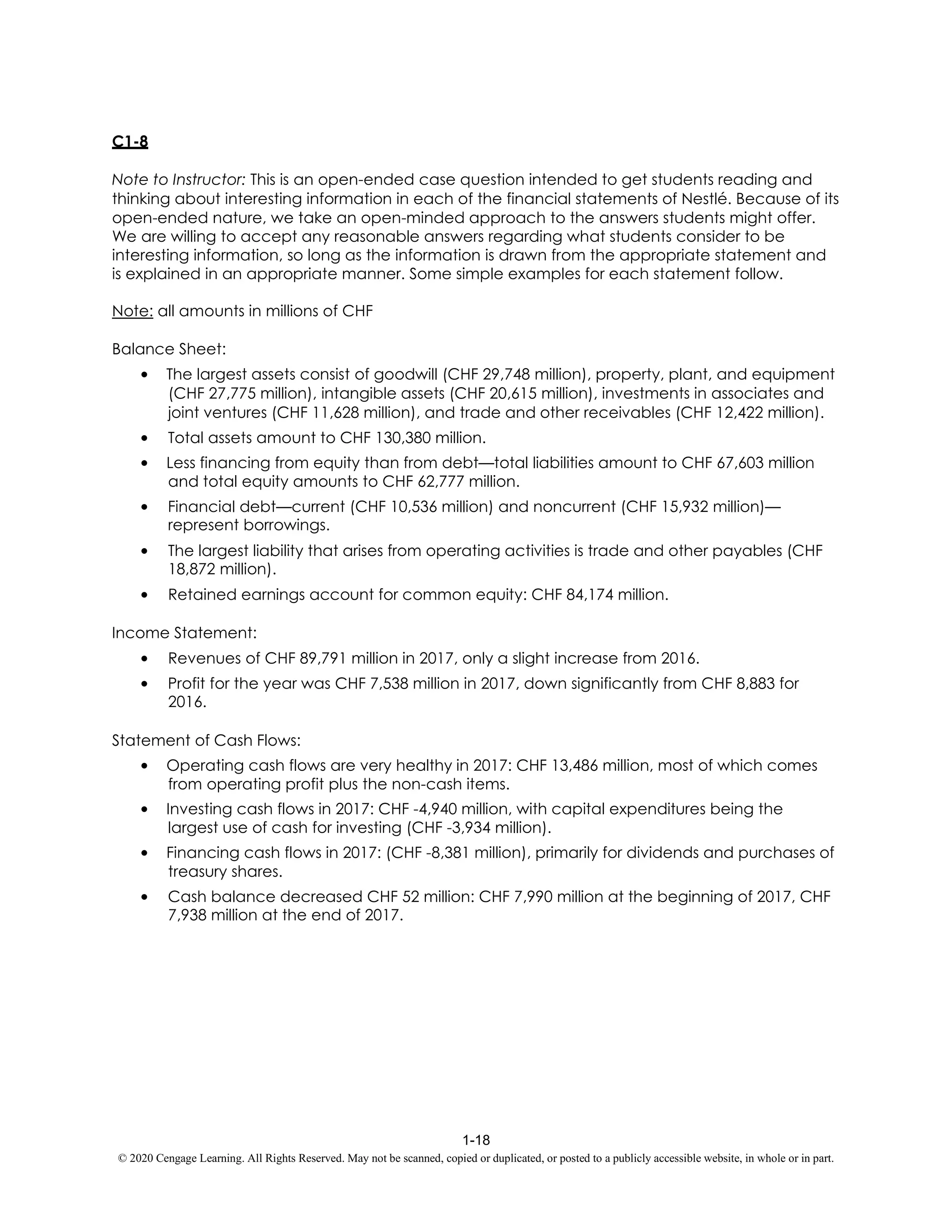
C1-8
Note to Instructor: This is an open-ended case question intended to get students reading and
thinking about interesting information in each of the financial statements of Nestlé. Because of its
open-ended nature, we take an open-minded approach to the answers students might offer.
We are willing to accept any reasonable answers regarding what students consider to be
interesting information, so long as the information is drawn from the appropriate statement and
is explained in an appropriate manner. Some simple examples for each statement follow.
Note: all amounts in millions of CHF
Balance Sheet:
• The largest assets consist of goodwill (CHF 29,748 million), property, plant, and equipment
(CHF 27,775 million), intangible assets (CHF 20,615 million), investments in associates and
joint ventures (CHF 11,628 million), and trade and other receivables (CHF 12,422 million).
• Total assets amount to CHF 130,380 million.
• Less financing from equity than from debt—total liabilities amount to CHF 67,603 million
and total equity amounts to CHF 62,777 million.
• Financial debt—current (CHF 10,536 million) and noncurrent (CHF 15,932 million)—
represent borrowings.
• The largest liability that arises from operating activities is trade and other payables (CHF
18,872 million).
• Retained earnings account for common equity: CHF 84,174 million.
Income Statement:
• Revenues of CHF 89,791 million in 2017, only a slight increase from 2016.
• Profit for the year was CHF 7,538 million in 2017, down significantly from CHF 8,883 for
2016.
Statement of Cash Flows:
• Operating cash flows are very healthy in 2017: CHF 13,486 million, most of which comes
from operating profit plus the non-cash items.
• Investing cash flows in 2017: CHF -4,940 million, with capital expenditures being the
largest use of cash for investing (CHF -3,934 million).
• Financing cash flows in 2017: (CHF -8,381 million), primarily for dividends and purchases of
treasury shares.
• Cash balance decreased CHF 52 million: CHF 7,990 million at the beginning of 2017, CHF
7,938 million at the end of 2017.
1-19
© 2020 Cengage Learning. All Rights Reserved. May not be scanned, copied or duplicated, or posted to a publicly accessible website, in whole or in part.
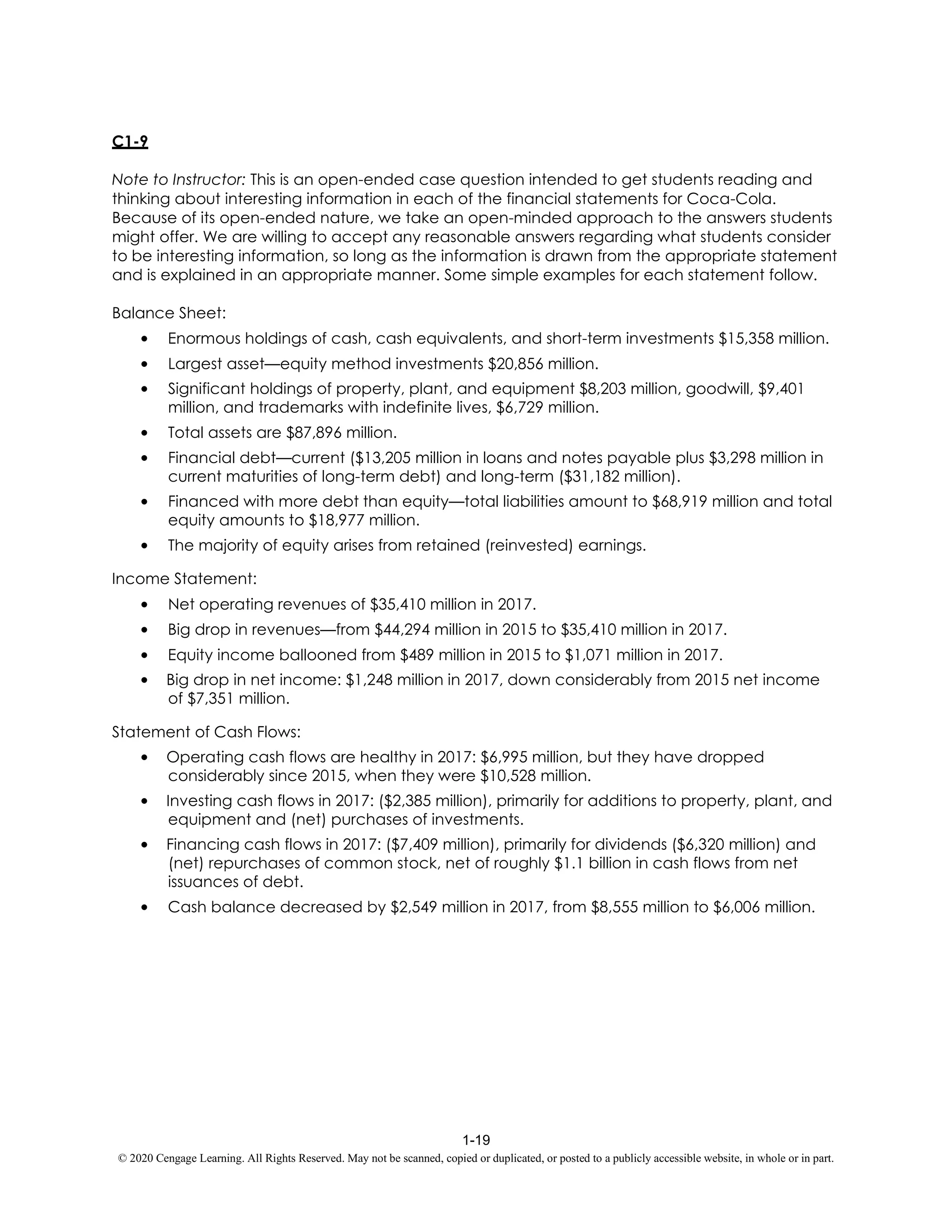
C1-9
Note to Instructor: This is an open-ended case question intended to get students reading and
thinking about interesting information in each of the financial statements for Coca-Cola.
Because of its open-ended nature, we take an open-minded approach to the answers students
might offer. We are willing to accept any reasonable answers regarding what students consider
to be interesting information, so long as the information is drawn from the appropriate statement
and is explained in an appropriate manner. Some simple examples for each statement follow.
Balance Sheet:
• Enormous holdings of cash, cash equivalents, and short-term investments $15,358 million.
• Largest asset—equity method investments $20,856 million.
• Significant holdings of property, plant, and equipment $8,203 million, goodwill, $9,401
million, and trademarks with indefinite lives, $6,729 million.
• Total assets are $87,896 million.
• Financial debt—current ($13,205 million in loans and notes payable plus $3,298 million in
current maturities of long-term debt) and long-term ($31,182 million).
• Financed with more debt than equity—total liabilities amount to $68,919 million and total
equity amounts to $18,977 million.
• The majority of equity arises from retained (reinvested) earnings.
Income Statement:
• Net operating revenues of $35,410 million in 2017.
• Big drop in revenues—from $44,294 million in 2015 to $35,410 million in 2017.
• Equity income ballooned from $489 million in 2015 to $1,071 million in 2017.
• Big drop in net income: $1,248 million in 2017, down considerably from 2015 net income
of $7,351 million.
Statement of Cash Flows:
• Operating cash flows are healthy in 2017: $6,995 million, but they have dropped
considerably since 2015, when they were $10,528 million.
• Investing cash flows in 2017: ($2,385 million), primarily for additions to property, plant, and
equipment and (net) purchases of investments.
• Financing cash flows in 2017: ($7,409 million), primarily for dividends ($6,320 million) and
(net) repurchases of common stock, net of roughly $1.1 billion in cash flows from net
issuances of debt.
• Cash balance decreased by $2,549 million in 2017, from $8,555 million to $6,006 million.
1-20
© 2020 Cengage Learning. All Rights Reserved. May not be scanned, copied or duplicated, or posted to a publicly accessible website, in whole or in part.
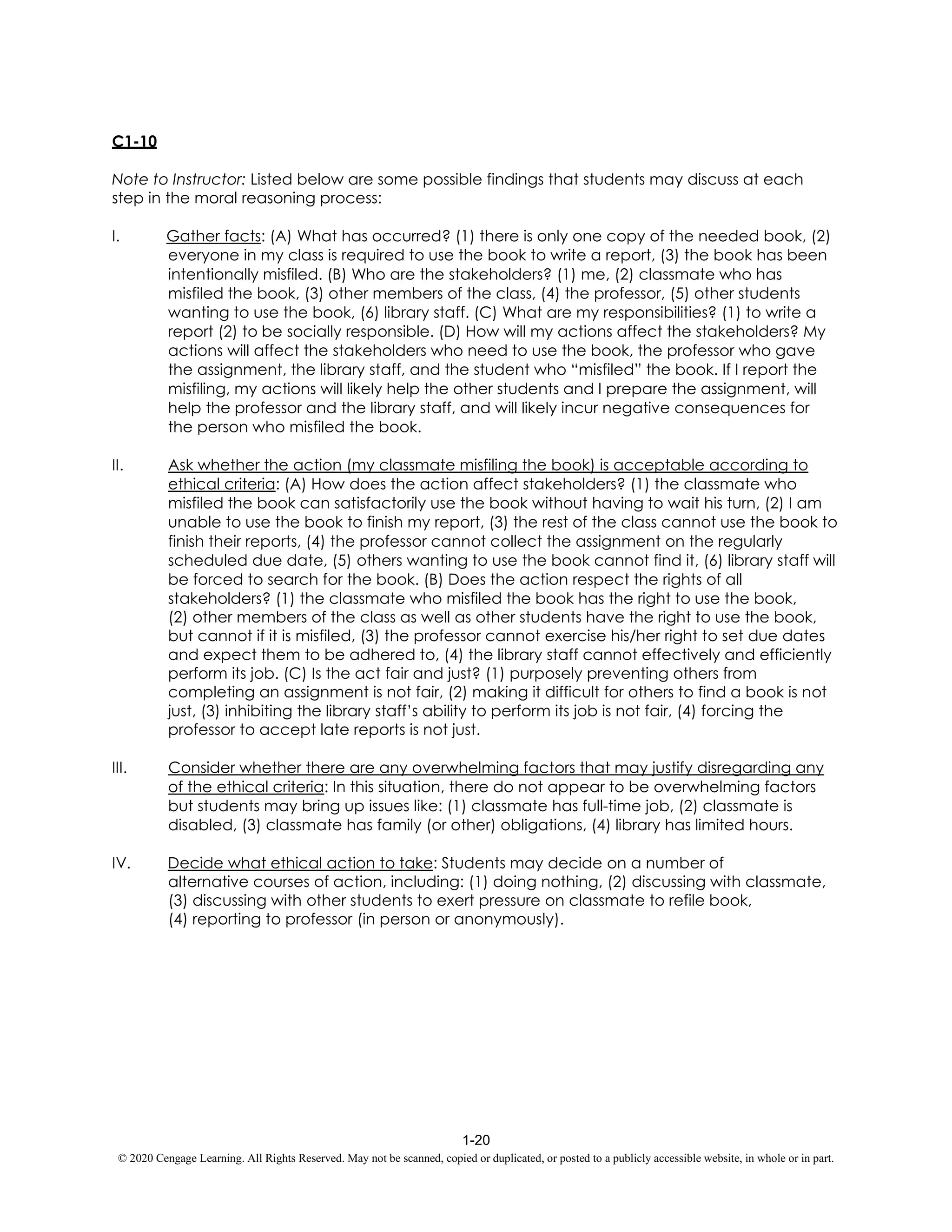
C1-10
Note to Instructor: Listed below are some possible findings that students may discuss at each
step in the moral reasoning process:
I. Gather facts: (A) What has occurred? (1) there is only one copy of the needed book, (2)
everyone in my class is required to use the book to write a report, (3) the book has been
intentionally misfiled. (B) Who are the stakeholders? (1) me, (2) classmate who has
misfiled the book, (3) other members of the class, (4) the professor, (5) other students
wanting to use the book, (6) library staff. (C) What are my responsibilities? (1) to write a
report (2) to be socially responsible. (D) How will my actions affect the stakeholders? My
actions will affect the stakeholders who need to use the book, the professor who gave
the assignment, the library staff, and the student who “misfiled” the book. If I report the
misfiling, my actions will likely help the other students and I prepare the assignment, will
help the professor and the library staff, and will likely incur negative consequences for
the person who misfiled the book.
II. Ask whether the action (my classmate misfiling the book) is acceptable according to
ethical criteria: (A) How does the action affect stakeholders? (1) the classmate who
misfiled the book can satisfactorily use the book without having to wait his turn, (2) I am
unable to use the book to finish my report, (3) the rest of the class cannot use the book to
finish their reports, (4) the professor cannot collect the assignment on the regularly
scheduled due date, (5) others wanting to use the book cannot find it, (6) library staff will
be forced to search for the book. (B) Does the action respect the rights of all
stakeholders? (1) the classmate who misfiled the book has the right to use the book,
(2) other members of the class as well as other students have the right to use the book,
but cannot if it is misfiled, (3) the professor cannot exercise his/her right to set due dates
and expect them to be adhered to, (4) the library staff cannot effectively and efficiently
perform its job. (C) Is the act fair and just? (1) purposely preventing others from
completing an assignment is not fair, (2) making it difficult for others to find a book is not
just, (3) inhibiting the library staff’s ability to perform its job is not fair, (4) forcing the
professor to accept late reports is not just.
III. Consider whether there are any overwhelming factors that may justify disregarding any
of the ethical criteria: In this situation, there do not appear to be overwhelming factors
but students may bring up issues like: (1) classmate has full-time job, (2) classmate is
disabled, (3) classmate has family (or other) obligations, (4) library has limited hours.
IV. Decide what ethical action to take: Students may decide on a number of
alternative courses of action, including: (1) doing nothing, (2) discussing with classmate,
(3) discussing with other students to exert pressure on classmate to refile book,
(4) reporting to professor (in person or anonymously).
1-21
© 2020 Cengage Learning. All Rights Reserved. May not be scanned, copied or duplicated, or posted to a publicly accessible website, in whole or in part.
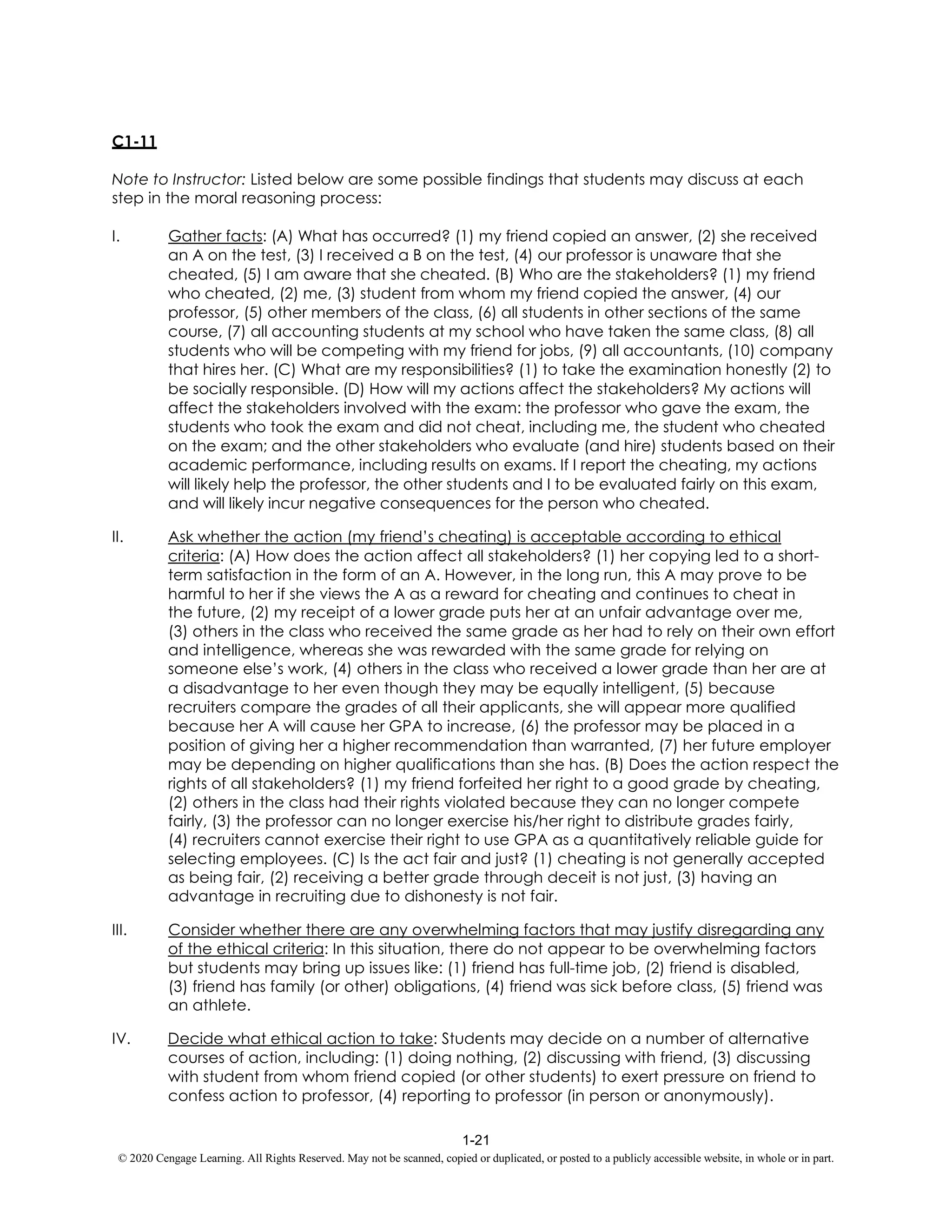
C1-11
Note to Instructor: Listed below are some possible findings that students may discuss at each
step in the moral reasoning process:
I. Gather facts: (A) What has occurred? (1) my friend copied an answer, (2) she received
an A on the test, (3) I received a B on the test, (4) our professor is unaware that she
cheated, (5) I am aware that she cheated. (B) Who are the stakeholders? (1) my friend
who cheated, (2) me, (3) student from whom my friend copied the answer, (4) our
professor, (5) other members of the class, (6) all students in other sections of the same
course, (7) all accounting students at my school who have taken the same class, (8) all
students who will be competing with my friend for jobs, (9) all accountants, (10) company
that hires her. (C) What are my responsibilities? (1) to take the examination honestly (2) to
be socially responsible. (D) How will my actions affect the stakeholders? My actions will
affect the stakeholders involved with the exam: the professor who gave the exam, the
students who took the exam and did not cheat, including me, the student who cheated
on the exam; and the other stakeholders who evaluate (and hire) students based on their
academic performance, including results on exams. If I report the cheating, my actions
will likely help the professor, the other students and I to be evaluated fairly on this exam,
and will likely incur negative consequences for the person who cheated.
II. Ask whether the action (my friend’s cheating) is acceptable according to ethical
criteria: (A) How does the action affect all stakeholders? (1) her copying led to a short-
term satisfaction in the form of an A. However, in the long run, this A may prove to be
harmful to her if she views the A as a reward for cheating and continues to cheat in
the future, (2) my receipt of a lower grade puts her at an unfair advantage over me,
(3) others in the class who received the same grade as her had to rely on their own effort
and intelligence, whereas she was rewarded with the same grade for relying on
someone else’s work, (4) others in the class who received a lower grade than her are at
a disadvantage to her even though they may be equally intelligent, (5) because
recruiters compare the grades of all their applicants, she will appear more qualified
because her A will cause her GPA to increase, (6) the professor may be placed in a
position of giving her a higher recommendation than warranted, (7) her future employer
may be depending on higher qualifications than she has. (B) Does the action respect the
rights of all stakeholders? (1) my friend forfeited her right to a good grade by cheating,
(2) others in the class had their rights violated because they can no longer compete
fairly, (3) the professor can no longer exercise his/her right to distribute grades fairly,
(4) recruiters cannot exercise their right to use GPA as a quantitatively reliable guide for
selecting employees. (C) Is the act fair and just? (1) cheating is not generally accepted
as being fair, (2) receiving a better grade through deceit is not just, (3) having an
advantage in recruiting due to dishonesty is not fair.
III. Consider whether there are any overwhelming factors that may justify disregarding any
of the ethical criteria: In this situation, there do not appear to be overwhelming factors
but students may bring up issues like: (1) friend has full-time job, (2) friend is disabled,
(3) friend has family (or other) obligations, (4) friend was sick before class, (5) friend was
an athlete.
IV. Decide what ethical action to take: Students may decide on a number of alternative
courses of action, including: (1) doing nothing, (2) discussing with friend, (3) discussing
with student from whom friend copied (or other students) to exert pressure on friend to
confess action to professor, (4) reporting to professor (in person or anonymously).
1-22
© 2020 Cengage Learning. All Rights Reserved. May not be scanned, copied or duplicated, or posted to a publicly accessible website, in whole or in part.
ANSWERS TO USING CODIFICATION
C1-12
Note to Instructor: Students are expected to cite references to GAAP in their research of this
issue. While they might use various sources to conduct their research, the FASB Accounting
Standards Codification, which is the primary source of GAAP, is cited.
The FASB Accounting Standards Codification is an electronic database that integrates and
topically organizes the U.S. accounting standards (GAAP). The Codification is important because
it is the only source of authoritative U.S. GAAP for companies to determine how to record their
transactions, events, or circumstances, and how to report the results in their financial statements.
(An exception to this statement is the rules and interpretive releases of the SEC which are
sources of authoritative GAAP for publicly traded companies that are required to file their
financial statements with the SEC. For convenience, the Codification includes selected portions
of GAAP issued by the SEC for publicly traded companies. The Codification, however, does not
contain all of the SEC’s rules and regulations that constitute GAAP.)
The Codification is located at http://asc.fasb.org (or, if your institution participates in the
American Accounting Association academic access initiate, at http://aaahq.org/ascLogin
.cfm). All users must register before they can log in. After logging in, the “home page” provides a
notice to constituents, links to tutorials, instructions on how to “join sections,” and explanations of
how to cross reference the Codification sections to the original pronouncements. The framework
of the Codification contains six components or levels: (1) Areas, (2) Topics, (3) Subtopics, (4)
Sections, (5) Subsections, and (6) Paragraphs containing GAAP. The Areas component is
located on the left side of the home page, and contains links to nine broad accounting subjects
which include General Principles, Presentation, Assets, Liabilities, Equity, Revenue, Expenses,
Broad Transactions, and Industry, along with a Master Glossary link and a “Go To” box for users
familiar with the Codification numbering system.
The Topics, Subtopics, Sections, Subsections, and Paragraphs are considered descending
“levels” of the Codification database, and each item in each level is numbered for reference
and search purposes. The Topics level is accessed by clicking on the Area “subject” links on the
Codification home page. The following is an explanation of the descending order of the levels
within each Area.
• Topics involve a collection of related guidance on a particular subject area (e.g.,
Assets).
• Subtopics are subsets of a Topic and generally are distinguished by “type” or by “scope”
(e.g., under the Leases Topic, there are Subtopics for Operating Leases and Capital
Leases, because they are different types of Leases).
• Sections characterize the nature of the content in a Subtopic (e.g., Recognition,
Measurement, Disclosure).
• Subsections refine and break down Sections into narrower and more specific items. If a
Subsection is necessary, it is not numbered but does include the Paragraphs that contain
the guidance that constitutes GAAP.
• Paragraphs contain the guidance that constitutes GAAP.
1-23
© 2020 Cengage Learning. All Rights Reserved. May not be scanned, copied or duplicated, or posted to a publicly accessible website, in whole or in part.
C1-12 (concluded)
To find the GAAP for a particular accounting issue, after logging in you would go to the Area
links in the left column of the home page and click on an Area (e.g., Assets). This would bring
you to a menu of Topics, after which you would click on one topic. This would bring you to a
menu containing Subtopics. After clicking on a Subtopic, this would bring you to a menu
containing several Sections. Here, you would have to decide which Section is most likely to
contain the answer to your question. You would click on that Section, which would bring you to
the paragraphs containing the answer (GAAP) for your question. This completes your search. If
you wanted to reference this answer, you would indicate that it can be found by listing the
Topic, Subtopic, Section, and paragraph numbers (e.g., ASC 330-10-30-1). Now, suppose you
had left this screen and wanted to go back to this paragraph. To save time, you could enter
330-10-30-1 in the “Go To” box on the home page, and it would bring you directly to the
paragraph.
C1-13
Note to Instructor: Students are expected to cite references to GAAP in their research of this
issue. While they might use various sources to conduct their research, the FASB Accounting
Standards Codification, which is the primary source of GAAP, is cited.
The cost of a productive facility (e.g., machine) is one of the costs of the services it renders
during its useful economic life. Generally accepted accounting principles (GAAP) require that
this cost be spread over the expected useful life of the facility in such a way as to allocate it as
equitably as possible to the periods during which services are obtained from the use of the
facility. This procedure is known as depreciation accounting, which aims to distribute the cost,
less salvage (if any), over the estimated useful life of the unit in a systematic and rational
manner. It is a process of allocation, not of valuation.
This is a summary. The complete GAAP may be found at FASB ASC 360-10-35-4.
The Codification is located at http://asc.fasb.org (or, if your institution participates in the
American Accounting Association academic access initiate, at http://aaahq.org/ascLogin
.cfm). All users must register before they can log in. After logging in, the “home page” provides a
notice to constituents, links to tutorials, instructions on how to “join sections,” and explanations of
how to cross reference the Codification sections to the original pronouncements. The framework
of the Codification contains six components or levels: (1) Areas, (2) Topics, (3) Subtopics,
(4) Sections, (5) Subsections, and (6) Paragraphs containing GAAP. The Areas component is
located on the left side of the home page, and contains links to nine broad accounting subjects
which include General Principles, Presentation, Assets, Liabilities, Equity, Revenue, Expenses,
Broad Transactions, and Industry, along with a Master Glossary link and a “Go To” box for users
familiar with the Codification numbering system.
• The Topics, Subtopics, Sections, Subsections, and Paragraphs are considered descending
“levels” of the Codification database, and each item in each level is numbered for
reference and search purposes. The Topics level is accessed by clicking on the Area
“subject” links on the Codification home page. The following is an explanation of the
descending order of the levels within each Area.
• Topics involve a collection of related guidance on a particular subject area (e.g.,
Assets).
1-24
© 2020 Cengage Learning. All Rights Reserved. May not be scanned, copied or duplicated, or posted to a publicly accessible website, in whole or in part.
C1-13 (concluded)
• Subtopics are subsets of a Topic and generally are distinguished by “type” or by “scope”
(e.g., under the Leases Topic, there are Subtopics for Operating Leases and Capital
Leases, because they are different types of Leases).
• Sections characterize the nature of the content in a Subtopic (e.g., Recognition,
Measurement, Disclosure).
• Subsections refine and break down Sections into narrower and more specific items. If a
Subsection is necessary, it is not numbered but does include the Paragraphs that contain
the guidance that constitutes GAAP.
• Paragraphs contain the guidance that constitutes GAAP.
To find the GAAP for a particular accounting issue, after logging in you would go to the Area
links in the left column of the home page and click on an Area (e.g., Assets). This would bring
you to a menu of seven Topics of assets, after which you would click on one topic. This would
bring you to a menu containing Subtopics. After clicking on a Subtopic, this would bring you to a
menu containing several Sections. Here, you would have to decide which Section is most likely
to contain the answer to your question. You would click on that Section, which would bring you
to the paragraphs containing the answer (GAAP) for your question. This completes your search.
If you wanted to reference this answer, you would indicate that it can be found by listing the
Topic, Subtopic, Section, and paragraph numbers (e.g., ASC 360-10-35-4). Now, suppose you
had left this screen and wanted to go back to this paragraph. To save time, you could enter
360-10-35-4 in the “Go To” box on the home page, and it would bring you directly to the
paragraph.
C1-14
Note to Instructor: Students are expected to cite references to GAAP in their research of this
issue. While they might use various sources to conduct their research, the FASB Accounting
Standards Codification, which is the primary source of GAAP, is cited.
The recognition of revenue of a company during a period involves consideration of the following
two factors, with sometimes one and sometimes the other being the more important
consideration:
(a) Being realized or realizable. Revenue generally is not recognized until realized or realizable.
Revenue is realized when products (goods or services), merchandise, or other assets are
exchanged for cash or claims to cash. Revenue is realizable when related assets received
or held are readily convertible to known amounts of cash or claims to cash.
(b) Being earned. Revenue is not recognized until earned. A company’s revenue-earning
activities involve delivering or producing goods, rendering services, or other activities that
constitute its ongoing major or central operations, and revenue is considered to have
been earned when the company has substantially accomplished what it must do to be
entitled to the benefits represented by the revenue.
This is a summary. The complete GAAP may be found at FASB ASC 605-10-25-1.
1-25
© 2020 Cengage Learning. All Rights Reserved. May not be scanned, copied or duplicated, or posted to a publicly accessible website, in whole or in part.
C1-14 (concluded)
The Codification is located at http://asc.fasb.org (or, if your institution participates in the
American Accounting Association academic access initiate, at http://aaahq.org/ascLogin
.cfm). All users must register before they can log in. After logging in, the “home page” provides a
notice to constituents, links to tutorials, instructions on how to “join sections,” and explanations of
how to cross reference the Codification sections to the original pronouncements. The framework
of the Codification contains six components or levels: (1) Areas, (2) Topics, (3) Subtopics,
(4) Sections, (5) Subsections, and (6) Paragraphs containing GAAP. The Areas component is
located on the left side of the home page, and contains links to nine broad accounting subjects
which include General Principles, Presentation, Assets, Liabilities, Equity, Revenue, Expenses,
Broad Transactions, and Industry, along with a Master Glossary link and a “Go To” box for users
familiar with the Codification numbering system.
The Topics, Subtopics, Sections, Subsections, and Paragraphs are considered descending
“levels” of the Codification database, and each item in each level is numbered for reference
and search purposes. The Topics level is accessed by clicking on the Area “subject” links on the
Codification home page. The following is an explanation of the descending order of the levels
within each Area.
• Topics involve a collection of related guidance on a particular subject area (e.g.,
Assets).
• Subtopics are subsets of a Topic and generally are distinguished by “type” or by “scope”
(e.g., under the Leases Topic, there are Subtopics for Operating Leases and Capital
Leases, because they are different types of Leases).
• Sections characterize the nature of the content in a Subtopic (e.g., Recognition,
Measurement, Disclosure).
• Subsections refine and break down Sections into narrower and more specific items. If a
Subsection is necessary, it is not numbered but does include the Paragraphs that contain
the guidance that constitutes GAAP.
• Paragraphs contain the guidance that constitutes GAAP.
To find the GAAP for a particular accounting issue, after logging in you would go to the Area
links in the left column of the home page and click on an Area (e.g., Assets). This would bring
you to a menu of Topics, after which you would click on one topic. This would bring you to a
menu containing Subtopics. After clicking on a Subtopic, this would bring you to a menu
containing several Sections. Here, you would have to decide which Section is most likely to
contain the answer to your question. You would click on that Section, which would bring you to
the paragraphs containing the answer (GAAP) for your question. This completes your search. If
you wanted to reference this answer, you would indicate that it can be found by listing the
Topic, Subtopic, Section, and paragraph numbers (e.g., ASC 605-10-25-1). Now, suppose you
had left this screen and wanted to go back to this paragraph. To save time, you could enter
605-10-25-1 in the “Go To” box on the home page, and it would bring you directly to the
paragraph.
Exploring the Variety of Random
Documents with Different Content
The Project Gutenberg eBook of The Oxford
Book of Ballads
This ebook is for the use of anyone anywhere in the United
States and most other parts of the world at no cost and with
almost no restrictions whatsoever. You may copy it, give it away
or re-use it under the terms of the Project Gutenberg License
included with this ebook or online at www.gutenberg.org. If you
are not located in the United States, you will have to check the
laws of the country where you are located before using this
eBook.
Title: The Oxford Book of Ballads
Editor: Arthur Quiller-Couch
Release date: January 5, 2014 [eBook #44593]
Most recently updated: October 23, 2024
Language: English
Credits: Produced by Charlene Taylor, Ted Garvin, Paul Clark and
the Online Distributed Proofreading Team at
http://www.pgdp.net
*** START OF THE PROJECT GUTENBERG EBOOK THE OXFORD
BOOK OF BALLADS ***
Transcriber's Note:
Every effort has been made to replicate this text as faithfully as possible. Some minor
corrections of spelling and puctuation have been made.
The cover image for the e-book version was created by the transcriber.
The Oxford Book of Ballads
The
Oxford Book of
Ballads
Chosen & Edited by
Arthur Quiller-Couch
Oxford
At the Clarendon Press
PRINTED IN GREAT BRITAIN
TO
THE ONE SURVIVOR
OF THREE MEN
TO WHOM ALL LOVERS OF THE BALLAD
OWE MOST IN THESE TIMES
FRANCIS JAMES CHILD
FREDERICK JAMES FURNIVALL
AND
JOHN WESLEY HALES
PREFACE
As in The Oxford Book of English Verse I tried to range over the
whole field of the English Lyric, and to choose the best, so in this
volume I have sought to bring together the best Ballads out of the
whole of our national stock. But the method, order, balance of the
two books are different perforce, as the fates of the Lyric and the
Ballad have been diverse. While the Lyric in general, still making for
variety, is to-day more prolific than ever and (all cant apart)
promises fruit to equal the best, that particular offshoot which we
call the Ballad has been dead, or as good as dead, for two hundred
years. It would seem to have discovered, almost at the start, a very
precise Platonic pattern of what its best should be; and having
exhausted itself in reproducing that, it declined (through a crab-
apple stage of Broadsides) into sterility. Therefore this anthology
cannot be brought down to the present day, and therefore the first
half of it contains far finer poetry than the second.
But it may be objected that among Ballads no such thing as
chronological order is possible; and that, if it were, I have not
attempted it. ‘Why then did I not boldly mix up all my flowers in a
heap and afterwards sit down to re-arrange them, disregarding
history, studious only that one flower should set off another and the
whole wreath be a well-balanced circle?’ I will try to answer this,
premising only that tact is nine-tenths of the anthologist’s business.
It is very true that the Ballads have no chronology: that no one can
say when Hynd Horn was composed, or assert with proof that Clerk
Saunders is younger than Childe Maurice or Tam Lin older than Sir
Patrick Spens, though that all five are older than The Children in the
Wood no one with an ounce of literary sense would deny. Even of
our few certainties we have to remember that, where almost
everything depends on oral tradition, it may easily happen—in fact
happens not seldom—that a really old ballad ‘of the best period’ has
reached us late and in a corrupted form, its original gold overlaid
with silver and bronze. It is true, moreover, that these pages,
declining an impossible order, decline also the pretence to it. I have
arranged the ballads in seven books: of which the first deals with
Magic, the ‘Seely Court’, and the supernatural; the second (and on
the whole the most beautiful) with stories of absolute romance such
as Childe Waters, Lord Ingram, Young Andrew; the third with
romance shading off into real history, as in Sir Patrick Spens, Hugh
of Lincoln, The Queen’s Marie; the fourth with Early Carols and
ballads of Holy Writ. This closes Part I. The fifth book is all of the
Greenwood and Robin Hood; the sixth follows history down from
Chevy Chase and the Homeric deeds of Douglas and Percy to less
renowned if not less spirited Border feuds; while the seventh and
last book presents the Ballad in various aspects of false beginning
and decline—The Old Cloak, which deserved a long line of children
but in fact has had few; Barbara Allen, late but exquisite; Lord Lovel,
which is silly sooth; and The Suffolk Tragedy, wherein a magnificent
ballad-theme is ambled to market like so much butter. My hope is
that this arrangement, while it avoids mixing up things that differ
and keeps consorted those (the Robin Hood Ballads for example)
which naturally go together, does ‘in round numbers’ give a view of
the Ballad in its perfection and decline, and that so my book may be
useful to the student as well as to the disinterested lover of poetry
for whom it is chiefly intended.
This brings me to the matter of text. To make a ‘scientific’ anthology
of the Ballads was out of the question. In so far as scientific
treatment could be brought to them the work had been done, for
many generations to come, if not finally, by the late Professor
Child[1] in his monumental edition, to which at every turn I have
been indebted for guidance back to the originals. Child’s method was
to get hold of every ballad in every extant version, good, bad, or
indifferent, and to print these versions side by side, with a foreword
on the ballad’s history, packed with every illustration that could be
contributed out of his immense knowledge of the folk-poetry of
every race and country. His work, as I say, left no room for follower
or imitator; but fortunately it lies almost as wide of my purpose as of
my learning. My reader did not require Sir Patrick Spens or May
Colvin in a dozen or twenty versions: he wanted one ballad, one Sir
Patrick Spens, one May Colvin, and that the best. How could I give
him the best in my power?
There is only one way. It was Scott’s way, and the way of William
Allingham, who has been at pains to define it in the preface to his
Ballad Book (Macmillan):—
The various oral versions of a popular ballad obtainable
throughout England, Scotland, and Ireland, are perhaps, even
at this late day,[2] practically innumerable—one as ‘authentic’ as
another. What then to do?... The right course has appeared to
be this, to make oneself acquainted with all attainable versions
of a ballad. Then (granting a ‘turn’ for such things, to begin;
without which all were labour in vain) the editor may be
supposed to get as much insight as may be into the origin and
character of the ballad in question; he sees or surmises more or
less as to the earliest version or versions, as to blunders,
corruptions, alterations of every sort (national, local, personal)
on the part of the reciters; he then comes to investigate the
doings of former editors, adopting thankfully what he finds
good, correcting at points whereupon he has attained better
information, rejecting (when for the worse) acknowledged or
obvious interpolations or changes. He has to give it in one form
—the best according to his judgement and feeling—in firm black
and white, for critics, and for readers cultivated and simple.
This fairly describes Scott’s method as well as Allingham’s own. But
while I must claim along with them ‘a “turn” for such things’ (the
claim is implicit in my attempt), these two men were poets, and
could dare more boldly than I to rewrite a faulty stanza or to supply
a missing one. Of this ticklish license I have been extremely chary,
and have used it with the double precaution (1) of employing, so far
as might be, words and phrases found elsewhere in the text of the
ballad, and (2) of printing these experiments in square brackets,[3]
that the reader may not be misled. Maybe I should have resisted the
temptation altogether but for the necessity—in a work intended for
all sorts of readers, young and old—of removing or reducing here
and there in these eight hundred and sixty-five pages a coarse or a
brutal phrase. To those who deny the necessity I will only answer
that while no literature in the world exercises a stronger or on the
whole a saner fascination upon imaginative youth than do these
ballads, it seems to me wiser to omit a stanza from Glasgerion, for
example, or to modify a line in Young Hunting, than to withhold
these beautiful things altogether from boy or maid.
Before leaving this subject of texts and their handling, I must
express my thanks for the permission given me to make free use of
the text of the Percy Folio MS., edited by Professors Hales and
Furnivall some forty years ago. This was of course indispensable. In
the history of our ballad-literature the Reliques themselves are, if
something more of a landmark, much less of a trophy than the three
famous volumes so romantically achieved by Professor Child and
their two editors, whose labour has been scarcely more honourable
than their liberality which has ever laid its results open to men’s
benefit. Mr. Child died in 1896; Mr. Furnivall a few months ago. To
Mr. Hales, survivor of the famous three, I owe the permission given
with a courtesy which set a fresh value on what was already beyond
value. I must also thank the Rev. Sabine Baring-Gould for leave to
include The Brown Girl and other ballads from his Songs of the West
and A Garland of Country Song (Methuen). It were idle to quote all
the scholars—Ritson, Herd, Scott, Jamieson and the rest—to whose
labours every ballad-editor must be indebted: but among younger
men I wish to thank Mr. F. Sidgwick, whose method in his two
volumes of Ballads (Bullen) I can admire the more unreservedly
because it differs from mine.
I hope, at any rate, that in presenting each ballad as one, and
reconstructing it sometimes from many versions, I have kept pretty
constantly to the idea, of which Professor Ker[4] says—‘The truth is
that the Ballad is an Idea, a Poetical Form, which can take up any
matter, and does not leave that matter as it was before.’ If the
reader interrogate me concerning this Idea of the Ballad, as Mr.
Pecksniff demanded of Mrs. Todgers her Notion of a Wooden Leg,
Professor Ker has my answer prepared:—
In spite of Socrates and his logic we may venture to say, in
answer to the question ‘What is a ballad?’—‘A Ballad is The
Milldams of Binnorie and Sir Patrick Spens and The Douglas
Tragedy and Lord Randal and Childe Maurice, and things of that
sort.’
There the reader has it, without need of the definition or of the
historical account which this Preface must not attempt. Its author, no
doubt, is destined to consign, some day, and ‘come to dust’ with
more learned editors: but meanwhile, if one ask ‘What is a Ballad?’—
I answer, It is these things; and it is
About the dead hour o’ the night
She heard the bridles ring.
(Tam Lin)
and
But this ladye is gone to her chamber,
Her maydens following bright.
(Sir Cawline)
It is
‘O we were sisters, sisters seven;
We were the fairest under heaven.’
(Cospatrick)
and
‘I see no harm by you, Margaret,
Nor you see none by me.’
(Fair Margaret and Sweet William)
and
In somer, when the shawes be sheyne,
And leves be large and long.
(Robin Hood and the Monk)
and
O there was horsing, horsing in haste,
And cracking of whips out owre the lee.
(Archie of Cawfield)
It is even
And there did he see brave Captain Ogilvie
A-training of his men on the green.
(The Duke of Gordon’s Daughter)
Like the Clown in Twelfth Night, it can sing both high and low: but
the note is unmistakable whether it sing high:
O cocks are crowing on merry middle-earth;
I wot the wild fowls are boding day.
(Clerk Saunders)
Half-owre, half-owre to Aberdour,
’Tis fifty fathoms deep;
And there lies gude Sir Patrick Spens,
Wi’ the Scots lords at his feet!
(Sir Patrick Spens)
‘O Earl Bran’, I see your heart’s bloud!’—
Ay lally, o lilly lally
‘It’s na but the glent o’ my scarlet hood’
All i’ the night sae early.
(Earl Brand)
or low
Then up bespake the bride’s mother—
She never was heard to speak so free:
‘Ye’ll not forsake my only daughter,
Though Susie Pye has cross’d the sea.’
(Young Beichan)
‘An’ thu sall marry a proud gunner,
An’ a proud gunner I’m sure he’ll be.’
(The Great Silkie of Sule Skerrie)
Rise up, rise up, brother Dives,
And go with us to see
A dismal place, prepared in hell,
To sit on a serpent’s knee.
(Dives and Lazarus)
or, merely flat and pedestrian:
There was slayne upon the English part
For sooth as I you say,
Of ninè thousand English men
Five hundred came away.
(Otterburn)
But it is always unmistakable and like no other thing in poetry; in
proof of which let me offer one simple, practical test. If any man
ever steeped himself in balladry, that man was Scott, and once or
twice, as in Proud Maisie and Brignall Banks, he came near to distil
the essence. If any man, taking the Ballad for his model, has ever
sublimated its feeling and language in a poem
seraphically free
From taint of personality,
that man was Coleridge and that poem his Ancient Mariner. If any
poet now alive can be called a ballad-writer of genius, it is the
author of Danny Deever and East and West. But let the reader
suppose a fascicule of such poems bound up with the present
collection, and he will perceive that I could have gone no straighter
way to destroy the singularity of the book.
In claiming this singularity for the Ballad I do not seek to exalt it
above any other lyrical form. Rather I am ready to admit, out of
some experience in anthologizing, that when a ballad is set in a
collection alongside the best of Herrick, Gray, Landor, Browning—to
name four poets opposite as the poles and to say nothing of such
masterwork as Spenser’s Epithalamion or Milton’s Lycidas—it is the
ballad that not only suffers by the apposition but suffers to a
surprising degree; so that I have sometimes been forced to
reconsider my affection, and ask ‘Are these ballads really beautiful as
they have always appeared to me?’ In truth (as I take it) the
contrast is unfair to them, much as any contrast between children
and grown folk would be unfair. They appealed to something young
in the national mind, and the young still ramp through Percy’s
Reliques—as I hope they will through this book—‘trailing clouds of
glory,’ following the note in Elmond’s wood—
May Margaret sits in her bower door
Sewing her silken seam;
She heard a note in Elmond’s wood,
And wish’d she there had been.
She loot the seam fa’ frae her side,
The needle to her tae,
And she is on to Elmond’s wood
As fast as she could gae.
A. Q. C.
FOOTNOTES:
[1] A smaller edition of ‘Child’, excellently planned, by Helen Child
Sargent and George Lyman Kittridge, is published in England by
Mr. Nutt.
[2] 1864.
[3] This does not hold of small transpositions, elisions of
superfluous words, or corrections of spelling. In these matters I
have allowed myself a free hand.
[4] On the History of the Ballads, 1100-1500, by W. P. Ker,
Proceedings of the British Academy, vol. iv.
CONTENTS
PART I
BOOK I
NO. PAGE
1. Thomas the Rhymer 1
2. Tam Lin 4
3. Sir Cawline 14
4. Sir Aldingar 20
5. Cospatrick 29
6. Willy’s Lady 36
7. The Queen of Elfland’s Nourice 41
8. Lady Isabel and the Elf-Knight 43
9. The Riddling Knight 46
10. May Colvin 47
11. The Wee Wee Man 51
12. Alison Gross 52
13. Kemp Owyne 55
14. The Laily Worm 59
15. King Orfeo 62
16. King Henry 64
17. The Boy and the Mantle 68
18. King Arthur and King Cornwall 75
19. The Marriage of Sir Gawain 88
20. Bonnie Annie 98
21. Brown Robyn’s Confession 100
22. The Cruel Mother 102
23. Binnorie 104
24. The Broomfield Hill 107
25. Earl Mar’s Daughter 110
26. Proud Lady Margaret 116
27. Clerk Saunders 118
28. The Daemon Lover 123
29. Clerk Colven 126
30. Young Hunting 129
31. The Great Silkie of Sule Skerrie 135
32. The Wife of Usher’s Well 136
33. A Lyke-Wake Dirge 138
34. The Unquiet Grave 140
BOOK II
35. Hynd Horn 142
36. Hynd Etin 145
37. Erlinton 153
38. Earl Brand 157
39. The Douglas Tragedy 160
40. Glasgerion 163
41. King Estmere 167
42. Fair Annie 179
43. The Lass of Lochroyan 184
44. Young Bekie 193
45. Young Beichan 199
46. Childe Waters 205
47. Childe Maurice 214
48. Brown Adam 221
49. Jellon Grame 223
50. Little Musgrave and Lady Barnard 227
51. Lord Ingram and Childe Vyet 232
52. Fair Janet 237
53. Old Robin of Portingale 242
54. Lord Thomas and Fair Annet 247
55. Rose the Red and White Lily 253
56. Leesome Brand 262
57. Babylon 265
58. Prince Robert 267
59. Young Andrew 270
60. The Gay Goshawk 275
61. Willie’s Lyke-Wake 280
62. Fair Margaret and Sweet William 281
63. The Twa Brothers 284
64. The Cruel Brother 287
65. Edward, Edward 290
66. Lord Randal 292
67. The Twa Corbies 293
68. The Three Ravens 294
BOOK III
69. The Nut-Brown Maid 295
70. Fause Foodrage 308
71. The Fair Flower of Northumberland 314
72. Young John 318
73. Lady Maisry 320
74. Bonny Bee Ho’m 326
75. Sir Patrick Spens 328
76. The Lord of Lorn 332
77. Edom o’ Gordon 342
78. Lamkin 348
79. Hugh of Lincoln 353
80. The Heir of Linne 356
81. Fair Mary of Wallington 361
82. Young Waters 367
83. The Queen’s Marie 369
84. The Outlaw Murray 374
85. Glenlogie 386
86. Lady Elspat 388
87. Jamie Douglas 390
88. Katharine Johnstone 395
89. Johnie Armstrong 398
90. Clyde Water 404
91. Young Benjie 409
92. Annan Water 413
93. Rare Willie Drowned in Yarrow 416
94. The Duke of Gordon’s Daughter 417
95. The Bonny Earl of Murray 422
96. Bonny George Campbell 423
BOOK IV
97. Judas 425
98. St. Stephen and King Herod 426
99. The Maid and the Palmer 428
100. The Falcon 430
101. The Cherry-Tree Carol 431
102. The Carnal and the Crane 434
103. Jolly Wat 439
104. I Saw Three Ships 442
105. The Twelve Good Joys 443
106. The Angel Gabriel 446
107. The Three Kings 448
108. The Innocents 451
109. Dives and Lazarus 455
110. The Holy Well 458
111. The Seven Virgins 460
PART II
BOOK V
112. Robyn and Gandelyn 462
113. The Birth of Robin Hood 465
114.
Adam Bell, Clym of the Clough, and William of
Clondesley
468
115. A Little Geste of Robin Hood and his Meiny 497
116. Robin Hood and Guy of Gisborne 575
117. Robin Hood and the Monk 585
118. Robin Hood and the Curtal Friar 600
119. Robin Hood and the Butcher 607
120. Robin Hood and the Bishop of Hereford 612
121. Robin Hood and Alan a Dale 616
122. Robin Hood and the Widow’s Three Sons 621
123. Robin Hood’s Golden Prize 626
124. The Noble Fisherman 630
125. The Death of Robin Hood 635
BOOK VI
126. Durham Field 640
127. The Battle of Otterburn 651
128. Chevy Chase 664
129. Northumberland Betrayed by Douglas 675
130. Sir Andrew Barton 684
131. The ‘George Aloe’ 697
132. The ‘Golden Vanity’ 701
133. John Dory 703
134. Willie Macintosh 704
135. The Bonnie House o’ Airlie 705
136. Johnnie of Cockerslee 707
137. Kinmont Willie 712
138. Jock o’ the Side 720
139. Hobbie Noble 726
140. Archie of Cawfield 732
141. Jamie Telfer in the Fair Dodhead 738
142. Dick o’ the Cow 746
143. Hughie the Graeme 757
144. The Lochmaben Harper 759
145. The Fire of Frendraught 763
146. The Death of Parcy Reed 767
147. Baby Livingston 774
148. The Gypsy Countess 781
149. The Baron of Brackley 783
150. The Dowie Houms of Yarrow 786
151. Lord Maxwell’s Last Goodnight 789
152. Helen of Kirconnell 792
153. The Lament of the Border Widow 793
BOOK VII
154. Lady Alice 795
155. Lord Lovel 796
156. The Trees so High 798
157. The Brown Girl 800
158. Barbara Allen’s Cruelty 802
159. The Gardener 804
160. The Lowlands o’ Holland 806
161. The Spanish Lady’s Love 807
162. The Bailiff’s Daughter of Islington 811
163. The Blind Beggar’s Daughter of Bednall-Green 813
164. The Loving Ballad of Lord Bateman 825
165. Mary Ambree 829
166. The Lady turned Serving-Man 832
167. The Simple Ploughboy 837
168. Cawsand Bay 839
169. The Greenland Fishery 841
170. The Old Cloak 843
171. Widdicombe Fair 845
172. Get Up and Bar the Door 847
173. King John and the Abbot of Canterbury 849
174. The Children in the Wood 854
175. The Suffolk Miracle 860
176. Bessie Bell and Mary Gray 865
Index of First Lines
867
Certainly, I must confesse my own barbarousnes, I neuer heard
the olde song of Percy and Duglas that I found not my heart
mooued more then with a Trumpet.
Sir Philip Sidney.
Download the complete Solution Manual for Intermediate Accounting 3rd Edition by Wahlen book instantly in PDF format.

  • 1.
    Visit https://testbankmall.com todownload the full version and explore more testbank or solutions manual Solution Manual for Intermediate Accounting 3rd Edition by Wahlen _____ Click the link below to download _____ https://testbankmall.com/product/solution-manual-for- intermediate-accounting-3rd-edition-by-wahlen/ Explore and download more testbank or solutions manual at testbankmall.com
  • 2.
    Here are somerecommended products that we believe you will be interested in. You can click the link to download. Solution Manual for Intermediate Accounting Reporting and Analysis 1st Edition by Wahlen https://testbankmall.com/product/solution-manual-for-intermediate- accounting-reporting-and-analysis-1st-edition-by-wahlen/ Test Bank for Intermediate Accounting: Reporting and Analysis, 3rd Edition, James M. Wahlen https://testbankmall.com/product/test-bank-for-intermediate- accounting-reporting-and-analysis-3rd-edition-james-m-wahlen/ Test Bank for Intermediate Accounting Reporting and Analysis 1st Edition by Wahlen https://testbankmall.com/product/test-bank-for-intermediate- accounting-reporting-and-analysis-1st-edition-by-wahlen/ Intermediate Accounting Reporting and Analysis 2nd Edition Wahlen Test Bank https://testbankmall.com/product/intermediate-accounting-reporting- and-analysis-2nd-edition-wahlen-test-bank/
  • 3.
    Solution Manual forIntermediate Accounting 17th by Kieso https://testbankmall.com/product/solution-manual-for-intermediate- accounting-17th-by-kieso/ Solution Manual for Intermediate Accounting 10th by Spiceland https://testbankmall.com/product/solution-manual-for-intermediate- accounting-10th-by-spiceland/ Solution Manual for Intermediate Accounting, Volume 2, 12th Canadian by Kieso https://testbankmall.com/product/solution-manual-for-intermediate- accounting-volume-2-12th-canadian-by-kieso/ Solution Manual for Intermediate Accounting, Volume 1, 12th Canadian by Kieso https://testbankmall.com/product/solution-manual-for-intermediate- accounting-volume-1-12th-canadian-by-kieso/ Solution Manual for Intermediate Accounting Principles and Analysis 2nd Edition by Warfield https://testbankmall.com/product/solution-manual-for-intermediate- accounting-principles-and-analysis-2nd-edition-by-warfield/
  • 5.
    1-2 © 2020 Cengage Learning. All Rights Reserved. May not be scanned, copied or duplicated, or posted to a publicly accessible website, in whole or in part. NUMBER TOPIC CONTENTLO ADAPTED DIFFICULTY TIME EST. AACSB AICPA BLOOM’S 1-13 Standard Setting Process for issuing accounting standard update 4 Easy 5 Analytic Measurement Comprehension 1-14 Standard Setting FASB; IASB 5 Easy 5 Analytic Measurement Analysis 1-15 Standard Setting Definition of IFRS 5 Easy 5 Analytic Measurement Application 1-16 Standard Setting Changing standards over time; U.S. GAAP; IFRS 5 Easy 5 Analytic Measurement Comprehension 1-17 Standard Setting The impact of pure theory vs. politics in standard setting 5 Easy 5 Analytic Measurement Analysis 1-18 Financial Statements Balance sheet; financial reporting stakeholders 6 Easy 5 Analytic Reporting Application 1-19 Financial Statements Income statement; financial reporting stakeholders 6 Easy 5 Analytic Reporting Application 1-20 Financial Statements Statement of cash flows; financial reporting stakeholders 6 Easy 5 Analytic Reporting Application 1-21 Financial Statements Statement of shareholders' equity; financial reporting stakeholders 6 Easy 5 Analytic Reporting Application 1-22 Financial Statements Purpose of footnotes; disclosure of financial information 6 Easy 5 Analytic Reporting Application 1-23 Earnings and the Stock Market Economic consequences of earnings information 7 Easy 5 Analytic Measurement Analysis 1-24 Ethics Ethics 7 Easy 5 Analytic Measurement Application 1-25 Ethics Ethics; code of professional conduct 7 Easy 5 Analytic Measurement Comprehension
  • 6.
    1-3 © 2020 Cengage Learning. All Rights Reserved. May not be scanned, copied or duplicated, or posted to a publicly accessible website, in whole or in part. NUMBER TOPIC CONTENTLO ADAPTED DIFFICULTY TIME EST. AACSB AICPA BLOOM’S E1-1 Pronouncements FASB Accounting Standards Codification; different sources of GAAP 4 Easy 15 Analytic Measurement Comprehension C1-1 Accounting Principles Describe the meaning of the terms “accounting principles” and “generally accepted” 3 AICPA Easy 10 Analytic Measurement Application C1-2 Standard Setting Describe why there is political action and social involvement in the standard- setting process 3 CMA Easy 10 Analytic Measurement Application C1-3 Organization of the FASB Summarize the structure of the FASB and its operating procedures 3 Easy 15 Analytic Measurement Application C1-4 Code of Professional Conduct Identify, briefly discuss, and provide examples to illustrate the first five principles of CPC 7 Easy 10 Analytic Measurement Application C1-5 Lobbying the FASB Discuss pros and cons of lobbying the FASB by interested parties 3 Easy 5 Analytic Measurement Application C1-6 International Convergence Discuss convergence of U.S. GAAP and international accounting standards; include discussion of SEC and its role in this convergence; includes IFRS 5 Moderate 10 Analytic Measurement Application C1-7 Starbucks’s Financial Statements Identify two important pieces of information from each of the four primary financial statements and management discussion and analysis 6 Moderate 20 Analytic Reporting Application
  • 7.
    1-4 © 2020 Cengage Learning. All Rights Reserved. May not be scanned, copied or duplicated, or posted to a publicly accessible website, in whole or in part. NUMBER TOPIC CONTENTLO ADAPTED DIFFICULTY TIME AACSB AICPA BLOOM’S EST. C1-8 Nestlé’s Financial Identify two important pieces of information from each of three primary financial statements 6 Moderate 20 Analytic Reporting Application Statements C1-9 Coca Cola's Financial Statements Identify two important pieces of information from each of three primary financial statements 6 Moderate 20 Analytic Reporting Application C1-10 Ethical Responsibilities Discuss steps to take in an ethical dilemma (“misplaced” book in library) 7 Moderate 5 Reflective Measurement Analysis Thinking C1-11 Ethical Responsibilities Discuss steps to take in an ethical dilemma (cheating by friend on exam) 7 Moderate 5 Reflective Measurement Analysis Thinking C1-12 Codification Prepare a memo to explain and demonstrate the Codification to an introductory accounting student, who is familiar with the financial statements and accounts Moderate 25 Analytic Measurement Application C1-13 Codification Search the Codification to determine how a company should account for the cost of a new desktop computer for use in the office Moderate 15 Analytic Measurement Application C1-14 Codification Search the Codification to determine how a company should account for recognition of retail revenues with the right to return Moderate 25 Analytic Measurement Application
  • 8.
    1-5 © 2020 CengageLearning. All Rights Reserved. May not be scanned, copied or duplicated, or posted to a publicly accessible website, in whole or in part. ANSWERS TO GOT IT? 1-1 The role of financial accounting is to identify, measure, record, and report relevant and reliable financial information about companies to present and potential future stakeholders. Financial reporting is the process of communicating financial accounting information about a company to existing and potential future investors, creditors, and other external decision makers and stakeholders. An important way a company’s financial accounting information is reported is in its quarterly and annual reports. The role of financial reporting is to inform investors, creditors, and other stakeholders. Financial reporting also provides information to mitigate agency problems which stem from the separation of ownership and control of resources. 1-2 The primary stakeholders that are important users of financial information include investors, creditors, banks, suppliers, customers, employees, executives, labor unions, pension funds, government regulatory authorities, tax authorities, local communities, and many others (see Exhibit 1.1). The instructor can discuss how these stakeholders can be divided into two major categories: external users and internal users. These two groups do not have the same decision-making information needs because of their differing relationships with the company providing economic information. Of these groups, FASB has stated the primary purpose of financial reporting is to inform investors and creditors. 1-3 Investors and creditors take different risks and enjoy different potential upside gains from investing or lending. Equity investors are the residual risk bearers of corporations, but stand to enjoy potentially greater upside if the company is successful and profitable. Creditors face less risk of loss of their investments because they have superior claim in bankruptcy over equity investors. But creditors do not share in the same upside potential as equity investors. As a result of these differences, their information needs differ. Equity investors are more concerned with profitability, whereas creditors tend to be more focused on cash flows. 1-4 Information asymmetry arises from the separation of ownership and control of resources. Financial reporting helps reduce (but not eliminate) information asymmetry problems by enabling managers (agents) to provide relevant and faithfully represented information to investors and creditors (principals), thereby reducing information asymmetry. 1-5 The demand for financial accounting information, as an economic good in society, arises from the needs of equity shareholders, creditors, and various other stakeholders for information to make resource allocation decisions. This demand arises because businesses have to compete for and attract scarce economic resources, such as equity and debt capital, productive resources, employees, supplier and customer relationships, and so forth. In order to compete for these valuable resources, companies must provide relevant and faithfully represented information to those who can provide the resources.
  • 9.
    1-6 © 2020 CengageLearning. All Rights Reserved. May not be scanned, copied or duplicated, or posted to a publicly accessible website, in whole or in part. 1-6 To solve the problems that would arise from biases in a self-reporting accounting system, a natural demand arises for accounting standards and audits. The demand for accounting information drives the demand for professionally established accounting standards that provide authoritative guidance on how to measure and report economic activities in financial statements. In addition, the demand for accounting information also drives the demand for auditing—independent verification and attestation of whether the financial statements have been fairly presented in accordance with professional accounting standards. 1-7 Generally Accepted Accounting Principles (GAAP) are the principles, concepts, guidelines, procedures, and practices that U.S. companies that are listed in the United States and subject to SEC regulation are required to use in recording and reporting the accounting information in audited financial statements. 1-8 The supply of accounting information that companies report to external stakeholders is determined primarily by the interactions between two sets of forces: • The authoritative professional accounting standards that govern in the company’s country of incorporation, such as U.S. GAAP or IFRS, and • the many choices, methods, estimates, and judgments that the company must make in order to apply those accounting standards to measure and report their financial statements. 1-9 The stated mission of the U.S. Securities and Exchange Commission is to “protect investors, maintain fair, orderly, and efficient markets, and facilitate capital formation.” The U.S. Congress created the SEC to administer the Securities Act of 1933 and the Securities Exchange Act of 1934. Under these Acts, the SEC has the legal authority to prescribe accounting principles and reporting practices for all corporations issuing publicly traded securities within the U.S. capital markets. The SEC has mandated that the information communicated to external users in financial reporting must be based on professionally established accounting principles, such as GAAP for U.S companies and IFRS for non-U.S. companies. The SEC delegates the authority over standard setting to private standard-setting bodies within the accounting profession, such as the Financial Accounting Standards Board (FASB) establishing GAAP for U.S. companies and the International Accounting Standards Board (IASB) establishing IFRS for companies from many other countries around the world. The SEC monitors closely and oversees the standards being developed by these standard setters. From time to time, the SEC exerts pressure on the standard setters to adopt, or not adopt, specific standards. 1-10 The FASB is responsible for identifying financial accounting issues, conducting research to address these issues, and resolving them by issuing new accounting standards applicable to U.S. companies. The FASB fulfills its responsibility by: • establishing standards that are the most acceptable, given the various affected constituencies, and • continually monitoring the consequences of its actions so that revised standards can be issued where appropriate.
  • 10.
    1-7 © 2020 CengageLearning. All Rights Reserved. May not be scanned, copied or duplicated, or posted to a publicly accessible website, in whole or in part. 1-11 In assisting the FASB, the primary objectives of the EITF are: • to identify significant emerging accounting issues (i.e., unique transactions and accounting problems) that it feels the FASB should address. • to develop consensus positions on the implementation issues involving the application of standards. In some cases, these consensus positions may be viewed as the ‘‘best available guidance’’ on GAAP, particularly as they relate to new accounting issues. 1-12 The Codification is an electronic database that integrates and topically organizes the U.S. GAAP into one coherent body of literature. There are six levels in the framework of Codification: Areas, Topics, Subtopics, Sections, Subsections, and Paragraphs. The Topics level contains a collection of related guidance on a particular subject Area. The Subtopics level includes subsets of a Topic. The Sections level characterizes the nature of the content in a Subtopic (e.g., Recognition, Measurement, Disclosure). The Subsections level provides finer breakdown of the content in a Section. Paragraphs contain the guidance that constitutes GAAP. The FASB issued six types of pronouncements prior to the Codification: 1. Statements of Financial Accounting Standards. These pronouncements established GAAP. They indicated the methods and procedures required on specific accounting issues. 2. Interpretations. These pronouncements provided clarifications of conflicting or unclear issues relating to previously issued FASB Statements of Financial Accounting Standards, APB Opinions, or Accounting Research Bulletins. 3. Staff Positions. The staff of the FASB issued these pronouncements to provide more timely and consistent application guidance in regard to FASB literature, as well as to make narrow and limited revisions of GAAP. 4. Technical Bulletins. The staff of the FASB issued these pronouncements to clarify, explain, and elaborate on accounting and reporting issues related to Statements of Standards or Interpretations. 5. Statements of Financial Accounting Concepts. These pronouncements established a theoretical foundation upon which to base GAAP. They are the output of the FASB’s “conceptual framework” project. 6. Other Pronouncements. On a major topic, the staff of the FASB may have issued a Guide for Implementation. The Codification did not change GAAP per se, in that it did not issue or rescind any standards. Instead, the FASB developed the Codification to achieve three goals: • Simplify user access by codifying all authoritative U.S. GAAP in one spot. • Ensure the codified content accurately represented all authoritative U.S. GAAP. • Create a codification research system that is up to date, including the most recently released standards.
  • 11.
    1-8 © 2020 CengageLearning. All Rights Reserved. May not be scanned, copied or duplicated, or posted to a publicly accessible website, in whole or in part. 1-13 Before issuing an Accounting Standards Update, the FASB generally completes a multistage process as follows: (1) identifies topic (2) appoints task force (3) conducts research (4) issues Discussion Memorandum or Invitation to Comment (5) holds public hearings (6) deliberates on findings (7) issues Exposure Draft (8) holds public hearings (9) modifies Exposure Draft (10) votes After a super-majority vote (five votes out of seven) is attained, the FASB issues an Accounting Standards Update. 1-14 The FASB and IASB are structured very similarly, in organizations that are overseen and supported by Boards of Trustees, and supported by large staffs of professional and technical experts and administrative support. Both Boards follow similar open, careful due processes in deliberating new accounting standards. Whereas the FASB is a seven-member Board consisting of only U.S. members, the IASB is larger, with 16 full- time members. The composition of the IASB is structured to contain representation from different countries and regions of the world. The IASB issues International Financial Reporting Standards (IFRS). To do so, its operating procedures include study of the topic, issuance of an Exposure Draft, evaluation of comments, and consideration of a revised draft. If approved by at least nine members of the IASB, the International Financial Reporting Standard is issued. 1-15 They are the principles, concepts, guidelines, procedures, and practices that companies from the roughly 130 countries that have adopted IFRS are required to use in recording and reporting the accounting information in audited financial statements. In the United States, the SEC has decided to allow non-U.S. companies that are listed in the United States and subject to SEC regulation to use IFRS for preparation of financial statements filed with the SEC. 1-16 The FASB and the IASB have worked together toward convergence since the “Norwalk Agreement” in 2002. At that time, the two Boards entered into this agreement to work together on the development of high-quality, compatible accounting standards that could be used for both “domestic” and “cross-border” financial reporting. The Boards in 2009 and 2010 identified a number of major projects they undertook jointly. The Boards have completed most of these major projects. These joint projects have helped achieve greater convergence in accounting standard for revenue recognition (issued 2014), consolidated financial statements (issued 2011), fair value measurement (issued 2011), and financial statement presentation (amendments to reporting comprehensive income completed in 2011; other joint work discontinued).
  • 12.
    1-9 © 2020 CengageLearning. All Rights Reserved. May not be scanned, copied or duplicated, or posted to a publicly accessible website, in whole or in part. 1-17 Because of the substantial economic consequences of new standards, key constituents often disagree about the objectives for new standards. Because the Boards hold public hearings and open meetings, various external user groups (e.g., investors and creditors) and other interested parties (e.g., affected corporations and CPA firms) exert pressure to influence the new standards, continue existing standards, or change existing standards in their own best interests. In addition, research results about the likely effects of new standards are sometimes conflicting, and only “best guesses” can be made of the future consequences of current standards. A particular difficulty is that costs of complying with new standards are often significant and measurable, whereas the benefits of new information to decision makers are diffuse and hard to quantify. As a consequence, the FASB and the IASB often make decisions about new accounting standards that sometimes require compromise between conflicting views and interests. 1-18 The balance sheet, or statement of financial position, presents a snapshot of the resources of a firm (assets) and the claims on the company (liabilities and shareholders’ equity) as of a specific date (usually the last day of the fiscal quarter or the fiscal year). The balance sheet reports the following equality: Assets = Liabilities + Shareholders’ Equity Most stakeholders in a company, particularly investors and creditors, will be interested in balance sheet information because it reports the financial position (resources and obligations) of the company. 1-19 The income statement measures and reports the financial results of a firm’s performance for a period of time, usually a quarter or a year. The income statement provides information about the profits (or losses) the firm has generated during the period by conducting operating, investing, and financing activities. Most stakeholders in a company, particularly equity investors, will be interested in income statement information because it reports the profits and losses that accrue to the common equity shareholders of the company. The chapter shows empirical research evidence on how changes in earnings are associated with changes in stock prices. 1-20 The statement of cash flows reports for a period of time the net cash flows (inflows minus outflows) from the three principal categories of business activities: operating, investing, and financing. The purpose of the statement of cash flows is important but simple: to provide useful information about how a firm is generating and using cash. The statement of cash flows provides information to complement the income statement, demonstrating how cash flows differ from accrual-based income. Cash flow information is very helpful to financial statement users who want to gauge how the firm is executing its strategy. The statement is particularly useful to creditors and other stakeholders with claims on future cash flows of a firm. The statement of cash flows helps them evaluate the firm’s cash-generating ability, giving them information about the likelihood of future cash flows for future payments of their obligations.
  • 13.
    1-10 © 2020 CengageLearning. All Rights Reserved. May not be scanned, copied or duplicated, or posted to a publicly accessible website, in whole or in part. 1-21 The statement of shareholders’ equity (sometimes called the statement of changes in shareholders’ equity) provides information about the common shareholders’ equity claims on the company, and how those claims changed during the period. The year- end amounts reported in this statement for the various common shareholders’ equity accounts will match the amounts reported in the shareholders’ equity section of the balance sheet. Equity investors will be particularly interested in the information in this statement. 1-22 A firm’s accounting system records the results of transactions, events, and commercial arrangements and generates the financial statements, but the financial statements do not stand alone. To provide more relevant and representationally faithful information for financial statement users, firms typically provide a substantial amount of important additional information with the financial statements, including the Notes, Management Discussion and Analysis, and Managers’ and Independent Auditors’ Attestations. The notes to the statements explain the methods, assumptions, and estimates the firm has used in measuring and reporting the accounting information in the financial statements. 1-23 To illustrate the striking links between accounting earnings and stock returns, the chapter provides a brief discussion of the results from empirical research by D. Craig Nichols and James Wahlen. They studied the average cumulative market-adjusted stock returns generated by firms during the 12 months leading up to and including the month in which each firm announced annual earnings numbers. For a sample of 31,923 firm-years between 1988 and 2001, they found that the average firm that announced an increase in earnings (over the prior year’s earnings) experienced stock returns that beat market average returns by roughly 19.2 percent. On the other hand, the average firm that announced a decrease in earnings experienced stock returns that were roughly 16.4 percent lower than the market average. Their results suggest that merely the sign of the change in earnings was associated with a 35.6 percent stock return differential in one year, on average, over their sample period. The results show that earnings information has important economic consequences, because changes in earnings are strongly associated with significant changes in share prices. 1-24 As accountants, we create valuable financial information that stakeholders use to make informed resource allocation decisions about companies. Accounting information triggers substantial economic consequences for a wide array of different stakeholders in a company. Because accounting information has such important consequences for so many different stakeholders, being an accountant requires the ability to bear this great responsibility while behaving ethically. 1-25 The Code of Professional Conduct is a document published by the AICPA to help guide members in public practice, industry, government, and education in performing their responsibilities in an ethical and professional manner. The six areas covered by the Principles include: (1) responsibilities, (2) public interest, (3) integrity, (4) objectivity and independence, (5) due care, and (6) scope and nature of services.
  • 14.
    1-11 © 2020 CengageLearning. All Rights Reserved. May not be scanned, copied or duplicated, or posted to a publicly accessible website, in whole or in part. SOLUTION TO EXERCISE E1-1 1. e 2. c 3. b 4. d 5. f 6. a 7. f ANSWERS TO CASES C1-1 [AICPA Adapted] 1. The term “accounting principles” in the auditor’s report includes not only accounting principles but also concepts, practices, and the methods of applying them. The auditor's report typically refers to “accounting principles” being applied by the firm being audited. The independent auditor's attestation as to the fairness of a company's financial statements relative to U.S. GAAP or IFRS is an essential element for the reliability of financial statements. 2. Generally accepted accounting principles are those principles that have substantial authoritative support. The SEC has deemed the FASB’s Accounting Standards Codification as GAAP for U.S. companies. In addition, the SEC has deemed IFRS as generally accepted accounting principles for non-U.S. companies that are listed in the United States. The FASB and the IASB follow extensive, due processes to deliberate and develop new accounting standards that, if adopted, become “generally accepted.” C1-2 [CMA Adapted] Financial accounting standards inspire or encourage political action and social involvement during the standard-setting process because the effects and economic consequences of accounting standards are wide-ranging and impact many varying groups. The setting of accounting standards is a social decision and the user groups play a significant role and have considerable influence. The economic consequences of financial accounting standards inspire companies, stakeholders, and special interest groups to become vocal and critical when standards are being formulated. The reporting of financial information impacts companies’ financial statements and the wealth and decision-making of stakeholders in differing ways. Companies and stakeholders may want particular economic events accounted for in particular ways and are willing to fight for what they want. The formulation of accounting standards has political roots in the Securities and Exchange Acts of 1933 and 1934. Although the SEC was vested with complete authority to define and formulate accounting standards, it has, for the most part, delegated this authority to the private sector. The SEC supports the FASB in this endeavor and encourages its “due process” system of standard setting. Financial accounting standards issued are considered to be “generally accepted accounting principles” and, as such, they must be followed in the preparation of financial statements. Therefore, the formulation of standards is of vital interest to companies responsible for preparing the financial statements, stakeholders that use the statements, and auditors.
  • 15.
    1-12 © 2020 CengageLearning. All Rights Reserved. May not be scanned, copied or duplicated, or posted to a publicly accessible website, in whole or in part. C1-3 The Financial Accounting Foundation is the parent organization of the FASB. It is governed by a 14- to 18-member Board of Trustees appointed from the memberships of eight organizations (the AICPA, Financial Executives Institute, Institute of Management Accountants, CFA Institute, American Accounting Association, Securities Industry and Financial Markets Association, Government Finance Officers Association, and National Association of State Auditors, Comptrollers, and Treasurers) interested in the formulation of accounting principles. The primary responsibilities of the Financial Accounting Foundation are to provide general oversight to its operations and appoint the members of the Financial Accounting Standards Advisory Council (FASAC) and the FASB. The FASAC consists of about 33 members; it is responsible for advising the FASB about major policy issues, the priority of topics, the selection of task forces, the suitability of tentative decisions, and other matters. There are seven members of the FASB. Appointees to the FASB are full-time, fully paid members with no other organizational ties and are selected to represent a wide cross-section of interests. Each Board member is required to have a knowledge of, and experience in, accounting, finance, investing, business, and accounting education and research; high intelligence, integrity, and discipline; and a concern for the public interest regarding investing, financial accounting, and financial reporting. The FASB is responsible for identifying financial accounting issues, conducting research to address these issues, and resolving them. The FASB is supported by a research and technical staff that performs numerous functions such as researching issues, communicating with constituents, and drafting preliminary findings. The administrative staff assists the FASB by handling library, publications, personnel, and other activities. Operating Procedures and Pronouncements. Before issuing an accounting standards update, the FASB generally completes a multistage process, although the sequence and numbers of steps may vary. Initially, a topic or project is identified and placed on the FASB’s agenda. This topic may be the result of suggestions from the FASAC, the accounting profession, industry, or other interested parties. On major issues, a Task Force may be appointed to advise and consult with the FASB’s Research and Technical Staff on such matters as the scope of the project and the nature and extent of additional research. The Staff then conducts any research specifically related to the project. A Preliminary Views document or Invitation to Comment, which outlines the research related to the issues, is then usually published and a public comment period is set. During this period, public hearings, similar to those conducted by Congress, may be held. The intent is to receive information from and views of interested individuals and organizations on the issues. Many parties submit written comments (“position papers”) or make oral presentations. These parties include representatives of CPA firms and interested corporations, security analysts, members of professional accounting associations, and academicians, to name a few. After deliberating on the views expressed and information collected, the FASB issues an Exposure Draft of the proposed Accounting Standards Update. Interested parties generally have 30–90 days to provide written comments of reaction. On major issues, more public hearings may be held. Sometimes, a “field test” of the proposed standard is conducted with selected companies to evaluate implementation issues. A modified draft is prepared, if necessary, and brought to the FASB for a final vote. After a super-majority vote (at least five of seven votes in favor) is attained, the FASB Accounting Standards Update is issued.
  • 16.
    1-13 © 2020 CengageLearning. All Rights Reserved. May not be scanned, copied or duplicated, or posted to a publicly accessible website, in whole or in part. C1-4 The first five principles of the AICPA’s Code of Professional Conduct are as follows: 1. Responsibilities: In carrying out their responsibilities as professionals, members should exercise sensitive professional and moral judgments in all their activities. For example, when a member chooses a depreciation method, she must carefully analyze each alternative based upon well-defined criteria before making a final choice. 2. The Public Interest: Members should act in a way that will serve the public interest, honor the public trust, and demonstrate a commitment to professionalism. When a member refuses to ignore internal control deficiencies in a company with publicly traded stock, but instead enumerates these deficiencies in the Auditor’s report, she is adhering to the public interest principle. 3. Integrity: To maintain and broaden public confidence, members should perform all professional responsibilities with the highest sense of integrity. For example, a member who carefully and conscientiously performs each step of an audit without skipping those steps that are tedious or of less interest is exercising the integrity principle. 4. Objectivity and Independence: A member should be objective and be free from conflicts of interest in discharging professional responsibilities. A member in public practice should be independent in fact and appearance when providing auditing and other attestation services. For example, a member who declines to audit the financial statements of the company for which his father is a marketing vice president is adhering to this principle. 5. Due Care: A member should observe the profession’s technical and ethical standards, strive continually to improve competence and the quality of standards, strive continually to improve competence and the quality of services, and discharge professional responsibility to the best of the member’s ability. When a member reads current accounting literature and strives to employ current principles and procedures, she is exercising due care. C1-5 On balance, most people would agree that it is a good idea for the FASB to allow written comments and oral presentations in which interested parties can lobby for a particular ruling. However, there are both pros and cons to allowing interested parties to provide input to its deliberation process. They include: Advantages • Enables FASB to get input from different perspectives • Provides users a forum to express concerns • Provides preparers a forum to express concerns • Provides auditors a forum to express concerns • Overcomes criticism of failing to listen to constituencies • Allows for consideration of views of all interested parties • Rulings appear more fair to all constituencies
  • 17.
    1-14 © 2020 CengageLearning. All Rights Reserved. May not be scanned, copied or duplicated, or posted to a publicly accessible website, in whole or in part. C1-5 (concluded) • Rulings consider the costs and benefits of implementation • Standards are established that are the most acceptable • Allows for clarification of rules • Allows for corrections of any errors • Allows for consideration of implementation issues Disadvantages • Rulings sometimes appear to be biased in favor of certain user groups • Rulings sometimes are inconsistent with other Statements of Standards • Rulings sometimes are inconsistent with Statements of Concepts • Rulings sometimes appear illogical • FASB is too slow in establishing standards • Standards are too complex and difficult to implement C1-6 Currently, U.S. corporations are subject to the accounting standards (called U.S. GAAP) established by the FASB, while foreign corporations are subject to international standards called IFRS (international financial reporting standards) established by the International Accounting Standards Board (IASB) or by their national accounting standards boards. These differences in accounting standards have led to differences among U.S. and foreign corporations’ financial statements. These differences, in turn, have made it difficult for investors and creditors to make valid comparisons across corporations and to make effective buy-sell-hold decisions in the U.S. and foreign capital markets. To overcome this problem, the FASB and the IASB have been working together toward convergence since the “Norwalk Agreement” in 2002. At that time, the two Boards entered into this agreement to work together on the development of high-quality, compatible accounting standards that could be used for both “domestic” and “cross-border” financial reporting. To achieve this compatibility, the Boards agreed to work together to achieve “short-term” convergence on a number of individual differences between U.S. and international accounting standards. They also agreed to coordinate their future agendas on substantial long-term projects which both Boards would address concurrently. Finally, they agreed to continue working on joint projects they were currently undertaking. This overall collaboration is sometimes referred to as the convergence or harmonization of accounting standards. The Boards in 2009 and 2010 identified a number of major joint projects to undertake jointly, as well as short-term projects (in which convergence can occur fairly quickly). The Boards have completed most of their joint efforts to complete these major projects. The major projects the Boards have completed have achieved great convergence in accounting standards for: • Consolidated financial statements • Fair value measurement • Financial statement presentation • Revenue recognition
  • 18.
    1-15 © 2020 CengageLearning. All Rights Reserved. May not be scanned, copied or duplicated, or posted to a publicly accessible website, in whole or in part. C1-6 (continued) Moving forward, the FASB will continue to work on global accounting issues with the IASB through its membership in the Accounting Standards Advisory Forum (ASAF), a newly established advisory body comprising twelve standard setters from across the globe. Both Boards also provide quarterly progress reports which can be downloaded from their web sites. The SEC has moved forward on two fronts: (1) changing its filing regulations for foreign companies and (2) considering changing its filing requirements for U.S. companies. In the past, a foreign company filing its financial statements with the SEC that used accounting standards other than U.S. GAAP had to file a form which “reconciled” certain amounts reported in its financial statements with the amounts that would have been reported using U.S. GAAP. However, in late 2007 the SEC rescinded this rule for foreign companies that use English- language IFRS (with no exceptions) to prepare their financial statements. These companies no longer have to file a reconciliation. In July 2012, the SEC staff issued its final report considering incorporating IFRS into the financial reporting system for U.S. companies. The report was the final phase of a work plan, initiated in February 2010, to consider specific issues relevant to the SEC’s determination as to where, when, and how the current financial reporting system for U.S. issuers should be transitioned to a system incorporating IFRS. The 2012 report summarized the staff’s findings regarding key issues surrounding the potential incorporation of IFRS into U.S. financial reporting, but did not make any recommendation to the Commission. “Additional analysis and consideration of this threshold policy question is necessary before any decision by the Commission concerning the incorporation of IFRS into the financial reporting system for the U.S. issuers can occur,” the report said. In the report, the staff identified a number of unresolved issues relating to the potential incorporation of IFRS into the U.S. financial reporting system. These issues include the diversity in how IFRS are interpreted, applied, and enforced in various jurisdictions around the world; the potential cost to U.S. issuers of adopting or incorporating IFRS; investor education; and governance. The movement by more foreign companies to using IFRS has created two potential problems for U.S. companies using U.S. GAAP (“regulated companies”) and that operate globally. First, their financial statements are likely to be different from those of the foreign companies with which they are competing for capital, creating difficulties for investors in comparing companies. Second, if they have subsidiaries operating in foreign countries, they may be required to prepare their subsidiaries’ financial statements according to IFRS for local filings. Since they still have to prepare their financial statements using U.S. GAAP to file with the SEC, this creates potential costly inefficiencies. As a result, the SEC has begun a study of whether it should require or allow U.S. companies to use IFRS in their financial statements filed with the SEC. There are many issues related to this possible change, and they are very complex and far reaching. These include: (1) Many U.S. companies (particularly smaller ones) filing with the SEC do not operate globally so they would not see any advantage to using IFRS. If IFRS were required, it would likely be very costly for them to switch from U.S. GAAP to IFRS, thereby affecting their profitability during the conversion period.
  • 19.
    1-16 © 2020 CengageLearning. All Rights Reserved. May not be scanned, copied or duplicated, or posted to a publicly accessible website, in whole or in part. C1-6 (concluded) (2) The vast majority of U.S. corporations do not issue publicly traded securities and therefore are not regulated by the SEC. These corporations use U.S. GAAP in preparing their financial statements. A switch to IFRS for regulated U.S. companies would create a “dual- GAAP” system in the United States. (3) Investors, creditors, financial analysts, and other external users would have to retrain to be able to evaluate the financial statements of companies using IFRS. Also, those external users who have more resources to learn about analyses under IFRS may be at a competitive advantage. (4) Accountants and auditors would have to be trained and/or retrained to understand the impact of IFRS on the preparation of financial statements and the related audits of companies using IFRS. Larger auditing firms with more resources for training may be at a competitive advantage over smaller auditing firms. (5) Many companies that have borrowed money have “debt covenants” based on U.S. GAAP that restrict their financing activities. Modifications in existing IFRS may have to be made to maintain (or modify) these debt covenants. (6) Some accounting issues (e.g., related to extractive industries) are not covered by IFRS. New high-quality IFRS would have to be established to address these issues. C1-7 Note to Instructor: This is an open-ended case question intended to get students reading and thinking about interesting information in each of the financial statements for Starbucks. Because of its open-ended nature, we take an open-minded approach to the answers students might offer. We are willing to accept any reasonable answers regarding what students consider to be interesting information, so long as the information is drawn from the appropriate statement and is explained in an appropriate manner. Some simple examples for each statement follow. Balance Sheet: • Enormous holdings of cash and cash equivalents, $2,462.3 million. • Large amount of inventory, $1,364.0 million. • Jump in property, plant, and equipment, from $4,533.8 million to $4,919.5 million. • Decrease in goodwill, from $1,719.6 million to $1,539.2. • Significant increase in long-term debt financing—from $3,185.3 million to $3,932.6 million. • Total equity ($5,457.0 million) comprises just under 38% of the liabilities and equity, $14,365.6 million. • The majority of equity arises from retained earnings, which amounts to $5,563.2. Students may note that retained earnings actually exceeded total shareholders' equity, in part because of the accumulated other comprehensive loss of $155.6 million.
  • 20.
    1-17 © 2020 CengageLearning. All Rights Reserved. May not be scanned, copied or duplicated, or posted to a publicly accessible website, in whole or in part. C1-7 (concluded) Income Statement: • Revenues of $22,386.8 million, most of which come from company-operated retail stores, amounting to $17,650.7 million. • Nice jump in revenues in 2017 (+5.0%)—from $21,315.9 million to $22,386.8 million. • Along with the growth in revenues, most of the operating expenses experienced significant increases. Some students will also note that in fiscal 2017, Starbucks recognized $153.5 million in restructuring and impairment charges. The net result is a slight decrease in operating income, from $4,171.9 million in 2016 to $4,134.7 million in 2017. • Income tax expense in fiscal 2017 is $1,432.6 million. • Record earnings in fiscal 2017 of $2,884.7. Statement of Cash Flows: • Operating cash flows in fiscal 2017 are very healthy: $4,174.3 million, a large portion of which comes from net earnings plus the depreciation and amortization addback. • Investing cash outflows: ($850.0 million), primarily for additions to property, plant, and equipment ($1,519.4 million), less the net cash inflows from net sales and maturities of investment securities. • Financing cash outflows: ($3,001.6 million), long-term borrowings (net) contributed $350.2 million, whereas cash outflows consisted primarily of payments for dividends ($1,450.4 million) and repurchases of common stock ($2,042.5 million). • Cash balance increased in 2017, from $2,128.8 million to $2,462.3 million. Statement of Shareholders’ Equity: • Interesting pieces of information about equity from the balance sheet can be applied to this part of the case, too. • Other comprehensive losses during fiscal 2017 of $47.2 million increased the accumulated other comprehensive loss from $108.4 million to $155.6 million. • Retained earnings decreased despite net earnings of $2,884.7 million. The decline is attributable to dividends declared ($1,515.9 million) and share repurchases ($2,079.1 million) subtracted from retained earnings, with another $323.6 million subtracted from additional paid-in capital. Management Discussion and Analysis: The MD&A section contains many pieces of information, including: • Starbucks had 27,339 stores worldwide at the end of fiscal 2017. • In fiscal 2018, Starbucks expects revenue growth in “the high single digits.” • In fiscal 2018, Starbucks plans to open roughly 2,300 new stores. • Starbucks expects capital expenditures to be approximately $2.0 billion in fiscal 2018.
  • 21.
    1-18 © 2020 CengageLearning. All Rights Reserved. May not be scanned, copied or duplicated, or posted to a publicly accessible website, in whole or in part. C1-8 Note to Instructor: This is an open-ended case question intended to get students reading and thinking about interesting information in each of the financial statements of Nestlé. Because of its open-ended nature, we take an open-minded approach to the answers students might offer. We are willing to accept any reasonable answers regarding what students consider to be interesting information, so long as the information is drawn from the appropriate statement and is explained in an appropriate manner. Some simple examples for each statement follow. Note: all amounts in millions of CHF Balance Sheet: • The largest assets consist of goodwill (CHF 29,748 million), property, plant, and equipment (CHF 27,775 million), intangible assets (CHF 20,615 million), investments in associates and joint ventures (CHF 11,628 million), and trade and other receivables (CHF 12,422 million). • Total assets amount to CHF 130,380 million. • Less financing from equity than from debt—total liabilities amount to CHF 67,603 million and total equity amounts to CHF 62,777 million. • Financial debt—current (CHF 10,536 million) and noncurrent (CHF 15,932 million)— represent borrowings. • The largest liability that arises from operating activities is trade and other payables (CHF 18,872 million). • Retained earnings account for common equity: CHF 84,174 million. Income Statement: • Revenues of CHF 89,791 million in 2017, only a slight increase from 2016. • Profit for the year was CHF 7,538 million in 2017, down significantly from CHF 8,883 for 2016. Statement of Cash Flows: • Operating cash flows are very healthy in 2017: CHF 13,486 million, most of which comes from operating profit plus the non-cash items. • Investing cash flows in 2017: CHF -4,940 million, with capital expenditures being the largest use of cash for investing (CHF -3,934 million). • Financing cash flows in 2017: (CHF -8,381 million), primarily for dividends and purchases of treasury shares. • Cash balance decreased CHF 52 million: CHF 7,990 million at the beginning of 2017, CHF 7,938 million at the end of 2017.
  • 22.
    1-19 © 2020 CengageLearning. All Rights Reserved. May not be scanned, copied or duplicated, or posted to a publicly accessible website, in whole or in part. C1-9 Note to Instructor: This is an open-ended case question intended to get students reading and thinking about interesting information in each of the financial statements for Coca-Cola. Because of its open-ended nature, we take an open-minded approach to the answers students might offer. We are willing to accept any reasonable answers regarding what students consider to be interesting information, so long as the information is drawn from the appropriate statement and is explained in an appropriate manner. Some simple examples for each statement follow. Balance Sheet: • Enormous holdings of cash, cash equivalents, and short-term investments $15,358 million. • Largest asset—equity method investments $20,856 million. • Significant holdings of property, plant, and equipment $8,203 million, goodwill, $9,401 million, and trademarks with indefinite lives, $6,729 million. • Total assets are $87,896 million. • Financial debt—current ($13,205 million in loans and notes payable plus $3,298 million in current maturities of long-term debt) and long-term ($31,182 million). • Financed with more debt than equity—total liabilities amount to $68,919 million and total equity amounts to $18,977 million. • The majority of equity arises from retained (reinvested) earnings. Income Statement: • Net operating revenues of $35,410 million in 2017. • Big drop in revenues—from $44,294 million in 2015 to $35,410 million in 2017. • Equity income ballooned from $489 million in 2015 to $1,071 million in 2017. • Big drop in net income: $1,248 million in 2017, down considerably from 2015 net income of $7,351 million. Statement of Cash Flows: • Operating cash flows are healthy in 2017: $6,995 million, but they have dropped considerably since 2015, when they were $10,528 million. • Investing cash flows in 2017: ($2,385 million), primarily for additions to property, plant, and equipment and (net) purchases of investments. • Financing cash flows in 2017: ($7,409 million), primarily for dividends ($6,320 million) and (net) repurchases of common stock, net of roughly $1.1 billion in cash flows from net issuances of debt. • Cash balance decreased by $2,549 million in 2017, from $8,555 million to $6,006 million.
  • 23.
    1-20 © 2020 CengageLearning. All Rights Reserved. May not be scanned, copied or duplicated, or posted to a publicly accessible website, in whole or in part. C1-10 Note to Instructor: Listed below are some possible findings that students may discuss at each step in the moral reasoning process: I. Gather facts: (A) What has occurred? (1) there is only one copy of the needed book, (2) everyone in my class is required to use the book to write a report, (3) the book has been intentionally misfiled. (B) Who are the stakeholders? (1) me, (2) classmate who has misfiled the book, (3) other members of the class, (4) the professor, (5) other students wanting to use the book, (6) library staff. (C) What are my responsibilities? (1) to write a report (2) to be socially responsible. (D) How will my actions affect the stakeholders? My actions will affect the stakeholders who need to use the book, the professor who gave the assignment, the library staff, and the student who “misfiled” the book. If I report the misfiling, my actions will likely help the other students and I prepare the assignment, will help the professor and the library staff, and will likely incur negative consequences for the person who misfiled the book. II. Ask whether the action (my classmate misfiling the book) is acceptable according to ethical criteria: (A) How does the action affect stakeholders? (1) the classmate who misfiled the book can satisfactorily use the book without having to wait his turn, (2) I am unable to use the book to finish my report, (3) the rest of the class cannot use the book to finish their reports, (4) the professor cannot collect the assignment on the regularly scheduled due date, (5) others wanting to use the book cannot find it, (6) library staff will be forced to search for the book. (B) Does the action respect the rights of all stakeholders? (1) the classmate who misfiled the book has the right to use the book, (2) other members of the class as well as other students have the right to use the book, but cannot if it is misfiled, (3) the professor cannot exercise his/her right to set due dates and expect them to be adhered to, (4) the library staff cannot effectively and efficiently perform its job. (C) Is the act fair and just? (1) purposely preventing others from completing an assignment is not fair, (2) making it difficult for others to find a book is not just, (3) inhibiting the library staff’s ability to perform its job is not fair, (4) forcing the professor to accept late reports is not just. III. Consider whether there are any overwhelming factors that may justify disregarding any of the ethical criteria: In this situation, there do not appear to be overwhelming factors but students may bring up issues like: (1) classmate has full-time job, (2) classmate is disabled, (3) classmate has family (or other) obligations, (4) library has limited hours. IV. Decide what ethical action to take: Students may decide on a number of alternative courses of action, including: (1) doing nothing, (2) discussing with classmate, (3) discussing with other students to exert pressure on classmate to refile book, (4) reporting to professor (in person or anonymously).
  • 24.
    1-21 © 2020 CengageLearning. All Rights Reserved. May not be scanned, copied or duplicated, or posted to a publicly accessible website, in whole or in part. C1-11 Note to Instructor: Listed below are some possible findings that students may discuss at each step in the moral reasoning process: I. Gather facts: (A) What has occurred? (1) my friend copied an answer, (2) she received an A on the test, (3) I received a B on the test, (4) our professor is unaware that she cheated, (5) I am aware that she cheated. (B) Who are the stakeholders? (1) my friend who cheated, (2) me, (3) student from whom my friend copied the answer, (4) our professor, (5) other members of the class, (6) all students in other sections of the same course, (7) all accounting students at my school who have taken the same class, (8) all students who will be competing with my friend for jobs, (9) all accountants, (10) company that hires her. (C) What are my responsibilities? (1) to take the examination honestly (2) to be socially responsible. (D) How will my actions affect the stakeholders? My actions will affect the stakeholders involved with the exam: the professor who gave the exam, the students who took the exam and did not cheat, including me, the student who cheated on the exam; and the other stakeholders who evaluate (and hire) students based on their academic performance, including results on exams. If I report the cheating, my actions will likely help the professor, the other students and I to be evaluated fairly on this exam, and will likely incur negative consequences for the person who cheated. II. Ask whether the action (my friend’s cheating) is acceptable according to ethical criteria: (A) How does the action affect all stakeholders? (1) her copying led to a short- term satisfaction in the form of an A. However, in the long run, this A may prove to be harmful to her if she views the A as a reward for cheating and continues to cheat in the future, (2) my receipt of a lower grade puts her at an unfair advantage over me, (3) others in the class who received the same grade as her had to rely on their own effort and intelligence, whereas she was rewarded with the same grade for relying on someone else’s work, (4) others in the class who received a lower grade than her are at a disadvantage to her even though they may be equally intelligent, (5) because recruiters compare the grades of all their applicants, she will appear more qualified because her A will cause her GPA to increase, (6) the professor may be placed in a position of giving her a higher recommendation than warranted, (7) her future employer may be depending on higher qualifications than she has. (B) Does the action respect the rights of all stakeholders? (1) my friend forfeited her right to a good grade by cheating, (2) others in the class had their rights violated because they can no longer compete fairly, (3) the professor can no longer exercise his/her right to distribute grades fairly, (4) recruiters cannot exercise their right to use GPA as a quantitatively reliable guide for selecting employees. (C) Is the act fair and just? (1) cheating is not generally accepted as being fair, (2) receiving a better grade through deceit is not just, (3) having an advantage in recruiting due to dishonesty is not fair. III. Consider whether there are any overwhelming factors that may justify disregarding any of the ethical criteria: In this situation, there do not appear to be overwhelming factors but students may bring up issues like: (1) friend has full-time job, (2) friend is disabled, (3) friend has family (or other) obligations, (4) friend was sick before class, (5) friend was an athlete. IV. Decide what ethical action to take: Students may decide on a number of alternative courses of action, including: (1) doing nothing, (2) discussing with friend, (3) discussing with student from whom friend copied (or other students) to exert pressure on friend to confess action to professor, (4) reporting to professor (in person or anonymously).
  • 25.
    1-22 © 2020 CengageLearning. All Rights Reserved. May not be scanned, copied or duplicated, or posted to a publicly accessible website, in whole or in part. ANSWERS TO USING CODIFICATION C1-12 Note to Instructor: Students are expected to cite references to GAAP in their research of this issue. While they might use various sources to conduct their research, the FASB Accounting Standards Codification, which is the primary source of GAAP, is cited. The FASB Accounting Standards Codification is an electronic database that integrates and topically organizes the U.S. accounting standards (GAAP). The Codification is important because it is the only source of authoritative U.S. GAAP for companies to determine how to record their transactions, events, or circumstances, and how to report the results in their financial statements. (An exception to this statement is the rules and interpretive releases of the SEC which are sources of authoritative GAAP for publicly traded companies that are required to file their financial statements with the SEC. For convenience, the Codification includes selected portions of GAAP issued by the SEC for publicly traded companies. The Codification, however, does not contain all of the SEC’s rules and regulations that constitute GAAP.) The Codification is located at http://asc.fasb.org (or, if your institution participates in the American Accounting Association academic access initiate, at http://aaahq.org/ascLogin .cfm). All users must register before they can log in. After logging in, the “home page” provides a notice to constituents, links to tutorials, instructions on how to “join sections,” and explanations of how to cross reference the Codification sections to the original pronouncements. The framework of the Codification contains six components or levels: (1) Areas, (2) Topics, (3) Subtopics, (4) Sections, (5) Subsections, and (6) Paragraphs containing GAAP. The Areas component is located on the left side of the home page, and contains links to nine broad accounting subjects which include General Principles, Presentation, Assets, Liabilities, Equity, Revenue, Expenses, Broad Transactions, and Industry, along with a Master Glossary link and a “Go To” box for users familiar with the Codification numbering system. The Topics, Subtopics, Sections, Subsections, and Paragraphs are considered descending “levels” of the Codification database, and each item in each level is numbered for reference and search purposes. The Topics level is accessed by clicking on the Area “subject” links on the Codification home page. The following is an explanation of the descending order of the levels within each Area. • Topics involve a collection of related guidance on a particular subject area (e.g., Assets). • Subtopics are subsets of a Topic and generally are distinguished by “type” or by “scope” (e.g., under the Leases Topic, there are Subtopics for Operating Leases and Capital Leases, because they are different types of Leases). • Sections characterize the nature of the content in a Subtopic (e.g., Recognition, Measurement, Disclosure). • Subsections refine and break down Sections into narrower and more specific items. If a Subsection is necessary, it is not numbered but does include the Paragraphs that contain the guidance that constitutes GAAP. • Paragraphs contain the guidance that constitutes GAAP.
  • 26.
    1-23 © 2020 CengageLearning. All Rights Reserved. May not be scanned, copied or duplicated, or posted to a publicly accessible website, in whole or in part. C1-12 (concluded) To find the GAAP for a particular accounting issue, after logging in you would go to the Area links in the left column of the home page and click on an Area (e.g., Assets). This would bring you to a menu of Topics, after which you would click on one topic. This would bring you to a menu containing Subtopics. After clicking on a Subtopic, this would bring you to a menu containing several Sections. Here, you would have to decide which Section is most likely to contain the answer to your question. You would click on that Section, which would bring you to the paragraphs containing the answer (GAAP) for your question. This completes your search. If you wanted to reference this answer, you would indicate that it can be found by listing the Topic, Subtopic, Section, and paragraph numbers (e.g., ASC 330-10-30-1). Now, suppose you had left this screen and wanted to go back to this paragraph. To save time, you could enter 330-10-30-1 in the “Go To” box on the home page, and it would bring you directly to the paragraph. C1-13 Note to Instructor: Students are expected to cite references to GAAP in their research of this issue. While they might use various sources to conduct their research, the FASB Accounting Standards Codification, which is the primary source of GAAP, is cited. The cost of a productive facility (e.g., machine) is one of the costs of the services it renders during its useful economic life. Generally accepted accounting principles (GAAP) require that this cost be spread over the expected useful life of the facility in such a way as to allocate it as equitably as possible to the periods during which services are obtained from the use of the facility. This procedure is known as depreciation accounting, which aims to distribute the cost, less salvage (if any), over the estimated useful life of the unit in a systematic and rational manner. It is a process of allocation, not of valuation. This is a summary. The complete GAAP may be found at FASB ASC 360-10-35-4. The Codification is located at http://asc.fasb.org (or, if your institution participates in the American Accounting Association academic access initiate, at http://aaahq.org/ascLogin .cfm). All users must register before they can log in. After logging in, the “home page” provides a notice to constituents, links to tutorials, instructions on how to “join sections,” and explanations of how to cross reference the Codification sections to the original pronouncements. The framework of the Codification contains six components or levels: (1) Areas, (2) Topics, (3) Subtopics, (4) Sections, (5) Subsections, and (6) Paragraphs containing GAAP. The Areas component is located on the left side of the home page, and contains links to nine broad accounting subjects which include General Principles, Presentation, Assets, Liabilities, Equity, Revenue, Expenses, Broad Transactions, and Industry, along with a Master Glossary link and a “Go To” box for users familiar with the Codification numbering system. • The Topics, Subtopics, Sections, Subsections, and Paragraphs are considered descending “levels” of the Codification database, and each item in each level is numbered for reference and search purposes. The Topics level is accessed by clicking on the Area “subject” links on the Codification home page. The following is an explanation of the descending order of the levels within each Area. • Topics involve a collection of related guidance on a particular subject area (e.g., Assets).
  • 27.
    1-24 © 2020 CengageLearning. All Rights Reserved. May not be scanned, copied or duplicated, or posted to a publicly accessible website, in whole or in part. C1-13 (concluded) • Subtopics are subsets of a Topic and generally are distinguished by “type” or by “scope” (e.g., under the Leases Topic, there are Subtopics for Operating Leases and Capital Leases, because they are different types of Leases). • Sections characterize the nature of the content in a Subtopic (e.g., Recognition, Measurement, Disclosure). • Subsections refine and break down Sections into narrower and more specific items. If a Subsection is necessary, it is not numbered but does include the Paragraphs that contain the guidance that constitutes GAAP. • Paragraphs contain the guidance that constitutes GAAP. To find the GAAP for a particular accounting issue, after logging in you would go to the Area links in the left column of the home page and click on an Area (e.g., Assets). This would bring you to a menu of seven Topics of assets, after which you would click on one topic. This would bring you to a menu containing Subtopics. After clicking on a Subtopic, this would bring you to a menu containing several Sections. Here, you would have to decide which Section is most likely to contain the answer to your question. You would click on that Section, which would bring you to the paragraphs containing the answer (GAAP) for your question. This completes your search. If you wanted to reference this answer, you would indicate that it can be found by listing the Topic, Subtopic, Section, and paragraph numbers (e.g., ASC 360-10-35-4). Now, suppose you had left this screen and wanted to go back to this paragraph. To save time, you could enter 360-10-35-4 in the “Go To” box on the home page, and it would bring you directly to the paragraph. C1-14 Note to Instructor: Students are expected to cite references to GAAP in their research of this issue. While they might use various sources to conduct their research, the FASB Accounting Standards Codification, which is the primary source of GAAP, is cited. The recognition of revenue of a company during a period involves consideration of the following two factors, with sometimes one and sometimes the other being the more important consideration: (a) Being realized or realizable. Revenue generally is not recognized until realized or realizable. Revenue is realized when products (goods or services), merchandise, or other assets are exchanged for cash or claims to cash. Revenue is realizable when related assets received or held are readily convertible to known amounts of cash or claims to cash. (b) Being earned. Revenue is not recognized until earned. A company’s revenue-earning activities involve delivering or producing goods, rendering services, or other activities that constitute its ongoing major or central operations, and revenue is considered to have been earned when the company has substantially accomplished what it must do to be entitled to the benefits represented by the revenue. This is a summary. The complete GAAP may be found at FASB ASC 605-10-25-1.
  • 28.
    1-25 © 2020 CengageLearning. All Rights Reserved. May not be scanned, copied or duplicated, or posted to a publicly accessible website, in whole or in part. C1-14 (concluded) The Codification is located at http://asc.fasb.org (or, if your institution participates in the American Accounting Association academic access initiate, at http://aaahq.org/ascLogin .cfm). All users must register before they can log in. After logging in, the “home page” provides a notice to constituents, links to tutorials, instructions on how to “join sections,” and explanations of how to cross reference the Codification sections to the original pronouncements. The framework of the Codification contains six components or levels: (1) Areas, (2) Topics, (3) Subtopics, (4) Sections, (5) Subsections, and (6) Paragraphs containing GAAP. The Areas component is located on the left side of the home page, and contains links to nine broad accounting subjects which include General Principles, Presentation, Assets, Liabilities, Equity, Revenue, Expenses, Broad Transactions, and Industry, along with a Master Glossary link and a “Go To” box for users familiar with the Codification numbering system. The Topics, Subtopics, Sections, Subsections, and Paragraphs are considered descending “levels” of the Codification database, and each item in each level is numbered for reference and search purposes. The Topics level is accessed by clicking on the Area “subject” links on the Codification home page. The following is an explanation of the descending order of the levels within each Area. • Topics involve a collection of related guidance on a particular subject area (e.g., Assets). • Subtopics are subsets of a Topic and generally are distinguished by “type” or by “scope” (e.g., under the Leases Topic, there are Subtopics for Operating Leases and Capital Leases, because they are different types of Leases). • Sections characterize the nature of the content in a Subtopic (e.g., Recognition, Measurement, Disclosure). • Subsections refine and break down Sections into narrower and more specific items. If a Subsection is necessary, it is not numbered but does include the Paragraphs that contain the guidance that constitutes GAAP. • Paragraphs contain the guidance that constitutes GAAP. To find the GAAP for a particular accounting issue, after logging in you would go to the Area links in the left column of the home page and click on an Area (e.g., Assets). This would bring you to a menu of Topics, after which you would click on one topic. This would bring you to a menu containing Subtopics. After clicking on a Subtopic, this would bring you to a menu containing several Sections. Here, you would have to decide which Section is most likely to contain the answer to your question. You would click on that Section, which would bring you to the paragraphs containing the answer (GAAP) for your question. This completes your search. If you wanted to reference this answer, you would indicate that it can be found by listing the Topic, Subtopic, Section, and paragraph numbers (e.g., ASC 605-10-25-1). Now, suppose you had left this screen and wanted to go back to this paragraph. To save time, you could enter 605-10-25-1 in the “Go To” box on the home page, and it would bring you directly to the paragraph.
  • 30.
    Exploring the Varietyof Random Documents with Different Content
  • 34.
    The Project GutenbergeBook of The Oxford Book of Ballads
  • 35.
    This ebook isfor the use of anyone anywhere in the United States and most other parts of the world at no cost and with almost no restrictions whatsoever. You may copy it, give it away or re-use it under the terms of the Project Gutenberg License included with this ebook or online at www.gutenberg.org. If you are not located in the United States, you will have to check the laws of the country where you are located before using this eBook. Title: The Oxford Book of Ballads Editor: Arthur Quiller-Couch Release date: January 5, 2014 [eBook #44593] Most recently updated: October 23, 2024 Language: English Credits: Produced by Charlene Taylor, Ted Garvin, Paul Clark and the Online Distributed Proofreading Team at http://www.pgdp.net *** START OF THE PROJECT GUTENBERG EBOOK THE OXFORD BOOK OF BALLADS ***
  • 36.
    Transcriber's Note: Every efforthas been made to replicate this text as faithfully as possible. Some minor corrections of spelling and puctuation have been made. The cover image for the e-book version was created by the transcriber.
  • 37.
    The Oxford Bookof Ballads The Oxford Book of Ballads Chosen & Edited by Arthur Quiller-Couch Oxford At the Clarendon Press PRINTED IN GREAT BRITAIN TO THE ONE SURVIVOR OF THREE MEN TO WHOM ALL LOVERS OF THE BALLAD OWE MOST IN THESE TIMES FRANCIS JAMES CHILD FREDERICK JAMES FURNIVALL AND JOHN WESLEY HALES
  • 39.
    PREFACE As in TheOxford Book of English Verse I tried to range over the whole field of the English Lyric, and to choose the best, so in this volume I have sought to bring together the best Ballads out of the whole of our national stock. But the method, order, balance of the two books are different perforce, as the fates of the Lyric and the Ballad have been diverse. While the Lyric in general, still making for variety, is to-day more prolific than ever and (all cant apart) promises fruit to equal the best, that particular offshoot which we call the Ballad has been dead, or as good as dead, for two hundred years. It would seem to have discovered, almost at the start, a very precise Platonic pattern of what its best should be; and having exhausted itself in reproducing that, it declined (through a crab- apple stage of Broadsides) into sterility. Therefore this anthology cannot be brought down to the present day, and therefore the first half of it contains far finer poetry than the second. But it may be objected that among Ballads no such thing as chronological order is possible; and that, if it were, I have not attempted it. ‘Why then did I not boldly mix up all my flowers in a heap and afterwards sit down to re-arrange them, disregarding history, studious only that one flower should set off another and the whole wreath be a well-balanced circle?’ I will try to answer this, premising only that tact is nine-tenths of the anthologist’s business. It is very true that the Ballads have no chronology: that no one can say when Hynd Horn was composed, or assert with proof that Clerk Saunders is younger than Childe Maurice or Tam Lin older than Sir Patrick Spens, though that all five are older than The Children in the Wood no one with an ounce of literary sense would deny. Even of our few certainties we have to remember that, where almost everything depends on oral tradition, it may easily happen—in fact happens not seldom—that a really old ballad ‘of the best period’ has
  • 40.
    reached us lateand in a corrupted form, its original gold overlaid with silver and bronze. It is true, moreover, that these pages, declining an impossible order, decline also the pretence to it. I have arranged the ballads in seven books: of which the first deals with Magic, the ‘Seely Court’, and the supernatural; the second (and on the whole the most beautiful) with stories of absolute romance such as Childe Waters, Lord Ingram, Young Andrew; the third with romance shading off into real history, as in Sir Patrick Spens, Hugh of Lincoln, The Queen’s Marie; the fourth with Early Carols and ballads of Holy Writ. This closes Part I. The fifth book is all of the Greenwood and Robin Hood; the sixth follows history down from Chevy Chase and the Homeric deeds of Douglas and Percy to less renowned if not less spirited Border feuds; while the seventh and last book presents the Ballad in various aspects of false beginning and decline—The Old Cloak, which deserved a long line of children but in fact has had few; Barbara Allen, late but exquisite; Lord Lovel, which is silly sooth; and The Suffolk Tragedy, wherein a magnificent ballad-theme is ambled to market like so much butter. My hope is that this arrangement, while it avoids mixing up things that differ and keeps consorted those (the Robin Hood Ballads for example) which naturally go together, does ‘in round numbers’ give a view of the Ballad in its perfection and decline, and that so my book may be useful to the student as well as to the disinterested lover of poetry for whom it is chiefly intended. This brings me to the matter of text. To make a ‘scientific’ anthology of the Ballads was out of the question. In so far as scientific treatment could be brought to them the work had been done, for many generations to come, if not finally, by the late Professor Child[1] in his monumental edition, to which at every turn I have been indebted for guidance back to the originals. Child’s method was to get hold of every ballad in every extant version, good, bad, or indifferent, and to print these versions side by side, with a foreword on the ballad’s history, packed with every illustration that could be contributed out of his immense knowledge of the folk-poetry of every race and country. His work, as I say, left no room for follower
  • 41.
    or imitator; butfortunately it lies almost as wide of my purpose as of my learning. My reader did not require Sir Patrick Spens or May Colvin in a dozen or twenty versions: he wanted one ballad, one Sir Patrick Spens, one May Colvin, and that the best. How could I give him the best in my power? There is only one way. It was Scott’s way, and the way of William Allingham, who has been at pains to define it in the preface to his Ballad Book (Macmillan):— The various oral versions of a popular ballad obtainable throughout England, Scotland, and Ireland, are perhaps, even at this late day,[2] practically innumerable—one as ‘authentic’ as another. What then to do?... The right course has appeared to be this, to make oneself acquainted with all attainable versions of a ballad. Then (granting a ‘turn’ for such things, to begin; without which all were labour in vain) the editor may be supposed to get as much insight as may be into the origin and character of the ballad in question; he sees or surmises more or less as to the earliest version or versions, as to blunders, corruptions, alterations of every sort (national, local, personal) on the part of the reciters; he then comes to investigate the doings of former editors, adopting thankfully what he finds good, correcting at points whereupon he has attained better information, rejecting (when for the worse) acknowledged or obvious interpolations or changes. He has to give it in one form —the best according to his judgement and feeling—in firm black and white, for critics, and for readers cultivated and simple. This fairly describes Scott’s method as well as Allingham’s own. But while I must claim along with them ‘a “turn” for such things’ (the claim is implicit in my attempt), these two men were poets, and could dare more boldly than I to rewrite a faulty stanza or to supply a missing one. Of this ticklish license I have been extremely chary, and have used it with the double precaution (1) of employing, so far as might be, words and phrases found elsewhere in the text of the
  • 42.
    ballad, and (2)of printing these experiments in square brackets,[3] that the reader may not be misled. Maybe I should have resisted the temptation altogether but for the necessity—in a work intended for all sorts of readers, young and old—of removing or reducing here and there in these eight hundred and sixty-five pages a coarse or a brutal phrase. To those who deny the necessity I will only answer that while no literature in the world exercises a stronger or on the whole a saner fascination upon imaginative youth than do these ballads, it seems to me wiser to omit a stanza from Glasgerion, for example, or to modify a line in Young Hunting, than to withhold these beautiful things altogether from boy or maid. Before leaving this subject of texts and their handling, I must express my thanks for the permission given me to make free use of the text of the Percy Folio MS., edited by Professors Hales and Furnivall some forty years ago. This was of course indispensable. In the history of our ballad-literature the Reliques themselves are, if something more of a landmark, much less of a trophy than the three famous volumes so romantically achieved by Professor Child and their two editors, whose labour has been scarcely more honourable than their liberality which has ever laid its results open to men’s benefit. Mr. Child died in 1896; Mr. Furnivall a few months ago. To Mr. Hales, survivor of the famous three, I owe the permission given with a courtesy which set a fresh value on what was already beyond value. I must also thank the Rev. Sabine Baring-Gould for leave to include The Brown Girl and other ballads from his Songs of the West and A Garland of Country Song (Methuen). It were idle to quote all the scholars—Ritson, Herd, Scott, Jamieson and the rest—to whose labours every ballad-editor must be indebted: but among younger men I wish to thank Mr. F. Sidgwick, whose method in his two volumes of Ballads (Bullen) I can admire the more unreservedly because it differs from mine. I hope, at any rate, that in presenting each ballad as one, and reconstructing it sometimes from many versions, I have kept pretty constantly to the idea, of which Professor Ker[4] says—‘The truth is
  • 43.
    that the Balladis an Idea, a Poetical Form, which can take up any matter, and does not leave that matter as it was before.’ If the reader interrogate me concerning this Idea of the Ballad, as Mr. Pecksniff demanded of Mrs. Todgers her Notion of a Wooden Leg, Professor Ker has my answer prepared:— In spite of Socrates and his logic we may venture to say, in answer to the question ‘What is a ballad?’—‘A Ballad is The Milldams of Binnorie and Sir Patrick Spens and The Douglas Tragedy and Lord Randal and Childe Maurice, and things of that sort.’ There the reader has it, without need of the definition or of the historical account which this Preface must not attempt. Its author, no doubt, is destined to consign, some day, and ‘come to dust’ with more learned editors: but meanwhile, if one ask ‘What is a Ballad?’— I answer, It is these things; and it is About the dead hour o’ the night She heard the bridles ring. (Tam Lin) and But this ladye is gone to her chamber, Her maydens following bright. (Sir Cawline) It is ‘O we were sisters, sisters seven; We were the fairest under heaven.’ (Cospatrick)
  • 44.
    and ‘I see noharm by you, Margaret, Nor you see none by me.’ (Fair Margaret and Sweet William) and In somer, when the shawes be sheyne, And leves be large and long. (Robin Hood and the Monk) and O there was horsing, horsing in haste, And cracking of whips out owre the lee. (Archie of Cawfield) It is even And there did he see brave Captain Ogilvie A-training of his men on the green. (The Duke of Gordon’s Daughter) Like the Clown in Twelfth Night, it can sing both high and low: but the note is unmistakable whether it sing high: O cocks are crowing on merry middle-earth; I wot the wild fowls are boding day. (Clerk Saunders)
  • 45.
    Half-owre, half-owre toAberdour, ’Tis fifty fathoms deep; And there lies gude Sir Patrick Spens, Wi’ the Scots lords at his feet! (Sir Patrick Spens) ‘O Earl Bran’, I see your heart’s bloud!’— Ay lally, o lilly lally ‘It’s na but the glent o’ my scarlet hood’ All i’ the night sae early. (Earl Brand) or low Then up bespake the bride’s mother— She never was heard to speak so free: ‘Ye’ll not forsake my only daughter, Though Susie Pye has cross’d the sea.’ (Young Beichan) ‘An’ thu sall marry a proud gunner, An’ a proud gunner I’m sure he’ll be.’ (The Great Silkie of Sule Skerrie) Rise up, rise up, brother Dives, And go with us to see A dismal place, prepared in hell, To sit on a serpent’s knee. (Dives and Lazarus)
  • 46.
    or, merely flatand pedestrian: There was slayne upon the English part For sooth as I you say, Of ninè thousand English men Five hundred came away. (Otterburn) But it is always unmistakable and like no other thing in poetry; in proof of which let me offer one simple, practical test. If any man ever steeped himself in balladry, that man was Scott, and once or twice, as in Proud Maisie and Brignall Banks, he came near to distil the essence. If any man, taking the Ballad for his model, has ever sublimated its feeling and language in a poem seraphically free From taint of personality, that man was Coleridge and that poem his Ancient Mariner. If any poet now alive can be called a ballad-writer of genius, it is the author of Danny Deever and East and West. But let the reader suppose a fascicule of such poems bound up with the present collection, and he will perceive that I could have gone no straighter way to destroy the singularity of the book. In claiming this singularity for the Ballad I do not seek to exalt it above any other lyrical form. Rather I am ready to admit, out of some experience in anthologizing, that when a ballad is set in a collection alongside the best of Herrick, Gray, Landor, Browning—to name four poets opposite as the poles and to say nothing of such masterwork as Spenser’s Epithalamion or Milton’s Lycidas—it is the ballad that not only suffers by the apposition but suffers to a surprising degree; so that I have sometimes been forced to reconsider my affection, and ask ‘Are these ballads really beautiful as
  • 47.
    they have alwaysappeared to me?’ In truth (as I take it) the contrast is unfair to them, much as any contrast between children and grown folk would be unfair. They appealed to something young in the national mind, and the young still ramp through Percy’s Reliques—as I hope they will through this book—‘trailing clouds of glory,’ following the note in Elmond’s wood— May Margaret sits in her bower door Sewing her silken seam; She heard a note in Elmond’s wood, And wish’d she there had been. She loot the seam fa’ frae her side, The needle to her tae, And she is on to Elmond’s wood As fast as she could gae. A. Q. C. FOOTNOTES: [1] A smaller edition of ‘Child’, excellently planned, by Helen Child Sargent and George Lyman Kittridge, is published in England by Mr. Nutt. [2] 1864. [3] This does not hold of small transpositions, elisions of superfluous words, or corrections of spelling. In these matters I have allowed myself a free hand. [4] On the History of the Ballads, 1100-1500, by W. P. Ker, Proceedings of the British Academy, vol. iv.
  • 48.
    CONTENTS PART I BOOK I NO.PAGE 1. Thomas the Rhymer 1 2. Tam Lin 4 3. Sir Cawline 14 4. Sir Aldingar 20 5. Cospatrick 29 6. Willy’s Lady 36 7. The Queen of Elfland’s Nourice 41 8. Lady Isabel and the Elf-Knight 43 9. The Riddling Knight 46 10. May Colvin 47 11. The Wee Wee Man 51 12. Alison Gross 52 13. Kemp Owyne 55 14. The Laily Worm 59 15. King Orfeo 62 16. King Henry 64 17. The Boy and the Mantle 68 18. King Arthur and King Cornwall 75 19. The Marriage of Sir Gawain 88
  • 49.
    20. Bonnie Annie98 21. Brown Robyn’s Confession 100 22. The Cruel Mother 102 23. Binnorie 104 24. The Broomfield Hill 107 25. Earl Mar’s Daughter 110 26. Proud Lady Margaret 116 27. Clerk Saunders 118 28. The Daemon Lover 123 29. Clerk Colven 126 30. Young Hunting 129 31. The Great Silkie of Sule Skerrie 135 32. The Wife of Usher’s Well 136 33. A Lyke-Wake Dirge 138 34. The Unquiet Grave 140 BOOK II 35. Hynd Horn 142 36. Hynd Etin 145 37. Erlinton 153 38. Earl Brand 157 39. The Douglas Tragedy 160 40. Glasgerion 163 41. King Estmere 167 42. Fair Annie 179 43. The Lass of Lochroyan 184 44. Young Bekie 193 45. Young Beichan 199 46. Childe Waters 205
  • 50.
    47. Childe Maurice214 48. Brown Adam 221 49. Jellon Grame 223 50. Little Musgrave and Lady Barnard 227 51. Lord Ingram and Childe Vyet 232 52. Fair Janet 237 53. Old Robin of Portingale 242 54. Lord Thomas and Fair Annet 247 55. Rose the Red and White Lily 253 56. Leesome Brand 262 57. Babylon 265 58. Prince Robert 267 59. Young Andrew 270 60. The Gay Goshawk 275 61. Willie’s Lyke-Wake 280 62. Fair Margaret and Sweet William 281 63. The Twa Brothers 284 64. The Cruel Brother 287 65. Edward, Edward 290 66. Lord Randal 292 67. The Twa Corbies 293 68. The Three Ravens 294 BOOK III 69. The Nut-Brown Maid 295 70. Fause Foodrage 308 71. The Fair Flower of Northumberland 314 72. Young John 318 73. Lady Maisry 320
  • 51.
    74. Bonny BeeHo’m 326 75. Sir Patrick Spens 328 76. The Lord of Lorn 332 77. Edom o’ Gordon 342 78. Lamkin 348 79. Hugh of Lincoln 353 80. The Heir of Linne 356 81. Fair Mary of Wallington 361 82. Young Waters 367 83. The Queen’s Marie 369 84. The Outlaw Murray 374 85. Glenlogie 386 86. Lady Elspat 388 87. Jamie Douglas 390 88. Katharine Johnstone 395 89. Johnie Armstrong 398 90. Clyde Water 404 91. Young Benjie 409 92. Annan Water 413 93. Rare Willie Drowned in Yarrow 416 94. The Duke of Gordon’s Daughter 417 95. The Bonny Earl of Murray 422 96. Bonny George Campbell 423 BOOK IV 97. Judas 425 98. St. Stephen and King Herod 426 99. The Maid and the Palmer 428 100. The Falcon 430
  • 52.
    101. The Cherry-TreeCarol 431 102. The Carnal and the Crane 434 103. Jolly Wat 439 104. I Saw Three Ships 442 105. The Twelve Good Joys 443 106. The Angel Gabriel 446 107. The Three Kings 448 108. The Innocents 451 109. Dives and Lazarus 455 110. The Holy Well 458 111. The Seven Virgins 460 PART II BOOK V 112. Robyn and Gandelyn 462 113. The Birth of Robin Hood 465 114. Adam Bell, Clym of the Clough, and William of Clondesley 468 115. A Little Geste of Robin Hood and his Meiny 497 116. Robin Hood and Guy of Gisborne 575 117. Robin Hood and the Monk 585 118. Robin Hood and the Curtal Friar 600 119. Robin Hood and the Butcher 607 120. Robin Hood and the Bishop of Hereford 612 121. Robin Hood and Alan a Dale 616 122. Robin Hood and the Widow’s Three Sons 621 123. Robin Hood’s Golden Prize 626
  • 53.
    124. The NobleFisherman 630 125. The Death of Robin Hood 635 BOOK VI 126. Durham Field 640 127. The Battle of Otterburn 651 128. Chevy Chase 664 129. Northumberland Betrayed by Douglas 675 130. Sir Andrew Barton 684 131. The ‘George Aloe’ 697 132. The ‘Golden Vanity’ 701 133. John Dory 703 134. Willie Macintosh 704 135. The Bonnie House o’ Airlie 705 136. Johnnie of Cockerslee 707 137. Kinmont Willie 712 138. Jock o’ the Side 720 139. Hobbie Noble 726 140. Archie of Cawfield 732 141. Jamie Telfer in the Fair Dodhead 738 142. Dick o’ the Cow 746 143. Hughie the Graeme 757 144. The Lochmaben Harper 759 145. The Fire of Frendraught 763 146. The Death of Parcy Reed 767 147. Baby Livingston 774 148. The Gypsy Countess 781 149. The Baron of Brackley 783 150. The Dowie Houms of Yarrow 786
  • 54.
    151. Lord Maxwell’sLast Goodnight 789 152. Helen of Kirconnell 792 153. The Lament of the Border Widow 793 BOOK VII 154. Lady Alice 795 155. Lord Lovel 796 156. The Trees so High 798 157. The Brown Girl 800 158. Barbara Allen’s Cruelty 802 159. The Gardener 804 160. The Lowlands o’ Holland 806 161. The Spanish Lady’s Love 807 162. The Bailiff’s Daughter of Islington 811 163. The Blind Beggar’s Daughter of Bednall-Green 813 164. The Loving Ballad of Lord Bateman 825 165. Mary Ambree 829 166. The Lady turned Serving-Man 832 167. The Simple Ploughboy 837 168. Cawsand Bay 839 169. The Greenland Fishery 841 170. The Old Cloak 843 171. Widdicombe Fair 845 172. Get Up and Bar the Door 847 173. King John and the Abbot of Canterbury 849 174. The Children in the Wood 854 175. The Suffolk Miracle 860 176. Bessie Bell and Mary Gray 865 Index of First Lines 867
  • 55.
    Certainly, I mustconfesse my own barbarousnes, I neuer heard the olde song of Percy and Duglas that I found not my heart mooued more then with a Trumpet. Sir Philip Sidney.