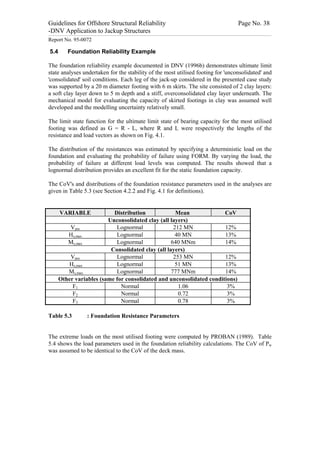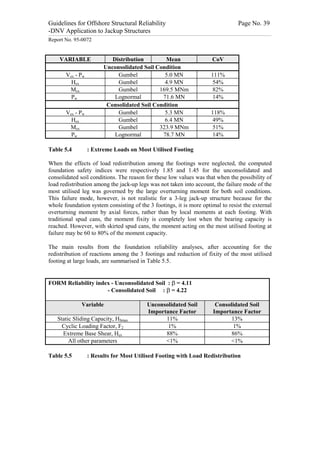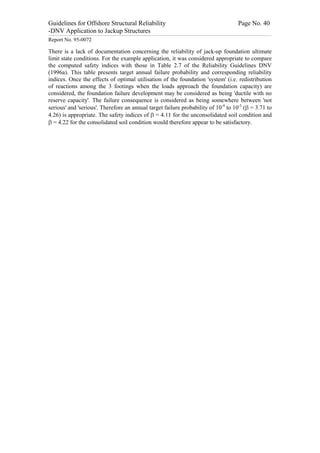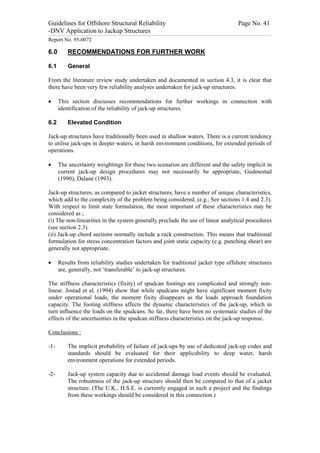
Guidelines for Offshore Structural Reliability                                                                                                                                                                                                                                                                                                                                 Page No. 1
-DNV Application to Jackup Structures
------------------------------------------------------------------------------------------------------------------------------------------------------------------------------------------------------------------------------------------------------------------------------------------------------------------------------------------------------------------------------------------------------------------------------------------------


Report No. 95-0072

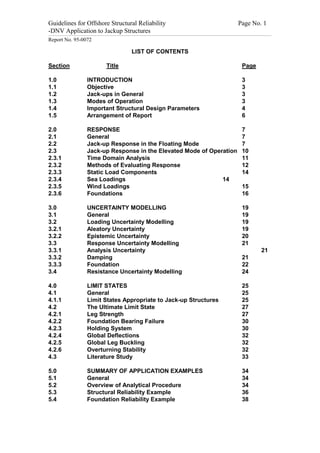
                                                                                                                                                                 LIST OF CONTENTS

Section                                                                                                         Title                                                                                                                                                                                                                                                                 Page

1.0                                                                       INTRODUCTION                                                                                                                                                                                                                                                                                                3
1.1                                                                       Objective                                                                                                                                                                                                                                                                                                   3
1.2                                                                       Jack-ups in General                                                                                                                                                                                                                                                                                         3
1.3                                                                       Modes of Operation                                                                                                                                                                                                                                                                                          3
1.4                                                                       Important Structural Design Parameters                                                                                                                                                                                                                                                                      4
1.5                                                                       Arrangement of Report                                                                                                                                                                                                                                                                                       6

2.0                                                                       RESPONSE                                                                                                                                                                                                                                                                                                    7
2.1                                                                       General                                                                                                                                                                                                                                                                                                     7
2.2                                                                       Jack-up Response in the Floating Mode                                                                                                                                                                                                                                                                       7
2.3                                                                       Jack-up Response in the Elevated Mode of Operation                                                                                                                                                                                                                                                          10
2.3.1                                                                     Time Domain Analysis                                                                                                                                                                                                                                                                                        11
2.3.2                                                                     Methods of Evaluating Response                                                                                                                                                                                                                                                                              12
2.3.3                                                                     Static Load Components                                                                                                                                                                                                                                                                                      14
2.3.4                                                                     Sea Loadings                                 14
2.3.5                                                                     Wind Loadings                                                                                                                                                                                                                                                                                               15
2.3.6                                                                     Foundations                                                                                                                                                                                                                                                                                                 16

3.0                                                                       UNCERTAINTY MODELLING                                                                                                                                                                                                                                                                                       19
3.1                                                                       General                                                                                                                                                                                                                                                                                                     19
3.2                                                                       Loading Uncertainty Modelling                                                                                                                                                                                                                                                                               19
3.2.1                                                                     Aleatory Uncertainty                                                                                                                                                                                                                                                                                        19
3.2.2                                                                     Epistemic Uncertainty                                                                                                                                                                                                                                                                                       20
3.3                                                                       Response Uncertainty Modelling                                                                                                                                                                                                                                                                              21
3.3.1                                                                     Analysis Uncertainty                                                                                                                                                                                                                                                                                                                              21
3.3.2                                                                     Damping                                                                                                                                                                                                                                                                                                     21
3.3.3                                                                     Foundation                                                                                                                                                                                                                                                                                                  22
3.4                                                                       Resistance Uncertainty Modelling                                                                                                                                                                                                                                                                            24

4.0                                                                       LIMIT STATES                                                                                                                                                                                                                                                                                                25
4.1                                                                       General                                                                                                                                                                                                                                                                                                     25
4.1.1                                                                     Limit States Appropriate to Jack-up Structures                                                                                                                                                                                                                                                              25
4.2                                                                       The Ultimate Limit State                                                                                                                                                                                                                                                                                    27
4.2.1                                                                     Leg Strength                                                                                                                                                                                                                                                                                                27
4.2.2                                                                     Foundation Bearing Failure                                                                                                                                                                                                                                                                                  30
4.2.3                                                                     Holding System                                                                                                                                                                                                                                                                                              30
4.2.4                                                                     Global Deflections                                                                                                                                                                                                                                                                                          32
4.2.5                                                                     Global Leg Buckling                                                                                                                                                                                                                                                                                         32
4.2.6                                                                     Overturning Stability                                                                                                                                                                                                                                                                                       32
4.3                                                                       Literature Study                                                                                                                                                                                                                                                                                            33

5.0                                                                       SUMMARY OF APPLICATION EXAMPLES                                                                                                                                                                                                                                                                             34
5.1                                                                       General                                                                                                                                                                                                                                                                                                     34
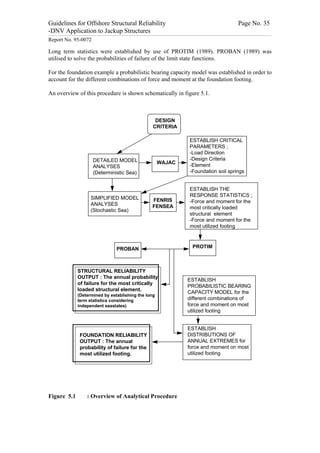
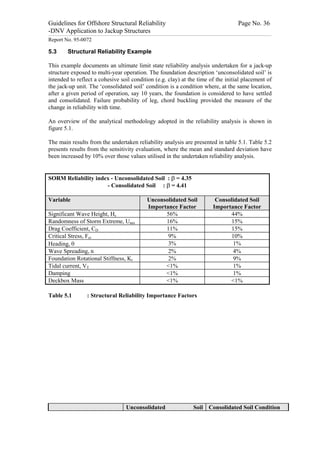
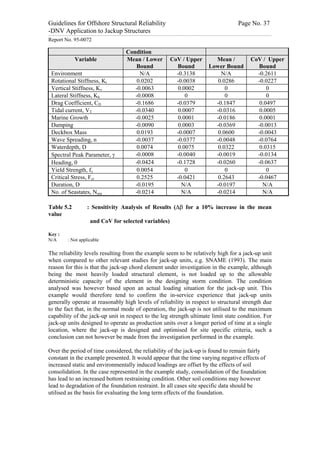
5.2                                                                       Overview of Analytical Procedure                                                                                                                                                                                                                                                                            34
5.3                                                                       Structural Reliability Example                                                                                                                                                                                                                                                                              36
5.4                                                                       Foundation Reliability Example                                                                                                                                                                                                                                                                              38
Guidelines for Offshore Structural Reliability                                                                                                                                                                                                                                                                                                                                 Page No. 2
-DNV Application to Jackup Structures
------------------------------------------------------------------------------------------------------------------------------------------------------------------------------------------------------------------------------------------------------------------------------------------------------------------------------------------------------------------------------------------------------------------------------------------------


Report No. 95-0072

Section                                                                                                         Title                                                                                                                                                                                                                                                                 Page

6.0                                                                       RECOMMENDATIONS FOR FURTHER WORK                                                                                                                                                                                                                                                                            41
6.1                                                                       General                                                                                                                                                                                                                                                                                                     41
6.2                                                                       Elevated Condition                                                                                                                                                                                                                                                                                          41
6.3                                                                       Floating / Installation Phase Conditions                                                                                                                                                                                                                                                                    42

7.0                                                                       REFERENCES                                                                                                                                                                                                                                                                                                  44
Guidelines for Offshore Structural Reliability                                                                                                                                                                                                                                                                                                                                 Page No. 3
-DNV Application to Jackup Structures
------------------------------------------------------------------------------------------------------------------------------------------------------------------------------------------------------------------------------------------------------------------------------------------------------------------------------------------------------------------------------------------------------------------------------------------------


Report No. 95-0072

1.0                                  INTRODUCTION

1.1                                  Objective

The objective of this report is to document offshore structural reliability guidelines
appropriate to self-elevating unit structures (hereafter referred to as ‘jack-ups’). With this
intention the following items are addressed ;
- characteristic responses
- modes of failure and related reliability analysis characteristics and parameters
- typical examples of reliability analysis.

The guidelines are intended for application of Level III structural reliability where the joint
probability distribution of uncertain parameters is used to compute a probability of failure.

1.2                                  Jack-ups in General

The term ‘Jack-up’ covers a large variety of offshore structures from small liftboat structures,
Stewart (1991), to large deepwater designs, e.g. Bærheim (1993). The purpose of the jack-up
design is to provide a mobile, self-installing, stable working platform at an offshore (or off-
land) location. The jack-up platform itself may be designed to serve any function such as, for
example ; tender assist, accommodation, drilling or production.

Thus, the term jack-up may represent a structure that has a mass of a few hundred tonnes and
is capable of elevating not more than a few metres above the still water surface, to a structure
that has a mass of over 20,000 tonnes and is capable of operating in water depths in excess of
100 metres.

·                 It is evident, for the above stated reasons, that statistics representing jack-up structures
                  should be treated with a good deal of suspicion as they may not be representative for the
                  type of structure required to be considered.

·                 These guidelines are intended to deal primarily with conventional design, larger size
                  jack-ups, namely those intended to operate in waterdepths in excess of, say, 50 metres. A
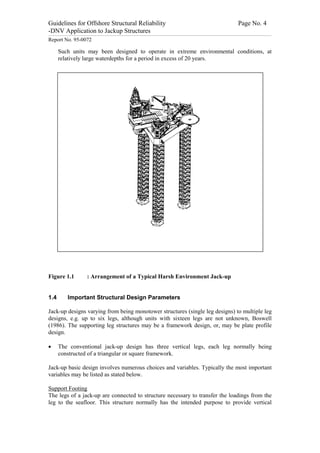
                  typical arrangement of such a unit is shown in Figure 1.1 below, Bærheim (1993).

1.3                                  Modes of Operation

A jack-up generally arrives on location in the self-floating mode. The transportation of the
jack-up to the site may, however, have been undertaken as a wet, or dry (piggy-back) tow, or,
may have been undertaken by the use of self-propulsion. Once on location installation will
take place, which will typically involve elevating the hull structure to a predetermined height
above the water surface, preloading, and then elevating to an operational height.
Characteristically the jack-up will then remain on location for a period of 2-4 months, before
jacking down, raising the legs to the transit mode condition, and transferring to the next
location.

·                 This short-term contracting of jack-up units has historically resulted in that, within its life
                  cycle, the jack-up rarely operates to its maximum design environmental criteria.

·                 There is a current tendency to design jack-up units for extended period operation at
                  specific sites, Bærheim (1993), Scot Kobus (1989), e.g. as work-over or production units.
Guidelines for Offshore Structural Reliability                                                                                                                                                                                                                                                                                                                                 Page No. 4
-DNV Application to Jackup Structures
------------------------------------------------------------------------------------------------------------------------------------------------------------------------------------------------------------------------------------------------------------------------------------------------------------------------------------------------------------------------------------------------------------------------------------------------


Report No. 95-0072

                  Such units may been designed to operate in extreme environmental conditions, at
                  relatively large waterdepths for a period in excess of 20 years.


Figure 1.1                                                                 : Arrangement of a Typical Harsh Environment Jack-up


1.4                                  Important Structural Design Parameters

Jack-up designs varying from being monotower structures (single leg designs) to multiple leg
designs, e.g. up to six legs, although units with sixteen legs are not unknown, Boswell
(1986). The supporting leg structures may be a framework design, or, may be plate profile
design.

·                 The conventional jack-up design has three vertical legs, each leg normally being
                  constructed of a triangular or square framework.

Jack-up basic design involves numerous choices and variables. Typically the most important
variables may be listed as stated below.

Support Footing
The legs of a jack-up are connected to structure necessary to transfer the loadings from the
leg to the seafloor. This structure normally has the intended purpose to provide vertical
Guidelines for Offshore Structural Reliability                                                                                                                                                                                                                                                                                                                                 Page No. 5
-DNV Application to Jackup Structures
------------------------------------------------------------------------------------------------------------------------------------------------------------------------------------------------------------------------------------------------------------------------------------------------------------------------------------------------------------------------------------------------------------------------------------------------


Report No. 95-0072

support and moment restraint at the base of the legs. The structural arrangement of such
footing may take the following listed forms;
-gravity based (steel or concrete),
-piled
-continuous foundation support, e.g. mat foundations
-individual leg footings, e.g. spudcans (with or without skirts).

Legs
The legs of a jack-up unit are normally vertical, however, slant leg designs also exist. Design
variables for jack-up legs may involve the following listed considerations ;
-number of legs
-global orientation and positioning of the legs
-frame structure or plate structure
-cross section shape and properties
-number of chords per leg
-configuration of bracings
-cross-sectional shape of chords
-unopposed, or opposed pinion racks
-type of nodes (e.g. welded or non-welded (e.g. forged) nodes)
-choice of grade of material, i.e. utilisation of extra high strength steel

Method of transferring loading from (and to) the deckbox to the legs
The method of transferring the loadings from (and to) the deckbox to the legs is critical to
design of the jack-up. Typical design are ;
-utilisation and design of guides (e.g. with respect to ; number, positioning, flexibility,
 supporting length and plane(s), gaps, etc.)
-utilisation of braking system in gearing units
-support of braking units (e.g. fixed or floating systems)
-utilisation of chocking systems
-utilisation of holding and jacking pins and the support afforded by such.

Deckbox
The deckbox is normally designed from stiffened panel elements. The shape of the deck
structure may vary considerably from being triangular in basic format to rectangular and even
octagonal. The corners of the deckbox may be square or they may be rounded. Units intended
for drilling are normally provided with a cantilever at the aft end of the deckbox, however,
even this solution is not without exception and units with drilling derricks positioned in the
middle of the deckbox structure are not unknown.

There are a large number of solutions available to the designer of a jack-up unit and, although
series units have been built, there exist today an extremely large number of unique jack-up
designs.
Guidelines for Offshore Structural Reliability                                                                                                                                                                                                                                                                                                                                 Page No. 6
-DNV Application to Jackup Structures
------------------------------------------------------------------------------------------------------------------------------------------------------------------------------------------------------------------------------------------------------------------------------------------------------------------------------------------------------------------------------------------------------------------------------------------------


Report No. 95-0072

1.5                                  Arrangement of Report
Response of jack-up structures is described in Section 2, together with relevant methods for
computation of the resulting load effects. Model uncertainties associated with the
computation of these load effects are discussed in Section 3. Important limit states together
with stochastic modelling of failure modes are described in Section 4. Section 5 provides a
summary of two example reliability analyses undertaken for the ultimate limit state, DNV
(1996b). Recommendations for further work are given in Section 6.

Note :
This report should be read in conjunction with the following listed documentation ;
- “Guideline for Offshore Structural Reliability Analysis -General”,
   DNV Technical Report no.95-2018, DNV (1996a)
- “Guideline for Offshore Structural Reliability Analysis- Examples for Jack-ups”,
   DNV Technical Report no.95-0072, DNV (1996b)

Companion application guidelines are also documented covering for jacket and TLP
structures.
Guidelines for Offshore Structural Reliability                                                                                                                                                                                                                                                                                                                                 Page No. 7
-DNV Application to Jackup Structures
------------------------------------------------------------------------------------------------------------------------------------------------------------------------------------------------------------------------------------------------------------------------------------------------------------------------------------------------------------------------------------------------------------------------------------------------


Report No. 95-0072

2.0                                  RESPONSE

2.1                                  General

Jack-up units are normally designed to function in several different operational modes. These
modes may be characterised as follows ;
-transit
-installation
-retrieval
-operational (including survival) condition.

Response of a jack-up in the floating mode of operation is, obviously, far different from that
of the jack-up in the as-installed, elevated condition. Both of these modes are critical to the
safe operation of a jack-up unit as each mode of operation may impose its own limiting
design criteria on certain parts of the structure.

To provide relevant guidance with respect to the stochastic properties and probabilistic
analytical procedures for both of these modes of operation, is considered to be too large an
undertaking to be handled by this example guidance note.

·                 This section is therefore mainly concerned with jack-ups in the elevated mode of
                  operation whilst it deals only in general terms with jack-ups in the floating mode.

   2.2                               Jack-up Response in the Floating Mode

A jack-up unit may transfer from one location to another by a number of methods. For ‘field’
moves a jack-up would, normally, transfer in the self-floating mode utilising either its own
propulsion system, or, be ‘wet’ towed to the new location. For ‘ocean’ tows, on the other
hand, it is common practice to transfer by means of a dry-tow.

Three major sources of accident have been identified in respect to a jack-up in the transit
condition, Standing and Rowe (1993), namely those due to;
-1-     Wave damage to the unit structure leading to penetration of watertight boundaries.
-2-     Damage to the structure as a result of shifting cargo (usually caused by direct wave
        impact, excessive motions and/or inadequate seafastenings).
-3-     Structural damage in the vicinity of the leg support structures.

In the jack-up installation phase there are normally two main areas of concern, these being ;
-1-      Impact loadings upon contact with the seabed.
-2-      Foundation failure (i.e. punch-through) during preloading.
Impact loadings occur when the jack-up unit is operating in the floating mode, whilst
foundation failure is a condition occurring when the jack-up is normally elevated above the
still water surface.

The retrieval phase of a jack-up has not traditionally been considered as providing
dimensioning load conditions. However, when a leg is held fast at the seabed, e.g. due to
large penetrations, there may be large loadings imposed upon the jack-up structure. Such
loadings may result from the action of waves, current, wind, deballasting and jacking up
loadings.

Few model tests, or full-scale measurements, have been undertaken for jack-ups in the
floating mode. Indeed, recent record searches and enquiries with model basins to establish
Guidelines for Offshore Structural Reliability                                                                                                                                                                                                                                                                                                                                 Page No. 8
-DNV Application to Jackup Structures
------------------------------------------------------------------------------------------------------------------------------------------------------------------------------------------------------------------------------------------------------------------------------------------------------------------------------------------------------------------------------------------------------------------------------------------------


Report No. 95-0072

relevant model test data, Standing and Rowe (1993), have only been able to identify six
relevant model tests in total, with published papers on only two of these cases, Fernandes
(1985, 1986). These experiments include free decay tests to provide estimates of damping
and natural periods, measurements in heave, roll and pitch motions in regular and irregular
waves at zero speed, and measurements of resistance, heave, roll and pitch in regular and
irregular waves at 6 knots tow speed. A number of the tests were repeated with the legs raised
or lowered various distances. Some full scale results were also published.

Comparisons with linear wave theory, based upon potential flow assumptions, predict roll
and pitch responses in regular wave sea states very well at frequencies away from resonance,
but may tend to overpredict the responses at the natural period (dependent upon damping
assumptions). The results from the published jack-up model test data seem to be consistent
with findings from ships and barges, i.e. that roll response at resonance is overestimated
unless due account is taken of the increased damping resulting from viscous effects.
Generally, levels of measured and predicted heave motions in regular waves agreed
reasonably well although there may be marked differences in the shapes of the curves.
Measurements in regular waves at 6 knots showed a considerable increase in the pitch
damping, compared with similar results at zero speed, with reduced response at the natural
period. Heave response was similar to that at zero speed.

·                 Conventional wave diffraction theory will, in general, predict motion responses of a jack-
                  up unit with a reasonable degree of accuracy. If non-linear loading effects e.g. water on
                  deck (‘green seas’), slamming, damping (especially at and around resonance periods),
                  non-zero transit speed etc. are significant, then it is necessary to utilise time-domain
                  simulation and/or model test data.

·                 The use of strip theory or Morison formulation to compute the total sea loadings on a
                  jack-up in transit will normally be inappropriate.

·                 In connection with the prediction of motion responses, notwithstanding account taken of
                  relevant non-linear loading effects, it seems reasonable to refer to ship or barge related
                  reliability data (e.g. Frieze (1991), Lotsberg (1991), Wang and Moan (1993)).

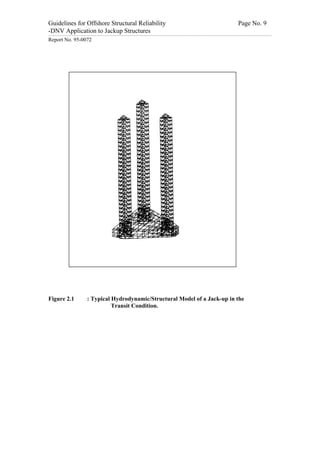
·                 When evaluating leg strength at critical connections, transfer functions for element forces
                  and moments (or stresses) may be calculated directly from the rig’s motions analysis. A
                  model similar to that shown in Figure 2.1 may, typically, be utilised for such purpose.

·                 Generally, the following loads will be necessary to consider in respect to any ultimate
                  strength analysis of a jack-up in the transit condition ;
                      -static load components
                      -inertia load components (as a result of motion)
                      -wind load components.

·                 If any significant structural non-linearities are present in the system then such non-
                  linearities should be accounted for in the model. One such non-linearity that may be
                  significant is the modelling of any gaps between jackhouse guides and chords.

·                 Reliability analysis of seafastening arrangements is documented, DNV (1992). The
                  generalities of this documented example and the procedure utilised may also be applied
                  to seafastenings for a jack-up unit under transit. If direct wave impact on the item held by
                  the seafastening is a possible designing load, then such loading and associated load
                  uncertainty should additionally be included within the analysis.
Guidelines for Offshore Structural Reliability                                                                                                                                                                                                                                                                                                                                 Page No. 9
-DNV Application to Jackup Structures
------------------------------------------------------------------------------------------------------------------------------------------------------------------------------------------------------------------------------------------------------------------------------------------------------------------------------------------------------------------------------------------------------------------------------------------------


Report No. 95-0072


Figure 2.1                                                                 : Typical Hydrodynamic/Structural Model of a Jack-up in the
                                                                                     Transit Condition.
Guidelines for Offshore Structural Reliability                                                                                                                                                                                                                                                                                                                                 Page No. 10
-DNV Application to Jackup Structures
------------------------------------------------------------------------------------------------------------------------------------------------------------------------------------------------------------------------------------------------------------------------------------------------------------------------------------------------------------------------------------------------------------------------------------------------


Report No. 95-0072

2.3                                  Jack-up Response in the Elevated Mode of Operation

Response of jack-up structures in the elevated condition has previously been extensively
studied, Ahilan (1993), with relevant analytical methodology being described in detail in the
Jack-up Recommended Practice, SNAME (1993).

The response of jack-up structures, when subjected to random sea excitation, is found to be
non-Guassian in nature. Due to the non-linearities in the structural system the extreme
responses are generally found to be larger than the extremes of a corresponding Gaussian
process, Karunakaran (1993).

Relevant, non-linear effects that may be significant in respect to response of jack-up
structures are given as ;
-       non-linear loading components (e.g. drag force loadings)
-       bottom restraint (non-linear foundation characteristics)
-       damping (e.g. due to the motions of the jack-up structure, there may be significant
        hydrodynamic damping as a result of the relative velocity of the water particles and
        the leg member)
-       dynamics of the structure (as the natural period of the structure is typically relatively
        high, e.g. 5-8 seconds, there may be significant wave energy available to excite the
        structural system and hence relatively large inertial forces may result)
-       second order effects (such effects may significantly influence the response in the
        considered structure)
-       non-linearites of structural interfaces (e.g. gaps between the leg structure and guides)

·                 For reliability analysis, in order to account for the non-linearities in jack-up loading and
                  response, it is considered necessary that explicit time domain analysis, utilising
                  stochastic sea simulation, is undertaken.

·                 Foundation modelling assumptions have been shown to be an important aspect in respect
                  to the resulting response from analytical models of jack-up units, Manuel et al. (1993).
                  Hence, unless it can be demonstrated that the effects are not significant, non-linear
                  characteristics in the foundation system should be explicitly modelled when undertaking
                  analyses in connection with reliability studies.

·                 Guidance provided in the guideline example for jacket structures, DNV (1996c), in
                  respect to the fatigue limit state covers the state-of-the-art knowledge with respect to
                  fatigue reliability analysis. Response in respect to the fatigue limit state is therefore not
                  explicitly covered in this section. Due to the non-linear characteristics of jack-up loading
                  and response, frequency domain solution techniques are however not recommended
                  unless, either it can be demonstrated that such effects are insignificant, or, due account
                  has been taken of such effects.
Guidelines for Offshore Structural Reliability                                                                                                                                                                                                                                                                                                                                 Page No. 11
-DNV Application to Jackup Structures
------------------------------------------------------------------------------------------------------------------------------------------------------------------------------------------------------------------------------------------------------------------------------------------------------------------------------------------------------------------------------------------------------------------------------------------------


Report No. 95-0072

2.3.1                                Time Domain Analysis

Two general methods may be utilised in time domain analysis. These two methods being ;

         -use of simple, single degree of freedom (SDOF) models, and,
         -use of multi-degree of freedom models.
In both cases however the following general guidance may be given for the analysis, SNAME
(1993) ;

1.                                   The generated random sea should consist of superposition of, at least, 200 regular
                                     wave components utilising divisions of equal energy of the wave spectrum.

2.                                   In order to obtain sufficiently stable response statistics, simulation time for a single
                                     simulation should generally not be less than 60 minutes.

3.                                   The integration time step should not normally be taken greater than the smaller of the
                                     following ;
                                     - one twentieth of the zero up-crossing period of the wave spectrum
                                     - one twentieth of the jack-up natural period.

4.                                   When evaluating the response of the jack-up, the transient effects at the start of the
                                     analysis should be removed. At least the smallest of 100 seconds, or 200 time steps
                                     should be removed in this connection.

5.                                   The method of evaluating the response (e.g. the Most Probable Maximum (MPM)
                                     response) should be compatible with the simulation time and sea qualification
                                     procedure adopted for the analysis. -Further guidance in connection with this item is
                                     provided in the Commentaries to the Jack-up Recommended Practice, SNAME
                                     (1993).

The asymmetry of crest heights and troughs, accounted for by higher order wave theories, is
not reproduced in methods based upon random wave simulation techniques. Linear wave
theory, Sarpkaya (1981), utilised in random wave simulation, accounts for particle kinematics
upto the still water surface and ‘kinematic stretching’ is undertaken to compute the
kinematics to the instantaneous free surface. It is recommended, Gudmestad and Karunakaran
(1994), that Wheeler stretching, Wheeler (1969), is utilised in this connection.

The extent of wave asymmetry is a function of waterdepth. For waterdepths less than 25
metres, in extreme environmental conditions, irregular wave simulation is normally
considered to be inappropriate and regular wave analysis should be considered. For
waterdepths greater than 25 meters wave asymmetry may be accounted for by the formulation
given in equation 2.1 below, SNAME (1993).

                       Hs = ( 1 + 0.5 e (-d/25) ) Hsrp                                                                                                                                                                                                                                                                                                                                                                    (2.1)

Where :
Hs      : adjusted significant wave height to account for wave kinematics (metres)
Hsrp    : significant wave height (metres)
d       : waterdepth (metres)
Guidelines for Offshore Structural Reliability                                                                                                                                                                                                                                                                                                                                 Page No. 12
-DNV Application to Jackup Structures
------------------------------------------------------------------------------------------------------------------------------------------------------------------------------------------------------------------------------------------------------------------------------------------------------------------------------------------------------------------------------------------------------------------------------------------------


Report No. 95-0072

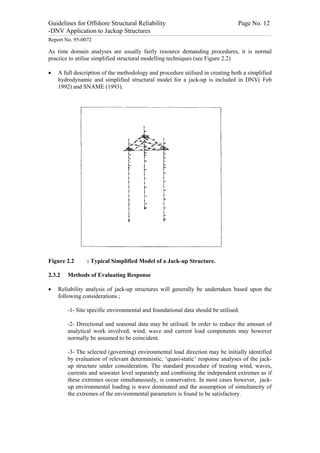
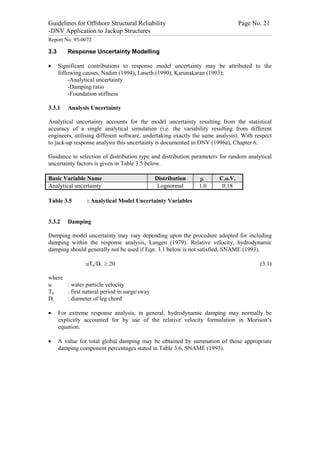
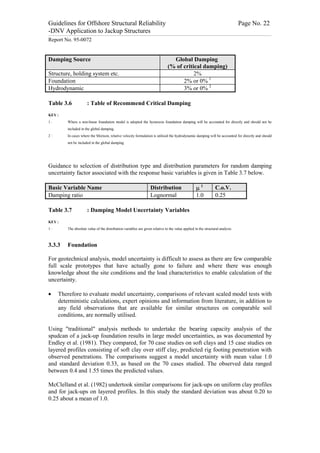
As time domain analyses are usually fairly resource demanding procedures, it is normal
practice to utilise simplified structural modelling techniques (see Figure 2.2)

·                 A full description of the methodology and procedure utilised in creating both a simplified
                  hydrodynamic and simplified structural model for a jack-up is included in DNV( Feb
                  1992) and SNAME (1993).


Figure 2.2                                                                : Typical Simplified Model of a Jack-up Structure.

2.3.2                                Methods of Evaluating Response

·                 Reliability analysis of jack-up structures will generally be undertaken based upon the
                  following considerations ;

                                     -1- Site specific environmental and foundational data should be utilised.

                                     -2- Directional and seasonal data may be utilised. In order to reduce the amount of
                                     analytical work involved, wind, wave and current load components may however
                                     normally be assumed to be coincident.

                                     -3- The selected (governing) environmental load direction may be initially identified
                                     by evaluation of relevant deterministic, ‘quasi-static’ response analyses of the jack-
                                     up structure under consideration. The standard procedure of treating wind, waves,
                                     currents and seawater level separately and combining the independent extremes as if
                                     these extremes occur simultaneously, is conservative. In most cases however, jack-
                                     up environmental loading is wave dominated and the assumption of simultaneity of
                                     the extremes of the environmental parameters is found to be satisfactory.
Guidelines for Offshore Structural Reliability                                                                                                                                                                                                                                                                                                                                 Page No. 13
-DNV Application to Jackup Structures
------------------------------------------------------------------------------------------------------------------------------------------------------------------------------------------------------------------------------------------------------------------------------------------------------------------------------------------------------------------------------------------------------------------------------------------------


Report No. 95-0072

The probability of failure is estimated during a reference period significantly longer than the
analysed, simulated time period. An extrapolation procedure for determining the extreme
values for the reliability analysis is therefore required when several environmental variables
are to be combined.

·                 The reference period for extreme environmental data is normally selected as being equal
                  to the one year return period such that the results may be directly compared with annual
                  target reliabilities.

·                 For jack-ups, the two most appropriate procedures for estimation of extreme load events
                  would seem to be ;
                      -1-     By use of long term statistics of independent sea states
                      -2-     By use of conditional extreme event analysis.

These procedures are described in detail in Chapter 6 to the guidelines, DNV (1996a). For
conventional jack-up structures, in general, the long term response is controlled by the
extreme sea states and, as such, both of these procedures are normally acceptable. An
example of the estimation of extreme load events by use of long term statistics of
independent sea states is provided in the jack-up examples guidelines DNV (1996b).

Karunakaran (1993) documents that the short term extreme storm response is marginally
higher than the long term response if the long term response is controlled by extreme sea
states. If however the long term response is controlled by resonance sea states, the short term
extreme storm response is about 10% lower than the long term response for those case
studies considered.

Response from time history simulations may be characterised by the normalised statistical
moments ; mx, sx, sx’, g3, g4, which are the mean, standard deviation, standard deviation of the
time derivative, skewness and kurtosis of the response respectively. A limit state may then be
defined from the statistical moments of the response and the estimated reliability thus
obtained by the resulting response surface, DNV (1996b).

·                 Response surface techniques are considered to provide the most appropriate methodology
                  in the estimation of the reliability of jack-up structures for extreme load events.

In order to model how the statistical moments change with realisations of the basic variables,
the derivatives of these moments may be estimated by finite differences of the variables at
one estimation point. As the limit state functions are highly non-linear this technique will
only give satisfactory results if a good fit is obtained around the design point.

Generally, reliability analyses of jack-up structures may be undertaken by use of first and
second order solution methods (FORM/SORM), Madsen (1986). -See also DNV (1996a),
Chapters 2 and 3, for further guidance concerning utilisation of reliability methods.
Guidelines for Offshore Structural Reliability                                                                                                                                                                                                                                                                                                                                 Page No. 14
-DNV Application to Jackup Structures
------------------------------------------------------------------------------------------------------------------------------------------------------------------------------------------------------------------------------------------------------------------------------------------------------------------------------------------------------------------------------------------------------------------------------------------------


Report No. 95-0072

2.3.3                                Static Loading Components

Previous jack-up reliability analyses, Karunakaran (1993), Løseth et al. (1990), have
identified that response uncertainty is not significantly affected by the choice of the static
mass model. This is further demonstrated in the example documented in DNV (1996b).

·                 Permanent loads and variable loads are generally lumped together. For structural
                  assessment the upper bound of this sum is normally conservatively modelled. For
                  overturning assessment the mean variable load is combined with the permanent load.

2.3.4                                Sea Loadings

Sea loadings on conventional jack-up structures are calculated utilising Morison’s equation,
Sarpkaya (1981) ;

                                                      pD 2                  1
                                     Fn ( r , t ) = r      Cma n ( r , t ) + rDCd v n ( r , t ) v n ( r , t )                                                                                                                                                                                                                                                                                                             (2.2)
                                                       4                    2

Wave and current velocity components in the Morison equation are obtained by combining
the vectorial sum of the wave particle velocity and the current velocity normal to the member
axis. (When relative motions are involved, eqn 2.2 may be modified to reflect such motions
in the terms an(r,t) and vn(r,t)).

Epistemic uncertainties related to Morison’s equation are documented in Section 3.

Wave Loadings

The basic stochastic sea description is defined by use of a wave energy spectrum. The choice
of the analytical wave spectrum and associated spectral parameters should reflect the width
and shape of the spectra and significant wave height for the site being considered. Generally,
either the Pierson-Moskowitz or the Jonswap spectra will be appropriate. See DNV (1996a),
Section 5.

·                 Due to the possibility of inducing greater dynamic response at lower wave periods than
                  that necessarily associated with storm maximum significant wave height, a range of
                  periods and associated significant wave heights should normally be investigated.

·                 The simulated storm length is normally to be taken as 3 hours, SNAME (1993) or 6
                  hours, NPD (1992).
Guidelines for Offshore Structural Reliability                                                                                                                                                                                                                                                                                                                                 Page No. 15
-DNV Application to Jackup Structures
------------------------------------------------------------------------------------------------------------------------------------------------------------------------------------------------------------------------------------------------------------------------------------------------------------------------------------------------------------------------------------------------------------------------------------------------


Report No. 95-0072

For the extreme load event it is normally, conservatively assumed that a long crested sea
simulation is undertaken, NPD (1992), however, in accordance with SNAME (1993) the
following directionality function F(a) may be utilised ;

                                               F(a) = C. cos2na                                                                                                                                                                           for -p/2 £ a £ p/2                                                                                                                                                              (2.3)

where ;
n       : 2.0 for fatigue analysis
          4.0 for extreme analysis
                                                                                                                                                                                         p /2
C                                    : constant chosen such that :                                                                                                          å            -p / 2
                                                                                                                                                                                                            F (a )da = 10
                                                                                                                                                                                                                        .
Current Loadings

·                 Current velocity should include all relevant components, DNV (1996). Normally,
                  however, it is acceptable to divide the total current into two components, namely, that of
                  wind and wave generated current, V(w,w) and that of residual (e.g. tidal) current, Vr. The
                  first of these two current components may be assumed to be fully correlated with the
                  significant wave height, whilst the latter current component, Vr, is assumed to be
                  completely independent of the other environmental characteristics. See DNV (1996a),
                  Section 5.1.3.2, for a full description of this procedure.

Unless site specific data indicate otherwise the current profile should be described according
to the procedure documented in SNAME (1993).

2.3.5                                Wind Loadings

Singh (1989) has found a number of inconsistencies in existing wind loading calculation
procedures. Based upon this finding it has been concluded that wind tunnel measurements
appear to provide the only viable method for accurately estimating loads on complex offshore
structures.

·                 For jack-up structures, if it is not possible to utilise model test data, either by direct
                  testing, or from scaling of geosim models, then, assuming that wave loading is the
                  dominating load effect, it is normally acceptable to base such loading on simplified,
                  direct calculation methods.

SNAME (1993) documents an acceptable procedure for the calculation of wind loadings,
where the wind loading, Fwi , is calculated as a static load contribution by use of the equation
;

                                           Fwi = ½ r Vref² Ch Cs Aw                                                                                                                                                                                                                                                                                                                                                       (2.4)

where
r                                    : density of air
Vref                                 : the 1 minute sustained wind velocity at 10 meters above sea level
Ch                                   : height coefficient
Cs                                   : shape coefficient
Aw                                   : projected area of the block considered

In locations where wind loading may be the dominating load effect (e.g. due to cyclones etc.)
this load effect should be specially considered.
Guidelines for Offshore Structural Reliability                                                                                                                                                                                                                                                                                                                                 Page No. 16
-DNV Application to Jackup Structures
------------------------------------------------------------------------------------------------------------------------------------------------------------------------------------------------------------------------------------------------------------------------------------------------------------------------------------------------------------------------------------------------------------------------------------------------


Report No. 95-0072

2.3.6                                Foundations

The uncertainty in jack-up response is greatly influenced by the uncertainties in the soil
characteristics that determine the resistance of the foundation to the forces imposed by the
jack-up structure. Ronold (1990) showed that, for a jack-up, the total uncertainty governing
the safety against foundation failure is dominated by the uncertainty in the loading. Nadim et
al. (1994), on the other hand, showed that the response of a jack-up structure subjected to a
combination of static and cyclic loads is just as much influenced by the uncertainties in the
loads as by the uncertainties in the soil resistance. The significant discrepancy between these
results is due to the different assumptions made with respect to the uncertainties in the
variables. One should therefore be careful in generalising the results obtained for a specific
site to other environmental and soil conditions.

For traditional jack-up foundation solutions, the stability and performance of a jack-up
foundation is primarily determined by the installation procedure for the unit. This operation
involves elevating the hull and pumping water ballast into the preload tanks, causing the
spudcans to penetrate into soil and thereby increasing their bearing capacity.

·                 The geotechnical areas of concern for jack-up foundations are:
                     -Prediction of footing penetration during preloading.
                     -Jack-up foundation capacity under various load combinations after preloading.
                     -Foundation stiffness characteristics under the design storm.

The recent trend in using jack-up structures in deeper waters and on a more permanent basis
has resulted in another type of foundation solution, namely spud-cans equipped with skirts.
The installation of skirted footings is normally achieved by suction, not preloading. The
skirted footings not only provide more predictable capacity, they also increase the footing
fixity significantly. The procedure for estimating the capacity of the individual footings is
based upon analytical procedures similar to that undertaken for foundation of gravity based
structures. For jack-up foundation systems, however, it is important to look at the complete
foundation ‘system’ because at loads close to failure, significant re-distribution of reactions
among the footings may take place. (Refer to the foundation example in DNV (1996c) for
more information in respect to this item.)

It is evident from statistics, Sharples et al. (1989), Arnesen et al. (1988), that punch-through
during preloading is the most frequently encountered foundation problem for jack-ups.
Punch-through occurs when a weak soil layer is encountered beneath a strong surficial soil
layer.

·                 The only way to avoid punch-through is to undertake a thorough site investigation at the
                  jack-up location prior to installation in order to identify the potentially problematic weak
                  soil layers.

The total amount of preload used in the installation is often used as a checking parameter for
the spudcan capacity to withstand extreme loads. The so-called “100% preload check”
requires that the foundation reaction during preloading on any leg should be equal to, or
greater than, the maximum vertical reaction arising from gravity loads and 100% of
environmental loads. The preload defines the static foundation capacity under pure vertical
loading immediately after installation. Under the design storm the footing is subjected to
simultaneous action of vertical and horizontal loads, and overturning moment. The storm
induced loads are cyclic with a short duration and the supporting soil may have a higher
reference static shear strength than right after installation due to consolidation under the jack-
Guidelines for Offshore Structural Reliability                                                                                                                                                                                                                                                                                                                                 Page No. 17
-DNV Application to Jackup Structures
------------------------------------------------------------------------------------------------------------------------------------------------------------------------------------------------------------------------------------------------------------------------------------------------------------------------------------------------------------------------------------------------------------------------------------------------


Report No. 95-0072

up weight. On the other hand, for equal degrees of consolidation, the vertical capacity of a
footing will be greater during pure vertical loading than during a combination of vertical,
horizontal and moment loadings.

Having regard to the oversimplification of the l00% preload check, SNAME (1993) suggests
a phased method with three steps, increasing in the order of complexity, for the evaluation of
foundation capacity, as follows :

Step 1. Preload Check
The foundation capacity check is based on the preloading capability - assuming pinned
footings.

Step 2. Bearing Capacity Check
Bearing capacity check based on resultant loading on the footing under the design storm.

Step 3. Displacement Check
The displacement check requires the calculation of displacements associated with an
overload situation arising from Step 2.

Any higher level check need only be performed if the lower level checks fail to meet the
foundation acceptance criteria.

It is difficult to quantify the uncertainties associated with the “preload check” approach.
Nadim and Lacasse (1992) developed a procedure for reliability analysis of the foundation
bearing capacity of jack-ups. The procedure, which may be categorised as a Step 2 approach,
is based on a prior calculation of the bearing capacity under different load combinations
(interaction diagram) and updating the interaction diagram from the measured vertical
preload. The bearing capacity calculations are performed probabilistically using the FORM
approximation. The procedure developed by Nadim and Lacasse (1992) was used by Nadim
et al. (1994) to study the reliability of a jack-up at a dense sand site in the North Sea.

An important result of the FORM analyses is the correlation between the foundation capacity
under a given combination of horizontal and vertical loads (and overturning moment if
spudcan fixity is significant) and the foundation capacity under pure vertical loading. The
degree of correlation determines the significance of the measured preload on reducing the
uncertainty associated with foundation capacity for a given load combination.

·                 For a given loading combination (vertical, horizontal and moment), the lognormal
                  distribution function appears to provide a good fit to the foundation capacity, Nadim and
                  Lacasse (1992).

·                 The properties of the volume of soil under the footing fluctuate spatially and can be
                  represented by a random field. The effects of this are accounted for by spatial averaging,
                  Vanmarcke (1977, 1984), and by using stochastic interpolation techniques, Matheron
                  (1963), if enough data exist.

·                 Otherwise, the uncertainties in the soil parameters are based on the statistics of the
                  available data. Mean and standard deviation are calculated by ordinary statistical
                  methods, e.g. Ang and Tang (1975). Usually the probability distribution function used to
                  represent geological processes follows a normal or lognormal law. More often than not
                  however, and especially in the case of jack-up structures, there are not enough data
Guidelines for Offshore Structural Reliability                                                                                                                                                                                                                                                                                                                                 Page No. 18
-DNV Application to Jackup Structures
------------------------------------------------------------------------------------------------------------------------------------------------------------------------------------------------------------------------------------------------------------------------------------------------------------------------------------------------------------------------------------------------------------------------------------------------


Report No. 95-0072

                  available, and the designer needs to use correlations or normalised properties as a
                  function of the type of soil to establish consistent soil profiles.

See also DNV (1996a), Section 7.3.

As an example the undrained shear strength of soft sedimentary clay normalised to the in-situ
overburden stress is about 0.23 ± 0.03 for a horizontal failure mode; the friction angle of sand
can be selected on the basis of its relative density and an in-situ penetration test.
Guidelines for Offshore Structural Reliability                                                                                                                                                                                                                                                                                                                                 Page No. 19
-DNV Application to Jackup Structures
------------------------------------------------------------------------------------------------------------------------------------------------------------------------------------------------------------------------------------------------------------------------------------------------------------------------------------------------------------------------------------------------------------------------------------------------


Report No. 95-0072

3.0                                  UNCERTAINTY MODELLING

3.1                                  General

This section provides general guidance in respect to uncertainty modelling as appropriate to
the extreme load event for a jack-up structure.

3.2                                LoadingUncertaintyModelling


Uncertainty in the load process may be attributed to either aleatory uncertainty (inherent
variability and natural randomness of a quantity) or epistemic uncertainty (uncertainty owing
to limited knowledge). In respect to jack-up reliability analysis, guidance appropriate to the
most significant of the uncertain variables associated with the load process is given below.

3.2.1                                Aleatory Uncertainty

Tables 3.1 to 3.3 below document a summary of recommended distributions for selected
stochastic variables. It should be noted however that site specific evaluation of environmental
variables may dictate use of variable distributions other than those recommended in the tables
below. For further guidance see also DNV (1996a), Chapter 5.


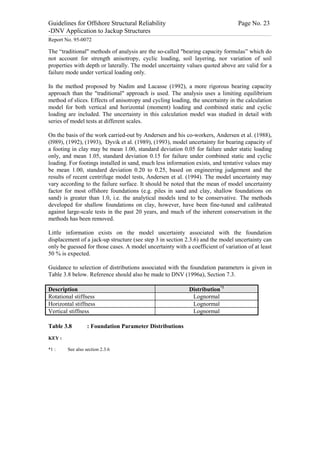
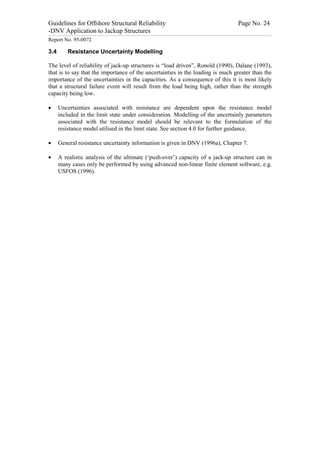
Description                                                                                                                                                                                          Distribution
Randomness of storm extremes                                                                                                                                                                         Poisson
Waterdepth (D)                                                                                                                                                                                       Uniform (tidal effects), or,
                                                                                                                                                                                                     Normal (storm surge effects - conditional
                                                                                                                                                                                                     on Hs)
Marine Growth                                                                                                                                                                                        Lognormal

Table 3.1                                                                  : General Environmental Variable Distributions


Description                                                                                                                                                                                                 Distribution
Significant wave height (Hs)                                                                                                                                                                                3-parameter Weibull/Lognormal
Zero up-crossing period (Tz)                                                                                                                                                                                Lognormal (conditional on Hs)
Spectral peak period (Tp)                                                                                                                                                                                   Lognormal (conditional on Hs)
Joint distribution (Hs,Tz) or (Hs,Tp)                                                                                                                                                                       3-parameter Weibull for Hs and Lognormal
                                                                                                                                                                                                            for Tz or Tp (conditional on Hs)
Tidal current speed (Vt)                                                                                                                                                                                    Uniform
Wind generated current speed (Vw)                                                                                                                                                                           Normal (conditional on U10m)
Average wind speed (U10m)                                                                                                                                                                                   Weibull (conditional on Hs)

Table 3.2                                                                  : Long Term Analysis Variable Distributions
Guidelines for Offshore Structural Reliability                                                                                                                                                                                                                                                                                                                                 Page No. 20
-DNV Application to Jackup Structures
------------------------------------------------------------------------------------------------------------------------------------------------------------------------------------------------------------------------------------------------------------------------------------------------------------------------------------------------------------------------------------------------------------------------------------------------


Report No. 95-0072


Description                                                                                                                                                                                                                                           Distribution
Significant wave height (Hs)                                                                                                                                                                                                                          Gumbel *1, 2
Total current speed (Vc)                                                                                                                                                                                                                              Gumbel *1, 2
Average wind speed (U10m)                                                                                                                                                                                                                             Gumbel *1, 2

Table 3.3                                                                  : Extreme Analysis Variable Distributions

KEY :

*1 :                                 Normally it is sufficient to consider the extreme dominating variable being either ; -the significant wave height, -the
                                     current, or, -the wind speed, in combination with this extreme distribution the remaining two variables are assigned
                                     the distribution according to Table 3.2.

*2 :                                 Instead of a Gumbel distribution, a Weibull distribution (see the long term analysis variables in table 3.2), raised to
                                     the power of the number of considered seastates in one year, NSea, may be utilised in practice. (See DNV (1996a),
                                     Section 6.7.)


3.2.2                                Epistemic Uncertainty

·                 The following listed time independent, basic load variables have been identified as being
                  possible significant contributors to the overall reliability of a jack-up structures, Løseth
                  (1990), Karunakaran (1993), Dalane (1993) ;
                      -Drag coefficient
                      -Inertia coefficient
                      -Marine growth
                      -Mass of structure.

Guidance to selection of distribution type and distribution parameters for random model
uncertainty factors associated with these basic load variables is given in Table 3.4 below.

Basic Variable Name                                                                                                                                            Distribution                                                                                       m1                                                 C.o.V.
Drag coefficient 2    (CD)                                                                                                                                      Lognormal                                                                                         1.0                                                 0.2
                    3
Inertia coefficient   (CI)                                                                                                                                      Lognormal                                                                                         1.0                                                 0.1
Marine growth 4                                                                                                                                                 Lognormal                                                                                         1.0                                                 0.2
Mass of structure 5                                                                                                                                             Lognormal                                                                                         1.0                                                 0.14

Table 3.4                                                                  : Load Model Uncertainty Variables
KEY :
1:                                   The absolute value of the distribution variables are given relative to the value applied in the structural analysis.
2:                                   The selection of appropriate drag coefficients for the structural analysis are stated in SNAME (1993).
3:                                   For extreme value jack-up analysis, without loss of any generality, it is normally considered acceptable to select the
                                     inertia coefficient as a fixed quantitiy. An inertia coefficient of 1.8 may be utilised.
4:                                   The selection of the appropriate value for the marine growth should be evaluated based upon a site specific
                                     evaluation, e.g. NPD (1992).
5:                                   See also section 2.3.3
Guidelines for Offshore Structural Reliability                                                                                                                                                                                                                                                                                                                                 Page No. 21
-DNV Application to Jackup Structures
------------------------------------------------------------------------------------------------------------------------------------------------------------------------------------------------------------------------------------------------------------------------------------------------------------------------------------------------------------------------------------------------------------------------------------------------


Report No. 95-0072

3.3                                  Response Uncertainty Modelling

·                 Significant contributions to response model uncertainty may be attributed to the
                  following causes, Nadim (1994), Løseth (1990), Karunakaran (1993);
                      -Analytical uncertainty
                      -Damping ratio
                      -Foundation stiffness

3.3.1                                Analysis Uncertainty

Analytical uncertainty accounts for the model uncertainty resulting from the statistical
accuracy of a single analytical simulation (i.e. the variability resulting from different
engineers, utilising different software, undertaking exactly the same analysis). With respect
to jack-up response analysis this uncertainty is documented in DNV (1996a), Chapter 6.

Guidance to selection of distribution type and distribution parameters for random analytical
uncertainty factors is given in Table 3.5 below.

Basic Variable Name                                                                                                                                                                                           Distribution                                                                         m                                       C.o.V.
Analytical uncertainty                                                                                                                                                                                         Lognormal                                                                           1.0                                      0.18

Table 3.5                                                                  : Analytical Model Uncertainty Variables


3.3.2                                Damping

Damping model uncertainty may vary depending upon the procedure adopted for including
damping within the response analysis, Langen (1979). Relative velocity, hydrodynamic
damping should generally not be used if Eqn. 3.1 below is not satisfied, SNAME (1993).

                                                                        uTn/Di ³ 20                                                                                                                                                                                                                                                                                                                                       (3.1)

where
u     : water particle velocity
Tn    : first natural period in surge/sway
Di    : diameter of leg chord

·                 For extreme response analysis, in general, hydrodynamic damping may normally be
                  explicitly accounted for by use of the relative velocity formulation in Morison’s
                  equation.

·                 A value for total global damping may be obtained by summation of those appropriate
                  damping component percentages stated in Table 3.6, SNAME (1993).
Guidelines for Offshore Structural Reliability                                                                                                                                                                                                                                                                                                                                 Page No. 22
-DNV Application to Jackup Structures
------------------------------------------------------------------------------------------------------------------------------------------------------------------------------------------------------------------------------------------------------------------------------------------------------------------------------------------------------------------------------------------------------------------------------------------------


Report No. 95-0072


Damping Source                                                                                                                                                                                                                           Global Damping
                                                                                                                                                                                                                                       (% of critical damping)
Structure, holding system etc.                                                                                                                                                                                                                    2%
Foundation                                                                                                                                                                                                                                   2% or 0% 1
Hydrodynamic                                                                                                                                                                                                                                 3% or 0% 2

Table 3.6                                                                  : Table of Recommend Critical Damping
KEY :
1:                                   Where a non-linear foundation model is adopted the hysteresis foundation damping will be accounted for directly and should not be
                                     included in the global damping.
2:                                   In cases where the Morison, relative velocity formulation is utilised the hydrodynamic damping will be accounted for directly and should
                                     not be included in the global damping.


Guidance to selection of distribution type and distribution parameters for random damping
uncertainty factor associated with the response basic variables is given in Table 3.7 below.

Basic Variable Name                                                                                                                                                                                  Distribution                                                                             m1                                   C.o.V.
Damping ratio                                                                                                                                                                                        Lognormal                                                                                1.0                                  0.25

Table 3.7                                                                  : Damping Model Uncertainty Variables
KEY :
1:                                   The absolute value of the distribution variables are given relative to the value applied in the structural analysis.


3.3.3                                Foundation

For geotechnical analysis, model uncertainty is difficult to assess as there are few comparable
full scale prototypes that have actually gone to failure and where there was enough
knowledge about the site conditions and the load characteristics to enable calculation of the
uncertainty.

·                 Therefore to evaluate model uncertainty, comparisons of relevant scaled model tests with
                  deterministic calculations, expert opinions and information from literature, in addition to
                  any field observations that are available for similar structures on comparable soil
                  conditions, are normally utilised.

Using "traditional" analysis methods to undertake the bearing capacity analysis of the
spudcan of a jack-up foundation results in large model uncertainties, as was documented by
Endley et al. (1981). They compared, for 70 case studies on soft clays and 15 case studies on
layered profiles consisting of soft clay over stiff clay, predicted rig footing penetration with
observed penetrations. The comparisons suggest a model uncertainty with mean value 1.0
and standard deviation 0.33, as based on the 70 cases studied. The observed data ranged
between 0.4 and 1.55 times the predicted values.

McClelland et al. (1982) undertook similar comparisons for jack-ups on uniform clay profiles
and for jack-ups on layered profiles. In this study the standard deviation was about 0.20 to
0.25 about a mean of 1.0.
Guidelines for Offshore Structural Reliability                                                                                                                                                                                                                                                                                                                                 Page No. 23
-DNV Application to Jackup Structures
------------------------------------------------------------------------------------------------------------------------------------------------------------------------------------------------------------------------------------------------------------------------------------------------------------------------------------------------------------------------------------------------------------------------------------------------


Report No. 95-0072

The “traditional" methods of analysis are the so-called "bearing capacity formulas” which do
not account for strength anisotropy, cyclic loading, soil layering, nor variation of soil
properties with depth or laterally. The model uncertainty values quoted above are valid for a
failure mode under vertical loading only.

In the method proposed by Nadim and Lacasse (1992), a more rigorous bearing capacity
approach than the "traditional" approach is used. The analysis uses a limiting equilibrium
method of slices. Effects of anisotropy and cycling loading, the uncertainty in the calculation
model for both vertical and horizontal (moment) loading and combined static and cyclic
loading are included. The uncertainty in this calculation model was studied in detail with
series of model tests at different scales.

On the basis of the work carried-out by Andersen and his co-workers, Andersen et al. (1988),
(l989), (1992), (1993), Dyvik et al. (1989), (1993), model uncertainty for bearing capacity of
a footing in clay may be mean 1.00, standard deviation 0.05 for failure under static loading
only, and mean 1.05, standard deviation 0.15 for failure under combined static and cyclic
loading. For footings installed in sand, much less information exists, and tentative values may
be mean 1.00, standard deviation 0.20 to 0.25, based on engineering judgement and the
results of recent centrifuge model tests, Andersen et al. (1994). The model uncertainty may
vary according to the failure surface. It should be noted that the mean of model uncertainty
factor for most offshore foundations (e.g. piles in sand and clay, shallow foundations on
sand) is greater than 1.0, i.e. the analytical models tend to be conservative. The methods
developed for shallow foundations on clay, however, have been fine-tuned and calibrated
against large-scale tests in the past 20 years, and much of the inherent conservatism in the
methods has been removed.

Little information exists on the model uncertainty associated with the foundation
displacement of a jack-up structure (see step 3 in section 2.3.6) and the model uncertainty can
only be guessed for those cases. A model uncertainty with a coefficient of variation of at least
50 % is expected.

Guidance to selection of distributions associated with the foundation parameters is given in
Table 3.8 below. Reference should also be made to DNV (1996a), Section 7.3.

Description                                                                                                                                                                                                                                                                     Distribution*1
Rotational stiffness                                                                                                                                                                                                                                                             Lognormal
Horizontal stiffness                                                                                                                                                                                                                                                             Lognormal
Vertical stiffness                                                                                                                                                                                                                                                               Lognormal

Table 3.8                                                                  : Foundation Parameter Distributions
KEY :

*1 :                                 See also section 2.3.6
Guidelines for Offshore Structural Reliability                                                                                                                                                                                                                                                                                                                                 Page No. 24
-DNV Application to Jackup Structures
------------------------------------------------------------------------------------------------------------------------------------------------------------------------------------------------------------------------------------------------------------------------------------------------------------------------------------------------------------------------------------------------------------------------------------------------


Report No. 95-0072

3.4                                  Resistance Uncertainty Modelling

The level of reliability of jack-up structures is “load driven”, Ronold (1990), Dalane (1993),
that is to say that the importance of the uncertainties in the loading is much greater than the
importance of the uncertainties in the capacities. As a consequence of this it is most likely
that a structural failure event will result from the load being high, rather than the strength
capacity being low.

·                 Uncertainties associated with resistance are dependent upon the resistance model
                  included in the limit state under consideration. Modelling of the uncertainly parameters
                  associated with the resistance model should be relevant to the formulation of the
                  resistance model utilised in the limit state. See section 4.0 for further guidance.

·                 General resistance uncertainty information is given in DNV (1996a), Chapter 7.

·                 A realistic analysis of the ultimate (‘push-over’) capacity of a jack-up structure can in
                  many cases only be performed by using advanced non-linear finite element software, e.g.
                  USFOS (1996).
Guidelines for Offshore Structural Reliability                                                                                                                                                                                                                                                                                                                                 Page No. 25
-DNV Application to Jackup Structures
------------------------------------------------------------------------------------------------------------------------------------------------------------------------------------------------------------------------------------------------------------------------------------------------------------------------------------------------------------------------------------------------------------------------------------------------


Report No. 95-0072

4.0                                  LIMIT STATES

4.1                                  General

Limit states are formulations of physical criteria beyond which the structure no longer
satisfies the design performance requirements. Limit state categorisation is generally defined
as follows, ISO 13819, Part 1, ISO (1995) ;

a).                                  The ultimate limit states that generally correspond to the maximum resistance to
                                     applied actions.

b.)                                  The serviceability limit states that correspond to the criteria governing normal
                                     functional use.

c.)                                  The fatigue limit states that correspond to the accumulated effect of repeated actions.

d.)                                  The accidental damage limit states that correspond to the situation where damage to
                                     components has occurred due to an accidental event.

Some code of practices, e.g. Eurocode 3 (1992), however, defines only two limit states, these
being ; the Ultimate Limit State, and the Serviceability Limit State. In such cases the states
prior to structural collapse which, for simplicity are considered in place of the collapse itself,
are also classified and treated as the ultimate limit state.

4.1.1                                Limit States Appropriate to Jack-up Structures

Serviceability Limit State (SLS)
· For steel structures, the serviceability limit state is not normally a designing criterion and
    is therefore not further discussed within this section.

Fatigue Limit State (FLS)
· The fatigue limit state is a relevant limit state to consider for jack-up structures. Both for
    long term site engagements and for the transit condition, the fatigue limit state may be
    designing.

·                 The guidance provided in the guideline example for jacket structures, DNV (1996c), in
                  respect to the fatigue limit state, although utilising frequency domain solution techniques,
                  covers the state-of-the-art knowledge with respect to fatigue reliability analysis of jack-
                  up structures. The fatigue limit state is therefore not explicitly covered in this section and
                  reference should be made to DNV (1996c) for appropriate guidance concerning the
                  fatigue limit state.

Ultimate Limit State (ULS)
ISO 13819, Part 1, ISO (1995), lists the following examples of ultimate limit states ;

a.)                                  loss of static equilibrium of the structure, or of a part of the structure, considered as a
                                     rigid body (e.g. overturning or capsizing),

b.)                                  failure of critical components of the structure caused by exceeding the ultimate
                                     strength ( in some cases reduced by repeated actions) or the ultimate deformation of
                                     the components,
Guidelines for Offshore Structural Reliability                                                                                                                                                                                                                                                                                                                                 Page No. 26
-DNV Application to Jackup Structures
------------------------------------------------------------------------------------------------------------------------------------------------------------------------------------------------------------------------------------------------------------------------------------------------------------------------------------------------------------------------------------------------------------------------------------------------


Report No. 95-0072

c.)                                  transformation of the structure into a mechanism (collapse or excessive deformation),

d.)                                  loss of structural stability (buckling etc.),

e.)                                  loss of station keeping (free drifting), and

f.)                                  sinking.

·                 The ultimate limit state for jack-up structures is difficult to describe through simple
                  design equations. Additionally, general guidelines on how to perform structural system
                  collapse analyses are lacking, hence limit state functions for reliability analysis of jack-
                  up structures are general based on design equations for single components.

For a jack-up in the elevated mode of operation the following listed ultimate limit states may
be considered as designing ;

Component Level

-leg local structural strength
-hull local structural strength
-foundation capacity (local)
-holding system loadings

·                 The following listed limit states may therefore be considered as being relevant
                  component limits states for reliability analyses ;
                     -1-     Leg element yield
                     -2-     Leg element buckling
                     -3-     Leg joint capacity
                     -4-     Foundation bearing failure
                     -5-     Holding system capacity

System (Global) Level

-leg global structural strength
-hull global structural strength
-overturning stability
-horizontal deflections
-foundation capacity.

Accidental Damage Limit State (ALS)
The accidental damage limit state check ensures that local damage or flooding does not lead
to complete loss of integrity or performance of the structure.

·                 The intention of this limit state is to ensure that the structure can tolerate the damage due
                  to specified accidental events and subsequently maintain integrity for a sufficient period
                  under specified environmental conditions to enable evacuations to take place. The
                  accidental events and the consequences of such events are normally based upon
                  Quantitative Risk Analyses (QRA). For further details on QRA reference should be made
                  to DNV (1996a), Chapter 2.

4.2                                  The Ultimate Limit State
Guidelines for Offshore Structural Reliability                                                                                                                                                                                                                                                                                                                                 Page No. 27
-DNV Application to Jackup Structures
------------------------------------------------------------------------------------------------------------------------------------------------------------------------------------------------------------------------------------------------------------------------------------------------------------------------------------------------------------------------------------------------------------------------------------------------


Report No. 95-0072

This subsection describes in more detail Ultimate Limit State criteria documented in
subsection 4.1.1.

4.2.1                                Leg Strength

General
As previously mentioned, (see Section 3.4), reliability of a jack-up structure in the ultimate
limit state condition is found to be ‘load driven’, i.e. the importance of the uncertainties
associated with the loading dominates. When describing the uncertain quantities associated
with the limit state it is generally therefore not necessary to breakdown the individual
uncertainties associated with, for example, a buckling resistance code formulation, and code
criteria may be utilised with generalised randomisation parameters.

·                 Suitable strength resistance criteria, may be found in a wide variety of structural codes
                  and standards. The following references may be recommended ;
                      -AISC (1984)
                      -API (1993)
                      -DNV (1995)
                      -Eurocode 3 (1992)
                      -NPD (1990)
                      -SNAME (1993)

When utilising standard codes and Practices the following issues should be considered ;

(i)                                  The formulations contained in these codes may only be applicable within certain
                                     limits (e.g. R/t ratio between given limits). It should therefore be ensured that the
                                     resistance formulation utilised in the limit state is satisfactory for the structure under
                                     consideration.

(ii)                                 The resistance formulations contained within these codes are based upon analytical
                                     approximations to the physical behaviour where characteristic values are defined at
                                     some fractile value or lower bound value. For reliability analysis the capacity
                                     formulation in the limit states should be based on the 50 percent fractile (median)
                                     values.
                                     The basis for buckling curves in different codes and standards are different. The API
                                     buckling curve, API (1993) is derived as a lower bound value for low slenderness
                                     while it is equal to the Euler stress for high slenderness values, which may be
                                     considered as an upper bound value in that region. Another definition of a buckling
                                     curve is used in AISC (1984). The background for the buckling curves used in design
                                     of steel structures in European design standards is based on work carried out within
                                     the European Convention for Constructional Steelwork which is presented in The
                                     Manual on Stability of Steel Structures, ECCS (1976). The design curves are
                                     presented by their characteristic values which are defined as mean values minus two
                                     standard deviations along the slenderness axis. The test results are assumed normal
                                     distributed.

(iii)                                Effective buckling lengths are dependent upon joint flexibilities. Buckling lengths
                                     may normally be measured in relation to centreline to centreline for chords, whilst,
                                     face to face lengths are normally acceptable for the braces. X-brace buckling lengths
                                     depend upon the amount of tension loading in the crossing member. The effective
                                     lengths may be derived from analytical considerations. The effective buckling
Guidelines for Offshore Structural Reliability                                                                                                                                                                                                                                                                                                                                 Page No. 28
-DNV Application to Jackup Structures
------------------------------------------------------------------------------------------------------------------------------------------------------------------------------------------------------------------------------------------------------------------------------------------------------------------------------------------------------------------------------------------------------------------------------------------------


Report No. 95-0072

                                     lengths derived from tests of frame structures until collapse are generally shorter than
                                     those derived from theoretical calculations.

(iv)                                 Different allowable requirements to fabrication tolerances (eccentricity) are
                                     associated with the various buckling curves. For European buckling curves a
                                     straightness deviation at the middle of the column equal to 0.0015 times the column
                                     length is allowed, while for API (1993) and AISC (1984) the corresponding numbers
                                     are 0.0010 and 0.00067 respectively.

For conventional design jack-up structural elements the effect of external pressure may,
normally be disregarded.

The susceptibility of local buckling of tubular members is a function of the member geometry
and yield strength. For jack-up structures, it may normally be assumed that leg elements are
stocky, beam elements. Yield strength control is implicitly covered by the buckling limit state
for members in compression, whilst, for tension members, the limit state is given by, for
example, eqn. 5.1, NPD (1990), NS3472 (1984).


                                     G = fy -                                              [ s a + s by + s bz ]2 + 3[ t xy + t xz + t t ]2                                                                                                                                                                                                                                                                               (5.1)

where
   fy                                                                     = material yield strength
   sa                                                                     = axial stress component
t         t
                                                                          = torsional shear stress component
sby , sbz                                                                 = bending stress components
t xy , t xz                                                               = plain shear stress components

The capacity criterion stated in SNAME (1993) is an example of an expression applicable to
describe resistance of jack-up elements subjected to compressive loadings. Such formulation
may be described in the limit state format as ;

                                                                                                                                                                                                                                                                 1
                                                                                                                                        h h
                                                                                                               Pu 8 éì M uex ü ì M uey ü ù
                                                                                                                              h
                                                                                                                                ï      ï ú
                                     G = 1 - X bias [                                                            + êí        ý +í      ý                                                                                                                                    ]                                                                                                                                             (5.2)
                                                                                                               Pn 9 êî M nx þ ï M ny ï ú
                                                                                                                                î      þ û
                                                                                                                    ë

Where ;
 Pu                                  is the chord axial load
 Pn                                  is the chord nominal axial strength in compression
 M uex                               is the chord local effective applied bending moment about the local x-axis
 M uey                               is the chord local effective applied bending moments about the local y-axis
 M nx                                is the chord local nominal bending strength about the local x-axis
 M ny                                is the chord local nominal bending strength about the local y-axis
 h                                   is the exponent for biaxial bending.
Guidelines for Offshore Structural Reliability                                                                                                                                                                                                                                                                                                                                 Page No. 29
-DNV Application to Jackup Structures
------------------------------------------------------------------------------------------------------------------------------------------------------------------------------------------------------------------------------------------------------------------------------------------------------------------------------------------------------------------------------------------------------------------------------------------------


Report No. 95-0072

A full description of limiting criteria, the parameters utilised in Equation 5.2, and the
methodology utilised in calculating the specific values of these terms are documented in
SNAME (1993), Section 8.1.4.

The SNAME (1993) formulation for buckling resistance is based upon AISC (1978). The
uncertainty parameters stated in Galambos (1988) may therefore be utilised in describing the
uncertainty parameters including Xbias.

Joint Capacity

Joint capacity design equations have been established for the static strength of tubular joints.
The equations in API (1993) and NPD (1990) show a similar shape although the coefficients
are different as also might be expected as the API (1993) are based on allowable stresses and
NPD (1990) has based the design on the partial coefficient method.

Jack-up brace/chord connections are, however, normally non-standard, due to the rack
structure inclusion in the chord section. Static strength capacity formulation for standard
tubular/tubular connections may give erroneous results for brace/chord connections.

Work on joint capacities is currently being performed in development of a new ISO standard
on design of steel offshore structures. This work should be considered as basis for limit state
functions when it is available.

As an example limit state Eqn 5.3 documents the static strength of tubular joints formulation
based on the NPD guidelines, NPD (1990) and the limit state function for the static capacity
of tubular joints can then be formulated, NPD(1990) as ;

                                                                                                                                                                               2
                                                                                                            N æ M IP ö     M
                                  G = 1 - X bias [                                                             +ç       ÷ + OP                                                                                                      ]
                                                                                                            N k è M IPk ø  M OPk                                                                                                                                                                                                                                                                                       (5.3)


where

Xbias                                = bias (See DNV (1996a), Chapter 7.2)
  N                                  = brace axial force
  Nk                                 = characteristic capacity of the brace subjected to axial force
  M IP                               = brace in-plane moment
  M IPk                              = characteristic capacity of the brace subjected to in-plane moments
  M OP                               = brace out-of-plane moment
  M OPk                              = characteristic capacity of the brace subjected to out-of-plane moments

A detailed description of this limit state is given in DNV (1996c).
Guidelines for Offshore Structural Reliability                                                                                                                                                                                                                                                                                                                                 Page No. 30
-DNV Application to Jackup Structures
------------------------------------------------------------------------------------------------------------------------------------------------------------------------------------------------------------------------------------------------------------------------------------------------------------------------------------------------------------------------------------------------------------------------------------------------


Report No. 95-0072

4.2.2                                Foundation Bearing Failure

The limit state function for the ultimate limit state of foundation bearing capacity is defined
as : G = R - L, where R and L are respectively the lengths of resistance and load vectors as
shown in Fig 4.1. The origin of the vectors on the vertical axis, Pw, is the static load on the
footing due to submerged weight of the jack-up. The end point of vector L, point A, is the co-
ordinate in the load space under the design storm. The end point of vector R, point B, is the
foundation bearing capacity along the load path Pw®A.

For the limit state function, G, the lengths of resistance, R, and load vectors, L, are defined as
follows ;

                                                         L=                           (Vex - Pw ) 2 + ( Hex ) 2 + ( Mex / r ) 2                                                                                                                                                                                                                                                                                          (5.4)


                                   R=                            (Vcy , f - Pw ) 2 + ( Hcy , f ) 2 + ( Mcy , f / r ) 2                                                                                                                                                                                                                                                                                                    (5.5)

Vex                                  =                                    Vertical load on footing under the extreme load combination
Hex                                  =                                    Lateral load on footing under the extreme load combination
Mex                                  =                                    Moment load on footing under the extreme load combination
Vcy,f                                =                                    Vertical capacity of footing along the path defined by load vector
                                                                          starting at (Pw,0,0) in direction of (Vex, Hex, Mex)
Hcy,f                                =                                    Lateral capacity of footing along the path defined by load vector
                                                                          starting at (Pw,0,0) in direction of (Vex, Hmax, Mex)
Mcy,f                                =                                    Moment capacity of footing along the path defined by load vector
                                                                          starting at (Pw,0,0) in direction of (Vex, Hmax, Mex)
Pw                                   =                                    Mean vertical load on footing during the storm (mainly due to
                                                                          submerged weight of jack-up)
r                                    =                                    Radius of footing (reference length used for normalising the
                                                                          moment)

The values of Vcy,f, Hcy,f, and Mcy,f are obtained by extending the load vector starting at
(Pw,0,0) in the direction of (Vex, Hex, Mex) until it intersects the bearing capacity interaction
diagram as shown on Fig. 4.1a.

L and R are the lengths of the extreme load and resistance vectors shown on Fig. 4.1b.

4.2.3                                Holding System

The limit state function for the ultimate limit state of holding system capacity is defined as :
G = R - S, where R is the ultimate holding capacity of the jacking system and S is the
response loading. The ultimate capacity of the holding system is usually obtained by detailed
finite element analysis (F.E.M. analysis) in combination with relevant prototype testing.
Guidelines for Offshore Structural Reliability                                                                                                                                                                                                                                                                                                                                 Page No. 31
-DNV Application to Jackup Structures
------------------------------------------------------------------------------------------------------------------------------------------------------------------------------------------------------------------------------------------------------------------------------------------------------------------------------------------------------------------------------------------------------------------------------------------------


Report No. 95-0072


Figure 4.1 :                                                              Definition of Limit State Function for a Footing on Clay with Moment
                                                                          Fixity.
Guidelines for Offshore Structural Reliability                                                                                                                                                                                                                                                                                                                                 Page No. 32
-DNV Application to Jackup Structures
------------------------------------------------------------------------------------------------------------------------------------------------------------------------------------------------------------------------------------------------------------------------------------------------------------------------------------------------------------------------------------------------------------------------------------------------


Report No. 95-0072

4.2.4                                Global Deflections

The limit state function for the ultimate limit state of global deflections is defined as : G = R
- S, where R is a stated value (some prescribed threshold), e.g. chosen from considerations in
respect to proximity to another offshore installation, and S is the response displacement.

4.2.5                                Global Leg Strength

The structural behaviour beyond first member failure depends not only on the ability of the
structure to redistribute the load, but also on the post-failure behaviour of the system, e.g. the
ductility of the individual members and joints.

For a balanced structure, i.e. where all members, in a linear analysis, have the same
utilisation at the time of first member failure, the first member to fail and the system effects
for overload capacity beyond the first member failure are determined by randomness in
member capacity.

As the uncertainty in the structural capacity is much less than that in the loading, Dalane
(1993), and the structure is not balanced, there will normally be only a few failure modes that
will dominate. The identification of such members is however, complicated by simplicities
made in the analysis e.g. at the interfaces between the hull and the leg structures, and at the
foundation interfaces.

There has been little previous workings undertaken concerning jack-up collapse analysis
related to reliability analysis, however, by referring to jacket experience, it is considered that
the collapse capacity may be directly related to the global overturning moment. This implies
that the collapse capacity can be represented by a single random variable. The loading may
also be represented by a single random variable, and, as such, the limit state function for the
ultimate limit state of global leg strength capacity may be defined as : G = R - S, where R is
the strength capacity of the leg (i.e. the overturning moment) and S is the loading.

Guidelines related to the total collapse of jacket structures are given in (1995c). Such
guidelines may form the basis for considerations relevant for the collapse (‘push-over’)
analysis of a jack-up structure.

4.2.6                                Overturning Stability

Jack-up overturning stability criteria are documented in various publications, e.g. SNAME
(1993), DNV (Feb 1992). An example of this limit state is given by SNAME (1993) as ;

                                   G = ( MD + ML + MS ) - ( ME + MDN )                                                                                                                                                                                                                                                                                                                                                    (5.6)

MD                                   = the stabilising moment due to weight of structure and non-varying loads
                                       (at the displaced position)
ML                                   = the stabilising moment due to the variable loads(at the displaced position)
MS                                   = the stabilising moment due to the seabed foundation fixity
ME                                   = the overturning moment due to the extreme environmental load condition
MDN                                  = the dynamic overturning moment

When considering the moments in connection with this limit state it is important to ensure
that the axis of rotation of the system is fully considered.
Guidelines for Offshore Structural Reliability                                                                                                                                                                                                                                                                                                                                 Page No. 33
-DNV Application to Jackup Structures
------------------------------------------------------------------------------------------------------------------------------------------------------------------------------------------------------------------------------------------------------------------------------------------------------------------------------------------------------------------------------------------------------------------------------------------------


Report No. 95-0072

4.3                                  Literature Study

From a literature review it may be concluded that there have, in the past, been few public
papers issued concerning structural reliability of jack-up units.

From an extensive documentation review the following listed reliability studies have been
identified in respect to jack-up structures ;

General Structural Reliability Papers ;

1.)                                  Løseth, R., Mo, O., and Lotsberg, I, (1990)
2.)                                  Leira, B.J., and Karunakaran, D. (1991)
3.)                                  Mo.O., et.al. (1991)
4.)                                  Ahilan, R.V. et.al. (1992)
5.)                                  Gudmestad, O.T., et.al. (1992)
6.)                                  Karunakaran, D., et.al. (1993)
7.)                                  Ahilan, R.V., Baker, M.J., and Snell, R.O., (1993)
8.)                                  Dalane J.I.(1993)

The majority of the papers referred to above may be considered as providing information
concerning general reliability.

Løseth et.al. (1990) and Karunakaran et al.(1993) document the global limit state criteria of
maximum axial force and base shear in one leg. Karunakaran et al.(1993) also documents
considerations with respect to deck displacement and foundation limit states. Ahilan et
al.(1992), (1993) covers reliability code calibration studies undertaken in connection with
SNAME (1993). Mo et al. (1991) and Dalane (1993) document structural leg strength
capacity considerations.

Foundation Reliability Papers ;

1.)                                  Ronold, K.O., (1990)
2.)                                  Nadim, F., Lacasse, S., (1992)
3.)                                  Nadim, F., Haver, S., and Mo, O. (1994)
Guidelines for Offshore Structural Reliability                                                                                                                                                                                                                                                                                                                                 Page No. 34
-DNV Application to Jackup Structures
------------------------------------------------------------------------------------------------------------------------------------------------------------------------------------------------------------------------------------------------------------------------------------------------------------------------------------------------------------------------------------------------------------------------------------------------


Report No. 95-0072

5.0                                  SUMMARY OF APPLICATION EXAMPLES

5.1                                  General

This section documents a summary of the reliability analyses undertaken to analyse the
response of a jack-up structure in a typical North Sea environment at a waterdepth of 81
metres as documented in DNV (1996b). In order to assess change in reliability as a function
of time, the reliability examples are undertaken for a jack-up exposed to multi-year operation
at the same location. The following listed time dependent effects have been considered in the
analyses ;

- Soil Consolidation
The foundation rotational stiffness was increased by a factor of 2.5 to account for soil
consolidation.

- Drag Coefficient
Drag coefficients were increased by a factor of 15% to account for the change in drag due to
increased roughness.

- Marine Growth
Marine growth diameter thickness’ according to the values recommended by the NPD (1992)
were applied.

- Deckbox Mass
The total mass of the rig was assumed to have increased by a factor of 10% to account for
weight growth in the deckbox.

Two limit states have been considered covering the structural strength of the jack-up leg and
the foundation capacity. In both of these cases the effects on reliability of long term operation
at the specific site have been evaluated.

The reliability analyses documented in DNV (1996b) have been undertaken by the
methodology generally known as ‘Long Term Statistics by Independent Seastates’, Bjerager
et al. (1988), and were based upon response resulting from time domain simulations in
irregular seastates.

Report DNV (1996b) fully documents the following items ;
-      introduction to the problem stating assumptions and provisions
-      theory of the models for representation of the problem
-      a description of the limit state formulation and the formulation itself
-      probabilistic and deterministic modelling descriptions
-      the reliability analysis procedures
-      results of the analysis, including reliability indices, failure probabilities, uncertainty
       importance factors, and parametric sensitivity factors
-      discussion and conclusions.

5.2                                  Overview of Analytical Procedure

Utilising site specific criteria, detailed deterministic and simplified dynamic, non-linear
analyses were undertaken in order to determine appropriate jack-up response statistics.
Guidelines for Offshore Structural Reliability                                                                                                                                                                                                                                                                                                                                 Page No. 35
-DNV Application to Jackup Structures
------------------------------------------------------------------------------------------------------------------------------------------------------------------------------------------------------------------------------------------------------------------------------------------------------------------------------------------------------------------------------------------------------------------------------------------------


Report No. 95-0072

Long term statistics were established by use of PROTIM (1989). PROBAN (1989) was
utilised to solve the probabilities of failure of the limit state functions.

For the foundation example a probabilistic bearing capacity model was established in order to
account for the different combinations of force and moment at the foundation footing.

An overview of this procedure is shown schematically in figure 5.1.


                                                                                                                                                                                                           DESIGN
                                                                                                                                                                                                          CRITERIA

                                                                                                                                                                                                                                                                                 ESTABLISH CRITICAL
                                                                                                                                                                                                                                                                                 PARAMETERS ;
                                                                                                                                                                                                                                                                                 -Load Direction
                                                                                      DETAILED MODEL                                                                                                                                                                             -Design Criteria
                                                                                                                                                                                                                 WAJAC                                                           -Element
                                                                                      ANALYSES
                                                                                      (Deterministic Sea)                                                                                                                                                                        -Foundation soil springs


                                                                                                                                                                                                                                                                                 ESTABLISH THE
                                                                                                                                                                                                                                                                                 RESPONSE STATISTICS ;
                                                                                  SIMPLIFIED MODEL                                                                                                       FENRIS                                                                  -Force and moment for the
                                                                                  ANALYSES                                                                                                               FENSEA                                                                  most critically loaded
                                                                                  (Stochastic Sea)
                                                                                                                                                                                                                                                                                 structural element
                                                                                                                                                                                                                                                                                 -Force and moment for the
                                                                                                                                                                                                                                                                                 most utilized footing


                                                                                                                                    PROBAN                                                                                                                                             PROTIM


                                                        STRUCTURAL RELIABILITY
                                                        OUTPUT : The annual probability
                                                                                                                                                                                                                                                                             ESTABLISH
                                                        of failure for the most critically
                                                                                                                                                                                                                                                                             PROBABILISTIC BEARING
                                                        loaded structural element.
                                                                                                                                                                                                                                                                             CAPACITY MODEL for the
                                                        (Determined by establishing the long
                                                        term statistics considering                                                                                                                                                                                          different combinations of
                                                        independent seastates)                                                                                                                                                                                               force and moment on most
                                                                                                                                                                                                                                                                             utilized footing


                                                                                                                                                                                                                                                                             ESTABLISH
                                                            FOUNDATION RELIABILITY                                                                                                                                                                                           DISTRIBUTIONS OF
                                                            OUTPUT : The annual                                                                                                                                                                                              ANNUAL EXTREMES for
                                                            probability of failure for the                                                                                                                                                                                   force and moment on most
                                                            most utilized footing.                                                                                                                                                                                           utilized footing


Figure 5.1                                                                 : Overview of Analytical Procedure
Guidelines for Offshore Structural Reliability                                                                                                                                                                                                                                                                                                                                 Page No. 36
-DNV Application to Jackup Structures
------------------------------------------------------------------------------------------------------------------------------------------------------------------------------------------------------------------------------------------------------------------------------------------------------------------------------------------------------------------------------------------------------------------------------------------------


Report No. 95-0072

5.3                                  Structural Reliability Example

This example documents an ultimate limit state reliability analysis undertaken for a jack-up
structure exposed to multi-year operation. The foundation description ‘unconsolidated soil’ is
intended to reflect a cohesive soil condition (e.g. clay) at the time of the initial placement of
the jack-up unit. The ‘consolidated soil’ condition is a condition where, at the same location,
after a given period of operation, say 10 years, the foundation is considered to have settled
and consolidated. Failure probability of leg, chord buckling provided the measure of the
change in reliability with time.

An overview of the analytical methodology adopted in the reliability analysis is shown in
figure 5.1.

The main results from the undertaken reliability analysis are presented in table 5.1. Table 5.2
presents results from the sensitivity evaluation, where the mean and standard deviation have
been increased by 10% over those values utilised in the undertaken reliability analysis.


SORM Reliability index - Unconsolidated Soil : b = 4.35
                     - Consolidated Soil : b = 4.41

Variable                                                                                                                                                                                       Unconsolidated Soil                                                                                                             Consolidated Soil
                                                                                                                                                                                               Importance Factor                                                                                                              Importance Factor
Significant Wave Height, Hs                                                                                                                                                                          56%                                                                                                                             44%
Randomness of Storm Extreme, Uaux                                                                                                                                                                    16%                                                                                                                             15%
Drag Coefficient, CD                                                                                                                                                                                 11%                                                                                                                             15%
Critical Stress, Fcr                                                                                                                                                                                  9%                                                                                                                             10%
Heading, q                                                                                                                                                                                            3%                                                                                                                              1%
Wave Spreading, n                                                                                                                                                                                     2%                                                                                                                              4%
Foundation Rotational Stiffness, Kr                                                                                                                                                                   2%                                                                                                                              9%
Tidal current, VT                                                                                                                                                                                    <1%                                                                                                                              1%
Damping                                                                                                                                                                                              <1%                                                                                                                              1%
Deckbox Mass                                                                                                                                                                                         <1%                                                                                                                            <1%

Table 5.1                                                                  : Structural Reliability Importance Factors


                                                                                                                                                      Unconsolidated                                                                                                                    Soil Consolidated Soil Condition
Guidelines for Offshore Structural Reliability                                                                                                                                                                                                                                                                                                                                 Page No. 37
-DNV Application to Jackup Structures
------------------------------------------------------------------------------------------------------------------------------------------------------------------------------------------------------------------------------------------------------------------------------------------------------------------------------------------------------------------------------------------------------------------------------------------------


Report No. 95-0072

                                                                                                                                                      Condition
                                                  Variable                                                                                            Mean / Lower                                                                         CoV / Upper                                                                  Mean /                                                                         CoV / Upper
                                                                                                                                                         Bound                                                                               Bound                                                                    Lower Bound                                                                        Bound
     Environment                                                                                                                                           N/A                                                                               -0.3138                                                                      N/A                                                                            -0.2611
     Rotational Stiffness, Kr                                                                                                                             0.0202                                                                             -0.0038                                                                     0.0286                                                                          -0.0227
     Vertical Stiffness, Kv                                                                                                                              -0.0063                                                                             0.0002                                                                         0                                                                               0
     Lateral Stiffness, Kh                                                                                                                               -0.0008                                                                                0                                                                           0                                                                               0
     Drag Coefficient, CD                                                                                                                                -0.1686                                                                             -0.0379                                                                    -0.1847                                                                          0.0497
     Tidal current, VT                                                                                                                                   -0.0340                                                                             0.0007                                                                     -0.0316                                                                          0.0005
     Marine Growth                                                                                                                                       -0.0025                                                                             0.0001                                                                     -0.0186                                                                          0.0001
     Damping                                                                                                                                             -0.0090                                                                             0.0003                                                                     -0.0369                                                                          -0.0013
     Deckbox Mass                                                                                                                                         0.0193                                                                             -0.0007                                                                     0.0600                                                                          -0.0043
     Wave Spreading, n                                                                                                                                   -0.0037                                                                             -0.0377                                                                    -0.0048                                                                          -0.0764
     Waterdepth, D                                                                                                                                        0.0074                                                                             0.0075                                                                      0.0322                                                                          0.0315
     Spectral Peak Parameter, g                                                                                                                          -0.0008                                                                             -0.0040                                                                    -0.0019                                                                          -0.0134
     Heading, q                                                                                                                                          -0.0424                                                                             -0.1728                                                                    -0.0260                                                                          -0.0637
     Yield Strength, fy                                                                                                                                   0.0054                                                                                0                                                                           0                                                                               0
     Critical Stress, Fcr                                                                                                                                 0.2525                                                                             -0.0421                                                                     0.2643                                                                          -0.0467
     Duration, D                                                                                                                                         -0.0195                                                                               N/A                                                                      -0.0197                                                                            N/A
     No. of Seastates, Nsea                                                                                                                              -0.0214                                                                               N/A                                                                      -0.0214                                                                            N/A

Table 5.2                                                                  : Sensitivity Analysis of Results (Db for a 10% increase in the mean
value
                                                                                and CoV for selected variables)

Key :
N/A                                  : Not applicable

The reliability levels resulting from the example seem to be relatively high for a jack-up unit
when compared to other relevant studies for jack-up units, e.g. SNAME (1993). The main
reason for this is that the jack-up chord element under investigation in the example, although
being the most heavily loaded structural element, is not loaded up to the allowable
deterministic capacity of the element in the designing storm condition. The condition
analysed was however based upon an actual loading situation for the jack-up unit. This
example would therefore tend to confirm the in-service experience that jack-up units
generally operate at reasonably high levels of reliability in respect to structural strength due
to the fact that, in the normal mode of operation, the jack-up is not utilised to the maximum
capability of the jack-up unit in respect to the leg strength ultimate limit state condition. For
jack-up units designed to operate as production units over a longer period of time at a single
location, where the jack-up is designed and optimised for site specific criteria, such a
conclusion can not however be made from the investigation performed in the example.

Over the period of time considered, the reliability of the jack-up is found to remain fairly
constant in the example presented. It would appear that the time varying negative effects of
increased static and environmentally induced loadings are offset by the effects of soil
consolidation. In the case represented in the example study, consolidation of the foundation
has lead to an increased bottom restraining condition. Other soil conditions may however
lead to degradation of the foundation restraint. In all cases site specific data should be
utilised as the basis for evaluating the long term effects of the foundation.
Guidelines for Offshore Structural Reliability                                                                                                                                                                                                                                                                                                                                 Page No. 38
-DNV Application to Jackup Structures
------------------------------------------------------------------------------------------------------------------------------------------------------------------------------------------------------------------------------------------------------------------------------------------------------------------------------------------------------------------------------------------------------------------------------------------------


Report No. 95-0072

  5.4                                Foundation Reliability Example

The foundation reliability example documented in DNV (1996b) demonstrates ultimate limit
state analyses undertaken for the stability of the most utilised footing for 'unconsolidated' and
'consolidated' soil conditions. Each leg of the jack-up considered in the presented case study
was supported by a 20 m diameter footing with 6 m skirts. The site consisted of 2 clay layers:
a soft clay layer down to 5 m depth and a stiff, overconsolidated clay layer underneath. The
mechanical model for evaluating the capacity of skirted footings in clay was assumed well
developed and the modelling uncertainty relatively small.

The limit state function for the ultimate limit state of bearing capacity for the most utilised
footing was defined as G = R - L, where R and L were respectively the lengths of the
resistance and load vectors as shown on Fig. 4.1.

The distribution of the resistances was estimated by specifying a deterministic load on the
foundation and evaluating the probability of failure using FORM. By varying the load, the
probability of failure at different load levels was computed. The results showed that a
lognormal distribution provides an excellent fit for the static foundation capacity.

The CoV's and distributions of the foundation resistance parameters used in the analyses are
given in Table 5.3 (see Section 4.2.2 and Fig. 4.1 for definitions).


                     VARIABLE           Distribution              Mean             CoV
                                      Unconsolidated clay (all layers)
                       Vpre              Lognormal               212 MN            12%
                      Hs,max             Lognormal               40 MN             13%
                      Ms,max             Lognormal              640 MNm            14%
                                       Consolidated clay (all layers)
                       Vpre              Lognormal               253 MN            12%
                      Hs,max             Lognormal               51 MN             13%
                      Ms,max             Lognormal              777 MNm            14%
                   Other variables (same for consolidated and unconsolidated conditions)
                        F1                 Normal                  1.06             3%
                        F2                 Normal                  0.72             3%
                        F3                 Normal                  0.78             3%

Table 5.3                                                                  : Foundation Resistance Parameters


The extreme loads on the most utilised footing were computed by PROBAN (1989). Table
5.4 shows the load parameters used in the foundation reliability calculations. The CoV of Pw
was assumed to be identical to the CoV of the deck mass.
Guidelines for Offshore Structural Reliability                                                                                                                                                                                                                                                                                                                                 Page No. 39
-DNV Application to Jackup Structures
------------------------------------------------------------------------------------------------------------------------------------------------------------------------------------------------------------------------------------------------------------------------------------------------------------------------------------------------------------------------------------------------------------------------------------------------


Report No. 95-0072


                     VARIABLE                                                                                Distribution        Mean                                                                                                                                                                                        CoV
                                                                                                          Unconsolidated Soil Condition
                                 Vex - Pw                                                                      Gumbel            5.0 MN                                                                                                                                                                                    111%
                                   Hex                                                                         Gumbel            4.9 MN                                                                                                                                                                                     54%
                                  Mex                                                                          Gumbel          169.5 MNm                                                                                                                                                                                    82%
                                   Pw                                                                         Lognormal         71.6 MN                                                                                                                                                                                     14%
                                                                                                           Consolidated Soil Condition
                                 Vex - Pw                                                                      Gumbel            5.3 MN                                                                                                                                                                                    118%
                                   Hex                                                                         Gumbel            6.4 MN                                                                                                                                                                                     49%
                                  Mex                                                                          Gumbel          323.9 MNm                                                                                                                                                                                    51%
                                   Pw                                                                         Lognormal         78.7 MN                                                                                                                                                                                     14%

Table 5.4                                                                  : Extreme Loads on Most Utilised Footing

When the effects of load redistribution among the footings were neglected, the computed
foundation safety indices were respectively 1.85 and 1.45 for the unconsolidated and
consolidated soil conditions. The reason for these low values was that when the possibility of
load redistribution among the jack-up legs was not taken into account, the failure mode of the
most utilised leg was governed by the large overturning moment for both soil conditions.
This failure mode, however, is not realistic for a 3-leg jack-up structure because for the
whole foundation system consisting of the 3 footings, it is more optimal to resist the external
overturning moment by axial forces, rather than by local moments at each footing. With
traditional spud cans, the moment fixity is completely lost when the bearing capacity is
reached. However, with skirted spud cans, the moment acting on the most utilised footing at
failure may be 60 to 80% of the moment capacity.

The main results from the foundation reliability analyses, after accounting for the
redistribution of reactions among the 3 footings and reduction of fixity of the most utilised
footing at large loads, are summarised in Table 5.5.


FORM Reliability index - Unconsolidated Soil : b = 4.11
                     - Consolidated Soil : b = 4.22

                                                                Variable                                                                                                                       Unconsolidated Soil                                                                                                             Consolidated Soil
                                                                                                                                                                                               Importance Factor                                                                                                              Importance Factor
                 Static Sliding Capacity, HSmax                                                                                                                                                      11%                                                                                                                             13%
                   Cyclic Loading Factor, F2                                                                                                                                                          1%                                                                                                                              1%
                   Extreme Base Shear, Hex                                                                                                                                                           88%                                                                                                                             86%
                      All other parameters                                                                                                                                                           <1%                                                                                                                            <1%

Table 5.5                                                                  : Results for Most Utilised Footing with Load Redistribution
Guidelines for Offshore Structural Reliability                                                                                                                                                                                                                                                                                                                                 Page No. 40
-DNV Application to Jackup Structures
------------------------------------------------------------------------------------------------------------------------------------------------------------------------------------------------------------------------------------------------------------------------------------------------------------------------------------------------------------------------------------------------------------------------------------------------


Report No. 95-0072

There is a lack of documentation concerning the reliability of jack-up foundation ultimate
limit state conditions. For the example application, it was considered appropriate to compare
the computed safety indices with those in Table 2.7 of the Reliability Guidelines DNV
(1996a). This table presents target annual failure probability and corresponding reliability
indices. Once the effects of optimal utilisation of the foundation 'system' (i.e. redistribution
of reactions among the 3 footings when the loads approach the foundation capacity) are
considered, the foundation failure development may be considered as being 'ductile with no
reserve capacity'. The failure consequence is considered as being somewhere between 'not
serious' and 'serious'. Therefore an annual target failure probability of 10-4 to 10-5 (b = 3.71 to
4.26) is appropriate. The safety indices of b = 4.11 for the unconsolidated soil condition and
b = 4.22 for the consolidated soil condition would therefore appear to be satisfactory.
Guidelines for Offshore Structural Reliability                                                                                                                                                                                                                                                                                                                                 Page No. 41
-DNV Application to Jackup Structures
------------------------------------------------------------------------------------------------------------------------------------------------------------------------------------------------------------------------------------------------------------------------------------------------------------------------------------------------------------------------------------------------------------------------------------------------


Report No. 95-0072

6.0                                  RECOMMENDATIONS FOR FURTHER WORK

6.1                                  General

From the literature review study undertaken and documented in section 4.3, it is clear that
there have been very few reliability analyses undertaken for jack-up structures.

·                 This section discusses recommendations for further workings in connection with
                  identification of the reliability of jack-up structures.

6.2                                  Elevated Condition

Jack-up structures have traditionally been used in shallow waters. There is a current tendency
to utilise jack-ups in deeper waters, in harsh environment conditions, for extended periods of
operations.

·                 The uncertainty weightings for these two scenarios are different and the safety implicit in
                  current jack-up design procedures may not necessarily be appropriate, Gudmestad
                  (1990), Dalane (1993).

Jack-up structures, as compared to jacket structures, have a number of unique characteristics,
which add to the complexity of the problem being considered. (e.g., See sections 1.4 and 2.3).
With respect to limit state formulation, the most important of these characteristics may be
considered as ;
(i) The non-linearities in the system generally preclude the use of linear analytical procedures
(see section 2.3).
(ii) Jack-up chord sections normally include a rack construction. This means that traditional
formulation for stress concentration factors and joint static capacity (e.g. punching shear) are
generally not appropriate.

·                 Results from reliability studies undertaken for traditional jacket type offshore structures
                  are, generally, not ‘transferable’ to jack-up structures.

The stiffness characteristics (fixity) of spudcan footings are complicated and strongly non-
linear. Jostad et al. (1994) show that while spudcans might have significant moment fixity
under operational loads, the moment fixity disappears as the loads approach foundation
capacity. The footing stiffness affects the dynamic characteristics of the jack-up, which in
turn influence the loads on the spudcans. So far, there have been no systematic studies of the
effects of the uncertainties in the spudcan stiffness characteristics on the jack-up response.

Conclusions :

-1-                                  The implicit probability of failure of jack-ups by use of dedicated jack-up codes and
                                     standards should be evaluated for their applicability to deep water, harsh
                                     environment operations for extended periods.

-2-                                  Jack-up system capacity due to accidental damage load events should be evaluated.
                                     The robustness of the jack-up structure should then be compared to that of a jacket
                                     structure. (The U.K., H.S.E. is currently engaged in such a project and the findings
                                     from these workings should be considered in this connection.)
Guidelines for Offshore Structural Reliability                                                                                                                                                                                                                                                                                                                                 Page No. 42
-DNV Application to Jackup Structures
------------------------------------------------------------------------------------------------------------------------------------------------------------------------------------------------------------------------------------------------------------------------------------------------------------------------------------------------------------------------------------------------------------------------------------------------


Report No. 95-0072

-3-                                  Traditional, frequency domain (linear analysis) based fatigue reliability should be
                                     compared with that reliability achieved utilising time domain (non-linear) analysis in
                                     order to identify, for a jack-up structures, the importance of the non-linear effects for
                                     the fatigue limit state.

-4-                                  Reliability considering the following foundation related criteria is recommended to
                                     be investigated ;
                                     -system effects
                                     -response as related to the uncertainty and non-linearity in foundational support.

6.3                                  Floating / Installation Phase Conditions

Of the 250 jack-up casualties reported during the period 1979 to 1991, some 50% of the total
losses, or major incidents occurred during towage, Standing and Rowe (1993).

Standing and Rowe (1993) document the following listed items as being the major source of
accident in respect to a jack-up in the transit condition ;
(i)     Wave damage to the unit structure leading to penetration of watertight boundaries.
(ii)    Damage to the structure as a result of shifting cargo (usually caused by direct wave
        impact, excessive motions and/or inadequate seafastenings).
(ii)    Structural damage in the vicinity of the leg support structures.

·                 There does not appear to have been any reliability studies undertaken for jack-ups in the
                  transit condition.

During the installation phase, there are normally two main areas of concern, these being;
impact loadings upon contact with the seabed, and, foundation failure (i.e. punch-through)
during preloading.

Sharples et al (1989) summarised the causes for jack-up mishaps in a 10 year period. Out of
226 “accidents", over 50 were attributed to “soils”. The causes for unsatisfactory foundation
performance were distributed as follows:
Punch-through of footings 70%
Failure due to storm loading 16%
Scour around footings         5%
Other causes                  9%
Based on a survey of major accidents between 1980 and 1987, Arnesen et al. (1988) came to
similar conclusions.

·                 It is evident from the above statistics that punch-through during preloading is the most
                  frequently-encountered foundation problem for jack-ups.

·                 The physics of the impact loading problem are extremely complicated and the
                  uncertainties in the process are not well documented. Additionally, regulation
                  requirements for the installation condition are considered to be vague and incomplete.
Guidelines for Offshore Structural Reliability                                                                                                                                                                                                                                                                                                                                 Page No. 43
-DNV Application to Jackup Structures
------------------------------------------------------------------------------------------------------------------------------------------------------------------------------------------------------------------------------------------------------------------------------------------------------------------------------------------------------------------------------------------------------------------------------------------------


Report No. 95-0072

Conclusions :

-1-                                  Reliability analysis for the transit condition would appear to be necessary, not least,
                                     in order to understand the importance of uncertainties associated with the process
                                     and to identify areas where further workings are required.

-2-                                  Reliability investigations in the installation phase should be considered for the
                                     following listed loading conditions ;
                                     -preloading
                                     -impact loading.
Guidelines for Offshore Structural Reliability                                                                                                                                                                                                                                                                                                                                 Page No. 44
-DNV Application to Jackup Structures
------------------------------------------------------------------------------------------------------------------------------------------------------------------------------------------------------------------------------------------------------------------------------------------------------------------------------------------------------------------------------------------------------------------------------------------------


Report No. 95-0072

7.0                                  REFERENCES

Ahilan, R.V. et.al.(1992), ‘Reliability Based Development of Jackup Assessment Criteria’,
Tenth Structures Congress (ASCE), San Antonio, 1992.

Ahilan, R.V., Baker, M.J., and Snell, R.O.(1993), ‘Development of Jackup assessment
Criteria using Probabilistic Methods’, OTC 7305, Houston, 1993

AISC(1984),’Specification for the Design, Fabrication and Erection of Structural Steel for
Buildings’, American Institute of Steel Construction, Eighth Edition, Oct.1984.

Andersen, K.H. and Lauritzsen, R.(1988), ‘Bearing Capacity for foundation with Cyclic
Loads,’, ASCE. Jorn. of Geotechnical Engineering. V 114, No 5, pp. 516-555

Andersen, K H., Lauritzsen, R., Dyvik, R., and Aas, P.M.(1988), ‘Cyclic Bearing Capacity
Analysis for Gravity Platforms; Calculation Procedure, Verification by Model Tests, and
Application for the Gullfaks C Platform.’, Proc. BOSS'88 Conf. Trondheim, Norway. V 1,
pp. 311-325

Andersen, K.H., Dyvik, R., Lauritzsen, R., Heien, D., Hårvik L., and Amundsen, T., (1989),
‘Model Tests of Gravity Platforms. II: Interpretation.’ ASCE. Jorn. of Geotechnical
Engineering. V 115, No 11, pp. 1550-l568.

Andersen, K.H., Dyvik, R., and Schrøder, K.(1992), ‘Pull-Out Capacity Analyses of Suction
Anchors for Tension Leg Platforms.’, Proc. BOSS'92 Conf. London, U.K. V 2, pp. 1311-
1322.

Andersen, K.H., Dyvik, R., Schrøder, K., Hansteen, O.E., and Bysvecn, S.(1993). ‘Field
Tests of Anchors in clay II: Predictions and Interpretation.’, ASCE Jorn. of Geotechnical
Engineering. V 119, No 10, pp. 1532-l549.

Andersen, K.H, Allard, A. and Hermstad J.(1994), ‘Centrifuge Model Tests of A Gravity
Platform on Very Dense Sand; II. Interpretation.’, Proc. BOSS'94 Conf. Cambridge, Mass.
USA. Vol. 1, pp. 255-252.

Ang, A.H.S. and Tang, W.H.,(1975), ‘Probability Concepts in Engineering Planning and
Design. Volume I - Basic Principles.’, John Wiley and Sons, Inc., New York, 409p.

Arnesen, K., Dahlberg, R., Kjeøy, H., and Carlsen, C.A.,(1988), ‘Soil -Structural Interaction
Aspects for Jackup Platforms’, BOSS’88 Conf. Trondheim, Norway, June 1988.

API(1993), ‘Recommended Practice for Planning, Design and Constructing Fixed Offshore
Platforms -Load and Resistance Factor Design’, API Recommended Practice 2A-LRFD (RP
2A-LRFD), First Edition, July 1993.

Bjerager, P., Løseth, R., Winterstein, S., and Cornell, A., (1988) ‘Reliability Method for
Marine Structures Under Multiple Environmental Load Processes’, Proceeding of 5th
International Conf. on Behaviour of Offshore Structures, Vol.3, Trondheim, Norway, June
1988, pp1239-1253.

Boswell(1986), ‘The Jackup Drilling Platform’, Edited by L.F.Boswell, City University,
London. Collins Publication, 1986
Guidelines for Offshore Structural Reliability                                                                                                                                                                                                                                                                                                                                 Page No. 45
-DNV Application to Jackup Structures
------------------------------------------------------------------------------------------------------------------------------------------------------------------------------------------------------------------------------------------------------------------------------------------------------------------------------------------------------------------------------------------------------------------------------------------------


Report No. 95-0072


Bærheim M.(1993), ‘Structural Effects of Foundation Fixity on a Large Jackup’, Proc. The
Jackup Platform, 4th Int.Conf., 1993

Dalane, J.I.(1993), ‘System reliability in Design and Maintenance of Fixed Offshore
Structures’, Dr.Ing. Thesis, NTH, May 1993.

DNV(1992),‘Structural Reliability Analysis of Marine Structures’, DNV Classification Note
No. 30.6, Example 4.5, July 1992

DNV (Feb. 1992), ‘Strength Analysis of Main Structures of Self-elevating Units’,
Classification Note no. 31.5, Feb. 1992.

DNV(1995), ‘Buckling Strength Analysis’, Det Norske Veritas Classification Note no. 30.1,
July 1995.

DNV(1996), ‘Rules for Classification of Mobile Offshore Units’, Det Norske Veritas, Part 3
Chapter 1, ‘Structural Design General’, January 1996

DNV(1996a) “Guideline for Offshore Structural Reliability Analysis - General”, DNV
Technical Report no.95-2018, Dated: May 1996

DNV(1996b),‘Guidelines for Offshore Structural Reliability - Examples for Jackups’, DNV
Technical Report no.95-0072, Dated: February 1996

DNV(1996c),‘Guidelines for Offshore Structural Reliability Applications to Jacket
Platforms’, DNVI Technical Report no.95-3203, Dated: Draft Format May 1996.

Dyvik, R., Andersen, K.H., Madshus, C., and Amundsen, T., ( 1989). ‘Model Tests of
Gravity Platforms I: Description.’, ASCE. Jorn. of Geotechnical Engineering. V 115, No 10,
pp. 1532-1549.

Dyvik, R., Andersen, K.H., Hansen, S.B., and Christophersen, H.P. (1993). ‘Field Tests of
Anchors in Clay I: Description.’, ASCE Jorn. of Geotechnical Engineering. V 119, No 10 pp.
1515-1531.

ECCS(1976), ‘Manual on Stability of Steel Structures’, Second Edition, June 1976

Endley, S.N., Rapoport, V., Thompson, V.J., and Baglioni, V.P.(1981). ‘Predictions of Jack-
Up Rig Footing Penetration’, 13th Offshore Technology Conference, Houston, Texas, USA,
Paper OTC 4144, Vol. 4, pp.285-296

Eurocode 3(1992): ‘Design of Steel Structures -Part 1.1: General Rules and Rules for
Buildings’, CEN, April 1992.

Fernandes, A.C.(1985), ‘Analysis of a Jackup Platform by Model Testing’, Proc. of the 5th
Int. Sym. on Offshore Engineering, Vol.5, 1985

Fernandes, AC, et.al.(1986), ‘Dynamic Behaviour of a Jackup Platform in Waves’, Proc. of
the 21st American Towing Tank Conf., 1986
Guidelines for Offshore Structural Reliability                                                                                                                                                                                                                                                                                                                                 Page No. 46
-DNV Application to Jackup Structures
------------------------------------------------------------------------------------------------------------------------------------------------------------------------------------------------------------------------------------------------------------------------------------------------------------------------------------------------------------------------------------------------------------------------------------------------


Report No. 95-0072

Frieze, P.A., et al.(1991), ‘Report of ISSC Committee V.1 Applied Design’, 11th ISSC,
Wuxi, China, Elsevier Applied Science, London 1991

Galambos, V. (1988), Guide to Stability Design Criteria for Metal Structures, Fourth Edition,
John Wiley & Sons

Gudmestad, O.T.(1990), ‘Refined Modelling of Hydrodynamic Loads on Dynamically
Sensitive Structures’, Integrity of Offshore Structures-4, Elsevier Applied Science
Publication, pp19-37, July 1990.

Gudmestad, O.T., et.al.(1992), ‘Nonlinear Dynamic Response Analysis of Dynamically
Sensitive Offshore Structures’, OMEA, 1992.

Gudmestad, O.T., and Karunakaran, D.(1994), ‘Wave Kinematics Models for Calculation of
wave Loads on Truss Structures’, OTC 7421, Houston 1994.

ISO(1995), International Standard ISO/DIS 13819-1, ‘Petroleum and Natural Gas Industries -
Offshore Structures’, Part 1 : General Requirements, 1995

Jones, D.E., Hoyle, M.J.R., and Bennett, W.T.(1993), ‘The Joint Industry Development of a
Recommended Practice for the Site-Specific Assessment of Mobile Jackup Units’ OTC 7306,
Houston, 1993

Jostad, H.P., Nadim, F., and Andersen, K.H.,(1994). ‘A Computational Model for Fixity of
Spud Cans on Stiff Clay.’, Proc. BOSS’94, Conf. Cambridge, Mass., USA, Vol.1 pp 151-171.

Karunakaran, D.N.(1993), ‘Nonlinear Dynamic response and Reliability Analysis of Drag-
dominated Offshore Platforms’, Dr.Ing. Thesis, NTH, Nov. 1993

Karunakaran, D., et.al.(1993), ‘Prediction of Extreme Dynamic Response of a Jackup using
Nonlinear Time Domain Simulations’, OMEA, 1993.

Keaveny, J., Nadim, F., and Lacasse, S.(1989). ‘Autocorrelation Functions for Offshore
Geotechnical Data.’, Proc 5th ICOSSAR. San Francisco, Cal. USA. pp. 263-270

Langen, I.; and Sigbjørnsson, R.(1979), ‘Dynamisk Analyse av Konstruksjoner’, Tapir
Publications, 1979.

Leira, B.J., and Karunakaran, D.(1991), ‘Site Dependent Reliability of a Mobile Jackup
Platform’, OMAE, 1991.

Lotsberg, I., et. al.(1991), ‘Probabilistic Design of a Ship Type Floating Production Vessel’,
OMAE Conf., Stavanger, ASME, New York 1991

Løseth, R., Bjerager, P.(1989), ‘ Reliability of Offshore Structures with Uncertain Properties
under Multiple Load Processes’, OTC 5969, Houston 1989

Løseth, R., Mo, O., and Lotsberg, I.(1990), ‘Probabilistic Analysis of a Jackup Platform with
Respect to the Ultimate Limit State’, Euroms-90, EOMS, Trondheim 1990.

Madsen , H.O., Krenk, S., and Lind, N.C.(1986), ‘Methods of Structural Safety’, Prentice-
Hall Inc., Englewood Cliffs, NJ, 1986.
Guidelines for Offshore Structural Reliability                                                                                                                                                                                                                                                                                                                                 Page No. 47
-DNV Application to Jackup Structures
------------------------------------------------------------------------------------------------------------------------------------------------------------------------------------------------------------------------------------------------------------------------------------------------------------------------------------------------------------------------------------------------------------------------------------------------


Report No. 95-0072


Manuel, L., Cornell, C.A. (1993), ‘Sensitivity of the Dynamic Response of a Jack-up Rig to
Support Modelling and Morison Force Assumptions’, Proc. of the 12th Int. Conf. on
Offshore Mech. and Arctic Eng., ASME, Vol2, Jan. 1993.

Matheron, G. (1985), ‘Principles of Geostatistics.’, Economic Geology, Vol. 58, pp. 1246-
1266.

McClelland, B., Young, A.G., and Remmes B.D.,(1982). ‘Avoiding Jack-Up Rig Foundation
Failures.’, Geotechnical Engineering, V 13, No 2, pp. 151-188.

Mo, O., Lotsberg, I., Løseth, R.M., (1991) ‘Response Analysis of Jackup Platforms’, Inter.
Society of Offshore and Polar Eng. (ISOPE), 1991, Vol.1.

Nadim, F., and Lacasse, S. (1992). ‘Probabilistic Bearing Capacity Analysis of Jack-Up
Structures.’, Canadian Geotechnical Journal. v 29. No 4. pp. 580-588.

Nadim, F., Haver, S., and Mo, O.,(1994). ‘Effects of Load uncertainty on Performance of
Jack-Up Foundation.’, Proc. 6th ICOSSAR. Innsbruck, Austria.

NPD(1990), ‘Guidelines on Design and Analysis of Steel Structures’, Norwegian Petroleum
Directorate, 3rd January 1990.

NPD(1992), ‘Guidelines concerning Loads and Load Effects to Regulations concerning
Loadbearing Structures in the Petroleum Activities’, Issued by the Norwegian Directorate,
7th Feb. 1992.

NS 3472(1984), Norwegian Standard NS 3472 E, ‘Steel Structures, Design Rules’, June
1984.

PROBAN (1989) Proban Theory Manual, Det Norske Veritas Research A.S.
Report no. 89-2023, 22nd December 1989.

PROTIM (1989) ‘Theoretical and Users Manual for PROTIM -Probabilistic Analysis of
Time Domain Simulation Results’, Det Norske Veritas Research A.S.
Report no. 89-2038, 21st December 1989.

Ronold, K.O.(1990), ‘Long Term Reliability of a Jackup Foundation’, Proc. 3rd IFIP
Working Conf. on Reliability and Optimisation of Structural Systems, Berkeley, California,
1990.

Sarpkaya, T.; and Isaacson, M.(1981), ‘Mechanics of Wave Forces on Offshore Structures’
Van Norstrand Reinhold Publication, 1981.

Sesam(1993), ‘Integrated System for Structural Design and Analysis’, Sesam User’s Manual,
Sesam System DNV Sesam A.S., 1st January 1993.


Scot Kobus L.C., et al.(1989), ‘Jackup Conversion for Production’, Marine Structures
Design, Construction and Safety, Vol.2, 1989.
Guidelines for Offshore Structural Reliability                                                                                                                                                                                                                                                                                                                                 Page No. 48
-DNV Application to Jackup Structures
------------------------------------------------------------------------------------------------------------------------------------------------------------------------------------------------------------------------------------------------------------------------------------------------------------------------------------------------------------------------------------------------------------------------------------------------


Report No. 95-0072

Sharples, B.P.M., Trickey, J.C., and Bennet, W.T.(1989), ‘Risk Analysis of Jack-Up Rigs.’,
Proc. 2nd Intern. Conf. Jack-Up Drilling Platform, Design, Construction and Operation.
(Ed.L.F. Boswell and C.A. D'Mello). Elsevier Applied Science, London, UK pp. 101-123.

Singh, S.(1989), ‘Uncertainties in the Estimation of Fluid Loading on Offshore Structures
with Special emphasis on Wind Forces’, Trans. Inst. Marine Engineers, Vol 101, Part 6,
1989.

SNAME(1993), ‘Site Specific Assessment of Mobile Jackup Units, Guideline,
Recommended Practice, and Commentaries’, S.N.A.M.E., Techn. & Research Bulletin 5-5,
1993

Standing, R.G. and Rowe, S.J.(1993), ‘Stability and Seakeeping Review for Jackups in
Transit’, Proc. of the 4th Int. Conf. on the Jackup Platform, 1993

Stewart W.P. et al.(1991),‘Observed Storm Stability of Jackup Boats (Liftboats)’, OTC 6611,
1991

USFOS (1996), ‘USFOS -A Computer Program for Progressive Collapse Analysis of Steel
Offshore Structures”, SINTEF Report no. STF71 F88039, Dated 1996-01-01

Vanmarcke, E.H. (1977). ‘Probabilistic Modelling of Soil Profiles.’, ASCE. Journ. of
Geotechnical Engineering. V 103, No 11, pp. 1227-1246.

Vanmarcke, E.H. (1984). ‘Random Fields.’, MIT Press. Cambridge, Mass, USA. 382p.

Wang, X., and Moan, T.(1993), ‘Reliability Analysis of Production Ships’, Proc. ISOPE
Conf., Osaka, 1993

Wheeler, J. D.(1969), ‘Method for Calculating Forces Produced by Irregular Waves’, OTC
1006, 1969

Download

  • 1.
    Guidelines for OffshoreStructural Reliability Page No. 1 -DNV Application to Jackup Structures ------------------------------------------------------------------------------------------------------------------------------------------------------------------------------------------------------------------------------------------------------------------------------------------------------------------------------------------------------------------------------------------------------------------------------------------------ Report No. 95-0072 LIST OF CONTENTS Section Title Page 1.0 INTRODUCTION 3 1.1 Objective 3 1.2 Jack-ups in General 3 1.3 Modes of Operation 3 1.4 Important Structural Design Parameters 4 1.5 Arrangement of Report 6 2.0 RESPONSE 7 2.1 General 7 2.2 Jack-up Response in the Floating Mode 7 2.3 Jack-up Response in the Elevated Mode of Operation 10 2.3.1 Time Domain Analysis 11 2.3.2 Methods of Evaluating Response 12 2.3.3 Static Load Components 14 2.3.4 Sea Loadings 14 2.3.5 Wind Loadings 15 2.3.6 Foundations 16 3.0 UNCERTAINTY MODELLING 19 3.1 General 19 3.2 Loading Uncertainty Modelling 19 3.2.1 Aleatory Uncertainty 19 3.2.2 Epistemic Uncertainty 20 3.3 Response Uncertainty Modelling 21 3.3.1 Analysis Uncertainty 21 3.3.2 Damping 21 3.3.3 Foundation 22 3.4 Resistance Uncertainty Modelling 24 4.0 LIMIT STATES 25 4.1 General 25 4.1.1 Limit States Appropriate to Jack-up Structures 25 4.2 The Ultimate Limit State 27 4.2.1 Leg Strength 27 4.2.2 Foundation Bearing Failure 30 4.2.3 Holding System 30 4.2.4 Global Deflections 32 4.2.5 Global Leg Buckling 32 4.2.6 Overturning Stability 32 4.3 Literature Study 33 5.0 SUMMARY OF APPLICATION EXAMPLES 34 5.1 General 34 5.2 Overview of Analytical Procedure 34 5.3 Structural Reliability Example 36 5.4 Foundation Reliability Example 38
  • 2.
    Guidelines for OffshoreStructural Reliability Page No. 2 -DNV Application to Jackup Structures ------------------------------------------------------------------------------------------------------------------------------------------------------------------------------------------------------------------------------------------------------------------------------------------------------------------------------------------------------------------------------------------------------------------------------------------------ Report No. 95-0072 Section Title Page 6.0 RECOMMENDATIONS FOR FURTHER WORK 41 6.1 General 41 6.2 Elevated Condition 41 6.3 Floating / Installation Phase Conditions 42 7.0 REFERENCES 44
  • 3.
    Guidelines for OffshoreStructural Reliability Page No. 3 -DNV Application to Jackup Structures ------------------------------------------------------------------------------------------------------------------------------------------------------------------------------------------------------------------------------------------------------------------------------------------------------------------------------------------------------------------------------------------------------------------------------------------------ Report No. 95-0072 1.0 INTRODUCTION 1.1 Objective The objective of this report is to document offshore structural reliability guidelines appropriate to self-elevating unit structures (hereafter referred to as ‘jack-ups’). With this intention the following items are addressed ; - characteristic responses - modes of failure and related reliability analysis characteristics and parameters - typical examples of reliability analysis. The guidelines are intended for application of Level III structural reliability where the joint probability distribution of uncertain parameters is used to compute a probability of failure. 1.2 Jack-ups in General The term ‘Jack-up’ covers a large variety of offshore structures from small liftboat structures, Stewart (1991), to large deepwater designs, e.g. Bærheim (1993). The purpose of the jack-up design is to provide a mobile, self-installing, stable working platform at an offshore (or off- land) location. The jack-up platform itself may be designed to serve any function such as, for example ; tender assist, accommodation, drilling or production. Thus, the term jack-up may represent a structure that has a mass of a few hundred tonnes and is capable of elevating not more than a few metres above the still water surface, to a structure that has a mass of over 20,000 tonnes and is capable of operating in water depths in excess of 100 metres. · It is evident, for the above stated reasons, that statistics representing jack-up structures should be treated with a good deal of suspicion as they may not be representative for the type of structure required to be considered. · These guidelines are intended to deal primarily with conventional design, larger size jack-ups, namely those intended to operate in waterdepths in excess of, say, 50 metres. A typical arrangement of such a unit is shown in Figure 1.1 below, Bærheim (1993). 1.3 Modes of Operation A jack-up generally arrives on location in the self-floating mode. The transportation of the jack-up to the site may, however, have been undertaken as a wet, or dry (piggy-back) tow, or, may have been undertaken by the use of self-propulsion. Once on location installation will take place, which will typically involve elevating the hull structure to a predetermined height above the water surface, preloading, and then elevating to an operational height. Characteristically the jack-up will then remain on location for a period of 2-4 months, before jacking down, raising the legs to the transit mode condition, and transferring to the next location. · This short-term contracting of jack-up units has historically resulted in that, within its life cycle, the jack-up rarely operates to its maximum design environmental criteria. · There is a current tendency to design jack-up units for extended period operation at specific sites, Bærheim (1993), Scot Kobus (1989), e.g. as work-over or production units.
  • 4.
    Guidelines for OffshoreStructural Reliability Page No. 4 -DNV Application to Jackup Structures ------------------------------------------------------------------------------------------------------------------------------------------------------------------------------------------------------------------------------------------------------------------------------------------------------------------------------------------------------------------------------------------------------------------------------------------------ Report No. 95-0072 Such units may been designed to operate in extreme environmental conditions, at relatively large waterdepths for a period in excess of 20 years. Figure 1.1 : Arrangement of a Typical Harsh Environment Jack-up 1.4 Important Structural Design Parameters Jack-up designs varying from being monotower structures (single leg designs) to multiple leg designs, e.g. up to six legs, although units with sixteen legs are not unknown, Boswell (1986). The supporting leg structures may be a framework design, or, may be plate profile design. · The conventional jack-up design has three vertical legs, each leg normally being constructed of a triangular or square framework. Jack-up basic design involves numerous choices and variables. Typically the most important variables may be listed as stated below. Support Footing The legs of a jack-up are connected to structure necessary to transfer the loadings from the leg to the seafloor. This structure normally has the intended purpose to provide vertical
  • 5.
    Guidelines for OffshoreStructural Reliability Page No. 5 -DNV Application to Jackup Structures ------------------------------------------------------------------------------------------------------------------------------------------------------------------------------------------------------------------------------------------------------------------------------------------------------------------------------------------------------------------------------------------------------------------------------------------------ Report No. 95-0072 support and moment restraint at the base of the legs. The structural arrangement of such footing may take the following listed forms; -gravity based (steel or concrete), -piled -continuous foundation support, e.g. mat foundations -individual leg footings, e.g. spudcans (with or without skirts). Legs The legs of a jack-up unit are normally vertical, however, slant leg designs also exist. Design variables for jack-up legs may involve the following listed considerations ; -number of legs -global orientation and positioning of the legs -frame structure or plate structure -cross section shape and properties -number of chords per leg -configuration of bracings -cross-sectional shape of chords -unopposed, or opposed pinion racks -type of nodes (e.g. welded or non-welded (e.g. forged) nodes) -choice of grade of material, i.e. utilisation of extra high strength steel Method of transferring loading from (and to) the deckbox to the legs The method of transferring the loadings from (and to) the deckbox to the legs is critical to design of the jack-up. Typical design are ; -utilisation and design of guides (e.g. with respect to ; number, positioning, flexibility, supporting length and plane(s), gaps, etc.) -utilisation of braking system in gearing units -support of braking units (e.g. fixed or floating systems) -utilisation of chocking systems -utilisation of holding and jacking pins and the support afforded by such. Deckbox The deckbox is normally designed from stiffened panel elements. The shape of the deck structure may vary considerably from being triangular in basic format to rectangular and even octagonal. The corners of the deckbox may be square or they may be rounded. Units intended for drilling are normally provided with a cantilever at the aft end of the deckbox, however, even this solution is not without exception and units with drilling derricks positioned in the middle of the deckbox structure are not unknown. There are a large number of solutions available to the designer of a jack-up unit and, although series units have been built, there exist today an extremely large number of unique jack-up designs.
  • 6.
    Guidelines for OffshoreStructural Reliability Page No. 6 -DNV Application to Jackup Structures ------------------------------------------------------------------------------------------------------------------------------------------------------------------------------------------------------------------------------------------------------------------------------------------------------------------------------------------------------------------------------------------------------------------------------------------------ Report No. 95-0072 1.5 Arrangement of Report Response of jack-up structures is described in Section 2, together with relevant methods for computation of the resulting load effects. Model uncertainties associated with the computation of these load effects are discussed in Section 3. Important limit states together with stochastic modelling of failure modes are described in Section 4. Section 5 provides a summary of two example reliability analyses undertaken for the ultimate limit state, DNV (1996b). Recommendations for further work are given in Section 6. Note : This report should be read in conjunction with the following listed documentation ; - “Guideline for Offshore Structural Reliability Analysis -General”, DNV Technical Report no.95-2018, DNV (1996a) - “Guideline for Offshore Structural Reliability Analysis- Examples for Jack-ups”, DNV Technical Report no.95-0072, DNV (1996b) Companion application guidelines are also documented covering for jacket and TLP structures.
  • 7.
    Guidelines for OffshoreStructural Reliability Page No. 7 -DNV Application to Jackup Structures ------------------------------------------------------------------------------------------------------------------------------------------------------------------------------------------------------------------------------------------------------------------------------------------------------------------------------------------------------------------------------------------------------------------------------------------------ Report No. 95-0072 2.0 RESPONSE 2.1 General Jack-up units are normally designed to function in several different operational modes. These modes may be characterised as follows ; -transit -installation -retrieval -operational (including survival) condition. Response of a jack-up in the floating mode of operation is, obviously, far different from that of the jack-up in the as-installed, elevated condition. Both of these modes are critical to the safe operation of a jack-up unit as each mode of operation may impose its own limiting design criteria on certain parts of the structure. To provide relevant guidance with respect to the stochastic properties and probabilistic analytical procedures for both of these modes of operation, is considered to be too large an undertaking to be handled by this example guidance note. · This section is therefore mainly concerned with jack-ups in the elevated mode of operation whilst it deals only in general terms with jack-ups in the floating mode. 2.2 Jack-up Response in the Floating Mode A jack-up unit may transfer from one location to another by a number of methods. For ‘field’ moves a jack-up would, normally, transfer in the self-floating mode utilising either its own propulsion system, or, be ‘wet’ towed to the new location. For ‘ocean’ tows, on the other hand, it is common practice to transfer by means of a dry-tow. Three major sources of accident have been identified in respect to a jack-up in the transit condition, Standing and Rowe (1993), namely those due to; -1- Wave damage to the unit structure leading to penetration of watertight boundaries. -2- Damage to the structure as a result of shifting cargo (usually caused by direct wave impact, excessive motions and/or inadequate seafastenings). -3- Structural damage in the vicinity of the leg support structures. In the jack-up installation phase there are normally two main areas of concern, these being ; -1- Impact loadings upon contact with the seabed. -2- Foundation failure (i.e. punch-through) during preloading. Impact loadings occur when the jack-up unit is operating in the floating mode, whilst foundation failure is a condition occurring when the jack-up is normally elevated above the still water surface. The retrieval phase of a jack-up has not traditionally been considered as providing dimensioning load conditions. However, when a leg is held fast at the seabed, e.g. due to large penetrations, there may be large loadings imposed upon the jack-up structure. Such loadings may result from the action of waves, current, wind, deballasting and jacking up loadings. Few model tests, or full-scale measurements, have been undertaken for jack-ups in the floating mode. Indeed, recent record searches and enquiries with model basins to establish
  • 8.
    Guidelines for OffshoreStructural Reliability Page No. 8 -DNV Application to Jackup Structures ------------------------------------------------------------------------------------------------------------------------------------------------------------------------------------------------------------------------------------------------------------------------------------------------------------------------------------------------------------------------------------------------------------------------------------------------ Report No. 95-0072 relevant model test data, Standing and Rowe (1993), have only been able to identify six relevant model tests in total, with published papers on only two of these cases, Fernandes (1985, 1986). These experiments include free decay tests to provide estimates of damping and natural periods, measurements in heave, roll and pitch motions in regular and irregular waves at zero speed, and measurements of resistance, heave, roll and pitch in regular and irregular waves at 6 knots tow speed. A number of the tests were repeated with the legs raised or lowered various distances. Some full scale results were also published. Comparisons with linear wave theory, based upon potential flow assumptions, predict roll and pitch responses in regular wave sea states very well at frequencies away from resonance, but may tend to overpredict the responses at the natural period (dependent upon damping assumptions). The results from the published jack-up model test data seem to be consistent with findings from ships and barges, i.e. that roll response at resonance is overestimated unless due account is taken of the increased damping resulting from viscous effects. Generally, levels of measured and predicted heave motions in regular waves agreed reasonably well although there may be marked differences in the shapes of the curves. Measurements in regular waves at 6 knots showed a considerable increase in the pitch damping, compared with similar results at zero speed, with reduced response at the natural period. Heave response was similar to that at zero speed. · Conventional wave diffraction theory will, in general, predict motion responses of a jack- up unit with a reasonable degree of accuracy. If non-linear loading effects e.g. water on deck (‘green seas’), slamming, damping (especially at and around resonance periods), non-zero transit speed etc. are significant, then it is necessary to utilise time-domain simulation and/or model test data. · The use of strip theory or Morison formulation to compute the total sea loadings on a jack-up in transit will normally be inappropriate. · In connection with the prediction of motion responses, notwithstanding account taken of relevant non-linear loading effects, it seems reasonable to refer to ship or barge related reliability data (e.g. Frieze (1991), Lotsberg (1991), Wang and Moan (1993)). · When evaluating leg strength at critical connections, transfer functions for element forces and moments (or stresses) may be calculated directly from the rig’s motions analysis. A model similar to that shown in Figure 2.1 may, typically, be utilised for such purpose. · Generally, the following loads will be necessary to consider in respect to any ultimate strength analysis of a jack-up in the transit condition ; -static load components -inertia load components (as a result of motion) -wind load components. · If any significant structural non-linearities are present in the system then such non- linearities should be accounted for in the model. One such non-linearity that may be significant is the modelling of any gaps between jackhouse guides and chords. · Reliability analysis of seafastening arrangements is documented, DNV (1992). The generalities of this documented example and the procedure utilised may also be applied to seafastenings for a jack-up unit under transit. If direct wave impact on the item held by the seafastening is a possible designing load, then such loading and associated load uncertainty should additionally be included within the analysis.
  • 9.
    Guidelines for OffshoreStructural Reliability Page No. 9 -DNV Application to Jackup Structures ------------------------------------------------------------------------------------------------------------------------------------------------------------------------------------------------------------------------------------------------------------------------------------------------------------------------------------------------------------------------------------------------------------------------------------------------ Report No. 95-0072 Figure 2.1 : Typical Hydrodynamic/Structural Model of a Jack-up in the Transit Condition.
  • 10.
    Guidelines for OffshoreStructural Reliability Page No. 10 -DNV Application to Jackup Structures ------------------------------------------------------------------------------------------------------------------------------------------------------------------------------------------------------------------------------------------------------------------------------------------------------------------------------------------------------------------------------------------------------------------------------------------------ Report No. 95-0072 2.3 Jack-up Response in the Elevated Mode of Operation Response of jack-up structures in the elevated condition has previously been extensively studied, Ahilan (1993), with relevant analytical methodology being described in detail in the Jack-up Recommended Practice, SNAME (1993). The response of jack-up structures, when subjected to random sea excitation, is found to be non-Guassian in nature. Due to the non-linearities in the structural system the extreme responses are generally found to be larger than the extremes of a corresponding Gaussian process, Karunakaran (1993). Relevant, non-linear effects that may be significant in respect to response of jack-up structures are given as ; - non-linear loading components (e.g. drag force loadings) - bottom restraint (non-linear foundation characteristics) - damping (e.g. due to the motions of the jack-up structure, there may be significant hydrodynamic damping as a result of the relative velocity of the water particles and the leg member) - dynamics of the structure (as the natural period of the structure is typically relatively high, e.g. 5-8 seconds, there may be significant wave energy available to excite the structural system and hence relatively large inertial forces may result) - second order effects (such effects may significantly influence the response in the considered structure) - non-linearites of structural interfaces (e.g. gaps between the leg structure and guides) · For reliability analysis, in order to account for the non-linearities in jack-up loading and response, it is considered necessary that explicit time domain analysis, utilising stochastic sea simulation, is undertaken. · Foundation modelling assumptions have been shown to be an important aspect in respect to the resulting response from analytical models of jack-up units, Manuel et al. (1993). Hence, unless it can be demonstrated that the effects are not significant, non-linear characteristics in the foundation system should be explicitly modelled when undertaking analyses in connection with reliability studies. · Guidance provided in the guideline example for jacket structures, DNV (1996c), in respect to the fatigue limit state covers the state-of-the-art knowledge with respect to fatigue reliability analysis. Response in respect to the fatigue limit state is therefore not explicitly covered in this section. Due to the non-linear characteristics of jack-up loading and response, frequency domain solution techniques are however not recommended unless, either it can be demonstrated that such effects are insignificant, or, due account has been taken of such effects.
  • 11.
    Guidelines for OffshoreStructural Reliability Page No. 11 -DNV Application to Jackup Structures ------------------------------------------------------------------------------------------------------------------------------------------------------------------------------------------------------------------------------------------------------------------------------------------------------------------------------------------------------------------------------------------------------------------------------------------------ Report No. 95-0072 2.3.1 Time Domain Analysis Two general methods may be utilised in time domain analysis. These two methods being ; -use of simple, single degree of freedom (SDOF) models, and, -use of multi-degree of freedom models. In both cases however the following general guidance may be given for the analysis, SNAME (1993) ; 1. The generated random sea should consist of superposition of, at least, 200 regular wave components utilising divisions of equal energy of the wave spectrum. 2. In order to obtain sufficiently stable response statistics, simulation time for a single simulation should generally not be less than 60 minutes. 3. The integration time step should not normally be taken greater than the smaller of the following ; - one twentieth of the zero up-crossing period of the wave spectrum - one twentieth of the jack-up natural period. 4. When evaluating the response of the jack-up, the transient effects at the start of the analysis should be removed. At least the smallest of 100 seconds, or 200 time steps should be removed in this connection. 5. The method of evaluating the response (e.g. the Most Probable Maximum (MPM) response) should be compatible with the simulation time and sea qualification procedure adopted for the analysis. -Further guidance in connection with this item is provided in the Commentaries to the Jack-up Recommended Practice, SNAME (1993). The asymmetry of crest heights and troughs, accounted for by higher order wave theories, is not reproduced in methods based upon random wave simulation techniques. Linear wave theory, Sarpkaya (1981), utilised in random wave simulation, accounts for particle kinematics upto the still water surface and ‘kinematic stretching’ is undertaken to compute the kinematics to the instantaneous free surface. It is recommended, Gudmestad and Karunakaran (1994), that Wheeler stretching, Wheeler (1969), is utilised in this connection. The extent of wave asymmetry is a function of waterdepth. For waterdepths less than 25 metres, in extreme environmental conditions, irregular wave simulation is normally considered to be inappropriate and regular wave analysis should be considered. For waterdepths greater than 25 meters wave asymmetry may be accounted for by the formulation given in equation 2.1 below, SNAME (1993). Hs = ( 1 + 0.5 e (-d/25) ) Hsrp (2.1) Where : Hs : adjusted significant wave height to account for wave kinematics (metres) Hsrp : significant wave height (metres) d : waterdepth (metres)
  • 12.
    Guidelines for OffshoreStructural Reliability Page No. 12 -DNV Application to Jackup Structures ------------------------------------------------------------------------------------------------------------------------------------------------------------------------------------------------------------------------------------------------------------------------------------------------------------------------------------------------------------------------------------------------------------------------------------------------ Report No. 95-0072 As time domain analyses are usually fairly resource demanding procedures, it is normal practice to utilise simplified structural modelling techniques (see Figure 2.2) · A full description of the methodology and procedure utilised in creating both a simplified hydrodynamic and simplified structural model for a jack-up is included in DNV( Feb 1992) and SNAME (1993). Figure 2.2 : Typical Simplified Model of a Jack-up Structure. 2.3.2 Methods of Evaluating Response · Reliability analysis of jack-up structures will generally be undertaken based upon the following considerations ; -1- Site specific environmental and foundational data should be utilised. -2- Directional and seasonal data may be utilised. In order to reduce the amount of analytical work involved, wind, wave and current load components may however normally be assumed to be coincident. -3- The selected (governing) environmental load direction may be initially identified by evaluation of relevant deterministic, ‘quasi-static’ response analyses of the jack- up structure under consideration. The standard procedure of treating wind, waves, currents and seawater level separately and combining the independent extremes as if these extremes occur simultaneously, is conservative. In most cases however, jack- up environmental loading is wave dominated and the assumption of simultaneity of the extremes of the environmental parameters is found to be satisfactory.
  • 13.
    Guidelines for OffshoreStructural Reliability Page No. 13 -DNV Application to Jackup Structures ------------------------------------------------------------------------------------------------------------------------------------------------------------------------------------------------------------------------------------------------------------------------------------------------------------------------------------------------------------------------------------------------------------------------------------------------ Report No. 95-0072 The probability of failure is estimated during a reference period significantly longer than the analysed, simulated time period. An extrapolation procedure for determining the extreme values for the reliability analysis is therefore required when several environmental variables are to be combined. · The reference period for extreme environmental data is normally selected as being equal to the one year return period such that the results may be directly compared with annual target reliabilities. · For jack-ups, the two most appropriate procedures for estimation of extreme load events would seem to be ; -1- By use of long term statistics of independent sea states -2- By use of conditional extreme event analysis. These procedures are described in detail in Chapter 6 to the guidelines, DNV (1996a). For conventional jack-up structures, in general, the long term response is controlled by the extreme sea states and, as such, both of these procedures are normally acceptable. An example of the estimation of extreme load events by use of long term statistics of independent sea states is provided in the jack-up examples guidelines DNV (1996b). Karunakaran (1993) documents that the short term extreme storm response is marginally higher than the long term response if the long term response is controlled by extreme sea states. If however the long term response is controlled by resonance sea states, the short term extreme storm response is about 10% lower than the long term response for those case studies considered. Response from time history simulations may be characterised by the normalised statistical moments ; mx, sx, sx’, g3, g4, which are the mean, standard deviation, standard deviation of the time derivative, skewness and kurtosis of the response respectively. A limit state may then be defined from the statistical moments of the response and the estimated reliability thus obtained by the resulting response surface, DNV (1996b). · Response surface techniques are considered to provide the most appropriate methodology in the estimation of the reliability of jack-up structures for extreme load events. In order to model how the statistical moments change with realisations of the basic variables, the derivatives of these moments may be estimated by finite differences of the variables at one estimation point. As the limit state functions are highly non-linear this technique will only give satisfactory results if a good fit is obtained around the design point. Generally, reliability analyses of jack-up structures may be undertaken by use of first and second order solution methods (FORM/SORM), Madsen (1986). -See also DNV (1996a), Chapters 2 and 3, for further guidance concerning utilisation of reliability methods.
  • 14.
    Guidelines for OffshoreStructural Reliability Page No. 14 -DNV Application to Jackup Structures ------------------------------------------------------------------------------------------------------------------------------------------------------------------------------------------------------------------------------------------------------------------------------------------------------------------------------------------------------------------------------------------------------------------------------------------------ Report No. 95-0072 2.3.3 Static Loading Components Previous jack-up reliability analyses, Karunakaran (1993), Løseth et al. (1990), have identified that response uncertainty is not significantly affected by the choice of the static mass model. This is further demonstrated in the example documented in DNV (1996b). · Permanent loads and variable loads are generally lumped together. For structural assessment the upper bound of this sum is normally conservatively modelled. For overturning assessment the mean variable load is combined with the permanent load. 2.3.4 Sea Loadings Sea loadings on conventional jack-up structures are calculated utilising Morison’s equation, Sarpkaya (1981) ; pD 2 1 Fn ( r , t ) = r Cma n ( r , t ) + rDCd v n ( r , t ) v n ( r , t ) (2.2) 4 2 Wave and current velocity components in the Morison equation are obtained by combining the vectorial sum of the wave particle velocity and the current velocity normal to the member axis. (When relative motions are involved, eqn 2.2 may be modified to reflect such motions in the terms an(r,t) and vn(r,t)). Epistemic uncertainties related to Morison’s equation are documented in Section 3. Wave Loadings The basic stochastic sea description is defined by use of a wave energy spectrum. The choice of the analytical wave spectrum and associated spectral parameters should reflect the width and shape of the spectra and significant wave height for the site being considered. Generally, either the Pierson-Moskowitz or the Jonswap spectra will be appropriate. See DNV (1996a), Section 5. · Due to the possibility of inducing greater dynamic response at lower wave periods than that necessarily associated with storm maximum significant wave height, a range of periods and associated significant wave heights should normally be investigated. · The simulated storm length is normally to be taken as 3 hours, SNAME (1993) or 6 hours, NPD (1992).
  • 15.
    Guidelines for OffshoreStructural Reliability Page No. 15 -DNV Application to Jackup Structures ------------------------------------------------------------------------------------------------------------------------------------------------------------------------------------------------------------------------------------------------------------------------------------------------------------------------------------------------------------------------------------------------------------------------------------------------ Report No. 95-0072 For the extreme load event it is normally, conservatively assumed that a long crested sea simulation is undertaken, NPD (1992), however, in accordance with SNAME (1993) the following directionality function F(a) may be utilised ; F(a) = C. cos2na for -p/2 £ a £ p/2 (2.3) where ; n : 2.0 for fatigue analysis 4.0 for extreme analysis p /2 C : constant chosen such that : å -p / 2 F (a )da = 10 . Current Loadings · Current velocity should include all relevant components, DNV (1996). Normally, however, it is acceptable to divide the total current into two components, namely, that of wind and wave generated current, V(w,w) and that of residual (e.g. tidal) current, Vr. The first of these two current components may be assumed to be fully correlated with the significant wave height, whilst the latter current component, Vr, is assumed to be completely independent of the other environmental characteristics. See DNV (1996a), Section 5.1.3.2, for a full description of this procedure. Unless site specific data indicate otherwise the current profile should be described according to the procedure documented in SNAME (1993). 2.3.5 Wind Loadings Singh (1989) has found a number of inconsistencies in existing wind loading calculation procedures. Based upon this finding it has been concluded that wind tunnel measurements appear to provide the only viable method for accurately estimating loads on complex offshore structures. · For jack-up structures, if it is not possible to utilise model test data, either by direct testing, or from scaling of geosim models, then, assuming that wave loading is the dominating load effect, it is normally acceptable to base such loading on simplified, direct calculation methods. SNAME (1993) documents an acceptable procedure for the calculation of wind loadings, where the wind loading, Fwi , is calculated as a static load contribution by use of the equation ; Fwi = ½ r Vref² Ch Cs Aw (2.4) where r : density of air Vref : the 1 minute sustained wind velocity at 10 meters above sea level Ch : height coefficient Cs : shape coefficient Aw : projected area of the block considered In locations where wind loading may be the dominating load effect (e.g. due to cyclones etc.) this load effect should be specially considered.
  • 16.
    Guidelines for OffshoreStructural Reliability Page No. 16 -DNV Application to Jackup Structures ------------------------------------------------------------------------------------------------------------------------------------------------------------------------------------------------------------------------------------------------------------------------------------------------------------------------------------------------------------------------------------------------------------------------------------------------ Report No. 95-0072 2.3.6 Foundations The uncertainty in jack-up response is greatly influenced by the uncertainties in the soil characteristics that determine the resistance of the foundation to the forces imposed by the jack-up structure. Ronold (1990) showed that, for a jack-up, the total uncertainty governing the safety against foundation failure is dominated by the uncertainty in the loading. Nadim et al. (1994), on the other hand, showed that the response of a jack-up structure subjected to a combination of static and cyclic loads is just as much influenced by the uncertainties in the loads as by the uncertainties in the soil resistance. The significant discrepancy between these results is due to the different assumptions made with respect to the uncertainties in the variables. One should therefore be careful in generalising the results obtained for a specific site to other environmental and soil conditions. For traditional jack-up foundation solutions, the stability and performance of a jack-up foundation is primarily determined by the installation procedure for the unit. This operation involves elevating the hull and pumping water ballast into the preload tanks, causing the spudcans to penetrate into soil and thereby increasing their bearing capacity. · The geotechnical areas of concern for jack-up foundations are: -Prediction of footing penetration during preloading. -Jack-up foundation capacity under various load combinations after preloading. -Foundation stiffness characteristics under the design storm. The recent trend in using jack-up structures in deeper waters and on a more permanent basis has resulted in another type of foundation solution, namely spud-cans equipped with skirts. The installation of skirted footings is normally achieved by suction, not preloading. The skirted footings not only provide more predictable capacity, they also increase the footing fixity significantly. The procedure for estimating the capacity of the individual footings is based upon analytical procedures similar to that undertaken for foundation of gravity based structures. For jack-up foundation systems, however, it is important to look at the complete foundation ‘system’ because at loads close to failure, significant re-distribution of reactions among the footings may take place. (Refer to the foundation example in DNV (1996c) for more information in respect to this item.) It is evident from statistics, Sharples et al. (1989), Arnesen et al. (1988), that punch-through during preloading is the most frequently encountered foundation problem for jack-ups. Punch-through occurs when a weak soil layer is encountered beneath a strong surficial soil layer. · The only way to avoid punch-through is to undertake a thorough site investigation at the jack-up location prior to installation in order to identify the potentially problematic weak soil layers. The total amount of preload used in the installation is often used as a checking parameter for the spudcan capacity to withstand extreme loads. The so-called “100% preload check” requires that the foundation reaction during preloading on any leg should be equal to, or greater than, the maximum vertical reaction arising from gravity loads and 100% of environmental loads. The preload defines the static foundation capacity under pure vertical loading immediately after installation. Under the design storm the footing is subjected to simultaneous action of vertical and horizontal loads, and overturning moment. The storm induced loads are cyclic with a short duration and the supporting soil may have a higher reference static shear strength than right after installation due to consolidation under the jack-
  • 17.
    Guidelines for OffshoreStructural Reliability Page No. 17 -DNV Application to Jackup Structures ------------------------------------------------------------------------------------------------------------------------------------------------------------------------------------------------------------------------------------------------------------------------------------------------------------------------------------------------------------------------------------------------------------------------------------------------ Report No. 95-0072 up weight. On the other hand, for equal degrees of consolidation, the vertical capacity of a footing will be greater during pure vertical loading than during a combination of vertical, horizontal and moment loadings. Having regard to the oversimplification of the l00% preload check, SNAME (1993) suggests a phased method with three steps, increasing in the order of complexity, for the evaluation of foundation capacity, as follows : Step 1. Preload Check The foundation capacity check is based on the preloading capability - assuming pinned footings. Step 2. Bearing Capacity Check Bearing capacity check based on resultant loading on the footing under the design storm. Step 3. Displacement Check The displacement check requires the calculation of displacements associated with an overload situation arising from Step 2. Any higher level check need only be performed if the lower level checks fail to meet the foundation acceptance criteria. It is difficult to quantify the uncertainties associated with the “preload check” approach. Nadim and Lacasse (1992) developed a procedure for reliability analysis of the foundation bearing capacity of jack-ups. The procedure, which may be categorised as a Step 2 approach, is based on a prior calculation of the bearing capacity under different load combinations (interaction diagram) and updating the interaction diagram from the measured vertical preload. The bearing capacity calculations are performed probabilistically using the FORM approximation. The procedure developed by Nadim and Lacasse (1992) was used by Nadim et al. (1994) to study the reliability of a jack-up at a dense sand site in the North Sea. An important result of the FORM analyses is the correlation between the foundation capacity under a given combination of horizontal and vertical loads (and overturning moment if spudcan fixity is significant) and the foundation capacity under pure vertical loading. The degree of correlation determines the significance of the measured preload on reducing the uncertainty associated with foundation capacity for a given load combination. · For a given loading combination (vertical, horizontal and moment), the lognormal distribution function appears to provide a good fit to the foundation capacity, Nadim and Lacasse (1992). · The properties of the volume of soil under the footing fluctuate spatially and can be represented by a random field. The effects of this are accounted for by spatial averaging, Vanmarcke (1977, 1984), and by using stochastic interpolation techniques, Matheron (1963), if enough data exist. · Otherwise, the uncertainties in the soil parameters are based on the statistics of the available data. Mean and standard deviation are calculated by ordinary statistical methods, e.g. Ang and Tang (1975). Usually the probability distribution function used to represent geological processes follows a normal or lognormal law. More often than not however, and especially in the case of jack-up structures, there are not enough data
  • 18.
    Guidelines for OffshoreStructural Reliability Page No. 18 -DNV Application to Jackup Structures ------------------------------------------------------------------------------------------------------------------------------------------------------------------------------------------------------------------------------------------------------------------------------------------------------------------------------------------------------------------------------------------------------------------------------------------------ Report No. 95-0072 available, and the designer needs to use correlations or normalised properties as a function of the type of soil to establish consistent soil profiles. See also DNV (1996a), Section 7.3. As an example the undrained shear strength of soft sedimentary clay normalised to the in-situ overburden stress is about 0.23 ± 0.03 for a horizontal failure mode; the friction angle of sand can be selected on the basis of its relative density and an in-situ penetration test.
  • 19.
    Guidelines for OffshoreStructural Reliability Page No. 19 -DNV Application to Jackup Structures ------------------------------------------------------------------------------------------------------------------------------------------------------------------------------------------------------------------------------------------------------------------------------------------------------------------------------------------------------------------------------------------------------------------------------------------------ Report No. 95-0072 3.0 UNCERTAINTY MODELLING 3.1 General This section provides general guidance in respect to uncertainty modelling as appropriate to the extreme load event for a jack-up structure. 3.2 LoadingUncertaintyModelling Uncertainty in the load process may be attributed to either aleatory uncertainty (inherent variability and natural randomness of a quantity) or epistemic uncertainty (uncertainty owing to limited knowledge). In respect to jack-up reliability analysis, guidance appropriate to the most significant of the uncertain variables associated with the load process is given below. 3.2.1 Aleatory Uncertainty Tables 3.1 to 3.3 below document a summary of recommended distributions for selected stochastic variables. It should be noted however that site specific evaluation of environmental variables may dictate use of variable distributions other than those recommended in the tables below. For further guidance see also DNV (1996a), Chapter 5. Description Distribution Randomness of storm extremes Poisson Waterdepth (D) Uniform (tidal effects), or, Normal (storm surge effects - conditional on Hs) Marine Growth Lognormal Table 3.1 : General Environmental Variable Distributions Description Distribution Significant wave height (Hs) 3-parameter Weibull/Lognormal Zero up-crossing period (Tz) Lognormal (conditional on Hs) Spectral peak period (Tp) Lognormal (conditional on Hs) Joint distribution (Hs,Tz) or (Hs,Tp) 3-parameter Weibull for Hs and Lognormal for Tz or Tp (conditional on Hs) Tidal current speed (Vt) Uniform Wind generated current speed (Vw) Normal (conditional on U10m) Average wind speed (U10m) Weibull (conditional on Hs) Table 3.2 : Long Term Analysis Variable Distributions
  • 20.
    Guidelines for OffshoreStructural Reliability Page No. 20 -DNV Application to Jackup Structures ------------------------------------------------------------------------------------------------------------------------------------------------------------------------------------------------------------------------------------------------------------------------------------------------------------------------------------------------------------------------------------------------------------------------------------------------ Report No. 95-0072 Description Distribution Significant wave height (Hs) Gumbel *1, 2 Total current speed (Vc) Gumbel *1, 2 Average wind speed (U10m) Gumbel *1, 2 Table 3.3 : Extreme Analysis Variable Distributions KEY : *1 : Normally it is sufficient to consider the extreme dominating variable being either ; -the significant wave height, -the current, or, -the wind speed, in combination with this extreme distribution the remaining two variables are assigned the distribution according to Table 3.2. *2 : Instead of a Gumbel distribution, a Weibull distribution (see the long term analysis variables in table 3.2), raised to the power of the number of considered seastates in one year, NSea, may be utilised in practice. (See DNV (1996a), Section 6.7.) 3.2.2 Epistemic Uncertainty · The following listed time independent, basic load variables have been identified as being possible significant contributors to the overall reliability of a jack-up structures, Løseth (1990), Karunakaran (1993), Dalane (1993) ; -Drag coefficient -Inertia coefficient -Marine growth -Mass of structure. Guidance to selection of distribution type and distribution parameters for random model uncertainty factors associated with these basic load variables is given in Table 3.4 below. Basic Variable Name Distribution m1 C.o.V. Drag coefficient 2 (CD) Lognormal 1.0 0.2 3 Inertia coefficient (CI) Lognormal 1.0 0.1 Marine growth 4 Lognormal 1.0 0.2 Mass of structure 5 Lognormal 1.0 0.14 Table 3.4 : Load Model Uncertainty Variables KEY : 1: The absolute value of the distribution variables are given relative to the value applied in the structural analysis. 2: The selection of appropriate drag coefficients for the structural analysis are stated in SNAME (1993). 3: For extreme value jack-up analysis, without loss of any generality, it is normally considered acceptable to select the inertia coefficient as a fixed quantitiy. An inertia coefficient of 1.8 may be utilised. 4: The selection of the appropriate value for the marine growth should be evaluated based upon a site specific evaluation, e.g. NPD (1992). 5: See also section 2.3.3
  • 21.
    Guidelines for OffshoreStructural Reliability Page No. 21 -DNV Application to Jackup Structures ------------------------------------------------------------------------------------------------------------------------------------------------------------------------------------------------------------------------------------------------------------------------------------------------------------------------------------------------------------------------------------------------------------------------------------------------ Report No. 95-0072 3.3 Response Uncertainty Modelling · Significant contributions to response model uncertainty may be attributed to the following causes, Nadim (1994), Løseth (1990), Karunakaran (1993); -Analytical uncertainty -Damping ratio -Foundation stiffness 3.3.1 Analysis Uncertainty Analytical uncertainty accounts for the model uncertainty resulting from the statistical accuracy of a single analytical simulation (i.e. the variability resulting from different engineers, utilising different software, undertaking exactly the same analysis). With respect to jack-up response analysis this uncertainty is documented in DNV (1996a), Chapter 6. Guidance to selection of distribution type and distribution parameters for random analytical uncertainty factors is given in Table 3.5 below. Basic Variable Name Distribution m C.o.V. Analytical uncertainty Lognormal 1.0 0.18 Table 3.5 : Analytical Model Uncertainty Variables 3.3.2 Damping Damping model uncertainty may vary depending upon the procedure adopted for including damping within the response analysis, Langen (1979). Relative velocity, hydrodynamic damping should generally not be used if Eqn. 3.1 below is not satisfied, SNAME (1993). uTn/Di ³ 20 (3.1) where u : water particle velocity Tn : first natural period in surge/sway Di : diameter of leg chord · For extreme response analysis, in general, hydrodynamic damping may normally be explicitly accounted for by use of the relative velocity formulation in Morison’s equation. · A value for total global damping may be obtained by summation of those appropriate damping component percentages stated in Table 3.6, SNAME (1993).
  • 22.
    Guidelines for OffshoreStructural Reliability Page No. 22 -DNV Application to Jackup Structures ------------------------------------------------------------------------------------------------------------------------------------------------------------------------------------------------------------------------------------------------------------------------------------------------------------------------------------------------------------------------------------------------------------------------------------------------ Report No. 95-0072 Damping Source Global Damping (% of critical damping) Structure, holding system etc. 2% Foundation 2% or 0% 1 Hydrodynamic 3% or 0% 2 Table 3.6 : Table of Recommend Critical Damping KEY : 1: Where a non-linear foundation model is adopted the hysteresis foundation damping will be accounted for directly and should not be included in the global damping. 2: In cases where the Morison, relative velocity formulation is utilised the hydrodynamic damping will be accounted for directly and should not be included in the global damping. Guidance to selection of distribution type and distribution parameters for random damping uncertainty factor associated with the response basic variables is given in Table 3.7 below. Basic Variable Name Distribution m1 C.o.V. Damping ratio Lognormal 1.0 0.25 Table 3.7 : Damping Model Uncertainty Variables KEY : 1: The absolute value of the distribution variables are given relative to the value applied in the structural analysis. 3.3.3 Foundation For geotechnical analysis, model uncertainty is difficult to assess as there are few comparable full scale prototypes that have actually gone to failure and where there was enough knowledge about the site conditions and the load characteristics to enable calculation of the uncertainty. · Therefore to evaluate model uncertainty, comparisons of relevant scaled model tests with deterministic calculations, expert opinions and information from literature, in addition to any field observations that are available for similar structures on comparable soil conditions, are normally utilised. Using "traditional" analysis methods to undertake the bearing capacity analysis of the spudcan of a jack-up foundation results in large model uncertainties, as was documented by Endley et al. (1981). They compared, for 70 case studies on soft clays and 15 case studies on layered profiles consisting of soft clay over stiff clay, predicted rig footing penetration with observed penetrations. The comparisons suggest a model uncertainty with mean value 1.0 and standard deviation 0.33, as based on the 70 cases studied. The observed data ranged between 0.4 and 1.55 times the predicted values. McClelland et al. (1982) undertook similar comparisons for jack-ups on uniform clay profiles and for jack-ups on layered profiles. In this study the standard deviation was about 0.20 to 0.25 about a mean of 1.0.
  • 23.
    Guidelines for OffshoreStructural Reliability Page No. 23 -DNV Application to Jackup Structures ------------------------------------------------------------------------------------------------------------------------------------------------------------------------------------------------------------------------------------------------------------------------------------------------------------------------------------------------------------------------------------------------------------------------------------------------ Report No. 95-0072 The “traditional" methods of analysis are the so-called "bearing capacity formulas” which do not account for strength anisotropy, cyclic loading, soil layering, nor variation of soil properties with depth or laterally. The model uncertainty values quoted above are valid for a failure mode under vertical loading only. In the method proposed by Nadim and Lacasse (1992), a more rigorous bearing capacity approach than the "traditional" approach is used. The analysis uses a limiting equilibrium method of slices. Effects of anisotropy and cycling loading, the uncertainty in the calculation model for both vertical and horizontal (moment) loading and combined static and cyclic loading are included. The uncertainty in this calculation model was studied in detail with series of model tests at different scales. On the basis of the work carried-out by Andersen and his co-workers, Andersen et al. (1988), (l989), (1992), (1993), Dyvik et al. (1989), (1993), model uncertainty for bearing capacity of a footing in clay may be mean 1.00, standard deviation 0.05 for failure under static loading only, and mean 1.05, standard deviation 0.15 for failure under combined static and cyclic loading. For footings installed in sand, much less information exists, and tentative values may be mean 1.00, standard deviation 0.20 to 0.25, based on engineering judgement and the results of recent centrifuge model tests, Andersen et al. (1994). The model uncertainty may vary according to the failure surface. It should be noted that the mean of model uncertainty factor for most offshore foundations (e.g. piles in sand and clay, shallow foundations on sand) is greater than 1.0, i.e. the analytical models tend to be conservative. The methods developed for shallow foundations on clay, however, have been fine-tuned and calibrated against large-scale tests in the past 20 years, and much of the inherent conservatism in the methods has been removed. Little information exists on the model uncertainty associated with the foundation displacement of a jack-up structure (see step 3 in section 2.3.6) and the model uncertainty can only be guessed for those cases. A model uncertainty with a coefficient of variation of at least 50 % is expected. Guidance to selection of distributions associated with the foundation parameters is given in Table 3.8 below. Reference should also be made to DNV (1996a), Section 7.3. Description Distribution*1 Rotational stiffness Lognormal Horizontal stiffness Lognormal Vertical stiffness Lognormal Table 3.8 : Foundation Parameter Distributions KEY : *1 : See also section 2.3.6
  • 24.
    Guidelines for OffshoreStructural Reliability Page No. 24 -DNV Application to Jackup Structures ------------------------------------------------------------------------------------------------------------------------------------------------------------------------------------------------------------------------------------------------------------------------------------------------------------------------------------------------------------------------------------------------------------------------------------------------ Report No. 95-0072 3.4 Resistance Uncertainty Modelling The level of reliability of jack-up structures is “load driven”, Ronold (1990), Dalane (1993), that is to say that the importance of the uncertainties in the loading is much greater than the importance of the uncertainties in the capacities. As a consequence of this it is most likely that a structural failure event will result from the load being high, rather than the strength capacity being low. · Uncertainties associated with resistance are dependent upon the resistance model included in the limit state under consideration. Modelling of the uncertainly parameters associated with the resistance model should be relevant to the formulation of the resistance model utilised in the limit state. See section 4.0 for further guidance. · General resistance uncertainty information is given in DNV (1996a), Chapter 7. · A realistic analysis of the ultimate (‘push-over’) capacity of a jack-up structure can in many cases only be performed by using advanced non-linear finite element software, e.g. USFOS (1996).
  • 25.
    Guidelines for OffshoreStructural Reliability Page No. 25 -DNV Application to Jackup Structures ------------------------------------------------------------------------------------------------------------------------------------------------------------------------------------------------------------------------------------------------------------------------------------------------------------------------------------------------------------------------------------------------------------------------------------------------ Report No. 95-0072 4.0 LIMIT STATES 4.1 General Limit states are formulations of physical criteria beyond which the structure no longer satisfies the design performance requirements. Limit state categorisation is generally defined as follows, ISO 13819, Part 1, ISO (1995) ; a). The ultimate limit states that generally correspond to the maximum resistance to applied actions. b.) The serviceability limit states that correspond to the criteria governing normal functional use. c.) The fatigue limit states that correspond to the accumulated effect of repeated actions. d.) The accidental damage limit states that correspond to the situation where damage to components has occurred due to an accidental event. Some code of practices, e.g. Eurocode 3 (1992), however, defines only two limit states, these being ; the Ultimate Limit State, and the Serviceability Limit State. In such cases the states prior to structural collapse which, for simplicity are considered in place of the collapse itself, are also classified and treated as the ultimate limit state. 4.1.1 Limit States Appropriate to Jack-up Structures Serviceability Limit State (SLS) · For steel structures, the serviceability limit state is not normally a designing criterion and is therefore not further discussed within this section. Fatigue Limit State (FLS) · The fatigue limit state is a relevant limit state to consider for jack-up structures. Both for long term site engagements and for the transit condition, the fatigue limit state may be designing. · The guidance provided in the guideline example for jacket structures, DNV (1996c), in respect to the fatigue limit state, although utilising frequency domain solution techniques, covers the state-of-the-art knowledge with respect to fatigue reliability analysis of jack- up structures. The fatigue limit state is therefore not explicitly covered in this section and reference should be made to DNV (1996c) for appropriate guidance concerning the fatigue limit state. Ultimate Limit State (ULS) ISO 13819, Part 1, ISO (1995), lists the following examples of ultimate limit states ; a.) loss of static equilibrium of the structure, or of a part of the structure, considered as a rigid body (e.g. overturning or capsizing), b.) failure of critical components of the structure caused by exceeding the ultimate strength ( in some cases reduced by repeated actions) or the ultimate deformation of the components,
  • 26.
    Guidelines for OffshoreStructural Reliability Page No. 26 -DNV Application to Jackup Structures ------------------------------------------------------------------------------------------------------------------------------------------------------------------------------------------------------------------------------------------------------------------------------------------------------------------------------------------------------------------------------------------------------------------------------------------------ Report No. 95-0072 c.) transformation of the structure into a mechanism (collapse or excessive deformation), d.) loss of structural stability (buckling etc.), e.) loss of station keeping (free drifting), and f.) sinking. · The ultimate limit state for jack-up structures is difficult to describe through simple design equations. Additionally, general guidelines on how to perform structural system collapse analyses are lacking, hence limit state functions for reliability analysis of jack- up structures are general based on design equations for single components. For a jack-up in the elevated mode of operation the following listed ultimate limit states may be considered as designing ; Component Level -leg local structural strength -hull local structural strength -foundation capacity (local) -holding system loadings · The following listed limit states may therefore be considered as being relevant component limits states for reliability analyses ; -1- Leg element yield -2- Leg element buckling -3- Leg joint capacity -4- Foundation bearing failure -5- Holding system capacity System (Global) Level -leg global structural strength -hull global structural strength -overturning stability -horizontal deflections -foundation capacity. Accidental Damage Limit State (ALS) The accidental damage limit state check ensures that local damage or flooding does not lead to complete loss of integrity or performance of the structure. · The intention of this limit state is to ensure that the structure can tolerate the damage due to specified accidental events and subsequently maintain integrity for a sufficient period under specified environmental conditions to enable evacuations to take place. The accidental events and the consequences of such events are normally based upon Quantitative Risk Analyses (QRA). For further details on QRA reference should be made to DNV (1996a), Chapter 2. 4.2 The Ultimate Limit State
  • 27.
    Guidelines for OffshoreStructural Reliability Page No. 27 -DNV Application to Jackup Structures ------------------------------------------------------------------------------------------------------------------------------------------------------------------------------------------------------------------------------------------------------------------------------------------------------------------------------------------------------------------------------------------------------------------------------------------------ Report No. 95-0072 This subsection describes in more detail Ultimate Limit State criteria documented in subsection 4.1.1. 4.2.1 Leg Strength General As previously mentioned, (see Section 3.4), reliability of a jack-up structure in the ultimate limit state condition is found to be ‘load driven’, i.e. the importance of the uncertainties associated with the loading dominates. When describing the uncertain quantities associated with the limit state it is generally therefore not necessary to breakdown the individual uncertainties associated with, for example, a buckling resistance code formulation, and code criteria may be utilised with generalised randomisation parameters. · Suitable strength resistance criteria, may be found in a wide variety of structural codes and standards. The following references may be recommended ; -AISC (1984) -API (1993) -DNV (1995) -Eurocode 3 (1992) -NPD (1990) -SNAME (1993) When utilising standard codes and Practices the following issues should be considered ; (i) The formulations contained in these codes may only be applicable within certain limits (e.g. R/t ratio between given limits). It should therefore be ensured that the resistance formulation utilised in the limit state is satisfactory for the structure under consideration. (ii) The resistance formulations contained within these codes are based upon analytical approximations to the physical behaviour where characteristic values are defined at some fractile value or lower bound value. For reliability analysis the capacity formulation in the limit states should be based on the 50 percent fractile (median) values. The basis for buckling curves in different codes and standards are different. The API buckling curve, API (1993) is derived as a lower bound value for low slenderness while it is equal to the Euler stress for high slenderness values, which may be considered as an upper bound value in that region. Another definition of a buckling curve is used in AISC (1984). The background for the buckling curves used in design of steel structures in European design standards is based on work carried out within the European Convention for Constructional Steelwork which is presented in The Manual on Stability of Steel Structures, ECCS (1976). The design curves are presented by their characteristic values which are defined as mean values minus two standard deviations along the slenderness axis. The test results are assumed normal distributed. (iii) Effective buckling lengths are dependent upon joint flexibilities. Buckling lengths may normally be measured in relation to centreline to centreline for chords, whilst, face to face lengths are normally acceptable for the braces. X-brace buckling lengths depend upon the amount of tension loading in the crossing member. The effective lengths may be derived from analytical considerations. The effective buckling
  • 28.
    Guidelines for OffshoreStructural Reliability Page No. 28 -DNV Application to Jackup Structures ------------------------------------------------------------------------------------------------------------------------------------------------------------------------------------------------------------------------------------------------------------------------------------------------------------------------------------------------------------------------------------------------------------------------------------------------ Report No. 95-0072 lengths derived from tests of frame structures until collapse are generally shorter than those derived from theoretical calculations. (iv) Different allowable requirements to fabrication tolerances (eccentricity) are associated with the various buckling curves. For European buckling curves a straightness deviation at the middle of the column equal to 0.0015 times the column length is allowed, while for API (1993) and AISC (1984) the corresponding numbers are 0.0010 and 0.00067 respectively. For conventional design jack-up structural elements the effect of external pressure may, normally be disregarded. The susceptibility of local buckling of tubular members is a function of the member geometry and yield strength. For jack-up structures, it may normally be assumed that leg elements are stocky, beam elements. Yield strength control is implicitly covered by the buckling limit state for members in compression, whilst, for tension members, the limit state is given by, for example, eqn. 5.1, NPD (1990), NS3472 (1984). G = fy - [ s a + s by + s bz ]2 + 3[ t xy + t xz + t t ]2 (5.1) where fy = material yield strength sa = axial stress component t t = torsional shear stress component sby , sbz = bending stress components t xy , t xz = plain shear stress components The capacity criterion stated in SNAME (1993) is an example of an expression applicable to describe resistance of jack-up elements subjected to compressive loadings. Such formulation may be described in the limit state format as ; 1 h h Pu 8 éì M uex ü ì M uey ü ù h ï ï ú G = 1 - X bias [ + êí ý +í ý ] (5.2) Pn 9 êî M nx þ ï M ny ï ú î þ û ë Where ; Pu is the chord axial load Pn is the chord nominal axial strength in compression M uex is the chord local effective applied bending moment about the local x-axis M uey is the chord local effective applied bending moments about the local y-axis M nx is the chord local nominal bending strength about the local x-axis M ny is the chord local nominal bending strength about the local y-axis h is the exponent for biaxial bending.
  • 29.
    Guidelines for OffshoreStructural Reliability Page No. 29 -DNV Application to Jackup Structures ------------------------------------------------------------------------------------------------------------------------------------------------------------------------------------------------------------------------------------------------------------------------------------------------------------------------------------------------------------------------------------------------------------------------------------------------ Report No. 95-0072 A full description of limiting criteria, the parameters utilised in Equation 5.2, and the methodology utilised in calculating the specific values of these terms are documented in SNAME (1993), Section 8.1.4. The SNAME (1993) formulation for buckling resistance is based upon AISC (1978). The uncertainty parameters stated in Galambos (1988) may therefore be utilised in describing the uncertainty parameters including Xbias. Joint Capacity Joint capacity design equations have been established for the static strength of tubular joints. The equations in API (1993) and NPD (1990) show a similar shape although the coefficients are different as also might be expected as the API (1993) are based on allowable stresses and NPD (1990) has based the design on the partial coefficient method. Jack-up brace/chord connections are, however, normally non-standard, due to the rack structure inclusion in the chord section. Static strength capacity formulation for standard tubular/tubular connections may give erroneous results for brace/chord connections. Work on joint capacities is currently being performed in development of a new ISO standard on design of steel offshore structures. This work should be considered as basis for limit state functions when it is available. As an example limit state Eqn 5.3 documents the static strength of tubular joints formulation based on the NPD guidelines, NPD (1990) and the limit state function for the static capacity of tubular joints can then be formulated, NPD(1990) as ; 2 N æ M IP ö M G = 1 - X bias [ +ç ÷ + OP ] N k è M IPk ø M OPk (5.3) where Xbias = bias (See DNV (1996a), Chapter 7.2) N = brace axial force Nk = characteristic capacity of the brace subjected to axial force M IP = brace in-plane moment M IPk = characteristic capacity of the brace subjected to in-plane moments M OP = brace out-of-plane moment M OPk = characteristic capacity of the brace subjected to out-of-plane moments A detailed description of this limit state is given in DNV (1996c).
  • 30.
    Guidelines for OffshoreStructural Reliability Page No. 30 -DNV Application to Jackup Structures ------------------------------------------------------------------------------------------------------------------------------------------------------------------------------------------------------------------------------------------------------------------------------------------------------------------------------------------------------------------------------------------------------------------------------------------------ Report No. 95-0072 4.2.2 Foundation Bearing Failure The limit state function for the ultimate limit state of foundation bearing capacity is defined as : G = R - L, where R and L are respectively the lengths of resistance and load vectors as shown in Fig 4.1. The origin of the vectors on the vertical axis, Pw, is the static load on the footing due to submerged weight of the jack-up. The end point of vector L, point A, is the co- ordinate in the load space under the design storm. The end point of vector R, point B, is the foundation bearing capacity along the load path Pw®A. For the limit state function, G, the lengths of resistance, R, and load vectors, L, are defined as follows ; L= (Vex - Pw ) 2 + ( Hex ) 2 + ( Mex / r ) 2 (5.4) R= (Vcy , f - Pw ) 2 + ( Hcy , f ) 2 + ( Mcy , f / r ) 2 (5.5) Vex = Vertical load on footing under the extreme load combination Hex = Lateral load on footing under the extreme load combination Mex = Moment load on footing under the extreme load combination Vcy,f = Vertical capacity of footing along the path defined by load vector starting at (Pw,0,0) in direction of (Vex, Hex, Mex) Hcy,f = Lateral capacity of footing along the path defined by load vector starting at (Pw,0,0) in direction of (Vex, Hmax, Mex) Mcy,f = Moment capacity of footing along the path defined by load vector starting at (Pw,0,0) in direction of (Vex, Hmax, Mex) Pw = Mean vertical load on footing during the storm (mainly due to submerged weight of jack-up) r = Radius of footing (reference length used for normalising the moment) The values of Vcy,f, Hcy,f, and Mcy,f are obtained by extending the load vector starting at (Pw,0,0) in the direction of (Vex, Hex, Mex) until it intersects the bearing capacity interaction diagram as shown on Fig. 4.1a. L and R are the lengths of the extreme load and resistance vectors shown on Fig. 4.1b. 4.2.3 Holding System The limit state function for the ultimate limit state of holding system capacity is defined as : G = R - S, where R is the ultimate holding capacity of the jacking system and S is the response loading. The ultimate capacity of the holding system is usually obtained by detailed finite element analysis (F.E.M. analysis) in combination with relevant prototype testing.
  • 31.
    Guidelines for OffshoreStructural Reliability Page No. 31 -DNV Application to Jackup Structures ------------------------------------------------------------------------------------------------------------------------------------------------------------------------------------------------------------------------------------------------------------------------------------------------------------------------------------------------------------------------------------------------------------------------------------------------ Report No. 95-0072 Figure 4.1 : Definition of Limit State Function for a Footing on Clay with Moment Fixity.
  • 32.
    Guidelines for OffshoreStructural Reliability Page No. 32 -DNV Application to Jackup Structures ------------------------------------------------------------------------------------------------------------------------------------------------------------------------------------------------------------------------------------------------------------------------------------------------------------------------------------------------------------------------------------------------------------------------------------------------ Report No. 95-0072 4.2.4 Global Deflections The limit state function for the ultimate limit state of global deflections is defined as : G = R - S, where R is a stated value (some prescribed threshold), e.g. chosen from considerations in respect to proximity to another offshore installation, and S is the response displacement. 4.2.5 Global Leg Strength The structural behaviour beyond first member failure depends not only on the ability of the structure to redistribute the load, but also on the post-failure behaviour of the system, e.g. the ductility of the individual members and joints. For a balanced structure, i.e. where all members, in a linear analysis, have the same utilisation at the time of first member failure, the first member to fail and the system effects for overload capacity beyond the first member failure are determined by randomness in member capacity. As the uncertainty in the structural capacity is much less than that in the loading, Dalane (1993), and the structure is not balanced, there will normally be only a few failure modes that will dominate. The identification of such members is however, complicated by simplicities made in the analysis e.g. at the interfaces between the hull and the leg structures, and at the foundation interfaces. There has been little previous workings undertaken concerning jack-up collapse analysis related to reliability analysis, however, by referring to jacket experience, it is considered that the collapse capacity may be directly related to the global overturning moment. This implies that the collapse capacity can be represented by a single random variable. The loading may also be represented by a single random variable, and, as such, the limit state function for the ultimate limit state of global leg strength capacity may be defined as : G = R - S, where R is the strength capacity of the leg (i.e. the overturning moment) and S is the loading. Guidelines related to the total collapse of jacket structures are given in (1995c). Such guidelines may form the basis for considerations relevant for the collapse (‘push-over’) analysis of a jack-up structure. 4.2.6 Overturning Stability Jack-up overturning stability criteria are documented in various publications, e.g. SNAME (1993), DNV (Feb 1992). An example of this limit state is given by SNAME (1993) as ; G = ( MD + ML + MS ) - ( ME + MDN ) (5.6) MD = the stabilising moment due to weight of structure and non-varying loads (at the displaced position) ML = the stabilising moment due to the variable loads(at the displaced position) MS = the stabilising moment due to the seabed foundation fixity ME = the overturning moment due to the extreme environmental load condition MDN = the dynamic overturning moment When considering the moments in connection with this limit state it is important to ensure that the axis of rotation of the system is fully considered.
  • 33.
    Guidelines for OffshoreStructural Reliability Page No. 33 -DNV Application to Jackup Structures ------------------------------------------------------------------------------------------------------------------------------------------------------------------------------------------------------------------------------------------------------------------------------------------------------------------------------------------------------------------------------------------------------------------------------------------------ Report No. 95-0072 4.3 Literature Study From a literature review it may be concluded that there have, in the past, been few public papers issued concerning structural reliability of jack-up units. From an extensive documentation review the following listed reliability studies have been identified in respect to jack-up structures ; General Structural Reliability Papers ; 1.) Løseth, R., Mo, O., and Lotsberg, I, (1990) 2.) Leira, B.J., and Karunakaran, D. (1991) 3.) Mo.O., et.al. (1991) 4.) Ahilan, R.V. et.al. (1992) 5.) Gudmestad, O.T., et.al. (1992) 6.) Karunakaran, D., et.al. (1993) 7.) Ahilan, R.V., Baker, M.J., and Snell, R.O., (1993) 8.) Dalane J.I.(1993) The majority of the papers referred to above may be considered as providing information concerning general reliability. Løseth et.al. (1990) and Karunakaran et al.(1993) document the global limit state criteria of maximum axial force and base shear in one leg. Karunakaran et al.(1993) also documents considerations with respect to deck displacement and foundation limit states. Ahilan et al.(1992), (1993) covers reliability code calibration studies undertaken in connection with SNAME (1993). Mo et al. (1991) and Dalane (1993) document structural leg strength capacity considerations. Foundation Reliability Papers ; 1.) Ronold, K.O., (1990) 2.) Nadim, F., Lacasse, S., (1992) 3.) Nadim, F., Haver, S., and Mo, O. (1994)
  • 34.
    Guidelines for OffshoreStructural Reliability Page No. 34 -DNV Application to Jackup Structures ------------------------------------------------------------------------------------------------------------------------------------------------------------------------------------------------------------------------------------------------------------------------------------------------------------------------------------------------------------------------------------------------------------------------------------------------ Report No. 95-0072 5.0 SUMMARY OF APPLICATION EXAMPLES 5.1 General This section documents a summary of the reliability analyses undertaken to analyse the response of a jack-up structure in a typical North Sea environment at a waterdepth of 81 metres as documented in DNV (1996b). In order to assess change in reliability as a function of time, the reliability examples are undertaken for a jack-up exposed to multi-year operation at the same location. The following listed time dependent effects have been considered in the analyses ; - Soil Consolidation The foundation rotational stiffness was increased by a factor of 2.5 to account for soil consolidation. - Drag Coefficient Drag coefficients were increased by a factor of 15% to account for the change in drag due to increased roughness. - Marine Growth Marine growth diameter thickness’ according to the values recommended by the NPD (1992) were applied. - Deckbox Mass The total mass of the rig was assumed to have increased by a factor of 10% to account for weight growth in the deckbox. Two limit states have been considered covering the structural strength of the jack-up leg and the foundation capacity. In both of these cases the effects on reliability of long term operation at the specific site have been evaluated. The reliability analyses documented in DNV (1996b) have been undertaken by the methodology generally known as ‘Long Term Statistics by Independent Seastates’, Bjerager et al. (1988), and were based upon response resulting from time domain simulations in irregular seastates. Report DNV (1996b) fully documents the following items ; - introduction to the problem stating assumptions and provisions - theory of the models for representation of the problem - a description of the limit state formulation and the formulation itself - probabilistic and deterministic modelling descriptions - the reliability analysis procedures - results of the analysis, including reliability indices, failure probabilities, uncertainty importance factors, and parametric sensitivity factors - discussion and conclusions. 5.2 Overview of Analytical Procedure Utilising site specific criteria, detailed deterministic and simplified dynamic, non-linear analyses were undertaken in order to determine appropriate jack-up response statistics.
  • 35.
    Guidelines for OffshoreStructural Reliability Page No. 35 -DNV Application to Jackup Structures ------------------------------------------------------------------------------------------------------------------------------------------------------------------------------------------------------------------------------------------------------------------------------------------------------------------------------------------------------------------------------------------------------------------------------------------------ Report No. 95-0072 Long term statistics were established by use of PROTIM (1989). PROBAN (1989) was utilised to solve the probabilities of failure of the limit state functions. For the foundation example a probabilistic bearing capacity model was established in order to account for the different combinations of force and moment at the foundation footing. An overview of this procedure is shown schematically in figure 5.1. DESIGN CRITERIA ESTABLISH CRITICAL PARAMETERS ; -Load Direction DETAILED MODEL -Design Criteria WAJAC -Element ANALYSES (Deterministic Sea) -Foundation soil springs ESTABLISH THE RESPONSE STATISTICS ; SIMPLIFIED MODEL FENRIS -Force and moment for the ANALYSES FENSEA most critically loaded (Stochastic Sea) structural element -Force and moment for the most utilized footing PROBAN PROTIM STRUCTURAL RELIABILITY OUTPUT : The annual probability ESTABLISH of failure for the most critically PROBABILISTIC BEARING loaded structural element. CAPACITY MODEL for the (Determined by establishing the long term statistics considering different combinations of independent seastates) force and moment on most utilized footing ESTABLISH FOUNDATION RELIABILITY DISTRIBUTIONS OF OUTPUT : The annual ANNUAL EXTREMES for probability of failure for the force and moment on most most utilized footing. utilized footing Figure 5.1 : Overview of Analytical Procedure
  • 36.
    Guidelines for OffshoreStructural Reliability Page No. 36 -DNV Application to Jackup Structures ------------------------------------------------------------------------------------------------------------------------------------------------------------------------------------------------------------------------------------------------------------------------------------------------------------------------------------------------------------------------------------------------------------------------------------------------ Report No. 95-0072 5.3 Structural Reliability Example This example documents an ultimate limit state reliability analysis undertaken for a jack-up structure exposed to multi-year operation. The foundation description ‘unconsolidated soil’ is intended to reflect a cohesive soil condition (e.g. clay) at the time of the initial placement of the jack-up unit. The ‘consolidated soil’ condition is a condition where, at the same location, after a given period of operation, say 10 years, the foundation is considered to have settled and consolidated. Failure probability of leg, chord buckling provided the measure of the change in reliability with time. An overview of the analytical methodology adopted in the reliability analysis is shown in figure 5.1. The main results from the undertaken reliability analysis are presented in table 5.1. Table 5.2 presents results from the sensitivity evaluation, where the mean and standard deviation have been increased by 10% over those values utilised in the undertaken reliability analysis. SORM Reliability index - Unconsolidated Soil : b = 4.35 - Consolidated Soil : b = 4.41 Variable Unconsolidated Soil Consolidated Soil Importance Factor Importance Factor Significant Wave Height, Hs 56% 44% Randomness of Storm Extreme, Uaux 16% 15% Drag Coefficient, CD 11% 15% Critical Stress, Fcr 9% 10% Heading, q 3% 1% Wave Spreading, n 2% 4% Foundation Rotational Stiffness, Kr 2% 9% Tidal current, VT <1% 1% Damping <1% 1% Deckbox Mass <1% <1% Table 5.1 : Structural Reliability Importance Factors Unconsolidated Soil Consolidated Soil Condition
  • 37.
    Guidelines for OffshoreStructural Reliability Page No. 37 -DNV Application to Jackup Structures ------------------------------------------------------------------------------------------------------------------------------------------------------------------------------------------------------------------------------------------------------------------------------------------------------------------------------------------------------------------------------------------------------------------------------------------------ Report No. 95-0072 Condition Variable Mean / Lower CoV / Upper Mean / CoV / Upper Bound Bound Lower Bound Bound Environment N/A -0.3138 N/A -0.2611 Rotational Stiffness, Kr 0.0202 -0.0038 0.0286 -0.0227 Vertical Stiffness, Kv -0.0063 0.0002 0 0 Lateral Stiffness, Kh -0.0008 0 0 0 Drag Coefficient, CD -0.1686 -0.0379 -0.1847 0.0497 Tidal current, VT -0.0340 0.0007 -0.0316 0.0005 Marine Growth -0.0025 0.0001 -0.0186 0.0001 Damping -0.0090 0.0003 -0.0369 -0.0013 Deckbox Mass 0.0193 -0.0007 0.0600 -0.0043 Wave Spreading, n -0.0037 -0.0377 -0.0048 -0.0764 Waterdepth, D 0.0074 0.0075 0.0322 0.0315 Spectral Peak Parameter, g -0.0008 -0.0040 -0.0019 -0.0134 Heading, q -0.0424 -0.1728 -0.0260 -0.0637 Yield Strength, fy 0.0054 0 0 0 Critical Stress, Fcr 0.2525 -0.0421 0.2643 -0.0467 Duration, D -0.0195 N/A -0.0197 N/A No. of Seastates, Nsea -0.0214 N/A -0.0214 N/A Table 5.2 : Sensitivity Analysis of Results (Db for a 10% increase in the mean value and CoV for selected variables) Key : N/A : Not applicable The reliability levels resulting from the example seem to be relatively high for a jack-up unit when compared to other relevant studies for jack-up units, e.g. SNAME (1993). The main reason for this is that the jack-up chord element under investigation in the example, although being the most heavily loaded structural element, is not loaded up to the allowable deterministic capacity of the element in the designing storm condition. The condition analysed was however based upon an actual loading situation for the jack-up unit. This example would therefore tend to confirm the in-service experience that jack-up units generally operate at reasonably high levels of reliability in respect to structural strength due to the fact that, in the normal mode of operation, the jack-up is not utilised to the maximum capability of the jack-up unit in respect to the leg strength ultimate limit state condition. For jack-up units designed to operate as production units over a longer period of time at a single location, where the jack-up is designed and optimised for site specific criteria, such a conclusion can not however be made from the investigation performed in the example. Over the period of time considered, the reliability of the jack-up is found to remain fairly constant in the example presented. It would appear that the time varying negative effects of increased static and environmentally induced loadings are offset by the effects of soil consolidation. In the case represented in the example study, consolidation of the foundation has lead to an increased bottom restraining condition. Other soil conditions may however lead to degradation of the foundation restraint. In all cases site specific data should be utilised as the basis for evaluating the long term effects of the foundation.
  • 38.
    Guidelines for OffshoreStructural Reliability Page No. 38 -DNV Application to Jackup Structures ------------------------------------------------------------------------------------------------------------------------------------------------------------------------------------------------------------------------------------------------------------------------------------------------------------------------------------------------------------------------------------------------------------------------------------------------ Report No. 95-0072 5.4 Foundation Reliability Example The foundation reliability example documented in DNV (1996b) demonstrates ultimate limit state analyses undertaken for the stability of the most utilised footing for 'unconsolidated' and 'consolidated' soil conditions. Each leg of the jack-up considered in the presented case study was supported by a 20 m diameter footing with 6 m skirts. The site consisted of 2 clay layers: a soft clay layer down to 5 m depth and a stiff, overconsolidated clay layer underneath. The mechanical model for evaluating the capacity of skirted footings in clay was assumed well developed and the modelling uncertainty relatively small. The limit state function for the ultimate limit state of bearing capacity for the most utilised footing was defined as G = R - L, where R and L were respectively the lengths of the resistance and load vectors as shown on Fig. 4.1. The distribution of the resistances was estimated by specifying a deterministic load on the foundation and evaluating the probability of failure using FORM. By varying the load, the probability of failure at different load levels was computed. The results showed that a lognormal distribution provides an excellent fit for the static foundation capacity. The CoV's and distributions of the foundation resistance parameters used in the analyses are given in Table 5.3 (see Section 4.2.2 and Fig. 4.1 for definitions). VARIABLE Distribution Mean CoV Unconsolidated clay (all layers) Vpre Lognormal 212 MN 12% Hs,max Lognormal 40 MN 13% Ms,max Lognormal 640 MNm 14% Consolidated clay (all layers) Vpre Lognormal 253 MN 12% Hs,max Lognormal 51 MN 13% Ms,max Lognormal 777 MNm 14% Other variables (same for consolidated and unconsolidated conditions) F1 Normal 1.06 3% F2 Normal 0.72 3% F3 Normal 0.78 3% Table 5.3 : Foundation Resistance Parameters The extreme loads on the most utilised footing were computed by PROBAN (1989). Table 5.4 shows the load parameters used in the foundation reliability calculations. The CoV of Pw was assumed to be identical to the CoV of the deck mass.
  • 39.
    Guidelines for OffshoreStructural Reliability Page No. 39 -DNV Application to Jackup Structures ------------------------------------------------------------------------------------------------------------------------------------------------------------------------------------------------------------------------------------------------------------------------------------------------------------------------------------------------------------------------------------------------------------------------------------------------ Report No. 95-0072 VARIABLE Distribution Mean CoV Unconsolidated Soil Condition Vex - Pw Gumbel 5.0 MN 111% Hex Gumbel 4.9 MN 54% Mex Gumbel 169.5 MNm 82% Pw Lognormal 71.6 MN 14% Consolidated Soil Condition Vex - Pw Gumbel 5.3 MN 118% Hex Gumbel 6.4 MN 49% Mex Gumbel 323.9 MNm 51% Pw Lognormal 78.7 MN 14% Table 5.4 : Extreme Loads on Most Utilised Footing When the effects of load redistribution among the footings were neglected, the computed foundation safety indices were respectively 1.85 and 1.45 for the unconsolidated and consolidated soil conditions. The reason for these low values was that when the possibility of load redistribution among the jack-up legs was not taken into account, the failure mode of the most utilised leg was governed by the large overturning moment for both soil conditions. This failure mode, however, is not realistic for a 3-leg jack-up structure because for the whole foundation system consisting of the 3 footings, it is more optimal to resist the external overturning moment by axial forces, rather than by local moments at each footing. With traditional spud cans, the moment fixity is completely lost when the bearing capacity is reached. However, with skirted spud cans, the moment acting on the most utilised footing at failure may be 60 to 80% of the moment capacity. The main results from the foundation reliability analyses, after accounting for the redistribution of reactions among the 3 footings and reduction of fixity of the most utilised footing at large loads, are summarised in Table 5.5. FORM Reliability index - Unconsolidated Soil : b = 4.11 - Consolidated Soil : b = 4.22 Variable Unconsolidated Soil Consolidated Soil Importance Factor Importance Factor Static Sliding Capacity, HSmax 11% 13% Cyclic Loading Factor, F2 1% 1% Extreme Base Shear, Hex 88% 86% All other parameters <1% <1% Table 5.5 : Results for Most Utilised Footing with Load Redistribution
  • 40.
    Guidelines for OffshoreStructural Reliability Page No. 40 -DNV Application to Jackup Structures ------------------------------------------------------------------------------------------------------------------------------------------------------------------------------------------------------------------------------------------------------------------------------------------------------------------------------------------------------------------------------------------------------------------------------------------------ Report No. 95-0072 There is a lack of documentation concerning the reliability of jack-up foundation ultimate limit state conditions. For the example application, it was considered appropriate to compare the computed safety indices with those in Table 2.7 of the Reliability Guidelines DNV (1996a). This table presents target annual failure probability and corresponding reliability indices. Once the effects of optimal utilisation of the foundation 'system' (i.e. redistribution of reactions among the 3 footings when the loads approach the foundation capacity) are considered, the foundation failure development may be considered as being 'ductile with no reserve capacity'. The failure consequence is considered as being somewhere between 'not serious' and 'serious'. Therefore an annual target failure probability of 10-4 to 10-5 (b = 3.71 to 4.26) is appropriate. The safety indices of b = 4.11 for the unconsolidated soil condition and b = 4.22 for the consolidated soil condition would therefore appear to be satisfactory.
  • 41.
    Guidelines for OffshoreStructural Reliability Page No. 41 -DNV Application to Jackup Structures ------------------------------------------------------------------------------------------------------------------------------------------------------------------------------------------------------------------------------------------------------------------------------------------------------------------------------------------------------------------------------------------------------------------------------------------------ Report No. 95-0072 6.0 RECOMMENDATIONS FOR FURTHER WORK 6.1 General From the literature review study undertaken and documented in section 4.3, it is clear that there have been very few reliability analyses undertaken for jack-up structures. · This section discusses recommendations for further workings in connection with identification of the reliability of jack-up structures. 6.2 Elevated Condition Jack-up structures have traditionally been used in shallow waters. There is a current tendency to utilise jack-ups in deeper waters, in harsh environment conditions, for extended periods of operations. · The uncertainty weightings for these two scenarios are different and the safety implicit in current jack-up design procedures may not necessarily be appropriate, Gudmestad (1990), Dalane (1993). Jack-up structures, as compared to jacket structures, have a number of unique characteristics, which add to the complexity of the problem being considered. (e.g., See sections 1.4 and 2.3). With respect to limit state formulation, the most important of these characteristics may be considered as ; (i) The non-linearities in the system generally preclude the use of linear analytical procedures (see section 2.3). (ii) Jack-up chord sections normally include a rack construction. This means that traditional formulation for stress concentration factors and joint static capacity (e.g. punching shear) are generally not appropriate. · Results from reliability studies undertaken for traditional jacket type offshore structures are, generally, not ‘transferable’ to jack-up structures. The stiffness characteristics (fixity) of spudcan footings are complicated and strongly non- linear. Jostad et al. (1994) show that while spudcans might have significant moment fixity under operational loads, the moment fixity disappears as the loads approach foundation capacity. The footing stiffness affects the dynamic characteristics of the jack-up, which in turn influence the loads on the spudcans. So far, there have been no systematic studies of the effects of the uncertainties in the spudcan stiffness characteristics on the jack-up response. Conclusions : -1- The implicit probability of failure of jack-ups by use of dedicated jack-up codes and standards should be evaluated for their applicability to deep water, harsh environment operations for extended periods. -2- Jack-up system capacity due to accidental damage load events should be evaluated. The robustness of the jack-up structure should then be compared to that of a jacket structure. (The U.K., H.S.E. is currently engaged in such a project and the findings from these workings should be considered in this connection.)
  • 42.
    Guidelines for OffshoreStructural Reliability Page No. 42 -DNV Application to Jackup Structures ------------------------------------------------------------------------------------------------------------------------------------------------------------------------------------------------------------------------------------------------------------------------------------------------------------------------------------------------------------------------------------------------------------------------------------------------ Report No. 95-0072 -3- Traditional, frequency domain (linear analysis) based fatigue reliability should be compared with that reliability achieved utilising time domain (non-linear) analysis in order to identify, for a jack-up structures, the importance of the non-linear effects for the fatigue limit state. -4- Reliability considering the following foundation related criteria is recommended to be investigated ; -system effects -response as related to the uncertainty and non-linearity in foundational support. 6.3 Floating / Installation Phase Conditions Of the 250 jack-up casualties reported during the period 1979 to 1991, some 50% of the total losses, or major incidents occurred during towage, Standing and Rowe (1993). Standing and Rowe (1993) document the following listed items as being the major source of accident in respect to a jack-up in the transit condition ; (i) Wave damage to the unit structure leading to penetration of watertight boundaries. (ii) Damage to the structure as a result of shifting cargo (usually caused by direct wave impact, excessive motions and/or inadequate seafastenings). (ii) Structural damage in the vicinity of the leg support structures. · There does not appear to have been any reliability studies undertaken for jack-ups in the transit condition. During the installation phase, there are normally two main areas of concern, these being; impact loadings upon contact with the seabed, and, foundation failure (i.e. punch-through) during preloading. Sharples et al (1989) summarised the causes for jack-up mishaps in a 10 year period. Out of 226 “accidents", over 50 were attributed to “soils”. The causes for unsatisfactory foundation performance were distributed as follows: Punch-through of footings 70% Failure due to storm loading 16% Scour around footings 5% Other causes 9% Based on a survey of major accidents between 1980 and 1987, Arnesen et al. (1988) came to similar conclusions. · It is evident from the above statistics that punch-through during preloading is the most frequently-encountered foundation problem for jack-ups. · The physics of the impact loading problem are extremely complicated and the uncertainties in the process are not well documented. Additionally, regulation requirements for the installation condition are considered to be vague and incomplete.
  • 43.
    Guidelines for OffshoreStructural Reliability Page No. 43 -DNV Application to Jackup Structures ------------------------------------------------------------------------------------------------------------------------------------------------------------------------------------------------------------------------------------------------------------------------------------------------------------------------------------------------------------------------------------------------------------------------------------------------ Report No. 95-0072 Conclusions : -1- Reliability analysis for the transit condition would appear to be necessary, not least, in order to understand the importance of uncertainties associated with the process and to identify areas where further workings are required. -2- Reliability investigations in the installation phase should be considered for the following listed loading conditions ; -preloading -impact loading.
  • 44.
    Guidelines for OffshoreStructural Reliability Page No. 44 -DNV Application to Jackup Structures ------------------------------------------------------------------------------------------------------------------------------------------------------------------------------------------------------------------------------------------------------------------------------------------------------------------------------------------------------------------------------------------------------------------------------------------------ Report No. 95-0072 7.0 REFERENCES Ahilan, R.V. et.al.(1992), ‘Reliability Based Development of Jackup Assessment Criteria’, Tenth Structures Congress (ASCE), San Antonio, 1992. Ahilan, R.V., Baker, M.J., and Snell, R.O.(1993), ‘Development of Jackup assessment Criteria using Probabilistic Methods’, OTC 7305, Houston, 1993 AISC(1984),’Specification for the Design, Fabrication and Erection of Structural Steel for Buildings’, American Institute of Steel Construction, Eighth Edition, Oct.1984. Andersen, K.H. and Lauritzsen, R.(1988), ‘Bearing Capacity for foundation with Cyclic Loads,’, ASCE. Jorn. of Geotechnical Engineering. V 114, No 5, pp. 516-555 Andersen, K H., Lauritzsen, R., Dyvik, R., and Aas, P.M.(1988), ‘Cyclic Bearing Capacity Analysis for Gravity Platforms; Calculation Procedure, Verification by Model Tests, and Application for the Gullfaks C Platform.’, Proc. BOSS'88 Conf. Trondheim, Norway. V 1, pp. 311-325 Andersen, K.H., Dyvik, R., Lauritzsen, R., Heien, D., Hårvik L., and Amundsen, T., (1989), ‘Model Tests of Gravity Platforms. II: Interpretation.’ ASCE. Jorn. of Geotechnical Engineering. V 115, No 11, pp. 1550-l568. Andersen, K.H., Dyvik, R., and Schrøder, K.(1992), ‘Pull-Out Capacity Analyses of Suction Anchors for Tension Leg Platforms.’, Proc. BOSS'92 Conf. London, U.K. V 2, pp. 1311- 1322. Andersen, K.H., Dyvik, R., Schrøder, K., Hansteen, O.E., and Bysvecn, S.(1993). ‘Field Tests of Anchors in clay II: Predictions and Interpretation.’, ASCE Jorn. of Geotechnical Engineering. V 119, No 10, pp. 1532-l549. Andersen, K.H, Allard, A. and Hermstad J.(1994), ‘Centrifuge Model Tests of A Gravity Platform on Very Dense Sand; II. Interpretation.’, Proc. BOSS'94 Conf. Cambridge, Mass. USA. Vol. 1, pp. 255-252. Ang, A.H.S. and Tang, W.H.,(1975), ‘Probability Concepts in Engineering Planning and Design. Volume I - Basic Principles.’, John Wiley and Sons, Inc., New York, 409p. Arnesen, K., Dahlberg, R., Kjeøy, H., and Carlsen, C.A.,(1988), ‘Soil -Structural Interaction Aspects for Jackup Platforms’, BOSS’88 Conf. Trondheim, Norway, June 1988. API(1993), ‘Recommended Practice for Planning, Design and Constructing Fixed Offshore Platforms -Load and Resistance Factor Design’, API Recommended Practice 2A-LRFD (RP 2A-LRFD), First Edition, July 1993. Bjerager, P., Løseth, R., Winterstein, S., and Cornell, A., (1988) ‘Reliability Method for Marine Structures Under Multiple Environmental Load Processes’, Proceeding of 5th International Conf. on Behaviour of Offshore Structures, Vol.3, Trondheim, Norway, June 1988, pp1239-1253. Boswell(1986), ‘The Jackup Drilling Platform’, Edited by L.F.Boswell, City University, London. Collins Publication, 1986
  • 45.
    Guidelines for OffshoreStructural Reliability Page No. 45 -DNV Application to Jackup Structures ------------------------------------------------------------------------------------------------------------------------------------------------------------------------------------------------------------------------------------------------------------------------------------------------------------------------------------------------------------------------------------------------------------------------------------------------ Report No. 95-0072 Bærheim M.(1993), ‘Structural Effects of Foundation Fixity on a Large Jackup’, Proc. The Jackup Platform, 4th Int.Conf., 1993 Dalane, J.I.(1993), ‘System reliability in Design and Maintenance of Fixed Offshore Structures’, Dr.Ing. Thesis, NTH, May 1993. DNV(1992),‘Structural Reliability Analysis of Marine Structures’, DNV Classification Note No. 30.6, Example 4.5, July 1992 DNV (Feb. 1992), ‘Strength Analysis of Main Structures of Self-elevating Units’, Classification Note no. 31.5, Feb. 1992. DNV(1995), ‘Buckling Strength Analysis’, Det Norske Veritas Classification Note no. 30.1, July 1995. DNV(1996), ‘Rules for Classification of Mobile Offshore Units’, Det Norske Veritas, Part 3 Chapter 1, ‘Structural Design General’, January 1996 DNV(1996a) “Guideline for Offshore Structural Reliability Analysis - General”, DNV Technical Report no.95-2018, Dated: May 1996 DNV(1996b),‘Guidelines for Offshore Structural Reliability - Examples for Jackups’, DNV Technical Report no.95-0072, Dated: February 1996 DNV(1996c),‘Guidelines for Offshore Structural Reliability Applications to Jacket Platforms’, DNVI Technical Report no.95-3203, Dated: Draft Format May 1996. Dyvik, R., Andersen, K.H., Madshus, C., and Amundsen, T., ( 1989). ‘Model Tests of Gravity Platforms I: Description.’, ASCE. Jorn. of Geotechnical Engineering. V 115, No 10, pp. 1532-1549. Dyvik, R., Andersen, K.H., Hansen, S.B., and Christophersen, H.P. (1993). ‘Field Tests of Anchors in Clay I: Description.’, ASCE Jorn. of Geotechnical Engineering. V 119, No 10 pp. 1515-1531. ECCS(1976), ‘Manual on Stability of Steel Structures’, Second Edition, June 1976 Endley, S.N., Rapoport, V., Thompson, V.J., and Baglioni, V.P.(1981). ‘Predictions of Jack- Up Rig Footing Penetration’, 13th Offshore Technology Conference, Houston, Texas, USA, Paper OTC 4144, Vol. 4, pp.285-296 Eurocode 3(1992): ‘Design of Steel Structures -Part 1.1: General Rules and Rules for Buildings’, CEN, April 1992. Fernandes, A.C.(1985), ‘Analysis of a Jackup Platform by Model Testing’, Proc. of the 5th Int. Sym. on Offshore Engineering, Vol.5, 1985 Fernandes, AC, et.al.(1986), ‘Dynamic Behaviour of a Jackup Platform in Waves’, Proc. of the 21st American Towing Tank Conf., 1986
  • 46.
    Guidelines for OffshoreStructural Reliability Page No. 46 -DNV Application to Jackup Structures ------------------------------------------------------------------------------------------------------------------------------------------------------------------------------------------------------------------------------------------------------------------------------------------------------------------------------------------------------------------------------------------------------------------------------------------------ Report No. 95-0072 Frieze, P.A., et al.(1991), ‘Report of ISSC Committee V.1 Applied Design’, 11th ISSC, Wuxi, China, Elsevier Applied Science, London 1991 Galambos, V. (1988), Guide to Stability Design Criteria for Metal Structures, Fourth Edition, John Wiley & Sons Gudmestad, O.T.(1990), ‘Refined Modelling of Hydrodynamic Loads on Dynamically Sensitive Structures’, Integrity of Offshore Structures-4, Elsevier Applied Science Publication, pp19-37, July 1990. Gudmestad, O.T., et.al.(1992), ‘Nonlinear Dynamic Response Analysis of Dynamically Sensitive Offshore Structures’, OMEA, 1992. Gudmestad, O.T., and Karunakaran, D.(1994), ‘Wave Kinematics Models for Calculation of wave Loads on Truss Structures’, OTC 7421, Houston 1994. ISO(1995), International Standard ISO/DIS 13819-1, ‘Petroleum and Natural Gas Industries - Offshore Structures’, Part 1 : General Requirements, 1995 Jones, D.E., Hoyle, M.J.R., and Bennett, W.T.(1993), ‘The Joint Industry Development of a Recommended Practice for the Site-Specific Assessment of Mobile Jackup Units’ OTC 7306, Houston, 1993 Jostad, H.P., Nadim, F., and Andersen, K.H.,(1994). ‘A Computational Model for Fixity of Spud Cans on Stiff Clay.’, Proc. BOSS’94, Conf. Cambridge, Mass., USA, Vol.1 pp 151-171. Karunakaran, D.N.(1993), ‘Nonlinear Dynamic response and Reliability Analysis of Drag- dominated Offshore Platforms’, Dr.Ing. Thesis, NTH, Nov. 1993 Karunakaran, D., et.al.(1993), ‘Prediction of Extreme Dynamic Response of a Jackup using Nonlinear Time Domain Simulations’, OMEA, 1993. Keaveny, J., Nadim, F., and Lacasse, S.(1989). ‘Autocorrelation Functions for Offshore Geotechnical Data.’, Proc 5th ICOSSAR. San Francisco, Cal. USA. pp. 263-270 Langen, I.; and Sigbjørnsson, R.(1979), ‘Dynamisk Analyse av Konstruksjoner’, Tapir Publications, 1979. Leira, B.J., and Karunakaran, D.(1991), ‘Site Dependent Reliability of a Mobile Jackup Platform’, OMAE, 1991. Lotsberg, I., et. al.(1991), ‘Probabilistic Design of a Ship Type Floating Production Vessel’, OMAE Conf., Stavanger, ASME, New York 1991 Løseth, R., Bjerager, P.(1989), ‘ Reliability of Offshore Structures with Uncertain Properties under Multiple Load Processes’, OTC 5969, Houston 1989 Løseth, R., Mo, O., and Lotsberg, I.(1990), ‘Probabilistic Analysis of a Jackup Platform with Respect to the Ultimate Limit State’, Euroms-90, EOMS, Trondheim 1990. Madsen , H.O., Krenk, S., and Lind, N.C.(1986), ‘Methods of Structural Safety’, Prentice- Hall Inc., Englewood Cliffs, NJ, 1986.
  • 47.
    Guidelines for OffshoreStructural Reliability Page No. 47 -DNV Application to Jackup Structures ------------------------------------------------------------------------------------------------------------------------------------------------------------------------------------------------------------------------------------------------------------------------------------------------------------------------------------------------------------------------------------------------------------------------------------------------ Report No. 95-0072 Manuel, L., Cornell, C.A. (1993), ‘Sensitivity of the Dynamic Response of a Jack-up Rig to Support Modelling and Morison Force Assumptions’, Proc. of the 12th Int. Conf. on Offshore Mech. and Arctic Eng., ASME, Vol2, Jan. 1993. Matheron, G. (1985), ‘Principles of Geostatistics.’, Economic Geology, Vol. 58, pp. 1246- 1266. McClelland, B., Young, A.G., and Remmes B.D.,(1982). ‘Avoiding Jack-Up Rig Foundation Failures.’, Geotechnical Engineering, V 13, No 2, pp. 151-188. Mo, O., Lotsberg, I., Løseth, R.M., (1991) ‘Response Analysis of Jackup Platforms’, Inter. Society of Offshore and Polar Eng. (ISOPE), 1991, Vol.1. Nadim, F., and Lacasse, S. (1992). ‘Probabilistic Bearing Capacity Analysis of Jack-Up Structures.’, Canadian Geotechnical Journal. v 29. No 4. pp. 580-588. Nadim, F., Haver, S., and Mo, O.,(1994). ‘Effects of Load uncertainty on Performance of Jack-Up Foundation.’, Proc. 6th ICOSSAR. Innsbruck, Austria. NPD(1990), ‘Guidelines on Design and Analysis of Steel Structures’, Norwegian Petroleum Directorate, 3rd January 1990. NPD(1992), ‘Guidelines concerning Loads and Load Effects to Regulations concerning Loadbearing Structures in the Petroleum Activities’, Issued by the Norwegian Directorate, 7th Feb. 1992. NS 3472(1984), Norwegian Standard NS 3472 E, ‘Steel Structures, Design Rules’, June 1984. PROBAN (1989) Proban Theory Manual, Det Norske Veritas Research A.S. Report no. 89-2023, 22nd December 1989. PROTIM (1989) ‘Theoretical and Users Manual for PROTIM -Probabilistic Analysis of Time Domain Simulation Results’, Det Norske Veritas Research A.S. Report no. 89-2038, 21st December 1989. Ronold, K.O.(1990), ‘Long Term Reliability of a Jackup Foundation’, Proc. 3rd IFIP Working Conf. on Reliability and Optimisation of Structural Systems, Berkeley, California, 1990. Sarpkaya, T.; and Isaacson, M.(1981), ‘Mechanics of Wave Forces on Offshore Structures’ Van Norstrand Reinhold Publication, 1981. Sesam(1993), ‘Integrated System for Structural Design and Analysis’, Sesam User’s Manual, Sesam System DNV Sesam A.S., 1st January 1993. Scot Kobus L.C., et al.(1989), ‘Jackup Conversion for Production’, Marine Structures Design, Construction and Safety, Vol.2, 1989.
  • 48.
    Guidelines for OffshoreStructural Reliability Page No. 48 -DNV Application to Jackup Structures ------------------------------------------------------------------------------------------------------------------------------------------------------------------------------------------------------------------------------------------------------------------------------------------------------------------------------------------------------------------------------------------------------------------------------------------------ Report No. 95-0072 Sharples, B.P.M., Trickey, J.C., and Bennet, W.T.(1989), ‘Risk Analysis of Jack-Up Rigs.’, Proc. 2nd Intern. Conf. Jack-Up Drilling Platform, Design, Construction and Operation. (Ed.L.F. Boswell and C.A. D'Mello). Elsevier Applied Science, London, UK pp. 101-123. Singh, S.(1989), ‘Uncertainties in the Estimation of Fluid Loading on Offshore Structures with Special emphasis on Wind Forces’, Trans. Inst. Marine Engineers, Vol 101, Part 6, 1989. SNAME(1993), ‘Site Specific Assessment of Mobile Jackup Units, Guideline, Recommended Practice, and Commentaries’, S.N.A.M.E., Techn. & Research Bulletin 5-5, 1993 Standing, R.G. and Rowe, S.J.(1993), ‘Stability and Seakeeping Review for Jackups in Transit’, Proc. of the 4th Int. Conf. on the Jackup Platform, 1993 Stewart W.P. et al.(1991),‘Observed Storm Stability of Jackup Boats (Liftboats)’, OTC 6611, 1991 USFOS (1996), ‘USFOS -A Computer Program for Progressive Collapse Analysis of Steel Offshore Structures”, SINTEF Report no. STF71 F88039, Dated 1996-01-01 Vanmarcke, E.H. (1977). ‘Probabilistic Modelling of Soil Profiles.’, ASCE. Journ. of Geotechnical Engineering. V 103, No 11, pp. 1227-1246. Vanmarcke, E.H. (1984). ‘Random Fields.’, MIT Press. Cambridge, Mass, USA. 382p. Wang, X., and Moan, T.(1993), ‘Reliability Analysis of Production Ships’, Proc. ISOPE Conf., Osaka, 1993 Wheeler, J. D.(1969), ‘Method for Calculating Forces Produced by Irregular Waves’, OTC 1006, 1969