Don’t Start a Non-Profit!

          (?)

             Special Thanks to the Wyncote Foundation
Every one of you is trying to
make your best artistic work.

     GOAL: Make Art
Most artists are self funding their
     work in a variety of ways when
        they first start making it
•   Paying for things with their own $
•   Donating their time (creative, administrative)
•   Volunteer collaborative team
•   In kind services – barter/borrow systems
• In other words: we usually begin
from DIY model

•We think a lot about how we plan
our art work but we don’t always
plan our administrative structures
Brad
• The Berserker Residents
• Ensemble of 3 writer/creators who collaborate
  with different directors/designers/companies.
• Company exists to support the work of this
  ensemble from project to project.

   Berserker Stats:
       •5 original shows in 5 years.
       •Toured 2 pieces to NYC
       •Published one play
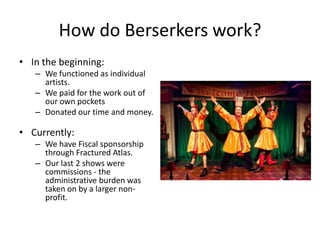
How do Berserkers work?
• In the beginning:
   – We functioned as individual
     artists.
   – We paid for the work out of
     our own pockets
   – Donated our time and money.

• Currently:
   – We have Fiscal sponsorship
     through Fractured Atlas.
   – Our last 2 shows were
     commissions - the
     administrative burden was
     taken on by a larger non-
     profit.
Adrienne
• Swim Pony Performing Arts
• Solo auteur-style director who envisions
  projects and invites other artists to join or
  engages in single project collaborations
• Company exists to support the work of this
  particular artist.
Swim Pony Stats:
    • “Founded” in 2010 after 7 years of self-producing
    • 2 Live Arts presentations
    • One fully staged project (SURVIVE!) with no larger
    producing entity
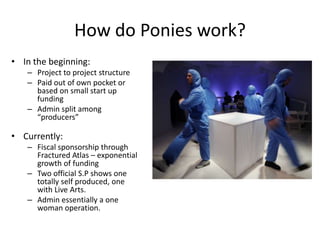
How do Ponies work?
• In the beginning:
   – Project to project structure
   – Paid out of own pocket or
     based on small start up
     funding
   – Admin split among
     “producers”

• Currently:
   – Fiscal sponsorship through
     Fractured Atlas – exponential
     growth of funding
   – Two official S.P shows one
     totally self produced, one
     with Live Arts.
   – Admin essentially a one
     woman operation.
Some examples
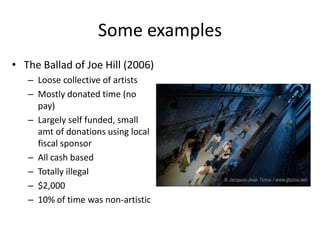
• The Ballad of Joe Hill (2006)
   – Loose collective of artists
   – Mostly donated time (no
     pay)
   – Largely self funded, small
     amt of donations using local
     fiscal sponsor
   – All cash based
   – Totally illegal
   – $2,000
   – 10% of time was non-artistic
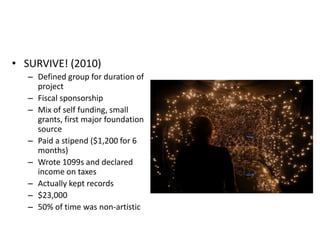
• SURVIVE! (2010)
   – Defined group for duration of
     project
   – Fiscal sponsorship
   – Mix of self funding, small
     grants, first major foundation
     source
   – Paid a stipend ($1,200 for 6
     months)
   – Wrote 1099s and declared
     income on taxes
   – Actually kept records
   – $23,000
   – 50% of time was non-artistic
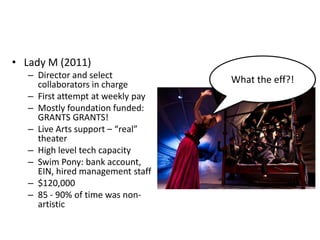
• Lady M (2011)
   – Director and select           What the eff?!
     collaborators in charge
   – First attempt at weekly pay
   – Mostly foundation funded:
     GRANTS GRANTS!
   – Live Arts support – “real”
     theater
   – High level tech capacity
   – Swim Pony: bank account,
     EIN, hired management staff
   – $120,000
   – 85 - 90% of time was non-
     artistic
What’s going on?
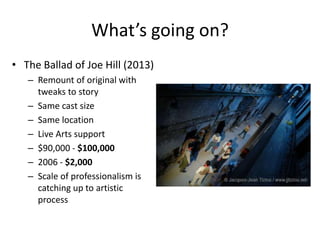
• The Ballad of Joe Hill (2013)
   – Remount of original with
     tweaks to story
   – Same cast size
   – Same location
   – Live Arts support
   – $90,000 - $100,000
   – 2006 - $2,000
   – Scale of professionalism is
     catching up to artistic
     process
What’s going on?
• As you grow, you need resources and you want to
  make your work more sustainably.

• To get resources you to need to build structure to
  support your art practices.
  –   Admin tasks
  –   Business skills - budget/accounting
  –   Grant writing/development
  –   PR and Marketing
  –   Producing skills
• Essentially the SAME artistic model/process
  – Lengthy rehearsal and development phase
  – Design intensive
  – Ensemble/lead artist driven
• But exponentially expanding admin/business
  structures
• DIY model quickly becomes unsustainable as
  you engage in higher level “professional” work
A Catch 22?
• I can't live on nothing and neither can my
  collaborators.

• The non-creative work to make money takes over
  my time and I don't make art.

• Is this non-profit inevitable?

• Will it even solve the problem?
Art Making Structures

      A review…
Individual Artist
What does that mean?

• Hired by others/commissions
• Works project to project
• Considered for profit
Individual Artist
• Pros
  – Has total control
  – Potentially doesn't need as much admin structure

• Con
  – Small amount of grants available
  – Guided by who will hire you
  – Generally, all admin work is handled by this
    individual
Non-Profit - 501 (c) 3
What?

• Public charity making works for the public
  good.
• Has a mission and a board whose jobs is to
  uphold that mission
• Can make money, but that money must be
  used to further the company structure.
Non-Profit - 501 (c) 3
• Pros
   – Tax exempt
   – Almost all foundation support is geared towards non-profits
   – Structure!

• Cons
   – Costs: Just applying for Federal tax exemption can cost up to
     $850, and because a nonprofit organization is a legal entity under
     federal, state, and local laws, consistent access to an
     attorney, accountant, or other professionals may prove necessary.
   – Admin work: a nonprofit must keep detailed records and submit
     annual filings to the state and IRS by stated deadlines in order to keep
     its active and exempt status.
   – Shared Control: A board is ultimately responsible for a non-profit and
     its mission
Fiscal Sponsorship
What is it?
• Legal Agreement between an individual artist
  & arts organization (501 c 3) that allows
  sponsee to raise tax-deductible contributions.
• NYFA, the Field, Fractured Atlas
• Usually takes a fee (6%) for services
Fiscal Sponsorship
• Pros
   – Bigger funding access
   – Some oversight
   – Often come with other benefits: online courses, education
     programs, directories to other kinds of resources (lawyers, insurance
     etc)

• Cons
   – Gives better access to more $$$ but not more support to manage it
   – Many funders won't use it
   – Taxes and accounting are all up to the artist
   – Don't have as immediate access to funds/resources. Waiting period to
     get funds and grant approval.
   – Can't get money until you've spent it or created an invoice (ie
     no, here's some cash, go get stuff at home depot and bring me
     change), a lot of artists fronting large amounts of money
LLC - Limited Liability Company
What?

• A small for profit company
LLC
• Pros
  – Less administration than standard corporation
  – Protects individual against legal issues (their house can't
    be taken if they're sued)
  – Can legally divide profits in ensembles
  – A lot of same benefits as individual artists: Control, project
    to project

• Cons
  – Can't accept tax deductible donations
  – No help with foundation support
  – Admin work is still on the artist shoulders
Discuss…

• What is your model/structure?
• Who does the work?
• How do you find funding for it?


                                    - Individual Artist
                                    - Non-Profit
                                    - Fiscal Sponsorship
                                    - LLC
To 501 (c) 3 or not to 501 (c) 3
                                  That is the question…

•   Non-Profit: Why or Why not?
•   What do you gain?
•   What do you lose?
•   Success/horror stories
What would your ideal administrative
          structure be?
• Assuming the world stays roughly the same
• How would you want to function
• Think about hours in the day you could spend
  doing admin for your art practice
Funding
• Where does your money come from?
• Where do you want it to come from?
• Is there anything other than funding
  opportunities that drive you to become a non-
  profit?
Specialized Knowledge
• Some fields require really specialized info:
  – Taxes
  – Legal
  – Bookkeeping
• How do you handle these aspects of the
  work?
Some real world examples…
The Small Non-Profit

Vampire Cowboys
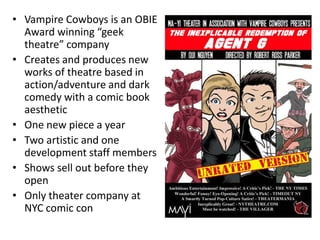
• Vampire Cowboys is an OBIE
  Award winning “geek
  theatre” company
• Creates and produces new
  works of theatre based in
  action/adventure and dark
  comedy with a comic book
  aesthetic
• One new piece a year
• Two artistic and one
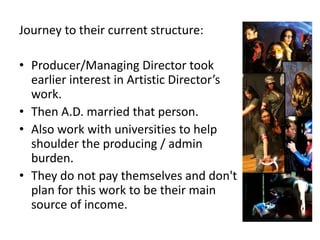
  development staff members
• Shows sell out before they
  open
• Only theater company at
  NYC comic con
Journey to their current structure:

• Producer/Managing Director took
  earlier interest in Artistic Director’s
  work.
• Then A.D. married that person.
• Also work with universities to help
  shoulder the producing / admin
  burden.
• They do not pay themselves and don't
  plan for this work to be their main
  source of income.
The Individual Artist

    SuliHolum
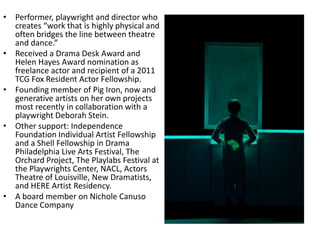
• Performer, playwright and director who
  creates “work that is highly physical and
  often bridges the line between theatre
  and dance.”
• Received a Drama Desk Award and
  Helen Hayes Award nomination as
  freelance actor and recipient of a 2011
  TCG Fox Resident Actor Fellowship.
• Founding member of Pig Iron, now and
  generative artists on her own projects
  most recently in collaboration with a
  playwright Deborah Stein.
• Other support: Independence
  Foundation Individual Artist Fellowship
  and a Shell Fellowship in Drama
  Philadelphia Live Arts Festival, The
  Orchard Project, The Playlabs Festival at
  the Playwrights Center, NACL, Actors
  Theatre of Louisville, New Dramatists,
  and HERE Artist Residency.
• A board member on Nichole Canuso
  Dance Company
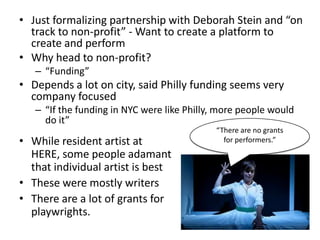
• Just formalizing partnership with Deborah Stein and “on
  track to non-profit” - Want to create a platform to
  create and perform
• Why head to non-profit?
   – “Funding”
• Depends a lot on city, said Philly funding seems very
  company focused
   – “If the funding in NYC were like Philly, more people would
     do it”
                                            “There are no grants
• While resident artist at                    for performers.”
  HERE, some people adamant
  that individual artist is best
• These were mostly writers
• There are a lot of grants for
  playwrights.
• It would be great to have “someone else.”
• Right now all company development is unpaid
   – “As the needs arise, we rise to meet them”
• No rush but expects non-profit to happen eventually
• On Nichole’s board – saw how she had to learn how to
  use the board.
• As an individual, as a tiny company, having the board
  relationship is really useful.
• Get a sense, a feel, of community around your projects
• As a board member, it’s very clear that the locus of
  power is with Nichole. The company is Nichole and
  wouldn’t exist without Nichole.
   – “But you could definitely end up with a crazy person on the
     board.”
• Sees a big dividing line between companies with a space
  they own
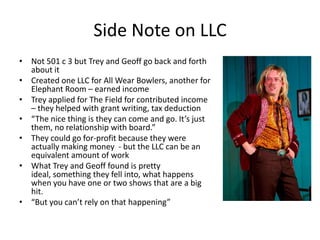
Side Note on LLC
• Not 501 c 3 but Trey and Geoff go back and forth
  about it
• Created one LLC for All Wear Bowlers, another for
  Elephant Room – earned income
• Trey applied for The Field for contributed income
  – they helped with grant writing, tax deduction
• “The nice thing is they can come and go. It’s just
  them, no relationship with board.”
• They could go for-profit because they were
  actually making money - but the LLC can be an
  equivalent amount of work
• What Trey and Geoff found is pretty
  ideal, something they fell into, what happens
  when you have one or two shows that are a big
  hit.
• “But you can’t rely on that happening”
Fiscal Sponsors

  A Chat with
Eleanor Whitney
    at NYFA
• Established in 1971 by the New York State Council on
  the Arts as an independent organization to serve
  individual artists throughout the state, the mission of
  the New York Foundation for the Arts (NYFA) is to
  empower artists across all disciplines at critical stages
  in their creative lives.
• “We do this through three main program areas: cash
  grants and fiscal sponsorship, online resources, and
  professional development training.”
• Fiscal sponsorship operates at national level – ~ 700
  artists/groups and about 100 emerging organizations
• Fiscal sponsorship program for 40 of their 41 years
• Services for individuals include things like
  1099’s if you opt into it, some light
  bookkeeping (but only for your contributed
  income), no tax help
• For emerging organizations more services
  – Full bookkeeping
  – We become their bank account
  – Payroll
  – Much more personalized
  – But you have to incorporate as non-profit at the
    state level
• A lot of what we do is education. Many people
  haven’t done fundraising before.
• It’s a professional development opportunity
• Many of our artists need more
  guidance, oversight as they’re starting out
• Mentioned lag time for grants, cash advances
  – That’s our job, to provide oversight, in some
    artist’s cases, for the first time
• Do you think fiscal sponsorship is a permanent
  solution?
   – Not sure, depends on the person
• I think a big question is where do bigger funders
  stand on innovation
• If you keep running into things maybe there are
  too many cooks in the kitchen
• A time share: lawyers, bookkeepers,
  administrators
   – That sounds awesome!
   – But that kind of stuff has to be local
• FYI, had a very similar convo with Fractured Atlas

Don't start a nonprofit

  • 1.
    Don’t Start aNon-Profit! (?) Special Thanks to the Wyncote Foundation
  • 2.
    Every one ofyou is trying to make your best artistic work. GOAL: Make Art
  • 3.
    Most artists areself funding their work in a variety of ways when they first start making it • Paying for things with their own $ • Donating their time (creative, administrative) • Volunteer collaborative team • In kind services – barter/borrow systems
  • 4.
    • In otherwords: we usually begin from DIY model •We think a lot about how we plan our art work but we don’t always plan our administrative structures
  • 5.
    Brad • The BerserkerResidents • Ensemble of 3 writer/creators who collaborate with different directors/designers/companies. • Company exists to support the work of this ensemble from project to project. Berserker Stats: •5 original shows in 5 years. •Toured 2 pieces to NYC •Published one play
  • 6.
    How do Berserkerswork? • In the beginning: – We functioned as individual artists. – We paid for the work out of our own pockets – Donated our time and money. • Currently: – We have Fiscal sponsorship through Fractured Atlas. – Our last 2 shows were commissions - the administrative burden was taken on by a larger non- profit.
  • 7.
    Adrienne • Swim PonyPerforming Arts • Solo auteur-style director who envisions projects and invites other artists to join or engages in single project collaborations • Company exists to support the work of this particular artist. Swim Pony Stats: • “Founded” in 2010 after 7 years of self-producing • 2 Live Arts presentations • One fully staged project (SURVIVE!) with no larger producing entity
  • 8.
    How do Ponieswork? • In the beginning: – Project to project structure – Paid out of own pocket or based on small start up funding – Admin split among “producers” • Currently: – Fiscal sponsorship through Fractured Atlas – exponential growth of funding – Two official S.P shows one totally self produced, one with Live Arts. – Admin essentially a one woman operation.
  • 9.
    Some examples • TheBallad of Joe Hill (2006) – Loose collective of artists – Mostly donated time (no pay) – Largely self funded, small amt of donations using local fiscal sponsor – All cash based – Totally illegal – $2,000 – 10% of time was non-artistic
  • 10.
    • SURVIVE! (2010) – Defined group for duration of project – Fiscal sponsorship – Mix of self funding, small grants, first major foundation source – Paid a stipend ($1,200 for 6 months) – Wrote 1099s and declared income on taxes – Actually kept records – $23,000 – 50% of time was non-artistic
  • 11.
    • Lady M(2011) – Director and select What the eff?! collaborators in charge – First attempt at weekly pay – Mostly foundation funded: GRANTS GRANTS! – Live Arts support – “real” theater – High level tech capacity – Swim Pony: bank account, EIN, hired management staff – $120,000 – 85 - 90% of time was non- artistic
  • 12.
    What’s going on? •The Ballad of Joe Hill (2013) – Remount of original with tweaks to story – Same cast size – Same location – Live Arts support – $90,000 - $100,000 – 2006 - $2,000 – Scale of professionalism is catching up to artistic process
  • 13.
    What’s going on? •As you grow, you need resources and you want to make your work more sustainably. • To get resources you to need to build structure to support your art practices. – Admin tasks – Business skills - budget/accounting – Grant writing/development – PR and Marketing – Producing skills
  • 14.
    • Essentially theSAME artistic model/process – Lengthy rehearsal and development phase – Design intensive – Ensemble/lead artist driven • But exponentially expanding admin/business structures • DIY model quickly becomes unsustainable as you engage in higher level “professional” work
  • 15.
    A Catch 22? •I can't live on nothing and neither can my collaborators. • The non-creative work to make money takes over my time and I don't make art. • Is this non-profit inevitable? • Will it even solve the problem?
  • 16.
  • 17.
    Individual Artist What doesthat mean? • Hired by others/commissions • Works project to project • Considered for profit
  • 18.
    Individual Artist • Pros – Has total control – Potentially doesn't need as much admin structure • Con – Small amount of grants available – Guided by who will hire you – Generally, all admin work is handled by this individual
  • 19.
    Non-Profit - 501(c) 3 What? • Public charity making works for the public good. • Has a mission and a board whose jobs is to uphold that mission • Can make money, but that money must be used to further the company structure.
  • 20.
    Non-Profit - 501(c) 3 • Pros – Tax exempt – Almost all foundation support is geared towards non-profits – Structure! • Cons – Costs: Just applying for Federal tax exemption can cost up to $850, and because a nonprofit organization is a legal entity under federal, state, and local laws, consistent access to an attorney, accountant, or other professionals may prove necessary. – Admin work: a nonprofit must keep detailed records and submit annual filings to the state and IRS by stated deadlines in order to keep its active and exempt status. – Shared Control: A board is ultimately responsible for a non-profit and its mission
  • 21.
    Fiscal Sponsorship What isit? • Legal Agreement between an individual artist & arts organization (501 c 3) that allows sponsee to raise tax-deductible contributions. • NYFA, the Field, Fractured Atlas • Usually takes a fee (6%) for services
  • 22.
    Fiscal Sponsorship • Pros – Bigger funding access – Some oversight – Often come with other benefits: online courses, education programs, directories to other kinds of resources (lawyers, insurance etc) • Cons – Gives better access to more $$$ but not more support to manage it – Many funders won't use it – Taxes and accounting are all up to the artist – Don't have as immediate access to funds/resources. Waiting period to get funds and grant approval. – Can't get money until you've spent it or created an invoice (ie no, here's some cash, go get stuff at home depot and bring me change), a lot of artists fronting large amounts of money
  • 23.
    LLC - LimitedLiability Company What? • A small for profit company
  • 24.
    LLC • Pros – Less administration than standard corporation – Protects individual against legal issues (their house can't be taken if they're sued) – Can legally divide profits in ensembles – A lot of same benefits as individual artists: Control, project to project • Cons – Can't accept tax deductible donations – No help with foundation support – Admin work is still on the artist shoulders
  • 25.
    Discuss… • What isyour model/structure? • Who does the work? • How do you find funding for it? - Individual Artist - Non-Profit - Fiscal Sponsorship - LLC
  • 26.
    To 501 (c)3 or not to 501 (c) 3 That is the question… • Non-Profit: Why or Why not? • What do you gain? • What do you lose? • Success/horror stories
  • 27.
    What would yourideal administrative structure be? • Assuming the world stays roughly the same • How would you want to function • Think about hours in the day you could spend doing admin for your art practice
  • 28.
    Funding • Where doesyour money come from? • Where do you want it to come from? • Is there anything other than funding opportunities that drive you to become a non- profit?
  • 29.
    Specialized Knowledge • Somefields require really specialized info: – Taxes – Legal – Bookkeeping • How do you handle these aspects of the work?
  • 30.
    Some real worldexamples…
  • 31.
  • 32.
    • Vampire Cowboysis an OBIE Award winning “geek theatre” company • Creates and produces new works of theatre based in action/adventure and dark comedy with a comic book aesthetic • One new piece a year • Two artistic and one development staff members • Shows sell out before they open • Only theater company at NYC comic con
  • 33.
    Journey to theircurrent structure: • Producer/Managing Director took earlier interest in Artistic Director’s work. • Then A.D. married that person. • Also work with universities to help shoulder the producing / admin burden. • They do not pay themselves and don't plan for this work to be their main source of income.
  • 34.
  • 35.
    • Performer, playwrightand director who creates “work that is highly physical and often bridges the line between theatre and dance.” • Received a Drama Desk Award and Helen Hayes Award nomination as freelance actor and recipient of a 2011 TCG Fox Resident Actor Fellowship. • Founding member of Pig Iron, now and generative artists on her own projects most recently in collaboration with a playwright Deborah Stein. • Other support: Independence Foundation Individual Artist Fellowship and a Shell Fellowship in Drama Philadelphia Live Arts Festival, The Orchard Project, The Playlabs Festival at the Playwrights Center, NACL, Actors Theatre of Louisville, New Dramatists, and HERE Artist Residency. • A board member on Nichole Canuso Dance Company
  • 36.
    • Just formalizingpartnership with Deborah Stein and “on track to non-profit” - Want to create a platform to create and perform • Why head to non-profit? – “Funding” • Depends a lot on city, said Philly funding seems very company focused – “If the funding in NYC were like Philly, more people would do it” “There are no grants • While resident artist at for performers.” HERE, some people adamant that individual artist is best • These were mostly writers • There are a lot of grants for playwrights.
  • 37.
    • It wouldbe great to have “someone else.” • Right now all company development is unpaid – “As the needs arise, we rise to meet them” • No rush but expects non-profit to happen eventually • On Nichole’s board – saw how she had to learn how to use the board. • As an individual, as a tiny company, having the board relationship is really useful. • Get a sense, a feel, of community around your projects • As a board member, it’s very clear that the locus of power is with Nichole. The company is Nichole and wouldn’t exist without Nichole. – “But you could definitely end up with a crazy person on the board.” • Sees a big dividing line between companies with a space they own
  • 38.
    Side Note onLLC • Not 501 c 3 but Trey and Geoff go back and forth about it • Created one LLC for All Wear Bowlers, another for Elephant Room – earned income • Trey applied for The Field for contributed income – they helped with grant writing, tax deduction • “The nice thing is they can come and go. It’s just them, no relationship with board.” • They could go for-profit because they were actually making money - but the LLC can be an equivalent amount of work • What Trey and Geoff found is pretty ideal, something they fell into, what happens when you have one or two shows that are a big hit. • “But you can’t rely on that happening”
  • 39.
    Fiscal Sponsors A Chat with Eleanor Whitney at NYFA
  • 40.
    • Established in1971 by the New York State Council on the Arts as an independent organization to serve individual artists throughout the state, the mission of the New York Foundation for the Arts (NYFA) is to empower artists across all disciplines at critical stages in their creative lives. • “We do this through three main program areas: cash grants and fiscal sponsorship, online resources, and professional development training.” • Fiscal sponsorship operates at national level – ~ 700 artists/groups and about 100 emerging organizations • Fiscal sponsorship program for 40 of their 41 years
  • 41.
    • Services forindividuals include things like 1099’s if you opt into it, some light bookkeeping (but only for your contributed income), no tax help • For emerging organizations more services – Full bookkeeping – We become their bank account – Payroll – Much more personalized – But you have to incorporate as non-profit at the state level
  • 42.
    • A lotof what we do is education. Many people haven’t done fundraising before. • It’s a professional development opportunity • Many of our artists need more guidance, oversight as they’re starting out • Mentioned lag time for grants, cash advances – That’s our job, to provide oversight, in some artist’s cases, for the first time
  • 43.
    • Do youthink fiscal sponsorship is a permanent solution? – Not sure, depends on the person • I think a big question is where do bigger funders stand on innovation • If you keep running into things maybe there are too many cooks in the kitchen • A time share: lawyers, bookkeepers, administrators – That sounds awesome! – But that kind of stuff has to be local • FYI, had a very similar convo with Fractured Atlas