Download free for 30 days
Sign in
Upload
Language (EN)
Support
Business
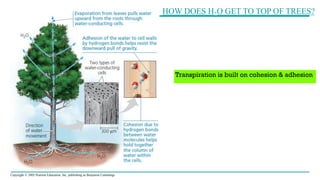
Mobile
Social Media
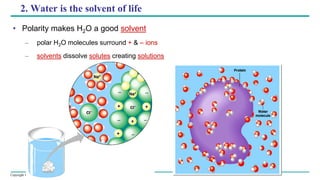
Marketing
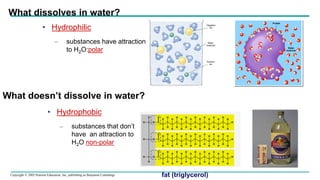
Technology
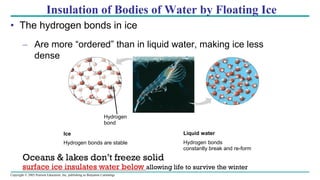
Art & Photos
Career
Design
Education
Presentations & Public Speaking
Government & Nonprofit
Healthcare
Internet
Law
Leadership & Management
Automotive
Engineering
Software
Recruiting & HR
Retail
Sales
Services
Science
Small Business & Entrepreneurship
Food
Environment
Economy & Finance
Data & Analytics
Investor Relations
Sports
Spiritual
News & Politics
Travel
Self Improvement
Real Estate
Entertainment & Humor
Health & Medicine
Devices & Hardware
Lifestyle
Change Language
Language
English
Español
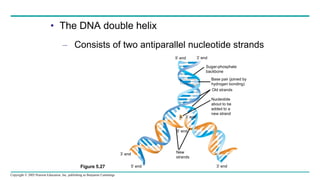
Português
Français
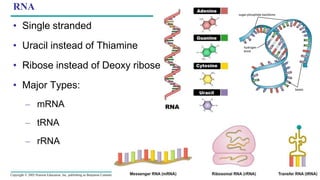
Deutsche
Cancel
Save
EN
Uploaded by
dipanshub240171cs
77 views
(DONE)Module I_2_Structure and Function of Macromolecules.pdf
jhgf
Investor Relations
◦
Read more
0
Save
Share
Embed
Embed presentation
Download
Download to read offline
1
/ 51
2
/ 51
Most read
3
/ 51
4
/ 51
5
/ 51
6
/ 51
7
/ 51
8
/ 51
9
/ 51
10
/ 51
11
/ 51
12
/ 51
13
/ 51
14
/ 51
15
/ 51
16
/ 51
17
/ 51
18
/ 51
Most read
19
/ 51
20
/ 51
21
/ 51
22
/ 51
23
/ 51
24
/ 51
25
/ 51
26
/ 51
27
/ 51
28
/ 51
29
/ 51
30
/ 51
31
/ 51
32
/ 51
33
/ 51
34
/ 51
35
/ 51
36
/ 51
37
/ 51
38
/ 51
39
/ 51
40
/ 51
41
/ 51
42
/ 51
43
/ 51
44
/ 51
45
/ 51
46
/ 51
47
/ 51
48
/ 51
49
/ 51
50
/ 51
51
/ 51
More Related Content
PPTX
2 Biochemical molecules
by
Magdaléna Kubešová
PPT
CHEMISTRY Organic and Inorganic Molecules.ppt
by
JohnLloydChristopher1
PPTX
AP Biology - Chemical Macromolecules (DNA, Etc.)
by
engestebanvaca
PPT
Biochemistry PowerPoint
by
BiologyIB
PPTX
The_chemistry_of_life_-_revised.pptx____
by
Jesús Andelfo Pinilla Arismendy
PPTX
3 cell chemistry and biosynthesis
by
saveena solanki
PPT
Chapter 2 part 1
by
amyottmers
PPTX
the_chemistry_of_life.pptx
by
NOELIEIBACARRA
2 Biochemical molecules
by
Magdaléna Kubešová
CHEMISTRY Organic and Inorganic Molecules.ppt
by
JohnLloydChristopher1
AP Biology - Chemical Macromolecules (DNA, Etc.)
by
engestebanvaca
Biochemistry PowerPoint
by
BiologyIB
The_chemistry_of_life_-_revised.pptx____
by
Jesús Andelfo Pinilla Arismendy
3 cell chemistry and biosynthesis
by
saveena solanki
Chapter 2 part 1
by
amyottmers
the_chemistry_of_life.pptx
by
NOELIEIBACARRA
Similar to (DONE)Module I_2_Structure and Function of Macromolecules.pdf
PPT
Chapter 23 -_chemical_composition_of_the_body
by
Yudi Bublle
PPT
Biochemistry
by
Espirituanna
PPTX
Biological Molecules ( I and a group of friends )
by
Daisy Sowah
PPT
The-Chemistry-of-Life-Organic-Compounds.ppt
by
JeahAbelBatobalunos
PPTX
05 macromolecules
by
Andrew McCaskill
PPTX
CAPE Biology Unit 1
by
Maxy Maxwell
PDF
unit1-biology-140328092310-phpapp01.pdf
by
fatima haruna
PPT
Module I_6_Structure and Function of Macromolecules.ppt
by
pk2003158
PPT
biochemistry.ppt for the students easily access
by
nirmalaperiasamy1
PPT
Ch1~the chemical nature of cells
by
RachelCaico
PPT
BiochemistryHB 2019
by
Dobbs Ferry High School
PPT
Biochemistry
by
Gaurav Kr
PDF
Biological Molecules chapter 2 as level.pdf
by
pgirly20
PDF
UNIT 2 Chemistry of Life: Biomolecules and water
by
AprilJoyFabella
PPT
Chap 2 micro bio lecture
by
Nathalie Wroy
PDF
Ap biology review chemistry biochemistry
by
Abdallah Yousif
PPTX
food chemistry.pptx
by
halabo1
PPTX
AP Biology - Week 1 Biochemistry
by
Sylvia Puglisi
PDF
Open stax biology(nonmajors)_ch02_imageslideshow
by
Lumen Learning
PPT
Ch 2 3 chemistry
by
JimenezAPBiology
Chapter 23 -_chemical_composition_of_the_body
by
Yudi Bublle
Biochemistry
by
Espirituanna
Biological Molecules ( I and a group of friends )
by
Daisy Sowah
The-Chemistry-of-Life-Organic-Compounds.ppt
by
JeahAbelBatobalunos
05 macromolecules
by
Andrew McCaskill
CAPE Biology Unit 1
by
Maxy Maxwell
unit1-biology-140328092310-phpapp01.pdf
by
fatima haruna
Module I_6_Structure and Function of Macromolecules.ppt
by
pk2003158
biochemistry.ppt for the students easily access
by
nirmalaperiasamy1
Ch1~the chemical nature of cells
by
RachelCaico
BiochemistryHB 2019
by
Dobbs Ferry High School
Biochemistry
by
Gaurav Kr
Biological Molecules chapter 2 as level.pdf
by
pgirly20
UNIT 2 Chemistry of Life: Biomolecules and water
by
AprilJoyFabella
Chap 2 micro bio lecture
by
Nathalie Wroy
Ap biology review chemistry biochemistry
by
Abdallah Yousif
food chemistry.pptx
by
halabo1
AP Biology - Week 1 Biochemistry
by
Sylvia Puglisi
Open stax biology(nonmajors)_ch02_imageslideshow
by
Lumen Learning
Ch 2 3 chemistry
by
JimenezAPBiology
(DONE)Module I_2_Structure and Function of Macromolecules.pdf
1.
Copyright © 2005
Pearson Education, Inc. publishing as Benjamin Cummings
2.
Copyright © 2005
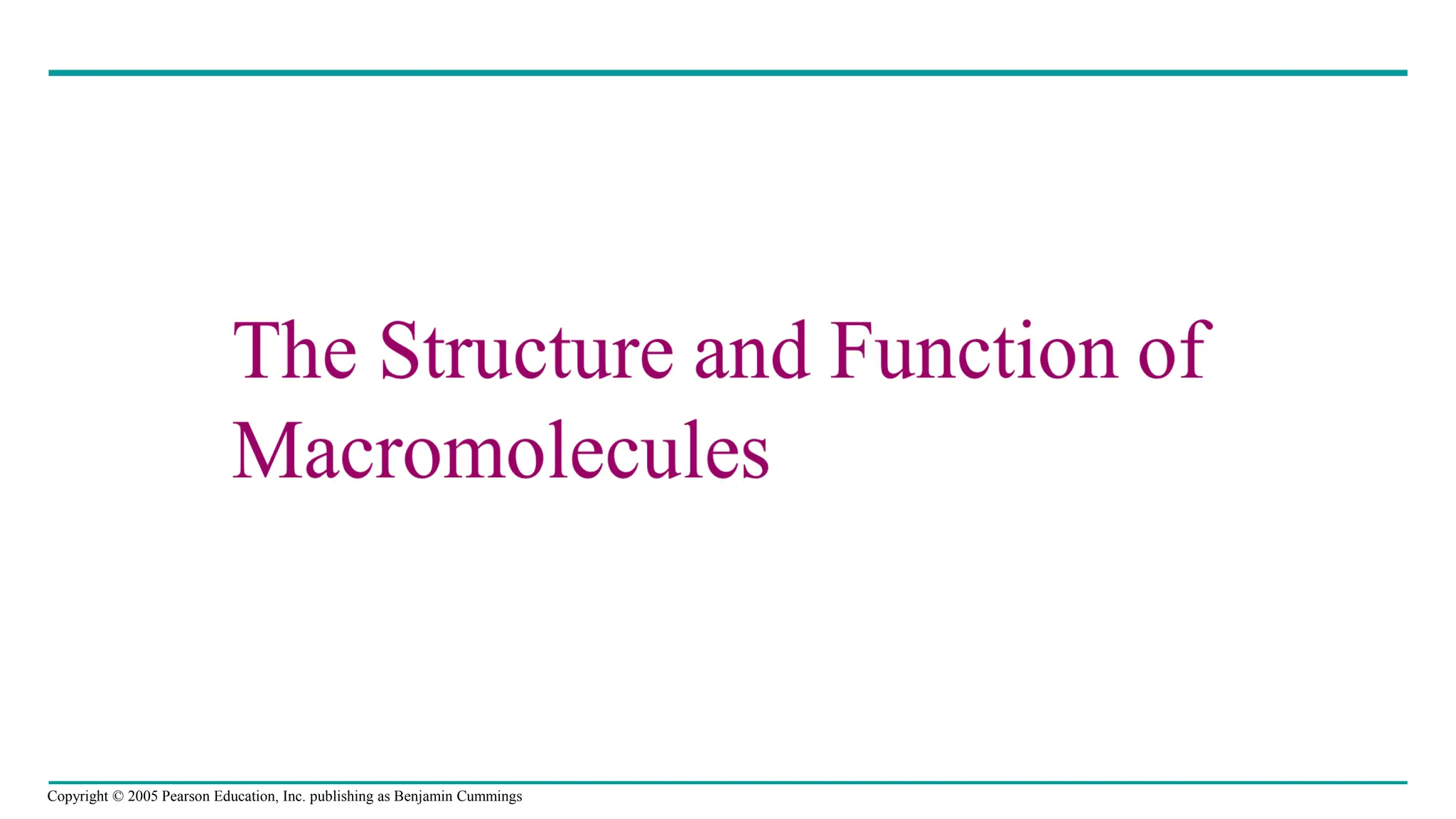
Pearson Education, Inc. publishing as Benjamin Cummings Atom- Molecule-Element- Compound Relationship ▪ Everything is made of matter ▪ Matter is made of atoms
3.
Copyright © 2005
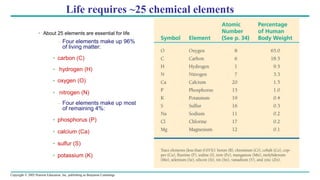
Pearson Education, Inc. publishing as Benjamin Cummings Life requires ~25 chemical elements • About 25 elements are essential for life – Four elements make up 96% of living matter: • carbon (C) • hydrogen (H) • oxygen (O) • nitrogen (N) – Four elements make up most of remaining 4%: • phosphorus (P) • calcium (Ca) • sulfur (S) • potassium (K)
4.
Copyright © 2005
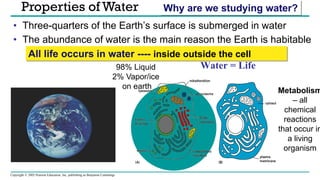
Pearson Education, Inc. publishing as Benjamin Cummings Water = Life • Three-quarters of the Earth’s surface is submerged in water • The abundance of water is the main reason the Earth is habitable Properties of Water Why are we studying water? All life occurs in water ---- inside outside the cell Metabolism – all chemical reactions that occur in a living organism 98% Liquid 2% Vapor/ice on earth
5.
Copyright © 2005
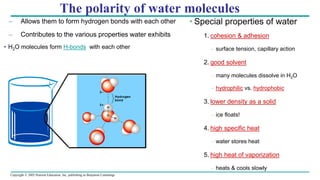
Pearson Education, Inc. publishing as Benjamin Cummings The polarity of water molecules – Allows them to form hydrogen bonds with each other – Contributes to the various properties water exhibits • H2O molecules form H-bonds with each other • Special properties of water 1. cohesion & adhesion – surface tension, capillary action 2. good solvent – many molecules dissolve in H2O – hydrophilic vs. hydrophobic 3. lower density as a solid – ice floats! 4. high specific heat – water stores heat 5. high heat of vaporization – heats & cools slowly
6.
Copyright © 2005
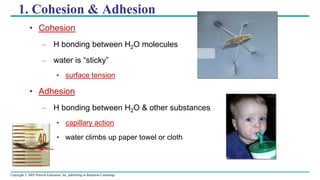
Pearson Education, Inc. publishing as Benjamin Cummings 1. Cohesion & Adhesion • Cohesion – H bonding between H2O molecules – water is “sticky” • surface tension • Adhesion – H bonding between H2O & other substances • capillary action • water climbs up paper towel or cloth
7.
Copyright © 2005
Pearson Education, Inc. publishing as Benjamin Cummings HOW DOES H2O GET TO TOP OF TREES? Transpiration is built on cohesion & adhesion
8.
Copyright © 2005
Pearson Education, Inc. publishing as Benjamin Cummings 2. Water is the solvent of life • Polarity makes H2O a good solvent – polar H2O molecules surround + & – ions – solvents dissolve solutes creating solutions
9.
Copyright © 2005
Pearson Education, Inc. publishing as Benjamin Cummings What dissolves in water? • Hydrophilic – substances have attraction to H2O:polar What doesn’t dissolve in water? • Hydrophobic – substances that don’t have an attraction to H2O non-polar fat (triglycerol)
10.
Copyright © 2005
Pearson Education, Inc. publishing as Benjamin Cummings Insulation of Bodies of Water by Floating Ice • The hydrogen bonds in ice – Are more “ordered” than in liquid water, making ice less dense Liquid water Hydrogen bonds constantly break and re-form Ice Hydrogen bonds are stable Hydrogen bond Oceans & lakes don’t freeze solid surface ice insulates water below allowing life to survive the winter
11.
Copyright © 2005
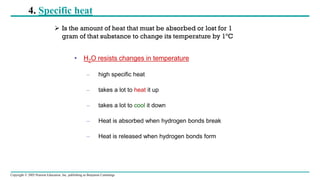
Pearson Education, Inc. publishing as Benjamin Cummings 4. Specific heat • H2O resists changes in temperature – high specific heat – takes a lot to heat it up – takes a lot to cool it down – Heat is absorbed when hydrogen bonds break – Heat is released when hydrogen bonds form ➢ Is the amount of heat that must be absorbed or lost for 1 gram of that substance to change its temperature by 1ºC
12.
Copyright © 2005
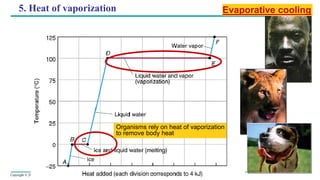
Pearson Education, Inc. publishing as Benjamin Cummings 5. Heat of vaporization Organisms rely on heat of vaporization to remove body heat Evaporative cooling
13.
Copyright © 2005
Pearson Education, Inc. publishing as Benjamin Cummings Ionization of water & pH • Water ionizes – H+ splits off from H2O, leaving OH– • if [H+] = [-OH], water is neutral • if [H+] > [-OH], water is acidic • if [H+] < [-OH], water is basic • pH scale – how acid or basic solution is – 1 → 7 → 14 H2O → H+ + OH– pH Scale tenfold change in H+ ions pH1 → pH2 10-1 → 10-2 10 times less H+ pH8 → pH7 10-8 → 10-7 10 times more H+ pH10 → pH8 10-10 → 10-8 100 times more H+
14.
Copyright © 2005
Pearson Education, Inc. publishing as Benjamin Cummings 1 0 0 1 2 3 4 5 6 7 8 9 3 Amount of base added Buffering range 4 5 2 pH Buffers & cellular regulation • pH of cells must be kept ~7 – pH affects shape of molecules – shape of molecules affect function – pH affects cellular function • Control pH by buffers (Are substances that minimize changes in the concentrations of hydrogen and hydroxide ions in a solution) – reservoir of H+ • donate H+ when [H+] falls • absorb H+ when [H+] rises
15.
Copyright © 2005
Pearson Education, Inc. publishing as Benjamin Cummings Macromolecules • Macromolecules – Are large molecules composed of smaller molecules – Are complex in their structures •Four of the classes of life’s organic molecules are polymers – Carbohydrates – Proteins – Lipids and Fats – Nucleic acids
16.
Copyright © 2005
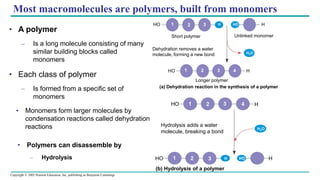
Pearson Education, Inc. publishing as Benjamin Cummings • A polymer – Is a long molecule consisting of many similar building blocks called monomers • Each class of polymer – Is formed from a specific set of monomers Most macromolecules are polymers, built from monomers • Monomers form larger molecules by condensation reactions called dehydration reactions (a) Dehydration reaction in the synthesis of a polymer HO H 1 2 3 HO HO H 1 2 3 4 H H2O Short polymer Unlinked monomer Longer polymer Dehydration removes a water molecule, forming a new bond • Polymers can disassemble by – Hydrolysis (b) Hydrolysis of a polymer HO 1 2 3 H HO H 1 2 3 4 H2O H HO Hydrolysis adds a water molecule, breaking a bond
17.
Copyright © 2005
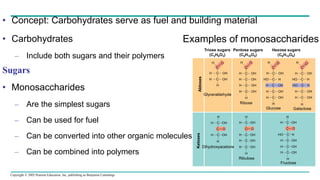
Pearson Education, Inc. publishing as Benjamin Cummings • Concept: Carbohydrates serve as fuel and building material • Carbohydrates – Include both sugars and their polymers Sugars • Monosaccharides – Are the simplest sugars – Can be used for fuel – Can be converted into other organic molecules – Can be combined into polymers Examples of monosaccharides Triose sugars (C3H6O3) Pentose sugars (C5H10O5) Hexose sugars (C6H12O6) H C OH H C OH H C OH H C OH H C OH H C OH HO C H H C OH H C OH H C OH H C OH HO C H HO C H H C OH H C OH H C OH H C OH H C OH H C OH H C OH H C OH H C OH C O C O H C OH H C OH H C OH HO C H H C OH C O H H H H H H H H H H H H H H C C C C O O O O Aldoses Glyceraldehyde Ribose Glucose Galactose Dihydroxyacetone Ribulose Ketoses Fructose
18.
Copyright © 2005
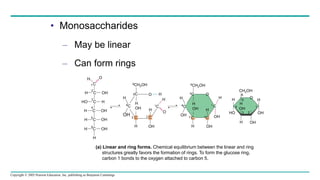
Pearson Education, Inc. publishing as Benjamin Cummings • Monosaccharides – May be linear – Can form rings H H C OH HO C H H C OH H C OH H C O C H 1 2 3 4 5 6 H OH 4C 6CH2OH 6CH2OH 5C H OH C H OH H 2 C 1C H O H OH 4C 5C 3 C H H OH OH H 2C 1 C OH H CH2OH H H OH HO H OH OH H 5 3 2 4 (a) Linear and ring forms. Chemical equilibrium between the linear and ring structures greatly favors the formation of rings. To form the glucose ring, carbon 1 bonds to the oxygen attached to carbon 5. OH 3 O H O O 6 1
19.
Copyright © 2005
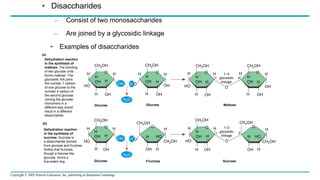
Pearson Education, Inc. publishing as Benjamin Cummings • Examples of disaccharides Dehydration reaction in the synthesis of maltose. The bonding of two glucose units forms maltose. The glycosidic link joins the number 1 carbon of one glucose to the number 4 carbon of the second glucose. Joining the glucose monomers in a different way would result in a different disaccharide. Dehydration reaction in the synthesis of sucrose. Sucrose is a disaccharide formed from glucose and fructose. Notice that fructose, though a hexose like glucose, forms a five-sided ring. (a) (b) H HO H H OH H OH O H OH CH2OH H HO H H OH H OH O H OH CH2OH H O H H OH H OH O H OH CH2OH H H2O H2O H H O H HO H OH O H CH2OH CH2OH HO OH H CH2OH H OH H H HO OH H CH2OH H OH H O O H OH H CH2OH H OH H O H OH CH2OH H HO O CH2OH H H OH O O 1 2 1 4 1–4 glycosidic linkage 1–2 glycosidic linkage Glucose Glucose Glucose Fructose Maltose Sucrose OH H H • Disaccharides – Consist of two monosaccharides – Are joined by a glycosidic linkage
20.
Copyright © 2005
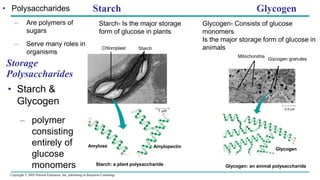
Pearson Education, Inc. publishing as Benjamin Cummings • Polysaccharides – Are polymers of sugars – Serve many roles in organisms Storage Polysaccharides • Starch & Glycogen – polymer consisting entirely of glucose monomers Starch Glycogen Starch- Is the major storage form of glucose in plants Chloroplast Starch Amylose Amylopectin 1 m Starch: a plant polysaccharide Glycogen- Consists of glucose monomers Is the major storage form of glucose in animals Mitochondria Giycogen granules 0.5 m Glycogen: an animal polysaccharide Glycogen
21.
Copyright © 2005
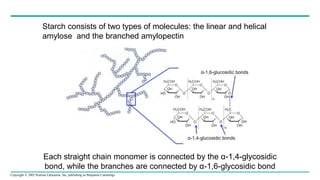
Pearson Education, Inc. publishing as Benjamin Cummings Each straight chain monomer is connected by the α-1,4-glycosidic bond, while the branches are connected by α-1,6-glycosidic bond Starch consists of two types of molecules: the linear and helical amylose and the branched amylopectin
22.
Copyright © 2005
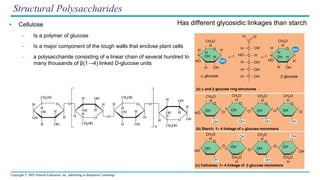
Pearson Education, Inc. publishing as Benjamin Cummings Structural Polysaccharides • Cellulose – Is a polymer of glucose – Is a major component of the tough walls that enclose plant cells – a polysaccharide consisting of a linear chain of several hundred to many thousands of β(1→4) linked D-glucose units Has different glycosidic linkages than starch (c) Cellulose: 1– 4 linkage of glucose monomers H O O CH2O H H OH H H OH OH H H HO 4 C C C C C C H H H HO OH H OH OH OH H O CH2O H H H H OH OH H H HO 4 OH CH2O H O OH OH HO 4 1 O CH2O H O OH OH O CH2O H O OH OH CH2O H O OH OH O O CH2O H O OH OH HO 4 O 1 OH O OH OH O CH2O H O OH O OH O OH OH (a) and glucose ring structures (b) Starch: 1– 4 linkage of glucose monomers 1 glucose glucose CH2O H CH2O H 1 4 4 1 1
23.
Copyright © 2005
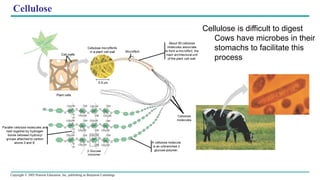
Pearson Education, Inc. publishing as Benjamin Cummings Cellulose Cellulose is difficult to digest Cows have microbes in their stomachs to facilitate this process
24.
Copyright © 2005
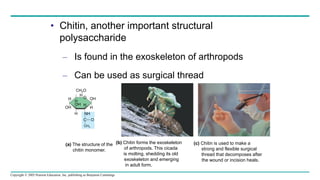
Pearson Education, Inc. publishing as Benjamin Cummings • Chitin, another important structural polysaccharide – Is found in the exoskeleton of arthropods – Can be used as surgical thread (a) The structure of the chitin monomer. O CH2O H OH H H OH H NH C CH3 O H H (b) Chitin forms the exoskeleton of arthropods. This cicada is molting, shedding its old exoskeleton and emerging in adult form. (c) Chitin is used to make a strong and flexible surgical thread that decomposes after the wound or incision heals. OH
25.
Copyright © 2005
Pearson Education, Inc. publishing as Benjamin Cummings • Lipids are a diverse group of hydrophobic molecules • Lipids – Are the one class of large biological molecules that do not consist of polymers – Share the common trait of being hydrophobic
26.
Copyright © 2005
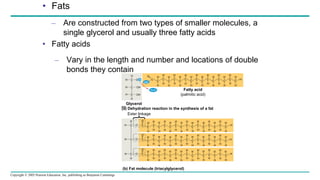
Pearson Education, Inc. publishing as Benjamin Cummings • Fats – Are constructed from two types of smaller molecules, a single glycerol and usually three fatty acids • Fatty acids – Vary in the length and number and locations of double bonds they contain (b) Fat molecule (triacylglycerol) H H H H H H H H H H H H H H H H O H O H C C C H H OH OH H H H H H H H H H H H H H H H H H C C C C C C C C C C C C C C C C Glycerol Fatty acid (palmitic acid) H H H H H H H H H H H H H H H H H H H H H H H H H H H H H H H H H H H H H H H H H H H H H H H H H H H H H H H H H H H H H H H H H H H H H H H H H H H H H H H H H H H H H H H H H H H H H H H H H H HO O O O O C C C C C C C C C C C C C C C C C C C C C C C C C C C C C C C C C C C C C C C C C C C C C C C C C C C O O (a) Dehydration reaction in the synthesis of a fat Ester linkage
27.
Copyright © 2005
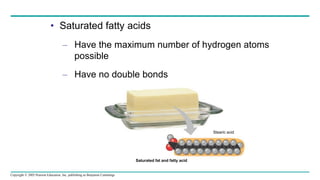
Pearson Education, Inc. publishing as Benjamin Cummings • Saturated fatty acids – Have the maximum number of hydrogen atoms possible – Have no double bonds Saturated fat and fatty acid Stearic acid
28.
Copyright © 2005
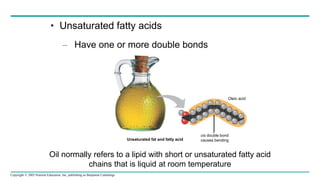
Pearson Education, Inc. publishing as Benjamin Cummings • Unsaturated fatty acids – Have one or more double bonds Unsaturated fat and fatty acid cis double bond causes bending Oleic acid Oil normally refers to a lipid with short or unsaturated fatty acid chains that is liquid at room temperature
29.
Copyright © 2005
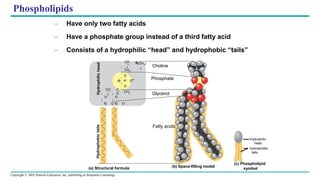
Pearson Education, Inc. publishing as Benjamin Cummings CH2 O P O O O CH2 C H CH 2 O O C O C O Phosphate Glycerol (a) Structural formula (b) Space-filling model Fatty acids (c) Phospholipid symbol Hydrophilic head Hydrophobic tails – CH 2 Choline + N(CH3) 3 Phospholipids – Have only two fatty acids – Have a phosphate group instead of a third fatty acid – Consists of a hydrophilic “head” and hydrophobic “tails”
30.
Copyright © 2005
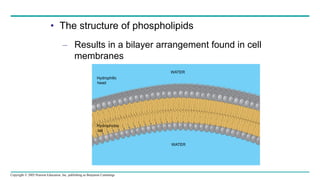
Pearson Education, Inc. publishing as Benjamin Cummings • The structure of phospholipids – Results in a bilayer arrangement found in cell membranes Hydrophilic head WATER WATER Hydrophobic tail
31.
Copyright © 2005
Pearson Education, Inc. publishing as Benjamin Cummings Polypeptides • Polypeptides – Are polymers of amino acids • A protein – Consists of one or more polypeptides Amino Acid Monomers • Amino acids – Are organic molecules possessing both carboxyl and amino groups – Differ in their properties due to differing side chains, called R groups
32.
Copyright © 2005
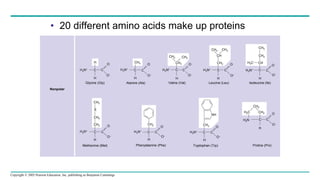
Pearson Education, Inc. publishing as Benjamin Cummings • 20 different amino acids make up proteins O O– H H3N+ C C O O– H CH3 H3N+ C H C O O– CH3 CH3 CH3 C C O O– H H3N+ CH CH3 CH2 C H H3N+ CH3 CH3 CH2 CH C H H3N+ C CH3 CH2 CH2 C H3N+ H C O O– CH2 C H3N+ H C O O– CH2 NH H C O O– H3N+ C CH2 H2C H2N C CH2 H C Nonpolar Glycine (Gly) Alanine (Ala) Valine (Val) Leucine (Leu) Isoleucine (Ile) Methionine (Met) Phenylalanine (Phe) C O O– Tryptophan (Trp) Proline (Pro) H3C S O O–
33.
Copyright © 2005
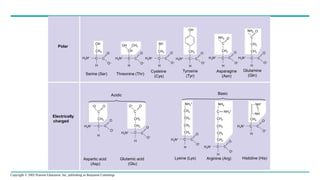
Pearson Education, Inc. publishing as Benjamin Cummings O– OH CH2 C C H H3N+ O O– H3N+ OH CH3 CH C C H O– O SH CH2 C H H3N+ C O O– H3N+ C C CH2 OH H H H H3N+ NH2 CH2 O C C C O O– NH2 O C CH2 CH2 C C H3N+ O O– O Polar Electrically charged –O O C CH2 C C H3N+ H O O– O– O C CH2 C C H3N+ H O O– CH2 CH2 CH2 CH2 NH3 + CH2 C C H3N+ H O O– NH2 C NH2 + CH2 CH2 CH2 C C H3N+ H O O– CH2 NH+ NH CH2 C C H3N+ H O O– Serine (Ser) Threonine (Thr) Cysteine (Cys) Tyrosine (Tyr) Asparagine (Asn) Glutamine (Gln) Acidic Basic Aspartic acid (Asp) Glutamic acid (Glu) Lysine (Lys) Arginine (Arg) Histidine (His)
34.
Copyright © 2005
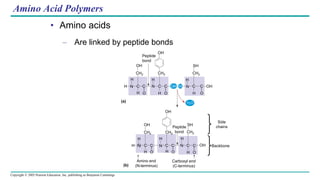
Pearson Education, Inc. publishing as Benjamin Cummings Amino Acid Polymers • Amino acids – Are linked by peptide bonds OH DESMOSOMES DESMOSOMES DESMOSOMES OH CH2 C N H C H O H OH OH Peptide bond OH OH OH H H H H H H H H H H H H N N N N N SH Side chains SH O O O O O H2O CH2 CH2 CH2 CH2 CH2 C C C C C C C C C C Peptide bond Amino end (N-terminus) Backbone (a) (b) Carboxyl end (C-terminus)
35.
Copyright © 2005
Pearson Education, Inc. publishing as Benjamin Cummings Determining the Amino Acid Sequence of a Polypeptide • The amino acid sequences of polypeptides – Were first determined using chemical means – Can now be determined by automated machines
36.
Copyright © 2005
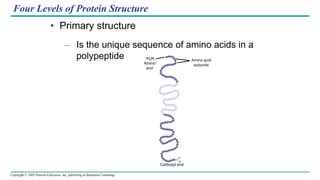
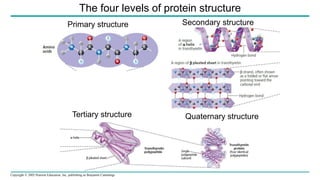
Pearson Education, Inc. publishing as Benjamin Cummings Four Levels of Protein Structure • Primary structure – Is the unique sequence of amino acids in a polypeptide – Amino acid subunits +H3N Amino end o Carboxyl end o c GlyProThr Gly Thr Gly Glu Seu Lys Cys Pro Leu Met Val Lys Val Leu Asp AlaVal ArgGly Ser Pro Ala Gly lle Ser ProPheHisGluHis Ala Glu Val Val Phe Thr Ala Asn Asp Ser GlyPro Arg Arg Tyr Thr lle Ala Ala Leu Leu Ser Pro Tyr Ser Tyr Ser Thr Thr Ala Val Val Thr AsnPro LysGlu Thr Lys Ser Tyr Trp Lys Ala Leu GluLle Asp
37.
Copyright © 2005
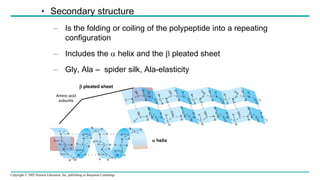
Pearson Education, Inc. publishing as Benjamin Cummings O C helix pleated sheet Amino acid subunits N C H C O C N H C O H R C N H C O H C R N H H R C O R C H N H C O H N C O R C H N H H C R C O C O C N H H R C C O N H H C R C O N H R C H C O N H H C R C O N H R C H C O N H H C R C O N H H C R N H O O C N C R C H O C H R N H O C R C H N H O C H C R N H C C N R H O C H C R N H O C R C H H C R N H C O C N H R C H C O N H C • Secondary structure – Is the folding or coiling of the polypeptide into a repeating configuration – Includes the helix and the pleated sheet – Gly, Ala – spider silk, Ala-elasticity H H
38.
Copyright © 2005
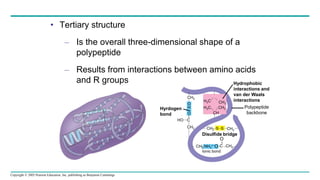
Pearson Education, Inc. publishing as Benjamin Cummings • Tertiary structure – Is the overall three-dimensional shape of a polypeptide – Results from interactions between amino acids and R groups CH2 CH O H O C HO CH2 CH2 NH3 + C -O CH2 O CH2 S S CH2 CH CH3 CH3 H3C H3C Hydrophobic interactions and van der Waals interactions Polypeptide backbone Hyrdogen bond Ionic bond CH2 Disulfide bridge
39.
Copyright © 2005
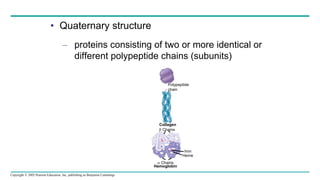
Pearson Education, Inc. publishing as Benjamin Cummings • Quaternary structure – proteins consisting of two or more identical or different polypeptide chains (subunits) Polypeptide chain Collagen Chains Chains Hemoglobin Iron Heme
40.
Copyright © 2005
Pearson Education, Inc. publishing as Benjamin Cummings The four levels of protein structure Primary structure Secondary structure Tertiary structure Quaternary structure
41.
Copyright © 2005
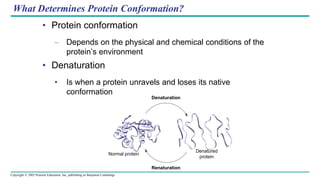
Pearson Education, Inc. publishing as Benjamin Cummings What Determines Protein Conformation? • Protein conformation – Depends on the physical and chemical conditions of the protein’s environment • Denaturation • Is when a protein unravels and loses its native conformation Denaturation Renaturation Denatured protein Normal protein
42.
Copyright © 2005
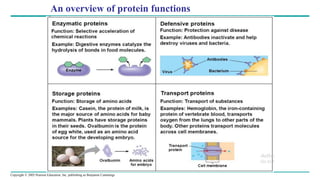
Pearson Education, Inc. publishing as Benjamin Cummings An overview of protein functions
43.
Copyright © 2005
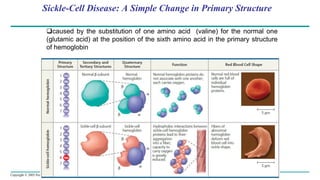
Pearson Education, Inc. publishing as Benjamin Cummings Sickle-Cell Disease: A Simple Change in Primary Structure ❑caused by the substitution of one amino acid (valine) for the normal one (glutamic acid) at the position of the sixth amino acid in the primary structure of hemoglobin
44.
Copyright © 2005
Pearson Education, Inc. publishing as Benjamin Cummings • Nucleic acids store and transmit hereditary information • Genes – Are the units of inheritance – Program the amino acid sequence of polypeptides – Are made of nucleic acids
45.
Copyright © 2005
Pearson Education, Inc. publishing as Benjamin Cummings The Roles of Nucleic Acids • There are two types of nucleic acids – Deoxyribonucleic acid (DNA) – Ribonucleic acid (RNA) • DNA – Stores information for the synthesis of specific proteins
46.
Copyright © 2005
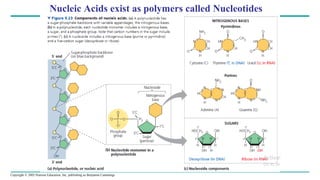
Pearson Education, Inc. publishing as Benjamin Cummings Nucleic Acids exist as polymers called Nucleotides
47.
Copyright © 2005
Pearson Education, Inc. publishing as Benjamin Cummings Nucleotide Polymers • Nucleotide polymers – Are made up of nucleotides linked by the–OH group on the 3´ carbon of one nucleotide and the phosphate on the 5´ carbon on the next • The sequence of bases along a nucleotide polymer – Is unique for each gene
48.
Copyright © 2005
Pearson Education, Inc. publishing as Benjamin Cummings The DNA Double Helix • Cellular DNA molecules – Have two polynucleotides that spiral around an imaginary axis – Form a double helix • The nitrogenous bases in DNA – Form hydrogen bonds in a complementary fashion (A with T only, and C with G only)
49.
Copyright © 2005
Pearson Education, Inc. publishing as Benjamin Cummings • The DNA double helix – Consists of two antiparallel nucleotide strands 3’ end Sugar-phosphate backbone Base pair (joined by hydrogen bonding) Old strands Nucleotide about to be added to a new strand A 3’ end 3’ end 5’ end New strands 3’ end 5’ end 5’ end Figure 5.27
50.
Copyright © 2005
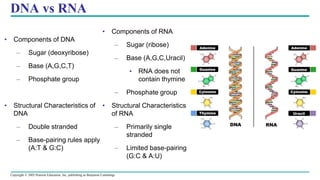
Pearson Education, Inc. publishing as Benjamin Cummings RNA • Single stranded • Uracil instead of Thiamine • Ribose instead of Deoxy ribose • Major Types: – mRNA – tRNA – rRNA
51.
Copyright © 2005
Pearson Education, Inc. publishing as Benjamin Cummings DNA vs RNA • Components of DNA – Sugar (deoxyribose) – Base (A,G,C,T) – Phosphate group • Structural Characteristics of DNA – Double stranded – Base-pairing rules apply (A:T & G:C) • Components of RNA – Sugar (ribose) – Base (A,G,C,Uracil) • RNA does not contain thymine – Phosphate group • Structural Characteristics of RNA – Primarily single stranded – Limited base-pairing (G:C & A:U)
Download
![Copyright © 2005 Pearson Education, Inc. publishing as Benjamin Cummings
Ionization of water & pH
• Water ionizes
– H+ splits off from H2O, leaving OH–
• if [H+] = [-OH], water is neutral
• if [H+] > [-OH], water is acidic
• if [H+] < [-OH], water is basic
• pH scale
– how acid or basic solution is
– 1 → 7 → 14
H2O → H+ + OH–
pH Scale
tenfold change
in H+ ions
pH1 → pH2
10-1 → 10-2
10 times less H+
pH8 → pH7
10-8 → 10-7
10 times more H+
pH10 → pH8
10-10 → 10-8
100 times more H+](https://image.slidesharecdn.com/donemodulei2structureandfunctionofmacromolecules-250830162126-8d109ef9/85/DONE-Module-I_2_Structure-and-Function-of-Macromolecules-pdf-13-320.jpg)
![Copyright © 2005 Pearson Education, Inc. publishing as Benjamin Cummings
1
0
0
1
2
3
4
5
6
7
8
9
3
Amount of base added
Buffering
range
4 5
2
pH
Buffers & cellular regulation
• pH of cells must be kept ~7
– pH affects shape of molecules
– shape of molecules affect function
– pH affects cellular function
• Control pH by buffers (Are substances that minimize changes in
the concentrations of hydrogen and hydroxide ions in a solution)
– reservoir of H+
• donate H+ when [H+] falls
• absorb H+ when [H+] rises](https://image.slidesharecdn.com/donemodulei2structureandfunctionofmacromolecules-250830162126-8d109ef9/85/DONE-Module-I_2_Structure-and-Function-of-Macromolecules-pdf-14-320.jpg)