Subject Name: Mathematics
Grade Level: Grade 4
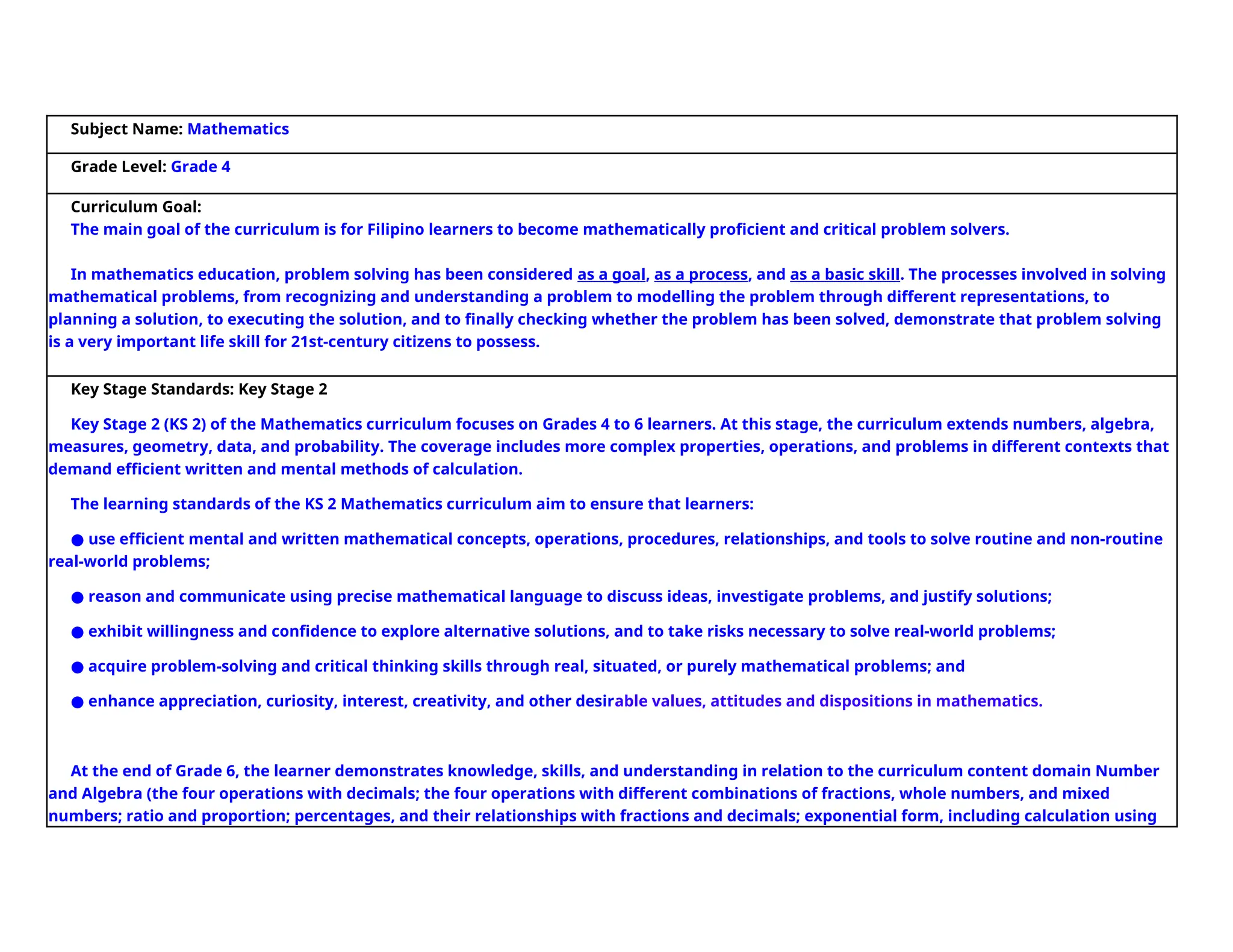
Curriculum Goal:
The main goal of the curriculum is for Filipino learners to become mathematically proficient and critical problem solvers.
In mathematics education, problem solving has been considered as a goal, as a process, and as a basic skill. The processes involved in solving
mathematical problems, from recognizing and understanding a problem to modelling the problem through different representations, to
planning a solution, to executing the solution, and to finally checking whether the problem has been solved, demonstrate that problem solving
is a very important life skill for 21st-century citizens to possess.
Key Stage Standards: Key Stage 2
Key Stage 2 (KS 2) of the Mathematics curriculum focuses on Grades 4 to 6 learners. At this stage, the curriculum extends numbers, algebra,
measures, geometry, data, and probability. The coverage includes more complex properties, operations, and problems in different contexts that
demand efficient written and mental methods of calculation.
The learning standards of the KS 2 Mathematics curriculum aim to ensure that learners:
use efficient mental and written mathematical concepts, operations, procedures, relationships, and tools to solve routine and non-routine
●
real-world problems;
reason and communicate using precise mathematical language to discuss ideas, investigate problems, and justify solutions;
●
exhibit willingness and confidence to explore alternative solutions, and to take risks necessary to solve real-world problems;
●
acquire problem-solving and critical thinking skills through real, situated, or purely mathematical problems; and
●
enhance appreciation, curiosity, interest, creativity, and other desir
● able values, attitudes and dispositions in mathematics.
At the end of Grade 6, the learner demonstrates knowledge, skills, and understanding in relation to the curriculum content domain Number
and Algebra (the four operations with decimals; the four operations with different combinations of fractions, whole numbers, and mixed
numbers; ratio and proportion; percentages, and their relationships with fractions and decimals; exponential form, including calculation using
the GEMDAS rules; greatest common factors, least common multiples); Measurement and Geometry (right, acute, and obtuse; tessellation of
shapes; resulting figure after translation, reflection and rotation; units of volume and capacity; volume of cubes and rectangular prisms;
properties of triangles and quadrilaterals; perimeter and area of triangles, parallelograms, trapezoids; parts of a circle, including circumference;
area of a circle; composite figures composed of any two or more of: triangle, square, rectangle, circle, semi-circle; prisms and pyramids; surface
area of solid figures; symmetric figures and designs; 12- and 24-hour time, and world time zones); Data and Probability (presentation and
interpretation of data in tabular form and in a single line graph; double bar graphs and double line graphs; theoretical probability; pie graphs).
This knowledge, skills and understanding is applied, with the use of technology, to the processes within Mathematics of critical thinking,
problem solving, communicating, reasoning, and making connections between topic areas.
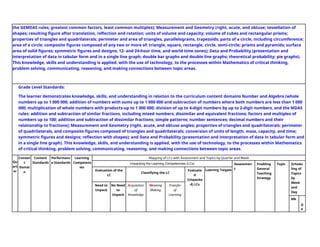
Grade Level Standards:
The learner demonstrates knowledge, skills, and understanding in relation to the curriculum content domains Number and Algebra (whole
numbers up to 1 000 000; addition of numbers with sums up to 1 000 000 and subtraction of numbers where both numbers are less than 1 000
000; multiplication of whole numbers with products-up to 1 000 000; division of up to 4-digit numbers by up to 2-digit numbers, and the MDAS
rules; addition and subtraction of similar fractions, including mixed numbers; dissimilar and equivalent fractions; factors and multiples of
numbers up to 100; addition and subtraction of dissimilar fractions; simple patterns; number sentences; decimal numbers and their
relationship to fractions); Measurement and Geometry (right, acute, and obtuse angles; properties of triangles and quadrilaterals; perimeter
of quadrilaterals, and composite figures composed of triangles and quadrilaterals; conversion of units of length, mass, capacity, and time;
symmetric figures and designs; reflection with shapes); and Data and Probability (presentation and interpretation of data in tabular form and
in a single line graph). This knowledge, skills, and understanding is applied, with the use of technology, to the processes within Mathematics
of critical thinking, problem solving, communicating, reasoning, and making connections between topic areas.
Qu
art
er
Conten
t
Domai
n
Content
Standards
Performanc
e Standards
Learning
Competenc
ies
Mapping of LCs with Assessment and Topics by Quarter and Week
Unpacking the Learning Competencies (LCs) Assessmen
t
Enabling
General
Teaching
Strategy
Topic Schedu
ling of
Topics
by
Week
and
Day
Evaluation of the
LC
Classifying the LC
Evaluate
d
(Unpacke
d) LCs
Learning Targets
Need to
Unpack
No Need
to
Unpack
Acquisition
of
Knowledge
Meaning
Making
Transfer
of
Learning
Wk
D
a
y
Q
1
Mea
sure
ment
and
Geo
metr
y
(MG)
1.
measur
es of
angles
2.
properti
es of
triangle
s and
quadrila
terals.
3.
perimet
er of
quadrila
terals,
and
composi
te
figures
compos
ed of
triangle
s and
quadrila
terals.
By the
end of
the
quarter,
the
learners
are able
to ...
• illustrate
and
measure
different
angles
(MG)
• classify
triangles
and
quadrilat
eral, and
differenti
ate
quadrilat
erals, by
applying
their
propertie
s. (MG)
• find the
perimeter
of
quadrilat
erals and
composit
e figures
1.
illustrate
different
angles
(right,
acute,
and
obtuse)
using
models.
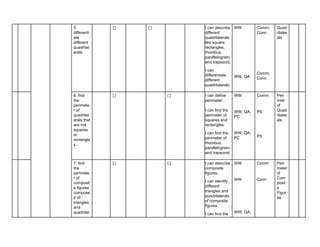
✅ ✅ ✅ I can define
Acute, Obtuse,
and Right
Angles.
I can
differentiate
Acute, Obtuse,
and Right
Angles.
I can illustrate
Acute, Obtuse,
and Right
Angles.
WW
WW
WW; QA;
PC
Comm
Conn
(analyze
)
PS
Angle
s
Angle
s
Angle
s
2.
measure
and draw
angles
using a
protracto
r.
✅ ✅ 2.
measure
and
draw
angles
(right,
acute,
and
obtuse)
using a
protracto
r.
I can
demonstrate
how to use
protractor by
using the
correct steps.
I can measure
different
angles (acute,
obtuse, and
right) using
protractor.
I can draw
different
angles (acute,
WW
WW, QA,
PC
WW, QA,
PC
Conn
(apply)
PS
PS
Mesur
ing
Angle
s
Meas
uring
Angle
s
Meas
uring
Angle
compose
d of
triangles
and
quadrilat
erals.
(MG)
• read,
write, and
compare
whole
numbers
up to 1
000 000.
(NA)
•
performs
addition
of
numbers
with
sums up
to 1 000
000 and
subtractio
n of
numbers
where
both
numbers
are less
than 1
000 000.
(NA)
obtuse, and
right) using
protractor.
s
3. draw
and state
the
propertie
s of
triangles
and
quadrilat
erals.
✅ ✅ I can state
properties of
triangles and
quadrilaterals.
I can draw
triangles and
quadrilaterals
using their
properties.
WW, QA
WW, QA,
PC
Comm
PS
Trian
gles
and
Quad
rilater
als
4.
classify
triangles
and
quadrilat
erals
accordin
g to
sides
and
angles.
✅ ✅ I can classify
triangles
according to
sides.
I can classify
triangles
according to
angles.
I can classify
triangles
according to
sides and
angles.
I can classify
quadrilaterals
according
sides and
angles.
WW, QA,
PC
WW, QA,
PC
WW, QA,
PC
WW, QA,
PC
Conn; R;
PS
Conn; R;
PS
Conn; R;
PS
Conn; R;
PS
Class
ifying
Trian
gles
and
Quad
rilater
als
5.
differenti
ate
different
quadrilat
erals.
✅ ✅ I can describe
different
quadrilaterals
like square,
rectangles,
rhombus,
parallelogram,
and trapezoid.
I can
differentiate
different
quadrilaterals.
WW
WW, QA
Comm;
Conn
Comm;
Conn
Quad
rilater
als
6. find
the
perimete
r of
quadrilat
erals that
are not
squares
or
rectangle
s.
✅ ✅ I can define
perimeter.
I can find the
perimeter of
squares and
rectangles.
I can find the
perimeter of
rhombus,
parallelogram
and trapezoid.
WW
WW; QA;
PC
WW; QA;
PC
Comm
PS
PS
Peri
metr
of
Quad
rilater
als
7. find
the
perimete
r of
composit
e figures
compose
d of
triangles
and
quadrilat
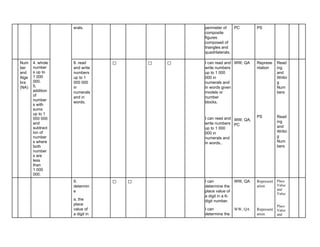
✅ ✅ I can describe
composite
figures.
I can identify
different
triangles and
quadrilaterals
of composite
figures.
I can find the
WW
WW
WW; QA;
Comm
Conn
Peri
meter
of
Com
posit
e
Figur
es
erals. perimeter of
composite
figures
composed of
triangles and
quadrilaterals.
PC PS
Num
ber
and
Alge
bra
(NA)
4. whole
number
s up to
1 000
000.
5.
addition
of
number
s with
sums
up to 1
000 000
and
subtract
ion of
number
s where
both
number
s are
less
than
1 000
000.
8. read
and write
numbers
up to 1
000 000
in
numerals
and in
words.
✅ ✅ ✅ I can read and
write numbers
up to 1 000
000 in
numerals and
in words given
models or
number
blocks.
I can read and
write numbers
up to 1 000
000 in
numerals and
in words..
WW; QA
WW; QA;
PC
Represe
ntation
PS
Read
ing
and
Writin
g
Num
bers
Read
ing
and
Writin
g
Num
bers
9.
determin
e
a. the
place
value of
a digit in
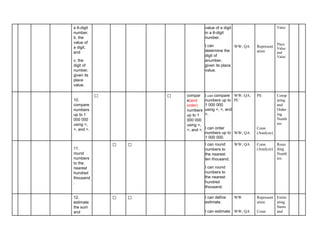
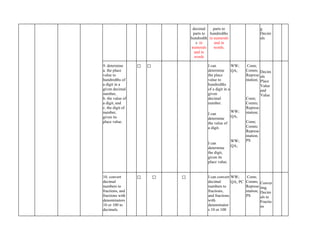
✅ ✅ I can
determine the
place value of
a digit in a 6-
digit number.
I can
determine the
WW, QA
WW, QA
Represent
ation
Represent
ation
Place
Value
and
Value
Place
Value
and
a 6-digit
number,
b. the
value of
a digit,
and
c. the
digit of
number,
given its
place
value.
value of a digit
in a 6-digit
number.
I can
determine the
digit of
anumber,
given its place
value.
WW, QA Represent
ation
Value
Place
Value
and
Value
10.
compare
numbers
up to 1
000 000
using =,
<, and >.
✅ ✅ compar
e(and
order)
numbers
up to 1
000 000
using =,
<, and >.
I can compare
numbers up to
1 000 000
using =, <, and
>.
I can order
numbers up to
1 000 000.
WW; QA;
PC
WW; QA
PS
Conn
(Analyze)
Comp
aring
and
Order
ing
Numb
ers
11.
round
numbers
to the
nearest
hundred
thousand
.
✅ ✅ I can round
numbers to
the nearest
ten thousand.
I can round
numbers to
the nearest
hundred
thousand.
WW; QA Conn
(Analyze)
Roun
ding
Numb
ers
12.
estimate
the sum
and
✅ ✅ I can define
estimate.
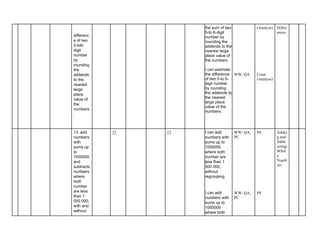
I can estimate
WW
WW; QA
Represent
ation
Conn
Estim
ating
Sums
and
differenc
e of two
5-to6-
digit
number
by
rounding
the
addends
to the
nearest
large
place
value of
the
numbers
.
the sum of two
5-to 6-digit
number by
rounding the
addends to the
nearest large
place value of
the numbers.
I can estimate
the difference
of two 5-to 6-
digit number
by rounding
the addends to
the nearest
large place
value of the
numbers.
WW; QA
(Analyze)
Conn
(Analyze)
Differ
ences
13. add
numbers
with
sums up
to
1000000
and
subtracts
numbers
where
both
number
are less
than 1
000 000,
with and
without
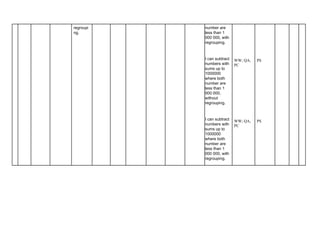
✅ ✅ I can add
numbers with
sums up to
1000000
where both
number are
less than 1
000 000,
without
regrouping.
I can add
numbers with
sums up to
1000000
where both
WW; QA,
PC
WW; QA,
PC
PS
PS
Addin
g and
Subtr
acting
Whol
e
Numb
ers
regroupi
ng.
number are
less than 1
000 000, with
regrouping.
I can subtract
numbers with
sums up to
1000000
where both
number are
less than 1
000 000,
without
regrouping.
I can subtract
numbers with
sums up to
1000000
where both
number are
less than 1
000 000, with
regrouping.
WW; QA,
PC
WW; QA,
PC
PS
PS
Quarter 2
Qua
rter
Content
Domain
Content
Standards
Performance
Standards
Learning
Competencies
Mapping of LCs with Assessment and Topics by Quarter and Week
Unpacking the Learning Competencies (LCs)
Asses
smen
t
Enabling
General
Teaching
Strategy
Topic
Scheduling of
Topics by
Week and Day
Evaluation of
the LC
Classifying the LC
Evaluated
(Unpacked)
LCs
Learning
Targets
Need to
Unpack
No Need
to
Unpack
Acquisition
of
Knowledge
(Knowing)
Meaning
Making
(Understandin
g)
Transfer of
Learning
(Doing) Wk Day
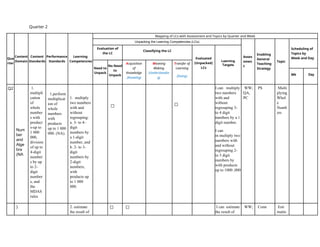
Q2
Num
ber
and
Alge
bra
(NA
1.
multipli
cation
of
whole
number
s with
product
s-up to
1 000
000,
division
of up to
4-digit
number
s by up
to 2-
digit
number
s, and
the
MDAS
rules
1.perform
multiplicat
ion of
whole
numbers
with
products
up to 1 000
000. (NA).
1. multiply
two numbers
with and
without
regrouping:
a. 3- to 4-
digit
numbers by
a 1-digit
number, and
b. 2- to 3-
digit
numbers by
2-digit
numbers,
with
products up
to 1 000
000.
✅ ✅
I can multiply
two numbers
with and
without
regrouping 3-
to 4 digit
numbers by a 1
digit number.
I can
m multiply two
numbers with
and without
regrouping 2-
to 3 digit
numbers by
with products
up to 1000 ,000
WW;
QA,
PC
PS Multi
plying
Whol
e
Numb
ers
) 2. estimate
the result of
✅ ✅ I can estimate
the result of
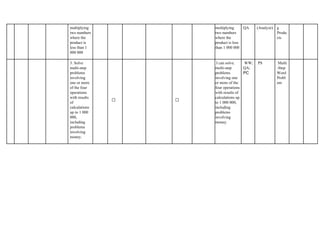
WW; Conn Esti
matin
multiplying
two numbers
where the
product is
less than 1
000 000
multiplying
two numbers
where the
product is less
than 1 000 000
QA (Analyze) g
Produ
cts
3. Solve
multi-step
problems
involving
one or more
of the four
operations
with results
of
calculations
up to 1 000
000,
including
problems
involving
money.
✅ ✅
I can solve.
multi-step
problems
involving one
or more of the
four operations
with results of
calculations up
to 1 000 000,
including
problems
involving
money.
WW;
QA;
PC
PS Multi
-Step
Word
Probl
em
Mea
sure
ment
and
Geo
metr
y
(MG
2.conve
rsion of
units of
length,
mass,
capacity
, and
time
2. perform
division of
up to 4-
digit
numbers
by up to 2-
digit
numbers.
(NA)
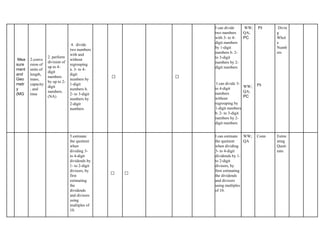
4. divide
two numbers
with and
without
regrouping
a. 3- to 4-
digit
numbers by
1-digit
numbers b.
2- to 3-digit
numbers by
2-digit
numbers
✅ ✅
I can divide
two numbers
with 3- to 4-
digit numbers
by 1-digit
numbers b. 2-
to 3-digit
numbers by 2-
digit numbers
I can divide 3-
to 4-digit
numbers
without
regrouping by
1-digit numbers
b. 2- to 3-digit
numbers by 2-
digit numbers
WW;
QA;
PC
WW;
QA;
PC
PS
PS
Divin
g
Whol
e
Numb
ers
5.estimate
the quotient
when
dividing 3-
to 4-digit
dividends by
1- to 2-digit
divisors, by
first
estimating
the
dividends
and divisors
using
multiples of
10.
✅ ✅
I can estimate
the quotient
when dividing
3- to 4-digit
dividends by 1-
to 2-digit
divisors, by
first estimating
the dividends
and divisors
using multiples
of 10.
WW;
QA
Conn Estim
ating
Quoti
ents
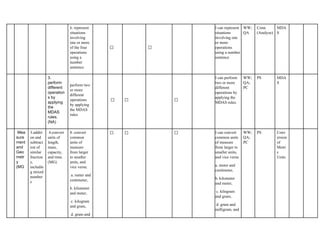
6. represent
situations
involving
one or more
of the four
operations
using a
number
sentence
✅ ✅
I can represent
situations
involving one
or more
operations
using a number
sentence
WW;
QA
Conn
(Analyze)
MDA
S
3.
perform
different
operation
s by
applying
the
MDAS
rules.
(NA)
perform two
or more
different
operations
by applying
the MDAS
rules
✅ ✅ ✅
I can perform
two or more
different
operations by
applying the
MDAS rules.
WW;
QA;
PC
PS MDA
S
Mea
sure
ment
and
Geo
metr
y
(MG
3.additi
on and
subtract
ion of
similar
fraction
s,
includin
g mixed
number
s
4.convert
units of
length,
mass,
capacity,
and time.
(MG)
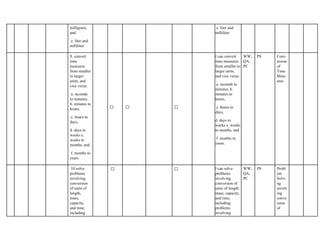
8. convert
common
units of
measure
from larger
to smaller
units, and
vice versa:
a. meter and
centimeter,
b. kilometer
and meter,
c. kilogram
and gram,
d. gram and
✅ ✅ ✅ I can convert
common units
of measure
from larger to
smaller units,
and vice versa:
a. meter and
centimeter,
b. kilometer
and meter,
c. kilogram
and gram,
d. gram and
milligram, and
WW;
QA;
PC
PS Conv
ersion
of
Metri
c
Units
milligram,
and
e. liter and
milliliter
e. liter and
milliliter
9. convert
time
measures
from smaller
to larger
units, and
vice versa:
a. seconds
to minutes,
b. minutes to
hours,
c. hours to
days,
d. days to
weeks e.
weeks to
months, and
f. months to
years.
✅ ✅ ✅
I can convert
time measures
from smaller to
larger units,
and vice versa:
a. seconds to
minutes, b.
minutes to
hours,
c. hours to
days,
d. days to
weeks e. weeks
to months, and
f. months to
years.
WW;
QA;
PC
PS Conv
ersion
of
Time
Meas
ures
10.solve
problems
involving
conversion
of units of
length,
mass,
capacity,
and time,
including
✅ ✅ I can solve
problems
involving
conversion of
units of length,
mass, capacity,
and time,
including
problems
involving
WW;
QA;
PC
PS Probl
em
Solvi
ng
involv
ing
conve
rsion
of
problems
involving
elapsed time
in hours and
minutes.
elapsed time in
hours and
minutes.
units
Num
ber
and
Alge
bra
(NA)
5. perform
addition
and
subtraction
of similar
fractions,
including
mixed
numbers.
(NA)
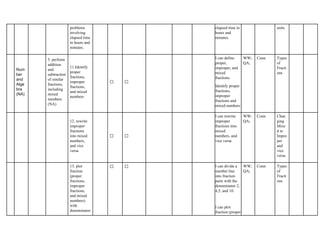
11.Identify
proper
fractions,
improper
fractions,
and mixed
numbers
✅ ✅
I can define
proper,
improper, and
mixed
fractions.
Identify proper
fractions,
improper
fractions and
mixed numbers
WW;
QA;
Conn Types
of
Fracti
ons
12. rewrite
improper
fractions
into mixed
numbers,
and vice
versa
✅ ✅
I can rewrite
improper
fractions into
mixed
numbers, and
vice versa
WW;
QA;
Conn Chan
ging
Mixe
d to
Impro
per
and
vice
versa
13. plot
fraction
(proper
fractions,
improper
fractions,
and mixed
numbers)
with
denominator
✅ ✅ I can divide a
number line
into fraction
parts with the
denominator 2,
4,5, and 10.
I can plot
fraction (proper
WW;
QA;
Conn Types
of
Fracti
ons
s 2, 4, 5, and
10 on the
number line
fractions,
improper
fractions, and
mixed
numbers) with
denominators
2, 4, 5, and 10
on the number
line
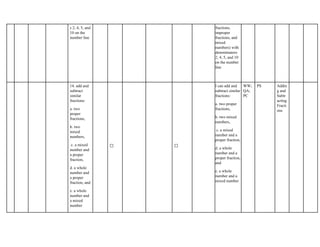
14. add and
subtract
similar
fractions:
a. two
proper
fractions,
b. two
mixed
numbers,
c. a mixed
number and
a proper
fraction,
d. a whole
number and
a proper
fraction, and
e. a whole
number and
a mixed
number
✅ ✅
I can add and
subtract similar
fractions:
a. two proper
fractions,
b. two mixed
numbers,
c. a mixed
number and a
proper fraction,
d. a whole
number and a
proper fraction,
and
e. a whole
number and a
mixed number
WW;
QA;
PC
PS Addin
g and
Subtr
acting
Fracti
ons
Quarter 3
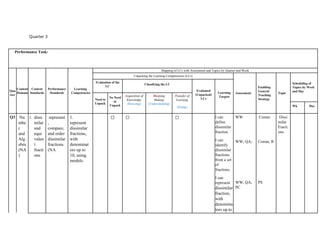
Performance Task:
Qua
rter
Content
Domain
Content
Standards
Performance
Standards
Learning
Competencies
Mapping of LCs with Assessment and Topics by Quarter and Week
Unpacking the Learning Competencies (LCs)
Assessment
Enabling
General
Teaching
Strategy
Topic
Scheduling of
Topics by Week
and Day
Evaluation of the
LC
Classifying the LC
Evaluated
(Unpacked)
LCs
Learning
Targets
Need to
Unpack
No Need
to
Unpack
Acquisition of
Knowledge
(Knowing)
Meaning
Making
(Understanding)
Transfer of
Learning
(Doing) Wk Day
Q3 Nu
mbe
r
and
Alg
ebra
(NA
)
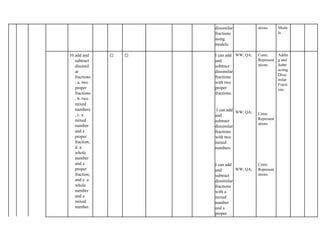
1. dissi
milar
and
equi
valen
t
fracti
ons
represent
,
compare,
and order
dissimilar
fractions.
(NA
1.
represent
dissimilar
fractions,
with
denominat
ors up to
10, using
models.
✅ ✅ ✅ I can
define
dissimilar
fraction
I can
identify
dissimilar
fractions
from a set
of
fractions.
I can
represent
dissimilar
fraction,
with
denomina
tors up to
WW
WW; QA;
WW; QA;
PC
Comm
Comm, R
PS
Dissi
milar
Fracti
ons
10, using
models
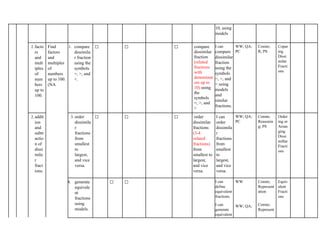
2. facto
rs
and
mult
iples
of
num
bers
up to
100.
Find
factors
and
multiples
of
numbers
up to 100.
(NA
1. compare
dissimila
r fraction
using the
symbols
=, >, and
<.
✅ ✅ ✅ compare
dissimilar
fraction
(related
fractions
with
denominat
ors up to
10) using
the
symbols
=, >, and
<
I can
compare
dissimilar
fraction
using the
symbols
=, >, and
< using
models
and
similar
fractions.
WW; QA;
PC
Comm;
R; PS
Copar
ing
Dissi
milar
Fracti
ons
2. addit
ion
and
subtr
actio
n of
dissi
mila
r
fract
ions.
3. order
dissimila
r
fractions
from
smallest
to
largest,
and vice
versa.
✅ ✅ ✅ order
dissimilar
fractions
(3-4
related
fractions)
from
smallest to
largest,
and vice
versa.
I can
order
dissimila
r
fractions
from
smallest
to
largest,
and vice
versa.
WW; QA;
PC
Comm;
Reasonin
g; PS
Order
ing or
Arran
ging
Dissi
millar
Fracti
ons
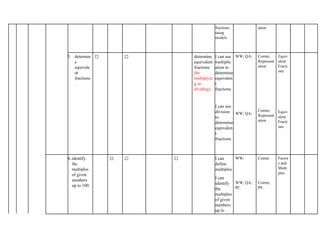
4. generate
equivale
nt
fractions
using
models.
✅ ✅ I can
define
equivalent
fractions.
I can
generate
equivalent
WW
WW; QA;
Comm;
Represent
ation
Comm;
Represent
Equiv
alent
Fracti
ons
fractions
using
models
ation
5. determin
e
equivale
nt
fractions
.
✅ ✅ determine
equivalent
fractions
(by
multiplyin
g or
dividing).
I can use
multiplic
ation to
determine
equivalen
t
fractions.
I can use
division
to
determine
equivalen
t
fractions.
WW; QA;
WW; QA;
Comm;
Represent
ation
Comm;
Represent
ation
Equiv
alent
Fracti
ons
Equiv
alent
Fracti
ons
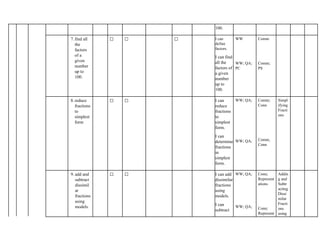
6.identify
the
multiples
of given
numbers
up to 100.
✅ ✅ ✅ I can
define
multiples.
I can
identify
the
multiples
of given
numbers
up to
WW;
WW; QA;
PC
Comm
Comm;
PS
Factor
s and
Multi
ples
100.
7.find all
the
factors
of a
given
number
up to
100.
✅ ✅ ✅ I can
define
factors.
I can find
all the
factors of
a given
number
up to
100.
WW
WW; QA;
PC
Comm
Comm;
PS
8.reduce
fractions
to
simplest
form
✅ ✅ I can
reduce
fractions
to
simplest
form.
I can
determine
fractions
in
simplest
form.
WW; QA;
WW; QA;
Comm;
Conn
Comm,
Conn
Simpl
ifying
Fracti
ons
9. add and
subtract
dissimil
ar
fractions
using
models.
✅ ✅ I can add
dissimilar
fractions
using
models.
I can
subtract
WW; QA;
WW; QA;
Conn;
Represent
ations
Conn;
Represent
Addin
g and
Subtr
acting
Dissi
milar
Fracti
ons
using
dissimilar
fractions
using
models.
ations Mode
ls
10.add and
subtract
dissimil
ar
fractions
: a. two
proper
fractions
, b. two
mixed
numbers
, c. a
mixed
number
and a
proper
fraction,
d. a
whole
number
and a
proper
fraction,
and e. a
whole
number
and a
mixed
number.
✅ ✅ I can add
and
subtract
dissimilar
fractions
with two
proper
fractions.
I can add
and
subtract
dissimilar
fractions
with two
mixed
numbers
I can add
and
subtract
dissimilar
fractions
with a
mixed
number
and a
proper
WW; QA;
WW; QA;
WW; QA;
Conn;
Represent
ations
Conn;
Represent
ations
Conn;
Represent
ations
Addin
g and
Subtr
acting
Dissi
milar
Fracti
ons
fraction
I can add
and
subtract
dissimilar
fractions
with a
whole
number
and a
proper
fraction
I can add
and
subtract
dissimilar
fractions
with a
whole
number
and a
mixed
number
WW; QA;
WW; QA;
Conn;
Represent
ations
Conn;
Represent
ations
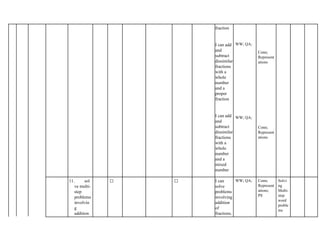
11. sol
ve multi-
step
problems
involvin
g
addition
✅ ✅ I can
solve
problems
involving
addition
of
fractions.
WW; QA; Conn;
Represent
ations;
PS
Solvi
ng
Multi-
step
word
proble
ms
and/or
subtracti
on of
fractions
I can
solve
problems
involving
subtractio
n of
fractions.
I can
solve
multi-
step
problems
involving
addition
and/or
subtractio
n of
fractions
WW; QA;
WW; QA;
Conn;
Represent
ations;
PS
Conn;
Represent
ations;
PS
involv
ing
additi
on or
subtra
ction
Mea
sure
men
t
and
Geo
met
ry
(M
G
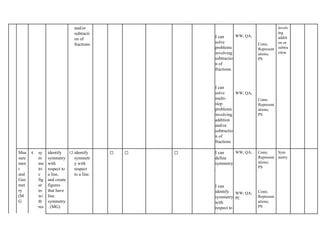
4. sy
m
me
tri
c
fig
ur
es
wi
th
res
identify
symmetry
with
respect to
a line,
and create
figures
that have
line
symmetry
. (MG)
12.identify
symmetr
y with
respect
to a line.
✅ ✅ ✅ I can
define
symmetry
.
I can
identify
symmetry
with
respect to
WW; QA;
WW; QA;
PC
Conn;
Represent
ations;
PS
Conn;
Represent
ations;
PS
Sym
metry
pe
ct
to
a
lin
e
5. resu
lting
ima
ges
after
appl
ying
refle
ctio
n
with
resp
ect
to a
line.
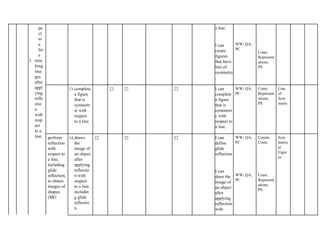
a line.
I can
create
figures
that have
line of
symmetry
.
WW; QA;
PC
Conn;
Represent
ations;
PS
13.complete
a figure
that is
symmetr
ic with
respect
to a line.
✅ ✅ ✅ I can
complete
a figure
that is
symmetri
c with
respect to
a line.
WW; QA;
PC
Conn;
Represent
ations;
PS
Line
of
Sym
metry
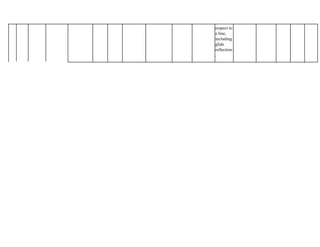
perform
reflection
with
respect to
a line,
including
glide
reflection,
to obtain
images of
shapes.
(MG
14.draws
the
image of
an object
after
applying
reflectio
n with
respect
to a line,
includin
g glide
reflectio
n.
✅ ✅ ✅ I can
define
glide
reflection
I can
draw the
image of
an object
after
applying
reflection
with
WW; QA;
PC
WW; QA;
PC
Comm;
Conn;
Conn;
Represent
ations;
PS
Sym
metric
al
Figur
es
respect to
a line,
including
glide
reflection
.
Quarter 4
Quarter
Content
Domain
Content
Standards
Performance
Standards
Learning
Competencies
Mapping of LCs with Assessment and Topics by Quarter and Week
Unpacking the Learning Competencies (LCs) Assess
ment
Enabli
ng
Gener
al
Teachi
ng
Strateg
y
Topic Schedul
ing of
Topics
by
Week
and
Day
Evaluation
of the LC
Classifying the LC Evaluate
d
(Unpacke
d) LCs
Learning
Targets
Need
to
Unpac
k
No
Need
to
Unpac
k
A
cquisiti
on of
Knowle
dge
(Knowi
ng)
M
eaning
Making
(Underst
anding)
T
ransfe
r of
Learn
ing
(Doin
g)
W
k
Da
y
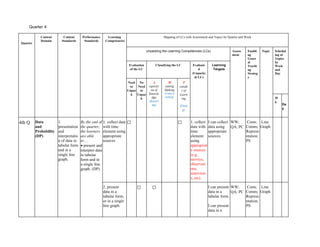
4th Q Data
and
Probability
(DP)
1.
presentation
and
interpretatio
n of data in
tabular form
and in a
single line
graph.
By the end of
the quarter,
the learners
are able
to ...
• present and
interpret data
in tabular
form and in
a single line
graph. (DP)
1. collect data
with time
element using
appropriate
sources
✅ ✅ 1. collect
data with
time
element
using
appropriat
e sources
(e.g.
surveys,
observati
ons,
interview
s, etc).
I can collect
data using
appropriate
sources.
WW;
QA; PC
Conn;
Comm;
Represe
ntation;
PS
Line
Graph
2. present
data in a
tabular form,
or in a single
line graph.
✅ ✅ I can present
data in a
tabular form.
I can present
data in a
WW;
QA; PC
Conn;
Comm;
Represe
ntation;
PS
Line
Graph
single line
graph.
3. interpret
data
presented in a
tabular form,
or in a single
line graph.
✅ ✅ I can
interpret data
presented in
a tabular
form.
I can
interpret data
in a single
line graph.
WW;
QA; PC
WW;
QA; PC
Conn;
Comm;
Represe
ntation;
PS
Conn;
Comm;
Represe
ntation;
PS
Line
Graph
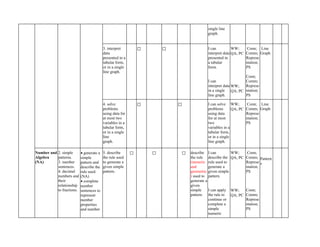
4. solve
problems
using data for
at most two
variables in a
tabular form,
or in a single
line
graph.
✅ ✅ I can solve
problems
using data
for at most
two
variables in a
tabular form,
or in a single
line graph.
WW;
QA; PC
Conn;
Comm;
Represe
ntation;
PS
Line
Graph
Number and
Algebra
(NA)
2. simple
patterns.
3. number
sentences.
4. decimal
numbers and
their
relationship
to fractions.
• generate a
simple
pattern and
describe the
rule used.
(NA)
• complete
number
sentences to
represent
number
properties
and number
5. describe
the rule used
to generate a
given simple
pattern.
✅ ✅ ✅ describe
the rule
(numeric
and
geometric
) used to
generate a
given
simple
pattern.
I can
describe the
rule used to
generate a
given simple
pattern.
I can apply
the rule to
continue or
complete a
simple
numeric
WW;
QA; PC
WW;
QA; PC
Conn;
Comm;
Represe
ntation;
PS
Conn;
Comm;
Represe
ntation;
PS
Pattern
s
facts. (NA)
• represent,
compare,
order, and
round
decimal
numbers.
(NA)
• convert
decimal
numbers to
fractions and
fractions
(with
denominator
s 10 or 100)
to decimals.
(NA)
pattern.
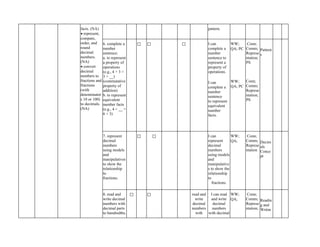
6. complete a
number
sentence:
a. to represent
a property of
operations
(e.g., 4 + 3 =
3 + __)
(commutative
property of
addition)
b. to represent
equivalent
number facts
(e.g., 4 + __ =
6 + 3)
✅ ✅ ✅ I can
complete a
number
sentence to
represent a
property of
operations.
I can
complete a
number
sentence
to represent
equivalent
number
facts.
WW;
QA; PC
WW;
QA; PC
Conn;
Comm;
Represe
ntation;
PS
Conn;
Comm;
Represe
ntation;
PS
Pattern
s
7. represent
decimal
numbers
using models
and
manipulatives
to show the
relationship
to
fractions.
✅ ✅ I can
represent
decimal
numbers
using models
and
manipulative
s to show the
relationship
to
fractions.
WW;
QA;
Conn;
Comm;
Represe
ntation
Decim
als
Conce
pt
8. read and
write decimal
numbers with
decimal parts
to hundredths.
✅ ✅ read and
write
decimal
numbers
with
I can read
and write
decimal
numbers
with decimal
WW;
QA;
Conn;
Comm;
Represe
ntation;
Readin
g and
Writin
decimal
parts to
hundredth
s in
numerals
and in
words
parts to
hundredths
in numerals
and in
words.
g
Decim
als
9. determine
a. the place
value to
hundredths of
a digit in a
given decimal
number,
b. the value of
a digit, and
c. the digit of
number,
given its
place value.
✅ ✅ I can
determine
the place
value to
hundredths
of a digit in a
given
decimal
number.
I can
determine
the value of
a digit.
I can
determine
the digit,
given its
place value.
WW;
QA;
WW;
QA;
WW;
QA;
Conn;
Comm;
Represe
ntation;
Conn;
Comm;
Represe
ntation;
Conn;
Comm;
Represe
ntation;
PS
Decim
als
Place
Value
and
Value
10. convert
decimal
numbers to
fractions, and
fractions with
denominators
10 or 100 to
decimals.
✅ ✅ ✅ I can convert
decimal
numbers to
fractions,
and fractions
with
denominator
s 10 or 100
WW;
QA; PC
Conn;
Comm;
Represe
ntation;
PS
Conver
ting
Decim
als to
Fractio
ns
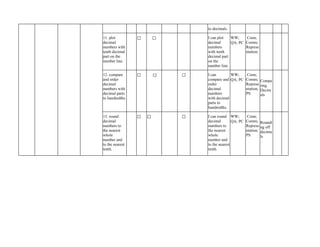
to decimals.
11. plot
decimal
numbers with
tenth decimal
part on the
number line.
✅ ✅ I can plot
decimal
numbers
with tenth
decimal part
on the
number line.
WW;
QA; PC
Conn;
Comm;
Represe
ntation;
12. compare
and order
decimal
numbers with
decimal parts
to hundredths.
✅ ✅ ✅ I can
compare and
order
decimal
numbers
with decimal
parts to
hundredths.
WW;
QA; PC
Conn;
Comm;
Represe
ntation;
PS
Compa
ring
Decim
als
13. round
decimal
numbers to
the nearest
whole
number and
to the nearest
tenth.
✅ ✅ ✅ I can round
decimal
numbers to
the nearest
whole
number and
to the nearest
tenth.
WW;
QA; PC
Conn;
Comm;
Represe
ntation;
PS
Roundi
ng off
decima
ls

DONE - MATH (Cluster 4-6) Instructional Plan.docx

  • 1.
    Subject Name: Mathematics GradeLevel: Grade 4 Curriculum Goal: The main goal of the curriculum is for Filipino learners to become mathematically proficient and critical problem solvers. In mathematics education, problem solving has been considered as a goal, as a process, and as a basic skill. The processes involved in solving mathematical problems, from recognizing and understanding a problem to modelling the problem through different representations, to planning a solution, to executing the solution, and to finally checking whether the problem has been solved, demonstrate that problem solving is a very important life skill for 21st-century citizens to possess. Key Stage Standards: Key Stage 2 Key Stage 2 (KS 2) of the Mathematics curriculum focuses on Grades 4 to 6 learners. At this stage, the curriculum extends numbers, algebra, measures, geometry, data, and probability. The coverage includes more complex properties, operations, and problems in different contexts that demand efficient written and mental methods of calculation. The learning standards of the KS 2 Mathematics curriculum aim to ensure that learners: use efficient mental and written mathematical concepts, operations, procedures, relationships, and tools to solve routine and non-routine ● real-world problems; reason and communicate using precise mathematical language to discuss ideas, investigate problems, and justify solutions; ● exhibit willingness and confidence to explore alternative solutions, and to take risks necessary to solve real-world problems; ● acquire problem-solving and critical thinking skills through real, situated, or purely mathematical problems; and ● enhance appreciation, curiosity, interest, creativity, and other desir ● able values, attitudes and dispositions in mathematics. At the end of Grade 6, the learner demonstrates knowledge, skills, and understanding in relation to the curriculum content domain Number and Algebra (the four operations with decimals; the four operations with different combinations of fractions, whole numbers, and mixed numbers; ratio and proportion; percentages, and their relationships with fractions and decimals; exponential form, including calculation using
  • 2.
    the GEMDAS rules;greatest common factors, least common multiples); Measurement and Geometry (right, acute, and obtuse; tessellation of shapes; resulting figure after translation, reflection and rotation; units of volume and capacity; volume of cubes and rectangular prisms; properties of triangles and quadrilaterals; perimeter and area of triangles, parallelograms, trapezoids; parts of a circle, including circumference; area of a circle; composite figures composed of any two or more of: triangle, square, rectangle, circle, semi-circle; prisms and pyramids; surface area of solid figures; symmetric figures and designs; 12- and 24-hour time, and world time zones); Data and Probability (presentation and interpretation of data in tabular form and in a single line graph; double bar graphs and double line graphs; theoretical probability; pie graphs). This knowledge, skills and understanding is applied, with the use of technology, to the processes within Mathematics of critical thinking, problem solving, communicating, reasoning, and making connections between topic areas. Grade Level Standards: The learner demonstrates knowledge, skills, and understanding in relation to the curriculum content domains Number and Algebra (whole numbers up to 1 000 000; addition of numbers with sums up to 1 000 000 and subtraction of numbers where both numbers are less than 1 000 000; multiplication of whole numbers with products-up to 1 000 000; division of up to 4-digit numbers by up to 2-digit numbers, and the MDAS rules; addition and subtraction of similar fractions, including mixed numbers; dissimilar and equivalent fractions; factors and multiples of numbers up to 100; addition and subtraction of dissimilar fractions; simple patterns; number sentences; decimal numbers and their relationship to fractions); Measurement and Geometry (right, acute, and obtuse angles; properties of triangles and quadrilaterals; perimeter of quadrilaterals, and composite figures composed of triangles and quadrilaterals; conversion of units of length, mass, capacity, and time; symmetric figures and designs; reflection with shapes); and Data and Probability (presentation and interpretation of data in tabular form and in a single line graph). This knowledge, skills, and understanding is applied, with the use of technology, to the processes within Mathematics of critical thinking, problem solving, communicating, reasoning, and making connections between topic areas. Qu art er Conten t Domai n Content Standards Performanc e Standards Learning Competenc ies Mapping of LCs with Assessment and Topics by Quarter and Week Unpacking the Learning Competencies (LCs) Assessmen t Enabling General Teaching Strategy Topic Schedu ling of Topics by Week and Day Evaluation of the LC Classifying the LC Evaluate d (Unpacke d) LCs Learning Targets Need to Unpack No Need to Unpack Acquisition of Knowledge Meaning Making Transfer of Learning Wk D a
  • 3.
    y Q 1 Mea sure ment and Geo metr y (MG) 1. measur es of angles 2. properti es of triangle sand quadrila terals. 3. perimet er of quadrila terals, and composi te figures compos ed of triangle s and quadrila terals. By the end of the quarter, the learners are able to ... • illustrate and measure different angles (MG) • classify triangles and quadrilat eral, and differenti ate quadrilat erals, by applying their propertie s. (MG) • find the perimeter of quadrilat erals and composit e figures 1. illustrate different angles (right, acute, and obtuse) using models. ✅ ✅ ✅ I can define Acute, Obtuse, and Right Angles. I can differentiate Acute, Obtuse, and Right Angles. I can illustrate Acute, Obtuse, and Right Angles. WW WW WW; QA; PC Comm Conn (analyze ) PS Angle s Angle s Angle s 2. measure and draw angles using a protracto r. ✅ ✅ 2. measure and draw angles (right, acute, and obtuse) using a protracto r. I can demonstrate how to use protractor by using the correct steps. I can measure different angles (acute, obtuse, and right) using protractor. I can draw different angles (acute, WW WW, QA, PC WW, QA, PC Conn (apply) PS PS Mesur ing Angle s Meas uring Angle s Meas uring Angle
  • 4.
    compose d of triangles and quadrilat erals. (MG) • read, write,and compare whole numbers up to 1 000 000. (NA) • performs addition of numbers with sums up to 1 000 000 and subtractio n of numbers where both numbers are less than 1 000 000. (NA) obtuse, and right) using protractor. s 3. draw and state the propertie s of triangles and quadrilat erals. ✅ ✅ I can state properties of triangles and quadrilaterals. I can draw triangles and quadrilaterals using their properties. WW, QA WW, QA, PC Comm PS Trian gles and Quad rilater als 4. classify triangles and quadrilat erals accordin g to sides and angles. ✅ ✅ I can classify triangles according to sides. I can classify triangles according to angles. I can classify triangles according to sides and angles. I can classify quadrilaterals according sides and angles. WW, QA, PC WW, QA, PC WW, QA, PC WW, QA, PC Conn; R; PS Conn; R; PS Conn; R; PS Conn; R; PS Class ifying Trian gles and Quad rilater als
  • 5.
    5. differenti ate different quadrilat erals. ✅ ✅ Ican describe different quadrilaterals like square, rectangles, rhombus, parallelogram, and trapezoid. I can differentiate different quadrilaterals. WW WW, QA Comm; Conn Comm; Conn Quad rilater als 6. find the perimete r of quadrilat erals that are not squares or rectangle s. ✅ ✅ I can define perimeter. I can find the perimeter of squares and rectangles. I can find the perimeter of rhombus, parallelogram and trapezoid. WW WW; QA; PC WW; QA; PC Comm PS PS Peri metr of Quad rilater als 7. find the perimete r of composit e figures compose d of triangles and quadrilat ✅ ✅ I can describe composite figures. I can identify different triangles and quadrilaterals of composite figures. I can find the WW WW WW; QA; Comm Conn Peri meter of Com posit e Figur es
  • 6.
    erals. perimeter of composite figures composedof triangles and quadrilaterals. PC PS Num ber and Alge bra (NA) 4. whole number s up to 1 000 000. 5. addition of number s with sums up to 1 000 000 and subtract ion of number s where both number s are less than 1 000 000. 8. read and write numbers up to 1 000 000 in numerals and in words. ✅ ✅ ✅ I can read and write numbers up to 1 000 000 in numerals and in words given models or number blocks. I can read and write numbers up to 1 000 000 in numerals and in words.. WW; QA WW; QA; PC Represe ntation PS Read ing and Writin g Num bers Read ing and Writin g Num bers 9. determin e a. the place value of a digit in ✅ ✅ I can determine the place value of a digit in a 6- digit number. I can determine the WW, QA WW, QA Represent ation Represent ation Place Value and Value Place Value and
  • 7.
    a 6-digit number, b. the valueof a digit, and c. the digit of number, given its place value. value of a digit in a 6-digit number. I can determine the digit of anumber, given its place value. WW, QA Represent ation Value Place Value and Value 10. compare numbers up to 1 000 000 using =, <, and >. ✅ ✅ compar e(and order) numbers up to 1 000 000 using =, <, and >. I can compare numbers up to 1 000 000 using =, <, and >. I can order numbers up to 1 000 000. WW; QA; PC WW; QA PS Conn (Analyze) Comp aring and Order ing Numb ers 11. round numbers to the nearest hundred thousand . ✅ ✅ I can round numbers to the nearest ten thousand. I can round numbers to the nearest hundred thousand. WW; QA Conn (Analyze) Roun ding Numb ers 12. estimate the sum and ✅ ✅ I can define estimate. I can estimate WW WW; QA Represent ation Conn Estim ating Sums and
  • 8.
    differenc e of two 5-to6- digit number by rounding the addends tothe nearest large place value of the numbers . the sum of two 5-to 6-digit number by rounding the addends to the nearest large place value of the numbers. I can estimate the difference of two 5-to 6- digit number by rounding the addends to the nearest large place value of the numbers. WW; QA (Analyze) Conn (Analyze) Differ ences 13. add numbers with sums up to 1000000 and subtracts numbers where both number are less than 1 000 000, with and without ✅ ✅ I can add numbers with sums up to 1000000 where both number are less than 1 000 000, without regrouping. I can add numbers with sums up to 1000000 where both WW; QA, PC WW; QA, PC PS PS Addin g and Subtr acting Whol e Numb ers
  • 9.
    regroupi ng. number are less than1 000 000, with regrouping. I can subtract numbers with sums up to 1000000 where both number are less than 1 000 000, without regrouping. I can subtract numbers with sums up to 1000000 where both number are less than 1 000 000, with regrouping. WW; QA, PC WW; QA, PC PS PS
  • 10.
    Quarter 2 Qua rter Content Domain Content Standards Performance Standards Learning Competencies Mapping ofLCs with Assessment and Topics by Quarter and Week Unpacking the Learning Competencies (LCs) Asses smen t Enabling General Teaching Strategy Topic Scheduling of Topics by Week and Day Evaluation of the LC Classifying the LC Evaluated (Unpacked) LCs Learning Targets Need to Unpack No Need to Unpack Acquisition of Knowledge (Knowing) Meaning Making (Understandin g) Transfer of Learning (Doing) Wk Day Q2 Num ber and Alge bra (NA 1. multipli cation of whole number s with product s-up to 1 000 000, division of up to 4-digit number s by up to 2- digit number s, and the MDAS rules 1.perform multiplicat ion of whole numbers with products up to 1 000 000. (NA). 1. multiply two numbers with and without regrouping: a. 3- to 4- digit numbers by a 1-digit number, and b. 2- to 3- digit numbers by 2-digit numbers, with products up to 1 000 000. ✅ ✅ I can multiply two numbers with and without regrouping 3- to 4 digit numbers by a 1 digit number. I can m multiply two numbers with and without regrouping 2- to 3 digit numbers by with products up to 1000 ,000 WW; QA, PC PS Multi plying Whol e Numb ers ) 2. estimate the result of ✅ ✅ I can estimate the result of WW; Conn Esti matin
  • 11.
    multiplying two numbers where the productis less than 1 000 000 multiplying two numbers where the product is less than 1 000 000 QA (Analyze) g Produ cts 3. Solve multi-step problems involving one or more of the four operations with results of calculations up to 1 000 000, including problems involving money. ✅ ✅ I can solve. multi-step problems involving one or more of the four operations with results of calculations up to 1 000 000, including problems involving money. WW; QA; PC PS Multi -Step Word Probl em
  • 12.
    Mea sure ment and Geo metr y (MG 2.conve rsion of units of length, mass, capacity ,and time 2. perform division of up to 4- digit numbers by up to 2- digit numbers. (NA) 4. divide two numbers with and without regrouping a. 3- to 4- digit numbers by 1-digit numbers b. 2- to 3-digit numbers by 2-digit numbers ✅ ✅ I can divide two numbers with 3- to 4- digit numbers by 1-digit numbers b. 2- to 3-digit numbers by 2- digit numbers I can divide 3- to 4-digit numbers without regrouping by 1-digit numbers b. 2- to 3-digit numbers by 2- digit numbers WW; QA; PC WW; QA; PC PS PS Divin g Whol e Numb ers 5.estimate the quotient when dividing 3- to 4-digit dividends by 1- to 2-digit divisors, by first estimating the dividends and divisors using multiples of 10. ✅ ✅ I can estimate the quotient when dividing 3- to 4-digit dividends by 1- to 2-digit divisors, by first estimating the dividends and divisors using multiples of 10. WW; QA Conn Estim ating Quoti ents
  • 13.
    6. represent situations involving one ormore of the four operations using a number sentence ✅ ✅ I can represent situations involving one or more operations using a number sentence WW; QA Conn (Analyze) MDA S 3. perform different operation s by applying the MDAS rules. (NA) perform two or more different operations by applying the MDAS rules ✅ ✅ ✅ I can perform two or more different operations by applying the MDAS rules. WW; QA; PC PS MDA S Mea sure ment and Geo metr y (MG 3.additi on and subtract ion of similar fraction s, includin g mixed number s 4.convert units of length, mass, capacity, and time. (MG) 8. convert common units of measure from larger to smaller units, and vice versa: a. meter and centimeter, b. kilometer and meter, c. kilogram and gram, d. gram and ✅ ✅ ✅ I can convert common units of measure from larger to smaller units, and vice versa: a. meter and centimeter, b. kilometer and meter, c. kilogram and gram, d. gram and milligram, and WW; QA; PC PS Conv ersion of Metri c Units
  • 14.
    milligram, and e. liter and milliliter e.liter and milliliter 9. convert time measures from smaller to larger units, and vice versa: a. seconds to minutes, b. minutes to hours, c. hours to days, d. days to weeks e. weeks to months, and f. months to years. ✅ ✅ ✅ I can convert time measures from smaller to larger units, and vice versa: a. seconds to minutes, b. minutes to hours, c. hours to days, d. days to weeks e. weeks to months, and f. months to years. WW; QA; PC PS Conv ersion of Time Meas ures 10.solve problems involving conversion of units of length, mass, capacity, and time, including ✅ ✅ I can solve problems involving conversion of units of length, mass, capacity, and time, including problems involving WW; QA; PC PS Probl em Solvi ng involv ing conve rsion of
  • 15.
    problems involving elapsed time in hoursand minutes. elapsed time in hours and minutes. units Num ber and Alge bra (NA) 5. perform addition and subtraction of similar fractions, including mixed numbers. (NA) 11.Identify proper fractions, improper fractions, and mixed numbers ✅ ✅ I can define proper, improper, and mixed fractions. Identify proper fractions, improper fractions and mixed numbers WW; QA; Conn Types of Fracti ons 12. rewrite improper fractions into mixed numbers, and vice versa ✅ ✅ I can rewrite improper fractions into mixed numbers, and vice versa WW; QA; Conn Chan ging Mixe d to Impro per and vice versa 13. plot fraction (proper fractions, improper fractions, and mixed numbers) with denominator ✅ ✅ I can divide a number line into fraction parts with the denominator 2, 4,5, and 10. I can plot fraction (proper WW; QA; Conn Types of Fracti ons
  • 16.
    s 2, 4,5, and 10 on the number line fractions, improper fractions, and mixed numbers) with denominators 2, 4, 5, and 10 on the number line 14. add and subtract similar fractions: a. two proper fractions, b. two mixed numbers, c. a mixed number and a proper fraction, d. a whole number and a proper fraction, and e. a whole number and a mixed number ✅ ✅ I can add and subtract similar fractions: a. two proper fractions, b. two mixed numbers, c. a mixed number and a proper fraction, d. a whole number and a proper fraction, and e. a whole number and a mixed number WW; QA; PC PS Addin g and Subtr acting Fracti ons
  • 18.
    Quarter 3 Performance Task: Qua rter Content Domain Content Standards Performance Standards Learning Competencies Mappingof LCs with Assessment and Topics by Quarter and Week Unpacking the Learning Competencies (LCs) Assessment Enabling General Teaching Strategy Topic Scheduling of Topics by Week and Day Evaluation of the LC Classifying the LC Evaluated (Unpacked) LCs Learning Targets Need to Unpack No Need to Unpack Acquisition of Knowledge (Knowing) Meaning Making (Understanding) Transfer of Learning (Doing) Wk Day Q3 Nu mbe r and Alg ebra (NA ) 1. dissi milar and equi valen t fracti ons represent , compare, and order dissimilar fractions. (NA 1. represent dissimilar fractions, with denominat ors up to 10, using models. ✅ ✅ ✅ I can define dissimilar fraction I can identify dissimilar fractions from a set of fractions. I can represent dissimilar fraction, with denomina tors up to WW WW; QA; WW; QA; PC Comm Comm, R PS Dissi milar Fracti ons
  • 19.
    10, using models 2. facto rs and mult iples of num bers upto 100. Find factors and multiples of numbers up to 100. (NA 1. compare dissimila r fraction using the symbols =, >, and <. ✅ ✅ ✅ compare dissimilar fraction (related fractions with denominat ors up to 10) using the symbols =, >, and < I can compare dissimilar fraction using the symbols =, >, and < using models and similar fractions. WW; QA; PC Comm; R; PS Copar ing Dissi milar Fracti ons 2. addit ion and subtr actio n of dissi mila r fract ions. 3. order dissimila r fractions from smallest to largest, and vice versa. ✅ ✅ ✅ order dissimilar fractions (3-4 related fractions) from smallest to largest, and vice versa. I can order dissimila r fractions from smallest to largest, and vice versa. WW; QA; PC Comm; Reasonin g; PS Order ing or Arran ging Dissi millar Fracti ons 4. generate equivale nt fractions using models. ✅ ✅ I can define equivalent fractions. I can generate equivalent WW WW; QA; Comm; Represent ation Comm; Represent Equiv alent Fracti ons
  • 20.
    fractions using models ation 5. determin e equivale nt fractions . ✅ ✅determine equivalent fractions (by multiplyin g or dividing). I can use multiplic ation to determine equivalen t fractions. I can use division to determine equivalen t fractions. WW; QA; WW; QA; Comm; Represent ation Comm; Represent ation Equiv alent Fracti ons Equiv alent Fracti ons 6.identify the multiples of given numbers up to 100. ✅ ✅ ✅ I can define multiples. I can identify the multiples of given numbers up to WW; WW; QA; PC Comm Comm; PS Factor s and Multi ples
  • 21.
    100. 7.find all the factors of a given number upto 100. ✅ ✅ ✅ I can define factors. I can find all the factors of a given number up to 100. WW WW; QA; PC Comm Comm; PS 8.reduce fractions to simplest form ✅ ✅ I can reduce fractions to simplest form. I can determine fractions in simplest form. WW; QA; WW; QA; Comm; Conn Comm, Conn Simpl ifying Fracti ons 9. add and subtract dissimil ar fractions using models. ✅ ✅ I can add dissimilar fractions using models. I can subtract WW; QA; WW; QA; Conn; Represent ations Conn; Represent Addin g and Subtr acting Dissi milar Fracti ons using
  • 22.
    dissimilar fractions using models. ations Mode ls 10.add and subtract dissimil ar fractions :a. two proper fractions , b. two mixed numbers , c. a mixed number and a proper fraction, d. a whole number and a proper fraction, and e. a whole number and a mixed number. ✅ ✅ I can add and subtract dissimilar fractions with two proper fractions. I can add and subtract dissimilar fractions with two mixed numbers I can add and subtract dissimilar fractions with a mixed number and a proper WW; QA; WW; QA; WW; QA; Conn; Represent ations Conn; Represent ations Conn; Represent ations Addin g and Subtr acting Dissi milar Fracti ons
  • 23.
    fraction I can add and subtract dissimilar fractions witha whole number and a proper fraction I can add and subtract dissimilar fractions with a whole number and a mixed number WW; QA; WW; QA; Conn; Represent ations Conn; Represent ations 11. sol ve multi- step problems involvin g addition ✅ ✅ I can solve problems involving addition of fractions. WW; QA; Conn; Represent ations; PS Solvi ng Multi- step word proble ms
  • 24.
    and/or subtracti on of fractions I can solve problems involving subtractio nof fractions. I can solve multi- step problems involving addition and/or subtractio n of fractions WW; QA; WW; QA; Conn; Represent ations; PS Conn; Represent ations; PS involv ing additi on or subtra ction Mea sure men t and Geo met ry (M G 4. sy m me tri c fig ur es wi th res identify symmetry with respect to a line, and create figures that have line symmetry . (MG) 12.identify symmetr y with respect to a line. ✅ ✅ ✅ I can define symmetry . I can identify symmetry with respect to WW; QA; WW; QA; PC Conn; Represent ations; PS Conn; Represent ations; PS Sym metry
  • 25.
    pe ct to a lin e 5. resu lting ima ges after appl ying refle ctio n with resp ect to a line. aline. I can create figures that have line of symmetry . WW; QA; PC Conn; Represent ations; PS 13.complete a figure that is symmetr ic with respect to a line. ✅ ✅ ✅ I can complete a figure that is symmetri c with respect to a line. WW; QA; PC Conn; Represent ations; PS Line of Sym metry perform reflection with respect to a line, including glide reflection, to obtain images of shapes. (MG 14.draws the image of an object after applying reflectio n with respect to a line, includin g glide reflectio n. ✅ ✅ ✅ I can define glide reflection I can draw the image of an object after applying reflection with WW; QA; PC WW; QA; PC Comm; Conn; Conn; Represent ations; PS Sym metric al Figur es
  • 26.
  • 27.
    Quarter 4 Quarter Content Domain Content Standards Performance Standards Learning Competencies Mapping ofLCs with Assessment and Topics by Quarter and Week Unpacking the Learning Competencies (LCs) Assess ment Enabli ng Gener al Teachi ng Strateg y Topic Schedul ing of Topics by Week and Day Evaluation of the LC Classifying the LC Evaluate d (Unpacke d) LCs Learning Targets Need to Unpac k No Need to Unpac k A cquisiti on of Knowle dge (Knowi ng) M eaning Making (Underst anding) T ransfe r of Learn ing (Doin g) W k Da y 4th Q Data and Probability (DP) 1. presentation and interpretatio n of data in tabular form and in a single line graph. By the end of the quarter, the learners are able to ... • present and interpret data in tabular form and in a single line graph. (DP) 1. collect data with time element using appropriate sources ✅ ✅ 1. collect data with time element using appropriat e sources (e.g. surveys, observati ons, interview s, etc). I can collect data using appropriate sources. WW; QA; PC Conn; Comm; Represe ntation; PS Line Graph 2. present data in a tabular form, or in a single line graph. ✅ ✅ I can present data in a tabular form. I can present data in a WW; QA; PC Conn; Comm; Represe ntation; PS Line Graph
  • 28.
    single line graph. 3. interpret data presentedin a tabular form, or in a single line graph. ✅ ✅ I can interpret data presented in a tabular form. I can interpret data in a single line graph. WW; QA; PC WW; QA; PC Conn; Comm; Represe ntation; PS Conn; Comm; Represe ntation; PS Line Graph 4. solve problems using data for at most two variables in a tabular form, or in a single line graph. ✅ ✅ I can solve problems using data for at most two variables in a tabular form, or in a single line graph. WW; QA; PC Conn; Comm; Represe ntation; PS Line Graph Number and Algebra (NA) 2. simple patterns. 3. number sentences. 4. decimal numbers and their relationship to fractions. • generate a simple pattern and describe the rule used. (NA) • complete number sentences to represent number properties and number 5. describe the rule used to generate a given simple pattern. ✅ ✅ ✅ describe the rule (numeric and geometric ) used to generate a given simple pattern. I can describe the rule used to generate a given simple pattern. I can apply the rule to continue or complete a simple numeric WW; QA; PC WW; QA; PC Conn; Comm; Represe ntation; PS Conn; Comm; Represe ntation; PS Pattern s
  • 29.
    facts. (NA) • represent, compare, order,and round decimal numbers. (NA) • convert decimal numbers to fractions and fractions (with denominator s 10 or 100) to decimals. (NA) pattern. 6. complete a number sentence: a. to represent a property of operations (e.g., 4 + 3 = 3 + __) (commutative property of addition) b. to represent equivalent number facts (e.g., 4 + __ = 6 + 3) ✅ ✅ ✅ I can complete a number sentence to represent a property of operations. I can complete a number sentence to represent equivalent number facts. WW; QA; PC WW; QA; PC Conn; Comm; Represe ntation; PS Conn; Comm; Represe ntation; PS Pattern s 7. represent decimal numbers using models and manipulatives to show the relationship to fractions. ✅ ✅ I can represent decimal numbers using models and manipulative s to show the relationship to fractions. WW; QA; Conn; Comm; Represe ntation Decim als Conce pt 8. read and write decimal numbers with decimal parts to hundredths. ✅ ✅ read and write decimal numbers with I can read and write decimal numbers with decimal WW; QA; Conn; Comm; Represe ntation; Readin g and Writin
  • 30.
    decimal parts to hundredth s in numerals andin words parts to hundredths in numerals and in words. g Decim als 9. determine a. the place value to hundredths of a digit in a given decimal number, b. the value of a digit, and c. the digit of number, given its place value. ✅ ✅ I can determine the place value to hundredths of a digit in a given decimal number. I can determine the value of a digit. I can determine the digit, given its place value. WW; QA; WW; QA; WW; QA; Conn; Comm; Represe ntation; Conn; Comm; Represe ntation; Conn; Comm; Represe ntation; PS Decim als Place Value and Value 10. convert decimal numbers to fractions, and fractions with denominators 10 or 100 to decimals. ✅ ✅ ✅ I can convert decimal numbers to fractions, and fractions with denominator s 10 or 100 WW; QA; PC Conn; Comm; Represe ntation; PS Conver ting Decim als to Fractio ns
  • 31.
    to decimals. 11. plot decimal numberswith tenth decimal part on the number line. ✅ ✅ I can plot decimal numbers with tenth decimal part on the number line. WW; QA; PC Conn; Comm; Represe ntation; 12. compare and order decimal numbers with decimal parts to hundredths. ✅ ✅ ✅ I can compare and order decimal numbers with decimal parts to hundredths. WW; QA; PC Conn; Comm; Represe ntation; PS Compa ring Decim als 13. round decimal numbers to the nearest whole number and to the nearest tenth. ✅ ✅ ✅ I can round decimal numbers to the nearest whole number and to the nearest tenth. WW; QA; PC Conn; Comm; Represe ntation; PS Roundi ng off decima ls