DOMAIN DISUPTEE
IPT 3002
SCHOOL OF MANAGEMENT
By Anand Sapruu
At:10:00AM to 1:00PM
Admission number: 15160601
Enrolment No.: 151010201001
We are Going to Learn About
1. Introduction Domain Name
2. Owning a website and company’s online
Branding Strategy
3. Common Phenomenon of Domain Name
Disputes
4. Preventing Domain Name Theft
5. Types of Domain Name Disputes
6. gTLDs include .com, .net and .ord.
7. ccTLD includes .in, .uk and etc.
8. Dispute Resolution Procedure for ‘.in’ Domains
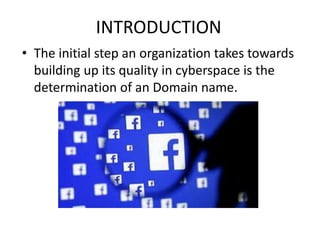
• The initial step an organization takes towards
building up its quality in cyberspace is the
determination of an Domain name.
INTRODUCTION
Owning a website and company’s
online Branding Strategy
• The Problem of Domain Name Disputes starts
when a domain name that should have been
rightfully yours is already bought by someone
else. Who is willing to sell you, what should
actually be yours.
Common Phenomenon of Domain
Name Disputes
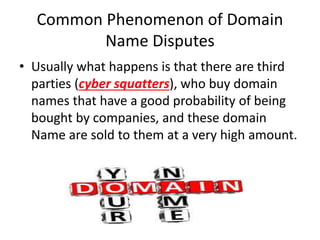
• Usually what happens is that there are third
parties (cyber squatters), who buy domain
names that have a good probability of being
bought by companies, and these domain
Name are sold to them at a very high amount.
Continue…
• Some Individuals also bank on the fame of others
website by using similar using domain names.
• A popular Example of Domain name disputes in
India is that of Yahoo Inc. Vs Aaksah Arora the
defendant.
• A domain name registrant does not obtain any
legal right to use that particular domain name
because the registered domain name could make
him liable for trademark violation.
Preventing Domain Name Theft
• Companies and trademark holders have a
moral obligation of not only protecting their
brands but also preventing their misuse.[1]
• Domain name theft also ruins the image of
the original brand.[2]
Types of Domain Name Disputes
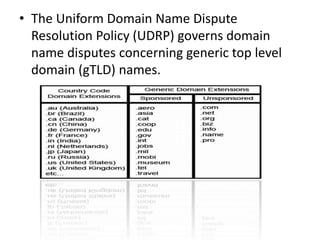
• The Uniform Domain Name Dispute
Resolution Policy (UDRP) governs domain
name disputes concerning generic top level
domain (gTLD) names.
Continue…
• Domain name disputes related to country
code TLD (ccTLD) name like, .in for INDIA are
entertained by National Internet Exchange of
India (NIXI) and are governed by the .IN
Dispute Resolution Policy (INDRP).
gTLDs include .com, .net and .ord.
• These domian names are resolved under the
UDRP policy wherein a complaint is filed with
any ICANN accredited dispute resolution
service provider such as the National
Arbitration Forum (NAF), then CPR institute
for Dispute Resolution and the World
Intellectual Property Organization (WIPO).
ccTLD includes .in, .uk and etc.
• A complainant can file a complaint with National
Internet Exchange of India (NIXI) for domain name
dispute resolution under the INDRP policy on the
following grounds:
1. The Domain name under dispute is deceptively
similar or identical to his trademark.
2. The current holder of the domain name has no
legitimate interests or rights with respect to that
domain name.
3. The registration and use of the domain name by the
present owner is in bad faith.
Dispute Resolution Procedure for
‘.in’ Domains
1. A Complain has to be filed with the .IN Registry
upon paying a certain fee.
2. The complainant can ask for transfer of the domain
name registration to him or cancellation of the
domain name.
3. .IN Registry appoints an Arbitrator from a list of
arbitrators published at http://www.registry.in/.
4. The arbitration proceedings are carried out by the
arbitrator in accordance with the IDRP policy and
rules and the Arbitration or Conciliation Act 1996.
5. The Registrant of the domain name against whom
the complaint is made is mandatorily required to
cooperate with the arbitration proceedings. He
cannot transfer the registration of the domain name
to anyone else for 15 working days after the
proceeding is concluded and also during a pending
case.
6. The complaint is resolved by the Arbitrator as per
applicable policies. The decision is then published on
the internet.
Referral Links
• http://www.registry.in/
• http://www.wipo.int/amc/en/domains/
• https://www.icann.org/resources/pages/dndr-
2012-02-25-en
• http://www.google.com/domain_Name/
• Wikipedia for reading material.
Domain dispute 2018 ipt3002

Domain dispute 2018 ipt3002

  • 1.
    DOMAIN DISUPTEE IPT 3002 SCHOOLOF MANAGEMENT By Anand Sapruu At:10:00AM to 1:00PM Admission number: 15160601 Enrolment No.: 151010201001
  • 2.
    We are Goingto Learn About 1. Introduction Domain Name 2. Owning a website and company’s online Branding Strategy 3. Common Phenomenon of Domain Name Disputes 4. Preventing Domain Name Theft 5. Types of Domain Name Disputes 6. gTLDs include .com, .net and .ord. 7. ccTLD includes .in, .uk and etc. 8. Dispute Resolution Procedure for ‘.in’ Domains
  • 3.
    • The initialstep an organization takes towards building up its quality in cyberspace is the determination of an Domain name. INTRODUCTION
  • 4.
    Owning a websiteand company’s online Branding Strategy • The Problem of Domain Name Disputes starts when a domain name that should have been rightfully yours is already bought by someone else. Who is willing to sell you, what should actually be yours.
  • 5.
    Common Phenomenon ofDomain Name Disputes • Usually what happens is that there are third parties (cyber squatters), who buy domain names that have a good probability of being bought by companies, and these domain Name are sold to them at a very high amount.
  • 6.
    Continue… • Some Individualsalso bank on the fame of others website by using similar using domain names. • A popular Example of Domain name disputes in India is that of Yahoo Inc. Vs Aaksah Arora the defendant. • A domain name registrant does not obtain any legal right to use that particular domain name because the registered domain name could make him liable for trademark violation.
  • 7.
    Preventing Domain NameTheft • Companies and trademark holders have a moral obligation of not only protecting their brands but also preventing their misuse.[1] • Domain name theft also ruins the image of the original brand.[2]
  • 8.
    Types of DomainName Disputes
  • 9.
    • The UniformDomain Name Dispute Resolution Policy (UDRP) governs domain name disputes concerning generic top level domain (gTLD) names.
  • 10.
    Continue… • Domain namedisputes related to country code TLD (ccTLD) name like, .in for INDIA are entertained by National Internet Exchange of India (NIXI) and are governed by the .IN Dispute Resolution Policy (INDRP).
  • 11.
    gTLDs include .com,.net and .ord. • These domian names are resolved under the UDRP policy wherein a complaint is filed with any ICANN accredited dispute resolution service provider such as the National Arbitration Forum (NAF), then CPR institute for Dispute Resolution and the World Intellectual Property Organization (WIPO).
  • 12.
    ccTLD includes .in,.uk and etc. • A complainant can file a complaint with National Internet Exchange of India (NIXI) for domain name dispute resolution under the INDRP policy on the following grounds: 1. The Domain name under dispute is deceptively similar or identical to his trademark. 2. The current holder of the domain name has no legitimate interests or rights with respect to that domain name. 3. The registration and use of the domain name by the present owner is in bad faith.
  • 13.
    Dispute Resolution Procedurefor ‘.in’ Domains
  • 14.
    1. A Complainhas to be filed with the .IN Registry upon paying a certain fee. 2. The complainant can ask for transfer of the domain name registration to him or cancellation of the domain name. 3. .IN Registry appoints an Arbitrator from a list of arbitrators published at http://www.registry.in/. 4. The arbitration proceedings are carried out by the arbitrator in accordance with the IDRP policy and rules and the Arbitration or Conciliation Act 1996.
  • 15.
    5. The Registrantof the domain name against whom the complaint is made is mandatorily required to cooperate with the arbitration proceedings. He cannot transfer the registration of the domain name to anyone else for 15 working days after the proceeding is concluded and also during a pending case. 6. The complaint is resolved by the Arbitrator as per applicable policies. The decision is then published on the internet.
  • 16.
    Referral Links • http://www.registry.in/ •http://www.wipo.int/amc/en/domains/ • https://www.icann.org/resources/pages/dndr- 2012-02-25-en • http://www.google.com/domain_Name/ • Wikipedia for reading material.

Editor's Notes

  • #7 Yahoo Inc. (The Plaintiff) vs Aakash Arora & Anc. , Here the Court Observed that “it was an effort to trade on the fame of yahoo’s trademark.”
  • #8 Suing someone for domain name theft is a duty more so because consumer are the ultimate victims. If an original brand owner does not take steps to prevent the sale of false goods through a domain name that is similar to his/her trademark but is bought and operated by someone else, he is contributing in a way towards the exploitation of consumers.
  • #10 Internet Corporation for Assigned Names and Numbers (ICANN) which cater disputes and accredits dispute resolution service provided.