DOING
PHILOSOPHY
WHAT IS PHILOSOPHY?
The word philosophy comes from two Greek words:
philos (love) and sophia (wisdom). The ancient Greeks
used this term to refer to “love of wisdom” and they soon
applied it to the study or discipline that uses human
reason to investigate the ultimate causes, reasons, and
principles which govern all things.
● Philosophy is the study of general and fundamental
questions about existence, knowledge, values, reason,
mind, and language.
● Philosophy in simple words is a way of thinking about
the world, the universe, and society. It works by asking
very basic questions about the nature of human
thought, the nature of the universe, and the
connections between them. The ideas in philosophy
are often general and abstract.
●Philosophy is the study of humans and the
world by thinking and asking questions. It is
a science and an art. Philosophy tries to
answer important questions by coming up
with answers about real things and asking
"why?"
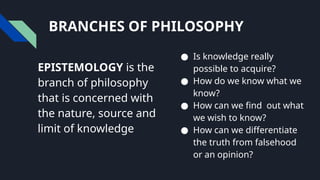
BRANCHES OF PHILOSOPHY
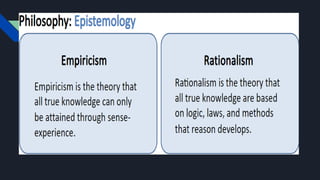
EPISTEMOLOGY is the
branch of philosophy
that is concerned with
the nature, source and
limit of knowledge
● Is knowledge really
possible to acquire?
● How do we know what we
know?
● How can we find out what
we wish to know?
● How can we differentiate
the truth from falsehood
or an opinion?
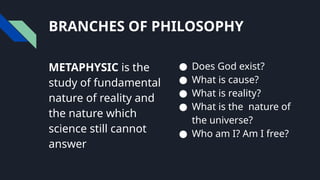
BRANCHES OF PHILOSOPHY
METAPHYSIC is the
study of fundamental
nature of reality and
the nature which
science still cannot
answer
● Does God exist?
● What is cause?
● What is reality?
● What is the nature of
the universe?
● Who am I? Am I free?
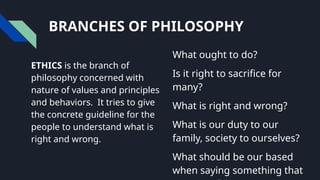
BRANCHES OF PHILOSOPHY
ETHICS is the branch of
philosophy concerned with
nature of values and principles
and behaviors. It tries to give
the concrete guideline for the
people to understand what is
right and wrong.
What ought to do?
Is it right to sacrifice for
many?
What is right and wrong?
What is our duty to our
family, society to ourselves?
What should be our based
when saying something that
PROBLEM ADDRESSED BY ETHICS
MORAL AUTHORITY,
blindly acceptance of an
ideology, norms,
principle and behavior
MORAL RELATIVISM,
the instance when
right and wrong is
relative to a person
or a culture.
BRANCHES OF PHILOSOPHY
AESTHETIC is the
branch of philosophy
that concerned with
the nature and value
of art and aesthetic
experience.
What is beauty
What is an art
What are the criteria
of beauty
How can we
appreciate beauty
BRANCHES OF PHILOSOPHY
LOGIC is the study of proper
reasoning using valid, sound and
inference, statement and proposition.
Consistent: there is no contradiction
among th statement
Soundness: only the conclusion will
inferred true premises.
Completeness: all premises can be
proven.
What is valid argument
How can evaluate the
truthfulness of a
proposition?
How can we assess the
soundness of an
argument ?
What are logical fallacies?
EXAMPLE
The are 10 cookies in the jar.
The first cookie is not delicious.
The second cookie is not
delicious. The third and fourth
cookies are not all delicious.
Then, all cookies are might not
be delicious.
All bachelors are single
men
Henry is still single
Henry is bachelor
HOLISTIC PERSPECTIVE /
PARTIAL POINT OF VIEW
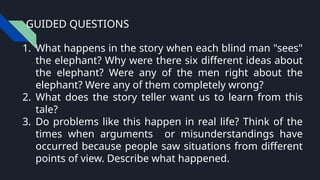
GUIDED QUESTIONS
1. What happens in the story when each blind man "sees"
the elephant? Why were there six different ideas about
the elephant? Were any of the men right about the
elephant? Were any of them completely wrong?
2. What does the story teller want us to learn from this
tale?
3. Do problems like this happen in real life? Think of the
times when arguments or misunderstandings have
occurred because people saw situations from different
points of view. Describe what happened.
PERSPECTIVE
IS A WAY OF LOOKING AT A SITUATION OR A
FACT BASES ON TRUE RELATION OR RELATIVE
IMPORTANCE
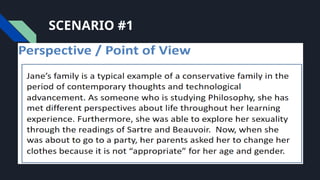
SCENARIO #1
SHOULD JANE FOLLOW HER FAMILY’S
ADVISE TO CHANGE HER CLOTHES?
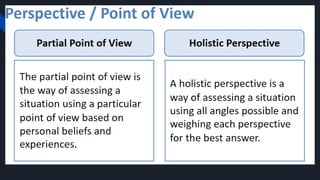
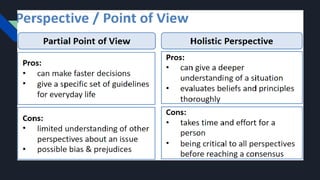
● HOLISTIC THINKING refers to a perspective that
considers large-scale patterns insystems. This is
often described as looking at the “big picture” when
describing and analyzing a situation or problem.
● A holistic perspective requires an individual to have
an open mindset and an ability to get the general
sense or impression regarding a situation. A holistic
view also means that one does not confine one’s
understanding of the world to one’s own
perspective, but also includes the perspective of
others.
PARTIAL THINKING, on the other hand, focuses on specific
aspects of a situation. The partial view is an important
component of analytical thinking, as an individual focuses on
certain areas or aspects of a problem in order to understand
it.
CLASS ACTIVITY:
THANK YOU!

DOING-PHILOSOPHY-GRADE-12-PHILOSOPHY.pptx

  • 1.
  • 2.
    WHAT IS PHILOSOPHY? Theword philosophy comes from two Greek words: philos (love) and sophia (wisdom). The ancient Greeks used this term to refer to “love of wisdom” and they soon applied it to the study or discipline that uses human reason to investigate the ultimate causes, reasons, and principles which govern all things.
  • 3.
    ● Philosophy isthe study of general and fundamental questions about existence, knowledge, values, reason, mind, and language. ● Philosophy in simple words is a way of thinking about the world, the universe, and society. It works by asking very basic questions about the nature of human thought, the nature of the universe, and the connections between them. The ideas in philosophy are often general and abstract.
  • 4.
    ●Philosophy is thestudy of humans and the world by thinking and asking questions. It is a science and an art. Philosophy tries to answer important questions by coming up with answers about real things and asking "why?"
  • 5.
    BRANCHES OF PHILOSOPHY EPISTEMOLOGYis the branch of philosophy that is concerned with the nature, source and limit of knowledge ● Is knowledge really possible to acquire? ● How do we know what we know? ● How can we find out what we wish to know? ● How can we differentiate the truth from falsehood or an opinion?
  • 7.
    BRANCHES OF PHILOSOPHY METAPHYSICis the study of fundamental nature of reality and the nature which science still cannot answer ● Does God exist? ● What is cause? ● What is reality? ● What is the nature of the universe? ● Who am I? Am I free?
  • 8.
    BRANCHES OF PHILOSOPHY ETHICSis the branch of philosophy concerned with nature of values and principles and behaviors. It tries to give the concrete guideline for the people to understand what is right and wrong. What ought to do? Is it right to sacrifice for many? What is right and wrong? What is our duty to our family, society to ourselves? What should be our based when saying something that
  • 9.
    PROBLEM ADDRESSED BYETHICS MORAL AUTHORITY, blindly acceptance of an ideology, norms, principle and behavior MORAL RELATIVISM, the instance when right and wrong is relative to a person or a culture.
  • 10.
    BRANCHES OF PHILOSOPHY AESTHETICis the branch of philosophy that concerned with the nature and value of art and aesthetic experience. What is beauty What is an art What are the criteria of beauty How can we appreciate beauty
  • 11.
    BRANCHES OF PHILOSOPHY LOGICis the study of proper reasoning using valid, sound and inference, statement and proposition. Consistent: there is no contradiction among th statement Soundness: only the conclusion will inferred true premises. Completeness: all premises can be proven. What is valid argument How can evaluate the truthfulness of a proposition? How can we assess the soundness of an argument ? What are logical fallacies?
  • 12.
    EXAMPLE The are 10cookies in the jar. The first cookie is not delicious. The second cookie is not delicious. The third and fourth cookies are not all delicious. Then, all cookies are might not be delicious. All bachelors are single men Henry is still single Henry is bachelor
  • 13.
  • 15.
    GUIDED QUESTIONS 1. Whathappens in the story when each blind man "sees" the elephant? Why were there six different ideas about the elephant? Were any of the men right about the elephant? Were any of them completely wrong? 2. What does the story teller want us to learn from this tale? 3. Do problems like this happen in real life? Think of the times when arguments or misunderstandings have occurred because people saw situations from different points of view. Describe what happened.
  • 16.
    PERSPECTIVE IS A WAYOF LOOKING AT A SITUATION OR A FACT BASES ON TRUE RELATION OR RELATIVE IMPORTANCE
  • 17.
  • 18.
    SHOULD JANE FOLLOWHER FAMILY’S ADVISE TO CHANGE HER CLOTHES?
  • 21.
    ● HOLISTIC THINKINGrefers to a perspective that considers large-scale patterns insystems. This is often described as looking at the “big picture” when describing and analyzing a situation or problem. ● A holistic perspective requires an individual to have an open mindset and an ability to get the general sense or impression regarding a situation. A holistic view also means that one does not confine one’s understanding of the world to one’s own perspective, but also includes the perspective of others.
  • 22.
    PARTIAL THINKING, onthe other hand, focuses on specific aspects of a situation. The partial view is an important component of analytical thinking, as an individual focuses on certain areas or aspects of a problem in order to understand it.
  • 24.
  • 26.