Documentary analysis- UK’S
toughest teenage prison
Type of documentary
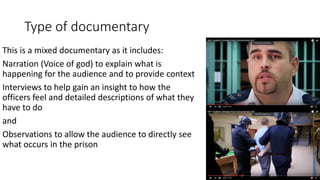
This is a mixed documentary as it includes:
Narration (Voice of god) to explain what is
happening for the audience and to provide context
Interviews to help gain an insight to how the
officers feel and detailed descriptions of what they
have to do
and
Observations to allow the audience to directly see
what occurs in the prison
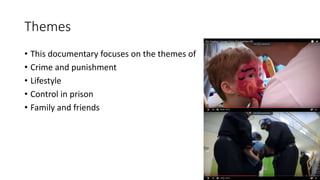
Themes
• This documentary focuses on the themes of
• Crime and punishment
• Lifestyle
• Control in prison
• Family and friends
Narrative structure
• This is an open structure as we are unaware of what will happen next
• This follows a singular structure focusing on the lives that prisoners
have to face.
• This is non linear as anything could occur during it.
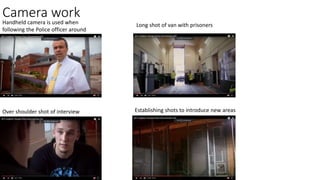
Camera workHandheld camera is used when
following the Police officer around
Long shot of van with prisoners
Over shoulder shot of interview Establishing shots to introduce new areas
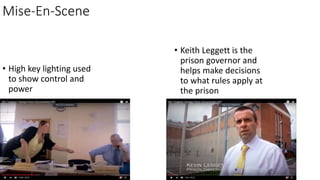
Mise-En-Scene
• High key lighting used
to show control and
power
• Keith Leggett is the
prison governor and
helps make decisions
to what rules apply at
the prison
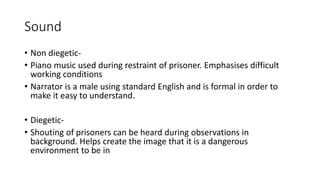
Sound
• Non diegetic-
• Piano music used during restraint of prisoner. Emphasises difficult
working conditions
• Narrator is a male using standard English and is formal in order to
make it easy to understand.
• Diegetic-
• Shouting of prisoners can be heard during observations in
background. Helps create the image that it is a dangerous
environment to be in
Editing
• Questions that are asked during interviews are edited out in order to create a
faster pace and consistency with the documentary. It is also not necessary to
keep the questions in as what they say still makes complete sense without it
• Slow zoom in during images of achieve footage
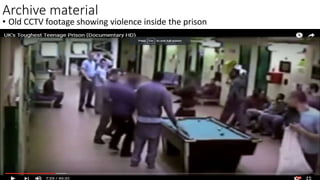
Archive material
• Old CCTV footage showing violence inside the prison
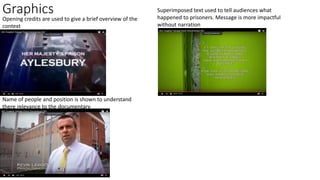
Graphics
Opening credits are used to give a brief overview of the
context
Superimposed text used to tell audiences what
happened to prisoners. Message is more impactful
without narration
Name of people and position is shown to understand
there relevance to the documentary

Documentary analysis UK’S toughest teenage prison

  • 1.
  • 2.
    Type of documentary Thisis a mixed documentary as it includes: Narration (Voice of god) to explain what is happening for the audience and to provide context Interviews to help gain an insight to how the officers feel and detailed descriptions of what they have to do and Observations to allow the audience to directly see what occurs in the prison
  • 3.
    Themes • This documentaryfocuses on the themes of • Crime and punishment • Lifestyle • Control in prison • Family and friends
  • 4.
    Narrative structure • Thisis an open structure as we are unaware of what will happen next • This follows a singular structure focusing on the lives that prisoners have to face. • This is non linear as anything could occur during it.
  • 5.
    Camera workHandheld camerais used when following the Police officer around Long shot of van with prisoners Over shoulder shot of interview Establishing shots to introduce new areas
  • 6.
    Mise-En-Scene • High keylighting used to show control and power • Keith Leggett is the prison governor and helps make decisions to what rules apply at the prison
  • 7.
    Sound • Non diegetic- •Piano music used during restraint of prisoner. Emphasises difficult working conditions • Narrator is a male using standard English and is formal in order to make it easy to understand. • Diegetic- • Shouting of prisoners can be heard during observations in background. Helps create the image that it is a dangerous environment to be in
  • 8.
    Editing • Questions thatare asked during interviews are edited out in order to create a faster pace and consistency with the documentary. It is also not necessary to keep the questions in as what they say still makes complete sense without it • Slow zoom in during images of achieve footage
  • 9.
    Archive material • OldCCTV footage showing violence inside the prison
  • 10.
    Graphics Opening credits areused to give a brief overview of the context Superimposed text used to tell audiences what happened to prisoners. Message is more impactful without narration Name of people and position is shown to understand there relevance to the documentary