


and
Docker meetup Tokyo #5

Aug 19, 2015
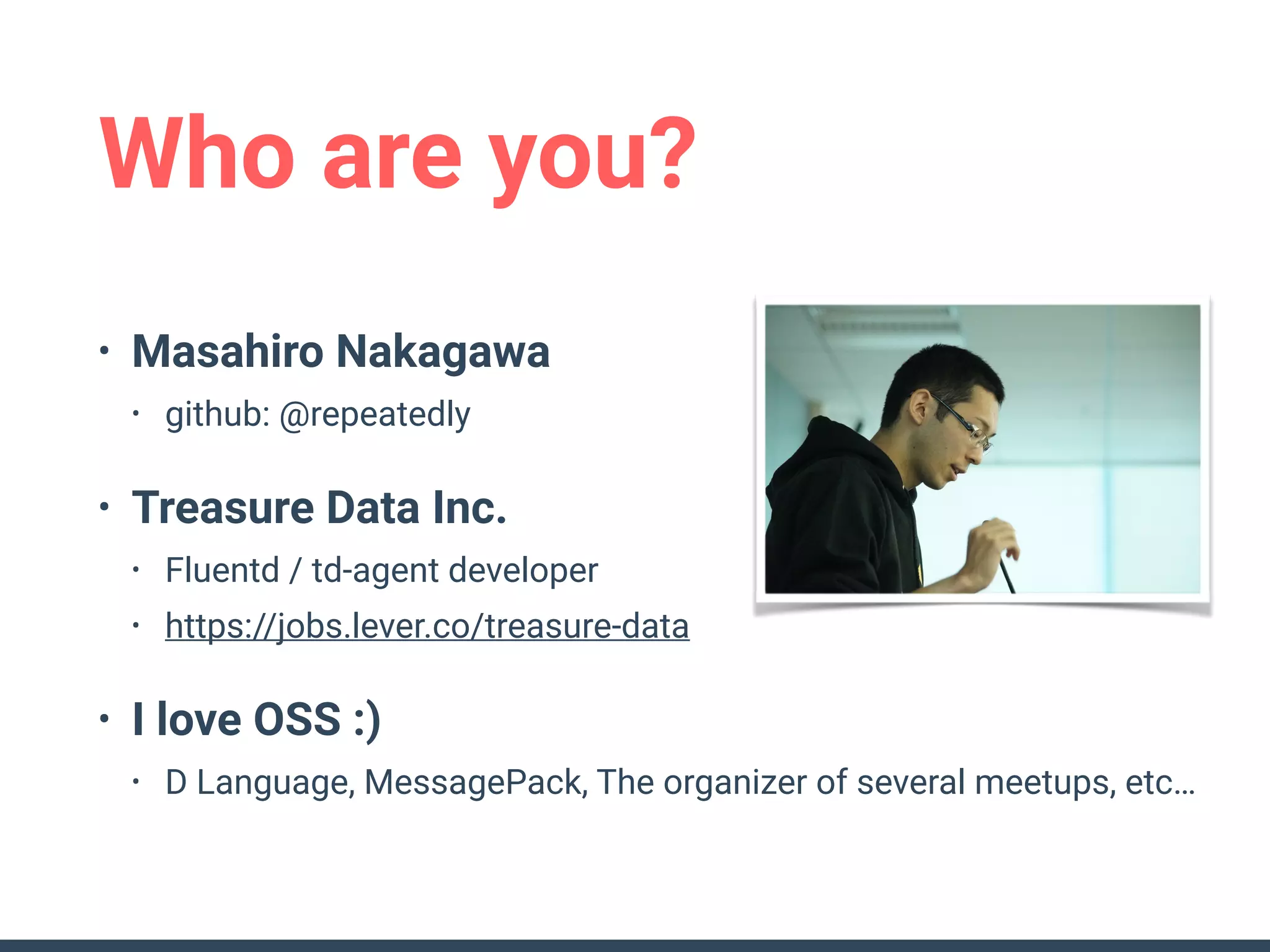
Who are you?
• Masahiro Nakagawa
• github: @repeatedly
• Treasure Data Inc.
• Fluentd / td-agent developer
• https://jobs.lever.co/treasure-data
• I love OSS :)
• D Language, MessagePack, The organizer of several meetups, etc…
Logging for containers
• Storage:
• should be outside of containers / hosts
• Transferring:
• should be over network
• Aggregation:
• should be done per container / per service
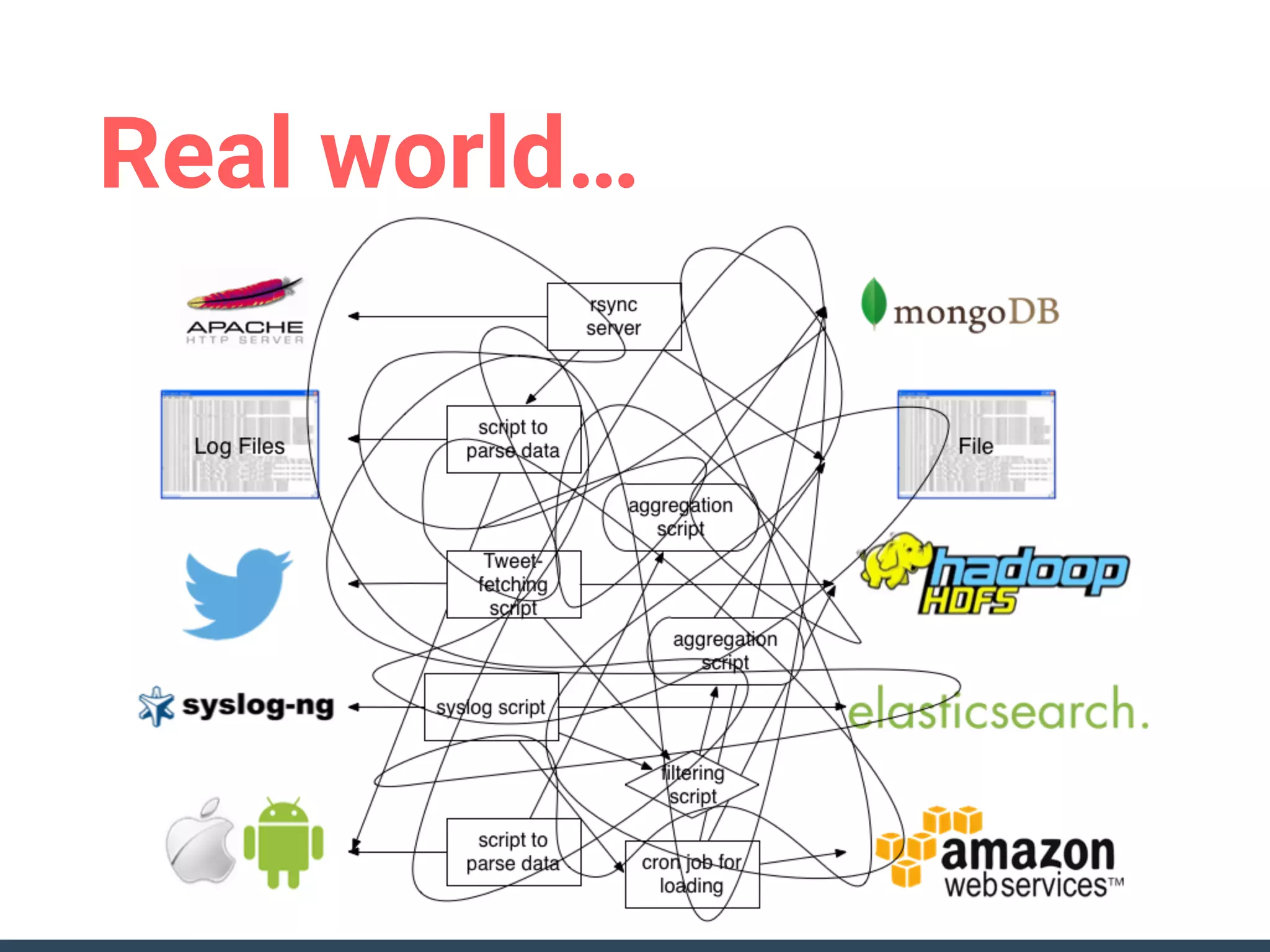
Real world…
Container-based world
needs unified logging layer
Structured logging
Reliable forwarding
Pluggable architecturehttp://fluentd.org/
What’s Fluentd?
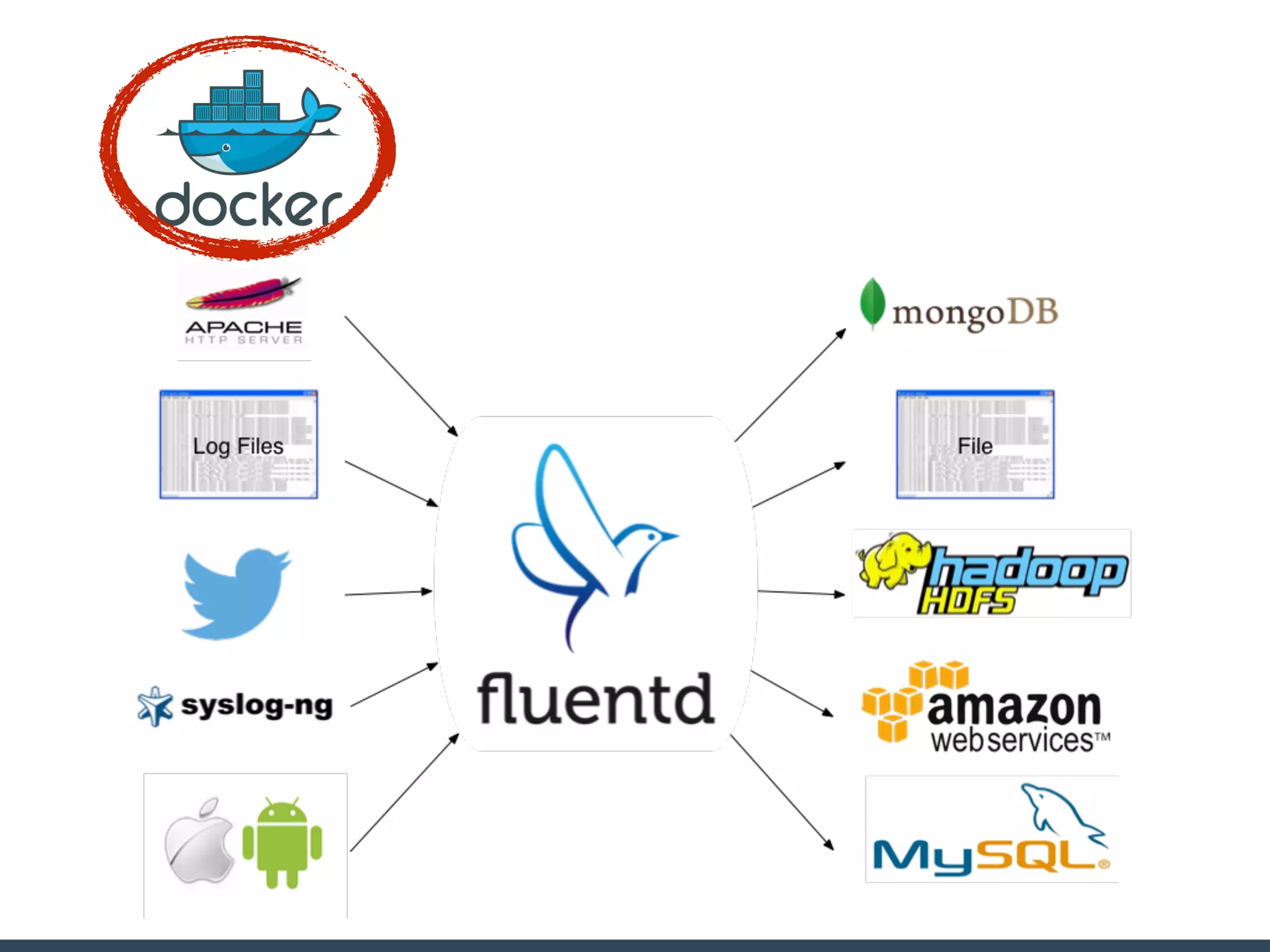
• Data collector for unified logging layer
• Streaming data transfer based on JSON
• Written in Ruby
• Gem based various plugins
• http://www.fluentd.org/plugins
• Working on lots of productions
• http://www.fluentd.org/testimonials
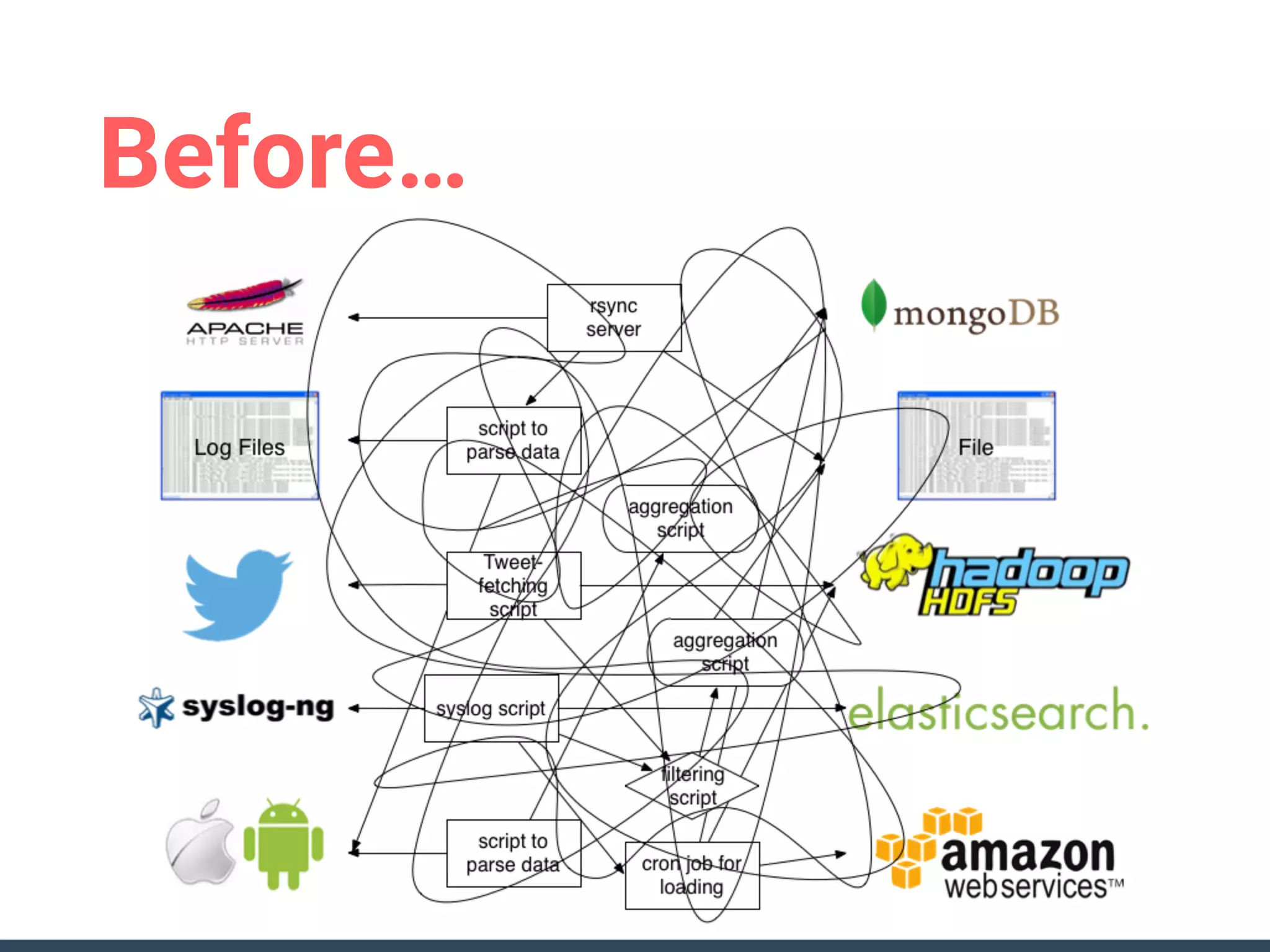
Before…
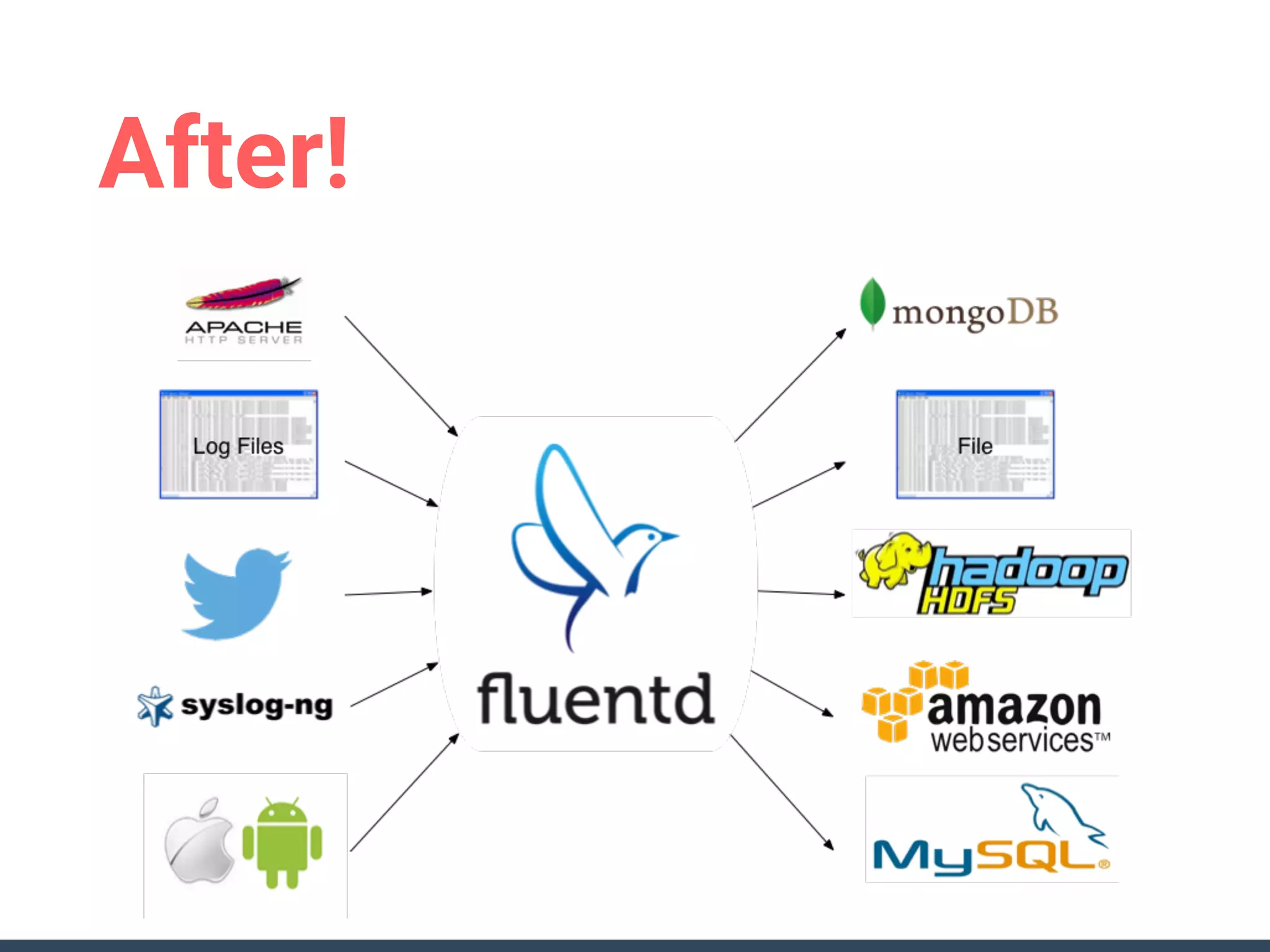
After!
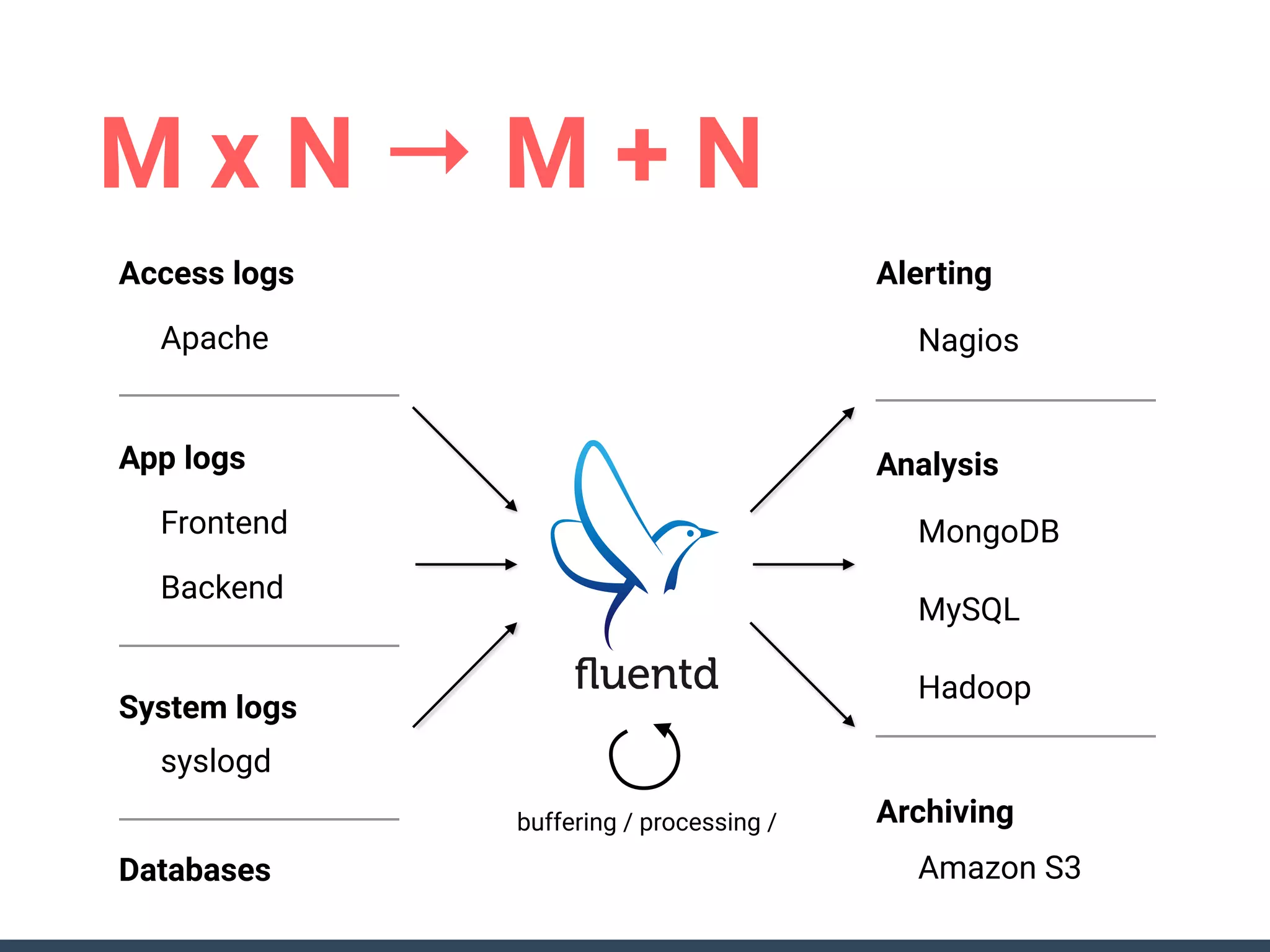
M x N → M + N
Nagios
MongoDB
Hadoop
Alerting
Amazon S3
Analysis
Archiving
MySQL
Apache
Frontend
Access logs
syslogd
App logs
System logs
Backend
Databases
buffering / processing /
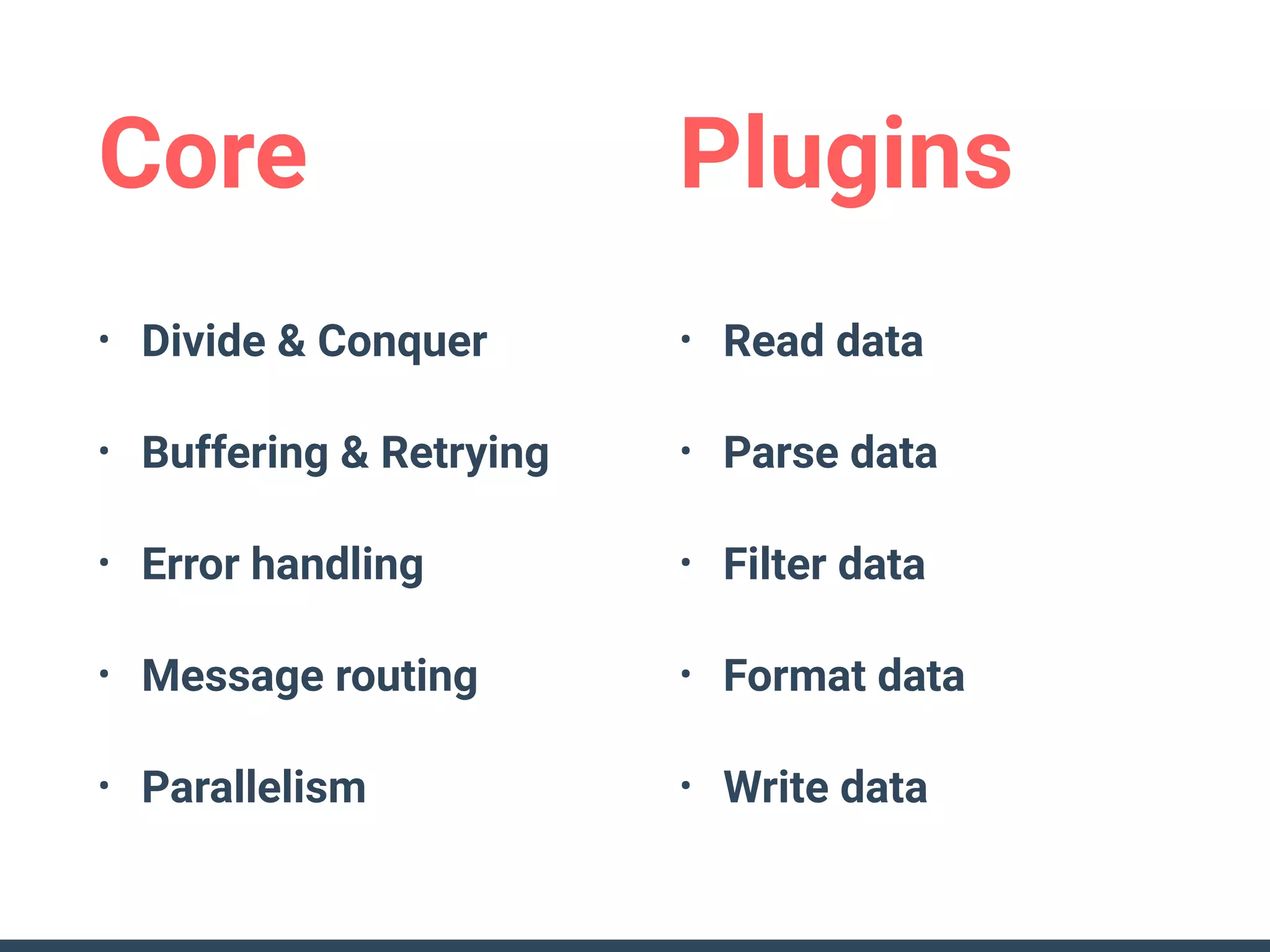
Core Plugins
• Divide & Conquer
• Buffering & Retrying
• Error handling
• Message routing
• Parallelism
• Read data
• Parse data
• Filter data
• Format data
• Write data
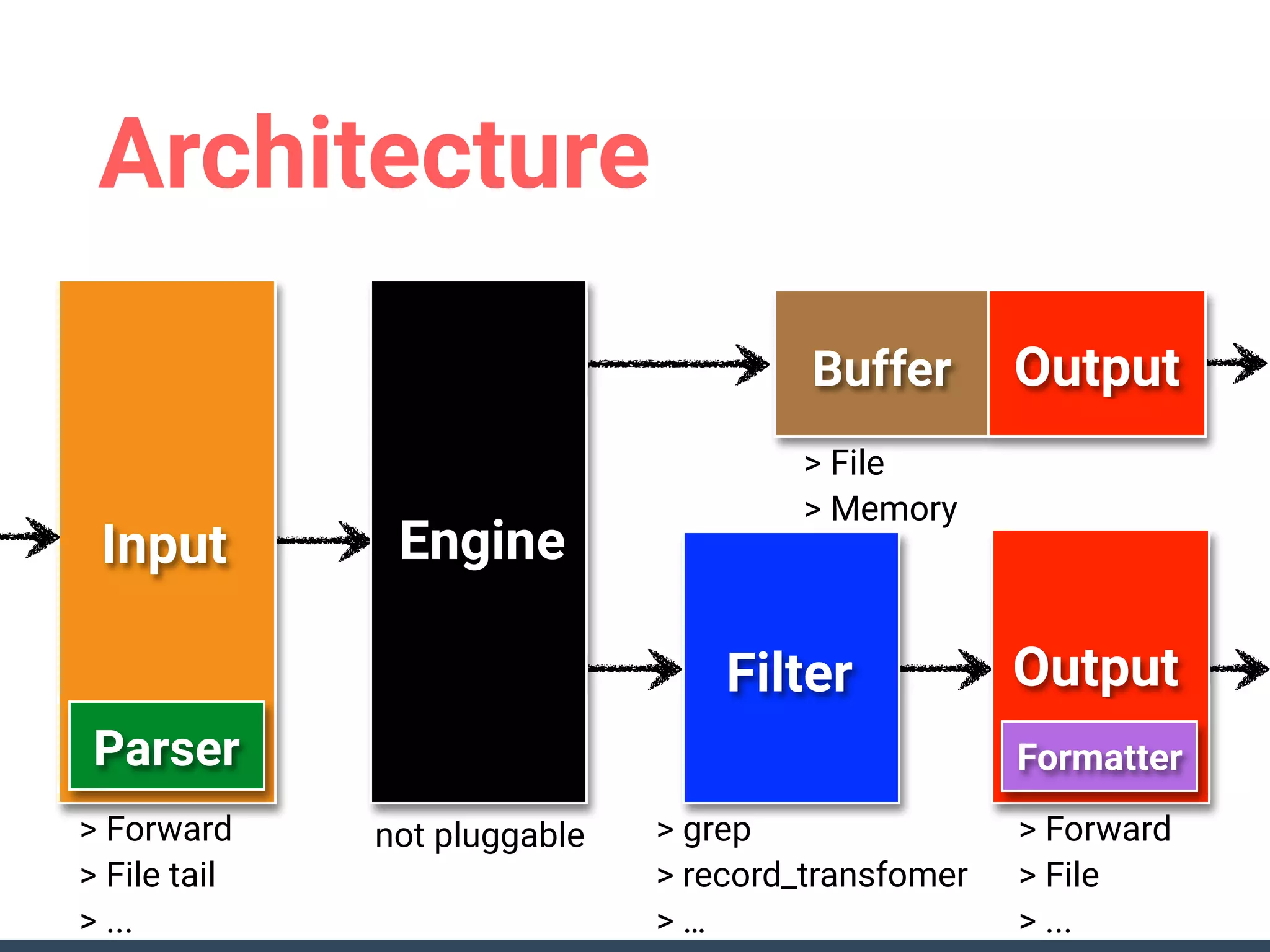
Architecture
EngineInput
Filter Output
Buffer
> grep
> record_transfomer
> …
> Forward
> File tail
> ...
> Forward
> File
> ...
Output
> File
> Memory
not pluggable
FormatterParser
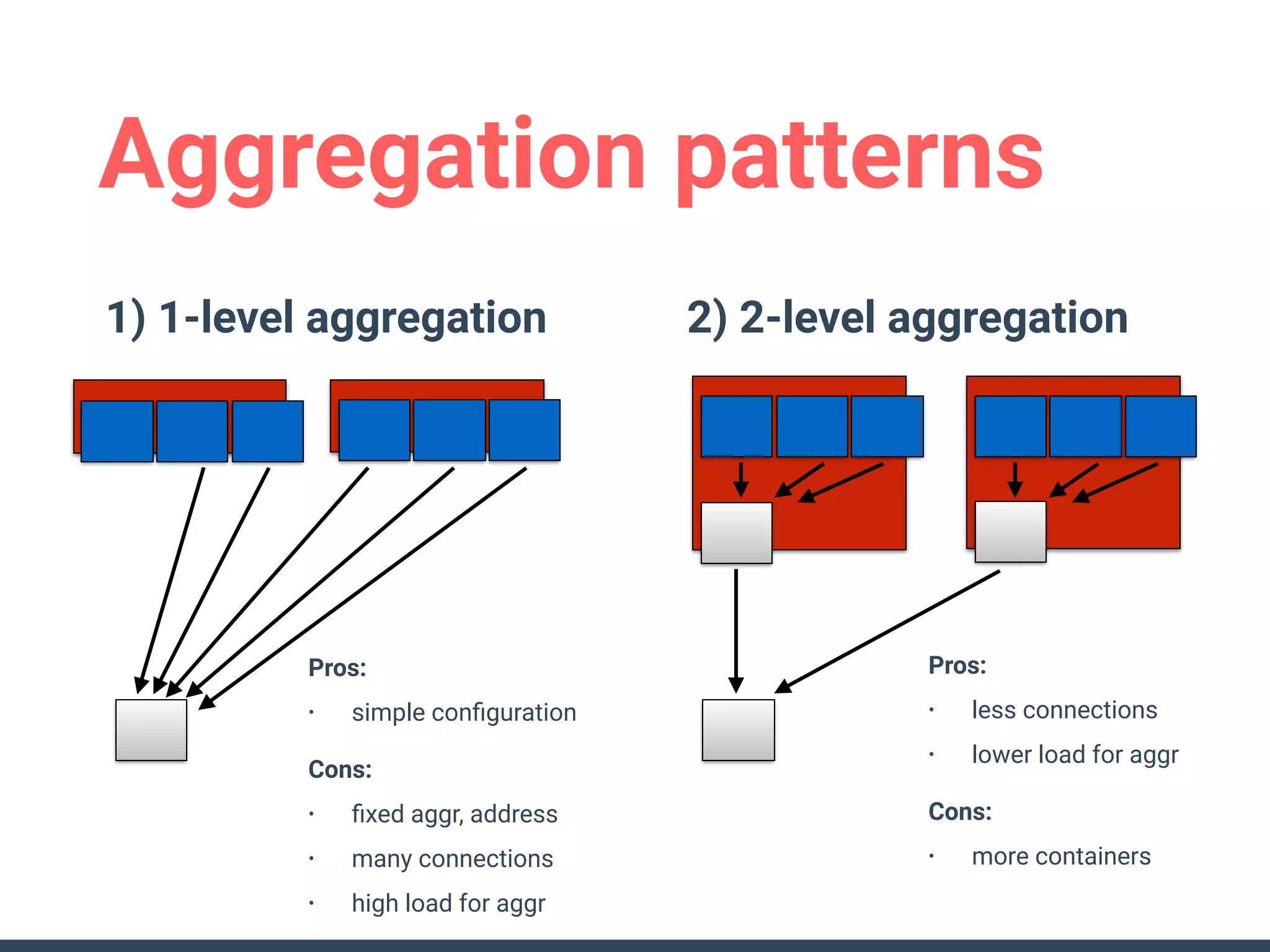
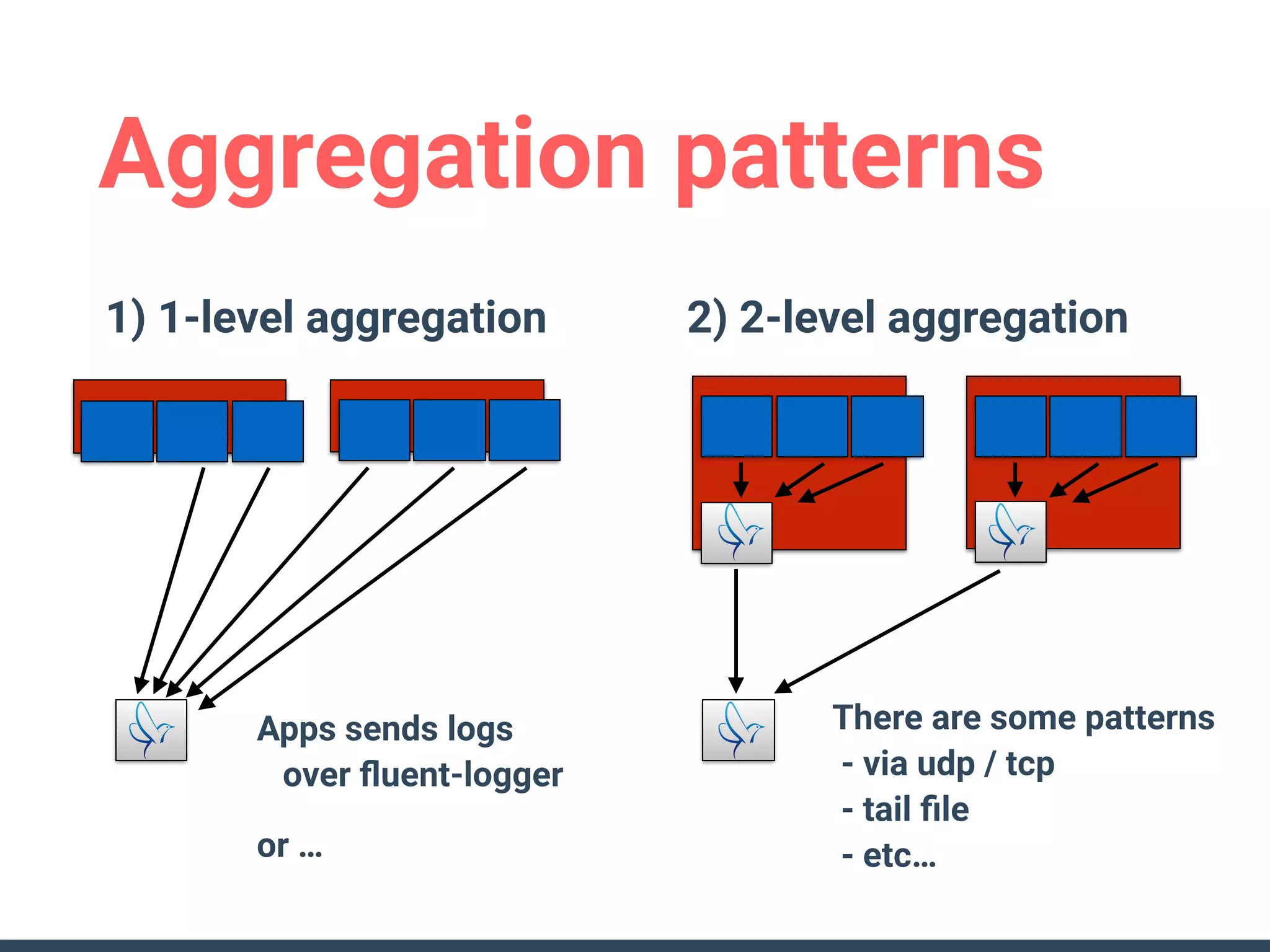
Aggregation patterns
1) 1-level aggregation 2) 2-level aggregation
Pros:
• simple configuration
Cons:
• fixed aggr, address
• many connections
• high load for aggr
Pros:
• less connections
• lower load for aggr
Cons:
• more containers
Aggregation patterns
1) 1-level aggregation 2) 2-level aggregation
Apps sends logs

over fluent-logger
or …
There are some patterns

- via udp / tcp

- tail file

- etc…
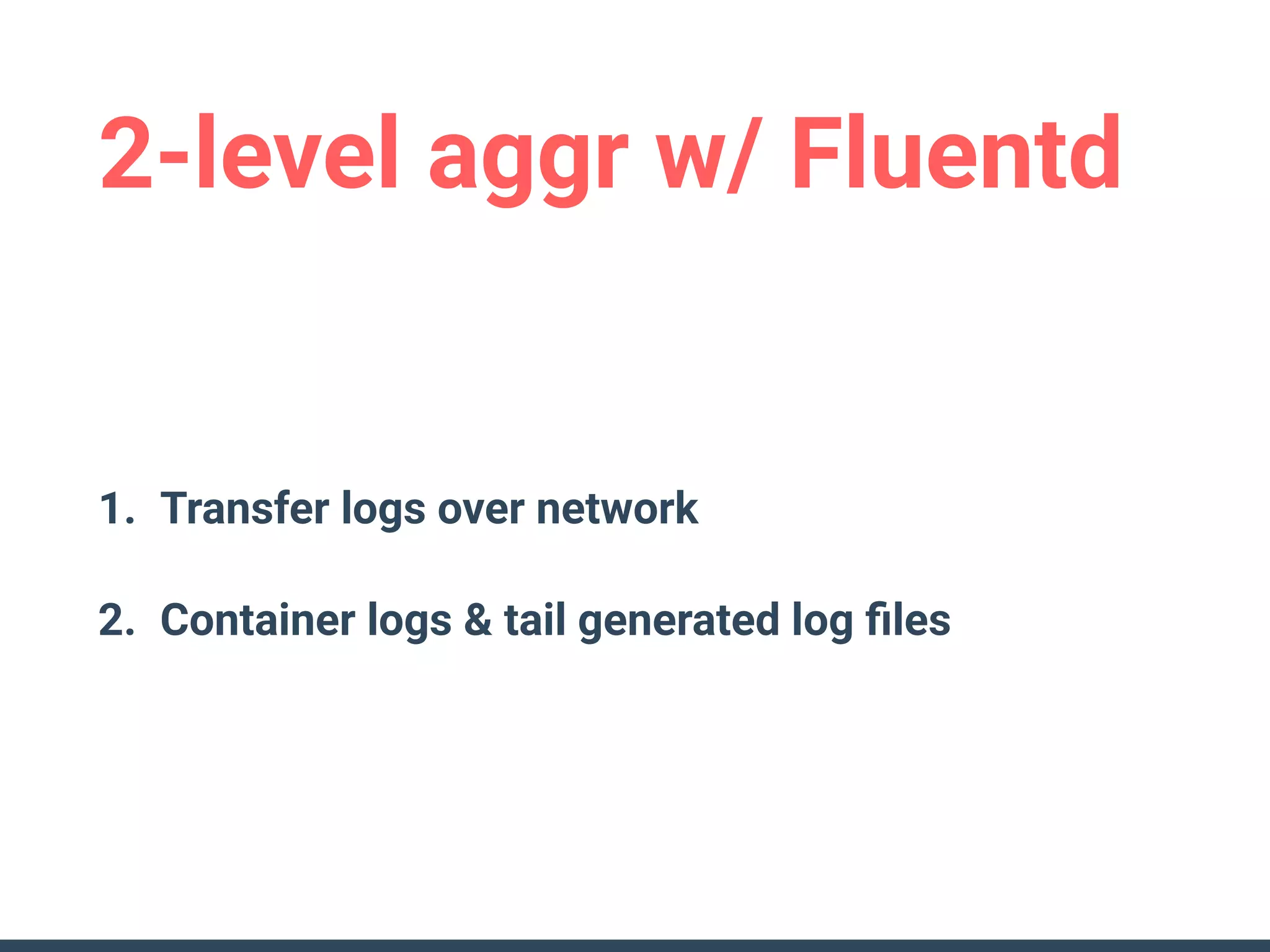
2-level aggr w/ Fluentd
1. Transfer logs over network
2. Container logs & tail generated log files
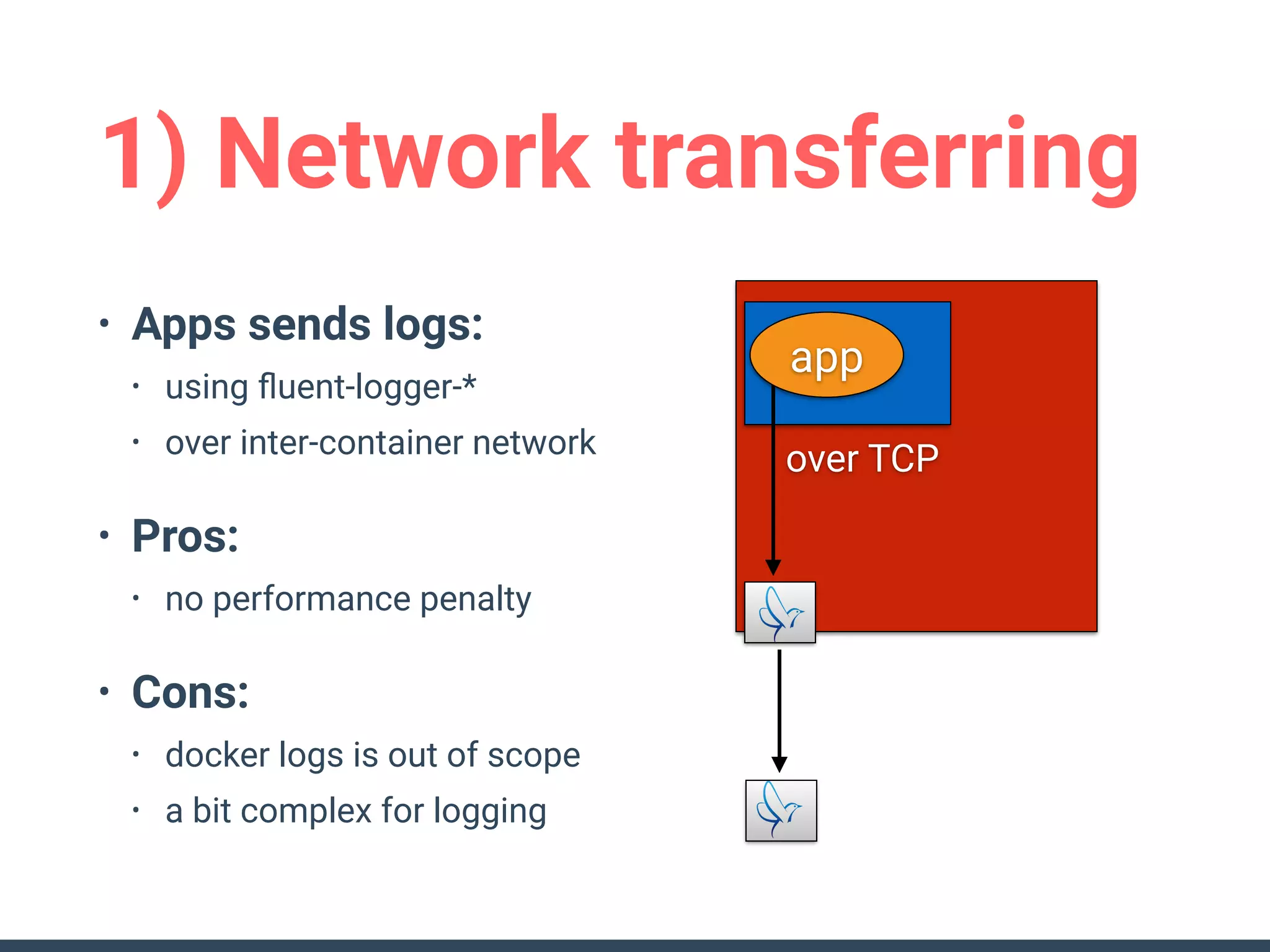
1) Network transferring
• Apps sends logs:
• using fluent-logger-*
• over inter-container network
• Pros:
• no performance penalty
• Cons:
• docker logs is out of scope
• a bit complex for logging
over TCP
app
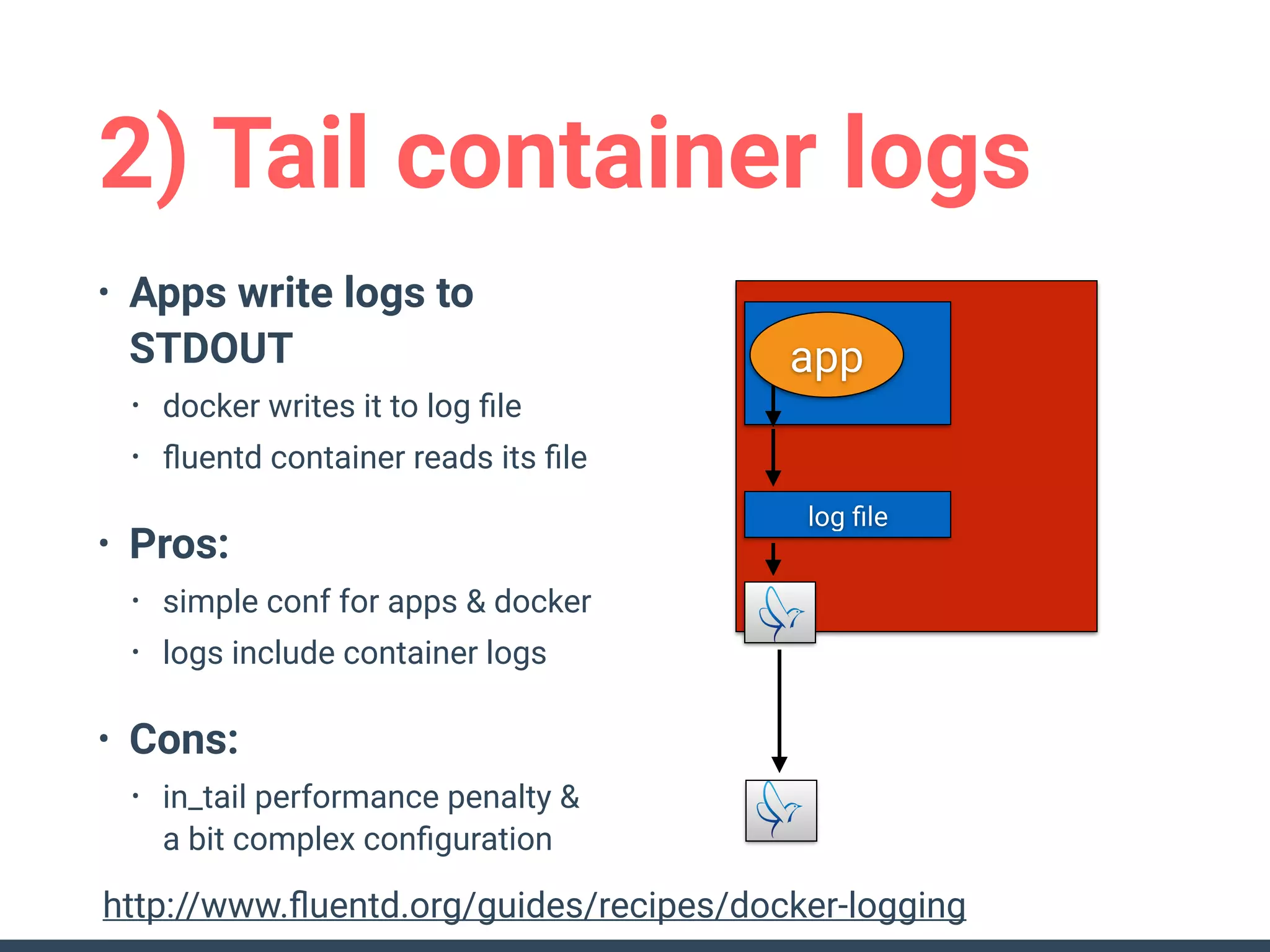
2) Tail container logs
• Apps write logs to
STDOUT
• docker writes it to log file
• fluentd container reads its file
• Pros:
• simple conf for apps & docker
• logs include container logs
• Cons:
• in_tail performance penalty &

a bit complex configuration
log file
app
http://www.fluentd.org/guides/recipes/docker-logging
Seems good?
But we now have smarter way!
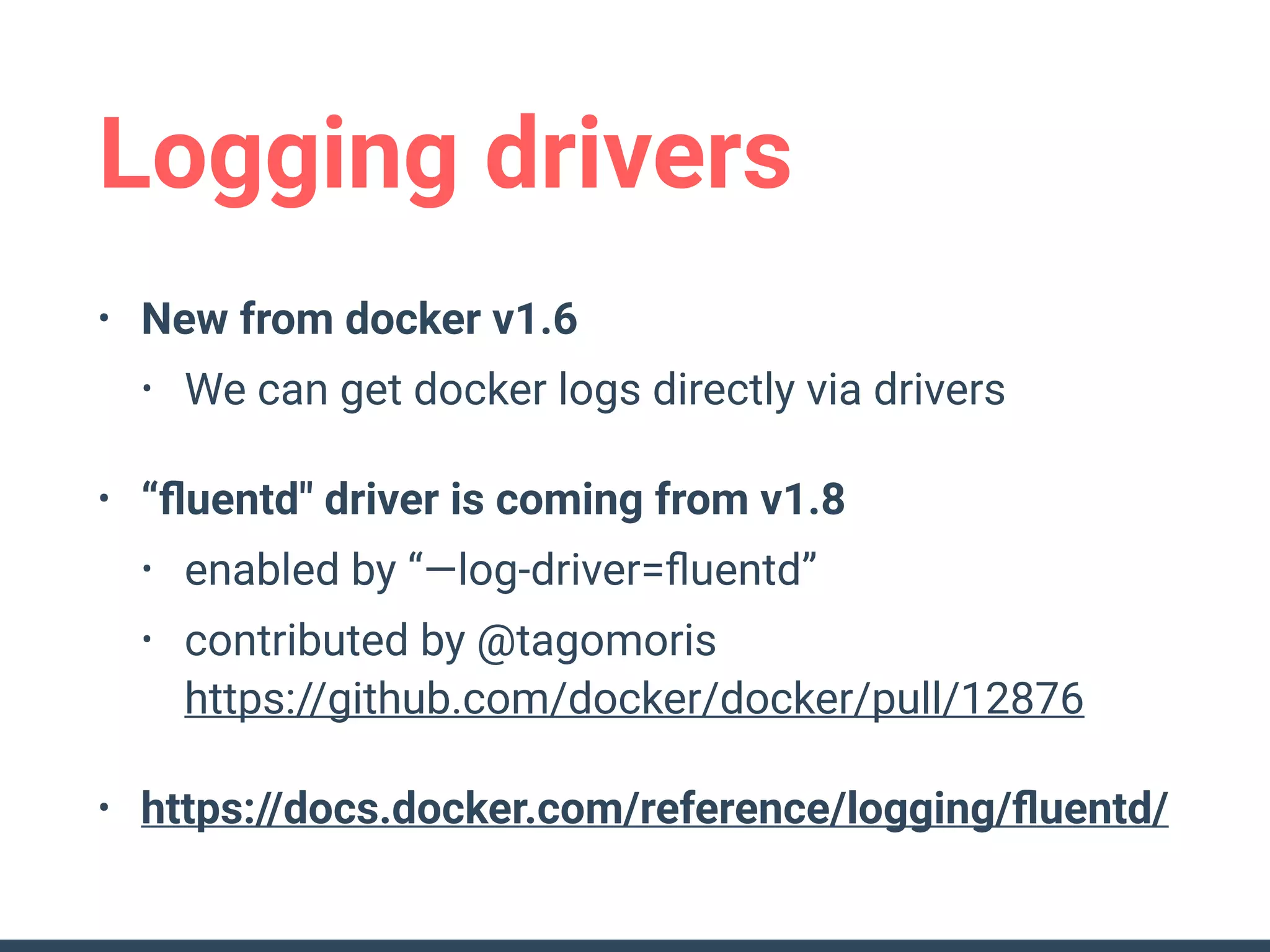
Logging drivers
• New from docker v1.6
• We can get docker logs directly via drivers
• “fluentd" driver is coming from v1.8
• enabled by “—log-driver=fluentd”
• contributed by @tagomoris

https://github.com/docker/docker/pull/12876
• https://docs.docker.com/reference/logging/fluentd/
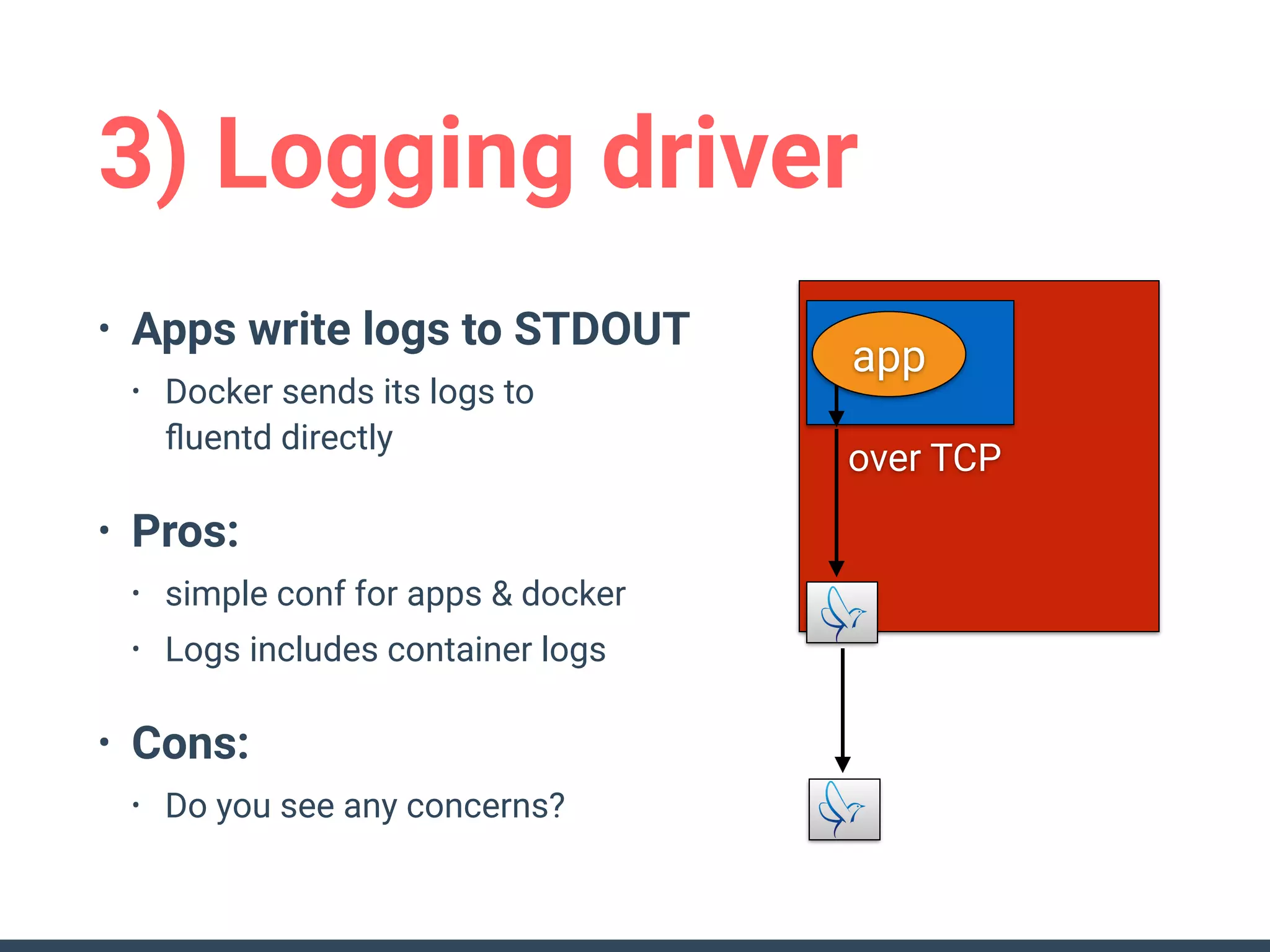
3) Logging driver
• Apps write logs to STDOUT
• Docker sends its logs to

fluentd directly
• Pros:
• simple conf for apps & docker
• Logs includes container logs
• Cons:
• Do you see any concerns?
over TCP
app
Demo?
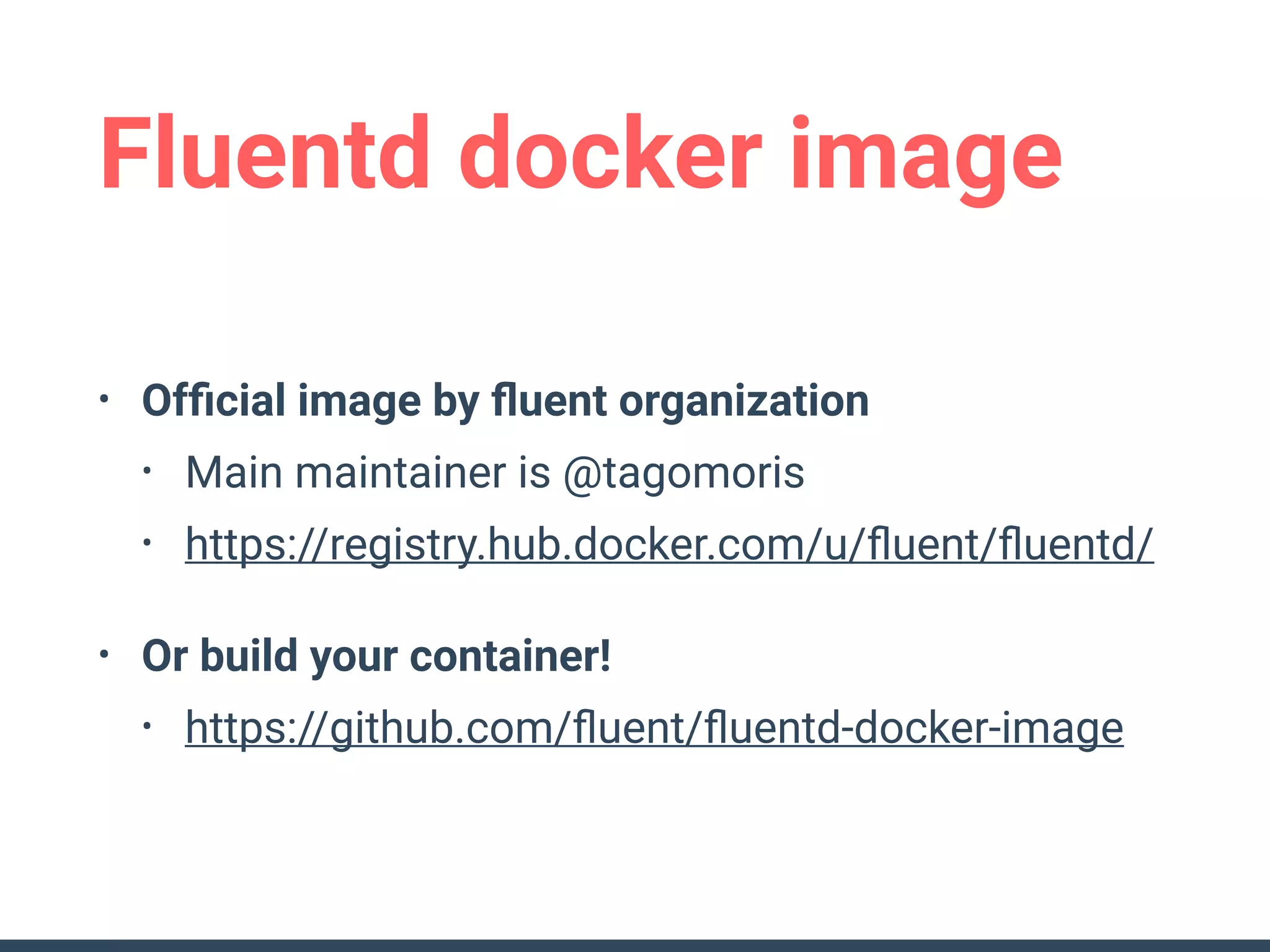
Fluentd docker image
• Official image by fluent organization
• Main maintainer is @tagomoris
• https://registry.hub.docker.com/u/fluent/fluentd/
• Or build your container!
• https://github.com/fluent/fluentd-docker-image
With Kubernetes
• Kubernetes provides fluentd + Elasticsearch +
Kibana image officially
• https://hub.docker.com/r/kubernetes/fluentd-
elasticsearch/
• http://www.dasblinkenlichten.com/logging-in-
kubernetes-with-fluentd-and-elasticsearch/
Cloud service for
entire data pipeline!

Docker and Fluentd

  • 1.
    and Docker meetup Tokyo#5
 Aug 19, 2015
  • 2.
    Who are you? •Masahiro Nakagawa • github: @repeatedly • Treasure Data Inc. • Fluentd / td-agent developer • https://jobs.lever.co/treasure-data • I love OSS :) • D Language, MessagePack, The organizer of several meetups, etc…
  • 3.
    Logging for containers •Storage: • should be outside of containers / hosts • Transferring: • should be over network • Aggregation: • should be done per container / per service
  • 4.
  • 5.
  • 6.
    Structured logging Reliable forwarding Pluggablearchitecturehttp://fluentd.org/
  • 7.
    What’s Fluentd? • Datacollector for unified logging layer • Streaming data transfer based on JSON • Written in Ruby • Gem based various plugins • http://www.fluentd.org/plugins • Working on lots of productions • http://www.fluentd.org/testimonials
  • 8.
  • 9.
  • 10.
    M x N→ M + N Nagios MongoDB Hadoop Alerting Amazon S3 Analysis Archiving MySQL Apache Frontend Access logs syslogd App logs System logs Backend Databases buffering / processing /
  • 11.
    Core Plugins • Divide& Conquer • Buffering & Retrying • Error handling • Message routing • Parallelism • Read data • Parse data • Filter data • Format data • Write data
  • 12.
    Architecture EngineInput Filter Output Buffer > grep >record_transfomer > … > Forward > File tail > ... > Forward > File > ... Output > File > Memory not pluggable FormatterParser
  • 13.
    Aggregation patterns 1) 1-levelaggregation 2) 2-level aggregation Pros: • simple configuration Cons: • fixed aggr, address • many connections • high load for aggr Pros: • less connections • lower load for aggr Cons: • more containers
  • 14.
    Aggregation patterns 1) 1-levelaggregation 2) 2-level aggregation Apps sends logs
 over fluent-logger or … There are some patterns
 - via udp / tcp
 - tail file
 - etc…
  • 15.
    2-level aggr w/Fluentd 1. Transfer logs over network 2. Container logs & tail generated log files
  • 16.
    1) Network transferring •Apps sends logs: • using fluent-logger-* • over inter-container network • Pros: • no performance penalty • Cons: • docker logs is out of scope • a bit complex for logging over TCP app
  • 17.
    2) Tail containerlogs • Apps write logs to STDOUT • docker writes it to log file • fluentd container reads its file • Pros: • simple conf for apps & docker • logs include container logs • Cons: • in_tail performance penalty &
 a bit complex configuration log file app http://www.fluentd.org/guides/recipes/docker-logging
  • 18.
    Seems good? But wenow have smarter way!
  • 19.
    Logging drivers • Newfrom docker v1.6 • We can get docker logs directly via drivers • “fluentd" driver is coming from v1.8 • enabled by “—log-driver=fluentd” • contributed by @tagomoris
 https://github.com/docker/docker/pull/12876 • https://docs.docker.com/reference/logging/fluentd/
  • 20.
    3) Logging driver •Apps write logs to STDOUT • Docker sends its logs to
 fluentd directly • Pros: • simple conf for apps & docker • Logs includes container logs • Cons: • Do you see any concerns? over TCP app
  • 22.
  • 23.
    Fluentd docker image •Official image by fluent organization • Main maintainer is @tagomoris • https://registry.hub.docker.com/u/fluent/fluentd/ • Or build your container! • https://github.com/fluent/fluentd-docker-image
  • 24.
    With Kubernetes • Kubernetesprovides fluentd + Elasticsearch + Kibana image officially • https://hub.docker.com/r/kubernetes/fluentd- elasticsearch/ • http://www.dasblinkenlichten.com/logging-in- kubernetes-with-fluentd-and-elasticsearch/
  • 25.