Do You Think OOP 
(Object-Oriented Programming) 
When Writing Topics? 
by Gunnar H. Krause
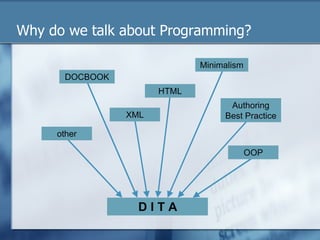
Why do we talk about Programming? 
HTML 
D I T A 
DOCBOOK 
XML 
OOP 
Minimalism 
other 
Authoring 
Best Practice
Outline 
n What is OOP, non-OOP and Oops? 
n Bridge to DITA specification 
n Writing topics with OOP in mind 
n Generic, specific and complex topics 
n Thoughts to take away
Object-Oriented Programming 
n OOP is a programming paradigm using "objects" 
to design applications and computer programs. 
n An object can represent any useful item that has 
n identity, structure, behavior. 
n An object is a data structure consisting of 
n data fields, methods together with their interactions. 
n OOP basics are rather old. 
n OOP got a hype in 1990s. 
n OOP is regarded state-of-the-art today.
What about Non-OOP?! 
n Example: procedural programming 
n Software code consists of procedures and call of 
procedures. 
n Procedures define variables and parameters to process 
information and compute results. 
n Reuse is possible on procedure level from basic 
functions to complex processing. 
n Many other ways of non-OOP are possible.
Oops !!! 
n Many programming languages support 
object orientation. 
n But, you are never forced to good OOP. 
Knowing the DITA specification or 
using a DITA-based authoring system 
does not enforce user-friendly and easy 
to maintain documentation, either.
What to Learn? 
n Understanding the basic principles is needed. 
n Experience is needed as well.
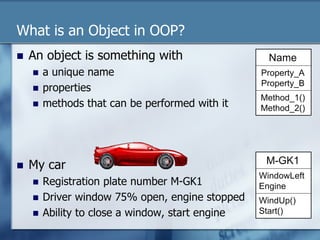
What is an Object in OOP? 
n An object is something with 
n a unique name 
n properties 
n methods that can be performed with it 
n My car 
n Registration plate number M-GK1 
n Driver window 75% open, engine stopped 
n Ability to close a window, start engine 
Name 
Property_A 
Property_B 
Method_1() 
Method_2() 
M-GK1 
WindowLeft 
Engine 
WindUp() 
Start()
Abstraction 
n Ignore unimportant details for a certain level of 
aggregation 
n A combination of stone, wood, 
glass can be described as a house 
n A collection of houses is a town 
n Abstraction reduces complexity by separating 
levels of detail. 
n You can still reach the other level of detail by 
intentionally looking at a related object.
Encapsulation 
n Encapsulation is an imperative 
n to keep things together that 
belong together, 
n on the same level of abstraction, 
of course. 
n Do not split things that belong together. 
n Complexity is reduced by collecting relevant 
information in one place.
Inheritance 
by Specialization D Generalization 
n On one level of abstraction you may find similar 
objects. 
n Define a superclass 
with what is common. 
n Derive more specific 
classes based on this 
one. 
n Redefine properties 
or methods 
n Add properties 
or methods 
Convertible 
Roof 
OpenRoof() 
eCar 
BatteryLevel 
{FuelLevel} 
LoadBattery() 
{FillTank()} 
Car 
FuelLevel 
Engine 
FillTank() 
Start()
Inheritance (2) 
n A link between two specific classes is established. 
n You can easily detect commonalities versus 
specific characteristics. 
n Inherited associations 
n My_eCar can drive on the same road as MyConvertible. 
n A driver can use My_eCar or MyConvertible. 
n General methods reduce complexity as you do not 
invent the wheel twice. 
n Generalization and specialization are two 
approaches that lead to the same class hierarchy.
Information Hiding 
n Hiding secrets should apply for 
n any difficult design decisions or 
n design decisions which are likely 
to change. 
n Provide methods for everything that can be done 
with the object independent of the current 
internal implementation. 
n Complexity is reduced for the case of changing 
the internal solution.
What is a Class in OOP? 
n Every object belongs to a class. 
n A class is a static description. 
n An object is a dynamic instance. 
n All properties and methods of an object are 
defined in its class. 
n The class is therefore a virtual thing.
Bridge to DITA Specification
Bridge to DITA Specification 
n The generic DITA topic is a class. 
n Its DTD describes the possible properties. 
n A topic titled “Your New Family Van" based on this 
DTD is an object. 
n A task topic is a subclass. 
n Its DTD enables more specific topics like "Closing the 
driver window" (object). 
Note: In DITA, the term “topic” is used for 
the class (“we write reference topics”) and 
the object (“my map references 21 topics”).
Bridge to DITA Specification 
n Class methods are handled by the open toolkit 
n Resolving conref information 
n Creating links between topics 
n Formatting title and using it as link text 
n Embedding images 
n It is defined once how something like a <title> 
behaves in an html or PDF context.
Applying Lessons Learned from OOP 
n Is your technical documentation about complex 
products that may change faster than before due 
to shorter design cycles? 
è Reduce complexity 
è Improve handling of complexity 
n Do your engineers prepare, provide, or support 
the product documentation? 
n R&D engineers may already know OOP. 
n You can speak their language. 
è Facilitate change management
Writing Topics for Products or Services 
n The class is a product family the company offers. 
n DDR3 memory module 
n The subclass is the specific product or service you 
can order from the company. 
n 2 GByte PC3-6400 Unbuffered DIMM 
n The object is the specific thing bought or used by 
the reader of a technical document. 
n Example: identify object by serial number
Writing Generic Topics 
n Details have to be described on the right level of 
abstraction in a hierarchy of product classes. 
n “Feature List” are reference topics with title and 
metadata according to the level of detail. 
n Features of 
n a DRAM, 
n a DDR3 DRAM, 
n a 70 nm DRAM technology 
n a specific 1Gbit DDR3 DRAM project in 70 nm
Mindset Problems 
n This approach was introduced to internal technical 
documentation in R&D. 
n Traditionally the complete list was authored and 
sorted on project level. 
n The new approach splits a list “artificially” into 
sub-lists. 
n “We are not used to this.” 
n “We do not need this inside this project.”
Improvements 
n Happy readers 
n Some users need to know the 
commonalities to reuse test 
equipment or packaging. 
n Others are interested in the differences to cover the 
special features in new test routines. 
n Program manager can readily identify reuse 
opportunities as well as issues driven by changes.
Topic Categories Introduced by Gunnar 
n New metadata to handle topics in CMS 
n Generic (topic) 
n Content is applicable to a range of projects 
n Information is unlike to change and ready for reuse 
n Specific (topic) 
n Content is specific to a project 
n No reuse, no dependencies 
n Complex (topic) 
n For the sake of encapsulation some topics are 
better off with conditional text to handle 
project specific information.
Rendition 
n For internal publishing 
n Keep separate lists or concepts to emphasize what is 
common or specific across products 
n Filter complex topics to fit product 
n For external publishing 
n Merge lists and concepts for integrated text flow 
n Filter complex topics for external readers
Information Hiding in Authoring 
n With the concept of “Information Hiding” writers 
have been convinced that 
n users do not need all the information in one spot, 
n fewer text updates are needed when revising the 
implementation. 
n This is part of the approach called “minimalism”.
Information Hiding in Authoring 
n Separate information according to reliability 
n Stable or approved information 
Features of DDRx Standard – Consensus List 
• Supply Voltage of 1.2 V 
• FBGA Package 
n Transient or preliminary information 
Potential Features of DDRx Standard 
• Low density components: 512 Mbit and 1 Gbit 
• Burst chop mode 
n Separate topics reduce scope of change. 
n Unreliable topics can be marked or excluded in 
rendition.
If you are a Computer Scientist 
n Your knowledge and concepts for design of 
software applications may fit to technical 
authoring done by others in your content 
management system. 
n Using plain language instead of computer 
language doesn’t make a big difference. 
n Communicating concepts, tasks and references is 
close to writing an application.
If you are an Information Architect 
n Assess modularization strategy based on 
n abstraction 
n encapsulation 
n inheritance 
n information hiding 
n Check the metadata and filter properties 
n to support generic, specific, and complex topics 
n to reduce the overall complexity of the topics
If you are a Technical Writer 
n Check the complexity and modularization of your 
topics. 
n You may already write according to the principles you 
heard today. 
è Move from intuition to fact based modularization. 
n You may find opportunities 
n to reduce complexity in single topics, 
n to reduce likelihood for change of your topics, 
n to increase reuse of text moved to generic topics. 
è Reassess your modularization strategy
Summary 
n DITA specification and Open Toolkit are based on 
principles of OOP. 
n OOP principles are state-of-the-art in computer 
science – but they are not the best pick for all 
applications. 
n Engineers embrace OOP and can apply its 
principles to modularization of topics written for 
technical documentation to reduce complexity and 
updates and to increase reuse.
Thank you for your Attention! 
n Questions? 
n Contact info: ghkrause@web.de
Resources 
n Steve McConnell, Code Complete, 2004 
n Michael J. Chonoles, James A. Schardt, 
UML 2 for Dummies, 2003 
n And of course many pages in Wikipedia including 
n http://en.wikipedia.org/wiki/Object-oriented_programming

Do you think OOP when writing topics?

  • 1.
    Do You ThinkOOP (Object-Oriented Programming) When Writing Topics? by Gunnar H. Krause
  • 2.
    Why do wetalk about Programming? HTML D I T A DOCBOOK XML OOP Minimalism other Authoring Best Practice
  • 3.
    Outline n Whatis OOP, non-OOP and Oops? n Bridge to DITA specification n Writing topics with OOP in mind n Generic, specific and complex topics n Thoughts to take away
  • 4.
    Object-Oriented Programming nOOP is a programming paradigm using "objects" to design applications and computer programs. n An object can represent any useful item that has n identity, structure, behavior. n An object is a data structure consisting of n data fields, methods together with their interactions. n OOP basics are rather old. n OOP got a hype in 1990s. n OOP is regarded state-of-the-art today.
  • 5.
    What about Non-OOP?! n Example: procedural programming n Software code consists of procedures and call of procedures. n Procedures define variables and parameters to process information and compute results. n Reuse is possible on procedure level from basic functions to complex processing. n Many other ways of non-OOP are possible.
  • 6.
    Oops !!! nMany programming languages support object orientation. n But, you are never forced to good OOP. Knowing the DITA specification or using a DITA-based authoring system does not enforce user-friendly and easy to maintain documentation, either.
  • 7.
    What to Learn? n Understanding the basic principles is needed. n Experience is needed as well.
  • 8.
    What is anObject in OOP? n An object is something with n a unique name n properties n methods that can be performed with it n My car n Registration plate number M-GK1 n Driver window 75% open, engine stopped n Ability to close a window, start engine Name Property_A Property_B Method_1() Method_2() M-GK1 WindowLeft Engine WindUp() Start()
  • 9.
    Abstraction n Ignoreunimportant details for a certain level of aggregation n A combination of stone, wood, glass can be described as a house n A collection of houses is a town n Abstraction reduces complexity by separating levels of detail. n You can still reach the other level of detail by intentionally looking at a related object.
  • 10.
    Encapsulation n Encapsulationis an imperative n to keep things together that belong together, n on the same level of abstraction, of course. n Do not split things that belong together. n Complexity is reduced by collecting relevant information in one place.
  • 11.
    Inheritance by SpecializationD Generalization n On one level of abstraction you may find similar objects. n Define a superclass with what is common. n Derive more specific classes based on this one. n Redefine properties or methods n Add properties or methods Convertible Roof OpenRoof() eCar BatteryLevel {FuelLevel} LoadBattery() {FillTank()} Car FuelLevel Engine FillTank() Start()
  • 12.
    Inheritance (2) nA link between two specific classes is established. n You can easily detect commonalities versus specific characteristics. n Inherited associations n My_eCar can drive on the same road as MyConvertible. n A driver can use My_eCar or MyConvertible. n General methods reduce complexity as you do not invent the wheel twice. n Generalization and specialization are two approaches that lead to the same class hierarchy.
  • 13.
    Information Hiding nHiding secrets should apply for n any difficult design decisions or n design decisions which are likely to change. n Provide methods for everything that can be done with the object independent of the current internal implementation. n Complexity is reduced for the case of changing the internal solution.
  • 14.
    What is aClass in OOP? n Every object belongs to a class. n A class is a static description. n An object is a dynamic instance. n All properties and methods of an object are defined in its class. n The class is therefore a virtual thing.
  • 15.
    Bridge to DITASpecification
  • 16.
    Bridge to DITASpecification n The generic DITA topic is a class. n Its DTD describes the possible properties. n A topic titled “Your New Family Van" based on this DTD is an object. n A task topic is a subclass. n Its DTD enables more specific topics like "Closing the driver window" (object). Note: In DITA, the term “topic” is used for the class (“we write reference topics”) and the object (“my map references 21 topics”).
  • 17.
    Bridge to DITASpecification n Class methods are handled by the open toolkit n Resolving conref information n Creating links between topics n Formatting title and using it as link text n Embedding images n It is defined once how something like a <title> behaves in an html or PDF context.
  • 18.
    Applying Lessons Learnedfrom OOP n Is your technical documentation about complex products that may change faster than before due to shorter design cycles? è Reduce complexity è Improve handling of complexity n Do your engineers prepare, provide, or support the product documentation? n R&D engineers may already know OOP. n You can speak their language. è Facilitate change management
  • 19.
    Writing Topics forProducts or Services n The class is a product family the company offers. n DDR3 memory module n The subclass is the specific product or service you can order from the company. n 2 GByte PC3-6400 Unbuffered DIMM n The object is the specific thing bought or used by the reader of a technical document. n Example: identify object by serial number
  • 20.
    Writing Generic Topics n Details have to be described on the right level of abstraction in a hierarchy of product classes. n “Feature List” are reference topics with title and metadata according to the level of detail. n Features of n a DRAM, n a DDR3 DRAM, n a 70 nm DRAM technology n a specific 1Gbit DDR3 DRAM project in 70 nm
  • 21.
    Mindset Problems nThis approach was introduced to internal technical documentation in R&D. n Traditionally the complete list was authored and sorted on project level. n The new approach splits a list “artificially” into sub-lists. n “We are not used to this.” n “We do not need this inside this project.”
  • 22.
    Improvements n Happyreaders n Some users need to know the commonalities to reuse test equipment or packaging. n Others are interested in the differences to cover the special features in new test routines. n Program manager can readily identify reuse opportunities as well as issues driven by changes.
  • 23.
    Topic Categories Introducedby Gunnar n New metadata to handle topics in CMS n Generic (topic) n Content is applicable to a range of projects n Information is unlike to change and ready for reuse n Specific (topic) n Content is specific to a project n No reuse, no dependencies n Complex (topic) n For the sake of encapsulation some topics are better off with conditional text to handle project specific information.
  • 24.
    Rendition n Forinternal publishing n Keep separate lists or concepts to emphasize what is common or specific across products n Filter complex topics to fit product n For external publishing n Merge lists and concepts for integrated text flow n Filter complex topics for external readers
  • 25.
    Information Hiding inAuthoring n With the concept of “Information Hiding” writers have been convinced that n users do not need all the information in one spot, n fewer text updates are needed when revising the implementation. n This is part of the approach called “minimalism”.
  • 26.
    Information Hiding inAuthoring n Separate information according to reliability n Stable or approved information Features of DDRx Standard – Consensus List • Supply Voltage of 1.2 V • FBGA Package n Transient or preliminary information Potential Features of DDRx Standard • Low density components: 512 Mbit and 1 Gbit • Burst chop mode n Separate topics reduce scope of change. n Unreliable topics can be marked or excluded in rendition.
  • 27.
    If you area Computer Scientist n Your knowledge and concepts for design of software applications may fit to technical authoring done by others in your content management system. n Using plain language instead of computer language doesn’t make a big difference. n Communicating concepts, tasks and references is close to writing an application.
  • 28.
    If you arean Information Architect n Assess modularization strategy based on n abstraction n encapsulation n inheritance n information hiding n Check the metadata and filter properties n to support generic, specific, and complex topics n to reduce the overall complexity of the topics
  • 29.
    If you area Technical Writer n Check the complexity and modularization of your topics. n You may already write according to the principles you heard today. è Move from intuition to fact based modularization. n You may find opportunities n to reduce complexity in single topics, n to reduce likelihood for change of your topics, n to increase reuse of text moved to generic topics. è Reassess your modularization strategy
  • 30.
    Summary n DITAspecification and Open Toolkit are based on principles of OOP. n OOP principles are state-of-the-art in computer science – but they are not the best pick for all applications. n Engineers embrace OOP and can apply its principles to modularization of topics written for technical documentation to reduce complexity and updates and to increase reuse.
  • 31.
    Thank you foryour Attention! n Questions? n Contact info: ghkrause@web.de
  • 32.
    Resources n SteveMcConnell, Code Complete, 2004 n Michael J. Chonoles, James A. Schardt, UML 2 for Dummies, 2003 n And of course many pages in Wikipedia including n http://en.wikipedia.org/wiki/Object-oriented_programming