1
DNA stands for deoxyribose nucleic acid
This chemical substance is present in the nucleus
of all cells in all living organisms
DNA controls all the chemical changes which
take place in cells
DNA 2
DNA is a very large molecule made up of a long
chain of nucleotides
Each nucleotide is made up of
• a sugar called deoxyribose
• a phosphate group and
• an organic base
DNA molecule 3
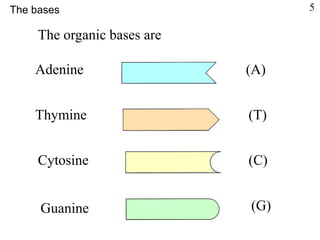
The organic bases are
Adenine (A)
Thymine (T)
Cytosine (C)
Guanine (G)
The bases 5
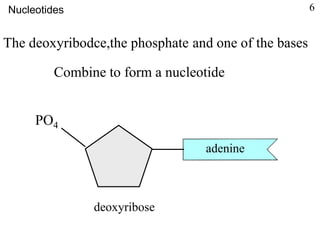
The deoxyribodce,the phosphate and one of the bases
adenine
deoxyribose
PO4
Combine to form a nucleotide
Nucleotides 6
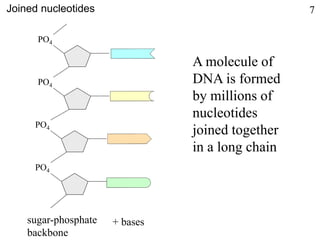
A molecule of
DNA is formed
by millions of
nucleotides
joined together
in a long chain
PO4
PO4
PO4
PO4
sugar-phosphate
backbone
+ bases
Joined nucleotides 7
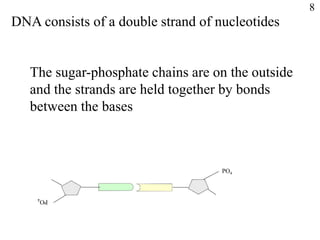
DNA consists of a double strand of nucleotides
The sugar-phosphate chains are on the outside
and the strands are held together by bonds
between the bases
8
PO4
PO
4
PO4
PO4
PO4
PO4
PO4
PO4
PO4
PO4
PO4
PO4
PO4
PO4
PO4
PO4
PO4
PO4
2-stranded DNA 9
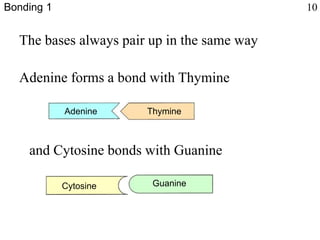
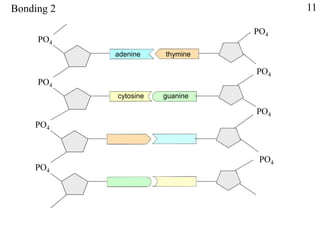
The bases always pair up in the same way
Adenine forms a bond with Thymine
and Cytosine bonds with Guanine
Bonding 1 10
Adenine Thymine
Cytosine Guanine
PO4
PO4
PO4
thymine
PO4
PO4
PO4
PO4
adenine
cytosine
PO4
guanine
Bonding 2 11
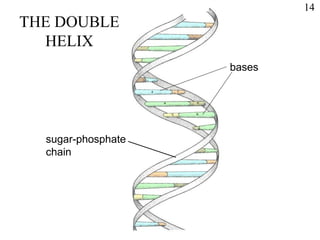
The paired strands are coiled into a spiral called
A DOUBLE HELIX
13
sugar-phosphate
chain
bases
THE DOUBLE
HELIX
14
STOP
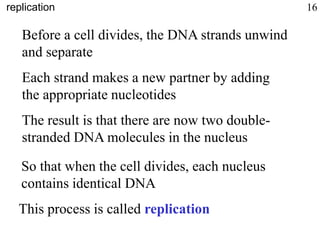
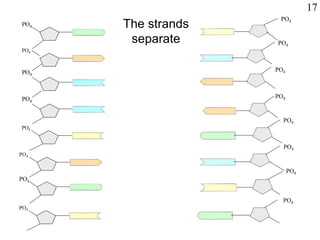
Before a cell divides, the DNA strands unwind
and separate
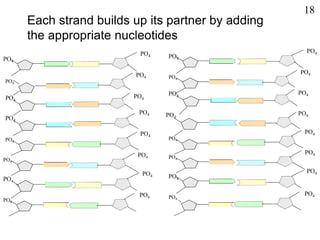
Each strand makes a new partner by adding
the appropriate nucleotides
The result is that there are now two double-
stranded DNA molecules in the nucleus
So that when the cell divides, each nucleus
contains identical DNA
This process is called replication
replication 16
PO4
PO4
PO4
PO4
PO4
PO4
PO4
PO4
PO4
PO4
PO4
PO4
PO4
PO4
PO4
PO4
The strands
separate
17
PO4
PO4
PO4
PO4
PO4
PO4
PO4
PO4
PO4
PO4
PO4
PO4
PO4
PO4
PO4
PO4
PO4
PO4
PO4
PO4
PO4
PO4
PO4
PO4
PO4
PO4
PO4
PO4
PO4
PO4
PO4
PO4
Each strand builds up its partner by adding
the appropriate nucleotides
18
The sequence of bases in DNA forms the
Genetic Code
A group of three bases (a triplet) controls
the production of a particular amino acid in
the cytoplasm of the cell
The different amino acids and the order in
which they are joined up determines the
sort of protein being produced
Genetic code 1 19
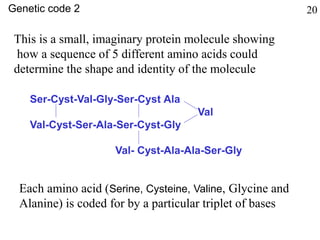
Ser-Cyst-Val-Gly-Ser-Cyst Ala
Val
Val-Cyst-Ser-Ala-Ser-Cyst-Gly
Val- Cyst-Ala-Ala-Ser-Gly
This is a small, imaginary protein molecule showing
how a sequence of 5 different amino acids could
determine the shape and identity of the molecule
Each amino acid (Serine, Cysteine, Valine, Glycine and
Alanine) is coded for by a particular triplet of bases
Genetic code 2 20
For example
Cytosine
Adenine Codes for Valine
Cytosine (C)
Guanine (G)
Adenine (A)
Codes for Alanine
Thymine
Coding 21
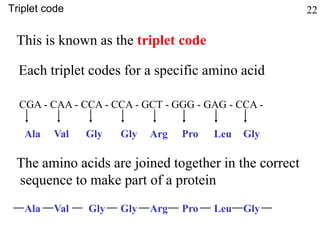
This is known as the triplet code
Each triplet codes for a specific amino acid
CGA - CAA - CCA - CCA - GCT - GGG - GAG - CCA -
Ala Val Gly Gly Arg Pro Leu Gly
The amino acids are joined together in the correct
sequence to make part of a protein
Triplet code 22
The proteins build the cell structures
They also make enzymes
The DNA controls which enzymes are made and
the enzymes determine what reactions take place
The structures and reactions in the cell determine
what sort of a cell it is and what its function is
So DNA exerts its control through the enzymes
DNA and enzymes 23
A sequence of triplets in the DNA molecule may
code for a complete protein
Such a sequence forms a gene
There may be a thousand or more bases in
one gene
Genes 24
Question 1
Which of the following are components of
nucleotides?
(a) deoxyribose
(b) amino acids
(c) phosphate
(d) enzymes
(e) organic bases
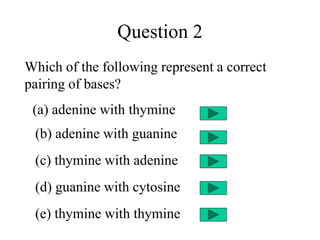
Question 2
Which of the following represent a correct
pairing of bases?
(a) adenine with thymine
(b) adenine with guanine
(c) thymine with adenine
(d) guanine with cytosine
(e) thymine with thymine
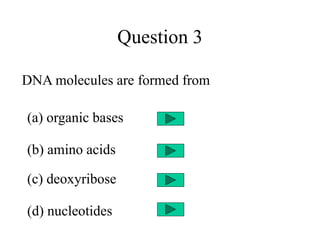
Question 3
DNA molecules are formed from
(a) organic bases
(b) amino acids
(c) deoxyribose
(d) nucleotides
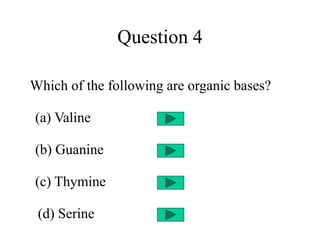
Question 4
Which of the following are organic bases?
(a) Valine
(b) Guanine
(c) Thymine
(d) Serine
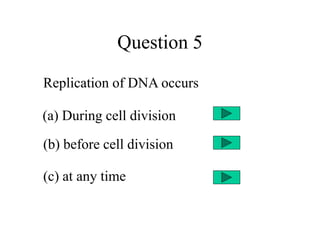
Question 5
Replication of DNA occurs
(a) During cell division
(b) before cell division
(c) at any time
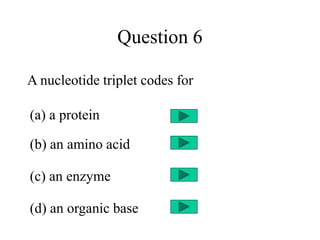
Question 6
A nucleotide triplet codes for
(a) a protein
(b) an amino acid
(c) an enzyme
(d) an organic base
Answer
CORRECT
Answer
INCORRECT

DNA structure