LAMBAYEQUE
CRADLE OF LIBERTY
LAMBAYEQUE: CRADLE OF LIBERTY

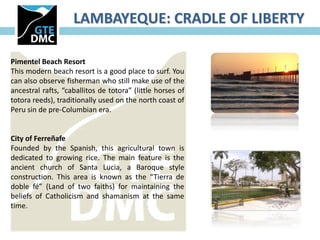
Pimentel Beach Resort
This modern beach resort is a good place to surf. You
can also observe fisherman who still make use of the
ancestral rafts, “caballitos de totora” (little horses of
totora reeds), traditionally used on the north coast of
Peru sin de pre-Columbian era.


City of Ferreñafe
Founded by the Spanish, this agricultural town is
dedicated to growing rice. The main feature is the
ancient church of Santa Lucia, a Baroque style
construction. This area is known as the “Tierra de
doble fé” (Land of two faiths) for maintaining the
beliefs of Catholicism and shamanism at the same
time.
LAMBAYEQUE: CRADLE OF LIBERTY

               Museo Nacional de Sicán
              (National Sicán Museum)
Sican or House of the Moon is a museum that
gathers objects from the research lead bye the
archeologist Izumi Shimada, director of the Sican
Archeological Proyect, for more than two decades.
The exhibition compiles the artifacts found in the site
digs of Batán Grande and demonstrates how they
were used or fabricated. The intention is to model
different aspects linked to the Sican culture through
the representation of the details of domestic life, the
manufacturing processes or production work. The
rooms represented excavated tomb and exhibit the
burial paraphernalia discovered there.
The museum also offers detailed information on the
excavation process and the site preservation, as well
as the chronology, development, trade networks,
economic activities, burial patterns, and cosmology
of the Sican or Lambayeque cultures.
LAMBAYEQUE: CRADLE OF LIBERTY

      Museo Nacional Tumbas Reales de Sipán
      (Royal Tombs of Sipán National Museum)
This modern architectural building houses the
collection of archeological objects of gold, silver and
copper found in tomb of the Lord of Sipan.
The museum is directed by the archeologist Walter
Alva, manager and director of the project, who was
also the discoverer of the tomb in the archeological
zone of the Huaca Rajada in the town of Sipan.
Among the many important pieces are earrings,
ceremonial scepters, medallions, heavy circular gold
ingot, nose rings, gold necklaces in the shape of
peanuts, a gold chin and cheek mask, gold back flap
and gold disks worn around the neck.
LAMBAYEQUE: CRADLE OF LIBERTY

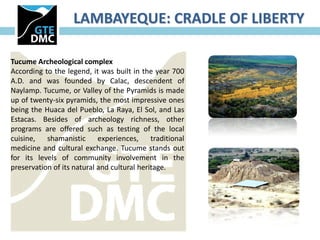
Tucume Archeological complex
According to the legend, it was built in the year 700
A.D. and was founded by Calac, descendent of
Naylamp. Tucume, or Valley of the Pyramids is made
up of twenty-six pyramids, the most impressive ones
being the Huaca del Pueblo, La Raya, El Sol, and Las
Estacas. Besides of archeology richness, other
programs are offered such as testing of the local
cuisine, shamanistic experiences, traditional
medicine and cultural exchange. Tucume stands out
for its levels of community involvement in the
preservation of its natural and cultural heritage.
LAMBAYEQUE: CRADLE OF LIBERTY

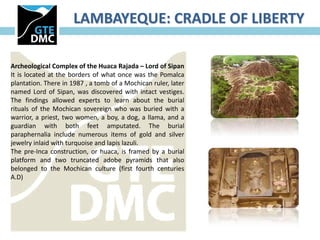
Archeological Complex of the Huaca Rajada – Lord of Sipan
It is located at the borders of what once was the Pomalca
plantation. There in 1987 , a tomb of a Mochican ruler, later
named Lord of Sipan, was discovered with intact vestiges.
The findings allowed experts to learn about the burial
rituals of the Mochican sovereign who was buried with a
warrior, a priest, two women, a boy, a dog, a llama, and a
guardian with both feet amputated. The burial
paraphernalia include numerous items of gold and silver
jewelry inlaid with turquoise and lapis lazuli.
The pre-Inca construction, or huaca, is framed by a burial
platform and two truncated adobe pyramids that also
belonged to the Mochican culture (first fourth centuries
A.D)
LAMBAYEQUE: CRADLE OF LIBERTY


               www.gte-dmc.com

               info@gte-dmc.com

51 1 244 6688 / 51 1 99811 0829 / 051 1 99503 9919

                   Lima - Peru

Dmc lambayeque

  • 1.
  • 2.
    LAMBAYEQUE: CRADLE OFLIBERTY Pimentel Beach Resort This modern beach resort is a good place to surf. You can also observe fisherman who still make use of the ancestral rafts, “caballitos de totora” (little horses of totora reeds), traditionally used on the north coast of Peru sin de pre-Columbian era. City of Ferreñafe Founded by the Spanish, this agricultural town is dedicated to growing rice. The main feature is the ancient church of Santa Lucia, a Baroque style construction. This area is known as the “Tierra de doble fé” (Land of two faiths) for maintaining the beliefs of Catholicism and shamanism at the same time.
  • 3.
    LAMBAYEQUE: CRADLE OFLIBERTY Museo Nacional de Sicán (National Sicán Museum) Sican or House of the Moon is a museum that gathers objects from the research lead bye the archeologist Izumi Shimada, director of the Sican Archeological Proyect, for more than two decades. The exhibition compiles the artifacts found in the site digs of Batán Grande and demonstrates how they were used or fabricated. The intention is to model different aspects linked to the Sican culture through the representation of the details of domestic life, the manufacturing processes or production work. The rooms represented excavated tomb and exhibit the burial paraphernalia discovered there. The museum also offers detailed information on the excavation process and the site preservation, as well as the chronology, development, trade networks, economic activities, burial patterns, and cosmology of the Sican or Lambayeque cultures.
  • 4.
    LAMBAYEQUE: CRADLE OFLIBERTY Museo Nacional Tumbas Reales de Sipán (Royal Tombs of Sipán National Museum) This modern architectural building houses the collection of archeological objects of gold, silver and copper found in tomb of the Lord of Sipan. The museum is directed by the archeologist Walter Alva, manager and director of the project, who was also the discoverer of the tomb in the archeological zone of the Huaca Rajada in the town of Sipan. Among the many important pieces are earrings, ceremonial scepters, medallions, heavy circular gold ingot, nose rings, gold necklaces in the shape of peanuts, a gold chin and cheek mask, gold back flap and gold disks worn around the neck.
  • 5.
    LAMBAYEQUE: CRADLE OFLIBERTY Tucume Archeological complex According to the legend, it was built in the year 700 A.D. and was founded by Calac, descendent of Naylamp. Tucume, or Valley of the Pyramids is made up of twenty-six pyramids, the most impressive ones being the Huaca del Pueblo, La Raya, El Sol, and Las Estacas. Besides of archeology richness, other programs are offered such as testing of the local cuisine, shamanistic experiences, traditional medicine and cultural exchange. Tucume stands out for its levels of community involvement in the preservation of its natural and cultural heritage.
  • 6.
    LAMBAYEQUE: CRADLE OFLIBERTY Archeological Complex of the Huaca Rajada – Lord of Sipan It is located at the borders of what once was the Pomalca plantation. There in 1987 , a tomb of a Mochican ruler, later named Lord of Sipan, was discovered with intact vestiges. The findings allowed experts to learn about the burial rituals of the Mochican sovereign who was buried with a warrior, a priest, two women, a boy, a dog, a llama, and a guardian with both feet amputated. The burial paraphernalia include numerous items of gold and silver jewelry inlaid with turquoise and lapis lazuli. The pre-Inca construction, or huaca, is framed by a burial platform and two truncated adobe pyramids that also belonged to the Mochican culture (first fourth centuries A.D)
  • 7.
    LAMBAYEQUE: CRADLE OFLIBERTY www.gte-dmc.com info@gte-dmc.com 51 1 244 6688 / 51 1 99811 0829 / 051 1 99503 9919 Lima - Peru