GRADES 1 to 12
DAILY LESSON LOG
School: Grade Level: IV
Teacher: File created by Sir BIENVINIDO C. CRUZ JR Learning Area: SCIENCE
Teaching Dates and
Time: OCTOBER 3 – 7, 2022 (WEEK 7) Quarter: 1ST QUARTER
MONDAY TUESDAY WEDNESDAY THURSDAY FRIDAY
I. OBJECTIVES .
A .Content Standards The learners demonstrate understanding of changes that materials undergo when exposed to certain conditions.
B .Performance Standards The learners should be able to evaluate whether the changes in materials are useful or harmful to one's environment
C. Learning Competencies/
Objectives
Write the LC code for each
Describe changes in properties of materials when conditions
such as temperature or when mixed with other materials
S4MT-Ig-h-6
Identify changes in materials whether useful or harmful to one’s environment
S4mT-Ii-j-7s
Identify changes in the materials that are useful or harmful to the environment.
Describe the harmful effects of the changes in the materials to the environment.
Suggest some ways of preventing the harmful effects of the changes in the materials to the
environment
II. CONTENT Lesson 13 : Changes in the Materials That are Useful or Harmful to One’s Environment
III. LEARNING RESOURCES
A. References
1. Teacher’s Guide pages pp. 59-60 59-60
2. Learner’s Materials pages pp.46-49 49-56
3. Textbook pages
4. Additional Materials from
Learning Resource (LR) portal
B. Other Learning Resources /
materials
Liquid materials LED tv, ppt, pictures
IV. PROCEDURES
A. Reviewing previous lesson or
presenting the new lesson
What happened to the solid materials when mixed with other
solid material?
*What happens to the solid
materials when mixed with the
other liquid materials?
What activity did we do
yesterday? Tell something
about it.
What are the changes in the
materials that are useful to the
environment? What made them
useful?
. What are the changes in the
materials that are harmful to
the environment? What made
them harmful?
B. Establishing a purpose for the
lesson
Bubble-making Activity (See TG, p.60) What are the things that we can get
from trees?
How can we make paper, coals
wood out of trees?
Today, we are going to do
perform another activity for
you to understand the harmful
effects of the changes in the
materials to the environment.
C. Presenting examples / instances
of the new lesson
*Where do bubbles come from?
*What materials were mixed to produce the bubbles?
Present some pictures of waste
materials like old newspapers,
cartons, metal scraps.
Can we still use the following
waste? What do we do to these
waste?
Show pictures of illegal logging,
dirty/illegal dumpsites, and
factories emitting smokes.
Are these activities good for
Mother Earth?
Let pupils apply their
understanding or show what
they can do to help prevent/
minimize the harmful effects of
the changes in the materials to
the environment
D. Discussing new concepts and
practicing new skills #1
Introduce the activity. See pp 46 of the LM for the group activity.
Lesson 12: Activity 3
Emphasize the precautionary measures before doing the activity.
-See pp 49-50 of the LM for the
group activity.
-Remind them of the precautionary
measures.
-See pp. 53-56 of the LM for
the activity.
-Have the pupils answer these
individually with the teacher’s
guidance.
Clarify misconceptions if needed
E. Discussing new concepts and
practicing new skills #2
Group Reporting and presentation of data.
What liquid materials mixed completely? What made this
happen?
What liquid materials did not mix completely? What made this
happen?
The teacher clarifies misconceptions.
- Group Reporting and presentation
of data.
- The teacher further explains the
lesson.
1. What are the changes in the
materials that are useful to the
environment? What made them
useful?
2. What are the changes in the
materials that are harmful to the
environment? What made them
harmful?
- The teacher further explains
the lesson.
- The teacher explains what the
each picture shows and its
harmful effect to the
environment
-Explain the concepts (5R’s of
Responsible Waste
Management) in “Remember
These”, p.54 of LM.
F. Developing Mastery
(Leads to Formative Assessment)
Explain the background information (pg 46of LM)
-Have the pupils master the concepts.
-Let the pupils show their own ways
of preventing/minimizing the
harmful effects of the changes in
the materials to the environment.
What can people do to
prevent/minimize the harmful
effect to the environment?
G. Finding practical application of
concepts and skills in daily living
When some liquid materials are combined with liquid, can we still
separate them?
Ask the pupils to give
examples of materials that are
useful/harmful to the
environment.
As a Grade 4 pupil, what simple
things can you do to avoid the
harmful effects of some waste
materials?
H. Making generalizations and
abstractions about the lesson
*What happens to the liquid materials when mixed with the
other liquid materials?
*What are the changes in the
materials that are useful and
harmful in our environment?
*What are the harmful effects
of the changes in the materials
in our environment?
Original File Submitted and
Formatted by DepEd Club
Member - visit depedclub.com
for more
I. Evaluating learning
Formative assessment may be done by considering the activity
output and/or the pupils participation during the discussion.
Tell whether the changes in the
following materials are useful or
harmful.
Which is being described by
the following situations? Write
REDUCE, REUSE, RECYCLE,
REPAIR, ROT.
The group performance in the
activity / task given
J. Additional activities for
application or remediation
List some liquid materials that mixed completely in liquid
materials
List examples of some changes in
the materials that are useful..
Draw some ways of minimizing
the harmful effects of the
materials in the environment.
Prepare for a performance
assessment.
V.REMARKS
VI.REFLECTION
A. No. of learners who
earned 80% in the
evaluation
___ of Learners who earned
80% above
___ of Learners who earned
80% above
___ of Learners who earned 80%
above
___ of Learners who earned 80%
above
___ of Learners who earned
80% above
B. No. of learners who
require additional
activities for
remediation who
scored below 80%
___ of Learners who require
additional activities for
remediation
___ of Learners who require
additional activities for
remediation
___ of Learners who require
additional activities for
remediation
___ of Learners who require
additional activities for
remediation
___ of Learners who require
additional activities for
remediation
C. Did the remedial
lessons work? No.
of learners who
have caught up
with the lesson
___Yes ___No
____ of Learners who caught
up the lesson
___Yes ___No
____ of Learners who caught up
the lesson
___Yes ___No
____ of Learners who caught up
the lesson
___Yes ___No
____ of Learners who caught up
the lesson
___Yes ___No
____ of Learners who caught up
the lesson
D. No. of learners who
continue to require
remediation
___ of Learners who
continue to require
remediation
___ of Learners who continue
to require remediation
___ of Learners who continue to
require remediation
___ of Learners who continue to
require remediation
___ of Learners who continue
to require remediation
E. Which of my
teaching strategies
worked well? Why
did these work?
Strategies used that work
well:
___ Group collaboration
___ Games
___ Power Point Presentation
___ Answering preliminary
activities/exercises
___ Discussion
___ Case Method
___ Think-Pair-Share (TPS)
___ Rereading of Paragraphs/
Poems/Stories
___ Differentiated Instruction
___ Role Playing/Drama
___ Discovery Method
___ Lecture Method
Why?
___ Complete IMs
___ Availability of Materials
___ Pupils’ eagerness to learn
___ Group member’s
Cooperation in doing their
tasks
Strategies used that work well:
___ Group collaboration
___ Games
___ Power Point Presentation
___ Answering preliminary
activities/exercises
___ Discussion
___ Case Method
___ Think-Pair-Share (TPS)
___ Rereading of Paragraphs/
Poems/Stories
___ Differentiated Instruction
___ Role Playing/Drama
___ Discovery Method
___ Lecture Method
Why?
___ Complete IMs
___ Availability of Materials
___ Pupils’ eagerness to learn
___ Group member’s
Cooperation in doing their
tasks
Strategies used that work well:
___ Group collaboration
___ Games
___ Power Point Presentation
___ Answering preliminary
activities/exercises
___ Discussion
___ Case Method
___ Think-Pair-Share (TPS)
___ Rereading of Paragraphs/
Poems/Stories
___ Differentiated Instruction
___ Role Playing/Drama
___ Discovery Method
___ Lecture Method
Why?
___ Complete IMs
___ Availability of Materials
___ Pupils’ eagerness to learn
___ Group member’s
Cooperation in doing their
tasks
Strategies used that work well:
___ Group collaboration
___ Games
___ Power Point Presentation
___ Answering preliminary
activities/exercises
___ Discussion
___ Case Method
___ Think-Pair-Share (TPS)
___ Rereading of Paragraphs/
Poems/Stories
___ Differentiated Instruction
___ Role Playing/Drama
___ Discovery Method
___ Lecture Method
Why?
___ Complete IMs
___ Availability of Materials
___ Pupils’ eagerness to learn
___ Group member’s
Cooperation in doing their
tasks
Strategies used that work well:
___ Group collaboration
___ Games
___ Power Point Presentation
___ Answering preliminary
activities/exercises
___ Discussion
___ Case Method
___ Think-Pair-Share (TPS)
___ Rereading of Paragraphs/
Poems/Stories
___ Differentiated Instruction
___ Role Playing/Drama
___ Discovery Method
___ Lecture Method
Why?
___ Complete IMs
___ Availability of Materials
___ Pupils’ eagerness to learn
___ Group member’s
Cooperation in doing their
tasks
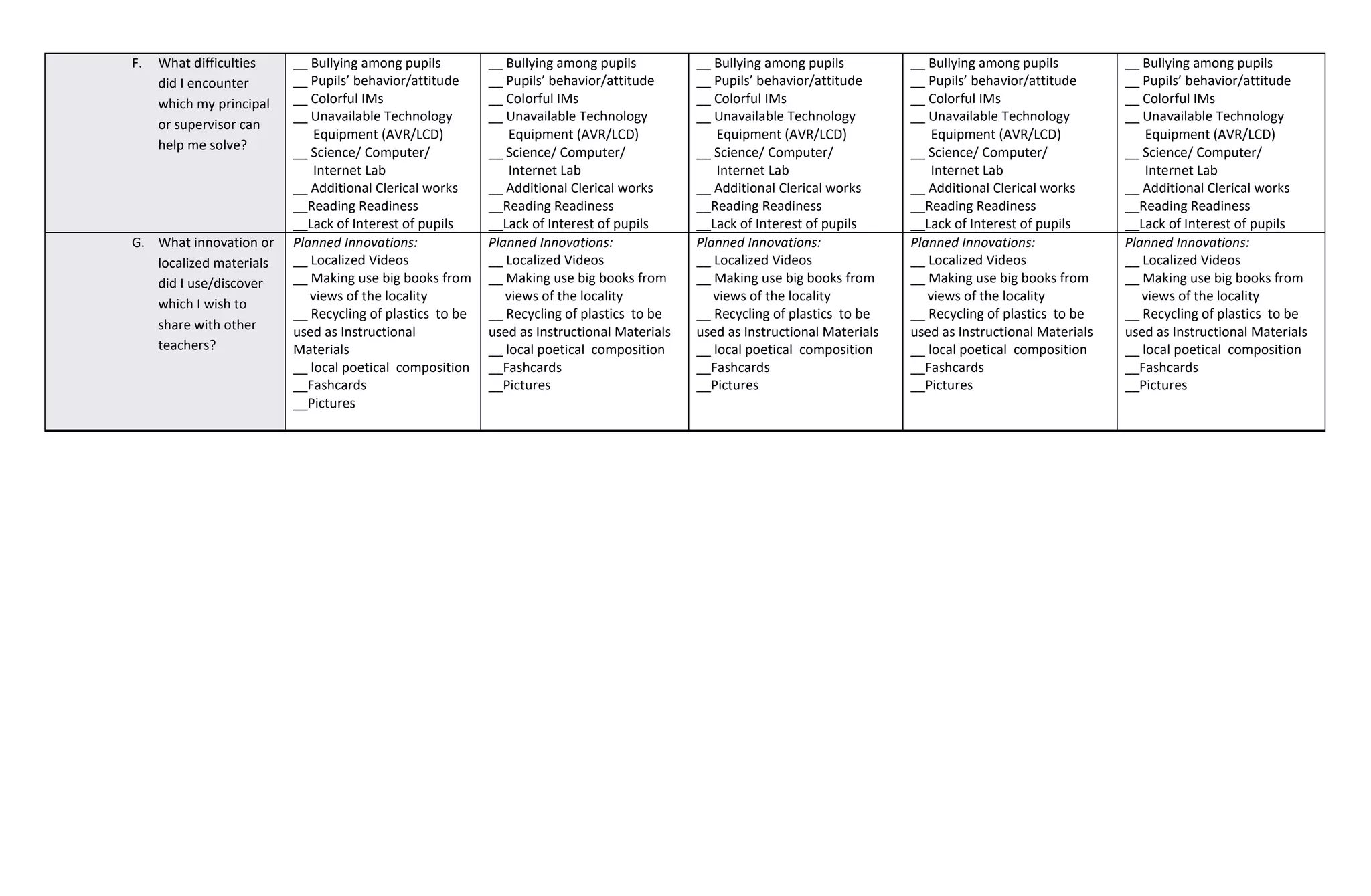
F. What difficulties
did I encounter
which my principal
or supervisor can
help me solve?
__ Bullying among pupils
__ Pupils’ behavior/attitude
__ Colorful IMs
__ Unavailable Technology
Equipment (AVR/LCD)
__ Science/ Computer/
Internet Lab
__ Additional Clerical works
__Reading Readiness
__Lack of Interest of pupils
__ Bullying among pupils
__ Pupils’ behavior/attitude
__ Colorful IMs
__ Unavailable Technology
Equipment (AVR/LCD)
__ Science/ Computer/
Internet Lab
__ Additional Clerical works
__Reading Readiness
__Lack of Interest of pupils
__ Bullying among pupils
__ Pupils’ behavior/attitude
__ Colorful IMs
__ Unavailable Technology
Equipment (AVR/LCD)
__ Science/ Computer/
Internet Lab
__ Additional Clerical works
__Reading Readiness
__Lack of Interest of pupils
__ Bullying among pupils
__ Pupils’ behavior/attitude
__ Colorful IMs
__ Unavailable Technology
Equipment (AVR/LCD)
__ Science/ Computer/
Internet Lab
__ Additional Clerical works
__Reading Readiness
__Lack of Interest of pupils
__ Bullying among pupils
__ Pupils’ behavior/attitude
__ Colorful IMs
__ Unavailable Technology
Equipment (AVR/LCD)
__ Science/ Computer/
Internet Lab
__ Additional Clerical works
__Reading Readiness
__Lack of Interest of pupils
G. What innovation or
localized materials
did I use/discover
which I wish to
share with other
teachers?
Planned Innovations:
__ Localized Videos
__ Making use big books from
views of the locality
__ Recycling of plastics to be
used as Instructional
Materials
__ local poetical composition
__Fashcards
__Pictures
Planned Innovations:
__ Localized Videos
__ Making use big books from
views of the locality
__ Recycling of plastics to be
used as Instructional Materials
__ local poetical composition
__Fashcards
__Pictures
Planned Innovations:
__ Localized Videos
__ Making use big books from
views of the locality
__ Recycling of plastics to be
used as Instructional Materials
__ local poetical composition
__Fashcards
__Pictures
Planned Innovations:
__ Localized Videos
__ Making use big books from
views of the locality
__ Recycling of plastics to be
used as Instructional Materials
__ local poetical composition
__Fashcards
__Pictures
Planned Innovations:
__ Localized Videos
__ Making use big books from
views of the locality
__ Recycling of plastics to be
used as Instructional Materials
__ local poetical composition
__Fashcards
__Pictures

DLL_SCIENCE 4_Q1_W7.docx

  • 1.
    GRADES 1 to12 DAILY LESSON LOG School: Grade Level: IV Teacher: File created by Sir BIENVINIDO C. CRUZ JR Learning Area: SCIENCE Teaching Dates and Time: OCTOBER 3 – 7, 2022 (WEEK 7) Quarter: 1ST QUARTER MONDAY TUESDAY WEDNESDAY THURSDAY FRIDAY I. OBJECTIVES . A .Content Standards The learners demonstrate understanding of changes that materials undergo when exposed to certain conditions. B .Performance Standards The learners should be able to evaluate whether the changes in materials are useful or harmful to one's environment C. Learning Competencies/ Objectives Write the LC code for each Describe changes in properties of materials when conditions such as temperature or when mixed with other materials S4MT-Ig-h-6 Identify changes in materials whether useful or harmful to one’s environment S4mT-Ii-j-7s Identify changes in the materials that are useful or harmful to the environment. Describe the harmful effects of the changes in the materials to the environment. Suggest some ways of preventing the harmful effects of the changes in the materials to the environment II. CONTENT Lesson 13 : Changes in the Materials That are Useful or Harmful to One’s Environment III. LEARNING RESOURCES A. References 1. Teacher’s Guide pages pp. 59-60 59-60 2. Learner’s Materials pages pp.46-49 49-56 3. Textbook pages 4. Additional Materials from Learning Resource (LR) portal B. Other Learning Resources / materials Liquid materials LED tv, ppt, pictures IV. PROCEDURES A. Reviewing previous lesson or presenting the new lesson What happened to the solid materials when mixed with other solid material? *What happens to the solid materials when mixed with the other liquid materials? What activity did we do yesterday? Tell something about it. What are the changes in the materials that are useful to the environment? What made them useful? . What are the changes in the materials that are harmful to the environment? What made them harmful? B. Establishing a purpose for the lesson Bubble-making Activity (See TG, p.60) What are the things that we can get from trees? How can we make paper, coals wood out of trees? Today, we are going to do perform another activity for you to understand the harmful effects of the changes in the materials to the environment.
  • 2.
    C. Presenting examples/ instances of the new lesson *Where do bubbles come from? *What materials were mixed to produce the bubbles? Present some pictures of waste materials like old newspapers, cartons, metal scraps. Can we still use the following waste? What do we do to these waste? Show pictures of illegal logging, dirty/illegal dumpsites, and factories emitting smokes. Are these activities good for Mother Earth? Let pupils apply their understanding or show what they can do to help prevent/ minimize the harmful effects of the changes in the materials to the environment D. Discussing new concepts and practicing new skills #1 Introduce the activity. See pp 46 of the LM for the group activity. Lesson 12: Activity 3 Emphasize the precautionary measures before doing the activity. -See pp 49-50 of the LM for the group activity. -Remind them of the precautionary measures. -See pp. 53-56 of the LM for the activity. -Have the pupils answer these individually with the teacher’s guidance. Clarify misconceptions if needed E. Discussing new concepts and practicing new skills #2 Group Reporting and presentation of data. What liquid materials mixed completely? What made this happen? What liquid materials did not mix completely? What made this happen? The teacher clarifies misconceptions. - Group Reporting and presentation of data. - The teacher further explains the lesson. 1. What are the changes in the materials that are useful to the environment? What made them useful? 2. What are the changes in the materials that are harmful to the environment? What made them harmful? - The teacher further explains the lesson. - The teacher explains what the each picture shows and its harmful effect to the environment -Explain the concepts (5R’s of Responsible Waste Management) in “Remember These”, p.54 of LM. F. Developing Mastery (Leads to Formative Assessment) Explain the background information (pg 46of LM) -Have the pupils master the concepts. -Let the pupils show their own ways of preventing/minimizing the harmful effects of the changes in the materials to the environment. What can people do to prevent/minimize the harmful effect to the environment? G. Finding practical application of concepts and skills in daily living When some liquid materials are combined with liquid, can we still separate them? Ask the pupils to give examples of materials that are useful/harmful to the environment. As a Grade 4 pupil, what simple things can you do to avoid the harmful effects of some waste materials? H. Making generalizations and abstractions about the lesson *What happens to the liquid materials when mixed with the other liquid materials? *What are the changes in the materials that are useful and harmful in our environment? *What are the harmful effects of the changes in the materials in our environment? Original File Submitted and Formatted by DepEd Club Member - visit depedclub.com for more I. Evaluating learning Formative assessment may be done by considering the activity output and/or the pupils participation during the discussion. Tell whether the changes in the following materials are useful or harmful. Which is being described by the following situations? Write REDUCE, REUSE, RECYCLE, REPAIR, ROT. The group performance in the activity / task given J. Additional activities for application or remediation List some liquid materials that mixed completely in liquid materials List examples of some changes in the materials that are useful.. Draw some ways of minimizing the harmful effects of the materials in the environment. Prepare for a performance assessment.
  • 3.
    V.REMARKS VI.REFLECTION A. No. oflearners who earned 80% in the evaluation ___ of Learners who earned 80% above ___ of Learners who earned 80% above ___ of Learners who earned 80% above ___ of Learners who earned 80% above ___ of Learners who earned 80% above B. No. of learners who require additional activities for remediation who scored below 80% ___ of Learners who require additional activities for remediation ___ of Learners who require additional activities for remediation ___ of Learners who require additional activities for remediation ___ of Learners who require additional activities for remediation ___ of Learners who require additional activities for remediation C. Did the remedial lessons work? No. of learners who have caught up with the lesson ___Yes ___No ____ of Learners who caught up the lesson ___Yes ___No ____ of Learners who caught up the lesson ___Yes ___No ____ of Learners who caught up the lesson ___Yes ___No ____ of Learners who caught up the lesson ___Yes ___No ____ of Learners who caught up the lesson D. No. of learners who continue to require remediation ___ of Learners who continue to require remediation ___ of Learners who continue to require remediation ___ of Learners who continue to require remediation ___ of Learners who continue to require remediation ___ of Learners who continue to require remediation E. Which of my teaching strategies worked well? Why did these work? Strategies used that work well: ___ Group collaboration ___ Games ___ Power Point Presentation ___ Answering preliminary activities/exercises ___ Discussion ___ Case Method ___ Think-Pair-Share (TPS) ___ Rereading of Paragraphs/ Poems/Stories ___ Differentiated Instruction ___ Role Playing/Drama ___ Discovery Method ___ Lecture Method Why? ___ Complete IMs ___ Availability of Materials ___ Pupils’ eagerness to learn ___ Group member’s Cooperation in doing their tasks Strategies used that work well: ___ Group collaboration ___ Games ___ Power Point Presentation ___ Answering preliminary activities/exercises ___ Discussion ___ Case Method ___ Think-Pair-Share (TPS) ___ Rereading of Paragraphs/ Poems/Stories ___ Differentiated Instruction ___ Role Playing/Drama ___ Discovery Method ___ Lecture Method Why? ___ Complete IMs ___ Availability of Materials ___ Pupils’ eagerness to learn ___ Group member’s Cooperation in doing their tasks Strategies used that work well: ___ Group collaboration ___ Games ___ Power Point Presentation ___ Answering preliminary activities/exercises ___ Discussion ___ Case Method ___ Think-Pair-Share (TPS) ___ Rereading of Paragraphs/ Poems/Stories ___ Differentiated Instruction ___ Role Playing/Drama ___ Discovery Method ___ Lecture Method Why? ___ Complete IMs ___ Availability of Materials ___ Pupils’ eagerness to learn ___ Group member’s Cooperation in doing their tasks Strategies used that work well: ___ Group collaboration ___ Games ___ Power Point Presentation ___ Answering preliminary activities/exercises ___ Discussion ___ Case Method ___ Think-Pair-Share (TPS) ___ Rereading of Paragraphs/ Poems/Stories ___ Differentiated Instruction ___ Role Playing/Drama ___ Discovery Method ___ Lecture Method Why? ___ Complete IMs ___ Availability of Materials ___ Pupils’ eagerness to learn ___ Group member’s Cooperation in doing their tasks Strategies used that work well: ___ Group collaboration ___ Games ___ Power Point Presentation ___ Answering preliminary activities/exercises ___ Discussion ___ Case Method ___ Think-Pair-Share (TPS) ___ Rereading of Paragraphs/ Poems/Stories ___ Differentiated Instruction ___ Role Playing/Drama ___ Discovery Method ___ Lecture Method Why? ___ Complete IMs ___ Availability of Materials ___ Pupils’ eagerness to learn ___ Group member’s Cooperation in doing their tasks
  • 4.
    F. What difficulties didI encounter which my principal or supervisor can help me solve? __ Bullying among pupils __ Pupils’ behavior/attitude __ Colorful IMs __ Unavailable Technology Equipment (AVR/LCD) __ Science/ Computer/ Internet Lab __ Additional Clerical works __Reading Readiness __Lack of Interest of pupils __ Bullying among pupils __ Pupils’ behavior/attitude __ Colorful IMs __ Unavailable Technology Equipment (AVR/LCD) __ Science/ Computer/ Internet Lab __ Additional Clerical works __Reading Readiness __Lack of Interest of pupils __ Bullying among pupils __ Pupils’ behavior/attitude __ Colorful IMs __ Unavailable Technology Equipment (AVR/LCD) __ Science/ Computer/ Internet Lab __ Additional Clerical works __Reading Readiness __Lack of Interest of pupils __ Bullying among pupils __ Pupils’ behavior/attitude __ Colorful IMs __ Unavailable Technology Equipment (AVR/LCD) __ Science/ Computer/ Internet Lab __ Additional Clerical works __Reading Readiness __Lack of Interest of pupils __ Bullying among pupils __ Pupils’ behavior/attitude __ Colorful IMs __ Unavailable Technology Equipment (AVR/LCD) __ Science/ Computer/ Internet Lab __ Additional Clerical works __Reading Readiness __Lack of Interest of pupils G. What innovation or localized materials did I use/discover which I wish to share with other teachers? Planned Innovations: __ Localized Videos __ Making use big books from views of the locality __ Recycling of plastics to be used as Instructional Materials __ local poetical composition __Fashcards __Pictures Planned Innovations: __ Localized Videos __ Making use big books from views of the locality __ Recycling of plastics to be used as Instructional Materials __ local poetical composition __Fashcards __Pictures Planned Innovations: __ Localized Videos __ Making use big books from views of the locality __ Recycling of plastics to be used as Instructional Materials __ local poetical composition __Fashcards __Pictures Planned Innovations: __ Localized Videos __ Making use big books from views of the locality __ Recycling of plastics to be used as Instructional Materials __ local poetical composition __Fashcards __Pictures Planned Innovations: __ Localized Videos __ Making use big books from views of the locality __ Recycling of plastics to be used as Instructional Materials __ local poetical composition __Fashcards __Pictures