derbyshire.greatbritishlife.co.uk56 DERBYSHIRE LIFE May 2013
‘I
t’s controlled aggression – it
allows you to attack people
with swords without getting
arrested!’ 15-year-old Will
Taylor is not a teenage gang
member. He’s a bright, articulate student
and founder member of his school’s
fencing team. In fact, with plans to study
Law and Criminology next year, you’ll be
much more likely to find him wearing a
barrister’s wig than in the dock.
Will’s story is remarkable on two
counts. First, he’s partially sighted.
Second, he attends one of Derbyshire’s
smaller state schools, which is more than
20 miles from the nearest swimming pool
or athletics track. But he hasn’t let either
circumstance stop him.
In the classroom his restricted vision
means he needs enlarged versions of
schoolwork and text books and support
from a teaching assistant for reading from
the board. On the fencing piste Will opts
for the biggest weapon – the sabre,
originally used on horse back for slashing
the head off your opponent’s steed.
‘Being partially sighted makes it more
difficult for things like blade control and
being accurate with lunges but that’s why
I enjoy sabre more than epée or foil –
because you don’t have to be as accurate
you can go a bit wild with the sword!’
Watching ‘Pirates of the Caribbean’
inspired Will to badger School Sport Co-
ordinator, Mrs Ruth Cook, to re-establish
the school’s fencing club which had sadly
folded. Will and his fellow students Seren
and Connor took the matter to student
council and set up a training day run by
his Manchester club coach, Stuart
Marshall. As a clever piece of PR, Will
staged a fight at the school talent show
between students and teachers asking
headteacher Mr Bernie Hunter and
science teachers Mr Thomas and Miss
Dainty if they wouldn’t mind being
‘beaten up on stage’. The club now has 15
members including Joe Bell who fences
from his wheelchair.
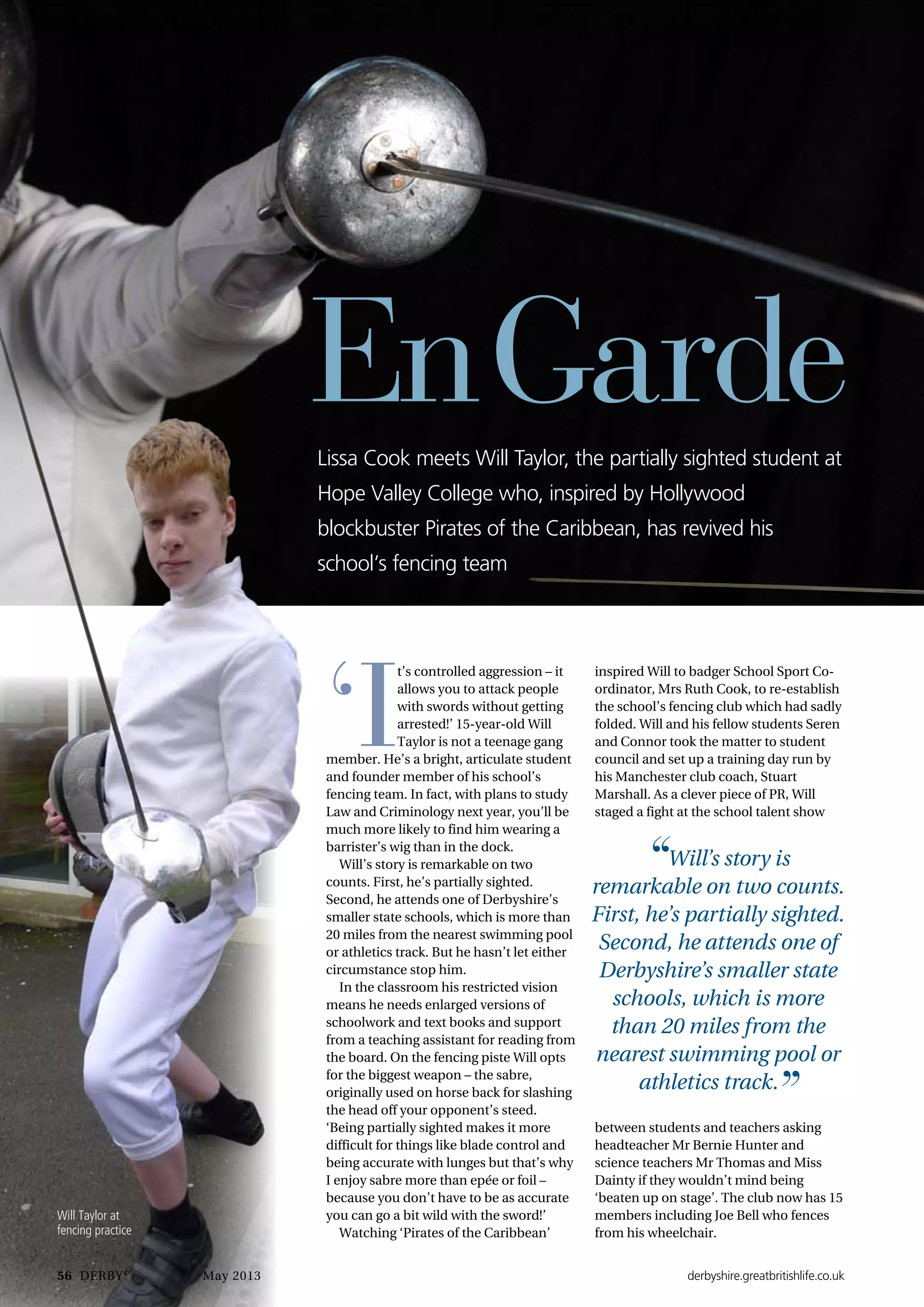
EnGardeLissa Cook meets Will Taylor, the partially sighted student at
Hope Valley College who, inspired by Hollywood
blockbuster Pirates of the Caribbean, has revived his
school’s fencing team
“Will’s story is
remarkable on two counts.
First, he’s partially sighted.
Second, he attends one of
Derbyshire’s smaller state
schools, which is more
than 20 miles from the
nearest swimming pool or
athletics track.
”
Will Taylor at
fencing practice
derbyshire.greatbritishlife.co.uk DERBYSHIRE LIFE May 2013 57
What’s the secret of Will’s success at
Hope Valley? After all, in addition to an
active fencing club the school also boasts
a climbing wall and what’s more Mr
Hunter believes they are the only state
school in the country with an onsite
mountain bike track. All good schools of
course rely on the support of the Parent
Teacher Association and local
community. For example the climbing
wall was bought with the help of Hope
Valley’s cement works Lafarge.
Another key is being responsive to
student demands. Mrs Cook explains the
vision: ‘It’s really important, it’s part of
our ethos that we listen to our Student
Voice and accommodate what we can. It’s
often difficult to find coaches because of
our rural location but we’re very inclusive
and we like to include a lot of alternative
sports here like climbing, fencing and
OzBox and we have a fitness suite as well
as the mountain bike track.’
But perhaps what many parents are
unaware of is that Hope Valley College is
part of a wider network – the Rural
Derbyshire School Sport Partnership.
Partnership Development Manager
Janice Price, based at Anthony Gell in
Wirksworth, works with five School Sports
Coordinators, like Mrs Cook, each based
in a ‘hub’ secondary school. Each hub
links to a cluster of around a dozen
primary and infant schools (64 in
total) stretching all the way from
Edale down to Sudbury 50 miles
further south. By pooling resources,
building links with community clubs
and training older students to coach
younger pupils the partnership runs a
programme of inter-school
competitions and after-school activities
that would otherwise be out of the reach
of many of the smallest, most remote
schools.
Mr Hunter says, ‘Many of our
primaries are chocolate box
schools in very small
communities. In terms of
specialist PE provision we
are fundamentally their
prime link so our ability
to support them is
critical.’ The afternoon
of my visit for example
Mrs Cook was rushing off
with pupils from Bamford
Primary School to take part
in the athletics competition
at Queen Elizabeth’s
Grammar School in
Ashbourne. Janice Price sums it
up: ‘Last term alone in rural
Derbyshire 111 primaries took
part in 18 primary school
competitions in nine
Top centre: Fencing Club member Joe Bell
Top right: Hope Valley College fencing club
Above: Will Taylor at fencing practice
derbyshire.greatbritishlife.co.uk58 DERBYSHIRE LIFE May 2013
different sports. That means a grand total
of 1,813 pupils taking part in sport.’
The sad reality is that one in every ten
children starting primary school in
Derbyshire is not just overweight but
already obese. By the time they leave that
figure has doubled to nearly one in five
(18 per cent). Baroness Sue Campbell,
chair of the Youth Sport Trust, warned
recently in a newspaper interview of a
generation blighted by physical illiteracy:
‘Some secondary school teachers have
11-year-old pupils who hardly move.
They can’t catch, throw, jump or run – the
fundamental basic movements of every
sport.’
It’s not just about physical fitness – it’s
also about teaching vital life skills and
values like inclusivity and leadership, says
Mr Hunter: ‘When Will’s team mate Joe
Bell is seen in the corridor and it’s clear to
everyone that he is overcoming
enormous obstacles to achieve, that’s got
to have an inspirational spin-off for other
youngsters who are too inclined to give in
to the smallest obstacles.’
‘When our students go back as a
graduate to coach in their primary school
that really sends a powerful message but
it also gives students self esteem – a real
lift. It can only lay the early seeds that
there are more ways of being involved in
sport than just by direct participation in
team sports.’ Janice Price quantifies their
contribution: ‘Last term the RDSSP
trained 328 secondary school Young
Sports Leaders. Each gave 3.5
volunteering hours to support those 18
primary school competitions. Combined
that’s a massive 1,148 volunteering
hours.’
Will Taylor agrees: ‘Sport’s also
mentally beneficial because it gives you
the confidence to say actually I can
probably do this. You obviously need self-
confidence for public speaking to do law.’
Will’s self-belief is evident. Not only has
he got the fencing club up and running
and is busy with exams but he also stood
in the school’s mock elections and has a
very honourable mentor in the form of
Home Secretary David Blunkett who
visited the school after Will wrote to him.
I’ll leave the last word to Will. ‘Making
sure that everyone is equal is an
important thing and I‘d like the numbers
of people and diversity to increase within
fencing because it shows no matter what
your difficulty – if
you’re physically
impaired you can
still give it a go
and it doesn’t
stop you.’ n
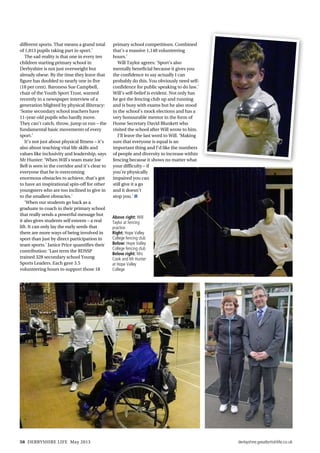
Above right: Will
Taylor at fencing
practice
Right: Hope Valley
College fencing club
Below: Hope Valley
College fencing club
Below right: Mrs
Cook and Mr Hunter
at Hope Valley
College

d-life-may-will-taylor

  • 1.
    derbyshire.greatbritishlife.co.uk56 DERBYSHIRE LIFEMay 2013 ‘I t’s controlled aggression – it allows you to attack people with swords without getting arrested!’ 15-year-old Will Taylor is not a teenage gang member. He’s a bright, articulate student and founder member of his school’s fencing team. In fact, with plans to study Law and Criminology next year, you’ll be much more likely to find him wearing a barrister’s wig than in the dock. Will’s story is remarkable on two counts. First, he’s partially sighted. Second, he attends one of Derbyshire’s smaller state schools, which is more than 20 miles from the nearest swimming pool or athletics track. But he hasn’t let either circumstance stop him. In the classroom his restricted vision means he needs enlarged versions of schoolwork and text books and support from a teaching assistant for reading from the board. On the fencing piste Will opts for the biggest weapon – the sabre, originally used on horse back for slashing the head off your opponent’s steed. ‘Being partially sighted makes it more difficult for things like blade control and being accurate with lunges but that’s why I enjoy sabre more than epée or foil – because you don’t have to be as accurate you can go a bit wild with the sword!’ Watching ‘Pirates of the Caribbean’ inspired Will to badger School Sport Co- ordinator, Mrs Ruth Cook, to re-establish the school’s fencing club which had sadly folded. Will and his fellow students Seren and Connor took the matter to student council and set up a training day run by his Manchester club coach, Stuart Marshall. As a clever piece of PR, Will staged a fight at the school talent show between students and teachers asking headteacher Mr Bernie Hunter and science teachers Mr Thomas and Miss Dainty if they wouldn’t mind being ‘beaten up on stage’. The club now has 15 members including Joe Bell who fences from his wheelchair. EnGardeLissa Cook meets Will Taylor, the partially sighted student at Hope Valley College who, inspired by Hollywood blockbuster Pirates of the Caribbean, has revived his school’s fencing team “Will’s story is remarkable on two counts. First, he’s partially sighted. Second, he attends one of Derbyshire’s smaller state schools, which is more than 20 miles from the nearest swimming pool or athletics track. ” Will Taylor at fencing practice
  • 2.
    derbyshire.greatbritishlife.co.uk DERBYSHIRE LIFEMay 2013 57 What’s the secret of Will’s success at Hope Valley? After all, in addition to an active fencing club the school also boasts a climbing wall and what’s more Mr Hunter believes they are the only state school in the country with an onsite mountain bike track. All good schools of course rely on the support of the Parent Teacher Association and local community. For example the climbing wall was bought with the help of Hope Valley’s cement works Lafarge. Another key is being responsive to student demands. Mrs Cook explains the vision: ‘It’s really important, it’s part of our ethos that we listen to our Student Voice and accommodate what we can. It’s often difficult to find coaches because of our rural location but we’re very inclusive and we like to include a lot of alternative sports here like climbing, fencing and OzBox and we have a fitness suite as well as the mountain bike track.’ But perhaps what many parents are unaware of is that Hope Valley College is part of a wider network – the Rural Derbyshire School Sport Partnership. Partnership Development Manager Janice Price, based at Anthony Gell in Wirksworth, works with five School Sports Coordinators, like Mrs Cook, each based in a ‘hub’ secondary school. Each hub links to a cluster of around a dozen primary and infant schools (64 in total) stretching all the way from Edale down to Sudbury 50 miles further south. By pooling resources, building links with community clubs and training older students to coach younger pupils the partnership runs a programme of inter-school competitions and after-school activities that would otherwise be out of the reach of many of the smallest, most remote schools. Mr Hunter says, ‘Many of our primaries are chocolate box schools in very small communities. In terms of specialist PE provision we are fundamentally their prime link so our ability to support them is critical.’ The afternoon of my visit for example Mrs Cook was rushing off with pupils from Bamford Primary School to take part in the athletics competition at Queen Elizabeth’s Grammar School in Ashbourne. Janice Price sums it up: ‘Last term alone in rural Derbyshire 111 primaries took part in 18 primary school competitions in nine Top centre: Fencing Club member Joe Bell Top right: Hope Valley College fencing club Above: Will Taylor at fencing practice
  • 3.
    derbyshire.greatbritishlife.co.uk58 DERBYSHIRE LIFEMay 2013 different sports. That means a grand total of 1,813 pupils taking part in sport.’ The sad reality is that one in every ten children starting primary school in Derbyshire is not just overweight but already obese. By the time they leave that figure has doubled to nearly one in five (18 per cent). Baroness Sue Campbell, chair of the Youth Sport Trust, warned recently in a newspaper interview of a generation blighted by physical illiteracy: ‘Some secondary school teachers have 11-year-old pupils who hardly move. They can’t catch, throw, jump or run – the fundamental basic movements of every sport.’ It’s not just about physical fitness – it’s also about teaching vital life skills and values like inclusivity and leadership, says Mr Hunter: ‘When Will’s team mate Joe Bell is seen in the corridor and it’s clear to everyone that he is overcoming enormous obstacles to achieve, that’s got to have an inspirational spin-off for other youngsters who are too inclined to give in to the smallest obstacles.’ ‘When our students go back as a graduate to coach in their primary school that really sends a powerful message but it also gives students self esteem – a real lift. It can only lay the early seeds that there are more ways of being involved in sport than just by direct participation in team sports.’ Janice Price quantifies their contribution: ‘Last term the RDSSP trained 328 secondary school Young Sports Leaders. Each gave 3.5 volunteering hours to support those 18 primary school competitions. Combined that’s a massive 1,148 volunteering hours.’ Will Taylor agrees: ‘Sport’s also mentally beneficial because it gives you the confidence to say actually I can probably do this. You obviously need self- confidence for public speaking to do law.’ Will’s self-belief is evident. Not only has he got the fencing club up and running and is busy with exams but he also stood in the school’s mock elections and has a very honourable mentor in the form of Home Secretary David Blunkett who visited the school after Will wrote to him. I’ll leave the last word to Will. ‘Making sure that everyone is equal is an important thing and I‘d like the numbers of people and diversity to increase within fencing because it shows no matter what your difficulty – if you’re physically impaired you can still give it a go and it doesn’t stop you.’ n Above right: Will Taylor at fencing practice Right: Hope Valley College fencing club Below: Hope Valley College fencing club Below right: Mrs Cook and Mr Hunter at Hope Valley College