IOT AND ML BASED EARLY DETECTION AND
MONITORING OF PARKINSON’S DISEASE
Group - 29
Under the supervision of - Dr. Biswajit Ghosh
Presented By
Ritesh Kumar Shaw (13000220104)
Ambarish Adak (13000220105)
Promita Agasty(13000220110)
Abhisekh Kumar Gupta(13000320018)
OBJECTIVE
● To develop a system which can detect parkinson at its earliest
stage to slow down the progression of disease.
● To track disease progression and assess the effectiveness of
treatment.
● To improve access to care for PD patients in underserved areas
or those with limited mobility.
● To develop IoT-based PD detection systems that are more cost-
effective than traditional diagnostic methods.
PROBLEM STATEMENT
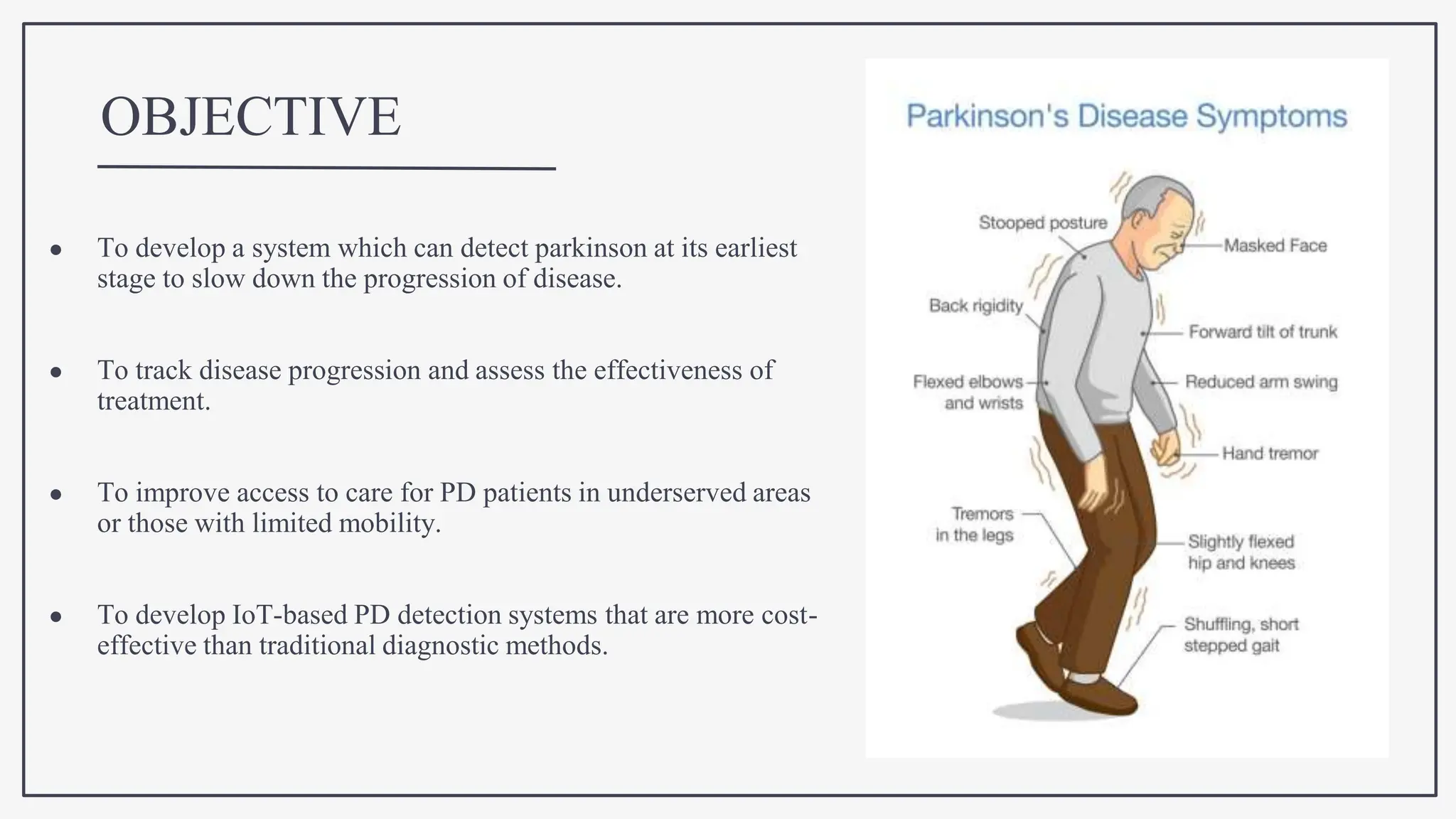
IoT sensors can be used to measure
movement patterns, such as tremors, rigidity,
and bradykinesia, which are characteristic
symptoms of PD.
Detecting Parkinson’s with the help of
IoT and ML
To integrate IoT and ML into one system to
develop a non-invasive, low-cost, and reliable
method for early diagnosis and monitoring of
PD.
LITERATURE REVIEW
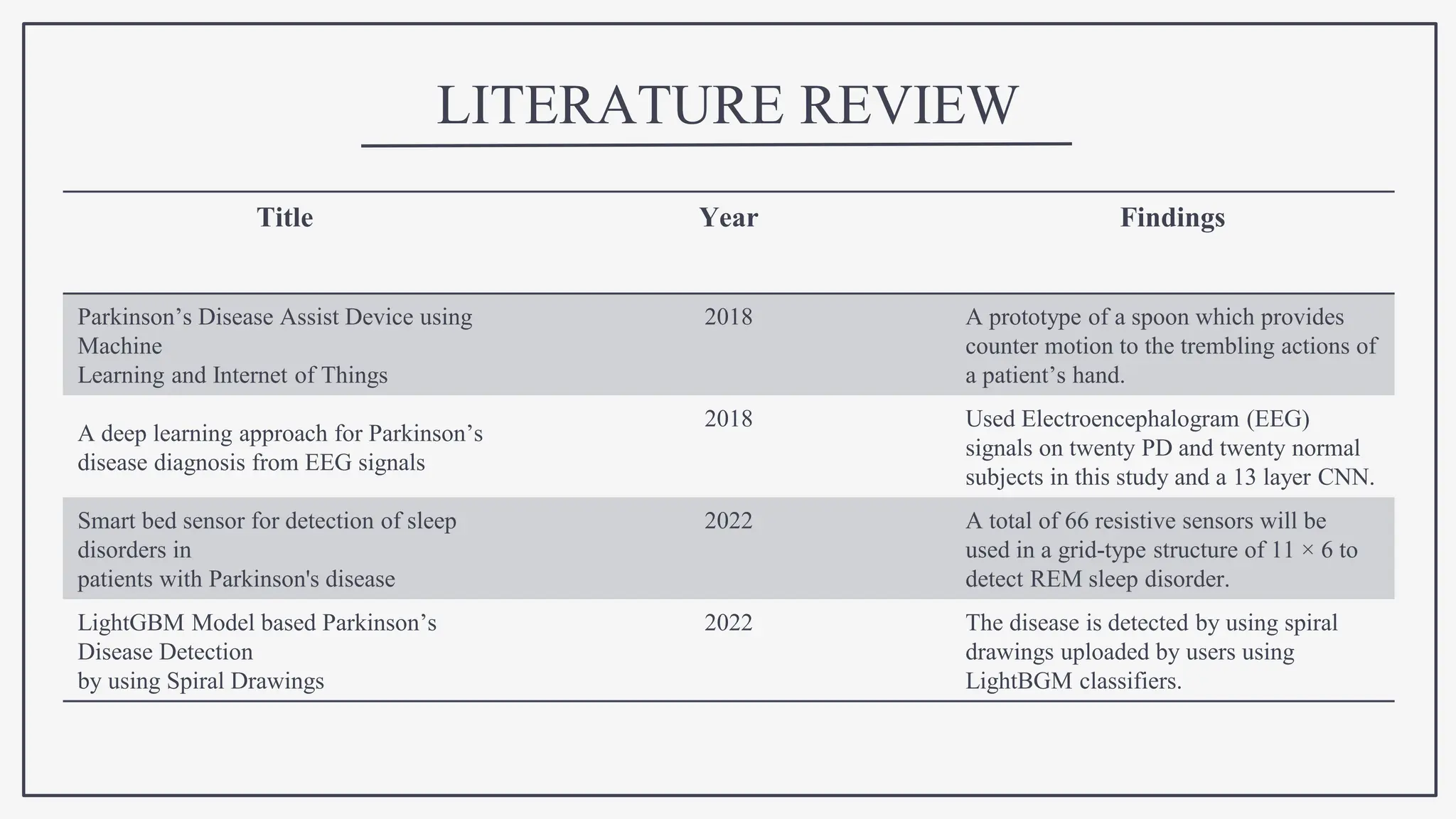
Title Year Findings
Parkinson’s Disease Assist Device using
Machine
Learning and Internet of Things
2018 A prototype of a spoon which provides
counter motion to the trembling actions of
a patient’s hand.
A deep learning approach for Parkinson’s
disease diagnosis from EEG signals
2018 Used Electroencephalogram (EEG)
signals on twenty PD and twenty normal
subjects in this study and a 13 layer CNN.
Smart bed sensor for detection of sleep
disorders in
patients with Parkinson's disease
2022 A total of 66 resistive sensors will be
used in a grid-type structure of 11 × 6 to
detect REM sleep disorder.
LightGBM Model based Parkinson’s
Disease Detection
by using Spiral Drawings
2022 The disease is detected by using spiral
drawings uploaded by users using
LightBGM classifiers.
PROPOSED METHODOLOGY
A two way approach has been adopted to detect parkinson with better accuracy.
1. By Voice
2. By Sensor data
Detection Through Voice
Voice analysis offers several advantages over traditional diagnostic methods, such as the ability to detect subtle
changes in voice patterns even before motor symptoms manifest.
• Increased jitter and shimmer: These measures reflect the variability in vocal fold vibration, which is often
elevated in PD, leading to a perceived hoarseness or roughness in the voice.
• Reduced harmonics-to-noise ratio (HNR): This measure reflects the clarity of the voice, which is typically
lower in PD, contributing to a muffled or breathy quality.
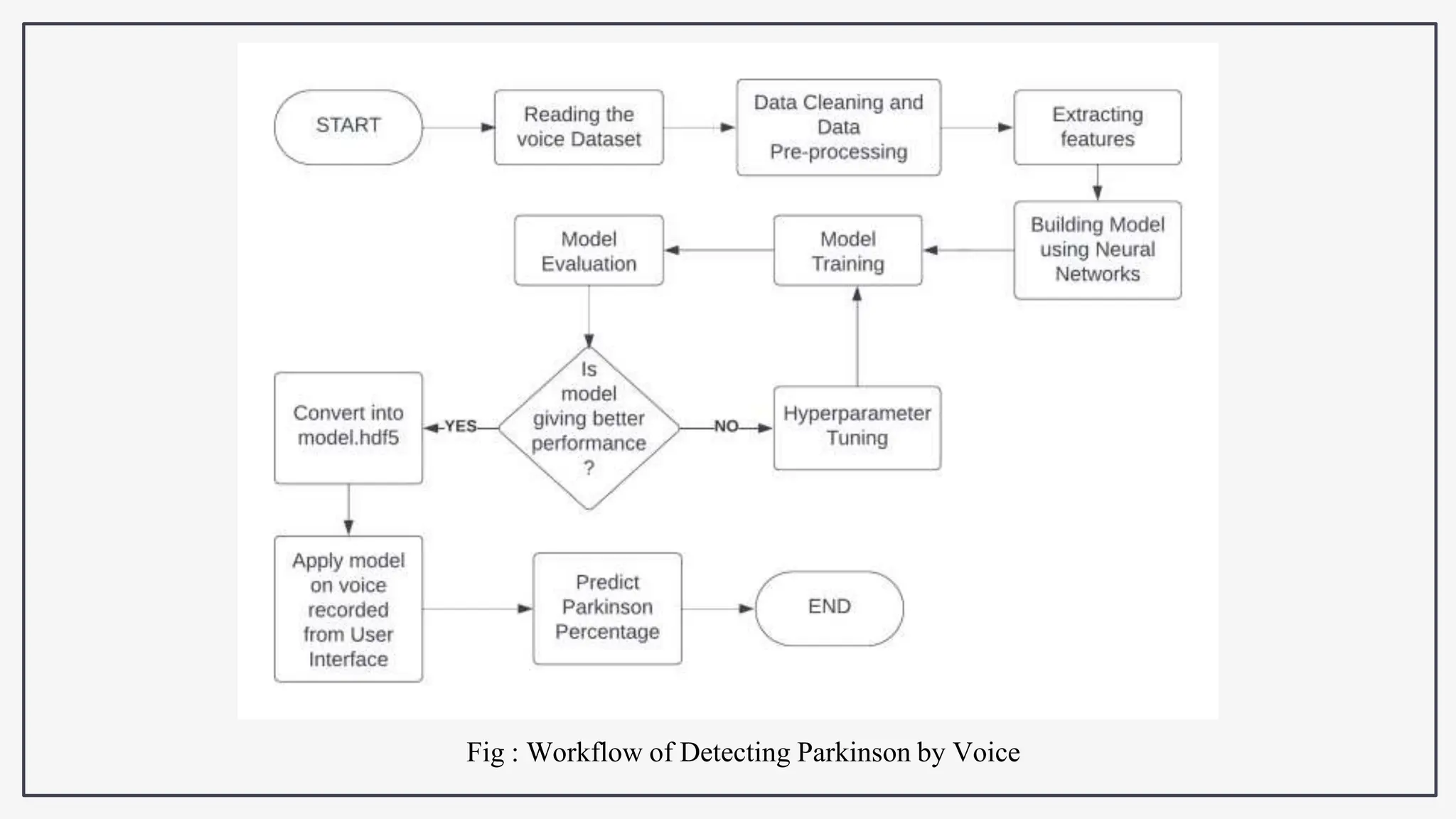
Fig : Workflow of Detecting Parkinson by Voice
Detection By Sensor Data
The MPU6050 is a promising tool for the detection of PD. It is non-invasive, low-cost, and can be used to collect
data in real-time.The MPU6050 is a 6-axis MotionTracking device that combines a 3-axis gyroscope and a 3-axis
accelerometer.
Steps Involved :
1. Acquiring Dataset : Dataset has to be collected from both healthy and parkinson patient wearing the
device on their index finger of most affected side.
2. Classification : The collected dataset will be classified for hand movement for resting tremor
assessment or bradykinesia assessment based on the accelerometer data.
3. Tiny ML : Burning of Machine Learning classifier into a microcontroller(ESP8266) to monitor the real
time data of the patient.
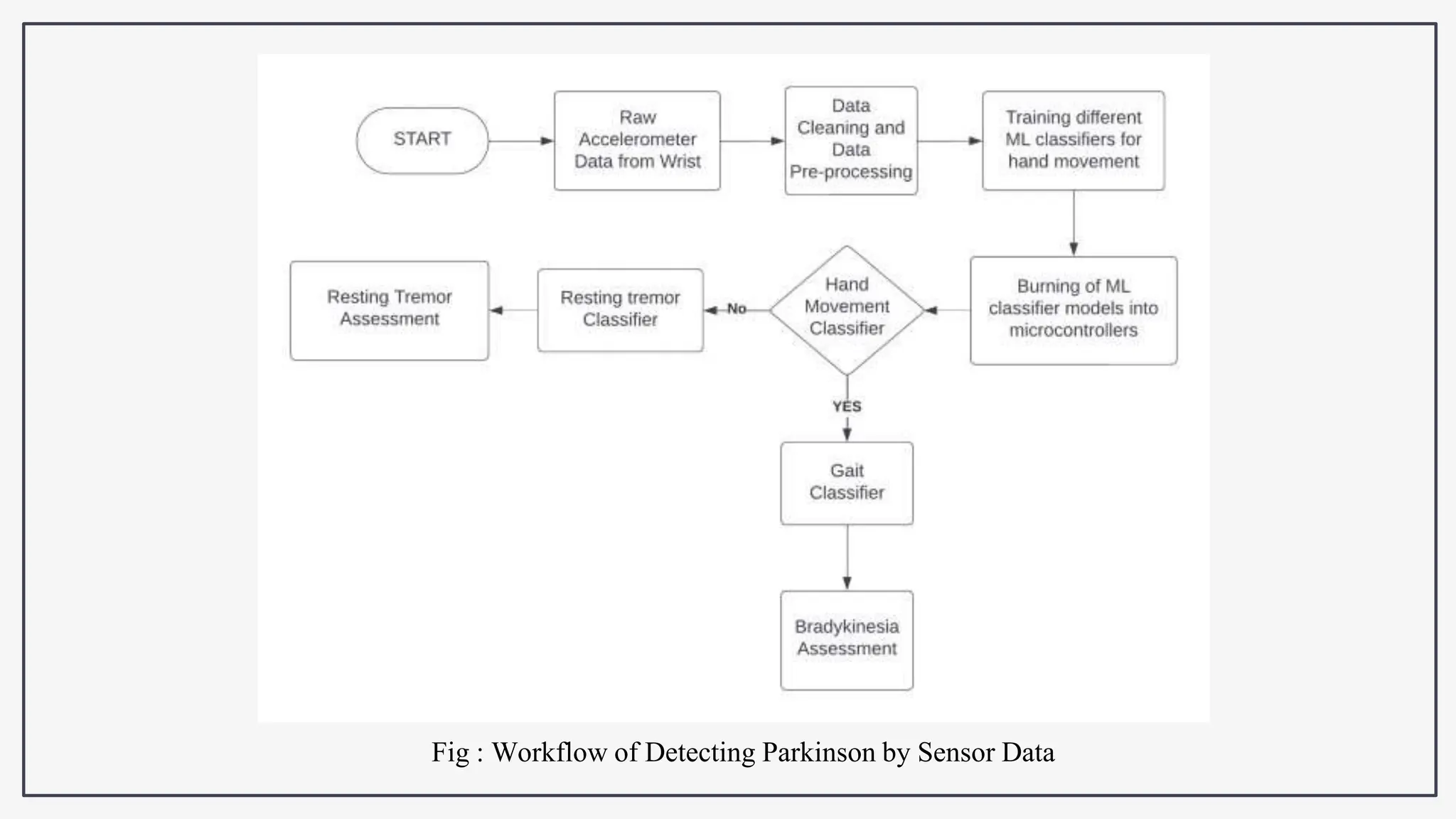
Fig : Workflow of Detecting Parkinson by Sensor Data
EXPERIMENTAL DETAILS
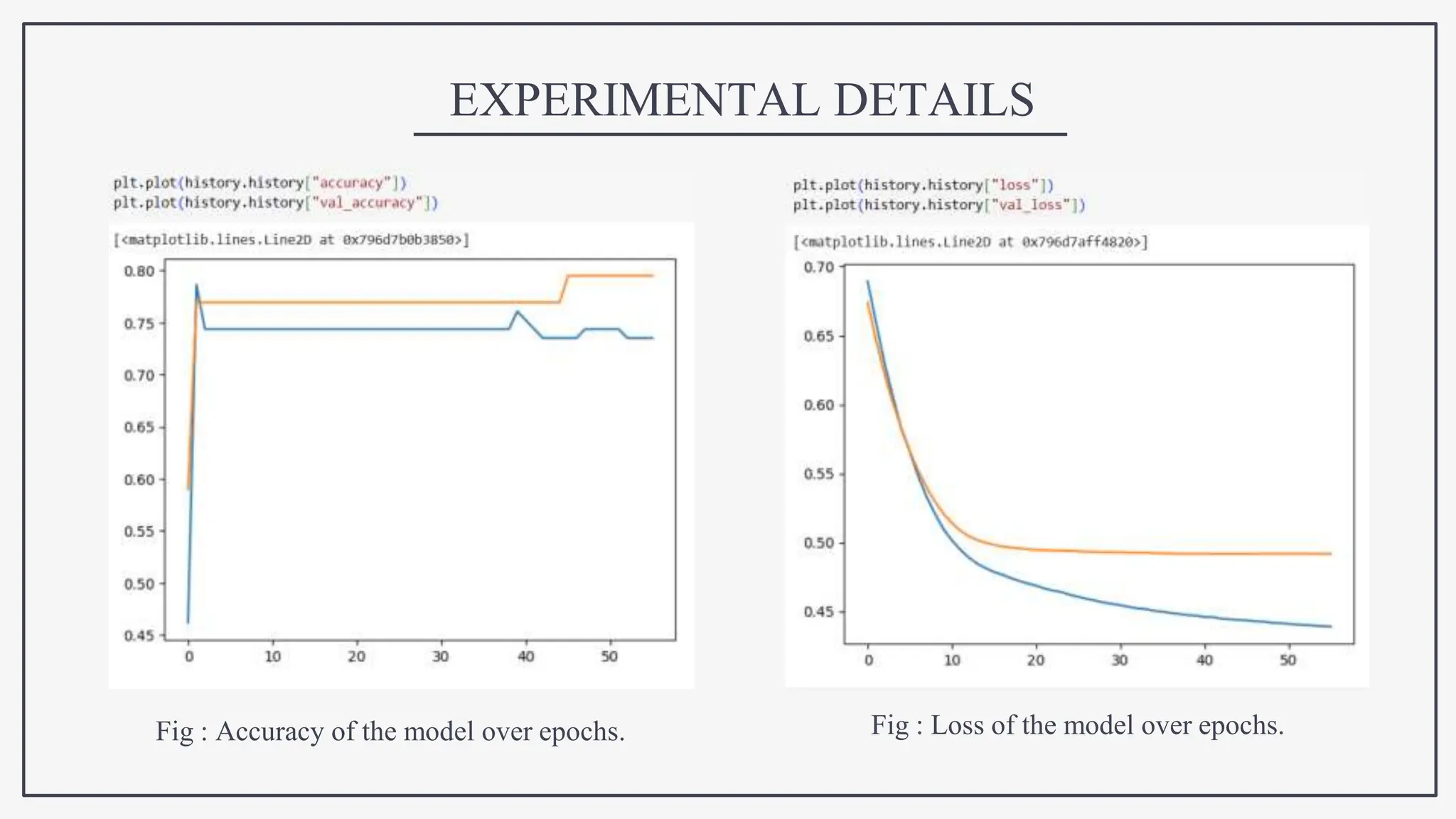
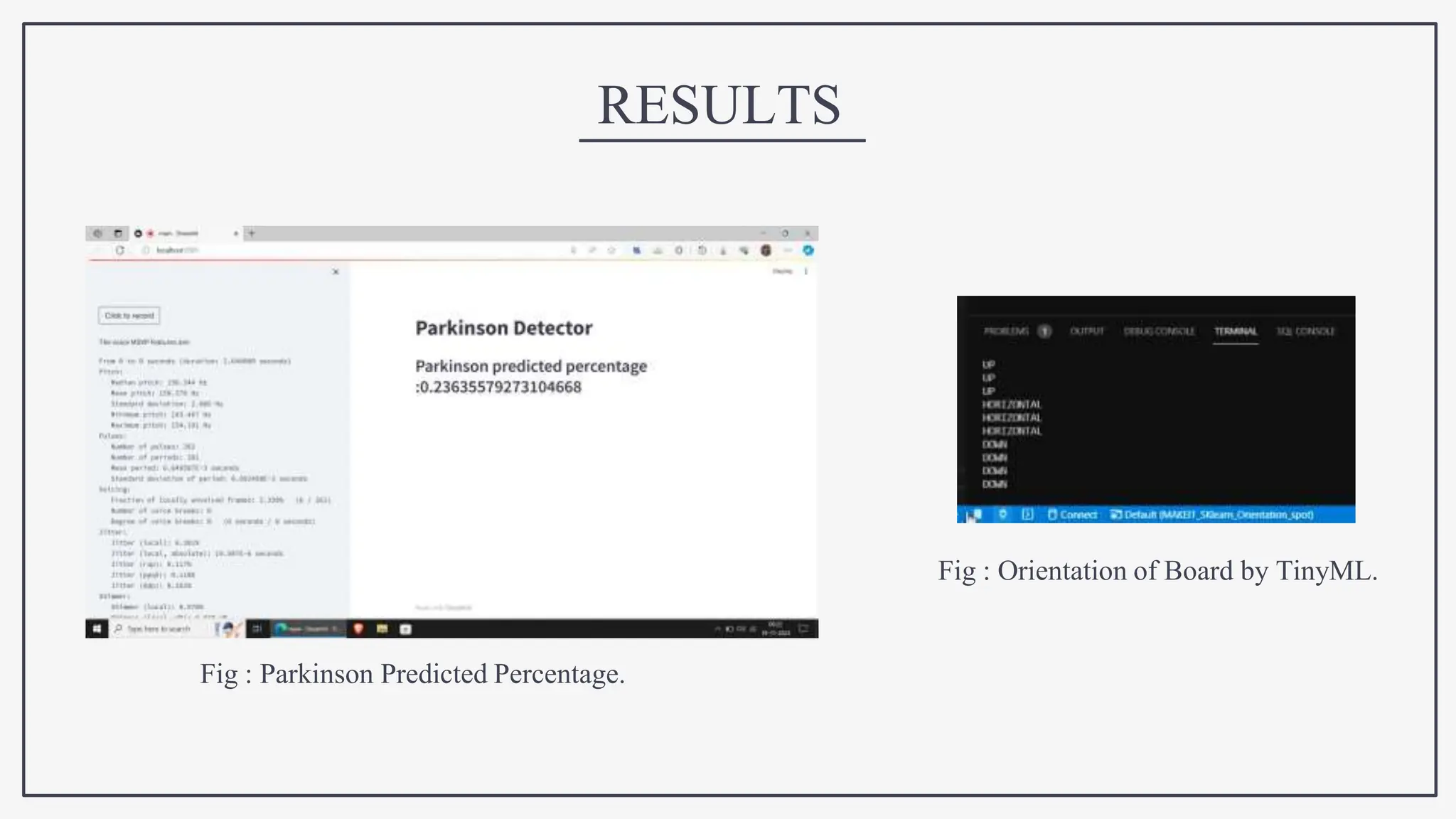
Fig : Accuracy of the model over epochs. Fig : Loss of the model over epochs.
RESULTS
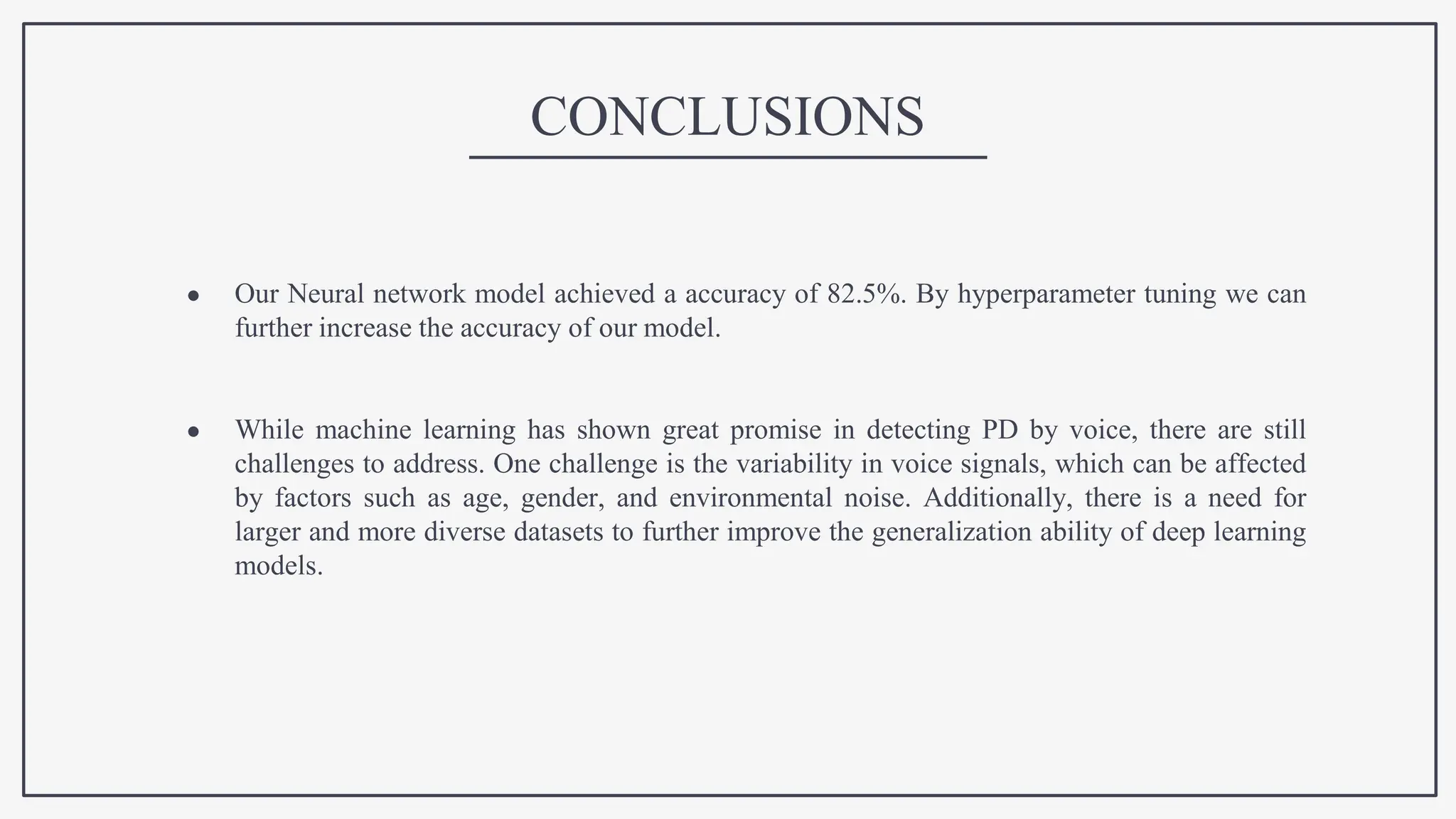
Fig : Parkinson Predicted Percentage.
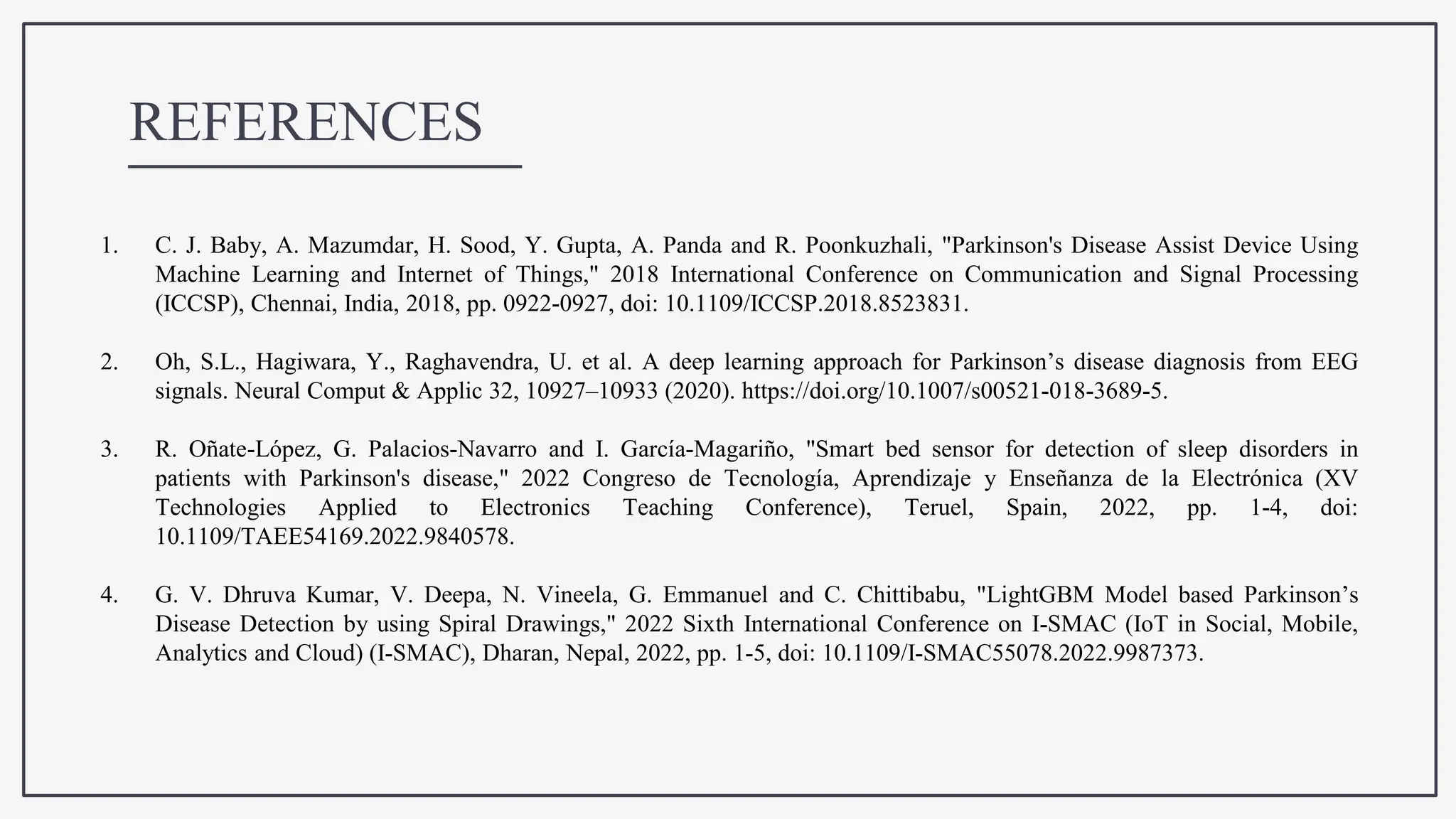
Fig : Orientation of Board by TinyML.
CONCLUSIONS
● Our Neural network model achieved a accuracy of 82.5%. By hyperparameter tuning we can
further increase the accuracy of our model.
● While machine learning has shown great promise in detecting PD by voice, there are still
challenges to address. One challenge is the variability in voice signals, which can be affected
by factors such as age, gender, and environmental noise. Additionally, there is a need for
larger and more diverse datasets to further improve the generalization ability of deep learning
models.
REFERENCES
1. C. J. Baby, A. Mazumdar, H. Sood, Y. Gupta, A. Panda and R. Poonkuzhali, "Parkinson's Disease Assist Device Using
Machine Learning and Internet of Things," 2018 International Conference on Communication and Signal Processing
(ICCSP), Chennai, India, 2018, pp. 0922-0927, doi: 10.1109/ICCSP.2018.8523831.
2. Oh, S.L., Hagiwara, Y., Raghavendra, U. et al. A deep learning approach for Parkinson’s disease diagnosis from EEG
signals. Neural Comput & Applic 32, 10927–10933 (2020). https://doi.org/10.1007/s00521-018-3689-5.
3. R. Oñate-López, G. Palacios-Navarro and I. García-Magariño, "Smart bed sensor for detection of sleep disorders in
patients with Parkinson's disease," 2022 Congreso de Tecnología, Aprendizaje y Enseñanza de la Electrónica (XV
Technologies Applied to Electronics Teaching Conference), Teruel, Spain, 2022, pp. 1-4, doi:
10.1109/TAEE54169.2022.9840578.
4. G. V. Dhruva Kumar, V. Deepa, N. Vineela, G. Emmanuel and C. Chittibabu, "LightGBM Model based Parkinson’s
Disease Detection by using Spiral Drawings," 2022 Sixth International Conference on I-SMAC (IoT in Social, Mobile,
Analytics and Cloud) (I-SMAC), Dharan, Nepal, 2022, pp. 1-5, doi: 10.1109/I-SMAC55078.2022.9987373.
THANK YOU

Parkinson's disease detection using ml a

  • 1.
    IOT AND MLBASED EARLY DETECTION AND MONITORING OF PARKINSON’S DISEASE Group - 29 Under the supervision of - Dr. Biswajit Ghosh Presented By Ritesh Kumar Shaw (13000220104) Ambarish Adak (13000220105) Promita Agasty(13000220110) Abhisekh Kumar Gupta(13000320018)
  • 2.
    OBJECTIVE ● To developa system which can detect parkinson at its earliest stage to slow down the progression of disease. ● To track disease progression and assess the effectiveness of treatment. ● To improve access to care for PD patients in underserved areas or those with limited mobility. ● To develop IoT-based PD detection systems that are more cost- effective than traditional diagnostic methods.
  • 3.
    PROBLEM STATEMENT IoT sensorscan be used to measure movement patterns, such as tremors, rigidity, and bradykinesia, which are characteristic symptoms of PD. Detecting Parkinson’s with the help of IoT and ML To integrate IoT and ML into one system to develop a non-invasive, low-cost, and reliable method for early diagnosis and monitoring of PD.
  • 4.
    LITERATURE REVIEW Title YearFindings Parkinson’s Disease Assist Device using Machine Learning and Internet of Things 2018 A prototype of a spoon which provides counter motion to the trembling actions of a patient’s hand. A deep learning approach for Parkinson’s disease diagnosis from EEG signals 2018 Used Electroencephalogram (EEG) signals on twenty PD and twenty normal subjects in this study and a 13 layer CNN. Smart bed sensor for detection of sleep disorders in patients with Parkinson's disease 2022 A total of 66 resistive sensors will be used in a grid-type structure of 11 × 6 to detect REM sleep disorder. LightGBM Model based Parkinson’s Disease Detection by using Spiral Drawings 2022 The disease is detected by using spiral drawings uploaded by users using LightBGM classifiers.
  • 5.
    PROPOSED METHODOLOGY A twoway approach has been adopted to detect parkinson with better accuracy. 1. By Voice 2. By Sensor data Detection Through Voice Voice analysis offers several advantages over traditional diagnostic methods, such as the ability to detect subtle changes in voice patterns even before motor symptoms manifest. • Increased jitter and shimmer: These measures reflect the variability in vocal fold vibration, which is often elevated in PD, leading to a perceived hoarseness or roughness in the voice. • Reduced harmonics-to-noise ratio (HNR): This measure reflects the clarity of the voice, which is typically lower in PD, contributing to a muffled or breathy quality.
  • 6.
    Fig : Workflowof Detecting Parkinson by Voice
  • 7.
    Detection By SensorData The MPU6050 is a promising tool for the detection of PD. It is non-invasive, low-cost, and can be used to collect data in real-time.The MPU6050 is a 6-axis MotionTracking device that combines a 3-axis gyroscope and a 3-axis accelerometer. Steps Involved : 1. Acquiring Dataset : Dataset has to be collected from both healthy and parkinson patient wearing the device on their index finger of most affected side. 2. Classification : The collected dataset will be classified for hand movement for resting tremor assessment or bradykinesia assessment based on the accelerometer data. 3. Tiny ML : Burning of Machine Learning classifier into a microcontroller(ESP8266) to monitor the real time data of the patient.
  • 8.
    Fig : Workflowof Detecting Parkinson by Sensor Data
  • 9.
    EXPERIMENTAL DETAILS Fig :Accuracy of the model over epochs. Fig : Loss of the model over epochs.
  • 10.
    RESULTS Fig : ParkinsonPredicted Percentage. Fig : Orientation of Board by TinyML.
  • 11.
    CONCLUSIONS ● Our Neuralnetwork model achieved a accuracy of 82.5%. By hyperparameter tuning we can further increase the accuracy of our model. ● While machine learning has shown great promise in detecting PD by voice, there are still challenges to address. One challenge is the variability in voice signals, which can be affected by factors such as age, gender, and environmental noise. Additionally, there is a need for larger and more diverse datasets to further improve the generalization ability of deep learning models.
  • 12.
    REFERENCES 1. C. J.Baby, A. Mazumdar, H. Sood, Y. Gupta, A. Panda and R. Poonkuzhali, "Parkinson's Disease Assist Device Using Machine Learning and Internet of Things," 2018 International Conference on Communication and Signal Processing (ICCSP), Chennai, India, 2018, pp. 0922-0927, doi: 10.1109/ICCSP.2018.8523831. 2. Oh, S.L., Hagiwara, Y., Raghavendra, U. et al. A deep learning approach for Parkinson’s disease diagnosis from EEG signals. Neural Comput & Applic 32, 10927–10933 (2020). https://doi.org/10.1007/s00521-018-3689-5. 3. R. Oñate-López, G. Palacios-Navarro and I. García-Magariño, "Smart bed sensor for detection of sleep disorders in patients with Parkinson's disease," 2022 Congreso de Tecnología, Aprendizaje y Enseñanza de la Electrónica (XV Technologies Applied to Electronics Teaching Conference), Teruel, Spain, 2022, pp. 1-4, doi: 10.1109/TAEE54169.2022.9840578. 4. G. V. Dhruva Kumar, V. Deepa, N. Vineela, G. Emmanuel and C. Chittibabu, "LightGBM Model based Parkinson’s Disease Detection by using Spiral Drawings," 2022 Sixth International Conference on I-SMAC (IoT in Social, Mobile, Analytics and Cloud) (I-SMAC), Dharan, Nepal, 2022, pp. 1-5, doi: 10.1109/I-SMAC55078.2022.9987373.
  • 13.