Distributed Systems Theory
for Mere Mortals
Ensar Basri Kahveci
1
Java Day Istanbul
May 2017
I am Ensar Basri Kahveci
Hello!
Distributed Systems Engineer
twitter & github
website
@ Hazelcast
metanet
basrikahveci.com
2
Hazelcast
◉ Leading open source Java IMDG
◉ Distributed Java collections, JCache, HD store, ….
◉ Distributed computation and messaging
◉ Embedded or client-server deployment
◉ Integration modules & cloud friendly
3
Hazelcast as a Distributed System
◉ Scale up & scale out
◉ Distributed from day one
◉ Dynamic clustering and elasticity
◉ Data partitioning and replication
◉ Fault tolerance
4
◉ Collection of entities trying to solve a common
problem
○ Communication via passing messages
○ Uncertain and partial knowledge
◉ We need distributed systems mostly because:
○ Scalability
○ Fault tolerance
Distributed Systems
5
◉ Independent failures
◉ Non-negligible message transmission delays
◉ Unreliable communication
Main Difficulties
6
◉ System models come into play.
○ Interaction models
○ Failure modes
○ Notion of time
◉ Consensus Problem
◉ CAP Principle
Systems Models
7
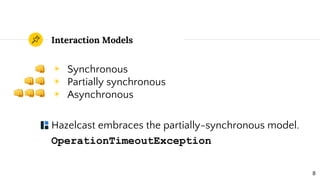
◉ Synchronous
◉ Partially synchronous
◉ Asynchronous
Hazelcast embraces the partially-synchronous model.
OperationTimeoutException
Interaction Models
8
Failure modes
◉ Crash-stop
◉ Omission faults
◉ Crash-recover
◉ Arbitrary failures (Byzantine)
Hazelcast handles crash-recover failures by
making them look like crash-stop failures.
9
Time & Order: Physical time
◉ Time is often used to order events in distributed
algorithms.
◉ Physical timestamps
○ LatestUpdateMapMergePolicy in Hazelcast
◉ Clock drifts can break latest update wins
◉ Google TrueTime
10
Time & Order: Logical Clocks
◉ Logical clocks (Lamport clocks)
○ Local counters and communication
◉ Defines happens-before relationship.
○ (i.e., causality)
Hazelcast extensively uses it along with
primary-copy replication.
11
Time & Order: Vector Clocks
◉ Inferring causality by comparing timestamps.
◉ Vector clocks are used to infer causality.
○ Dynamo-style databases use them to detect conflicts.
Lamport clocks work fine for Hazelcast because
there is only a single node performing the updates.
12
Consensus
◉ The problem of having a set of processes
agree on a value.
○ Leader election, state machine replication, strong
consistency, distributed transactions, …
◉ Safety
◉ Liveness
13
FLP Result
◉ In the asynchronous model, distributed consensus
may not be solved within bounded time if at least
one process can fail with crash-stop.
◉ It is because we cannot differentiate between a
crashed process or a slow process.
14
Unreliable Failure Detectors
◉ Local failure detectors which rely on timeouts and
can make mistakes.
◉ Two types of mistakes:
○ suspecting from a running process ⇒ ACCURACY
○ not suspecting from a failed process ⇒ COMPLETENESS
◉ Different types of failure detectors.
15
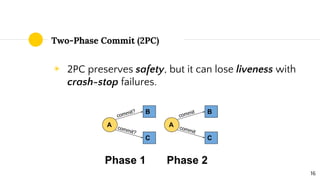
Two-Phase Commit (2PC)
◉ 2PC preserves safety, but it can lose liveness with
crash-stop failures.
16
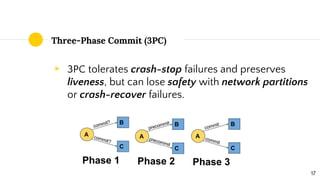
Three-Phase Commit (3PC)
◉ 3PC tolerates crash-stop failures and preserves
liveness, but can lose safety with network partitions
or crash-recover failures.
17
Majority Based Consensus
◉ Availability of majority is needed for liveness
and safety.
○ 2f + 1 nodes tolerate failure of f nodes.
◉ Resiliency to crash-stop, network partitions
and crash-recover.
◉ Paxos, Zab, Raft, Viewstamped Replication
18
Consensus: Recap
We have 2PC and 3PC in Hazelcast, but not
majority based consensus algorithms.
◉ Consensus systems are mainly used for
achieving strong consistency.
19
CAP Principle
◉ Proposed by Eric Brewer in 2000.
○ Formally proved in 2002.
◉ A shared-data system cannot achieve perfect
consistency and perfect availability in the
presence of network partitions.
○ AP versus CP
◉ Widespread acceptance, and yet a lot of criticism.
20
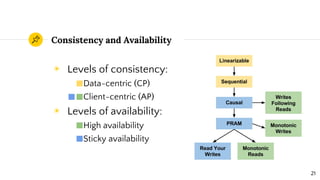
Consistency and Availability
◉ Levels of consistency:
Data-centric (CP)
Client-centric (AP)
◉ Levels of availability:
High availability
Sticky availability
21
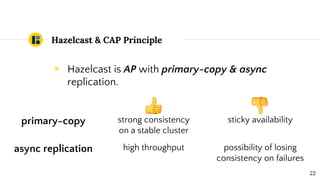
Hazelcast & CAP Principle
◉ Hazelcast is AP with primary-copy & async
replication.
primary-copy strong consistency
on a stable cluster
sticky availability
async replication high throughput possibility of losing
consistency on failures
22
No Hocus Pocus
◉ A lot of variations in the abstractions and models.
◉ Learn the fundamentals, the rest will change
anyway.
23
Any questions ?
Thanks!
24

Distributed Systems Theory for Mere Mortals - Java Day Istanbul May 2017

  • 1.
    Distributed Systems Theory forMere Mortals Ensar Basri Kahveci 1 Java Day Istanbul May 2017
  • 2.
    I am EnsarBasri Kahveci Hello! Distributed Systems Engineer twitter & github website @ Hazelcast metanet basrikahveci.com 2
  • 3.
    Hazelcast ◉ Leading opensource Java IMDG ◉ Distributed Java collections, JCache, HD store, …. ◉ Distributed computation and messaging ◉ Embedded or client-server deployment ◉ Integration modules & cloud friendly 3
  • 4.
    Hazelcast as aDistributed System ◉ Scale up & scale out ◉ Distributed from day one ◉ Dynamic clustering and elasticity ◉ Data partitioning and replication ◉ Fault tolerance 4
  • 5.
    ◉ Collection ofentities trying to solve a common problem ○ Communication via passing messages ○ Uncertain and partial knowledge ◉ We need distributed systems mostly because: ○ Scalability ○ Fault tolerance Distributed Systems 5
  • 6.
    ◉ Independent failures ◉Non-negligible message transmission delays ◉ Unreliable communication Main Difficulties 6
  • 7.
    ◉ System modelscome into play. ○ Interaction models ○ Failure modes ○ Notion of time ◉ Consensus Problem ◉ CAP Principle Systems Models 7
  • 8.
    ◉ Synchronous ◉ Partiallysynchronous ◉ Asynchronous Hazelcast embraces the partially-synchronous model. OperationTimeoutException Interaction Models 8
  • 9.
    Failure modes ◉ Crash-stop ◉Omission faults ◉ Crash-recover ◉ Arbitrary failures (Byzantine) Hazelcast handles crash-recover failures by making them look like crash-stop failures. 9
  • 10.
    Time & Order:Physical time ◉ Time is often used to order events in distributed algorithms. ◉ Physical timestamps ○ LatestUpdateMapMergePolicy in Hazelcast ◉ Clock drifts can break latest update wins ◉ Google TrueTime 10
  • 11.
    Time & Order:Logical Clocks ◉ Logical clocks (Lamport clocks) ○ Local counters and communication ◉ Defines happens-before relationship. ○ (i.e., causality) Hazelcast extensively uses it along with primary-copy replication. 11
  • 12.
    Time & Order:Vector Clocks ◉ Inferring causality by comparing timestamps. ◉ Vector clocks are used to infer causality. ○ Dynamo-style databases use them to detect conflicts. Lamport clocks work fine for Hazelcast because there is only a single node performing the updates. 12
  • 13.
    Consensus ◉ The problemof having a set of processes agree on a value. ○ Leader election, state machine replication, strong consistency, distributed transactions, … ◉ Safety ◉ Liveness 13
  • 14.
    FLP Result ◉ Inthe asynchronous model, distributed consensus may not be solved within bounded time if at least one process can fail with crash-stop. ◉ It is because we cannot differentiate between a crashed process or a slow process. 14
  • 15.
    Unreliable Failure Detectors ◉Local failure detectors which rely on timeouts and can make mistakes. ◉ Two types of mistakes: ○ suspecting from a running process ⇒ ACCURACY ○ not suspecting from a failed process ⇒ COMPLETENESS ◉ Different types of failure detectors. 15
  • 16.
    Two-Phase Commit (2PC) ◉2PC preserves safety, but it can lose liveness with crash-stop failures. 16
  • 17.
    Three-Phase Commit (3PC) ◉3PC tolerates crash-stop failures and preserves liveness, but can lose safety with network partitions or crash-recover failures. 17
  • 18.
    Majority Based Consensus ◉Availability of majority is needed for liveness and safety. ○ 2f + 1 nodes tolerate failure of f nodes. ◉ Resiliency to crash-stop, network partitions and crash-recover. ◉ Paxos, Zab, Raft, Viewstamped Replication 18
  • 19.
    Consensus: Recap We have2PC and 3PC in Hazelcast, but not majority based consensus algorithms. ◉ Consensus systems are mainly used for achieving strong consistency. 19
  • 20.
    CAP Principle ◉ Proposedby Eric Brewer in 2000. ○ Formally proved in 2002. ◉ A shared-data system cannot achieve perfect consistency and perfect availability in the presence of network partitions. ○ AP versus CP ◉ Widespread acceptance, and yet a lot of criticism. 20
  • 21.
    Consistency and Availability ◉Levels of consistency: Data-centric (CP) Client-centric (AP) ◉ Levels of availability: High availability Sticky availability 21
  • 22.
    Hazelcast & CAPPrinciple ◉ Hazelcast is AP with primary-copy & async replication. primary-copy strong consistency on a stable cluster sticky availability async replication high throughput possibility of losing consistency on failures 22
  • 23.
    No Hocus Pocus ◉A lot of variations in the abstractions and models. ◉ Learn the fundamentals, the rest will change anyway. 23
  • 24.