Distributed Systems Concurrency And Consistency 1st Edition Matthieu Perrin Auth
Distributed Systems Concurrency And Consistency 1st Edition Matthieu Perrin Auth
Distributed Systems Concurrency And Consistency 1st Edition Matthieu Perrin Auth
Distributed Systems Concurrency And Consistency 1st Edition Matthieu Perrin Auth
Distributed Systems Concurrency And Consistency 1st Edition Matthieu Perrin Auth
1.
Distributed Systems ConcurrencyAnd Consistency
1st Edition Matthieu Perrin Auth download
https://ebookbell.com/product/distributed-systems-concurrency-
and-consistency-1st-edition-matthieu-perrin-auth-6614870
Explore and download more ebooks at ebookbell.com
2.
Here are somerecommended products that we believe you will be
interested in. You can click the link to download.
Operating Systems Concurrent And Distributed Software Design Jean
Bacon
https://ebookbell.com/product/operating-systems-concurrent-and-
distributed-software-design-jean-bacon-917336
Concurrency Control In Distributed System Using Mutual Exclusion Chaki
https://ebookbell.com/product/concurrency-control-in-distributed-
system-using-mutual-exclusion-chaki-6754464
Distributed Systems An Algorithmic Approach Second Edition 2nd Edition
Sukumar Ghosh
https://ebookbell.com/product/distributed-systems-an-algorithmic-
approach-second-edition-2nd-edition-sukumar-ghosh-46470366
Distributed Systems Theory And Applications Ratan K Ghosh Hiranmay
Ghosh
https://ebookbell.com/product/distributed-systems-theory-and-
applications-ratan-k-ghosh-hiranmay-ghosh-47682234
3.
Distributed Systems PrinciplesAnd Paradigms 4th Edition 401 Maarten
Van Steen
https://ebookbell.com/product/distributed-systems-principles-and-
paradigms-4th-edition-401-maarten-van-steen-49052298
Distributed Systems Security Issues Processes And Solutions 1st
Edition Abhijit Belapurkar
https://ebookbell.com/product/distributed-systems-security-issues-
processes-and-solutions-1st-edition-abhijit-belapurkar-2002180
Distributed Systems Principles And Paradigms 2nd Ed New International
Ed Tanenbaum
https://ebookbell.com/product/distributed-systems-principles-and-
paradigms-2nd-ed-new-international-ed-tanenbaum-22019962
Distributed Systems An Algorithmic Approach 1st Edition Sukumar Ghosh
https://ebookbell.com/product/distributed-systems-an-algorithmic-
approach-1st-edition-sukumar-ghosh-2267322
Distributed Systems Principles And Paradigms 2nd Edition Andrew S
Tanenbaum
https://ebookbell.com/product/distributed-systems-principles-and-
paradigms-2nd-edition-andrew-s-tanenbaum-23339972
Acknowledgments
I am gratefulto Achour Mostéfaoui and Claude Jard for their contribution to the
work presented in this book. I offer warm thanks to Luc Bougé and Maria
Potop-Butucaru for their relevant comments that helped improve the quality of this
book. Finally, I would like to thank Matoula Petrolia for playing Alice’s role in the
illustrating examples.
9.
Introduction
I.1. Preamble
Bob wasdaydreaming as he walked into the subway station. It has been two days
since he had last talked to Alice. His anger has gradually turned into bitterness, then
into guilt. He understood now that his initial reaction had been somewhat
exaggerated and wanted more than anything to bury the hatchet with his childhood
friend but did not know how to approach the situation. He felt surprised and relieved
when he received a message from her inviting him to go out for coffee. He managed
to quickly respond as the train was approaching the dark tunnel. However, at the heart
of the city, the failing network could not transmit his liberating reply “Obviously”.
Alice loved Bob as a sister, despite the chronic anxiety and shady character of the
one whom she saw as her oldest friend. Two days earlier, he had left in a rage because
of a simple misunderstanding and she hadn’t been able to reason with him since. Even
now, reconciliation seemed difficult: Bob had purely and simply ignored her invitation
to go out for coffee. She tried a new strategy and sent “You didn’t answer.” followed a
few seconds later by a humble “Are you angry?”.
The story does not tell what happened in the end and we can only imagine
it. As strange as it may seem, Alice and Bob’s fate very strongly depends on
the instant messaging service chosen to communicate. We have tried to reproduce
their conversation with three general instant messaging services: Google Hangouts1
(Hangouts), WhatsApp Messenger2 (WhatsApp) and Microsoft Skype3 (Skype). The
experiment has been performed with Matoula Petrolia playing the role of Alice and
myself in the role of Bob. Bob’s dropping connection has been modeled by using the
1 http://www.hangouts.google.com/
2 http://www.whatsapp.com/
3 http://www.skype.com/
10.
xii Distributed Systems
airplanemode of the mobile phone. For each experiment, we present a screenshot
taken before reconnection and another taken after reconnection for both interlocutors.
The three messaging services exhibit very different behaviors confronted with the
same situation.
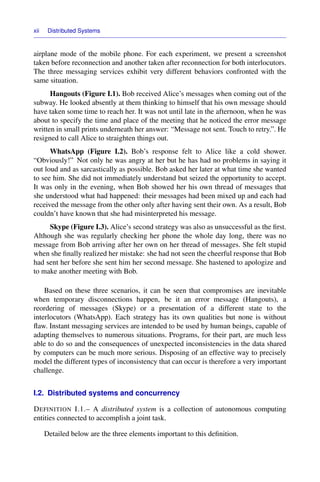
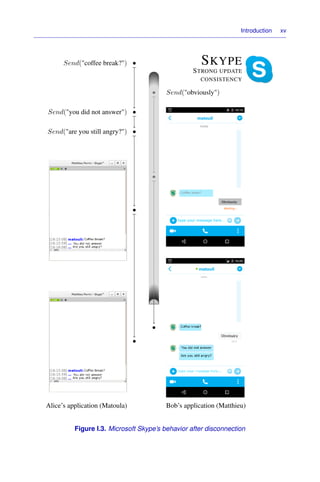
Hangouts (Figure I.1). Bob received Alice’s messages when coming out of the
subway. He looked absently at them thinking to himself that his own message should
have taken some time to reach her. It was not until late in the afternoon, when he was
about to specify the time and place of the meeting that he noticed the error message
written in small prints underneath her answer: “Message not sent. Touch to retry.”. He
resigned to call Alice to straighten things out.
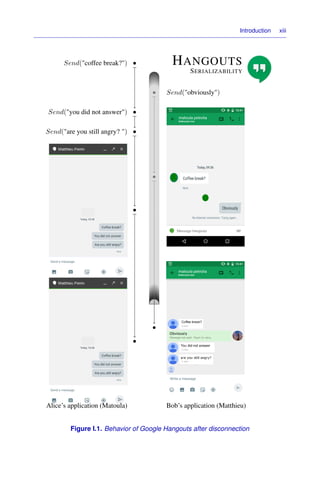
WhatsApp (Figure I.2). Bob’s response felt to Alice like a cold shower.
“Obviously!” Not only he was angry at her but he has had no problems in saying it
out loud and as sarcastically as possible. Bob asked her later at what time she wanted
to see him. She did not immediately understand but seized the opportunity to accept.
It was only in the evening, when Bob showed her his own thread of messages that
she understood what had happened: their messages had been mixed up and each had
received the message from the other only after having sent their own. As a result, Bob
couldn’t have known that she had misinterpreted his message.
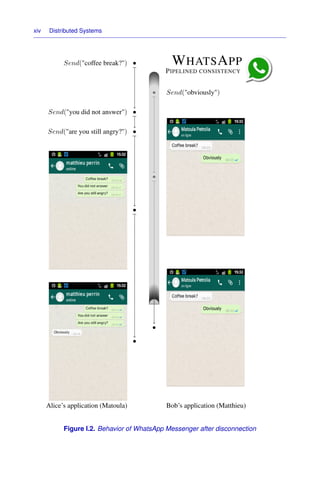
Skype (Figure I.3). Alice’s second strategy was also as unsuccessful as the first.
Although she was regularly checking her phone the whole day long, there was no
message from Bob arriving after her own on her thread of messages. She felt stupid
when she finally realized her mistake: she had not seen the cheerful response that Bob
had sent her before she sent him her second message. She hastened to apologize and
to make another meeting with Bob.
Based on these three scenarios, it can be seen that compromises are inevitable
when temporary disconnections happen, be it an error message (Hangouts), a
reordering of messages (Skype) or a presentation of a different state to the
interlocutors (WhatsApp). Each strategy has its own qualities but none is without
flaw. Instant messaging services are intended to be used by human beings, capable of
adapting themselves to numerous situations. Programs, for their part, are much less
able to do so and the consequences of unexpected inconsistencies in the data shared
by computers can be much more serious. Disposing of an effective way to precisely
model the different types of inconsistency that can occur is therefore a very important
challenge.
I.2. Distributed systems and concurrency
DEFINITION I.1.– A distributed system is a collection of autonomous computing
entities connected to accomplish a joint task.
Detailed below are the three elements important to this definition.
xiv Distributed Systems
WHATSAPP
PIPELINEDCONSISTENCY
•
Send("coffee break?")
•
Send("you did not answer")
•
Send("are you still angry?")
•
•
• Send("obviously")
•
•
Bob’s application (Matthieu)
Alice’s application (Matoula)
Figure I.2. Behavior of WhatsApp Messenger after disconnection
13.
Introduction xv
SKYPE
STRONG UPDATE
CONSISTENCY
•
Send("coffeebreak?")
•
Send("you did not answer")
•
Send("are you still angry?")
•
•
• Send("obviously")
•
•
Bob’s application (Matthieu)
Alice’s application (Matoula)
Figure I.3. Microsoft Skype’s behavior after disconnection
14.
xvi Distributed Systems
Computationalentity. Computational entity refers to entities sufficiently
complex and able to make their own choices, either following their own will, such
as human beings or even animals, or based on the result of a complex computation
when it comes to processes on a computer, or even in response to external stimuli in
the case of sensor networks. The term process will be generically used to designate
these computational entities, even in situations where they do not correspond to the
execution of a program by a computer.
In the previous examples, Alice and Bob are two computational entities.
Conversely, a stellar system consisting of a star and several planets will not be
considered as a distributed system, because no entity comprised therein is capable
of decision-making.
Connection in view of performing a joint task. In order to qualify as a
distributed system, processes must have a need to communicate. For example, two
processes running different programs on the same computer (such as a music player
and a text editor) do not have a joint task to accomplish. Conversely, in the previous
example, Alice and Bob are seeking to solve a dispute, which forms their joint task.
To this end, they use a messenger service that allows them to connect together.
Note that the execution of a joint task does not necessarily mean that processes
share a common interest. There are many purposes for distributed systems. They
can be designed for the purpose of collaboration (document editing, Web sites
administration, etc.) or instead for competition (network games, high-frequency
trading in financial markets, etc.) or even for simple communication (messaging
services, websites, peer-to-peer file sharing) between independent entities, generally
human. Finally, replication can be used to overcome failures: if a machine suffers
break down, others are available to substitute it.
Autonomy. In the previous examples, Alice and Bob are pre-existing in the
system. They existed before seeking to communicate and they will still exist after.
In the analysis of distributed systems, the focus is on issues that may occur with
processes to accomplish their joint task. The fact that they are autonomous means
that their operation depends only on themselves. In particular, there can be no master
process among them that decides when and how others can operate. The autonomy of
processes is what differentiates distributed systems and parallel systems. In a parallel
system, the objective is to aggregate computing power to accomplish a particularly
complex task, such as the simulation of physical or biological phenomena. The
program executed by the processes is known in advance, and its execution is supposed
to depend only on initial parameters. However, a parallel system can implement
techniques proper to distributed systems, especially to synchronize processes. The
difference between parallel and distributed systems is therefore more a matter of point
of view than a reality of the system. This distinction between parallel and distributed
computing is detailed by Michel Raynal in [RAY 15].
15.
Introduction xvii
The worldthat surrounds us is inherently a distributed system composed of
independent individuals forced to communicate in their daily tasks to elect their
representatives, to avoid collisions on the road, etc. Specifically, distributed computer
systems, in which the behavior of processes is governed by controllable programs,
have recently invaded our lives. In 2015, over three billion internauts were recorded
throughout the world4, today any processor in a mobile phone is multi-core, cloud
computing is starting to become more democratic with the expansion of the services
it offers and geo-replication is widely used to ensure the persistence of sensitive data.
Despite all possible applications of distributed systems, distributed applications
are generally much harder to design than their sequential counterparts: while events
in a sequential environment occur one after another in a sequence controlled by the
programmer, the notion of time between events occurring in a distributed system
appears to be much more blurred. In Alice and Bob’s example, it is not clear if Alice
has sent her last two messages before or after Bob, hence the differences in behaviors
observed in this situation for the three instant messaging services. This situation,
proper to distributed systems, in which events are not totally ordered has a name:
concurrency.
DEFINITION I.2.– A system is said to be concurrent if its behavior depends on the
order in which operate the actors of the system.
I.3. Wait-free distributed systems
The mastering of concurrency is one of the main challenges in distributed systems.
According to the security level required for applications and the control of incidents
likely to occur in the system in which they are deployed, concurrency will be more
or less visible. For example, in the control system of a plane, the relative speed of
each component and the paths taken by control orders are perfectly under control so
as to remove any uncertainty associated with concurrency. In contrast, in collaborative
document editors such as subversion or git, the majority of editing events are carried
out offline. Concurrency is then detected at the time of synchronization, resulting
in conflicts that must be manually solved. The main parameters that characterize a
distributed system are listed here below.
System scale. A system is distributed when it comprises at least two processes.
Therefore, a program whose graphical interface (GUI) is displayed on the screen in
an asynchronous fashion can already be considered as distributed. In contrast, Tianhe-
2, currently the most powerful supercomputer in the world, has 3,120,000 cores and
BOINC, the management platform of the peer-to-peer project SETI@home [SPA 99]
dedicated to the research of extra-terrestrial signals, claims to be installed on more
than thirteen million computers in the world5.
4 http://www.internetlivestats.com/watch/internet-users/
5 http://boincstats.com
16.
xviii Distributed Systems
Interactionmeans. In general, we can make a distinction between systems
in which processes must communicate by exchanging messages and those in which
processes access shared memory. Finer divisions can bring further detail into these
families. If processes communicate by messages, is the network complete? Do
processes know their neighbors? Are these fixed? Can they choose their neighbors?
For those communicating by means of shared memory, what operations are they
allowed to call? Can they write to all registers?
Failure management. The greater the systems, the more frequent failures are.
In peer-to-peer systems, processes leave and others connect to one another on a
permanent basis; when one considers the Internet as being increasingly composed of
connected mobile terminals, the reliability of transmissions cannot be assured; hackers
will always seek to attack sensitive applications such as those pertaining to banking
and governmental institutions (the so-called Byzantine faults). These faults can be of
various kinds: crash failure (a process stops its execution without warning others),
omission failure or loss of messages (when sending or receiving) or non-compliant
process behavior (memory corruption or intentional attacks). The number of failures
that can be accepted and the presence of a reliable server known to all are also defining
the characteristics of the system.
Relation to time. The presence or lack of a global clock accessible by all
processes, completely changes the nature of a system. In a fully synchronous system,
all processes proceed according to a well-defined temporal pattern (eventually a
priori) and if they communicate through messages, these messages are transmitted
within a limited timeframe. These two assumptions can be impaired. In a completely
asynchronous system, there is no bound on the relative speed of processes or on the
duration of message transfers (network latency). If, in addition, crash failures can
occur, a process that does not receive an expected message is unable to deduce if the
transmitter is faulty or extremely slow. The heterogeneity of the hardware running the
processes can be a major cause of asynchronicity.
The purpose of this book is to study concurrency. We are therefore considering
a poorly performing system where applications cannot hide it completely. For
example, it could be accepted, as in the preface, that processes undergo temporary
disconnections. More specifically, we assume that processes communicate by sending
messages to one another but that it is not acceptable nor possible for a process to wait
explicitly for messages from an another process. This assumption is realistic to model
a large number of systems, including those mentioned below.
Size. Systems whose number of processes is unknown, which prevent knowing
the number of responses to expect, in peer-to-peer systems, for instance.
Cost. Systems for which time spent waiting is considered too costly, for example
in high-performance computing.
17.
Introduction xix
Partitions. Systemsin which partitions can occur, temporarily preventing
processes to communicate with each other. Such partitions are frequent in cloud
architectures [VOG 09]. Temporary disconnections on the Internet can also be
modeled by partitions.
Faults. Systems for which fault management is critical to the extent where the
system should continue to operate even if only a single process is left operating in the
system. In such a situation, a process cannot wait for the participation of a known a
priori number of other processes as they may be at fault. This case is the one that we
prefer to model the hypothesis in which there is no waiting time because it is easier to
formally define.
More precisely, we consider wait-free message-passing asynchronous distributed
systems. We only provide the intuition here, these systems being formally defined in
section 1.3.2.
Distributed message-passing systems. The systems that we consider are
composed of a fixed and known-sized set of sequential processes that communicate
by means of primitives for sending and receiving messages.
Wait-free systems. All processes are likely to crash and the system must
continue to operate even when reduced to a single process.
Asynchronous systems. Processes do not run at the same speed and there is no
bound on the time taken by a message to reach its destination. Under these conditions,
a process that does not receive a message that it is expecting can never know if this
message is very slow to reach it, or if the message has never been sent because of
failure in the transmitter.
I.4. Shared objects
At a very high level, distributed applications all share a similar model: processes
interact with each other by means of one or more shared objects that are able to
manage concurrency. In the case of an online game, the shared object is the game
being played and the rules of the game make explicit authorized strokes; processes
that compute weather forecasts share the map during the simulation, etc. Shared
memory and communication channels are other examples of shared objects, but at a
lower level. In general, distributed applications can often be modeled by layers, each
layer being an abstraction in the form of shared objects of the previous layer. To sum
up, a program can be seen as a hierarchy of shared objects, each with its level of
semantic requirement.
For instance, consider a collaborative editing of documents. At the highest level,
the application provides access to character insert and delete operations at the cursor
level and cursor movement operations, accessible from the keyboard. The
18.
xx Distributed Systems
implementationof these operations involves a data structure that stores the sequence
of characters of the document. Depending on the application, this sequence itself
utilizes lower-level objects, such as a data management system abstracting the
communication primitives of the system in which the application is implemented.
The fact of considering a perspective that involves wait-free systems has significant
implications for the shared objects that can be build therein [ATT 95, ATT 94]. When
an operation on a shared object is initiated at the local level by a process, it must
be processed using only local knowledge of the process. The reads should be effected
locally, which means that each process has a local copy of the object. The impossibility
of synchronizing during operations prevents the removal of all inconsistencies. These
must therefore be specified with special attention. The central question of this book
can be formulated in this way: how can shared objects be specified in a wait-free
system?
I.5. Shared object specification
How can we describe what an instant messaging service is? If we ask the
question randomly to users of these services, odds are high that the answer will be as
follows. “An instant messaging service allows the sending of messages between
multiple correspondents and displays received messages, from the oldest to the
newest”. This describes the normal behavior of these services, which occurs when
there is no concurrency occurring, i.e. in the case of sequential use. In the same way,
developers of concurrent applications in general often wish they could make use of a
shared version of the objects they are accustomed to in sequential programs. The
specification of a shared object must therefore rely on its sequential specification.
Obviously, the sequential specification is insufficient to explain the differences
between the three services exposed in the prologue. One additional property,
consistency criterion, is necessary to explain how concurrency is managed. During
concurrent execution, accesses to shared objects create interactions between the local
operations of the various processes. Figure I.4 shows some examples of histories
extracted from concurrent executions involving one or two processes sharing a set
inside which it is possible to insert values or whose content can be read, i.e. the set of
the values previously inserted. The figure shows the operations performed by each
process over time, which elapses from the left to the right. A rounded rectangle
defines the time between the call and the return of an operation. The values returned
by the reads are represented after a slash.
Which histories are correct? In the sequential case, there is no possible ambiguity.
In Figure 1.4(a), during its first read, the process has inserted 1, it can therefore
return only {1}. The reads following the insertion of the 2 have no other option than
returning {1, 2}. The history of Figure 1.4(b) must also be considered as correct: all
19.
Introduction xxi
operations areconsecutive in time and the sequence of values returned is the same as
in the sequential execution. What about Figure 1.4(c)? The operations are also
sequential but the first read follows the insertion of the 2 without taking it into
account. On the one hand, we could argue that this reading is false and therefore that
this history is inconsistent. On the other hand, each process performs the same
operations and reads the same values as in the previous execution. The only
difference between these two histories is thus how both processes perceive their
relative speed [PER 16]. However, in an asynchronous system, processes are unable
to tell the difference between the two histories, because the observed temporal order
could also be due to a desynchronization of the clocks of both processes, which
would have no effect on programs that use the object. There is therefore no definitive
answer to what is a consistent history, every situation being simply better described
by a particular consistency criterion. History of Figure I.4(b) is said to be
linearizable whereas that of Figure I.4(c) is only sequentially consistent.
p Insert(1) Read()/{1} Insert(2) Read()/{1, 2} Read()/{1, 2}
(a) Sequential execution
p1
p2
Insert(1) Read()/{1}
Insert(2) Read()/{1, 2}
Read()/{1, 2}
(b) Linearizable execution
p1
p2
Insert(1) Read()/{1}
Insert(2) Read()/{1, 2}
Read()/{1, 2}
(c) Sequentially consistent execution
p1
p2
Insert(1) Read()/{1}
Insert(2) Read()/{2}
Read()/{1, 2}
Read()/{1, 2}
(d) Causally convergent execution
Figure I.4. Which behaviors are acceptable?
Unfortunately, sequential consistency and linearizability are too strong criteria to
be implemented in wait-free systems [ATT 94, GIL 02]: inconsistencies such as those
of history in Figure 4(d) cannot be avoided. In this case, how can we describe such
histories? The literature related to the subject presents a limited picture of the concepts
and definitions, often partial and incomparable between themselves. The extension
20.
xxii Distributed Systems
andthe formalization of these concepts is an important part of the work presented in
this book. We endeavor to fill in the blanks in order to extract the structure of the space
of weak criteria and therefrom to draw a map presented in Figure I.5.
I.6. Organization
After this introduction, a notation table is provided. Next, Chapter 1 presents the
mathematical framework common to all other chapters: therein we formally define
sequential specifications, concurrent histories and consistency criteria. This chapter
also formally defines wait-free systems.
In Chapter 2, we present the key concepts proposed by the various communities
facing concurrency to specify their distributed objects. As much as possible, we try
to include these concepts in the context presented in the previous chapter with the
objective to compare them. The most difficult concepts to expand will be the subject
to the following chapters.
Eventual consistency requires that all processes terminate in a common
convergence state. The specification of this convergence state is a difficult problem.
In Chapter 3, we present two consistency criteria to solve it: update consistency and
strong update consistency that relate the convergence state to updates by means of
the sequential specification. Therein, we also present three algorithms to implement
them in wait-free systems.
Causal memory [AHA 95] is recognized as a central object among the memory
models that can be implemented in wait-free systems, but its definition utilizes
semantic links between reads and writes. Chapter 4 addresses the challenge of
including causality as a consistency criterion in our model. We define therein four
consistency criteria. Weak causal consistency is the greatest common denominator of
these four criteria. It can be associated with update consistency to form causal
convergence or to pipelined consistency to form causal consistency, which
corresponds to causal memory when it is applied to memory. Strong causal
consistency finally enables the study of false causality induced by the standard
implementation of causal memory.
Chapter 5 focuses on computability in wait-free systems. In this chapter, we
establish a structural map of the space of weak criteria, divided into three families of
primary criteria (eventual consistency, validity and state locality) which can be
combined in pairs to form three families of secondary criteria (update consistency,
pipelined consistency and serializability). On the other hand, the conjunction of the
three primary criteria cannot be implemented in wait-free systems, which justifies the
colors of Figure I.5.
21.
Introduction xxiii
Chapter 6shows how these concepts can be applied to programming for
distributed systems. The library CODS implements weak consistency criteria within
the object-oriented programming language D. CODS offers the most possible
transparent abstract programming interface, in which instantiation is only replaced by
the reference to a sequential specification defined by a class of the program and of a
consistency criterion among those of the library or even implemented as an extension
of this library.
SCC
CC
PC
C⊥
V
WCC
CCv
SUC
UC
C⊥
EC
SEC
Ser
C⊥
SL
SC
SC
LC C
PC
Pipelined
consistency
(p. 74)
SEC
Strong eventual
consistency
(p. 67)
SUC
Strong update
consistency
(p. 92)
CCv
Causal
convergence
(p. 132)
WCC
Weak causal
consistency
(p. 130)
SCC
Strong causal
consistency
(p. 138)
SL
State
locality
(p. 147)
EC
Eventual
consistency
(p. 65)
UC
Update
consistency
(p. 90)
Ser
Serializability
(p. 63)
V
Validity
(p. 146)
CC
Causal
consistency
(p. 135)
SC
Sequential
consistency
(p. 55)
LC
Local
consistency
(p. 47)
SC
Cache
consistency
(p. 43)
C⊥
Minimal
criterion
(p. 42)
C
Maximal
criterion
(p. 42)
Figure I.5. Map of the consistency criteria discussed in this book. For
the color version of this figure, www.iste.co.uk/perrin/distributed.zip
22.
xxiv Distributed Systems
Finally,Chapter 6 summarizes the previous chapters and outlines future
directions for research. After the bibliography, the index provides help to navigate the
document.
The Project GutenbergeBook of The Washer of
the Ford: Legendary moralities and barbaric
tales
28.
This ebook isfor the use of anyone anywhere in the United
States and most other parts of the world at no cost and with
almost no restrictions whatsoever. You may copy it, give it away
or re-use it under the terms of the Project Gutenberg License
included with this ebook or online at www.gutenberg.org. If you
are not located in the United States, you will have to check the
laws of the country where you are located before using this
eBook.
Title: The Washer of the Ford: Legendary moralities and
barbaric tales
Author: William Sharp
Release date: August 3, 2013 [eBook #43395]
Most recently updated: October 23, 2024
Language: English
Credits: Produced by sp1nd, Sam W. and the Online Distributed
Proofreading Team at http://www.pgdp.net (This file
was
produced from images generously made available by
The
Internet Archive)
*** START OF THE PROJECT GUTENBERG EBOOK THE WASHER OF
THE FORD: LEGENDARY MORALITIES AND BARBARIC TALES ***
29.
THE
WASHER OF THEFORD
LEGENDARY MORALITIES
AND BARBARIC TALES
BY FIONA MACLEOD
NEW YORK
STONE KIMBALL
M DCCC XCVI
30.
BY THE SAMEAUTHOR
Pharais: A Romance of the Isles
The Mountain Lovers: A Romance
The Sin-Eater
IN PREPARATION:
Green Fire: A Romance
Lyric Rimes and Founsheen
31.
CONTENTS
PAGE
Prologue 3
The Washerof the Ford 25
St. Bride of the Isles 51
The Fisher of Men 97
The Last Supper 117
The Dark Nameless One 135
The Three Marvels of Hy 149
I.The Festival of the Birds 151
II. The Sabbath of the Fishes and the Flies 161
III.The Moon-Child 170
The Annir-Choille 183
The Shadow-Seers 237
I.The Sight 239
II. The Dark Hour of Fergus 244
III.The White Fever 254
IV. The Smoothing of the Hand 260
Seanachas 267
The Song of the Sword 271
The Flight of the Culdees 289
Mircath 301
The Laughter of Scathach the Queen 309
Ula and Urla 321
32.
“Here are toldthe stories of these pictures of the imagination,
of magic and romance. Yet they were gravely chosen withal,
and for reasons manifold.... What if they be but dreams? ‘We
are such stuff as dreams are made of.’ What if they be but
magic and romance? These things are not ancient and dead,
but modern and increasing. For wherever a man learns power
over Nature, there is Magic; wherever he carries out an ideal
into Life there is Romance.”
Patrick Geddes:
“The Interpreter.”
33.
T
PROLOGUE
(TO KATHIA)
I find,under the boughs of love and hate,
Eternal Beauty wandering on her way.
The Rose upon the Rood of Time.
O you, in your far-away home in Provence, I send these tales
out of the remote North you love so well, and so well
understand. The same blood is in our veins, a deep current
somewhere beneath the tide that sustains us. We have meeting-
places that none knows of; we understand what few can
understand; and we share in common a strange and inexplicable
heritage. It is because you, who are called Kathia of the Sunway, are
also Kathia nan Ciar, Kathia of the Shadow, it is because you are
what you are that I inscribe this book to you. In it you will find much
that is familiar to you, though you may never have read or heard
anything of the kind; for there is a reality, beneath the unfamiliar
accident, which may be recognised in a moment as native to the
secret life that lives behind the brain and the wise nerves with their
dim ancestral knowledge.
The greater portion of this book deals with the remote life of a
remote past. “The Shadow-Seers,” however, though of to-day, may
equally be of yesterday or to-morrow; and as for “The Last Supper”
or “The Fisher of Men,” they are of no time or date, for they are
founded upon elemental facts which are modified but not
transformed by the changing years.
34.
It may bethe last of its kind I shall write—at any rate, for a time. I
would like it to be associated with you, to whom not only the
mystery but the pagan sentiment and the old barbaric emotion are
so near. With the second sight of the imagination we can often see
more clearly in the perspectives of the past than in the maze of the
present; and most clearly when we recognise that, below the
accidents of time and circumstance, the present is but a reflection of
that past to which we belong—belong, as intimately and inalienably,
as to the hour wherein happily content we swing to those anchors
which we do not see are linked to us by ropes of sand.
If I am eager to have my say on other aspects of our Celtic life in
the remoter West Highlands and in the Isles: now with the idyllic,
now with the tragic, now with the grotesque, the humorous, the
pathetic, with all the medley cast from the looms of Life—all that
“... from the looms of Life are spun,
Warp of shadow and woof of sun—”
and if, too, I long to express anew something of that wonderful
historic romance in which we of our race and country are so rich, I
am not likely to forget those earlier dreams which are no whit less
realities—realities of the present seen through an inverted glass—
which have been, and are, so full of inspiration and of a strange and
terrible beauty.
But one to whom life appeals by a myriad avenues, all alluring and
full of wonder and mystery, cannot always abide where the heart
longs most to be. It is well to remember that there are shadowy
waters even in the cities, and that the Fount of Youth is discoverable
in the dreariest towns as well as in Hy Bràsil: a truth apt to be
forgotten by those of us who dwell with ever-wondering delight in
that land of lost romance which had its own day, as this epoch of a
still stranger, if a less obvious, romance has its own passing hour.
The titular piece—with its strange name that will not be unfamiliar to
you who know our ancient Celtic literature, or may bear in mind the
35.
striking use madeof it and its vague cognate legend, by Ferguson,
in his Irish epic, Congal—gives the keynote not only of this book but
of what has for hundreds of years, and to some extent still is, the
characteristic of the purely Celtic mind in the Highlands and the
Isles. This characteristic is a strange complexity of paganism and
Christianity, or rather an apparent complexity arising from the
grafting of Christianity upon paganism. Columba, St. Patrick, St.
Ronan, Kentigern, all these militant Christian saints were merely
transformed pagans. Even in the famous dialogue between St.
Patrick and Oisìn, which is the folk-telling of the passing of the old
before the new, the thrill of a pagan sympathy on the part of the
uncompromising saint is unmistakable. To this day, there are
Christian rites and superstitions which are merely a gloss upon a
surviving antique paganism. I have known an old woman, in no wise
different from her neighbours, who on the day of Beltane sacrificed
a hen: though for her propitiatory rite she had no warrant save that
of vague traditionary lore, the lore of the teinntean, of the hearth-
side—where, in truth, are best to be heard the last echoes of the
dim mythologic faith of our ancestors. What is the familiar “clachan,”
now meaning a hamlet with a kirk, but an echo of the Stones, the
circles of the druids or of a more ancient worship still, that perhaps
of the mysterious Anait, whose sole record is a clach on a lonely
moor, of which from time immemorial the people have spoken as the
“Teampull na’n Anait”? A relative of mine saw, in South Uist, less
than twenty-five years ago, what may have been the last sun-
sacrifice in Scotland, when an old Gael secretly and furtively slew a
lamb on the summit of a conical grassy knoll at sunrise. Those who
have the Gaelic have their ears filled with rumours of a day that is
gone. When an evicted crofter laments, O mo chreach, mo chreach!
[1] or some poor soul on a bed of pain cries, O mo chradshlat,[2] he
who knows the past recognises in the one the mournful refrain of
the time when the sea-pirates or the hill-robbers pillaged and
devasted quiet homesteads, and, in the other, not the moan of
suffering only, but the cry of torment from the victim racked on the
cradhshlat, a bitter ignominious torture used by the ancient Gaels.
36.
When, in goodfellowship, one man says to another, Tha, a laochain
(yes, my dear fellow), he recalls Fionn and the chivalry of eld, for
laochan is merely a contraction for laoch-Fhinn, meaning a
companion in war, a hero, literally Fionn’s right-hand man in battle.
To this day, women, accompanying a marching regiment, are
sometimes heard to say in the Gaelic, “We are going with the dear
souls to the wars”—literally an echo of the Ossianic Siubhlaidh sinn
le’n anam do’n araich, “We shall accompany their souls to the battle-
field.” A thousand instances could be adduced. The language is a
herring-net, through which the unchanging sea filtrates, even
though the net be clogged with the fish of the hour. Nor is it the
pagan atmosphere only that survives: often we breathe the air of
that early day when the mind of man was attuned to a beautiful
piety that was wrought into nature itself. Of the several words for
the dawn, there is a beautiful one, Uinneagachadh. We have it in the
phrase ’nuair a bha an latha ag uinneagachadh, “when the day
began to dawn.” Now this word is simply an extension of Uinneag, a
window: and the application of the image dates far back to the days
of St. Columba, when some devout and poetic soul spoke of the
uinneagan Neimh, the windows of Heaven.
[1] Oh, alas, alas! (Literally, Oh, my undoing, or Oh, my utter
ruin.)
[2] Alas my torment!
Sometimes, among the innumerable “legendary moralities” which
exist fragmentarily in the West Highlands and in the Isles, there is a
coherent narrative basis—as, for example, in the Irish and Highland
folk-lore about St. Bride, or Bridget, “Muime Chriosd.” Sometimes
there is simply a phrase survived out of antiquity. I doubt if any now
living, either in the Hebrides or in Ireland, has heard any legend of
the “Washer of the Ford.” The name survives, with its atmosphere of
a remote past, its dim ancestral memory of a shadowy figure of awe
haunting a shadowy stream in a shadowy land. Samuel Ferguson, in
Congal, has done little more than limn an obscure shadow of that
shadow: yet it haunts the imagination. In the passage of paganism,
37.
these old mythswere too deep-rooted in the Celtic mind to vanish at
the bidding of the Cross: thus came about that strange grafting of
the symbolic imagery of the devout Culdee, of the visionary
Mariolater, upon the surviving Druidic and prehistoric imagination. In
a word, the Washer of the Ford might well have appeared, to a
single generation, now as a terrible and sombre pagan goddess of
death, now as a symbolic figure in the new faith, foreshadowing
spiritual salvation and the mystery of resurrection.
If in a composition such as “The Annir-Choille,” there is the
expression of revolt—not ancient only, nor of the hour, but eternal,
for the revolt is of the sovereign nature within us whereon all else is
an accidental superstructure—against the Christian ethic of
renunciation, with an echo of our deep primeval longing for earth-
kinship with every life in nature: if here there is the breath of a day
that may not come again, there is little or nothing of the past, save
what is merely accidental, in “The Fisher of Men” or “The Last
Supper.” I like to think that these eachdaireachd Spioradail, these
spiritual chronicles, might as well, in substance, have been told a
thousand years ago or be written a thousand years hence. That
Fisher still haunts the invisible shadowy stream of human tears:
those mystic Spinners still ply their triple shuttles, and the Fair
Weaver of Hope, now as of yore and for ever, sends his rainbows
adrift across the hearts and through the minds of men. What does it
matter, again, that the Three Marvels of Hy are set against the
background of the Iona of St. Columba? St. Francis blessed the birds
of Assisi, and San Antonio had a heart as tender for all winged and
gentle creatures: and there are innumerable quiet gardens of peace
in the world even now where the kindred of San Antonio and St.
Francis and St. Columba are kith to our fellow-beings, knowing them
akin one and all to the seals whom St. Molios blessed at the end of
his days, and in his new humbleness hailed as likewise of the
company of the Sons of God.
But of this I am sure. If there is spiritual truth in the vision of the
Blind Harper who saw the Washer of the Ford, or in that of Molios
38.
who hailed theseals as brethren, or in that of Colum who blessed
the birds and the fish of the sea and even the vagrant flies of the air,
and saw the Moon-Child, and in that seeing learned the last mystery
of the life of the soul, if in these, as in the “Fisher of Men” and “The
Last Supper,” I have given faint utterance to the heart-knowledge we
all have, I would not have you or any think that the pagan way is
therefore to me as the way of darkness. The lost monk who loved
the Annir-Choille was doubtless not the less able to see the
Uinneagan Neimh because he was under ban of Colum and all his
kin: and there are those of us who would rather be with Cathal of
the Woods, and be drunken with green fire, than gain the paradise
of the holy Molios who banned him, if in that gain were involved the
forfeiture of the sunny green world, the joy of life, and the earth-
sweet ancient song of the blood that is in the veins of youth.
These tales, let me add, are not legendary “mysteries” but legendary
“moralities.” They are reflections from the mirror that is often
obscured but is never dimmed. There is no mystery in them, or
anywhere: except the eternal mystery of beauty.
Of the Seanachas, the short barbaric tales, I will say nothing to you,
whose favourite echo from Shelley is that thrilling line “the
tempestuous loveliness of terror.”
You in your far Provence, amid the austere hills that guard an
ancient land of olive and vine, a land illumined by the blue flowing
light of the Rhone, and girt by desert places where sun and wind
inhabit, and scarce any other—you there and I here have this in
common. Everywhere we see the life of man in subservient union
with the life of Nature; never, in a word, as a sun beset by tributary
stars, but as one planet among the innumerous concourse of the
sky, nurtured, it may be, by light from other luminaries and other
spheres than we know of. That we are intimately at one with Nature
is a cosmic truth we are all slowly approaching. It is not only the
dog, it is not only the wild beast and the wood-dove, that are our
close kindred, but the green tree and the green grass, the blue wave
and the flowing wind, the flower of a day and the granite peak of an
39.
æon. And Ifor one would rather have the wind for comrade, and the
white stars and green leaves as my kith and kin, than many a
human companion, whose chief claim is the red blood that differs
little from the sap in the grass or in the pines, and whose “deathless
soul” is, mayhap, no more than a fugitive light blown idly for an hour
betwixt dawn and dark. We are woven in one loom, and the Weaver
thrids our being with the sweet influences, not only of the Pleiades,
but of the living world of which each is no more than a multi-
coloured thread: as, in turn, He thrids the wandering wind with the
inarticulate cry, the yearning, the passion, the pain, of that bitter
clan, the Human.
Truly, we are all one. It is a common tongue we speak, though the
wave has its own whisper, and the wind its own sigh, and the lip of
the man its word, and the heart of woman its silence.
Long, long ago a desert king, old and blind, but dowered with
ancestral wisdom beyond all men that have lived, heard that the Son
of God was born among men. He rose from his place, and on the
eve of the third day he came to where Jesus sat among the gifts
brought by the wise men of the East. The little lad sat in Mary’s lap,
beneath a tree filled with quiet light; and while the folk of Bethlehem
came and went He was only a child as other children are. But when
the desert king drew near, the child’s eyes deepened with
knowledge.
“What is it, my little son?” said Mary the Virgin.
“Sure, Mother dear,” said Jesus, who had never yet spoken a word,
“it is Deep Knowledge that is coming to me.”
“And what will that be, O my Wonder and Glory?”
“That which will come in at the door before you speak to me again.”
Even as the child spoke, an old blind man entered, and bowed his
head.
40.
“Come near, Otired old man,” said Mary that had borne a son to
Joseph, but whose womb knew him not.
With that the tears fell into the old man’s beard. “Sorrow of
Sorrows,” he said, “but that will be the voice of the Queen of
Heaven!”
But Jesus said to his mother: “Take up the tears, and throw them
into the dark night.” And Mary did so: and lo! upon the wilderness,
where no light was, and on the dark wave, where seamen toiled
without hope, clusters of shining stars rayed downward in a white
peace.
Thereupon the old king of the desert said:
“Heal me, O King of the Elements.”
And Jesus healed him. His sight was upon him again, and his gray
ancientness was green youth once more.
“I have come with Deep Knowledge,” he said.
“Ay, sure, I am for knowing that,” said the King of the Elements, that
was a little child.
“Well, if you will be knowing that, you can tell me who is at my right
side?”
“It is my elder brother the Wind.”
“And what colour will the Wind be?”
“Now blue as Hope, now green as Compassion.”
“And who is on my left?”
“The Shadow of Life.”
“And what colour will the Shadow be?”
41.
“That which iswoven out of the bowels of the earth and out of the
belly of the sea.”
“Truly, thou art the King of the Elements. I am bringing you a great
gift, I am: I have come with Deep Knowledge.”
And with that the old blind man, whose eyes were now as stars, and
whose youth was a green garland about him, chanted nine runes.
The first rune was the Rune of the Four Winds.
The second rune was the Rune of the Deep Seas.
The third rune was the Rune of the Lochs and Rivers and the Rains
and the Dews and the many waters.
The fourth rune was the Rune of the Green Trees and of all things
that grow.
The fifth rune was the Rune of Man and Bird and Beast, and of
everything that lives and moves, in the air, on the earth, and in the
sea: all that is seen of man, and all that is unseen of man.
The sixth rune was the Rune of Birth, from the spawn on the wave
to the Passion of Woman.
The seventh rune was the Rune of Death, from the quenching of a
gnat to the fading of the stars.
The eighth rune was the Rune of the Soul that dieth not, and the
Spirit that is.
The ninth rune was the Rune of the Mud and the Dross and the
Slime of Evil—that is the Garden of God, wherein He walks with
sunlight streaming from the palms of his hands and with stars
springing beneath his feet.
Then when he had done, the old man said: “I have brought you
Deep Knowledge.” But at that Jesus the Child said:
42.
“All this Iheard on my way hither.”
The old desert king bowed his head. Then he took a blade of grass,
and played upon it. It was a wild, strange air that he played.
“Iosa mac Dhe, tell the woman what song that is,” cried the desert
king.
“It is the secret speech of the Wind that is my Brother,” cried the
child, clapping his hands for joy.
“And what will this be?” and with that the old man took a green leaf,
and played a lovely whispering song.
“It is the secret speech of the leaves,” cried Jesus the little lad,
laughing low.
And thereafter the desert king played upon a handful of dust, and
upon a drop of water, and upon a flame of fire; and the Child
laughed for the knowing and the joy. Then he gave the secret
speech of the singing bird, and the barking fox, and the howling
wolf, and the bleating sheep: of all and every created kind.
“O King of the Elements,” he said then, “for sure you knew much;
but now I have made you to know the secret things of the green
Earth that is Mother of you and of Mary too.”
But while Jesus pondered that one mystery, the old man was gone:
and when he got to his people, they put him alive into a hollow of
the earth and covered him up, because of his shining eyes, and the
green youth that was about him as a garland.
And when Christ was nailed upon the Cross, Deep Knowledge went
back into the green world, and passed into the grass and the sap in
trees, and the flowing wind, and the dust that swirls and is gone.
All this is of the wisdom of the long ago, and you and I are of those
who know how ancient it is, how remoter far than when Mary, at the
43.
bidding of herlittle son, threw up into the firmament the tears of an
old man.
It is old, old—
“Thousands of years, thousands of years,
If all were told.”
Is it wholly unwise, wholly the fantasy of a dreamer, to insist, in this
late day, when the dust behind and the mist before hide from us the
Beauty of the World, that we can regain our birthright only by
leaving our cloud-palaces of the brain, and becoming consciously at
one with the cosmic life of which, merely as men, we are no more
than a perpetual phosphorescence?
44.
W
THE WASHER OFTHE FORD
HEN Torcall the Harper heard of the death of his friend,
Aodh-of-the-Songs, he made a vow to mourn for him for
three seasons—a green time, an apple time, and a snow
time.
There was sorrow upon him because of that death. True, Aodh was
not of his kindred, but the singer had saved the harper’s life when
his friend was fallen in the Field of Spears.
Torcall was of the people of the north—of the men of Lochlin. His
song was of the fjords, and of strange gods, of the sword and the
war-galley, of the red blood and the white breast, of Odin and Thor
and Freya, of Balder and the Dream-God that sits in the rainbow, of
the starry North, of the flames of pale blue and flushing rose that
play around the Pole, of sudden death in battle, and of Valhalla.
Aodh was of the south isles, where these shake under the thunder of
the western seas. His clan was of the isle that is now called Barra,
and was then Iondû; but his mother was a woman out of a royal
rath in Banba, as men of old called Eiré. She was so fair that a man
died of his desire of her. He was named Ulad, and was a prince. “The
Melancholy of Ulad” was long sung in his land after his end in the
dark swamp, where he heard a singing, and went laughing glad to
his death. Another man was made a prince because of her. This was
Aodh the Harper, out of the Hebrid Isles. He won the heart out of
her, and it was his from the day she heard his music and felt his
eyes flame upon her. Before the child was born, she said, “He shall
be the son of love. He shall be called Aodh. He shall be called Aodh-
of-the-Songs.” And so it was.
45.
Sweet were hissongs. He loved, and he sang, and he died.
And when Torcall that was his friend knew this sorrow, he arose and
made his vow, and went out for evermore from the place where he
was.
Since the hour of the Field of Spears he had been blind. Torcall Dall
he was upon men’s lips thereafter. His harp had a moonshine wind
upon it from that day, it was said: a beautiful strange harping when
he went down through the glen, or out upon the sandy machar by
the shore, and played what the wind sang, and the grass whispered,
and the tree murmured, and the sea muttered or cried hollowly in
the dark.
Because there was no sight to his eyes, men said he saw and he
heard. What was it he heard and he saw that they saw not and
heard not? It was in the voice that was in the strings of his harp, so
the rumour ran.
When he rose and went away from his place, the Maormor asked
him if he went north, as the blood sang; or south, as the heart cried;
or west, as the dead go; or east, as the light comes.
“I go east,” answered Torcall Dall.
“And why so, Blind Harper?”
“For there is darkness always upon me, and I go where the light
comes.”
On that night of the nights, a fair wind blowing out of the west,
Torcall the Harper set forth in a galley. It splashed in the moonshine
as it was rowed swiftly by nine men.
“Sing us a song, O Torcall Dall!” they cried.
“Sing us a song, Torcall of Lochlin,” said the man who steered. He
and all his company were of the Gael: the Harper only was of the
Northmen.
46.
“What shall Ising?” he asked. “Shall it be of war that you love, or of
women that twine you like silk o’ the kine; or shall it be of death that
is your meed; or of your dread, the Spears of the North?”
A low sullen growl went from beard to beard.
“We are under geas, Blind Harper,” said the steersman, with
downcast eyes because of his flaming wrath; “we are under bond to
take you safe to the mainland, but we have sworn no vow to sit still
under the lash of your tongue. ’Twas a wind-fleet arrow that sliced
the sight out of your eyes: have a care lest a sudden sword-wind
sweep the breath out of your body.”
Torcall laughed a low, quiet laugh.
“Is it death I am fearing now—I who have washed my hands in
blood, and had love, and known all that is given to man? But I will
sing you a song, I will.”
And with that he took his harp, and struck the strings.
There is a lonely stream afar in a lone dim land:
It hath white dust for shore it has, white bones
bestrew the strand:
The only thing that liveth there is a naked leaping
sword;
But I, who a seer am, have seen the whirling hand
Of the Washer of the Ford.
A shadowy shape of cloud and mist, of gloom and
dusk, she stands,
The Washer of the Ford:
She laughs, at times, and strews the dust through
the hollow of her hands.
She counts the sins of all men there, and slays the
red-stained horde—
47.
The ghosts ofall the sins of men must know the
whirling sword
Of the Washer of the Ford.
She stoops and laughs when in the dust she sees a
writhing limb:
“Go back into the ford,” she says, “and hither and
thither swim;
Then I shall wash you white as snow, and shall take
you by the hand,
And slay you here in the silence with this my
whirling brand,
And trample you into the dust of this white windless
sand—”
This is the laughing word
Of the Washer of the Ford
Along that silent strand.
There was silence for a time after Torcall Dall sang that song. The
oars took up the moonshine and flung it hither and thither like loose
shining stones. The foam at the prow curled and leaped.
Suddenly one of the rowers broke into a long, low chant—
Yo, eily-a-ho, ayah-a-ho, eily-ayah-a-ho,
Singeth the Sword
Eily-a-ho, ayah-a-ho, eily-ayah-a-ho,
Of the Washer of the Ford!
And at that all ceased from rowing. Standing erect, they lifted up
their oars against the stars, and the wild voices of them flew out
upon the night—
Yo, eily-a-ho, ayah-a-ho, eily-ayah-a-ho,
Singeth the Sword
Eily-a-ho, ayah-a-ho, eily-ayah-a-ho,
Of the Washer of the Ford!
48.
Torcall Dall laughed.Then he drew his sword from his side and
plunged it into the sea. When he drew the blade out of the water
and whirled it on high, all the white shining drops of it swirled about
his head like a sleety rain.
And at that the steersman let go the steering-oar and drew his
sword, and clove a flowing wave. But with the might of his blow the
sword spun him round, and the sword sliced away the ear of the
man who had the sternmost oar. Then there was blood in the eyes
of all there. The man staggered, and felt for his knife, and it was in
the heart of the steersman.
Then because these two men were leaders, and had had a blood-
feud, and because all there, save Torcall, were of one or the other
side, swords and knives sang a song.
The rowers dropped their oars; and four men fought against three.
Torcall laughed, and lay back in his place. While out of the
wandering wave the death of each man clambered into the hollow of
the boat, and breathed its chill upon its man, Torcall the Blind took
his harp. He sang this song, with the swirling spray against his face,
and the smell of blood in his nostrils, and the feet of him dabbling in
the red tide that rose there.
Oh, ’tis a good thing the red blood, by Odin his
word!
And a good thing it is to hear it bubbling deep.
And when we hear the laughter of the Sword,
Oh, the corbies croak, and the old wail, and the
women weep!
And busy will she be there where she stands,
Washing the red out of the sins of all this slaying
horde;
And trampling the bones of them into white powdery
sands,
And laughing low at the thirst of her thirsty sword—
49.
The Washer ofthe Ford!
When he had sung that song there was only one man whose pulse
still beat, and he was at the bow.
“A bitter black curse upon you, Torcall Dall!” he groaned out of the
ooze of blood that was in his mouth.
“And who will you be?” said the Blind Harper.
“I am Fergus, the son of Art, the son of Fergus of the Dûns.”
“Well, it is a song for your death I will make, Fergus mac Art mhic
Fheargus: and because you are the last.”
With that Torcall struck a wild sob out of his harp, and he sang—
Oh, death of Fergus, that is lying in the boat here,
Betwixt the man of the red hair and him of the
black beard,
Rise now, and out of thy cold white eyes take out
the fear,
And let Fergus mac Art mhic Fheargus see his
weird!
Sure, now, it’s a blind man I am, but I’m thinking I
see
The shadow of you crawling across the dead.
Soon you will twine your arm around his shaking
knee,
And be whispering your silence into his listless
head.
And that is why, O Fergus—
But here the man hurled his sword into the sea, and with a choking
cry fell forward; and upon the white sands he was, beneath the
trampling feet of the Washer of the Ford.
50.
II
It was afair wind that blew beneath the stars that night. At dawn
the mountains of Skye were like turrets of a great Dûn against the
east.
But Torcall the Blind Harper did not see that thing. Sleep, too, was
upon him. He smiled in that sleep, for in his mind he saw the dead
men, that were of the alien people, his foes, draw near the stream
that was in a far place. The shaking of them, poor, tremulous frostbit
leaves they were, thin and sere, made the only breath there was in
that desert.
At the ford—this is what he saw in his vision—they fell down like
stricken deer with the hounds upon them.
“What is this stream?” they cried in the thin voice of rain across the
moors.
“The River of Blood,” said a voice.
“And who are you that are in the silence?”
“I am the Washer of the Ford.”
And with that each red soul was seized and thrown into the water of
the ford; and when white as a sheep-bone on the hill, was taken in
one hand by the Washer of the Ford and flung into the air, where no
wind was and where sound was dead, and was then severed this
way and that, in four whirling blows of the sword from the four
quarters of the world. Then it was that the Washer of the Ford
trampled upon what fell to the ground, till under the feet of her was
only a white sand, white as powder, light as the dust of the yellow
flowers that grow in the grass.
It was at that Torcall Dall smiled in his sleep. He did not hear the
washing of the sea; no, nor any idle plashing of the unoared boat.
Then he dreamed, and it was of the woman he had left, seven
51.
summer-sailings ago, inLochlin. He thought her hand was in his,
and that her heart was against his.
“Ah, dear, beautiful heart of woman,” he said, “and what is the pain
that has put a shadow upon you?”
It was a sweet voice that he heard coming out of sleep.
“Torcall, it is the weary love I have.”
“Ah, heart o’ me, dear! sure ’tis a bitter pain I have had, too, and I
away from you all these years.”
“There’s a man’s pain, and there’s a woman’s pain.”
“By the blood of Balder, Hildyr, I would have both upon me to take it
off the dear heart that is here.”
“Torcall!”
“Yes, white one.”
“We are not alone, we two in the dark.”
And when she had said that thing, Torcall felt two baby arms go
round his neck, and two leaves of a wild rose press cool and sweet
against his lips.
“Ah! what is this?” he cried, with his heart beating, and the blood in
his body singing a glad song.
A low voice crooned in his ear: a bitter-sweet song it was, passing-
sweet, passing-bitter.
“Ah, white one, white one,” he moaned; “ah, the wee fawn o’ me!
Baby o’ foam, bonnie wee lass, put your sight upon me that I may
see the blue eyes that are mine too and Hildyr’s.”
But the child only nestled closer. Like a fledgling in a great nest she
was. If God heard her song, He was a glad God that day. The blood
52.
that was inher body called to the blood that was in his body. He
could say no word. The tears were in his blind eyes.
Then Hildyr leaned into the dark, and took his harp, and played
upon it. It was of the fonnsheen he had learned, far, far away, where
the isles are.
She sang: but he could not hear what she sang.
Then the little lips, that were like a cool wave upon the dry sand of
his life, whispered into a low song: and the wavering of it was like
this in his brain—
Where the winds gather
The souls of the dead,
O Torcall, my father,
My soul is led!
In Hildyr-mead
I was thrown, I was sown:
Out of thy seed
I am sprung, I am blown!
But where is the way
For Hildyr and me,
By the hill-moss gray
Or the gray sea?
For a river is here,
And a whirling sword—
And a Woman washing
By a Ford!
With that, Torcall Dall gave a wild cry, and sheathed an arm about
the wee white one, and put out a hand to the bosom that loved him.
But there was no white breast there, and no white babe: and what
was against his lips was his own hand red with blood.
53.
“O Hildyr!” hecried.
But only the splashing of the waves did he hear.
“O white one!” he cried.
But only the scream of a sea-mew, as it hovered over that boat filled
with dead men, made answer.
III
All day the Blind Harper steered the galley of the dead. There was a
faint wind moving out of the west. The boat went before it, slow,
and with a low, sighing wash.
Torcall saw the red gaping wounds of the dead, and the glassy eyes
of the nine men.
“It is better not to be blind and to see the dead,” he muttered, “than
to be blind and to see the dead.”
The man who had been steersman leaned against him. He took him
in his shuddering grip and thrust him into the sea.
But when, an hour later, he put his hand to the coolness of the
water, he drew it back with a cry, for it was on the cold, stiff face of
the dead man that it had fallen. The long hair had caught in a cleft
in the leather where the withes had given.
For another hour Torcall sat with his chin in his right hand, and his
unseeing eyes staring upon the dead. He heard no sound at all, save
the lap of wave upon wave, and the suss of spray against spray, and
a bubbling beneath the boat, and the low, steady swish of the body
that trailed alongside the steering oar.
At the second hour before sundown he lifted his head. The sound he
heard was the sound of waves beating upon rocks.
54.
At the hourbefore sundown he moved the oar rapidly to and fro,
and cut away the body that trailed behind the boat. The noise of the
waves upon the rocks was now a loud song.
When the last sunfire burned upon his neck and made the long hair
upon his shoulders ashine, he smelt the green smell of grass. Then it
was too that he heard the muffled fall of the sea, in a quiet haven,
where shelves of sand were.
He followed that sound, and while he strained to hear any voice the
boat grided upon the sand, and drifted to one side. Taking his harp,
Torcall drove an oar into the sand, and leaped on to the shore.
When he was there, he listened. There was silence. Far, far away he
heard the falling of a mountain-torrent, and the thin, faint cry of an
eagle, where the sun-flame dyed its eyrie as with streaming blood.
So he lifted his harp, and, harping low, with a strange, wild song on
his lips, moved away from that place, and gave no more thought to
the dead.
It was deep gloaming when he came to a wood. He felt the cold
green breath of it.
“Come,” said a voice, low and sweet.
“And who will you be?” asked Torcall the Harper, trembling because
of the sudden voice in the stillness.
“I am a child, and here is my hand, and I will lead you, Torcall of
Lochlin.”
The blind man had fear upon him.
“Who are you that in a strange place are for knowing who I am?”
“Come.”
“Ay, sure, it is coming I am, white one; but tell me who you are, and
whence you came, and whither we go.”
55.
Then a voicethat he knew sang:
O where the winds gather
The souls of the dead,
O Torcall, my father,
My soul is led!
But a river is here,
And a whirling Sword—
And a Woman washing
By a Ford!
Torcall Dall was as the last leaf on a tree at that.
“Were you on the boat?” he whispered hoarsely.
But it seemed to him that another voice answered: “Yea, even so.”
“Tell me, for I have blindness: Is it peace?”
“It is peace.”
“Are you man, or child, or of the Hidden People?”
“I am a shepherd.”
“A shepherd? Then, sure, you will guide me through this wood? And
what will be beyond this wood?”
“A river.”
“And what river will that be?”
“Deep and terrible. It runs through the Valley of the Shadow.”
“And is there no ford there?”
“Ay, there is a ford.”
“And who will guide me across that ford?”
56.
“She.”
“Who?”
“The Washer ofthe Ford.”
But hereat Torcall Dall gave a sore cry and snatched his hand away,
and fled sidelong into an alley of the wood.
It was moonshine when he lay down, weary. The sound of flowing
water filled his ears.
“Come,” said a voice.
So he rose and went. When the cold breath of the water was upon
his face, the guide that led him put a fruit into his hand.
“Eat, Torcall Dall!”
He ate. He was no more Torcall Dall. His sight was upon him again.
Out of the blackness shadows came; out of the shadows, the great
boughs of trees; from the boughs, dark branches and dark clusters
of leaves; above the branches, white stars; below the branches,
white flowers; and beyond these, the moonshine on the grass and
the moonfire on the flowing of a river dark and deep.
“Take your harp, O Harper, and sing the song of what you see.”
Torcall heard the voice, but saw no one. No shadow moved. Then he
walked out upon the moonlit grass; and at the ford he saw a woman
stooping and washing shroud after shroud of woven sunbeams:
washing them there in the flowing water, and singing a low song
that he did not hear. He did not see her face. But she was young,
and with long black hair that fell like the shadow of night over a
white rock.
So Torcall took his harp, and he sang:
Glory to the great Gods, it is no Sword I am seeing:
57.
Nor do Isee aught but the flowing of a river.
And I see shadows on the flow that are ever fleeing,
And I see a woman washing shrouds for ever and
ever.
Then he ceased, for he heard the woman sing:
Glory to God on high, and to Mary, Mother of Jesus,
Here am I washing away the sins of the shriven,
O Torcall of Lochlin, throw off the red sins that ye
cherish
And I will be giving you the washen shroud that they
wear in Heaven.
Filled with a great awe, Torcall bowed his head. Then once more he
took his harp, and he sang:
O well it is I am seeing, Woman of the Shrouds,
That you have not for me any whirling of the Sword:
I have lost my gods, O woman, so what will the
name be
Of thee and thy gods, O woman that art Washer of
the Ford?
But the woman did not look up from the dark water, nor did she
cease from washing the shrouds made of the woven moonbeams.
But he heard this song above the sighing of the water:
It is Mary Magdalene my name is, and I loved Christ.
And Christ is the son of God, and Mary the Mother of
Heaven.
And this river is the river of death, and the shadows
Are the fleeing souls that are lost if they be not
shriven.
Then Torcall drew nigher unto the stream. A melancholy wind was
upon it.
58.
Welcome to ourwebsite – the perfect destination for book lovers and
knowledge seekers. We believe that every book holds a new world,
offering opportunities for learning, discovery, and personal growth.
That’s why we are dedicated to bringing you a diverse collection of
books, ranging from classic literature and specialized publications to
self-development guides and children's books.
More than just a book-buying platform, we strive to be a bridge
connecting you with timeless cultural and intellectual values. With an
elegant, user-friendly interface and a smart search system, you can
quickly find the books that best suit your interests. Additionally,
our special promotions and home delivery services help you save time
and fully enjoy the joy of reading.
Join us on a journey of knowledge exploration, passion nurturing, and
personal growth every day!
ebookbell.com



![xvi Distributed Systems
Computational entity. Computational entity refers to entities sufficiently
complex and able to make their own choices, either following their own will, such
as human beings or even animals, or based on the result of a complex computation
when it comes to processes on a computer, or even in response to external stimuli in
the case of sensor networks. The term process will be generically used to designate
these computational entities, even in situations where they do not correspond to the
execution of a program by a computer.
In the previous examples, Alice and Bob are two computational entities.
Conversely, a stellar system consisting of a star and several planets will not be
considered as a distributed system, because no entity comprised therein is capable
of decision-making.
Connection in view of performing a joint task. In order to qualify as a
distributed system, processes must have a need to communicate. For example, two
processes running different programs on the same computer (such as a music player
and a text editor) do not have a joint task to accomplish. Conversely, in the previous
example, Alice and Bob are seeking to solve a dispute, which forms their joint task.
To this end, they use a messenger service that allows them to connect together.
Note that the execution of a joint task does not necessarily mean that processes
share a common interest. There are many purposes for distributed systems. They
can be designed for the purpose of collaboration (document editing, Web sites
administration, etc.) or instead for competition (network games, high-frequency
trading in financial markets, etc.) or even for simple communication (messaging
services, websites, peer-to-peer file sharing) between independent entities, generally
human. Finally, replication can be used to overcome failures: if a machine suffers
break down, others are available to substitute it.
Autonomy. In the previous examples, Alice and Bob are pre-existing in the
system. They existed before seeking to communicate and they will still exist after.
In the analysis of distributed systems, the focus is on issues that may occur with
processes to accomplish their joint task. The fact that they are autonomous means
that their operation depends only on themselves. In particular, there can be no master
process among them that decides when and how others can operate. The autonomy of
processes is what differentiates distributed systems and parallel systems. In a parallel
system, the objective is to aggregate computing power to accomplish a particularly
complex task, such as the simulation of physical or biological phenomena. The
program executed by the processes is known in advance, and its execution is supposed
to depend only on initial parameters. However, a parallel system can implement
techniques proper to distributed systems, especially to synchronize processes. The
difference between parallel and distributed systems is therefore more a matter of point
of view than a reality of the system. This distinction between parallel and distributed
computing is detailed by Michel Raynal in [RAY 15].](https://image.slidesharecdn.com/3307435-250523192707-522e5d87/85/Distributed-Systems-Concurrency-And-Consistency-1st-Edition-Matthieu-Perrin-Auth-14-320.jpg)
![Introduction xvii
The world that surrounds us is inherently a distributed system composed of
independent individuals forced to communicate in their daily tasks to elect their
representatives, to avoid collisions on the road, etc. Specifically, distributed computer
systems, in which the behavior of processes is governed by controllable programs,
have recently invaded our lives. In 2015, over three billion internauts were recorded
throughout the world4, today any processor in a mobile phone is multi-core, cloud
computing is starting to become more democratic with the expansion of the services
it offers and geo-replication is widely used to ensure the persistence of sensitive data.
Despite all possible applications of distributed systems, distributed applications
are generally much harder to design than their sequential counterparts: while events
in a sequential environment occur one after another in a sequence controlled by the
programmer, the notion of time between events occurring in a distributed system
appears to be much more blurred. In Alice and Bob’s example, it is not clear if Alice
has sent her last two messages before or after Bob, hence the differences in behaviors
observed in this situation for the three instant messaging services. This situation,
proper to distributed systems, in which events are not totally ordered has a name:
concurrency.
DEFINITION I.2.– A system is said to be concurrent if its behavior depends on the
order in which operate the actors of the system.
I.3. Wait-free distributed systems
The mastering of concurrency is one of the main challenges in distributed systems.
According to the security level required for applications and the control of incidents
likely to occur in the system in which they are deployed, concurrency will be more
or less visible. For example, in the control system of a plane, the relative speed of
each component and the paths taken by control orders are perfectly under control so
as to remove any uncertainty associated with concurrency. In contrast, in collaborative
document editors such as subversion or git, the majority of editing events are carried
out offline. Concurrency is then detected at the time of synchronization, resulting
in conflicts that must be manually solved. The main parameters that characterize a
distributed system are listed here below.
System scale. A system is distributed when it comprises at least two processes.
Therefore, a program whose graphical interface (GUI) is displayed on the screen in
an asynchronous fashion can already be considered as distributed. In contrast, Tianhe-
2, currently the most powerful supercomputer in the world, has 3,120,000 cores and
BOINC, the management platform of the peer-to-peer project SETI@home [SPA 99]
dedicated to the research of extra-terrestrial signals, claims to be installed on more
than thirteen million computers in the world5.
4 http://www.internetlivestats.com/watch/internet-users/
5 http://boincstats.com](https://image.slidesharecdn.com/3307435-250523192707-522e5d87/85/Distributed-Systems-Concurrency-And-Consistency-1st-Edition-Matthieu-Perrin-Auth-15-320.jpg)
![Introduction xix
Partitions. Systems in which partitions can occur, temporarily preventing
processes to communicate with each other. Such partitions are frequent in cloud
architectures [VOG 09]. Temporary disconnections on the Internet can also be
modeled by partitions.
Faults. Systems for which fault management is critical to the extent where the
system should continue to operate even if only a single process is left operating in the
system. In such a situation, a process cannot wait for the participation of a known a
priori number of other processes as they may be at fault. This case is the one that we
prefer to model the hypothesis in which there is no waiting time because it is easier to
formally define.
More precisely, we consider wait-free message-passing asynchronous distributed
systems. We only provide the intuition here, these systems being formally defined in
section 1.3.2.
Distributed message-passing systems. The systems that we consider are
composed of a fixed and known-sized set of sequential processes that communicate
by means of primitives for sending and receiving messages.
Wait-free systems. All processes are likely to crash and the system must
continue to operate even when reduced to a single process.
Asynchronous systems. Processes do not run at the same speed and there is no
bound on the time taken by a message to reach its destination. Under these conditions,
a process that does not receive a message that it is expecting can never know if this
message is very slow to reach it, or if the message has never been sent because of
failure in the transmitter.
I.4. Shared objects
At a very high level, distributed applications all share a similar model: processes
interact with each other by means of one or more shared objects that are able to
manage concurrency. In the case of an online game, the shared object is the game
being played and the rules of the game make explicit authorized strokes; processes
that compute weather forecasts share the map during the simulation, etc. Shared
memory and communication channels are other examples of shared objects, but at a
lower level. In general, distributed applications can often be modeled by layers, each
layer being an abstraction in the form of shared objects of the previous layer. To sum
up, a program can be seen as a hierarchy of shared objects, each with its level of
semantic requirement.
For instance, consider a collaborative editing of documents. At the highest level,
the application provides access to character insert and delete operations at the cursor
level and cursor movement operations, accessible from the keyboard. The](https://image.slidesharecdn.com/3307435-250523192707-522e5d87/85/Distributed-Systems-Concurrency-And-Consistency-1st-Edition-Matthieu-Perrin-Auth-17-320.jpg)
![xx Distributed Systems
implementation of these operations involves a data structure that stores the sequence
of characters of the document. Depending on the application, this sequence itself
utilizes lower-level objects, such as a data management system abstracting the
communication primitives of the system in which the application is implemented.
The fact of considering a perspective that involves wait-free systems has significant
implications for the shared objects that can be build therein [ATT 95, ATT 94]. When
an operation on a shared object is initiated at the local level by a process, it must
be processed using only local knowledge of the process. The reads should be effected
locally, which means that each process has a local copy of the object. The impossibility
of synchronizing during operations prevents the removal of all inconsistencies. These
must therefore be specified with special attention. The central question of this book
can be formulated in this way: how can shared objects be specified in a wait-free
system?
I.5. Shared object specification
How can we describe what an instant messaging service is? If we ask the
question randomly to users of these services, odds are high that the answer will be as
follows. “An instant messaging service allows the sending of messages between
multiple correspondents and displays received messages, from the oldest to the
newest”. This describes the normal behavior of these services, which occurs when
there is no concurrency occurring, i.e. in the case of sequential use. In the same way,
developers of concurrent applications in general often wish they could make use of a
shared version of the objects they are accustomed to in sequential programs. The
specification of a shared object must therefore rely on its sequential specification.
Obviously, the sequential specification is insufficient to explain the differences
between the three services exposed in the prologue. One additional property,
consistency criterion, is necessary to explain how concurrency is managed. During
concurrent execution, accesses to shared objects create interactions between the local
operations of the various processes. Figure I.4 shows some examples of histories
extracted from concurrent executions involving one or two processes sharing a set
inside which it is possible to insert values or whose content can be read, i.e. the set of
the values previously inserted. The figure shows the operations performed by each
process over time, which elapses from the left to the right. A rounded rectangle
defines the time between the call and the return of an operation. The values returned
by the reads are represented after a slash.
Which histories are correct? In the sequential case, there is no possible ambiguity.
In Figure 1.4(a), during its first read, the process has inserted 1, it can therefore
return only {1}. The reads following the insertion of the 2 have no other option than
returning {1, 2}. The history of Figure 1.4(b) must also be considered as correct: all](https://image.slidesharecdn.com/3307435-250523192707-522e5d87/85/Distributed-Systems-Concurrency-And-Consistency-1st-Edition-Matthieu-Perrin-Auth-18-320.jpg)
![Introduction xxi
operations are consecutive in time and the sequence of values returned is the same as
in the sequential execution. What about Figure 1.4(c)? The operations are also
sequential but the first read follows the insertion of the 2 without taking it into
account. On the one hand, we could argue that this reading is false and therefore that
this history is inconsistent. On the other hand, each process performs the same
operations and reads the same values as in the previous execution. The only
difference between these two histories is thus how both processes perceive their
relative speed [PER 16]. However, in an asynchronous system, processes are unable
to tell the difference between the two histories, because the observed temporal order
could also be due to a desynchronization of the clocks of both processes, which
would have no effect on programs that use the object. There is therefore no definitive
answer to what is a consistent history, every situation being simply better described
by a particular consistency criterion. History of Figure I.4(b) is said to be
linearizable whereas that of Figure I.4(c) is only sequentially consistent.
p Insert(1) Read()/{1} Insert(2) Read()/{1, 2} Read()/{1, 2}
(a) Sequential execution
p1
p2
Insert(1) Read()/{1}
Insert(2) Read()/{1, 2}
Read()/{1, 2}
(b) Linearizable execution
p1
p2
Insert(1) Read()/{1}
Insert(2) Read()/{1, 2}
Read()/{1, 2}
(c) Sequentially consistent execution
p1
p2
Insert(1) Read()/{1}
Insert(2) Read()/{2}
Read()/{1, 2}
Read()/{1, 2}
(d) Causally convergent execution
Figure I.4. Which behaviors are acceptable?
Unfortunately, sequential consistency and linearizability are too strong criteria to
be implemented in wait-free systems [ATT 94, GIL 02]: inconsistencies such as those
of history in Figure 4(d) cannot be avoided. In this case, how can we describe such
histories? The literature related to the subject presents a limited picture of the concepts
and definitions, often partial and incomparable between themselves. The extension](https://image.slidesharecdn.com/3307435-250523192707-522e5d87/85/Distributed-Systems-Concurrency-And-Consistency-1st-Edition-Matthieu-Perrin-Auth-19-320.jpg)
![xxii Distributed Systems
and the formalization of these concepts is an important part of the work presented in
this book. We endeavor to fill in the blanks in order to extract the structure of the space
of weak criteria and therefrom to draw a map presented in Figure I.5.
I.6. Organization
After this introduction, a notation table is provided. Next, Chapter 1 presents the
mathematical framework common to all other chapters: therein we formally define
sequential specifications, concurrent histories and consistency criteria. This chapter
also formally defines wait-free systems.
In Chapter 2, we present the key concepts proposed by the various communities
facing concurrency to specify their distributed objects. As much as possible, we try
to include these concepts in the context presented in the previous chapter with the
objective to compare them. The most difficult concepts to expand will be the subject
to the following chapters.
Eventual consistency requires that all processes terminate in a common
convergence state. The specification of this convergence state is a difficult problem.
In Chapter 3, we present two consistency criteria to solve it: update consistency and
strong update consistency that relate the convergence state to updates by means of
the sequential specification. Therein, we also present three algorithms to implement
them in wait-free systems.
Causal memory [AHA 95] is recognized as a central object among the memory
models that can be implemented in wait-free systems, but its definition utilizes
semantic links between reads and writes. Chapter 4 addresses the challenge of
including causality as a consistency criterion in our model. We define therein four
consistency criteria. Weak causal consistency is the greatest common denominator of
these four criteria. It can be associated with update consistency to form causal
convergence or to pipelined consistency to form causal consistency, which
corresponds to causal memory when it is applied to memory. Strong causal
consistency finally enables the study of false causality induced by the standard
implementation of causal memory.
Chapter 5 focuses on computability in wait-free systems. In this chapter, we
establish a structural map of the space of weak criteria, divided into three families of
primary criteria (eventual consistency, validity and state locality) which can be
combined in pairs to form three families of secondary criteria (update consistency,
pipelined consistency and serializability). On the other hand, the conjunction of the
three primary criteria cannot be implemented in wait-free systems, which justifies the
colors of Figure I.5.](https://image.slidesharecdn.com/3307435-250523192707-522e5d87/85/Distributed-Systems-Concurrency-And-Consistency-1st-Edition-Matthieu-Perrin-Auth-20-320.jpg)
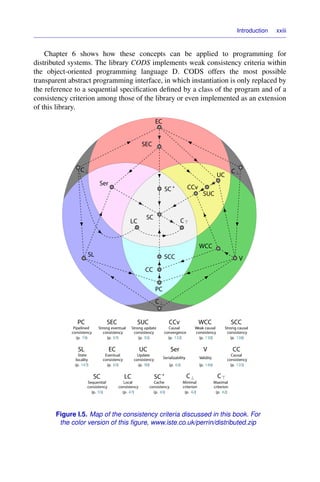

![This ebook is for the use of anyone anywhere in the United
States and most other parts of the world at no cost and with
almost no restrictions whatsoever. You may copy it, give it away
or re-use it under the terms of the Project Gutenberg License
included with this ebook or online at www.gutenberg.org. If you
are not located in the United States, you will have to check the
laws of the country where you are located before using this
eBook.
Title: The Washer of the Ford: Legendary moralities and
barbaric tales
Author: William Sharp
Release date: August 3, 2013 [eBook #43395]
Most recently updated: October 23, 2024
Language: English
Credits: Produced by sp1nd, Sam W. and the Online Distributed
Proofreading Team at http://www.pgdp.net (This file
was
produced from images generously made available by
The
Internet Archive)
*** START OF THE PROJECT GUTENBERG EBOOK THE WASHER OF
THE FORD: LEGENDARY MORALITIES AND BARBARIC TALES ***](https://image.slidesharecdn.com/3307435-250523192707-522e5d87/85/Distributed-Systems-Concurrency-And-Consistency-1st-Edition-Matthieu-Perrin-Auth-28-320.jpg)
![striking use made of it and its vague cognate legend, by Ferguson,
in his Irish epic, Congal—gives the keynote not only of this book but
of what has for hundreds of years, and to some extent still is, the
characteristic of the purely Celtic mind in the Highlands and the
Isles. This characteristic is a strange complexity of paganism and
Christianity, or rather an apparent complexity arising from the
grafting of Christianity upon paganism. Columba, St. Patrick, St.
Ronan, Kentigern, all these militant Christian saints were merely
transformed pagans. Even in the famous dialogue between St.
Patrick and Oisìn, which is the folk-telling of the passing of the old
before the new, the thrill of a pagan sympathy on the part of the
uncompromising saint is unmistakable. To this day, there are
Christian rites and superstitions which are merely a gloss upon a
surviving antique paganism. I have known an old woman, in no wise
different from her neighbours, who on the day of Beltane sacrificed
a hen: though for her propitiatory rite she had no warrant save that
of vague traditionary lore, the lore of the teinntean, of the hearth-
side—where, in truth, are best to be heard the last echoes of the
dim mythologic faith of our ancestors. What is the familiar “clachan,”
now meaning a hamlet with a kirk, but an echo of the Stones, the
circles of the druids or of a more ancient worship still, that perhaps
of the mysterious Anait, whose sole record is a clach on a lonely
moor, of which from time immemorial the people have spoken as the
“Teampull na’n Anait”? A relative of mine saw, in South Uist, less
than twenty-five years ago, what may have been the last sun-
sacrifice in Scotland, when an old Gael secretly and furtively slew a
lamb on the summit of a conical grassy knoll at sunrise. Those who
have the Gaelic have their ears filled with rumours of a day that is
gone. When an evicted crofter laments, O mo chreach, mo chreach!
[1] or some poor soul on a bed of pain cries, O mo chradshlat,[2] he
who knows the past recognises in the one the mournful refrain of
the time when the sea-pirates or the hill-robbers pillaged and
devasted quiet homesteads, and, in the other, not the moan of
suffering only, but the cry of torment from the victim racked on the
cradhshlat, a bitter ignominious torture used by the ancient Gaels.](https://image.slidesharecdn.com/3307435-250523192707-522e5d87/85/Distributed-Systems-Concurrency-And-Consistency-1st-Edition-Matthieu-Perrin-Auth-35-320.jpg)
![When, in good fellowship, one man says to another, Tha, a laochain
(yes, my dear fellow), he recalls Fionn and the chivalry of eld, for
laochan is merely a contraction for laoch-Fhinn, meaning a
companion in war, a hero, literally Fionn’s right-hand man in battle.
To this day, women, accompanying a marching regiment, are
sometimes heard to say in the Gaelic, “We are going with the dear
souls to the wars”—literally an echo of the Ossianic Siubhlaidh sinn
le’n anam do’n araich, “We shall accompany their souls to the battle-
field.” A thousand instances could be adduced. The language is a
herring-net, through which the unchanging sea filtrates, even
though the net be clogged with the fish of the hour. Nor is it the
pagan atmosphere only that survives: often we breathe the air of
that early day when the mind of man was attuned to a beautiful
piety that was wrought into nature itself. Of the several words for
the dawn, there is a beautiful one, Uinneagachadh. We have it in the
phrase ’nuair a bha an latha ag uinneagachadh, “when the day
began to dawn.” Now this word is simply an extension of Uinneag, a
window: and the application of the image dates far back to the days
of St. Columba, when some devout and poetic soul spoke of the
uinneagan Neimh, the windows of Heaven.
[1] Oh, alas, alas! (Literally, Oh, my undoing, or Oh, my utter
ruin.)
[2] Alas my torment!
Sometimes, among the innumerable “legendary moralities” which
exist fragmentarily in the West Highlands and in the Isles, there is a
coherent narrative basis—as, for example, in the Irish and Highland
folk-lore about St. Bride, or Bridget, “Muime Chriosd.” Sometimes
there is simply a phrase survived out of antiquity. I doubt if any now
living, either in the Hebrides or in Ireland, has heard any legend of
the “Washer of the Ford.” The name survives, with its atmosphere of
a remote past, its dim ancestral memory of a shadowy figure of awe
haunting a shadowy stream in a shadowy land. Samuel Ferguson, in
Congal, has done little more than limn an obscure shadow of that
shadow: yet it haunts the imagination. In the passage of paganism,](https://image.slidesharecdn.com/3307435-250523192707-522e5d87/85/Distributed-Systems-Concurrency-And-Consistency-1st-Edition-Matthieu-Perrin-Auth-36-320.jpg)